DEMOGRAPHIC RESEARCH
VOLUME 29, ARTICLE 32, PAGES 865-884
PUBLISHED 22 OCTOBER 2013
http://www.demographic-research.org/Volumes/Vol29/32/ DOI: 10.4054/DemRes.2013.29.32
Research Article
Low fertility, human capital, and economic
growth: The importance of financial education
and job retraining
Robert Clark
Rikiya Matsukura
Naohiro Ogawa
This publication is part of the Special Collection on “Population Dynamics and Economic Development”, organized by Guest Alexia Fürnkranz-Prskawetz, David Bloom, and Wolfgang Lutz.
© 2013 Robert Clark, Rikiya Matsukura, and Naohiro Ogawa.
This open-access work is published under the terms of the Creative Commons Attribution NonCommercial License 2.0 Germany, which permits use, reproduction & distribution in any medium for non-commercial purposes, provided the original author(s) and source are given credit.
1 Introduction 866
2 Japan’s rapidly changing demographics 867
3 Work and family survey 869
4 Financial literacy of older Japanese workers 871
5 Demand for investment in human capital 876
6 Conclusions and policy implications 880
Low fertility, human capital, and economic growth:
The importance of financial education and job retraining
Robert Clark1
Rikiya Matsukura2
Naohiro Ogawa3
Abstract
BACKGROUND
International research has shown that workers have a rather low level of financial literacy. Financial literacy is associated with lifetime planning and saving for retirement. This article focuses on the role of financial literacy in the demand for human capital and on-the-job training among older workers in Japan. Workers with higher levels of financial literacy are more likely to demand human capital, plan to enter training programs, and desire to work after retirement.
OBJECTIVE
Does financial literacy affect the demand for additional human capital among older Japanese workers? How does the level of financial literacy affect the age of retirement and plans for working after retirement from a career job in Japan?
METHODS
This paper analyzes data from a national survey of Japanese employees. We estimate the effect of financial literacy on the demand for additional human capital to remain competitive for promotions and for finding employment after retirement.
RESULTS
Higher levels of financial literacy are associated with greater demand for additional human capital and for participation in on-the-job training programs among older workers in Japan.
1 North Carolina State University, U.S.A. E-mail: [email protected]. 2
Nihon University, Japan. E-mail: [email protected].
CONCLUSIONS
Given the rapid aging of the Japanese population and the decline in the total population, providing employment opportunities for older workers (ages 60 and older) is a key to sustaining economic growth and per capita income. The analysis indicates that greater levels of financial literacy are associated with a desire for more training and human capital. Thus, enhancing the level of financial literacy among older workers may be a key to maintaining economic wellbeing.
1. Introduction
For the past 30 years, Japan has had one of the lowest fertility rates in the world. Over the past decade, the total fertility has hovered around 1.3 births per woman. As a result of this long-term trend in fertility, Japan now has one of the oldest populations in the world and the absolute size of the population has begun to decline (Ogawa et al. 2012). In this demographic environment, sustained economic growth depends in large measure on the continued participation of older workers in the labor force and their ability to maintain or even increase their productivity.
In this paper, we explore the demand for additional education or training and the acquisition of new marketable skills by older Japanese workers. Our analysis indicates that over half of workers aged 40 to 59 believe that they need additional training and skills to continue working on their current job, to have prospects for promotions, and to be competitive for employment after they leave their career job. The demand for further training to enhance job market opportunities is shown to be related to the level of financial literacy. This is not surprising since acquisition of human capital is a form of investment which requires the individual to understand the cost and benefits associated with the allocation of time and resources to acquire additional human capital.
Japanese workers would help enable firms to respond to an aging work force. At the national level, keeping older individuals in the labor force while maintaining their productivity is a key element in maintaining per capita income in an aging society (Clark et al. 2008; Clark et al. 2010; Weil 2012).
The next section of the paper provides a brief overview of the demographic landscape in Japan and the importance of older persons continuing to work and maintaining their human capital. Section II describes the Work and Family Survey and presents sample means from the survey. Section III examines the level of financial literacy among older Japanese workers and Section IV explores the relationship between financial literacy and the demand for additional skills to remain competitive in the labor market. Key findings and policy implications are discussed in Section V.
2. Japan’s rapidly changing demographics
The decline in fertility in postwar Japan was one of the first of its kind to occur in the non-Western world, and was the greatest in magnitude among all the industrialized countries. Following a short-lived baby boom period (1947-1949), Japan’s fertility dropped dramatically (Hodge and Ogawa 1991; Ogawa and Retherford 1993; Retherford and Ogawa 2006). Between 1947 and 1957, the Total Fertility Rate (TFR) declined by more than 50% from 4.54 to 2.04 children per woman. This 50% reduction in fertility over the 10-year period was the first such experience in the history of mankind. Subsequent to this rapid fertility reduction in the 1950s, there had been only minor fluctuations around the replacement level until the first oil crisis occurred in 1973. Thereafter, Japan’s TFR started to fall again, and by the mid-1990s, it declined below 1.5 children per woman.
In 2005, it further plummeted to 1.26, lowest in postwar time, before a slight rebound to 1.39 in 2010. If fertility were to remain constant at the present level, each successive generation would decline approximately at a rate of 35% per generation (National Institute of Population and Social Security Research 2011).
In addition to the fertility transition, Japan’s mortality transition in the postwar period has been spectacular. During 1947-1965, for instance, Japan’s life expectancy at birth rose from 50.1 to 67.7 years for men and from 54.0 to 72.9 years for women. When Japan joined the OECD in 1964, its life expectancy for both men and women was the lowest among the member countries (Mason and Ogawa 2001), but became one of the highest in the OECD by the mid-1970s. Furthermore, in 2010, male life expectancy at birth reached 79.6 years to become the third highest in the world, following Switzerland (79.8 years) and Israel (79.7 years), while female life expectancy rose to 86.4 years, the highest in the world, followed by France (84.8 years) and Spain (84.6 years).
It should also be noted that the infant mortality rate fell with unprecedented rapidity from 60.1 per 1000 live births in 1950 to 2.3 in 2010. Moreover, between 1950-1952 and 2010, life expectancy at age 65 grew substantially, from 11.4 to 18.9 years for men and from 13.4 to 23.9 years for women, which implies a marked increase in the retirement period and the joint survival to older ages for husbands and wives (Ogawa, Chawla, and Matsukura 2010).
As a consequence of these long-term transformations in fertility and mortality, the age structure of the Japanese population has been shifting markedly. The number of persons aged 65 and over increased from 4.9% of the total population in 1950 to 20.2% in 2005, making Japan’s population the oldest national population in the world during 2005. In 2010, persons 65 and older represented 23.1% of the Japanese population. The proportion of the oldest-old persons (those aged 75 and over) in the total population was only 1.3% in 1950, but increased to 11.2% by 2010.
In contrast to elderly persons, the number of persons aged 14 and younger has declined for 29 consecutive years, and Japan now has fewer children than at any time since 1908. Furthermore, the overall size of Japan’s population began declining from the end of 2005. More importantly, these demographic trends of low fertility and population decline are expected to persist over the next several decades (National Institute of Population and Social Security Research 2012).
In spite of the aging of the population and increasing life expectancy, many Japanese companies maintain mandatory retirement policies at the relatively young age of 60. The Japanese government is currently attempting to encourage firms to increase the mandatory retirement age to 65. The Law Concerning Stabilization of Employment of Older Persons, passed in 2004, requires firms to increase the age of mandatory retirement to 65; however, no penalties were specified for noncompliance and to date few companies have complied (Clark et al. 2010).
corresponding figure for some of developed countries in Europe (France, Germany, and Austria) is well below 10%. The participation rate of men 65 and older in the United States is slightly over 20%. A similar inter-country observation is applicable to Japanese elderly women and their counterparts in Europe and the United States.
Another feature of Japan’s labor market is related to the age-specific labor force participation rates of Japanese women which still show an M-shaped pattern, despite the fact that participation among middle-aged women has been rising in recent years, primarily due to their higher education, shortening of the reproductive span, and a more modern lifestyle (Ogawa and Ermisch 1996; Mason and Ogawa 2001; Retherford and Ogawa 2006). It should be stressed that slightly more than half of married women working as paid employees are part-time workers, and that this proportion has been growing at a rate faster than that of full-time workers since the early 1990s.
Given these long term trends and projections of future demographic change, it is easy to understand the importance of high labor force participation rates among older men and women. It is equally important for older workers to maintain and enhance their human capital if they are going to continue to make substantial contributions to the national output. Clark et al. (2010) demonstrated the impact of increasing labor force participation rates for persons 60 and older on national income in Japan. This paper extends that analysis by examining the demand for additional training by workers aged 40 to 59 (see Clark et al. 2008).
3. Work and family survey
The present study is based on data from the 2010 National Survey on Work and Family. The survey covers a wide range of topics related to work and family life, including information about the demographic and socio-economic characteristics of respondents and their spouses, marriage decisions, childbearing and childrearing, care for the elderly, birth history, working conditions, knowledge of financial and investment products, contraceptive use, experience of infertility, and sexual activity. The target population was both men and women age 20-59. A two-stage cluster sample design was used to select 9,000 potential respondents. Questionnaires were left for potential respondents to complete and were later collected by members of the survey team. The respondents were also given the option of mailing the questionnaire themselves.4
There were 5,162 completed surveys for a response rate of 57.4% (number of returned questionnaires divided by the number of cases contacted). In order to focus on the demand for on-the-job training by older workers, we restricted the sample to individuals aged 40 to 59. This yielded a sample of 2,872 individuals. Given our focus on the demand for additional training and skill acquisition on the job, we limited our analysis to only those individuals who were working at the time of the survey and who answered all the relevant financial literacy, employment, and household questions which yielded a sample of 1,875 respondents.
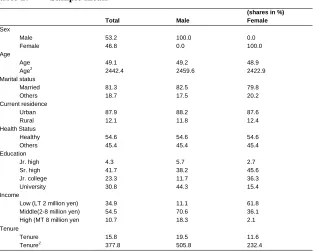
Sample means are shown in Table 1. Slightly over half of the sample is male (53.2%), most are married (81.3%), and living in urban areas (87.9%). The respondents have a high level of education with over 95% of the workers having achieved at least a high school degree, and with 30.8 graduating from a university. Most of the workers exhibit a high degree of job stability, as shown by their mean years of job tenure of 15.8 including 40% of the sample having 20 or more years of service with their current employer.
Table 1: Sample mean
(shares in %)
Total Male Female
Sex
Male 53.2 100.0 0.0
Female 46.8 0.0 100.0
Age
Age 49.1 49.2 48.9
Age2 2442.4 2459.6 2422.9
Marital status
Married 81.3 82.5 79.8
Others 18.7 17.5 20.2
Current residence
Urban 87.9 88.2 87.6
Rural 12.1 11.8 12.4
Health Status
Healthy 54.6 54.6 54.6
Others 45.4 45.4 45.4
Education
Jr. high 4.3 5.7 2.7
Sr. high 41.7 38.2 45.6
Jr. college 23.3 11.7 36.3
University 30.8 44.3 15.4
Income
Low (LT 2 million yen) 34.9 11.1 61.8
Middle(2-8 million yen) 54.5 70.6 36.1
High (MT 8 million yen 10.7 18.3 2.1
Tenure
Tenure 15.8 19.5 11.6
Tenure2
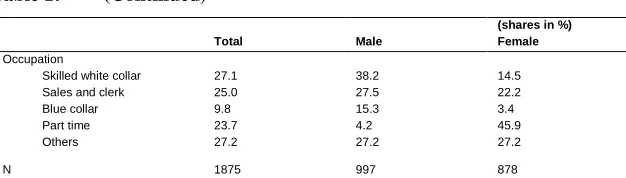
Table 1: (Continued)
(shares in %)
Total Male Female
Occupation
Skilled white collar 27.1 38.2 14.5
Sales and clerk 25.0 27.5 22.2
Blue collar 9.8 15.3 3.4
Part time 23.7 4.2 45.9
Others 27.2 27.2 27.2
N 1875 997 878
4. Financial literacy of older Japanese workers
Lifecycle economic theories are based on the assumption that individuals have an adequate knowledge of important financial issues such as understanding compounding of interest, the impact of inflation on real income, risk and return characteristics of various assets, and the importance of diversification. Incorrect knowledge can lead to suboptimal decisions such as excessive consumption early in life and having too little income in retirement or not investing enough in human capital because future returns are not correctly measured in comparison to costs that are borne today.
The study of financial literacy and its importance has emerged as a major focus of economic analysis in recent years. Studies have attempted to assess the level of financial literacy by examining a few key questions that have been included in national surveys. While much of this work has been done in the United States5, financial literacy research is now a global issue. The OECD (2005, 2006, 2008) has published a series of reports concerning the importance of financial education in household investment decisions. Lusardi and Mitchell led an international research project examining financial literacy in a variety of developed countries. Reports from this project are summarized in Lusardi and Mitchell (2011b) and the individual country papers are published in the same issue of the Journal of Pension Economics and Finance. These reports highlight the need for additional financial education throughout the developed economies if workers are to make optimal retirement saving decisions.
Studies in Japan indicate low levels of financial literacy with 71% of adults indicating that they have almost no knowledge of investments in securities such as stocks and bonds, half stating that they have almost no knowledge of the mechanisms of the economy and finance, and 57% responding that they have almost no knowledge of financial products (Central Council for Financial Services Information 2001). In addition, only 18% report that they understand the concept of compound interest, only
3.4% understand the concept of portfolio diversification, and 9.6 indicate that they understand the issues associated with risk and return (OECD 2005).6
Most of the research on the implications of financial literacy has examined the impact of literacy on saving and investment decisions, choices relating to various aspects of employer pensions, and the age of retirement. In this study, we explore the link between financial literacy and investment in human capital by older workers.
This is an important choice in low fertility countries where productive older workers will play an important role in maintaining economic growth.
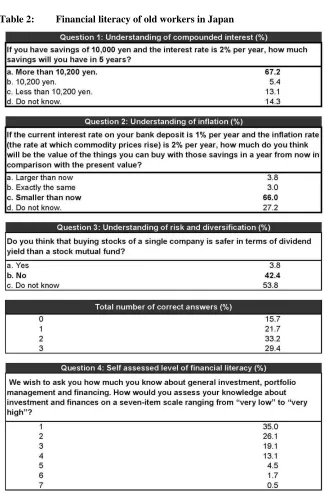
The Work and Family Survey includes three questions concerning the key financial concepts of compound interest, the impact of inflation on real income, and the importance of diversification on investment. The three financial literacy questions that are used in this study were originally designed by Lusardi and Mitchell for a module on financial literacy and planning in the 2004 Health and Retirement Study (Lusardi and Mitchell 2011a). Similar questions have been used in a number of other surveys (Lusardi and Mitchell 2007, 2008; Clark, Morrill, and Allen 2012), and Bucher-Koenen and Lusardi (2011) are engaged in a project covering eight countries across the globe using versions of the same questions that are included in the Work and Family Survey. The responses of Japanese workers to these questions are shown in Table 2 with the correct answers highlighted in bold. Two thirds of respondents correctly answered the interest rate and inflation questions but only 40% gave the correct answer to the diversification question.
6
Considering all of the questions together, we observe that 15.7% of the respondents gave incorrect answers for all three questions and 29.4% gave the correct answer for each of the three questions. Table 3 illustrates how financial knowledge differs by age and sex. The average number of correct answers for men is approximately 0.3 higher than for women. There is no significant age pattern except in the number of correct answers among the respondents.
Table 3: Average number of corrected answers on three financial literacy questions by age, sex
Age Total Men Women
40-44 1.74 1.87 1.56
45-49 1.78 1.91 1.61
50-54 1.75 1.86 1.60
55-59 1.78 1.84 1.69
All ages 1.76 1.88 1.61
Table 2 also reports responses to the question “How would you assess your knowledge about investment and finances on a seven-item scale ranging from, very low to very high”? Over 60% of the respondents rated themselves in the two lowest categories of knowledge and slightly less than 7% of respondents rated themselves in the three highest categories of knowledge. The evidence from the National Survey on Work and Family supports the general assessment that Japanese workers have rather a low level of financial literacy and that they recognize the limits to their knowledge.
A series of papers has shown that low levels of financial literacy can adversely affect saving behavior and retirement planning. For example, Lusardi and Mitchell (2007) demonstrate the fact that poor planning can lead to inadequate saving for retirement and lower lifetime welfare. Also, inaccurate financial knowledge can affect the timing of planned retirement which may be associated with inadequate saving and investment decisions (Clark, Morrill, and Allen 2012).
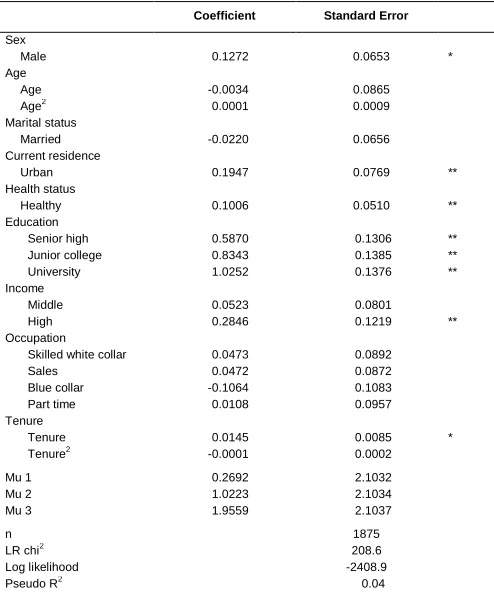
Financial literacy varies across individuals based on economic and demographic factors. Using an ordered probit, we estimated a financial literacy equation in which the dependent variable is the number of correct answers on the three questions described above. The results shown in Table 4 are consistent with expectations and previous studies in other countries (Lusardi and Mitchell 2011b, OECD 2008). Men are significantly more likely to correctly answer the questions as are persons living in urban areas and those with more formal education. Persons with higher annual incomes are also more likely to score higher on this measure of financial literacy.
Table 4: Ordered Probit result on score of financial literacy
Coefficient Standard Error
Sex
Male 0.1272 0.0653 *
Age
Age -0.0034 0.0865
Age2
0.0001 0.0009
Marital status
Married -0.0220 0.0656
Current residence
Urban 0.1947 0.0769 **
Health status
Healthy 0.1006 0.0510 **
Education
Senior high 0.5870 0.1306 **
Junior college 0.8343 0.1385 **
University 1.0252 0.1376 **
Income
Middle 0.0523 0.0801
High 0.2846 0.1219 **
Occupation
Skilled white collar 0.0473 0.0892
Sales 0.0472 0.0872
Blue collar -0.1064 0.1083
Part time 0.0108 0.0957
Tenure
Tenure 0.0145 0.0085 *
Tenure2 -0.0001 0.0002
Mu 1 0.2692 2.1032
Mu 2 1.0223 2.1034
Mu 3 1.9559 2.1037
n 1875
LR chi2
208.6
Log likelihood -2408.9
Pseudo R2
0.04
Recognizing the low level of financial literacy raises questions concerning the impact of this lack of knowledge on saving for retirement which may impact total national saving and hence economic growth. It is also important to consider the effect of the lack of financial knowledge on one of life’s most important investment choices, investing in one’s own human capital. If older workers stop investing in their employment skills, their productivity will decline and they will be less competitive in the labor market. Poorer quality older workers along with those who are unable to find jobs because of their lack of skills will have an adverse effect on the future economic growth of low fertility countries, especially Japan.7We now turn our attention to the relationship between financial literacy and the demand for continued investment in human capital by older workers.
5. Demand for investment in human capital
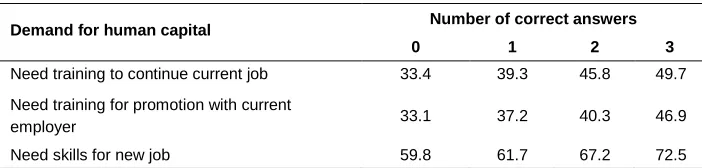
In order to remain on their career jobs until mandatory retirement and to continue to receive promotions, older workers need to consider their current skill set and whether they need to enhance their productivity to remain in good standing with their current employer. The National Survey on Work and Family asks three questions concerning the need for further employment-related skills in order to remain competitive in the labor force. Table 5 shows that almost half of the older workers in the survey indicated that they needed additional skills to remain competitive on their current job and over two thirds stated that they needed to acquire additional training and skills to find a job after they leave their career employer. Thus, on an individual level, additional investment in human capital appears to be an important decision for older workers in Japan. At the macro-level, keeping older workers in the labor force and maintaining or increasing their productivity is essential to economic growth in a low fertility country like Japan (Clark et al. 2008, 2010).
7 The link between human capital and value of workers in production is well known and was clearly described
Table 5: Demand for investment in human capital
Table 6: Financial literacy and demand for human capital
Demand for human capital Number of correct answers
0 1 2 3
Need training to continue current job 33.4 39.3 45.8 49.7 Need training for promotion with current
employer 33.1 37.2 40.3 46.9
Need skills for new job 59.8 61.7 67.2 72.5
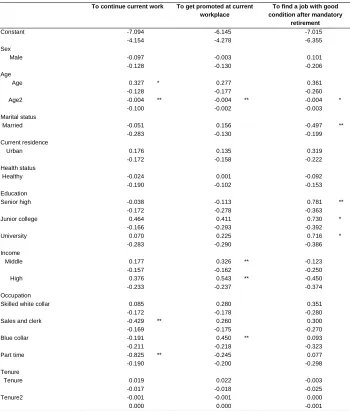
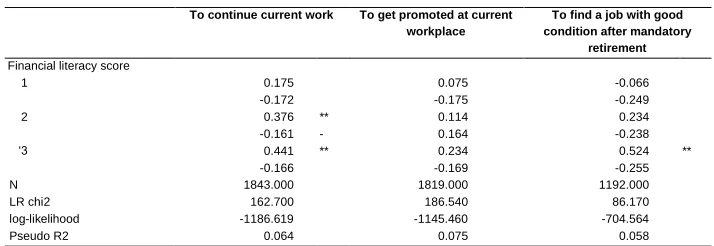
In addition to this comparison of means, we estimated the expressed need for additional human capital as a function of financial literacy as measured by the three questions along with various demographic and economic variables that should explain the demand for additional human capital. The results from the logit model are presented in Table 7 and show that workers with greater financial literacy, as measured by the number of correct answers, are significantly more likely to express a need for additional training to maintain successful participation in the labor market.
Table 7: Logit analysis of demand for investment in human capital
To continue current work To get promoted at current
workplace
To find a job with good condition after mandatory
retirement
Constant -7.094 -6.145 -7.015
-4.154 -4.278 -6.355
Sex
Male -0.097 -0.003 0.101
-0.128 -0.130 -0.206
Age
Age 0.327 * 0.277 0.361
-0.128 -0.177 -0.260
Age2 -0.004 ** -0.004 ** -0.004 *
-0.100 -0.002 -0.003
Marital status
Married -0.051 0.156 -0.497 **
-0.283 -0.130 -0.199
Current residence
Urban 0.176 0.135 0.319
-0.172 -0.158 -0.222
Health status
Healthy -0.024 0.001 -0.092
-0.190 -0.102 -0.153
Education
Senior high -0.038 -0.113 0.781 **
-0.172 -0.278 -0.363
Junior college 0.464 0.411 0.730 *
-0.166 -0.293 -0.392
University 0.070 0.225 0.716 *
-0.283 -0.290 -0.386
Income
Middle 0.177 0.326 ** -0.123
-0.157 -0.162 -0.250
High 0.376 0.543 ** -0.450
-0.233 -0.237 -0.374
Occupation
Skilled white collar 0.085 0.280 0.351
-0.172 -0.178 -0.280
Sales and clerk -0.429 ** 0.260 0.300
-0.169 -0.175 -0.270
Blue collar -0.191 0.450 ** 0.093
-0.211 -0.218 -0.323
Part time -0.825 ** -0.245 0.077
-0.190 -0.200 -0.298
Tenure
Tenure 0.019 0.022 -0.003
-0.017 -0.018 -0.025
Tenure2 -0.001 -0.001 0.000
Table 7: (Continued)
To continue current work To get promoted at current
workplace
To find a job with good condition after mandatory
retirement
Financial literacy score
1 0.175 0.075 -0.066
-0.172 -0.175 -0.249
2 0.376 ** 0.114 0.234
-0.161 - 0.164 -0.238
‘3 0.441 ** 0.234 0.524 **
-0.166 -0.169 -0.255
N 1843.000 1819.000 1192.000
LR chi2 162.700 186.540 86.170
log-likelihood -1186.619 -1145.460 -704.564
Pseudo R2 0.064 0.075 0.058
* = 10%, ** =5% significant level
This greater recognition of the need for additional investment in human capital may be due to a better understanding of the returns to this investment and/or a better understanding of the need for income in retirement. These findings suggest that additional financial education that improves financial literacy could lead to greater investment in human capital and the improvement in the productivity of older workers.
6. Conclusions and policy implications
Countries with fertility rates below 1.5 face rapid population aging and will ultimately experience absolute declines in the size of their populations unless offset by rather large flows of immigration. As depopulation occurs and nations experience a “super aging” of their populations, can economic growth be maintained? A key to continued economic growth in low fertility countries is to increase the employment rates of workers aged 60 and older (Clark et al. 2010; Weil 2012). Merely keeping older persons in the labor force is not enough. It is critically important that older persons continue to invest in enhancing their human capital in order to maintain their productivity.
ages. The level of financial literacy in many countries is very low and the lack of appropriate knowledge will adversely affect key lifecycle decisions (Lusardi and Mitchell 2011b and other articles in same issue).
References
Becker, G. (1964). Human Capital. New York: Columbia University Press.
Bucher-Koenen, T. and Lusardi, A. (2011). Financial literacy and retirement planning in Germany. Journal of Pension Economics and Finance 10(4): 565-584. doi:10.3386/w17110.
Central Council for Financial Services Information (2001). Report on Japan Consumer Survey on Finance. http://www.shiruporuto.jp/finance/chosa/enqu/index.html (in Japanese), last accessed on November 27, 2010.
Clark, R., Morrill, M., and Allen, S. (2010). Employer-provided retirement planning programs. In: Clark, R. and Mitchell, O. (eds.). Reorienting Retirement Risk Management. Oxford: Oxford University Press: 36-64. doi:10.1093/acprof:oso/ 9780199592609.003.0003.
Clark, R., Morrill, M., and Allen, S. (2012). Financial literacy and retirement plans.
Economic Inquiry 50 (4): 851-866. doi:10.1111/j.1465-7295.2011.00390.x.
Clark, R., Ogawa, N., Lee, S.-H., and Matsukura, R. (2008). Older Workers and National Productivity in Japan. Population and Development Review
34(Supplement): 257-274.
Clark, R., Ogawa, N., Kondo, M., and Matsukura, R. (2010). Population decline, labor force stability, and the future of the Japanese economy. European Journal of Population 26(2): 207-227. doi:10.1007/s10680-009-9179-9.
Hodge, R. and Ogawa, N. (1991). Fertility Change in Contemporary Japan. Chicago: University of Chicago Press.
Lusardi, A. and Mitchell, O. (2007). Baby boomer retirement security: The role of planning, financial literacy, and housing wealth. Journal of Monetary Economics
54(1): 205-224. doi:10.1016/j.jmoneco.2006.12.001.
Lusardi, A. and Mitchell, O. (2008). How much do people know about economics and finance? Financial illiteracy and the importance of financial education. Policy Brief: Michigan Center for Retirement Research.
Lusardi, A. and Mitchell, O. (2011b). Financial literacy around the world: An overview.
Journal of Pension Economics and Finance 10(4): 497-508. doi:10.1017/ S1474747211000448.
Mason, A. and Ogawa, N. (2001). Population, labor force, saving and Japan’s future. In: Blomström, M., Gangnes, B., and La Croix, S. (eds.). Japan’s New Economy: Continuity and Change in the Twenty-First Century. Oxford: Oxford University Press: 48-74.
National Institute of Population and Social Security Research (ed.). (2011). Latest Demographic Statistics 2011. Population Research Series No.324, 2011, Tokyo, National Institute of Population and Social Security Research.
National Institute of Population and Social Security Research. (2012). Population Projections for Japan: 2011-2060 (With long-range Population Projections: 2061-2110). Tokyo, Health and Welfare Statistics Association (in Japanese).
OECD (2005). Improving Financial Literacy: Analysis of Issues and Policies. Paris: OECD Publishing.
OECD (2006). The Importance of Financial Education. Policy Brief. July 2006, Paris.
OECD (2008). Improving Financial Education and Awareness on Insurance and Private Pensions. Paris: Oxford Publishing.
Ogawa, N. and Retherford, R.D. (1993). The resumption of fertility decline in Japan: 1973-92. Population and Development Review 19(4): 703-741. doi:10.2307/2938411.
Ogawa, N. and Ermisch, J.F. (1996). Family structure, home time demands, and the employment patterns of Japanese married women. Journal of Labor Economics
14(4): 677-702. doi:10.1086/209827.
Ogawa, N., Lee, S.H., and Matsukura, R. (2005). Health and its impact on work and dependency among the elderly in Japan. Asian Population Studies 1(1): 121-145. doi:10.1080/17441730500126019.
Ogawa, N., Chawla, A., and Matsukura, R. (2010). Changing intergenerational transfers in aging Japan. In: Eggleston, K. and Tuljapurkar, S. (eds.). Aging Asia: The Economic and Social Implications of Rapid Demographic Change in China, Japan, and South Korea. Stanford: Walter H. Shorenstein Asia-Pacific Research Center: 43-62.
the prospects? In: Park, D., Lee, S.-H., and Mason, A. (eds.). Aging, Economic Growth, and Old-Age Security in Asia. Cheltenham, UK and Northampton, MA, USA: Edward Elgar: 231-276. doi:10.4337/9781781953600.00014.
Retherford, R.D. and Ogawa, N. (2006). Japan’s baby bust: causes, implications, and policy responses. In: Harris, F.R. (ed.). The Baby Bust: Who Will Do the Work? Who Will Pay the Taxes? Lanham: Rowman & Littlefield Publishers: 5-47.
Schultz, T. (1963). The Economic Value of Education. New York: Columbia University Press.
Sekita, S. (2011). Financial literacy and retirement planning in Japan. Journal of
Pension Economics and Finance 10(4): 637-656.
doi:10.1017/S1474747211000527.