in the population sciences published by the Max Planck Institute for Demographic Research Doberaner Strasse 114 · D-18057 Rostock · GERMANY www.demographic-research.org
DEMOGRAPHIC RESEARCH
VOLUME 6, ARTICLE 8, PAGES 191-240
PUBLISHED 06 MARCH 2002
www.demographic-research.org/Volumes/Vol6/8/
DOI: 10.4054/DemRes.2002.6.8
Political Economy and Life Course
Patterns: The Heterogeneity of
Occupational, Family and Household
Trajectories of Young Spaniards
Pau Baizán
Francesca Michielin
Francesco C. Billari
1 Introduction 192
2 Changes in the institutional context and research hypotheses
193
2.1 Institutional regulations in the labor market and education
193
2.2 The family system and the welfare capability of households
197
2.3 New role of women 201
3 Data 202
4 Measures 204
5 Occupational trajectories 205
6 Family trajectories 211
7 Household trajectories 215
8 Conclusions 218
Acknowledgments 219
Notes 221
References 223
Figures 230
Political Economy and Life Course Patterns:
The Heterogeneity of Occupational, Family and Household
Trajectories of Young Spaniards
Pau Baizán1, Francesca Michielin2 and Francesco C. Billari3
Abstract
We explore the strong linkages between macro changes and the dynamics of educational, occupational, family, and household careers of young Spanish adults born between 1945 and 1974. We review theory and evidence on macro factors: changes in the welfare system, centrality of the family as a service provider, and the changing role of women. We outline some hypotheses of how life course trajectories, and their heterogeneity, change across cohorts. We build data on sequences of states using FFS. In our analysis, we find an increase in the discontinuity of careers and of the heterogeneity among cohort members, especially for employment. Women’s careers are becoming more similar to those of men. Family and household formation is postponed, with a limited spread of post-nuclear family forms.
1
Max Planck Institute for Demographic Research, Doberaner Str. 114, D-18057 Rostock, Germany. E-mail: [email protected]
2
Department of Statistical Sciences, University of Padova, via Cesare Battisti 241/243, I-35121 Padova, Italy. E-mail: [email protected]
3
1. Introduction
Two ideal-typical models have often been used to depict the post-war changes in the life course in western societies. The first is characterized by highly standardized and linear biographies, as a result of stable, well-paid jobs for males, stable and quasi universal marriage with childbearing soon after, and women foregoing their working careers after marriage to become housewives. This model has been termed fordist (Myles, 1990) or
bourgeois-family (Roussel, 1989). The second model, sometimes called post-industrial
or post-modern, implies a shift to a situation marked by discontinuity in life patterns and by greater heterogeneous experiences among individuals. A tentative list of the second model’s features would include: precariousness of employment and income, couples earning two incomes, increasing individualization, and late and unstable families and households. These two "regimes" (Buchmann, 1989; Esping-Andersen, 1990; Mayer, 1997) of biographies can be used as benchmarks when analyzing the life courses of the Spanish cohorts born between the 1940s and the 1970s.
Here we are particularly interested in the way institutional arrangements shape individual life courses. Although global processes, such as de-industrialization and globalization, exert roughly similar pressures and challenges for all advanced societies, historically-rooted specific institutional set-ups will lead to very different and nationally varying responses (Mayer, 2001). Moreover, institutional configurations tend to be historically stable and difficult to change. "Path dependencies" tend to lock societies into given tracks, and changes to the existing order are associated with costs and mal-adaptations of individuals and institutions (Arthur, 1994). Demographic responses to global processes such as individualization and post-modernism (Giddens, 1991; van de Kaa, 1996) may be very sensitive to specific contexts, and accordingly show different forms in each country.
The second part of the paper is devoted to an examination of changes in the biographies in Spain. Since we mainly adopt an explorative perspective, our data and methods follow this approach. We study five-year birth-cohorts, from 1945 to 1974, in order to follow in detail the evolutions in the biographies. Our purpose is to detect inter-cohort trends in the degree of diversity and stability in the work, educational, household and family careers. In the Spanish context, one cannot speak of a “fordist-parsonian” regime until we reach the cohorts born from the mid 1940s and the 1950s, and even for such cohorts only to a limited extent. In a similar way, only the cohorts born from the 1960s start showing traits of a post-industrial regime. This means that there is a time lag in the cohorts involved in the respective regimes, compared to most other west European countries. However, more interesting than this "laggard" status are the peculiarities or the divergences of the Spanish transformation (Esping-Andersen, 1999).
2. Changes in the institutional context and research hypotheses
Our reasoning is based on the framework of several recent contributions that explore the interrelationship between the macro context and life course transitions. Such link is generally difficult to grasp (Mayer, 1997), and lacks operational definitions. Pfau-Effinger (1999) emphasized that institutions are embedded in the cultural system, and that they result from actors’ interests and ideologies. Given that they are, at least partially, the result of struggle and unintended events, inconsistencies between institutions are to be expected. Esping-Andersen (1990; 1999) points to the importance of the household economy and its link to specific welfare regimes. It is crucial to detect both, changes in the family system that affect the welfare capability of the family and changes affecting the role and status of women (Wall, 1995; Orloff, 1996).
2.1 Institutional regulations in the labor market and education
pensions, health insurance), were not provided by the private sector, but were public sector jobs. The public sector not only included jobs in administration and social services (which both developed very slowly before the transition to democracy), but also in the numerous state-owned enterprises (e.g. the automobile and steel industries, in communications and energy sectors).
A strict labor market regulation developed during the late 1960s and the 1970s, partially as a result of a corporativistic representation and coordination, that in a modified way (for instance the Pactos de la Moncloa in 1977) survived into the democratic period (Martínez Alier and Roca Jusmet, 1988) (Note 2). Job protection was (and still is) focused on people already having permanent-contract jobs. Basically, this implies a high cost of redundancy for enterprises, and the fact that unemployment benefits and high salaries are mainly secured to employees with long-term contracts. In this context, a divide has developed between “insiders” and “outsiders” in the employment market since the economic crises of the mid-seventies (Bentolila and Dolado, 1994; Saint-Paul, 2000). Newcomers to the labor market, especially young people and women, experience strong barriers to getting core jobs. Before 1974, levels of unemployment were below 4 percent. This coexisted with emigration to Northern Europe (and during the 1950s to Latin America), which alleviated labor surplus. Since then, unemployment has soared, reaching the highest levels among OECD countries and consistently fluctuating around 20 percent. Unemployment among young people reached 40 percent (Note 3) (Instituto Nacional de Estadística, 2001). Such an exceptionally high unemployment rate has been the subject of much debate, of course, and several causes have been suggested for it. We can mention the partial time overlap between the reallocation of the labor force from agriculture to industry and the transition from industry to services (Marimon and Zilibotti, 1996), a rigid labor market, growing labor costs due to the increased power of trade unions (they were illegal during dictatorship), cohort-size (e.g. the number of births between 1960-64 was 16 percent higher than those born between 1950-54), and the orthodox structural adjustment policy strategy that was followed to joint the European Community and later to comply with the European Monetary Union rules (Boix, 1996; Navarro, 2000). Parallel supply-side structural reforms have tried to open up the economy, transform non-competitive sectors of the economy and deregulate markets.
would jeopardize the security and welfare of many families with a single wage earner. Therefore, the whole system of rights for those holding a permanent contract was respected. As work-experience and job-training contracts were subsidized, it was mainly through these that young people and women (re-)entering the labor market gained access to jobs since then. The proportion of the active population on fixed-term contracts rapidly jumped from 15 percent in 1987 to 30 percent in 1990, and it has remained around that last level until now (Jimeno and Toharia, 1994; Instituto Nacional de Estadística, 2001). Massive unemployment and flexibilization of the labor market have affected mainly young people and women, not only because they are the new entrants in the labor market, but also because of their weaker bargaining power and because of normative expectations concerning the functioning of households (see section 2.2). Although unions strongly opposed a deregulated labor market, electoral support for successive governments endorsing these measures has been relatively unaffected. By contrast, there was much more government support for the public funding and provision of benefits following the significant growth in early retirement at the beginning of the 1980s, connected with industrial restructuring. This support was justified on the grounds that often the laid-off individuals were household heads and the only income providers for their households (Maravall and Fraile, 1998).
A striking feature of the dictatorship was the chronic underdevelopment of social welfare. The tax system was extremely regressive and underdeveloped (tax revenue amounted in 1975 to 19.5 percent of Gross Domestic Product, compared to an OECD average of 32.7). Public expenditure on social protection was mainly associated with job related benefits, and it was through this that other dependent household members had access to social welfare. Moreover, government expenditure mostly benefited higher income groups in absolute terms, a feature that has notably diminished though not disappeared in the later period (Gimeno, 1993).
reduced somewhat the need of assistance and co-residence with close family members of the elderly. Other measures of a much more timid scope were also taken in the direction of de-commodifying welfare provision. These included a guaranteed income for extremely poor individuals, child benefits for very low-income families and unemployment subsidies (Guillén, 1992 and 1996; Laparra and Aguilar, 1997).
The extreme underdevelopment of social welfare in Spain during the dictatorship had a very clear manifestation in the educational enrolment and in the educational attainment of the population. Educational reforms came late and have suffered chronic under-funding, compromising their results. It was only in 1970 that compulsory education up to the age of 14 was introduced and only raised to 16 in the mid-1990s. Systems of professional education and training remained extremely underdeveloped. The expansion of the educational system took place during the late 1970s and particularly during the 1980s, with an important increase in government spending (the budget for education increased from 2.8 to 4.5 of gross domestic product between 1981 and 1991). Starting from a very low base, especially among women, there was a rapid increase in enrolment in secondary schools and universities. However, only the cohorts born from 1960 onwards could benefit from such increase. We expect such changes to lead to more years spent during young adulthood in an institutionalized setting, and to a drastic improvement in human capital acquisition, in comparison to previous birth-cohorts. Longer periods in the educational system also mean a postponement of labor market integration and family formation events (Hoem, 1986; Blossfeld, 1995; Billari et al., 2001b; Baizán, 2001; Billari et al., forthcoming) (Note 4).
Given the trends mentioned above, we expected the following dynamics for the life courses of post-industrial birth-cohorts.
Hypothesis 1: The increasingly flexible labor market should lead to a growth in
heterogeneity of experiences (in the timing of transitions and in the states experienced)
and to an increased discontinuity in the work careers (mobility between unemployment/work and between different jobs).
Hypothesis 2: The increased difficulties of economic integration
(insiders/outsiders divide) have the effect of postponed access to employment. Longer and increased periods of precariousness for an ever-larger part of the population should increase the heterogeneity among individuals.
Hypothesis 3: More time spent in the educational system should have the effect of
2.2 The family system and the welfare capability of households
In this section we briefly indicate some ways in which national policies shape household formation and intergenerational relationships in Spain. Although the normative (Note 5) aspect is extremely important in directing and legitimizing family models (Fahey, 1995), we mainly focus on the economic elements of state action. The state sets up the legal and policy frameworks that (implicitly) support particular family models.
Let us first remind the conservative legislation under dictatorship, with its explicit patriarchal and gender inequality features (Valiente, 1993). This legislation was not changed until the late 1970s, in spite of the significant individualization and democratization of family values and behavior experienced by a growing proportion of the population (Alberdi, 1999). Catholic “social doctrine” has also had a major bearing on successive governments and their policies. It is based on the principle of “subsidiarity”, i.e. limiting public interference to situations where the primary social network -the family- fails. As a result, active family policies were (and still are) extraordinarily underdeveloped (Jurado Guerrero and Naldini, 1997). Therefore, a paramount characteristic of Spanish social policy was its ‘familialism’, consisting in the family internalization of welfare responsibilities (Orloff, 1996; Saraceno, 1996; Esping-Andersen, 1999).
The new Constitution and the later legislative developments changed some aspects of the normative system. The Catholic Church lost much of its power on family-related legislation. In 1981 for instance, civil marriage became an option for citizens and divorce was (re-)legalized (divorce had been possible during the 1930s). Rules regarding finance in marriage, infidelity, paternity and children born out-of-wedlock were also changed (Alberdi, 1999). However, welfare state development under democracy kept some elements of the previous period. Continuity was kept in particular in the “familialistic” model, with its characteristic male and middle age (or mature age) bias, common with other Southern European societies such as Italy. Apart from the important exceptions of the health care and educational system, the welfare state is largely an income-transfer system and is only marginally dedicated to family servicing. It basically assumes that married women are housewives and that children, including adult children, should rely on their parents as primary providers until they receive an independent income and should only turn to the state in times of need.
Spanish context, since the relative prices of services incorporate the high protection and ‘family wage’ for insiders in the labor market (Esping-Andersen, 1999).
In fact, Spanish family policy has been classified as “indolent” among the OECD countries because of its low profile in economic (i.e. transfers and tax) and ecological (i.e. community services) intervention (Künzler et al., 1999). Below are several examples of these policies:
•
Unemployment benefits for individuals seeking their first job are non-existent, as the unemployed are supposed to be supported by their families.•
Active labor market policies are relatively underdeveloped, as well as public mediation between employers and job seekers. This situation reinforces the role of the family and other private connections. As many as 61 percent of young Spaniards have got their jobs thanks to their families. By comparison, the percentage in Italy was 65, in Germany 21, and in the Netherlands 18 (Commission of the European Communities, 1994).•
Housing policies have consistently provoked the erosion and quasi disappearance of the rental housing market. In 1988, Spain had (with Ireland and Luxembourg) the highest proportion of home ownership in the European Union: 74 percent (Eurostat, 1996). Symptomatically, deregulation of the rental housing market in the early 1980s was limited to new contracts, thus disproportionately affecting young people. The preference given to ownership by government policies implies a heavy economic burden on household formation. Such policies include a relative inhibition to promote social housing and a focus on tax allowances for mortgage payments (Leal Maldonado, 1992; Serrano Secanella, 1997).•
The tax system favors joint taxation of married couples, which constitutes a disincentive to women’s labor force participation (Alvarez García and Carrascal Arranz, 2000). There is tax relief on the income of parents with young adults living in the parental home and not having their own income.•
The low level of student grants means that the formation of independent households by students is unlikely. Furthermore, before the mid-1980s, only a small fraction of students was entitled to grants (Bricall, 2000).choose informal solutions as an alternative to or supplement to formal (public or private) childcare, including extended family members and private child minders. By the same token, the extension of public education from the age of three that occurred during the 1980s has greatly favored women’s integration in the labor market.
•
The amount of child benefit is extremely low. It was universal until 1990, when it became means tested.•
The maternity leave period is currently 16 weeks, with right to full earnings. The Spanish welfare model, then, blends strong job-rights, job-related income guarantees (including unemployment benefits, pension rights) and an unusually powerful “familialism”, including income pooling, the absorption of social risks and the provision of social care by private households. It is therefore assumed that the family can internalize such obligations. However, social class is an important determinant of the ability to provide the basis of independence for young adults, in particular when investments in education are concerned (Baizán, 2001). Moreover, such an organization implies in fact the economic dependence of young people on their parental household, and of women with children on their husbands. Hence, the capacity of young adults and women to form independent households is severely curtailed. Newly formed households are exposed to economic precariousness, unless supported by a household member with a stable job. One-parent households headed by women and one-person households are at high risk of social deprivation (Layte et al. 2000, table 2). One can hypothesize that given the high economic cost involved in the formation of new households and the considerable investment associated with it, the support of the parental family is usually needed, increasing the dependency on intergenerational relationships.In this context, remaining in the parental home and postponing family formation may be seen as a strategy compatible with a post industrial life course (Note 6), where the development of independence takes place within the family of origin. One has to take into account that staying in the parental home has changed its meaning, from subordination to a more democratic and autonomous living arrangement (Marí-Klose and Nos Colom, 1999). Family forms and family formation apparently have changed little, although the actual relationship of people and their social situation has been transformed.
Economic theories of the family that have centered on the growing autonomy of women (Becker, 1981), relative economic deprivation (Easterlin, 1980) or labor market conditions of both genders (Oppenheimer, 1988) do not provide a complete account of these realities, especially as far as Southern European countries are concerned. On the other hand, theories emphasizing long-term trends and global processes implying a rise in individualism, in the individual’s resources (psychological or educational), in the enhanced value of both the family and personal privacy and the weakening of external forms of imposition, have not been articulated sufficiently with welfare state changes.
This relative lack of research into the dynamic relationship between institutions can be exemplified by the inconsistencies shown by data on values and behavior. Several surveys on values consistently show that the ‘Parsonian’ family model is no longer supported by the Spanish population. Younger cohorts in particular exhibit a high degree of gender equality values, tolerance for individualistic forms of household, as well as highly favorable attitudes to family life (Centro de Investigaciones Sociológicas, 1994, 2000). These studies show much more similarity and convergence with other developed countries than could be expected from demographic indicators. They rather seem to support the cultural globalization thesis, that is, that peoples of the world are increasingly interrelated in terms of their cultural understandings and self-identity (Knudsen and Waernes, 1999). Moreover, they provide only mixed support to the hypothesis that public opinion conforms to state welfare type (Treas and Widmer, 2000). Institutional constraints should be taken into account in the explanation of such inconsistencies, in particular the lack of adaptation of welfare state and labor market institutions to the increasingly prevalent family models and values.
explanation of the relative stability of the power relationships existent in the society, since their weakness impinges upon their capacity to influence institutional arrangements.
Thus, it can be argued that the familialistic ideology is explained by public policies and is itself an explanation for them. There is, however, a risk of over-emphasizing the mechanisms leading to stability, and of ad hoc tautological theorizing. It is easy to interpret an institutional arrangement as being valuable if it has found its established place in some situation, but conceivably a different arrangement may have served the situation as well or possibly even better.
Finally, we can formulate the following expectations for individual biographies of post-industrial birth-cohorts, to be discussed in our empirical analyses:
Hypothesis 4: The expansion of education and unfavorable labor market trends
induce the postponement of family transitions. Deregulation of the labor market should also have some impact on the instability and diversity of family forms.
Hypothesis 5: Economic and normative constraints continue to constitute an
effective check to the diversification of family forms. Consequently we expect a limited
growth of heterogeneity across cohorts.
2.3 New role of women
As noted above, educational enrolment and educational levels attained by women have completely filled the gender gap existing in older birth-cohorts. However, the type of education and its market value still strongly differ among genders, and this has had a translation in the vertical and horizontal segregation of occupations (Garrido, 1992). The increasing participation in the labor market by women has been a consistent trend that has nevertheless coexisted with much higher unemployment rates among women. Gender discrimination and segregation in the labor market has also taken the form of higher proportion of women in non-formal jobs and short-term contracts. This may help explain their low presence in unions, and the relative low presence of family issues in public discussions concerning labor market regulation. These factors imply a lower earnings potential for women (Note 9), and it must have had some influence on the generally subordinate position of their employment career, vis-à-vis that of their partners (Note 10) or other household members. This often leads to a retreat from the labor market. The interest of the household or the larger family can then be invoked by the individuals involved as a justification for men specializing in the labor market and women in household services and care provision.
progressively replaced, in the post-industrial model, by a search for job stability before marriage and childbearing (González et al 2000; Luxán et al. 2000). The need for career consolidation (i.e. the work experience and the human capital accumulation associated with it) and the importance of women’s contribution in setting-up a household may be important factors in the delay in household and family formation. In addition, the lack of social care services, discussed above, impose high opportunity costs on household and family formation.
Public sector development has played, as in several other countries, an important role in the increase in women’s employment participation rates. Jobs in the public sector provide preferential opportunities for women. Women have more equal access to these jobs, since they are based more on educational qualifications and less on work experience. More importantly, these jobs are more compatible with household obligations, as far as the number of hours worked and flextime availability and the provision of easier access to maternity leave are concerned. The relatively late and uneven development of the welfare state implies less participation of women belonging to the older birth-cohorts analyzed, especially in higher professional positions.
Based on the discussion above, one can expect the following inter cohort trends:
Hypothesis 6: The gender gap in education and in employment dynamics to
become narrower. However the trade-off between household obligations and work career, has the consequence of more heterogeneity among women, since some still follow the breadwinner pattern, some have a partial or precarious participation in the labor market, and some others are able to get ‘core’ jobs.
Hypothesis 7: More equal roles and the democratization of power relationships
between genders may lead to more family instability and the emergence of diversity (heterogeneity) in family/household forms.
3. Data
The data for our analysis comes from the Spanish Fertility and Family Survey (FFS), which was conducted between November 1994 and February 1995 for the men’s sample, and between June and October 1995 for the women’s sample. This survey collected retrospective histories of partnership, births, employment and education for 4021 women and 1991 men aged between 18 and 49. The response rate was 84 per cent for women and 77 per cent for men (Delgado and Castro Martin, 1999).
simplified application of the classification is based on two questions from the FFS. The first concerns the profession of the individual in each job. This was an open question that was coded by the institution that collected the data into only 29 categories. Since the content of each category was not specified, our reclassification is somehow discretionary. A second question concerned the employment relations, and comprised the categories: employer, self-employed, employee, family help, cooperative, other. Individuals holding a job are then classified in five categories, that can be identified by the most representative situation in their class: “unskilled workers”, “skilled workers”, “small proprietors”, “non-manual employees”, “professionals” [see Annex]. Our classification includes the situation of individuals not holding a job at a given moment. However, the data do not distinguish between the unemployed and individuals not in the labor force. In addition, we considered full-time education enrolment. If an individual is simultaneously in full-time education and in a job we considered him/her as employed. The criteria used to distinguish between the categories “in education” and “having returned to education” is the following: individuals that interrupted enrolment in education for a period longer than 8 months and then returned to education are classified as “returned to education”.
The FFS survey provides more detailed information on the family status of individuals. In our classification we consider the marital status, distinguishing cohabitants, and we cross-tabulate these categories with those either having children or not having children. After the separation of a consensual union, the individual is included in the category “separated, divorced, widowed”. This last category mainly includes individuals whose consensual union has been dissolved.
divorce a father, classified as living in his own family, keeps the custody of the children, he is still considered as “living in own family”, but the partner is classified as “divorced without children” if she does not live with any of their children.
The data were arranged as monthly sequences of states (Abbott, 1995; Rohwer and Trappe, 1999). This approach provides a useful starting point to study the transition to adulthood (Billari, 2001 a). In particular, using a sequence representation allows to easily measure heterogeneity of life courses and mobility within life courses (Billari and Piccarreta, 2001; Billari, 2001 b). For each individual we built three vectors describing occupational, family and residential status, with each element of the vector representing the status in a specific month. We started from the age of 15 and we ended at the exact age of 30 (a length of 180 months). Individuals belonging to younger five-year cohorts were censored at the age at the interview of the youngest individuals in that cohort.
4. Measures
To throw light on the hypotheses outlined in Section 2, we use sequence-type data to compute some measures from the data. These measures aim to give a picture of how the three trajectories are “packaged” within a cohort and how such packaging changes across cohorts. Part of our analyses will consider the sequences at a given age (same element of the vector across all cohorts), while other parts will consider the whole vector (see also Billari, 2001 a). Our analyses are based on the following measures:
a) State distribution at a given age. In order to give a basic description for each month (from 15 to 30 years of age), we calculate the distribution of individuals by state as a function of age.
b) Entropy. This measures the heterogeneity of state distributions for each month, that is, the heterogeneity within a population at a given age (Rohwer and Pötter, 1999).
Let
N
t denote the total number of individuals at time t, andp
tj theproportion of
N
t being in state j. Then, assuming states j = 1, …, q, theentropy is defined by
( )
tj qj tj
t
p
p
E
log
1
∑
=
−
=
with the convention that 0 log(0) = 0. It follows that 0 =
E
t= log(q). TheIt takes its maximum value if the individuals are equally spread over the different states. We calculated the entropy indicator for each time unit separately and then plotted this indicator as a function of age.
c) Number of transitions. We compute the mean and standard error of the number of state changes (events) in individual sequences.
d) Duration in a state. We compute the mean and the standard error of the number of months spent by the individual in different states.
e) Number of episodes in each state. We compute the mean and the standard error of the number of episodes of stay in each state.
5. Occupational trajectories
In Figures 1 and 2, we show the educational/employment status distribution for the birth cohorts 1945-49 to 1970-74. We immediately notice the extraordinary increase in educational enrolment across cohorts, especially for women, and the negligible numerical importance of people returning to education. The period spent in education, which is clearly delimited by institutional constraints, has been prolonged substantially. Nevertheless, the end of full-time education has remained an essentially irreversible event, with very few individuals enrolled after the age of 25. The impression of little coordination between education and employment is reinforced by the high proportion (between 15 and 35 percent, according to age) of men in their teens and early twenties unemployed or out of the labor force, even in older cohorts. The impact of military service on men’s lives is visible around the age of 20.
cohort, non-manual occupations and self-employment have increased their share of person-months.
Women’s occupational evolution is dominated by their rapid accession to the labor market, and by the feedback of the family situation on their labor market careers. Nevertheless, the proportion of women who are out of the labor force or unemployed is always considerably higher than that of men, which indicates a much more difficult integration into the job market. Unfortunately, it is not possible to distinguish between the unemployed and housewives with FFS data. Nevertheless, we notice an important decrease in paid work after the age of 22-23 for older birth-cohorts, connected with their involvement as housewives and family formation. For birth-cohorts born since the early 1960s, that retreat from paid work is no longer visible. There is a clear increase with age in the proportion of women in work, suggesting that in younger cohorts, Spanish women are more likely to consolidate their position in the labor market before forming a family. That is, they increasingly try to get a certain degree of independence and security before forming their own family (as for men). An additional feature of labor force patterns is the strong gender segregation of occupations, which seems to be reinforced across cohorts. On the one hand, women are concentrated in service jobs (categories I-II and especially III), some of which relate to expansion of welfare-state occupations (administration, education, health, etc). On the other hand, the trend can also be related to the crises in some industries (for instance, textiles) and agriculture. Educational expansion has meant more “career” jobs, from which women were previously excluded. These are often more stable and better paid (class I-II).
career becomes more acute through birth-cohorts, leading to an increase in heterogeneity among women.
The description provided by the preceding results may give a false impression of stability in the careers of young adults, since it does not give an account of the changes made by the individuals between each of the categories across their life course. To do so, we use measures that consider the whole sequence of states. This type of analysis yields a considerable amount of data. After inspection of all the results in these analyses (including previous sections), we have selected, for the purpose of presentation, two birth-cohorts, 1950-54 and 1960-64. These cohorts can be considered as the closest representatives in Spain of, respectively, a “Fordist” life course, and the first post-industrial cohort with comparable results. For both cohorts, we have survey data up to the age of 30.
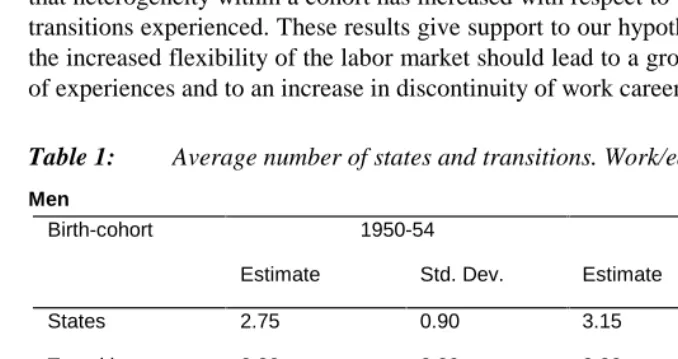
As expected in our hypothesis 1, the results show a significant increase in the mean number of states and in the number of transitions experienced by individuals across cohorts, implying more discontinuity in their educational and occupational careers (Table 1). For instance, the average number of transitions jumps from 2.8 to 3.8 for men and from 2.4 to 3.1 for women. The increase in the standard deviations also indicates that heterogeneity within a cohort has increased with respect to the number of states and transitions experienced. These results give support to our hypothesis 1 which stated that the increased flexibility of the labor market should lead to a growth in the heterogeneity of experiences and to an increase in discontinuity of work careers.
Table 1: Average number of states and transitions. Work/educational career.
Men
Birth-cohort 1950-54 1960-64
Estimate Std. Dev. Estimate Std. Dev.
States 2.75 0.90 3.15 1.95
Transitions 2.80 2.09 3.80 3.99
Women
Birth-cohort 1950-54 1960-64
Estimate Std. Dev. Estimate Std. Dev.
States 2.30 0.84 2.63 0.89
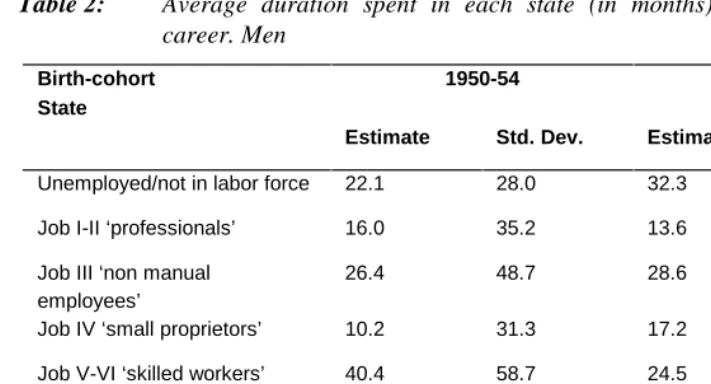
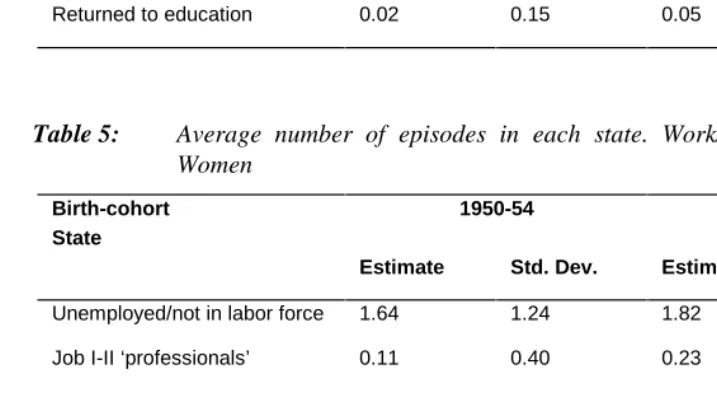
The most remarkable feature of the work careers of men is the increase across cohorts of the length of time spent out of the labor force or unemployed, from 22 months in 1950-54 cohort to 32 months on average in the 1960-64 cohort (Table 2). This is consistent with our expectations of a more difficult integration into the labor market (Hypothesis 2). This probably also implies more episodes of unemployment and shorter periods of employment, since the mean number of episodes of unemployment or not in the labor market jumps from 1.22 to 1.74 (Table 4). This last trend can also be observed for women, although to a lesser extent (1.64 to 1.82) (Table 5).
There is also some variation across cohorts in the duration spent in each type of job by men. Manual occupations, especially skilled manual occupations (class V-VII) have declined rapidly, whereas lower service jobs (class III) show an increase. There also appear to be longer periods of self-employment, as can be expected in a post-industrial economy. Nevertheless, this increase seems a little surprising, taking into account that there probably still existed a certain proportion of farmers in the older cohort.
The mean number of episodes experienced in each job category does not increase evenly for all classes. It increases in non-manual occupations and for the self-employed, but it decreases for manual jobs (Tables 4 and 5). This suggests that precariousness has increased to a greater extent in the former professions. Again, standard deviations generally increase substantially, suggesting a greater degree of heterogeneity of individual experiences. Time spent in education has sharply increased for both genders, although this increase is more remarkable for women. Inter-cohort changes in duration of time spent in unemployment or not in the labor force for women indicate a reduction for the younger cohort, consistent with the increased participation in the labor market (Table 3). Given the importance of this trend, it is not possible to distinguish any growth in periods of unemployment from periods of withdrawal from the labor force.
Table 2: Average duration spent in each state (in months). Work/educational career. Men
Birth-cohort State
1950-54 1960-64
Estimate Std. Dev. Estimate Std. Dev.
Unemployed/not in labor force 22.1 28.0 32.3 36.1
Job I-II ‘professionals’ 16.0 35.2 13.6 30.6
Job III ‘non manual employees’
26.4 48.7 28.6 48.1
Job IV ‘small proprietors’ 10.2 31.3 17.2 37.2
Job V-VI ‘skilled workers’ 40.4 58.7 24.5 48.2
Job VII ‘unskilled workers 48.5 58.8 36.8 53.8
In education 15.4 30.2 25.6 34.2
Returned to education 1.0 7.6 1.5 9.6
Table 3: Average duration spent in each state (months). Work/educational career.
Women
Birth-cohort State
1950-54 1960-64
Estimate Std. Dev. Estimate Std. Dev.
Unemployed/not in labor force 85.0 60.0 74.1 57.8
Job I-II ‘professionals’ 5.5 21.3 9.7 25.7
Job III ‘non manual employees’
41.9 54.6 43.4 53.8
Job IV ‘small proprietors’ 9.7 33.1 7.7 26.2
Job V-VI ‘skilled workers’ 13.9 37.7 11.5 35.0
Job VII ‘unskilled workers 12.3 33.8 6.6 26.2
In education 10.6 24.5 25.4 35.5
Table 4: Average number of episodes in each state. Work/educational career. Men
Birth-cohort State
1950-54 1960-64
Estimate Std. Dev. Estimate Std. Dev.
Unemployed/not in labor force 1.22 1.11 1.74 1.56
Job I-II ‘professionals’ 0.27 0.57 0.32 0.67
Job III ‘non manual employees’
0.42 0.69 0.64 1.07
Job IV ‘small proprietors’ 0.15 0.40 0.24 0.45
Job V-VI ‘skilled workers’ 0.51 0.72 0.38 0.67
Job VII ‘unskilled workers 0.83 0.90 0.79 1.26
In education 0.37 0.62 0.64 0.58
Returned to education 0.02 0.15 0.05 0.23
Table 5: Average number of episodes in each state. Work/educational career.
Women
Birth-cohort State
1950-54 1960-64
Estimate Std. Dev. Estimate Std. Dev.
Unemployed/not in labor force 1.64 1.24 1.82 1.51
Job I-II ‘professionals’ 0.11 0.40 0.23 0.62
Job III ‘non manual employees’
0.69 0.87 0.95 1.28
Job IV ‘small proprietors’ 0.12 0.34 0.15 0.51
Job V-VI ‘skilled workers’ 0.20 0.51 0.16 0.43
Job VII ‘unskilled workers 0.29 1.12 0.19 0.92
In education 0.30 0.47 0.58 0.65
6. Family trajectories
From state distributions (Figures 7 and 8), we can see that in all birth-cohorts few people live in “unstable” or “post-nuclear” states (separated, divorced, consensual unions, unmarried with children). However, there is a clear increase in periods spent in such states across cohorts, in particular for those born in the 1960s. In older birth cohorts, virtually all individuals followed the typical nuclear path, which includes a relatively short period as married without children. From the mid-1950s birth cohorts, there is a diversification of situations (Baizán et al. 2001). In particular, a growth in cohabitation can be observed, a state presumably short-lived for most people. Unexpectedly, more men than women are found in the states of cohabitant and separated/divorced without children. This may be due to different perceptions and willingness to disclose periods of cohabitation, according to gender, a result that in itself indicates the still marginal status of such unions. This situation also has some consequences for the categories “divorced/separated/widowed” with and without children, that include separation after cohabitation.
On the whole, the results are in line with our hypothesis 5, in which only a limited growth of heterogeneity of family forms was expected, due to normative and economic constraints. However, in hypothesis 7 an increase in the instability and diversity of household forms was expected, as a result of more equal roles between genders and a change in their relationships. Such inconsistency suggests that the constraints experienced by individuals seem to prevail over the forces driving the diversification of family forms.
The graphs show the visible postponement of family formation for cohorts born in the 1960s and 1970s, which is consistent with hypothesis 4. Most individuals do not form families in ways different from earlier cohorts, they essentially postpone family formation, something that for an increasing minority may suppose to forego the formation of a family of their own. Our interpretation of these trends has emphasized the effect of structural constraints: the “familialistic” welfare state, the difficulties of integration and the flexibilization of the labor market, and a normative context (including family law) not favoring individual autonomy. Moreover, our paper has also mentioned the changes in family relationships, in the sense of an increasing democratization (which is not possible to visualize with our data). Therefore, the continuity and adaptation of “traditional” family forms seem to prevail. The increasing demands by younger generations for autonomy and security as pre-requisites for the formation of their own families, clash with a context of ever-rising difficulties in attaining them.
heterogeneity of life course across cohorts (Figures 9 and 10). The only exception is teenagers, who all increasingly remain unmarried without children (in the parental home), thus resulting in a virtually non-existent heterogeneity.
Let us now turn to the whole sequences. We can see that the total number of states and transitions experienced by individuals remains quite stable across cohorts. For instance, the number of transitions for the male birth-cohort 1950-54 was 1.59 and for those born in 1960-64 was 1.40, while for women there was virtually no difference in the number of transitions: 1.76 and 1.77, respectively for each cohort. One has to take into account that these measures are affected by the postponement of family formation transitions, and that we limit our measures to the ages between 15 and 30. That postponement offsets the small growth in “unstable” or “post-nuclear” family forms, as hypothesized above (Hypotheses 4 and 5). However, it is worthwhile noting that the standard deviations of our measures do show the expected rise in diversity of experiences, in practically all the categories examined (Tables 6 to 10).
Table 6: Average number of states and transitions. Family career
Men
Birth-cohort 1950-54 1960-64
Estimate Std. Dev. Estimate Std. Dev.
States 2.56 0.86 2.37 0.99
Transitions 1.59 0.90 1.40 1.05
Women
Birth-cohort 1950-54 1960-64
Estimate Std. Dev. Estimate Std. Dev.
States 2.75 0.71 2.74 0.83
Transitions 1.76 0.73 1.77 0.92
months in the 1960-64 birth-cohort. “Cohabitation” (3.6 and 6.2 months), “divorce/separated/widowed” (1.1 and 3.1), and “unmarried with child” (0.3 and 0.9), all show an increase across cohorts in their (short) duration. Women show similar trends. However, the time spent as unmarried without children is rather stable between birth-cohorts, reflecting the fact that a higher proportion of the 1960-64 cohort formed a union early in their life course than in the 1950-54 birth cohort, thus spending a longer duration in that state, and compensating for the postponement of that transition by the other members of the cohort. The important relative increase in the duration of time spent as divorced, separated or widowed with children (from 0.8 to 1.6 months) for women, reflects the widespread norm according to which women receive custody of children after the disruption of a union.
Finally, the average number of episodes in each state captures only in part the instability of family life courses, since it heavily depends on the definition of the states (for some, certain states cannot be revisited).
Table 7: Average duration spent in each state (months). Family career. Men
Birth-cohort State
1950-54 1960-64
Estimate Std. Dev. Estimate Std. Dev.
Unmarried no children 127.6 37.2 131.3 43.4
Married no children 13.7 16.5 14.4 19.4
Cohabiting no ch. 3.6 14.9 6.2 17.9
Div./sep./wid. no ch. 1.1 7.9 3.1 14.1
Unmarried with ch. 0.3 3.7 0.9 8.1
Married with children 32.0 31.2 21.1 33.1
Cohabiting with ch. 1.0 7.4 2.3 13.4
Table 8: Average duration spent in each state (in months). Family career. Women
Birth-cohort State
1950-54 1960-64
Estimate Std. Dev. Estimate Std. Dev.
Unmarried no children 105.9 39.8 103.1 47.3
Married no children 17.2 18.6 20.4 22.1
Cohabiting no ch. 1.4 9.4 3.5 14.1
Div./sep./wid. no ch. 0.5 5.7 0.8 6.5
Unmarried with ch. 0.6 6.3 1.3 10.1
Married with children 52.7 39.1 47.9 46.5
Cohabiting with ch. 1.0 9.1 1.4 8.8
Div./sep./wid. with ch. 0.8 7.0 1.6 9.9
Table 9: Average number of episodes in each state. Family career. Men
Birth-cohort State
1950-54 1960-64
Estimate Std. Dev. Estimate Std. Dev.
Unmarried no children 1.00 0.00 0.99 0.07
Married no children 0.74 0.44 0.59 0.49
Cohabiting no ch. 0.10 0.34 0.21 0.48
Div./sep./wid. no ch. 0.04 0.23 0.08 0.30
Unmarried with ch. 0.02 0.15 0.02 0.15
Married with children 0.65 0.48 0.43 0.50
Cohabiting with ch. 0.02 0.14 0.04 0.20
Table 10: Average number of episodes in each state. Family career. Women
Birth-cohort State
1950-54 1960-64
Estimate Std. Dev. Estimate Std. Dev.
Unmarried no children 1.00 0.00 0.99 0.07
Married no children 0.85 0.36 0.81 0.40
Cohabiting no ch. 0.04 0.21 0.12 0.36
Div./sep./wid. no ch. 0.02 0.14 0.03 0.19
Unmarried with ch. 0.01 0.12 0.03 0.18
Married with children 0.79 0.41 0.70 0.46
Cohabiting with ch. 0.02 0.16 0.04 0.22
Div./sep./wid. with ch. 0.02 0.16 0.05 0.24
7. Household trajectories
Very similar trends to those reflected by the family trajectories can be observed for the household career. They are also dominated by the impression of little diversification and by the postponement of transitions. This is shown by the status distribution figures (11 and 12), by the entropy measure (figures 13 and 14) and by the number of transitions and states experienced by individuals (tables 11 to 15). The heterogeneity is reduced across cohorts due to the fact that more and more young people stay at the parental home for longer periods, with the corresponding reduction in the duration spent in other states, especially for men.
departure of younger birth-cohorts. Moreover, no increases in the status “alone or with others”, as expected by the second demographic transition, can be found. In fact the reversal is true, as the decrease in the period spent in this last household status attest: from 14 months for men and 9 months for women in the 1950-54 cohort to 13 and 8 months respectively for the 1960-64 birth-cohort (Tables 12 and 13). This trend is partially due to the importance, for older birth-cohorts, of long distance migration in connection with job search, which means that a sizeable proportion of young people, men in particular, left the parental home and formed their own households before union formation (Baizán, 1999). The support found at the parental home for the integration into adult life, and the corresponding long stay there, may be considered essentially as a constant for the cohorts studied. However, the long period of intergenerational co-residence can also be related to the important increases in the time spent in the educational system and the growing need to accumulate resources before forming an own household. As explained above, this can be done under the most favorable conditions only by staying in the parental home. Finally, the state “disrupted family” (divorced, separated or widowed individuals without children) is still marginal, in spite of small increases through cohorts. The overall picture reflects the limited diversification of household forms. Individuals may be confronted by different challenges in each birth-cohort, but they respond by adopting the same living arrangements. As expected in our hypotheses 4 and 5, economic and normative constraints seem to constitute an effective check on the growth of heterogeneity across cohorts.
Table 11: Average number of states and transitions. Household career
Men
Birth-cohort 1950-54 1960-64
Estimate Std. Dev. Estimate Std. Dev.
States 1.95 0.64 1.92 0.72
Transitions 0.97 0.68 0.96 1.81
Women
Birth-cohort 1950-54 1960-64
Estimate Std. Dev. Estimate Std. Dev.
States 1.98 0.52 1.98 0.54
Table 12: Average duration spent in each state (months). Household career. Men
Birth-cohort State
1950-54 1960-64
Estimate Std. Dev. Estimate Std. Dev.
Parental home 118.3 49.3 125.0 50.9
Alone/others 14.0 34.3 12.6 32.8
Own family 46.6 36.3 40.2 39.1
Disrupted family 1.0 6.0 2.2 11.1
Table 13: Average duration spent in each state (months). Household career.
Women
Birth-cohort State
1950-54 1960-64
Estimate Std. Dev. Estimate Std. Dev.
Parental home 100.7 47.2 101.4 50.8
Alone/others 9.1 26.7 7.8 24.2
Own family 69.6 42.1 70.1 47.1
Disrupted family 0.6 6.8 0.7 5.9
Table 14: Average number of episodes in each state. Household career. Men
Birth-cohort State
1950-54 1960-64
Estimate Std. Dev. Estimate Std. Dev.
Parental home 0.97 0.17 0.99 0.10
Alone/others 0.20 0.40 0.20 0.40
Own family 0.76 0.46 0.70 0.51
Table 15: Average number of episodes in each state. Household career. Women
Birth-cohort State
1950-54 1960-64
Estimate Std. Dev. Estimate Std. Dev.
Parental home 0.98 0.13 0.98 0.14
Alone/others 0.14 0.34 0.14 0.35
Own family 0.86 0.38 0.85 0.41
Disrupted family 0.01 0.13 0.03 0.17
8. Conclusions
In this paper, we have focused on the specific consequences of changes at the macro level on the dynamics of young Spaniards’ life courses. We focused on the interplay between global processes, such as markets liberalization and individualization, and on the historically changing national system of actors and forces. Such interplay has triggered peculiar responses, that bear some commonalities with other Southern European countries.
As we have discussed, there are no fully “Fordist” birth-cohorts in the Spanish context, given the late development of the economy and the welfare state. Here we propose the 1950-54 cohort as the most representative, having enjoyed relatively protected jobs and showing a highly “Parsonian” behavior. Cohorts born at the beginning of the 1960s show some signs of a “post-industrial” life course. They entered a highly flexible labor market, albeit still much regulated and dualistic, that impinged on their capacity for economic integration. A majority of their members could still count on intact and highly solidaristic parental families while waiting for better chances for independent family life. The rearrangement of family and work obligations between men and women they initiated could only be achieved very partially and at a great personal and societal cost.
to form any kind of household, especially individualistic types. Normative and welfare arrangements partially contribute to preventing not only the diversification of household forms, but of household formation ‘tout court'. Paradoxically, the very same nuclear family that is supposed to be protected becomes attainable only much later -if ever- for a large proportion of the new generations.
It may seem as if, at its origins, the Spanish welfare state was conceived for a world where unemployment was only sporadic, where families had stable male providers, and where the vulnerable were mainly the aged. Instead, the actual expansion of the welfare state took place while the growing needs correspond to young people and women who try to find hard-to-get and precarious jobs, the long-term unemployed and dual-income households. The increasing risks of unemployment and flexibilization are concentrated on young people and women, not only because they are the new entrants in the labor market, but mainly because of their weaker position in the household organization/social policy link. As we have seen, this has the consequence of delaying the transition to adulthood.
Here we have seen that some of the developments sustaining current trends in life course are in fact quite recent, and not part of a traditional past. Prolonged education, especially for women, labor force insecurity, increased female participation in the labor market and ‘latest late’ household formation by young adults. All have developed during the last two or three decades, and can be considered as a response to the specific circumstances and challenges encountered on the way to the modernization of Spanish society. We can wonder what are the chances that the forces sustaining these developments will continue in the future. Women’s attachment to the labor market will probably continue, undermining power relationships in households and in society. Concerns about labor market insecurity are present in the general public demands as well as in the political agenda, although it is yet unclear if they can lead to any reversal of the situation. Finally, the normative context and the values of the public are changing rapidly, becoming an important force for change, especially towards increased gender equality and the acceptance of diversity in family forms.
Acknowledgments
useful comments and advice. We also thank Arnstein Aassve for his comments on a previous version of this paper, and Joe Vaughan and Susann Backer for language editing. A presentation based on a preliminary version of this paper was given at the Instituto Juan March, Madrid, in March 2000.
Notes
1. Similar analyses concerning the employment career, social class position, and family status are available for Great Britain and Germany (Hillmert, 2000).
2. The most important laws in this respect were, under the Franco regime, the
Ordenanzas Laborales (1958), and now the so-called Workers’ Statute (1980).
3. Unemployment trends (as percentages of labor force in each category):
Years total unemployed < 25 years old unemployed women unemployed
1977 4.8 11.3 5.0
1982 15.5 37.8 18.0
1985 21.7 47.6 24.8
1990 16.3 31.8 24.2
1994 24.3 45.1 31.4
1999 15.6 29.3 22.9
Source: Instituto Nacional de Estadística, Encuesta de Población Activa, annual series (second quarter).
4. In this paper we do not focus on the relationship between individual careers, but on the effects of the institutional changes on each career. Instability of employment and unemployment have been shown to strongly reduce the probability of family and household formation events in Spain (Billari et al. 2000; Simó et al. 2000; Ahn and Mira, 2001; Baizán, 2001).
5. Relatively little quantitative data exists on the social norms existing in Spain for the decades under investigation, in particular referring to differentials according to regional or social class contexts. On the other hand, legislative change mainly took place under the constitution of 1978 and its later development.
6. Which in terms of a family model may be characterized, not as much by some particular family forms, as by individual autonomy, flexibility in engagement, and emotional closeness between family members (Giddens, 1991; Aquilino, 1997).
8. Some authors have suggested that the market and other economic institutions do more than allocate goods and services: they also influence the evolution of values, tastes and preferences in a dynamic way (Bowles, 1998; Jakee and Sun, 2001).
9. Marriage market practices, favouring a marriage upwards in terms of education for women, also contribute to the differential economic capacities of partners (González, 2001).
References
Abbott, A, (1995). "Sequence analysis: New methods for old ideas". Annual Review of
Sociology, 21: 93-113.
Ahn, N. and Mira, P. (2001). "Job bust, baby bust?: Evidence from Spain". Journal of
Population Economics, 14: 505-521.
Alberdi, I. (1999). La nueva familia española. Madrid: Taurus.
Alvarez García, S. and Carrascal Arranz, U. (2000). "La reforma del IRPF y el tratamiento de la familia: El coste de los hijos y su compensación mediante el mínimo familiar". Estudios sobre la Economía Española, Madrid: FEDEA.
Aquilino, W.S. (1997). "From adolescent to young adult: A prospective study of parent-child relations during the transition to adulthood". Journal of Marriage and the
Family, 59: 670-686.
Arthur, B. W. (1994). Increasing returns and path dependency in the economy. Ann Arbor, MI: University of Michigan Press.
Baizán, P. (1999). Changements dans les déterminants de la migration au long de la trajectoire domestique des individus: application à l’Espagne. In: Tabutin, D., Gourbin, C., Masuy-Stroobant, G., and Schoumaker, B., editors. Théories, paradigmes et courants explicatifs en démographie. Chaire Quetelet 1997, pp. 227-250. Louvain-la-Neuve: Academia-Bruylant/L’Harmattan.
Baizán, P. (2001). Transitions to adulthood in Spain. In: Corijn, M. and Klijzing, E., editors. Transitions to adulthood in Europe. European Studies of Population series no. 10, pp. 279-312. Dordrecht: Kluwer Academic Publishers.
Baizán P., Aassve A. and Billari F.C. (2001). "Cohabitation, marriage, first birth: The Interrelationship of Family Formation Events in Spain". Max-Planck Institute for Demographic Research, Working Paper-2001-36.
Becker, G. (1981). A treatise on the family. Cambridge, Mass: Harvard University Press.
Bentolila, S. and Dolado, J. (1994). "Spanish labor markets". Economic policy (Apr.). 55-99.
Billari, F.C. (2001 b). "Sequence analysis in demographic research and applications".
Canadian Studies in Population, 28: 439-458.
Billari, F. C. and Piccarreta, R. (2001). "Studying demographic life courses as sequences". mimeo.
Billari, F.C., Philipov, D., Baizán, P. (2001a). "Leaving Home in Europe: The Experience of Cohorts Born Around 1960". International Journal of Population
Geography, 7: 339-356.
Billari, F.C., Castiglioni, M., Castro Martín T. and Michielin, F. (2001b). "Transitions to adulthood in a period of deep societal changes: A study of Spanish post-war cohorts". mimeo.
Billari, F.C., Castiglioni, M., Castro Martín T. Michielin, F. and Ongaro, F. (forthcoming). Household and union formation in a Mediterranean fashion: Italy and Spain. In: Klijzing, E. and Corijn M., editors. Fertility and partnership in Europe: findings and lessons from comparative research. Volume II. Geneva/New York: United Nations.
Blossfeld, H.P. (1995). The new role of women: Family formation in modern societies. Boulder, CO: Westview Press.
Boix, C. (1996). Partidos Políticos, Crecimiento e Igualdad. Madrid: Alianza Editorial.
Bowles, S. (1998). "Endogenous preferences: The cultural consequences of markets and other Economic institutions". Journal of Economic Literature, 36(1): 75-111.
Bricall, J.M. (2000). Informe Universidad 2000. Conferencia de Rectores de las Universidades Españolas. http://www.crue.upm.es/
Buchmann, M. (1989). The script of life in modern society. Entry into adulthood in a changing world. Chicago: The University of Chicago Press.
Centro de Investigaciones Sociológicas (2000). Informe sobre la Juventud Española 2000. Madrid: Instituto de la Juventud. www.cis.es
Centro de Investigaciones Sociológicas (1994). "Dinámica intergeneracional en los sistemas de valores de los españoles". Opiniones y Actitudes CIS, No. 9, Madrid: CIS. www.cis.es.
Dalla Zuanna, G. (2001). "The banquet of Aeolus: A familialistic interpretation of Italy’s lowest low fertility". Demographic Research, 4 (5). www.demographic-research.org
Delgado, M. and Castro Martín T. (1999). Fertility and family surveys in the countries of the ECE Region. Standard Country Report. Spain. New York and Geneva: United Nations.
Durán, M.A. (1997). "El papel de las mujeres y hombres en la economía española".
Información Comercial Española, 760: 9-29.
Easterlin, R. (1980). Birth and fortune. New York: Basic Books.
Eriksson, R. and Goldthorpe, J.H. (1993). The constant flux: A study of class mobility in industrial societies. Oxford: Clarendon Press.
Esping-Andersen, G. (1999). Social foundations of postindustrial economies. Oxford: Oxford University Press.
Esping-Andersen, G. (1990). The three worlds of welfare capitalism. Cambridge: Polity Press.
Eurostat (1996). Social portrait of Europe. Luxemburg: Office of the Official Publications of the European Communities.
Eurydice (1996). Key data on education in the European Union. Luxembourg: Commission of the European Communities.
Fahey, T. (1995). Full citizenship for the next generation. In: Healy, S. and Reynolds, B., editors. Pp. 106-131. New frontiers for full citizenship. Dublin: CMRS.
Garrido, L.J. (1992). Las dos biografías de la mujer en España. Madrid: Ministerio de Asuntos Sociales, Instituto de la Mujer.
Giddens, A. (1991). Modernity and self-identity: Self and society in the late modern age. Cambridge: Polity Press.
Gimeno, J.A. (1993). Incidencia del Gasto Público por Niveles de Renta. In: Sector Público y Redistribución, I Symposium sobre Igualdad y Distribución de la Renta y la Riqueza. Madrid: Fundación Argentaria.
Gunther, R. (1996). "Spanish public policy: From dictatorship to democracy". Estudio/Working Paper 1996/84. Madrid: Instituto Juan March.
Guillén, A. (1992). "Social policy in Spain: From dictatorship to democracy (1939-1982)". In: Ferge Z. and Kolberg, J.E., editors. Social policy in a changing Europe. Boulder, Co: Campus/Westview.
Hillmert, S. (2000). "Welfare State Regimes and Life-Course Patterns: An Introduction", Max Planck Institute for Human Development, Berlin. http://www.mpib-berlin.mpg.de/dok/full/e2001.0232/frames/paper.htm.
Hoem, J. (1986). "The impact of education in on modern family-union initiation".
European Journal of Population, 2:113-133.
Instituto Nacional de Estadística, 2001, Encuesta de población activa. Annual series: Tempus. www.ine.es.
Jakee, K. and Guang-Zhen Sun (2001). "Adaptive preferences and welfare state dynamics: A simple model". Max-Planck-Institute for Research into Economic Systems (Jena, Germany). Papers on Economics and Evolution, 2.
Jimeno, J.F. and Toharia, L. (1994). Unemployment and Labor Market Flexibility: Spain. Geneva: International Labor Organization.
Jurado Guerrero, T., and Naldini, M. (1997). Is the South so different? Italian and Spanish families in comparative perspective. In: Rhodes, M., editor. Southern European welfare states. Between crises and reform. Pp. 42-66. London: Frank Cass.
Knudsen, K. and Waerness, K. (1999). "Reactions to global processes of change: Attitudes toward gender roles and marriage in modern nations". Comparative
Social Research, 18: 161-195.
Künzler, J., Schulze, H-J. and van Hekken, S. (1999). "Welfare States and Normative Orientations Toward Women’s Employment". Comparative Social Research, 18: 197-225.
Laparra, M. and Aguilar, M. (1997). Social exclusion and minimum income programmes in Spain. In: Rhodes, M., editor. Southern European welfare states. Between crises and reform. Pp. 87-114. London: Frank Cass.
Leal Maldonado, J. (1992). Informe para una nueva política de vivienda, Madrid: Ministerio de Obras Públicas y Transporte.
Lobo, F. (1990). Irregular work in Spain. In: Underground economy and irregular forms of employment. Final synthesis report, Brussels: Commission of the European Communities.
Luxán, M., Miret, P. and Treviño, R. (2000). Is the male-provider model still in place? Partnership formation in contemporary Spain. In: González, M.J., Jurado, T. and Naldini, T., editors. Gender inequalities in Southern Europe, women, work and welfare in the 1990s. Pp. 171-194. London: Frank Cass.
Maravall, J.M. and Fraile, M. (1998). "The politics of unemployment. The Spanish experience in comparative perspective". Estudio/WorkingPaper 1998/124, Madrid: Instituto Juan March.
Marí-Klose, M. and Nos Colom, A. (1999). Itinerarios vitales: educación, trabajo y fecundidad de las mujeres. Opiniones y Actitudes no. 27, Madrid: Centro de Investigaciones Sociológicas.
Marimon, R. and Zilibotti, F. (1996). "Actual versus virtual employment in Europe: Is Spain different?". European University Institute Working Paper, ECO no. 96/21.
Martínez Alier, J. and Roca Jusmet, J. (1988). "Economía política del corporativismo en el Estado español: Del franquismo al posfranquismo". Revista Española de
Investigaciones Sociológicas, 41: 25-62.
Martínez Veiga, U. (1999). Immigrants in the Spanish labor market. In: Baldwin-Edwards, M., and Arango, J., editors. Immigrants and the informal economy in Southern Europe. Pp. 105-128. London: Frank Cass.
Mayer, K. U. (2001). The paradox of global social change and national path dependencies. Life course patterns in advanced societies. In: Woodward, A. and Kohli, M., editors. Inclusions and exclusions in European societies. Pp. 89-110. New York: Routledge.
Mayer, K.U. (1997). Notes on a comparative political economy of life courses.
Comparative Social Research, 16: 203-226.
Ministerio de Educación y Ciencia (1994). Estadísticas de la enseñanza en España, niveles de preescolar, infantil, general básica y enseñanzas medias. Madrid: MEC.
Myles, J. (1990). States, labour markets and life cycles. In: Friedland, R., and Robertson, S., editors. Beyond the marketplace: Rethinking economy and society. Pp. 271-298. New York: Aldine de Grueyter.
Navarro, V. (2000). Neoliberalismo y Estado del bienestar. Barcelona: Ariel Sociedad Económica.
Oppenheimer, V.K. (1988). "A theory of marriage timing". American Journal of
Sociology, 94: 563-61.
Orloff, A.S. (1996). "Gender and the welfare state". Estudio/Working Paper 1996/79, Madrid: Instituto Juan March.
Pfau-Effinger, B. (1999). "Change of family policies in the socio-cultural context of European societies. Comparative Social Research, 18: 135-159.
Reher, D. S. (1998). "Family ties in Western Europe: persistent contrasts". Population
and Development Review, 24 (2): 203-234.
Rico, A. (1997). Regional decentralization and health care reform in Spain (1976-1996). In: Rhodes, M., editor. Southern European Welfare States. Between crises and reform. Pp. 115-134. London: Frank Cass.
Rindfuss, R. R. (1991). "The young adult years: diversity, structural change and fertility". Demography, 28(4): 493-512.
Rodriguez Cabrero, G. (1994). La protección social a la familia. In: V Informe sociológico sobre la situación de la familia en España. Madrid: Fundación FOESSA.
Roussel, L. (1989). La famille incertaine. Paris: Odile Jacob.
Rohwer, G. and Pötter, U. (1999). TDA user’s manual. Ruhr-Universität Bochum, Bochum. http://www.stat.ruhr-uni-bochum.de/.