University of New Orleans University of New Orleans
ScholarWorks@UNO
ScholarWorks@UNO
University of New Orleans Theses and
Dissertations Dissertations and Theses
5-15-2009
Exploring Bilingual Arab-American Students' Performance in
Exploring Bilingual Arab-American Students' Performance in
Solving Mathematics Word Problems in Arabic and English
Solving Mathematics Word Problems in Arabic and English
Samar El-Rifai Sarmini University of New Orleans
Follow this and additional works at: https://scholarworks.uno.edu/td
Recommended Citation Recommended Citation
Sarmini, Samar El-Rifai, "Exploring Bilingual Arab-American Students' Performance in Solving Mathematics Word Problems in Arabic and English" (2009). University of New Orleans Theses and Dissertations. 905.
https://scholarworks.uno.edu/td/905
This Dissertation is protected by copyright and/or related rights. It has been brought to you by ScholarWorks@UNO with permission from the rights-holder(s). You are free to use this Dissertation in any way that is permitted by the copyright and related rights legislation that applies to your use. For other uses you need to obtain permission from the rights-holder(s) directly, unless additional rights are indicated by a Creative Commons license in the record and/ or on the work itself.
Exploring Bilingual Arab-American Students’ Performance in Solving Mathematics Word Problems
in Arabic and English
A Dissertation
Submitted to the Graduate Faculty of the University of New Orleans
in partial fulfillment of the requirements for the degree of
Doctor of Philosophy in
Curriculum and Instruction Mathematics Education
by
Samar El-Rifai Sarmini
B.S., American University of Beirut, 1990 M. Ed., University of New Orleans, 1996
©2009
In memory of my beloved father, may he rest in peace.
ACKNOWLEDGEMENTS
First and foremost, I would like to thank God for giving me the strength
and perseverance to successfully finish this project. I also thank Him for
surrounding me with wonderful caring people who made this journey possible
and worthwhile. I am proud to have been able to fulfill my father’s aspiration,
may God rest his soul. I only wish he is with us here to share the joy of this
occasion.
I would like to thank all the students who participated in this study,
especially the ones who put serious effort in solving and completing both sets
of problems. I also would like to thank their teachers who went out of their
way and interrupted their scheduled daily activities to accommodate the
requirements of this study. My gratitude goes to the school administration for
allowing this study to take place. I especially want to thank the diligence and
continuous follow up of Sr. Bilquis Al-Tamimi who made sure the data for this
study was in order and that it was sent to me on time.
Data from my pilot study was an essential source for establishing
reliability of this current study. Hence, special thanks to all my students at
Muslim Academy and members of my community who participated in my pilot
study and received me with open hearts and strong support.
Next, I am forever grateful to my committee members’ priceless feedback.
Nothing is more precious than the gift of knowledge, and for this I sincerely
thank you. Your wisdom and invaluable insights helped mold and shape this
Dr. Germain, my advisor and major professor, I have been honored to
work with you. You truly practice what you teach. There is never a dull
moment with you; you always have new ideas that engage your students in
new educational endeavors. Your open-mindedness and love of learning are
truly contagious. Thank you for the many hours spent in reading and revising
this text. Your guidance and leadership have been enlightening.
Dr. Speaker, I am greatly indebted to you for your valuable feedback:
organized and straight to the point. Your questions and insights made a major
impact on how I made sense of the data. Your list of demands has facilitated
shaping and organizing my chapters. I have nothing but the utmost respect for
you.
Dr. Thoreson, you have made working with statistics enjoyable and
bearable. I have truly enjoyed our discussion sessions in your office. Thank
you for providing me with your undivided attention and rich resources.
Dr. Al-Ashhab, you have been a vital part of this study, authenticating
and validating the Arabic portion of it. I have managed to keep you busy with
correcting student problem sets for both my pilot study and this current study.
Thank you for providing me with your time and effort.
I would also like to thank Leslie Cobar who has reviewed the word
problems used in this study and has used her own two sons to evaluate the
appropriateness of the difficulty level.
This journey has been a long one, but as everyone told me, it truly has
been a true support when things got rough and bumpy. Thank you for acting
as a co-rater for the students’ solution sets. I am happy that we have helped
each other meet the tough demands of the doctoral program. You kept
reassuring me that I will meet deadlines, when it seemed I was far from it, and
for that I am grateful. I wish you the best.
At the end, I dedicate this work to my husband, Mahmoud; without his
support and unconditional love, none of this could have ever been possible. I
thank you for not allowing me to quit when things got hectic. When at times I
felt floating in the middle of the ocean, you kept pushing me and believing in
me until you helped me reach the shore, and for that I am forever grateful. My
kids are my real inspiration. Mohammad, Bilal, and Omar: thank you for your
prayers and for your patience when your mommy was not around.
My gratitude goes to all the members of my family. In particular, I love
you mom and dad for instilling in me the love of learning. You have raised me
to have a better appreciation for what is really important in life. I would also
like to thank my brother, Naim, and my sisters, Ibtisam and Heyam, for looking
out for me and continuously encouraging me. I would also like to give special
thanks for my in-laws who played an important role in providing support and a
hot meal when things got crazy. Thank you all.
ﺎﻤﻠﻋ
ﺎﻧدزو
ﺎﻨﺘﻤﻠﻋ
ﺎﻤﺑ
ﺎﻨﻌﻔﻧاو
ﺎﻨﻌﻔﻨﻳ
ﺎﻣ
ﺎﻨﻤﻠﻋ
ﻢﻬﻠﻟا
Oh Lord! Teach us what benefits us, benefit us with what you taught us, and increase our
TABLE OF CONTENTS
List of Tables... xii
Abstract ... xv
CHAPTER ONE: INTRODUCTION Introduction ...1
Background of the Study...1
Theoretical Framework ...3
Purpose of the Study ...5
Research Questions...5
Significance of the Study ...6
Definitions of Terms ...6
Limitations and Delimitations of the Study ...9
Chapter Summary...9
Organization of the Study... 10
CHAPTER TWO: REVIEW OF RELATED LITERATURE Introduction ... 12
Theoretical Framework ... 12
Constructivist Theory ... 12
Types of Constructivist Learning... 17
NCTM and Constructivism... 18
NCTM and Equity ... 22
Importance of Language... 26
Quality of Acquisition of Second Language... 28
Social Class and Background Factors ... 28
Different Levels of Bilinguality ... 30
The Linguistic Distance Hypothesis ... 33
Language Proficiency... 34
Nature of Language Proficiency ... 34
Cummins Theory ... 38
Mathematics and Language ... 42
Verbal Problems and Translation Issues ... 44
Political Debate... 46
Mathematical Communication ... 47
Problem Solving Studies ... 48
Better recollection of word problems given in L1... 50
Language system effect on bilinguals’ problem solving ability . 51 Reading comprehension and problem solving ... 52
Context sensitivity/language specificity... 56
Operations expressed in a multitude of ways... 60
Translating algebraic expressions... 60
Use of Primary Language in Instruction ... 62
Tests and Language ... 63
Conclusion ... 64
Introduction ... 66
Purpose of the Study ... 66
Research Questions... 68
Procedures for Conducting the Study ... 69
Plan for school recruitment... 69
Plan for obtaining informed consent from parents ... 70
Administering the Tests ... 71
Sample... 71
Population ... 71
Sampling Menthod... 72
Selection Criteria ... 73
Instrumentation ... 74
Principal Survey ... 74
Stanford Achievement Test ... 75
Arabic Final Average ... 78
Two Sets of Word Problems... 79
Research Design... 82
Variables of the Study... 84
Data Analysis Procedures ... 85
Research Issues ... 88
Reliability ... 88
Internal consistency reliability... 88
Equivalent forms reliability ... 89
Validity... 90
Conclusion ... 91
CHAPTER FOUR: FINDINGS OF THE STUDY Introduction ... 92
Descriptives ... 93
Correlations ... 95
MANCOVA Results ... 100
MANOVA Results... 104
Multiple Regression Results... 108
Regression Results ... 110
Set 1 English version only... 110
Set 1 Arabic version only ... 111
Set 2 English version only... 112
Set 1 Arabic version only ... 114
Summary of Quantitative Results ... 115
Word Problems Processing Analysis... 117
Overview of Scores Below 10% and Above 90%... 118
Discussion of Category 1 problems: Logical Reasoning ... 120
Logical Reasoning: Problem 2 and 8 of set 1 ... 122
Logical Reasoning: Problem 7 of set 2... 123
Logical Reasoning: Problem 1 of set 2... 124
Twice as many: problem 1 of set 1 and problem 2 of set 2 ... 127
Four/three times as many: problem 9 of set 1 and problem 6 of set 2... 129
Discussion of Category 3 Problems: “Fewer Than” ... 130
Fewer than: problem 5 of set 1 and problem 5 of set 2... 132
Fewer than: problem 10 of set 1 ... 133
Fewer than: problem 9 of set 2 ... 135
Discussion of Category 4 Problems: “Think Backwards” ... 136
Think backwards: problem 7 of set 1 and problem 3 of set 2 138 Think backwards: problem 4 of set 1 and problem 8 of set 2 139 Discussion of Category 5 Problems: “Multi-step Problem” ... 141
Multi-step problem: problem 3 of set 1 and problem 4 of set 2 ... 143
Multi-step problem: problem 6 of set 1 and problem 10 of set 2 ... 144
General Remarks About Students’ Processing of the Problems .. 145
Summary of Qualitative Results ... 146
Conclusion ... 147
CHAPTER FIVE: CONCLUSIONS AND RECOMMENDATIONS Introduction ... 148
Purpose of the Study ... 148
Research Questions and Findings... 148
Comparison to Other Studies ... 151
Conclusion ... 159
REFERENCES... 160
APPENDICES Appendix A: Principal Survey... 171
Appendix B: Teacher Letter of Support ... 175
Appendix C1: Parental Letter of Consent for Minors – English Version... 177
Appendix C2: Parental Letter of Consent for Minors – Arabic Version... 180
Appendix D: Student Letter of Assent ... 183
Appendix E1: Set 1 Word Problems With Solutions – English Version... 184
Appendix E2: Set 1 Word Problems – Arabic Version... 188
Appendix F1: Set 2 Word Problems With Solutions – English Version... 190
Appendix F2: Set 2 Word Problems – Arabic Version ... 194
Appendix G: Student Survey... 196
Appendix H: IRB Approval form….. ... 197
LIST OF TABLES
TABLE
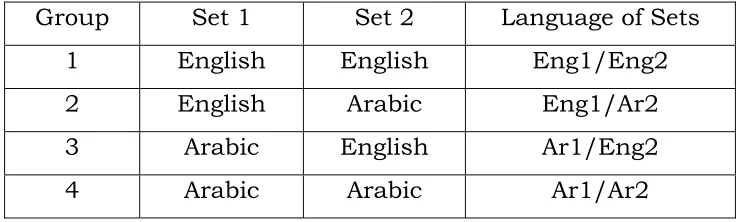
1 Description of groups with respect to language of each set... 72
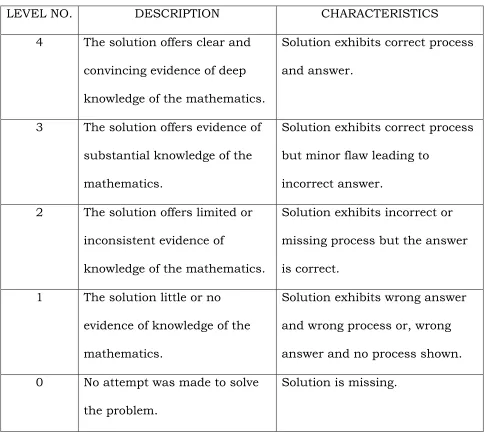
2 The rubric used for assessing student solutions ... 83
3 Distribution of the students with respect to grade level and gender... 93
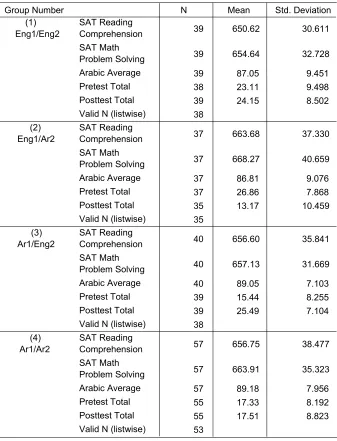
4 Descriptive statistics of students by group... 94
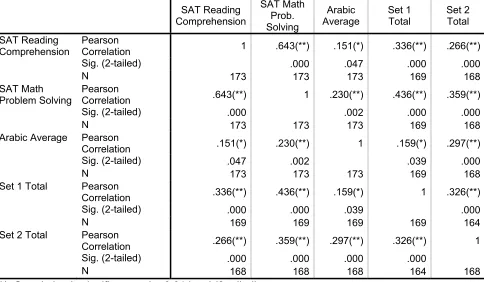
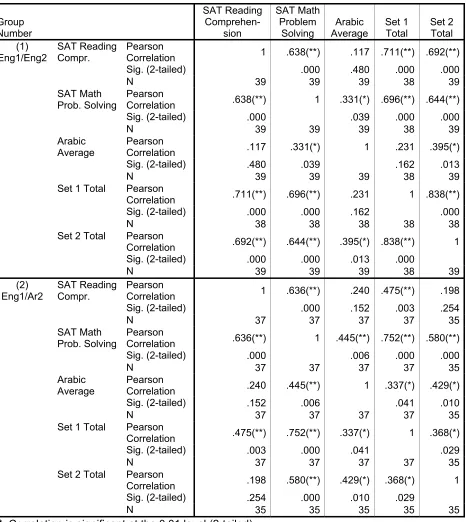
5 Overall correlation of variables... 95
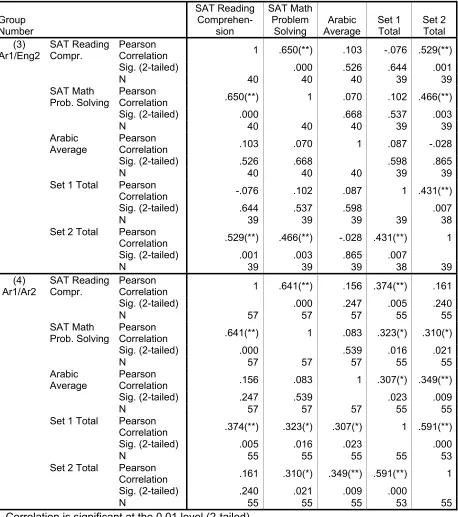
6 Correlations of variables within each group ... 98
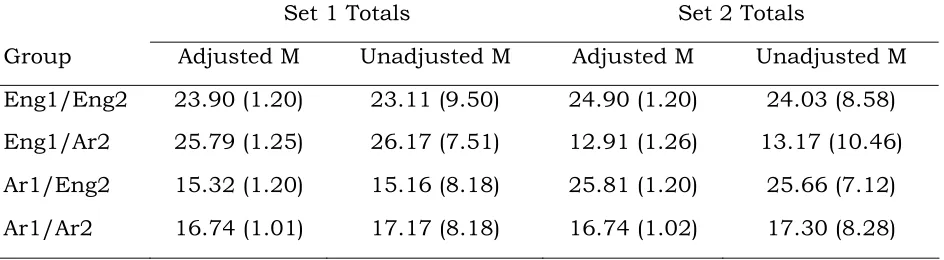
7 Adjusted And Unadjusted Means For Set 1 And Set 2 Totals By Group Category Using The Covariates SAT Reading Comprehension Scores, SAT Mathematics Problem Solving Scores, And Arabic Final Average As Covariates ... 102
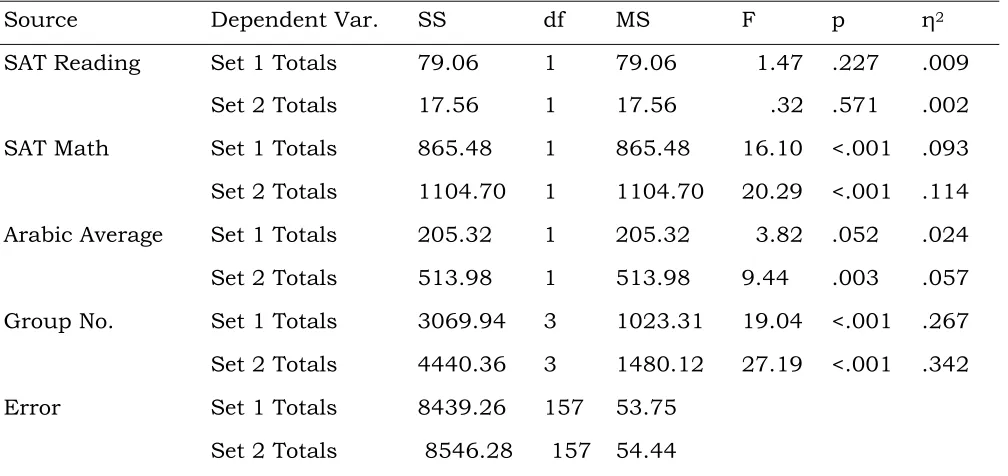
8 ANCOVA Summary Table for Set 1 and Set 2 Totals as a Function of Group Membership, Using SAT Reading Comprehension Scores, SAT Mathematics Problem Solving Scores, And Arabic Final Average As Covariates ... 103
9 Adjusted Means For Set 1 And Set 2 Totals By Group Number... 105
10 Effects of Group Number on Set 1 and Set 2 Totals... 105
11 Parameter Estimates as a result of MANOVA ... 106
12 Post Hoc multiple comparison of groups using Tukey ... 107
13 Coefficients For Model Variable Set 1, Using Group 1 as the Reference ... 109
14 Coefficients For Model Variable Set 2, Using Group 1 as the Reference ... 109
15 Simple and Multiple Regression Analysis Summary for Predicting English Version of Set 1 Totals ... 111
17 Simple and Multiple Regression Analysis Summary for Predicting
English Version of Set 2 Totals ... 113
18 Simple and Multiple Regression Analysis Summary for predicting
Arabic version of Set 2 Totals... 114
19 Total Percentage of Students Who Received Either a Score Of 0/1 (Failure), or 3/4 (Success) on Each Word Problem Based on the
Rubric ... 118
20 Total Percentage of Students Who Received Either a Score Of 0/1 (Failure), or 3/4 (Success) on Each Word Problem in the “Logical
Reasoning” Category Based on the Results from Table 19 ... 120
21 “Logical Reasoning” Word Problems... 121
22 Total Percentage of Students Who Received Either a Score of 0/1
(Failure), or 3/4 (Success) on Each Word Problem in the “Twice/Three/ Four Times As” Category Based on the Results from Table 19 ... 126
23 “X Times as Many” Word Problems ... 127
24 Total Percentage of Students Who Received Either a Score Of 0/1 (Failure), or 3/4 (Success) on Each Word Problem in the “Fewer Than” Category Based on the Results from Table 19 ... 130
25 “Fewer Than” Word Problems... 131
26 Total Percentage of Students Who Received Either a Score Of 0/1 (Failure), or 3/4 (Success) on Each Word Problem in the “Think
Backwards” Category Based on the Results from Table 19 ... 136
27 “Think Backwards” Word Problems... 137
28 Total Percentage of Students Who Received Either a Score Of 0/1 (Failure), or 3/4 (Success) on Each Word Problem in the “Multi-Step Problem” Category Based on the Results from Table 19 ... 141
ABSTRACT
This study aims at answering questions pertaining to the performance of
bilingual Arab-American students on solving word problems written in their
home and school languages: (1) Does the language in which a word problem is
stated have an effect on the performance of the bilingual Arab-American
students?; (2) Do Arab-American students with higher levels of Arabic
proficiency perform better in either or both versions of the word problems?; and
(3) What are some common differences and similarities in the problem solving
processes of Arab-American students as they solve problems in English or
Arabic? The study used both quantitative and qualitative methods to analyze
these questions.
A total of 173 students from a full-time Islamic school participated in
this study: 56 students in fifth grade, 56 students in sixth grade, and 61
students in seventh grade. All students were asked to solve two sets of ten
word problems each. The students were randomly assigned to one of four
groups.
Results showed that Arab-American students performed significantly
better in the English version of the word problems. Arab-American students
with higher levels of Arabic proficiency performed better in the Arabic version of
the word problems. Students’ standardized scores on mathematics problem
solving was a significant factor in explaining variances in student performance
standardized scores on reading comprehension was a significant factor in
predicting the students’ performance on the English version of the word
problems, students’ final average in the Arabic subject was a significant factor
in predicting students’ performance on the Arabic version of the word
problems.
Differences and similarities emerged in the problem solving processes of
Arab-American students solving the word problems in either English or Arabic.
Some students found statements involving double comparisons, problems with
hidden information, and problems that required multi-step solutions or
thinking backwards to be problematic in both language versions of the
problems. Difficult vocabulary was especially problematic for students when
solving the Arabic version of the word problems.
KEYWORDS: Arab-Americans, bilinguals, language minority students, Arabic
language, math problem solving, word problems, multicultural education,
CHAPTER ONE
INTRODUCTION
This study investigated the effect of student comprehension levels in the
home language (Arabic) and the language of instruction (English) on their
abilities to solve mathematical word problems presented in both languages.
The study also investigated whether students with higher levels of
comprehension in the home language tend to perform better on either language
versions of the word problems. The study finally explored any common trends
in student processings of both language versions of the problems.
This chapter describes the background of the study, the theoretical
framework, the purpose of the study, the research questions, and the
significance of the study. A list of definitions of terms, limitations and
delimitations, and the organization of the study are included at the end of the
chapter.
Background of the Study
Many studies have shown that students’ difficulties and poor
performance in mathematical problem solving are more of a linguistic nature
rather than intellectual or cognitive (Bernardo, 2002; Dawe, 1983; De Avila &
Duncan, 1985, Mestre, 1988). This influence of language on problem solving
skills is particularly salient for students who are bilingual and are considered
source of underachievement in school is students’ inability to understand the
language of instruction. Khisty (1995) makes it clear that language is crucial
in the teaching and learning process by which meanings are developed and
shared within the classroom. Aiken (1972) reports that reading comprehension
highly correlated with problem solving abilities and that difficult vocabulary
and syntax continue to be an impediment to successful problem solving.
Students who are not native-born English speakers are often labeled as
Limited English Proficient (LEP) or language minority students. Such
educational labels tend to call attention to what students cannot do. In
addition, the term “minority” tends to carry the meaning of inferiority, even
though it is used in reference to the numerical status of these particular
students. This sensitivity towards labeling has been reflected in refraining
from referring to people as “disabled” or “handicapped”, but rather as people
who are “physically challenged” or “differently abled”, thus, steering focus away
from their limitations and viewing them in terms of their capabilities (McLeod,
1994). Negative labels may color the treatment of students who lack English
fluency and enhance false assumptions that somehow students who cannot
speak English proficiently also lack the intellectual capacity for high level
academic achievement (McLeod, 1994).
The National Assessment for Educational Progress (NAEP) reported that,
in 2003, 51% of Limited-English-proficient (LEP) students in 4th Grade and
74% in 8th Grade performed below the Basic level nationwide, while only 9% of
Proficient level (National Center for Education Statistics [NCES], 2003).
Compare these percentages to 24% of public school students nationwide in 4th
Grade and 33% in 8th Grade performing at below Basic level; while 31% in 4th
Grade and 27% in 8th Grade performing at or above Proficient level. Of the
ELL students in grades 4 and 8, 44% (7% less from 2003) and 70% (4% less
from 2003) performed below the Basic level nationwide, respectively. Of the
ELL students in grades 4 and 8, 13% (4% more than 2003) and 6% (1% more
than 2003) performed at or above the Proficient level, respectively. On the
other hand, 16% of non ELL public school students in 4th Grade (8% less than
2003) and 27% in 8th Grade (6% less than 2003) performed at below Basic
level; while 42% in 4th Grade (11% more than 2003) and 33% in 8th Grade (6%
more than 2003) performed at or above Proficient level. ELL students have
shown slight improvement in 2007, compared to 2003; however, public school
students have shown greater improvement, especially for those performing at
or above Proficient level (NCES, 2007).
Theoretical Framework
In an attempt to understand the low academic achievement of students
from non-English language backgrounds, the educational status is analyzed
from two different approaches. The traditional approach focuses on the inner
abilities of the students, thus emphasizing the psychological aspect of learning,
whereas the more contemporary approach shifts attention to the conditions of
is a psychologically based model that sees language as the main obstacle to
success, and therefore promotes programs that teach English as a second
language as the means to help these students achieve success (McLeod, 1994).
The goal is to enable students to become more acceptable in the mainstream
society by overcoming the language barrier and helping non-English speakers
to become better English speakers (McLeod, 1994). This approach focuses
more on imitating already successful groups, hence ignoring the emotional and
identification aspects of second language learners (McLeod, 1994). On the
other hand, the sociological approach seeks to achieve parity through accepting
the non-English speakers into the mainstream society as he or she is, without
sacrificing diversity or demeaning any particular group. Identifying
non-English speaking students as members of a subordinate group is the main
obstacle these students face, not the lack of language skills (McLeod, 1994). If
treatment of these students in the day to day classroom activities is ensured to
be fair and just, then the end goal of improving their achievement levels will
naturally occur as a result (McLeod, 1994).
Both approaches agree on the need to achieve parity between the level of
achievement of students from non-English backgrounds and native English
speakers. However, they disagree on how to achieve this goal (McLeod, 1994).
As these two approaches converge, a new model of teaching emerges that
embodies the strengths of both models and tackles shortcomings and oversight
and socio-emotional factors in the learning process of non-English speaking
students (McLeod, 1994).
Purpose of the Study
The purpose of this study is to investigate the performance of
Arab-American students when solving mathematics word problems in Arabic and
English. Students who participated in this study were mostly non-native
English speaking students sharing similar cultural background where the
home language is non-English and mostly Arabic. The purpose of this study is
to provide a source of input on how this particular group of bilingual students
performs on mathematical problem solving when problems are presented in
their home language (Arabic) or in their language of instruction (English). This
study explored the effect of students’ comprehension levels in the Arabic and
English languages on their mathematical problem solving abilities.
Research Questions
This study aims at answering the following questions for Arabic speaking
students who are literate in both English and Arabic:
1. Does the language in which a mathematical word problem is stated
have an effect on the performance of the bilingual students?
Specifically, is there a difference in the performance of
Arab-American students when solving word problems in English compared
2. Do Arab-American students with higher levels of Arabic proficiency
perform better in either or both versions of the word problems?
3. What are some common differences and similarities in the problem
solving processes of Arab-American students as they solve problems
in English or Arabic?
Significance of the Study
There has been growing interest in the effects of bilingualism on the
students’ cognitive abilities; however, the majority of research has focused on
Hispanic students and other minorities, overlooking the Arabic speaking
population. This study adds to the existing body of research on bilinguals’
performance in mathematical problem solving through its attention to
Arab-American students. The lack of research on this particular student population
makes this study exploratory in nature and an important first step setting
direction for future studies.
Definition of Terms
The following terms are defined in reference to their use for the purpose
of this study:
Language proficiency vs. verbal ability: the term language proficiency is used to
refer to language skills of persons who do not exhibit native-like skills, while
the term verbal ability is used to refer to a continuum of verbal skills
ELL: English Language Learners.
NEP: Non-English Proficient.
LEP: Limited English Proficient.
L1: first language which refers to the home language.
L2: second language which refers to the school language.
Semilinguals: Students who possess less than native-like skills in both
languages (Cummins, 1979).
Fully bilingual: Students who possess native-like skills in both languages
(Cummins, 1979).
Arab-American: An Arab-American is a person who resides in the United States
and holds an Arab cultural and linguistic heritage. For the purpose of this
study, students are referred to as Arab-Americans because their home
language is Arabic and they are currently living and studying in the United
States. The term Arab-American does not convey any indication of the
student’s proficiency in either the Arabic or the English languages. In fact,
Arab-American students participating in this study include students that can
be described as ELL, NEP, LEP, semilinguals, and fully bilinguals. They are
considered to be language-minority population. SAT reading comprehension is
the measure that was used in this study to differentiate between the levels of
English proficiency of these students.
Stanford Achievement Test, tenth edition: The Stanford Achievement Test (SAT)
is a standardized test that measures student achievement in reading, language,
grade levels. For the purpose of this study, only reading comprehension and
mathematics problem solving categories within the SAT test were used to
measure students’ proficiency in the English language and ability in
mathematical word problem solving.
Arabic final average: the overall average in the Arabic subject given by the
school at the end of the academic year. This grade acted as a general measure
of Arabic competency of the students participating in this study.
Linguistic distance hypothesis: The differences between semantics, functions
and status of languages are referred to in sociolinguistic theory as the
linguistic (language) distance (Halliday, 1975).
Cognitive constructivism: Cognitive constructivism explains how learners
adapt and refine mental structures that are viable and reflective of one’s
personal experience (Windschitl, 2002).
Social constructivism: Social constructivism views knowledge as the product of
the individual’s participation in meaningful activities with others, where much
emphasis is placed on communication and negotiation within a mathematical
community of learners (Noddings, 1990).
NCTM: the National Council for Teachers of Mathematics is an organization of
mathematics educators and administrators who embarked on a mission to
drastically improve mathematics education in the United States and Canada.
Equity: Equity as defined by NCTM does not translate to providing all students
with identical instruction, but rather making practical and realistic
Limitations and Delimitations of the Study
This study has been conducted in a full-time Islamic school in the
Eastern region of the United States. The population of this study consisted of
173 students from grades 5, 6, and 7. The size of the study sample is relatively
small. I used the final yearly average for the Arabic subject given by the school
due to the lack of standardized testing in the Arabic subject. While this
average provided an overall measure of students’ level of competence in the
Arabic language, it did not provide a specific measure of the level of
comprehension of the student in the Arabic language.
This may limit the generalizability of the findings of this study to
students who are Arab-American enrolled in full-time Islamic schools in the
United States.
Chapter Summary
Many students, including Arab-Americans, struggle in mathematics.
There is a lack of research on exploring factors that might affect Arab-American
students’ performance in mathematics, particularly in solving word problems.
Based on my literature review, many studies found that limited proficiency in
the language of mathematical instruction contributed to difficulties faced by
bilinguals, especially when the language of instruction of the mathematics was
in their weaker language (Aiken, 1972; Bernardo, 1999; Cuevas,1984; Dawe,
1983; De Avila & Duncan, 1985). This study goes beyond investigating the
mathematical word problems, and the students’ mathematical problem solving
abilities. The students’ individual solutions have been carefully studied to
detect any patterns or mistakes specific to the Arabic version of the word
problems.
Organization of the Study
This study is organized into five chapters that present literature and
research results on the influence of language on bilingual students’ processing
of mathematical word problems.
Chapter I describes the background of this study, the theoretical
framework, the purpose of this study, the research questions, and the
significance of the study. A list of definitions of terms is included explaining
the context in which these terms will be utilized within the study. At the end of
this chapter, a limitations and delimitations section followed by an overview of
the organization of the study is included.
Chapter II contains a review of the literature pertaining to this study.
The chapter begins with an overview of the constructivist theory and then
presents NCTM’s goals and achievements focusing on issues of equity and
cultural diversity in relation to bilingual students. A description of factors
affecting the quality of acquiring a second language and a detailed account of
Cummins theory on how bilinguals can achieve cognitive competence follows.
Finally, a discussion of how knowledge of more than one language relates to
from several studies on bilingual students’ performance on mathematical
problem solving follows.
Chapter III describes the methodology of this study. It begins with a
reference to the purpose of the study and the research questions. This chapter
includes a detailed description of the procedures for conducting the study, the
sample population, instrumentation, the research design, the data analysis
procedures, and research issues, such as reliability and validity of the study.
Chapter IV presents the findings of this study. This chapter begins with
the results of the quantitative statistical analysis from running descriptive
statistics, correlations, MANCOVA, MANOVA, a multiple regression, and finally,
a simple regression followed by a multiple regression. The second part of this
chapter reports the results of the qualitative analysis of student word problems
processing for each problem in both sets.
Chapter V, the final chapter, ends with relating the findings of this study
to the research reported in the literature review. The chapter ends with
CHAPTER TWO
REVIEW OF RELATED LITERATURE
Introduction
This literature review begins with an overview of the theoretical
framework guiding this study, namely the constructivist theory. This leads
into presenting the contributions of NCTM in the advancement of the
mathematics education with special attention to its first principle of equity and
how it impacts the mathematical education of students with diverse cultural
and linguistic heritage. I then describe the relationship between bilingualism
and cognitive achievement, as well as factors affecting the quality of acquiring a
second language. Then, a detailed account of Cummins theory that shows the
importance of continually developing the first language in order for bilinguals
to attain cognitive benefits follows. Finally, a discussion of how knowledge of
more than one language relates to students’ performance in mathematics
follows, along with an account of several studies’ findings with respect to
bilingual students’ performance on mathematical problem solving.
Theoretical Framework
Constructivist Theory
Constructivism is the basis for progressive pedagogy (Windschitl, 2002).
From the historical perspective, constructivist movement is in many ways
centered to child centered instruction. Both encouraged teaching for
conceptual understanding rather than factual memorization (Windschitl,
2002). Early attempts to reform were reported as early as the late 1800s and
included taking students on fieldtrips to the countryside with the intent of
teaching them geography in context (Windschitl, 2002). Other attempts
included adapting the curriculum to the needs and interests of the students as
means of enabling students to become autonomous learners (Windschitl,
2002), self-motivated and active participants in the learning experience.
Ernst von Glasersfeld (1990) derives the following basic principles of
constructivism from Jean Piaget’s writings whom he and many others
considered to be the great pioneer of the constructivist theory of knowing:
1. Knowledge is not passively received either through the senses or by
way of communication. Knowledge is actively built up by the
cognizing subject.
2. (a) The function of cognition is adaptive, in the biological sense of the
term, tending towards fit or viability;
(b) Cognition serves the subject’s organization of the experiential
world, not the discovery of an objective ontological reality (pp 22-23).
Through actions and reflection on actions, individuals construct their
own reality which is viable within the realm of their experience (Steffe & Kieren,
1994). Moreover, students’ constructed knowledge is not considered a mirror
but rather the conceptual means through which individuals make sense of
their own experience (von Glasersfeld, 1990).
It was Piaget’s cognitive development psychology, and not his
epistemology, that greatly influenced the constructivist thought (Steffe &
Kieren, 1994). Both Piaget and Kant made a distinction between empirical
knowledge and logico-mathematical knowledge (Noddings, 1990). However,
while Kant viewed cognitive structures as innate, Piaget believed that they were
products of development (Noddings, 1990). Similarly, while Chomsky viewed
the linguistic structures of mind to be innate, Piaget maintained that the
development of certain logical structures through the coordination of action
preceded the construction of linguistic structures and made them possible
(Noddings, 1990). Both would agree that cognitive structures are themselves
products of continued active construction (Noddings, 1990). Constructivism is
thus a combination of a process of assimilation in which knowledge is created,
and a process of accommodation in which existing constructs are continually
revised and modified based on new experience (Noddings, 1990).
Based on Piaget’s logical structures and emphasis on experience in
constructivism, children are ready to learn fundamental structures of
mathematics through working with physical materials (Steffe & Kieren, 1994).
Cognitive research has shown that learners’ mathematical thinking progress
from the concrete to the abstract (Baroody & Ginsburg, 1990). Hence, a direct
application of the Piagetian theory is the heavy use of manipulatives in
purpose to engage them in the learning process (Noddings, 1990). The
underlying principle of constructivism is that understanding cannot be
imposed upon the learner (Baroody & Ginsburg, 1990). Children, like adults,
will usually engage in the learning process when they are presented with a
novel task of medium complexity that triggers their interest or arouses their
natural curiosity (Baroody & Ginsburg, 1990). Vygotsky (1978) referred to the
distance between the learner’s current level of knowledge and the attainable
level of knowledge within reach of the learner as the zone of proximal
development (ZPD). Within this ZPD, children are constructing knowledge
through problem solving, collaboration, and social interaction In his own
words, Vygotsky (1978) defines ZPD as “..the distance between the actual
development level as determined by independent problem solving and the level
of potential development as determined through problem solving under adult
guidance or in collaboration with more capable peers (p. 86).” A main source
for learning difficulties is the gap between formal instruction which is usually
abstract and the child’s existing knowledge of mathematics which is usually
concrete and informal (Baroody & Ginsburg, 1990). When formal instruction is
disconnected from the students’ existing knowledge and the learning tasks are
either too complex or too repetitious and redundant, students will quickly lose
interest because they either are not yet ready to learn the material or it makes
little or no sense to them (Baroody & Ginsburg, 1990). Polya (1963)
acknowledges that abstractions are important in the study of mathematics,
for the students. Hence, implications for successful teaching are: to develop
diagnostic teaching strategies in the zone of current knowledge; to progress to
the zone of proximal development through the use of authentic activities such
as problem solving; and to reshape the roles of the teacher and the other
learner, the more capable peer (Harland, 2003). A key to successfully
diagnosing the current level of knowledge and progressing through the zone of
proximal development is to reflect critically about learning (Harland, 2003).
Furthermore, authentic activities are essential components for establishing the
best environment for learning (Harland, 2003) which are the opposite of the
‘busy work’ described by Dewey (1938) as “something that has the semblance
but not the substance of scientific activity.” (p. 108)
Constructivists propose that all mental activity is constructive, even in
passive learning situations that involve drill and practice or listening to
lectures (Windschitl, 2002; von Glasersfeld, 1995; Noddings, 1990). So,
instead of debating on whether a learning situation is constructive or not, some
theorists suggest differentiating between “strong” acts of construction and
“weak” ones (Windschitl, 2002; Noddings, 1990). Connecting new information
with existing concepts to form internally coherent and meaningful body of
knowledge that can later be used to further construct new knowledge reflect
“strong” acts of construction (Windschitl, 2002). On the other hand, “weak”
acts of construction usually occur through memorization or recollection of
(Windschitl, 2002) and have no practical application to the knower (Noddings,
1990).
Types of Constructivist Learning
Some theorists emphasize the cognitive process as constructivist
learning; others emphasize the social processes, depending on whether the
focus is the individual as the learner, or as the social co-constructor of
knowledge (Windschitl, 2002). Cognitive constructivism explains how learners
adapt and refine mental structures that are viable and reflective of one’s
personal experience (Windschitl, 2002). Focus is on studying and explaining
the individual’s ability to use tools, information resources and input from other
individuals to solve problems that arise in the learning process while
maintaining and refining ideas that are reasonable to the learner (Windschitl,
2002). The backbone of the process of construction is for the learner to
develop personal autonomy (Confrey, 1990). Hence, as teachers, we provide
the learner with the lens and the tools to make sense of the world and be able
to reflect on those lenses to further develop their cognition (Confrey, 1990).
Social constructivism, on the other hand, views knowledge as the product of
the individual’s participation in meaningful activities with others. Much
emphasis is placed on communication and negotiation within a mathematical
community of learners (Noddings, 1990). The use of small groups in
cooperative learning enables children to gradually internalize the talk that
dialogue (Windschitl, 2002) during which they begin to question each other’s
reasoning and challenge each other while at the same time monitoring their
own mental processing until they reach consensus (Noddings, 1990) and come
up with “shared constructs”. Some scholars offered a way of combining the
cognitive and social constructivist perspectives by claiming that “knowledge is
personally constructed and socially mediated” (Windschitl, 2002). Each
individual makes sense of their own personal experience within the constraints
of the social interaction through collaboration and communication with other
members of the social group to achieve a fit and a consensus within the
domain of the social environment (von Glasersfeld, 1990).
NCTM and Constructivism
The business community is always on the lookout for employees who can
think creatively, can identify and solve problems, are flexible and able to meet
the ever changing work demands, and can work collaboratively with others to
produce complex and sophisticated products (Windschitl, 2002). Mathematical
competence has always played an important role in opening doors for more
productive futures. Realizing that, and the need for continually improving the
quality of mathematics instruction to remain competitive with other countries,
the National Council for Teachers of Mathematics (NCTM) embarked on a
mission to drastically improve mathematics education in the United States and
Canada. Beginning in 1989, NCTM published several documents articulating
curricula, teaching, and assessment. The latest of those documents is the
Principles and Standards for School Mathematics, published in 2000, which
describes the basic skills and understandings necessary for students to be
proficient and competent in the twenty-first century. The document is divided
into sections highlighting:
(1) The Principles: Principles deal with broad mathematical issues,
mainly: equity, curriculum, teaching, learning, assessment, and technology.
These principles lay the foundation on which educators could base their
decisions related to school mathematics.
(2) The Standards: Standards consist of a total of ten comprehensive
goals: five of which discuss instructional goals in the content areas of number
and operations, algebra, geometry, measurement, and data analysis and
probability; the other five describe procedural goals in problem solving,
reasoning and proof, connections, communication, and representation. The
ten Standards are discussed in detail including a set of expectations specific to
each of the four grade bands: from prekindergarten to grade 2; grades 3 to 5;
grades 6 to 8; and grades 9 to 12. Discussion of the issues pertaining to the
practical applications of the Principles to help make the vision set by NCTM a
reality is included.
Consistent with the theory of constructivism, NCTM (2000) maintains
that “students learn more and better when they take control of their own
learning. (p. 5)” Making conjectures, experimenting with various approaches
others’ arguments, characterize an active learning environment advocated by
NCTM (2000). Problem solving is considered to be a goal as well as a means of
learning mathematics. Through problem solving, students build new
mathematical knowledge, apply and adapt a variety of appropriate strategies to
solve problems while monitoring and reflecting on the process (NCTM, 2000).
In mathematics education, acknowledging the learner as an active
knower implies a way of teaching where teachers who embrace the
constructivist philosophy act as agents of change rather than transmitters of
knowledge (Noddings, 1990). Their aim should include teaching students how
to think for the purpose of solving problems by utilizing formal thought
processes, such as inductive and deductive reasoning, as well as informal ones,
such as making educated guesses about the results of the problem before
actually solving the problem (Polya, 1963). Students learn mathematics most
efficiently through guided discovery, meaningful application, and problem
solving rather than imitating teacher’s manipulation of formal symbols through
worked out examples and preset algorithms (Goldin, 1990). Polya (1963)
identifies three principles of learning:
1. Active learning: “The best way to learn anything is to discover it by
yourself.” Hence, allowing students to discover the major concepts of
the lesson and to establish the mathematical relationships by
themselves make the learned information more accessible for future
2. Best motivation: Allowing students to formulate their own problems
requires more insight and originality than working on the solution,
and usually motivate them to work harder to solve the problem. A
desirable attitude of the mind to instill in the students would be to
encourage them to guess the result before actually solving the
problem, hence, following the example of real life scientists.
3. Consecutive phases: Learning begins with (1) exploration and
perception through manipulating and experiencing with concrete
objects; (2) then formalization to a more conceptual level that involves
the use of terminology, definitions, and proofs; and (3) assimilation,
where the learnt material is mentally digested and incorporated
within the larger system of knowledge leading to higher
generalizations on one hand and practical application on the other.
Constructivist teachers build their instruction on students’ current
knowledge. Because students learn by connecting new ideas to prior
knowledge (NCTM, 2000), such teachers are aware of what children bring to
the learning situation and they continually evaluate growth in students’
understanding through observing, questioning students’ solutions and
listening to students’ interacting with each other (Steffe & Kieren, 1994). A
constructivist teacher is more interested in learning how students developed
their solution rather than being presented with a faultless product (Noddings,
1990). Hence, part of the effort of the constructivist teacher is to help students
order to overcome misconceptions about the students’ ways of perceiving an
idea, (Confrey, 1990). A constructivist teacher challenges students’ existing
ideas and presents them with problems that encourage students to engage in
discussions utilizing new ideas in different contexts (Windschitl, 2002). They
encourage students to discover that various roads might lead to the intended
solutions or instructional endpoints (Noddings, 1990). In ideal problem solving
situations, teacher’s input and guidance should be given only if necessary, so
that students don’t become preoccupied with trying to fulfill or discover the
teacher’s expectations and intentions (Noddings, 1990).
NCTM and Equity
The NCTM’s Principles and Standards (2000)had a profound
influence on the reform in mathematics education. NCTM acknowledged that
among the issues that have been ignored in the teaching and learning of
mathematics were considering the contribution of the student cultural
experiences, social background, and the effect of student gender on their
learning. In adherence to the importance of cultural heritage, several writers
have written books or articles connecting a particular culture to mathematics.
Many of Ladson-Billings (1995a, 1995b, 1997) work focus on culturally
relevant strategies for teaching African-American students mathematics and
other subjects. Several books by Zaslavsky (1994, 1996, 2003) describe
different mathematical activities or games that are practiced by diverse
perspective to provide lenses from which diversity can be appreciated (NCTM,
1997; Nelson, 1993). Germain-McCarthy and Owens (2005) provide case
studies of teachers engaging students in a learning environment that is
relevant to the student cultural backgrounds and is in accordance with NCTM
recommendations and standards. Teachers portrayed use problems or
situations that have a cultural connection to classrooms of African-American
students, Muslim Arab-American students, Euro-American students, Haitian
students, Hispanic students, and native-American students. In this book, the
researcher of this study is profiled in a lesson to a group of Arab-American fifth
grade students focusing on Islamic inheritance laws as a motivation for
teaching multiplication of fractions (Sarmini, 2005). The lesson made
connections to the important historical mathematician, Al-Khawarizmi and
implemented the use of both Arabic and English languages to show how the
terms ‘algebra’ and ‘algorithm’ originated from the Arabic terms. The lesson
touched on how the Islamic inheritance law is related to the general
inheritance laws found in the American society.
Such connections address concerns reflected in a statement issued by
NCTM in September of 2008 declaring its position on students who speak a
first language other than English or have related cultural differences:
Every student’s cultural heritage should be accepted and
celebrated for the diversity that it brings to the learning
environment. Expanded opportunities should be available to
develop mathematical understanding and proficiency.
Mathematics teachers should have knowledge of content and
pedagogy that support ELL students, including an understanding
of the role of the first language. (p. 1)
The first principle set by NCTM in the Principles and Standards for School
Mathematics highlights the vision for a more competitive future: “Excellence in
mathematics education requires equity – high expectations and strong support
for all students.” Equity as defined by NCTM does not translate to providing all
students with identical instruction, but rather making practical and realistic
adjustments to instruction so that all students have equal access to success.
In order to achieve educational equity, NCTM sets general guidelines in order to
achieve educational equity:
1) Equity requires high expectations and worthwhile opportunities for all (p.
12, NCTM 2000). Students who are not native speakers of English, who
live in poverty, who are females or classified as nonwhites, and who have
disabilities have all been victims of low expectations which had a
detrimental effect on their own confidence to succeed in mathematics.
Teachers’ awareness of this issue, purposive effort to provide steady
support to all students, and high-quality mathematics instruction play
an important role in ensuring students excelling in mathematics.
2) Equity requires accommodating differences to help everyone learn
for some students in order to meet high mathematics expectations, such
as students who are not native speakers of English.
3) Equity requires resources and support for all classrooms and all
students (p. 13, NCTM 2000). Technology can play an important
role in capturing and maintaining student interest and providing
individualized instruction for students who need the extra practice
or instruction. Moreover, it may provide students with intellectual
resources and a link to the global community of mathematics
learners and allow them to engage in collaborative projects with
other schools nationwide or worldwide.
Schools and teachers should make content more accessible in a second
language as well as find ways to implement culturally relevant pedagogy in
teaching mathematics in order to properly serve ELL students (NCTM, 2008).
Since communication is underscored in the Principles and Standards for School
Mathematics (NCTM, 2000) “as an essential part of mathematics and
mathematics education”, it is critical that teachers provide appropriate support
and encouragement for all students, especially ELL students, to speak, write,
read, and listen in mathematics classes (NCTM, 2008). Since mathematics is a
specialized language with its own grammar and vocabulary, students need to
engage in using “the language of mathematics to express mathematical ideas
precisely” (NCTM, 2000). Through communication, students learn to articulate
their thinking and as they listen to their peers’ explanations, they learn to
communication is exploring problems from multiple perspectives which help
sharpen the participants’ thinking and reasoning skills.
Recognizing the importance of problem solving as a goal as well as a
means of learning mathematics, I was interested in investigating
Arab-American students solving word problems in both their home language as well
as the language of instruction. When formulating the word problems for each
set, special attention was given to choosing a level of difficulty appropriate for
students in grade 5 through 7. The numbers used in the word problems were
at a difficulty level appropriate for a fifth grader to handle, but not too easy for
a seventh grader. The complexity of the word problems was within reach of the
students. In order to trigger their interest, the content of the word problems
were geared to reflect the students’ own cultural experience and social values.
Based on NCTM’s recommendations to establish equity for ELL students,
Arabic may play an important role in supporting the teaching of Arab-American
students and in helping make excellence more accessible.
Language and Performance
Importance of Language
Misconceptions about the central role of language in the educational
development of bilinguals might prompt some teachers to ask parents of
minority language children to avoid using their first language in
communicating with their children at home in hopes of helping them become
minimizing confusion of continuous switching between their first language (L1)
and L2 (Cummins, 1981b). If parents refrain from using L1 at home and are
not proficient themselves in L2, then they are more likely to expose their
children to faulty application of the L2 which will inhibit the children’s proper
development of L2. On the other hand, if the parents are proficient in L2 but
refrain from using L1 at home, then they simply deprive their children of the
chance of becoming fully bilingual even though their children’s development of
L2 might not suffer per se. The bottom line is that when parents support the
development of L1 at home through reading activities and regular interactions,
they are raising their children’s chances in succeeding academically in both L1
and L2 through further development of essential cognitive/academic language
proficiency (Cummins, 1981a).
While some research has shown that bilingual students acquire higher
levels of academic achievement (De Avila & Duncan, 1985; Lambert & Anisfeld,
1969), other studies have shown that continuous switching between home and
school languages seems to result in inadequate command of both first and
second languages (Cocking & Chipman, 1988). Mismatch between home and
school languages demands that students acquire new set of linguistic
constructs and rules in order for them to think and express themselves in the
mathematics classroom (Adetula, 1990). Macnamara (1967) proposes that in
order to achieve balance, a bilingual child sacrifices some of his L1 skills to
attain skills in L2. Macnamara (1967) also claims that mismatch between
especially when students are taught through the weaker language (cited in
Cummins, 1979). However, experimental studies that show students studying
in a second language matching or excelling over those studying in their mother
tongue, refutes Macnamara’s “balance effect” claim and suggests that other
social factors might play a role in determining the level of academic
achievement of bilinguals (Cummins, 1979). It is highly recommended to
initiate schooling for bilinguals in their first language in situations where the
home language is not highly valued by the community at large, where either
teachers and/or pupils are insensitive or ignorant about their values and
traditions, and where no support or pressure exist within the home to maintain
literacy in their first language. Otherwise, where literacy is greatly valued and
highly encouraged, it seems fully appropriate for bilinguals to begin schooling
in the second language (Cummins, 1979). In order to better understand the
interaction between initial instruction in their first language and academic
progress, one needs to explore two main child input factors:
conceptual-linguistic knowledge, and motivation to learn L2 while maintaining L1.
Quality of Acquisition of Second Language
Social Class and Background Factors
The social and cultural aspects of bilingualism play an important role in
determining not only how fluent a person becomes in each language, but also
prestige of L1, security of children’s identity and self-concept, and level of
support for L1 development and maintenance in home and environment affect
the level of success of students in bilingual educational programs (Cummins,
1981b).
There are four possible outcomes to how minority language children
identify themselves when participating in two different cultures: (1) they tend
to closely identify themselves with both cultures and hence are more likely to
achieve high levels of competence in both languages compared to (2) children
who reject both cultures; (3) they might identify themselves with their own L1
culture and reject L2 culture and hence might resist learning L2; (4) they might
identify themselves with L2 culture and reject their own L1 culture and hence
might promote learning L2 which gradually replaces L1 (Cummins, 1979).
Children who reject both cultures often end up unable to fully identify
themselves with either of the two cultures (Cummins, 1981a).
character affect how skillfully a person learns another language (Von Glasersfeld, 1995).
Another factor affecting the level of difficulty of learning a second
language is the age at which the student is exposed to the second language.
Even though older second-language learners may possess higher developed
skills that make it easier and quicker for them to learn the second-language
than younger students, it is more challenging for them to produce more
accurate and formal aspects of the language than younger learners. As
second-language learners progress through school, the challenge to learning
posed by the language becomes greater (Dawe, 1983). Moreover, the social and
cognitive abilities of the students along with their desire and motivation
determine the rate at which they learn a second language (Duran, 1985). Also,
certain aspects of the student’s own native language and culture play a critical
role in facilitating or inhibiting learning a second language.
Different Levels of Bilinguality
When referring to the language skills of a student, different terms are
used to distinguish between native speakers of that language and those who
are not. The term verbal ability is used to refer to a continuum of verbal skills
observable in native speakers, while the term language proficiency is used to
refer to language skills of persons who do not exhibit native-like skills (Duran,
1985). For students to be considered bilinguals, they need to be proficient in
student (De Avila, 1988). Students who possess less than native-like skills in
both languages are described as “semilinguals”; in this case, their linguistic
abilities have detrimental effects on their academic and cognitive progress
(Cummins, 1979). Cummins (1979) also differentiated between “additive”
bilingualism, where the bilingual child is adding or acquiring another language
without diminishing his competence in L1; and “subtractive” bilingualism,
where the bilingual child gradually replaces his L1 with a more prominent L2.
“Additive” bilingualism has been associated with studies that found positive
impact on the child’s cognitive growth, whereas “subtractive” bilingualism has
been associated with negative impact on the child’s cognitive growth. In order
for the child to benefit from acquiring a second language, the child needs to
acquire high competence in L2 without diminishing competence in L1
(Cummins, 1979).
Cummins (1981a), through extensive review of research, builds a case for
asserting that developing and maintaining L1 have a positive, rather than
negative, effect on the development of L2 and on other academic skills.
Promoting proficiency in both languages by using the minority language as
means of instruction in immersion programs for majority language children as
well as in bilingual programs for minority children has been proven effective
(Cummins,1981a). Based on the review of several researches, Cummins
(1981a) maintains that intellectual and academic advantages over
monolinguals are experienced by bilingual students who develop and maintains
relativity theory known as Sapir-Whorf theory which suggests that a language is not simply a means of communication, but embedded in the language is a world view. In other words, individuals articulate their world view through their language. This suggests that people who acquire more than one language tend to have a broader understanding and perception of the world (Von
Glasersfeld, 1995). However, acquiring a new language cannot be successfully achieved by merely learning a different vocabulary and a new set of
grammatical rules. Consequently, learning a new language demands a higher level of complexity and sophistication when dealing with the world and daily issues (Von Glasersfeld, 1995).
Time spent on developing minority students’ L1 proficiency can be
accomplished in school without undermining proficiency in the majority
language, L2 (Cummins, 1981). The Alberta government in Canada financially
supports a program in eight Edmonton elementary schools since 1972 in which
the medium of instruction for 50% of the regular school day is Ukrainian
(Cummins, 1981). A study by Cummins and Mulcahy (1978) compared the
performance of two groups of bilingual students attending the
Ukrainian-English bilingual program in Edmonton, Canada against a monolingual control
group from each of the first and third grade levels matched for IQ, SES, sex
and age. The two groups of bilingual students differed in the amount of
Ukrainian spoken at home which affected the degree of fluency of the student
in Ukrainian. The study found that bilingual students who were relatively
performed significantly better on analyzing ambiguities in the sentence
structure than the other groups with and without feedback cues (Cummins &
Mulcahy, 1978). The findings of this study is consistent with earlier studies
that have shown early childhood exposure to two languages promote better
linguistic awareness, more analytic processing of language input, and greater
sensitivity to linguistic cues and feedback (Cummins & Mulcahy, 1978). An
evaluation of a bilingual program used by certain schools in Santa Fe in which
Spanish was used between 30 and 50 percent of the school day throughout
elementary school found that children enrolled in that program performed
significantly better in both reading and mathematics than those enrolled in an
English-only program. Those who were enrolled in that bilingual program
since grade 2, performed in reading at a similar level as their English
counterparts by grade 5 and surpassed them in grade 4 and maintained equal
if not superior level through grade 6 (Cummins,1981). These findings might
impact the way administrators in full-time Islamic schools allot time for the
instruction of Arabic, especially in the elementary grade levels in order to
enable Arab-American students to achieve higher fluency in both languages as
they progress in school.
The Linguistic Distance Hypothesis
In acquiring a second language, the language learner faces challenges or
even advantages as predetermined by the similarities and differences between