R E V I E W
Open Access
Phytochemical and pharmacological progress on
the genus
Syringa
Guozhu Su
1,2, Yuan Cao
1,2, Chun Li
1, Xuelong Yu
1,2, Xiaoli Gao
1, Pengfei Tu
1and Xingyun Chai
1*Abstract
GenusSyringa, belonging to the Oleaceae family, consists of more than 40 plant species worldwide, of which 22 species, including 18 endemic species, are found in China. MostSyringaplants are used in making ornaments and traditional medicines, whereas some are employed for construction or economic use. Previous studies have shown that extracts ofSyringaplants mainly contain iridoids, lignans, and phenylethanoids that have antitumor, antihypertensive, anti-oxidant, and anti-inflammatory activities. This study reviews phytochemical and pharmacological progress on
Syringain the recent 20 years and discusses the future research prospects to provide a reference in further promotion and application of the genus.
Keywords:Syringa, Oleaceae, Iridoid, Lignan, Phenylethanoid, Bioactivities, Review
Introduction
Plants belonging to the family Oleaceae, which consists of 27 genera and 400 species worldwide, have important applications in the daily life of people living in developing countries. Plants of many well-known genera, including
Forsythia,Syringa, andOsmanthus, have been widely used for medicinal and industrial purposes. For instance, the stems and roots ofS. pinnatifoliavar.alashanensisis the major composition of atraditional formula‘Ba wei chen-xiang’powder that is used for treatment of asthma, cardio-palmus, and angina [1].
Most Syringa plants are deciduous shrubs and arbors and include more than 40 species distributed around Europe and Asia [2]. At present, 22 species are found in China, of which 18 are endemic species that are mainly distributed in the southwestern part of Sichuan, Yunnan, Tibet, and other Northwestern regions. ManySyringa spe-cies, such asS. chinensis,S. meyeri, andS. pekinensis, are
used for making ornaments. Flowers of S. oblata and
S. reticulatavar.mandshuricaare an ideal source of aroma oils or nectar. Some Syringaplants are also used for con-struction purposes or for manufacturing furniture [1].
Previous phytochemical studies on Syringa species
have revealed the presence of more than 140 secondary
metabolites, including iridoids, lignans, phenylethanoids, their glycosides, minor organic acids, and essential oils [3,4]. Modern pharmacological studies have shown the bioactivities of these metabolites, such as antitumor, an-tihypertensive, anti-oxidant, anti-inflammatory activities, and so on [5]. However, a systematic review of these studies has not been performed to date. This review summarizes the phytochemical and pharmacological
progress on Syringato date by focusing on its chemical
classification, structural features, and biological and pharmacological applications to provide information for further research on this genus.
Chemical constituents
Previous studies have reported that extracts of Syringa
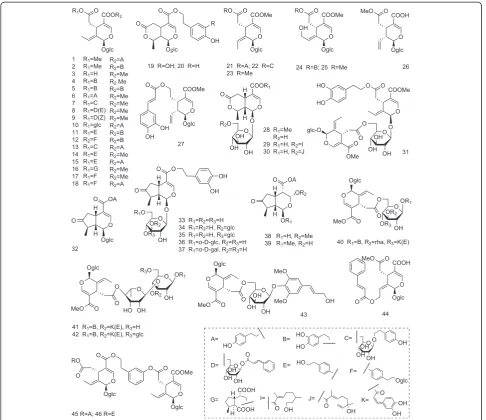
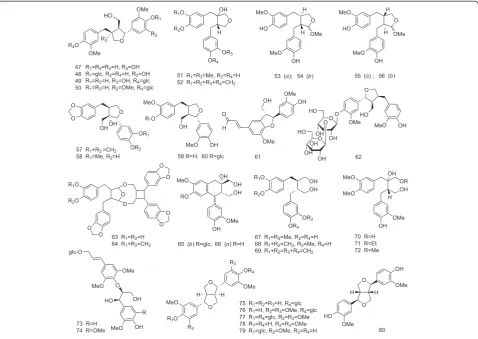
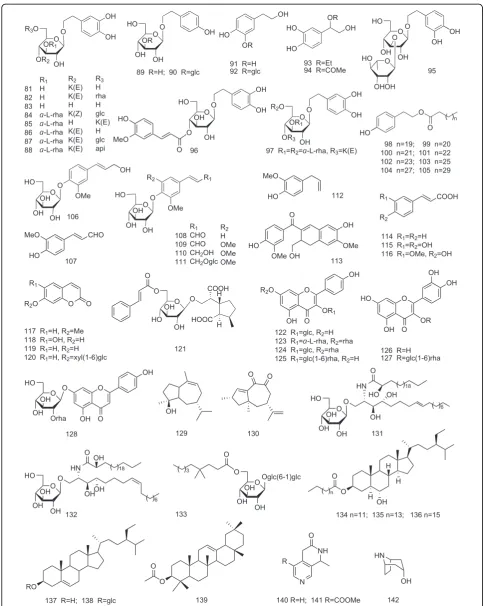
plants contain iridoids (1–46), lignans (47–80), phenyl-propanoids (81–105), phenylethanoids (106–121), and
other compounds (122–142). The structures of these
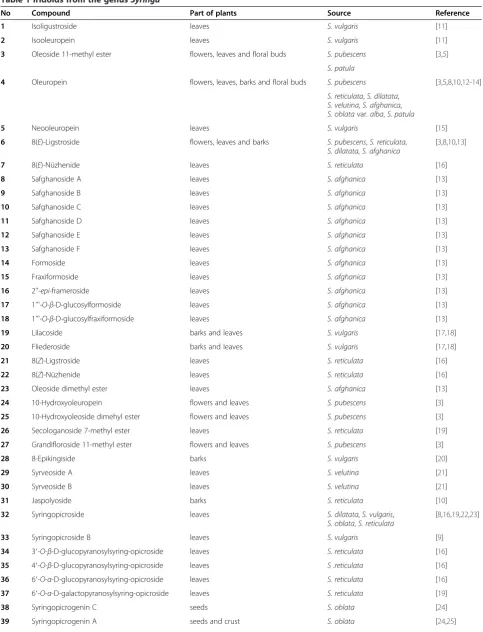
compounds are shown in Figures 1, 2, and 3 and related information are listed in Tables 1, 2, and 3.
Iridoids
Iridoids are one of the most important natural compounds that are widely distributed in various plant families such as Plantaginaceae, Rubiaceae, and Scrophulariaceae [6]. Iri-doids are extensively present in almost all Syringa species and have antitumor, antihypertensive, anti-inflammatory, anti-oxidant, and antifungal activities. In addition, iridoids * Correspondence:[email protected]
1Modern Research Center for Traditional Chinese Medicine, Beijing University of Chinese Medicine, 11 North 3rd Ring Road, Chaoyang District, Beijing 100029, P. R. China
Full list of author information is available at the end of the article
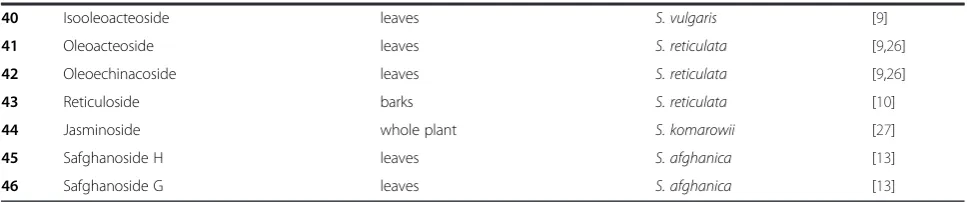
play an important role in defense mechanism of ants [7]. Among all the iridoids reported in this genus, secoiridoids are the most abundant and have been shown to have anti-tumor activity. To date, 46 iridoids (1–46) have been de-scribed, including secoiridoids (1–30 and 40–44), eight typical iridoids (32–39), and three minor dimers (31, 45,
and 46). Most iridoids exist as glycosides and are
mainly produced by the glycosylation of glucose and galactose. Syringairidoids are generally substituted by various acid fragments and phenolic moieties such as 1-O-cinnamoyl-β-D-glucopyranosyl,p-hydroxphenethyl, 3, 4-dihydroxy-phenethyl, and caffeic acid, which contrib-ute to their low polarity.Syringa iridoids have antitumor (33 and 40) [8,9], antihypertensive (4), and anti-oxidant (4and31) activities [10].
Lignans
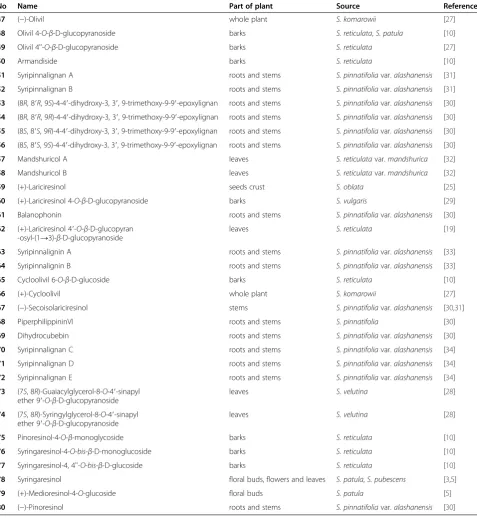
Lignans are another major compounds in this genus, par-ticularly inS. komarowii[27],S. pubescens[3],S. reticulata
[10],S. velutina[28],S. patula[5],S. vulgaris[29],S. pin-natifolia var. alashanensis [30,31], and S. reticulata var.
mandshurica [32]. Syringa species have 34 lignans and their glycosides (47–80), including monoepoxylignans (47–60,62) and their dimers (63and64), neolignans (61, 73–74), cyclolignans (65and66), simple lignans (67–72),
and bisepoxylignans (75–80). Lignans also exhibit
many bioactivities. For example, compound 50 has
anti-oxidant activity [10]; compounds 57 and 58 have
antifungal activities [32]; and compound75has signifi-cant cytotoxic, antihypertensive, anti-inflammatory, and anti-oxidant activities [5].
Other compounds
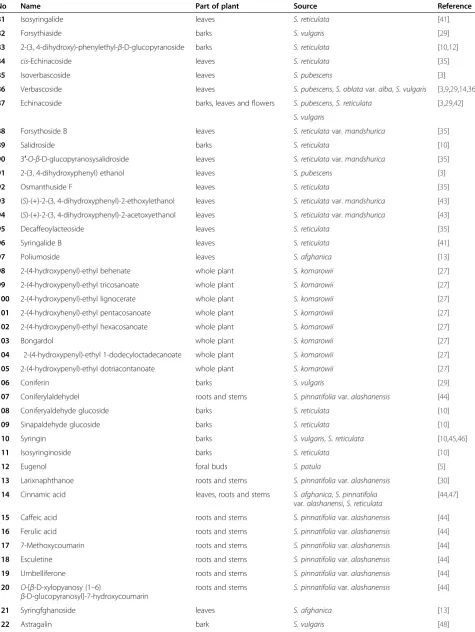
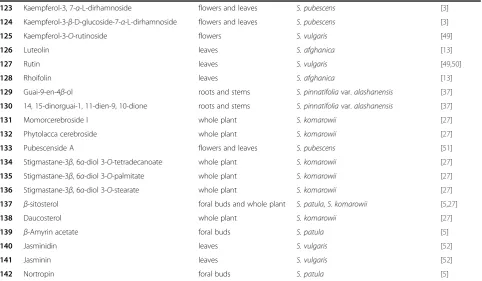
Phenylethanoids (81–105), phenylpropanoids and their analogues (106–121), flavonoids (122–128),
sesquiter-penes (129 and 130), and other minor compounds have
been described in Syringa plants. Of these,
phenyletha-noids are predominant, particularly in S. reticulata
[10,12,35],S. vulgaris[29],S. pubescens [3],S. oblatavar.
alba[36],S. reticulatavar.mandshurica[35],S. afghanica
[13], andS. komarowii[27]. Sesquiterpenes (129and130) are present in the stems ofS. pinnatifoliavar.alashanensis
[37]. These miscellaneous compounds have cytotoxic, anti-inflammatory, antihypertensive, anti-oxidant, and an-tifungal properties.
Besides the abovementioned compounds,Syringaplants
contain essential oils that form the most important constit-uents not only because of their economic utility but also because of their potential medicinal value as antimicrobial, antipyretic, and antiviral agents. Multiple analytical techniques such as headspace solid-phase
microextrac-tion, gas chromatography–mass spectrometry (GC–MS),
GC–MS coupled with heuristic evolving latent
projec-tions, moving subwindow searching, nuclear magnetic
resonance spectroscopy, and X-ray single-crystal diffrac-tion analysis have been used to identify essential oils from fresh flowers ofS. oblatavar.alba. For instance, 39 vola-tile oil constituents were identified, including four charac-teristic isomers of lilac alcohols (lilac alcohols A–D) and lilac aldehydes A–D [38]. Ninety-five components, includ-ing 15 terpenes, 14 oxygenated terpenes, 10 aromatic
com-pounds, and 13 n-alkanes were quantitatively analyzed
fromS. oblatabuds [39]. Forty-nine components were de-scribed from essential oil ofS. pubescens flowers, most of which are monoterpenes and sesquiterpenes [40]. Thirty-four volatile oil components, accounting for around 64.7% (zerumbone) of the toil oil, were identified from roots and barks of S. pinnatifolia var. alashanensis [4]. These data imply that Syringa plants could be considerably different from each other in terms of their essential oil components.
Pharmacological activities
Various crude extracts and isolated compounds from
Syringaplants have shown significant antitumor, antihy-pertensive, anti-inflammatory, anti-oxidant, and antifun-gal activities.
Table 1 Iridoids from the genusSyringa
No Compound Part of plants Source Reference
1 Isoligustroside leaves S. vulgaris [11]
2 Isooleuropein leaves S. vulgaris [11]
3 Oleoside 11-methyl ester flowers, leaves and floral buds S. pubescens [3,5]
S. patula
4 Oleuropein flowers, leaves, barks and floral buds S. pubescens [3,5,8,10,12-14]
S. reticulata,S. dilatata,
S. velutina,S. afghanica,
S. oblatavar.alba,S. patula
5 Neooleuropein leaves S. vulgaris [15]
6 8(E)-Ligstroside flowers, leaves and barks S. pubescens,S. reticulata,
S. dilatata,S. afghanica
[3,8,10,13]
7 8(E)-Nüzhenide leaves S. reticulata [16]
8 Safghanoside A leaves S. afghanica [13]
9 Safghanoside B leaves S. afghanica [13]
10 Safghanoside C leaves S. afghanica [13]
11 Safghanoside D leaves S. afghanica [13]
12 Safghanoside E leaves S. afghanica [13]
13 Safghanoside F leaves S. afghanica [13]
14 Formoside leaves S. afghanica [13]
15 Fraxiformoside leaves S. afghanica [13]
16 2''-epi-frameroside leaves S. afghanica [13]
17 1'''-O-β-D-glucosylformoside leaves S. afghanica [13]
18 1'''-O-β-D-glucosylfraxiformoside leaves S. afghanica [13]
19 Lilacoside barks and leaves S. vulgaris [17,18]
20 Fliederoside barks and leaves S. vulgaris [17,18]
21 8(Z)-Ligstroside leaves S. reticulata [16]
22 8(Z)-Nüzhenide leaves S. reticulata [16]
23 Oleoside dimethyl ester leaves S. afghanica [13]
24 10-Hydroxyoleuropein flowers and leaves S. pubescens [3]
25 10-Hydroxyoleoside dimehyl ester flowers and leaves S. pubescens [3]
26 Secologanoside 7-methyl ester leaves S. reticulata [19]
27 Grandifloroside 11-methyl ester flowers and leaves S. pubescens [3]
28 8-Epikingiside barks S. vulgaris [20]
29 Syrveoside A leaves S. velutina [21]
30 Syrveoside B leaves S. velutina [21]
31 Jaspolyoside barks S. reticulata [10]
32 Syringopicroside leaves S. dilatata,S. vulgaris,
S. oblata,S. reticulata
[8,16,19,22,23]
33 Syringopicroside B leaves S. vulgaris [9]
34 3′-O-β-D-glucopyranosylsyring-opicroside leaves S. reticulata [16]
35 4′-O-β-D-glucopyranosylsyring-opicroside leaves S .reticulata [16]
36 6′-O-α-D-glucopyranosylsyring-opicroside leaves S. reticulata [16]
37 6′-O-α-D-galactopyranosylsyring-opicroside leaves S. reticulata [19]
38 Syringopicrogenin C seeds S. oblata [24]
Antitumor activity
Cytotoxic activities of crude extracts and chemicals
ob-tained from Syringa plants have been extensively
evalu-ated against various tumor cell lines. Aqueous extracts from the flowers and leaves ofS. pubescensinhibited the growth of L2215 (hepatitis B virus) cells, with a 50% in-hibitory concentration (IC50) value of 78 μg/mL [51]. Hydrolysis of isoligustroside (1) and isooleuropein (2) were assayed using a disease-oriented panel of 39 human cancer cell lines. The results showed that the hydrolysis
product of compound2had moderate cytotoxic activity
against lung cancer cell lines DMS273 [log GI50 = 5.19
(6.4μM)] and DMS114 [log GI50 = 5.06 (8.7μM)]. Pre-liminary analysis of structure–activity relationship
sug-gested that C-5′-OH plays an important role in this
cytotoxic activity [11]. Isooleoacteoside (40) showed
weak cytotoxicity against LOX-IMVI melanoma cell line, with GI50 value of 16 μM, and syringopicroside B (33) showed weak cytotoxic activity against NCI-H522 lung cancer cell line, with GI50value of 13μM [9]. MTT assay used to assess the cytotoxicities of syringaresinol (78)
and oleoside 11-methyl ester (3) showed that compound
78 had a strong dose-dependent effect on HepG2 cell
line, with an IC50 value of 94.6 μM, and compound 3
has a dose–response curve of low slope, with a high IC50
value of 186.5 μM, compared with positive controls
dexamethasone (IC50 14.2 μM) and paclitaxel (IC50 700
nM). However, compound 78was cytotoxic even at the
lowest concentration of 29.9 μM. β-Amyrin acetate
(139) showed weak cytotoxicity against A2780 human
ovarian cancer and HepG2 cell lines [5]. Oleuropein (4) and 2-(3, 4-dihydroxy)-phenylethyl-β-D-glucopyranoside (83) showed evident cytotoxicities against P-388, L-1210,
SNU-5, and HL-60 cell lines, with IC50 values varying
from 8.5 to 139.8 μM [12]. Verbascoside (86) showed
moderate cytotoxic activity against SNB-75 (brain cancer) and SNB-78 cell lines, with GI50values of 7.4 and 7.7μM, respectively [9]. A pharmacokinetic study showed that
compound86interacted with the catalytic domain of PKC
and acted as a competitive inhibitor of adenosine
triphos-phate (Ki = 22 μM) and non-competitive inhibitor of
phosphate acceptor (histone III). Because83is one part of
86in its molecular structure, the cytotoxic effect could be attributed to 3, 4-dihydroxyphenylethoxy moiety, which may act as a competitive inhibitor to the catalytic domain of PKC. Therefore,83is a potentially essential skeleton of most cytotoxic phenylethanoid glycosides [12].
Hypotensive activity
Syringin (110) and kaempferol-3-O-rutinoside (125) showed antihypertensive activity. Intravenous injection
of 10 mg/kg of compound86significantly decreased
sys-tolic, diassys-tolic, and mean arterial blood pressure in Pentothal-anesthetized rats. Moreover, the depressor
ef-fect of compound 86 was independent of muscarinic
and histaminergic receptors because it did not block the effect of atropine (an antimuscarinic agent) and chlor-pheniramine/cimetidine (antihistaminergic agents) [36].
In vitro studies showed that oleuropein (4) significantly lowered blood pressure. It is interesting to note that
an-tihypertensive effect of compound 4 (33% at 30 mg/kg
dose) on the blood pressure of anesthetized rats was
similar to that of compound 86(39.04% ± 2.38% at 10
mg/kg dose) [14,36], which is probably because of the similarity in their structures, with both possessing the same aromatic fragment having two hydroxy groups.
Anti-inflammatory activity
Iridoid glycosides (IGs) exerted obvious anti-inflammatory effects on ulcerative colitis in vivo by inhibiting relative proinflammatory cytokines [53]. IGs significantly ame-liorated macroscopic damages and histological changes, reduced the activity of myeloperoxidase, and strongly inhibited epithelial cell apoptosis. Moreover, IGs markedly decreased the levels of tumor necrosis factor-α, interleukin-8, cyclooxygenase-2, and transforming growth factor-β1 in colonic tissues in a dose-dependent manner. Moreover, ef-fects of IGs (160 and 240 mg/kg) were superior to those of positive control salicylazosulfapyridine (150 mg/kg). Fur-thermore, IGs significantly blocked NF-κB signaling by inhibiting inflammatory bowel phosphorylation/degrad-ation and inhibitor kappa B kinase β activity; downregu-lated protein and mRNA expressions of Fas/FasL, Bax, and caspase-3; and activated Bcl-2 in intestinal epithelial cells
Table 1 Iridoids from the genusSyringa(Continued)
40 Isooleoacteoside leaves S. vulgaris [9]
41 Oleoacteoside leaves S. reticulata [9,26]
42 Oleoechinacoside leaves S. reticulata [9,26]
43 Reticuloside barks S. reticulata [10]
44 Jasminoside whole plant S. komarowii [27]
45 Safghanoside H leaves S. afghanica [13]
[53,54].β-Amyrin acetate (139) and syringaresinol (78) at a dose of 20 μg/mL evidently inhibited lipopolysaccharide-induced nitric oxide (NO) production, with inhibition rates of 49.97% and 33.21%, respectively [5].
Liver-protective and cholagogic effects
Crude extract ofSyringaspecies, interferon (IFN), and
an injection of “Gan-Yan-Ling” were compared to
evaluate their liver-protective effects on the survival rates of HepG2.215 cells and secretion of hepatitis B surface antigen (HBsAg) and HBeAg. The results indi-cated that all the three assayed drugs may suppress the secretion of HBsAg and HBeAg from HepG2.215 cells in a dose-dependent manner, with the effect of crude
extract ofSyringabeing intermediate those of IFN and
Gan-Yan-Ling. Therefore, extracts of Syringa plant
Table 2 Lignans from the genusSyringa
No Name Part of plant Source Reference
47 (−)-Olivil whole plant S. komarowii [27]
48 Olivil 4-O-β-D-glucopyranoside barks S. reticulata,S. patula [10]
49 Olivil 4''-O-β-D-glucopyranoside barks S. reticulata [27]
50 Armandiside barks S. reticulata [10]
51 Syripinnalignan A roots and stems S. pinnatifoliavar.alashanensis [31]
52 Syripinnalignan B roots and stems S. pinnatifoliavar.alashanensis [31]
53 (8R, 8′R, 9S)-4-4′-dihydroxy-3, 3′, 9-trimethoxy-9-9′-epoxylignan roots and stems S. pinnatifoliavar.alashanensis [30]
54 (8R, 8′R, 9R)-4-4′-dihydroxy-3, 3′, 9-trimethoxy-9-9′-epoxylignan roots and stems S. pinnatifoliavar.alashanensis [30]
55 (8S, 8′S, 9R)-4-4′-dihydroxy-3, 3′, 9-trimethoxy-9-9′-epoxylignan roots and stems S. pinnatifoliavar.alashanensis [30]
56 (8S, 8′S, 9S)-4-4′-dihydroxy-3, 3′, 9-trimethoxy-9-9′-epoxylignan roots and stems S. pinnatifoliavar.alashanensis [30]
57 Mandshuricol A leaves S. reticulatavar.mandshurica [32]
58 Mandshuricol B leaves S. reticulatavar.mandshurica [32]
59 (+)-Lariciresinol seeds crust S. oblata [25]
60 (+)-Lariciresinol 4-O-β-D-glucopyranoside barks S. vulgaris [29]
61 Balanophonin roots and stems S. pinnatifoliavar.alashanensis [30]
62 (+)-Lariciresinol 4′-O-β-D-glucopyran -osyl-(1→3)-β-D-glucopyranoside
leaves S. reticulata [19]
63 Syripinnalignin A roots and stems S. pinnatifoliavar.alashanensis [33]
64 Syripinnalignin B roots and stems S. pinnatifoliavar.alashanensis [33]
65 Cycloolivil 6-O-β-D-glucoside barks S. reticulata [10]
66 (+)-Cycloolivil whole plant S. komarowii [27]
67 (−)-Secoisolariciresinol stems S. pinnatifoliavar.alashanensis [30,31]
68 PiperphilippininVI roots and stems S. pinnatifolia [30]
69 Dihydrocubebin roots and stems S. pinnatifoliavar.alashanensis [30]
70 Syripinnalignan C roots and stems S. pinnatifoliavar.alashanensis [34]
71 Syripinnalignan D roots and stems S. pinnatifoliavar.alashanensis [34]
72 Syripinnalignan E roots and stems S. pinnatifoliavar.alashanensis [34]
73 (7S, 8R)-Guaiacylglycerol-8-O-4′-sinapyl ether 9′-O-β-D-glucopyranoside
leaves S. velutina [28]
74 (7S, 8R)-Syringylglycerol-8-O-4′-sinapyl ether 9′-O-β-D-glucopyranoside
leaves S. velutina [28]
75 Pinoresinol-4-O-β-monoglycoside barks S. reticulata [10]
76 Syringaresinol-4-O-bis-β-D-monoglucoside barks S. reticulata [10]
77 Syringaresinol-4, 4''-O-bis-β-D-glucoside barks S. reticulata [10]
78 Syringaresinol floral buds, flowers and leaves S. patula,S. pubescens [3,5]
79 (+)-Medioresinol-4-O-glucoside floral buds S. patula [5]
Table 3 Other type of compounds from the genusSyringa
No Name Part of plant Source Reference
81 Isosyringalide leaves S. reticulata [41]
82 Forsythiaside barks S. vulgaris [29]
83 2-(3, 4-dihydroxy)-phenylethyl-β-D-glucopyranoside barks S. reticulata [10,12]
84 cis-Echinacoside leaves S. reticulata [35]
85 Isoverbascoside leaves S. pubescens [3]
86 Verbascoside leaves S. pubescens,S. oblatavar.alba,S. vulgaris [3,9,29,14,36]
87 Echinacoside barks, leaves and flowers S. pubescens,S. reticulata [3,29,42]
S. vulgaris
88 Forsythoside B leaves S. reticulatavar.mandshurica [35]
89 Salidroside barks S. reticulata [10]
90 3′-O-β-D-glucopyranosysalidroside leaves S. reticulatavar.mandshurica [35]
91 2-(3, 4-dihydroxyphenyl) ethanol leaves S. pubescens [3]
92 Osmanthuside F leaves S. reticulata [35]
93 (S)-(+)-2-(3, 4-dihydroxyphenyl)-2-ethoxylethanol leaves S. reticulatavar.mandshurica [43]
94 (S)-(+)-2-(3, 4-dihydroxyphenyl)-2-acetoxyethanol leaves S. reticulatavar.mandshurica [43]
95 Decaffeoylacteoside leaves S. reticulata [35]
96 Syringalide B leaves S. reticulata [41]
97 Poliumoside leaves S. afghanica [13]
98 2-(4-hydroxypenyl)-ethyl behenate whole plant S. komarowii [27]
99 2-(4-hydroxypenyl)-ethyl tricosanoate whole plant S. komarowii [27]
100 2-(4-hydroxypenyl)-ethyl lignocerate whole plant S. komarowii [27]
101 2-(4-hydroxyhenyl)-ethyl pentacosanoate whole plant S. komarowii [27]
102 2-(4-hydroxypenyl)-ethyl hexacosanoate whole plant S. komarowii [27]
103 Bongardol whole plant S. komarowii [27]
104 2-(4-hydroxypenyl)-ethyl 1-dodecyloctadecanoate whole plant S. komarowii [27]
105 2-(4-hydroxypenyl)-ethyl dotriacontanoate whole plant S. komarowii [27]
106 Coniferin barks S. vulgaris [29]
107 Coniferylaldehydel roots and stems S. pinnatifoliavar.alashanensis [44]
108 Coniferyaldehyde glucoside barks S. reticulata [10]
109 Sinapaldehyde glucoside barks S. reticulata [10]
110 Syringin barks S. vulgaris,S. reticulata [10,45,46]
111 Isosyringinoside barks S. reticulata [10]
112 Eugenol foral buds S. patula [5]
113 Larixnaphthanoe roots and stems S. pinnatifoliavar.alashanensis [30]
114 Cinnamic acid leaves, roots and stems S. afghanica,S. pinnatifolia
var.alashanensi,S. reticulata
[44,47]
115 Caffeic acid roots and stems S. pinnatifoliavar.alashanensis [44]
116 Ferulic acid roots and stems S. pinnatifoliavar.alashanensis [44]
117 7-Methoxycoumarin roots and stems S. pinnatifoliavar.alashanensis [44]
118 Esculetine roots and stems S. pinnatifoliavar.alashanensis [44]
119 Umbelliferone roots and stems S. pinnatifoliavar.alashanensis [44]
120 O-[β-D-xylopyanosy (1–6)
β-D-glucopyranosyl]-7-hydroxycoumarin
roots and stems S. pinnatifoliavar.alashanensis [44]
121 Syringfghanoside leaves S. afghanica [13]
could be used to develop effective and less toxic anti-hepatitis B medicines [55].
Aqueous extracts of S. reticulatavar.mandshurica sig-nificantly decreased the levels of alanine transaminase and aspartate transaminase and the concentration of malon-dialdehyde in the serum but increased the activity of superoxide dismutase (SOD) in the liver. These extracts showed protective effects on acute liver injury induced by CCl4in mice [56]. In addition, the essential oils ofSyringa exerted protective effects on the liver and cholecyst [39].
Antifungal activity
Phenylpropanoids such as verbascoside (86) and
for-sythiaside (82) exhibit significant antimicrobial activity
[29]. Compounds 93 and 94 at 1- mM concentration
inhibited the radial growth ofPhytophthora capsici after 6 days of incubation, with inhibition rates 59.1% and 72.5%, respectively [43]. Two sesquiterpenes, guai-9-en-4β-ol (129) and 4, 15-dinorguai-1, 11-dien-9, 10-dione (130), have antibacterial and antifungal properties.
Com-pound 129 was active againstBacillus coagulans
[inhib-ition zone (IZ) = 15.34 mm] andAspergillus niger(IZ =
13.20 mm) while compound 130 significantly inhibited
Escherichia coli (IZ = 15.34 mm) and Fusarium oxy-sporum(IZ = 15.32 mm) [37].
Compound 3 showed effective antimicrobial activity
againstLactobacillus pentosus(IZ = 1 mm), and compound
139inhibited the growth ofCandidaspecies at concentra-tions of 30–250μg/mL [5].
Antioxidant activity
A 70% EtOH extract of S. reticulata barks showed
po-tent superoxide anion and DPPH free radical scavenging activities, with EC50values of 5.88 and 38.10 μg/mL, re-spectively [10].
Among the compounds isolated from the bark ofS. reti-culata, six (4, 31,50, 77,83, and 111) showed significant superoxide anion scavenging activity, with EC50 values of 2.57, 4.97, 10.64, 15.98, 4.97, and 14.14μg/mL, respectively.
Compound 4 also interacted with the stable free radical
DPPH, with an IC50value of 40.4μM [8,10]. These different anti-oxidant activities are closely related to their structural features. Presence of 2-(3, 4-dihydroxyphenyl)-ethoxy moi-ety might be important for a higher activity because the most potent compounds (EC50= 2.57–4.97μM), including the two secoiridoid glycosides (31and4) and a phenyletha-noid glycoside (83), possess the same structural features.
Comparison of the structures of compounds4and83with
those of 8(Z)-ligstroside (21) and salidroside (89) showed
that presence of ortho-coupling hydroxyl group at C-2
might be responsible for their different activities. It has been previously reported that 1, 2-dihydroxybenzene moi-ety is crucial to its DPPH scavenging activity [10].
Table 3 Other type of compounds from the genusSyringa(Continued)
123 Kaempferol-3, 7-α-L-dirhamnoside flowers and leaves S. pubescens [3]
124 Kaempferol-3-β-D-glucoside-7-α-L-dirhamnoside flowers and leaves S. pubescens [3]
125 Kaempferol-3-O-rutinoside flowers S. vulgaris [49]
126 Luteolin leaves S. afghanica [13]
127 Rutin leaves S. vulgaris [49,50]
128 Rhoifolin leaves S. afghanica [13]
129 Guai-9-en-4β-ol roots and stems S. pinnatifoliavar.alashanensis [37]
130 14, 15-dinorguai-1, 11-dien-9, 10-dione roots and stems S. pinnatifoliavar.alashanensis [37]
131 Momorcerebroside I whole plant S. komarowii [27]
132 Phytolacca cerebroside whole plant S. komarowii [27]
133 Pubescenside A flowers and leaves S. pubescens [51]
134 Stigmastane-3β, 6α-diol 3-O-tetradecanoate whole plant S. komarowii [27]
135 Stigmastane-3β, 6α-diol 3-O-palmitate whole plant S. komarowii [27]
136 Stigmastane-3β, 6α-diol 3-O-stearate whole plant S. komarowii [27]
137 β-sitosterol foral buds and whole plant S. patula,S. komarowii [5,27]
138 Daucosterol whole plant S. komarowii [27]
139 β-Amyrin acetate foral buds S. patula [5]
140 Jasminidin leaves S. vulgaris [52]
141 Jasminin leaves S. vulgaris [52]
Syringaresinol (78) showed a strong scavenging activ-ity against DPPH, with EC50value as low as 12.5μg/mL, which might be responsible for its strong inhibition of NO production [5].
Eugenol (112) inhibited the catalytic activity of H2O2/
Ca2+ human erythrocyte membrane lipid peroxidation
at a concentration of 200μmol/L, with an inhibition rate of 62%, and completely suppressed the catalytic activity of
dibenzoyl peroxide/Ca2+ human erythrocyte membrane
lipid peroxidation at a concentration of 100μmol/L. Com-pound112exerted its effect in a non-competitive manner by reacting with Ca2+and inhibiting the formation of hy-droxyl radicals, thus, protecting the cell membrane lipid from oxidation [2].
Inhibition of platelet aggregation
Aqueous extract of S. aramaticumsignificantly inhibited adenosine diphosphate (ADP) and collagen-induced platelet aggregation, with inhibition rates of 37.4% and 69.7%, respectively [57]. Mandshuricols A (57) and B (58) showed antagonistic activities on platelet-activating factor (PAF) in [3H]PAF receptor binding assay, with IC50values of 4.8 × 10⁻⁵and 3.5 × 10⁻⁵M, respectively [32].
Others
Essential oils from the stems and roots ofS. pinnatifolia
var. alashanensis (SPEO) reduced the deviation of ST segment; decreased the levels of lactate dehydrogenase, creatine kinase, and troponin T; and increased the activity of SOD. These protective effects were further confirmed by histopathological examination [58]. Treatment with both 8 and 32 mg/kg SPEO prolonged the survival of mice under hypoxia conditions, showing a remarkable protect-ive effect against H2O2-induced death in cultured rat
myo-cytes. Moreover, 5, 2.5 and 1.25 μg/mL doses of SPEO
inhibited ADP-induced rat platelet aggregation by 47.4%, 37.0%, and 32.9%, respectively [58], implying that SPEO exerted protective effects against myocardial ischemia.
Oral and intraperitoneal administration of 0.2–0.4 g of leaf extract ofS. vulgarisin cats or rabbits exerted an antipyretic effect that was equal to the effect of 0.1–0.3 g of aminopyrine administered orally or intraperitone-ally. However, leaf extracts of S. vulgarisare consider-ably more toxic than aminopyrine, with their toxic dosages being 0.4 and 1.2 g/kg, respectively [59].In vitro
evaluation of leaf extract of S. aramaticum showed its
antiviral activity against herpes simplex virus at
concen-trations 1.25%–2.5%. The protective effect was more
obvious when controlling the amount of virus attacks at 9.2–92 tissue culture infective dose (TCID50), suggest-ing thatS. aramaticumeffectively killed the virus with-out any harmful side effects [60-62].
Studies have reported that leaf extracts ofS.
aramati-cum could be used for treating hemorrhoids [63].
Eugenol (112) inhibited the metabolism of arachidonic
acid. Extracts of S. reticulata var. mandshurica have
been used for treating bronchitis, and one of its constit-uents 2-(3, 4-dihydroxyphenyl) ethanol (91) significantly inhibited the production of phlegm [2].
Review and conclusions
This review describes phytochemical and
pharmaco-logical progress on the genus Syringa in the recent 20
years and discusses the future research prospects.
Syringaplants are used not only as traditional medicines to treat rheumatoid arthritis, asthma, cardiopalmus, and angina pectoris by natives in China but also for making or-naments, volatile oils, food additives, and bactericides worldwide, particularly in developing countries. Previous phytochemical studies on crude extracts from various species of this genus have identified iridoids, lignans, phe-nylpropanoids, and phenylethanoids having antitumor, anti-hypertensive, anti-oxidant, and anti-inflammatory activities. Iridoids, lignans, and phenylethanoids are the most
pre-dominant compounds inSyringaplants that probably
con-tribute independently or synergistically to their main biological activities.
To the best of our knowledge, 46 iridoid
representa-tives have been reported in Syringa plants, with high
concentrations present in the leaves of S. vulgaris, S. pubescens, S. afghanica, S. reticulata, and S. velutina
and barks ofS. vulgaris andS. reticulata and low
con-centrations present in the flowers (S. pubescens), seeds, and seeds crust (S. oblata). This difference may be asso-ciated with their ecological roles, because iridoids are produced mainly to fight predators and/or microbes. Moreover, high concentrations of lignans in the stems and roots can be attributed to the rigidity of these plants. This may be the reason for the absence of iridoids inS. pinnatifoliavar.alashanensisbecause materials used for chemical investigation included peeled stems and roots. Anti-inflammatory effects of extracts from these plants are mainly responsible for their applications in trad-itional medicine. However, only preliminary work has been performed on most isolated compounds, such as
Competing interests
The authors declare that they have no competing interests.
Authors’contributions
SG, CY, LC, GX, and YX have all been involved in preparing this review. SG, TP and CX are responsible for writing, checking and revising the manuscript. All authors read, discussed and approved final version of the manuscript.
Acknowledgments
This paper is financially supported by the National Natural Science Foundation of China (No.81473426).
Author details 1
Modern Research Center for Traditional Chinese Medicine, Beijing University of Chinese Medicine, 11 North 3rd Ring Road, Chaoyang District, Beijing 100029, P. R. China.2School of Chinese Materia Medica, Beijing University of Chinese Medicine, 6 Wangjing Southern Middle Ring Road, Chaoyang District, Beijing 100102, P. R. China.
Received: 26 April 2014 Accepted: 7 January 2015
References
1. Editorial Committee of Chinese Material Medica. Chinese Material Medica-Mongolian volume. Shanghai Sci Technol Press. 1992;61:2–50.
2. Zhang JF, Zhang SJ. An overview of the genusSyringa: phytochemical and pharmacological aspects. Nat Sci J Hainan Univ. 2007;2:201–5.
3. Deng RX, Yuan H, Liu P, Yin WP, Wang XS, Zhao TZ. Chemical constituents fromSyringa pubescensTurcz. Biochem Syst Ecol. 2010;38:813–5. 4. Zhang GB, Liu LJ, Wang MK. Chemical constituents of volatile oils from
Syringa pinnatifolia. Chin Pharm J. 1994;5:271.
5. SamyK ED, GamalEldeen AM. Cytotoxic and anti-inflammatory activities of some constituents from the floral buds ofSyringa patula. Pharm Biol. 2009;47:872–7.
6. Dinda B, Debnath S, Harigaya Y. Naturally occurring iridoids. a review, part 1. Chem Pharm Bull. 2007;55:159–222.
7. Ghisalberti EL. Biological and pharmacological activity of naturally occurring iridoids and secoiridoids. Phytomedicine. 1998;5:147–63.
8. Oh H, Ko EK, Kim DH, Jang KK, Park SE, Lee HS, et al. Secoiridoid glucosides with free radical scavenging activity from the leaves ofSyringa dilatata. Phytother Res. 2003;17:417–9.
9. Masafumi K, Yasunri Y, Nariyasu M. Glycoside from the leaves ofSyringa vulgarisand their growth inhibitory activity against human cancer cell lines. Japan Soc Pharm. 2010;64:104–5.
10. Bi XY, Li W, Sasaki T, Li Q, Mitsuhata N, Asada Y, et al. Secoiridoid glucosides and related compounds fromSyringa reticulataand their anti-oxidant activities. Bioorg Med Chem Lett. 2011;21:6426–9.
11. Kikuchi M, Yaoita Y, Mano N, Kikuchi M. Structure and cytotoxic activity of enzymatic hydrolysis products of secoiridoid glucosides, isoligustroside and isooleuropein. Chem Biodivers. 2011;8:651–7.
12. Park HJ, Lee MS, Lee KT, Sohn IC, Han YN, Miyamoto K. Studies on constituents with cytotoxic activity from the stem bark ofSyringa velutina. Chem Pharm Bull. 1999;47:1029–31.
13. Yk T, Okazaki N, Tanahashi T, Nagakura N, Nishi T. Secoiridoid and iridoid glucosides fromSyringa afghanica. Phytochemistry. 2002;59:779–87. 14. Nenadis N, Vervoort J, Boeren S, Tsimidou MZ.Syringa oblataLindl var.albaas
a source of oleuropein and related compounds. J Sci Food Agr. 2007;87:160–6. 15. Kikuch IM, Yamauchi Y, Yanase C. Structures of new secoiridoid glycosides
from the leaves ofSyringa vulgarisLinn. Yakugakuzasshi. 1987;107:245–8. 16. Machida K, Kaneko A, Hosogai T, Kakuda R, Yaoita Y, Kikuchi M. Studies on
the constituents ofSyringaspecies. X. five new iridoid glycosides from the leaves ofSyringa reticulata(Blume) Hara. Chem Pharm Bull. 2002;50:493–7. 17. Sticher O, Ahmad M, Salama O, Winkler T. Two new secoiridoid glucosides
fromSyringa vulgaris. Planta Med. 1982;45:151.
18. Kikuch IM, Yamauchi Y, Takahashi Y. Structures of new secoiridoid glycosides from the leaves ofSyringa vulgarisLinn. Yakugakuzasshi. 1988;108:355–60.
19. Machida K, Unagami E, Ojima H, Kikuchi M. Studies on the constituents of Syringaspecies. XII. new glycosides from the leaves ofSyringa reticulata (Blume) Hara. Chem Pharm Bull. 2003;51:883–4.
20. Garcia J, Lavaitte S, Gey C. 8-Epikingiside and its vanillate ester, isolated from Gentiana pyrenaica. Phytochemistry. 1989;28:2199–201.
21. Feng XS, Qu Y, Wu ZHXL, Zhang DS, Gao HY, Wu LJ. Two new secoiridoid glucosides fromSyringa velutinaKom. Chinese Chem Lett. 2009;20:702–5. 22. Asaka Y, Kamikawa T, Tokoroyama T, Kubota T. The structure and absolute
configuration of syringopicroside. a new iridoid glucoside fromSyringa vulgaris. Tetrahedron. 1970;26:2365–70.
23. Zhou YM, Gao HY, Wu B, Li SH, Wu LJ. Structure determination of syringopicroside from the leaves ofSyringa oblataLindl. using 2D NMR spectral methods. Asian J Tradit Med. 2006;1:31–3.
24. Zhang SJ, Guo HQ, Han J, Zhao M, Wang JJ. Chemical constituents from seeds ofSyringa oblata. Chin Tradit Herbal Drugs. 2011;42:1894–900. 25. Wang JL, Zhang GF, Dong LW, Zhao M, Zhang SJ. Chemical constituents
from seed crust ofSyringa oblata. Chin Tradit Herbal Drugs. 2010;41:1598–601. 26. Kikuch IM, Yamauchi Y, Takahashi Y. Studies on constituents ofSyringa
species. VIII. Isolation and structures of phenylpropanoid glycosides from the leaves ofSyringa reticulata(Blume) Hara. Yakugakuzasshi. 1989;109:366–71. 27. Luo Y, Liu Y, Qi H, Wu Z, Zhang G. Steryl esters and phenylethanol esters
fromSyringa komarowii. Steroids. 2006;71:700–5.
28. Feng XS, Qu Y, Xu L, Wang DC, Wu LJ, Meng FH, et al. Two new neolignans fromSyringa velutinaKom. Molecules. 2009;14:953–8.
29. Kurkin VA. Phenylpropanoids from medicinal plants: distribution, classification, structural analysis, and biological activity. Chem Nat Compd. 2003;39:123–53.
30. Zeng XJ, Wang GC, Wu X, Li YL. Chemical constituents fromSyringa pinnatifolia. Chin Tradit Herbal Drugs. 2013;7:1721–5.
31. Ao WLJ, Bao XH, Wu XL, Wang QH. Lignans fromSyringa pinnatifoliavar. alashanensis. J Asian Nat Prod Res. 2012;14:396–400.
32. Xu QM, Li Q, Liu YL, Feng YL, Yang SL, Li XR. New lignans fromSyringa reticulatavar.mandshurica. Chem Nat Compd. 2010;46:366–9.
33. Wang QH, Ao WLJ, Wu QS, Ying X. Two new neolignans from the stems of Syringa pinnatifoliavar.alashanensis. Helv Chim Acta. 2012;95:1680–5. 34. Ao WLJ, Wang QH, Wang XL, Dai YNT. Extraction and structure elucidation
of three lignans from peeled dried roots and stems ofSyringa pinnatifolia. Chin Tradit Herbal Drugs. 2013;7:791–3.
35. Machida K, Ohkawa N, Ohsawa A, Kikuchi M. Two new phenolic glycosides fromSyringa reticulata. J Nat Med. 2009;63:192–4.
36. Ahmad M, Rizwan GH, Aftab K, Ahmad VU, Gilani AH, Ahmad SP. Acteoside: a new antihypertensive drug. Phytother Res. 1995;9:525–7.
37. Ao WLJ, Wang QH, Si Q, Mu D, Sa RTY, Dai NYT, et al. The structural elucidation and antimicrobial activities of two new sesquiterpenes from Syringa pinnatifolia. Chin J Nat Med. 2012;10:477–80.
38. Li ZG, Lee MR, Shen DL. Analysis of volatile compounds emitted from fresh Syringa oblataflowers in different florescence by headspace solid-phase microextraction-gas chromatography–mass spectrometry. Anal Chim Acta. 2006;1:43–9.
39. Chen XZ, Liang YZ, Fang HZ, Li XN. Temperature-programmed retention indices for gas chromatography-mass spectroscopy analysis of plant essential oils. J Chromatogr A. 2005;1096:76–85.
40. Yu AN, Yang XZ. Chemical composition of the essential oil of fresh wild Syringa pubescensflowers from China. Adv MaterRes (Durnten-Zurich, Switzerland). 2012;22:581–2.
41. Kikuch IM, Yamauchi Y. Studies the constituents ofSyringaspecies. I. Isolation and structures of iridiods and secoiridoids from the leaves of Syringa reticulata(Blume) Hara. Yakugakuzasshi. 1987;107:350–4. 42. Ahmad M, Salama O, Sticher O. Isolation of echinacoside from the white
flowers ofSyringa vulgaris. J Chem Soc Pakistan. 1987;9:451–4.
43. Xu QM, Liu YL, Li XR, Feng YL, Yang SL. Two new phenylglycol derivatives isolated fromSyringa reticulatavar.mandshuricaand their antifungal activities. Chem Pharm Bull. 2009;57:863–6.
44. Ao WLJ, Wang QH, Dai YNT. Chemical detection on the stems ofSyringa pinnatifoliavar.alashanensis. Chin Hosp Pharm J. 2013;33:1544–6. 45. Kurkin VA. Phenylpropanoids as the biologically active compounds of the
medicinal plants and phytopharmaceuticals. Adv Biol Chem. 2013;3:26–8. 46. Ahmad M, Aftab K. Hypotensive action of syringin fromSyringa vulgaris.
Phytother Res. 1995;9:452–4.
47. Kikuch IM, Yamauchi Y. Studies on constituents ofSyringaspecies I. Isolation and structure of iridodids and secoiridoids from the leaves ofSyringa reticulata(Blume) Hara. Yakugakuzasshi. 1987;107:23–7.
49. Ahmad M, Salama O. Flavonoids from violet flowers ofSyringa vulgaris. Pakistan J Sci Ind Res. 1987;30:150–1.
50. Ahmad M, Salama O. Isolation of rutin from the fresh leaves ofSyringa vulgaris. J Pharm. 1985;4:9–11.
51. Yin WP, Zhao TZ, Zhang HY. A novel oligosaccharide ester fromSyringa pubescens. J Asian Nat Prod Res. 2008;10:95–100.
52. Helmut R. Jasminidin, ein neues monoterpenalklaloid ausSyringa vulgaris. Phytochemistry. 1978;17:1069–70.
53. Liu X, Wang JM. Iridoid glycosides fraction of Folium Syringae leaves modulate NF-κB signal pathyway and intestinal epithelial cells apoptosis in experimental colitis. Plos One. 2011;6:e24740.
54. Liu X, Wang JM. Anti-inflammatory effects of iridoid glycosides fraction of Folium Syringaeleaves on TNBS-induced colitis in rats. J Ethnopharmacol. 2011;133:780–7.
55. Gao SQ, Niu JQ, Wang F, Wang F, Liu XD, Jin ZX, et al. Comparative studies on the resistance of hepatitis B bySyringaextract, IFN and ganyanling in HepG2.2.15 cells. Chin J Cell Mol Immunol. 2003;19:385–6.
56. Yao DL, Han ZG, Zhou W, Ju GM, Li G. Protective effects of theSyringa reticulatavar.mandshuricaextract against acute liver injury in mice. J Med Sci Yan B Univ. 2009;32:29–31.
57. Li JX. TheSyringa aramaticummodern pharmacological research. P J Pract Tradit Chin Med. 2002;18:54.
58. Yan Y, WLJ O, Zhao XJ, Ye XC, Zhang C, Hao JJ, et al. Effect of essential oil ofSyringa pinnatifoliavar.alashanensison ischemia of myocardium, hypoxia and platelet aggregation. J Ethnopharmacol. 2010;131:248–55.
59. Balint G, Eperjessy ET, Thuranszky K. Hypothermic action of the leaf extract ofSyringa vulgaris. Acta Physiolo Acad Sci Hung. 1965;28:399–406. 60. Yang WW, Xing MY. The preparations ofSyringa oblataleaves change in
immunoassay after the treatment on herpes simplex keratitis. Chin J Pract Ophthalmolol. 1990;8:252–61.
61. Xing MY. The preparations ofSyringa oblataleaves change in tears’PH after the treatment on herps simplex keratitis. Chin J Ophthalmolol. 1992;10:312–21. 62. Xing MY, Li B. The preparations ofSyringa oblataleaves treat epidemic
hermorrhagic conjunctivitis. Chin J Ophthalmolol. 1996;14:301. 63. Li SJ, Xu LY. The preparations ofSyringa oblataleaves treat hemorrhoids
with 18 cases. China Acad J. 2001;1:57.
Open access provides opportunities to our colleagues in other parts of the globe, by allowing
anyone to view the content free of charge.
Publish with
Chemistry
Central and every
scientist can read your work free of charge
W. Jeffery Hurst, The Hershey Company.
available free of charge to the entire scientific community peer reviewed and published immediately upon acceptance cited in PubMed and archived on PubMed Central yours you keep the copyright
Submit your manuscript here: