Copyright © 2008 Pearson Education, Inc., publishing as Pearson Benjamin Cummings
PowerPoint® Lecture Presentations for
Biology
Eighth Edition
Neil Campbell and Jane Reece
Lectures by Chris Romero, updated by Erin Barley with contributions from Joan Sharp
Chapter 15
Chapter 15
Overview: Locating Genes Along Chromosomes
• Mendel’s “hereditary factors” were genes,
though this wasn’t known at the time
• Today we can show that genes are located on
chromosomes
• The location of a particular gene can be seen
by tagging isolated chromosomes with a fluorescent dye that highlights the gene
Concept 15.1: Mendelian inheritance has its physical basis in the behavior of chromosomes
• Mitosis and meiosis were first described in the
late 1800s
• The chromosome theory of inheritance
states:
– Mendelian genes have specific loci (positions) on
chromosomes
– Chromosomes undergo segregation and independent
assortment
• The behavior of chromosomes during meiosis
was said to account for Mendel’s laws of segregation and independent assortment
Fig. 15-2
P Generation Yellow-round
seeds (YYRR)
Y
F1 Generation
Y R R R Y r r r y y y Meiosis Fertilization Gametes Green-wrinkled seeds (yyrr)
All F1 plants produce
yellow-round seeds (YyRr)
R R
Y Y
r y r y
Meiosis
R R
Y Y
r r
y y
Metaphase I
Y Y
R r r R
y y
Anaphase I
r r
y Y
Metaphase II
R Y R y y y y R R Y Y r r r r y Y Y R R yR Yr yr YR 1/
4 1/4 1/4 1/4
F2 Generation
Gametes
An F1 F1 cross-fertilization
9 : 3 : 3 : 1
LAW OF INDEPENDENT ASSORTMENT Alleles of genes on nonhomologous
chromosomes assort
independently during gamete formation.
Fig. 15-2a P Generation Gametes Meiosis Fertilization Yellow-round
seeds (YYRR)
Green-wrinkled seeds (yyrr)
All F1 plants produce
Fig. 15-2b
0.5 mm
Meiosis
Metaphase I
Anaphase I
Metaphase II
Gametes
LAW OF SEGREGATION The two alleles for each gene separate during gamete
formation.
LAW OF INDEPENDENT
ASSORTMENT Alleles of genes on nonhomologous
chromosomes assort
independently during gamete formation.
1
4 yr 1 4 Yr 1
4 YR
3 3
F1 Generation
14 yR
R R R R R R R
R R R R
R Y Y Y Y Y Y Y Y Y Y Y Y y r r r r r r r r
r r r r
y y y y y y y y y y y
All F1 plants produce yellow-round seeds (YyRr)
1
2 2
Fig. 15-2c
F2 Generation
An F1 F1 cross-fertilization
9 : 3 : 3 : 1
Morgan’s Experimental Evidence: Scientific Inquiry
• The first solid evidence associating a specific
gene with a specific chromosome came from Thomas Hunt Morgan, an embryologist
• Morgan’s experiments with fruit flies provided
convincing evidence that chromosomes are the location of Mendel’s heritable factors
Morgan’s Choice of Experimental Organism
• Several characteristics make fruit flies a
convenient organism for genetic studies:
– They breed at a high rate
– A generation can be bred every two weeks
– They have only four pairs of chromosomes
• Morgan noted wild type, or normal,
phenotypes that were common in the fly populations
• Traits alternative to the wild type are called
mutant phenotypes
Correlating Behavior of a Gene’s Alleles with Behavior of a Chromosome Pair
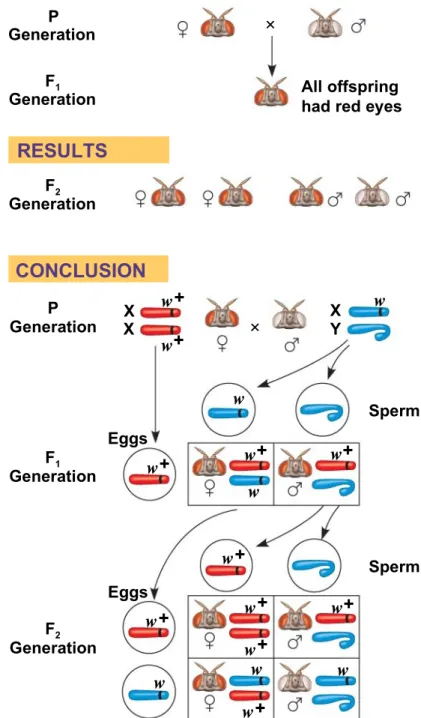
• In one experiment, Morgan mated male flies
with white eyes (mutant) with female flies with red eyes (wild type)
– The F1 generation all had red eyes
– The F2 generation showed the 3:1 red:white
eye ratio, but only males had white eyes
• Morgan determined that the white-eyed mutant
allele must be located on the X chromosome
• Morgan’s finding supported the chromosome
theory of inheritance
Fig. 15-4 P Generation Generation Generation Generation Generation Generation F1 F2 All offspring had red eyes
Sperm Eggs F1 F2 P Sperm Eggs X X X Y CONCLUSION EXPERIMENT RESULTS w w w w w w w w + + + + + w
Concept 15.2: Sex-linked genes exhibit unique patterns of inheritance
• In humans and some other animals, there is a
chromosomal basis of sex determination
The Chromosomal Basis of Sex
• In humans and other mammals, there are two
varieties of sex chromosomes: a larger X chromosome and a smaller Y chromosome
• Only the ends of the Y chromosome have
regions that are homologous with the X chromosome
• The SRY gene on the Y chromosome codes for
the development of testes
Fig. 15-5
X
• Females are XX, and males are XY
• Each ovum contains an X chromosome, while
a sperm may contain either an X or a Y chromosome
• Other animals have different methods of sex
determination
Fig. 15-6
44 +
XY Parents 44 + XX
22 + X 22 +
X or 22 + Y +
44 + XX or Sperm Egg 44 + XY Zygotes (offspring) (a) The X-Y system
22 +
XX 22 + X
(b) The X-0 system
76 +
ZW 76 + ZZ
(c) The Z-W system
32
(Diploid) (Haploid)16
Inheritance of Sex-Linked Genes
• The sex chromosomes have genes for many
characters unrelated to sex
• A gene located on either sex chromosome is
called a sex-linked gene
• In humans, sex-linked usually refers to a gene
on the larger X chromosome
• Sex-linked genes follow specific patterns of
inheritance
• For a recessive sex-linked trait to be expressed
– A female needs two copies of the allele
– A male needs only one copy of the allele
• Sex-linked recessive disorders are much more
common in males than in females
Fig. 15-7
(a) (b) (c)
XNXN XnY XNXn XNY XNXn XnY
Y Xn Sperm Y XN Sperm Y Xn Sperm
XNXn
Eggs XN
XN XNXn
XNY
XNY
Eggs XN
Xn
XNXN
XnXN
XNY
XnY
Eggs XN
Xn
XNXn
XnXn
XNY
• Some disorders caused by recessive alleles on
the X chromosome in humans:
– Color blindness
– Duchenne muscular dystrophy
– Hemophilia
X Inactivation in Female Mammals
• In mammalian females, one of the two X
chromosomes in each cell is randomly
inactivated during embryonic development
• The inactive X condenses into a Barr body
• If a female is heterozygous for a particular
gene located on the X chromosome, she will be a mosaic for that character
Fig. 15-8
X chromosomes
Early embryo:
Allele for orange fur Allele for black fur
Cell division and X chromosome inactivation Two cell
populations in adult cat:
Active X
Active X Inactive X
• Each chromosome has hundreds or thousands of genes
• Genes located on the same chromosome that
tend to be inherited together are called linked
genes
Concept 15.3: Linked genes tend to be inherited
together because they are located near each other on the same chromosome
How Linkage Affects Inheritance
• Morgan did other experiments with fruit flies to
see how linkage affects inheritance of two characters
• Morgan crossed flies that differed in traits of
body color and wing size
Fig. 15-UN1
b+ vg+
Parents
in testcross
Most
offspring
b+ vg+
b vg
b vg
b vg
b vg
b vg
b vg
Fig. 15-9-4
EXPERIMENT
P Generation (homozygous)
RESULTS
Wild type (gray body,
normal wings)
Double mutant (black body, vestigial wings)
b b vg vg
b b vg vg
Double mutant TESTCROSS
b+ b+ vg+ vg+
F1 dihybrid (wild type)
b+ b vg+ vg
Testcross
offspring Eggs b+ vg+ b vg b+ vg b vg+
Black-normal Gray-vestigial Black-vestigial Wild type (gray-normal) b vg Sperm
b+ b vg+ vg b b vg vg b+ b vg vg b b vg+ vg
PREDICTED RATIOS
If genes are located on different chromosomes:
If genes are located on the same chromosome and
parental alleles are always inherited together:
1 1 1 1 1 1 0 0
965 944 206 185
• Morgan found that body color and wing size are usually inherited together in specific
combinations (parental phenotypes)
• He noted that these genes do not assort
independently, and reasoned that they were on the same chromosome
• However, nonparental phenotypes were also produced
• Understanding this result involves exploring
genetic recombination, the production of offspring with combinations of traits differing from either parent
Genetic Recombination and Linkage
• The genetic findings of Mendel and Morgan
relate to the chromosomal basis of recombination
Recombination of Unlinked Genes: Independent Assortment of Chromosomes
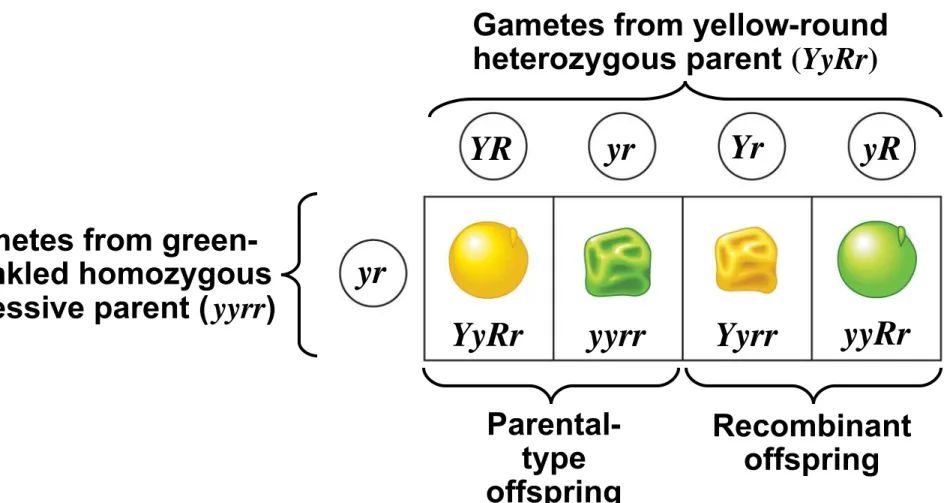
• Mendel observed that combinations of traits in
some offspring differ from either parent
• Offspring with a phenotype matching one of the
parental phenotypes are called parental types
• Offspring with nonparental phenotypes (new
combinations of traits) are called recombinant
types, or recombinants
• A 50% frequency of recombination is observed
for any two genes on different chromosomes
Fig. 15-UN2
YyRr
Gametes from green-wrinkled homozygous recessive parent (yyrr)
Gametes from yellow-round heterozygous parent (YyRr)
Parental-type offspring
Recombinant offspring
yr
yyrr Yyrr yyRr
Recombination of Linked Genes: Crossing Over
• Morgan discovered that genes can be linked,
but the linkage was incomplete, as evident from recombinant phenotypes
• Morgan proposed that some process must
sometimes break the physical connection between genes on the same chromosome
• That mechanism was the crossing over of
homologous chromosomes
Copyright © 2008 Pearson Education Inc., publishing as Pearson Benjamin Cummings
Animation: Crossing Over
Fig. 15-10 Testcross parents Replication of chromo-somes
Gray body, normal wings (F1 dihybrid)
Black body, vestigial wings (double mutant)
Replication of chromo-somes
b+ vg+
b+vg+
b+vg+
b vg
bvg bvg
b vg b vg bvg bvg bvg bvg b+vg+
b+ vg b vg+
b vg
Recombinant chromosomes
Meiosis I and II Meiosis I
Meiosis II
b vg+
b+vg
b vg b+ vg+
Eggs
Testcross
offspring Wild type965
(gray-normal) 944 Black-vestigial 206 Gray-vestigial 185 Black-normal
b+vg+
b vg b vg
b vg b+ vg
b vg b vg b vg+
Sperm
b vg
Parental-type offspring Recombinant offspring Recombination
Fig. 15-10a Testcross parents Replication of chromo-somes
Gray body, normal wings (F1 dihybrid)
Black body, vestigial wings (double mutant)
Replication of chromo-somes
b+ vg+
b+ vg+
b+ vg+
b vg
b vg
b vg
b vg
b vg
b vg
b vg
b vg
b vg
b+ vg+
b+ vg
b vg+
b vg
Recombinant chromosomes
Meiosis I and II Meiosis I
Meiosis II
Eggs Sperm
Fig. 15-10b Testcross offspring 965 Wild type (gray-normal) 944 Black-vestigial 206 Gray-vestigial 185 Black-normal
b+ vg+
b vg b vg
b vg b+ vg
b vg
b vg
b+ vg+
Sperm
b vg
Parental-type offspring Recombinant offspring
Recombination
frequency = 2,300 total offspring391 recombinants 100 = 17%
b vg
b+ vg b vg+
b vg+
Eggs
Mapping the Distance Between Genes Using Recombination Data: Scientific Inquiry
• Alfred Sturtevant, one of Morgan’s students,
constructed a genetic map, an ordered list of
the genetic loci along a particular chromosome
• Sturtevant predicted that the farther apart two
genes are, the higher the probability that a crossover will occur between them and
therefore the higher the recombination frequency
• A linkage map is a genetic map of a
chromosome based on recombination frequencies
• Distances between genes can be expressed as
map units; one map unit, or centimorgan, represents a 1% recombination frequency
• Map units indicate relative distance and order,
not precise locations of genes
Fig. 15-11
RESULTS
Recombination frequencies
Chromosome
9% 9.5%
17%
• Genes that are far apart on the same
chromosome can have a recombination frequency near 50%
• Such genes are physically linked, but
genetically unlinked, and behave as if found on different chromosomes
• Sturtevant used recombination frequencies to
make linkage maps of fruit fly genes
• Using methods like chromosomal banding,
geneticists can develop cytogenetic maps of chromosomes
• Cytogenetic maps indicate the positions of
genes with respect to chromosomal features
Fig. 15-12
Mutant phenotypes Short
aristae Blackbody
Cinnabar
eyes Vestigialwings Browneyes
Red eyes Normal
wings Red
eyes Gray
body Long aristae
(appendages on head)
Wild-type phenotypes
Concept 15.4: Alterations of chromosome number or structure cause some genetic disorders
• Large-scale chromosomal alterations often
lead to spontaneous abortions (miscarriages) or cause a variety of developmental disorders
Abnormal Chromosome Number
• In nondisjunction, pairs of homologous
chromosomes do not separate normally during meiosis
• As a result, one gamete receives two of the
same type of chromosome, and another gamete receives no copy
Fig. 15-13-3
Meiosis I
Nondisjunction
(a) Nondisjunction of homologous
chromosomes in meiosis I (b) Nondisjunction of sister chromatids in meiosis II Meiosis II
Nondisjunction
Gametes
Number of chromosomes
• Aneuploidy results from the fertilization of
gametes in which nondisjunction occurred
• Offspring with this condition have an abnormal
number of a particular chromosome
• A monosomic zygote has only one copy of a particular chromosome
• A trisomic zygote has three copies of a
particular chromosome
• Polyploidy is a condition in which an organism
has more than two complete sets of chromosomes
– Triploidy (3n) is three sets of chromosomes
– Tetraploidy (4n) is four sets of chromosomes
• Polyploidy is common in plants, but not animals
• Polyploids are more normal in appearance than
aneuploids
Alterations of Chromosome Structure
• Breakage of a chromosome can lead to four
types of changes in chromosome structure:
– Deletion removes a chromosomal segment
– Duplication repeats a segment
– Inversion reverses a segment within a
chromosome
– Translocation moves a segment from one
chromosome to another
Fig. 15-15
Deletion
A B C D E F G H A B C E F G H (a)
(b)
(c)
(d)
Duplication
Inversion
Reciprocal translocation A B C D E F G H
A B C D E F G H
A B C D E F G H
A B C B C D E F G H
A D C B E F G H
M N O C D E F G H
Human Disorders Due to Chromosomal Alterations
• Alterations of chromosome number and
structure are associated with some serious disorders
• Some types of aneuploidy appear to upset the
genetic balance less than others, resulting in individuals surviving to birth and beyond
• These surviving individuals have a set of
symptoms, or syndrome, characteristic of the type of aneuploidy
Down Syndrome (Trisomy 21)
• Down syndrome is an aneuploid condition that results from three copies of chromosome 21
• It affects about one out of every 700 children
born in the United States
• The frequency of Down syndrome increases
with the age of the mother, a correlation that has not been explained
Aneuploidy of Sex Chromosomes
• Nondisjunction of sex chromosomes produces
a variety of aneuploid conditions
• Klinefelter syndrome is the result of an extra
chromosome in a male, producing XXY individuals
• Monosomy X, called Turner syndrome,
produces X0 females, who are sterile; it is the only known viable monosomy in humans
Disorders Caused by Structurally Altered Chromosomes
• The syndrome cri du chat (“cry of the cat”),
results from a specific deletion in chromosome 5
• A child born with this syndrome is mentally
retarded and has a catlike cry; individuals usually die in infancy or early childhood
• Certain cancers, including chronic
myelogenous leukemia (CML), are caused by translocations of chromosomes
Fig. 15-17
Normal chromosome 9
Normal chromosome 22
Reciprocal
translocation Translocated chromosome 9
Concept 15.5: Some inheritance patterns are exceptions to the standard chromosome theory
• There are two normal exceptions to Mendelian
genetics
• One exception involves genes located in the
nucleus, and the other exception involves genes located outside the nucleus
Genomic Imprinting
• For a few mammalian traits, the phenotype
depends on which parent passed along the alleles for those traits
• Such variation in phenotype is called genomic
imprinting
• Genomic imprinting involves the silencing of
certain genes that are “stamped” with an imprint during gamete production
Fig. 15-18
Normal Igf2 allele is expressed Paternal
chromosome Maternal chromosome
Normal Igf2 allele is not expressed
Mutant Igf2 allele inherited from mother (a) Homozygote
Wild-type mouse (normal size)
Mutant Igf2 allele inherited from father
Normal size mouse
(wild type) Dwarf mouse(mutant)
Normal Igf2 allele
is expressed Mutant is expressedIgf2 allele
Mutant Igf2 allele
is not expressed Normal is not expressedIgf2 allele
• It appears that imprinting is the result of the
methylation (addition of –CH3) of DNA
• Genomic imprinting is thought to affect only a
small fraction of mammalian genes
• Most imprinted genes are critical for embryonic
development
Inheritance of Organelle Genes
• Extranuclear genes (or cytoplasmic genes) are genes found in organelles in the cytoplasm
• Mitochondria, chloroplasts, and other plant
plastids carry small circular DNA molecules
• Extranuclear genes are inherited maternally
because the zygote’s cytoplasm comes from the egg
• The first evidence of extranuclear genes came
from studies on the inheritance of yellow or
white patches on leaves of an otherwise green plant
• Some defects in mitochondrial genes prevent
cells from making enough ATP and result in diseases that affect the muscular and nervous systems
– For example, mitochondrial myopathy and
Leber’s hereditary optic neuropathy
Fig. 15-UN4 Egg Sperm P generation gametes C B A D E F D F E ABC e d f c ba d f e c b a
This F1 cell has 2n = 6 chromosomes and is heterozygous for all six
genes shown (AaBbCcDdEeFf). Red = maternal; blue = paternal.
+
Each chromosome has hundreds or
thousands of genes. Four (A, B, C, F) are shown on this one.
The alleles of unlinked genes are either on
separate chromosomes (such as d and e) or so far apart on the same chromosome (c and f) that they assort
independently.
You should now be able to:
1. Explain the chromosomal theory of
inheritance and its discovery
2. Explain why sex-linked diseases are more
common in human males than females
3. Distinguish between sex-linked genes and
linked genes
4. Explain how meiosis accounts for
recombinant phenotypes
5. Explain how linkage maps are constructed
6. Explain how nondisjunction can lead to aneuploidy
7. Define trisomy, triploidy, and polyploidy
8. Distinguish among deletions, duplications,
inversions, and translocations
9. Explain genomic imprinting
10.Explain why extranuclear genes are not
inherited in a Mendelian fashion