Issues
ISSN: 2146-4138
available at http: www.econjournals.com
International Journal of Economics and Financial Issues, 2015, 5(Special Issue) 247-256.
2nd AFAP INTERNATIONAL CONFERENCE ON ENTREPRENEURSHIP AND BUSINESS MANAGEMENT (AICEBM 2015), 10-11 January 2015, Universiti Teknologi Malaysia, Kuala Lumpur, Malaysia.
Teaching Writing with a Web Based Collaborative Learning
Erikson Togatorop*
Department of Electronic Engineering, Batam State Polytechnic, Batam 29461, Indonesia. *Email: [email protected]
ABSTRACT
Writing is known as one of the most important but difficult academic skills. It usually takes so much time for students to master competently and hence tends to be a boring lesson. At the Batam state Polytechnic, there are still many students reluctant to practice English writing and hence their writing ability is still very low. This research tried to teach writing with a web-based collaborative method to increase the students’ interest in writing activities and hence improve their writing performance. Applying a quasi-experiment method, the study implemented a purposive sample; those were two classes that took the Academic Writing Courses. One of the classes which consists of 24 students was treated as the experiment group and the other one which consists of 23 students as the control group. In the experiment class, a web forum was provided and students were asked to share their writings and to give comments or feedback (do peer editing) to their friends’ uploaded writing tasks. The web system provided accumulated mark for the quantity and the quality of those writings and comments or feedbacks. Lecturers also provided feedback before students did revising and rewriting. The control class, on the other hand, was taught with a conventional method. Both groups were compared in the development of their English writing quality by providing pretest and posttest analyzed quantitatively using SPSS. It was found that the average performance of the experiment class better than the control class.
Keywords: Writing, Collaborative Learning, Web Based Collaborative Leaning JEL Classifications: M00
1. INTRODUCTION
It is known that writing in English as a second language is a difficult skill which usually takes so much time for students to master competently. And hence, it tends to be a boring lesson. The writing difficulty is usually associated with its complex process or activities. It could be said that writing is the most difficult of the four language skills (speaking, listening, reading, and writing). This view is supported by several experts including Nunan (1995), Brown (2001) and Harmer (2007) who said that writing is a very complex activity for its complicated components such as the development of ideas, syntax, grammar, organization, vocabulary, content, communication skills, use of punctuation.
At Batam Polytechnic, the English lecturers have spent much time and energy in preparing the writing program and developing their skill on how to teach and to motivate the students to write. Yet, in fact, the student writing skill is still very low and there are
still many students who are reluctant to practice English writing. Indeed, it has been many times that the teaching of writing in Batam Polytechnic is impeded by the students’ low motivation. The class interaction is very minimal, since most of the students do not give active participation in the writing activity designed by the lecturer. The students’ passiveness and unwillingness mitigates against the lecturers’ attempts to create an effective English writing class. As a result, the output of this course - that is the students’ writing performance, is still very low. This phenomenon was confirmed by Bonwell and Eison (1991) who reported that by the time the university graduates get job, most of them get difficulty in doing works related to the writing skills. These issues encouraged the emergence of a thought to seek a more effective method of teaching writing which can provide a more adequate writing skill for the Batam state Polytechnic graduates.
the students. In the provided web forum, the lecturer asked the student to share their writing and to give comments or feedback (do peer editing) to the uploaded writing tasks. The web system gave accumulated points for the quantity and quality of those writings, comments or feedbacks shared in the forum. The form of the reward adopted the Indonesian army ranks range system from sergeant to general. The more points a student might collect, the higher his/her rank was. This reward scheme enlarged the students’ enthusiasm and participation in writing and hence raised their writing capability.
Based on the description the above, the objective of this research is to increase the Batam state Polytechnic student writing competency by using a web-based CL. The proposed research hypothesis is that there is a difference in the writing ability between the students using a web-based CL and the students using conventional teaching method.
2. LITERATURE REVIEW
Writing is known as one of the most important academic skills for university students. The university students need writing skills during their study as well as when they have graduated and entered the world of work. Most lecturer assignments are in written forms such as reports, reviews, giving written opinion, etc. Since most of the universities emphasize on research, writing skills are mandatory. Dalsky and Tajino (2007) said that the ability to write academically is indispensable for the academic lives of L2 learners at research universities. On the hand, writing skills are also very essential in the world of work that will be entered by the university graduates. Employees in business as well as government must be able to create clearly written documents, memoranda, technical reports, and electronic messages.
Regardless of how important the writing ability for university students is, this skill is very difficult to learn particularly by the foreign or the second language (L2) learners (Lee, 1997). Unlike the spoken language in which the listener can perceive the meaning with the help of the speaker mime and gesture, the reader of a text writing can only rely entirely on what is written in the text. Gunning (1998) said that writing is both more complex and more abstract than talk. Alsamadani (2010) restated and added that EFL/ESL writing is a difficult, complex and challenging process. Tahvildar and Zade (2013) identified three major types of ESL/EFL writing approaches with its difficulties. Those are product, process and genre-based approach. In the product approach, the teachers teach and evaluate students writing by how well-structured and grammatically correct their composition is (Brown, 2001). The second approach stresses on the processes of writing; such as planning, drafting, revising and editing (Harmer, 2007). Langan (2005) affirmed that those stages and sub-processes are quite complex. The genre-based approach spotlights on the social context in which the students should present their writing to a specific audience in a specific context and with specific purpose (Santoso, 2010).
In the context of academic writing research, Evans and Green (2007) argued that students may perceive all aspects of academic
writing to be difficult. They found that the student impediments in writing include the language-related and the structure/content-related components. The language-structure/content-related components cover the straits in communicating ideas appropriately, accurately, and smoothly, while the structure/content-related components comprise the writing the method sections, the writing references, and the writing results section. Regarding which component is more difficult, Bitchener and Basturkmen (2006) discovered that students experienced more difficulties in organizing ideas and arguments, using appropriate styles of writing, and expressing thoughts clearly in English. On the other hand, Marshall (1991) suggested that students may have more problems with the structure of a paper more often than the language-related components. The reason behind the ESL/EFL students writing difficulties was concluded by Luchini (2010) as because the writing process demands a wide range of cognitive, interpersonal and linguistic strategies of which ESL/EFL students are mostly unaware.
Teachers should avoid making L2 learning any more difficult than it needs to be since a high level of difficulty may increase the student anxiety or negative attitude toward L2 learning (Tajino, 1997). Collaborative learning (CL) is an appropriate method used for such difficult subject like writing since in a collaborative environment students may help and learn from each other in undergoing the all complex processes of writing. The theory underlying the CL is the social constructivism theory which believes that the student may have a higher quality of the learning process and gain a better cognition when learning collaboratively than when learning alone (Slavin, 1990). Similar to this notion, Astin (1993) said that CL provides a social foundation for learning including fellow interactions which contributes much to the college students’ accomplishment.
opinion. It means that the CL endorses the students’ curiosity and critical thinking.
Johnson and Johnson survey of educational research (2009) showed that CL results in higher achievement and greater productivity, more caring, supportive, and committed relationships, and reater psychological health, social competence and self esteem. Further more, Laal and Ghodsi (2012) summarized the advantages of CL into four major categories of; social, psychological, academic and assessment benefits. First, CL social benefits are helping to develop a social support system for learners, leading to build diversity understanding among students and staff, establishing a positive atmosphere for modeling and practicing cooperation, and developing learning communities. Next, the CL psychological benefits range from increasing students’ self esteem, reducing anxiety to developing positive attitudes towards teachers. And then, the academic benefits cover the potency of promoting critical thinking skills, involving students actively in the learning process, improvement of the classroom results are and modeling appropriate student problem solving techniques (pp. 487).
The main theoretical bases of the web-based CL method selection in this research are the theory of Social Constructivist Learning, Community of Practice theory and the theory of general interest. Social Constructivist Learning Theory says that learning in collaborative situations can give better results than learning itself (Vygotsky, 1978). Based on this theory, Dillenbourg (1999) proposed several aspects of an effective CL those are collaborative environment, collaborative interaction, and collaboration mechanism. In line with Armiati and Sastramiharja (2007) and Khan et al., (2014) stressed that interaction between the students in the form of peer review is one of the main goals of CL. Wenger (1998) previously suggested that CL will be much better if done online in a community of practice. The three important characteristics in making a community of practice, according to Wenger is the domain, community and practice. The General Interest Theory (Eisenberger, 1999) then advocated the potency of giving reward to increase the students’ learning motivation and performance as long as it may meet the students’ satisfaction of need and satisfaction of want or desire.
3. RESEARCH DESIGN
The research was conducted in the Batam state Polytechnic and the study populations were the students who took Academic Writing Courses in the first semester of 2014/2015 academic year consisting of 254 students divided into 9 classes. The purposive sampling method was used to select 2 of 9 the population classes to become the sample of the study, those were the third semester Mechatronics A class which consisted of 24 students and the third semester Mechatronics B class which consisted of 23 students. The consideration of the choice was for the effectiveness the research since the author taught in the two classes and as to the author’s initial observations both of the classes had similar characteristics. And then, the Mechatronics A was randomly selected as the experiment class and the Meronics B as the control class.
The method used was an experiment method by applying a pretest-posttest non-equivalent control group design (Crano and Brewer, 2002). The study design was as follows: (1) Dividing or selecting randomly the experiment class and the control class; (2) giving pretest to the both groups to see the equality of their writing ability; (3) providing web-based CL treatment to the experiment group and the conventional treatment to control group; (4) conducting a posttest to remeasure the writing ability of the two classes after the treatment; (5) calculating and statistically comparing the difference between the pretest and the postest mean ot the two groups. In general, the design of this study is illustrated in Table 1.
Instruments used to collect data in this study were tests, those were pretest and posttest. The pretest was used to measure the writing ability of the students both in the experiment and in the control class before the treatment, while the posttest was to quantify their competence after the treatment. The form of the pre and post tests were essay tests and the difficulty level of the two tests was the same. From the two types of writing assessment proposed by Hughes (2003: 94-106) - the holistic method and the analytic method, this research applied the analytic methods considering that the merits of this second method was regarded more suitable with the circumstances of this study, since there was only one scorer (the author himself). For an assessment with limited or single scorer, the analytic method is considered tobe more reliable method for it assesses more aspects of writing in more detail although taking more time (Hughes, 2003). This method would also provide information to both the students and the lecture of which elements were still weak and hence required more serious treatment. The analytic method assessment applied in this study was the one proposed by Jacob et al. (1981) as cited by Hughes (2003: 94-104), which assesses five aspects of writing, namely: Content (30%), organization (20%), vocabulary (20%), language use (25%) and mechanics (5%).
Since the test instruments were intended to measure the content or the concept, that was the samples’ knowledge about the theory of writing and their ability to apply those theories, the validity type used was the content validity (Sugiyono, 2012: 177). The content validity was done by asking expert judgment on whether the designed pre and post tests were feasible or not to measure the students’ knowledge and ability to write a good paragraph in accordance with the Academic Writing Couse syllabus in the Batam state Polytechnic. The validators of the test instruments were Yosi Handayani, the Academic Writing Course lecturer in the Business Management Department of the Batam state Polytechnic and Ms Roza Puspita, the Academic Writing Couse lecturer in the the Department of Informatics. Both of these lecturers are considered to have adequate knowledge and experiences to become
Table 1: The study design
Group Pretest Treatment Posttest
EC T1 WbCL T3
CC T2 CM T4
the experts to evaluate the validity of the test instrument used in this study. Both validators gave their final assessment on the pre and post tests instruments as “feasible to be used after being revised as the suggestions given.” The instruments were then improved based on recommendations given by the validators before using then to measure the students writing ability before and after the treatment.
Writing ability categories in this study was classified into four levels based on the range of writing test scores that might be obtained by the student referring to the writing assessment system proposed by Jacob et al. (1981) as cited by Hughes (2003: 94-104). Ranging from the possible lowest to the highest scores, the writing ability categories are as follows in Table 2.
Before doing the hypothesis t-test, statistical requirement tests were firstly done. Those were the normality and the homogeneity tests. The normality test was performed to determine whether the pretest and the posttest result from both the experiment and the control classes were normally distributed or not, while the homogeneity test was to determine the variance similarity of the two sets of data.
The effectiveness of computer learning supportive web-based CL was also analyzed using the Hake’s theory of normalized gain. Hake’s gain is the difference between the posttest and the pretest. This score showed to what extend the student ability increased after following the learning process. According to Hake (1999), the normalized gain score is formulated as follows:
g = PosttestScore PretestScore MaximumScore PretestScore
-Note:
g = normalized gain score
The obtained normalized gain score was then interpreted to determine the criteria of the student enhancement atter following the learning process (Table 3), as follow (Hake, 1999).
4. RESULTS AND DISCUSSION
This research resulted: (1) A web with a reward system used as a medium for CL, (2) the experiment and the control classes pretest scores with its analysis, (3) the experiment and the control classes posttests score with its analysis, and (4) the both classes gain score.
4.1. CL Web with a Reward System
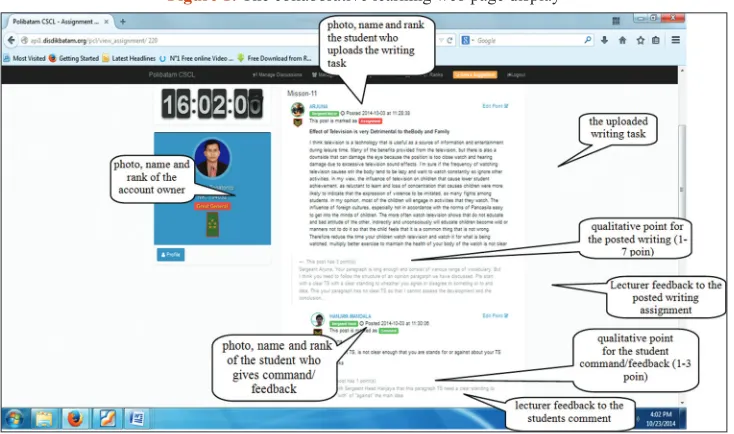
The provided CL web in this study came with a forum space in which the lecture asked students to upload their writing assigments and to leave a comment or feedback on the posted writings of their friends. The display web page can be seen in Figure 1.
Web system automatically gave point on the quantity of writing tasks and comments uploaded by the students in the web forum while the lecturer added the score to the quality of those writings and comments. Quantitative point of writing is 1-3 depending on
the uploading time; 3 points for uploading before the predetermined time period, 2 for uploading withing the predetermined time period and 1 point for a late uploading. While each of the uploaded comments or feedbacks got 1 point. On the other hand, the quality of student writings and comments were assessed by the lecturer. For each of posted writings, the lecturer awarded 1-7 point depending on the quality of writing in reference to the writing assessment system proposed by Jacob et al. (1981) in Hughes (2003). Besides, the lectures still gifted 1-3 score to the comments posted by the students. The summary of web point system can be seen in Table 4.
All the points obtained by the students were accumulated by the web to gain the level of reward. The more points a student collected, the higher his rank was. The form of the reward levels in this study was adopted from the Indonesian army rank system ranging from sergeant to general as can be seen in the Table 5.
4.2. The Pretest Score and the Analysis
Analysis of the pretest scores was conducted in order to measure the writing ability of the student before following the learning process, or in other words, assessing the students competency in the subject going to be taught. The following is the descriptive statistical analysis of the experiment and the control classes pretest scores.
From the data in the Table 6, it can be seen that the pretest score mean of the experiment class was 56.63 with the minimum score of 47 and the maximum score of 71. While the control class pretest score mean was 56.87 with the with a minimum score of 40 and the maximum score of 70. Based on the writing ability categories that has been formulated referring to the writing assessment system proposed by Jacob et al. (1981) as cited by Hughes (2003), the average writing ability level of both the experiment and the control classes before following the learning process was in poor - fair category (mean score 51-72). As has been noted earlier, this is due to the high level of writing difficulty with all its complex processes (Evans and Green, 2007; Luchini, 2010; Westwood 2008).
The comparison of the experiment and the control classes prestest sores statistic analysis can be seen in the Chart 1.
It can be clearly seen from the chart that the mean of the experiment and the control classes pretest were almost the same or had only very small difference. Yet, to determine wheather this difference was significant or not, a statistical t-tests was done by using the
Table 2: The writing ability categories referring to the writing assessment system proposed by Jacob et al. (1981)
Range of Writing Test Score Writing Ability Categories
93-100 Very good - exellent
72-92 Avarage - good
51-72 Poor - fair
34-50 Very poor
Table 3: The normalized gain score criteria
g score Interpretation of criteria
0.7< g <1 High
0.3≤ g ≤0.7 Average
SPSS 20 program. There are two requirements to do a t-tests, those are that the data from the two groups must be normally distributed and that they must be homogen. Hence, the normality and the homogeneity test were firstly done before conducting the t-test.
The normality tests was conducted using Shapiro–Wilk test statistic since the number of the respondents both in experiment and control classes was <50. The results of the test can be seen in the Table 7.
The table of normality test results in Shapiro–Wilk column above indicates that the experiment class had Sig (P) = 0.08, and the control class obtained Sig (P) = 0.92. Both of them were bigger than the value of α = 0.05. In other words, the experiment class P = 0.08 > α (0.05) and the control class P = 0.92 > α (0.05). Then it could be concluded that the both of data groups were normally distributed.
After knowing that the pretest data was normally distributed, the next step was to do the homogeneity test to identify the variances similarity among the pretest scores. The result of the homogeneity test using the Levene statistic of SPSS 20 program is shown in the Table 8.
Table 4: The point web system
Kinds of point Point of
writing commandPoint of Remark
Quantitative point 1-3 1 Automaticly given by the web system Qualitative point 1-7 1-3 Given by the lecturer
with the feedback
Figure 1: The collaborative learning web page display
Table 5: The Web Reward Rank (adopted from the Indonesian army rank system, available: www.tni.mil.id/ pages-22-kepangkatan.html)
Points
accumulation Rank nameThe obtained rewardEpaulet
10 Second sergeant
20 First sergeant
30 Sergeant major
40 Sergeant head
55 Second lieutenant
70 First lieutenant
85 Captain
105 Major
125 Lieutenant colonel
145 Colonel
165 Brigadier general
190 Major general
215 Lieutenant general
240 General
Table 6: The descriptive statistics of the experiment and the control classes pretest scores data
Class N Mean Minimum Maximum
Experiment 24 56.63 47 71
Control 23 56.87 40 70
The Levene statistic test on the pretest mean of the experiment and the control classes brought out the Sig. (P) = 0.544. By comparing the value of α = 0.05, this value was bigger or Sig. P (0544) > α (0.05). With this result, it could be concluded that the prestest scores of both the experiment and the control class came from the populations with the same variance (homogeneous).
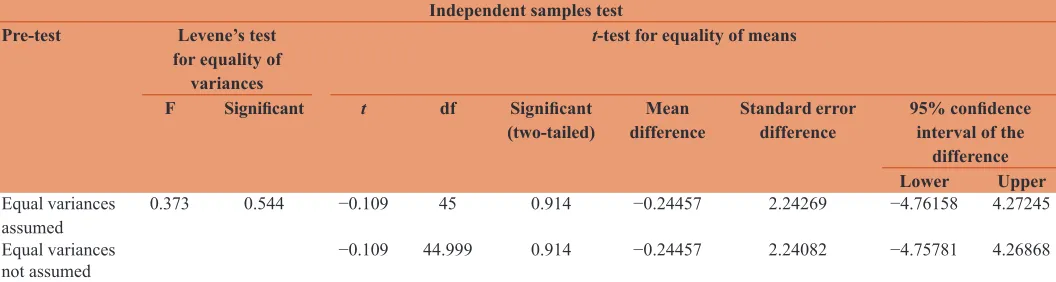
Being proved to be normally distributed and homogeneous, the prestest scores data was then qulified to be tested with the independent samples t-test of SPSS 20 to see the similarity of the experiment and the control classes writing ability before following the writing class. The t-test was done with a significance level of 5% and the the result is shown in Table 9.
As shown in the Table 9, the t-test result of the experiment and the control classes pretest showed a significance value of 0.914 which was bigger than 0.5. It clearly indicated that that there was no significant difference in the writing ability between the experiment and control classes at the beginning of the writing lesson.
4.3. The Posttest Score and the Analysis
The posttest was given to measure students’ writing abilities after following the learning processes in both the experiment class which was given the web based CL treatment and the control class which got the conventional treatment. The descriptive statistical analysis of the experiment and the control classes posttest scores is shown in Table 10.
Based on the data in the Table 10, it can be seen that the mean of the the experiment class posttest score was 75.75 with the minimum score of 60 and the maximum score of 97. While the mean of the control clas posttest score was 65.43 with the minimum score of 54 and the maximum score of 85. Based on the writing ability categories that has been formulated referring to the writing assessment system proposed by Jacob et al. (1981) as cited by Hughes (2003), the average writing ability level of the experiment class increased from a poor-fair (mean score 51-72) before the treatment into an average-good category (mean score 72-92) after after following the learning process while the one of the control classes was still in poor-fair category.
The comparison of the experiment and the control classes posttest scores statistic analysis can be seen in the Chart 2.
The graph obviously shows that the experiment class mean posttest scores was different from the one of the control group. However, to see whether this difference was significant or not, the the independent samples t-Test of SPSS program needed to be done. And as being implemented to the pretest previously, this posttest scores data needed to be firstly proved to have a normal distribution and to be homogenous by doing a normality and homogeneity test of SPSS program.
The normality test result conducted with the Shapiro–Wilk test of the SPSS 20 is as shown in Table 11.
The table shows that the Sig (P) of the experiment class was 0.080 and the one of the control class was 0.102 which were both of them were greater than the value of α = 0.05. In other words, for the experiment class P = 0.080 > α (0.05) and for control clas P = 0.102 > α (0.05). So that it could be concluded that the data of the posttest scores of both the experiment and the control class was normally distributed.
Table 8: The homogeneity test result of the experiment and the control classes pretest
Test of homogeneity of variance
Pretest scores Levene
statistic df1 df2 Significant
Based on mean 0.373 1 45 0.544
Based on median 0.135 1 45 0.715
Based on median and
with adjusted df 0.135 1 44.994 0.715 Based on trimmed mean 0.323 1 45 0.572
Table 9: The t-test results of the experiment and the control pretest scores
Independent samples test
Pre-test Levene’s test
for equality of variances
t-test for equality of means
F Significant t df Significant
(two-tailed) differenceMean Standard error difference 95% confidence interval of the difference
Lower Upper
Equal variances
assumed 0.373 0.544 −0.109 45 0.914 −0.24457 2.24269 −4.76158 4.27245
Equal variances
not assumed −0.109 44.999 0.914 −0.24457 2.24082 −4.75781 4.26868
Table 7: The normality test result of the experiment and the control classes pretest
Tests of normality Pretest
scores Kolmogorov–Smirnov
a Shapiro–Wilk
Statistic df Significant Statistic df Significant Experiment
class 0.187 23 0.036 0.875 23 0.008
Control
class 0.159 23 0.136 0.927 23 0.092
Next was the test of homogeneity to know the variance similarity between the experiment and the control classes posttest. This homogeneity test was done with the Levene Statistic of SPSS 20 and the result is shown in Table 12.
The provided Sig. (P) of the based on mean homogeneity test of the experiment and the control classes posttest was 0.134 which was bigger than the value of α (0.05). Since the value of
P (0.134) > α (0.05), it could be concluded that the two sets of data came from populations with the same variance (homogeneous).
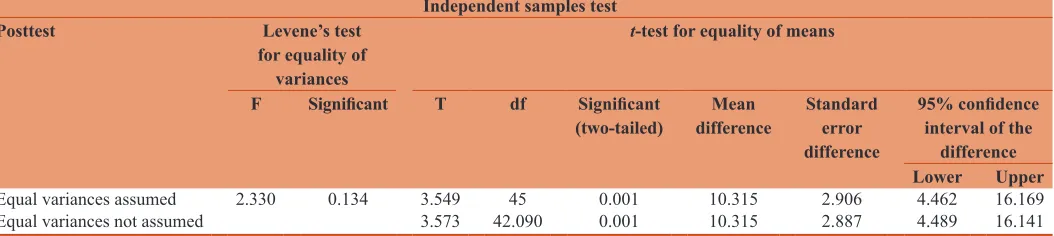
Since the postest scores of the both classes had a normally distribution and homogeny, they were feasible to be tested with the independent samples t-Test. The t-test with a significance level of 5% tested the formulated hypothesis below:
Ho: “The posttest score between the experiment class and control class is the same.”
Ha: “The posttest score between the experiment class and control class is different.”
And the results of the test is as in Table 13.
As being shown in the table above, the t-test significance value obtained was 0.001 which was smaller than the 0.5 so that the Ho was rejected and hence the Ha was accepted. It meant that there was a significant difference in the posttest scores of the experiment class and the control class. The difference can be clearly seen in Table 11 where the mean of the experiment class posttest class was 75.75 while the one of control group was 65.43.
4.4. The Data Gain and the Analysis
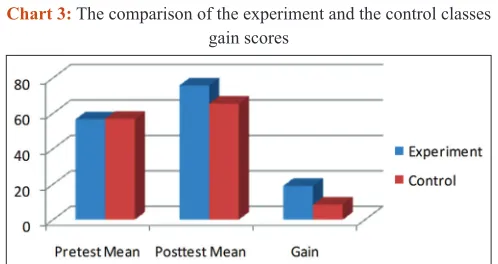
To examine the effectiveness of the web-based CL method applied in the experiment class and the effectiveness of the conventional learning method used in the control class, the normalized gain calculation was employed. The gain score was obtained from the difference between the posttest and the pretest mean. The results of the normalized gain <g> computation of the in the experiment and the control classes can be seen in Table 14.
Based on the pretest score mean in the beginning of the lesson and the posttest score mean in the end, the obtained normalized gain score for the experiment class was 0.44 and for the control class was 0.20. The acquired gain value was then interpreted in the <g> score criterion, and it was found that the effectiveness of web-based CL method in improving students writing skills in the experiment class was at an average category, while the effectiveness of the conventional method in the control class was at a low level. The comparison of the two gain scores can be seen in the Chart 3.
Table 10: Descriptive statistics of posttest scores
Class N Mean Minimum Maximum
Experiment 24 75.75 60 97
Control 23 65.43 54 85
Table 11: The results of normality test of the experiment and the control classes posttest scores
Tests of normality
Group Kolmogorov–Smirnova Shapiro–Wilk
Statistic df Significant Statistic df Significant Posttest
scores
Experiment 0.164 24 0.092 0.926 24 0.080 Control 0.096 23 0.200* 0.929 23 0.102 *This is a lower bound of the true significance, aLilliefors significance correction
Table 12: The results of homogeneity test of the experiment and the control classes posttest scores
Test of homogeneity of variance
Posttest scores Levene
statistic df1 df2 Significant
Based on mean 2.330 1 45 0.134
Based on median 1.633 1 45 0.208
Based on median and
with adjusted df 1.633 1 40.801 0.209 Based on trimmed mean 2.172 1 45 0.148
Table 13: The t-test results of the experiment and the control posttest scores
Independent samples test
Posttest Levene’s test
for equality of variances
t-test for equality of means
F Significant T df Significant
(two-tailed) differenceMean Standard error difference
95% confidence
interval of the difference
Lower Upper
Equal variances assumed 2.330 0.134 3.549 45 0.001 10.315 2.906 4.462 16.169
Equal variances not assumed 3.573 42.090 0.001 10.315 2.887 4.489 16.141
This finding is in line with what Vygotsky (1978) said that CL is better than learning alone, especially for difficult subjects such as writing that has quite complex process (Nunan, 1999; Bitchener and Basturkmen, 2006). The features available in the web CL could improve student writing ability level in the experiment class from a score mean which was only 56.63 before following the learning process to become 75.75 after the learning process. The CL method hence could increase the writing ability level from poor-fair to average-good (Jacob et al., 1981). There was also a raise in the control classes with the conventional method, but it was not as significant as the experiment class. The conventional way was able to improve the control class average writing score from 56.87 to 65.43, yet still the class was in poor-fair level. The collaborative environment became very conducive since the web provided each student spaces not only for posting their writings and but also for giving and receiving feedback on any posted writing. It gave the opportunity for each group member to share with the group both the difficulties they had in the process of writing and the success when they managed to get through those adversities. This collaboration increased the individual and the group eagerness and respect to the writing activities that led to a better writing ability. Keller (1983) called this series as a positive cycle of good performance. This is in line with Bligh’s notion (1972) that the CL fosters higher levels of performance. The web based CL in this study generated a cozy learning atmosphere in which learners felt respected and connected to one another in doing their writing tasks. This strong social support system promoted increase in the student writing ability (Cohen and Willis, 1985).
The collaboration learning web in this study also facilitated the creation of the interaction among the students in the form of peer review which is one of the main goals of CL (Armiati and Sastramiharja, 2007). This peer review was done in form of online discussion and sometimes debate that gave each group member the occasion to clarify ideas, knowledge and information that could be retained longer in the students mind. At the same time, this way of collaboration also raised the student critical thinking (Kulik and Kulik, 1979; Webb, 1980, 1982; Johnson, 1971, 1973, Johnson and Johnson, 1990). The critical thinking is very essential
in producing creative writings. When the students write to learn what they think, they are practicing critical thinking in its basic form (Macrorie, 1980). Furthermore, the peer review promoted by the web also fostered the student responsibility toward the writing learning process and result. As they gave and received input from their colleagues they weaned themselves away from considering lecturer the only sources of knowledge and understanding (Felder, 1997; Rafique, et al., 2014). The lecturer did give the students feedback but it was no more the sole resources they had since they enjoyed abundant of information from all group members that accelerated their writing performance.
The web reward system in the study gave chances to the all students with different writing ability level to get the points since it compensated not only the quality but also the quantity of the writings and comments. Unlike the competition spirit that encourages a win-lose condition where superior students take all rewards and middle or low-achieving students get none, the web promoted a mutual collaboration in which the students could help each other in doing the difficult writing tasks which raised the performance level of each member (Kagan 1986). This way the writing complex process could be made less tedious through the web based CL activities (Tannenberg, 1995). In this notion, Felder (1997) said that web CL allows assignment of more challenging tasks without making the workload unreasonable.
5. CONCLUSION AND SUGGESTIONS
This study concluded that there was difference in the levels of the writing ability between the experiment class and the control class after the learning treatment. This meant that the effectiveness of the web-based CL method applied in the experiment class was higher than the one of the conventional methods used in the control classes. This was shown by the result of posttest scores hypothesis test after the learning process and the normalized gain scores obtained by the both classes. The t-test significance values derived from the hypothesis test was 0.001 which was smaller than 0.5 so that the Ho “The posttest scores between the experiment class and control class are the same” was rejected and hence the Ha “The posttest scores between the experiment class and control class are different” was accepted. The result of the normalized gain score calculation between two classes also indicated that the the web-based CL method had a better efficacy than then conventional one, since the web-based CL method obtained the normalized gain score
<g> = 0.44 (average effectiveness category) while the conventional method only got <g> = 0.20 (low effectiveness category).
Regarding to this conclusion, it was suggested to continue and to expand the use of this web-based CL method in other classes in Batam Polytechnic, particularly in those taking the Academic Writing course. It was also recommended to improve the existing computer laboratory and the internet services as this learning method is highly dependent on the use of the computers and the smoothness of the internet network. For further study on this topic, it was encouraged to do extended researches on the effect of web-based CL on other variables such as on the student learning motivation and/or to expand the study population on other educational institutions.
Table 14: The results of gain calculaion of the experiment and control classes
Group Posttest
score mean score meanPretest Gain <g> Criteria
Experiment 75.75 56.63 19.12 0.44 Average
Control 65.43 56.87 8.56 0.20 Low
6. ACKNOWLEDGMENT
The author would like to thank the Director of the Batam State Polytechnic and the Chairman of the Research and Community Service of the Batam State Polytechnic who have provided the opportunity and funding to conduct this research as a part of the university Tridarma in the Batam State Polytechnic.
REFERENCES
Alsamadani, H.A. (2010), The relationship between Saudi EFL students’ writing competence, L1 writing proficiency, and self-regulation. European Journal of Social Sciences, 16(1), 53-63.
Armiati, S., Sastramiharja, H. (2007), Collaborative Learning Framework. Proceedings of SNATI, Yogyakarta, p42-48.
Astin, A., (1993), What Matters in College. San Francisco: Jossey-Bass. Bitchener, J., Basturkmen, H. (2006), Perceptions of the difficulties of
postgraduate L2 Thesis students writing the discussion section. Journal of English for Academic Purposes, 5(1), 4-18.
Bligh, D.A. (1972), What’s the use of lectures. Karmondsworth. England: Penguin.
Bonk, C.J., Reynolds, T. (1997), Learner-centered web instruction for higher-order thinking, teamwork, and apprenticeship. In: Kahn, B.H., editor. Web-based instruction. Englewood Cliffs, NJ: Educational Technology Publications, Inc. p167-175.
Bonwell, C.C., Eison, J. (1991), Active Learning: Creating Excitement in the Classroom. ASHE-ERIC Higher Education Report No. 1, George Washington University.
Brown, H.D. (2001), Teaching by Principles: An Interactive Approach to Language Pedagogy. 2nd ed. California: San Francisco State
University.
Cohen, S., Wills, T.A. (1985). Stress, social support, and the buffering hypothesis. Psychological bulletin, 98(2), 310.
Crano, W.D., Brewer, M.B. (2002), Principles and Methods of Social Research. New Jersey: Lawrence Erlbaum Association, Inc. Dalsky, D., Tajino, A. (2007), Students’ perceptions of difficulties with
academic writing: A report from Kyoto University academic writing courses. Kyoto University Researches in Higher Education, 13, 45-50. Dillenbourg, P. (1999), Collaborative-Learning: Cognitive and
Computational Approaches. Oxford: Elsevier.
Eisenberger, R., Rhoades, L., Cameron, J., (1999), Does pay for performance increase or decrease perceived self-determination and intrinsic motivation? Journal of Personality and Social Psychology, 77(5), Nov 1999.
Evans, S., Green, C. (2007), Why EAP is necessary: A survey of Hong Kong tertiary students. Journal of English for Academic Purposes, 6(1), 3-17. Felder, R.M. (1997), Beating the Numbers Game: Effective Teaching
in Large Classes. Proceeding ot the Annual ASEE Conference, Milwaukee, p72-77.
Gokhale, A.A. (1995), Collaborative learning enhances critical thinking. Journal of Technology Education, 7(1), 22-30.
Gunning, T.G. (1998), Assessing and Correcting Reading and Writing Difficulties. Boston: Allyn and Bacon.
Hake, B.J. (1999), Lifelong learning in late modernity: The challenges to society, organizations, and individuals. Adult Education Quarterly, 49(2), 79-90.
Harmer, J. (2007), The practice of English Language Teaching. 4th ed.
Harlow: Longman.
Hughes, A. (2003), Testing fot Language Teachers. 2nded. Cambridege:
Cambridege University Press.
Jacobs, Robert A, (1995). "Methods for combining experts' probability assessments." Neural computation 7.5: 867-888.
Johnson, D.W. (1971), Effectiveness of role reversal: Actor or listener. Psychological Reports. 28(3), 275-282.
Johnson, D.W. (1973), Communication in conflict situations: A critical review of the research. International Journal of Group Tensions, 3(1), 46-67. Johnson, D.W., Johnson, R.T. (2009), An educational psychology success
story: Social interdependence theory and cooperative learning. Journal of Educational researcher, 38(5), 365-379.
Johnson, D.W., Johnson, R.T. (1990). Social skills for successful group work. Educational leadership, 47(4), 29-33.
Kagan, S. (1986), Cooperative learning and sociocultural factors in schooling. Beyond Language: Social and Cultural Factors in Schooling Language Minority Students. Los Angeles: California State University. Khan, A.A., Sultan, A., Jan, F.A. (2014), Effects of perceived stressors
and psychiatric morbidity on academic performance of university students. Journal Of Management Info, 4(1), 147-156.
Kolodner, J., Guzdial, M. (1996), Effects with and of CSCL: Tracking learning in a new paradigm. In: Koschman, T., editor. CSCL: Theory and Practice of An Emerging Paradigm. Mahwah, NJ: Lawrence Erlbaum Associates. p307-320.
Kulik, J.A., Kulik, C.L. (1979), College teaching. In: Peterson, P., Walberg, H., editors. Research in Teaching: Concepts, Findings and Implications. Berkeley, CA: McCutcheon Publishing.
Laal, M., Ghodsi, S.M. (2012), Benefits of Collaborative Learning. Procedia of Social and Behavioral Sciences, 31, 486-490.
Langan, J. (2005), College Writing Skills. Atlantic Cape Community College: McGraw Hill.
Lee, I. (1997), ESL Learners’ performance in error correction in writing: Some implications for teaching. System Journal, 15, 465-477. Lisi, R.D., Golbeck, S.L. (1999), Implications of piagetian theory for peer
learning. In: O’Donnell, A.M., King, A., editors. Cognitive Perspectives on Peer Learning. Mahwah, New Jersey: Lawrence Erlbaum. p3-37. Luchini, P.L. (2010), Evaluating the effectiveness of a complimentary
approach to teaching writing skills. International Journal of Language Studies (IJLS), 4(3), 73-92.
Macrorie, K. (1980), Searching Writing. New Jersey: Hayden. Marshall, S. (1991), A genre-based approach to the teaching of
report-writing. English for Specific Purposes Journal, 10(1), 3-13. Millis, B.J., P.G. Cottell. 1998, Cooperative learning for higher education
faculty. Phoenix, Ariz.: American Council on Education and Oryx. Nunan, D. (1995), Closing the gap between learning and instruction.
TESOL Quarterly, 29(1), 133-158.
Peterson, P.L., Swing, S.R. (1985), Students cognitions as mediators of the effectiveness of small-group learning. Journal of Educational Psychology, 77(3), 299-312.
Rafique, M., Bing, Z., Ansari, M.A., Soomro, J.A., Wei, S.Z. (2014), Comparing of body mass index and by sit and reach flexibility test of Tsinghua University Beijing China and University of sindh Pakistan students. Journal Of Management Info, 4(1), 157-166.
Santoso, A. (2010), Scaffolding an EFL effective writing class in a hybrid learning community. Unpublished Ph.D. Dissertation. Queensland: Queensland University of Technology.
Slavin, R.E. (1990), Cooperative Learning: Theory, Research, and Practice. NJ: Prentice-Hall.
Sugiyono, P. Dr. 2012. Metode Penelitian Kuantitatif, Kualitatif, dan R&D. Bandung: Alfabeta.
Tahvildar, Z., Zade, A.E. (2013), Evaluation of writing skills and the levels of difficulty. Journal of Academic and Applied Studies (Special Issue on Applied Sciences), 3(9), 53-63.
Tajino, A. (1997), Learner difficulty: What is it, and how well do we understand it? The Teacher Trainer Journal, 11(2), 12-14.
Topping, K., Ehly, S. (1998), Introduction to peer Assisted learning. In: Topping, K., Ehly, S., editors. Peer-Assisted Learning. Mahwah, NJ: Lawrence Erlbaum. p1-23.
Vygotsky, L.S. (1978), Mind in Society: The Development of Higher Psychological Processes. Cambridge, MA: Harvard University. Webb, N.M. (1982), Group composition, group interaction and achievement
in small groups. Journal of Educational Psychology, 74(4), 475-484.
Webb, N.M. (1980), An analysis of group intyeraction and mathematical errors in heterogeneous ability groups. British Journal of Educational Psychology, 50(2), 266-276.
Wenger, E. (1998), Communities of Practice: Learning, Meaning and Identity. Cambridge: Cambridge University Press.