Historical Perspective
Imagine you woke up one day and you had no memory. You wouldn’t know who you were. You wouldn’t know your family and friends. You wouldn’t remember your school or your favourite television program. You would find yourself in a world where nothing was familiar. How do you think you would feel if you knew nothing about your past?
History is similar to your memory. It is the record of what has happened in the past. Without history, we do not know how things came to be as they are today. All events have their roots in the past. Things happen because other things have happened. History helps us to understand why things are the way they are. We call this historical perspective.
Like all countries, Canada has a history. By learning about our history, we discover the traditions and values that are important to Canadians today.
Knowing about the past helps us to understand the present. It also helps us think about what may happen in the future.
Confederation
Key
CONCEPT
▲
What factors led British Columbia, Prince Edward Island, Alberta,
Saskatchewan, and then Newfoundland to become provinces of
Canada, and what were the consequences?
Chapter
Use a Know-Wonder-Learn chart like the one below to organize your thoughts about the expansion of Confederation.
• Think about what you already know about Confederation. Think about the reasons why some colonies joined the union in 1867. Think about why others did not. Record everything you know about the topic in the “Know” column.
• Then, in the “Wonder” column, record those things you would like to know about the expansion of Confederation after 1867. • When you have finished this chapter, return
to your chart. Check off the questions in the “Wonder” column that you have answered. • Then, summarize what you have learned in
the “Learn” column.
Think
AHEAD
▲
Political cartoons can be a fun way to learn about history. The Skill Check feature in this chapter will
show you how to Analyze Political Cartoonsfor meaning. The project at the end of the chapter will ask you to create your own political cartoon on one of the issues you have read about.
Honing
Your Skills
Expansion of Confederation
Know Wonder Learn
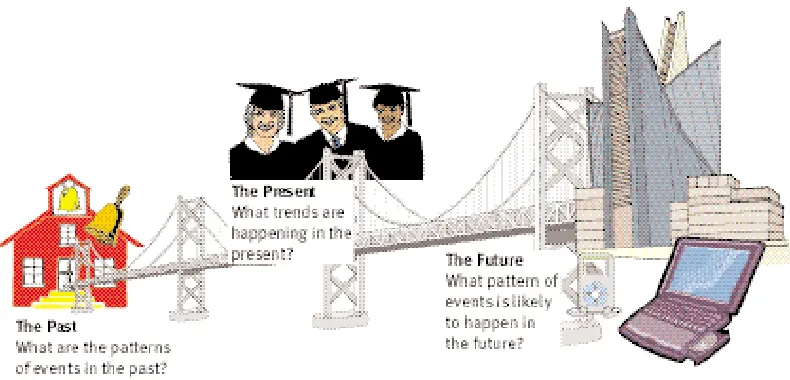
Figure 10.1 Building a bridge between the past, the present, and the future. We can make history come alive by building bridges between events in the past and events that are happening today. Then we can study these patterns and trends. They can help us think about what may happen in the future. For example, in the previous chapter, you learned about the railway expanding in Canada. What forms of transportation are in use in Canada today? What pattern do you see? Predict how transportation will change in Canada’s future.
Time and Change
P
olitical cartoons have been around for a long time. They have been printed in Canada’s newspapers since before Confederation. They are still popular today.Political cartoons poke fun at politicians. They use humour to make statements about important events and issues. When we look at such cartoons from the past, we get an idea of what people were thinking about at that time. In this way, political cartoons help us gain historical perspective.
To understand political cartoons, we need to interpret what they are trying to say. Here are some tips to help you in your analysis.
1. Look to see if the cartoon has a title.If it does, what does it mean?
2. Examine the overall scene in the cartoon.What is the key issue or event?
3. Describe the setting.Where and when does the action take place?
4. Identify the people or characters in the cartoon.What are they saying? What does their mood appear to be?
5. Identify any keywords or symbols.What do they mean?
6. At whom or what is the cartoonist poking fun?
7. What is the message in the cartoon?Is it expressed effectively? Why or why not?
8. What techniques has the cartoonist used (for example, labels or exaggeration of physical features)?
How has the cartoonist created humour?
S
KILL
C
HECK
:
Analyze Political Cartoons
Analyze the political cartoon on this page.
Just follow the steps outlined
at left.
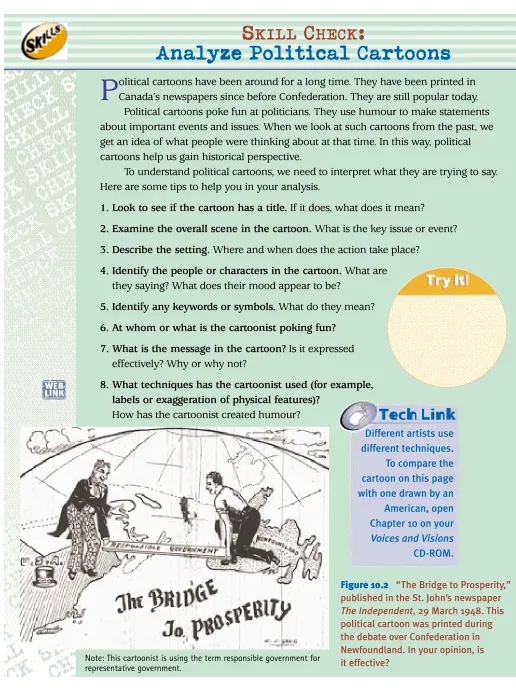
Figure 10.2 “The Bridge to Prosperity,” published in the St. John’s newspaper The Independent, 29 March 1948. This political cartoon was printed during the debate over Confederation in Newfoundland. In your opinion, is it effective?
Different artists use different techniques. To compare the cartoon on this page with one drawn by an American, open Chapter 10 on your Voices and Visions CD-ROM.
Tech Link
A
fter 1867, many newcomers came to Canada to settle on the vast prairies of the North-West Territories. They were luredhere by the promise of fertile farmland. British Columbia, though, seemed all rock and mountain. At first, farming was only possible in mountain valleys and river deltas. Why did people come to British Columbia? They came for one thing: gold! In this section, you’ll find out how the gold rush and the events that followed led British Columbia to join Confederation.
A Gold Colony
The fur trade attracted the first Europeans to the Pacific coast. The number of
explorers and traders was small, though. In those days, there were far more First
Nations peoples than Europeans. They lived along the coast and in the interior. In fact, by 1849, the only European settlement was a small British colony at Fort Victoria on Vancouver Island.
In the 1850s, all that was about to change. The First Nations who lived along the Fraser River had been mining gold for hundreds of years. When the Hudson’s Bay Company set up a trading post nearby, the First Nations miners brought their gold there to trade. Word that there was gold in the mountains quickly spread to the outside
world. Before long, prospectorsin search of gold stampeded into the region. The gold rush was on! In 1858, about
25 000 prospectors were scrambling along the banks of the Fraser River.
At first, Vancouver Island was a colony, and the mainland was British territory. The governor was James Douglas. He grew alarmed as thousands of miners—mostly Americans—flooded into the area. There had been lawlessness in the California gold rush a few years earlier. Douglas did not want the same thing to happen here. He began issuing licences to the miners. Then, to maintain law and order, he created a police force and appointed magistrates (judges) to enforce the law.
The Stó:lô [STAH-loh] and Nlaka’pamux [unth-lah-KAH-pum] Nations lived along the Fraser River. They relied on salmon for their livelihood. The miners searched for gold all along the river. This scared the fish away. In August 1858, the Stó:lô and the Nlaka’pamux blocked the river to keep the miners out. The standoff turned violent. Many First Nations people were killed. The two sides were close to war before Douglas and a band of soldiers arrived to restore
What factors led to British Columbia joining Confederation?
Focus
British Columbia Joins Confederation
Figure 10.3 A prospector panning for gold, as painted by William Hind in 1864. The quest for gold has often spurred people on to seek adventure in foreign lands. What role did this quest play in the Europeans’ early explorations?
peace. They assured the Stó:lô and the Nlaka’pamux they would be protected from the miners.
Then, to bring law and order to the region, Britain created the colony of British Columbia in 1858. Fort Victoria would be the administrative centre. Douglas was appointed governor of both colonies. The two colonies had a population of about 50 000, including First Nations.
The Road to Gold [
In time, the prospectors moved farther north. They were searching for the main source of the gold nuggets the river had carried downstream. They finally discovered more gold along the Quesnel River in the Cariboo Mountains. It was hard to get supplies to these remote mining camps, though. The Fraser River was too rough to travel by boat. Governor Douglas decided to build a wagon road.
In 1865, the Cariboo Road was finished. It had cost more than a million dollars to build. Now, though, horse-drawn wagons could carry supplies to the distant mining camps. Over time, 100 000 miners would start out in New Westminster on the coast. They would make their way up the Fraser River, teetering along the road that clung to the steep canyon walls. Then they would travel over land for 650 kilometres. Finally, tired out, they would reach
Barkerville, a supply town for the goldfields in the central interior. For a brief time, boomtown Barkerville was the largest city north of San Francisco and west of Chicago. Figure 10.4 Wagon trains on the Cariboo Road in the early 1870s.
When the road was finished, it opened up the Cariboo territory. Miners and ranchers settled in the area. What impact do you think they would have had on the First Nations people who lived here?
A New Beginning [
The gold rush lasted only until about 1868. This was the year that Barkerville burned to the ground. Yet the gold rush marked a turning point for British Columbia. During the height of the rush, the sleepy town of Victoria was transformed into a thriving centre. After the rush, many of the
newcomers stayed on. They built farms and started up businesses. British officials arrived to set up a government. The Cariboo Road marked the beginning of a whole network of roads. Out of the hustle and
bustle of the gold rush, a permanent settlement emerged on the Pacific coast.
Over time, other economic activities got going. Logging was one of the most
important of these. How does an economic activity help get towns started? Let’s look at one example. The Fraser Mills Company needed people to work in its sawmill. It invited 40 Canadien families to come to BC from Québec in 1909. They founded
Maillardville, near Vancouver. It was the first BC Francophone community. Many BC towns were started for people who wanted to work in the logging industry.
Catherine Schubert (1835–1918)
Most prospectors travelled to British Columbia by boat. Some, however, made the trip over land from the East. Known as the Overlanders, they travelled by wagon and canoe, on horseback and on foot, led by First Nations guides. They
followed the fur-trading routes across the prairies and over the mountains. It was a long and often dangerous journey.
The only woman among the Overlanders was Catherine Schubert. She and her husband, Augustus, were desperate to reach the trading post at Kamloops quickly. Schubert was pregnant with her fourth child. There was no time to spare! They were rafting down the Thompson River when Schubert’s labour began. The family reached a Secwepemc [SUHK-wep-muhk] village near the Kamloops trading post. There, the Secwepemc women took care of Schubert. She quickly delivered a baby girl.
The Schuberts finally bought a farm at Lillooet. But Schubert’s husband was more interested in finding gold than in farming. He made frequent trips to the goldfields. He was
never very successful, though. To support her family,
Catherine Schubert opened a roadhouse and rented out rooms to travellers. She ran the farm and taught school to local
children in her home. Later, she sold her hotel to take a teaching job at a boarding school. In 1881, Augustus Schubert vowed to give up prospecting. The family moved to a farm in the Okanagan Valley. Once again, Schubert opened a roadhouse for
travellers. Catherine Schubert served her community until she died in 1918. She was 83 years old. A monument was built in her honour in 1926. It says, simply, “A brave and notable pioneer.”
Biography
Biography
Why is Catherine Schubert described as a “notable” pioneer? Think about how she helped build the new communities in the BC interior. Do you think she should also be described as an active citizen? Explain.
First Nations in
British Columbia []
Various First Nations lived on the mainland and islands of British Columbia. They hunted sea mammals in the ocean, gathered shellfish along the coast, and fished the mountain rivers. The Pacific Coast has a lush temperate rain forest. The First Nations relied on it as a dependable source of food. They also had a highly developed trading network.
Before the gold rush, the First Nations peoples tried to adjust to the newcomers in their territories. It wasn’t easy, though. The newcomers didn’t understand the First Nations’ way of life. They didn’t understand the importance of the land and waters to these peoples.
In 1850 and 1854, Governor Douglas bought 14 parcels of land on Vancouver Island from the First Nations. These become known as the Douglas Treaties. Douglas set up small reserves where the First Nations people could live. He recognized their right to hunt and fish on unoccupied territory. In return, the people agreed to move off their traditional lands. These were the only land deals between the British and the First Nations in British Columbia for many decades. To this day, most BC First Nations have not signed treaties. They have not received any compensation for land taken from them. For the most part, the
newcomers did not ask permission to take the land.
Figure 10.6 Two loggers cutting down a Douglas fir tree in British Columbia. The loggers are standing on springboards that go right inside the tree trunk. Logging became the backbone of the provincial economy. What transportation networks do you think were needed to make this happen?
Figure 10.7 A fishing weir in British Columbia, 1866. The Tsilhqot’in [tsil-KOH-tin] used fishing weirs like this one to trap salmon as they swam upstream. The miners panned for gold on the same rivers. How might the miners’ activities disrupt the fishing weirs?
Sometimes the First Nations fought back. In 1864, this happened in Tsilhqot’in territory. A road crew was building a road through Tsilhqot’in lands without Tsilhqot’in
permission. The work was scaring off the animals and fish. In addition, some of the road crew were raiding the villages. They were looting graves for valuable artifacts. In response, a group of Tsilhqot’in attacked and killed members of the road crew.
A group of British soldiers was dispatched to end the conflict. They arrested five Tsilhqot’in men and charged them with murder. During the trial, the judge agreed that the Tsilhqot’in people’s land had been invaded and that the road crew had provoked them. Still, the Tsilhqot’in were found guilty and were hanged. The next year, though, a law was passed making it illegal to loot First Nations graves. A hundred years later, the government of British Columbia apologized for the way the Tsilhqot’in had been treated.
One Colony on the Pacific
You’ll recall that the purpose of colonies was to provide wealth and power for the home country. On the Pacific coast, first furs, and then gold, added to Britain’s wealth. Britain valued its two Pacific colonies for their location, too. They provided a base for the British fleet on the Pacific coast. In return for these benefits, Britain paid for the colonies’ defence and government.
As the gold rush wound down, though, the colonies almost went bankrupt. The gold was nearly gone. The fur trade was in decline. Britain began to think it cost too much money to run two colonies. In 1866, it decided to unite Vancouver Island and British Columbia. Now there was just one colony: British Columbia.
By now, though, the colonists were unhappy with their relationship with Britain. The colony was deeply in debt. It had spent most of its money building the Cariboo Road and other roads and providing public
services. There were not enough people to pay taxes or to buy land. Therefore, there wasn’t enough money for the government to meet its financial needs.
V
OICES
V
OICES
“
At first, the newcomers saw the First Nations peoples as partners in the fur trade. As the gold rush began, however, the newcomers took over more and more land to meet their needs. Before long, the newcomers saw First Nations peoples as obstacles to their progress. A Nuu-chah-nulth [noo-CHAH-noolth] chief expressed his people’s perspective:
We see your ships, and hear things that make our hearts grow faint. They say that your King-George-men [Europeans] will soon be here, and will take our land, our firewood, our fishing grounds; that we shall be placed on a little spot, and shall have to do everything according to the fancies of the King-George-men.
Source: Gilbert Malcolm Sproat, Scenes and Studies of Savage Life
(London: Smith, Elder & Co., 1868), p. 4.
”
To learn more about Barkerville, the boomtown of the gold rush, open Chapter 10 on your Voices and VisionsCD-ROM.
Things were changing outside the colony, too. East of the Rockies, Canada was expanding across the prairies. To the north, the United States had bought Alaska from Russia in 1867. To the south, the state of Washington was quickly filling up with homesteaders. In British Columbia, the colonists felt the time had come to decide about their future. They had three choices: • to remain a British colony
• to become a province of Canada • to join the United States
Confederation Achieved]
In 1870, three delegates from British Columbia travelled to Ottawa. They wanted to talk about joining Canada. They were determined to drive a hard bargain. If the colony was to join Confederation, they wanted several things in return.
V
OICES
V
OICES
“
The future of British Columbia was the topic of a great debate. Thomas Lett Wood was a member of the colonial government. He wanted British Columbia to stay a British colony.
The bond of union between Canada and the other Provinces bears no resemblance to the union between England and her colonies. There is no natural love and feeling of loyalty. The feeling of loyalty towards England is a feeling blind, instinctive, strong, born with us and impossible to be shaken off; and I believe that it is impossible to transfer a feeling of loyalty at will.
Source: The BC Legislative Council, Debate on the Subject of Confederation with Canada, 1870(Victoria, 1912), p. 28.
”
“
I advocate Confederation because it will secure … this Colony under the British Flag, and strengthen British interests on this Continent; … it will benefit this community, by [reducing taxes] and … securing the aid of the Dominion Government, who are … able to … develop the naturalresources and to promote the prosperity of this Colony; and by affording, through a railway, the only means of acquiring a permanent population, which must come from east of the Rocky Mountains.
Source: The British Columbia Archives, Debate on the Subject of Confederation with Canada, 1870.
Summarize each of these quotations in your own words. Choose one. Illustrate what the speaker is saying by drawing a picture or retelling it in your
own words.
Respond
”
Joseph Trutch played a leading role in the shaping of British Columbia. He was eager to see a Canada united from sea to sea.
“
I am a loyal Briton, and [I] would prefer living under the institutions of my own country, were it practical. But I … would prefer the flag and institutions of the United States, with prosperity, to remaining as we are, with no prospect of succeeding as a British colony.Source: The British Columbian, 1870.
”
• They wanted Canada to pay the colony’s debts.
• They wanted a road to be built across the prairies to the Pacific. It would link British Columbia with the rest of Canada. • They wanted Canada to make payments
to the new province every year.
Much to their surprise, Canada agreed.
What’s more, Canada offered to build something better than a road. They offered to build a transcontinental railway—and they would do it within 10 years.
The delegates went home. They had little trouble winning approval for the deal. On 20 July 1871, British Columbia became Canada’s sixth province.
CASE
STUDY
The Growth of Vancouver
The city of Vancouver began as the tiny sawmill village of Granville. People also knew it as Gastown. The name came from a talkative saloon keeper
known as “Gassy Jack” Deighton.
Life in Granville got busy after the village became the western end of the railway line. In April 1886, Granville became the City of
Vancouver. This name was chosen to honour George Vancouver. He was the British explorer who surveyed much of the West Coast. A year later, on 23 May 1887, the first train arrived from Montréal. The port quickly grew into the centre of activity on the West Coast. Cargo was transferred from the trains onto ships from Asia and Australia, and vice versa. Industries were set up along the railway line. At first, working families lived near these industries so they could walk to work. Wealthier families lived alongside the waters of English Bay. In the early 1900s, though, business and industry began to spread throughout the city centre. Streetcars and trams allowed working families to move to the suburbs. Wealthy families moved, too.
They built homes south of the city with views of the snow-capped mountains to the north. The patterns created in these early days in Vancouver can still be seen today.
What factors affected the pattern of growth in Vancouver?
Respond
1. a) Record the arguments for and against British Columbia joining Confederation. The chart below shows a way you could organize your ideas.
b) Which side of the debate do you think had the strongest arguments? Give reasons for your answer.
2. In Chapter 7, you learned about the factors that led to Confederation in 1867. Compare these with the arguments you listed for British Columbia.
a) What are the similarities?
b) What factors were unique to British Columbia?
Think It
Through
▲
Today, Vancouver is still a major port. More cargo passes through here than any other port in the country. Huge freighters sit anchored in the harbour. They wait to unload their cargoes and take on others. They will transport loads of grain, lumber, and minerals across the Pacific.
Vancouver is the third-largest city in Canada. Only Toronto and Montréal are bigger. Vancouver is the centre of business in British Columbia. The residents enjoy a beautiful ocean setting, with a backdrop of snow-capped mountains. These make Vancouver popular with tourists. They also attract newcomers to Canada. These new immigrants help make Vancouver unique.
Figure 10.9 An aerial photo of Vancouver, taken in 1991. What patterns can you identify in the layout of the city? How are these similar to and different from the patterns in Figure 10.8?
The Issue: Should British Columbia Join Confederation?
P
rince Edward Island was one of the colonies that took part in the talks that led to Confederation in 1867. After debatingthe idea, though, the Islanders decided not to join Canada. In this section, you’ll learn more about why PEI stayed out of Confederation. Then you’ll find out why the Islanders changed their minds.
Rejecting Confederation
As you saw in Chapter 7, PEI rejected Confederation in 1867. The people of Prince Edward Island had wanted two things. They wanted more money and more Members of Parliament. The other colonies wanted PEI to join them. However, they were unwilling to meet PEI’s demands. For
the time being, Prince Edward Island remained on its own.
Rethinking
Confederation]
What factors convinced the people of PEI to change their minds?
• The “Land Question” helped to persuade the Islanders to rethink joining Canada. Absentee British landowners owned most of the island. This meant that, instead of owning their own homes and farms, most Islanders paid rent to the landowners. Canada offered a way out of this dilemma. If PEI joined the country, Canada promised to buy the land for them.
• In 1871, the government of PEI decided to build a railway across the island. It argued that a railway would provide jobs. It could help farmers get their produce to market. A railway was expensive to build, though. What was the solution? After union with Canada, the federal
government could help pay for it. Those who opposed the
railway thought it was just an excuse for bringing the colony into Confederation.
Prince Edward Island Joins Confederation
What factors led to Prince Edward Island joining Confederation?
Focus
Before beginning this section, flip to its end and read the Think It Through activity. Then, as you read the section, look for possible answers.
Figure 10.10 The sailing ship Fanny Bailey. Shipyards in Prince Edward Island produced many wooden sailing vessels such as the Fanny Bailey. They traded these ships and most of the other goods they received with other countries, not the colonies. How would this affect PEI’s interest in union?
To see an image of an early PEI farm,
open Chapter 13 on your Voices and Visions
CD-ROM.
• Prince Edward Island was trying to make a trade deal with the United States. It wanted goods to move tax-free across the
border. This angered the British government. After all, Prince Edward Island was just a colony. It could not make trade deals with other countries. As a result, the talks went nowhere.
Therefore, PEI had to look elsewhere for a market for its produce. The only option left was Canada.
• Britain wanted to rid itself of the cost of running the colony. Canada worried that the Americans secretly planned to take over the island. As a result, both Canada and Britain put pressure on PEI to join the union.
A Better Deal []
In 1873, delegates from PEI went to Ottawa. They wanted to discuss joining Canada. They were tough negotiators. As part of the deal, Canada agreed to
• pay the island’s debts Figure 10.11 The Tryon Woollen Mills on Prince Edward Island.
Local sheep farms provided the mill with wool to make cloth. If you had been the owner of the mill in 1873, what political future would you have supported for PEI?
V
OICES
V
OICES
“
Was the railway a way to force the people of Prince Edward Island to join Confederation? Some politicians believed it was.
The railway is so far beyond our means that I am convinced that the Government are fully aware that they cannot accomplish one-third of the undertaking without aid, and that aid, I have no doubt, they expect to obtain from their friends in [Canada], in exchange for delivering the Island into their hands. … Confederation is, in my opinion, the object sought, and not the prosperity of the Island.
—Benjamin Davies, PEI politician Source: Debates of the House of Assembly of PEI, 1871, p. 193.
”
“
Looking at the question fairly in the face, my Ministers see that there are only two courses open to them: either they must impose heavy taxes on the people, or seek admission into the Union, provided that Canada would make our railway debt her own.—Lieutenant Governor W.F.C. Robinson Source: Francis Bolger, ed., Canada’s Smallest Province: A History of PEI(Halifax: John Deyell Company, 1991) p. 208.
”
• pay the province an annual sum of money • take over the cost and building of the
island’s railway
• provide year-round steamboat service between the island and the mainland • give PEI six MPs in the House of
Commons (which is high in relation to the number of people represented)
• buy back land from the absentee landowners in Britain
On their return to PEI, the delegates put the deal to a vote. The Islanders voted in favour of joining Canada. On 1 July 1873, Prince Edward Island became the seventh province of Canada.
CASE
STUDY
The Acadians of Île-du-Prince-Édouard
The first Europeans to live on Prince Edward Island (then called Île Saint-Jean) were about 200 people from France. They settled at Havre Saint-Pierre and Havre-aux-Sauvages in 1720. Here, they fished cod. They had a good relationship with the local Mi’kmaq [MIG-mah]. In the following decade, the first Acadians joined the first homesteaders. Over the next 35 years, the communities
expanded to include about 5000 people. They made a living from farming and fishing. Jean Pierre de Roma built the first road in 1731 to connect all the
settlements.
In 1758, the British deported 3000 Acadians from the island to France. A third of them died of disease or drowning during the voyage. About 2000 escaped the deportation by hiding on the island or fleeing to New Brunswick. It took many years for the Acadian population to build up again. (For more on the deportation, see page 107.)
At the time of Confederation, the Acadian population was small but politically active. In fact, the first Acadian MP in the House of Commons came from PEI. Stanislaus F. Perry (Poirier) was elected in 1874. Perry was known for his integrity. He was called “Perry the Noble.”
About 12 per cent of PEI’s current population has Acadian roots. The provincial government provides many services in French. To read more about the Acadians, see pages 106 to 109 in Chapter 5.
You know that most Prince Edward
Island residents were concerned that a government in far-off Ottawa would not be able to represent their interests. How do you think the Acadian minority on the island would
feel about it?
Respond
CASE
STUDY
The Island Mi’kmaq
The arrival of Europeans had greatly affected the Mi’kmaq of Prince Edward Island. In 1767, the British government had divided the island into 67
townships. It held a lottery, and gave the island away to British landowners. In this one act, the Mi’kmaq of PEI lost all their hunting and fishing grounds. As a result, the number of Mi’kmaq on the island steadily dropped. In the 1800s, only about 300 Mi’kmaq were left in PEI.
However, in its lottery, the British government had overlooked one piece of land. It was a 534-hectare (1320-acre) island off the north coast. It had been the favourite campsite of the Mi’kmaq for as long as they could recall. In 1834, David Stewart of England bought the island for the purpose of “protecting the Indians and to prevent their being annoyed and driven about.” The Mi’kmaq lobbied the colonial government to buy the island from him and make it a legal reserve. But the government was not willing to pay for it. Then, in 1870, a British group called the Aborigines Protection Society bought the island (known as Lennox Island) from Stewart. This group set the island aside for the Mi’kmaq. In 1912, they gave the island to the Crown in trust for the Mi’kmaq. Finally the Mi’kmaq had some recognition that Lennox Island was theirs.
However, no treaty negotiation had taken place. The colonial government did not look after the needs of the Mi’kmaq. After 1873, neither did the Canadian government. The people lived in poverty and isolation.
Today, nearly 600 Mi’kmaq live on Lennox Island. They have joined with the people of the Abegweit [A-buh-gwit] band to create the Mi’kmaq Confederacy of PEI. Since the people never gave up title to the land, they are planning a land claims case. They hope to gain back their land rights in PEI.
In 1972, the government built a causeway to link Lennox Island with the rest of the province. How would this help the Mi’kmaq? What kinds of things make a government take action to solve a problem?
Respond
For more than 100 years, the ferry service was the only way for Islanders to travel to the mainland and back. In the 1990s, though, people began thinking about building a bridge. Islanders were asked to vote on the idea in 1993. A minority expressed concern that the island would lose its unique island character. The majority, however, voted in favour of a bridge. Construction began later that year. The Confederation Bridge was completed in 1997. It now links PEI to New Brunswick. At almost 13 kilometres, it is the longest bridge in the world that crosses water that is ice-covered for part of the year.
Figure 10.14 The Confederation Bridge, looking south toward New Brunswick. The promise of a link to the mainland was important to the people of PEI when they decided to join Confederation. What benefits do you think the bridge provides for PEI?
Create two posters about PEI joining Canada. One poster will support Confederation. The other will oppose it. Your posters should refer to the problems the Islanders believed Confederation would either solve or create.
Think It
Through
▲
William Henry Pope (1825–1879)
William Henry Pope was a lawyer, politician, and newspaper editor. He was a strong supporter of union with Canada. He thought it would be good for the economy. Few of the island’s politicians agreed with him. Neither did the premier of the colony—Pope’s younger brother, James.
When PEI decided to stay out of Confederation in 1867, William Pope quit politics. He didn’t give up on the idea of union,
though. He wrote editorials and gave lectures. He kept close ties with Prime Minister John A. Macdonald. He talked to politicians in London. Eventually, in 1873, he helped to
persuade the Islanders, including his brother, to change their minds. In 1873, PEI joined Canada.
A
fter Prince Edward Island and British Columbia had joined Confederation,Canada stretched from sea to sea. But in the middle, between
Manitoba and the Rocky Mountains, lay the North-West Territories. They were part of Canada, but they were not provinces. In this section, you’ll discover what factors led to two new provinces on the prairies. You will also look at how the creation of these provinces tried to meet the needs of the people in the West.
Government for the
Territories
Canada purchased Rupert’s Land from the Hudson’s Bay Company in 1869. It had carved out part of the area as the new province of Manitoba. The rest became the North-West Territories.
The North-West Territories Act made Regina the capital city. It also put a government in place. An appointed
lieutenant-governor led a small, appointed council. As the population grew, elected members replaced appointed members. In 1888, the council was replaced. In its place, the people got an elected Legislative
Assembly of 22 members. Within a few years, the lieutenant-governor no longer ran the Assembly. In 1897, the North-West Territories were granted full responsible government. In the meantime, the
North-West Territories had been given four seats in the federal House of Commons in 1887.
Provincial Status [
Responsible government was not enough for the people of the North-West Territories. The population was growing quickly. Surely they deserved the same status that people in the provinces had. The arrival of so many newcomers was putting pressure on local services. Schools, roads, railways, and other services were badly needed. The people wanted their territory to become a province. Then they could collect taxes to pay for the things they needed.
The North-West Territories were not like British Columbia and Prince Edward
What factors led to the creation of the provinces of Alberta and Saskatchewan?
Focus
“Province” versus “Territory”
Provinces and territories are both political regions. What is the difference? A provinceowns its lands, while a territory does not. Instead, Canada owns territorial lands. A territory has less power to govern itself than a province has.
Figure 10.15 Two homesteaders stand outside the first post office at Lake Saskatoon, Alberta, in 1909. Governments pay for the services they provide by collecting taxes. Alberta and Saskatchewan could not tax residents until they got provincial status. What services might they start providing?
Two New Provinces in the West
Island. Those two provinces had been colonies. For them, the issue had been whether or not to join Canada. The North-West Territories were alreadya part of Canada. The issue was not whether or not to join the country. Instead, it was whether or not they should become a province. Three additional issues had to be settled first:
• the number of provinces to be created • the division of powers and ownership
of resources • minority rights
One Province or Two
Frederick Haultain was a lawyer and the leading politician in the North-West Territories. He led the fight for provincial status. In 1905, he wrote a letter to Prime Minister Wilfrid Laurier. He laid out his arguments on the key points. Here is what he said about whether to create one province or two:
Laurier insisted that two provinces were better than one. He argued that a single province would be too large to manage. He was afraid that a single large province would be too powerful. By dividing it in two, Laurier hoped that one of them would support minority education rights. In 1905, the Saskatchewan Act and the
Alberta Act created two new provinces. Saskatchewan and Alberta each had a government with control over local matters.
Federal versus Provincial Power
The second question concerned land and natural resources. Haultain wanted the provinces to own the land and control the natural resources. Laurier disagreed. To populate the West, his government needed control of the land. Laurier wanted to make sure that new immigrants could obtain cheap land for settlement. Unlike the other provinces, the North-West had never been a colony, which owns its lands. This is what Laurier said:
The federal government did keep control of public lands and resources. In return, it paid each province just over a million dollars. The two provinces did not receive title to their lands for another 25 years.
Minority Rights
The third issue that had to be settled before the deal was that of minority education rights. Tensions on this topic had been building for quite some time.
The first schools in the North-West Territories were Catholic, Francophone schools. The Roman Catholic Church ran them. This included the first school in the West, in St. Albert. Father Albert Lacombe established it for the children of Fort Edmonton. Catholic nuns such as the
I am more convinced than ever that there is no need for dividing the country into two provinces …. The new Territories have for a number of years been under one government and legislature …. There does not seem to be any reason why … they should be suddenly divided in two … and obliged to do with two sets of machinery and institutions what they have been doing quite well with one.
Source: The Saskatoon Phoenix, 17 March 1905.
When the two new provinces came into the Dominion, it cannot be said that they can retain the ownership of their lands, as they never had the ownership.
Soeurs Grises(Grey Nuns) usually ran these early Catholic schools.
In 1875, the North-West Territories Act allowed Catholics to have their own separate schools. French could be used in the
classroom. This law agreed with the BNA Act, which sets out the right to denominational schools. Citizens of Edmonton took action to make this a reality. They gathered many signatures on a petition. In 1889, the government let them create the Saint-Joachim Roman Catholic School District #7.
Over time, a great many newcomers arrived. They wanted their children
educated in English. The Francophones had become a tiny minority. So, in 1892, the territorial government changed its mind. It now wanted just one education system for all—an English one. Ordinance #29 made English the language of instruction in all schools. (An ordinance is a type of law.) Francophones were very disappointed. Imagine a one-room schoolhouse filled with Francophone, Catholic students. They would have to take their lessons in English! Only one hour of French language
instruction was allowed each day.
Francophones turned to Prime Minister Wilfrid Laurier for help. Would he enforce the minority education rights that were in the Constitution? Would he get back their Catholic, Francophone schools?
Here is what Haultain thought about the issue:
It turned out that Laurier partly agreed with Haultain. He believed that provinces should be independent. However, he also thought that the Catholic minority should keep its right to a separate school system. This is what he said:
With regard to the question of education … the provinces should be left to deal with the subject …. The question is one of provincial rights. It is not the question of the rights of a religious minority, which must be properly, and may be safely, left to the provincial legislatures to be dealt with ….
Source: Doug Owram, The Formation of Alberta: A Documentary History(Alberta Records Publications Board, Historical Society of Alberta, 1979), p. 279.
Types of Schools
Public schools and separate schools are both paid for by the public through their taxes. A public school is for all students. A separate school is a public school meant for a particular group, such as Catholic students.
A private schoolis different. A private school is funded by parents through tuition fees.
A Protestant schoolis for Protestant students. A
Catholic school is for Roman Catholic students. Most Catholics in the West were Francophone. That explains why French tended to be the language of instruction in Catholic schools.
Laurier made sure that the Alberta Act gave a guarantee of separate schools. In the schools, however, English would still be the language of instruction. An hour of French instruction would still be permitted.
Some Francophones in Québec and the new provinces were satisfied with the compromise. Others were very angry about it. They accused Laurier of not protecting their rights. They believed that, outside of Québec, Canada wanted to create a single Canadian identity—an identity based on the culture of an English Canada.
CASE
STUDY
Choosing a Capital: Calgary or Edmonton?
When Alberta and Saskatchewan became provinces in 1905, a decision had to be made about where to have the capital cities. In Saskatchewan, Regina seemed the obvious choice. It had already been the capital of the North-West Territories. In Alberta, the choice was harder. Calgary and Edmonton were the two largest cities in the area. They both had populations of about 12 000, they were both on the railway lines, and they were both important centres of business.
The prime minister had the power to decide. Laurier chose Edmonton. In the 1904 election, voters in Edmonton had supported Laurier’s Liberal party, while Calgary voters had supported his rival— Robert Borden of the Conservative
Party. Laurier made Edmonton the capital as a reward.
The rivalry between the two cities has continued to the present day. Sports is a good example. Just think how excited people get when the Stampeders play
football against the Eskimos, or the Flames take on the Oilers in a hockey game.
In a small group, brainstorm ways to choose a capital city. Select what you think is the fairest approach. Fine-tune your idea, and share it with classmates.
Respond
Figure 10.17 Invitation to the celebrations in Edmonton, 1905. Edmonton is getting ready to celebrate being made capital of Alberta. In your opinion, how fair was Wilfrid Laurier’s method of choosing a capital?
My opinion is very clear, that when the territories are admitted as a province, the
[Francophone/Catholic]minority should not
be placed in a worse condition than it is today; that its schools ought to receive the same degree of protection as is granted to the minority in Ontario and Québec where separate schools existed at the first establishment of
Confederation.
The Northwest Territories still exists in a much smaller area than in 1900. It lies between Yukon to the west and Nunavut to the east.
Nunavut is Canada’s newest territory. It was created on 1 April 1999, out of an eastern portion of the Northwest Territories. The name Nunavutmeans “our land.” The territory is larger than any other territory or province. However, it has the smallest population. Only about 28 000 people live there.
Most of the people who live in Nunavut are Inuit. They are shaping their government to reflect their identity. One way they are doing this is by making Inuktitut one of the official languages. Their identity is also reflected in their flag (see Figure 10.18). The object in the centre is an inukshuk. These stone monuments were built to guide travellers, mark special places, or encourage caribou to head toward hunters. The star on the flag is the North Star. It symbolizes the leadership of the Elders in the community.
First Nations in the
New Provinces []
The changes that led to the creation of Alberta and Saskatchewan had a major impact on the First Nations and Métis peoples who lived there. As you will see in Chapter 12, the federal government signed many treaties with First Nations. The treaties moved the people onto reserves.
Further, Canada adopted a policy of assimilation. It wanted to absorb the First Nations and Métis into a uniform Canadian society. It demanded that First Nations parents put their children into residential schools. In these boarding schools, children were forced to adopt English ways. However, the First Nations and Métis resisted the efforts to assimilate them.
A
s you discovered in Chapter 7, Newfoundland chose not to join Confederation in 1867. Newfoundland andLabrador remained outside of Canada for more than 80 years. In the 1930s, though, the winds of change began to blow. In this section, you’ll find out what led the colonists to think again about joining Canada.
Economic Disaster
The economy of the colony of
Newfoundland and Labrador was based on exporting natural resources such as fish, wood, and minerals. During the Great Depression of the 1930s, this became a problem. As the world economy collapsed, prices plummeted. No one had the money to buy natural resources. Thousands of Newfoundlanders lost their jobs. At the
Newfoundland and Confederation
Why did Newfoundland join Confederation?
What were the consequences?
Focus
1. Create a timeline. Use it to show the events that led to the creation of Alberta and Saskatchewan.
2. Discuss the three issues that Haultain and Laurier argued about. How do the final decisions affect your life?
3. Organize information about British Columbia, Prince Edward Island, and Alberta and Saskatchewan becoming provinces of Canada. This chart is one way you might organize your ideas.
Think It
Through
▲
Arguments for Arguments against Terms of the Deal The Impact on
Becoming a Province Becoming a Province and Date of Canada
Agreement
Figure 10.19 A one-room schoolhouse in
Bruderheim, Alberta, taken in 1915. Laurier said of the education issue that it was “the most
same time, the colonial government faced a crisis. It could not afford to pay the interest on money it had borrowed. The colony was about to go bankrupt.
In response, Britain threw out the colony’s elected government. In 1934, it replaced it with a commission. Commission members, appointed by the British
government, would run the colony’s affairs until the economy returned to normal. Things did not get better, though, until the
Second World War broke out in 1939. Then Canada and the United States built military bases in the colony. The economy picked up. Soon there were jobs for just about everyone.
Confederation Revisited
At the end of the war, Britain wanted Newfoundland to take over its own affairs once again. The people had three
alternatives:
• to return to colonial status • to leave the commission in place
• to become the tenth province of Canada
The Debate over Confederation
Once again, deciding the future of the colony sparked a huge debate. Those in favour of joining Canada were eager to point out all the potential benefits. These included more social services and a stable economy. At first, the new province was called Newfoundland.
It wasn’t until 2001 that the name was changed in the Constitution to Newfoundland and Labrador.
Figure 10.20 Newfoundland and Labrador, 2005. Labrador is on the mainland northwest of the island of Newfoundland. Look at an atlas to compare the distance from Newfoundland to Alberta with the distance from Newfoundland to London, England. Use this information to help explain Newfoundlanders’ strong bond to Britain.
Deciding the Issue
On 3 June 1948, the people of Newfoundland voted in a referendumabout their future. (A referendum is a public vote on an issue.) Few people wanted to keep the commission. Otherwise, the results were unclear. A
second referendum took place on July 22. The result was close: 52.3 per cent voted to join Canada; 47.7 per cent voted to stay a British colony. The majority ruled. On 31 March 1949, Newfoundland and Labrador became the tenth province of Canada.
To All Mothers: Confederation would mean that never again would there be a hungry child in Newfoundland. If you have children under the age of 16, you will receive every month a cash allowance for every child ….
To All War Veterans: Canada treats her
veterans better than any other country in the world ….
To All Wage-Workers: All wage-workers will be protected by Unemployment Insurance.
Newfoundland, under Confederation, will be opened up and developed. Your country will be prosperous. Your condition will be better.
To All Railroaders: You will become employees of the biggest railway in the world, the
Canadian National Railway. You will have security and stability as CNR employees ….
To All Light Keepers: You will become
employees of the Government of Canada. Your wages and working conditions will be greatly improved.
To All Fishermen: The cost of living will come down. The cost of producing fish will come down. … The Fish Prices Support Board of Canada, backed by Canada’s millions, will protect the price of your fish.
To All Newfoundlanders: The cost of living will come down. The 120 000 children in our country will live better. The 10 000 Senior Citizens of our country will be protected in their old age. Newfoundland will be linked up with a strong, rich British nation.
Newfoundland will go ahead with Canada.
Are You in This List?
Figure 10.22 A re-creation of a real advertisement that appeared in the St. John’s pro-Confederation newspaper The Confederateon 31 May 1948. It points out the many benefits of Confederation. Ads sometimes stretch the truth. Identify one or two statements that you think may do this.
V
OICES
V
OICES
“
Those who opposed joining Canada made a strong pitch. The following editorial appeared in an anti-Confederation newspaper in 1948.
Newfoundland is your country. Have faith in it and your own ability to make it richer and better in every way. Strangers cannot do for you what you can do for yourselves. Canada cannot give us the only thing we need for our
prosperity—markets. Britain has no dollars and cannot buy from us. America is the best customer we have and we need self-government so we can approach the Americans with proposals for improved trade between us. … That is the only courageous course for Newfoundland to take at this critical moment in her history.
Source: The Independent, 31 May 1948, p. 7.
The Consequences of
Confederation []
In the short term, Confederation benefited the new province. The people gained access to Canada’s social programs. These included employment insurance, health care, and old-age pensions.
In the 1950s, an economic boom swept across Canada. Premier Joey Smallwood
took advantage of the good times. His government brought electric power to rural areas. It expanded the iron mines in Labrador. The fishing and forest industries did well. By 1965, the Trans-Canada Highway stretched across the province.
Over the longer term,
however, things did not remain as good as in the early years. The fishing industry declined, and the cod fishery was shut down. Limitations were placed on the seal hunt. A way of life tied to the sea had become unworkable. Still, in a poll taken in 1999, 85 per cent of the
people in the province said they believed Confederation had been a success.
The Impact on First
Nations and Inuit []
In the other provinces, the federal government was responsible for First Nations and Inuit. This was not the case in Newfoundland and Labrador. That province decided to take on the role itself. It would provide services such as schools and health care. In return, Canada agreed to pay the province money. The province had little experience providing these services, though. In the past, missionaries had filled this role. As a result, the government failed to meet the needs of First Nations and Inuit.
The people soon saw that their way of life was threatened. They began to fight to revive their cultures. The Mi’kmaq at Conne River gained recognition under the Indian Act. Their community was recognized as a reserve. In Labrador, the Inuit, Innu, and Métis formed associations to promote their cultures and reclaim their traditional lands.
Cultural Background
Many Newfoundlanders still feel a strong tie with Britain. After all, more than half of the people have British ancestry. This is a higher proportion than in any other province. There are other groups, however. Starting in the eighteenth century, fishers from France settled along the west coast of the island. This area became known as the French Shore. Some Acadians joined them after their expulsion from Nova Scotia. The descendants of the two groups make up the 27 785 Francophones in the province as of 2001.
Figure 10.23 Joseph (“Joey”) Smallwood signing the Confederation agreement, 1949. Joey Smallwood played a key role in bringing Newfoundland into Confederation. Afterwards, he was elected the first premier. He held this position for 23 years. What qualities would help a politician keep the support of voters for so long?
Open Chapter 10 on your Voices and VisionsCD-ROM to see a 1947 photograph
of the delegates negotiating the entry of Newfoundland
to Canada.
Chapter 10
PROJECT
Create a Political Cartoon
I
n Chapter 8, you wrote an opinion piece. It presented your point of view. In this chapter project, you will present a point of viewvisually. You will create your own political cartoon. Political cartoons are creative illustrations. They use humour and sarcasm (cutting irony) to make a point.
Choose a Topic or Issue
Before beginning to draw, you have to decide exactly what your cartoon is going to be about. Choose something from this chapter. What political issue, event, or behaviour would you like to present? Try to think of something controversial. What is your stand on this issue? What message do you want to send?
“Showing” Your Message]
Which of these visual devices will you use? • Exaggerating a well-known person’s physical
characteristics.This is called creating a
caricature. For example, imagine a person has a large chin in real life. The artist might draw him with a hugechin.
• Using symbols.Symbols help the reader understand the cartoon. For example, a maple leaf can be used to symbolize Canada. A dove means peace; a hawk could mean war. • Including captions. Cartoonists often add a
short comment under the cartoon. They can
also add dialogue in “bubbles” above the peoples’ heads. Captions and dialogue allow the artist to give the audience extra
information to clarify what is happening in the cartoon. They can also add humour. • Adding a title.Titles can be used to make your
message immediately clear to the audience.
Draw! []
Create your political cartoon in a 15 cm by 15 cm square. This will help you keep your cartoon simple. You may colour your cartoon, if you wish. Use Skill Check: Analyze Political Cartoons on page 218. It can help you make sure you have done everything necessary to make your point.
Share[]
Form groups of three or four students. Each person will take a turn presenting his or her cartoon while the others in the group analyze it. Listen carefully to your group members’
comments, and write down anything that you feel will help you improve your cartoon.
What Did You Learn? ]
Did the other students “get” your message right away, or did they need help understanding your cartoon? What was the most successful part of your cartoon? What part do you need to work on?
1. Create a visual timeline. It should show the key events that led Newfoundland to join Confederation.
2. Return to the Know-Wonder-Learn chart you created in the activity on page 217.
a) Choose one of the unanswered ques-tions in the “Wonder” column or think of a new question. Do some research to find the answer to it.
b) Present your findings in a visual, oral, or written presentation.
Think It
Through