A Case-Based Interactive Format for Very
Large Undergraduate Classes in
Introductory Bioscience Supports and
Improves Student Learning
Suzanne Evans, Charles Berry, and Karen E. Mate
Corresponding author: [email protected]
School of Biomedical Sciences and Pharmacy, University of Newcastle, Callaghan NSW 2308, Australia
Keywords: bioscience, health professional education, problem-based learning, audience response
International Journal of Innovation in Science and Mathematics Education, 22(7), 1-10, 2014.
Abstract
A sound understanding of bioscience and an ability to use that knowledge in solving complex problems is required for the development of proficient health practitioners. This paper describes the continuing development of a bioscience course designed specifically for this purpose; it uses a problem based approach to teach the skill of applying knowledge of basic scientific concepts to clinical case scenarios. Face to face teaching hours were divided equally between lectures (to introduce inexperienced learners to the material) and problem based interactive tutorials (to model and practice the skill of applying basic knowledge to clinical case scenarios). The difficulty of finding sufficient teaching staff with a strong scientific and clinical background was addressed by using a large group interactive format for tutorials, along with the use of an electronic audience response system. This approach resulted in an increase of both academic performance and student satisfaction, with no diminution of the perceived level of support provided to students.
Background
The diversity of the student cohort in large first year bioscience courses in relation to background knowledge, degree program and career path creates a challenging situation for both teaching staff and students. The particular challenges faced by nursing students have been well documented (Jordan, Davies, & Green, 1999; Gordon, Plenderleith, Hudson, Wirihana, & Craft, 2012; Craft, Hudson, Plenderleith, Wirihana, & Gordon, 2013).
Relevance and Clinical Application
A belief that scientific course content is relevant to their future career can be a dominant motivating factor for students (Glynn, Taasoobshirazi, & Brickman, 2009) and may contribute to the improved performance of allied health students in bioscience (Mate, Rodger, & Lidbury, 2012). Conversely, if material is presented with no connection to the professional program(s), by biomedical science lecturers and tutors with little to no clinical experience, students can quickly lose interest and motivation. The integration of scientific concepts with clinical scenarios requires experienced teaching staff with a broad skill set in basic and applied bioscience, followed up by reinforcement and demonstration of the clinical applications of bioscience during clinical placements. In the absence of appropriate clinical specialists and educators, the practice environment can however provide an additional barrier to the connection and integration of bioscience theory and clinical practice. For example, many senior staff nurses lack sufficient understanding of biomedical science and/or the confidence to communicate their knowledge in the context of their professional practice to students and junior staff (Campbell & Leathard, 2000; Clancy, McVicar & Bird, 2000; Friedel & Treagust, 2005; McVicar, Clancy & Mayes, 2010).
It has been suggested that specialist bioscience lecturers and clinical instructors could teach collaboratively to demonstrate relevance of theory in the clinical setting through its links to practice (Larcombe & Dick, 2003), however an appropriate staffing mix and costs can present significant barriers to this approach.
Teaching and assessment methods
Most first year bioscience cohorts are quite large and diverse, including a substantial number of mature students without recent study experience. The inexperienced and conservative learning style of nursing students has been demonstrated by their preference for structured didactic lectures (Al-Modhefer & Roe, 2009), reliance on the prescribed text, and their reticence to seek and utilise additional print or electronic resources (Davies, Murphy & Jordan, 2000). This learning style does not fit well with the development of critical thinking skills, reflective practice or maintenance of a current knowledge base. There is clearly a need to encourage a more active approach to learning for students in the health professions that can be sustained throughout their career. This requires a balance between structured teaching of concepts to direct and reassure the inexperienced learner with activities to encourage more self-motivated and inquisitive independent learning.
Assessments can also influence and reinforce the learning approach that is adopted by students (Govindasamy, 2002). If students are tested on higher order comprehension, application and problem-solving skills, they are more likely to develop a deeper holistic approach to learning. On the other hand, if assessments focus on factual recall, students are more likely to adopt a less desirable memorisation or surface approach to learning. Multiple choice questions (MCQs) are increasingly used for assessment in higher education, and as a flexible and rapid way to provide feedback to large numbers of students. Depending upon the context in which they are used, both formative and summative MCQs assessments can support the development of learner self-regulation (Nicol, 2007). Well-constructed MCQs can be used to assess learning throughout all six levels of Bloom’s Taxonomy of Educational Objectives (knowledge, comprehension, application, analysis, synthesis and evaluation) (Govindasamy, 2002; Palmer & Devitt, 2007).
An introductory bioscience course for nurses
The Bachelor of Nursing degree at the University of Newcastle is offered at three campuses: the main campus at Callaghan, the central coast campus at Ourimbah, and the Port Macquarie campus. Prior to 2011, Bachelor of Nursing students took a general first year bioscience course along with students of several allied health programmes. Nursing students had the highest failure rate of all the cohorts taking this course, and expressed low satisfaction with the course, in particular with the volume of factual content and a perceived lack of relevance to nursing. A Bioscience course dedicated solely to students of Nursing and Midwifery was therefore introduced in 2011. The course was structured around the Australian National Health Priority Areas (NHPAs), with both lectures and tutorials using clinical examples and case studies relevant to nursing students. The course was designed to emphasise application of knowledge over simple knowledge acquisition. After the first iteration of this course in 2011, the course was modified by the replacement of multiple small group tutorials with a single, large group tutorial activity (termed a lectorial) each week, as described later in this text.
Week-by-week format
The Blackboard site for the course was structured in a simplified way, so that all course activities for a particular week were to be found in a single folder. Learning objectives, lecture notes, tutorial questions, tests and quizzes were all found a single weekly folder. The intent of this simplification was to focus the attention of the students on the module for each week, and to minimise the chances of any student missing out on a required activity or a resource.
Lectures
Traditionally lectures are a one-way communication. Although they may be encouraged to actively participate, most first year students in large class groups are reluctant to ask or answer questions in lectures. To increase student engagement, reflection and communication, some lecturers used a web-based audience response system (Top Hat Monocle,
https://tophat.com/) during lectures. Short survey questions were integrated into lectures using the audience response system to gauge student understanding of lecture content and to engage the students in use of the language and discussion of the material just covered. The emphasis was not on correct answers, but discussing why an answer was correct and why an alternative was incorrect or ‘less’ correct.
Replacement of tutorials with lectorials
The reduced volume of material delivered in lectures was replaced by an increased focus on teaching students to apply the concepts taught to solving novel problems. Equal time was devoted to lectures and tutorials, with the rationale of providing a clear, structured presentation of material to reassure inexperienced learners (during lectures) and also provide the opportunity to develop active learning and critical thinking skills (during tutorials/lectorials).
During tutorials, students were guided through a series of clinical scenarios which required them to apply the knowledge provided in the previous lecture in order to solve the problems. This integration of scientific concepts with clinical scenarios required experienced teaching staff with a broad skill set in basic and applied bioscience. Due to staffing issues, the tutorial was changed to a large-group activity (named a lectorial) led by an experienced teacher, during later iterations of the course in 2012 and 2013. The rationale for this decision was to provide a consistency of approach to ensure that all students were being taught the value of learning to apply information, rather than the value of learning the correct answer to a particular question.
Use of audience response system in lectorials
The “teaching by questioning” approach used in large-group lectorials called for a high level of interactivity between teacher and students, and this was facilitated by the use of the Top Hat Monocle audience response system. This system allowed students to answer and ask questions anonymously, and to reveal any misconceptions they had about the material under discussion. Both short answer and multiple choice questions were used, and in each case it was possible to immediately view the response of the audience as a whole. The sessions could then be tailored to focus on areas that were revealed to be poorly understood by a large number of students.
The audience response system was also used to provide feedback on summative assessment items used in previous weeks of the course. Questions that had generally been answered poorly were given again to the whole class using the response system, and the responses monitored. After provision of feedback, the questions were given again, and the students given an opportunity to change their answers. The questions and student input, along with feedback added by the lecturer, were also made available after the session, for revision purposes.
Cardiovascular case study 1
Elsie Blenkinsop consults her doctor complaining of increasing shortness of breath over the last few months, which she says is worse when she lies down to sleep. She says she also feels more tired than usual, and her ankles are very swollen. Elsie had rheumatic fever as a young woman and the doctor sends her for an echocardiogram, which indicates mitral valve regurgitation.
i) Where is the mitral valve located, and what is its function there?
ii) If the mitral valve is regurgitating, where will the blood be backing up?
iii) Which one of Elsie’s symptoms would this account for?
iv) With the mitral valve not working so well, what effect will this have on the amount
of blood pumped into the systemic arteries?
v) What effect will this have on the arterial blood pressure?
vi) What responses will be triggered by this change in arterial blood pressure?
vii) Which of Elsie’s symptoms would this account for?
viii) What is the relationship between Elsie’s previous infection and her mitral valve
problem?
ix) Elsie is given a number of medications to treat her problem, one of which is an
ACE inhibitor. What is this, and how will it help Elsie?
teaching staff to identify and address misconceptions during the lectorial sessions. An example of one of the case-based problems used is shown in Figure 1.
Figure 1: Example of a case study used during a lectorial session on the cardiovascular system. Students submitted answers to each question part during the session, using the audience response system.
Regular online testing
Short online multiple choice assessments were delivered on a weekly basis via the Blackboard site. Each test was made available to students at the end of the week and contained questions based on that week’s work only. Students were also given access to additional practice questions to test themselves. Correct answers were provided for all test questions after students had completed the tests and received a score. The highest eight test scores (out of a total of 11 tests) were taken to provide a proportion (40%) of the final course mark. The main intent of this regular testing was to encourage students to maintain regular and consistent study habits, and to reduce anxiety for the final exam, by providing regular exposure to questions of the same type that would appear in the final exam.
Assessment
Since the quality and consistency of the multiple choice questions was a key component of the success of this approach, all applied questions were written and critiqued by staff with expertise in this area, and were carefully aligned with the learning outcomes of the course. This ensured coherence of question style across the entire course, notwithstanding the number of different lecturers across the 12 weeks of the course and the three campuses. The assessment regime did not change during the period of the study.
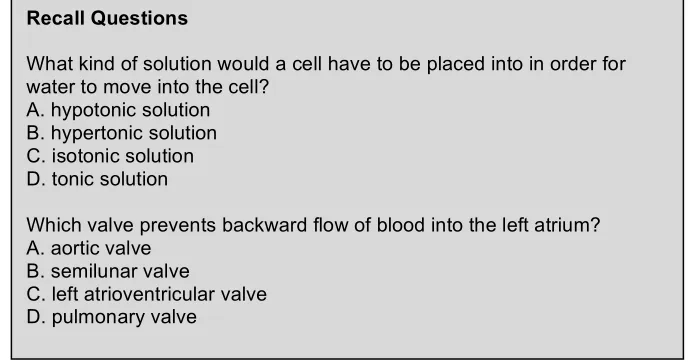
Figure 2: Examples of multiple choice questions requiring recall of knowledge only. This type of question represented approximately 50% of the formative and summative items used.
Figure 3: Examples of multiple choice questions requiring application of knowledge and problem solving. This type of question represented approximately 50% of the formative and summative items used.
Recall Questions
What kind of solution would a cell have to be placed into in order for water to move into the cell?
A. hypotonic solution B. hypertonic solution C. isotonic solution D. tonic solution
Which valve prevents backward flow of blood into the left atrium? A. aortic valve
B. semilunar valve
C. left atrioventricular valve D. pulmonary valve
Applied Questions
Sometimes, patients who have suffered severe blood loss are given a carbohydrate known as dextran intravenously. Dextran cannot get out of blood vessels. How do you think this will help the patient?
A. The dextran will increase the osmotic "pull" (osmotic pressure) within the blood vessels, holding more water in the blood vessels, and helping to maintain the circulating volume. B. The dextran will increase the solute concentration within the blood, allowing more water
to leave the blood, and hydrate the cells.
C. The dextran will remain in the blood until it reaches the areas of most need, and will then be able to supply energy to the cells that need it most.
D. The dextran will trigger the division of red blood cells within blood vessels, allowing quicker recovery of the circulating volume.
A patient has a tumour in her hypothalamus which causes insufficient Anti-Diuretic Hormone secretion. When her blood pressure is taken, which of the following readings would you therefore expect?
Student outcomes
Evaluation of course
Students were surveyed by the University of Newcastle’s Planning, Quality and Reporting Unit over the final two weeks of semester and the examination period in 2011 (tutorial), 2012 (lectorial) and 2013 (lectorial). A Likert scale (1= strongly disagree, 2= disagree, 3=neutral, 4=agree, 5=strongly agree) was used to record student responses to the following survey questions:
• Motivation: The activities of this course motivated me to learn.
• Structure: The various components of this course were linked in ways that supported
my learning.
• Assessment: The assessment items were clearly related to the learning objectives. • Relevance: I am able to apply my learning from this course to my wider goals.
• Outcomes: My knowledge and skills have developed as result of studying this course. • Support: The teaching staff were available to help me with my learning.
• Satisfaction: Overall, I am satisfied with the quality of this course.
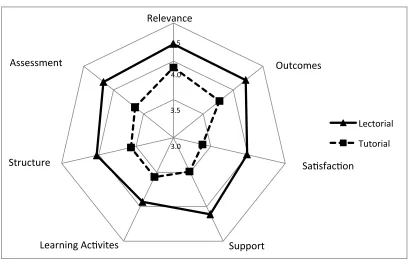
Several aspects of the course were rated significantly higher in the course delivered with lectorials (2012 & 2013) compared tutorials (2011) to support student learning. Most importantly, students felt more supported (p<0.001) following the introduction of lectorials, despite the greatly increased staff-student ratio during these sessions (Figure 4). Student feedback scores were also higher for structure, motivation, outcomes, assessment, overall satisfaction (all p<0.001) and relevance (p=0.02) following introduction of the lectorials (Figure 4).
Student feedback on the course in 2011 contained a number of negative comments about the small group tutorials, especially the perceived inequalities between tutor ability and engagement with students. Student comments in 2012 and 2013 produced a roughly equal number of negative comments about the large group (lectorial) approach, and in this case, comments were largely centred around the intimidating size of the group and the perceived difficulty in contributing to the discussion:
“Still effective but large group was intimidating (sic) when wanting to ask question”
“I found it too confronting to participate in tutorials and lectures in such a large group of people. I believe I would obtain more from this course in a smaller more personal group like those of 1101 and 1102.”
However, those students who had been exposed to small group tutorials subsequent to the large-group lectorial they experienced in this course, retrospectively rated the large group sessions highly in comparison with their subsequent small group traditional tutorials:
“The mass tutorial group in the first semester was better for learning, as we all got taught the same stuff”
“Massive tutorial and lecture is much better than an individual stream tutorial.”
“I strongly agree on bringing back mass tutorials as I was more motivated to attend them as they were more enjoyable and more beneficial to myself and also others as we were getting all the same information as every other student and also that no one appeared to be disadvantaged in any way as we all received (sic) the same information and answers were explained in more depth”
“I like the mass tutorials as I can listen to them over and over again on echo”.
Figure 4: Student feedback on the course Human Bioscience for Nursing and Midwifery at the Callaghan campus, delivered with tutorials (2011; n=146) and lectorials (2012 & 2013; n=367). Rating, 1= strongly disagree, 2= disagree, 3=neutral, 4=agree, 5=strongly agree. Learning Activities: The activities of this course motivated me to learn; Structure: The various components of this course were linked in ways that supported my learning; Assessment: The assessment items were clearly related to the learning objectives; Relevance: I am able to apply my learning from this course to my wider goals; Outcomes: My knowledge and skills have developed as result of studying this course; Satisfaction: Overall, I am satisfied with the quality of this course; Support: The teaching staff were available to help me with my learning.
Grades
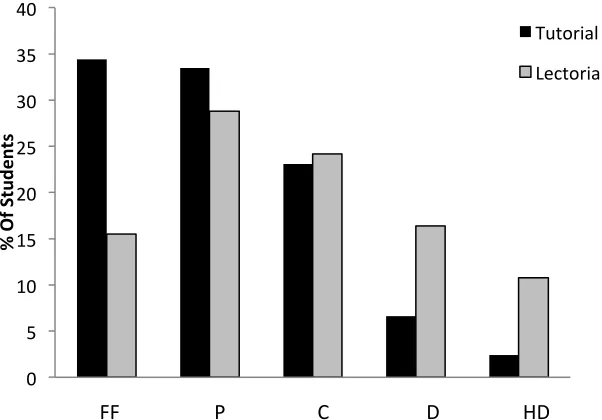
The distribution of students grades changed significantly (p<0.001, Chi-square) following the replacement of tutorials with lectorials (Figure 5). The failure rate dropped from 34% to approximately 15%, and there was an increase in the percentage of students achieving a Distinction or High Distinction grade. The withdrawal rate dropped from 7.2% (2011) to 4.2% (2012/13).
Conclusion
A course in bioscience delivered to students of health professions such as nursing and midwifery needs, first and foremost, to capture the interest and develop motivation for learning in students who may not have shown a particular interest in science or chosen to study science. Being able to achieve this relies heavily on making the relevance of the
Lectorial
Tutorial
Sa.sfac.on Relevance
Outcomes
Support Learning Ac.vites
Structure Assessment
students not just the relevance of science to clinical practice, but the importance of science as an underpinning element of good practice, requires that the course teaches students not just the course content, but how to use that content. While the ability to apply knowledge and problem solve is commonly listed as a graduate attribute, in practice, most teaching time is given over to conveying the required knowledge for the course, with very little being given over to teaching students how to apply their knowledge. This course has devoted equal time to each of these important activities, and divided the assessment equally between assessing these two attributes.
Figure 5: The distribution of grades achieved by students in HUBS1406 Human Bioscience for Nursing and Midwifery at the Callaghan campus delivered with tutorials (2011; n=457) and lectorials (2012&13; n=965). HD, 85-100%; D, 75-84%; C, 65-74%; P, 50-64%; FF, <50%.
Students appeared to recognise the value of the lectorial activity in developing their comprehension and application skills, and this seems to be supported by the improvement in student feedback scores and also in course results. Interestingly, in spite of the withdrawal of small group teaching in favour of a large group lectorial, students felt that they were better supported than in previous iterations of the course. This may, in part, be due to the increased provision of continuous feedback to students by means of both the active learning and assessment methods employed in the course. This combination addresses the principles of good feedback (Nicol, 2007), such as feedback shaping teaching, allowing clarification of standards, opportunities for self-assessment and reflection and dialogue around learning, in addition to the cycles of formative and summative testing.
The change of focus from a bioscience content-driven course to a context-driven course has produced positive results in terms of both student academic success and satisfaction. Replacement of small group tutorials with a large-group interactive format facilitated by an electronic audience response system did not result in diminution of the perceived level of support provided to students.
0 5 10 15 20 25 30 35 40
%
O
f S
tu
de
nt
s
Tutorial
Lectorial
References
Al-Modhefer, A.K., & Roe, S. (2009). Nursing students’ attitudes to biomedical science lectures. Nursing Standard, 24(14), 42-48.
Department of Health & Ageing. (2013). Strategic Review of Health and Medical Research in Australia – Better Health Through Research. Canberra, ACT: Commonwealth of Australia. Retrieved May 7, 2013, from
http://www.mckeonreview.org.au/downloads/Strategic_Review_of_Health_and_Medical_Research_Feb_20 13-Final_Report.pdf
Campbell, J., & Leathard, H. (2000). Nurses’ knowledge of biological and related science. Nursing Times Research, 5, 372-380.
Clancy, J., McVicar, A., & Bird, D. (2000). Getting it right? An exploration of issues relating to the biological sciences in nurse education and nursing practice. Journal of Advanced Nursing, 32(6), 1522-1532.
Craft, J., Hudson, P., Plenderleith, M., Wirihana, L., & Gordon, C. (2013). Commencing nursing students' perceptions and anxiety of bioscience, Nurse Education Today, 33(11), 1399–1405. Retrieved December 22, 2014, from http://dx.doi.org/10.1016/j.nedt.2012.10.020.
Davies, S., Murphy, F., & Jordan, S. (2000). Bioscience in the pre-registration curriculum: finding the right teaching strategy. Nurse Education Today, 20, 123-135.
Efstathiou, N., & Bailey, C. (2012). Promoting active learning using Audience Response System in large bioscience classes. Nurse Education Today, 32, 91-95.
Fenderson, B.A. (2005). Strategies for teaching pathology to graduate students and allied health professionals.
Human Pathology,36, 146-153.
Friedel, J.M., & Treagust, D.F. (2005). Learning bioscience in nursing education: perceptions of the intended and the prescribed curriculum. Learning in Health and Social Care, 4(4), 203-216.
Glynn, S.M., Taasoobshirazi, G., & Brickman, P. (2009). Science motivation questionnaire; Construct validation with nonscience majors. Journal of Research in Science Teaching, 46, 127-146.
Gordon, C., Plenderleith, M., Hudson, P, Wirihana, L., & Craft, J. (2012). Cross-sectional analysis of
undergraduate nursing students’ perceptions of bioscience. In M. Sharma & A. Yeung (Eds), Proceedings of the Australian Conference on Science and Mathematics Education 2012, (p. 17). Sydney NSW: University of Sydney.
Govindasamy, T. (2002). Successful implementation of e-Learning: Pedagogical considerations. Internet and Higher Education, 4, 287-299.
Jordan, S., Davies, S., & Green, B. (1999). The biosciences in the pre-registration nursing curriculum: staff and student perceptions of difficulties and relevance. Nurse Education Today, 19, 215-226.
Larcombe, J., & Dick, J. (2003). Who is best qualified to teach bioscience to nurses? Nursing Standard,17(51), 38-44.
Mate, K.E., Rodger, J.C., & Lidbury, B.A. (2012). Language support for first year human physiology and biology. In F. Zhang, B.A. Lidbury, A.M. Richardson, B.F. Yates, M.G. Gardiner, A.J. Bridgeman, J. Schulte, J.C. Rodger, & K.E. Mate, Sustainable Language Practices in Science Education: Technologies and Solutions (pp.129-145). Hershey PA: IGI Global.
McVicar, A., Clancy, J., & Mayes, N. (2010). An exploratory study of the application of biosciences in practice, and implications for pre-qualifying education. Nurse Education Today,30, 615-622.
Nicol, D. (2007). E-assessment by design: using multiple choice tests to good effect. Journal of Further and Higher Education, 31(1), 53-64.
Palmer, E.J., & Devitt, P.G. (2007). Assessment of higher order cognitive skills in undergraduate education: modified essay or multiple choice questions? Research paper. BMC Medical Education, 7, 49.
Prowse, M.A. & Heath, V. (2005). Working collaboratively in health care contexts: the influence of bioscientific knowledge on patient outcomes. Nurse Education Today,25, 132-139.
Smith, L., & Coleman, V. (2008). Student nurse transition from traditional to problem-based learning. Learning in Health and Social Care,7(2), 114-123.