Issues
ISSN: 2146-4138
available at http: www.econjournals.com
International Journal of Economics and Financial Issues, 2019, 9(5), 111-129.
Comparative Study of Ambiguity Resolution between the
Efficiency of Conventional and Islamic Banks in a S
table
Financial Context
Achraf Haddad
1*, Anis El Ammari
2, Abdelfettah Bouri
31Researcher at a Laboratory of Finance, Governance, and Accounting, University of Sfax, Tunisia, 2Department of Accounting and
Finance, Faculty of Economics and Management of Mahdia, University of Monastir, Tunisia, 3Director of Finance, Governance, and
Accounting Laboratory, University of Sfax, Tunisia. *E-mail: [email protected]
Received: 15 July 2019 Accepted: 01 September 2019 DOI: https://doi.org/10.32479/ijefi.8623
ABSTRACT
Based on the weak results of previous researches on the efficiency’s topic of Islamic and classical banks, we noticed that they were paradoxical results that are sometimes complementary and sometimes contradictory. Several studies have confirmed the effectiveness and resilience of Islamic banks in the face of financial shocks and crises during periods of disruption and financial imbalances, while others have supported the priority of conventional banks. Each stream of research has defended its contextual visions by the necessary specific arguments. But during the economic stable periods, the question does not have the answer so far. In this article, two samples were taken from two reference populations of all existing classical and Islamic banks in the selected countries. The choice of banks is limited to countries whose banking systems incorporate both Islamic and conventional banks
regardless of the proportion of each system in the country’s banking market. Subsequently, each list bank was reduced on the basis of qualitative and quantitative filtering criteria. Therefore, each conventional bank has its closest Islamic equivalence in terms of capital and size taken from the same country. Consequently, the sample size was reduced to 63 banks each over the period (2010-2018). The banks selected to form the two samples are all large and listed in different stock exchanges around the world. The results of our research showed that theoretically, Islamic finance is enjoying a growing reputation, as it is considered potentially ethical finance. However, empirically, Islamic banks are less efficient than their conventional counterparts during a financial stable period.
Keywords: Conventional Banks, Islamic Banks, Efficiency, Comparative Study, Financial Stable Period
JEL Classifications: F33, G20, G21, G24, G30
1. INTRODUCTION
The banking sector plays a fundamental stabilizing or agitating
role, depending on the context. It ensures a healthy and vigorous economy that meets the aspirations and needs of different
economic actors. If not, it creates financial complications and
increases monetary tensions and exchange pressures. Performance is an Anglo-Saxon concept with imprecise contours and eligible
for several definitions. According to the managerial approach,
performance refers systematically to the creation of value. Such
a value does not exist per se but is a function of perceptions and
internal representations of the financial institutions’ success. However, this notion has been defined by Bourguignon (1995) as “the achievement of organizational objectives regardless of the
nature and variety of these objectives.” Performance is, therefore,
a notion whose relevance varies from one organization to another and can take many forms. Nevertheless, the financial aspect of the performance indicators reflects the actual situation of a bank,
the quality of the chosen determinants and conveys the ability to
generate profits by effectively using its resources, after deduction
of the costs related to its process of transformation of the incoming
and outgoing. The efficiency is a measure of financial performance widely used in previous studies. This brings several financiers to take an interest in efficiency evaluation. In the literature, this parameter has evolved from a strategic concept defined in advance
to a goal to be achieved requiring a radical change in techniques
for evaluating effectiveness and methods of interpretation.
Although in most cases the results of previous studies on the
comparison between the efficiencies of Islamic and conventional
banks are mixed or contradictory, through our study, we sought
to answer definitively the following question: What is the type of banks, really, the most efficient in this comparative framework?
This information makes it easier for economic agents and
decision-makers to detect the best choices of financial backers in the event of savings and financing when investing in a world of financial competitiveness. In addition, our results will help
policymakers set better performance targets and enable bank
managers to allocate capital more effectively to communicate a clear and definitive answer. Our study provided an overview of
the fragility, vulnerability, and instability of conventional and Islamic banking systems, and makes a comparison between the two models. This research work makes it possible to achieve the following objective: establish a radical paradigm of choice
between the banking efficiencies that allows us to review its degree
of validity and develop more precise, decisive and well-argued
conclusions. Moreover, as the first contribution to the financial
literature, our study answered explicitly to the proposed gap. The second contribution of this article concerns the conditional
methodological approach in the choice of the banks’ observations
of and by respecting a severe procedure of application of the
statistical tests. Our third contribution is to make a comparison in
a stable economic context in sixteen heterogeneous countries of three continents. The fourth contribution is that this paper brings a potentially powerful empirical demonstration and a validation
of our hypothesis. Restriction of size has required the elimination
of small banks that are generally unlisted, this combination
systematically reduces the effect of category homogeneity, size effect, the effect of the extent of differences, the effect of the structure, the effect of particularities on the efficiency of each
sample. Besides, we distinguished between the two types of banks
based on a very specific parameter of financial performance rarely
taken alone in the previous studies, also, we used a single measure
of efficiency.
The rest of our comparative study is structured as follows. Section
2 presents the concept of efficiency in banks and literature review
based on contradictory previous conclusions. Section 3 describes the methodology and data. Section 4 discusses the empirical results
and gives the implications of the findings. Section 5 concludes
the study.
2. LITERATURE REVIEW AND
DEVELOPMENT OF HYPOTHESIS
2.1. Theoretical Approach of Bank Efficiency
For a long time, the previous studies dealing with the effectiveness
of Islamic banks are manifested in the form of simple research
on the management of financial instruments. It is important
to note that these measures were inspired by other studies on
conventional banks (Ariff and Khalid, 2000; Samad and Hassan, 2000). Initially, previous studies perpetually used proportional
and approximate measures to evaluate the effectiveness of conventional banks, after which researchers adapted the same
measures to estimate the effectiveness of Islamic banks. The studies which compared the efficiencies of the classical and Islamic banks are subdivided into two streams. The first current
has considered that the joint existence of Islamic banks along with conventional banks can let the former operate with their full
levels of efficiency. In fact, the decline in the efficiency is not
only due to the mechanical and systemic inadequacies of Islamic banks, but also to competition imposed by the conventional
banking market; the toxic and restrained financial operations of
the conventional banking system, and the contradictions between the particular dimensions of the two banking segments that hinder the smooth functioning of Islamic banks. This does not mean that the success and survival of Islamic banks depend on the existence of a monopoly banking market, Islamic banks can
operate with minimal security effectiveness which guarantees
its durability even in a conventional banking framework due to
its operating system based on the mode of sharing profits and
losses. Also, the management of Islamic banks and the selection
of sectors or areas of activity is done judiciously. However, the second current considered the lower efficiency of Islamic banks as the origin of the systemic inefficiency of the classical banks. Moreover, the Islamic banks’ efficiency compared to their
conventional counterparts varies from one region to another depending on whether it is an Islamic country or not. This view
was justified by the difference between the prudential rules of
the transactions applied in the two banking segments. In fact, the level of risk taken by the lender by granting credit via Mushraka or Mudaraba is higher compared to the level of risk generated
by the techniques involved in commercial-type financing (Khan, 2012; Thomi, 2014).
The choice of such a ratio is justified by the importance of the results would result (Modell, 2004; Vakkuri and Meklin, 2006),
the inclusiveness, the complementarity and the precision of the ratios guarantee the logic of interpretation and constitutes a good
management method (Weick, 1995; De-Kool, 2004). However,
research in the literature has shown that the simultaneous
highlighting of several efficacy measures has revealed contradictory
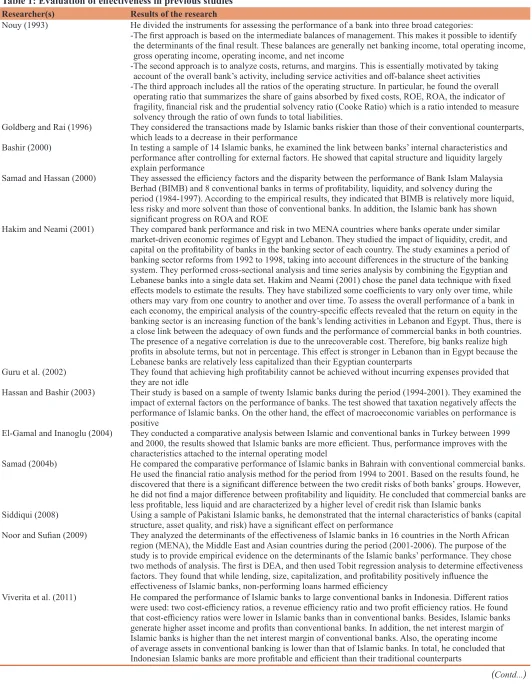
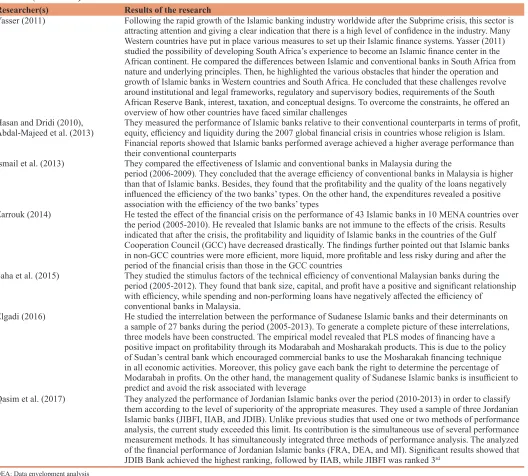
or non-conclusive results. Table 1 illustrates some comparative
studies between the efficiencies of classical and Islamic banks
published in the literature.
Referring to previous comparative studies of bank efficiencies
through the use of multiple ratios, we have noticed that the conclusions are almost always mixed. They are sometimes similar, but they are also sometimes contradictory from one study to another. In both scenarios, the advanced results are inconclusive due to the lack of convincing confirmations and lack of
generalization. Since the use of various ratios or the effectiveness measures is not sufficiently useful to obtain unique results, we have
created a new approach in our work. It consists of testing a single
Researcher(s) Results of the research
Nouy (1993) He divided the instruments for assessing the performance of a bank into three broad categories:
- The first approach is based on the intermediate balances of management. This makes it possible to identify the determinants of the final result. These balances are generally net banking income, total operating income,
gross operating income, operating income, and net income
- The second approach is to analyze costs, returns, and margins. This is essentially motivated by taking account of the overall bank’s activity, including service activities and off-balance sheet activities
- The third approach includes all the ratios of the operating structure. In particular, he found the overall
operating ratio that summarizes the share of gains absorbed by fixed costs, ROE, ROA, the indicator of fragility, financial risk and the prudential solvency ratio (Cooke Ratio) which is a ratio intended to measure
solvency through the ratio of own funds to total liabilities.
Goldberg and Rai (1996) They considered the transactions made by Islamic banks riskier than those of their conventional counterparts, which leads to a decrease in their performance
Bashir (2000) In testing a sample of 14 Islamic banks, he examined the link between banks’ internal characteristics and performance after controlling for external factors. He showed that capital structure and liquidity largely
explain performance
Samad and Hassan (2000) They assessed the efficiency factors and the disparity between the performance of Bank Islam Malaysia Berhad (BIMB) and 8 conventional banks in terms of profitability, liquidity, and solvency during the period (1984-1997). According to the empirical results, they indicated that BIMB is relatively more liquid,
less risky and more solvent than those of conventional banks. In addition, the Islamic bank has shown
significant progress on ROA and ROE
Hakim and Neami (2001) They compared bank performance and risk in two MENA countries where banks operate under similar market-driven economic regimes of Egypt and Lebanon. They studied the impact of liquidity, credit, and
capital on the profitability of banks in the banking sector of each country. The study examines a period of banking sector reforms from 1992 to 1998, taking into account differences in the structure of the banking
system. They performed cross-sectional analysis and time series analysis by combining the Egyptian and
Lebanese banks into a single data set. Hakim and Neami (2001) chose the panel data technique with fixed effects models to estimate the results. They have stabilized some coefficients to vary only over time, while
others may vary from one country to another and over time. To assess the overall performance of a bank in
each economy, the empirical analysis of the country-specific effects revealed that the return on equity in the banking sector is an increasing function of the bank’s lending activities in Lebanon and Egypt. Thus, there is
a close link between the adequacy of own funds and the performance of commercial banks in both countries.
The presence of a negative correlation is due to the unrecoverable cost. Therefore, big banks realize high profits in absolute terms, but not in percentage. This effect is stronger in Lebanon than in Egypt because the Lebanese banks are relatively less capitalized than their Egyptian counterparts
Guru et al. (2002) They found that achieving high profitability cannot be achieved without incurring expenses provided that
they are not idle
Hassan and Bashir (2003) Their study is based on a sample of twenty Islamic banks during the period (1994-2001). They examined the impact of external factors on the performance of banks. The test showed that taxation negatively affects the performance of Islamic banks. On the other hand, the effect of macroeconomic variables on performance is
positive
El-Gamal and Inanoglu (2004) They conducted a comparative analysis between Islamic and conventional banks in Turkey between 1999
and 2000, the results showed that Islamic banks are more efficient. Thus, performance improves with the
characteristics attached to the internal operating model
Samad (2004b) He compared the comparative performance of Islamic banks in Bahrain with conventional commercial banks. He used the financial ratio analysis method for the period from 1994 to 2001. Based on the results found, he discovered that there is a significant difference between the two credit risks of both banks’ groups. However, he did not find a major difference between profitability and liquidity. He concluded that commercial banks are less profitable, less liquid and are characterized by a higher level of credit risk than Islamic banks
Siddiqui (2008) Using a sample of Pakistani Islamic banks, he demonstrated that the internal characteristics of banks (capital structure, asset quality, and risk) have a significant effect on performance
Noor and Sufian (2009) They analyzed the determinants of the effectiveness of Islamic banks in 16 countries in the North African region (MENA), the Middle East and Asian countries during the period (2001-2006). The purpose of the study is to provide empirical evidence on the determinants of the Islamic banks’ performance. They chose two methods of analysis. The first is DEA, and then used Tobit regression analysis to determine effectiveness factors. They found that while lending, size, capitalization, and profitability positively influence the
effectiveness of Islamic banks, non-performing loans harmed efficiency
Viverita et al. (2011) He compared the performance of Islamic banks to large conventional banks in Indonesia. Different ratios were used: two cost-efficiency ratios, a revenue efficiency ratio and two profit efficiency ratios. He found that cost-efficiency ratios were lower in Islamic banks than in conventional banks. Besides, Islamic banks generate higher asset income and profits than conventional banks. In addition, the net interest margin of
Islamic banks is higher than the net interest margin of conventional banks. Also, the operating income of average assets in conventional banking is lower than that of Islamic banks. In total, he concluded that
Indonesian Islamic banks are more profitable and efficient than their traditional counterparts
(Contd...)
2.2. Efficiency Measurement Ratio of Conventional and Islamic Banks
The efficiency of banking operations helps managers and fundholders assess the performance of their own liabilities relative to their competitors and the performance of their institutions. This ensures bank owners and managers that directors have
considered the relevance of the work as a factor in maximizing the financial performance of the transaction or service being performed. Efficiency must be highlighted in the form of efforts. This parameter aims to improve the fund’s performance and outperforms the benchmarks. Efficiency is also needed to carefully examine the influence of the operating method on the sustainability
of Islamic and conventional banks.
Efficiency ratios are numerous. They have been used to measure a bank’s ability to control the quality of its resources, to measure the operating efficiency with which the bank uses its assets, to
transform income resources (Osama et al., 2013) to develop its methods, motivate its staff and optimize its costs and products.
An increase in the value of the rapport operating income/average total assets or the total turnover/total assets ratio is a good
indicator of efficiency. In other words, these rapports evoke the total effectiveness of the bank in using its global assets to generate profits. If this is not the case, the bank is likely to be inefficient.
Such an indication gives the bank two possibilities: it should either increase its total revenue or improve on an additional part of its
assets (Ross et al., 2005).
In a stable economic context of the European region, Das and
Ghosh (2006) carried out a study on non-cylindrical panel data
of the Indian commercial banking sector during the post-reform
period (1992–2002). They tested the degree of capital adequacy defined in advance against non-compliance of capital requirements.
They used excess risk-weighted capital assets. They concluded that Researcher(s) Results of the research
Yasser (2011) Following the rapid growth of the Islamic banking industry worldwide after the Subprime crisis, this sector is
attracting attention and giving a clear indication that there is a high level of confidence in the industry. Many Western countries have put in place various measures to set up their Islamic finance systems. Yasser (2011) studied the possibility of developing South Africa’s experience to become an Islamic finance center in the African continent. He compared the differences between Islamic and conventional banks in South Africa from
nature and underlying principles. Then, he highlighted the various obstacles that hinder the operation and
growth of Islamic banks in Western countries and South Africa. He concluded that these challenges revolve
around institutional and legal frameworks, regulatory and supervisory bodies, requirements of the South
African Reserve Bank, interest, taxation, and conceptual designs. To overcome the constraints, he offered an
overview of how other countries have faced similar challenges
Hasan and Dridi (2010),
Abdal-Majeed et al. (2013) They measured the performance of Islamic banks relative to their conventional counterparts in terms of profit, equity, efficiency and liquidity during the 2007 global financial crisis in countries whose religion is Islam.
Financial reports showed that Islamic banks performed average achieved a higher average performance than their conventional counterparts
Ismail et al. (2013) They compared the effectiveness of Islamic and conventional banks in Malaysia during the
period (2006-2009). They concluded that the average efficiency of conventional banks in Malaysia is higher than that of Islamic banks. Besides, they found that the profitability and the quality of the loans negatively influenced the efficiency of the two banks’ types. On the other hand, the expenditures revealed a positive association with the efficiency of the two banks’ types
Zarrouk (2014) He tested the effect of the financial crisis on the performance of 43 Islamic banks in 10 MENA countries over the period (2005-2010). He revealed that Islamic banks are not immune to the effects of the crisis. Results indicated that after the crisis, the profitability and liquidity of Islamic banks in the countries of the Gulf Cooperation Council (GCC) have decreased drastically. The findings further pointed out that Islamic banks in non-GCC countries were more efficient, more liquid, more profitable and less risky during and after the
period of the financial crisis than those in the GCC countries
Saha et al. (2015) They studied the stimulus factors of the technical efficiency of conventional Malaysian banks during the period (2005-2012). They found that bank size, capital, and profit have a positive and significant relationship with efficiency, while spending and non-performing loans have negatively affected the efficiency of
conventional banks in Malaysia.
Elgadi (2016) He studied the interrelation between the performance of Sudanese Islamic banks and their determinants on a sample of 27 banks during the period (2005-2013). To generate a complete picture of these interrelations, three models have been constructed. The empirical model revealed that PLS modes of financing have a positive impact on profitability through its Modarabah and Mosharakah products. This is due to the policy of Sudan’s central bank which encouraged commercial banks to use the Mosharakah financing technique
in all economic activities. Moreover, this policy gave each bank the right to determine the percentage of
Modarabah in profits. On the other hand, the management quality of Sudanese Islamic banks is insufficient to
predict and avoid the risk associated with leverage
Qasim et al. (2017) They analyzed the performance of Jordanian Islamic banks over the period (2010-2013) in order to classify
them according to the level of superiority of the appropriate measures. They used a sample of three Jordanian
Islamic banks (JIBFI, IIAB, and JDIB). Unlike previous studies that used one or two methods of performance
analysis, the current study exceeded this limit. Its contribution is the simultaneous use of several performance
measurement methods. It has simultaneously integrated three methods of performance analysis. The analyzed of the financial performance of Jordanian Islamic banks (FRA, DEA, and MI). Significant results showed that
JDIB Bank achieved the highest ranking, followed by IIAB, while JIBFI was ranked 3rd
DEA: Data envelopment analysis
the capital adequacy ratio (CAR) is positively related to technical efficiency (TE). Indeed, they argued that large conventional banks are the most capitalized. This allows them to lower the cost of borrowing and therefore, gains in efficiency and effectiveness. At the bottom of the same theme, Said (2013) studied the impact of banking risks on the effectiveness of Islamic banks in the MENA region during the period (2006-2009). He focused on
three types of risks: Credit, operational and liquidity risks. Bank
efficiency was measured by the data envelopment analysis (DEA) method while banking risks were analyzed by the financial ratios analysis method. He used Pearson’s correlation coefficient to examine the type of association between the risk and efficiency
of Islamic banks. Empirical results have shown that credit risk
and operational risk are negatively related to efficiency. While the liquidity risk has shown an insignificant correlation with the effectiveness of Islamic banks in the MENA region.
Although Islamic banks prohibit these clients from practicing interest on deposits, the dividend-sharing technique is an alternative
to investment-based pay (Haron and Ahmad, 2008). Clients who
deposit their funds in Islamic products sometimes derive higher profits than traditional deposit products. This characteristic
testifies the effectiveness of Islamic investment techniques and
the importance of the counterpart acquired. In this context, Sarker
(1999a) examined the Islamic banks’ efficiency in Bangladesh in an isolated way between 1995 and 1997 in a banking network made up of 39 banks, of which only five banks are Islamic (Islamic Bank Bangladesh Limited; Al Baraka Bank Bangladesh Limited
[Al-Baraka], Al-Arafah Islami Bank Limited [Al-Arafah], Social Investment Bank Limited and Faysal Islamic Bank of Bahrain
EC). The other banks are conventional. He asserted that Islamic banks could operate with a minimum level of efficiency and can
provide satisfactory services to public expectations even within a
conventional banking architecture in which the mode of financing by sharing profits and losses is not dominant. But if supported by
appropriate banking laws and regulations, it allows them to fully
utilize its potential and optimize the exploitation of its properties. Indeed, Shamsher et al. (2009) investigated the extent of bank efficiency between two groups of Islamic and conventional banks in 11 Organisation of Islamic Conference countries over the period (1990-2005). They found that Islamic banks have shown a high efficiency of their activities and a better performance compared to conventional banks during times of financial crisis Yudistira (2004), Sufian (2006), Mokhtar et al. (2008), and Thorsten et al. (2013). Similarly, Kader et al. (2007) reached this conclusion in
the context of the UAE.
The integration of the contextual considerations and the diversity of the objectives of the studies carried out or planned to oblige the researchers to change the analysis approach of the banking
efficiency, to modify their methods of execution and to make
reforms on the aspects of results interpretation. By referring to the
literature of comparative studies between the financial performance
of conventional and Islamic banks, we detected that several studies have been done in various regions. A non-exhaustive list of researchers made extensive use of the stochastic frontier approach
(SFA) to benchmark bank performance, and in particular, they performed comparative studies of bank efficiencies (Kraft and
Tirtiroglu, 1998; Altunbas et al., 2001; Isik and Hassan, 2002b; Mamatzakis et al., 2008; Shamsher et al., 2009; Tecles and Tabak, 2010; Srairi, 2010 and Rozzani and Rahman, 2013a). In this sense, Majid et al. (2003) used the SFA of costs to estimate the efficiency of the profitability of 34 Malaysian banks (24 local and 10 foreign) out of a total of 55 commercial banks in operation during the study period from 1993 to 2000. The results showed that Islamic banks are slightly more efficient than conventional banks. Although the costs of Islamic products increased a little (30.2%), the costs of conventional products rose only by (28%). In another study, Al-Shammari (2003) used alternative approaches such as “Translog Stochastic Cost” and “Profit Frontier” to compare the effectiveness
of Islamic banks with other types of banks in the Middle East region
over the period (1995-1999). First, he estimated Cost-Effective use
for the studied bank models. Then he repeated the aforementioned
analysis. After that, he estimated the effectiveness of the alternative profit for the same samples. Finally, he concluded that in the Middle East, Islamic banks are more profitable and their profits are more efficient than investment banks.
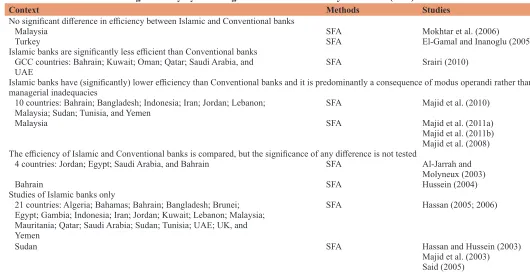
Table 2 brings together some annexed studies carried out in different contexts of which they evaluated different topics
about the banking efficiency. The common point between these
researches is that they all used the stochastic frontier analysis approach.
Continuing with the quotation from studies of bank efficiency
and more specifically the link between the efficiencies of
conventional and Islamic banks, Shamsher et al. (2008) compared the efficiency of the costs and profits of 80 banks in 21 countries of the Organization of Islamic Cooperation among 57 countries
located in three continents: Asia, Africa, and Europe. The choice
of the data analysis method was fixed on the SFA. They concluded that there are no significant differences between the overall results
of the comparative effectiveness of conventional banks and that of Islamic banks. There is, therefore, a substantial margin
for improving the efficiency of costs and profits in bank flows
in two banking systems in order to maintain their competitive advantages. Besides, Islamic banks in the Middle East and Turkey
were rated the best in terms of cost-efficiency (CE), while African Islamic banks were rated the lowest in terms of cost-efficiency. However, large conventional banks are more efficient than smaller conventional banks. While African conventional banks recorded the lowest profitability compared to conventional banks in Asia and the Middle East. Overall, Islamic banks are considered slightly and more efficient.
Given the shortcomings of old analytical methods and modeling limitations using the non-parametric programming technique to
evaluate bank efficiency, other researchers have preferred the
use of a more rigorous alternative method, which is DEA method
more distinct formalized hypotheses. The advantage of using the DEA method is to identify opportunities for improving efficiency by examining the differences between efficient and inefficient
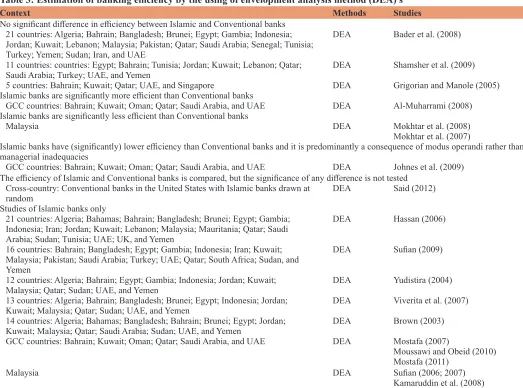
banks. The Table 3 illustrates some previous studies using this method, the assumptions made and the sum of source countries of the samples tested.
To highlight the results obtained in the literature, we focused on the most recent studies that have focused on the implementation
of this statistical technique. In this context, Serhat et al. (2016) compared the efficiency of Turkish and Azerbaijani classical banks during the period (2010-2014). The base sample was made up of “The ten largest banks” in each country based on the size of the
assets. They performed their analysis through the DEA method.
The ratios of inputs chosen to measure efficiency are listed as
Total Assets, Total Equity, Total Deposit, Number of Personnel,
Interest Expenses, and Number of Branches. While the outputs are ordered as follows: The Net Profit, the Interest Income, and
the Non-interest income. The empirical results showed that 9 out
of 10 Turkish banks were effective throughout the study period. However, only Turkiye Ekonomi Bankasis was not effective in 2011. On the other hand, they identified only 4 Azerbaijani banks that were effective in all years. However, they scored that 4 other banks were ineffective during a single year of the total period.
Besides, they also observed that UniBank and Bank Technique
were ineffective for 2 different years between 2010 and 2014. Therefore, they concluded that Turkish banks are more efficient than Azerbaijani banks.
Also, Johnes et al. (2012) compared the performance of 45 Islamic banks with 207 conventional banks before, during and immediately after the Subprime crisis (2004-2009) in 18 countries (Bahrain, Bangladesh, Qatar, Egypt, Indonesia, Jordan, Kuwait,
Malaysia, Mauritania, Pakistan, Palestine, Yemen, Saudi Arabia,
Sudan, Tunisia, Turkey, UAE, Brunei). They used the DEA method, but they found no significant difference between the average efficiency of conventional banks and that of Islamic banks. In the same context, Hisham et al. (2008) examined new
perspectives on the performance evaluation of Islamic banking. They measured the CE of their returns with the DEA method. They tested a sample of Malaysian banks consisting of 2 fully Islamic banks, 12 Islamic windows, and other conventional banks during
the period (1998-2004). The results of this study showed that the functioning of Islamic banks is relatively more efficient in terms of cost management than classical banks in terms of profiling.
Moreover, Gunes and Yilmaz (2016) studied the effect of the determinants of the TE on the Turkish banking sector between 2007 and 2013. The sample was composed of 4 Islamic participation banks and 28 conventional deposit banks. They used eight financial ratios
to perform the Tobit regression as a demonstration tool. Empirical
analysis revealed that factors of size, risk, and quality of banking
management have a negative impact on the TE of the Turkish banking
sector, while variables (loan intensity, market share, and profitability) have a positive impact on efficiency. On the whole, it seems that
Turkey has the necessary potential, favorable and appropriate conditions to become an Islamic and conventional banking center on a global scale able to compete with other dynamic centers.
In addition, Tugba et al. (2017) compared the technical, allocation
and economic efficiency of conventional and participative
banks in Turkey during the period (2005-2013) using the DEA
method. The results indicated that TE is higher than the allocation
efficiency for both types of banks in Turkey. This means that the main factor contributing to the profitability of the Turkish banking system is the TE rather than the efficiency of allocation and use of Table 2: Estimation of banking efficiency by the using stochastic frontier analysis method (SFA)
Context Methods Studies
No significant difference in efficiency between Islamic and Conventional banks
Malaysia SFA Mokhtar et al. (2006)
Turkey SFA El-Gamal and Inanoglu (2005)
Islamic banks are significantly less efficient than Conventional banks GCC countries: Bahrain; Kuwait; Oman; Qatar; Saudi Arabia, and
UAE SFA Srairi (2010)
Islamic banks have (significantly) lower efficiency than Conventional banks and it is predominantly a consequence of modus operandi rather than
managerial inadequacies
10 countries: Bahrain; Bangladesh; Indonesia; Iran; Jordan; Lebanon;
Malaysia; Sudan; Tunisia, and Yemen SFA Majid et al. (2010)
Malaysia SFA Majid et al. (2011a)
Majid et al. (2011b)
Majid et al. (2008) The efficiency of Islamic and Conventional banks is compared, but the significance of any difference is not tested
4 countries: Jordan; Egypt; Saudi Arabia, and Bahrain SFA Al-Jarrah and
Molyneux (2003)
Bahrain SFA Hussein (2004)
Studies of Islamic banks only
21 countries: Algeria; Bahamas; Bahrain; Bangladesh; Brunei; Egypt; Gambia; Indonesia; Iran; Jordan; Kuwait; Lebanon; Malaysia; Mauritania; Qatar; Saudi Arabia; Sudan; Tunisia; UAE; UK, and
Yemen
SFA Hassan (2005; 2006)
Sudan SFA Hassan and Hussein (2003)
Majid et al. (2003) Said (2005)
resources. Moreover, results have shown that loan spending and
quality have significantly negatively affected the effectiveness of conventional banks, but they have a positive and significant impact on the effectiveness of participating banks. While total loans have positively associated with the efficiency of two types of banks. As a result, the average efficiency of the participating banks is higher than the average efficiency of foreign banks, national private banks and state-owned banks (Arslan and Ergec, 2010; Er and Uysal, 2012).
In the same order of idea, Murat and Kurtaran (2013) evaluated the efficiency of 13 commercial banks in Turkey for the year 2011 with an integrated approach including the analytical
hierarchy process and DEA. According to the empirical results,
state-owned commercial banks are effective both in applying the (Charnes-Cooper-Rhodes) CCR model or the Banker-Charnes-Cooper (BCC) model. However, half of the commercial banks are inefficient, they should improve their non-monetary loans and shrink their annual staff costs. According to the CCR model, nine banks are identified as being inefficient, while according to the BCC, only seven banks are found identified. However, commercial banks with foreign capital have lower efficiency scores than public and private commercial banks. Ineffective banks are required to improve non-monetary loans and limit staff costs. In addition, more
than half (64.3%) of banks face inefficiencies in scale. These banks
should improve tactical actions and work procedures.
Similarly, Rozzani and Rahman (2013b) conducted a comparative
study between the performance of Islamic and classical banks
operating in Malaysia during the period (2008-2011). Data were
collected from 19 conventional banks and 16 Islamic banks. They resorted to the CAMELS model. Financial performance
was estimated through (Capital Adequacy = Equity Capital/Total Assets), (Asset Quality=Non-Performing Loans/Total Loans), (Earnings Quality= ROA and ROE), (Net Loans/Deposits and Short Term Funding) and (Liquid Assets/Deposits and Long Term Funding), ending with compliance with Sharia, they discerned this variable by (Sharia Compliance Score Sheet). They concluded that both types of banks are in good financial shape. But they also
showed major weaknesses in some aspects, which can harm their
future capacities of normal developments. These deficiencies
require intensive supervision by bank managers. In particular, the
analysis results revealed that there is no difference between ratings of asset quality and liquidity. Conventional banks were significantly efficient in terms of capital adequacy and earnings quality, reflecting
their ability to intervene at times of shocks, debt payments, and
operational risks. Nevertheless, Islamic banks have effectively Table 3: Estimation of banking efficiency by the using of envelopment analysis method (DEA) s
Context Methods Studies
No significant difference in efficiency between Islamic and Conventional banks 21 countries: Algeria; Bahrain; Bangladesh; Brunei; Egypt; Gambia; Indonesia; Jordan; Kuwait; Lebanon; Malaysia; Pakistan; Qatar; Saudi Arabia; Senegal; Tunisia; Turkey; Yemen; Sudan; Iran, and UAE
DEA Bader et al. (2008)
11 countries: countries: Egypt; Bahrain; Tunisia; Jordan; Kuwait; Lebanon; Qatar;
Saudi Arabia; Turkey; UAE, and Yemen DEA Shamsher et al. (2009) 5 countries: Bahrain; Kuwait; Qatar; UAE, and Singapore DEA Grigorian and Manole (2005) Islamic banks are significantly more efficient than Conventional banks
GCC countries: Bahrain; Kuwait; Oman; Qatar; Saudi Arabia, and UAE DEA Al-Muharrami (2008) Islamic banks are significantly less efficient than Conventional banks
Malaysia DEA Mokhtar et al. (2008)
Mokhtar et al. (2007)
Islamic banks have (significantly) lower efficiency than Conventional banks and it is predominantly a consequence of modus operandi rather than
managerial inadequacies
GCC countries: Bahrain; Kuwait; Oman; Qatar; Saudi Arabia, and UAE DEA Johnes et al. (2009) The efficiency of Islamic and Conventional banks is compared, but the significance of any difference is not tested
Cross-country: Conventional banks in the United States with Islamic banks drawn at
random DEA Said (2012)
Studies of Islamic banks only
21 countries: Algeria; Bahamas; Bahrain; Bangladesh; Brunei; Egypt; Gambia; Indonesia; Iran; Jordan; Kuwait; Lebanon; Malaysia; Mauritania; Qatar; Saudi Arabia; Sudan; Tunisia; UAE; UK, and Yemen
DEA Hassan (2006)
16 countries: Bahrain; Bangladesh; Egypt; Gambia; Indonesia; Iran; Kuwait; Malaysia; Pakistan; Saudi Arabia; Turkey; UAE; Qatar; South Africa; Sudan, and
Yemen
DEA Sufian (2009)
12 countries: Algeria; Bahrain; Egypt; Gambia; Indonesia; Jordan; Kuwait;
Malaysia; Qatar; Sudan; UAE, and Yemen DEA Yudistira (2004) 13 countries: Algeria; Bahrain; Bangladesh; Brunei; Egypt; Indonesia; Jordan;
Kuwait; Malaysia; Qatar; Sudan; UAE, and Yemen DEA Viverita et al. (2007) 14 countries: Algeria; Bahamas; Bangladesh; Bahrain; Brunei; Egypt; Jordan;
Kuwait; Malaysia; Qatar; Saudi Arabia; Sudan; UAE, and Yemen DEA Brown (2003) GCC countries: Bahrain; Kuwait; Oman; Qatar; Saudi Arabia, and UAE DEA Mostafa (2007)
Moussawi and Obeid (2010) Mostafa (2011)
Malaysia DEA Sufian (2006; 2007)
Kamaruddin et al. (2008)
Source: Johnes et al., (2012). A comparison of performance of Islamic and Conventional banks. Journal of Applied Finance and Banking, 2 (3), 123–161. DEA: Data envelopment
maintained their long-term liquidity levels. Overall, the financial
performance of conventional and Islamic Malaysian banks is very close. This is mainly due to the absence of management leadership,
the lack of quality information, the lack of effective training for executives and the needs of managers, and the lack of staff with sufficient experience which to ensure the ideal execution of the tasks. With these factors, Islamic banks are no longer likely to monopolize a majority of profits in the face of strong competition from conventional banks (Sangmi and Nazir, 2010).
Furthermore, Alharthi (2016) studied the determinants of efficiency in the banking sector around the world during the period (2005-2012). The studied samples were: the first sample
was composed of 43 Islamic banks, a second sample consisted of 242 conventional banks and another sample of 38 socially
responsible banks. In this study, efficiency was measured using the DEA method. It divided the efficiency into 3 categories: TE, TE pure and scale efficiency. From these measures, he showed that socially responsible banks are the most effective. This is
because the management of socially responsible banks requires a
minimum threshold of entrants and that this banks’ type is the most capitalized. The scores for Islamic banks are intermediate. Also, lending services are important for maximizing effective outputs. Indeed, efficiency in Islamic banks is significantly influenced by profits. Islamic banks with high capitalization proved more efficient. In contrast, the least efficient scores are recorded by
conventional banks because of the high proportion of payable fees and the relative probability of corruption. Therefore, stricter
control of corruption leads to greater efficiency.
However, other researchers have proven the opposite effect,
Islamic banks are less efficient than conventional banks in
similar contexts or in different contexts (Yudistira, 2004; Rosly and Bakar, 2003; Majid et al., 2005; Drake et al., 2006; Olson and Zoubi, 2008). In the Pakistani context, Haseeb et al. (2010)
conducted a comparative study between a list of classical banks
and another list of Islamic banks, each sample is made up of five banks. They worked on data covering the period (2005-2009).
The results of this test asserted the TE of conventional banks, but
in terms of efficiency of resource allocation and CE, both types
displayed healthy competition. The student Test showed that there
is no significant difference between the average scores of the effectiveness of conventional banks and the average scores for Islamic banks except for the year 2008. In the same framework, Ashraf and Rehman (2011), tested empirical data specific to
a sample of Pakistani banks. The objective was to distinguish between the performance of Islamic banks and that of conventional
banks over the period from 2007 to 2010. These researchers used financial ratios of profitability, profit, liquidity, credit risk and
assets. Based on the conclusions drawn, the performance of Islamic
banks appeared less efficient due to the swelling of unbearable operating costs and inefficient management. Islamic banks are
generally smaller than conventional banks. Therefore, they are
likely to be less efficient to the extent that TE changes in proportion to changes in the size of the bank (Bhattacharyya et al., 1997).
In the same sense of interest, Jaffar and Manarvi (2011) conducted a comparative study between the financial performance of Islamic
and conventional Pakistani banks during the period (2005-2009)
using the CAMEL method. The sample of Islamic banks consisted
of 5 Islamic banks (Meezan Bank, Islamic Bank Albaraka, Islamic Bank of Dubai, Bank Islamic Pakistan and Dawood Islamic Bank), while the sample of conventional banks is composed of 5 classical banks (Allied Commercial Bank Ltd., Muslim Commercial Bank,
Standard Chartered Bank, Habib Bank Ltd., and AL-Falah Bank).
The standard indicators selected to carry out the CAMEL Test are
listed respectively: The CAR (Debt to Equity ratio and Capital to Risk Assets Ratio), the quality of the assets (UNCOL ratio and Loan loss average ratio), the quality of management (Ratio of Operating Expenses and Lending Money Cost), earning capacity (ROA and ROE) and the degree of liquidity (Loan to asset ratio and Deposit to asset ratio). They found that the “equity-to-equity” ratio of Islamic banks indicated that they financed their assets
largely through equity rather than debt, while conventional banks are directed towards achieving high returns. Through the selection of investment opportunities with a high degree of risk. Capital risk on the assets of Islamic banks is less than capital on the risks of assets of conventional banks, which explains their holdings of large capital. Furthermore, they revealed that conventional banks are
more profitable and more skilled in loan management, the gap is
manifested through the adoption of an efficient loan disbursement policy supported. However, Islamic banks are more liquid and
more advantageous when it comes to managing capital. Besides, they spent a greater proportion of their revenues on operating expenses than their traditional competitors. Indeed, Islamic banks had an average ratio of “Loans to Assets” and an average ratio “Deposits to Assets” lower than those shown by their classical analogs, a conclusion from which they supported the strong capacity of Islamic banks to settle loans. The consequence is the surplus stock of available liquidity. In addition,, the results also
indicated that assets’ quality is the same in both types of banks. However, conventional banks have adopted a more efficient loan
recovery policy since they have recorded lower “Loan Losses” in proportion to the losses recorded by their Islamic counterparts.
Also, the comparative study of Sehrish et al. (2012) in the Pakistani context between 2007 and 2011 revealed that there is a statistically significant difference between the efficiency of Islamic banks and that of conventional banks. They confirmed that conventional banks are more efficient in terms of Asset Utility, Income Expense Ratio, and Operating Efficiency compared to the values recorded by Islamic
banks. This conclusion provided insights into the need to integrate assets and expenses management processes as well as the priority of improving revenue generation and revenue generation methods.
Indeed, Hanif et al. (2012) conducted a comparative study between the effectiveness of the best Islamic bank in Pakistan (Meezan Bank Limited) and the efficiency of five other conventional banks during the period (2003-2007). Efficiency was assessed by credit
risk. This variable is displayed through three ratios: Common Equity/Total Assets, Total Equity/Net Loans and Impaired Loans/
Gross Loans. They revealed that Islamic banks are less efficient than the five conventional banks.
Similarly, Onakoya and Onakoya (2013) conducted a comparative
five UK conventional banks between 2007 and 2011. Efficiency was
measured by three indicators that are the Income to expense ratio, the
operating efficiency ratio, and the utilization ratio. They concluded
that the two types of banks appear to be in frontal competition.
Generally, conventional banks are more able to respond effectively and promptly to financial obligations than Islamic banks since they have adopted a diversified strategy by exploiting windows of Islamic products. On the other hand, Islamic banks are ethically forbidden
to adapt an identical policy of practice of the interests, the selection of the movements is established attentively.
In the same vein, Bilal and Amin (2015) studied the difference in efficiencies between Islamic and conventional banks in Pakistan during the period (2007-2012). Four ratios are used to assess bank efficiency: Net interest margin, net income revenue/average assets,
other operating income/average assets, and cost/income ratio. The comparative analysis showed that Islamic and conventional
banks did not report a significant difference between operational efficiencies. However, according to the relative proportional efficiencies of banks, they favored conventional banks. This has become possible through the optimization of the use of internal
resources, the launch of training sessions, the development of mechanisms and innovative procedures for planning, production
and efficiency improvement as well as the retention of clients
around Islamic banking products and services.
Conventional banks generally follow a targeted investment policy to attract more profits to shareholder profiles. Nevertheless, Islamic banks are more focused on expansion strategies than on
profit maximization strategies, for which they have shown a lack of earnings (Jaffar and Manarvi, 2011). In order to identify the most efficient banking model, Maysa and Rasha (2015) assessed the effectiveness of Islamic and conventional banks in Jordan throughout the period (2009-2013). The results showed the presence of a statistically significant difference between the efficiency ratios of two types of financial institutions tested. According to which, conventional banks have taken priority in terms of efficiency.
They explained that these results are due mainly to the history of conventional banks in Jordan. Thus, they attributed the conclusions recorded to the experiments and integrated adaptations of the classical banks in the Jordanian banking sector.
Furthermore, Shahid et al. (2010) compared the efficiencies of conventional and Islamic banks in Pakistan on a sample of five Islamic banks and five conventional banks during the period (2005-2009). They found that allocative efficiency and CE in both sectors
are similar. But in terms of TE, conventional banks are better. In
the same vein, Hassan (2005) conducted a comparative study between management efficiency within Islamic and conventional banks. He applied a panel regression from 22 countries. Efficiency has been expressed by several variables such as bank size, profitability, and asset loan ratio. Empirical results have shown that Islamic banks are relatively less cost-efficient than their conventional counterparts, however, in terms of profit and resource management, Islamic banks are more efficient (Samad, 1999).
At the same level of interest, Majid et al. (2010) compared the
performance of a sample of Islamic banks to another sample of
conventional banks in a set of countries in which Islamic and conventional banks operate simultaneously: Malaysia, Sudan, Bangladesh, Tunisia, Jordan, Lebanon, Yemen, Indonesia, Bahrain,
and Iran during the period (1996-2002). The findings of this study
showed that the average performance of Islamic banks is lower than the performance of its competitors, although Islamic banks
have benefited more on a larger scale than conventional banks. This result is attributed to the inefficiency of Islamic banks in general and more particularly to the inefficiency of the Sudanese and Yemeni Islamic banks. However, testing each country’s efficiency
distribution revealed that Islamic banks in Iran, Malaysia, Bahrain,
and Bangladesh have achieved very high levels of efficiency
compared to other countries in the sample, especially countries
that guide the legalization of the Islamic banking sector. While
Islamic banks in Jordan, Lebanon, Tunisia, and Indonesia are in an
intermediate category of efficiency. Therefore, Majid et al. (2010)
concluded that despite controlling for operating environment
factors, there are significant systematic differences in efficiency due to the “Country Effect.” This indicates that the “Country Effect” has a significant role in explaining the differences in country efficiency distributions.
In addition, Sghaier (2015) analyzed the competitive state of
conventional banks and their Islamic counterparts in the MENA
region in terms of efficiency. She measured the TE of banks by
scores using the DEA method and the SFA method to calculate
the degree of efficiency. She concluded that traditional banks are more efficient than their Islamic competitors both in exploiting
the available resources optimally and at the level of cost control.
The technical inefficiency of Islamic banks in the MENA region is sensitive to several variables such as deposits, capitalization and other specific variables related to the sector.
Similarly, Rashwan and Ehab (2016) have investigated bank efficiency. They selected a sample of 66 banks including Islamic
and conventional banks from several countries namely: Egypt,
Pakistan, Bangladesh, Saudi Arabia, Kuwait, Qatar, Iraq, United
Arab Emirates, Sudan, Turkey, Bahrain, and Jordan during the
period between 2009 and 2014. They preferred the ratio analysis method to assess the effect of CE, revenue efficiency, and profit efficiency on profitability. Profitability is specified by ROA and ROE while efficiency is measured using cost to income, net interest margin and other operating income to average assets. On the one
hand, the results showed that the cost of income, the net interest margin and the operating income on average assets positively and
significantly influenced the ROA of Islamic banks. While non-interest expense on average assets has a negative and significant impact on the ROA. On the one hand, the cost of income has a negative and significant impact on the ROA of conventional banks.
Besides, non-interest expenses on average assets positively and
significantly affected the ROA of conventional banks. Regarding
the net interest margin and the operating income on average assets,
their relative effects are not significant. On the other hand, when the same test was performed on the ROE, Rashwan and Ehab (2016) revealed that non-interest charges on average assets have negatively and significantly influenced the ROE of Islamic banks.
Also, the net interest margin and the operating income on average
banks. In the case of conventional banks, only the variable “Cost
of Income” had a positive and significant impact on the ROE of conventional banks, the other effects are not significant. Overall, the results have shown that traditional banks are more efficient in terms of costs, revenues and profits than the relatively recent Islamic system. However, non-interest expenses relative to the
assets of Islamic and conventional banks have a negative and
significant impact on their efficiency (Usman and Khan, 2012; Jaffar and Manarvi, 2011; Ansari and Rehman, 2011).
After presenting an interesting list of previous studies, in the form of a theoretical intervention focused on contradictory empirical conclusions to what is pre-established, we have found that the most appropriate hypothesis is formulated as follows:
Hypothesis: Islamic banks are less efficient than conventional banks in a financial stable period.
To overcome the theoretical confusion of this subject and to answer the problem posed in the literature review, in the following section, we proceed to the empirical demonstration of the evolutionary
aspects of the efficiencies of Islamic and classical banks from a
comparative perspective. In what follows, we try to answer and interpret empirically the test which aims to provide answers to the
question previously asked: Are Islamic banks really more efficient and more solid than conventional banks or is the opposite assertion right?
3. METHODOLOGICAL FRAMEWORK:
PRESENTATION OF THE DATA AND
COMPARISON BETWEEN BANKING
EFFICIENCIES
In light of the above and previous studies on this topic, we tested the empirical validity of the hypothesis already proposed and to qualify the interdependence, which may exist, between
the efficiency of conventional banks and that of Islamic banks. Several studies have confirmed the strength of Islamic banks since they support shocks and resist against international financial crises and economic collapses (Jouini and Pastre, 2009; Siddiqui, 2009; Masmoudi and Belabed, 2010). Indeed, similar studies have demonstrated the stability of the Islamic financial system
and its continued ability to ensure a lasting improvement in the
effectiveness of Islamic banks even after the occurrence of the crisis. However, a third current has proved that the assumption of financial strength/fragility of Islamic and classical banks has been destroyed during periods of financial crisis/stability.
To continue our approach, we began our empirical study after having discussed the main empirical results elaborated on the topic
of the financial stability of the banks. This section is structured as follows: The first section presents the methodological choices made, while the second section focuses on the verification of assumptions before analyzing and interpreting the comparative results of the efficiency of Islamic banks and conventional banks.
In this section, we highlight the operational approach of comparing
the efficiencies’ ratios of traditional and Islamic banks. We adopted
the most effective method applied after an adaptation procedure and a convergent methodological demonstration: The financial
ratios analysis method. Each sample parameter is explained by a single ratio. Several reasons explain this choice. First, all measures
of performance are calculated from ratios that would not offer decisive and clear conclusions (Teker et al., 2011; Rashid and Khaleequzzaman, 2015). Secondly, because the efficiency specific
data of conventional and Islamic banks are not easily collected
and extracted from their annual reports, the reduction of the size
of our samples is necessary since the requested information on
efficiency is not always disclosed. Finally, given the available
banking information, we conducted a conditional study, in which the selection of observations is both a methodological contribution to obtain high-quality results and a basic limit already encountered during data collection. The preliminary observations were taken into account necessarily had an impact on the assumptions put in advance so that the observation that does not comply with the rules of play is eliminated taking into account the order of the following
assumptions and so on until we got the two final samples. Our contribution is to use a single efficiency ratio.
First, we explained the procedure for selecting two bank samples
definitively selected after applying the database collecting method. In the second step, we defined the different measures of variables.
Afterward, we indicated the investigation method used to interpret the results found.
3.1. Description of the Samples Studied
3.1.1. Constitution of the samples
Both samples tested were taken from two base populations.
These populations consisted of 1788 conventional financial institutions and 467 Islamic financial institutions from three
continents: Europe, Asia, and Africa. Sixteen countries involved in our work: Egypt, Bangladesh, Indonesia, Pakistan, Malaysia,
Turkey, United Kingdom, Bahrain, Jordan, Kuwait, Oman, Qatar,
Saudi Arabia, United Arab Emirates, South Africa, and Sri Lanka.
However, we excluded all specific financial institutions operating with specific regulations. The tested samples include only purely conventional or Islamic banks. Besides, given the difficulties of collecting information on efficiency, we excluded banks for
which we detected certain observations, variables or missing data. Furthermore, we also removed multi-type mutated banks
(Islamic banks with conventional windows and classical banks with Islamic windows). These three conditions led us to eliminate 337 traditional financial institutions and 231 Islamic financial
institutions. Subsequently, the number of remaining banks of each
type of bank was reduced based on qualitative filtering criteria (equality of samples, type of activity, similarity of country’s origin, bank width) so that every classical bank in each a country has
its closest Islamic equivalence taken from the same country, in
terms of capital and size. This restriction reduced the size of our
samples to 63 banks each. Finally, after several eliminations and
deletion steps, we obtained two pairs of equal samples (n1 = n2).
3.1.2. Data collection
banks and to improve the clarity and the truthfulness of the results, the choice of the observations relates essentially to individual data,
even if the bank belongs to a group of banks. However, the accuracy of the results required following a data filtering procedure so that
observations containing some missing data were eliminated. For
this reason, we have been careful to remove financial institutions
that do not qualify as banks. Moreover, we have also excepted the banks belonging to the same sample whose types are heterogeneous to obtain a sample of classical banks which is almost similar to its Islamic counterpart and vice versa.
Similarity means the CBs’ sample size is equal to the IBs’ sample size. Moreover, the number of Islamic banks chose from each
country is equal to the number of conventional banks in the same
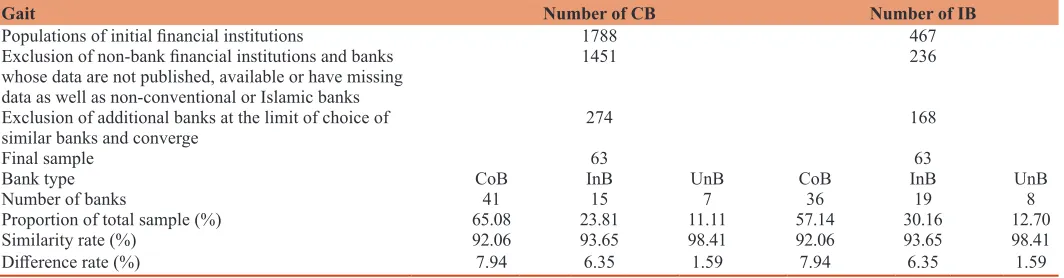
country. While, as shown in Table 4, the affinity means that a classical or Islamic bank (commercial type [CoB], investment type [InB] or universal type [UnB]) in such a country of the first sample
must have its counterpart of the second sample located at the same
country with a probability of 94.7% ~ (95%). After filtering, for each sample, data have a total of 63 banks and 567 observations collected during the period (2010-2018). The following Table 4
summarizes the process followed, as well as the different stages
of the observation selection process.
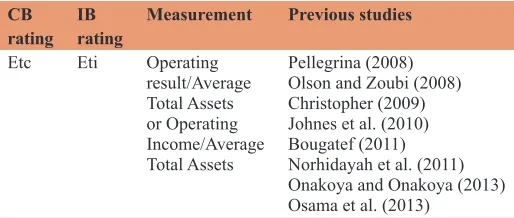
3.2. Measurement of the Variables to be Compared Since the findings in the literature are inconclusive due to the heavy use of financial ratios, we symbolized the efficiency by a single ratio. Our ratios choice is justified by two main reasons. On the one hand, in practice, a deep contention arises. The large
conventional banks listed adopt accounting rules established by
international standard setters (IASB) and (FASB). The prohibition
of using of interests means that some conventional accounting
practices may not be applicable in Islamic financial institutions.
Therefore, not all measures are valid for performing a comparative study between banking systems. In this case, the choice of a single
ratio to assess the efficiency situation can yield conclusive results that better reflect the reality of the bank, whatever its type. On the other hand, the two models differ in terms of the asset valuation method, the drafting of financing contracts, the recognition and treatment of income (Ahmed, 2002; Haniffa and Hudaib, 2002). Therefore, the financial ratios of the two models are not calculated
in the same way and the informational content of the measures will not be treated and interpreted identically. To remedy these
problems, (A.A.O.I.F.I.) has issued custom-tailored accounting
and auditing standards in coordination with other specific agencies
for use by listed and unlisted Islamic banks. This does not mean that existing conventional accounting measures and concepts will all be ignored or adopted. But, concepts inconsistent with Sharia
rules have been rejected or modified, while concepts converging
with Sharia principles have been incorporated into the norms
(A.A.O.I.F.I.) (Lewis and Algaoud, 2001).
Although each country has its own accounting framework that
is more/less different from other countries, this is the theoretical proof that avoids the lack of clarity related to differences in the
application of accounting standards. Before the determination of
the financial ratios, the account must be taken of the constitutional and functional differences between conventional banks and Islamic
banks. Practically, the functions of Islamic banks resemble those of conventional banks. Islamic scholars have compared the discrepancies to develop similar products to those of conventional banks, allowing them to replace interest rate payments and update
fees (Beck et al., 2013) and (Ada and Dalkilic, 2014). For example, Waseem (2008) argued that financing costs are almost the same in Islamic banks and conventional banks. His argument was that
interest rates take into account administrative costs, the sharing
of profits and record ancillary costs.
In particular, Turen (1996) has provided an assimilation of methods for calculating financial ratios between the two types of banks. He suggested that the Islamic bank activity depends combined effect of three laws governing the degree of the gap between the
two banking models. First, the deposits holders at the level of conventional banks are replaced by the shareholders of Islamic banks. Second, interest paid to depositors is converted by shared
profits or losses. Third, loans to traditional bank customers are
converted into equity investments in Islamic banks. Compliance
with these three principles indicates that most financial ratios in the two categories of banks are defined in the same way. However,
the net income of an Islamic bank includes the conventional net income before taxes, plus Zakat, which has been supplemented by the income tax. Furthermore, interest expenses are replaced by commission income and expenses. Indeed, the loans and advances granted by the conventional bank are essentially equivalent to the investments according to the technique of Mudaraba, Murabaha, and Moucharaka. As a result, all researchers tend to evaluate the
major sections of the financial statements of two banks’ types. They find that the main elements are almost similar.
Table 4: Samples filtering process of conventional and Islamic banks
Gait Number of CB Number of IB
Populations of initial financial institutions 1788 467 Exclusion of non-bank financial institutions and banks
whose data are not published, available or have missing data as well as non-conventional or Islamic banks
1451 236
Exclusion of additional banks at the limit of choice of
similar banks and converge 274 168
Final sample 63 63
Bank type CoB InB UnB CoB InB UnB
Number of banks 41 15 7 36 19 8
Proportion of total sample (%) 65.08 23.81 11.11 57.14 30.16 12.70 Similarity rate (%) 92.06 93.65 98.41 92.06 93.65 98.41
Difference rate (%) 7.94 6.35 1.59 7.94 6.35 1.59