The Class of Reasonable Equilibria
∗
Philip R. Neary
First version: June 1, 2008
This version: January 30, 2010
Abstract
We propose three new equilibrium refinements for normal form games. The re-finements are strategy-perturbation based, `a la perfection, as defined by Selten
(1975). An equilibrium is defined asreasonable if more costly mistakes are trem-bled onto with lower probability than less costly ones. However, we do not require that the relative likelihood be of a full order of magnitude, as in properness ( My-erson (1978)). The remaining two refinements are similar in spirit to reasonable equilibria although instead of requiring robustness to one such reasonable tremble, they require robustness to more, and all, such reasonable trembles respectively. We call an equilibrium more-than-proper if it is robust to a larger, yet tractable, class of reasonably constrained games than properness. We call an equilibrium truly proper if it is robust to the set of all reasonably constrained games.
Keywords: Equilibrium Refinement, Normal form, Perfection, Properness.
1
Introduction
The ideas of equilibrium refinements originated with the seminal work ofSelten(1975).
Selten (1975) observed that in extensive form games the Nash solution concept could
often prescribe seeminglyirrational (non-maximizing) behavior at unreached
informa-tion sets, and he sought to eliminate such unreasonable equilibria. In standard
eco-nomic models theseunreasonableequilibria often amounted to players making incredible
threats. This produced a huge inconsistency between game theoretical predictions and
reasonable (or at least observed) economic behaviour, and have caused some concern
to game theorists for some time.
Selten(1975) introduced the concept, that assigns a non-empty set of strategy
pro-files each element of which is known as aperfect equilibrium point, by postulating that
full rationality is the limiting case of incomplete rationality. To quote Okada (1981):
“He (Selten) parameterized incomplete rationality by a small positive probability for
the breakdown of rationality and defined the perfect equilibrium point to be stable
against arbitrarily slight parameterized incomplete rationality”.
Selten’s goal was to require that players prescribe rational behavior at every
infor-mation set. Mathematically, his mechanism found an equilibrium point stable against
an arbitrary sequence of perturbations in the strategy choice of players. It did this by
looking atnearby constrained games where all players were required to play each pure
strategy with non-zero probability. This ensured players now would (not just could) be
called on to act at each information set, hence proposing a non-maximizing action at
any information set was irrational.
Note, however, that behavior in these constrained games is fully rational by the
standard definition of rationality (maximizing expected payoffs given beliefs). Thus,
what Okada (1981) refers to as incomplete rationality is really an awareness on the
part of each player that his opponents and the player himself are constrained in their
allowable choices. These can be viewed as physical constraints placed on the players
or (perhaps more plausibly) as belief constraints on how a player may make slight
mistakes. Perfection required that an equilibrium be robust against an arbitrary set of
belief constraints.
The fundamental question that this paper seeks to address is: ‘What is theright set
are reasonable, and why?’ What is unique about our contribution is that we turn this
question on its head. Rather we ask: ‘What beliefs are unreasonable?’ and eliminate
these as possible candidates. The remaining set of beliefs are considered possible, and
any equilibrium supporting beliefs from this set is referred to as reasonable.
It was viewed as undesirable that the process towards full rationality may violate
dominance. It seemed odd that players could collectively agree that if strategy B
dominates strategy A for player i, then player i may tremble onto A with greater
probability than B. Myerson (1978) noticed this undesirable property of some perfect
equilibria, and so proposed a strict refinement of perfection, namely properness. Proper
equilibria are perfect equilibria where the added assumption is that there is a particular
rational mechanism underlying the perturbations.1
Myerson(1978) motivated properness with the idea that players ought to take care
as to how they tremble, and as such should tremble onto more costly mistakes with
in-finitely less probability than onto less costly ones. The main concern is that while
play-ers tremble in a reasonable (non-dominance violating) manner, the weighting scheme
they assign to strategies is very specific, and in some instances overly restrictive.
The first refinement we present here is a coarsening of properness. We look at
constrained games where every player must play a fully mixed strategy, and any pure
strategy that is not a best response given beliefs must receive infinitely less weight than
all pure strategy best responses. Within the complement of his best response set,2 a
player must give less weight to worse strategies, but need not give infinitely less weight,
just less. We also require that payoff equivalent strategies receive equal weight, be
they best responses or not. An equilibrium is reasonable if it is robust to one such
constrained game. Existence is immediate by Jurado and S´anchez (1990), who extend
Myerson’s properness to also require the equal weighting of payoff equivalent strategies. 3
Our next two procedures strictly refine the set of reasonable equilibria.
More-than-proper equilibria require robustness to the set of reasonably constrained games where
every player must play a fully mixed strategy, and any strategy that is not a best
response given beliefs must receive infinitely less weight than all pure best responses.
1We will use “trembles”, “perturbations”, and “belief constraints” interchangeably throughout. 2We will refer to a generic agent as “he” throughout the paper.
3Jurado and S´anchez(1990) call their refinementstrong properness. The difference is mild, so from
Within the complement of the best response set, worse strategies receive a constant δ
times the weight of the next best strategy, and this is required to hold for allδ ∈(0,1).
Truly proper equilibria require robustness to all reasonably constrained games. Thus
an equilibrium istruly proper if it is stable against all sequences of nearby constrained
games where the belief constraints do not violate dominance given knowledge of how
the opponents are playing. What it means formally for players to have collectively
reasonable belief constraints will be made precise in Section5. Truly proper equilibria
are a strict refinement of more-than-proper equilibria, but the difference is mild and
comes at a cost as more-than-properness is much more tractable, and can even be shown
to eliminate some intuitively bad proper equilibria. More-than-properness also permits
a simple test for selecting between multiple proper equilibria that is discussed in Section
7.
The paper is organized as follows: Section 2shows via a simple one player example
the differences between each of our 3 new equilibrium refinements, and contrasts them
with existing refinements like perfection and properness. Section4provides a brief recap
of normal form equilibrium refinements, highlighting the merits and deficiencies of each.
Section5argues that reasonable trembles are the correct way to think about Selten’s
so-calledbreakdowns in rationality, and as such properness is a step in the right direction.
Section 6 argues that the class of allowable reasonable trembles can also be reduced.
Section 7 formalises our equilibrium notion of more-than-properness, while Section 8
introduces true properness. Section 9 presents our main result which categorizes the
positioning of our new refinements in thefood chain of existing refinements. Section10
concludes. Our notation is reasonably standard and is quickly laid out in Section 3.
2
A one player Example
In their paper on sequential equilibria,Kreps and Wilson(1982) write: “Some sequential
equilibria are supported by beliefs that the analyst can reject because they are supported
by beliefs that are implausible. We will not propose any formal criteria for ‘plausible
beliefs’ here.” The purpose of this section is to show through a simple example what we
propose asplausible beliefs that players may hold. This is done by looking atreasonable
mechanisms by which a rational player couldtremble.
wherek and l parameterize the set. k is a real number strictly less than 2, while l is a
real number strictly less thank.
The story goes like this: Rowena adores Apples (A); she quite likes Bananas (B);
she also thinks Cheese (C) is ok, but not as nice as Bananas, while Dates (D) are her
least favourite food. Suppose Rowena walks into a room with a table on which lies
1 Apple (A), 1 banana (B), 2 identical pieces of cheese (C1, C2), and a bag of dates
(D). Rowena may choose only one item from the table. Her goal is to choose whatever
makes her happiest, and she is free to do so. A payoff matrix, Γ(k, l), representing this
situation is the following:
Row
A 100
B 2
C1 k
C2 k
D l
First of all notice that while this is technically a game, it is a 1-player game and
is more accurately viewed as a decision problem. Second, notice that in the realm of
decision problems, this is a trivial one: it is obvious what Rowena should do - she should
choose the apple (A). Thus the only equilibrium (if it can be called that) is for Rowena
to play A. Given that A is the only equilibrium and that it is a strict equilibrium,4 it
must therefore be the only robust equilibrium. So our focus here is not on refining the
set of equilibria, but rather in demonstrating variousreasonable mechanisms illustrating
how Rowena might make mistakes.
Let pi be the weight that Rowena gives each pure strategy i ∈ {A, B, C1, C2, D}.
In terms of mixed strategies, the equilibrium in this game can be described by the
5-dimensional vector (pA, pB, pC1, pC2, pD) = (1,0,0,0,0). We will analyse how Rowena
will make mistakes given the beliefs that she has.5
Under perfection,Selten(1975) would allow any sequence of perturbations of (1,0,0,0,0)
that converges to it. In one possible constrained game, Rowena could play a totally
4A strict equilibrium is one in which each player has a unique best response against the profile.
Clearly it must be in pure strategies.
5Note now why we discuss this in a decision problem sense. Rowena can have only one belief - that
mixed strategy described by (1−7ε, ε,2ε,3ε, ε). We think this is odd for at least two
reasons. First, given that k < 2 it seems odd that Rowena would put twice as much
weight onC1 thanB, and three times as much weight on C2 thatB. Second, given that
C1 and C2 represent duplications of the same thing, it is strange that Rowena would
place more weight onC2.
Under properness, Myerson (1978) argued that worse strategies, equivalently more
costly mistakes, should receive infinitely less weight in the limit than better ones. Thus
Myerson might insist on a mixed strategy of the form (1, ε, ε2, ε2, ε3).6 This seems plausible if Cheese (C) is really unpleasant to Rowena while bananas (B) are nice,
just not nearly as nice as Apples (A). But suppose that while Rowena strictly prefers
Bananas to Cheese, she does so only slightly. Then requiring a full order of magnitude
weighting difference seems excessive.
Under reasonableness, we argue that while C is clearly worse than B the relative
weighting of B to C (and also C relative to D) could very well be context specific,
and while C should certainly not receive more weight than B, insisting that it get
infinitely less is in many cases overly restrictive (the case where k is strictly less than
but very close to 2 is a clear example).7 Reasonableness also requires that duplicate
strategies receive equal weight, and that the sum of weights on duplicate strategies does
not exceed the weight assigned to any of the next best strategies. We have that the
set of ε-reasonable equilibria are {(pA, pB, pC1, pC2, pD)|pA+pB +pC1 +pC2 +pD =
1 ;pA, pB, pC1, pC2, pD > 0 ;pA < 1 ;pB ≤ εpA; pD ≤ pC1 = pC2 ≤pB/2}. Clearly as ε
goes to zero, any sequence in this set converges to (1,0,0,0,0).
Our next refinement, more-than-properness, requires robustness to a larger class of
constraints than properness. More-than-properness assumes that the modeler is aware
of how the players would rank their strategies given their beliefs, but is unsure as to
how much worse certain strategies are than others. The modeler also assumes that in
the complement of the best response set, that worse strategies get a constant fraction
of the weight of next best strategies. The modeler assumes this constant weighting
scheme, but since they are unsure as to which type of constant relative trembler the
6In fact Myerson’s properness would allow (1, ε, ε2, ε2/2, ε3/2), but this is ruled out under strong properness (Jurado and S´anchez(1990)).
7Objections to this by appealing to the cardinal nature of von-Neumann Morgenstern payoffs which
players are, requires robustness to all such constant relative weighting schemes. For
our example, the set of constrained games is the following: {(pA, pB, pC1, pC2, pD)|pA+
pB +pC1 +pC2 +pD = 1 ;pA, pB, pC1, pC2, pD > 0 ; pA < 1 ;pB ≤ εpA; pC1 = pC2 =
δpB/2, pD = δpC1 = δpC2}. Here, δ captures the idea of constant relative trembling.
Asε goes to zero, for a given value of δ we have a δ-more-than-proper equilibrium. An
equilibrium is said to be more-than-proper if it is δ-more-than-proper for all values of
δ∈(0,1).
Finally, we also propose the concept of true-properness. This is done to deflect
two possible objections to more-than-properness. First, more-than-properness has the
potentially undesirable feature that while the modeler is unsure as to what type (what
value ofδ) of trembler each player is, he assumes that all players are simultaneously of
the same type. But surely it is possible that different players maytremble in different
ways. Second, the constant relative trembling is attractive due to its tractability (as
it can be parameterized by only one parameter), but seems excessive. Letting δ =
(δ0, δ00) be a vector in (0,1)×(0,1), the set of δ-truly proper equilibria is the following:
{(pA, pB, pC1, pC2, pD)|pA +pB +pC1 +pC2 +pD = 1 ; pA, pB, pC1, pC2, pD > 0 ; pA <
1 ;pB ≤ εpA; pC1 = pC2 = δ
0p
B/2, pD = δ00pC1 = δ
00p
C2}. The equilibrium is truly proper if it isδ-truly proper for all pairs (δ0, δ00)∈(0,1)×(0,1).
The one player decision problem above does not capture how much stronger the
notion of true properness is as compared to more-than-propernes. For multi-player
games, true properness says that given a particular type of trembler for player i, the
constrained equilibrium must be robust for all types of relative tremblers of the other
players. And this statement must hold no matter what type of relative trembler player
iis.
3
Notation
A finite n-person normal form game is a 2n-tuple Γ = (S1, . . . , Sn, u1, . . . , un), where
Si is a finite nonempty set of pure strategies for player i, and ui is player i’s payoff
function defined as a mappingui :
Qn
j=1Sj −→R. These hold fori∈ {1, . . . , n}.
Σi denotes the set of all probability distributions overSi, and we call this set player
i’s mixed strategies space. We define S := Qn
j=1Sj and Σ :=
Qn
j=1Σj, with typical
Σ.
From player i’s perspective a pure strategy profile s ∈ S can be viewed as s =
(s\si), while a mixed strategy profile σ ∈ Σ can be viewed as σ = (σ\σi). Thus the
strategy profile (s\sˆi) will refer to (s1, . . . , si−1,sˆi, si+1, . . . , sn), i.e. the profiles, where
ˆ
si replacessi. Similarly for (σ\σˆi), and (σ\sˆi).
We will denote the set of pure best responses for player i to strategy profile σ as
bri(σ), where bri : Σ Si. We denote the set of all pure best replies to strategy
profileσ bybr(σ)≡Qni=1bri(σ).
A constrained game (to be made precise below) will be denoted Γε, where the
superscriptε (which may be a vector) fully parameterizes the constraints. Finally, we
will denote the set of Nash equilibria of a game Γ by E(Γ).
4
Recap of Definitions
The notion of a constrained game is fundamental to strategy-perturbation based
refine-ments. The constraints require that each player places strictly positive weight on each
pure strategy, thus guaranteeing that in an extensive form game every information set
is reached.8 This ingenious trick of Selten’s was intended to lead to rational behaviour
being prescribed at every information set.9 He viewed constraints as corresponding to
mistake probabilities that all playersj 6=i hold about playeri’s actions.10
Selten (1975) showed that no matter what the constraints, an equilibrium in the
constrained game “passes to the limit”, and that this limit is an equilibrium of the
original game. The real power of perfection is that in a constrained game a weakly
dominated strategy becomes strictly so, due to every information set being reached
with strictly positive probability, and as a rational (payoff maximizing) player will
8Our definitions will be for normal form games throughout. This is to avoid having to specify
purely extensive form notions like ‘sequential best responses’, etc. One may think of our analysis in the standard way of each player optimizing ex-ante. Each definition can of course be extended to general extensive form games.
9By the standard definition of rational behavior, that of maximizing expected payoffs given (possibly
constrained) beliefs, this does lead to rational behavior. However it can lead to what we later term unreasonable behavior.
10A further assumption is that player i is also aware of the mistakes he himself will make. See
assign as little weight as is permitted to weakly dominated strategies. In passing to the
limit, a perfect equilibrium therefore places zero weight on weakly dominated strategies.
Kohlberg and Mertens(1986) argue forcefully that players should assign zero weight to
weakly dominated strategies. So perfection is certainly a step in the right direction.
The definition of perfection we provide below is due toMyerson(1978). This
equiv-alent way of formalizing a perfect equilibrium introduces the notion of an ε-perfect
equilibrium.11 Thus we can consider perfect equilibria from the perspective of
conver-gence ofε-perfect equilibria.12
Definition 1. A strategy profile σε ∈Σis said to be an ε-perfect equilibrium of Γ, if
σε is completely mixed, and satisfies the following:
if ui(σε\s0i)< ui(σε\s00i),
then σiε(s0i)≤ε, for all i, for all s0i, s00i
A perfect equilibrium is the limit point of a sequence{σε}
ε↓0, where σε is an ε-perfect
equilibrium of Γ, for all ε.
The weakness of perfection is that for an equilibrium to be stable that it be robust
to some slight strategy perturbation. But the perturbation can be chosen arbitrarily
-its sole purpose is that it “works”.
Myerson (1978) introduced the notion of a proper equilibrium which implicitly
as-sumes that players will try harder to avoid more costly mistakes. Properness has been
interpreted as there being some rational mechanism governing the mistake
probabili-ties. Strategies that are more costly are assigned a probability of smaller order than less
costly ones. Formally, under perfection, players cannot act irrationally by the definition
of rational behavior (prescribe non-maximizing behaviour), but can hold and respond
to what are deemedunreasonablebeliefs over the mistake probabilities of others. Under
properness, mistake probabilities of players are constrained in a reasonable, but very
specific way.
11Intuitively, this just says that if a response to a strategy profile is not a best response for player
i, then it must get weight of no more than ε. It can be shown that an equilibrium is perfect if and only if it is a limit point ofε-perfect equilibria - see Theorem 8.4 (page 352) inFudenberg and Tirole
(1991).
12In an abuse of notation,εmay refer to a real number strictly between 0 and 1, or may refer to a
Definition 2. Let Γ be an n-person normal form game. Let ε > 0 and σε ∈ Σ.
Myerson (1978) calls σε an ε-proper equilibrium of Γ if σε is completely mixed and
satisfies:
if ui(σε\s0i)< ui(σε\s00i),
then σiε(s0i)≤εσiε(s00i), for all i, for all s0i, s00i.
A proper equilibrium is the limit point of a sequence {σε}ε↓0, whereσε is an ε-proper equilibrium of Γ, for all ε.
An -proper equilibrium always exists in the constrained game. Since each
con-strained game possesses at least one equilibrium, and this equilibrium is an element of
a compact set, the limit of the constrained equilibria (possibly passing to subsequences)
exists. That this limit is an equilibrium of the original game is trivial, by showing that
any proper equilibrium is perfect. Thus a proper equilibrium exists for all normal form
games.
Okada (1981) introduced the notion of a strictly perfect equilibrium point.
Intu-itively this just generalises perfection, i.e. where perfection requires stability to any
one sequence of nearby constrained games, strict perfection requires stability to all
sequences of nearby constrained games.
Definition 3. Let Γ be an n-person normal form game. Let ˆη ∈ RS
++, let Oηˆ :=
η∈RS
++|η <ηˆ .13 Call σ∈Σ astrictly perfect equilibrium of Γ if there exists some
ˆ
η∈RS
++ and for each η∈Oηˆ some ση ∈E(Γη) such that limη↓0ση =σ.
Van Damme(1996) introduced the following refinement of strict perfection where a
mild regularity condition is placed on the strategy perturbations. This condition ensures
that strategies change smoothly as beliefs change. He refers to such an equilibrium as
strictly proper.
Definition 4. An equilibrium σ of Γ is strictly proper if σ is strictly perfect and the
mapping η7→σ(η) from Oηˆ toΣ is continuous.
13Given two equal dimensional vectorsxand y, writex<y ifx
5
Reasonable Equilibria
That equilibria should be robust to trembles is widely accepted. Interpreting trembles
as uncertainty in beliefs rather than a mere technical trick is more controversial.14
However, if you require robustness to trembles and take seriously the behavioral notion
of trembles, then reasonableness, as defined below, is surely a necessary condition for
an equilibrium to be self enforcing.
The common theme to all our refinements is that players do not violate dominance
given their beliefs. We insist that players may make mistakes and are aware that other
do too. Note that no matter what beliefs a player holds, it is always possible to rank his
pure strategies in terms of the payoff each would yield. We insist that best responses
to a particular belief receivemost of the weight, while non-best responses receivelittle
weight. Inferior non-best responses receive less weight than better non-best responses.
It seems highly believable that players will make less costly mistakes. This is easily
understood and quite intuitive as the following suggests: it seems quite odd to
sup-pose that if pure strategyA and B are both strictly dominated relative to a proposed
equilibrium profile, while strategy B strictly dominates A, that strategy A should be
assigned more weight thanB in any constrained game. If not the payoffs are surely not
representative of the player’s preferences.
However, it also seems overly restrictive to insist that the weight put on a more
costly mistake always be a full order of magnitude lower than that on a less costly one
as in properness. Since if a strategy is only marginally less costly then the trembling
player is exerting a huge amount of energy to control the less costly mistake despite it
being only slightly so. Furthermore, there may be external factors not present in the
normal form, such that despite a particular player having a strategy appear much more
costly than another to the modeler, perhaps the player has an unobservable fondness
for that particular strategy. Provided the player is rational this more costly error will
certainly receive less weight, but need not receive a full order of magnitude less weight
as in the properness notion ofMyerson (1978).
Thus, taking the view that trembles are restrictions on players beliefs, it seems overly
restrictive and intuitively quite odd to require that complete rationality be viewed as
14Harsanyi and Selten(1988) argued thatsomebehavioral interpretation should be attached to the
the limiting case of any kind of unreasonable beliefs, as these are surely a component
of unreasonable behavior. We believe that incomplete rationality, of which complete
rationality is the limit, would better be modeled as having not-quite-certain but still
reasonable belief constraints. It seems far more natural to model the complete
rational-ity of an individual as the limiting case of nearby games in which players can tremble
in any manner they wish as long as it is reasonable. We now formally define what
it means for an equilibrium to satisfy this limit of reasonable beliefs. Naturally such
equilibria are referred to asreasonable.
First we will need the definition of an equivalence class.15
Definition 5. Given a strategy setSi for any player i. Define the equivalence class of
strategysi ∈Si as the subset of all elements of Si that are payoff equivalent to si:
[si] := {s0i ∈Si|ui(σ\s0i) = ui(σ\si),∀σ ∈Σ}
Ifs0i ands00i are both elements of the same equivalence class, we will writes0i ∼s00i. The
number of elements in [si] will be denoted by|[si]|.
Definition 6. Let Γ be an n-person normal form game. Let ε > 0 and σε ∈ Σ. We
call σε an ε-reasonable equilibrium of Γ if σε is completely mixed and satisfies:
1. if si ∈br(σε),
then σε i(s
0
i)≤εσiε(si), for alli, for all s0i 6∈br(σε).
2. if ui(σε\s0i)< ui(σε\s00i),
then σiε(s0i)≤ 1
|[s0i]|σ ε
i(s00i), for all i, for all s0i, s00i 6∈br(σε).
3. if s0i ∼s00i,
then σε i(s
0
i) = σεi(s 00
i), for all i.
A reasonable equilibrium is the limit point of a sequence {σε}
ε↓0, where σε is an ε
-reasonable equilibrium of Γ, for all ε.
Some remarks are in order:
15An equivalence relation is a binary relation (often denoted by ∼) on a set X. The following
Remark 1. Condition 1 in the definition follows Myerson in that it requires pure
strategies that are not best responses to the group profile receive at most ε times the
weight of those pure strategies that are best responses. Condition2 only requires that
within the complement of their best response set, that no player violates dominance with
their trembles. Condition3 just ensures that payoff equivalent strategies are assigned
equal weight.
Remark 2. The introduction of an equivalence class for each strategy is necessary as
without it, the solution concept is sensitive to the duplication of strategies. Without the
scaling in condition2, one could continue to add inferior strategies and their combined
weight could eventually exceed that of a “better” strategy.
Remark 3. The reader may object to a strictly worse strategy being allowed as much
weight as a better one. This is easily handled by a slight tweaking definition 6, where
instead of defining an ε-reasonable equilibrium, one instead defines an (εδ)-reasonable
equilibrium, whereδ is strictly less than 1, and is inserted on the right hand side of the
weak inequality in condition2. One could then intersect over all δ.
Reasonableness restricts the set of perturbations that are allowed. We will denote
the set of reasonable equilibria of a game Γ byRea(Γ).
Lemma 1. Rea(Γ) is a nonempty closed subset of the set of perfect equilibria. Every
proper equilibrium is reasonable.
Proof. That every reasonable equilibrium is perfect is trivial by definition1.
Existence is trivial since it is clear from definition 2 that every proper equilibrium
is reasonable, and proper equilibria always exist.
To show that Rea(Γ) is closed we proceed as follows. Fix ε > 0. Let Rε be the
set of γ-reasonable equilibria for γ ∈ (0, ). Let Rε denote the closure of Rε. Clearly
Rea(Γ) = ∩ε>0Rε. SinceRε is closed and the intersection of any arbitrary collection of
closed sets is closed we are done.
Consider the following game Γ(x), based on one from Van Damme (1996), where
x >0:
It is clear that Player 2 has a strictly dominant strategy that he must play, thus any
P1
P2
L C R
U 2,3 1,2 0,1 M 2,3 0,2 x,1
his set of pure strategies. Letpdenote the probability that player 1 playsU. Note that
every equilibrium in the connected set of equilibria {{p, L}:p∈[0,1]} is reasonable.
It is also not difficult to see that the unique proper equilibrium to this game is{U, L}.
However,{U, L} is only proper because player 2 strictly prefers C toR and as such is
required to playR with a full order of magnitude less thanC. Player 1’s best response
to this constrained optimization is to play U since given the order of magnitude of
player 2’s tremble, U is better than M (i.e. 1 > x2 for all sufficiently close to zero
no matter what the value ofx).
6
But is Reasonableness enough?
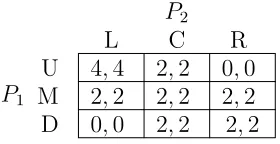
The following process shows the need for an extension to properness (and hence
rea-sonableness by Theorem1).16 Consider the following 2-player normal form game:
P1
P2
L C
U 4,4 2,2 M 2,2 2,2
Figure 1: A nongeneric game with 2 (pure strategy) equilibria.
This is a non-generic game with only 2 equilibria. Both equilibria, {U, L} and
{M, C}, are in pure strategies. As discussed before, since perfection is a rather weak
requirement, if an equilibrium is not perfect then it is very unstable. However, as is
easily shown, the only perfect equilibria in this game is {U, L}. In Figure 6below, we
transform the game by adding a weakly dominated strategy to each player.
Thus we have added a weakly dominated strategy to each player and it can now
be seen that both {U, L} and {M, C} are perfect. In fact, the equilibrium {M, C}
P1
P2
L C R
U 4,4 2,2 0,0 M 2,2 2,2 2,2 D 0,0 2,2 2,2
Figure 2: Game above altered by adding weakly dominated strategies.
is reasonable, and even proper.17 Thus even properness has selected the unappealing
equilibrium {M, C}.
7
More-Than-Proper Equilibria
We believe that the right set of constrained games to focus on is the set of all reasonably
constrained games. More-than-properness is arrived at by looking at a particular subset
of these reasonably constrained games. More-than-proper equilibria are the limit of a
sequence of (εδ)-more-than-proper equilibria. Before defining this, we will need one
additional piece of notation.
The following definition ranks a player’s strategies relative to a given strategy profile.
Definition 7. The number of pure strategies of playeristrictly preferred to ˆsi relative
to the profileσ is
ci(σ,ˆsi) := #
n
si ∈Si|ui(σ\si)> ui(σ\sˆi)
o
(1)
Clearly if ˆsi ∈bri(σ), then ci(σ,sˆi) = 0, and if s0i ∼s00i, then ci(σ, si0) =ci(σ, s00i).
Definition 8. Let Γ = (S1, . . . , Sn, u1, . . . , un) be an n-person normal form game. Let
ε >0, and δ ∈ (0,1), and σεδ ∈ Σ. We call σεδ an (εδ)-more-than-proper equilibrium
of Γ if it is completely mixed and satisfies:
1. if si ∈bri(σεδ),
then σεδ
i (s0i)≤εσiεδ(si), for all i, for alls0i 6∈bri(σεδ).
17 σ
1(U), σ1(M), σ1(D)) = (ε2,1, ε
2. if ci(σεδ, s00i)< ci(σεδ, s0i), and @s˜i ∈Si such that
ci(σεδ, s00i)< ci(σεδ,˜si)< ci(σεδ, s0i),
then σεδ i (s
0 i) =
1
|[s0i]|δσ εδ i (s
00
i), for alli, for all s 0 i, s
00
i 6∈bri(σεδ)
3. if s0i, s00i 6∈bri(σεδ), and s0i, s 00
i are payoff equivalent
then σεδ i (s
0
i) =σiεδ(s 00
i), for all i.
σδ ∈Σ is a δ-more-than-proper equilium of Γ, if σδ is a limit point of a sequence
σεδ ε↓0 where σεδ is an εδ-more-than-proper equilibrium of Γ for all ε, for some
δ∈(0,1).
Finally we say thatσ ∈Σis a more-than-proper equilibrium of Γ, if σ is a δ
-more-than-proper equilibrium of Γ for all δ∈(0,1).
Again, some remarks are in order:
Remark 4. The equality in the second condition is what gives more-than-properness
its bite. To see the difference between more-than-properness and properness consider
again game6. Clearly{U, L}is proper but it is not as obvious that{M, C}can be made
proper with the appropriately defined tremble given before. However, only {U, L} is
more-than-proper. {M, C}isδ-proper for values ofδ ∈(0,1/2], but fails to beδ-proper
for values ofδ >1/2. Thus our more-than-proper equilibrium concept has removed the
less desirable equilibria {M, C} from Game 6.
Remark 5. More-than-proper equilibria do not exist for all games. Refer back to
Game5. Note that if we permit player 2 to be an (δ)-trembler, then this preference of
player 1 forU overM need not always hold. For values ofx >1 we run into trouble for
δ >1/x, since in that case it need not be true that 1 > xδ. For small values of δ the
(δ)-more-than-proper equilibrium coincides with the-proper equilibrium {U, L}, but
for large values ofδ the (δ)-more-than-proper equilibrium flips to {M, L}. Since
more-than-properness requires intersecting over all δ ∈ (0,1) we have that the only proper
equilibrium of the game {U, L} is not more-than-proper. But while more-than-proper
equilibria do not exist for all games, the concept could be extended from a point-valued
solution to set-valued one. We leave this to future research.
Remark 6. While more-than-properness fails to exist for all games, it can in some
instances provide a method for selecting amongst multiple proper equilibria,18 since an
index of stability can be created for how robust a proper equilibrium is. For example,
in Game 6, the proper equilibrium {M, C} has only a stability index of δ = 1/2 and
thus is not particularly stable, whereas the proper equilibrium {U, L} has a stability
index of 1. This is as our intuition suggests.
Remark 7. It is not difficult to see that as in the definition of an ε-reasonable
equi-librium, the use of equivalence classes is again necessary to maintain robustness to
duplication of strategies.
Remark 8. Phelps and Pollak (1968) rewrote the way economists thought about
dis-counting. The standard models assumed that lifetime utility,U, was separable over
peri-ods and that the following days felicity (intertemporal utility),u, was always a constant
discount factor less valuable than the preceding day; i.e. U(c0, . . . , cT) =PTt=0βtu(ct),
where β ∈ [0,1] is the discount factor. This constant discounting scheme is similar to
the weighting scheme used by Myerson in properness, where next worse strategies are
assigned a constant weight of the next best strategy.. But Phelps and Pollak (1968)
conjectured that possibly the immediate following period is relatively more important
than future periods; i.e. that U(c0, c1, . . . , cT) =u(c0) +βPTt=1δt−1u(ct), where both
β, δ ∈ [0,1]. More-than-properness is an extension of properness somewhat analogous
to howPhelps and Pollak(1968) extended the standard exponential discounting model,
where the solution must be robust to the entire family of possible discounting
mecha-nisms.
We denote the set of proper equilibria of a game Γ by P rop(Γ) and the set of
more-than-proper equilibria byM T P(Γ).
Lemma 2. The set of more-than-proper equilibria, MTP(Γ), is a closed subset of
Prop(Γ). Though possibly empty.
Proof. Let σ be a more-than-proper equilibrium of Γ. Clearly then, for every ε > 0,
and every δ ∈ (0,1), there exists a (δ)-more-than-proper equilibrium such that σ =
limε→0σεδ. This follows since an (εδ)-more-than-proper equilibrium is (ε0δ
)-more-than-proper for all0 ≥. Now consider a sequence{δn}such thatδn↓0 as n→ ∞. Sinceσ
isδn-more-than-proper for alln, it is for all sufficiently large n. Thus we can construct
Each element of this sequence is anε-proper equilibrium and so the result immediately
follows.
To show that the set is closed fix a δ. Let Cεδ denote the closure of the set of
(εδ)-more-than-proper equilibria, for ε ∈ (0, ε). Letting Cδ denote the set of δ
-more-than-proper equilibria for this particular δ, we have that Cδ = ∩ε>0Cεδ. It follows
that
M T P(Γ) = \
δ>0
Cδ=
\
δ>0
\
ε>0
Cεδ
The possible emptiness of M T P(Γ) stems from intersecting over all δ ∈ (0,1). It
can be shown by a slight adaption of Theorem1 part 5, that the set Cδ is non-empty
for all δ∈(0,1).
8
Truly Proper Equilibria
Despite being a refinement of properness (see Theorem 1 part 3 below), the attentive
reader will have noticed that more-than-properness does not in fact cover the set of all
reasonably constrained games.
To be precise,Myerson(1978) constrains, via an upper bound, the weights thatmore
costly mistakes receive, but he does not insist that these constraints bind.
More-than-properness expands the set of constraints, and insists that the equilibrium is robust
for all these constraints. However, the set of reasonable constraints required by
more-than-properness is not exhaustive, as it only it insists on constant relative trembling,
and only requires robustness to everybody simultaneously trembling according to the
same constant weighting scheme. An equilibrium will be referred to as truly proper if
it holds for all weighting schemes that do not violate dominance in the complement of
the best response set, and not just the constant weighting schemes used in
more-than-properness.
Before presenting the formal statement we introduce some additional notation. Let
mi denote the number of pure strategies of player i, i.e. mi := |Si|. Define m :=
Pn
i=1mi. Let ˆmi denote the number of equivalent strategies (as in defintion 5) of player
i. Also define ˆm :=Pn
i=1mˆi. For each playeri, let δi denote an ( ˆmi−2)-dimensional
vector where each component is between 0 and 1. That isδi := (δ1
i, . . . , δ
ˆ
mi−2
i )∈Rmiˆ −2,
let δ denote a vector of relative trembling discount factors for the game Γ, that is
δ:= (δ1, . . . , δn)∈RPn
i=1( ˆmi−2) =R( ˆm−2n).
Definition 9. Let Γ = (S1, . . . , Sn, u1, . . . , un) be an n-person normal form game. Let
ε >0, and δ ∈ R( ˆm−2n), and σεδ ∈ Σ. We call σεδ an (εδ)-truly proper equilibrium of
Γ if it is completely mixed and satisfies:
1. if si ∈bri(σεδ),
then σiεδ(s0i)≤εσiεδ(si), for all i, for alls0i 6∈bri(σεδ).
2. if ci(σεδ, s00i)< ci(σεδ, s0i), and @s˜i ∈Si such that
ci(σεδ, s00i)< ci(σεδ,˜si)< ci(σεδ, s0i),
then σiεδ(s0i) = |[s10 i]|δ
0 iσ
εδ i (s
00
i), all i, all s0i, s00i 6∈bri(σεδ), someδi0 ∈(0,1)
3. if s0i, s00i 6∈bri(σεδ), and s0i, s 00
i are payoff equivalent
then σiεδ(s0i) =σiεδ(s00i), for all i.
σδ ∈Σis aδ-truly proper equilium of Γ, ifσδis a limit point of a sequence σεδ ε↓0 whereσεδ is an εδ-truly proper equilibrium of Γ for all ε, for some δ∈(0,1)( ˆm−2n).
Finally we say that σ ∈ Σ is a truly proper equilibrium of Γ, if σ is a δ-proper
equilibrium of Γ for all δ∈(0,1)( ˆm−2n).
Remark 9. It is immediately apparent that truly proper equilibria permit a finer
selection criterion to proper equilibria. It should be clear that
more-than-properness only has “bite” for games where at least one player has 3 or more pure
strategies. Similarly, true properness can only strictly refine the set of
more-than-proper equilibria for games where at least two players have 3 or more strategies.
Remark 10. Note that true properness is a much stronger refinement that
more-than-properness in the sense that it requires playeri to rank his pure strategies in the same
manner for all relative trembling profiles δj that all other players j may have. More
than properness only requires robustness to each player relatively trembling in the same
Remark 11. If more-than-properness is analogous to requiring robustness to the set
of all (βδ)-discounting model of Phelps and Pollak(1968), then truly proper equilibria
are analogous to the set of all hyperbolic discounting models whereU(c0, c1, . . . , cT) =
PT
t=0(
Q
0≤s≤tβs)u(ct), where β0 = 1, and βt ∈ [0,1] for all t ∈ {1, . . . , T}. In other
words there is no need for tomorrow to be as relatively less important to today, as
today was relatively less important to yesterday. Rather the only condition that must
be satisfied is that a day in the future is never more important than any preceding day.
Lemma 3. When they exist, the set of truly proper equilibria,T P(Γ), is a closed subset
of M T P(Γ). Though possibly empty.
Proof. More-than-proper equilibria are clearly a special case of truly proper equilibria
where robustness is only required for the set δ|δ= (δ, . . . , δ)∈Rmˆ−2,∀δ∈(0,1) .
Possible emptiness of T P(Γ) is then immediate. Showing the closure of T P(Γ) is
notationally far more cumbersome than that of lemma2but follows along similar lines.
It is therefore omitted.
9
The Food Chain Theorem
This section categorizes our three new strategy perturbation-based refinements in the
respective “food chain” of existing refinements for normal form games.
Theorem 1. 1. Every reasonable equilibrium is perfect.
2. Every proper equilibrium is reasonable.
3. Every more-than-proper equilibrium is proper.
4. Every truly proper equilibrium is more-than-proper.
5. Every strictly proper equilibrium is truly proper.
Proof. 1. This was shown in Lemma 1.
2. This was shown in Lemma 1.
3. This was shown in Lemma 2
5. We will show that every strictly proper equilibrium is more-than-proper. This is
for notational ease only. Showing that strict properness implies true properness
is proved along very similar lines, though is notationally far messier.
Assume σ is a strictly proper equilibrium of Γ. Let Oηˆ be as in definition 3. For
η ∈Oηˆ letσ(η) be as in definition 4.
Let δ∈(0,1), and let m be defined as before. We define and U as follows:
0< < min
si∈Si i∈N
ˆ
ηi(si)
U :=nη∈Oηˆ
δm−1 ≤ηi(si)≤, for all i, for all si o
Now define the correspondence G fromΣ toU as follows:
G(σ) := n
η∈U
(1) for all i, for all s
0
i 6∈bri(σ)
if si ∈bri(σ),
then ηi(s0i)≤εηi(si),
and
(2) for all i, for all s0i ∼s00i
then ηi(s0i) = ηi(s00i)
(3) for all i, for all s0i, s00i 6∈bri(σ)
if ci(σ, s00i)< ci(σ, s0i), and@s˜i ∈Si
such that
ci(σ, s00i)< ci(σ,s˜i)< ci(σ, s0i),
then ηi(s0i) =
1
|[s0i]|δηi(s 00 i)
o
It is clear that G(σ) is a compact and convex set for each σ ∈ Σ. The
upper-hemicontinuity of G follows from the continuity of each player’s utility function.
To show that G is nonempty we proceed as follows:
For a given profile σ, each si belongs to an equivalence class [si]. We define a
slightly modified version of the count function given in equation 1as follows: For
each strategy profile σ, let
ˆ
c(σ,[ˆsi]) := #
n
[si]|ui(σ\[si])> ui(σ\[ˆsi])
where (σ\[si]) denotes the profile σ, with σi replaced with any pure strategy
of player i that is payoff equivalent (against σ) to si. Thus the modified count
function, ˆc(σ,·) ranks the equivalence classes for a player relative to a given
strategy profile, σ. Define
ηi(si) =
1
Q
{[s00i]:ˆc(σ,[si00])≤ˆc(σ,[si])} |[s
00 i]|
εδˆc(σ,[si])
εP
[s0i]δcˆ(σ,[s
0 i])
Clearly ηi ∈Gi(σ), where Gi is the component of G associated with playeri, i.e.
G=G1× · · · ×Gn.
Now define a correspondence F from U to U byF(η) = G(σ(η)), where σ(η)∈
E(Γη). It is clear thatF satisfies the sufficient conditions of the Kakutani(1941)
fixed point theorem, and therefore has a fixed point in U. Let ηδ denote this
fixed point. To minimize notation, we will denote σ(ηδ) by σεδ.
We thus have constructed the following:
if si ∈bri(σ),
then ηiεδ(s0i)≤εηiεδ(si),for all i, for all s0i 6∈bri(σ). (2)
if ci(σεδ, s00i)< ci(σεδ, s0i),
and @˜si ∈Si such thatci(σεδ, s00i)< ci(σεδ,˜si)< ci(σεδ, s0i),
then ηiεδ(s0i) = 1
|[s0i]|δη
εδ i (s
00
i), for all i, for all s 0 i, s
00
i 6∈bri(σεδ). (3)
Now, sinceσεδ is an equilibrium of the constrained game (Γηδ), the players must
abide by the constraints. Hence we must have
σεδi (si)≥ηiδ(si), for all i, and allsi ∈Si (4)
Lemma 2.2.2 page 27) that the constraints on any pure strategy that is not a
best response must bind in a constrained game, so
if ui(σεδ\s0i)< ui(σεδ\s0i),
then σiεδ(s0i) =ηiδ(s0i), for all i, for all s0i, s00i. (5)
It is clear that by combining the equations from (2) - (5), we have thatσεδ is an
δ-more-than-proper equilibrium of Γ. For very small, we have that σεδ is close
to σ. As such σ is a δ-proper equilibrium of Γ.
Finally we note that our choice of δ was arbitrary, and thusσ is a δ
-more-than-proper equilibrium uniformly in δ. σ is therefore more-than-proper.
10
Conclusion
This paper extends the literature on rational behaviour in multiplayer noncooperative
games. Our main goal is to reexamine the notion of what are considered reasonable
beliefs that players may hold in equilibrium. Specifying reasonable off-path equilibrium
beliefs has always been done by looking at the limit of fully mixed strategies. The
question we sought to answer is a standard one: What kind of trembles are sensible?
We approach this problem from a different perspective by flipping the question on
its head, instead asking: What is the set of trembles that don’t make intuitive sense?
We assume perturbations of pure strategies that have full support, and insist on the
quite natural requirement that weights on pure strategies are ordered according to
conditional dominance. Any strategy profile in which any player assigns more weight
to an inferior strategy is deemed unreasonable and is rejected.
The set of perturbations not violating conditional dominance are referred to as
reasonable. An equilibrium is reasonable if it is robust to one sequence of perturbations
from the reasonable set. An equilibrium is referred to as more than proper if it is
robust to a large yet easily characterized set of perturbations from the reasonable set.
the reasonable set.
It is widely accepted that equilibria should be insensitive to some strategy
perturba-tions - as such requiring robustness to some (if not all such perturbaperturba-tions is essential).
It is not so widely accepted that strategy perturbations should be thought of as limiting
beliefs rather than a mere technical trick. We argue that if any behavioral
interpreta-tion is assigned to trembles, then reasonableness is surely a necessary condiinterpreta-tion for an
equilibrium to be self enforcing. Modeling is a key component of economics, and while
models break down in all sorts of ways, possibly (surely?) in a few cases, some modes
of breakdown are more plausible than others. So requiring robustness to these modes
seems all the more important. Furthermore, requiring robustness to certain modes of
breakdown can at times be seen as odd.
Potential extensions and applications of our refinements abound. Neary (2008)
examines what happens when there is common knowledge of reasonable trembling but
players have uncertainty over what type of reasonable trembler their opponents are.
Such an assumption selects thereasonably rationalizable strategies of a game. Another
interesting line of research could be to weaken the restrictions in learning-theoretic
foundations of equilibrium (seeFudenberg and Levine(1993)), to a point where players
need not even agree ex-post with on path beliefs, they just need havesimilar (and of
course reasonable) beliefs. Recently, refinements of equilibria have been applied in many
varied subfields of microeconomics: to the networks literature, see Calva-Armengol
and Rahmi (2007) for example; to voting games, see Sinopoli (2000) and Sinopoli,
Dutta, and Laslier (2006); and of course there is a large literature on refinements as
applied to signaling games, seeBanks and Sobel(1987) andCho and Kreps(1987). Our
refinements are tractable and supply another method for refinements in such games.
Finally, while this paper has focused mostly on reasonable equilibria, various
refer-ees have expressed interest in both more-than-properness and true-properness but are
concerned by the lack of existence of both. An interesting avenue to explore would
be to extend both point-valued concepts to set-valued versions, and to check whether
these sets satisfy the desired requirements of stability ofKohlberg and Mertens(1986),
and Mertens(1989, 1991). Hillas(1990) also looks at set-valued solutions by requiring
robustness to perturbations of the best-response correspondence. One could modify
his analysis by restricting the set of allowable perturbations to the best-response
References
Banks, J., andJ. Sobel(1987): “Equilibrium Selection in Signaling Games,”
Econo-metrica, 55(3), 647–661.
Calva-Armengol, A., and Rahmi (2007): “Pairwise-stability and Nash equilibria
in network formation,” International Journal of Game Theory.
Cho, I.-K.,and D. M. Kreps(1987): “Signaling Games and Stable Equilibria,”The
Quarterly Journal of Economics, 102(2), 179–221.
Fudenberg, D., and D. K. Levine (1993): “Self-Confirming Equilibrium,”
Econo-metrica, 61(3), 523–545.
Fudenberg, D., and J. Tirole (1991): Game Theory. MIT Press.
Harsanyi, J. C., and R. Selten(1988): A General Theory of Equilibrium Selection
in Games. MIT Press.
Hillas, J.(1990): “On the Definition of the Strategic Stability of Equilibria,”
Econo-metrica, 58(6), 1365–1390.
Jurado, I. G., and J. M. P. S´anchez (1990): “A remark on Myerson’s concept of
proper equilibrium,” International Journal of Game Theory, 19(1), 11–16.
Kakutani, S. (1941): “A Generalization of Brouwer’s Fixed Point Theorem,” Duke
Mathematical Journal, 8(3), 457–459.
Kohlberg, E., and J.-F. Mertens (1986): “On the Strategic Stability of
Equilib-ria,” Econometrica, 54(5), 1003–1037.
Kreps, D. M.,andR. Wilson(1982): “Sequential Equilibria,”Econometrica, 50(4),
863–894.
Mertens, J.-F. (1989): “Stable Equilibria: A Reformulation Part I. Definition and
Basic Properties,” Mathematics of Operations Research, 14(4), 575–625.
(1991): “Stable Equilibria: A Reformulation. Part II. Discussion of the
Myerson, R. B.(1978): “Refinements of the Nash equilibrium concept,”International
Journal of Game Theory, 7(2), 73–80.
Neary, P. R.(2008): “Reasonable Beliefs in Games,” Discussion paper, University of
California San Diego, Department of Economics.
Okada, A.(1981): “On stability of perfect equilibrium points,”International Journal
of Game Theory, 10.
Phelps, E. S., and R. A. Pollak (1968): “On Second-Best National Saving and
Game-Equilibrium Growth,” The Review of Economic Studies, 35(2), 185–199.
Selten, R. (1975): “Reexamination of the perfectness concept for equilibrium points
in extensive games,” International Journal of Game Theory, 4(1), 25–55.
Sinopoli, F., B. Dutta, and J.-F. Laslier(2006): “Approval voting: three
exam-ples,” International Journal of Game Theory, 35(1), 27–38.
Sinopoli, F. D. (2000): “Sophisticated voting and equilibrium refinements under
plurality rule,” Social Choice and Welfare, 17(4), 655–672.
Van Damme, E. (1984): “A Relation between Perfect Equilibria in Extensive Form
Games and Proper Equilibria in Normal Form Games,” International Journal of
Game Theory, 13.
(1996): Stability and Perfection of Nash Equilbria. Springer-Verlag Berlin