Journal of Advertising, vol. 41, no. 1 (Spring 2012), pp. 33–45. © 2012 American Academy of Advertising. All rights reserved. ISSN 0091-3367 / 2012 $9.50 + 0.00. DOI 10.2753/JOA0091-3367410103 Companies often use different accents in their marketing
com-munications and accents typically represent a strategic choice. For example, current Orbit chewing gum television ads feature a woman who stops shoppers and, in a British accent, asks, “Do you have a dirty mouth?” Does her British accent matter to consumers watching the ad? Do they like, prefer, understand, and retain information delivered by one accent over another? Would they feel differently toward Orbit if the spokesperson had a Southern, Midwestern, or Russian accent? Through a series of studies, we find evidence that when advertisers choose a spokesperson’s accent, they face a trade-off between liking and memory. Our results indicate that a spokesperson’s accent can significantly affect how consumers perceive products and services, how they process and respond to persuasion appeals, and what they remember about an ad. Through the construct of accent standardness, we provide new insights into why consumers have more favorable attitudes toward products advertised with a standard (e.g., British) accent versus a nonstandard accent (e.g., American Deep South), and why the mechanism that influences consumers’ favorability of such accents may hinder their memory for the messages delivered by a spokesperson with an accent.
THEORETICAL BACKGROUND
A manager’s strategic decision to leverage an accent when communicating to consumers is a complex one (Erdogan and Drollinger 2008). In addition to speech characteristics such as speech rate and voice pitch (Chattopadhyay et al. 2003; Moore, Hausknecht, and Thamodaran 1986), advertising managers must consider factors including consumers’ liking of and preference for the accent, comprehension of the accent, and retention of the key messages. Research on accents and personal selling has emphasized that accents tend to hinder the effectiveness of salespeople and spokespersons. Speech divergence is perceived as unfavorable; accented communica-tions evoke “hidden agendas” and negative social stereotypes, and decrease trust and perceived similarity, which results in erosion of spokesperson credibility and decreased purchase intentions (DeShields et al. 1997; DeShields and de los Santos 2000; Stafford, Stafford, and Day 2002). Our research, how-ever, explores how the standardness of an accent can change consumer responses, resulting in both positive and negative reactions depending on the accent.
Accent Standardness
We posit that consumers’ attitudes toward a message depends on the degree of accent standardness, the systemization and acceptance of a formal set of norms defining correct usage among language users (Giles and Powesland 1975; Stewart 1972). Standardness comprises two related components: (1) a context component, that is, the extent to which an accent is perceived as correct and is associated with education and formal attributes of a society, and (2) a social-class component, that is, the extent to which the accent is associated with the highest socioeconomic levels of a society (e.g., British Royal Court accent versus an immigrant accent). Hence, standard accents, compared with nonstandard accents, tend to be perceived as
Andrea C. Morales (Ph.D., University of Pennsylvania) is an asso-ciate professor of marketing, W.P. Carey School of Business, Arizona State University.
Maura L. Scott (Ph.D., Arizona State University) is an assistant professor of marketing, Gatton College of Business and Economics, University of Kentucky.
Eric A. Yorkston (Ph.D., New York University) is an associate professor of marketing, Neeley School of Business, Texas Christian University.
IN MESSAGE PREfERENCE AND RECALL
Andrea C. Morales, Maura L. Scott, and Eric A. Yorkston
more correct and prestigious. Although standard accents may be attributable to class and even concentrated in certain geo-graphical areas, standardness is a linguistic distinction within a language and is regarded as geographically independent of the listener’s location. An accent’s standardness is not relative to a specific area and is not related to whether the accent can be classified as locally or commonly heard.
Variations of the English language are characterized on a standard-to-nonstandard continuum. For example, British Received Pronunciation (BRP), or “BBC English,” is standard spoken English for the United Kingdom (Skinner 1990), and is a widely accepted pedagogical model for English learners (Kachru 1981). Based on historical, social, political, and com-mercial influences, in non-British contexts such as the United States or Australia, BRP is an overarching English-language standard (Callan and Gallois 1987; Giles and Powesland 1975; Milroy and Milroy 1999). On the nonstandard end of the con-tinuum, the most widely recognized nonstandard American English dialect is Southern American English (SAE) (Preston 1996). The perceived substandard nature of nonstandard-English dialects, such as SAE, “connote[s] various degrees of inferiority, with that connotation of inferiority carried over to those who speak a dialect” (Wardhaugh 2002, p. 28). In sum, nonstandard dialects are perceived as inferior relative to standard English, by both standard- and nonstandard-speaking individu-als (Niedzielski and Preston 2000). BRP is widely perceived as standard (correct and prestigious) across English variations, and is a foundation for standard American accents, whereas accents such as SAE are widely understood to be less standard.
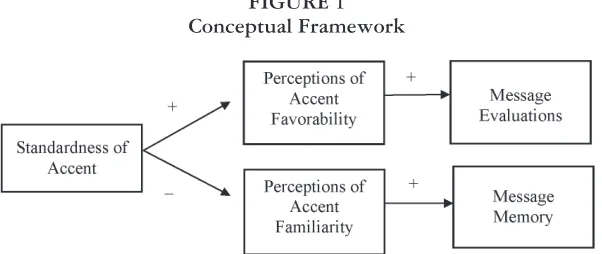
As outlined in our conceptual framework (see Figure 1), we propose that the extent to which a spokesperson’s accent is more or less standard influences both attitudes and memory. We hypothesize that as standardness increases, overall evaluations of the brand also increase. Standard accents are less familiar, more exclusive, and not widely used in everyday language. Receivers must direct their attentional and processing resources toward perceiving the standard accent, and devote fewer resources to the content itself. As a result, we also hypothesize that as standardness increases, memory for the advertised brand decreases.
This research makes several important contributions to advertising theory and practice. First, we demonstrate that evaluatory judgments can transfer directly from a spokesper-son accent to an advertised product. Second, we examine the trade-off between preference and message recall that arises when selecting a spokesperson accent. In our accent standard-ness framework, persuasion itself is only half the picture; recall also plays an important role that must be considered. No prior work has examined the role of accent standardness in persua-sion and the trade-off between preference and recall that occurs due to its underlying favorability and familiarity dimensions. Third, we demonstrate that spokesperson accent standardness
impacts product preference beyond country-of-origin/congru-ency effects, regardless of the message content or whether there is a congruent “fit” between the spokesperson and the product. Fourth, we examine the process by which accent standardness works and demonstrate that this may be nonconscious. Fifth, we test our theory using contemporary variables, such as star ratings, which are conceptually consistent with well-established measures but are also of importance to advertising researchers and practitioners.
favorability and Perceived Quality
The standard accent, by definition, is connected historically to the highest levels of socioeconomic status. The imposed norm hypothesis argues that standard accents are perceived as more favorable relative to nonstandard accents due to social and cultural norms (Giles et al. 1974; Preston and Long 2002; Wells 1982). People find standard accents more aesthetically pleasing and their positive properties are emphasized across cultures. For example, American consumers tend to prefer British accents over nonstandard American dialects based on centuries of historical norms.
Sociolinguistic research shows that speakers with standard English accents are seen as having high social status and as being competent, smart, educated, and formal (Giles 1995; Lambert 1967; Preston 2004; Seggie, Fulmizi, and Stewart 1982). Standard accents and their speakers are perceived as more competent and sophisticated (Giles et al. 1995). We propose that the overarching prestige afforded standard-accented spokespersons leads consumers to evaluate products more favorably and to perceive them as being of higher quality when a standard-accented spokesperson presents the message. We formally hypothesize:
Hypothesis 1: Products advertised by standard-accented spokes-persons are perceived more favorably than products advertised by nonstandard-accented spokespersons.
Congruity and Country-of-Origin Effects
product like French cheese such as Camembert or Roquefort may be more persuasive if speaking with a French accent. The audience is not expected to understand the literal meaning of the words, but merely to recognize that they are French—a sign that highlights “Frenchness.” Congruency at this gestalt level appears to affect preferences. Americans prefer to hear BBC broadcasts with a British accent (versus an American accent) when the BBC is broadcasting in America ( Jones 2003).
Although literature on country-of-origin effects and social categorization suggests that accents should lead to favorable results when there is congruency between product attributes and specific stereotypes triggered by the accents, we propose that congruency is not always necessary for a favorable impres-sion. Consumers’ responses to and evaluations of the product represented by the spokesperson’s accent can be independent of their responses to the message content. In fact, the favorability of the sound itself, such as a standard accent (e.g., BRP) being preferred to a nonstandard accent (e.g., SAE), may be more important for the perceiver than the content of the message or the congruency of the spokesperson and focal offering. This is due to the way accents are processed. Individuals distinguish the gross phonetic, phonological, phontactic, and prosodic variations between accents through a phoneme categorization process similar to that which allows us to distinguish one per-son’s voice from another (Floccia et al. 2006). This means that accents are processed as part of pronunciation, which is separate from the processing of meaning, syntax, or the grammatical and lexical composition of the utterances (Howell, Barry, and Vinson 2006; Hughes and Trudgill 1996; Wells 1982). Because individuals are concerned with how messages sound, having a more standard accent may exert more influence on a persuasion attempt than whether the word “lift” or “elevator” is used or the accent is congruent with the product it represents. This presents a key distinction between the standardness and the country-of-origin theoretical frameworks. The standard-ness framework predicts a favorable overarching response to a product when the spokesperson’s accent is relatively more stan-dard (versus nonstanstan-dard) regardless of whether the attributes of the product are consistent or inconsistent with the accent. However, country-of-origin effects predict a more favorable
response to a product only when the spokesperson’s accent and the product offering are congruent (versus incongruent), regardless of accent standardness.
Memory
Although people are favorably biased toward standard ac-cents and these acac-cents guide “correct” usage, most people do not frequently encounter standard accents in their daily lives because they are not widely spoken. For example, only 3% to 5% of the population of Great Britain speaks BRP (Trudgill and Hannah 1982). In contrast, predominantly nonstandard accents are widely spoken. The most widely recognized non-standard American English dialect is SAE (Preston 1996), spoken by an estimated 110 million individuals (Hazen and Fluharty 2004).
Consistent with research that finds novel stimuli capture more attention (Berlyne 1971; Johnston et al. 1990), we propose that standard accents, which are relatively unfamiliar and more novel, demand more attention and resources from consumers to process, thereby lowering comprehension and memory compared with nonstandard accents, which are rela-tively familiar and common. Indeed, prior work shows that the processing of a relatively unfamiliar (albeit prestigious) accent can negatively influence memory. In situations representative of how advertising messages are processed, a “voice effect” occurs, such that a more familiar accent is more effectively retained over time (Bottriell and Johnson 1985). Gill argues that speakers with native accents are perceived more favorably and experience increased recall compared with speakers with nonnative accents “because more resources are required to understand the accent of an accented person, less effort can be directed at processing what is being said . . . suggesting that they [listener hearing the unfamiliar accent] may have used up their cognitive resources before the recall task was completed” (1994, p. 357). This particular study only examined similar versus dissimilar accents, ignoring the standardness (i.e., favorability and familiarity) of the specific accents studied. In contrast, we propose differences in preference and memory depending on the degree of standardness of the accent.
Floccia et al. (2006) implemented a more nuanced ex-amination of accents, focusing on regional rather than foreign accents in order to study the impact of accent familiarity on processing speed and comprehension. They found that native French speakers demonstrated faster reaction times and increased accuracy in word identification tasks when the speaker used a local, regional French accent instead of the standard Parisian accent used by the media or an unfamiliar French accent. This research focused only on processing speed and comprehension of words in real time; it suggests a rela-tionship between accent familiarity and information recalled from memory. Keller (1993) corroborates such a link between familiarity and memory: increased brand familiarity, defined as the number of product-related experiences a consumer has through various venues, results in greater brand recognition and recall ability.
We argue that the imposed norm hypothesis triggers a process that results in an overarching favorable association with standard (versus nonstandard) accents. At the same time, standard accents are not widely used and are relatively unfa-miliar. This lower degree of accent familiarity then influences consumers’ ability to process information, such that unfamiliar accents initially hinder comprehension and have a negative impact on memory. Stated formally:
Hypothesis 2: Memory will be lower for messages presented by more-standard spokesperson accents than less-standard spokes-person accents.
By examining the construct of accent standardness, we are able to account for both the favorability and familiarity of an accent, thereby providing a more comprehensive theory of how spokesperson accents influence persuasion appeals. Specifically, we predict that consumers will prefer products associated with standard accents, but their recall for these products will be lower. Four experiments test these hypotheses and demonstrate the impact of spokesperson accents on preferences versus memory for advertised products.
STUDY 1
Study 1 (n = 64) assessed the target population’s perceptions of a standard and nonstandard accent. All research was conducted at a large Southwestern university in the United States on a target population of undergraduates who participated in ex-change for course credit. All subsequent studies were run at the same university. We operationalized the standard accent to be a BRP accent and the nonstandard accent to be an SAE accent. We selected a BRP as it is rated very high on the standard– nonstandard continuum among English speakers around the world (Giles and Powesland 1975; Kachru 1981; Milroy and Milroy 1999; Skinner 1990). SAE is the most widely spoken and representative nonstandard accent in the United States (Preston
1996). Although the stimuli are an international accent and a regional U.S. accent, neither stimulus was considered a local ac-cent for the tested population, and both British and Southerners would be considered out-groups for the study participants. This allowed us to establish accent standardness differences without any stereotyping or attitude formation based on in-group/out-group differences. Participants listened to a 45-second radio ad for a restaurant delivered by a native speaker with either a BRP or SAE accent. After hearing the ad, participants responded to familiarity and liking measures about the accent.
To measure liking, we asked, “How much did you like the accent in this radio ad?” (1 = “did not like at all” and 5 = “liked a lot”). Participants liked the British accent (M = 3.30) more than the Southern accent, M = 2.62; F(1, 62) = 6.03, p < .05. To measure familiarity, we asked, “How often have you heard someone talk with the accent in this radio ad?” (1 = “never” and 5 = “all the time”). Participants were more familiar with the nonstandard Southern accent (M = 3.25) than the standard British accent, M = 2.70; F(1, 62) = 4.02, p < .05. Study 1 established that consumers perceived the standard accent more favorably than the nonstandard accent. Participants were more familiar with the nonstandard Southern accent compared with the standard British accent, which we predict influences memory (H2).
STUDY 2
Study 2 tests H1 by demonstrating that a product represented by a spokesperson with a standard accent is preferred to a prod-uct advertised by a spokesperson with a nonstandard accent. H2 is tested by demonstrating that a product represented by a spokesperson with a standard accent is less likely to be recalled than one with a nonstandard accent. To increase the generaliz-ability of this research, we use two products: hotels varying on competence and sophistication. This allows us to rule out the possibility that a product/accent fit due to a congruency or country-of-origin effect is driving our observed results. Fi-nally, Study 2 introduces a star-rating system as a dependent variable. Star ratings are a contemporary and pervasive tool for consumer reporting and decision making (Galante 2010; Schoenfeld 2010); there is also a direct relationship between online consumer reviews and business performance, which makes the star-rating variable of particular interest to adver-tising managers (Ye, Law, and Gu 2009).
Method
Design
sixty-two participants from a large, Southwestern university were randomly assigned to one of the four experimental conditions in which they listened to and evaluated a radio advertisement for a hotel. The accent-standardness factor was manipulated by using a spokesperson with either a BRP accent or an SAE accent. Each recording was of professional quality and was cre-ated in a recording studio by a native-language actor.
Congruency Manipulation
Study 2 tests whether consumers have an overarching prefer-ence for the more standard accent along the standard–non-standard accent continuum. An alternate hypothesis would be that the accent does not produce an overall preference; instead, the observed effect may work on a more specific, attribute level. If individuals desire a product that is consistent with the characteristics evoked by a particular accent (e.g., those pertaining to sophistication and status), then the resultant attribute congruency would drive higher evaluations similar to those found in country-of-origin research (LeClerc, Schmitt, and Dubé 1994) rather than an overall accent preference. To rule out this alternate hypothesis, we manipulate congruency in Study 2.
Accent standardness comprises two distinct elements: the competence component relating to correctness, education, and formality and a sophistication component, relating to high socioeconomic status. These dovetail with two of Aaker’s (1997) five dimensions of brand personality: competence and sophistication. The competence element reflects Aaker’s (1997) underlying competence traits of reliable, intelligent, and successful; standard-language speakers tend to rate higher on intelligence and education level (Callan and Gallois 1987; Edwards 1982; Eltis 1980; Giles et al. 1995; Preston 2004). The sophistication element reflects Aaker’s (1997) underlying sophistication traits of upper class and charming; standard-language speakers generally come from higher socioeconomic strata and are attributed more prestige-related associations than nonstandard speakers (Giles et al. 1995). Standard and nonstandard accents thereby evoke different perceptions of competence and sophistication. By crossing these accents with hotels that differ on these two dimensions, we created advertisements in which the product–accent standardness link is either congruent or incongruent.
Using two hotel types, a business hotel and a B&B, we cre-ated high and low conditions of sophistication and competence. For example, the business hotel was described as a first-class hotel in the heart of the city’s financial district with various business amenities, including Internet access and voicemail. The descriptor “first-class” aligned with the personality dimen-sion of sophistication, and the business orientation aligned with competence. The B&B was described as being located along the waterfront on the outskirts of the city and touted
activities such as fishing and hiking, thereby evoking a less-sophisticated experience. We therefore expected that the busi-ness hotel would be perceived as relatively more sophisticated and competent than the B&B.
We ran a separate study with 40 undergraduates to pre-test whether the general product category “hotels” was more congruent with a Southern or British accent. We asked participants to think about hotels in general (including all types of hotels) and to rate the extent to which they associate them more with either a Southern accent or a British accent, using the following rating scale: 1 = “only Southern accent,” 2 = “slightly more Southern accent,” 3 = “neutral/about the same,” 4 = “slightly more British,” 5 = “only British accent.” When compared to the test value = 3, participants did not perceive the product category of hotel to be more associated with one accent over the other, M = 3.13; t(39) = .82, p > .4. We also evaluated the extent to which our descriptions of the business hotel and the B&B hotel were perceived as competent and sophisticated. The order in which participants read the hotel types and descriptions was randomized. We measured competence as (competent, intelligent, reliable, and success-ful) and sophistication as (sophisticated, upper class, and charming). Each item was measured on a five-point scale, and we created an index of competence (business α = .76, B&B α = .81) and sophistication (business α = .71, B&B α = .78), respectively. Relative to the B&B description, the business hotel description was rated as more competent, MBU = 4.31 versus MBB = 3.21; t(39) = 8.00, p < .001, and sophisticated, MBU = 3.57 versus MBB = 3.20; t(39) = 2.05, p < .05.
If a congruency effect is predominantly driving the favorable product evaluations, then we would expect a significant inter-action between accent standardness and hotel type such that the congruent hotels—a British business hotel and a Southern B&B—should be the more preferred hotels. If it is instead an overall preference for standard accents as we predicted in H1, however, no such interaction should emerge.
Procedure
Participants listened to a 45-second radio ad for the hotel, delivered by a British or Southern speaker describing either a business or a B&B hotel. After hearing the ad, participants evaluated the hotel on overall perception as well as the indi-vidual attributes of sophistication and competence as manipu-lation checks. Finally, as a measure of brand recall, participants were asked to recall the name of the hotel (the “Court Plaza Hotel” in all conditions).
Dependent Variables
results reported below also held for each individual measure. To measure hotel atmosphere, we asked, “In general, how would you describe the atmosphere of this hotel?” where 1 = “extremely casual” and 5 = “extremely fancy.” For star ratings, we asked, “If you were a hotel critic, how many stars would you give the hotel based on what you heard in the ad? (the more stars, the better the hotel)” on a five-star scale. Star-rating scales are used extensively on the Internet on sites such as Amazon.com, Expedia.com, and Urbanspoon.com to rate the quality of a variety of goods and services (Schoenfeld 2010). The five-star rating system in particular is used by consumers of the two largest travel Web sites—Expedia.com and Priceline .com (Galante 2010)—and Trip Advisor boasts over 35 million traveler reviews of over 1 million businesses using a star-rating system (tripadvisor.com). To measure the extent to which the accents and the hotels aligned with brand personality traits, participants rated how well different traits described the hotel using five-point scales, where 1 = “not at all descriptive” and 5 = “extremely descriptive” for sophistication and competence (Aaker 1997).1 We measured memory for the advertised brand
through unaided recall of the hotel’s name by asking, “What was the name of the hotel in the advertisement?”
Results
Manipulation Checks
Analyses of variance (ANOVAs) on the personality traits of competence and sophistication revealed that participants rated hotels advertised using a standard British accent as more competent (MBR = 3.60 versus MSO = 3.10, p < .001) and so-phisticated, MBR = 3.83 versus MSO = 3.14, F(1, 259) = 27.30, p < .001, than hotels advertised using a nonstandard Southern accent. Also, business hotels were rated as more competent (MBU = 3.53 versus MBB = 3.18, p < .01) and sophisticated, MBU = 3.66 versus MBB = 3.32, F(1, 259) = 5.22, p < .05, relative to B&Bs.
Brand Evaluation
Supporting H1, an accent by hotel type ANOVA on overall evaluation showed an accent type main effect; a nonstandard, Southern accent hotel (M = 3.31) was rated less favorably than a standard, British accent hotel, M = 3.73; F(1, 259) = 21.80, p < .001. We found no support for an accent-congruency effect, as neither the hotel type main effect nor the accent × hotel type interaction were significant.
Brand Recall
As predicted by H2, the results indicate higher recall for the hotel name when the nonstandard Southern accent was used;
specifically, 26% of participants in the Southern accent con-dition correctly recalled the name of the hotel, whereas only 11% of participants in the standard British accent condition recalled the name of the hotel (Wald χ2 = 8.98, p < .005).
Using hotel name recall as the dependent variable, the main effect for hotel type and the hotel type by accent interaction were not significant.
Discussion
As accents become more standard, they are perceived as more sophisticated, more competent, and more favorable overall. In Study 2, business hotels were better aligned with standard accents and B&B hotels with nonstandard accents. However, these alignments did not lead to stereotyping/congruency effects, as we observed no interaction between hotel type and accent standardness for hotel evaluations. Instead, consistent with H1, the standard accent provided a halo effect, such that the product advertised with a British accent received an evalu-atory boost regardless of whether a personality–trait match occurred. In contrast, hotel name recall decreased significantly as standardness increased.
We presented the instructions in an unframed manner so that participants could draw their own conclusions about the source of information in the ad. Prior work shows that listen-ers naturally make associations about the focal products and brands in an ad based on the standardness of the spokesperson’s accent. Our research is the first to provide evidence that not only do the semantic associations of a spokesperson transfer to the product/brand, but consumers also generate associa-tions based on unstressed spokesperson characteristics, such as accent. Study 3 will test how influential accents can be, even when they are not merely unstressed, but when listeners actively discount the accent.
Focus on the accent, whether intentional or unintentional, does not come without a cost. Processing the less common ac-cent makes the actual message content harder to understand; memory for the target brand was severely diminished in the standard accent condition. Study 2 demonstrates a trade-off between positive attitudes and likelihood of recall when using accents. Standard accents lead to more favorable immediate evaluations, but memory for message content is significantly lower for standard-accented messages relative to nonstandard-accented messages.
STUDY 3
provides diagnostic information. Using a manipulation of source awareness adapted from Yorkston and Menon (2004), we select an accented, on-air DJ as the nondiagnostic accent source and examine the extent to which individuals transfer their attitudes about an accent to the focal offering when the accent comes from this nondiagnostic source. Study 3 is a 2 (accent standard-ness) × 2 (accent diagnosticity) between-subjects design.
Method
Procedure
We randomly assigned to the four conditions 347 participants from the same target population but with no prior study overlap. Participants listened to and evaluated a 45-second radio advertisement for a hotel. As in Study 2, we manipulated accent standardness by using a native-speaking spokesperson with either a British accent or a Southern accent. The accent diagnosticity factor was manipulated by varying the instruc-tions read to participants (and concurrently provided to them in writing).
In the nondiagnostic accent condition, participants were told:
Without visual imagery to rely on, the accent of the spokesper-son often provides the stage and scenery for an advertisement. However, when an ad is read by an on-air announcer or DJ, the voice of the spokesperson isn’t really part of the message and shouldn’t be relied upon to tell us anything about the prod-uct. We’d like your opinion on the following advertisement that was recently read by the on-air radio DJ on a station in [England/the South].
In the diagnostic accent condition, participants received the following instructions:
We know we are often influenced by the accent used by the spokesperson in a radio advertisement. For example, Paul Hogan, an Australian actor and comedian, is the spokesperson for the Subaru Outback. According to the president of Subaru’s advertising agency, using an Australian accent rather than an American accent better fits the brand’s image and makes the ads more persuasive. We’d like your opinion on the fol-lowing radio advertisement that recently ran in [England/ the South].2
Dependent Variables
After participants listened to the instructions and hotel ad-vertisement, they rated the hotel overall and its atmosphere, using the same two variables as in Study 2 (r = .79). All results below are reported using a liking index of these two variables for a more concise explication; results were significant for each individual measure.
Results
A 2 (standardness) × 2 (diagnosticity) ANOVA using the liking index as the dependent variable produced a standard-ness main effect, F(1, 342) = 37.99, p < .001, a diagnosticity main effect, F(1, 342) = 8.04, p < .005, and a standardness by diagnosticity interaction, F(1, 342) = 4.63, p < .05. Con-sistent with prior studies, the standard accents (M = 3.55) are preferred to nonstandard accents (M = 3.09). Diagnosticity plays a more complex role. Planned contrasts reveal that in nonstandard conditions, discounting accents results in a higher liking rating (M = 3.27) than when accents are treated as relevant information, M = 2.90, F(1, 154) = 11.54, p < .001. This suggests that participants are consciously “punishing” products represented by relevant, nonstandard accents. In standard accent conditions, however, accent diagnosticity has no effect on favorability (M = 3.57 versus M = 3.52; n.s. [not significant]). Even nondiagnosticity does not appear to dampen the halo effect of standard accents.
Discussion
Within the nonstandard conditions, participants evaluated products more favorably when they discounted the accent than when they used the accent as diagnostic information. Yet when presented with the standard accent, the accent caused a halo effect wherein the product was always viewed favorably. This is consistent with the overarching positive influence of the imposed norm hypothesis associated with the more broadly standardized British accent (Giles et al. 1974; Preston and Long 2002; Wells 1982) and suggests that consumers effort-lessly or unintentionally perceive standard accents more favor-ably. This favorability extends to the advertised product. To examine how participants perceived a message depending on the relevance of the source of the accented sender, we varied the source of the accent between that of a product spokesper-son and an on-air DJ. As the DJ is not chosen by the product manager, the DJ’s accent does not represent a strategic choice and should not influence perceptions of the product. Thus, Study 3 demonstrated that individuals transfer their attitudes about an accent to the product even when the accent comes from an unintentional source. Note that varying the DJ accent required a change in ad location across conditions within the copy, which further generalizes the results relative to Study 2, where we control for ad location.
impact that accent standardness can have on evaluations by examining whether standard accents influence evaluations even when information more diagnostic than the accent is present. By changing the perceived strength of specific argu-ments in the message, we are able to examine the underlying process more closely to see whether standard accents can make individual arguments more persuasive, thereby changing the persuasiveness of the entire message.
STUDY 4
In Study 4, we introduce a new factor, message content strength, with strong and weak arguments, and examine the extent to which it influences persuasion and recall. Our accent standardness framework predicts that listeners will have an overarching favorable impression of messages from a more standard accented spokesperson, regardless of argument strength. In addition to brand recall being a central goal of an advertisement, the recall of key messages about the product is also important; Study 4 examines the extent to which specific messages are recalled when accent and message strength are varied.
Method
Procedure
Study 4 is a 2 (accent standardness) × 2 (argument strength) between-subjects design using 73 participants from the same population as prior studies. To focus attention explicitly on the persuasiveness of the advertising message, participants listened to a public service announcement (PSA) regarding a potential new university exam policy. Accent standardness was manipulated by creating studio-recorded PSAs employing native British- and Southern-accented actors. The 2-minute, 15-second PSA explained the reasoning behind a proposed new university policy that would require all seniors to pass a comprehensive examination before graduating. The argument strength factor was manipulated by including six weak or six strong arguments to support the adoption of this policy. The messages were adapted from and used a subset of the same arguments as previous persuasion research (Petty and Cacioppo 1979; Petty, Harkins, and Williams 1980). One weak reason was: “Since the comprehensive exam has been introduced at a leading university, student anxiety has increased by 31%, while at comparable schools without the exam, student anxiety increased by only 5% during the same period. It is likely that this increase in anxiety and fear of failure causes students to work harder.” The corresponding strong reason was: “Since the comprehensive exam has been introduced at a leading univer-sity, student GPAs have increased by 31%, while at comparable schools without the exam, student grades increased by only
5% during the same period. It is likely that the increase in GPA is due to students working harder and faculty teaching more effectively.”
Dependent Variables
After listening to the PSA, participants rated their overall attitude toward the policy (“Overall, how would you rate the comprehensive exam policy?” –4 = unfavorable to +4 = favor-able). Finally, participants were given an open, unaided recall task to recall all of the arguments for the policy (“In the space provided, list ALL the reasons you heard described for why your university should institute a comprehensive exam policy”).
Results
Message Persuasiveness
A 2 (argument strength) × 2 (standardness) ANOVA on par-ticipants’ overall attitude toward the comprehensive exam indicated main effects of argument strength, F(1, 69) = 29.01, p < .001, and standardness, F(1, 69) = 5.52, p < .05; their interaction was not significant, F(1, 69) = 2.15, p > .14. As one would expect, participants are swayed more by stronger arguments; overall attitudes are more favorable when the arguments are strong (M = .81) versus weak (M = –2.45). Consistent with H1, accent once again plays a role in message persuasiveness even when diagnostic arguments are presented. Regardless of argument strength, the PSA in the standard ac-cent (M = –.11) is evaluated more favorably than the PSA in the nonstandard accent (M = –1.53).
Message Recall
Supporting H2 and consistent with Study 2, participants recall a higher number of arguments from the nonstandard-accented spokesperson (M = 4.33) than from the standard-accented spokesperson, M = 3.46, F(1, 69) = 7.39, p < .01. The main effect of argument strength and its interaction with accent were not significant (F < 1).
Discussion
Study 4 tested the process through which the standard accent influences evaluations and recall by using a well established comprehensive exam manipulation from the persuasion litera-ture (Petty and Cacioppo 1979; Petty, Harkins, and Williams 1980). Consistent with Studies 2 and 3, we found higher evaluations of the focal offering but lower levels of memory for specific arguments when the message was presented with a standard accent compared with a nonstandard accent.3
evalu-ations of products and attitudes toward a proposed policy, standard accents hindered recall of key information such as brand names or specific arguments. Although the nonstandard accent made it harder to understand the words overall (as evident by the lower recall rates), these results suggest that if people ultimately understand the words being spoken, they are able to identify whether the argument is strong versus weak. Thus, we still see a difference in strong versus weak arguments for the British accents (and for Southern accents), but the recall for British messages is worse for both strong and weak argu-ments. Even though all arguments benefit from being spoken in a British accent by being evaluated more positively overall (the halo effect), strong arguments are still given more weight than weak arguments if the words are understood.
In Study 2, with the hotel named “Court Plaza,” participants had higher evaluations of the hotel in the standard-accented condition, but lower recall for the specific name of the hotel. It is possible that the low familiarity with nonstandard accents might make recall particularly poor for less familiar words such as brand names that are nonsense words or made-up names. This is a key issue when it comes to advertising and marketing brands. In other words, although consumers may be more persuaded by the standard accent, they are unable to remember the arguments that actually persuaded them in the first place.
GENERAL DISCUSSION
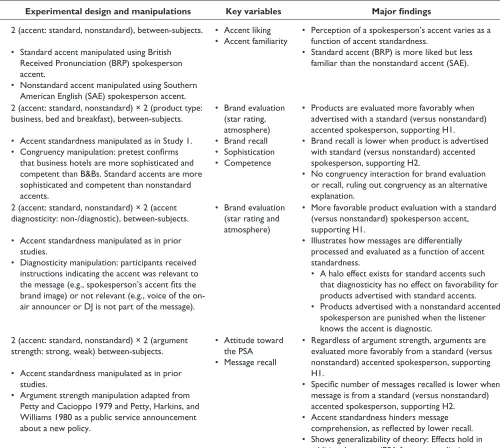
This research examined the effect of spokesperson accents on (1) perceptions of the advertising message, and (2) memory for important details about the message, such as the brand name or specific message arguments. Across four studies, we found that consumers demonstrate an overall preference for standard accents, which results in more favorable evaluations for products advertised by a standard-accented spokesperson. Taken together, these studies support our conceptual frame-work by showing that accent standardness influences both evaluation and recall of the advertised product, service, or idea (summarized in Table 1). Compared with nonstandard accents, standard accents are perceived as more favorable but lead to lower levels of recall. We demonstrate that accents varying in standardness influence consumers when the accent and product are in/congruent, non/diagnostic, and the argu-ment is weak or strong.
We show that a more standard accent (e.g., British Received Pronunciation) leads to more favorable evaluations toward the spokesperson’s accent and lower levels of familiarity with the accent compared with a less standard accent (e.g., Southern American English) (Study 1). We also find that products are evaluated more favorably when advertised with a standard- (ver-sus nonstandard-) accented spokesperson, but that brand recall is lower when a product is advertised with a standard- (versus
nonstandard-) accented spokesperson (Study 2). Furthermore, we show that consumers are influenced by accents even when the accent provides incongruent information (Study 2). When an accent is consciously discounted as nondiagnostic, messages are differentially processed and evaluated as a function of accent standardness (Study 3). Specifically, a halo effect exists for stan-dard accents, such that diagnosticity has no effect on favorability for products advertised with standard accents; however, products advertised with a nonstandard-accented spokesperson are pun-ished when the listener knows the accent is diagnostic (Study 3). Accent standardness also hinders message comprehension, re-gardless of whether the message arguments are weak or strong, as reflected by lower recall (Study 4). Consumers consistently remember less specific information from the standard-accented messages. Thus, there is a trade-off between increasing brand preference by using a standard accent or improving memory by using a more familiar, nonstandard accent. When choosing a spokesperson accent, managers must determine which criteria are more important: evaluation or memory.
Managerial Implications
Choosing the accent of the speaker is not as simple as matching the speaker to the target audience and foreign accents do not always detract from marketing efforts. As companies compete in a multicultural world with increasingly diverse workforces, a company’s management, employees, and spokespeople will speak in a broad range of accents. Choosing appropriate accents in vocalized marketing communications is one of many deci-sions managers must make. The positive evaluation of standard accents across countries and cultures provides a useful global tool for firms with multinational campaigns and international product Web sites.
Our research suggests that accent standardization can even override potential country-of-origin effects. For example, in 2000, Jacques Nasser, the Australian-accented then-CEO of Ford Motor Corporation spoke on television to reassure drivers of Ford Explorers’ quality in the wake of a spate of rollovers. The current spokesperson literature would suggest that con-sumers might perceive this message to be “untrustworthy”; the country-of-origin literature suggests that the incongruency between an Australian accent and an American car would lead to less favorable impressions. Our research suggests, however, that the degree to which a positive accent effect would prevail depends on the extent to which American consumers perceived Nasser’s cultivated Australian English accent to be closer to the standard end of the standard–nonstandard accent continuum; in other words, there would be an accent halo effect if the Cultivated Australian Accent was perceived to be consistent with standard British English.
Table 1
Summary of Designs, Manipulations, Key Variables, and Major Findings by Study
Study experimental design and manipulations Key variables Major findings
1 2 (accent: standard, nonstandard), between-subjects.
• Standard accent manipulated using British Received Pronunciation (BRP) spokesperson accent.
• Nonstandard accent manipulated using Southern American English (SAE) spokesperson accent.
• Accent liking
• Accent familiarity • Perception of a spokesperson’s accent varies as a function of accent standardness. • Standard accent (BRP) is more liked but less
familiar than the nonstandard accent (SAE).
2 2 (accent: standard, nonstandard) × 2 (product type: business, bed and breakfast), between-subjects.
• Accent standardness manipulated as in Study 1. • Congruency manipulation: pretest confirms
that business hotels are more sophisticated and competent than B&Bs. Standard accents are more sophisticated and competent than nonstandard accents.
• Brand evaluation (star rating, atmosphere) • Brand recall • Sophistication • Competence
• Products are evaluated more favorably when advertised with a standard (versus nonstandard) accented spokesperson, supporting H1.
• Brand recall is lower when product is advertised with standard (versus nonstandard) accented spokesperson, supporting H2.
• No congruency interaction for brand evaluation or recall, ruling out congruency as an alternative explanation.
3 2 (accent: standard, nonstandard) × 2 (accent diagnosticity: non-/diagnostic), between-subjects.
• Accent standardness manipulated as in prior studies.
• Diagnosticity manipulation: participants received instructions indicating the accent was relevant to the message (e.g., spokesperson’s accent fits the brand image) or not relevant (e.g., voice of the on-air announcer or DJ is not part of the message).
• Brand evaluation (star rating and atmosphere)
• More favorable product evaluation with a standard (versus nonstandard) spokesperson accent, supporting H1.
• Illustrates how messages are differentially processed and evaluated as a function of accent standardness.
• A halo effect exists for standard accents such that diagnosticity has no effect on favorability for products advertised with standard accents. • Products advertised with a nonstandard accented
spokesperson are punished when the listener knows the accent is diagnostic.
4 2 (accent: standard, nonstandard) × 2 (argument strength: strong, weak) between-subjects.
• Accent standardness manipulated as in prior studies.
• Argument strength manipulation adapted from Petty and Cacioppo 1979 and Petty, Harkins, and Williams 1980 as a public service announcement about a new policy.
• Attitude toward the PSA • Message recall
• Regardless of argument strength, arguments are evaluated more favorably from a standard (versus nonstandard) accented spokesperson, supporting H1.
• Specific number of messages recalled is lower when message is from a standard (versus nonstandard) accented spokesperson, supporting H2.
• Accent standardness hinders message comprehension, as reflected by lower recall. • Shows generalizability of theory: Effects hold in
additional context (PSA for a new policy). Note: PSA = public service announcement.
accents. Our findings suggest that standard accents may be effective for more immediate choices or for situations that rely on context instead of high levels of memory. For example, a standard British accent may be a better choice for a point-of-purchase display with a voice feature; in this case, the standard British accent may increase the favorable impression of the product and generate an immediate selection of the product. Accent choice is also important in product design; standard British accents may be particularly effective for products with text-to-speech functionality where the consumer’s response to the voice is immediate and there is little need for recall, such as
In an advertising context, the use of animated spokespeople in ads or Web sites makes it possible to choose the degree of accent standardness for the focal spokesperson with minimal effort (Heiser, Sierra, and Torres 2008).
In sum, we believe that the current paper’s contribution lies in providing a new way to look at the role spokesperson accents play in advertising and marketing communications. We have provided a new construct, accent standardness, which allows managers, a priori, to make predictions regarding how a spokesperson’s accent will affect both product evaluations and product recall. Our findings are grounded in current sociolinguistic theories and provide further evidence of the power of accents, accounting for both favorability and famil-iarity through standardness. We demonstrate an important trade-off that managers need to realize when making strate-gic decisions involving accents: evaluations and memory are negatively correlated.
Limitations and future Research
The knowledge gained through the current research provides a fruitful platform for future research. One limitation of this research is that participants were all from North America. Due to widespread media influences (Lwin and Wee 2000), it is likely the brand personality associations and preferences of standard British and nonstandard Southern accents would also apply in other contexts. However, these effects may be different among British or Southern listeners who make an in-group/out-group distinction. Future research could also explore the extent to which native listeners make more fine-grained distinctions of localized accents or whether they even detect an overly familiar native accent. Future research could also explore these effects outside North America.
We tested accent standardness on a population of students at a single university in a particular geographic region. Although this research has indicated that accent standardness is geo-graphically independent of the listener and operates through nationally held stereotypes and norms, managers may want to check local accent stereotypes and attitudes before using these findings in a specific region. For example, if a particular non-standard accent is perceived as more favorable than a non-standard accent in a specific region, these results would not hold (e.g., negative stereotypes of a New Jersey accent may not be held by people native to New Jersey). Furthermore, building on social identity theory research, an individual’s level of social identity with an ethnic group may influence the extent to which a relatively more standard accent is valued and accepted (Sierra, Hyman, and Torres 2009).
An examination of our conceptual model using struc-tural equation modeling may also provide further insights regarding the constructs comprising standardness, particu-larly correctness and prestige, and how consumers react to
accents that vary in standardness. There may be boundary conditions on the more standard end of the continuum in which favorable perceptions of standard accents diminish when they are perceived as arrogant or even more valid and legitimate. For instance, if Simon Cowell on American Idol spoke with a Southern accent rather than a British accent, perhaps his critiques would be discounted and appear less diagnostic. Future research could examine how to manage the balance between standardness and concepts such as perceived arrogance and exclusivity.
Although individuals respond favorably to messages sent by a spokesperson with a more standard accent, the additional processing required by the receiver hinders recall; such mes-sages may require additional support to make them effective. Future research could explore tools such as repetition or mul-tisensory messaging that may help enhance recall of standard accent messages. Finding ways to increase recall, this could eliminate the need for practitioners to make a trade-off between favorability and recall, potentially leading to higher levels on both outcomes.
NOTES
1. In a separate pretest on the same subject population (us-ing different individuals who had not participated in other studies), we asked participants to indicate how well each of the 15 traits of Aaker’s (1997) five brand personality dimensions described a person speaking with a standard (British) accent versus a nonstandard (Southern) accent on a five-point scale (1 = not at all descriptive and 5 = extremely descriptive). The results indicated that people with standard (British) accents were perceived as more competent, MBR = 3.64 versus MSO = 3.27,
F(1, 126) = 10.12, p < .005, sophisticated, MBR = 3.19 versus
MSO = 2.88, F(1, 126) = 6.54, p < .05, and exciting, MBR = 3.85 versus MSO = 2.70, F(1, 126) = 103.82, p < .001; people with nonstandard (Southern) accents were perceived as more sincere,
MSO = 3.70 versus MBR = 2.59, F(1, 126) = 110.72, p < .001, and rugged, MSO = 3.79 versus MBR = 3.13, F(1, 126) = 27.43,
p < .001. We then performed a factor analysis on the 15 traits
and found that they loaded onto the five brand personality dimensions. Our factor analysis indicated that the dimensions could be measured sufficiently using the following eight-item scale: sincerity (down-to-earth, honest, wholesome), excitement (daring, up-to-date), competence (intelligent), sophistication (sophisticated), and ruggedness (outdoorsy).
relevant” to “extremely relevant” and “ignore accent completely” to “pay a lot of attention to accent,” respectively. The spokesperson accent (M = 3.56) was found to be significantly more relevant than the DJ accent, M = 2.86; F(1, 45) = 4.50, p < .05. Just as important, there was no significant difference in intentions to ignore/pay attention to the accent across conditions (Ms = 3.32 and 3.40, p > .8). The results of our manipulation check and the prior work by Yorkston and Menon (2004) support our assertion that diagnosticity was manipulated; participants did not ignore accent in either condition, but rather discounted it based on the instructions.
3. It is important to note that we collected interest and in-volvement as covariates in all studies. These were measured on seven-point scales anchored on “not at all interested/involved” to “extremely interested/involved” (adopted from Raghubir and Menon 2005). All studies were seen as similarly interesting to the participants (MStudy2 = 2.69, MStudy3 = 2.67, MStudy4 = 2.58, SDs 1.04, 1.01, 1.06, and all ps > .1). In addition, the involvement in Study 4 (M = 3.20, SD = 1.07) was not significantly different than involvement in Study 2 (M = 3.22, SD = 1.04, p = .85). However, Study 4 was less involving than Study 3 (M = 3.43,
SD = 1.00, ps = .03 and .04, respectively). As Studies 2 and 3
have similar involvement (and all three studies have similar inter-est), we do not believe that involvement is driving our observed effects in Study 3. More important, involvement and interest do not differ across conditions within any of the studies. The systematic differences we thereby observe across cells cannot be explained by involvement.
REfERENCES
Aaker, Jennifer L. (1997), “Dimension of Brand Personality,”
Journal of Marketing Research, 34 (August), 347–356.
Berlyne, Daniel E. (1971), “Novelty and Attention: Controls for Retinal Adaptation and for Stimulus-Response Specificity,”
Psychonomic Science, 25 (6), 349–351.
Bottriell, Wendy J., and F. N. Johnson (1985), “Effect of a Speaker’s Accent on the Listener’s Memory for Verbal Ma-terial,” IRCS Medical Science: Psychology and Psychiatry, 13 (11/12), 1048.
Callan, Victor J., and Cynthia Gallois (1987), “Anglo-Australians’ and Immigrants’ Attitudes Toward Language and Accent: A Review of Experimental and Survey Research,” International
Migration Review, 21 (1), 48–69.
Chattopadhyay, Amitava, Darren W. Dahl, Robin J. B. Ritchie, and Kimary N. Shahin (2003), “Hearing Voices: The Impact of Announcer Speech Characteristics on Consumer Response to Broadcast Advertising,” Journal of Consumer Psychology, 13 (3), 198–204.
DeShields, Oscar W., and Gilberto de los Santos (2000), “Sales-person’s Accent as a Globalization Issue,” Thunderbird
International Business Review, 42 (1), 29–46.
———, Oscar W., Gilberto de los Santos, Olivia Aguire Beru-men, and Celia Cristina Orozco Torres (1997), “Salesperson’s Accent and Gender, and Consumer Purchase Intentions,”
Journal of International Consumer Marketing, 9 (3), 7–24.
Dixon, John A., and Berenice Mahoney (2004), “The Effect of Ac-cent Evaluation of Evidence on Suspect’s Perceived Guilt and Criminality,” Journal of Social Psychology, 144 (1), 63–73. Dyer, Gillian (1982), Advertising as Communication, London:
Methuen.
Edwards, John R. (1982), “Language Attitudes and Their Im-plications Among English Speakers,” in Attitudes Towards
Language Variation, Ellen Bouchard and Howard Giles, eds.,
London: Edward Arnold, 20–33.
Eltis, Ken J. (1980), “Pupil’s Speech-Style and Teacher Evalua-tion: Implications from Some Australian Data,” English in
Australia, 51 (March), 27–35.
Erdogan, B. Zafer, and Tanya Drollinger (2008), “Endorsement Practice: How Agencies Select Spokespeople,” Journal of
Advertising Research, 48 (4), 573–582.
Floccia, Caroline, Jeremy Goslin, Frederique Girard, and Gabri-elle Konopczynski (2006), “Does a Regional Accent Perturb Speech Processing?” Journal of Experimental Psychology:
Hu-man Perception and PerforHu-mance, 32 (5), 1276–1293.
Galante, Joseph (2010), “Priceline.com Soars After Profit, Forecast Top Estimates,” Bloomberg Business Week (August 4), available at www.bloomberg.com/news/2010-08-04/priceline-com-soars-most-in-a-year-after-profit-forecast-top-estimates .html (accessed December 19, 2011).
Giles, Howard, and Nikolas Coupland (1991), Language: Contexts
and Consequences, Belmont, CA: Wadsworth.
———, and Peter F. Powesland (1975), Speech Style and Social
Evaluation, London: Academic Press.
———, Richard Y. Bourhis, Peter Trudgill, and Alan Lewis (1974), “The Imposed Norm Hypothesis: A Validation,”
Quarterly Journal of Speech, 60 (4), 405–410.
———, Angie Williams, Diane M. Mackie, and Francine Ros-selli (1995), “Reactions to Anglo- and Hispanic-American Accented Speakers: Affect, Identity, Persuasion, and the English-Only Controversy,” Language and Communication, 15 (2), 107–120.
Gill, Mary M. (1994), “Accent and Stereotypes: Their Effect on Perceptions of Teacher and Lecture Comprehension,” Journal
of Applied Communication Research, 22 (4), 346–361.
Hazen, Kirk, and Ellen Fluharty (2004), Linguistic Diversity in
the South: Changing Codes, Practices and Ideology, Athens:
University of Georgia Press.
Heiser, Robert S., Jeremy J. Sierra, and Ivonne M. Torres (2008), “Creativity via Cartoon Spokespeople in Print Ads,” Journal
of Advertising, 37 (4), 75–84.
Howell, Peter, William Barry, and David Vinson (2006), “Strength of British English Accents in Altered Listening Conditions,” Perception and Psychophysics, 68 (1), 139–153. Hughes, Arthur, and Peter Trudgill (1996), English Accents and
Dialects: An Introduction to Social and Regional Varieties of English in the British Isles, 3rd ed., London: Arnold.
Johnston, William A., Kevin J. Hawley, Steven H. Plewe, John M. Elliott, and M. Jann DeWitt (1990), “Attention Capture by Novel Stimuli,” Journal of Experimental Psychology: General, 119 (4), 397–411.
Jones, Alex (2003), “The BBC’s War of Independence,” Financial
Kachru, Braj B. (1981), “American English and Other Englishes,” in Language in the USA, Charles A. Ferguson and Shirley B. Heath, ed., London: Cambridge University Press.
Keller, Kevin Lane (1993), “Conceptualizing, Measuring, and Managing Customer-Based Brand Equity,” Journal of
Market-ing, 57 (1), 1–22.
Lalwani, Ashok K., May Lwin, and Kuah Leng Li (2005), “Con-sumer Responses to English Accent Variations in Advertis-ing,” Journal of Global Marketing, 18 (3/4), 143–165. Lambert, Wallace E. (1967), “The Social Psychology of
Bilingual-ism,” Journal of Social Issues, 23 (2), 91–109.
LeClerc, France, Bernd H. Schmitt, and Laurette Dubé (1994), “Foreign Branding and Its Effects on Product Perceptions and Attitudes,” Journal of Marketing Research, 31 (May), 263–270.
Lwin, May O., and Chow-Hou Wee (2000), “The Influence of Spokesperson’s Race in Relation to Accents Used in Televi-sion Commercials,” Journal of Current Issues and Research in
Advertising, 22 (1), 67–83.
Milroy, James, and Lesley Milroy (1999), Authority in Language:
In-vestigating Standard English, 3rd ed., Routledge: New York.
Moore, Danny L., Douglas Hausknecht, and Kanchana Thamodaran (1986), “Time Compression, Response Opportunity, and Per-suasion,” Journal of Consumer Research, 13 (1), 85–99. Niedzielski, Nancy A., and Dennis R. Preston (2000), Folk
Lin-guistics, Berlin: Mouton de Gruyter.
Petty, Richard E., and John T. Cacioppo (1979), “Issue Involve-ment Can Increase or Decrease Persuasion by Enhancing Message-Relevant Cognitive Responses,” Journal of Personality
and Social Psychology, 37 (10), 1915–1926.
———, Stephen G. Harkins, and Kipling D. Williams (1980), “The Effects of Group Diffusion of Cognitive Effort on Atti-tudes: An Information-Processing View,” Journal of Personality
and Social Psychology, 38 (1), 81–92.
Preston, Dennis R. (1996), “Where the Worst English is Spoken,” in Focus on the USA, Edgar Schneider, ed., Amsterdam: Ben-jamins, 297–360.
——— (2004), “Three Kinds of Socio-Linguistics: A Psycho-linguistic Perspective,” in SocioPsycho-linguistic Variation, Carmen Fought, ed., New York: Oxford University Press.
Preston, Dennis R., and Daniel Long (2002), Handbook of Perceptual
Dialectology, Philadelphia: John Benjamins.
Raghubir, Priya, and Geeta Menon (2005), “When and Why Is Ease of Retrieval Informative?” Memory and Cognition, 33 (5), 821–832.
Schoenfeld, Bruce (2010), “In an Age When Everyone’s a Critic— and Hotels Thrive or Fail by Online Chatter—How Are New Review Sites Planning to Top TripAdvisor?” Travel
and Leisure ( June), available at www.travelandleisure.com/
articles/the-latest-hotel-ratings-websites/ (accessed Decem-ber 19, 2011).
Seggie, Ian, Carmel Fulmizi, and Judy Stewart (1982), “Evalu-ations of Personality Traits and Employment Suitability Based on Various Australian Accents,” Australian Journal
of Psychology, 34 (3), 345–357.
Sierra, Jeremy J., Michael R. Hyman, and Ivonne M. Torres (2009), “Using a Model’s Apparent Ethnicity to Influence Viewer Responses to Print Ads: A Social Identity Perspec-tive,” Journal of Current Issue and Research in Advertising, 31 (2), 41–66.
Skinner, Edith (1990), Speak with Distinction, Lilene Mansell, ed., New York: Applause Theatre.
Stafford, Marla R., Thomas F. Stafford, and Ellen Day (2002), “A Contingency Approach: The Effects of Spokesperson Type and Service Type on Service Advertising Perceptions,”
Journal of Advertising, 30 (2), 17–35.
Stewart, William A. (1972), “A Sociolinguistic Typology for Describing National Multilingualism,” in Readings in the
Sociology of Language, Joshua Fishman, ed., The Hague:
Mouton, 531–545.
Tajfel, Henri (1981), Human Groups and Social Categories, New York: Cambridge University Press.
Tripadvisor.com (2011), “Fact Sheet,” available at www.trip advisor.com/PressCenter-c4-Fact_Sheet.html (accessed December 19, 2011).
Trudgill, Peter, and Jean Hannah (1982), International English, London: Edward Arnold.
Wardhaugh, Ronald (2002), An Introduction to Sociolinguistics, 4th ed., Oxford: Blackwell.
Wells, John C. (1982), Accents of English, vol. 1, An Introduction, Cambridge: Cambridge University Press.
Ye, Qiang, Rob Law, and Bin Gu (2009), “The Impact of Online User Reviews on Hotel Room Sales,” International Journal of
Hospitality Management, 28 (1), 180–182.
Yorkston, Eric A., and Geeta Menon (2004), “A Sound Idea: Phonetic Effects of Brand Names on Consumer Judgments,”