Copyright © 2016 (Yves Gambier). Licensed under the Creative Commons Attribution Non-commercial No Derivatives (by-nc-nd). Available at http://ijoc.org.
Rapid and Radical Changes in Translation and Translation Studies
YVES GAMBIER
1University of Turku, Finland
The Free State University, Bloemfontein, South Africa
This article describes the changes in the field of translation by referring to practices such as localization, amateur translation, audiovisual translation, and news translation. The changes are enhanced by computing, information, and communication technologies. Therefore, two paradigms are evolving, and they justify, to some degree, the current multiplication of labels created for translation. On one hand, the paradigm of equivalence has been replaced by the paradigm of the cultural turn. And the shift exists concurrently with the change of the platforms and media through which all the activities of translation are carried out—from the printed book paradigm to the digital paradigm.
Keywords: audiovisual translation, cultural turn, digital paradigm, equivalence, information and communication technology, localization, translating news
Understood in its common sense, translation is an activity that has been eschewed for centuries— in terms of its need, the effort it requires, and its professional status. The experience is not uniform, however; languages and societies have neither borne the silence in the same way or to the same degree, nor at the same time. And although caution to generalize needs be exercised, in many historical traditions and time periods translation has more often than not seemed to serve the powers that be, ostensibly beholden to established authorities (both royal and religious), hidden away as if nonexistent and tucked in amid all kinds of routine exchanges—commercial, scientific, and philosophical, to name but a few (Delisle & Woodsworth, 1995/2012). Indeed, many sponsors, amateurs, self-translators (including scholars translating their own articles), and engineers within the language industry continue to consider translation as a mechanical process, a word-by-word substitution, a problem of dictionaries, or simply an activity that accrues no apparent prestige and which can be handed off at any moment to a bilingual relative or colleague.
Yves Gambier: [email protected] Date submitted: 2015–02–21
1 I would like to express my sincere gratitude to Debbie Folaron (Concordia University) for her
The popular assumption that a text to be translated is nothing more than a linear sequence of words or phrases no doubt explains why translation has long been considered as inferior, subordinate to the original. It testifies to the somewhat archaic perceptions of translation and translator by many who have inherited and continue to propagate common archetypes, perceiving language as static rather than dynamic, envisaging communication as a mere sequence of information packets rather than as interactions. Translators themselves have contributed to the eschewal of translation and to its abstention in professional circles over time. Often embodying and internalizing aspects of the subaltern in their work, they have been caught between the sacrificial idealism and calculating materialism of their activity, embracing the labor and servility of their always precarious vocation as if this practice required a certain predisposition toward docile self-effacement (Kalinowski, 2002; Simeoni, 1998). Metaphors of translation and images of the translator in the collective imagination are regularly reproduced in fiction, novels, films, and even in the media (Gambier, 2012). They verge on the stereotypical and on clichés, with the translator typically portrayed as a hardworking hermit and on the margins, as an impostor rather than a mediator.
In this article, I endeavor to put into perspective the most recent practices and research in translation. Two paradigms are evolving, and they justify, to some degree, the current multiplication of labels created for translation. On one hand, the more conventional conceptualization of translation that has endured for centuries through the paradigm of equivalence has evolved into one more oriented toward the public or audience—that is, the paradigm of the cultural turn. It exists concurrently with another changing paradigm, one that reflects the platforms and mediums through which the activity of translation is now carried out. In this sense, the paradigm of the book transforms into one of the digital and Web (where the text to translate becomes multimodal). This rapidly changing context can explain the proliferation of terms used to designate what was once translation.
Beyond a Mechanical View of Translation
resulted in different sectors using different labels for professional activities, many associations still rely on differentiating translation and translators through the foundational categories of literary and nonliterary (technical, commercial, medical, legal).
In what ways is the current clash of paradigms manifest? Often, the layperson will think of translation in the equivalence paradigm, or the quest to convey identical meanings. The implied aim is to achieve a text in the target language that is “of equal value” (Pym, 2009, p. 82), as if retranslation was never needed. Strong assumptions underlie such an approach of an implicit framework of the communication model, where a message is transferred from one language to another and the tropes of border and bridge work powerfully. It assumes, for instance, that two languages “do or can express the same values” (Pym, 2009, p. 82). But a word or concept may connote different meanings in another language or may be absent altogether, so the relationship between the two languages is not necessarily symmetrical. Two words may also refer to the same object, and this would not necessarily convey the intended meaning of the original text. Adequacy, fidelity, and loyalty to the source text may result in a text that is not easily comprehensible in the target language. The implicit assumptions of the equivalence paradigm usually compel people to criticize a translation because certain words have not been replaced. Thus, the famous set phrase: “Traduttore traditore.”
This focus on the lexical similarity of texts, however, is misguided. It does not allow one to consider, describe, and explain the translation decisions and the translated output. The distinction between what is manifest (literal, direct, surface level) and what is latent (implicit, connotative, underlying) misreads the process of translation and relegates the translator’s act of interpreting the content to a task of relative obscurity. Despite decades of academic and professional translation research, the traditional parameters configuring the equivalence paradigm persist. It has for a long time not only helped identify translation and its ethics of neutrality, but guided pedagogies. When scholars translate survey questionnaires, and journalists transfer news, when foreign businesses discuss contracts, and viewers watch subtitled TV programs, or when language teachers use back-translation, they all rely heavily on the equivalence paradigm—language differences are considered errors, distortions in meaning. This default paradigm most certainly has its historical reasons, deriving in part from the way foreign languages were traditionally taught (calling for a kind of automated correspondence) and in part from the printed media (an essentialist view on meaning transfer was easily framed within the paradigm of book; the same page could be reproduced and could be compared word-for-word in different languages. That was not possible with codex and is not possible with digital texts.) Viewed from this perspective, translators are nonexistent; they are passive agents, with no voice, no empathy, no subjectivity, no reflexivity, no interpreting skill, no intercultural awareness, and no qualifications.
cultural politics (Venuti, 2008), among others. Translation is thus viewed as a process of recontextualization, as a purposeful action. Translators consider and balance diverse factors during the translation process to achieve a communicative purpose, and their translations materialize as functionally adequate in the target culture. The entire decision-making process is bound to considerations that involve the client end receiver. Meaning is no longer considered a mere invariant in the source text but rather as culturally embedded, with a need to be interpreted. Translation becomes not just a lexical hurdle to overcome but the result of connections between text, context, and myriad agents. The word translation nowadays covers a broad spectrum of possible definitions.
As computer, information, and communication technologies gradually transformed the translation environment, the term localization made its way into popular use, creating some tension within the conventional purview of translation practice and research. “Going digital” for almost three decades now, translation processes and translators were jolted by the new work and social environments facilitated by technologies. Research in media and translation, meanwhile, had been carried out on a separate track. The year 1995—in conjunction with the 100-year anniversary of the cinema—saw a turning point for audiovisual translation (AVT), followed later by translation in newspapers and news agencies. We will now turn to consider the particular characteristics of these digital and media backdrops in relation to translation.
Translation and Localization
Localization has become a popular concept in both translation practice and theory. Four main historical phases (that now overlap) are generally designated: software, websites (Jiménez Crespo, 2013), mobile phones, and video games (O’Hagan & Mangiron, 2013)—including those that are digitally distributed. As desktop personal computers became more prevalent throughout the 1980s, and as software companies began to envision sales in countries and languages for which software programs were not originally conceived, the need arose to modify the functions and features of the applications in such a way that they would fulfill the requirements and demands of local consumers. At the same time that software engineers and programmers were coding content in their respective local languages around the world, the effective marketing and localization strategies and campaigns by multinational developers and the initial forays into initiatives that sought to harmonize protocols internationally—Unicode character encoding is one example—would eventually give way to increasing use of standard interfaces and terminology for office applications and Internet browsers worldwide. Indeed, the quest for a more seamless communication process by computer across diverse protocols, interfaces, and platforms in multiple languages was not confined to business transactions; it became a social experience as well.
digital framework for translation and localization. In a highly competitive market, software and hardware products with short shelf lives must be regularly and quickly updated and launched at the same time (known as simultaneous shipment, or simship) in myriad languages. Software programs designed to deal specifically with the new and diverse translation and localization environments have consistently improved, leading to the now common use of translation memory and terminology management systems, part of the suite of functionalities known as computer-assisted translation tools. Machine translation and postediting services now supplement these traditional ones (Folaron, 2012). Today, the localization industry is supported by professional organizations such as the Localisation Research Centre, the Centre for Next Generation Localisation, the annual Localization World conference, and the Globalization and Localization Association.
Localization refers not only to the professional procedure of adapting content linguistically, culturally, and technically; it also is used more loosely to refer to the entire industry that has emerged around localization. It is also highly context bound (Folaron, 2006). The acronym GILT (globalization internationalization localization translation) refers to the four correlated and interdependent activities that now comprise this industry. Although the order of the activities referred to in the acronym indicate the current sequence of processes that should ideally take place, the emergence of the terms historically is exactly the reverse. Overlapping practices, histories, and theorizations of the practices yield different readings in the translation studies domain.
Globalization in general, which has a long history of debate in various contexts (economic, political, social), acquires more specific meaning in the practice of professional localization. Penned G11N for short, globalization is synonymous with a certain mind-set that includes a series of corporate tasks. This lends support to Fry (2003), who noted early on that globalization is “the process of making all the necessary technical, financial, managerial, personnel, marketing and other enterprise decisions to facilitate localization” (p. 42).
Internationalization, abbreviated I18N in the professional domain, refers generally to two approaches, the first technical and the second linguistic/cultural. In terms of historical chronology, the widespread introduction of internationalization procedures grew out of a convergence between the knowledge gained from real localization project experience, evolving technologies, and the development of various protocols. It advocates separating the code from content and supporting international natural language character sets when the original digital content is first conceptualized so that there is less need for manipulation and engineering of the code later, when it is localized. Internationalization also includes use of controlled language.
workflows will vary substantially. In a nutshell, however, three areas are always addressed: linguistic, cultural, and technical. Content that was adapted linguistically and culturally before widespread use of computers, information, and communication technologies and digital devices was most commonly addressed in the literature as “adaptation.” Technical adaptation through technologies for use of the content in or with other technologies prompted the shift in terminology (i.e., to “localization”) in the translation domain.
Translation, the last component of the GILT acronym, can be viewed from two main perspectives in relation to localization. When analyzed from the perspective of professional workflow models, translation is a part of localization. When conceptualized from the perspective of translation history and the academic discipline, localization is a part of translation. There are various ways of analyzing, interpreting, and understanding translation in this context (see O’Hagan & Ashworth, 2002; Pym, 2004). If we assume that localization is about adapting a text so that it accounts for the local (i.e., target culture’s) linguistic and cultural norms and conventions, then the idea seems to be well established in both translation studies and practice (see Nida’s dynamic equivalence, 1964, p. 159; Nord’s instrumental translation, 1997, p. 52; House’s covert translation, 1997, ch. 2; or Venuti’s domestication, 1995, pp. 19-20) . Adding a new term (i.e., localization) would therefore seem unnecessary, except that we are clearly moving away from the traditional sense of translation within the equivalence paradigm.
As a last remark in this discussion of the characteristics of digital and media backdrops in relation to translation, according to some scholars, globalization (in the general sense) is believed to promote (cultural) homogeneity and impose sameness, whereas others tend to think of it more in terms of cultural heterogeneity (e.g., Appadurai, 1990). The two opposing approaches to globalization have been partially reconciled, at least to some extent, within the concept of glocalization introduced by Robertson (1994), a concept that has been a useful for considering traditional localization practices operating from top to bottom. On the one hand, we witness some homogenizing processes in the form of product globalization and internationalization that would seem to impose sameness; on the other hand, there are localizing processes in the form of product localization, whereby the products are adapted both linguistically (translation) and culturally so that they have the look and feel of a locally made product. However, no matter how local a given product looks, it will still retain a number of features of the original, global product (e.g., Microsoft’s Windows has some distinctive features across all its localized versions that make it easily recognizable irrespective of the language into which it has been localized). It could therefore be argued that such products are, in fact, glocalized.
Translation Going Digital
machine translation results. Equally important are the changing social relations. Experiences are shared thanks to discussion lists and forums, blogs, and social media and networking sites such as LinkedIn and YouTube.
From the use of microcomputers that exponentially facilitate data sharing and the creation of local networks, we have now moved to a kind of dematerialized computing (cloud computing) that lifts all the worries and burdens of management, maintenance, and reconfiguration of work tools from the translator’s shoulders. This rapid evolution is not inconsequential for the practice of translation, nor on the organization of its practice and surely not on its supply (Mossop, 2006; Perrino, 2009). Shared resources accessible in real time are now dynamic; costs are reduced; management is shortened; work is shared. Dematerialization favors simplification and productivity. On the other hand, it also creates a certain dependence on Internet connections and poses problems concerning security and confidentiality breaches.
The ongoing changes in translation practice in the digital world are not confined to professional translation and localization activities. Myriad types of users have emerged. One prominent example is the use of machine translation by general users everywhere. Programs available on the Web for free allow users to upload content and to obtain a gist, with no overriding concern for quality. Human intervention can be limited, even nonexistent. If users are bilingual or multilingual, they can now provide their feedback to the proposed results and attempt to improve the performance of the machine translation in their respective language pairs and directions.
A second kind of general user with more specific attributes includes those who have no professional training but who manage or are fluent in languages other than their mother tongue. They tend to associate for specific reasons, or rally around projects where they contribute their linguistic and cultural knowledge. They carry out such activities as fan translation, fan subbing, fan dubbing, and scan-trans on deliberately chosen mangas, animated films, and video games.
Finally, much collaborative translation work (as a team) continues to be carried out by a mix of professional working and professionally trained (but not necessarily working) translators. They share resources; can work on the same document or content from diverse locations; and share activities of translation, research, terminology management, revision, and proofreading. Dematerialized computer resources are available and at the common disposal of all. Translation jobs or projects may be bid on and qualifications and requirements posted (Proz and Translator’s Café are two examples). Volunteer networked translation can also be carried out by professionals (that is, those who have been trained for translation and/or have experience in translation)—for example, through networks such as Babel, Translators without Borders, and the Rosetta Foundation (Gambier, 2007). These activist translators work for a specific cause and respond to the needs expressed by nongovernmental organizations and other associations.
The schema provided above are helpful for designating the diverse translating groups that have emerged within a digital environment. For collaborative, volunteer-networked activist group and open-source community translation projects, professionally trained translators are also willing participants. Through the network, they share problems as well as tools and solutions, effectively putting an end to individualism or the romanticized translator image. Reconfigured by technologies, their socioprofessional enterprise materializes to meet the challenges of outsourcing, competition, job insecurity, online bidding, international requests for proposals, and so on. . For the general users and fan-based collectives, on the other hand, the link is primarily technological. Common interests link their efforts, and technologies enable them to carry out work on a site, a network, or a product. These online communities are limited in breadth and scope. Tying all these groups together, however, is a common thread of momentum that is shifted in the direction of the user-translator as actor, as the producer of content. The evolution of translation practice in the digital world is thus not only technical but economic and social.
How, and to what extent, might these new practices disqualify, or deprofessionalize, full-time translators who are trained and experienced? Productivity, accessibility, quality, and collaborative networking have all become more tightly intertwined. Some tools seem to resonate regressively, implying a return to the old concept of translation that is a word-based and a formal, mechanical, countable transfer. The line-by-line translations of European Union directives, produced with the constrained aid of translation memories, the practice of live subtitling, or the subtitles of fans, all tend to stick to the source and become verbatim, with no regard for such matters as the effects on reception and on reading. These changes in the conditions and pace of work can ultimately demotivate translators, who become dispossessed of all power, forced to always be online and beholden to the tool imposed by the client.
translators, and the translators’ concern for quality and precision could serve to assist media professionals increasingly being asked to sight translate to synthesize their texts more effectively. In both cases, acquiring skills is more important than gaining knowledge that is rapidly rendered obsolete, and where autonomous decision making and the ability to self-evaluate are essential. Finally, both professions are confronted with ICTs and all the transformations they imply within production workflows and in the distribution channels of information. As in journalism, the means and tools users have at their disposal today are making translation desirable and feasible.
The fears generated by ICTs and changing work conditions seem to be shared among journalists and translators alike. Both professions seem to be forced to question their very norms and ethics. Nonprofessionals and amateurs, who have long been disparaged by professional milieus, would seem to have their revenge. Often marginalized and caricaturized, amateurs are pushing the limits of certain professions and redefining their parameters and missions. Whether rebuffed under a form of (disguised?) liberalism or praised for animating certain practices, they reflect in part the profound mutations induced by the presence of ICTs. And yet a kind of mystification with regard to words such as community exists, as if all members were equally competent and strategic, with the same ability to interpret. The ideology of empowerment can lead one to believe that all amateurs are equally autonomous, reactive, thoughtful, and masters of their domains.
Audiovisual Translation
Before the current popular embrace of computers and ICTs in our digital world, audiovisual translation has been a fertile terrain for the discipline’s earliest research in translation and media. From the mid-1950s to today, the labels used for AVT have changed (film translation, language transfer, screen translation, translation for the media). Within the profession, versioning is sometimes preferred as a generic term that encompasses subtitling and dubbing, with translation being rejected for being too narrow (word-for-word).
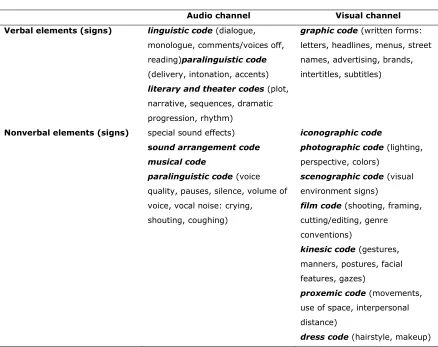
Table 1. Semiotic codes in AV products
Audio channel Visual channel Verbal elements (signs) linguistic code (dialogue,
monologue, comments/voices off, reading)paralinguistic code (delivery, intonation, accents) literary and theater codes (plot, narrative, sequences, dramatic progression, rhythm)
graphic code (written forms: letters, headlines, menus, street names, advertising, brands, intertitles, subtitles)
Nonverbal elements (signs) special sound effects) sound arrangement code musical code
paralinguistic code (voice quality, pauses, silence, volume of voice, vocal noise: crying,
shouting, coughing)
iconographic code
photographic code (lighting, perspective, colors)
scenographic code (visual environment signs)
film code (shooting, framing, cutting/editing, genre conventions)
kinesic code (gestures, manners, postures, facial features, gazes)
proxemic code (movements, use of space, interpersonal distance)
dress code (hairstyle, makeup)
The different types of audiovisual translation can be classified into two main categories (Gambier, 2013): intralingual and interlingual.
Intralingual translation refers to translation between codes (oral and written codes) within the same language. Four basic types of intralingual translation are:
in the United States, closed captions, as opposed to open captions (i.e., subtitles that cannot be turned off).
2. Live subtitling, sometimes called “respeaking.” Done in real time for live broadcasts (e.g., sporting events, TV news), it needs technical support, such as voice recognition software. The quality of the end product can be questionable, because there is little time, or resources, to proofread the output of the software before it is broadcast.
3. Audio description provides those who are blind and visually impaired access to films, art exhibits, museums, and opera and theater performances. It involves reading information to describe what is happening on-screen (action, body language, facial expressions, costumes, objects). The information is added to the sound track of the dialogue or to the dubbing of the dialogue for a foreign film.
4. Audio subtitling is useful for people who are dyslexic, elderly, partially sighted, or slow readers. A text-to-speech software reads the subtitles aloud. Interlingual translation refers to translation between languages and contains eight types of AVT:
1. Script/scenario translation is needed to obtain subsidies, grants, and other financial support for coproduction, or for searching for actors, technicians, and so on. 2. Interlingual subtitling involves moving from oral dialogue in one or several
languages to one or two written lines. The task is increasingly being carried out by a single person who translates, spots (or cues, time codes) and edits, thanks to ad hoc software.
3. Simultaneous or sight translation is generated from a script or another set of subtitles already available in a foreign language (pivot language). It is used during film festivals and in film archives (cinematheques).
4. Dubbing cannot be reduced to lip synchronization, but it may be time-synchronized or isochronic (when the length of the dubbed utterance matches the length of the original one). Not all viewers have the same degree of tolerance toward visual/lip dischrony and gesture and facial expression/voice dischrony.
5. Free commentary is clearly an adaptation for a new audience, with additions, omissions, clarifications, and comments. Synchronization is done with on-screen images rather than with a soundtrack. It is used for children’s programs, documentaries, and corporate videos.
7. Voice-over, or “half dubbing,” takes place when a documentary, an interview, or a film is translated and broadcast almost synchronously by a journalist or an actor who can half-dub several characters. The target voice is superimposed on the source voice, which is almost inaudible or incomprehensible.
8. Surtitling is a kind of subtitling placed above a theater or opera stage or in the backs of seats, and displayed nonstop throughout a performance. The surtitle file is not released automatically since actors and singers do not perform twice in the same way, at the same rate. Surtitling can also be provided for those who have hearing impairment.
To summarize: The various types of AVT do not translate in the same way, using the same codes. Some emphasize the oral dimension (dubbing, interpreting, voice-over, and free commentary); others switch from oral to written (interlingual, intralingual, live subtitling, and surtitling), from written to written (scenario translation), from pictures to oral (audio description), or from written to oral (sight translation, audio subtitling). Are some types more domesticating modes of translation than others? It is true that dubbing and free commentary allow the linguistic material to be manipulated, censored to conform to dominant expectations and preferences or to target-culture ideological drives and aesthetic norms. The history of AVT sheds light on how some AVT types are used as instruments of linguistic protectionism and language purism.
Digital technologies are changing AV production (script writing, production of sounds, pictures, and costumes as well as special effects, shooting, and editing), distribution, and projection. They have introduced new forms such as audio description, surtitling, live subtitling, and audio subtitling. New technologies and devices (video streaming, video and TV on demand, podcasting, mobile phones, and portable video) continue to redefine broadcasting and audiences. They create new demands and needs, such as new formats—for example, very short films lasting only a few minutes and “mobisodes,” a series for mobile phones lasting one or two minutes. Two quite different processes are at work. On one hand, technology offers a better and more versatile range of services and programs. The diversity of TV channels, through cable and satellites and via relay and networking (pay TV, transborder and local TV, and thematic TV channels on history, sports, finance, cartoons, etc.) marks the end of a centralized media model (mass media) from broadcasting to narrowcasting. On the other hand, the world audience is becoming increasingly global, with videos on YouTube and films on the Internet available for all.
subtitling. Fansubs, fandubs, and amateur subtitling use methods that challenge not only how we think about subtitling but the very process of AVT.
Finally, automation is changing the working process. Digitization can improve sound quality and allow analysis and resynthesis of an actor’s voice for dubbing. By combining software, it is also possible to automate the making of interlingual subtitles. These changes require revisiting certain concepts that are well established in translation studies. For example:
The concept of text: Screen texts are short-lived and multimodal. From the conventional text as a linear arrangement of sentences, or as sequence of verbal units to the hypertext on the Internet, the notion of text becomes ambiguous.
The concept of authorship: In literary studies and translation studies, the author is often perceived as a single individual. In AVT, a number of groups or institutions are an integral part of the authoring process (screenwriter, producer, director, actors, sound engineers, camera operators, editors, etc.).
The concept of sense/meaning: In AVT, sense/meaning is neither produced in a linear sequence nor within a single system of signs. Interaction transpires at multiple points: between the various agents involved in creating the AV product; between these agents and the viewers; between different AV productions (visual references, allusions).
The concept of a translation unit: The issues of text, authorship, and sense/meaning invite questions when considering the translation unit in AVT.
The concept and types of translation strategy: Strategy varies at the macro and micro levels, and with respect to the sociopolitical and cultural effects of AVT.
The links between translation norms and technical constraints. To what extent does technology imply certain new norms?
The relationships between written and oral (Gambier & Lautenbacher, 2010), between written norms, and between ordinary speech and dubbing are another relevant issue.
Even if interdisciplinarity increasingly characterizes AVT research today—with methods and concepts borrowed from literary studies, sociology, experimental psychology, film studies, reception studies, history, and didactics—the frameworks within which much AVT analysis continues to be conducted are predominantly linguistic, including pragmatics and discourse analysis (Gambier, 2008). More experimental studies are needed on viewer processing habits, reading strategies, and reception patterns. The ongoing fragmentation of audiences demand a better understanding of viewer needs and more adequate articulation of time-space correlation and mediation priorities for AV translators.
AVT and the localization of software, websites, mobile devices, and video games can be brought into fruitful dialogue. They have at least three features in common: Both types of translation are the results of teamwork; the work is on volatile and intermediate texts (production script, dialogue list, online documents in progress, rolling software versions, regularly updated Web and social media content) that overstep the traditional dichotomous boundaries between source and target and question the very notion of an original; and the criteria of quality include not only acceptability but comprehensibility, accessibility, and usability. All three features have implications for training.
Translation and the News
A relatively recent and growing area of research in translation studies is that of translation and the news. From news agencies to live editorial newsrooms, the news is continuously being filtered through languages; indeed, this seems to have been the case since the birth of journalism (Valdeón, 2012a). From local reporters to national and international news agencies (Associated Press, Reuters, Agence France-Presse), from special correspondents to different newspapers and TV channels, from bloggers to online editors, the information switches between oral and written forms, from regional languages to a lingua franca and again to national languages. Readers are rarely aware of any translation process, with or without ideological manipulation. The integration of foreign language sources in news reports, and intermedia agenda settings in the multilingual mediascape as well as the emergence of new values in linguistically and culturally diverse newsrooms are all potential areas of research. Scholars began to reflect on issues associated with translation in the news at a conference held at Warwick (United Kingdom) in 2006, one of a series of research seminars funded by the British Arts and Humanities Research Council as part of a three-year project (2004–2007) investigating the politics and economics of translation in global media (Bielsa & Bassnett, 2009; Conway & Bassnett, 2006).
time and space turnarounds, and obliged to follow in-house style preferences. In other words, they cannot help but rewrite, reframe, summarize, cut, clarify, reformulate the news: they “transedit” (Stetting, 1989) the foreign extracts and quotes embedded in news stories. In fact, the translational process in news discourse is rarely explicit, and the nature of translation as a process mediating between cultures is ignored. Journalists reject the term translation because they assume that translation implies equivalence, linguistic correspondence, fidelity to the source text, and no re-contextualization. However, in a special issue of Journalism dedicated to translation and the BBC (Baumann, Gillespie, & Sreberny, 2011), translation is understood as a linguistic transfer, even though the use and import of news is not limited to language-to-language transformations. In a previous issue, van Leeuwen (2006) discussed the rewriting in The Vietnam News. The title of his article is highly indicative of his hesitation: Translation is applied only to linguistic choices while adaptation is related to textual transformation practices with political, economic, and social implications (see also Raw, 2012). All these authors, working within Communication Studies, were unaware of the evolution of translation studies. Nevertheless, although the perception and representation of journalists remain grounded in a certain ideology of translation, their actions carried out match the concept of translation as defined today in translation studies. The transformations identified in news translation (e.g., restructuring the source text with a new focus, deleting and/or adding items, borrowing) are characteristic of translation more generally (Schäffner, 2012).
Studying and discussing the production and consumption of translation—mediated news across linguistic and cultural spaces needs the use of a clear and consensual terminology and careful methodology. This is also valid for broadcasted news (see Conway, 2011) and periodicals (Hernández Guerrero, 2009). Internationally distributed magazines such as Elle, Newsweek, Cosmopolitan, Scientific American, National Geographic, or Time are also examples of adaptation and localization, because both the linguistic and extralinguistic features of the products are modified so that they best appeal to the local readers of the magazines. Interestingly, transformations can happen when local information is globalized for a wider readership, when global news is localized (e.g., when official U.S. cables made available by WikiLeaks are distributed and explained to Spanish readers), or when local information is produced as a response to another local newspaper (e.g., the Greek slogans against some German campaigns in 2015 during the negotiation of the Greek debts with representatives of the Euro zone). In the latter case, allusions, clichés, and national stereotypes can become contentious issues for the translators (van Doorslaer, 2012; van Doorslaer, Flynn, & Leerssen, in press). Basic translation studies questions remain always: Who selects the information to be translated? What are the translation strategies? Who revises, accepts, and legitimizes or validates the final output? How does reception influence decision making? Selecting, translating, framing, and editing the news (reported events, leads, headlines, quotes) entails much more than carrying out a linguistic process; rather, it is “a complex mixture of power relationships (continental, national, linguistic, political and ideological)” (van Doorslaer, 2010, p. 180), where journalists are part of a larger social system (Bielsa, 2007; Schäffner & Bassnett, 2010; Valdéon, 2009, 2010a, 2010b, 2012b, 2014).
Mukherjee, 2004; Pedersen, 2014). The concept borders on adaptation and localization (the translation is done with a particular audience or local market in mind and makes use of technologies). Do different text types need different labels? Would software, mobile devices, and video games correlate more appropriately with localization, and marketing material, brochures, and advertising with transcreation, while websites straddle the two terms? In advertising, for example, transcreation seems to combine translation, creation, and copywriting: On the one hand, translators (or transcreators?) take an active and creative part in the communication process; on the other hand, they are involved with various semiotic resources, as in AVT—being responsible for the entire text (i.e., verbal text, layout, images, and animations) and moving meaning through intercultural communication in the global market. Thus, we can see a strong convergence between localization, adaptation, transediting, versioning, and transcreation. They all distance themselves in similar ways from the source text and from the field of translation (for too long limited to verbal texts and linguistic equivalence), conferring a more responsible and positive role to the translators. Although it is perhaps too early to dismiss all the labels as having no value in translation studies and to retain translation only, the paradigmatic changes are ostensibly in process.
Conclusion
The platforms, technical protocols, media, sociotechnical contexts, and digital world within which translation practices are currently organized reflect a conflation of the structured and structuring dynamics that motivate production and consumption of multimedia, multimodal content. The desire to translate, to communicate through translation, is enhanced by computing and ICT. The paradigm of equivalence, analytically viable for static texts and delimited territories, and as if the translation event was the fact of the only translator, is challenged by the dynamic and fluctuating content that passes fluidly from one production-consumption scenario to another, transformed into linguistic versions culturally amenable and relevant to users increasingly fluent in the language of technologies. The proliferation of terms designating the linguistic-cultural transformations for which the word translation would once have sufficed is indicative not only of a conceptual disruption but of the communication value being added to the nodes of a burgeoning global network.
References
Appadurai, A. (1990). Disjuncture and difference in the global cultural economy. In M. Featherston (Ed.), Global culture: Nationalism, globalization and modernity (pp. 295–310). London, UK: SAGE Publications.
Baumann, G., Gillespie, M., & Sreberny, A. (2011). Transcultural journalism and the politics of translation: Interrogating the BBC World Service. Journalism, 12(2), 135–142.
Bielsa, E. (2007). Translation in global news agencies. Target, 19(1), 135–155.
Conway, K. (2011). Everyone says no: Public service broadcasting and the failure of translation. Montreal, Canada: McGill-Queen’s University Press.
Conway, K., & Bassnett, S. (Eds.). (2006). Translation in global news: Proceedings of the conference held at the University of Warwick—23.6.2006. Coventry, UK: University of Warwick. Retrieved from http//www2.warwick.ac.uk/fac/arts/ctccs/research/tgn/
Davier, L. (2014). The paradoxical invisibility of translation in the highly multilingual context of news agencies. Global Media and Communication, 10(1), 53–72.
Delisle, J., & Woodsworth, J. (Eds.). (1995/2012). Translators through history. Amsterdam, The Netherlands: John Benjamins.
Dunne, K. (2006). Perspectives on Localization. Amsterdam, The Netherlands: John Benjamins.
Esselink, B. (2003, July–August). The evolution of localization. Localization: The guide from Multilingual Computing and Technology, no. 57 (Suppl.), 4–7.
Folaron, D. (2006). A discipline coming of age in the digital age. In K. Dunne (Ed.), Perspectives on localization (pp. 195–219). ATA Scholarly Monograph Series, Vol. 23. Amsterdam, The Netherlands: John Benjamins.
Folaron, D. (2012, September). Digitalizing translation. Translation Spaces, 1, 3–31.
Fry, D. (2003). The localization Industry Primer (2nd ed.). (Revised by Arle Lommel). Retrieved from www.dynamiclanguage.com/home14/wp-content/uploads/2014/07/LISA-Globalizaion-Primer.pdf
Gambier, Y. (1994, September). Multimédia et médiation: quel défis? [Multimedia and mediation: What are the challenges?]. Koiné, 4, 67–79.
Gambier, Y. (2007). Réseaux de traducteurs/interprètes bénévoles [Networks of volunteer translators and interpreters]. Meta, 52(4), 658–672.
Gambier, Y. (2008). Recent developments and challenges in audiovisual research. In C. Delia, H. Christina, & B. Chiara (Eds.), Between text and image: Updated research in screen translation (pp. 11–33). Amsterdam, The Netherlands: John Benjamins.
Gambier, Y. (2012). Le traducteur défiguré? [The disfigured translator?]. In E. Skibínska & N. Paprocka (Eds.), Figure(s) du traducteur [Translator’s figure(s)] (pp. 13–24). coll. Romanica
Wratislaviensia, Vol. 59. Wroclaw, Poland: PU.
Gambier, Y., & Lautenbacher, O.-P. (Eds.). (2010, July). Ecrit et oralité en traduction [Literacy and orality in translation]. Glottopol, 15. Retrieved from
http://www.univ-rouen.fr/dyalang/glottopol/numero15.html
Hernández Guerrero, M. J. (2009). Traducción y periodismo [Translation and journalism]. Bern, Germany: Peter Lang.
House, J. (1997). Translation Quality Assessment: A Model Revisited. Tübingen, Germany: Narr.
Jiménez Crespo, M. (2013). Translation and Web localization. Abingdon, UK: Routledge.
Kalinowski, I. (2002). La vocation au travail de traducteur [Vocation for translator’s work]. Actes de la Recherche en Sciences sociales, 144, 47–54.
Katan, D. (in press). Translation at the cross-roads: Intercultural mediation by others or ready for the transcreational turn? Perspectives.
Mossop, B. (2006). Has computerization changed translation? Meta, 51(4), 787–792.
Mukherjee, S. (2004). Translation as recovery. New Delhi, India: Pencraft International.
Nida, E. (1964). Toward a Science of Translation. Leiden, The Netherlands: E.J. Brill.
Nord, C. (1997). A functional typology of translations. In A. Trosborg (Ed.), Text Typology and Translation (pp.43-66). Amsterdam, The Netherlands: John Benjamins.
O’Hagan, M., & Ashworth, D. (2002). Translation-mediated communication in a digital world: Facing the challenges of globalization and localization. Clevedon, UK: Multilingual Matters.
O’Hagan, M., & Mangiron, C. (2013). Game localization. Amsterdam, The Netherlands: John Benjamins.
Pedersen, D. (2014). Exploring the concept of transcreation: Transcreation as “more than translation”? Cultus, 7, 57–71. Retrieved from http://cultusjournal.com/files/Archives/pedersen_5_p.pdf
Perrino, S. (2009). User-generated translation: The future of translation in a Web 2.0 environment. Journal of Translation, 12. Retrieved from http://www.jostrans.org/issue12/art_perrino.php
Pym, A. (2004). The moving text: Localization, translation, and distribution. Amsterdam, The Netherlands: John Benjamins.
Raw, L. (Ed.). (2012). Translation, adaptation and transformation. London, UK: Continuum.
Ray, R., & Kelly, N. (2010, March). Reaching new markets through transcreation: When translation just isn’t enough. Lowell, MA: Common Sense Advisory. Retrieved from
http://www.commonsenseadvisory.com/Portals/_default/Knowledgebase/ArticleImages/100331_ R_Transcreation_Preview.pdf
Reiss, K., & Vermeer, H. (2013). Towards a general theory of translational action: Skopos theory explained (C. Nord, Trans.). Manchester, UK: St Jerome. (Original work published in German 1984)
Robertson, R. (1994). Globalisation or glocalisation? Journal of International Communication, 1(1), 33–52.
Schäffner, C. (2012). Rethinking transediting. Meta, 57(4), 866–883.
Schäffner, C., & Bassnett, S. (Eds.). (2010). Political discourse, media and translation. Newcastle upon Tyne, UK: Cambridge Scholars.
Simeoni, D. (1998). The pivotal status of the translator’s habitus. Target, 10(1), 1–39.
Stetting, K. (1989). “Transediting”: A new term for coping with the grey area between editing and translating. In G. Caie, K. Haastrup, A. L. Jakobsen et al. (Eds.), Proceedings from the Fourth Nordic Conference for English Studies (pp. 371–382). Copenhagen, Denmark: University of Copenhagen.
Sun, S. (2014). Rethinking translation studies. Translation Spaces, 3, 167–191.
Toury, G. (1995/2012). Descriptive translation studies—and beyond (2nd ed.). Amsterdam, The Netherlands: John Benjamins.
Valdeón, R. (Ed.). (2009). Translating informative and persuasive texts. Perspectives, 17(2), 77–136.
Valdeón, R. (Ed.). (2010a). Translating information. Oviedo, Spain: Ediuno.
Valdeón, R. (Ed.). (2010b). Translating information in the post-industrial society. Across Languages and Cultures, 11(2). 149-284.
Valdeón, R. (2012a). From the Dutch corantos to convergence journalism: The role of translation in news production. Meta, 57(4), 850–865.
Valdeón, R. (2014). From adaptation to appropriation: Framing the world through news translation. Linguaculture, 1, 51–63.
van Doorslaer, L. (2010). Journalism and translation. In Y. Gambier & L. van Doorslaer (Eds.), Handbook of translation studies (Vol. 1, pp. 180–184). Amsterdam, The Netherlands: John Benjamins.
van Doorslaer, L. (2012). Translating, narrating, and constructing images in journalism, with a test case on representation in Flemish TV news. Meta, 57(4), 1046–1049.
van Doorslaer L., Flynn, P., & Leerssen, J. (Eds.). (in press). Interconnecting translation studies and imagology. Amsterdam, The Netherlands: John Benjamins.
van Leeuwen, T. (2006). Translation, adaptation, globalization: The Vietnam News. Journalism, 7(2), 217– 237.