Abstract:
Our research for this paper relates to the various uses and applications of lenses. We wanted to
illustrate the importance of lenses in our current society and the effect lenses have had in the
past as well. This paper describes the phenomenon of light refraction and how lenses utilize
light refraction to better the quality of human life. The applications we researched involving
lenses include eyewear (glasses and contacts), cameras, microscopes, and telescopes. Our
research paper provides an explanation of how each lens application is constructed, and the
evolution each application has endured directly influencing humanity in numerous ways.
Introduction:
Refraction is a characteristic of light that occurs when the direction of light changes.
This phenomenon happens when a ray of light travels as a wave from one medium to another
thus changing the velocity of the wave. Light travels with a velocity that is slowest through a
solid, faster through a liquid, and fastest through a gas (Ackay, 2005). If the light hits the
medium at an angle it will change direction because part of the wave hits the medium first
causing it to slow down. The rest of the wave bends around, because it is going faster, until the
whole wave is in the new medium. Lenses are an instrument we use to manipulate the
direction of light by altering the shape of glass into a curved structure.
There are two types of lenses; converging and diverging. A converging lens, or a convex
lens, refracts parallel light rays together at a single point known as a focal point (Ackay, 2005).
A diverging lens, or a concave lens, refracts parallel light rays in a way that spreads the light
bending of light which includes any form of eyewear (glasses and contacts), microscopes,
cameras, and telescopes. Each application of lenses has a rich history that will be discussed in
this research paper as well as their uses in today’s setting. Lenses are a significant aspect of our
society and their applications improve our quality and understanding of the world around us.
Glasses and Contacts:
The human eye contains a lens that contracts and expands in order to focus objects at
different distances. By changing the shape of a lens, light passes through at different angles
and changes the focal point of the lens. Unfortunately, this function of the eye does not always
work properly for certain people. Glasses and contacts are designed to address general blurring
due to a misshaped lens or cornea in the eye (Gupta, 2008). Near-sightedness and
far-sightedness can be corrected by designing a lens that corrects a person’s blurred vision.
Glasses are made up of two glass shaped lenses that are held together by a solid frame that rest
comfortably on one’s nose and ears. Contacts, however, are individual soft or hard lenses that
are placed into each eye seperately. Both glasses and contacts correct blurred vision by altering
the direction of light rays that enter the eye.
Glasses were an invention of the Middle Ages dating back to around 1200 A.D.
(Daxecker, 1999). The actual creator of glasses is unknown, but Salvino D'Armate is credited for
creating glasses that could be worn without assistance (Daxecker, 1999). Benjamin Franklin
would later create bifocals in 1784 that combined two lenses into one frame in order to focus
of glasses instead of switching between two types of eyewear to focus objects at various
distances. This invention would pave the way of creative eyewear over the next few centuries.
The history of contact lenses dates back to 1827 when Sir John Herschel presented a
scholarly discourse investigating the possibilities of individual lenses that could be placed in
each eye (Pearson, 1988). The quote below is a suggestion from Sir John Herschel’s discourse
that states:
“Should any very bad cases of irregular cornea be found, it is worth of consideration, whether
at least a temporary distinct vision could not be procured, by applying in contact with the
surface of the eye some transparent animal jelly contained in a spherical capsule of glass; or
whether an actual mold of the cornea might not be taken and impressed on some transparent
medium.” (Pearson, 1988).
The initial idea of a contact lens created by Sir John Herschel was tampered with for
over a century with different designs and constructs, none of which were affective or
comfortable to the eye. (Goodlaw, 2000). It was not until 1971 when the first soft contact
lenses were created that fit comfortable in the eye (Goodlaw, 2000). With the invention of soft
contact lenses that were comfortable to wear, people were able to utilize contact lenses and
replace glasses. Most contact lenses worn in today’s age are hydrophilic plastics called
hydorgels (Goodlaw, 2000). Hydrogels are able to absorb significant levels of water in order to
Contacts apply the same phenomenon as glasses by refracting light through a lens to
correct blurred vision. The difference between the two types of eyewear is the process in
which each type of eyewear is constructed and utilized by the individual. Both glasses and
contacts have improved vision for people who have a defective lens in their eye.
Cameras:
A camera is a device that can record a picture or image onto light sensitive film. A basic
pin-hole camera is a simple construction that uses a container where no light enters except
through a small hole called a “Pinhole.” There is light sensitive film placed on the opposite side
of the pin-hole that allows an image to be taken when a shutter is removed from the pin-hole
for an extended period of time. This allows light to enter the container and an inverted image
is formed on the film. The modern camera uses the same principles as a pin-hole camera, but
multiple lenses are used to magnify distant objects and focus close-up objects in order for the
camera to photograph images.
The article “Analysis of a varnish applied by Nicéphore Niépce to make a print used for
photographic purpose transparent,” discusses the invention of photography. The article states:
“Nicéphore Niépce carried out a lot of meticulous experiments that led him to the invention of
photography. In the 1820s, he obtained heliographs by coating a substrate with a light-sensitive
substance that was then exposed to light under a paper print made translucent with the help of
the coating while those portions shadowed by the lines of the print remained unhardened.
When dissolved in the lavender oil, the unhardened portions revealed the image.”
(Lattuati-Derieux, 2010).
With the creation of photo paper, cameras could now capture images onto light
sensitive film and develop pictures using various chemicals in a darkroom (Lattuati-Derieux,
2010). The single-lens reflex camera was patented in 1861 by Thomas Sutton although the idea
of incorporating a lens into a camera had been theorized decades before (Wicks, 2004). The
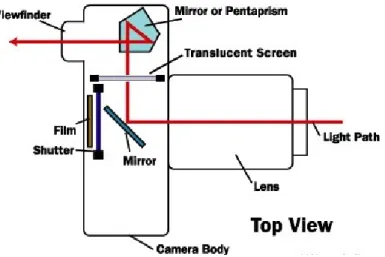
single-lens reflex camera is constructed of a mirror, lens, and pentaprism that reflects and
refracts light in order for the viewfinder to show the image being photographed through the
camera lens (Wicks, 2004). Before the invention of the single-lens reflex camera, the view
finder of the camera was an approximation of the image being photographed as opposed to the
actual image the camera film would be exposed to. Figure one below illustrates the path of
light traveling through a single-lens reflex camera.
Figure 1. The image viewed from the viewfinder is the image seen through the camera lens
Advancement of the single-lens reflex camera would lead to the invention of 135mm
film and the 35mm camera. This type of camera is still used today although digital cameras
have become extensively more popular within our culture. Cameras have captured historical
events for almost two centuries which has changed the way we view and analyze history. The
camera lens allows us to focus distance and close up objects in order to capture an image onto
light sensitive film.
Microscope:
There are several types of microscopes including: optical microscopes, electron
microscopes, and the scanning probe microscope. An optical microscope uses light through
lenses to allow a viewer to see objects too small to be seen by the naked eye. One can see the
object larger through the microscope because the lenses use refraction to bend the light as it
goes through each lens, causing the light to appear as if it came from a larger object
(Morrissette, 2009). The optical microscope was the first invented microscope and until
recently, it was the only microscope widely used. It is still commonly used because it is
inexpensive and easy to manufacture, but does not have the resolution or magnification power
of microscopes such as the electron microscope.
The first microscope was discovered by two Dutchmen in 1590. They were the first to
experiment putting two lenses together and found that the magnification of the object was
much larger than a single lens could produce. The lens was originally made out of glass, but was
1600’s which uses concave and convex lenses (Morrissette, 2009). During this time period,
there were many great discoveries including micro-organisms and red blood cells.
“Leeuwenhoek is credited with being the first to observe a number of protozoa, including both
free-living (Tetrahymena) and pathogenic (Giardia) organisms,”(Morrissette, 2009). After
Leeuwenhoek and Galileo, many more scientists throughout the 1700’s discovered one-celled
organisms. (Morrissette, 2009) Bacteria that caused sickness and disease was discovered and
better understood. “Toxoplasma was discovered by scientists in the early 20th century working
in the intellectual context of the studies of Robert Koch (1843–1910) and Louis Pasteur (1822–
1895),” (Morrissette, 2009). In the late 1800’s, August Köhler invented a method that allowed
light to be distributed evenly through an object. Leo Szilard designed the electron microscope,
but was unable to build one. Ernst Ruska and Maz Knoll were there first to construct one in
1931, and build another in 1933 that would have a better resolution than any optical
microscope (Shampo, 1997). The resolution is greater than an optical microscope because the
wavelength of an electron is about 100,000 times shorter than light. This wavelength allows us
to see about 10^3 times smaller resolution. This is very significant because the electron
microscope has a magnification of up to 10,000,000x where as an optical microscope is up to
2,000x (Shampo, 1997).
The electron microscope uses the same principles as the optical microscope but uses
electrons instead of light and electro magnets instead of lenses (Shampo, 1997). The resolution
from using electrons was significantly greater than using light from the optical microscope. The
scanning probe microscope is the most recent microscope to be invented (Shampo, 1997). This
can be seen on an atomic level. The electron and scanning probe microscope are very expensive
and are usually used by professionals.
The optical microscope is outdated and does not see much peer reviewed research
because it does not have the power to magnify as the newer microscopes. It is still used in
schools to allow students to view and understand basic concepts associated with microscopic
objects.
Telescopes:
Our current interpretation and understanding of the night sky is credited towards the
telescope. A refracting telescope utilizes two lenses; the objective lens and the eyepiece lens
(Swasey, 1932). The objective lens is located inside the telescope, and its main purpose is to
converge parallel light rays from distant objects. The eyepiece lens is used to magnify the
image created by the objective lens and sometimes inverts the image in order for an upright
image to be viewed. Two influential telescopes that have shaped astronomy greatly are the
Galilean and Keplerian telescopes.
Galileo Galilea was not the first to invent the telescope, but he did improve the design
and quality of the refracting telescope (Molesini, 1996). The Galilean Telescope uses a fixed
test target at a normal testing distance together with an adjustable lens system consisting of a
converging objective lens and a diverging lens eyepiece (Cheng, 2000). This telescope design
allowed for a magnified object to be viewed upright because of the diverging eyepiece. Due to
the shape and design of the Gailiean Telescope, the image viewed through the telescope was
enough for Galileo to view craters on the moon, Jupiter’s four main moons, and different
phases of Venus (Molesini, 1996).
Johannes Kepler improved the design of the Gailiean Telescope so images were more in
focus and less distorted. The main difference between the two telescopes is the type lens used
for the eyepiece. A Keplerian Telescope consists of a convex object lens and also a convex
eyepiece (Chenakal, 1975). The advantages of the Keplerian Telescope included a larger field of
view as well as a higher magnification of the image (Chenakal, 1975). With these
characteristics in place, the Keplerian Telescope could now be used for angular measurements
of distant bodies in space (Chenakal, 1975). Before Kepler, angular measurement could not
have been obtained using the Galilean Telescope. The one disadvantage the Keplerian
Telescope had compared to the Galilean Telescope was the orientation of the image. The
Keplerian Telescope created an image that was inverted as opposed to upright (Chenakal,
1975). The Keplerian Telescope would later be called the “Astronomical Telescope,” and would
replace the Galilean Telescope completely.
There are few refracting telescopes that are still being used today. Reflecting
telescopes, such as the Hubble Space Telescope, use parabolic mirrors to magnify objects
millions of light years away. These telescopes are more practical because of their ability to
correct spherical and chromatic aberration more effectively than refracting telescopes. The
most famous refracting telescope used today is located at the Yerkes Observatory at the
University of Chicago. The telescope at the Yerkes Observatory uses an objective lens that is 40
inches in diameter and is among the most powerful telescopes in the world (Feder, 2005).
refracting telescope, we do not comprehend how vast, large, beautiful, and strange our
universe is.
Conclusion:
Lenses have a rich history and their applications serve an extremely useful role in our
society. Without lenses, our perception of the current world would be altered in a dramatic
manner. Significant discoveries involving microscopic objects and extraterrestrial bodies would
not have been made without the telescope and microscope. The camera has captured images
of influential events and people over the past 150 years which has changed the way we analyze
and interpret history. The invention of eyewear allows people to see objects in focus as
opposed to seeing blurred objects constantly. Lenses utilize light refraction in order to improve
References
Akcay Hakan (2005). Lenses and Perception: Investigations with Light. Science
Activities, 41(1): 9-14
Chenakal V.L. (1975). Johannes Kepler's astronomical instruments. Vistas in Astronomy, 18:
819-824
Cheng Desmond, Woo George C (2000). The calibration of a 2.5× Galilean focusable telescope
as an optometer for refraction. Ophthalmic and Physiological Optics, 20(4): 342-347
Daxecker Franz (1999). Old news in ophthalmology. The Lancet, 354: SIV43
Dillon, J. J. (2009). Benjamin Franklin: A Wonder-Based Approach to Life and Learning.
Encounter, 22(4): 38-47
Feder, T. (2005). Historic Yerkes Observatory Is for Sale. Physics Today, 58(11): 26
Goodlaw Edward (2000). A personal perspective on the history of contact lenses. International
Gupta Yogesh, Gupta Meenakshi (2008). Optics, Refraction, Contact Lenses. Clinical and
Experimental Ophthalmology, 36: 341-349
Lattuati-Derieux Agnès, Echard Jean-Philippe, Thao-Heu Sylvie, Lavédrine Bertrand (2010).
Analysis of a varnish applied by Nicéphore Niépce to make a print used for
photographic purpose transparent. Journal of Cultural Heritage 11(4): 477-481
Molesini Giuseppe, Greco Vincenzo (1996). Galileo Galilei: Research and development of the
telescope. Trends in Optics: 423-438
Morrissette Naomi S, Ajioka James W (2009). The early years of Toxoplasma research: What’s
past is prologue. International Journal for Parasitology, 39(8): 865-869
Pearson Richardd M. (1988). The centenary of the contact lens. Journal of The British Contact
Lens Association, 11(2): 12-16
Shampo Marc A., Kyle Robert A. (1997). Ernst Ruska—Inventor of the Electron Microscope.
Mayo Clinic Proceedings, 72(2): 148
Swasey Ambrose (1932). Astronomers and their telescopes. Journal of the Franklin Institute,
214(3): 265-273