SHIFT FROM SITE DEVELOPMENT TO SKILL DEVELOPMENT: A CASE STUDY OF WATER HARVESTING THROUGH MICRO CATCHMENTS
Hassnain Shah*, Nadeem Akmal*, Waqas Farooq*, Muhammad Azeem Khan* and Shahid Munir**
ABSTRACT:- The present study was conducted to get insight about farmers' intention towards adoption of micro catchments as a useful tool for rainwater harvesting. The assessment of acceptability and compatibility of the intervention through farmers' perceptions, feed-back, practices and intentions regarding up-scaling the technology would develop the up-scaling and sustainability options for wider area. Under Watershed Rehabilitation and Irrigation Improvement Project besides other technologies, rainwater harvesting through micro catch-ments were demonstrated by Soil and Water Conservation Research Institute (SWCRI) in Pothwar area, Pakistan.The results highlight that the technology is not only suitable for in situ water conservation for fruit plants but also cost effective, water, labor and resource saving along with farmer friendly under rainfed condition with scare supplemental water availability. The cost of adoption of technology including labor charges for its preparation and maintenance was recovered from irrigation cost saved from single rainfall at the demonstration site. One of the important implications drawn in this regard was the need of a shift from site development to skill development. The same was derived as an important recommendation during assessment and evaluation of different demonstration and dissemination activities being conducted under Watershed Project. This shift could catalyze the technology adoption.
Key Words: Fruit Plants; On-farm Condition; Micro Catchment; Water Harvesting; Pakistan.
INTRODUCTION
The increasing population particularly in Asia has put a lot of pressure on the existing land resources to meet the food demands. Similarly the growing cities have also swallowed good agricultural lands available around them. With the increasing demand for non-agri-cultural uses along with little chances of expansion there is a need to exploit the potential available in
arid and semi-arid regions to minimize the land scarcity (Hudson, 1987). However, precipitation is generally lower than potential evaporation. It is mostly non-uniform in distribution that results in frequent drought periods during the crop growing season. Usually the rains come in intense bursts resulting in surface run-off and uncontrolled rill and gully erosion (Oweis and Hachum, 2009). There-fore, there is a need of a more efficient
* Social Sciences Research Institute, National Agricultural Research Centre, Islamabad, Pakistan. ** Soil and Water Conservation Research Institute (SAWCRI), Chakwal, Pakistan
capture and use of the scarce water resources in arid and semi-arid areas. An optimization of the rainfall management, through water har-vesting in sustainable and integrated production systems can contribute for improving the small-scale farmers' livelihood by upgrading the rainfed agriculture production (Ibraimo and Munguambe, 2007).Water shortage is the major constraint in any area, which could aggravate due to seasonal patterns, variation and irregularity in rainfall that may influence water supply and periodic droughts in the area (Lone and Hassan, 2002). The Pothwar plateau has undulating sloping topography causing loss of soil and water (Ullah et al., 2009) and about 4.2 billion cubic meter of water is lost from this plateau as surface runoff annually (Bhutta, 1999) which if properly utilized could help to improve the crop productivity and improve resilience in the area. Small water harvesting technologies and other water related technologies and inter-ventions have been useful in effective water use efficiency for improving livelihood in the area.
The concept of rain water harvesting is a process of collecting and concentrating precipitation from various forms of run-off for various beneficial uses (Oweis and Hachum, 2009; Critchley et al., 1991). The rainwater harvesting mechanism using different techniques covers a whole range of methods of collecting and concentrating various forms of run-off (Reij et al., 1988). It is a method of collecting surface runoff from a small catchment area and storing it in the root zone of an adjacent infiltration area (Cofie et al., 2004).
The present study was conducted to look at the short term effect and get insight about farmers' intention towards adoption of micro catch-ments as a useful tool for rainwater harvesting. The comparison of cost and benefits as realized from the on-farm demonstrations by the on-farmer- host- farmer would help to evaluate the economic viability of the techno-logy. The assessment of acceptability and compatibility of the intervention through farmers' perceptions, feed-back, practices and intentions regarding up-scaling the technology would further help to develop the up-scaling and sustainability options for wider areas.
MATERIALS AND METHOD
ideal methodology when a holistic, in-depth investigation is needed (Feagin et al., 1991).
Therefore, for current work case study methodology was employed. A case study is expected to capture the complexity of a single case, and the methodology which enables this has developed within the social sciences (Johansson, 2003). The case study is defined by interest in individual cases, not by the methods of inquiry (Robert, 1998). The case may be a relatively bounded object or a process; it may be theoretical, empirical, or both (Ragin and Becker, 1992). As in all research, consi-deration must be given to construct internal and external validity, and reliability (Yin, 1989). Several discussions were conducted with the host farmer related to the develop-ment of the process right from site selection, initial dialogue with the farmer, demonstration and technical interaction between farmer and the technology providers (scientists). This process was performed to increase reliability and validity. Therefore, to develop abdicative reasoning from a few facts and for making appropriate comparisons from the known cases and applying to an actual problem situation both “evidential paradigm” (Ginzburg, 1989) and naturalistic generalisation (Stake, 1995) were considered. The results and dis-cussion are based on the assessment, perception and memory recall, based on the experiences and practices of the farmer over the time of technology demonstration and adoption at the individual farm in real life situation. The actual costs paid/saved and benefits realized under farmer field conditions are used to generalize the results for similar conditions in the
overall recommendation domain of rainfed Pothwar. The scope of paper is limited to the socioeconomic aspects only. Therefore, the technical part regarding design, shape and measur-ements for water requirement or command area requirement etc., are not discussed.
RESULTS AND DISCUSSION
The selected farm is located in Tehsil Kallar Kahar, District Chakwal on old road from Kallar Kahar to Chakwal. It is about 75 acres sub-hilly and sloppy land. The farmer has started to establish it since 7 years. There was no proper farming or plan-tation except naturally grown plantation at this area. Arable farming was not possible due to undulating topography of the farm area. Therefore the farmer planted different kinds of fruit plants at the farm. At present, more than 11,000 different fruit plants of olive, citrus, apple, fig, beri and pomegranate are grown at this farm.
tanker was Rs. 900. The farmer who had his own tanker and tractor, still had to pay Rs. 175 per tanker to get water (fill the tank from water source) and cost of diesel was about Rs. 450 per tanker. On average water hauling cost was about Rs 5.80 per plant. From this point forward to irrigate plants electric or diesel pump was used to lift water for pipe irrigation. The labour cost was about 1 rupee per plant per irrigation. On an average after every two weeks one irrigation is done. So during the peak summer season application of water to all the plants was quite difficult.
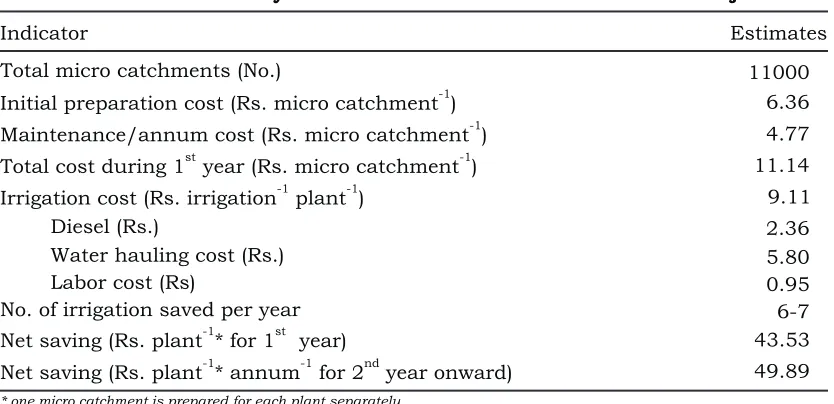
Watershed project team provided viable alternative solution and introduced the micro catchments technology in 2011 to conserve the rainwater for the fruit plants. The initial demonstration was done with 20 micro catchments. The project team besides developing demons-tration site also disseminated the information to farmers. Proper guidance about the design and layout of micro catchments was provided to the farmer during demonstration site development. The host farmer was invited to participate in professional and agricultural service providers training programmes under the project. This demonstration and interaction changed the mindset of the farmer and after first rainfall 2500 micro catchments were added during the first monsoon season of 2013. The conditions of plants also improved and subsequent irrigation within micro catchments was easy and useful for water utilization. Now nearly 11,000 micro catchments had been developed. The average cost of preparing one micro catchment resulted in Rs. 6.36 as one laborer could prepare 50 micro catchments
in on e d ay. T h e rep air an d maintenance (R&M) was required after every three months and costs about Rs.4.77 per catchment per year. Total initial investment was 70,000 at the farm and additional 52500 against repair and mainte-nance per year for 11,000 plants.
According to farmer experiences and perceptions during monsoon season there was very little difference in water saving before and after the situation. However, normally there are additional 6-7 rains, during the year in addition to monsoon season. Therefore, comparative analysis was done for this time period and number of rains. Minimum saving was equal to the cost of one irrigation whereas the higher intensity rains might save upto the cost of two irrigations. Farmer was paying about Rs 9.11
-1 -1
2003). In addition to direct benefits in terms of improved productivity and resource saving other indirect environment and conservational benefits are also reported in liter-ature.
The target farmer, as manager of the farm, is also working as agriculture service provider. The technical knowledge improved throu-gh interaction with the project team from SAWCRI has also targeted the skill development beside the site demonstration. Spillover effects are also reported as some other farmers are now replicating this technology at their own expenses including Jalil Farm.
CONCLUSION AND RECOMMENDATIONS
The systematic demonstration, follow up and engaging farmer in different training and dissemination activities not only helped to improve his knowledge, trust, skills and interaction but also made farmer a change agent for extension and promotion of technology. The shift in
focus from demonstration site deve-lopment to skill devedeve-lopment resulted in adoption and investment of resources by the farmer himself. The farmer has also started motivating other neighboring farmers having similar plantation and spillover effects are being observed in two years.
The results indicated that cost of input and initial investment along with the scale of business further catalyze investment in technology adoption subjected to systematic technology demonstration and dissemination strategy. It is there-fore, recommended that:
Site selection for demons-tration should fulfill this requirement.
Engagement of farmer and follow up to develop ownership based on skill development and imparting knowledge be targeted.
A paradigm shift from site development to skill develop-ment is required for sustain-able technology transfer.
Table 1. Cost benefit analysis of micro catchments at the Watershed Project site
* one micro catchment is prepared for each plant separately
Indicator Estimates
Total micro catchments (No.) 11000
-1
Initial preparation cost (Rs. micro catchment ) 6.36
Maintenance/annum cost (Rs. micro catchment )-1 4.77
st
Total cost during 1 year (Rs. micro catchment )-1 11.14
Irrigation cost (Rs. irrigation plant-1 -1) 9.11
Diesel (Rs.) 2.36
Water hauling cost (Rs.) 5.80
Labor cost (Rs) 0.95
No. of irrigation saved per year 6-7
Net saving (Rs. plant * for 1 year)-1 st 43.53
nd
The linkages developed by engaging farmer in different dissemination activities would help to sustain such activities in a dynamic fashion and would make farmer able to modify the technology with technical backup from rese-arch system.
For up scaling the technology at wider scale all stakeholders should be involved in plann-ing, designplann-ing, implemen-tation not only at demons-tration site but also other knowledge sharing and train-ing programmes for each technology.
ACKNOWLEDGEMENT
Financial support from USDA under Watershed Rehabilitation and Irrigation Improvement Project: Demonstration and Dissemination of Best Practices
LITERATURE CITED
Ben Mechlia, N., T. Oweis, M. Masmoudi, H. Khatteli, M. Ouessar, N. Sghaier, M. Anane, and M. Sghaier. 2009. Assess-ment of suppleAssess-mental irrigation and water harvesting potential: methodologies and case studies from Tunisia. ICARDA, Aleppo, Syria. 36p.
Bhutta, I.A. 1999. Achievements and issues in 20th century in small dams (rainwater harvesting). In: Chandio, B.A. (ed.), Proc. of Water Resources Achievements and Issues in 20th century and Challenges for the Next Millen-nium. Pakistan Council for
and
Technologies to Help Rural Farmers and
technical support by ICARDA for
conducting this research and development
activity are highly acknowledged.
Research in Water Resources, Islamabad, Pakistan. p. 64- 69. Cofie, O., B. Barry, and D. Bossio.
2004. Human resources as a driver of bright spots: The case of rain water harvesting in West Africa. NEPAD, Conference paper No 19. Nairobi. (Available at http://www.ifpri.org/sites/defau lt/files/ p.19rwh. pdf).
Critchley, W., K. Siegert, and C. Chapman. 1991 Water harves-ting: A manual for the design and construction of water harvesting schemes for plant production. AGL Miscellaneous Paper No. 17. Food and Agriculture Organi-zation of the United Nations (FAO), Rome, Italy. (Available at http://www.samsamwater.com/l ibrary/Water_harvesting_Critchl ey.pdf). p. 9.
Ennabli, N. 1993. Les aménagements hydrauliques et hydro-agricoles en Tunisie. Imprimerie Oficielle de la République Tunisienne, Tunis. 255p.
Feagin, J., A. Orum, and G. Sjoberg. (eds.). 1991. A case for case study. Chapel Hill, University of North Carolina Press. USA. p. 27-79. Ginzburg, C. 1989. Clus: Roots of an
E v i d e n t i a l P a r a d i g m . I n : Ginzburg. C. (ed.) Clues, myths, and the historical method. B a l t i m o r e , J o h n H o p k i n s University Press. p. 96-125.
Hudson, N.W. 1987. Soil and Water Conservation in Semi-Arid Areas. Soil Resources, Management and Conservation Service. FAO Land and Water Development Division. Soils Bulletin, No 57. Food and Agriculture Organization, Rome. Ibraimo, N., and P. Munguambe.
semi-arid areas. Department of Rural Engineering, Faculty of Agronomy and Forestry Engi-neering, University Eduardo M o n d l a n e , M a p u t o , M o z a -mbique. (Available at http:// www.waternetonline.ihe.nl/chall engeprogram/IR25%20Rainwate r%20Harvesting.pdf.) p.1.
Johansson, R. 2003. Case study methodology. A key note speech at the Intern. Conf. Method-ologies in Housing Research organised by the Royal Institute of Technology in cooperation with the Inter-national Association of People Environment Studies Stockholm, September, 22-24, 2003. (Avai-lable at http:-//www.infra.kth. se/BBA/IAPS%20PDF/paper%20 Rolf%20Johansson%20ver%202. pdf).
Kutsch, H. 1983. Currently used techniques in rainfed water-concentrating. Appl. Geog. Develop. 21: 108-117.
Lone, I.M., and F. Hassan. 2002. Role of Barani areas in mitigation of water crises in Pakistan. Paper No. 234. University of Agriculture Faisalabad. (Available at http:// pecongress.org.pk/images/uploa d/books/Paper234.pdf) p. 25-30. Oweis, T., and A. Hachum. 2009.
Water harvesting for improved rainfed agriculture in dry envir-onments. Rainfed Agriculture-Unlocking the Potential. p. 164-181.
Perrier, E.R. 1988. Opportunities for the productive use of rainfall normally lost to cropping for temporal or spatial reasons. In: Bidinger, F.R., and C. Johansen, (eds.). Drought Research Priori-ties for the Dryland Tropics.
Intern. Crops Res. Inst. for the Semi-Arid Tropics (ICRISAT), Patancheru, India. p.27-34.
Ragin, C.C., and H.S. Becker. 1992. What is a Case? Exploring the Foundations of Social Inquiry. Cambridge, USA: Cambridge University Press. p. 53-82
Rees, D.J., Z.A. Qureshi, S. Mehmood, and S.H. Raza. 1991. Catchment basin water harves-ting as a m e a n s o f i m p r o v i n g t h e productivity of rain-fed land in upland Balochistan. J. Agric. Sci. Cambridge, 116: 95–103.
Reij, C., Mulder, P., and Begemann, L. 1988. Water harvesting for plant production, World Bank Technical Series, Washington DC, p. 91-98. Robert, S. 1998. Case studies. In:
Norman, D. and Y. Lincoln. (eds.). Strategies of Qualitative Inquiry. Thousand Oaks, London, New Delhi: Sage Publications. p.86-109.
Stake, R. 1995. The art of case study r e s e a r c h . T h o u s a n d O a k s , L o n d o n , N e w D e l h i : S a g e Publications.
Ullah, R.L., M.I. Ali, and S. Hussain. 2009. Soil water variation under different crop-ping patterns on sloppy lands in Punjab, Pakistan. Department of Soil Science, Soil & Water Conservation. PMAS Arid Uni-versity, Rawalpindi. p. 156-161.
Yin, R. 1989. Case study research: Design and methods (Rev. edn.). N e w b u r y P a r k , C A : S a g e Publication.
Yuan, T., L. Fengmin, and L. Puhai. 2003. Economic analysis of rainwater harvesting and irri-gation methods, with an example from China. Agric. Water Manag. 60: 217-226.