Geosci. Model Dev., 11, 4269–4289, 2018 https://doi.org/10.5194/gmd-11-4269-2018 © Author(s) 2018. This work is distributed under the Creative Commons Attribution 4.0 License.
A representation of the collisional ice break-up process in the
two-moment microphysics LIMA v1.0 scheme of Meso-NH
Thomas Hoarau1, Jean-Pierre Pinty2, and Christelle Barthe1
1Laboratoire de l’Atmosphère et Cyclones, UMR 8105, CNRS/Météo-France/Université de La Réunion, St. Denis, La Réunion, France
2Laboratoire d’Aérologie, Université de Toulouse, CNRS, UPS, 14 avenue Edouard Belin, 31400 Toulouse, France Correspondence:Jean-Pierre Pinty ([email protected])
Received: 9 November 2017 – Discussion started: 5 December 2017
Revised: 12 September 2018 – Accepted: 17 September 2018 – Published: 18 October 2018
Abstract.The paper describes a switchable parameterization of collisional ice break-up (CIBU), an ice multiplication pro-cess that fits in with the two-moment microphysical Liquid Ice Multiple Aerosols (LIMA) scheme. The LIMA scheme with three ice types (pristine cloud ice crystals, snow aggre-gates, and graupel hail) was developed in the cloud-resolving mesoscale model (Meso-NH). Here, the CIBU parameteriza-tion assumes that collisional break-up is mostly efficient for the small and fragile snow aggregate class of particles when they are hit by large, dense graupel particles. The increase of cloud ice number concentration depends on a prescribed number (or a random number) of fragments being produced per collision. This point is discussed and analytical expres-sions of the newly contributing CIBU terms in LIMA are given.
The scheme is run in the cloud-resolving mesoscale model (Meso-NH) to simulate a first case of a three-dimensional deep convective event with heavy production of graupel. The consequence of dramatically changing the number of frag-ments produced per collision is investigated by examining the rainfall rates and the changes in small ice concentrations and mass mixing ratios. Many budgets of the ice phase are shown and the sensitivity of CIBU to the initial concentra-tion of freezing nuclei is explored.
The scheme is then tested for another deep convective case where, additionally, the convective available potential energy (CAPE) is varied. The results confirm the strong impact of CIBU with up to a 1000-fold increase in small ice concentra-tions, a reduction of the rainfall or precipitating area, and an invigoration of the convection with higher cloud tops.
Finally, it is concluded that the efficiency of the ice crys-tal fragmentation needs to be tuned carefully. The proposed parameterization of CIBU is easy to implement in any two-moment microphysics scheme. It could be used in this form to simulate deep tropical cloud systems where anomalously high concentrations of small ice crystals are suspected.
1 Introduction
4270 T. Hoarau et al.: CIBU, collisional ice break-up
conceivable scenario for generating multiple ice debris as envisioned by Hobbs and Farber (1972) and by Griggs and Choularton (1986). Therefore, a legitimate quest for a two-moment mixed-phase microphysics scheme, where number concentrations and mixing ratios of the ice crystals are pre-dicted, is to find ways to include an ice–ice break-up mecha-nism and to characterize its importance relative to other ice-generating processes such as ice heterogeneous nucleation. Our aim to introduce CIBU in a microphysics scheme was initially motivated by the detection of unexplained high ice water content which sometimes largely exceeded the concen-tration of ice-nucleating particles (Leroy et al., 2015; Field et al., 2017; Ladino et al., 2017).
As recalled by Yano and Phillips (2011), the first labora-tory experiments dedicated to the study of ice collisions were conducted in the 1970s following investigations concerning the promising H–M process. In the pioneering work of Vardi-man (1978), who highlighted the mechanical fracturing of natural ice crystals, the number of fragments was dependent on the shape of the initial colliding crystal and on the mo-mentum change following the collision. According to a con-cluding remark by Vardiman (1978), this secondary produc-tion of ice could lead to concentraproduc-tions as high as 1000 times the natural concentrations of ice crystals in clouds that would be expected from heterogeneous nucleation on ice freezing nuclei. Another laboratory study by Takahashi et al. (1995) also revealed a huge production of ice splinters after colli-sions between rimed and deposition-grown graupel. How-ever, because as many as 400 fragments could be obtained, their experimental set-up was more appropriate to very large, artificially grown crystals and to large impact velocities.
For clarity, this study does not focus on cloud conditions that lead to explosive ice multiplication due to mechanical break-up in ice–ice collisions. Nor does it attempt to refor-mulate this process on the basis of collisional kinetic energy with many empirical parameters, as proposed by Phillips et al. (2017), or earlier by Hobbs and Farber (1972), in terms of their breaking energy, mostly applicable to bin micro-physics schemes. Here, the goal is rather to implement an empirical but realistic parameterization of CIBU in the Liq-uid Ice Multiple Aerosols (LIMA) microphysics scheme (Vié et al., 2016) in conjunction with other microphysical pro-cesses (heterogeneous ice nucleation, droplet freezing, H–M process, etc.) to improve the representation of small ice crys-tal concentrations. In this study, our representation of CIBU is the formation of cloud ice crystals as the result of colli-sions between big graupel particles and small aggregates af-ter which the graupel particles lose mass to the aggregates. This parameterization of CIBU relies on the laboratory ob-servations by Vardiman (1978) to set limits on the number of fragments per collision. However, the large uncertainties attached to this parameter encouraged us to run exploratory experiments with several fixed values and also to model the number of fragments by means of a random process.
The LIMA scheme, inserted in the host model Meso-NH (Lafore et al., 1998), forms the framework of the present study. Several sensitivity experiments are performed to eval-uate the importance of the CIBU process and the impact of the tuning (i.e. the number of fragments produced per collision). The efficiency of CIBU in dramatically increas-ing the concentration of small ice crystals can be scaled by the ice number concentration from nucleation. The case of a three-dimensional continental deep convective storm, the well-known Stratospheric-Tropospheric Experiment: Radia-tion, Aerosols and Ozone (STERAO) case simulated by Ska-marock et al. (2000), provided a framework for several ad-justments of the number of ice fragments. A series of ex-periments was then performed for the same case to see how much the CIBU process altered the precipitation and the per-sistence of convective plumes. The question of the number of ice nuclei necessary to initiate CIBU (Field et al., 2017; Sullivan et al., 2018) was also addressed. A second case of a deep convective cloud (Weisman and Klemp, 1984) is run to confirm the impact of CIBU in a series of different CAPE en-vironments. The simulations showed that the invigoration of convection when the CIBU efficiency was strong led to larger cloud covers and an increase of the mean cloud top height. Finally, a conclusion is drawn on the importance of calibrat-ing the parameterization of CIBU and the need to systemati-cally include CIBU and other ice multiplication processes in bulk microphysics schemes.
2 Introduction of CIBU into the LIMA scheme 2.1 General considerations
In contrast to the work of Yano and Phillips (2011), where large and small graupel particles fuelled the CIBU process, we consider collisions involving two types of precipitating ice here: small ice particles grown by deposition and ag-gregation (aggregates including dendritic pristine ice crystals with a size larger than ∼150 µm) and large graupel particles grown by riming. Collisions between graupel particles of dif-ferent sizes are not considered because, according to Griggs and Choularton (1986), rime is very unlikely to fragment in natural clouds. For the proposed parameterization of CIBU, an impact velocity of the graupel particles that is well above 1 m s−1is imposed so as to stay in the break-up regime of the aggregates. This is achieved by selecting the size range of the aggregates and the graupel particles to enable CIBU.
A general form of the equation describing the CIBU pro-cess can be written
∂ni
∂t =αnsng, (1)
T. Hoarau et al.: CIBU, collisional ice break-up 4271
collision kernel multiplied byNsg, the number of ice frag-ments produced per collision. An expression for α, which does not include thermal and mechanical energy effects, is α=NsgVsg
π 4D
2
g, (2)
whereVsgis the impact velocity of a graupel particle of size Dgat the surface of the aggregate.
In Eq. (2), it is assumed that the size of the aggregate is negligible compared toDg.Vsgis expressed as the difference in fall speed between the colliding graupel and the aggre-gate target soVsg=(ρ00/ρa)0.4×(cgD
dg
g −csDsds)using the generic formula of the particle fall speeds with the air density correction of Foote and du Toit (1969) due to the drag force exerted by the particles during their fall. The parameterρ00 is the reference air densityρaat the reference pressure level. As introduced above, and suggested in Yano and Phillips (2011), the impact velocityVsgshould be large enough to en-able CIBU. An easy way to achieve this is to restrict the size of the aggregates to the range [Dsmin=0.2 mm, Dsmax= 1 mm] and to introduce a minimum size of Dgmin=2 mm for the graupel particles. The reasons for these choices are discussed below. The lower bound value of the aggregates, Dsmin, is such that the collision efficiency with a graupel particle approaches unity. ForDs< Dsmin, large crystals or aggregates stay outside the path of capture which explains the observation of bimodal ice spectra. Field (2000) reported minimum values of 150–200 µm for Dtrough, a critical size separating cloud ice and aggregate regimes. TheDsminvalue is also consistent with an upper bound of the cloud ice crys-tal size distribution resulting from the critical diameter of 125 µm to convert cloud ice to snow by deposition (see Har-rington et al., 1995, for the original and analytical develop-ments and Vié et al., 2016, for the implementation in LIMA). The choice of round numbers forDsmaxandDgminis above all dictated by the empirical rule that Vsg>1 m s−1. With the set-up in LIMA, which is[cx, dx] = [5.1,0.27]for “x= s” and [124,0.66] for “x=g” in metre, kilogram, and/or second (MKS) units, we obtainVsg>1.26 m s−1at ground level.
The number of ice fragments produced by a collision,Nsg, is the critical parameter for ice multiplication. From scaling arguments, Yano and Phillips (2011) recommended taking
Nsg=50. Recently, Yano and Phillips (2016) introduced a notion of random fluctuations into the production of frag-ments which leads to a stochastic equation of the ice crys-tal concentration. The parameterization of Nsg as a func-tion of collisional kinetic energy (Phillips et al., 2017) en-ables a treatment of the fragmentation that depends on the ice crystal type. All these results stem from Fig. 6 in Vardiman (1978), which suggests thatNsgis a function of momentum change,1Mg, after the collision. As1Mg∼0.1 g cm s−1for Dg=2 mm, the correspondingNsglies between 10 (for col-lision with plane dendrites) and 40 (for rimed spatial crys-tals). These values are consistent with those found by Yano
and Phillips (2011) for rimed assemblages. In conclusion, it is tempting to run both deterministic and stochastic simula-tions to test the sensitivity of the parameterization toNsgin the range suggested by laboratory experiments. In the fol-lowing,Nsgis set successively to 0.1 (weak effect) implying one fragment per 10 collisions, 1.0 (moderate effect), and up to 10.0 or even 50.0 (strong effect). Additional experi-ments were performed by first generating a random variable Xuniformly distributed over[0.0, 1.0]and then applying an empirical formula,Nsg=102.0×X−1.0, to generate values of
Nsgin the interval[0.1,10.0]. The randomization ofNsg re-flects the fact that the number of fragments depends on the positioning of the impact, on the tip, or on the body of the fragile particle, and also on the energy lost by the possible rotation of the residual particle.
4272 T. Hoarau et al.: CIBU, collisional ice break-up 2.3 Representation of CIBU in the LIMA scheme
In a two-moment bulk scheme, the zeroth-order (total num-ber concentration) and “bth”-order (mixing ratio)2moments of the size distributions are computed. From Eqs. (1) and (2), the CIBU tendency of the number concentration of the cloud ice,Ni(here in kg−1), can be written as
∂Ni ∂t = Nsg ρdref π 4 ρ 00 ρdref
0.4DZsmax
Dsmin
(3)
ns(Ds) ∞ Z Dgmin
Dg2(cgD dg
g −csDsds)ng(Dg)dDg
dDs,
whereρdref(z)is a reference density profile for dry air (Meso-NH is anelastic) and a further approximation ρa=ρdref is applied.
In LIMA, the size distributions follow a generalized gamma law:
n(D)dD=N α 0(ν)λ
ανDαν−1e−(λD)αdD,
whereαandνare fixed shape parameters,Nis the total num-ber concentration andλis the slope parameter. With the defi-nition of the momentsMxINC(p;X)of the incomplete gamma law given in Appendix A, integration of Eq. (3) leads to
∂Ni ∂t = Nsg ρdref π 4 ρ 00 ρdref
0.4
NsNg (4)
×ncg
MsINC(0;Dsmin)−MsINC(0;Dsmax)
Mg(2+dg)−MgINC 2+dg;Dgmin
−cs
MsINC(ds;Dsmin)−MsINC(ds;Dsmax)
Mg(2)−MgINC 2;Dgmin o
,
withNs=CsλsxsandNg=Cgλ xg
g . The set of parameters used in LIMA isCs=5,Cg=5.0×10⁵,xs=1,xg= −0.5. These values were chosen to generalize the classical Marshall– Palmer law,n(D)=N0exp(−λD), a degenerate form of the generalized gamma law when α=ν=1, leading to a total concentration N=N0λ−1 with a fixed intercept parameter N0.
Concerning the mixing ratios, the mass of the newly formed cloud ice fragments is simply taken as the product of the mean mass of the pristine ice crystals by the Ni ten-dency (Eq. 3). The mass loss of the aggregates after colli-sional break-up is equal to the mass of the ice fragments. The 2Ice mixing ratios are computed by integration over the size dis-tribution of the mass of individual particles given by a mass–size relationship (m(D)=aDb), a power law with a non-integer expo-nent “b”.
mass of the graupel is unchanged. The mass transfer from aggregates to small ice crystals is constrained by the mass of individual aggregates that may break up completely. This limiting mixing ratio tendency is given by
∂ri ∂t = −
∂rs ∂t = as ρdref π 4 ρ00 ρdref
0.4DZsmax
Dsmin
(5)
Dbs s ns(Ds)
∞ Z Dgmin
Dg2(cgD dg
g −csDsds)ng(Dg)dDg
dDs.
In the above expression, the mass of an aggregate of sizeDs is given byasDbss withasset to 0.02 andbsto 1.9 in LIMA, meaning that aggregates are practically two-dimensional par-ticles. After integration, the mixing ratio tendencies are ex-pressed as
∂ri ∂t = −
∂rs ∂t = as ρdref π 4 ρ 00 ρdref
0.4
NsNg (6) ×
n cg
MsINC(bs;Dsmin)−MsINC(bs;Dsmax)
Mg 2+dg−MgINC 2+dg;Dgmin
−cs
MsINC(bs+ds;Dsmin)−MsINC(bs+ds;Dsmax)
Mg(2)−MgINC 2;Dgmin o
.
This expression is independent of the number of fragments
Nsg.
3 Simulation of a three-dimensional deep convective case
T. Hoarau et al.: CIBU, collisional ice break-up 4273
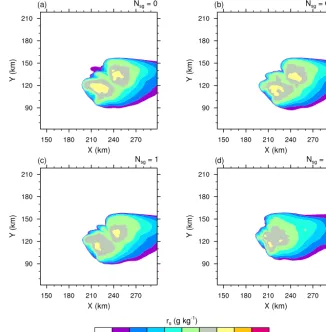
Figure 1.The 4 h accumulated precipitation of the STERAO simulations, where panels(a)–(d)refer to cases withNsg=0.0, 0.1, 1.0, and 10.0 ice fragments per collision, respectively. The plots are for a fraction of the computational domain.
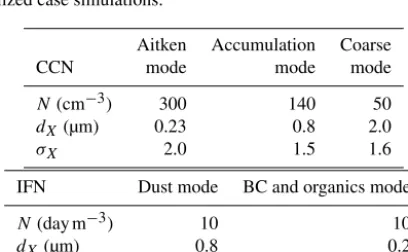
Table 1.Background CCN and IFN configuration for the STERAO idealized case simulations.
Aitken Accumulation Coarse
CCN mode mode mode
N(cm−3) 300 140 50
dX(µm) 0.23 0.8 2.0
σX 2.0 1.5 1.6
IFN Dust mode BC and organics mode
N(day m−3) 10 10
dX(µm) 0.8 0.2
σX 2.0 1.6
The aerosols were initialized as for the simulated squall-line case studied in Vié et al. (2016). A summary is given in Table 1 for the soluble CCN and for the insoluble IFN. Ho-mogeneous vertical profiles are assumed for the aerosols. Al-though the LIMA scheme incorporates size distribution pa-rameters and differentiates between the chemical
4274 T. Hoarau et al.: CIBU, collisional ice break-up
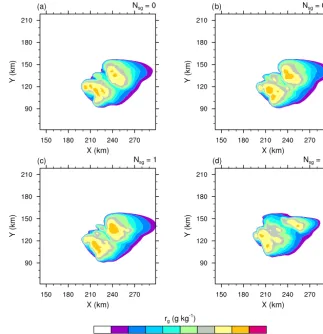
Figure 3.Mixing ratios of the cloud ice (riin log scale) of the STERAO simulations at 12 km height, where panels(a)–(d)refer to cases withNsg=0.0, 0.1, 1.0, and 10.0 ice fragments per collision, respectively. The plots are for a fraction of the computational domain.
tions of the CCN and the IFN, the characteristics of the five aerosol modes are standard for the simulations shown here, except for the sensitivity of CIBU to the initial concentration of the IFN which is explored in Sect. 3.5.
3.1 Impact on precipitation
Figure 1 shows the accumulated precipitation at ground level after 4 h of simulation for the four experiments correspond-ing to Nsg=0.0, 0.1, 1.0, and 10.0. The highest amount of rainfall is obtained when the CIBU process is ignored (Nsg=0.0) in Fig. 1a. Then, by increasing the CIBU ef-ficiency 10-fold from Nsg=0.1, Fig. 1b–d clearly show a steady reduction of precipitation and a fine-scale modifica-tion of the precipitamodifica-tion pattern. Furthermore, Fig. 1d re-veals that the spread of the precipitation field, caused by the motion of the multicellular storm, is significantly re-duced when Nsg=10.0. The results of Fig. 1 suggest em-pirically that a plausible range for Nsg is between 0.1 and 10.0 fragments per collision. A value lower than 0.1 leads to a negligible effect of CIBU in the simulation, while tak-ing Nsg>10.0 has an excessive impact on the storm
rain-fall (the “Nsg=50.0” case is not shown). In addition, Fig. 2 shows the results of a simulation, called “RANDOM” here-after, whereNsg∈ [0.1, 10]is generated by a random pro-cess as explained above. The perturbation caused by CIBU is also noticeable in this case; it remains weak for the precipi-tation field. These first 3-D numerical experiments show that inclusion of CIBU can modify surface precipitation strongly whenNsg>10.0 fragments per aggregate–graupel collision. Taking 0.1<Nsg<10.0 and also consideringNsgas deter-mined from a random process seems to be a more satisfac-tory approach. Admittedly,Nsg∼10 is more than an order of magnitude but our conclusion is to recommend an up-per bound value ofNsg that is much lower than the former N=50 used by Yano and Phillips (2011) with their notation in the box model.
3.2 Changes in the microphysics
aggre-T. Hoarau et al.: CIBU, collisional ice break-up 4275
Figure 4.As in Fig. 3 but for the mixing ratios of snow aggregates (rs).
gates. However, a further effect is possible because the partial mass sink of the snow aggregate particles also slows down the flux of graupel particles, which form essentially by heavy riming and conversion of the snow aggregates. This point is now examined by considering the ice in the high levels of the STERAO cells. Figures 3–5 reproduce the 10 min average of the mixing ratios ri,rs, and rg at 12 km from the four ex-periments havingNsg=0.0, 0.1, 1.0, and 10.0 after 4 h. The increase of the cloud ice mixing ratio withNsgis clear in the area covered by the 0.2 g kg−1isocontour in Fig. 3. Simulta-neously, a slight decrease ofrs, indicating a slow erosion of the mass of the aggregates, is visible in Fig. 4. The effect on the graupel (Fig. 5) is even smaller but appears clearly for the caseNsg=10.0, where less graupel is found. A last illustra-tion is provided in Fig. 6, showing the number concentraillustra-tion of cloud iceNiat a higher altitude of 15 km. Again, the in-crease ofNifollowsNsgwith an explosive multiplication of Ni whenNsg=10.0 (Ni is well above 1000 crystals kg−1of dry air in this case). Figure 7 summarizes the behaviour of ri,rs, andrgat 12 km height, and ofNiat 15 km height, for the “RANDOM” simulation. A comparison with Figs. 3–6 shows that the results are those expected. The examination of
the microphysics fields suggests that the “RANDOM” sim-ulation corresponds to a mean CIBU intensity intermediate betweenNsg=1 andNsg=10.
4276 T. Hoarau et al.: CIBU, collisional ice break-up
Figure 5.As in Fig. 3 but for the mixing ratios of graupel (rg).
Table 2.After 3 h of simulation, maximum value of the cloud ice number concentrationNimax as a function of the number of fragments produced per snow-aggregate–graupel collisionNsg. The last row shows the CIBU enhancement factor CIBUefin percent (see text).
Nsg(no unit) 0.0 0.1 1.0 2.0 5.0 10.0 20.0 50
Ni(kg−1) 790 940 1160 1860 8000 25 670 62 010 112 740
CIBUef(%) 0 19 47 135 913 3149 7749 14171
3.3 Budget of ice mixing ratios
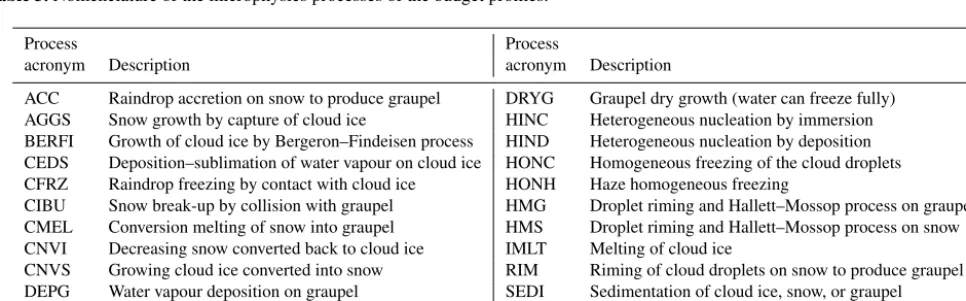
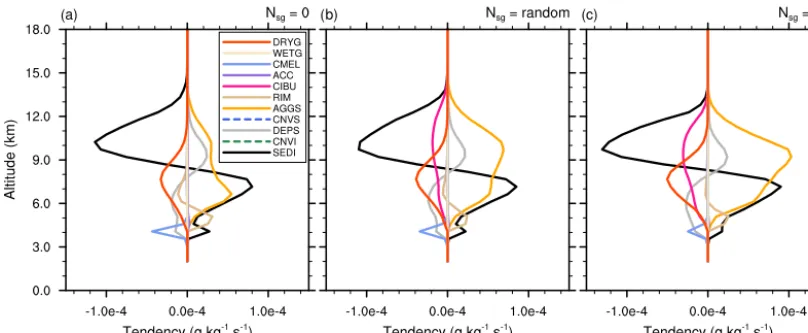
This step is devoted to the microphysics tendencies (using 10 min average again with the nomenclature of the processes provided in Table 3) of the ice mixing ratios in Figs. 9–11 to assess the impact of the CIBU process. We do not discuss the case of the liquid phase here because the tendencies (not shown) are only marginally affected by the CIBU process.
As expected, many tendencies ofri(Fig. 9a–c) are affected by the CIBU process. The main processes standing out in Fig. 9a, when CIBU is not activated, are CEDS (deposition– sublimation), essentially a gain term, and AGGS (aggre-gation), the main loss of ri by aggregation with a rate of 0.5×10⁻³g kg−1s−1. The loss ofri by CFRZ (drop freez-ing by contact) makes a moderate contribution as some
rain-drops are present in the glaciated part of the storm. Above z=10 000 m, the net loss ofri(AGGS and SEDI, the cloud ice sedimentation) is balanced by the convective vertical transport (not shown). WhenNsg=RANDOM, the ri ten-dencies are amplified, even with a modest contribution of∼ 0.2×10⁻³g kg−1s−1for CIBU itself. The growth of AGGS, which doubles at 10 km height, is caused by CIBU and by an increase in the convection because SEDI (a loss at this height) is amplified in response to an increase ofriin the up-per levels. The CFRZ contribution is also increased. The last case, withNsg=10 (Fig. 9c), confirms a further increase of the rates except for CFRZ, interpreted here as a lack of rain-drops.
T. Hoarau et al.: CIBU, collisional ice break-up 4277
Figure 6.Number concentration of the cloud ice (Niin log scale) of the STERAO simulations at 15 km height, where panels(a)–(d)refer to cases withNsg=0.0, 0.1, 1.0, and 10.0 ice fragments per collision, respectively. The plots are for a fraction of the computational domain.
range±0.05×10⁻³g kg−1s−1but SEDS (sedimentation of snow aggregates) dominates at z=11 000 m and at z= 7000 m. The inclusion of CIBU (Fig. 10b–c) mostly leads to an increase of AGGS, and the other processes remaining almost the same. Finally, many processes contribute to the evolution of the graupel mixing ratio profiles (Fig. 11). The strongest loss is in the GMLT term (melting of graupel) that converts graupel into rain (down to−0.3×10⁻³g kg−1s−1) while CFRZ reaches 0.15×10⁻³g kg−1s−1. The sedimen-tation term SEDG (sedimensedimen-tation of graupel) lies be-tween −0.3×10⁻³g kg−1s−1 at z=10 000 m and 0.15× 10⁻³g kg−1s−1 at 5000 m. Another noticeable effect is the sign change of DEPG (growth of graupel by deposition, ±0.07×10⁻³g kg−1s−1) showing that the water vapour is supersaturated abovez=7000 m and undersaturated below z=7000 m on average. The relative importance of these pro-cesses does not change very much when CIBU is increased but all tendencies weaken. To sum up, the impact of CIBU is modest for the microphysics mixing ratios. The increase of ice fragments in ri is approximately compensated by an increase of AGGS (see Figs. 9 and 10).
3.4 Budget of cloud ice concentration
4278 T. Hoarau et al.: CIBU, collisional ice break-up
Figure 7.“RANDOM” case of the STERAO simulations showing the mixing ratios of(a)the cloud ice (ri),(b)the snow aggregates (rs), and(c)the graupel (rg) at 12 km height. Panel(d)refers to the number concentration of the cloud ice crystals (Ni) at 15 km height. The plots are for a fraction of the computational domain.
Table 3.Nomenclature of the microphysics processes of the budget profiles.
Process Process
acronym Description acronym Description
ACC Raindrop accretion on snow to produce graupel DRYG Graupel dry growth (water can freeze fully) AGGS Snow growth by capture of cloud ice HINC Heterogeneous nucleation by immersion BERFI Growth of cloud ice by Bergeron–Findeisen process HIND Heterogeneous nucleation by deposition CEDS Deposition–sublimation of water vapour on cloud ice HONC Homogeneous freezing of the cloud droplets CFRZ Raindrop freezing by contact with cloud ice HONH Haze homogeneous freezing
CIBU Snow break-up by collision with graupel HMG Droplet riming and Hallett–Mossop process on graupel CMEL Conversion melting of snow into graupel HMS Droplet riming and Hallett–Mossop process on snow CNVI Decreasing snow converted back to cloud ice IMLT Melting of cloud ice
CNVS Growing cloud ice converted into snow RIM Riming of cloud droplets on snow to produce graupel DEPG Water vapour deposition on graupel SEDI Sedimentation of cloud ice, snow, or graupel DEPS Water vapour deposition on snow WETG Graupel wet growth (water is partially frozen)
0.1<Nsg<50 with a logarithmic progression aboveNsg= 1.0. The CIBU enhancement factor, CIBUef, was computed asNi(Nsg)/Ni(Nsg=0)−1 sinceNi(Nsg=0)constitutes a baseline not affected by CIBU. The results presented in Ta-ble 2 show that the growth of Ni is fast when Nsg reaches ∼5 (CIBUef rises sharply from 135 % to 913 % whenNsg increases from 2 to 5). TakingNsg=50 leads to an extremely high peak value ofNi.
The Ni tendencies are the subject of Fig. 13. Many pro-cesses are involved during the temporal integration of Ni. The Nsg=0 case confirms the importance of the hetero-geneous nucleation process by deposition (HIND; see
reser-T. Hoarau et al.: CIBU, collisional ice break-up 4279
Figure 8.Mean profiles of condensate mixing ratiosrc,rr,ri,rs, andrg(in g kg−1) of the STERAO simulations corresponding to(a)the Nsg=0.0 case,(b)the “RANDOM” case, and(c)the case withNsg=10.0.
Figure 9.Mean microphysics profiles of cloud ice mixing ratio tendencies of the STERAO simulations corresponding to(a)theNsg=0.0 (no CIBU) case,(b)the “RANDOM” case, and(c)the case withNsg=10.0. The dashed lines are associated with processes having no significant impact on these budgets.
voir. The sedimentation profile transports ice from the cloud top (SEDI<0) to mid-level cloud (SEDI>0). Then, taking
Nsg=RANDOM shows the domination of the CIBU pro-cess, which reaches 2.5 kg−1s−1 at 5 km height. The en-hancement of HIND at cloud top can also be noted. The CIBU source of ice crystals is balanced by an increase of AGGS and, above all, of CEDS (here, CEDS represents the sublimation of the ice crystal concentration when the crystals are detrained in the low level of the cloud vicinity, such as below the anvil). Finally, theNsg=10 case demonstrates the reality of the exponential-like growth ofNibecause the three main driving terms (CIBU, CEDS, and AGGS) are growing at a similar rate, which is multiplied by a factor of approxi-mately 5.
3.5 Sensitivity to the initial concentration of freezing nuclei
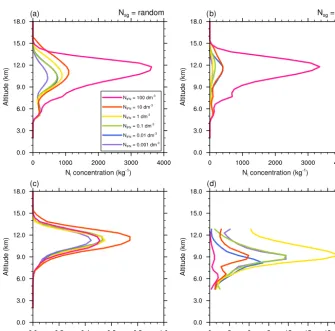
The purpose of the last series of experiments was to look more closely at the sensitivity of the cloud ice concentration toNIFN, the initial concentration of the IFN. Numerical sim-ulations were run withNIFN decreasing 10-fold from 100 to 0.001 day m−3for each IFN mode (see Table 1). Two differ-ent cases were considered. In the first case, CIBU was acti-vated with the RANDOM set-up while, in the second case, CIBU effects were ignored. All the results are summarized in the plots of Fig. 14.
4280 T. Hoarau et al.: CIBU, collisional ice break-up
Figure 10.As in Fig. 9 but for snow aggregates.
Figure 11.As in Fig. 9 but for graupel.
Figure 12. Mean profiles of the cloud ice crystal concentrations Ni(g kg−1) of the STERAO simulations corresponding to different values ofNsg(see the legend for details). The profiles drawn with a dashed line have been divided by 10 to fit into the plot.
T. Hoarau et al.: CIBU, collisional ice break-up 4281
Figure 13.Mean microphysics profiles of the cloud ice crystal concentration tendencies of the STERAO simulations corresponding to(a)the Nsg=0.0 (no CIBU) case,(b)the “RANDOM” case, and(c)the case withNsg= 10.0 (note that the horizontal scale increases from panela to panelc). The dashed lines of the list box are associated with processes having no significant impact on these budgets.
4282 T. Hoarau et al.: CIBU, collisional ice break-up
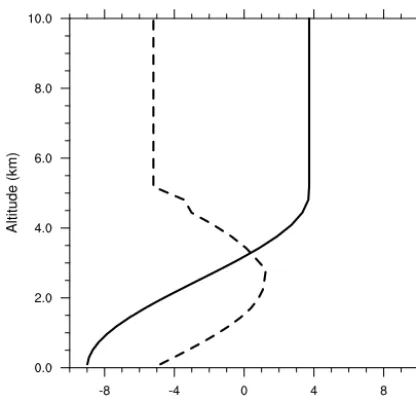
Figure 15.Vertical profile of the horizontal wind components of the WK84 simulations. The solid line with a constant shear (2.5×
10−2s−1) refers toU, thexcomponent of the wind, and the dashed line with a jet-like structure refers to V, they component of the wind.UandV are constant above 5 km height.
without CIBU. Although simulations using the same initial concentration NIFN may diverge because of additional non-linear effects (vertical transport, enhanced or reduced cloud ice sink processes), the figure gives an indication of the bulk sensitivity of CIBU to the IFN. The enhancement ratio due to CIBU remains low (less than 1 forNIFN∼100 day m−3) but can reach a factor of 20 at 9000 m height in the case of moderate IFN concentration, i.e. NIFN∼1 day m−3. The behaviour of LIMA can be explained in the sense that in-creasing NIFN too much leads to smaller pristine crystals that need a longer time to grow before being included in the next category of snow aggregates because such inclusion is size-dependent (see Harrington et al., 1995, and Vié et al., 2016). On the other hand, a low concentration ofNIFN initi-ates fewer snow aggreginiti-ates and thus fewer graupel particles, so the whole CIBU efficiency is also reduced. Consequently, this study confirms the essential role of CIBU in compensat-ing for IFN deficit when cloud ice concentrations are increas-ing.
4 Simulation of a three-dimensional idealized supercell storm with varying atmospheric stability
The idealized sounding of Weisman and Klemp (1982, 1984) was appealing to use for this test case (referred to as WK) because the intensity of the CAPE can be easily modified by changing a reference water vapour mixing ratio. The envi-ronmental conditions of the simulations were close to those of the STERAO case with the same set-up for the physics and the aerosol characteristics. The simulation domain was
180×180 grid points at 1 km resolution and 70 levels with a mean vertical grid spacing of 350 m. Convection was trig-gered by a domain-centred single 2 K buoyant air parcel of 10 km radius and 3 km height. The base of the upper level Rayleigh damper was set at 15 km above ground level.
Meso-NH was initialized with the analytic sounding of Weisman and Klemp (1984) with low two-dimensional shear. The hodograph in Fig. 15 features a three-quarter cycle with a constant wind of 6.4 m s−1(in modulus) above the height of 5 km. When running Meso-NH, a constant translation speed (Utrans=5 m s−1 and Vtrans=1 m s−1) was added to the wind to keep the convection well centred in the domain of simulation. As explained in Weisman and Klemp (1982), buoyancy was varied by altering the magnitude of the sur-face water vapour mixing ratioqv0keeping with the Weis-man and Klemp (1984) notation. Three water vapour pro-files were defined by takingqv0=13.5 g kg−1, hereafter the “low” CAPE case of 1970 J kg−1, qv0=14.5 g kg−1 as the “mid” CAPE case of 2400 J kg−1, andqv0=15.5 g kg−1 as the “high” CAPE case of 2740 J kg−1. Four experiments of 4 h each were performed for each CAPE case by using dif-ferent magnitudes ofNsg.
4.1 Sensitivity to mean ice concentrations
T. Hoarau et al.: CIBU, collisional ice break-up 4283
Figure 16.Small ice concentrationNiaverage between 9.5 and 10.5 km height after 4 h of the WK84 simulations, where panels(a–c)refer to no CIBU cases (Nsg=0.0),(d–f)to cases with random CIBU (0.1<Nsg<10),(g–i)to cases with a high CIBU effect (Nsg=10.0), and (j–l)to cases with an intense CIBU effect (Nsg=50.0). The contours are the cloud top heights with dotted lines for 11 km and solid lines for 13 km.
cases but approximately 10 times higher than in the “no CIBU” case (Nsg=0). Finally, the simulation results sug-gest that theNsgparameter could be constrained by satellite data because of the sensitivity of CIBU to the cloud ice cov-erage and the cloud top height.
4.2 Sensitivity to precipitation
The 4 h accumulated precipitation maps are presented in Fig. 17. On each row, precipitation increases from the “low” to “high” CAPE cases. This is because the CAPE is enhanced by the addition of more water vapour. Looking at the sen-sitivity of the accumulated precipitation toNsg, it is not as
easy to draw a general conclusion on the decrease of the precipitation peak with Nsg as for the STERAO case (see Sect. 3.1). The reason is the highly concentrated precipita-tion field, which leads to a sharp gradient around the locaprecipita-tion of the peak value. However, the decrease of the precipitation withNsg is observed in the “low” and “high” CAPE cases. In the “mid” case, the precipitation peak value remains high whenNsg=50 but the area where the precipitation is less than 10 mm shrinks continuously. The reduction of the area where the precipitation amount is greater than 10 mm when
4284 T. Hoarau et al.: CIBU, collisional ice break-up
Figure 17.As in Fig. 16 but for the 4 h accumulated precipitation of the WK84 simulations. The peak value (max in millimetres) corresponds to the peak value of precipitation of the main convective clouds in the centre of the simulation domain.
In conclusion, the simulations illustrate the fact that the precipitation patterns are affected by the value of the Nsg parameter. WhenNsg is increased from 0 to 50, the precipi-tation is reduced either for the peak value or at least for the precipitating area. This is consistent with our previous results concerning the STERAO case. The conversion efficiency of the small ice crystals to precipitating ice particles is lower when the cloud ice concentration is high because the depo-sition growth of individual small crystals is limited by the amount of supersaturated water vapour available.
4.3 Sensitivity to the ice thickness
This last analysis is concerned with the ice thicknesses (or ice water paths) computed as the integrals along the vertical
hu-T. Hoarau et al.: CIBU, collisional ice break-up 4285
Figure 18.As in Fig. 16 but for the total ice thickness in millimetres after 4 h of the WK84 simulations. The contours are the small ice thickness component (THIC) taken at 1 mm. The peak value of THIC (THICmax) is given in millimetres.
midity tends to favour the horizontal spread of the cloud ice mass.
5 Summary and perspectives
The aim of this work was to study a parameterization of the collisional ice break-up for the bulk two-moment microphysics LIMA scheme running in a cloud-resolving mesoscale model (Meso-NH, in our case). While the process is suspected to occur in real clouds, it is not included in cur-rent bulk microphysics schemes. Because of uncertainties to physically describe the ice break-up process, the present pa-rameterization has been kept as simple as possible. It consid-ers only collisions between small aggregates and large, dense
graupel particles. The number of ice fragments that results from a single collision,Nsg, is a key parameter, which is es-timated from only a very small number of past experiments (Vardiman, 1978). This study suggests an upper bound on
4286 T. Hoarau et al.: CIBU, collisional ice break-up
fragments as illustrated and discussed by Hobbs and Farber (1972). As a result, it has been shown that running LIMA with Nsg>10 for the STERAO and WK deep convection cases taken from Skamarock et al. (2000) and Weisman and Klemp (1982, 1984), respectively, alters surface precipitation because the conversion of cloud ice crystals to precipitating ice is slowed down. In any case, the increase of the number concentration of the small ice crystals due to the application of CIBU is clearly substantial (up to 1000-fold in the WK simulations withNsg=50).
The microphysics perturbation due to the activation of CIBU has been studied in detail for the STERAO case by looking at the profiles of the mixing ratios, ice concen-trations, and corresponding budget terms. In particular, the CIBU effect on the pristine ice and aggregate mixing ra-tios is compensated by an enhancement of the capture of the small crystals by the aggregates. The sensitivity of the ice concentration toNsgis demonstrated with a mean multipli-cation factor as high as 25 for Nsg=10. The last study on the sensitivity of the simulations to the initial IFN concentra-tion showed that CIBU was mostly efficient for current IFN concentrations of∼1 day m−3. Furthermore, the CIBU pro-cess was still active for very low IFN concentrations, down to 0.001 day m−3, which were sufficient to initiate the ice phase. The effects of CIBU have been confirmed by a second se-ries of WK simulations. The enhancement of the cloud ice concentration is very high whenNsg>10, and a loss of sur-face precipitation is found in terms of the peak value and the reduction of the precipitating areas. Higher ice concentra-tions lead to a larger coverage of ice clouds and higher cloud tops for the most vigorous convective cells. In contrast, the total ice thickness is almost insensitive to CIBU. An increase of cloud ice mass withNsgis balanced by a slight decrease of the precipitating ice (aggregates and graupel).
The proposed parameterization is very easy to imple-ment. It would be useful to evaluate it in other microphysics schemes where the conversion of the cloud ice and the growth of precipitating ice (aggregates and rimed particles) are treated differently. Adjustments to the scheme can be re-vised as soon as laboratory experiments are available to en-able more precise fixing of the sizes and the shapes of the crystals that break following collisions, and also to exam-ine any possible thermal effect and to estimate the variety of fragment numbers more accurately. Another way to deter-mine the acceptable range of values forNsgis to work with satellite data, as the WK experiments demonstrated an en-hancement of the cloud top ice cover withNsg(and possibly the cloud top height).
With new imagers, counters, and improvements in data analysis (Ladino et al., 2017), more and more evidence is being presented that ice multiplication is an essential process in natural deep convective clouds. However, the explanation of anomalously high ice crystal concentrations is still diffi-cult to link to a precise process (Rangno and Hobbs, 2001; Field et al., 2017). Therefore, the next step in the LIMA scheme will be to introduce the shattering of raindrops dur-ing freezdur-ing as proposed by Lawson et al. (2015) in order to complete the LIMA scheme, since the different ingredi-ents of raindrops and small ice crystals offer another path-way for ice multiplication. One task will then be to study whether all the known sources of small ice crystals, nucle-ation, and secondary ice production are able to work together in microphysics schemes to reproduce the very high val-ues of ice concentrations sometimes observed. Quantitative cloud data gathered in the tropics during the HAIC/HIWC (High Altitude Ice Crystals/ High Ice Water Content) field project (Leroy et al., 2015; Ladino et al., 2017) could pro-vide a starting point for the evaluation of the capability of high-resolution cloud simulations to reproduce events where high cloud ice content has been recorded.
T. Hoarau et al.: CIBU, collisional ice break-up 4287 Appendix A: Moments of the gamma and incomplete
gamma functions
Thepth moment of the generalized gamma function (see def-inition in the text) is
M(p)= ∞ Z
0
Dpn(D)dD=0(ν+p/α) 0(ν)
1
λp, (A1)
where the gamma function is defined as
0(x)= ∞ Z
0
tx−1e−tdt. (A2)
The pth moment of the incomplete gamma function is written as
MINC(p;X)= X Z
0
Dpn(D)dD. (A3)
The algorithm of the “GAMMA_INC(p;X)” function (Press et al., 1992) is useful to tabulateMINC(p;X)×0(p)in ad-dition to the “GAMMA” function algorithm of Press et al. (1992). A change of variable is necessary to take the gener-alized form of the gamma size distributions into account. As a result,MINC(p;X)is written as
4288 T. Hoarau et al.: CIBU, collisional ice break-up
Author contributions. TH and JPP conceived the scheme presented and performed the model developments and simulations. CB of-fered an expert analysis of the results, including the budget of the ice phase, and greatly improved the composition of the figures. All authors contributed to the writing of the manuscript.
Competing interests. The authors declare that they have no conflict of interest.
Acknowledgements. Jean-Pierre Pinty wishes to thank Vaughan Phillips for discussions about his original work on the topic. This work was done during the PhD of Thomas Hoarau, who is financially supported by Réunion Island Regional Council and the European Union Council. Thomas Hoarau thanks the University of La Réunion for supporting a short stay at the Laboratoire d’Aérologie. Susan Becker and Callum Thompson corrected the English language of the manuscript. Preliminary computations were performed on the 36-node homemade cluster of Laboratoire Aérologie. Jean-Pierre Pinty acknowledges CALMIP (CALcul MIdi-Pyrénés) of the University of Toulouse for access to the Eos supercomputer, where useful additional simulations were performed. Thomas Hoarau and Christelle Barthe acknowledge the GENCI resources for access to the OCCIGEN supercomputer. This work was supported by the French national programme LEFE/INSU through the LIMA-TROPIC project. The authors thank the reviewers and the topical editor for their pertinent comments and meticulous review which greatly improved previous versions of the manuscript.
Edited by: Simon Unterstrasser Reviewed by: two anonymous referees
References
Beheng, K. D.: Microphysical Properties of Glaciating Cumu-lus Clouds: Comparison of Measurements With A Numer-ical Simulation, Q. J. Roy. Meteor. Soc., 113, 1377–1382, https://doi.org/10.1002/qj.49711347815, 1987.
Chaboureau, J.-P.: Meso-NH code, version 5.1.2, available at: http://mesonh.aero.obs-mip.fr/mesonh51 (last access: 17 Octo-ber 2018), 2014.
Cohard, J. and Pinty, J.: A comprehensive two-moment warm microphysical bulk scheme. I: Description and tests, Q. J. Roy. Meteor. Soc., 126, 1815–1842, https://doi.org/10.1002/qj.49712656613, 2000.
Colella, P. and Woodward, P.: The piecewise parabolic method (PPM) for gas-dynamical simulations, J. Comput. Phys., 54, 174–201, 1984.
Dye, J. E., Ridley, B. A., Skamarock, W., Barth, M., Ven-ticinque, M., Defer, E., Blanchet, P., Théry, C., Laroche, P., Baumann, K., Hubler, G., Parrish, D. D., Ryerson, T., Trainer, M., Frost, G., Holloway, J. S., Matejka, T., Bar-tels, D., Fehsenfeld, F. C., Tuck, A., Rutledge, S. A., Lang, T., Stith, J., and Zerr, R.: An overview of the Stratospheric-Tropospheric Experiment: Radiation, Aerosols, and Ozone (STERAO)-Deep Convection experiment with results for the
July 10, 1996 storm, J. Geophys. Res., 105, 10023–10045, https://doi.org/10.1029/1999JD901116, 2000.
Field, P. R.: Bimodal ice spectra in frontal clouds, Q. J. Roy. Meteor. Soc., 126, 379–392, https://doi.org/10.1002/qj.49712656302, 2000.
Field, P. R., Lawson, R. P., Brown, P. R. A., Lloyd, G., West-brook, C., Moisseev, D., Miltenberger, A., Nenes, A., Blyth, A., Choularton, T., Connolly, P., Buehl, J., Crosier, J., Cui, Z., Dear-den, C., DeMott, P., Flossmann, A., Heymsfield, A., Huang, Y., Kalesse, H., Kanji, Z. A., Korolev, A., Kirchgaessner, A., Lasher-Trapp, S., Leisner, T., McFarquhar, G., Phillips, V., Stith, J., and Sullivan, S.: Secondary ice production: current state of the science and recommendations for the future, Meteor. Monogr., 58, 7.1–7.20, https://doi.org/10.1029/AMSMONOGRAPHS-D-16-0014.1, 2017.
Foote, G. B. and du Toit, P. S.: Terminal velocity of raindrops, J. Appl. Meteor., 8, 249–253, 1969.
Griggs, D. G. and Choularton, T. W.: A laboratory study of sec-ondary ice article production by the fragmentation of rime and vapour-grown ice crystals, Q. J. Roy. Meteor. Soc., 112, 149– 163, https://doi.org/10.1002/qj.49711247109, 1986.
Hallett, J. and Mossop, S. C.: Production of secondary ice particles during the riming process, Nature, 249, 26–28, https://doi.org/10.1038/249026a0, 1974.
Harrington, J. Y., Meyers, M. P., Walko, R. L., and Cot-ton, W. R.: Parameterization of Ice Crystal Conver-sion Processes Due to Vapor Deposition for Mesoscale Models Using Double-Moment Basis Functions. Part I: Basic Formulation and Parcel Model Results, J. At-mos. Sci., 52, 4344–4366, https://doi.org/10.1175/1520-0469(1995)052<4344:POICCP>2.0.CO;2, 1995.
Hobbs, P. V. and Farber, R. J.: Fragmentation of ice particles in clouds, J. Rech. Atmos., 6, 245–258, 1972.
Hobbs, P. V. and Rangno, A. L.: Ice particle concentrations in clouds, J. Atmos. Sci., 42, 2523–2549, 1985.
Hoarau, T., Pinty, J.-P., and Barthe, C.: A representation of the collisional ice break-up process in the two-moment mi-crophysics scheme LIMA v1.0 of Meso-NH, Supplement, https://doi.org/10.5281/zenodo.1078527, 2017.
Ladino, L. A., Korolev, A., Heckman, I., Wolde, M., Fridlind, A. M., and Ackerman, A. S.: On the role of ice-nucleating aerosol in the formation of ice particles in tropical mesoscale convective systems, Geophys. Res. Lett., 44, 1574–1582, https://doi.org/10.1002/2016GL072455, 2017.
Lafore, J. P., Stein, J., Asencio, N., Bougeault, P., Ducrocq, V., Duron, J., Fischer, C., Héreil, P., Mascart, P., Masson, V., Pinty, J.-P., Redelsperger, J.-L., Richard, E., and Vila-Guerau de Arel-lano, J.: The Meso-NH atmospheric simulation system. Part I: adiabatic formulation and control simulations, Ann. Geophys., 16, 90–109, https://doi.org/10.1007/s00585-997-0090-6, 1998. Lawson, R. P., Woods, S., and Morrison, H.: The microphysics of
ice and precipitation development in tropical cumulus clouds, J. Atmos. Sci., 72, 2429–2445, https://doi.org/10.1175/JAS-D-14-0274.1, 2015.
T. Hoarau et al.: CIBU, collisional ice break-up 4289
characteristics and ice crystal shapes, SAE Technical Paper, https://doi.org/10.4271/2015-01-2087, 2015.
Phillips, V. T., Yano, J.-I., and Khain, A.: Ice multiplication by break-up in ice-ice collisions. Part I: Theoretical formulation, J. Atmos. Sci., 74, 1705–1719, https://doi.org/10.1175/JAS-D-16-0224.1, 2017.
Press, W. H., Teukolsky, S. A., Vetterling, W. T., and Flannery, B. P.: Numerical Recipes in FORTRAN: The Art of Scientific Comput-ing, Cambridge University Press, New-York, 1992.
Rangno, A. L. and Hobbs, P. V.: Ice particles in stratiform clouds in the Arctic and possible mechanisms for the production of high ice concentrations, J. Geophys. Res., 106, 15065–15075, 2001. Skamarock, W. C., Powers, J. G., Barth, M., Dye, J. E., Matejka, T.,
Bartels, D., Baumann, K., Stith, J., Parrish, D. D., and Hubler, G.: Numerical simulations of the July 10 Stratospheric-Tropospheric Experiment: Radiation, Aerosol, and Ozone/Deep Convection Experiment convective system: Kinematics and transport, J. Geo-phys. Res., 105, 19973–19990, 2000.
Sullivan, S. C., Hoose, C., and Nenes, A.: Investigating the contribution of secondary ice production to in-cloud ice crystal numbers, J. Geophys. Res., 122, 9391–9412, https://doi.org/10.1002/2017JD026546, 2017.
Sullivan, S. C., Hoose, C., Kiselev, A., Leisner, T., and Nenes, A.: Initiation of secondary ice production in clouds, Atmos. Chem. Phys., 18, 1593–1610, https://doi.org/10.5194/acp-18-1593-2018, 2018.
Takahashi, T., Nagao, Y., and Kushiyama, Y.: Possible high ice par-ticle production during graupel-graupel collisions, J. Atmos. Sci., 52, 4523–4527, 1995.
Vardiman, L.: The generation of secondary ice par-ticles in clouds by crystal–crystal collision, J. At-mos. Sci., 35, 2168–2180, https://doi.org/10.1175/1520-0469(1978)035<2168:TGOSIP>2.0.CO;2, 1978.
Vié, B., Pinty, J.-P., Berthet, S., and Leriche, M.: LIMA (v1.0): A quasi two-moment microphysical scheme driven by a multi-modal population of cloud condensation and ice freezing nuclei, Geosci. Model Dev., 9, 567–586, https://doi.org/10.5194/gmd-9-567-2016, 2016.
Weisman, M. L. and Klemp, J. B.: The dependence of numerically simulated convective storms on vertical wind shear and buoy-ancy, Mon. Weather Rev., 110, 504–520, 1982.
Weisman, M. L. and Klemp, J. B.: The structure and classification of numerically simulated convective storms in directionally varying wind shear, Mon. Weather Rev., 112, 2479–2498, 1984. Yano, J.-I. and Phillips, V. T.: Ice–Ice Collisions: An Ice
Multiplica-tion Process in Atmospheric Clouds, J. Atmos. Sci., 68, 322–333, https://doi.org/10.1175/2010JAS3607.1, 2011.
Yano, J.-I. and Phillips, V. T.: Explosive Ice Multiplication In-duced by multiplicative-Noise fluctuation of Mechanical Break-up in Ice-Ice Collisions, J. Atmos. Sci., 73, 4685–4697, https://doi.org/10.1175/JAS-D-16-0051.1, 2016.