A
ANNEERRKKEENNNNTTNNIISS--TTHHEEOORREETTIICCAALLPPRROOJJEECCTT--SSTTUUDDYY F
FOORRSSTTUUDDEENNTTSSOOFFCCOOMMPPUUTTEERRSSCCIIEENNCCEE
K
KaarrllHHaayyooSSiieemmsseenn
University of Applied Sciences Emden / Leer, Germany
T
TaannjjaaSSnnaaiikkuuss
University of Applied Sciences Oldenburg / Ostfriesland / Wilhelmshaven
ABSTRACT: An erkenntnis-theoretical project-study for
students of computer science during the first semester, Summer 2001. Shortened version, 28. Juni 2001, updated version 18/05/2012 by Hayo Siemsen
KEYWORDS: projects, Erkenntnis-theory, Gestalttheory.
1. SUMMARY OF RESULTS IN THE
ERKENNTNIS
-THEORETICAL
PROJECT-STUDY
This summary was written in order to support people, who think about introducing a project-study at their university, in their decision-making process. It has to be considered, that in such a summary, aspects can only be presented in a simple manner. The project-study is briefly described. Moreover, this summary does not fully focus on the psychological mechanisms of a cognition oriented project-study.
Students, having experienced the project-study agree to 90 % on the advantages of the erkenntnis
-theoretical project-study. Disadvantages are not conceivable. Therefore it has to be forgiven, if - in such a simple contemplation like this - the minority of the students (which has predominantly not categorized the question) is not further taken into account. The point of view of students having experienced a project-study is taken as an assessment of the method. They possess the experience required to assess this type of study. This judgment of a majority of 90 % is a democratic measurement, especially remembering, that the students in the first semester are the main customers of the university.
It was noticed, that after 5 weeks of their first project-study the students intensively interacted in tutorials. By asking the right questions they helped to make the problems transparent during learning new lessons. By these means, the professors were able to recognize and then also to discuss more intensively the topics all students had difficulty in understanding. The professors also admitted that the atmosphere created by this dialog helped them as well as the students to concentrate on and enjoy the process of learning.
The performance in all five core subjects of the students being involved in the project study is compared to the performance of conventional students.1 On average, 81 % of the students of the
first semester of project-study were successful, compared to 54 % of students of conventional study. There is a considerably lower rate of students having participated in the project-study which are required to repeat examinations in the next semester. Also the coherence within the semester is improved by the enhanced ability to communicate which is transmitted by the project-study. Therefore, one can expect that the problems regarding low social coherence among the students will be reduced for future semesters following the project-study.
This summary is based on an organizational point of view: which semester of a conventional study has to include how much project-study? Afterwards the question is discussed, if a project-study in the first semester can teach knowledge, and with examples, which other intellectual abilities are enhanced. In a study examining university drop-outs [***01] a huge amount of drop-outs were determined in computer sciences. Among other goals, the project- study was supposed to reduce this effect. The drop-out rate was dramatically reduced from above 60 % to 4 % within one semester. A picture is given on how the students involved in the project-study see their university and their courses. It is a positive picture of this university of applied sciences, which increases the attractiveness of the university implementing a project-study. Furthermore, it is worthwhile implementing and extending the
erkenntnis-theoretical project-study.
2. PROJECT STUDY DURING THE FIRST
SEMESTER IN COMPUTER SCIENCE
For the 1st semester of the course, a project day is installed (from 8:00 am to 7:00 pm). The core times are ‘(8:00 am to 12:00 am, 1:00 pm to 5:30 pm)’.
1 The students did not know their performance at the time
During these times the students are expected to be at work. Each group keeps the records with an attendance list.
At the beginning of the semester, lectures about some key qualifications2 are given during the project
day. These lectures are held in order to provide a survey orienting the students towards the skills taught during the project study. This information is comparably condensed (lectured by Prof. Siemsen). After the key competences are recognized as required by the experiences, they are worked out again more deeply during the semester (partly by Prof. Siemsen, at one of the project days by the AfH Braunschweig (Burdewick)).
The later part of the appendix provides a list of the projects. Each project is worked out by one group. If the students are in the 1st semester, they receive some help. Each group presents their results (see below). They transfer their knowledge to the other students of the 1st semester during the project days on request3 . Every other week, one member of each
group sits in another group with a different subject for half the project day.
Each group presents itself, its members and their project. This presentation is done with a HTML web page with pictures and video as well as in a presentation (StarOffice 5.1 Impression) and also with a LATEX document (translated to PS and PDF). Each group can reach a score of 100 points, which are used to grade the non-technical optional subject. Typically the grade is composed by 50 % of the written text (Latex and PDF, HTML), to 25 % by the presentation (SO 5.1) and to 25 % by the transfer to the other groups. If a group has an exceptional result, special marks can be granted. If in a particular case a student does not take part in the project day, or evades his responsibilities, the performance will be marked outside the group.
List of projects (cooperation of the project groups is expected):
1. LATEX (specifying the layout of documents), PS and PDF (portable document format) (Socher) 2. Presentation by StarOffice Impression and work with a beamer (group of 2)
3. Function plots with Gnuplot; insertion of raw data, smoothing (splines); insertion into
2 The central issue among key qualifications is the
erkenntnis-theory, which helps the students observe and
optimize their own learning. This also requires a more sophisticated learning theory than the one naively used as default (the "funnel model"). The shifts in erkenntnis
-theory, learning theory and psychological theory used by the students are interrelated and centrally required for the project study to work in the way described.
3 The members of the group became "experts" in respect
to this subject and communicate their expert knowledge to the other groups.
documents, discussion of curves.
4. Production of mathematic formula, insertion into LATEX-documents (2) (Socher)
5. Insertion of pictures of different image formats into LATEX (2)
6. Spice, Pspice; example of a network with knot and mesh analysis, Ohms law; impulse response 7. Mupad; symbolic differentiation with application (Thom)
8. Euler; vector calculus, matrices with applications (Socher)
9. Mupad; numerical integration with applications (Thom) 10. Commands of the operating systems Unix, linux (with KDE)
11. Installation of linux
12. Windows98, installation, tools (2) (Thom) 13. Computer in the web, net tools (ping, X, ftp, http, traceroute) (Thom?)
14. Search, full-text search, investigation in the web; Soundex; regular expressions; database
15. The scripting language PHP
16. HTML, takeover to a Linux-server (place to the web; 2)
17. Production of images and image sequences (Mpeg 2 und 4) from AV and DV (digital video) 18. Organization (documents, Web, News), coordination, questions, letter-box, protocols
19. Firefighters
20. Public relations work, presentation of projects and of the project study
3. THE ORGANIZATIONAL PERSPECTIVE
Compatibility between project-study and
conventional study
If one does not want to completely replace the conventional study, the first question for planning is, whether there is a compromise between a project-study and a conventional study, or whether there can be a parallel course in the same semester. The answer (the average of 89 % of students reporting 4) is: the parallel
course make sense, both forms do not fundamentally disturb each other. The advantages of a erkenntnis
-theoretical project-study remain side-by-side to the conventional study. Concerns that the conventional study is disturbed by the project-study are not just.
4 A short note to the statistical data: The largest problem
11%
89%
yes no
Figure 1: Compatibility between project-study and conventional study
Project-study, from which semester on?
When a project-study is planned, it should start in the 1st semester with at least one project-day and a design comparable to the present one. The students having experienced this project-day are united in this opinion.
3%
97%
yes no
Figure 2: Other ”project-study” in the first semester
Project-Study in further semesters?
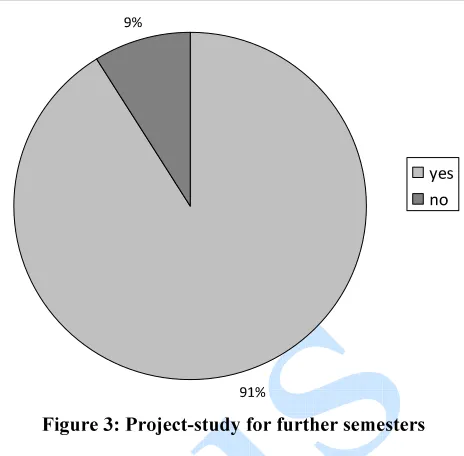
If and how - according to the students point of view that have experienced the project study - the project-study is to continue as shown in the following graph. A 90% majority wishes to continue with the project-study after the first semester.
9%
91%
yes no
Figure 3: Project-study for further semesters
Share of project-study in overall studies
The next question regards the mix between project-study and conventional project-study. The minimal share is: one project-day per week in a first semester course. A most likely optimal share for further semesters is shown in the following chart. The percentage starts from top of the figure clockwise, the corresponding part in the legend starts from top.
27% 22%
51%
project study mixture conventional study
Figure 4: Share of project-study in overall studies This distribution, which resembles the average of the students´ opinions, completely resembles the actual distribution of shares between project-study and conventional study in Esbjerg 5 [KE94]. Therefore a
distinct hint is given on how to assemble a study program in total, including project-study and conventional study shares in the same semester. For example, the new course being advertised at the
5 It should be noted that the project study in Esbjerg does
FHOOW, bio-informatics, is designed in this manner. For the first semester, a distribution different from the minimum is recommended: in many courses there is a lack of understanding in mathematics during the first semester. This lack could be compensated with another project-day (e.g. in combination with programming). On the other hand, the students have to work a lot on the coordination of the first project-day in the first 4 -5 weeks. Also they are working on understanding their part. At this time it is not practical to offer a second project-day with a different topic. However, if the problems regarding mathematics (cf. section ”Drop-Outs”) have to be counteracted against, a second project-day has to be introduced, beginning in the second half of the semester. At this time, also the minimal skills required in programming are available.
4. FINANCE
The project-study was handled mostly without additional financial expenditures. It required a work-place with a computer for every participant. These computers should have a minimum 400 MHz CPU, 128 MB RAM, 60 GB hard disk, DVD-drive, network connection, 19”’-monitor, Windows98 and Linux. The infrastructure of the room requires a Linux-server (200 GB), an effective laser-printer (HP 4050) in the network, a 2 Mbit connection to a provider (DFN), five additional, equally equipped computers for the student’s work places (two of which with 800 MHz), three 12x CD-writers, one Beamer 1024*768, one-thousand Lumen (proportionate) and a DV-camera (in this case mostly already existing).
For supervision a number of 10 % of the participants should be added as supervisors in the first three weeks. Afterwards the supervision can be reduced to 4-5 %. This task was done by the supervising professor and by student assistants. Especially in the first weeks, this task should mainly be taken over by additional staff (in the first few weeks of the semester, the time table for student assistants is not completely fixed yet, so they might be unavailable on short notice).
At the latest of three months prior to the beginning of the project-study (only for the first trial), instruction manuals and reports must be elaborated. On average, we have given away one study thesis per project for this task. Additionally we prepared 7-8 CDs of free software and manuals according to projects for the students.6
An epistemological conception (prior to the award of
6 The project-groups from the project-study of the first
semester are working on supplementary manuals, suitable for following projects on the project day.
a study-thesis) and supervision must be given separately to the technical competence. Only in this case it can be assumed that the project-study will intensively influence the learning process.
First we have documented all events about key-competences and the lectures held by the students with DV (digital video, accomplished by students of the project-study), then we have transformed it into Mpeg 4 and mp3, and finally we have written it on a CD. The latter process is very time-consuming. It requires approximately five to ten times the time necessary for recording.
We have spend a total of approx. 2000,-DM on materials for the 20 projects (100 DM per project), mostly paper, toner, CDs etc.
The costs for their own CDs were taken over by the students themselves.
5 CONVENTIONAL ”KNOWLEDGE TRANSFER” SUPPORT IN THE PROJECT-STUDY
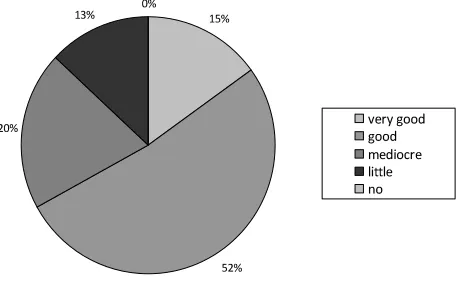
For someone who is not accustomed to the concept of project-study, the first question to arise regarding knowledge transfer usually is, whether a project-study is suitable for teaching specialized technical and basic knowledge. This question can be answered positively. Even more knowledge is taught in a project-study as compared to a conventional study (see page 43). Yet this is done in a different way. The way seems to be less systematic, but this perception is misleading. 52 % of the students in the project-study are of the opinion that they have acquired knowledge in a good manner. 15 % is rated very well. A further 20 % are at least not unsatisfied. It is very difficult, if not impossible to reach such high proportions of satisfied students holding conventional lectures alone.
52% 20%
13% 0% 15%
very good good mediocre little no
Figure 5: Transfer of specialized technical knowledge with the project-study
The transfer of ”basic” knowledge is supposed to be only a side effect, and not the essential effect of the
erkenntnis-theoretical project-study. This effect can
semester students. So what other qualifications are mediated? These qualifications are usually regarded as required prerequisite in a conventional study. The question is: is there another area, apart from specialized technical or basic knowledge, which is left out in a conventional study, and which could be seen worthy enough in order to be taught? There is, and this area is unrecognizable for a student, who was never in touch with a project-study before. Also for professors who have never experienced a project-study before, these mechanisms are hard to imagine. They are in-line with abilities known as the ”specialized technique” and ”basic” categories. The project-study consists of intellectual abilities, which - if used by a person for solving problems - seem obvious to this person. But if they are missing, a whole study can fail, with no apparent reason from the students' (and the professors') perspective.7
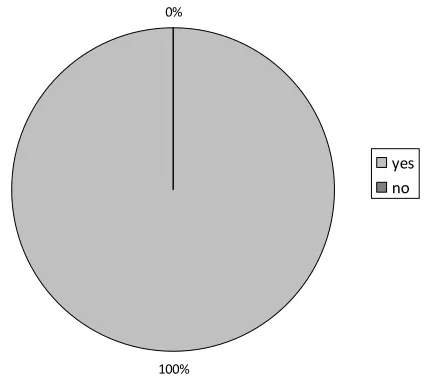
The diagram showing the existence of intellectual requirements in a project-study confirmed by the participants from their experience that the projects require additional intellectual skills, besides knowl-edge of facts. These requirements have different aspects than expected from the students at the beginning of the project-study.
0%
100%
yes no
Figure 6: Intellectual requirements during project-study other then the ”‘knowledge of facts”’ Before students start a project-study, they do not know the intellectual area, which is demanded and is supported by project-study. At the beginning of their project-study (within the first 6 to 8 weeks) they do
7 This aspect is very important as the centrality of the
erkenntnis-theoretical elements of the project study make
a huge difference in the effects such a project study can achieve as has been documented 12 years later (The Project Study After 10 years). At the time of the initial writing of this article, this aspect was also not explicitly apparent to the authors. A non-erkenntnis-theoretical
project study does by far not produce the same effects.
not expect that it makes sense to be concerned with it. The representatives of a conventional study are often unaware of the potential intellectual support the project-study has. This complicates the communication of the advantages of a project-study. The project-students early find that something else is demanded of them than just the knowledge of facts. One fundamental requirement to gain these intellectual abilities is to have experienced acting as a result of thinking. A second requirement is to be able to revise thinking and acting and adjust one to the other.8 These are examples for requirements
which are supported by the project-study. The ability to associate thinking and acting (Ernst Mach) is a
key qualification for the training of engineers. It is well known that there are enough students, who - after four semesters of intensive memorizing without understanding - are said to be unable to act on minor tasks in their practical semester by the host compa-nies. These students will become desperate, because in this situation, more memorizing without understanding does not help and the students might be misled to the conclusion that it is best for them to give up their studies. A correctly well conceived project-study fixes the requirements and helps in that respect as shown in the following diagram, reflecting the student’s opinion. After, for one time receiving help, the responsibility to recognize the situation is transferred to the student. It is the students´ responsibility to recognize whether there are discrepancies between thinking and acting, and to correct these discrepancies accordingly. Even if help is provided further on, the students are expected to try to solve the problem among them.
0%
100%
yes no
Fi gure 7: Qualifications: associate thinking and acting Some of the skills which are demanded by the projects during the project-study and which should
be fixed and exercised, are key qualifications. These abilities sound simple when explained, but it takes a lot of introspection and self-discipline to the beginner, to apply these concepts consistently to one. Introspection and self-discipline, in case they are not available to the beginner (as normal for 80 % of the students at the start of project-study), have to be learned during project work.
A project-study can be constructed to support exactly these skills, because there is a permanent challenge, which is only to be solved by the use of these skills. In contrast, the conventional study is mainly unsuited to teach these skills, as there are no situations for exercising them.
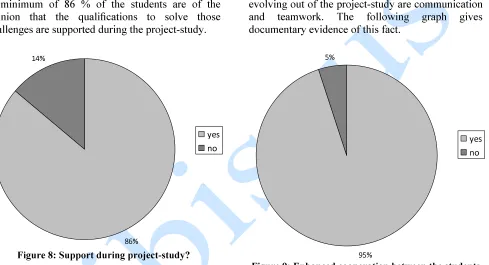
A minimum of 86 % of the students are of the opinion that the qualifications to solve those challenges are supported during the project-study.
14%
86%
yes no
Figure 8: Support during project-study? Some of the demands are embedded into situations. The students might not recognize them without being specially trained. Some students were not aware, that the project-study supports the communication between the students of the group, in the semester or in higher semesters. They were not aware that they were trained to ask acceptable (and precise) questions. Their answer given to a question in the questionnaire regarding this was, that they were not supported by the project-study; the single positive point had been the contact and the cooperation within the group and within the semester. So part of the support was existing, yet invisible to many of the students.9 The previous diagram with a
support felt by 86 % of the students was outperformed. This can be seen by the earlier diagram ”‘associate thinking and acting”’ showing that in this concrete case, every student is supported at least one time.
9 Though it was recognized by others, especially in
retrospect after finishing their studies and acquiring work experience where they observed a clear difference between their thinking and most of their colleagues'.
Furthermore, the novelty of the terms and aspects prevents a categorization within the questionnaire. In summary: the learning process, i.e. checking the correctness between thinking and acting, has not come to an end after one semester of project-study. Only 86 % of the students are aware of the invisible support when responding to the questionnaire.
The two following points could be included in the intellectual requirements. However, because they seem to be different, they are treated separately.
6. COMMUNICATION AND GROUP WORK
For an outsider, the most striking characteristics evolving out of the project-study are communication and teamwork. The following graph gives documentary evidence of this fact.
5%
95%
yes no
Figure 9: Enhanced cooperation between the students
They are not faced with the problem of having to treat the elder academics with kindness in their superior role. This is one point where the project-study is superior to a laboratory guided work, presuming there is a minimum initial understanding and mental access to the project.
7. INTEGRAL UNDERSTANDING OF THE FOLLOWING STUDY
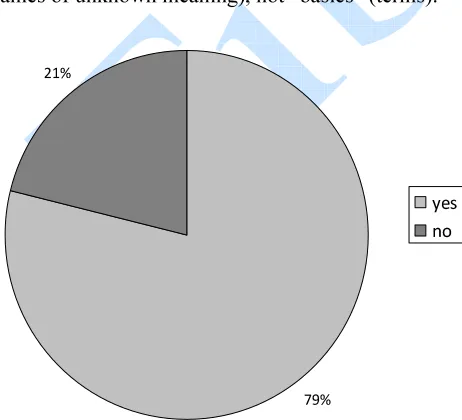
Generally, students in the first semester are not able to produce an integral and structural understanding of their course. They expect something from their course (and from their later job), and it seems that their expectations are mostly not met by their courses in the first semesters. The subjects of their expectations are not recognized by the students within the course. (In fact they appear in the course, but too abstract from concrete applications and divided into pieces, so a beginner is not able to reconstruct the puzzle from its parts.) This leads to the problems of lacking motivation, to frustration and finally to drop-out. The project-study, as constructed in this case, avoids this situation. 79 % of the students have an integral understanding over their course after the first semester of project-study. There are courses, where the integral understanding starts after four semesters. This is a consequence of a ”basic course” with ”basics” (without transfer to later work) in the first four semesters as a concept. If the methodological apparatus is missing, the lectures will not be transmitted to concrete situations; the processes of abstraction and of reconstruction from the pieces of the puzzle are disturbed. The lectured terms are in fact hieroglyphs for the learner (denotes names of unknown meaning), not ”basics” (terms).
21%
79%
yes no
Figure 10: Integral understanding over the contents of the following study after one semester of project-study
8. DROP-OUT
Causes for drop-outs are lack of motivation, self-doubt, and the students’ missing ability to act from ones own thinking (and not to be able to coordinate ones own thinking). The project-study, as described here, avoids these disturbances for up to 76 % of the students within the semester.
24%
76%
yes no
Figure 11: Thinking of drop-out
As a concrete example of how positive this chart can be seen, look at a comparable conventional study. After three semesters from the initially 100 % of the students, 86 % had left the course. In the investigation of drop-outs by Kosuch [Kos01] it was noticed, that the students typically had the thought of drop-out three semesters before the thought was translated into action. Only 24 % of the students at the end of the first semester now have thoughts of drop-out and are at risk.
Students who have chosen project-study in their own interest are less at risk then students in a conventional study. If one wants to solve the problem completely, one should implement a second day of project-study in the second half of the semester with projects on mathematics, physics and electrical engineering. Then the problem of drop-out would most likely not exist. The minimum is 20 % percent of study (a project day per week, lectures in key skills included). In Emden there had been between 1982 and 1987 less then 5 % of drop-outs in electrical engineering, from 1984 to 2001 the students in the lab of parallel processing starting with the fourth semester to the diploma thesis with about 350 students less than 0.3 % of drop-outs, and in Esbjerg [3] during the whole study as well less than 5 % of drop-outs. An erkenntnis-theoretical
The huge economic costs related to drop-outs in a conventional study make an erkenntnis-theoretical
project-study even more efficient in terms of increasing national welfare (not taking into account the social problems and individual financial costs to the students dropping-out, and ignoring the question, whether a faculty has to face the challenge at all to solve this problem more or less (see [2]).
9. THE IMAGE OF THE FHOOW FROM THE VIEW OF STUDENTS AFTER ONE
SEMESTER OF PROJECT-STUDY
Some student opinions after a project-study of one semester:
”Studying in Emden is top” (1.6.6 *2).
”Identification with the course and with the university of applied sciences” (1.2.3 20).
”High learning efficiency with a maximum of freedom” (1.5.2 22).
”I learned knowledge and had a lot of fun” (1.5.1 8). ”Unfortunately no [I learned nothing in participating], the only positive thing was the improvement of contacts to my fellow students and therefore the cooperation within the group” (1.5.2.3 25).
”I am convinced by the efficiency with respect to knowledge mediation.” (1.2.2 12).
”The project-study is the only ”subject”, with a lot of training and not until that time, one has really learnt it, one starts to learn something new” (1.3.1 35).
”The amount of support was really tremendous” (1.3.2 23).
”With respect to practice from now on the study will not fail anymore” (1.1. 28).
”Because the learning effect is higher” (1.6.7 *8). ”A different sort of learning, but it guides exceptionally to the later job” (1.3.1 3).
”The independent work was fascinating” (1.3.1 7). ”There is no better start into a course” (1.6.7 *10). ”Makes sense. Mainly during the first semester one needs the initial stages of learning and a lot of motivation” (1.6.7 *3).
”An ideal starting point” (1.6.7 *9).
”It makes sense! But in this project there is too much of key qualifications” (1.5.3.1 41).
”An altogether successful event. In comparison with conventional study the project study is sensitively superior at all. The project-study at the university of applied sciences opens an insight to the student into the area of computer science” (1.6.7 *13).
”If it is not offered at all any more, the most essential of the course is missing” (1.6.7 *2). ”I look at the world with different eyes!” (1.2.2 21). ”Phenomenal, to work and think independent (and have to do it)!” (1.2.3 7).
”Because I was lucky to join the project-study” (1.6.7 *14).
The distribution of positive and negative comments mirrors the distribution of general comments pro and con the project study (9:1 to 9.5:1).
On average, the statistics of expectations to the FHOOW looks well. Half of the students are content, and up to 90 % are at least partly content. If the worry around the understanding of mathematics is eliminated with a second project day starting in the middle of the semester, the result will look even better.
27% 22%
45% fulfilled
partly fulfilled not fulfilled
Figure 12: Expectations to the university of applied sciences FHOOW
A project-study will lead to a ”rise” in the number of students within six years by a factor of three, if it is continued. It is supported by word-of-mouth (examples: Emden Electrical engineering from 1982 to 1988; Esbjerg). When this rush will become visible, it is time to react on the new problem. The answers of students from the project-study in respect to the corporate identity of the FHOOW are convincing and within the range of plurality of individual responses nearly concurrent. An overwhelming vote to an erkenntnis-theoretical
project-study during the first semester (and following semesters) is proposed with this investigation.
American universities have a ranking in order to compare their teaching amongst themselves. The scale for the judgment of top universities from the view of students reaches 76 to 80 % approval (e.g. UNC Kenan-Flagler www.kenan-flagler.unc.edu, www.MBAscorecard.unc.edu/QEMStusurvey.html/) staying 5 to 10 % below the ranking of the
erkenntnis-theoretical project-study here (the results
participants in the sample. There is not enough financial support for a sample larger than 50 students in the experimental and the control group. One can take the resulting measurement error into account. The erkenntnis-theoretical project-study is
worldwide leading in its aspect for the process of learning in a basic course in the first semesters.
10. PERFORMANCE IN LEARNING (SHORT VERSION)
In the previous chapters, the opinions of the students10
were investigated. Additionally, the performance in five exams11 of the students involved in the
project-study and of those of the conventional project-study is compared12,13. The results of this comparison are
summarized in the following two charts.
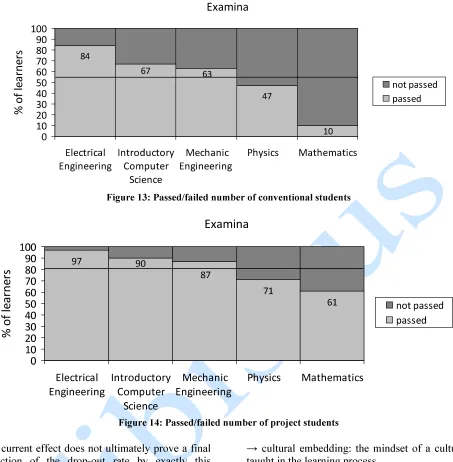
The upper (dark grey) part of the charts depicts the share of failed exams14. The conventional students
have passed considerably less exams (an average of 54 %) than the students involved in the project-study who passed with an average of 81 % (Fig. 14). The difference of the averages is an indicator of the performance in the short run of the superior understanding in an erkenntnis-theoretical
project-study. This even depicts the real situation in a rather optimistic way, because it only captures the students that took the exam and does not take into account the students that did not feel able to participate. As on average 53 % of the project study students participated in the exams and succeeded as compared to 15 % in the conventional study, the real impact of the project study on the exams is probably much larger.
In the long run, the students of a conventional study have to cope with the consequences of their unsolved problems (the “carpet of horror”). They have problems in understanding the ”basic” terms in the first semester, which are needed in the second
10 The students did not know the results of the exams
(exception: a part of ME) at the time of the survey.
11 The author did not know the exams; they are designed
independently (exception: ME und Mathematics); they are the same for students involved in the project-study and conventional students (same exams, same location, same time).
12 The conventional study group concerns mainly students
from a different subject (from Electrical Engineering, which
had the same lessons and exams together, but the students were not allowed to choose the project study. The students of the project study exclusively came from informatics.
13 In a comparison with the results of these exams from
previous years it was found, that the students from Electrical Engineering surpassed the students from informatics by 0.1 grades on a scale from 1 to 5 (which means basically no difference).
14 Only one of the sixteen conventional students has
passed exam mathematics. The percentage of students passing for subject mathematics can only be estimated.
and further semesters. These terms have to be learned again at the start of the second semester. By these means, they have to repeat a lot of exams at the end of the semester, while the study is going on. Their study is prolonged. They are not trained in key qualifications to manage the situation (make decisions of priority, communicate, ask questions). As known from former semesters, typically 62 % of them will drop-out.
The difference has larger consequences than is shown by the 27 % difference in the charts. The students taking part in the erkenntnis-theoretical
project-study are well prepared for their further studies. With a minimum share of 30 % of project-study, as known from other project studies, 90 % of them study within the normal time of study, and typically less than 5 % of them will drop out.
11 THE HIGH DROP-OUT RATE IN EARLIER FIRST SEMESTERS HAS BEEN
DRAMATICALLY IMPROVED
On the first project day (Programming II) of the second semester, 45 students of the first project-study from the first semester came to the course. In the first semester there were 46 students in the project. Nevertheless it has to be taken into account, that some students from the former second semester were taking part in the previous course and they might have already had the grade for Programming II, so they would not do it again.
From the project students of the previous first semester, two changed the area of study (to business administration at the same university). All others continue to study computer science. Additionally, there are a few students now from the third semester participating, as well as some students coming from the same area of study from other universities. The goal of reducing the drop-out rate has been achieved for the second semester: from 92 % (3 out of 37 beginners were continuing in the third semester in the year before the project study started) it has been reduced to below 4% (45 from 46 are left)15. This has already shown a high impact on the
curriculum: In the workgroup sessions of the second semester, the number of students has not been reduced by half or to a third, but stayed the same. So the workgroups now have to be taught in up to three parallel sessions or in larger rooms.
15 The effect is reached within one semester. At the time
Examina
47
10 67
84
63
0 10 20 30 40 50 60 70 80 90 100
Electrical
Engineering IntroductoryComputer Science
Mechanic
Engineering Physics Mathematics
%
o
f
le
ar
n
e
rs
not passed passed
Figure 13: Passed/failed number of conventional students
Examina
71
61 90
97
87
0 10 20 30 40 50 60 70 80 90 100
Electrical
Engineering IntroductoryComputer Science
Mechanic
Engineering Physics Mathematics
%
o
f
le
a
rn
e
rs
not passed passed
Figure 14: Passed/failed number of project students The current effect does not ultimately prove a final
reduction of the drop-out rate by exactly this amount. Nevertheless, the experiences from previous runs of a project study at FHOOW and in Esbjerg show exactly the same type of reduction in drop-outs as the numbers stated above suggest: After 6 years, the number of students for a given area of study triple, 90 % of them study in the minimum time necessary and the drop-out rate during the 8 semesters is below 5 %.
GLOSSARY
→ assessment of students: the judgment of the students with or without practical experience. → "content consumption": a consequence of the mindset of a → linear learning model. Follows a special → metaphysics of the curriculum
→ conventional learning: essentially characterized by frontal lessons and lectures generated without actions
→ cultural embedding: the mindset of a culture is taught in the learning process.
→ dissertations: PhD thesis. At present, typically 250-350 pages, after intensive confrontation developed with a theme. Approved by a faculty. → epistemology: science field after Ernst Mach, extracted using history of the documented cases and then generalized.
→ expectations: Judgment of the students without practical experience. Expectation of this form of teaching: assessment of students with no practical experience.
→ experience with different teaching methods: student opinion on a lesson forms the basis of concrete experience, for example, in hours.
→ Gestalt psychology: erkenntnis area, proposed
→ holistic meaning: The study results-oriented project is a holistic (monist) approach after Ernst Mach. The holistic approach requires that the approach does not use Specialization (Wittenberg), known as something unusual in science operation. → integration: embedded in a cultural context. → laboratory test: usually defined by a script with a fixed test set Number of questions.
→ linear learning model, contrary to a genetic model of learning. If the learning of linear contexts from.
→ metaphysics of the curriculum: The prerequisites for a curriculum in a culture set, it is the (often implicit) a priori. You should be disclosed.
→ communicated elsewhere content: A trade is defined out of his curriculum. Medium are content if they are classified by the learners in this way. → moderate test: specific task without high linguistic or grammatical requirements. The student knows, after reading the job, now what is sought. → number of publications: →publications
→ perceptual illusion of learners: A perception of the learner through empirical (statistics) refuted. → physics laboratory experiments with fixed, is well worked through an anchor for student understanding.
→ physiology: Perception of the human senses. → physiophysics: a field of science that the human sense organs and their function start.
→ pre-conceptions: an early non-logical term build for example by Gestalt.
→ pre-terms "learning rate" and "difficulty of the experiment" with students have experience outside of the experiment, the influence of these terms. → psychophysics: holistic science of Ernst Mach defined area.
→ publications: A defined scientific measure of surface activity, capture neither value nor depth the ideas contained.
→ reality experienced only in excerpts and in the categories of human perception
→ saturation value for learning in concentration → students with foreign roots and the culturally disadvantaged parents
→ test instructions: a script in which the idea of a student to work through should form, are summarized.
→ thesis, author: One of the authors
→ transfer report. A work in which students qualify for a deviation in England
→ trust: basic requirement that it maintain the learning or the experience to play
→ develop learning pre-conceptions: original form of individual thought; contrast: eidetic playback → worldview that gradually builds up and is refined. Fits into categories.
NOTE
We are in addition to the students who participated in the study, the research project for funding committed Best4HEL to produce the drawings, the following people to thank for their support: Dr. Blomeyer, Prof. Jaudzims, Franziskus Sauer (HTW), Dr . Karsten Wolke, Dr. Konstantin Yermashov, Rolf Rasenack (3 of the tutors), Tanja Snaikus (organization of the project study in semester 1), Christian Abt, Dr. Doris Ressmann (both math tutorial), Dr. Hussein Zedan, Dr. Hongji Yang and the staff of the STRL, De Montfort University Leicester (PhD).
REFERENCES
[HKS01]
Karl Hayo Siemsen, Gerhard
Kreutz,
Rolf
Socher
- Projektorientiertes Studium im 1. Semester Informatik, Entwurf vom 29.01.2001 V1.5, Datei ”1.PDF” [Kos01]Renate Kosuch
- Studienabbruch inden Fachbereichen Elektrotechnik und
Informatik sowie
Natur-wissenschaftliche Technik:
Untersuchung der Ursachen -Vorlage von Empfehlungen , März 2001 [KE94]
Finn Kjersdam, Stig Enemark
- TheAalborg Experiment, Project
Innovation in university education, Aalborg University Press, ISBN 87-7307-480-2, 1994.
[Sie81]
Karl Hayo Siemsen
-Genetisch-adaptativ aufgebauter
rechnergestützter
Kleingruppen-unterricht, Lang, Frankfurt, Bern 1981
[Wag70]
Martin
Wagenschein
-Ursprüngliches Verstehen und exaktes Denken, Klett, Stuttgart 1970