COMMUNICATION PATTERNS AND DIMENSIONS OF PARENTING: A CORRELATIONAL STUDY
1,
*Shree Krishna P. V. and
1
Ph.D. Research Scholar, Psychology, CERSSE, Hebbal, Jain University, Bangalore, India
2Professor and Head, Post Graduate Department
ARTICLE INFO ABSTRACT
Parents play a vital role in nurturing and educating their children. In the process of rearing a child, parenting dimensions varies from one individual to another; and found to be different amongst ‘father’ and ‘mother’. Having come from different backgrou
system, mode of thinking, attitudes, childhood experiences, and perception which reflects in the child. The focus of the present study is to know the communication patterns among parents of tenth grade students and t
dimensions of parenting. It was hypothesized that there is no relationship between communication patterns of parents and dimensions of parenting. The sample comprises of
adolescent parents, drawn from Bangalore city, using purposive sampling technique. The participants were administered Multi
on communication patterns of paren
child communication. Data was analyzed using Correlation to establish the relationship between communication patterns and dimensions of parenting. The study indicates that enhancing positive dimensions of parenting is related to the capacity of the parents to communicate a variety of Themes with their children. This study would significantly contribute in understanding the dynamics of parenting and suggests methods to enhance positive dimensi
Copyright © 2015 Shree Krishna and Shailaja Shastri.
unrestricted use, distribution, and reproduction in any medium, provided the original work is properly cited.
INTRODUCTION
Parents play a fundamental role in fostering and educating their children at every walk of their life until they are matured enough to take care of themselves. Children imbibe the values, principles, attitudes, behavior, personality, morality, social skills and communication patterns from their parents. Parents are the first teachers for children, as the child grows in the family; it observes, listens and imitates parents irrespective of good or bad behaviour exhibited by their parents. The personality of a person is shaped in childhood, which becomes his or her trait for lifetime in their respective family. Members of the family play a key role in shaping child’s character,
growth and development physically, mentally and
sociologically. According to Desai (1994) Family may be broadly defined as a unit of two or more persons united by marriage, blood, adoption, or consensual union, in general consulting a single household, interacting and communicating with each other (as cited in Sonawat, Reeta. 2001). Other members like aunt, uncle, grandparents, or any other members related directly or indirectly help in shaping the personality of a child and send them to competent world. Hence, as per Sriram (1993) family is considered as basic and important unit of
*Corresponding author: Shree Krishna P. V.
Ph.D. Research Scholar, Psychology, CERSSE, Hebbal, Jain University, Bangalore, India.
ISSN: 0975-833X
Article History:
Received 29th January, 2015
Received in revised form 16th February, 2015
Accepted 23rd March, 2015
Published online 30th April,2015
Key words:
Tenth grade students, Parents,
Dimensions of parenting, Communication of parents, Themes and styles.
RESEARCH ARTICLE
COMMUNICATION PATTERNS AND DIMENSIONS OF PARENTING: A CORRELATIONAL STUDY
Shree Krishna P. V. and
2Shailaja Shastri
Ph.D. Research Scholar, Psychology, CERSSE, Hebbal, Jain University, Bangalore, India
Professor and Head, Post Graduate Department of Psychology, SGS, Jain University, Bangalore, India
ABSTRACT
Parents play a vital role in nurturing and educating their children. In the process of rearing a child, parenting dimensions varies from one individual to another; and found to be different amongst ‘father’ and ‘mother’. Having come from different backgrounds, they are different in their belief system, mode of thinking, attitudes, childhood experiences, and perception which reflects in the child. The focus of the present study is to know the communication patterns among parents of tenth grade students and to identify the level of significance on negative dimensions of parenting over positive dimensions of parenting. It was hypothesized that there is no relationship between communication patterns of parents and dimensions of parenting. The sample comprises of
adolescent parents, drawn from Bangalore city, using purposive sampling technique. The participants were administered Multi-dimensional Parenting Scale (1985) and a self
on communication patterns of parents with respect to Themes and styles per se., to assesses parent child communication. Data was analyzed using Correlation to establish the relationship between communication patterns and dimensions of parenting. The study indicates that enhancing positive dimensions of parenting is related to the capacity of the parents to communicate a variety of Themes with their children. This study would significantly contribute in understanding the dynamics of parenting and suggests methods to enhance positive dimensions of parenting.
Shree Krishna and Shailaja Shastri. This is an open access article distributed under the Creative Commons Att use, distribution, and reproduction in any medium, provided the original work is properly cited.
Parents play a fundamental role in fostering and educating their children at every walk of their life until they are matured enough to take care of themselves. Children imbibe the values, principles, attitudes, behavior, personality, morality, social s and communication patterns from their parents. Parents are the first teachers for children, as the child grows in the family; it observes, listens and imitates parents irrespective of good or bad behaviour exhibited by their parents. The person is shaped in childhood, which becomes his or her trait for lifetime in their respective family. Members of the family play a key role in shaping child’s character,
growth and development physically, mentally and
1994) Family may be broadly defined as a unit of two or more persons united by marriage, blood, adoption, or consensual union, in general consulting a single household, interacting and communicating with each other (as cited in Sonawat, Reeta. 2001). Other members like aunt, uncle, grandparents, or any other members related directly or indirectly help in shaping the personality of a child and send them to competent world. Hence, as per Sriram (1993) family is considered as basic and important unit of
Ph.D. Research Scholar, Psychology, CERSSE, Hebbal, Jain
society because of the role it plays in generation of human capital resources and the power that is vested in it to influence individual, household, and community behavior (as cited in Sonawat, Reeta. 2001). Upbringing of the child in a positive healthier manner brings name, fame not only to their family but also to their school, community and country. According to Chandola, Anitha and Bhanot, Suman (2008) family is regarded as “nursery of socialization” and is formed in all societies with varying nature and composition and one of the important components of the family system is parenting as stated by
Modernity has brought everything around us to extreme changes. Therefore, the parenting tips that worked for parents many years ago require modifications to work for twenty century parents. In the views of Sharma, S. Pooja. (2012) parenting method for the upbringing of prese
children requires the core values of the past with the present. Brooks, (1987) says that parenting
process or the state of being a parent (as cited in Chan, B.M.Y. 2000). Once you have a child,
of parenting. Whereas, Morrison, G. S. (1978) put forward as is the process of developing and utilising the knowledge and skills appropriate to planning
rearing or providing care for offspring (as cited in Chan, B.M.Y. 2000). Sachdeva, Neeti. and Misra, Girishwar. (2008)
International Journal of Current Research
Vol. 7, Issue, 04, pp.15127-15134, April, 2015
OF CURRENT RESEARCH
COMMUNICATION PATTERNS AND DIMENSIONS OF PARENTING: A CORRELATIONAL STUDY
Ph.D. Research Scholar, Psychology, CERSSE, Hebbal, Jain University, Bangalore, India
of Psychology, SGS, Jain University, Bangalore, India
Parents play a vital role in nurturing and educating their children. In the process of rearing a child, parenting dimensions varies from one individual to another; and found to be different amongst nds, they are different in their belief system, mode of thinking, attitudes, childhood experiences, and perception which reflects in the child. The focus of the present study is to know the communication patterns among parents of tenth grade o identify the level of significance on negative dimensions of parenting over positive dimensions of parenting. It was hypothesized that there is no relationship between communication patterns of parents and dimensions of parenting. The sample comprises of one hundred and five adolescent parents, drawn from Bangalore city, using purposive sampling technique. The participants dimensional Parenting Scale (1985) and a self-designed survey questionnaire ts with respect to Themes and styles per se., to assesses parent-child communication. Data was analyzed using Correlation to establish the relationship between communication patterns and dimensions of parenting. The study indicates that enhancing positive dimensions of parenting is related to the capacity of the parents to communicate a variety of Themes with their children. This study would significantly contribute in understanding the dynamics of
ons of parenting.
is an open access article distributed under the Creative Commons Attribution License, which permits
society because of the role it plays in generation of human capital resources and the power that is vested in it to influence individual, household, and community behavior (as cited in Upbringing of the child in a positive healthier manner brings name, fame not only to their family but also to their school, community and country. According to itha and Bhanot, Suman (2008) family is regarded as “nursery of socialization” and is formed in all societies with varying nature and composition and one of the important components of the family system is parenting as
rything around us to extreme changes. Therefore, the parenting tips that worked for parents many years ago require modifications to work for twenty-first century parents. In the views of Sharma, S. Pooja. (2012) parenting method for the upbringing of present generation children requires the core values of the past with the present. (1987) says that parenting could be defined as a process or the state of being a parent (as cited in Chan, B.M.Y. you are involved in the process of parenting. Whereas, Morrison, G. S. (1978) put forward as it process of developing and utilising the knowledge and for, creating, giving birth and or providing care for offspring (as cited in Chan, Sachdeva, Neeti. and Misra, Girishwar. (2008)
are of the opinion that the process of parenting should not be restricted to the relationships between parents and their biological offspring, but individuals need to take an active role in the process of helping a child to grow and develop. Kang, T. and Jaswal, (2006) define parenting as a single minded, unconditional desire to provide a loving and caring home. It is the parents who exert the major influence on the development of the child from birth to maturity. Parenting is a complex, multifaceted phenomenon, however, encompassing a wide range of functions related to nurturing, discipline, stimulation, values, activities and routines – as stated by Lindsay, P. Chase-Lansdale. and Pittman, D. Laura. (2002). In the words of Chan, B.M.Y. (2000) there are some characters of parenting - First of all, with the advance of medical knowledge and technology, parenting becomes a choice in life. Secondly, being a parent is a life-long commitment. Thirdly, it involves responsibilities as parents are responsible to take good care of their children physically as well as psychologically. Lastly, parenting involves not just the couple but all the family members since the birth of a child affects the whole family. Thus, the responsibility shoulders primarily on the parents to make the child physically, socially and psychologically adaptable to different facets of life.
Parenting behaviour is a complex network of many variables which exert greater influence on parenting patterns. The communication process exhibited by the parent towards their adolescent children leads to adverse behaviour in children. According to Okorodudu and Omoni (2005) psychological tensions and emotional disturbances at home may drive the adolescents away from home or school and have the potentials of exposing them to negative associations. Personal performance both at home and in the public may be affected (as cited in Okorodudu, Grace Nwamaka, 2010) Darling, Nancy. (1999) says that for decades, psychologists have been interested on how parents influence the development of children’s social and instrumental competence since 1920s, one of the approaches to this area is the study of what is called as parenting style.
In a family, communication is considered to be an important aspect of parenting. Communication is a message that is given to another. Communication is the process of transferring messages from one person to another and it has several forms such as interpersonal, intrapersonal, group and mass communication using words, sounds, signs, or behaviors to express ideas or exchange information, thoughts, feelings, outlook or view. Communication is opinionated through verbal, written or gestural languages between parent-child, spouse or family members. The term 'Communication' has been derived from the Latin word 'communis' that means 'common'. Thus 'to communicate' means 'to make common' or 'to make known'. This act of making common and known is carried out through exchange of thoughts, ideas or the like. The exchange of thoughts and ideas can be had by gestures, signs, signals, speech or writing. People are said to be in communication when they discuss some matter, or when they talk on telephone, or when they exchange information through letters. Basically, communication is sharing information, whether in writing or orally. Communication patterns in families refer to repeated interaction among family members with respect to
theme and styles. In the views of Vangelisti (1993, as cited in Caughlin, P. John. and Allison, M. Scott. 2008) a single family member's communication behaviors over time can be patterned, but family communication scholars tend to focus on patterns among family members. Communication patterns can also be said as modes of communication that has been used between parents and children or with certain people in diverse situations. Some patterns may be common, that is, appearing in most communications despite of the circumstances, while many are situation-specific, that is, practiced with certain people (friends, spouse, children, etc..) or in certain situations (at work, in conflict, in fear, etc..). Communication is an element of supportive care, where as communication strategy is a well-planned series of actions aimed at achieving certain objectives through the use of communication methods, techniques and approaches has been said in a PCSD hand book prepared by Mefalopulos, Paolo. and Kamlongera, Chris. (2004).
In the views of Hannon (1999) parents are the main channel in providing a healthy environment for the family. Clear communication between spouse, parents and children has been found to provide an opportunity for parents to interact with family members and also to be involved in their children’s education. Parents who adopt two-way communications allow the children to mingle and exchange views on knowledge and also provide space for them to express their opinions (as cited in Abd. Razak Bin Zakaria et al., 2013). As Per cooper, et al. (2006) previous studies have found that families characterized by healthy communication at home not only strengthen family ties but also help to improve personal and emotional development of children and their academic achievement (as cited in Abd. Razak Bin Zakaria et al., 2013). Hence skills of communication would be considered as an essential component to keep a healthy relationship among members of the family, in large for upbringing children.
Parenting dimension is a specific trait exhibited by parents during the processes of rearing their offspring. Parents may either imbibe the communication pattern from their parents which is carried on generations by generations believing that their parents were the best in raring them or they would communicate based on self experiences in their children. Parenting attributes could be positive or negative in nature, a distinct positive attribute found and practiced in one parent could not be the same in another parent similarly, negative too. In total, frequently exhibited characters dominates and are put into usage thinking that it is correct way of parenting by such parents. Parenting dimension attempts to separate positive and negative aspects of parenting from one another.
As stated by Skinner, Ellen et al., (2005) parenting dimensions, is also defined as the features, the qualities, the descriptive scheme used to capture the nature of parenting, represent one set of building blocks on which the study of parenting is built. Broad meaning of parenting dimensions varies based on the requirement, context, comparability between positive and negative tasks and accumulated knowledge about parenting. Chauhan and Khokhar, (1985) says that parenting is a role-ship of the institution of family, related to the upbringing of the child. The positive interactions help the child in their
actualization of ‘I am, what I will be’ Parents are acting as key-models’ to guide and educate them. Parents play a vital role in nurturing and educating their children. In this process of rearing the child, parenting dimensions varies among individuals. “Bestowal of love, acceptance, independency, encouragement, democratic way of dealings, dominance, progressivism and parenting as whole, constitutes the positive parenting. Parenting, based on faulty reality-value-assumptions’ and ending in hate, rejection, dependencey, discouragement, autocratism, submission, conservatism and parenting as whole, could be termed deviant or negative parenting. The child turns into a parasite and an insecure entity” as opined by Chauhan and Khokhar, (1985).
The focus of the present study is to know communication pattern among parents of tenth grade students and identify parent’s significance level towards negative dimensions of parenting over positive dimensions. This may in turn help their children to have a sense of security, acceptance, guidance and develop positive behavioural trait in every activity involved and to be successful in all walks of life.
Research focus
To study the relationship between parenting dimensions and the communication patterns engaged by parents with their children.
Research Question
Is there a relationship between communication patterns and the dimensions of parenting adopted?
Hypothesis
There is no relationship between communication patterns of parents and dimensions of parenting.
Sample
The sample for the current study was collected using purposive sampling technique from one hundred and fifty parents (both mother and father), of which taking in to account completely filled questionnaires one hundred and five adolescent parents (both mother and father) were considered whose children are studying in grade ten based on the criteria formulated. The criteria for selection of sample are listed below:
Only parents who have biological children were considered
All the participants would be residents of Bangalore city
All the participants would have at least one child studying in grade tenth
The selection was made, if only both the parents (father and mother) were willing to participate voluntarily
Only parents who have answered all the questions were considered
Variables
After reviewing the available literature and considering other factors such as feasibility, availability of proper techniques and instruments the following variables were considered.
Dependent Variable
Dimensions of parenting
Independent Variable
Communication patterns of parents
Themes
Styles
Operational Definitions
1. Tenth grade students- Students, who will be appearing for board examination of grade ten (State Board, CBSE and ICSE)
2. Parent- Father or mother of the tenth grade child, biologically blood related
3. Parents- Refers to biologically related father and mother of tenth grade child
4. Dimensions of parenting- Dimensions of parenting are a measure of parental behavior in terms of mothering and fathering for the two ‘ends’ (positive and negative) on seven dichotomous dimensions and eighth would be parenting as a whole. The dimensions of parenting are considered separately for father and mother :
a. Positive dimensions
i. Love, Encouragement, Acceptance, Independency, Democratism, Dominance, Progressivism
ii. A total score on positive dimension is also computed (parenting as whole)
b. Negative dimensions
i. Hate, Discouragement, Rejection, Dependency,
Autocratism, Submission, Conservatism
ii. A total score on negative dimension is also computed (parenting as whole)
5. Communication of parents- It refers to communication patterns adopted by parents with respect to theme and styles to speak and listen to their children.
Themes- An idea or message discussed in an expanded manner. This refers to the variety of issues that the parent dialogues with their children. A low score on this scale indicates that parents are unable to talk to children on a variety of issues.
Styles- The way in which parents perform or express their feelings and communicate with their children. This refers to the manner in which the parents engage in conversations with their children. This even includes the nature of non verbal patterns. A low score on this scale indicates that parents are more rigid and restricted in their styles.
Tools
reviewing it; and keeping definite required trait in mind for existing study, Multi-dimensional parenting scale adopted and developed by Chauhan and Khokhar, (1985) was chosen for the current study, as it was found to be more appropriate, convincing and addressed major attributes. Similarly, it has been observed all the available questionnaires on communication patterns of parenting were also discarded due to the fact that they were not in ordinance with the study required with respect to Indian context. Hence, a self designed survey questionnaire on communication patterns of parents was constructed keeping in mind the required attributes on parenting (child-parent communication) and the same was used for the current study.
The two different questionnaires are
a. Standardized multi-dimensional parenting scale by Chauhan, N. S. and Khokhar, C. P. (MDP-SCALE, 1985)- MDP-SCALE (refer appendix 1) measures parental behaviour in terms of ‘mothering’ and ‘fathering’ for the two ‘ends’ of the seven dichotomous dimensions and the eighth would be parenting as a whole (ie. positive and negative). It is a five point rating verbal scale consist of 56 items for seven areas and as a whole. Measures for mothering and fathering on the two dimensions was obtained by following the keys and scoring norms on the areas as given in Table 1.
Table 1. Dimensions of parenting
S.No Positive dimensions Negative dimensions 1. Love Hate
2. Encouragement Discouragement 3. Acceptance Rejection 4. Independency Dependency 5. Democratism Autocratism 6. Dominance Submission 7. Progressivism Conservatism 8. Parenting as whole Parenting as whole
b. Survey Questionnaire on communication patterns of parents: It is a self-designed survey questionnaire (refer appendix 2) to assess parent-child communication patterns with respect to themes and styles adopted by parents for speaking and listening with their children. It is a five point rating verbal scale consists of twenty five items in two areas of communication on different themes (twelve items are related to teenager’s parent-child communication on everyday-to-day life situations) and styles (thirteen items are related to teenager’s parent-child styles of communication). Validated measures are obtained by following the keys, norms and scoring is done in the given areas.
The questionnaire has been pre-tested by conducting pilot study with a sample size of thirty parents and the data has been collected from grade tenth parents of Bell academy, Vijaynagar, Bangalore. After obtaining the responses from parents, the questionnaire has been scrutinized. Few questions have been restructured. Validity has been computed for survey questionnaire on parental communication patterns. The measure of the reliability, using Cronbach’s alpha (α), is
computed and the obtained value of 0.823 for the questionnaire is considered as reasonable degree of reliability.
Procedure
Adolescent parents were met in neighborhood and several tutorials where their wards were enrolled in Bangalore city. Parents of these children were invited to be a part of this study and only parents who volunteered were considered. Psychometric test multi-dimensional parenting scale by Chauhan and Khokhar, (1985) and self designed survey questionnaire on communication patterns of parents were administered with appropriate instruction and explanation. Rapport building with parents before administering helped to maintain uniformity in the administration procedure.
RESULT AND DISCUSSION
The present study investigated Positive & Negative dimensions of parental behaviour in terms of ‘mothering’ and ‘fathering’ for the two ‘ends’ of the seven dichotomous dimensions & parenting as whole using Multi-dimensional parenting scale by Chauhan and Khokhar, (1985). The communication pattern of parents with respect to themes and styles adopted by parents to speak and to communicate with their children was also assessed by self designed survey questionnaire on Communication patterns of parents. Data collected through the questionnaires were analyzed to meet the purpose of the study. Pearson’s correlation method was adopted to examine the relation. The results and the output have been generated by using SPSS 16 version.
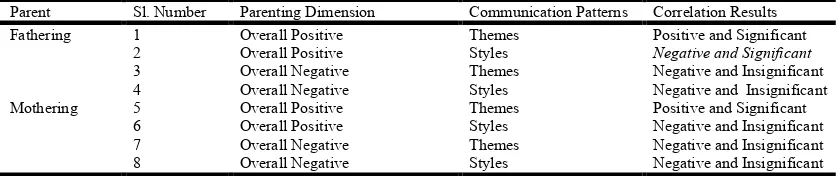
The Table 2 indicates that there is a significant positive relationship between the communication patterns linked to the themes discussed with positive parenting dimensions amongst mother and father. On the other hand the correlation is negative and significant, in case of positive parenting dimension and styles of communication only in case of paternal score. This relationship in the case of maternal scores is negative; however it is not statistically significant. Whereas, father and mother negative parenting dimension with themes and styles of communication patterns is also found to be statistically insignificant.
As per Steinberg et al. authoritative parents have been associated with many positive outcomes of children including strong academic achievement (as cited in Stewart, Mahtani. Sunita et al., 1998). From Table 3 findings could be illustrated that father or mother who engaged in a positive parenting style, were able to engage on varied issues with respect to themes along with their children. If parents of tenth grade practice and exercise positive parenting style such as Love, Encouragement, Acceptance, Independency, Democratism, Dominance, and Progressivism; it gives scope for communication on varied issues of themes such as academic, discipline, sports, politics, society, inventions, positive life style, etc, as their children are at the crucial point of their future and this would foster the child to be more balanced and leads to all-round development of child. Communication, protection and unconditional love among members of family develop social confidence and multiple skills among children.
According to Sandhu and Tung, (2003) positive interactions in the family, are associated with better psychosocial functioning, while negative generate negative outcomes (as cited in Mathur, Madhu. 2007).
Interestingly, from table 3 the study also revealed that parents in spite of being positive in their parenting dimension they are more rigid and restricted in their styles of communication. This is indicated by the negative correlation both for father and mother. However, the coefficient of correlation is significant only in the case of paternal scores. Although, father is positive in his approach, the study indicates that father needs to be more expressive in his styles of communication so that he is more approachable and could create comfortable zone to his children. Supported study has been illustrated: As Per
Fitzpatrick and Vangelisti, (1995) there are differences between the way mothers and fathers communicate with children. Sons often relate to fathers and model after them, one such example is father’s communication patterns (as cited in McNaughton, Jessica. 2000). In addition, fathers appear more authoritarian than mothers in the rearing of sons (Block, 1983, as cited in McNaughton, Jessica. 2000). Whereas, father-daughter relationship would be warmth. These types of responses could be interpreted as modelling a need for power by emphasizing control over situations. Mothers tend to use a different style when communicating with their children. For instance, mothers tend to speak to sons in an active manner, focusing on the son’s activities rather than on problems and solutions (Fitzpatrick and Vangelisti, 1995. As cited in McNaughton, Jessica. 2000). Mothers initiate more interactions by asking questions and tend to focus on the recognition and acceptance of the child’s opinions (Fitzpatrick and Vangelisti, 1995, Stewart, Cooper, Stewart, Cooper, Stewart and Friedley,
1996. As cited in McNaughton, Jessica. 2000). Communication styles by mothers give daughters a model of empathic conversation to follow. As Per Leaper et al. (1989) parents generally use “communications that emphasize closeness with daughters and separation with sons.”
Communications that emphasize closeness could include statements of love and praise while communications that emphasize separation could include criticism (as cited in Mc Naughton, Jessica. 2000). There are also findings of differences in parent-son communication versus parent-daughter communication. Conflicts and other interactions with females in families involve more mutual discussion, expression and negotiation and less avoidance and withdrawal while interactions with males involve more coercion (Fitzpatrick and Vangelisti, As cited in McNaughton, Jessica. 2000). Moumeni and Amiri (2008) says that some parents believe in independent and disciplined behaviours. They encourage verbal communications and have always a reason when they prohibit their children from doing something, or expect them to do something else. (as cited in Fariba, Shahhraki. Sanavi et al., 2013). Whereas Kapoor (2007) found that authoritarian parenting styles was prominent among mothers and were using during child rearing practices on their sons and daughters. On the other hand, fathers were using similar positive dimensions on sons and daughters. They were also using similar negative dimensions except conservatism, as they were found to be more conservative towards their daughter as compared to sons (as cited in Kang and Jaswal, 2011).
[image:5.595.45.557.87.178.2]The finding of the current study, in addition, indicates that the patterns of communication engaged by parents with their children vary significantly with positive dimensions of parenting. Therefore communication styles engaged by parents with their children and positive dimensions of parenting are associated strongly to each other. Kang, T. and Jaswal, S. (2011) discussed that mothers were more loving, encouraging, accepting and progressive towards sons as compared to daughters. They were using all the negative dimensions of parenting with more intensity on daughters as compared to sons. They were more hating, rejecting, authoritarian, discouraging and conservative towards their daughters. They also encouraged submissive-ness and dependency in daughters as compared to sons. Henry (1977) reflect that Parenting with
Table 2. Correlational value between dimensions of parenting vs communication patterns
FATHER MOTHER
Multi-dimensional parenting scale Positive Dimension Negative Dimension Positive Dimension Negative Dimension Communication patterns of parents Themes Styles Themes Styles Themes Styles Themes Styles Pearson Correlation .438** -.281** -0.13 -0.057 .469** -0.182 -0.169 -0.095
Significant (2-tailed) 0.01 level 0.01 level NS NS 0.01 level NS NS NS
N 105 105 105 105 105 105 105 105
Note: a. **. Correlation is significant. b. NS: Not Significant.
c. N: Total No. of subject participated.
Table 3. Summary of relationships between parenting dimensions and communication patterns
Parent Sl. Number Parenting Dimension Communication Patterns Correlation Results Fathering 1 Overall Positive Themes Positive and Significant
2 Overall Positive Styles Negative and Significant
3 Overall Negative Themes Negative and Insignificant 4 Overall Negative Styles Negative and Insignificant Mothering 5 Overall Positive Themes Positive and Significant
[image:5.595.92.511.214.302.2]appropriate communication would plays pivotal role in determining parenting patterns used by parents
(as cited in Kang and Jaswal, 2006). Parents who are better educated and trained have a tendency to be more helpful in training and educating tenth grade children in all their future endeavors.
Conclusion and recommendation
It could be concluded that enhancing positive dimensions of parenting is related to the capacity of the parents to communicate a variety of themes with their children. This study would significantly contribute in understanding the dynamics of parenting and suggests methods to enhance positive dimensions of parenting. So, it could be inferred that there is a relationship between communication patterns of parents and dimensions of parenting.
Based on the researcher’s finding it could be suggested as
• An intervention programme for parents on communication patterns with respect to themes and styles; and counseling on parenting could be taken forward to enhance positive dimensions of parenting and communication patterns of parents.
• Specific modules could be developed and training to parents with definite time duration will improve parent-child communication and parenting strategy, so that tenth grade child’s academic performance and personality trait will also improve by counseling parents at regular intervals of time on upbringing their children.
REFERENCES
Abd. Razak Bin Zakaria., Zuwati, Hasim., Umi Kalsum, Mohd Salleh., and Jal Zabdi, Mohd Yusoff, 2013. Family context and its relationship with parental involvement in the education of secondary school children. International
Journal of Asian Social Science, Vol. 3, No. 4 pp.
1063-1076. Retrieved from http://www.aessweb.com/pdf-files/ijass-3(4)-1063-1076.pdf
Caughlin, P. John. and Allison, M. Scott, 2008. Family communication patterns. The International Encyclopedia of
Communication. doi: 10.1111/b.9781405131995.2008.x
Chan, B.M.Y. 2000. Challenges to Parenting: The Local Scene. Child Assessment Service, Department of Health, Hong Kong, China. Proceding, page 182-184. Retrieved from http://www.hkjpaed.org/pdf/2004;9;182-184.pdf Chandola, Anita. and Bhanot, Suman, 2008. Role of Parenting
Style in Adjustment of High School Children. J. Hum.
Ecol., 24(1): 27-30 (2008). Retrieved from
http://www.krepublishers.com/02-Journals/JHE/JHE-24-0- 000-000-2008-Web/JHE-24-1-000-000-2008-Abst- PDF/JHE-24-1-027-08-1733-Chandola-A/JHE-24-1-027-08-1733-Chandola-A-Tt.pdf
Chauhan, N.S., and Khokhar, C.P. 1985. Manual for multi-dimensional parenting scale. Meerut: MAAPA publication. Darling, Nancy. 1999. Parenting Style and Its Correlates.
Source: The ERIC Clearinghouse on Elementary and Early
Childhood Education. Retrieved from
http://www.athealth.com/Practitioner/ceduc/parentingstyles .html. Jan, 25th 2011.
Fariba, Shahhraki. Sanavi., Abdolvahab, Baghbanian., Mehdi, Faraji. Shovey. and Alireza, Ansari-Moghaddam, 2013. A study on family communication pattern and parenting styles with quality of life in adolescent. Journal of Pakistam medical association, (JPMA) Vol. 63, No. 11, 1393-1398. Retrieved from http://www.jpma.org.pk/Pdf Download/5189.pdf
Kang, T. and Jaswal, S. 2006. Relationship of parental education with parenting patterns. J. Hum. Ecol., 20(2): 87-89 Retrieved from http://www.krepublishers.com/02- Journals/JHE/JHE-20-0-000-000-2006-Web/JHE-20-2- 000-000-2006-Abstract-PDF/JHE-20-2-087-089-2006- 1322-Kang-T/JHE-20-2-087-089-2006-1322-Kang-T-Text.pdf
Kang, T. and Jaswal, S. 2011. Gender Bias as Correlate of Parenting, Stud Home Com Sci, 5(2): 131-133. Retrieved
from
http://www.krepublishers.com/02-Journals/S- HCS/HCS-05-0-000-11-Web/HCS-05-2-000-11-Abst- PDF/HCS-05-2-131-11-107-Kang-T/HCS-05-2-131-11-107-Kang-T-Tt.pdf
Lindsay, P. Chase-Lansdale. and Pittman, D. Laura. (2002). Welfare Reform and Parenting: Reasonable Expectations. Journal Issue: Children and Welfare Reform Vol. 12, No. 1. Winter/Spring. Retrieved from http://futureofchildren. org/publications/journals/article/index.xml?journalid=43&a rticleid=182§ionid=1191
Madhu, Mathur, 2007. Social Skills Problem in Children: A study of parenting practices, Journal of Indian Health Psychology, ISSN: 0973-5755, Vol. 1, No. 2. Retrieved
from http://globalvisionpub.com/globaljournal
manager/pdf/1378554213.pdf
McNaughton, Jessica. 2000. Gender Differences in Parent Child Communication Patterns. UW-La Crosse JUR,
Volume III (2000), 25-32 Retrieved from
http://murphylibrary.uwlax.edu/digital/jur/2000/mcnaughto n.pdf
Okorodudu, Grace Nwamaka, 2010. Influence of parenting styles on adolescent delinquency in delta central senatorial district. Edo Journal of Counselling, Vol. 3, No. 1.
Retrieved from http://www.ajol.info/index.php/
ejc/article/viewFile/52682/41286
Paolo, Mefalopulos. and Chris, Kamlongera. 2004. Participatory communication strategy design (2nd ed.). Retrieved from ftp://ftp.fao.org/docrep/fao/008/y5794e/y 5794e00.pdf
Razali, Asbah and Razali, Nur Azah, 2013. Parent-Child Communication and Self Concept among Malays Adolescence. Asian Social Science; Vol. 9, No. 11; ISSN 1911-2017 E-ISSN 1911-2025. doi:10.5539/ass.v9n11p189 Razali, Asbah. 2013. Exploring Communication Differences between Children and Their Parent: A Report Using Qualitative Methods. International Journal of Management and Social Sciences Research (IJMSSR) Vol. 2, No. 12. Retrieved from http://www.irjcjournals.org/ijmssr/Dec 2013/1.pdf
Sachdeva, Neeti. and Misra, Girishwar 2008. The Changing Images of Parenting in the Three Subcultures of India.
Journal of the Indian Academy of Applied Psychology, Vol.
34, Special Issue, 16-23. Retrieved from http://medind.nic.in/jak/t08/s1/jakt08s1p16.pdf
Sharma, S. Pooja. 2012. Parenting tips for 21st century Parents. sooper articles. Retrieved from http://www.sooperarticles. com/home-and-family-articles/parenting-articles/parenting-tips-21st-century-parents-821235.html.
Skinner, Ellen., Sandy, Johnson., and Tatiana, Snyder. 2005. Six Dimensions of Parenting: A Motivational Model. Parenting: Science and practice. Lawrence Erlbaum Associates, Inc. Vol. 5, No. 2 pp. 175–235. Retrieved from www.pdx.edu/sites/www.../Assessment-9-Skinner
JohnsonSnyder2005.pdf
Sonawat, Reeta. 2001. Understanding Families in India: Reflection of Societal. Psic.: Teor. e Pesq. vol.17n 2, pp. 177-186. Retrieved from http://www.scielo.br/scielo.php? script=sci_arttext&pid=S0102-37722001000200010 Stewart, Mahtani. Sunita. and Rao, Nirmala., Michael H.
Bond. and McBride-Chang, Catherine., Fielding, Richard. and Kennard, D. Betsy, 1998. Chinese Dimensions of Parenting: Broadening Western Predictors and Outcomes.
International Journal of Psychology, 33 (5), 345 ± 358.
doi: 10.1080/002075998400231
Appendix 1 Instruction:
1. The present scale contains some statements about children.
2. Please go through each statement attentively. For answer tick (√ ) in a column that you find appropriate.
3. Answers may be described as Completely Agree ( ); Largely Agree ( ); Slightly Agree ( ); Slightly Disagree ( ); Largely Disagree ( ); Completely Disagree ( ).
4. You are to tick one of the given answers only; Do not leave any statement unanswered.
S.No. Items Completely
Agree
Largely Agree
Slightly Agree
Slightly Disagree
Largely Disagree
Completely Disagree 1 My mind remains occupied with the thought to
manage good food and dress for my offspring.
2 I fulfill the need of children as it arises in them.
3 I provide limited pleasure and convenience to children.
4 Achievements of children remain non-effective in motivating me.
5 I reward children on each of their achievement.
6 I always express concerned about problems of children.
7 I am incapable in fulfilling needs of children due to my involvement in worldly affairs.
8 I pay less attention to children’ ways of living.
9 Whenever I find the child doing something I speak something in his/her praise.
10 I keep in mind the interest, encouragement and recreation of children.
11 My order for children remains over and above all of children’s feelings.
12 I always want to see the work allotted to children fulfilled. I become angry when it does not happen.
13 My reply to the curiosity of children remains sympathetic.
14 The children in the house have full liberty to express each of their ideas.
15 I put before the children their failures more.
16 My joy remains unexpressed even on successes of my children.
17 There remains complete freedom for my children, in choosing school and subjects.
18 Surely, I consult my children in tasks related to them.
19 Criticism made by children remains tolerable to me.
20 Social relations of children are beyond my control.
21 My children enjoy full freedom in deciding every thing related to games & recreation.
22 I remain specially attentive to my children towards arrangement of food, education, dress etc.
23 Modernity of the day is worthless. I tell my children to follow the old customs & rites.
24 I keep control over my children going to see cinema or theatre.
25 I tell my children that I have seen the world. They are still small so they need to do as they are told.
26 The management of school and dress of my children depends upon my will.
27 I take even assistance of my children to promote family income.
28 Due to reasons, I am incapable of procuring very much the articles of children.
29 I always call my children by nick names e.g. Papu, Guddu etc.
30 Generally, on my way back home, I embrace and kiss my children.
31 So many curiosities of children are those that it is impossible for me to answer.
32 Getting disturbed from home affairs, I pass nasty abuses on children.
33 A sort of habit has been formed to motivate children when busy with work.
34 Understanding feelings and desires of my own childhood, I fulfill children’s desire.
35 The misdeeds of children force me to pass on them abusive words.
36 I seldom go the picture house with children.
37 I take children with me whenever I go for a walk.
38 I find splendid joy in the maximum need satisfactions of children.
39 Provision of punishment is right for correction of mistakes. I apply it even on children.
40 I want to see the task assigned to children in time. Negligence is intolerable for me.
41 I remain attentive to the pocket-money of children.
42 Complete freedom is available to my children to go to clubs & make friendship with peers (i.e. of the same age).
43 I don’t like children frequently asking something or the other, I take them to task.
44 Even on procuring facilities, failures of children force their thrashing.
45 While talking to children, I mind their feelings and desires.
46 A correct criticism of me by children is acceptable to me.
47 Adoption of a critical method of evaluation, in front of children is beyond my capacity.
48 I remain negligent about complaints against children.
49 I assign responsibilities to children according to their age only.
50 I make full efforts in procuring music education and paper-periodicals.
51 I keep children in limited freedom.
52 Keep satisfied with available resources only. Don’t desire for or more. This I say to them.
53 Children have to take my permission for going to other’s house & making friends, etc.
54 Untimely food and recreation for children force me to become angry.
55 Desires of children which I cannot fulfil, if repeated from time to time, make me angry
56 I could not keep control over children due to my inability.
Appendix 2 Instruction:
1. Go through each statement attentively. Please mark options of your choice in the space provided with a tick mark ( √ ) 2. Each question of enquiry is offered with 5 point scale namely- Never, Rarely Some-times, Often and Always
S.No. Items Never Rarely Some -times Often Always 1 I enquire about my child's academic performance. 2 I communicate in a very friendly manner so that my child feels comfortable in sharing thoughts and ideas. 3 I do not speak to my children when I am sad or tensed. 4 I interact and give suggestions to the friends of my children. 5 I will communicate with my child the pros and cons of different issues in life. 6 I yell and scold my child when I am angry. 7 I enquire about my child’s extra-curricular activities. 8 Whenever my child does a mistake, I will individually speak to him /her about it. 9 I do not like my children questioning me about my decisions. 10 I tell family related anecdotes (stories) to my children. 11 My child share with me sensitive issues and we sort it out together. 12 I do not listen to the ideas of my child as they are not matured enough. 13 My child communicates to me about physiological issues (with respect to growth and
development of their body). 14 I praise/appreciate my child in front of others. 15 I communicate my displeasure if my child spends less time in academic work. 16 I ask my children, on how they spent their day. 17 I consult my children and plan together for family trips and outings. 18 I criticize my child in front of her/his friends. 19 I ask my children, on how they spend their pocket money. 20 I spend time daily to talk my children amidst my busy schedule. 21 Whatever may be my child’s suggestion, ultimately it is my decision that matters. 22 My children express their feelings and emotions to me. 23 I share interesting information from newspapers/magazines/stories/jokes with my
children.
24 I have given freedom to my children to speak about anything to me. 25 I ask my children’s opinion whenever I purchase new products.