World population – development, transition
Světová populace – vývoj, proměny
Vladimír JENÍČEK
Faculty of International Relations, University of Economics, Prague,
Czech Republic
Abstract: The accelerated population growth is a very important problem of the present civilisation. The humankind started to realise the importance of the problem already at the beginning of 60s when the demographic development begun to show the unprecedented scope. The notion “population problem” became the topic of many discussions. gradually, all states of the developing countries started to apply the natality regulation strategy. The forcible methods applied in china and india cannot be accepted as they do not fulfil the human approach demands. The most important prerequisite of the gradual population stabilisation is the attitude of the families themselves. To decrease the population considerably, it is necessary to abolish the family as the base of the patriarchal structures in developing countries, to give women completely equal rights. it is important that both man and woman participated equally in the upbringing and nutrition of children. Woman should have the possibility to decide on the number of her children. They should be able to make their own decisions regarding marriage, job, as well as the way of spending money. however, many women lack this possibility; they are slaves of their fathers and husbands. The implementation of women rights into the population policy is the most important issue.
Key words: population development – Europe, Africa, America, Asia, demographic transition, demographic indicators, anti-population policy, migration, urbanisation
Abstrakt: rychlý růst populace je velmi závažným problémem dnešní civilizace. závažnost problému si lidstvo začalo uvědomovat již počátkem šedesátých let, neboť demografický vývoj začínal nabývat nevídaných rozměrů. Pojem „popu-lační problém“ se stal předmětem mnoha diskuzí. Postupně začaly všechny státy rozvojových zemí přistupovat ke strategii regulace porodnosti. násilné metody, které byly uplatněny v Číně a indii, nelze schvalovat, nesplňují totiž zásady humán-ního přístupu. nejdůležitějším předpokladem postupné stabilizace počtu lidí je postoj samotných rodin. Aby se populace výrazně snížila, je potřeba zrušit v rozvojových zemích rodinné i státní patriarcháty a dát ženám naprosto stejná práva jako mužům. Je důležité, aby se společně, muž i žena, podíleli na výživě a výchově dětí. Žena by měla mít možnost rozhodovat o počtu svých dětí. Měly by být schopné učinit vlastní rozhodnutí ohledně sňatku, zaměstnání i o tom, jak utratí peníze. Řada žen však tuto možnost nemá, jsou nevolnicemi svých otců a manželů. začlenění ženských práv do středu populační politiky je ze všeho nejdůležitější.
Klíčová slova: populační vývoj – Evropa, Afrika, Amerika, Asie, demografické proměny, demografické indikátory, antipo-pulační politika, migrace, urbanizace
Up to the 18 century, when the number of the Earth inhabitants reached the first billion, humankind went through a long and partially also chaotic history, dur-ing which its population growth was almost imper-ceptible. The differences in the individual continents population at the beginning of the new era were the result of the development of several millennia and of numerous natural catastrophes. For the biggest part of the human history – from the origin of humankind
till the period of approximately 10–12 thousand years ago – the human population was probably very small and its growth was most probably near to zero.
The beginnings of agriculture caused a fundamental change of the population and the hitherto non-exist-ent improvemnon-exist-ent of the nutrition possibilities. The transition to agriculture was reflected in the change of demographic reproduction. generally, the level of fertility increased. Simultaneously, the life span of adult
people was prolonged, so that women lived for a longer period of their life in fertile years and therefore could bear more children. This moment was completely unique for the human population in the world development. it lasted for 500, 000 years before the human population increased from 1 million to 10 million. compared to that, one thousand years for the further tenfold growth is an unbelievably short time.
The neolith brought about the turning point in the human population history; however, it did not change the nature of the demographic processes which determined the population development since the beginning of humankind. Alternating of the growth periods with the periods of stagnation or even de-crease of the population lasted approximately till the 17 century. it was impossible to ensure the sustainable growth. Wars, famines and epidemics curbed down the danger of over-mortality, as during them the number of inhabitants dropped down drastically, so that they played the decisive role in the demographic balance. The impact those three disasters brought about was the bigger as they most often followed each other.
The situation in other continents did not differ from that in Europe at all. The population development was determined by the same basic factors (high fer-tility, high mortality), as well as the reasons of crises (epidemics, hunger, wars). The total consequence for the world population was identical – an enormously slow population. The number of population of the world increased from 250 million at the beginning of our era to the mere 500 million 1 500 years later. in 1 750, it reached 830 million.
Population development in Europe from industrial revolution
At the end of 18 century, people started to intention-ally influence the natality and mortality, which were for the hundreds of centuries regulated by natural causes. The health care progress, improved level of living, contraception, but also the development of the way of thinking and the ethics changed the original natural reproduction order. These factors enabled, on one side, to fight efficiently the diseases and mortality, on the other hand, also to limit fertility. The industrial and demographic revolution changed basically the population balance of the world.
one of the last witnesses of the natural reproduc-tion order was Thomas Malthus (1766–1834), who formulated one of the first general theories of the population growth. Malthus reached, based just on following the population changes in certain regions of the north America colonised by the British, the idea of the geometric population growth. According
to him, the population doubles every 25 years, while the means of nutrition grew only according to the arithmetic series. The arithmetic growth is the maxi-mum which agriculture will never be able to overreach. With regard to the differences between the geometric growth of population and the arithmetic growth of the nutrition means, population growth is limited and has to adapt necessarily to the amount of food. otherwise, a part of the population is condemned to the life in poverty and premature death. To prevent this drastic regulation of the number of inhabitants, Malthus proposed to regulate the number of births by the sexual restraint. The history overcame Malthus’s opinions, even if the neo-Malthusian school gave them a new importance later on.
After the heavy crisis brought about by the first half of 17 century, a new period of growth started for the population of Europe. Between the mid 18 and mid 19 century, the medium life expectancy at birth grew from 25 to 35 years in many European countries.
The number of the newborn begun to prevail over the number of the deceased considerably. The hith-erto very low natural increase grew up to 1–1.5% per year. At this extraordinary decrease of mortal-ity, an important roe was played by the progress of medicine, the increased level of living, a more just income distribution and the progress in education of the inhabitants.
de-mographic revolution could continue for a long time in Europe without causing the crisis of the excessive population growth (Figure 1).
Population development of Africa and America
negative phenomena for Africa and America were the consequences of the colonial expansions. The liquida-tion of the pre-columbian civilisaliquida-tions brought about, namely in Latin America, huge bloodsheds. From 1 550 to 1 600, the number of inhabitants dropped down from about 40 to 10 million. north America was less populated; however, it met with a similar fate in the 17 century. only in the second half of the 19 century, the American continent reached the same number of inhabitants as in the 15 century. The immigrants from Europe helped it to a spectacular population jump.
in Africa, the population drop caused by the Euro-pean colonisation and namely by the trade with black slaves lasted up to the 19 century, and then up to the 20 century, the increase was very slow.
Asia lived, on the contrary, through the period of flourishing in the 16 and 17 century. its share in the world population rose from 53% to 64%. owing to the fact that it was overruled by the Europeans later, its population increased continually. in the years 1750–1950, it increased from 500 to 1 366 million.
in the final phase of the colonialism, its conse-quences were opposite. Africa reached the growth rates comparable to Asia at the beginning of 20 cen-tury. The population of the American continent and of Australia grew owing to the massive migration of fertile Europeans. The American population
expan-sion went on from the beginning of the 19 century in a different way in the northern and Southern part of the continent. The United States and canada, which entered the industrial revolution process and soon got a leading position in it, also went through the demographic revolution and soon followed Europe with the natural population increase of 1–1.5%, which was, however, doubled by the strong immigration.
The future third world countries had, before the WW 2, in common the high mortality as well as high fertility. compared to Europe of 18 century, their fertility level was still higher, though. Therefore, in many countries of the third world, the average number of children per 1 woman reached its maximum in the 60s. Almost in all countries, it overreached 6 and in some even 8 children per 1 woman.
The relative natural population increase in develop-ing countries was in average 2.5%. The level of 3% was overreached in many important countries (Mexico, Venezuela, Kenya, zimbabwe, iraq, Thailand etc.).
[image:3.595.85.515.512.726.2]notwithstanding the different development in the individual countries, developing countries formed one continual whole at the end of the 60s, which endan-gered by its possible population growth the future of the whole mankind. World population, the number of which increased from 1.6 billion in 1900 to 2.5 billion in 1950, reached 3.7 billion in 1970 and 5.4 billion in 1991. The situation in which the world population is found at present asks directly several questions which should be answered: For how long will the population increase in this way? And what shocks in the fragile geo-political balance of our planet would be caused by sustaining the population growth rate of 2–3% in
Figure 1. Model of the demographic transition Source: Villin (1992)
small increasing high decreasing low zero negative 1st period
Pre-industrial
mortality 2nd period
Transitional 3
rd period
industrial 4
th period
Post-industrial
large
small
n
at
al
ity
a
nd
m
or
ta
lit
y
(p
er
y
ea
r/
1
00
0
in
ha
bi
ta
nt
s)
re
la
tiv
e
si
ze
o
f p
op
ul
at
io
n
g r o w t h r a t e
TiME Total number of inhabitants
natality 80
70
60
50
40
30
20
10
developing countries, if the developed countries are aiming at the zero growth (Table 1)?
ThE PoPulATion ProblEm
At the beginning of the 60s, people started to real-ise the importance of the problem issuing from the growing population. Population growth is not just the problem of few countries; it regards all and can be solved only through the world-wide endeavour and co-operation. Let us imagine that the population really grows exponentially and if this trend is not stopped, it is just a mere question of time when the absolute amount of resources will not be sufficient for the hu-mankind. During the last 250 years, world population grew more than ten times and it seems that the present number will still double before it will be stabilised. The enormous population increase occurred during the last 200 years in different parts of the world and in different periods. At present, this phenomenon is most obvious in developing countries (http://www. news-info.net/populationproblem.html).
ThE PrEsEnT World in dEmogrAPhic indicATors
World population does not by far form a unified complex. The number of the earth inhabitants is a
rather abstract number; it consists of several sub-complexes living at different levels more or less de-pendently.
The present world is interconnected by trade as well as by communications, however, the differences persist. in principle, the world is divided into two big groups of countries: industrially developed countries and developing countries.
The sequence of countries according to the area and the number of inhabitants would not be identi-cal. Among the 20 largest countries, there emerge also very little populated countries, like Mongolia or greenland. Therefore, the population density of the individual countries is very different. Some countries with the seemingly average population density are facing serious problems of overpopulation. As an outstanding example, we can use Egypt, the average population density of which does not exceed 55 in-habitants/km2; however, a great part of its area is
formed by depopulated deserts. The population of Egypt then lives only on 3% of its area and the real population density is over 1 500 inhabitants/km2. The
average indicator is then only a relative one. The difference between the developing and de-veloped countries is obvious from the comparison on the number of population and the per capita gDP. rich countries, which include Europe, north America, Japan and the oceania, have one fifth of the world population and dispose of more than 80% of incomes. in the poor countries of Asia, Africa and Latin America, there live almost 4/5 of the population, but their share of income is mere 20%. A substantial share in the incomes is that of Europe and north America (approximately 25, resp. 30%), although their share in the world population is only 9, resp. 5%.
gender and age of the world population
if the two genders are really equal in anything, then it is their share in the number of inhabitants. This number balance among genders is based on three factors – the birth rate of boys and girls, the differ-ent mortality of men and women and their share in migration. The first two factors have a contradictory impact and are mutually balancing. Every year, a little more boys than girls are born (the masculinity index is 106 boys per 100 girls). however, men in general live to a lower average age than women. The migra-tion among the continents plays only a small role in the rate between genders.1
[image:4.595.64.290.83.293.2]The age structure of the developed and developing countries inhabitants differs considerably, as there
Table 1. The milestones of the world population
Population in billion Year
The numbers world population has reached
1 1804
2 1927 (123 years)
3 1960 (33 years)
4 1974 (14 years)
5 1987 (13 years)
6 1999 (12 years)
The numbers world population could reach in future
7 2012 (13 years)
8 2026 (14 years)
9 2043 (17 years)
Source: http://www.un.org/esa/population/publications/ concise2007/c2001Spanish.doc
are more young people in the less developed coun-tries, and since these young people will soon have their own children, the number of inhabitants will further grow. on the contrary, in developed coun-tries, the number of older people increases. As soon as developing countries manage to go through the demographic transition period, their age structure will approach gradually that of the developed countries. For simplification, we often distinguish three main age groups – up to 14 years, 15–64 years and 65+, which roughly represent the period of upbringing and education, economic activity /employment) and retirement. From the economic viewpoint, the first and third group live from that what was produced by the second group. in Europe and north America, 67 % of inhabitants belong to the age group of 14–64 years, while 21% are younger than 14 years and 12% older than 65 years. in difference from that, Africa has 45% of inhabitants under 15 years and mere 52% between 15 and 64 years. in other words, in Europe and north America, 2/3 of the population are “feed-ing” the remaining 1/3, while in Africa, a mere half of the population has to “feed” the other half. This rate in the individual countries points out to still wider differences. A still more disturbing fact is, that during the next five, ten or perhaps twenty years, the developing countries population pyramid will still be of the same shape, but with a much higher number of inhabitants. This phenomenon is labelled as the third world demographic explosion.
in Europe and north America, the situation is opposite. The number of population is slowly
di-minishing. And when the present most numerous groups reach the retirement age, the active part of the population will have to “feed” many more pensioners than at present.
Fertility and mortality
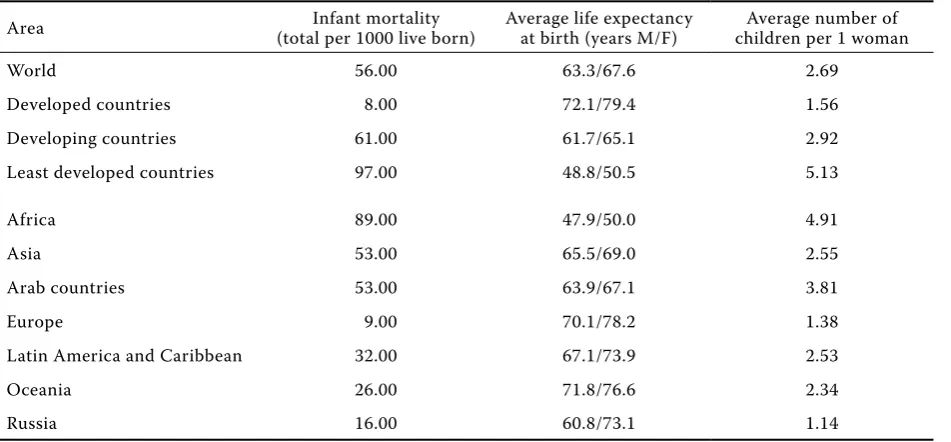
The variability of the powers setting the natural development rate of the present populations, i.e. fertility and mortality, is surprising. Every day, world population is increased by approximately 225 thousand people, by 9 360 every hour, by 156 every minute and by 2.6 every second. on this reality, the populating clocks, which could be seen at the world demographic conferences, were based. The velocity of the world population absolute increase is very suggestive; it is 2.6 times quicker than the velocity of the clock second-hand (Table 2).
[image:5.595.64.540.526.747.2]Still in the 1950, one woman gave birth to more than 6 children in half of the world countries. The 60s brought about the highest relative population increase; therefore, there rather prevailed the countries with 5 and more children per 1 woman. The drop of the cumulated fertility in the world was registered in the second half of the 20 century. however, this fact did not mean the step towards a full homogeneity; there still exist countries with the persevering higher fertil-ity level. The world average of the cumulated fertilfertil-ity fluctuated around 2.8 children in 2003. Even the big-gest china with its 1.3 billion inhabitants registered an enormous decrease – the most up-to-date numbers register the fertility of 1.7 children. however, this
Table 2. Selected indicators regarding children
Area (total per 1000 live born)infant mortality Average life expectancy at birth (years M/F) children per 1 womanAverage number of
World 56.00 63.3/67.6 2.69
Developed countries 8.00 72.1/79.4 1.56
Developing countries 61.00 61.7/65.1 2.92
Least developed countries 97.00 48.8/50.5 5.13
Africa 89.00 47.9/50.0 4.91
Asia 53.00 65.5/69.0 2.55
Arab countries 53.00 63.9/67.1 3.81
Europe 9.00 70.1/78.2 1.38
Latin America and caribbean 32.00 67.1/73.9 2.53
oceania 26.00 71.8/76.6 2.34
russia 16.00 60.8/73.1 1.14
positive development in china was reached owing to a sometimes quite drastic anti-population policy. on the other hand, women in some countries still bear 7 and more children, e.g. in niger (8.0), Somalia (7.2) and Yemen and Mali (7.0). in developed countries, this index often drops down to 2.0 or less.
The medium life expectancy at birth approximated 65 years for the average world inhabitant at the verge of the 80s and 90s. however, the real values for the individual countries are very different – the same as we have already outlined regarding fertility. nevertheless, we cannot divide the world according to mortality into the developed countries (average life expectancy 74 years) and developing countries (61 years), as the third world countries represent a very differentiated complex. The group of the developed Western coun-tries (north America, West Europe, Japan, Australia and new zealand) is then rather homogeneous, com-pared to the rest of the world. Most of them recorded the middle life span between 74 and 75 years at the beginning of 90s. The same as regarding fertility, also mortality situation is much more complicated in the developing countries. This can be seen already with regard to the big world areas, where in Africa the average life span is less than 55 years, while in East Asia 70 years. interesting again is the case of china, which surprises us by the middle life span (69 years) approaching that of the developed economies. on the contrary, some countries of the African continent are still recording the life expectancy at birth of only less than 40 years.
infant mortality is another indicator which reflects the state of health, and its level is again very differ-ent in the individual parts of the world. in Japan, only 5 out of every 1,000 newborn infants die before 1 year of age. in most African countries, more than 100 newborn infants out of 1 000 are dying. in the worst situated countries, infant mortality reaches even 150‰, in most South Asian countries, it moves around 60‰.
The different development of demographic indi-cators causes that the number of inhabitants in dif-ferent parts of the world changes by a difdif-ferent rate. The basic driving forces (fertility and mortality) are globally not balanced. it is, therefore, proper to pose a question: What will the tomorrow world look like? The face of the world is at present changing more quickly than ever, and this transformation is caused namely by two trends: the already mentioned still accelerating population growth and the migration of the developing countries inhabitants from the countryside into towns, issuing from many reasons, while the latter process is proceeding at the rate not seen since the industrial revolution time. At present,
the enormous population growth is reached by the countries where mortality has already decreased, while natality still remains high.
dEvEloPing counTriEs
The theories formulated on the basis of the European history state that all population will transit at a certain point if its development, under the influence of the deep economic and social changes, from the state of balance between the high fertility and high mortality into a new state of balance between low fertility and low mortality. however, the European development is not fully comparable with what goes on at present in developing countries.
Based on this knowledge, most specialists started to point out in the 60s at these differences and they came to the conclusion that these theories are not valid for developing countries. Mortality in the de-veloped countries decreased owing to the external contribution, totally without relation to their own economic progress and without a long period of ma-turing connected to the industrial revolution. none of the factors, owing to which also fertility decreased in Europe, is in activity in the developing countries. This pessimistic hypothesis influenced strongly the political discussions. Western countries, led by the U.S, began to realise the policy aimed at fertility regulation in developing countries.
This policy met with a different answer in the world. on one side, there were supporters of the opinion that the third world countries need the necessarily economic development and that the burdening weight of their enormous population development should not be overestimated. on the other side, there were supporters of the opinion that this extraordinary population growth presents a threat to the West. The image of the possibility that the West might be flooded by the incoming waves of the new-fangled barbarians from poor countries evoked great fears.
Similarly as e.g. the imports of antibiotics helped to lower the developed world mortality, the devel-opment of simple and very efficient contraception methods should have enabled the export of the fertil-ity limitations to the developing countries. All that was necessary was to persuade the local inhabitants to accept this step.
Latin America). At the beginning of the 60s, also the international organisations like the Who, the FAo and the UnESco,which hitherto carefully avoided any interfering, actively entered the game and supplied a considerable financial support to the fertility limita-tion programs. These means were understood also as the support of the health situation improvement and an inseparable part of the development aid.
The anti-population policy
The country which attracted the highest attention just for its still increasing population was india. it controlled births, but used sometimes rather disput-able methods to it.
india – birth regulation
The population explosion principle in india is very simple – the more indians there are, the more quickly their numbers increase. For many years already, the number of new-born indians is the highest in the world, higher than that of the chinese or any other nation. if we include the mortality, the yearly net in-crement of the indian inhabitants is over 16 million. For comparison – it is equal to the total population of Australia. While the world population trebled in the last century, i.e. from 2 to 6 billion people, the indian population increased almost five times, from 238 mil-lion to 1 bilmil-lion. This enormous population growth creates namely a great stress on the infrastructure and the diminishing stocks of water and food.
The most pressing problem is represented by the ongoing population boom in the indian state of Uttar Pradesh, which has about 170 million inhabitants, what is more than the total population of Pakistan or of France and germany together. Even now the population density in Uttar Pradesh is 689 people per 1 km2; moreover, the yearly population increase
is 3.99%, what is 1.4 % even above the indian average. The indo-Asian news Service quoted in April 2008 a scientific thesis according to which the impact of the population growth might be the increase of the unem-ployed people in this state from the present 40 million up to 150 million in 2050. That would probably mean a total economic as well as social catastrophe.
A massive campaign leading to the planned par-enthood and limiting natality was organised in india several times already. At the beginning of the 70s, it was famous under the slogan “A transistor wireless set in exchange for sterilisation“, in the 90s, the slogans were “We are two and have two” or “Small family – happy family”, is also the persisting remembrance of this drastic policy, which had been applied in 1975
by the indira ghandi government with the aim to limit the poor population growth. The population policy accepted by the government in 1976 called to the “frontal attack at the population problem” and demanded from the individual indian states govern-ments“accepting of the appropriate legislation which would force the citizens to family planning” and which would prevent the further childbirths after the third child “if it is in the interests of the state”. During the 2-years period after accepting the extraordinary means, forced sterilisations of the population took place commonly. in this period, almost 11 million people were sterilised.
After two years, this practice evoked a dismay, and the next governmental document to the population policy from 1977 already declared that “forcing in the sphere of family care has got to be avoided in future”. instead of that, education and motivation to voluntary decision making should have been utilised in this area.
however, it cannot be said that the practice of forced sterilisation was fully finished by this excess. in many cases, it only put on different forms. it namely regards the fact that the individual states implemented in the 80s, and are implementing even now, different financial and other advantages for those inhabitants who would decide to be sterilised. on the oppo-site, there are also “punishments” for the too fertile families. The indian states of Madjapradesh, Urisa, himachalpradesh, Andhra Pradesh, haryana, Delhi, Mahashtra and rajasthan passed the legal acts under which the families with more than 2 children lose the access to some state supports and advantages or their members are even prohibited by the administration to take part in the local elections. however, the tools aimed at a higher number of sterilisations are not aimed at families only. in the capital of rajasthan, the state offices are said to have set the minimum limits of monthly sterilisations for medical doctors both in the public and private institutions. if they fulfil the norm, they are rewarded. Some doctors are said to have been threatened in the case of not reaching the norm.
The indian Express published even more peculiar news regarding one of the latest attempts of the Uttar Pradesh, the most populated indian state, adminis-tration to divert the dangerous population boom. According to it, the state administration promised the man who would sign for sterilisation, an especially at-tractive reward – the permission to keep weapon.
What was the success based on? Above all, there were established 118 new centres for the care for mothers and children and also for sterilisation. About 200 medi-cal doctors were sent to take care of the natality and the health of children in the city slums. The helping medical workers, who are often the only accessible form of health care in the village areas, were given a special schooling on the contraception methods and the private cliniques were supplied for free with the material for contraception and sterilisation. namely, a new insurance program for mothers, who would decide for sterilisation, was established. if a woman dies in the procedure of sterilisation, the family gets 200 000 rupees. if she dies inside 30 days after the sterilisation, the family gets 50 000.
The norm of two children per family also brings about, however, certain not planned but unfortunately surprising consequences. Among them, there is the emerging unbalance between the born boys and girls. E.g. in rajasthan, where the 2 – children – rule is ap-plied since 1994, this rate dropped down to the level of 922 born girls per 1 000 boys. The illegal choice of gender during the pregnancy and the consequent abortions are numerous namely in the town areas, namely when it regards the second child.
A new measure, which should prevent choosing the sex of the child, is deposing a small amount of money every month at the account of the children of parents who agreed to sterilisation. girls are given monthly 500 rupees and boys 200 rupees. The whole sum is to their disposal when they reach 20 years of age. The project should not only help to decrease the number of families with many children, but also to increase the “attractiveness” of girls for their parents. in 2003, the rate of the newborn girls to boys increased, also owing to these measures, from 863 to 978.
Even if in the whole india the killing of the female foetuses and the discrimination of the born girls still occurs, the rate of the genders in the adult popula-tion is not much influenced by it. According to the demographic data, men are more often the victims of different diseases, like the TBc or AiDS, and they are also more open to the diseases connected with the consumption of alcohol and tobacco.
A substantial role in the natality control in india is also played by the different approach of different reli-gions to the problem. For example, the hinduists criti-cise the Moslem minority (there live about 120 million Moslems in india) that they refuse completely any birth control for religious reasons, while the Moslems argue that according to the Koran, children are the gift from god.
The results, which were reached in india, did not correspond sufficiently to the spent means and
en-deavour and have rather brought about a certain disappointment. The reasons are probably several. one of the most probable reasons is the fact that the tradition of millennia cannot be changed overnight. For centuries, the terrible epidemics of the pest, cholera and pox, together with the high children mortality, represented a natural regulation of the population. The epidemics were eradicated by the progressive development of medicine, children mor-tality was decreased and the human life doubled. in other words, the health care developed much more quickly than the thinking of people, formed by the thousand years of the experience that if 4 children are to survive, 10 children have to be born. The crea-tors of the contraception campaigns also probably underestimated the fact that almost 50% of the indian population is illiterate. notwithstanding all measures taken in favour of slowing down the population growth in india, it seems that india will become the most populated country of the world in future.
china – still the most populated country of the world
The most well-known example of a certain success in limiting natality through family planning, sterili-sation and abortions is china. During 15 years, the average number of children per 1 woman decreased from 6.0 to 2.4, i.e. almost by 2/3.
china is at present the most populated country of the world. Every day, 62 000 children are born there. Therefore, during one year the china population increases by one new canada – almost 23 million people, notwithstanding all strict anti-population measures. Even without the population explosion, just by the simple reproduction, this creases the fore-heads of the demographists. hitherto, an enormous migration takes place only inside china. however, the world has to be prepared for the situation that one day; the chinese population might start moving in the endeavour to secure a better living abroad. The countryside is obsolete and overpopulated; therefore, the present migration explosion is logical. The number of the internal migrants is estimated at more than 100 millions. however, by far not all chinese rural inhabitants can find livelihood in the big cities.
areas. For many farmers, the primitive patriarchal idea that a boy is better than a girl is still valid, the same as in india. in better cases, the newborn girls are put into orphanages, where they, however, often meet with a worse fate that the death at birth.
in china, every third pregnancy is interrupted; about 10.4 million abortions are performed every year. Population growth was curbed down by abortions also in some other countries, but there still exists the basic moral question – when does the human life begin? For many people in the world, an abortion is not acceptable, what is also supported by the fact that all important world religions support this opinion. Still, abortions are quite wide-spread. in the world, the rate is 30 million abortions per 120 million of births. Since 1989, when china applied the policy of 1 child per family, the “illegal” children are heavily fined, there even are the threats of the loss of job. Women are allowed to become pregnant only with the permission of the family planning committees, forced sterilisations and abortions are the daily rule. Under such drastic conditions, china managed to decrease the yearly population increment. however, is this practice in agreement with human rights?
The approach of Africa to population control
The fates of African women are in many aspects still more drastic than those of the indian or chinese women. Their problem is that they give birth to one child after the other, without regard to the terrible living conditions. it is clear even beforehand what their children could expect: poverty, hunger, unem-ployment, a wretched life at the society margin, if they live that long. Many of the children do not survive till adulthood; they die before the fifth year of age. Daily, about 25 thousand infants and 14 thousand children from 1 to 4 years die in Africa. one in every 12 in-fants does not live up to his/her first birthday, one in every 8 than his/her fifths birthday. Every fourth adult African suffers from hunger or under-nutrition, still the Africans approach the birth control policy only with hesitation. only few countries present an exception.
The policy of birth limitation earned also some very fierce opponents as well. Many countries, which have just a short time ago freed from the colonial rule, saw it as a renewed interfering into their sovereignty and the rights of their people. The inhabitants of colonies yarned for freedom, but at present, they have got dictatorships or inefficient governments and non-stability. owing to the backwardness of the colonies, always just a few powerful individuals profited, and the situation persists till present. The
first sings of the fertility decrease, which emerged in some developing countries at the end of the 60s, did not yet announce its quick and total decrease. The 70s brought about a completely new view. During the first 15 years (1950–1965), the situation practi-cally did not change. The countries in which fertil-ity increased slightly just balanced those in which it decreased, therefore, the total for the develop-ing countries practically showed a sustained status quo. opposite to that, the decrease which occurred between the years 1965–1970 and 1980–1985 has been almost general. only in the tropical Africa, the situation still shows no profound changes. in all other regions, the decrease is obvious, even in the Latin America mild zone. Fertility first started to drop down in the countries which reached a real economic increase, e.g., in South Korea, hong-Kong, Singapore etc. in these countries, it also decreased in the most pronounced way. Also in other developing countries, where fertility decreased, we can register an increase of the per capita gDP.
important factors influencing population growth
The programs of the natality limitation have, without doubt, contributed to the improvement. however, it seems that this turn was decisive enough not to be evoked also by other factors. The main role was surely played by strengthening of the position of women in the society. Among the priorities, we can include namely removing of their unequal access to education and the increased access to information and services in the field of sexual behaviour and reproduction health.
Education
one of the most important factors of decreasing population is education. if school attendance is pro-longed over the age limit of 15 years, it contributes efficiently to increasing the age of entering marriage. Still more important is, however, that school education is opens new horizons to women who were hitherto limited to motherhood and offers them the intellectual background for fulfilling also other ambitions. The number of illiterate people in the world is estimated at 875 million, 2/3 of which are women.
to become full-right members of human society. however, in developing countries, one out of every three children does not finish even the 5 years of primary school education. More than 60% of them are girls (http://www.financemagazine.cz/index. php?id=cislo5/clanek-unicef ).
This situation has of course many different reasons, some of which are rooted in the traditions and habits of the relevant country. The main reasons why girls attend school at a much lower percentage than boys or why they leave it prematurely are discrimination and poverty. To send a child to school means in most cases to lose the incomes from its work or to lose a household help. in the countries without a retirement insurance scheme, the old age pension is represented by children, as they represent at least a small guarantee of the secure old age. in most developing countries, a fee is paid in schools including primary schools, and the parents are expected to buy also a school uniform or a better dress for the child – however, the really poor cannot afford it. Therefore, if the family has to choose between the son and the daughter, it very often advantages the boy which can secure a higher profit from the investment, as he stays as a part of the original family even in adulthood.
The problem of the access to education does not, however, regard girls only, but many million children without regard to gender. Just at this moment, more than 150 million of children in the world have to work, other millions do not attend school because of the war or civil disturbances in their country, and about 300 thousand children are directly included in the military conflicts as child soldiers. it would be an enormously demanding task to give each of the 2 billion children in the world the chance to educa-tion. it is not enough to build enough schools and to produce the necessary school accessories, even if also this in itself would demand a huge financial and time investment. it is also necessary to adapt schools and teaching to the local traditions and habits (www. unicef.cz).)..
The experience then shows that there exists an indirect relation between the education of a woman and the number of her children. Women with higher education have fewer children and their children are healthier. it is, among other, the consequence of the higher age in which these women enter into marriage, and also of the real economic relationships – educated women have higher incomes, so that not only they would lose more financially by taking care of a child, but also the reason for having children as a security to survive in the old age does not exist there. Moreover, they are able of a better care for their children (health care, nutrition).
The researches show that:
1. More educate women are more productive mem-bers of the society. For every year of education, the income is increasing, notwithstanding gender, by 10–20%. in the informal sector, the productiv-ity is increased considerably by even few years of school education.
2. Educated women give over many advantages of edu-cation to their children and families. For example, educated mothers seek medical help in a higher measure; they have their children inoculated, give them a better nutrition and apply hygienic rules in the family.
3. Educated women can better utilise natural resources and are able to more easily accept the environment-friendly technologies and procedures.
4. Educated women have fewer children. Every year of school attendance lowers the woman fertility by 5–10%.
5. With educated women, there is a lower probability of pregnancy before reaching adulthood and moreo-ver, they have a longer time periods in between their pregnancies. Every year of school education prevents the deaths at childbirth of 2 others out of 1 000.
Thus, education is not only the natural right of every child, but also a real chance of the humankind survival for all. A quality education has to give every child a real chance of success. Also for this reason, education is part of all the UnicEF crisis programs – in the situation of natural catastrophes or an armed conflict, securing school attendance of children is of the same priority as supplying food, drinking water and health care. The fact that education cures pov-erty is generally known. it is also the only reasonable chance how to stop the world population explosion. Even if the original catastrophic prerequisites of the exponential world population growth from the 19 century were not proved, the fact remains that the number of the Earth inhabitants is growing – and that it is growing quickly (www.unicef.cz).)..
Poverty
distribution, important problems issue. The collapse of social care is then not very surprising.
if this system is not functioning, the “vicious circle” of poverty cannot be broken. if the social system, which in reality cannot work properly because of the population crisis, is failing, the “merry-go round” of poverty, epidemics, non-stability, totalitarian regimes and war conflicts in the developing countries can follow. The fanatics and extremists then parasite on poverty and hopelessness. owing to that, population explosion cannot be stopped. The result is again pov-erty and further hopelessness. The extremists then easily utilise the feeling that an individual is just like a straw, without the chance to change anything. War conflicts, political coups and terrorist attacks are very numerous in the third world countries, our media almost do not inform on them any more (http://www. news-info.net/populationproblem.html).
According to the World Bank (WB) data from 2003, from 6 billion people in the world, just the mere 1 billion people in the rich world owns 80% of gDP, while ¼ of population in developing countries lives under the poverty level. According to the WB, more than 1.2 billion people (more than 1/5 of the world population, live on less that 1 USD per day, another 2 billion survive at less than 2 USD per day. About 1.1 billion people suffer from under-nutrition; more than 1/6 of humankind has no access to drinking water. Approximately the same amount of people are homeless or with only insufficient housing, and they have no access to health care. The abyss be-tween the north and South is still not successfully narrowed, what creates a radical non-balance in the social and economic conditions in which the peo-ple live in different parts of the world (http://www. rozvojovka.cz).)..
When the countries of Africa and Asia were freed from the economic rule of the European countries, the economists of the time were full of optimism. it was generally expected that developing countries would be, owing to their mineral wealth and cheap labour, growing very quickly and that they would enjoy a similar prosperity and welfare as the former colonial powers inhabitants after only several decades.
however, the development was very dispropor-tionate. Even if some regions, e.g. the South-East Asia, really managed to reach a very remarkable economic successes, the scissors between the rich and poor countries are still more opening, the social justice differences among countries as well as inside them are growing, the armed conflicts increase and, moreover, the pandemics of the AiDS endangers the whole progress which had been reached during the last 40 years. namely in Africa, the last decades full
of wars, hunger and killing diseases pushed far aside the dream of the development and prosperity.
The Sub-Saharan Africa is the poorest part of the world. The total gDP of the region with 650 million inhabitants does not reach up to the gDP of Belgium, and when divided among 48 countries, the average yearly product reaches mere 2 billon USD, what is approximately the outcome of a 60-thousand- inhab-itants town in the US.
if nothing changes, all these problems will grow by the same rate as the world population in the next years. Ten years later, the world population might be 8 billion, from that, 7 billion living in developing countries. And by 2050, it will be already 9 billion, from that, 8 billion living in developing countries. it is also necessary to think forward and to predict what the situation might be if nobody is interested to do something about poverty already at present. The same as cancer, also poverty weakens and kills the whole body, not only the organs directly impacted by it. The risks issuing from the global poverty are known, and during the last years, they are unfortunately also still more visible. The common adversity towards rich countries is fed by the extreme poverty of the grow-ing share of population of developgrow-ing countries, and the crowds of people, whose chance for success is so small that they have nothing to lose, create new and very dangerous forms of the world terrorism.
Even if the world statistics on the global poverty are notoriously known, the image of the real face of poverty is very difficult for anybody who has not lived through it. Poverty means much more than the lack of money. Poverty means that you cannot sleep because of hunger. Poverty means that you are homeless. Poverty means that you are ill but without money to go to a doctor. Poverty means that you cannot read the time-table because you did not at-tend school. Poverty is powerlessness and injustice. The man from the town of Adaboya in ghana says in the book “Voices of the Poor”, published by the World Bank: “Poverty is like heat: you cannot see it. You can only feel it. To know poverty, you have to experience it.”
suf-ficient for buying food, drinking water, but also for the basic health care and the education of children. The children are best cared for by their parents, and the micro-credit programs should ensure them a long-term stability and development.
The success of the program is proved by the rate of the repaid loans, which moves around 95%. A relatively small starting sum of money thus can mean the difference between a dignified life and a poor survival for the whole families.
The question how to remove the world poverty has, alas, no simple answer. The developed countries governments and many international organisations are endeavouring at it with mixed results for several decades already. For example, the EU countries are obliged to contribute to the foreign development aid the sum corresponding to 0.39% of their gDP (www. unicef.cz). The question is whether the development). The question is whether the development. The question is whether the development aid is utilised to the purposes it is really allocated to, or whether it serves to the enrichment of a small group or groups of people. Some countries increase their armament expenditures and that at the detriment to the sad social situation pestering their country.
Aids – a threat to the humankind
Another problem connected with the demographic and political state of the third world countries are epidemics. in Africa, the most pressing problem is the AiDS epidemic. The collapse of the immunity system known as the AiDS, and the hiV virus which causes it, present the most wide-spread epidemic in the modern history of Africa (http://www.news-info. net/populationproblem.html).
From the hitherto documented 20 millions of vic-tims in the whole world, almost 85% were from the Sub-Saharan Africa. in india, the hiV is at present spread widely among the common population. in East Asia and the Pacific, the number of the newly infected increased by 70% in the period 1996–1998. in every minute we spend by our daily routine, 4 or more young Africans get infected by the hiV. Every day, Africa buries 5.5 thousand of its daughters and sons who died of the AiDS.
Some of the developing countries leaders do not even try to hide their disinterest regarding this threat. They state, that it is the gift from god to slow down the population explosion, which will reduce many of the ethnic and tribal problems by the mere fact that the ethnics and tribes will simply die out. The prevention and education is hindered namely by the primitive tribal structures and the local African religions. here, the religious rhetoric dies not reflect the general progress of the medicine and science,
and the consequences of this are shattering. As an example, we can mention the superstition that the infected man can be cured by the sexual intercourse with a virgin. owing to that, many brutal rapes of girls, often under 10 years, occur. These girls, moreo-ver, usually get pregnant and give birth to another hiV-positive child.
it does not, however, mean only an unimaginable tragedy of many individuals and their families. The situation also has a disastrous impact on the whole countries economies. The AiDS destroys the fragile and heavily demanding successes of the developing countries. it liquidates both the bread-winners as well as those who take care of the young, old and disabled. The AiDS destroys the whole structure of the society itself. The African health system is over-burdened by the care for the AiDS -impacted people to the detriment of other needs. in some countries, the costs connected with the AiDS devour one half or more of the total health care budget. it is obvious that the sum of 150 million USD spent yearly for the solution of the AiDS in Africa is by far not sufficient for the real needs. To implement the set of measures with at least the minimum efficiency in the impacted countries would demand at least six times more.
one of the goals of the Western countries has to be securing the accessible cure for the AiDS patients. it is necessary to find out low-cost and efficient therapies which even developing countries could afford – e.g. the method preventing the transition of the infection from mother to child and fighting the secondary infections connected to the hiV, e.g. the TBc. Many scientific and ethical problems, which have to be faced, can be overcome only through the global co-operation among governments, scientific institutions and the economies.
ThE World is AgEing
From the complexity viewpoint, it is necessary to also mention the developed countries. These are experiencing, contrary to developing countries, the opposite problem. Ageing of the population is closely connected with the prolongation of human life. Even if the prolongation of human life is for sure a positive social phenomenon, it can have the opposite impact on the economy of a country burdened by a non-flex-ible retirement payment system. With the growing length of human life, also the demographic structure of the whole society is changing. There are still less people in the productive age (15–65 years) and still more pensioners which depend financially on the productive part of the population.
The problem of Europe
The development of economic prosperity, flourishing of the social state and the high productivity of science brought about at least 3 non-intended consequences: the destabilisation of family, the population crisis and the growth of social tension regarding the assimilation of the immigration wave. There are born less children that the number of people in the parents generation, therefore, notwithstanding the prolonged human life, the number of the Europeans decreases. The European data are well known. To reproduce the society on the same level, the average natality rate has got to be slightly higher than 2. it means, that 2 children replace 2 parents, and as it is necessary to count with a certain number of deaths and people without children, the rate of 2.1–2.2 instead of the simple 2, is necessary to ensure a simple reproduction.
This so-called sustainable reproduction rate (2.1 chil-dren per 1 woman) is not reached by any European country, with the exception of Albania. Among the West European countries, the best situation is in France and ireland, where this rate reaches 1.8. The lowest part of the scale is occupied by the countries the experts would not expect to be there – italy and Spain with only 1.21. Between these poles, we can find other countries including germany with the rate of 1.4, what is the European average. The situation in the central and Eastern Europe is in average still worse – e.g. the czech republic reaches the rate of only 1.18 children per 1 woman.
What is the meaning of these data for future? According to the U.n. Population Forecast, there will live by 125 million less people in Europe in the middle of this century, than at present. Such a loss was not experienced by Europe since the 30-Years War. in Western Europe, a radical decrease of the
number of newborn children went on from the be-ginning of the 70s.
A similar situation can be perceived also in the central and Eastern Europe. According to the U.n. report, the number of inhabitants will decrease by the middle of this century by 38% in Bulgaria, 27% in romania, 25% in Estonia. To quote reiner Klingholzer, the director of the institute for Population and Development in Berlin, some areas of Eastern Europe, which are now only sparsely populated, will probably become completely depopulated.
Ageing of the population is perceived also in developing countries – the most so in china
Ageing of the population is not perceived only by the countries with a high level of living. The decrease of the share of young people is important even in the East Asian counters, where the natality dropped down considerably. Still, in the East Asia, the share of old people is much lower compared to Europe. The decrease of fertility is of a much older date in Europe. At present, only the developed countries have to cope with it, but soon it will become also the problem of the present developing countries.
The u.s. – the exception to the rule
There are supposed to be 420 million of the Americans. The U.S. is then the bright exception among the developed countries and need not be afraid of the eventual drop of the population. The studies estimate that the number of the Americans will in-crease by 43%, namely owing to immigration and the high natality of the hispans and black people.
it is necessary to underline that the decrease of natal-ity and the demographic ageing of population are the phenomena which take place practically everywhere in the world. however, Europe is especially impacted by it and the situation there is the most disturbing. its weight is clearly reflected in the development of the share of the Europeans in the total world popu-lation: in 1950, it was 22%, in 2000 only 12% and in 2050, it is estimated at about 7% (http://www.obcinst. cz/clanek.asp?id=702).
migrATion And urbAnisATion
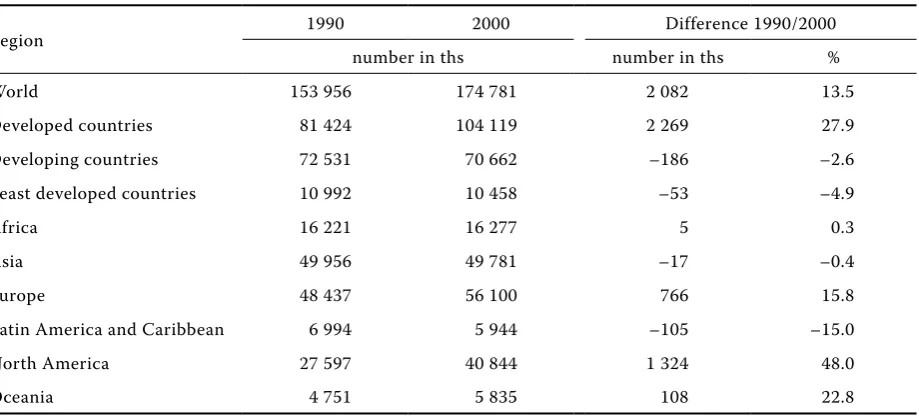
Similarly as the world population reaches the formerly unseen yearly increments, also the unprecedentedly high migration from the rural into the town areas and also the migration among countries occur. The high-est increase of the population is just in developing countries. The mentioned development brings about great risks, namely the possibility of the collapse of the basic services, an unacceptable damaging of environ-ment and the escalation of social conflicts. The third world big cities are bursting and they are still extend-ing. According to the specialists, the main problems
of the development of the world metropolises are the crammed slums, into which further millions of rural immigrants are flowing. They lack the clean water and sewage; there is the danger of different epidemics. At present, 1 billion people lives in such way in the over-populated metropolises in the conditions endangering not only their heath, but their life (Table 3).
Today, shortly after the beginning of a new millen-nium, more than one half of the world population lives in towns, and this number is increasing every day by 180 000. After 40 years, the number of people living in towns is supposed to equal the total present population, and the urbanisation process will still not be by far finished at that. it is expected that by the year 2015, almost 56% of inhabitants will live in towns, compared to less than 45% in 1990.
The Uno expects that the number of the 10-million megacity agglomerations will reach 50 by the 2025. The mentioned data are the mere results of forecasts, but still they ask for thinking.
Looking at some of the present world megacities with the highest number of inhabitants, the first place is occupied by Mexico with 26 million inhabitants. The Brazilian Sao Paolo has approximately 23 mil-lion, rio de Janeiro 20 million Shanghai 14 milmil-lion, Bombay, calcutta and Jakarta approach 15 million inhabitants. From the developed world metropolises, only new York and Tokyo are included in the list with 17, resp. 24 million inhabitants (www.stoplusjedna. newtonit.c72 531z/stare/200512/so/a00c.asp).
[image:14.595.73.533.539.747.2]The quick rate of immigration into towns is partially the consequence of the concentration of resources in towns and also of the economic policy deepening the gap between towns and the countryside.
Table 3. The size and increase of the migrating population according to the most important regions, 1990–2000
region 1990 2000 Difference 1990/2000
number in ths number in ths %
World 153 956 174 781 2 082 13.5
Developed countries 81 424 104 119 2 269 27.9
Developing countries 72 531 70 662 –186 –2.6
Least developed countries 10 992 10 458 –53 –4.9
Africa 16 221 16 277 5 0.3
Asia 49 956 49 781 –17 –0.4
Europe 48 437 56 100 766 15.8
Latin America and caribbean 6 994 5 944 –105 –15.0
north America 27 597 40 844 1 324 48.0
oceania 4 751 5 835 108 22.8
Urbanisation is an inseparable part of development and towns are the centres of the economic and cultural activity, however, the increasing town population creates social, economic and environmental problems (http:// www.unfpa.org/swp/2008/espanol/ch4/page3.htm).
People migrate in reaction to the unequal distribu-tion of resources, services and opportunities. in 2000, there were 175 millions of migrants in the world, who migrated among the borders of the individual countries, i.e. every 35th person. Then, there were only
79 millions of them in 1960. Many people, includ-ing the still higher number of women, are lookinclud-ing for work abroad, what has a negative impact on the countries they are leaving, as well as for those they are immigrating, because the economic impact works in both ways (Lošťák, hudečková 2008).
conclusions
The decreasing the number of children in family cannot be connected only to the accessibility of con-traception, but namely to the growth of education. The number of illiterate people in the world is estimated at approx. 1 billion, 2/3 of which are women. There were already prepared many documents proving the fact that a better education of women impacts positively the population growth and the poverty decrease. A higher education and a level of living also motivate families to voluntarily decide to have fewer children. it supplies women with the necessary knowledge, the access to information and self-confidence, owing to which they become equal partners of their husbands. The most efficient investment then is the investment into human capital. Simply said, it is generally valid that the more educated and developed the nation, the more it looses the need to have a high number of children for the old age security. A more educated population is also able to grant a higher quality of life for themselves and their children (Tichá 2008).
one fifth of the diseases and premature deaths in the world and one third of the deaths of women in the reproduction age are caused by the problems in the reproduction and sexual health care. Family plan-ning enables the couples in the women to decide on
the number of their children, not under a physical or psychical pressure, but by a free choice, what is one of the basic human rights. however, about 201million women, namely in the poorest countries, still have no access to the contraception. By using the means preventing conceiving, the non-planned births, forced abortions and also the death of the newborn babies and their mothers could be prevented.
in many countries, girls enter marriage at a very low age, the consequence of which is a very early pregnancy. it causes a high probability, that they will not finish school education and also a high probability of the hiV infection or another contagious veneric disease. The means how to prevent these risks could be to supply the adolescents with the information regarding sexual health.
rEFErEncEs
Lošťák M., hudečková h. (2008): Agriculture and farming related activities. Agricultural Economics – czech, 54: 242–265.
Srnec K., Svobodová E. (2009): Microfinance in less devel-opmnet countries: hisrory, progress, present – charity or business. Agricultural Economics – czech, 55: 57–62. Tichá i. (2008): intellectual capital reporting. Agricultural
Economics – czech, 54: 467–474.
Villin J. (1992): World population. Prague, Academia. http://www.stoplusjedna.newtonit.c72 531z/stare/200512/
so/a00c.asp
http://www.financemagazine.cz/index.php?id=cislo5/ clanek-unicef
http://www.news-info.net/populationproblem.html http://www.obcinst.cz/clanek.asp?id=702
http://www.rozvojovka.cz
http://www.un.org/esa/population/publications/cocise2007/ c2001Spanish.doc
http://www.un.org/esa/population/publications/ittmig2002/ ittmigrep2002/spanish.doc
http://www.unfpa.org/swp/2008/espanol/ch4/page3.htm
http://www.unfpa.org/swp/2008/espanol/indicators/in-dex.htm
http://www.unicef.cz http://www.unicprague.cz
Arrived on 5th october 2009
Contact address: