Evaluation of efficiency of the Common Measures
– measures for land accessibility, implemented
within land consolidation
Jiří PAPOUŠEK
Agroprojekt PSO, Brno, Czech Republic
Abstract: By the means of Land consolidation is understood, in accord with law no. 139/2002 coll., spending of funds
on land consolidations and land offices, provided the accessibility of grounds in public interest. Land consolidations also ensure the conditions for improvement of the ecosystem, protection and reclamation of land resources, waterway manage-ment and the increase of the ecological stability of landscape. All manage-mentioned measures are collectively called the common Measures, rural roads being one of the most significant of these measures as far as the ground accessibility is concerned. According to the Ministry of Agriculture and the central Land office (Mze, ÚPÚ) statistics, for instance in 2008, over 707.4 million czK was spent on the common measures projects from the public funds. of this sum, 82 per cent was spent on financing of the land accessibility projects – rural roads and objects on them. The cost & Benefit Analysis (cBA) meth-od was applied. The analysis explains step by step what benefits the investment projects bring and to whom, as well as what and from whom it takes something away. Thus defined effects and impacts are aggregated, converted into financial flows and included in the calculation of criteria indicators. These calculations enable to make decision whether the concerned project is in its consequences generally contributive. There is a difficulty in the method – it is applied ex-ante, which usually leads to the exaggerated input parameters, which may be significantly affected by a number of variable effects (time factor, socio-economic impacts, inflation rate, etc.). The ex-post application of the method cannot be objectively used due to the absence of the statistically processed input data for the analysis. Such data must be collected during the operational period of the realized investments. This is caused by the fact that these analyses consider lifetime of these investments in terms of 25–30 years. The ÚPÚ statistics, however, say that the operational period of most of realized common measures has not reached one half of their lifetime yet. The ex-ante analysis enables to evaluate the possible difficulty and the general benefit of projects, including their impact on the broad spectrum of subjects.
Key words: land consolidation, common measures, ground accessibility, efficiency
Land consolidations, according to § 2 law no. 139/2002 coll., on land consolidations and land of-fices, provide (among others) for accessibility and use of grounds in public interest and guarantee the conditions for improvement of environment and reclaiming of land resources, waterway management and the increase in the ecological stability of land-scape. These measures are collectively denoted as common Measures. As far as the ground accessibility is concerned, the most prominent of these measures are rural roads, including objects on them. generally, land consolidation is a tool for ensuring the effective and rational cultivation of farmland (Sklenička et al. 2009). in the czech republic, there were 914 finished Land consolidations (KPÚ) projects by December 31, 2008, covering the total area of 386 770 ha, and 3358 Simple Land consolidations (JPÚ), covering the area of 209 517 ha. To this day, the total of 1318.56 kilometres of rural paths has been built.
formation – regional systems of ecological stability (ÚSES), and 19.440 mil czK on all other measures. As the mentioned sums suggest, the greatest amount of money is spent on measures aimed at the improve-ment of ground accessibility (in 2008 almost 82% of the total expenses).
Economic assessment of investment projects im-plemented in pubic interest is specific, because the common Measures should not primarily maximize the profit or cash flow of their investor, but bring benefit to any subject (community, state, farmer, owner, tourist etc.). The EU is an important provider of subsidies on various common Measures. it should be noted that unlike commercial banks, which only follow projects promising maximum valorisation and the shortest possible payoff, the EU funds were primarily established to co-finance projects which economic recoverability is minimal or which can be even loss-making. Effects of such projects usually cannot be expressed in financial terms and it may be rather difficult to describe them in other terms (improvement of the environment, positive socio-economic effects etc.). The definition of common Measures, as stated in the land consolidation law, has a logical implication that the measures are realized to accomplish social effects of the non-financial, and often intangible nature (non-economic function).
The aim of the common Measures effectiveness evaluation is to identify the broadest possible range of the potential beneficiaries, to assess the antici-pated, especially socio-economic and environmental impacts of common Measures on the monitored regions, and according to the model example, to apply the relevant methods of the economic indica-tors calculation.
MATERIAL AND METHODS
Cost & Benefit Analysis (CBA)
cBA is a methodological technique used for an as-sessment of public sector projects. it gradually clarifies what benefits and damages the investment project brings about, and to whom. Thus defined impacts of the investment are consequently aggregated, trans-formed into cash flows and included in calculation of the crucial indicators. These indicators help us to decide whether a project is generally contributive or not. The method for the analysis procession was described by Sieber (2004).
Speaking of the efficiency assessment of common Measures and measures aimed at agricultural land accessibility in particular, we must mention some
essential specifics of the methodological approach. First of all, we must realize that the cBA analysis has been usually used for the assessment of publicly beneficial projects applying for the EU funds subsi-dies. This implies that the assessments are carried out ex-ante. This approach results in the universal inclination to exaggerate the input parameters neces-sary for the analysis. This leads to the distortion of the output values of the criteria indicators specified in the article 8 of the cBA analysis. To estimate cash flows resulting from the investment in the monitored field is extremely problematic. it is not possible to predict exactly where the czech agriculture will go in the following years and decades. Just as difficult is to predict the demographic development in rural areas etc. At the moment, the ex-post method cannot be used for an assessment of road network projects. The reason is naturally the absence of the statisti-cally processed input data for the analysis, which must be gathered during the operational period of the realized investments. This absence is caused by several specific features of the assessed objects. Land consolidations and their part, the common Measures, were first defined in the law no. 284/1991 coll., on land consolidations and land offices. The statistics of the Mze and ÚPÚ state that processing of land consolidation (from the start of land consolidation proceedings to the approval of the proposal and the following registration in the land register) usually takes 3 to 4 years. This period does not include the time necessary for the execution of the project itself, usually several months (the legislation naturally allows to start the publicly beneficial common measures projects before finishing of the land consolidation proceedings, hence after the approval of the common Measure plan). As hrdý (2006) states, calculations of the economic (financial) efficiency indicators of land communications investment are considered in the long term – 25 to 30 years. From the above mentioned facts and the central Land office statistics, it follows that most of the common Measure projects realized have not so far reached one half of their operational time (lifespan). These specifics and difficulties of the methodological approach relating to the financial and economic part of the common Measures efficiency analysis do not obstruct the relatively objective for-mulation of costs and benefits, stated in the articles 2 and 4 of the cBA analysis.
CF IN
PVCF
NPV n
t t
t
¦
1 1
where:
PVCF = current cash flow value (yield from investment) CFt = cash flow from the investment in period t IN = investment costs
k = capital costs for investment (discount rate) t = period (years) 1 to n
n = investment life span in years
CF IN
PP
where:
IN = investment costs CF = annual cash flow
RESULTS AND DISCUSSION
The CBA analysis processing stage – the model
(1) Project definition
The subject of the analysis is the material, immov-able investment property – a purpose-built road in a rural zone of a community. it is usually a one-off investment, financed and organized by the state (see above) and technically secured by a designer and a contractor. The purpose of the investment: transport, anti-erosive effect, landscape formation, recreation. operation of the investment is in charge of its owner. Stages of the project: the pre-investment stage – project documentation, preparatory works, administration, the investment stage – construc-tion (typically expenditure stage), the operaconstruc-tional stage – investment lifespan (income stage), the post-operational stage – disposal, sale.
(2) The structure and definition of all beneficiaries relevant from the point of view of the investor and actually affected by the project
A model list of beneficiaries: the community, where the investment takes place, surrounding communities (micro-region), interested agricultural and forestry firms, individual farmers and foresters, other inter-ested entrepreneurial subjects and organizations, local citizens and citizens of the surrounding communi-ties, owners and leaseholders of the adjoining plots, state, (non)profit organizations and associations, holidaymakers, etc.
(3) comparison between the investment variant and the “zero variant”
in this stage, a different situation of the above men-tioned subjects is defined – i.e. their benefits and damages in case the investment is not realized.
(4) Designation of the relevant costs & Benefits for different stages of the project included into the analysis
The operational stage benefits are defined (invest-ment and operational costs can be largely expressed directly in financial terms, examples are given below). From the perspective of agriculture, these benefits include particularly time savings for transportation, wage savings and operational costs (fuels, lubricants, repairs, etc.). A new rural road can also lead to the increase of the per hectare yield (a damaged rural road makes farmers drive their vehicles on field edges, which diminishes the crops). other benefits include the anti-erosive effect of a linear construction, the improvement of landscape, possibly yields from fruit trees planted along the road, plus the preservation of the local plant variants (gene pool). other greenery planted along the road may serve as a shelter and source of food for animals. Another important func-tion not to be omitted is related to the development of tourism industry, the integration of rural roads to a network of hiking trails and cycling tracks, the con-struction of new recreational facilities, agri-tourism and so on. We can also mention in-line skating – a recent new phenomenon. new roads very often con-nect the neighbouring villages and children can use them on their way to school instead of the frequented main roads. in residential areas, a new rural road can automatically raise the price of the surrounding land and plots. in the past, the rural roads were used for drying of agricultural crops, etc.
(5) Defining and characterization of the invaluable costs & Benefits, those which can be assessed only in the terms of quality (e.g. social or envi-ronmental nature)
(6) Transformation of the measurable costs & Benefits into cash flows (example)
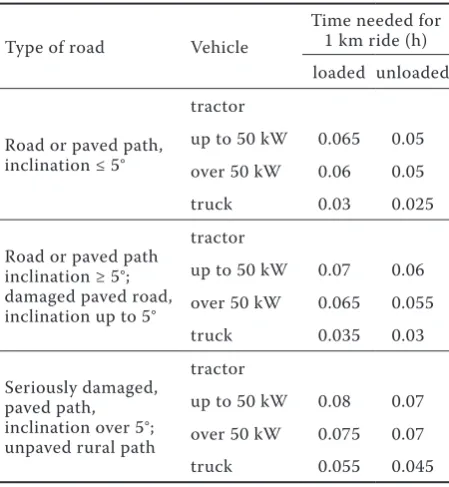
All cost items (construction expenses, material, wages, maintenance and so on) can be usually ex-pressed in financial terms. These items are by nature expressed in the form of cash flows. The calculation of standard costs of the common Measure maintenance can be done in the BUiLDpower system (rTS Brno). From the point of view of agricultural production, one of the most significant quantifiable operational benefits is time saving and the related operational costs. The calculation of operation costs was carried out on the basis of operation costs of the agricultural vehicles rides (Patřičný and Telc 1993), see Table 1. operation and service costs were determined in the BUiLDpower system (Table 2).
zetor 8045) – savings 8.13 czK, truck – savings 15.69 czK.
operation and service costs can be specified in the current price database of the BUiLDpower sys-tem. For other sources for estimation of the pos-sible cash flows, see e.g. Directions for agricultural and food processing production (Kavka et al. 2006), the database of the Bonited Soil-Ecological Units (BPEJ) of the research institute for Soil and Water
conservation (VÚMoP Praha), statistical data of the czech Statistical office (ČSÚ) etc.
(7) Establishing of the discount rate1, yield rate, which
provide the comparison with a similar investment alternative.
(8) calculation of the crucial indicators
in terms of quantity, the finished common Measures can be assessed by the standard indicators of the economic efficiency of investment (see Synek 2003; hrdý 2006). The payoff period (liquidity), profitabil-ity and the extent of investment risk should be the decisive factors. From the theory of public funding, however, it follows that the matter of increasing the public budget efficiency is highly arguable (finan-cial decisions are only made at the political level in public sector).
[image:4.595.65.290.95.339.2]The calculation was carried out on the basis of input data, stated in the article 6 of the cBA analysis. The assumed investment costs (year 0) are 18.6 mil czK. in the years 1 to 28, the expected income is Table 1. Time norms of the selected transport vehicles
rides
Type of road Vehicle
Time needed for 1 km ride (h) loaded unloaded
road or paved path, inclination ≤ 5°
tractor
up to 50 kW 0.065 0.05 over 50 kW 0.06 0.05
truck 0.03 0.025
road or paved path inclination ≥ 5°; damaged paved road, inclination up to 5°
tractor
up to 50 kW 0.07 0.06 over 50 kW 0.065 0.055
truck 0.035 0.03
Seriously damaged, paved path, inclination over 5°; unpaved rural path
tractor
up to 50 kW 0.08 0.07 over 50 kW 0.075 0.07
truck 0.055 0.045
Stated time norms are increased by the multiplication coefficients in case of:
tractor with two trailers or truck with a trailer 1.20 live cattle transport and deep snow 1.10
driving in fog 1.15
[image:4.595.305.532.95.303.2]note: When two or more of the factors coincide, the nominal time of the ride is successively multiplied by the single coefficients, not by their sum.
Table 2. operation and service costs of the selected trans-port vehicles (price database rTS 2009/i)
Type of vehicle operating costs (czK per hour)
Wheel tractor up to 50kW 178.00
Tractor type zetor 8045 427.00
Small tractor 343.00
Truck (type Tatra) 595.00
Small truck (type Avia) 447.00
combine harvester type E-512 1 744.00
Manure spreader 41.10
Fertilizer spreader 19.90
Profession hourly rate in czK
Tractor driver 115.00
Truck driver 106.50
Table 3. Determination of the net present value and payback period
Years 0 1 2 3 4 5 6 7 8 9 10 11 12 13 14
cF (mil czK) –18.6 0.7 1.0 1.2 1.5 1.6 1.7 1.8 0.6 1.7 1.5 1.5 1.4 1.3 –0.7
Years 0 15 16 17 18 19 20 21 22 23 24 25 26 27 28
cF (mil czK) –18.6 1.6 1.7 1.7 1.7. 1.6 1.6 0.8 1.5 1.5 1.5 1.1 1.4 1.2 –2.1
nPV 74 225.10
PP 15
cF = cash flow, nPV = net present value, PP = payback period
[image:4.595.62.539.613.717.2]the difference between the expected income and operational costs. The discount rate is 5 %. The MS Excel spreadsheet was used for the calculation of indicators (Table 3).
interpretation of the model example: the determined nPV is positive, which means that achievement of the desired profitability of the invested money can be expected. From this perspective, the investment can be accepted. The payback period is the year in which the invested capital was exceeded (after the accumulative summation of the expected profits). The investment can be accepted from this point of view as well because the payback period is shorter than
the assumed lifespan of the investment. With regard to all above mentioned difficulties in the investment efficiency assessment of a common Measure, we can say that the applied methods are relatively exact, but they do not offer an absolutely objective evaluation, which is caused by their ex-ante application. The risk of inaccuracy cannot be eliminated. The inaccuracy can be caused by many variable factors affecting the investment life cycle as a whole.
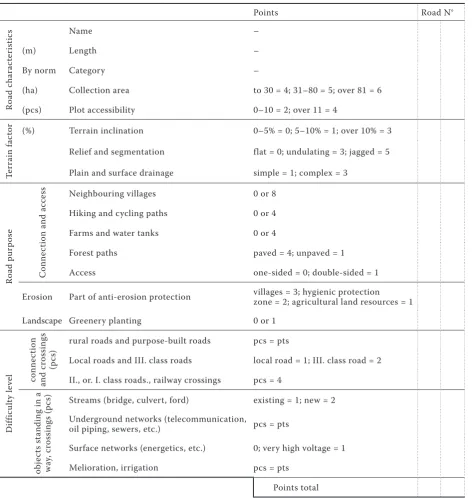
on the basis of long term experience in design-ing and constructdesign-ing, as well as the statistics of the individual Land offices, the Agroprojekt PSo Brno set a decision table for the determination of the
gen-Table 4. Decision table for determination of the general contribution and possible difficulty of construction projects
Points road n°
ro
ad
c
ha
ra
ct
er
is
tic
s name –
(m) Length –
By norm category –
(ha) collection area to 30 = 4; 31–80 = 5; over 81 = 6
(pcs) Plot accessibility 0–10 = 2; over 11 = 4
Te
rr
ai
n
fa
ct
or (%) Terrain inclination 0–5% = 0; 5–10% = 1; over 10% = 3
relief and segmentation flat = 0; undulating = 3; jagged = 5 Plain and surface drainage simple = 1; complex = 3
ro
ad
p
ur
po
se
c
on
ne
ct
io
n
an
d
ac
ce
ss neighbouring villages 0 or 8
hiking and cycling paths 0 or 4
Farms and water tanks 0 or 4
Forest paths paved = 4; unpaved = 1
Access one-sided = 0; double-sided = 1
Erosion Part of anti-erosion protection villages = 3; hygienic protection zone = 2; agricultural land resources = 1
Landscape greenery planting 0 or 1
D
iff
ic
ul
ty
le
ve
l conn
ec
tio
n
an
d
cr
os
si
ng
s
(p
cs
) rural roads and purpose-built roads pcs = pts
Local roads and iii. class roads local road = 1; iii. class road = 2 ii., or. i. class roads., railway crossings pcs = 4
ob
je
ct
s
st
an
di
ng
in
a
w
ay
, c
ro
ss
in
gs
(p
cs
) Streams (bridge, culvert, ford) existing = 1; new = 2
Underground networks (telecommunication,
oil piping, sewers, etc.) pcs = pts
Surface networks (energetics, etc.) 0; very high voltage = 1
Melioration, irrigation pcs = pts
[image:5.595.65.538.267.766.2]eral contribution and the possible difficulties of the common Measures projects (Table 4).
The table conveniently determines design categories of rural roads and facilitates decision-making about the project priorities, while the highest number of points guarantees a high level of social usefulness and the prevailing positive impact on a broad spectrum of the affected subjects. A highly evaluated design also has a good chance to win a subsidy from the EU funds. Determination of the difficulty level of a project is important for setting the construction priorities, because a timely solution of the mentioned collision situations significantly contributes to the future dynamic development of the region.
CONCLUSION
Land accessibility measures, like other land consoli-dation common Measures, represent an enormous potential as far as the dynamic and sustainable de-velopment of rural regions is considered. The c&B analysis is used to evaluate their positive impact on a very broad range of potential users. Most of the determined benefits can be transformed into cash flows, and their economic efficiency can be assessed by the standard indicators. As the estimated life span of land accessibility measures is cca 25 to 30 years (many finished measures have not reached one half of this period yet), it is necessary to monitor their impact on the region where they were implemented. Using the sum of data, collected during their life span, it will be possible to determine their objective economic and non-economic efficiency in relation to the region development, based on the above men-tioned indicators and model calculation.
REfERENCES
hrdý M. (2006): hodnocení ekonomické efektivnosti investičních projektů EU (Evaluation of Economic Ef-fectivity of EU investment Projects). ASPi, Praha; iSBn 80-7357-137-4.
Kavka M. a kol. (2006): normativy pro zemědělskou a potravinářskou výrobu (Directions for Agricultural and Food Processing Production). ÚzPi, Praha; iSBn 80-7271-163-6.
Patřičný V., Telc B. (1993): Doprava v zemědělské prvo-výrobě (Transportation in agricultural basic industry). Agrospoj – výstavba a technika, (6): 1–11.
Pravidla, kterými se stanovují podmínky pro poskytování dotace na projekty Programu rozvoje venkova Čr na období 2007–2013. opatření i. i. 4 Pozemkové úpravy. (guidelines for granting subsidies on countryside Devel-opment Program in the czech republic for 2007–2013 periods. Provision i. i. 4. Land consolidations). Mze Čr, č.j. 37198/2007–10000.
Sieber P. (2004): Analýza nákladů a přínosů – metod-ická příručka (cost and benefit analysis – a methodical guide). MMr Čr, Praha.
Sklenička P., hladík J., Střeleček F., Kottová B., Lososová J., Číhal L., Šálek M. (2009): historical, environmental and socio-economic driving forces on land ownership fragmentation, the land consolidation effect and the project costs. Agricultural Economics – czech, 55: 571–582.
Synek M. a kol. (2003): Manažerská ekonomika (Managerial Economics). 3rd ed. grada Publishing, Praha; iSBn 80-247-0515-X.
Arrived on 5th March 2010
Contact address