On basis of conducted analysis for existing stor-age spaces determined for treatment and storstor-age of both food and feed grain the following state can be noted. The grain treatment in existing storage spaces by active aeration use when to be insuffi-cient in practices, the stored grain is aerated ir-regularly. From this results that some parts of the stored grain are “interrupted”, some reach standard moisture, some have higher moisture content. For the active aeration are often used also inappropri-ate ventilators which do not correspond with the required parameters of air amount and pressure. Using unsuitable ventilator results in formation of condensation layer on the stored grain surface which is air-tight and could cause depreciation of the stored grain. Air supplied through the ventila-tor into sventila-torage space prevents excessive heat gen-eration produced by the stored grain respiration. With it is connected the demand for perfect air distribution in order the stored grain in storage space is exposed regularly to the air flow effect and to prevent creation of spaces where the input air affects the stored grain (KROUPA 2002). This is in practice the most critical point.
From view of the grain inner quality the highest risk is represented by the temporary accumulation storage before the own processing (KROUPA 2001, 2003). If there is accumulated wet or even less wet
grain on the heap for a longer time, the result is a loss of the inner quality (FAMĚRA 2001) in conse-quence of the self-heating effect. Particularly high risk is the accumulation storage heap for oil crops as rapeseed and sunflower. In the maize such stor-age creates danger of mycotoxin and mould devel-opment as well as bio-chemical changes including fermentation. Relative low risky is storage of cereals if their moisture does not exceed 16%.
Active aeration belongs currently to the tradi-tional methods of wet grain treatment. The pre-vailing harvested production volume is treated by this way in the Czech Republic. Its typical feature is installation of low-performance ventilators (axial particularly) of air specific supply maximum 10 m3/h per 1 ton of stored grain. At present this represents the simplest solution for small and mainly tem-porary storage and is being applied in small-size hangar storage using small axial ventilators able to ensure aeration of grain up to layer height of about 2 m (KROUPA 2003).
So far the storage spaces are fitted by the weak conditioning ventilators utilized in unfavourable seasons for the wet grain treatment what means mostly loss of the inner quality, risk of the self-heat-ing, development of mould and pests. This method is not convenient for grain moisture above 16% and can be used only within arid regions especially for
Grain aeration in hangar storage by low-pressure
ventilators
P. KROUPA, J. SKALICKÝ, P. KOVAŘÍČEK
Research Institute of Agricultural Engineering, Prague, Czech Republic
ABSTRACT: In the paper are presented measured values of air output velocity from the stored grain layer in hangar storage within its aeration by low-pressure ventilators. The proper aeration of the stored grain was conducted by three aerating ventilators of which every was individually connected with the “cage” aerating above-ground channel covered by technically woven fabrics. The channel diameter was 400 mm, axial pitch of the aerating channels was 4.5 m. Air output velocity was measured by the vane anemometer AIRFLOW. From the measured values resulted than the air output velocity from the stored grain layer in the hangar storage is insufficient, the used low-pressure ventilators are inconvenient, even lowest air output velocity has not been reached from the stored grain layer, i.e. 0.002 m/s, what is minimum figure determined only for grain conditioning.
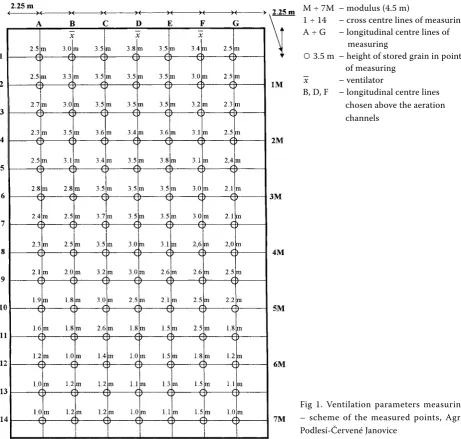
Fig 1. Ventilation parameters measuring – scheme of the measured points, Agro Podlesí-Červené Janovice
M ÷ 7M – modulus (4.5 m)
1 ÷ 14 – cross centre lines of measuring A ÷ G – longitudinal centre lines of
measuring
○ 3.5 m – height of stored grain in point of measuring
–x – ventilator
B, D, F – longitudinal centre lines chosen above the aeration channels
stabilization of the dry grain post-harvest ripeness and for conditioning treatment of insufficiently wet grain in other regions.
METHOD
The scope of the research was to find equality of the output air velocity from the stored grain layer in the hangar storage during its aeration. The storage space size is 18 × 60 m out of which grain is stored on surface of 18.0 × 31.5 m. The module of exist-ing hangar storage is 4.5 m, grain pourexist-ing height ranges from 1.0 to 3.8 m.
The proper aeration of the stored grain is conducted by three aerating ventilators, each of them connected individually with the “cage” aerating above-ground channel covered by the technically woven fabrics.
Diameter of the “cage” channel was 400 mm, axial pitch of the aerating channels 4.5 m.
The aerating ventilators parameters: 1. air amount 10,000 m3/h
over-pressure 75 Pa 2. air amount 15,000 m3/h over-pressure 100 Pa 3. air amount 10,000 m3/h over-pressure 75 Pa
These parameters indicate the low-pressure ven-tilators.
The principal parameter of the active aeration and conditioning of the stored grain is air output veloc-ity from the stored grain layer. The measuring was carried-out by the vane anemometer AIRFLOW. For accurate measuring of the air output velocity from the stored grain layer was used a special jig
[image:2.595.65.527.318.757.2]in shape of the truncated pyramid preventing input of ambient air into the apparatus. The base of this jig was 0.5 m × 0.5 m. Air velocity from the stored grain was found according to the unified method-ology for hangar storage just above the aerating channels and in the half axial distance between them as shown in Fig. 1.
RESULTS
The ventilation measurements were oriented to investigation of the air output velocity from the stored grain layer in existing hangar storage during its aeration by low-pressure ventilators.
These measurements were carried-out at the ag-ricultural enterprise Agro Podlesí, joint-stock com-pany Červené Janovice, locality Štipoklasy under the following conditions:
– stored grain weight (about) 1,088 Mg – stored grain crop food wheat Drifter – grain average pouring height 2.4 m – grain moisture 15.3%
– air temperature 9.6°C – air temperature 10.1°C – air relative humidity 76%
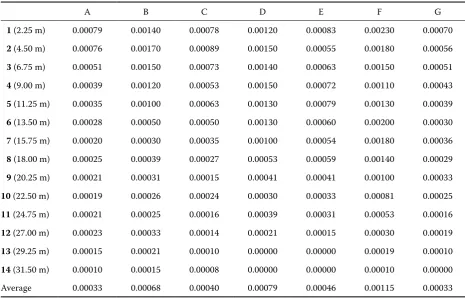
Data about measured points and measured and calculated values of the air output velocity from
the stored grain layer are presented in Fig. 2 and individually in Tables 1 and 2.
DISCUSSION
After complex assessment of the obtained results the following conclusions can be stated:
From the measured values results that the air out-put velocity from the stored grain is insufficient and often considerably irregular. This is caused probably by the inconvenient air distribution, un-levelled pouring height of grain and its poor ho-mogeneity.
On basis of the conducted analysis is recom-mended:
– To cover existing cage pipeline by the sacking of higher aerating ability.
– To level height of the stored grain after its storage (otherwise air leaks through the place of lower resistance).
[image:3.595.63.529.456.754.2]– To use the medium-pressure aerating ventilators for intensive aeration which are able to provide at least 20 m3 of air per 1 ton of stored grain per 1 hour and necessary over-pressure at least 1,000 Pa. By this solution will be reached a higher drying level and thus also demanded quality of the treatment grain.
Table 1. Air output velocity from the stored grain layer (food wheat Drifter)
A B C D E F G
1 (2.25 m) 0.00079 0.00140 0.00078 0.00120 0.00083 0.00230 0.00070
2 (4.50 m) 0.00076 0.00170 0.00089 0.00150 0.00055 0.00180 0.00056
3 (6.75 m) 0.00051 0.00150 0.00073 0.00140 0.00063 0.00150 0.00051
4 (9.00 m) 0.00039 0.00120 0.00053 0.00150 0.00072 0.00110 0.00043
5 (11.25 m) 0.00035 0.00100 0.00063 0.00130 0.00079 0.00130 0.00039
6 (13.50 m) 0.00028 0.00050 0.00050 0.00130 0.00060 0.00200 0.00030
7 (15.75 m) 0.00020 0.00030 0.00035 0.00100 0.00054 0.00180 0.00036
8 (18.00 m) 0.00025 0.00039 0.00027 0.00053 0.00059 0.00140 0.00029
9 (20.25 m) 0.00021 0.00031 0.00015 0.00041 0.00041 0.00100 0.00033
10 (22.50 m) 0.00019 0.00026 0.00024 0.00030 0.00033 0.00081 0.00025
11 (24.75 m) 0.00021 0.00025 0.00016 0.00039 0.00031 0.00053 0.00016
12 (27.00 m) 0.00023 0.00033 0.00014 0.00021 0.00015 0.00030 0.00019
13 (29.25 m) 0.00015 0.00021 0.00010 0.00000 0.00000 0.00019 0.00010
14 (31.50 m) 0.00010 0.00015 0.00008 0.00000 0.00000 0.00010 0.00000
y = 0.0007e–0.1317x
R = 0.93397
0.0000 0.0002 0.0004 0.0006 0.0008 0.0010
0 2 4 6 8 10 12 14
Coordinates of measuring
A ir ou tp ut v el oc ity (m /s ) A
y = 0.002e–0.1858x
R = 0.94255
0.0000 0.0005 0.0010 0.0015 0.0020
0 2 4 6 8 10 12 14
Coordinates of measuring
Air
output
velocity
(m/s)
[image:4.595.66.534.43.769.2]B
Fig. 2. Air output velocity from stored grain layer, point of measuring A–G Agro Podlesí-Červené Janovice
y = 0.0012e–0.1881x R = 0.97232
0.0000 0.0002 0.0004 0.0006 0.0008 0.0010
0 2 4 6 8 10 12 14
Coordinates of measuring
Air
output
velocity
(m/s)
C
y = –0.0006 Ln(x) + 0.0019
R = 0.80938
0.0000 0.0005 0.0010 0.0015 0.0020
0 2 4 6 8 10 12 14
Coordinates of measuring
Air
output
velocity
(m/s)
D
y = –0.0003 Ln(x) + 0.001 R = 0.78243
0.0000 0.0002 0.0004 0.0006 0.0008 0.0010
0 2 4 6 8 10 12 14
Coordinates of measuring
Air
output
velocity
(m/s)
E
y = 0.0038e–0.1973x
R = 0.93029
0.0000 0.0005 0.0010 0.0015 0.0020 0.0025
0 2 4 6 8 10 12 14
Coordinates of measuring
Air
output
velocity
(m/s)
F
y = –0.0002 Ln(x) + 0.0007
R = 0.95362
0.0000 0.0002 0.0004 0.0006 0.0008 0.0010
0 2 4 6 8 10 12 14
Coordinates of measuring
Air
output
velocity
(m/s)
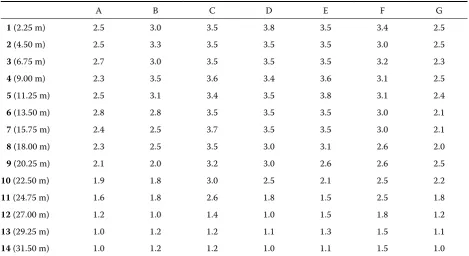
Table 2. Height of the stored grain in hangar storage
A B C D E F G
1 (2.25 m) 2.5 3.0 3.5 3.8 3.5 3.4 2.5
2 (4.50 m) 2.5 3.3 3.5 3.5 3.5 3.0 2.5
3 (6.75 m) 2.7 3.0 3.5 3.5 3.5 3.2 2.3
4 (9.00 m) 2.3 3.5 3.6 3.4 3.6 3.1 2.5
5 (11.25 m) 2.5 3.1 3.4 3.5 3.8 3.1 2.4
6 (13.50 m) 2.8 2.8 3.5 3.5 3.5 3.0 2.1
7 (15.75 m) 2.4 2.5 3.7 3.5 3.5 3.0 2.1
8 (18.00 m) 2.3 2.5 3.5 3.0 3.1 2.6 2.0
9 (20.25 m) 2.1 2.0 3.2 3.0 2.6 2.6 2.5
10 (22.50 m) 1.9 1.8 3.0 2.5 2.1 2.5 2.2
11 (24.75 m) 1.6 1.8 2.6 1.8 1.5 2.5 1.8
12 (27.00 m) 1.2 1.0 1.4 1.0 1.5 1.8 1.2
13 (29.25 m) 1.0 1.2 1.2 1.1 1.3 1.5 1.1
14 (31.50 m) 1.0 1.2 1.2 1.0 1.1 1.5 1.0
– To extend a pitch of the aerating channels. Here should be applied a basic rule i.e. pitch of the aer-ating channels must be less or equal to the pouring height of the stored grain in the storage space. – To ensure 100% passage through the channels,
incorrectly applied sacking could cause the chan-nel closing.
On basis of the measured results and conducted analysis can be stated that even the lowest air out-put velocity has not been reached from the stored grain, i.e. 0.002 m/s what represents minimum value set only for grain conditioning.
Results presented in this paper were obtained within solution of the research project of the Ministry of Agriculture No. QD 1201.
References
FAMĚRA O., 2001. Effect of the site and variety on qualitative indicators of the wheat grain. In: Conference on Problems of N-matter in Crop Products. Brno, Mendel University of
Agriculture and Forestry, Agricultural Research Institute Kroměříž: 20–25.
KROUPA P., 2001. The loss reduction and duality increase of grain by adaptation of silo towers Vítkovice for treatment and storage of corn crops. In: 2nd Agricultural Engineering Conference of Central and East Countries. Agricultural Engineering Research in the New Condition of the 21nd Century. Prague, Research Institute of Agricultural Engi-neering, 23.–24. 10.: 72–81.
KROUPA P., 2001. Adaptation of current silage towers Vít-kovice for grain crops treatment and storage. Research in Agricultural Engineering, 47: 129–135.
KROUPA P., 2002. Grain treatment by aeration. (in Czech) Farmář, No. 5: 51–52.
KROUPA P., 2003. The outer quality loss during grain post- harvest treatment and handling. Research in Agricultural Engineering, 49: 91–102.
Received for publication December 8, 2004 Accepted after corrections April 19, 2005
Provzdušňování zrna v hangárovém skladu nízkotlakými ventilátory
Výstupní rychlost vzduchu byla měřena lopatkovým anemometrem AIRFLOW. Z naměřených hodnot plyne, že výstupní rychlost vzduchu z vrstvy uskladněného zrna v hangárovém skladu je nedostatečná, použité nízkotlaké ventilátory jsou nevhodné, nebylo dosaženo ani nejnižší výstupní rychlosti vzduchu z vrstvy uskladněného zrna, tedy 0,002 m/s, což je minimální hodnota určená pouze ke kondiciování zrna.
Klíčová slova:rozvod vzduchu; provzdušňovací ventilátor; výstupní rychlost vzduchu; vlhkost zrna; kvalita zrnin
Corresponding author:
Ing. JAROSLAV SKALICKÝ, CSc., Výzkumný ústav zemědělské techniky, Drnovská 507, P.O. Box 54, 161 01 Praha 6-Ruzyně, Česká republika