The usage of fertilizers has a significant influence on crop production. However, long-term effects of fertilization on soil characteristics still have to be clarified (Liang et al. 2014). Understanding of the effects of management practices on processes of soil aggregate formation and stabilisation in different soil types is necessary for sustainable agricultural production (Bronick and Lal 2005). It was reported in many studies that present-day intensive soil cultivation causes soil structure degradation (Pagliai et al. 2004), which results in subsequent changes in soil porosity and hydrau-lic properties (Kodešová et al. 2011). Changes of soil physical parameters and reduced ability of soil aggregates to resist destruction mechanisms decrease soil fertility and increase the risk of soil erosion (Barthes and Roose 2002). Supriyadi et al. (2014) ranked soil aggregate stability among the
indicators of soil vulnerability; the decrease in SAS indicated the decrease in soil quality due to long-term tobacco production. Other important soil quality indicators are quantity and quality of soil organic matter. Even small chances of soil or-ganic matter and its labile and stable components can be distinguished by fourier transform infrared (FTIR) spectroscopy, which is well-suited for as-sessing the management effects on soil (Calderón et al. 2013).
Long-term field experiments (LTEs) enable to follow the changes of soil properties caused by different soil management practices and to assess their positive and negative influences. The aim of this study was to compare changes of soil aggregate stability and soil organic matter in three long-term experiments, differing in their experimental design, but including comparable fertilization treatments.
Study on some soil quality changes obtained
from long-term experiments
I. Stehlíková, M. Madaras, J. Lipavský, T. Šimon
Crop Research Institute, Prague, Czech Republic
ABSTRACT
Agricultural practice often causes soil structure degradation and as a result it leads to changes in soil fertility and quality. The aim of this study was to compare soil aggregate stability (SAS) and soil or-ganic matter (OM) quantity and quality in different systems of soil management. Three adjoining long-term experiments established on Chernozem were chosen; they were all set up in different years with different crop rotations and comparable fertilization treatments: control (without fertilization); NPK; ma-nure; NPK + mama-nure; N + mama-nure; OM and NPK + OM. SAS was statistically significantly lower in the trial with the highest proportion of cereals in the crop rotation. Differences among the fertilization treatments were noticeable, but not significant; the lowest SAS was observed at treatments with the mineral NPK fer-tilization. Significant correlation was found out between SAS and C/N ratio (R = –0.571; P < 0.05) and be-tween SAS and soil pH (R = 0.30; P < 0.05). Further, the individual trials differed in soil pH. A significant positive influence of the treatment NPK + manure was observed in the content of hot water-extractable car-bon (Chwl) and total soil organic carbon and nitrogen. The significant correlation between the 3000–2800/cm peak area of fourier transform infrared (FTIR) spectra and labile organic compounds in soil (Chwl) was confirmed.
Keywords: crop production; land management; farmyard manure; fraction; soil susceptibility
Supported by the Ministry of Education, Youth and Sports of the Czech Republic, Project No. LH12211, and by the Ministry of Agriculture of the Czech Republic, Project No. RO0415.
MATERIAL AND METHODS
The study was carried out in LTEs of the Crop Research Institute in Ivanovice na Hané (sugar beet cropping area, altitude of 225 m a.s.l., soil type Chernozem on loess, mean air temperature 8.4°C, annual sum of precipitation 556 mm). Experiments are placed in the flatland area in a distance of maximum 600 m from one another.
The experiment with cereals monocultures (MONO) described in Hrubý et al. (2008) was es-tablished in 1965. The experiment consists of 6 fields representing different crop rotation treatments: 1. winter wheat (w.w.) monoculture; 2. spring barley (s.b.) monoculture; 3. w.w. after s.b.; 4. s.b. after w.w.; 5. w.w. after one year of the intercrop (Phacelia), and 6. s.b. after one year of the intercrop. From each field, these treatments were chosen: NPK; NPK + OM (organic matter – straw ploughing + intercrop – Phacelia); NPK + manure (40 t/ha each 4th year).
The treatments were replicated 5 times. Fertilization by P (90 kg/ha) and K (120 kg/ha) was the same on all plots annually, N fertilization was at the annual dose of 120 kg/ha (w.w.), 50 kg/ha (s.b.) and 50 kg/ha (intercrop).
Ivanovice Crop Rotation Experiment (ICRE) which is described in Kunzová and Hejcman (2009) was established in 1956. The experiment has 8-year crop rotation (w.w., silage maize, s.b., winter oil-seed rape, triticale, potatoes, s.b. and clover). The experiment consists of 4 fields, differing only by the shift in the crop rotation. From each field, these treatments were chosen: control (without fertilization); manure each 4th year (40 t/ha); NPK
(N 80 kg/ha, P 40 kg/ha, K 80 kg/ha) + manure; N (N 80 kg/ha) + manure. The treatments were replicated 4 times.
International experiment focused on organic and nitrogen fertilization (IOSDV) was established in 1983. The experiment consisting of 3 fields and 3-year crop rotation was applied (sugar beet, w.w., winter barley). From each field, these fertilization treatments were chosen: control (without fertiliza-tion); NPK (sugar beet – N 150 kg/ha, cereals – N 120 kg/ha); manure (sugar beet – cattle manure 30 t/ha); NPK + manure (sugar beet – N 150 kg/ha + cattle manure 30 t/ha, cereals – N 120 kg/ha); OM (straw ploughing + mustard as intercrop once in 3 years) and NPK + OM (sugar beet – 150 kg N/ha, cereals –120 kg N/ha + straw plough-ing + mustard as intercrop once in 3 years). The
treatments were replicated 3 times. Fertilization with 35 kg P/ha and 83 kg K/ha annually was the same for all crops. In all experiments, ammonium nitrate and ammonium sulphate were used as N fertilizers.
In 2014 after harvest, soil samples from each plot replicate were taken from the layer 0–20 cm. Within the plot, soil samples from several sampling points were mixed together. Selected treatments were sampled also in 2013. In 2013, w.w. and s.b. were grown at MONO trial, w.w., s.b., maize and clover were grown at ICRE trial and sugar beet, w.w., winter barley at IOSDV trial. In 2014, w.w. and s.b. were grown at MONO trial, w.w., s.b. and oilseed rape were grown at ICRE trial and sugar beet, w.w., winter barley at IOSDV trial. Samples were taken in the period between 1st October and
1st November. As for the soil moisture during the
sampling campaign, soils were humid in 2013 and slightly drier in 2014.
Soil samples were dried at room temperature and the aggregates of 1–2 mm were separated by sieving. Afterwards, samples of all plot rep-lications were equally blended into a composite sample used for analyses. The soil aggregate sta-bility (SAS) was examined using the method of wet sieving (Kandeler 1996). Examination was repeated at least three times. The content of hot water extractable carbon (Chwl) was determined according to Körschens et al. (1990), total carbon (Ctot) and nitrogen (Ntot) on the Vario MAX CNS/ CN analyser (Elementar Analysensysteme GmbH, Hanau, Germany) and active soil reaction (pHH2O) according to ISO ČSN 10390. The FTIR spectra were measured on the Thermo Nicolet Avatar 320 FTIR spectrometer (Nicolet, Madison, USA) in a bulk soil and analysed at absorption bands that indicate the aliphatic C-H (3000–2800/cm) and aromatic C=C (1660–1580/cm) functional groups (Demyan et al. 2012). Decomposition index (in-tensity of FTIR spectra for C=C/C-H functional groups) was calculated.
The results were processed in the Statistica CZ 12.0 software (StatSoft. Inc., Tulsa, USA). By ANOVA, the effect of the trial (including several influences such as crop rotation, age of the trial, trial position etc.) and the effect of the fertilization treatment were evaluated. Within this study, the influence of the crop grown before soil sampling was considered as a source of statistical spread. Therefore, the effect of crop was not
ed, albeit it is known to have a significant effect on soil aggregate stability (Eviner and Chapin 2002). Individual years were evaluated separately. Statistical evaluation from the full-range sampling in 2014 is presented within this study. The results from 2013 are discussed when necessary.
RESULTS AND DISCUSSION
Statistically significant differences of SAS among the individual experiments were found (Figure 1a). The lowest aggregate stability was measured in soils at trial MONO, whereas the highest values of SAS were observed at the IOSDV experiment. These results were confirmed in both experimental years. Lower aggregate stability at monoculture cereals practice was reported e.g. by Ketcheson (1980) who observed a negative influence of cereals grown as monoculture on soil structure. The individual trials significantly differed in soil pH (Figure 1b). This observation is not consistent with the study of Neugschwandtner et al. (2014), who found that the crop rotation does not affect soil pH.
Besides differences in crop rotations and culti-vated crops, SAS and soil pH can be affected also by other factors. All treatments of MONO trial are fertilized by NPK, contrary to another two trials, where treatments without mineral fertilizing and control (non-fertilized) treatments are present too. In the case of MONO trial the negative effect of NPK fertilization on soil properties combines with the effect of cereal cropping. However, plant species effects on soil aggregation are usually larger than the effects of fertilization (Eviner and Chapin 2002). Soil heterogeneity also represents another possi-ble cause of observed differences, albeit the
experi-ments are not far from each other. The different age of trials and different previous land manage-ment might also cause soil differences at trials. The area of trials was cultivated for hundreds of years but possibly not always by one farmer. The detailed information about field history before trials establishment is not available.
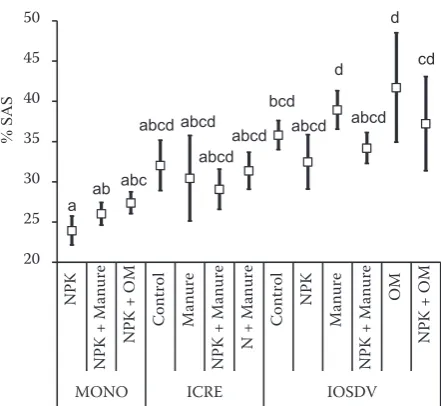
Average SAS values for different experiments and fertilization treatments are shown in Figure 2. Differences among the individual fertilization treat-ments were noticeable, but generally not significant. Our results show rather a negative influence of the 20
25 30 35 40
MONO ICRE IOSDV
% SA S a b c 6.5 7.0 7.5 8.0
MONO ICRE IOSDV
pH H2 O a b c 20 25 30 35 40
MONO ICRE IOSDV
% SA S a b c 6.5 7.0 7.5 8.0
MONO ICRE IOSDV
[image:3.595.77.509.94.223.2]pH H2 O a b c
Figure 1. Soil aggregate stability and active soil reaction in three long-term experiments. MONO – cereals monocultures; ICRE – Ivanovice Crop Rotation Experiment; IOSDV – International experiment focused on organic and nitrogen fertilization
20 25 30 35 40 45 50 N PK N PK + M an ur e N PK + O M C on tr ol M an ur e N PK + M an ur e N + M an ur e C on tr ol N PK M an ur e N PK + M an ur e O M N PK + O M
MONO ICRE IOSDV
%
S
A
S
a ab abc
[image:3.595.308.529.441.644.2]abcd abcd abcdabcd abcd abcd bcd cd d d
Figure 2. Average soil aggregate stability (± standard deviation) in the experiments with different fertiliza-tion treatments. Different letters indicate that averages are significantly different at P < 0.05 (Scheffe’s test). OM – organic matter; MONO – cereals monocultures; ICRE – Ivanovice Crop Rotation Experiment; IOSDV – International experiment focused on organic and ni-trogen fertilization
(a) (b)
mineral NPK fertilization on aggregate stability (ANOVA, P = 0.0002). This result is inconsistent with the literature data that generally reported a positive influence of inorganic fertilizers on soil structure through promotion of organic matter turnover and raising organic matter level (e.g. Naveed et al. 2014). Soil aggregation can be negatively influenced by ammonium-containing fertilizers. The negative ef-fects of NH4+ fertilizers can be expected in susceptible soils, especially in poorly aggregated, fine textured soils with low organic matter content (Haynes and Naidu 1998). This is therefore not very likely in the case of Chernozem. The changes can appear after longer period; Intrawech et al. (1982) reported that annual NH4+ fertilizer application during 10 years did not lead to significant changes of soil physical properties.
Statistically significant differences between NPK and NPK + OM were observed at MONO trial (Student’s test; P< 0.01). This corresponds with Wang et al. (2013), who found that the organic fertilizer treatments improved soil aggregate stabil-ity and soil microbiological properties compared with unfertilized and mineral NPK treatments.
In our pilot study (Stehlíková et al. 2014), we found out that soil aggregation was negatively
influenced by fertilization at 4 out of 5 other lo-calities in the Czech Republic. In this study on Chernozem, lower differences among treatments can be caused by high quality of this soil type, which is known for its high resistance to degradation.
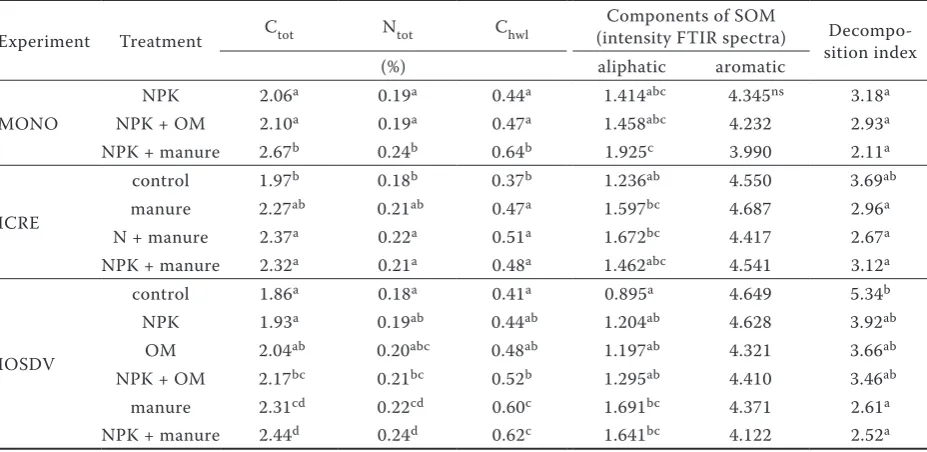
[image:4.595.65.529.480.706.2]Soil characteristics in different fertilization treat-ments within the trials are shown in Table 1. A sta-tistically significant positive influence of farmyard manuring and combined fertilization with mineral NPK was observed in the content of Chwl, Ctot and Ntot. Similarly, a positive effect of organic fertili-zation on soil properties was described by Wang et al. (2011). Aliphatic, more labile components of SOM were significantly increased in farmyard manured plots in all experiments as compared to control plots (Table 1). On the other hand, more recalcitrant, stable aromatic components of SOM did not differ among the treatments although in unfertilized variant and mineral NPK treatments were often higher. These results suggest differences in the degree of decomposition of soil organic mat-ter depending on different fertilization. Manure supplies the soil with a greater amount of organic matter, which is gradually transformed into the more stable components. Decomposition index which is hypothesised to be a measure unit of
Table 1. Soil characteristics regarding quantity and quality of soil organic matter (SOM) in different fertilization treatments within the trials
Experiment Treatment Ctot Ntot Chwl (intensity FTIR spectra)Components of SOM Decompo-
sition index
(%) aliphatic aromatic
MONO
NPK 2.06a 0.19a 0.44a 1.414abc 4.345ns 3.18a
NPK + OM 2.10a 0.19a 0.47a 1.458abc 4.232 2.93a
NPK + manure 2.67b 0.24b 0.64b 1.925c 3.990 2.11a
ICRE
control 1.97b 0.18b 0.37b 1.236ab 4.550 3.69ab
manure 2.27ab 0.21ab 0.47a 1.597bc 4.687 2.96a
N + manure 2.37a 0.22a 0.51a 1.672bc 4.417 2.67a
NPK + manure 2.32a 0.21a 0.48a 1.462abc 4.541 3.12a
IOSDV
control 1.86a 0.18a 0.41a 0.895a 4.649 5.34b
NPK 1.93a 0.19ab 0.44ab 1.204ab 4.628 3.92ab
OM 2.04ab 0.20abc 0.48ab 1.197ab 4.321 3.66ab
NPK + OM 2.17bc 0.21bc 0.52b 1.295ab 4.410 3.46ab
manure 2.31cd 0.22cd 0.60c 1.691bc 4.371 2.61a
NPK + manure 2.44d 0.24d 0.62c 1.641bc 4.122 2.52a
Different letters between rows in particular column indicate that treatment averages are significantly different at P < 0.05 (Scheffe’s test). OM – organic matter; MONO – cereals monocultures; ICRE – Ivanovice Crop Rotation Experiment; IOSDV – International experiment focused on organic and nitrogen fertilization; Ctot – total organic carbon; Ntot – total organic nitroegn; Chwl – hot water extractable carbon
organic matter transformation in soil (Margenot et al. 2015) is therefore significantly lower in ma-nured treatments compared to unfertilized con-trols. Index increases with increasing degree of SOM decomposition. The high degree of SOM decomposition is characteristic especially for soils lacking adequate organic matter input. Similarly, Demyan et al. (2012) found significantly higher relative peak area of FTIR spectra specific for aliphatic compared to aromatic components of SOM in farmyard manured plot in comparison with unfertilized plots in Haplic Chernozem.
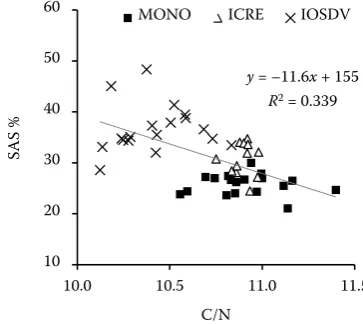
Correlation coefficients (R) for the evaluated soil characteristics are shown in Table 2. Correlation analysis of soil characteristics revealed a significant dependence between SAS and C/N ratio (Figure 3). The most obvious it was in the IOSDV experiment. Furthermore, dependence was proven between SAS and active soil reaction. Dependence between SAS and the content of carbon, as was reported by Kogut et al. (2012), was not proved. Neither was confirmed dependence between SAS and the total nitrogen content stated in Kasper et al. (2009). Chwl was significantly correlated with all other soil characteristics except C/N ratio. Chwl represents labile (active) part of SOM which shows a high turnover rate. Significant positive correla-tion between Chwl and aliphatic SOM components indicates the nature of this SOM fraction which is moreover confirmed by negative correlation between Chwl and aromatic SOM components. The link between the 3000–2800/cm peak area of FTIR spectra and labile organic compounds was previously confirmed by Demyan et al. (2012). On the other hand, significant negative correlations between aromatic organic components and C
frac-tions and Ntot indicate the recalcitrant character of aromatic components which form stable part of SOM. Decomposition index correlated nega-tively with Ctot and Ntot. Such negative correlations demonstrate that lower degree of decomposition is associated positively with soil organic C increase (Margenot et al. 2015).
[image:5.595.69.531.111.243.2]Monitoring the impact of different farming and fertilization practices on soil properties in long-term field experiments revealed a significant effect of crop rotation on the stability of soil aggregates. Simultaneously, the negative influence of long-term use of inorganic fertilizers on SAS was observed. FTIR spectroscopy in this study enabled to char-acterize labile and recalcitrant C pools relevant to soil organic matter. Using the decomposition index as an indicator of SOM transformation, substantial Table 2. Relationships among characterised soil parameters (correlation coefficients R)
Variable SAS Chwl Ctot Ntot C/N pHH2O
Chwl 0.053
Ctot –0.115 0.887
Ntot 0.014 0.918 0.968
C/N –0.571 0.110 0.375 0.167
pHH2O 0.300 –0.360 –0.168 –0.207 0.066
SOM components aliphatic –0.269 0.758 0.839 0.807 0.386 –0.209
aromatic 0.172 –0.673 –0.621 –0.606 –0.239 0.574
Decomposition index 0.261 –0.703 –0.780 –0.740 –0.407 0.266
Values of dependence statistically significant at the level of significance P < 0.05 are in bold. SAS – soil aggregate stabil-ity; Ctot – total organic carbon; Ntot – total organic nitroegn; Chwl – hot water extractable carbon
y = –11.6x + 155
R2 = 0.339
10 20 30 40 50 60
10.0 10.5 11.0 11.5
SA
S %
C/N
MONO ICRE IOSDV
Figure 3. Relationship between soil aggregate stability (SAS) and C/N ratio. MONO – cereals monocultures; ICRE – Ivanovice Crop Rotation Experiment; IOSDV – International experiment focused on organic and ni-trogen fertilization
[image:5.595.318.500.525.687.2]differences in the degree of decomposition of soil organic matter were found, depending on long-term organic and mineral fertilization.
REFERENCES
Barthés B., Roose E. (2002): Aggregate stability as an indicator of soil susceptibility to runoff and erosion; validation at several levels. Catena, 47: 133–149.
Bronick C.J., Lal R. (2005): Soil structure and management: A review. Geoderma, 124: 3–22.
Calderón F., Haddix M., Conant R., Magrini-Bair K., Paul E. (2013): Diffuse-reflectance fourier-transform mid-infrared spectroscopy as a method of characterizing changes in soil organic matter. Soil Science Society of America Journal, 77: 1591–1600.
Demyan M.S., Rasche F., Schultz E., Breulmann M., Müller T., Cadisch G. (2012): Use of specific peaks obtained by diffuse reflectance fourier transform mid-infrared spectroscopy to study the composition of organic matter in a Haplic Chernozem. European Journal of Soil Science, 63: 189–199.
Eviner V.T., Chapin III F.S. (2002): The influence of plant species, fertilization and elevated CO2 on soil aggregate stability. Plant and Soil, 246: 211–219.
Haynes R.J., Naidu R. (1998): Influence of lime, fertilizer and manure applications on soil organic matter content and soil physical conditions: A review. Nutrient Cycling in Agroeco-systems, 51: 123–137.
Hrubý J., Procházková B., Dovrtěl J., Janeček M. (2008): Effect of different agrotechnical and phytosanitary measures on spring barely yields in long-term monoculture. Agriculture (Poľnohospodárstvo), 54: 111–118.
Intrawech A., Stone L.R., Ellis R., Whitney D.A. (1982): Influence of fertilizer nitrogen source on soil physical and chemical prop-erties. Soil Science Society of America Journal, 46: 832–836. Kandeler E. (1996): Aggregate stability. In: Schiner F., Öhlinger
R., Kandeler E., Margesin R. (eds.): Methods in Soil Biology. Berlin, Springer-Verlag, 426.
Kasper M., Buchan G.D., Mentler A., Blum W.E.H. (2009): In-fluence of soil tillage systems on aggregate stability and the distribution of C and N in different aggregate fractions. Soil and Tillage Research, 105: 192–199.
Ketcheson J.W. (1980): Long-range effects of intensive cultiva-tion and monoculture on the quality of southern Ontario soils. Canadian Journal of Soil Science, 60: 403–410.
Kodešová R., Jirků V., Kodeš V., Mühlhanselová M., Nikodem A., Žigová A. (2011): Soil structure and soil hydraulic properties
of Haplic Luvisol used as arable land and grassland. Soil and Tillage Research, 111: 154–161.
Kogut B.M., Sysuev S.A., Kholodov V.A. (2012): Water stability and labile humic substances of typical chernozems under different land uses. Euroasian Soil Science, 45: 496–502.
Körschens M., Schulz E., Behm R. (1990): Heiβwasserlöslicher C und N in Boden als Kriterium für das N-Nachlieferungsvermö-gen. Zentralblatt für Mikrobiologie, 145: 305–311.
Kunzová E., Hejcman M. (2009): Yield development of winter wheat over 50 years of FYM, N, P and K fertilizer application on black earth soil in the Czech Republic. Field Crops Research, 111: 226–234.
Liang Ch.H., Yin Y., Chen Q. (2014): Dynamics of soil organic carbon fractions and aggregates in vegetable cropping systems. Pedosphere, 24: 605–612.
Margenot A.J., Calderón F.J., Bowles T.M., Parikh S.J., Jackson L.E. (2015): Soil organic matter functional group composition in relation to organic carbon, nitrogen, and phosphorus fractions in organically managed tomato fields. Soil Science Society of America Journal, 79: 772–782.
Naveed M., Moldrup P., Vogel H.J., Lamandé M., Wildenschild D., Tuller M., de Jonge L.W. (2014): Impact of long-term fer-tilization practice on soil structure evolution. Geoderma, 217–218: 181–189.
Neugschwandtner R.W., Liebhard P., Kaul H.-P., Wagentristl H. (2014): Soil chemical properties as affected by tillage and crop rotation in a long-term field experiment. Plant, Soil and Environment, 60: 57–62.
Pagliai M., Vignozzi N., Pellegrini S. (2004): Soil structure and the effect of management practices. Soil and Tillage Research, 79: 131–143. Stehlíková I., Teplá D., Madaras M. (2014): Influence of different
soil management systems on the stability of soil aggregates. Úroda, 12: 425–428. (In Czech)
Supriyadi S., Sudaryanto R., Winarno J., Hartati S., Jamil I.S. (2014): The quantitative soil quality assessment tobacco plant in Sindoro mountainous zone. Journal of Degraded and Mining Lands Management, 1: 105–110.
Wang W., Chen W.C., Wang K.R., Xie X.L., Yin Ch.M., Chen A.L. (2011): Effects of long-term fertilization on the distribution of carbon, nitrogen and phosphorus in water-stable aggregates in paddy soil. Agricultural Sciences in China, 10: 1932–1940. Wang F., Tong Y.A., Zhang J.S., Gao P.C., Coffie J.N. (2013): Ef-fects of various organic materials on soil aggregate stability and soil microbiological properties on the Loess Plateau of China. Plant, Soil and Environment, 59: 162–168.
Received on October 12, 2015 Accepted on January 4, 2016
Corresponding author:
RNDr. Mikuláš Madaras, Ph.D., Výzkumný ústav rostlinné výroby, v.v.i., Drnovská 507, 161 06 Praha-Ruzyně, Česká republika; e-mail: [email protected]