144
doi:10.1107/S2056989015024937 Acta Cryst.(2016).E72, 144–146research communications
Received 10 December 2015 Accepted 30 December 2015
Edited by M. Weil, Vienna University of Technology, Austria
†
Keywords:crystal structure; intermetallic compound; linear platinum chains
CCDC reference:1444811
Supporting information:this article has supporting information at journals.iucr.org/e
Crystal structure of Sr
2CdPt
2containing linear
platinum chains
Effendi Nawawi,aFakhili Guloa* and Ju¨rgen Ko¨hlerb
aDepartment of Chemical Education, Sriwijaya University, Inderalaya, Ogan Ilir 30662, South Sumatra, Indonesia, and b
Max Planck Institut fu¨r Festko¨rperforschung, Heisenbergstr. 1, 70698 Stuttgart, Germany. *Correspondence e-mail: [email protected]
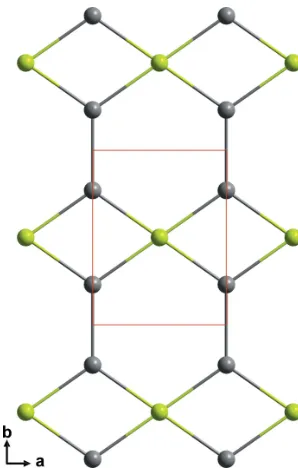
The ternary intermetallic title phase, distrontium cadmium diplatinum, was prepared from stoichiometric amounts of the elements at 1123 K for one day. The crystal structure adopts the orthorhombic Ca2GaCu2structure type in space groupImmm. Its main features are characterized by linear (Pt—Pt Pt—Pt)n chains that are aligned along [010] and condensed through cadmium atoms forming Cd-centred Pt2Cd2/2 rectangles to build up sheets parallel to (001). These sheets are connected to each other via alternating (001) sheets of strontium atoms along [001]. The strontium sheets consists of corrugated Sr4 units that are condensed to each other through edge-sharing parallel to [100].
1. Chemical context
A large number of transition metal-based ternary inter-metallic phases have been studied in terms of metal–metal interactions and structure–property relationships (Corbett, 2010). Exploratory synthetic approaches in systems A/Cd/Pt (A= alkaline earth metal) have revealed a great compositional and structural diversity. The calcium phase Ca6Cd16Pt8 contains a three-dimensional array of isolated Cd8tetrahedral stars (TS) and a face-centred cube of Pt@Ca6 octahedra (Samalet al., 2013) whilst the structure of Ca6Cd11Pt crystal-lizes in its own structure type consisting of apically inter-bonded Cd7pentagonal bipyramids and five-membered rings of Ca atoms (Guloet al., 2013). The strontium phase SrCd4Pt2 is made up of chains of edge-sharing Cd4tetrahedra bridged by four-bonded Sr atoms (Samal et al., 2013) and SrCdPt presents six-membered rings of Sr atoms in a chair confor-mation (Gulo & Ko¨hler, 2014). The barium phase BaCd2Pt exhibits zigzag chains of Ba atoms and Pt-centred boat and anti-boat conformations formed by six-membered rings of Cd atoms (Gulo & Ko¨hler, 2015). The Pt-based ternary inter-metallic compounds with general formulaA2XPt2(A= alka-line-earth or rare-earth metal;X= diel, triel, or tetrel element) adopt five different structure types. Sr2InPt2(Mutset al., 2007) crystallizes in the monoclinic Ca2Ir2S type (Schoolaert & Jung, 2002), Pu2SnPt2 (Pereira et al., 1997) in the tetragonal Mo2FeB2type (Gladyshevskiiet al., 1996) while U2CdPt2has its own structure type (Gravereau et al., 1994). Ce2CdPt2 (Po¨ttgen et al., 2000) adopts the tetragonal U3Si2 type (Zachariasen, 1948), and Ca2CdPt2 (Samal & Corbett, 2012) the orthorhombic Ca2GaCu2type (Fornasini & Merlo, 1988). In this article we present the crystal structure of the novel intermetallic phase Sr2CdPt2containing linear (Pt—Pt Pt— Pt)nchains as a principal structural motif.
2. Structural commentary
The ternary intermetallic title phase adopts the orthorhombic Ca2GaCu2structure type (Fornasini & Merlo, 1988) with the Ca, Ga, and Cu sites replaced by Sr, Cd, and Pt sites, respectively. The three atoms occupy three independent sites in the unit cell. The Sr atom resides on a special position with site symmetrymm2 (Wyckoff site 4j), the Cd atom occupies a special positions with site symmetry mmm(2 a) and the Pt atom is on a special positions with site symmetrym2m(4h). In the two structures, the transition metals (platinum and copper, respectively) occupy the same positions. In contrast, in the structure of SrCd4Pt2(Samalet al., 2013) which is isotypic with ZrFe4Si2 (Yarmolyuk et al., 1975), the transition metals (platinum and iron, respectively) occupy different positions and the Pt atoms reside on the respective Si sites because silicon and platinum atoms are the most electronegative atoms in the two systems. The new phase Sr2CdPt2 contains 26 valence electrons and, as already mentioned, is isotypic with
Ca2GaCu2. However, in comparison the structure of Sr2CdPt2 is appreciably distorted along the platinum chains, presumably because Ca2GaCu2 contains much smaller Cu atoms and a larger valence electron count of 29. Coordination spheres of each atomic site in the title structure are illustrated in Fig. 1. The Sr atom is coordinated by five other Sr, four Cd, and four Pt atoms. The Sr—Sr bond lengths vary from 3.674 (3) to 3.854 (1) A˚ , the Sr—Cd distances range from 3.490 (1) to 3.577 (1) A˚ , whereas the Sr—Pt values vary only slightly, from 3.188 (1) to 3.231 (1) A˚ . Six Sr atoms construct a square-planar pyramid, Sr@Sr5. The existence of Sr—Sr strong bonds is observable in SrCdPt (Gulo & Ko¨hler, 2014) but not in SrCd4Pt2 (Samalet al., 2013). The Cd atom exhibits a coor-dination number of twelve and has eight Sr and four Pt atoms in its environment with Cd—Pt distances of 2.785 (1) A˚ . The Pt atom is surrounded by six Sr, two Cd and one Pt atoms with a Pt—Pt distance of 2.734 (1) A˚ . This distance is slightly longer than those found in Ca2CdPt2 (2.659 A˚ ; Samal & Corbett, 2012) or Sr2InPt2 (2.707 A˚ ; Muts et al., 2007) but shorter than those in Pu2SnPt2(Pereiraet al., 1997), U2CdPt2 (Gravereauet al., 1994) or Ce2CdPt2(Po¨ttgenet al., 2000). All other interatomic distances (Sr—Cd, Sr—Pt, and Cd—Pt) are in agreement with those found in some ternary compounds in
A/Cd/Pt systems (A= alkaline earth metal).
3. Packing features
Sr atoms are bound together into corrugated sheets consisting of edge-sharing Sr4-units. These sheets spread parallel to (001) and are linked by another Sr—Sr bond of 3.674 (3) A˚ along [001]. (Fig. 2). The crystal structure is also characterized by the existence of linear (Pt—Pt Pt—Pt)nchains along [010] with longer distances of 3.2010 (14) A˚ between pairs of tightly
research communications
Acta Cryst.(2016).E72, 144–146 Nawawiet al. CdPt
[image:2.610.45.296.471.713.2]2Sr2
145
Figure 1
Coordination of strontium, cadmium, and platinum atoms in Sr2CdPt2.
Displacement ellipsoids are displayed at the 90% probability level.
Figure 2
Projection of the crystal structure of Sr2CdPt2approximately along theb
[image:2.610.366.515.475.709.2]axis.
Figure 3
Projection of linear platinum chains that are aligned along thebaxis and condensedvia cadmium atoms forming Pt2Cd2/2-rectangles in the ab
bound Pt—Pt dumbbells, a significant distortion in the direc-tion of dimerizadirec-tion. The platinum chains are condensed into (001) sheets through Cd atoms, forming Cd-centred rectangles with composition Pt2Cd2/2 (Fig. 3). The Pt2Cd2/2 layers are stacked along [001] and are linked through the corrugated sheets of Sr atoms.
4. Database survey
A search of the Pearson’s Crystal Data – Crystal Structure Database for Inorganic Compounds (Villars & Cenzual, 2015)
for the Sr/Cd/Pt family of compounds returned two
compounds only: SrCd4Pt2 (Samal et al., 2013) and SrCdPt (Gulo & Ko¨hler, 2014).
5. Synthesis and crystallization
The title compound was synthesized from starting materials of Sr granules (99.9+%, Alfa Aesar), Cd powder (99.9+%, Alfa Aesar) and Pt powder (99.95%, Chempur). A stoichiometric mixture of these elements was loaded into a Nb ampoule in an Ar-filled dry box. The Nb ampoule was then weld-sealed
under an Ar atmosphere and subsequently enclosed in an evacuated silica jacket. The sample was then heated to 1123 K for 15 h, equilibrated at 923 K for 4 days, and followed by slow cooling to room temperature.
6. Refinement
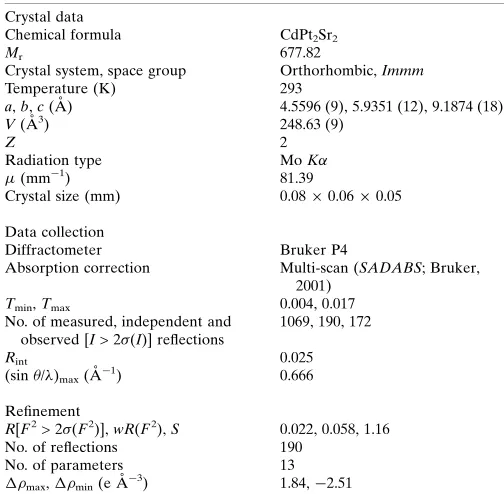
Crystal data, data collection and structure refinement details are summarized in Table 1. The maximum and minimum remaining electron densities are located 1.66 and 0.81 A˚ , respectively, from the Pt site.
Acknowledgements
Financial support for EN and FG from PNBP Unsri is grate-fully acknowledged.
References
Brandenburg, K. (2010).DIAMOND. Crystal Impact GbR, Bonn, Germany.
Bruker (2001).XSCANSandSADABS. Bruker AXS Inc., Madison, Wisconsin, USA.
Corbett, J. D. (2010).Inorg. Chem.49, 13–28.
Fornasini, M. L. & Merlo, F. (1988).J. Less-Common Met.142, 289– 294.
Gladyshevskii, E. I., Fedorov, T. F., Kuz’ma, Y. B. & Skolozdra, R. V. (1996).Sov. Powder Metall. Met. Ceram.5, 305–309.
Gravereau, P., Mirambet, F., Chevalier, B., Weill, F., Fourne`s, L., Laffargue, D., Boure´e, F. & Etourneau, J. R. (1994).J. Mater. Chem. 4, 1893–1895.
Gulo, F. & Ko¨hler, J. (2014).Acta Cryst.E70, 590–592.
Gulo, F. & Ko¨hler, J. (2015).Z. Anorg. Allg. Chem.641, 557–560. Gulo, F., Samal, S. L. & Corbett, J. D. (2013).Inorg. Chem.52, 10112–
10118.
Muts, I. R., Nilges, T., Rodewald, U. C., Zaremba, V. I. & Po¨ttgen, R. (2007).Z. Naturforsch. B,62, 1563–1566.
Pereira, L. C. J., Wastin, F., Winand, J. M., Kanellakopoulos, B., Rebizant, J., Spirlet, J. C. & Almeida, M. (1997). J. Solid State Chem.134, 138–147.
Po¨ttgen, R., Fugmann, A., Hoffmann, R. D., Rodewald, U. C. & Niepmann, D. (2000).Z. Naturforsch. B,55, 155–161.
Samal, S. L. & Corbett, J. D. (2012).Z. Anorg. Allg. Chem.638, 1963– 1969.
Samal, S. L., Gulo, F. & Corbett, J. D. (2013).Inorg. Chem.52, 2697– 2704.
Schoolaert, S. & Jung, W. (2002).Z. Anorg. Allg. Chem.628, 1806– 1810.
Sheldrick, G. M. (2008).Acta Cryst.A64, 112–122.
Villars, P. & Cenzual, K. (2015). Pearson’s Crystal Data – Crystal Structure Database for Inorganic Compounds. Release 2015/16. ASM International, Materials Park, Ohio, USA.
Yarmolyuk, Y. P., Lysenko, L. A. & Gladyshevskii, E. I. (1975). Uopov. Akad. Nauk Ukr. RSR, Ser. A.279.
Zachariasen, W. H. (1948).Acta Cryst.1, 265–268.
146
Nawawiet al. CdPt2Sr2 Acta Cryst.(2016).E72, 144–146
[image:3.610.43.295.92.339.2]research communications
Table 1
Experimental details.
Crystal data
Chemical formula CdPt2Sr2
Mr 677.82
Crystal system, space group Orthorhombic,Immm
Temperature (K) 293
a,b,c(A˚ ) 4.5596 (9), 5.9351 (12), 9.1874 (18)
V(A˚3) 248.63 (9)
Z 2
Radiation type MoK
(mm 1) 81.39
Crystal size (mm) 0.080.060.05
Data collection
Diffractometer Bruker P4
Absorption correction Multi-scan (SADABS; Bruker, 2001)
Tmin,Tmax 0.004, 0.017 No. of measured, independent and
observed [I> 2(I)] reflections
1069, 190, 172
Rint 0.025
(sin/)max(A˚ 1) 0.666 Refinement
R[F2> 2(F2)],wR(F2),S 0.022, 0.058, 1.16 No. of reflections 190
No. of parameters 13
max,min(e A˚ 3) 1.84, 2.51
supporting information
sup-1 Acta Cryst. (2016). E72, 144-146
supporting information
Acta Cryst. (2016). E72, 144-146 [doi:10.1107/S2056989015024937]
Crystal structure of Sr
2CdPt
2containing linear platinum chains
Effendi Nawawi, Fakhili Gulo and J
ü
rgen K
ö
hler
Computing details
Data collection: XSCANS (Bruker, 2001); cell refinement: XSCANS (Bruker, 2001); data reduction: XSCANS (Bruker,
2001); program(s) used to solve structure: SHELXS97 (Sheldrick, 2008); program(s) used to refine structure: SHELXL97
(Sheldrick, 2008); molecular graphics: DIAMOND (Brandenburg, 2010); software used to prepare material for
publication: SHELXL97 (Sheldrick, 2008).
Distrontium cadmium diplatinum
Crystal data CdPt2Sr2 Mr = 677.82
Orthorhombic, Immm Hall symbol: -I 2 2 a = 4.5596 (9) Å b = 5.9351 (12) Å c = 9.1874 (18) Å V = 248.63 (9) Å3 Z = 2
F(000) = 560 Dx = 9.054 Mg m−3
Mo Kα radiation, λ = 0.71073 Å Cell parameters from 25 reflections θ = 12–18°
µ = 81.39 mm−1 T = 293 K Block, brown
0.08 × 0.06 × 0.05 mm
Data collection Bruker P4 4-circle
diffractometer
Radiation source: fine-focus sealed tube Graphite monochromator
Detector resolution: 0 pixels mm-1 ω–scans
Absorption correction: multi-scan (SADABS; Bruker, 2001) Tmin = 0.004, Tmax = 0.017
1069 measured reflections 190 independent reflections 172 reflections with I > 2σ(I) Rint = 0.025
θmax = 28.3°, θmin = 4.1° h = −5→6
k = −7→7 l = −11→11
Refinement Refinement on F2
Least-squares matrix: full R[F2 > 2σ(F2)] = 0.022 wR(F2) = 0.058 S = 1.16 190 reflections 13 parameters 0 restraints
Primary atom site location: structure-invariant direct methods
Secondary atom site location: difference Fourier map
w = 1/[σ2(F
o2) + (0.0337P)2 + 3.9776P]
where P = (Fo2 + 2Fc2)/3
(Δ/σ)max < 0.001
Δρmax = 1.84 e Å−3
Δρmin = −2.51 e Å−3
Extinction correction: SHELXL, Fc*=kFc[1+0.001xFc2λ3/sin(2θ)]-1/4
supporting information
sup-2 Acta Cryst. (2016). E72, 144-146
Special details
Geometry. All e.s.d.'s (except the e.s.d. in the dihedral angle between two l.s. planes) are estimated using the full covariance matrix. The cell e.s.d.'s are taken into account individually in the estimation of e.s.d.'s in distances, angles and torsion angles; correlations between e.s.d.'s in cell parameters are only used when they are defined by crystal symmetry. An approximate (isotropic) treatment of cell e.s.d.'s is used for estimating e.s.d.'s involving l.s. planes.
Refinement. Refinement of F2 against ALL reflections. The weighted R-factor wR and goodness of fit S are based on F2,
conventional R-factors R are based on F, with F set to zero for negative F2. The threshold expression of F2 > σ(F2) is used
only for calculating R-factors(gt) etc. and is not relevant to the choice of reflections for refinement. R-factors based on F2
are statistically about twice as large as those based on F, and R- factors based on ALL data will be even larger.
Fractional atomic coordinates and isotropic or equivalent isotropic displacement parameters (Å2)
x y z Uiso*/Ueq
Pt 0.0000 0.23034 (10) 0.5000 0.0172 (3)
Cd −0.5000 0.5000 0.5000 0.0172 (4)
Sr 0.0000 0.5000 0.19995 (16) 0.0162 (4)
Atomic displacement parameters (Å2)
U11 U22 U33 U12 U13 U23
Pt 0.0156 (4) 0.0205 (4) 0.0155 (4) 0.000 0.000 0.000
Cd 0.0157 (8) 0.0152 (8) 0.0207 (9) 0.000 0.000 0.000
Sr 0.0171 (8) 0.0169 (8) 0.0146 (8) 0.000 0.000 0.000
Geometric parameters (Å, º)
Pt—Pti 2.7341 (13) Cd—Srvii 3.4901 (10)
Pt—Cdii 2.7855 (5) Cd—Srviii 3.5773 (12)
Pt—Cd 2.7855 (5) Cd—Sriii 3.5773 (13)
Pt—Sriii 3.1876 (14) Cd—Sr 3.5773 (12)
Pt—Sr 3.1876 (14) Cd—Srix 3.5773 (13)
Pt—Ptiii 3.2010 (14) Sr—Ptiii 3.1876 (14)
Pt—Sriv 3.2312 (10) Sr—Ptiv 3.2312 (10)
Pt—Srv 3.2312 (10) Sr—Ptxii 3.2312 (10)
Pt—Srvi 3.2312 (10) Sr—Ptxiii 3.2312 (10)
Pt—Srvii 3.2312 (10) Sr—Ptv 3.2312 (10)
Cd—Ptiii 2.7855 (5) Sr—Cdxiv 3.4901 (10)
Cd—Ptviii 2.7855 (5) Sr—Cdxiii 3.4901 (10)
Cd—Ptix 2.7855 (5) Sr—Cdii 3.5773 (12)
Cd—Sriv 3.4901 (10) Sr—Srxv 3.674 (3)
Cd—Srx 3.4901 (10) Sr—Srxvi 3.8535 (9)
Cd—Srxi 3.4901 (10)
Pti—Pt—Cdii 125.070 (13) Srviii—Cd—Sriii 180.0
Pti—Pt—Cd 125.070 (13) Ptiii—Cd—Sr 58.560 (14)
Cdii—Pt—Cd 109.86 (3) Ptviii—Cd—Sr 121.440 (14)
Pti—Pt—Sriii 120.139 (18) Ptix—Cd—Sr 121.440 (14)
Cdii—Pt—Sriii 73.232 (13) Pt—Cd—Sr 58.560 (14)
supporting information
sup-3 Acta Cryst. (2016). E72, 144-146
Pti—Pt—Sr 120.139 (18) Srx—Cd—Sr 113.929 (12)
Cdii—Pt—Sr 73.232 (13) Srxi—Cd—Sr 66.071 (12)
Cd—Pt—Sr 73.232 (13) Srvii—Cd—Sr 113.929 (12)
Sriii—Pt—Sr 119.72 (4) Srviii—Cd—Sr 79.18 (3)
Pti—Pt—Ptiii 180.0 Sriii—Cd—Sr 100.82 (3)
Cdii—Pt—Ptiii 54.930 (13) Ptiii—Cd—Srix 121.440 (14)
Cd—Pt—Ptiii 54.930 (13) Ptviii—Cd—Srix 58.560 (14)
Sriii—Pt—Ptiii 59.861 (18) Ptix—Cd—Srix 58.560 (14)
Sr—Pt—Ptiii 59.861 (18) Pt—Cd—Srix 121.440 (14)
Pti—Pt—Sriv 64.971 (13) Sriv—Cd—Srix 113.929 (12)
Cdii—Pt—Sriv 145.14 (2) Srx—Cd—Srix 66.071 (12)
Cd—Pt—Sriv 70.466 (13) Srxi—Cd—Srix 113.929 (12)
Sriii—Pt—Sriv 134.76 (2) Srvii—Cd—Srix 66.071 (12)
Sr—Pt—Sriv 73.786 (15) Srviii—Cd—Srix 100.82 (3)
Ptiii—Pt—Sriv 115.029 (13) Sriii—Cd—Srix 79.18 (3)
Pti—Pt—Srv 64.971 (13) Sr—Cd—Srix 180.0
Cdii—Pt—Srv 70.466 (13) Ptiii—Sr—Pt 60.28 (4)
Cd—Pt—Srv 145.14 (2) Ptiii—Sr—Ptiv 134.76 (2)
Sriii—Pt—Srv 134.76 (2) Pt—Sr—Ptiv 106.214 (15)
Sr—Pt—Srv 73.786 (15) Ptiii—Sr—Ptxii 106.214 (15)
Ptiii—Pt—Srv 115.029 (13) Pt—Sr—Ptxii 134.76 (2)
Sriv—Pt—Srv 89.75 (3) Ptiv—Sr—Ptxii 50.06 (3)
Pti—Pt—Srvi 64.971 (13) Ptiii—Sr—Ptxiii 106.214 (15)
Cdii—Pt—Srvi 70.466 (13) Pt—Sr—Ptxiii 134.76 (2)
Cd—Pt—Srvi 145.14 (2) Ptiv—Sr—Ptxiii 110.71 (5)
Sriii—Pt—Srvi 73.786 (15) Ptxii—Sr—Ptxiii 89.75 (3)
Sr—Pt—Srvi 134.76 (2) Ptiii—Sr—Ptv 134.76 (2)
Ptiii—Pt—Srvi 115.029 (13) Pt—Sr—Ptv 106.214 (15)
Sriv—Pt—Srvi 129.94 (3) Ptiv—Sr—Ptv 89.75 (3)
Srv—Pt—Srvi 69.29 (5) Ptxii—Sr—Ptv 110.71 (5)
Pti—Pt—Srvii 64.971 (13) Ptxiii—Sr—Ptv 50.06 (3)
Cdii—Pt—Srvii 145.14 (2) Ptiii—Sr—Cdxiv 151.90 (4)
Cd—Pt—Srvii 70.466 (13) Pt—Sr—Cdxiv 91.620 (18)
Sriii—Pt—Srvii 73.786 (15) Ptiv—Sr—Cdxiv 48.779 (16)
Sr—Pt—Srvii 134.76 (2) Ptxii—Sr—Cdxiv 93.47 (3)
Ptiii—Pt—Srvii 115.029 (13) Ptxiii—Sr—Cdxiv 93.47 (3)
Sriv—Pt—Srvii 69.29 (5) Ptv—Sr—Cdxiv 48.779 (16)
Srv—Pt—Srvii 129.94 (3) Ptiii—Sr—Cdxiii 91.620 (19)
Srvi—Pt—Srvii 89.75 (3) Pt—Sr—Cdxiii 151.90 (4)
Ptiii—Cd—Ptviii 180.0 Ptiv—Sr—Cdxiii 93.47 (3)
Ptiii—Cd—Ptix 109.86 (3) Ptxii—Sr—Cdxiii 48.779 (16)
Ptviii—Cd—Ptix 70.14 (3) Ptxiii—Sr—Cdxiii 48.779 (16)
Ptiii—Cd—Pt 70.14 (3) Ptv—Sr—Cdxiii 93.47 (3)
Ptviii—Cd—Pt 109.86 (3) Cdxiv—Sr—Cdxiii 116.48 (4)
Ptix—Cd—Pt 180.0 Ptiii—Sr—Cdii 48.21 (2)
Ptiii—Cd—Sriv 119.245 (13) Pt—Sr—Cdii 48.21 (2)
Ptviii—Cd—Sriv 60.755 (13) Ptiv—Sr—Cdii 152.59 (2)
supporting information
sup-4 Acta Cryst. (2016). E72, 144-146
Pt—Cd—Sriv 60.755 (13) Ptxiii—Sr—Cdii 89.339 (16)
Ptiii—Cd—Srx 60.755 (13) Ptv—Sr—Cdii 89.339 (16)
Ptviii—Cd—Srx 119.245 (13) Cdxiv—Sr—Cdii 113.929 (12)
Ptix—Cd—Srx 60.755 (13) Cdxiii—Sr—Cdii 113.929 (12)
Pt—Cd—Srx 119.245 (13) Ptiii—Sr—Cd 48.21 (2)
Sriv—Cd—Srx 180.00 (4) Pt—Sr—Cd 48.21 (2)
Ptiii—Cd—Srxi 60.755 (13) Ptiv—Sr—Cd 89.339 (16)
Ptviii—Cd—Srxi 119.245 (13) Ptxii—Sr—Cd 89.339 (16)
Ptix—Cd—Srxi 60.755 (13) Ptxiii—Sr—Cd 152.59 (2)
Pt—Cd—Srxi 119.245 (13) Ptv—Sr—Cd 152.59 (2)
Sriv—Cd—Srxi 116.48 (4) Cdxiv—Sr—Cd 113.929 (12)
Srx—Cd—Srxi 63.52 (4) Cdxiii—Sr—Cd 113.929 (12)
Ptiii—Cd—Srvii 119.245 (13) Cdii—Sr—Cd 79.18 (3)
Ptviii—Cd—Srvii 60.755 (13) Ptiii—Sr—Srxv 149.861 (18)
Ptix—Cd—Srvii 119.245 (13) Pt—Sr—Srxv 149.861 (18)
Pt—Cd—Srvii 60.755 (13) Ptiv—Sr—Srxv 55.35 (2)
Sriv—Cd—Srvii 63.52 (4) Ptxii—Sr—Srxv 55.35 (2)
Srx—Cd—Srvii 116.48 (4) Ptxiii—Sr—Srxv 55.35 (2)
Srxi—Cd—Srvii 180.0 Ptv—Sr—Srxv 55.35 (2)
Ptiii—Cd—Srviii 121.440 (14) Cdxiv—Sr—Srxv 58.24 (2)
Ptviii—Cd—Srviii 58.560 (14) Cdxiii—Sr—Srxv 58.24 (2)
Ptix—Cd—Srviii 58.560 (14) Cdii—Sr—Srxv 140.409 (17)
Pt—Cd—Srviii 121.440 (14) Cd—Sr—Srxv 140.409 (17)
Sriv—Cd—Srviii 66.071 (12) Ptiii—Sr—Srxvi 53.63 (3)
Srx—Cd—Srviii 113.929 (12) Pt—Sr—Srxvi 100.38 (5)
Srxi—Cd—Srviii 66.071 (12) Ptiv—Sr—Srxvi 151.51 (5)
Srvii—Cd—Srviii 113.929 (12) Ptxii—Sr—Srxvi 103.14 (3)
Ptiii—Cd—Sriii 58.560 (14) Ptxiii—Sr—Srxvi 52.59 (2)
Ptviii—Cd—Sriii 121.440 (14) Ptv—Sr—Srxvi 92.53 (2)
Ptix—Cd—Sriii 121.440 (14) Cdxiv—Sr—Srxvi 141.30 (3)
Pt—Cd—Sriii 58.560 (14) Cdxiii—Sr—Srxvi 58.05 (2)
Sriv—Cd—Sriii 113.929 (12) Cdii—Sr—Srxvi 55.88 (3)
Srx—Cd—Sriii 66.071 (12) Cd—Sr—Srxvi 101.13 (5)
Srxi—Cd—Sriii 113.929 (12) Srxv—Sr—Srxvi 103.81 (4)
Srvii—Cd—Sriii 66.071 (12)
Symmetry codes: (i) −x, −y, −z+1; (ii) x+1, y, z; (iii) −x, −y+1, −z+1; (iv) −x−1/2, −y+1/2, −z+1/2; (v) −x+1/2, −y+1/2, −z+1/2; (vi) x+1/2, y−1/2, z+1/2; (vii) x−1/2, y−1/2, z+1/2; (viii) x−1, y, z; (ix) −x−1, −y+1, −z+1; (x) x−1/2, y+1/2, z+1/2; (xi) −x−1/2, −y+3/2, −z+1/2; (xii) x−1/2, y+1/2, z−1/2; (xiii)