warwick.ac.uk/lib-publications
Original citation:Brand, Samuel P. C., Tildesley, Michael J. and Keeling, Matthew James. (2015) Rapid simulation of spatial epidemics : a spectral method. Journal of Theoretical Biology, Volume 370 . pp. 121-134.
Permanent WRAP URL:
http://wrap.warwick.ac.uk/67531
Copyright and reuse:
The Warwick Research Archive Portal (WRAP) makes this work by researchers of the University of Warwick available open access under the following conditions. Copyright © and all moral rights to the version of the paper presented here belong to the individual author(s) and/or other copyright owners. To the extent reasonable and practicable the material made available in WRAP has been checked for eligibility before being made available.
Copies of full items can be used for personal research or study, educational, or not-for-profit purposes without prior permission or charge. Provided that the authors, title and full bibliographic details are credited, a hyperlink and/or URL is given for the original metadata page and the content is not changed in any way.
Publisher’s statement:
© 2015, Elsevier. Licensed under the Creative Commons Attribution-NonCommercial-NoDerivatives 4.0 International http://creativecommons.org/licenses/by-nc-nd/4.0/ A note on versions:
The version presented here may differ from the published version or, version of record, if you wish to cite this item you are advised to consult the publisher’s version. Please see the ‘permanent WRAP url’ above for details on accessing the published version and note that access may require a subscription.
Author's Accepted Manuscript
Rapid Simulation of Spatial Epidemics: A Spectral Method
Samuel P.C. Brand, Michael J. Tildesley, Mat-thew J. Keeling
PII: S0022-5193(15)00036-3
DOI: http://dx.doi.org/10.1016/j.jtbi.2015.01.027
Reference: YJTBI8055
To appear in: Journal of Theoretical Biology
Received date: 19 August 2014 Revised date: 15 January 2015 Accepted date: 26 January 2015
Cite this article as: Samuel P.C. Brand, Michael J. Tildesley, Matthew J. Keeling, Rapid Simulation of Spatial Epidemics: A Spectral Method, Journal of Theoretical Biology, http://dx.doi.org/10.1016/j.jtbi.2015.01.027
This is a PDF file of an unedited manuscript that has been accepted for publication. As a service to our customers we are providing this early version of the manuscript. The manuscript will undergo copyediting, typesetting, and review of the resulting galley proof before it is published in its final citable form. Please note that during the production process errors may be discovered which could affect the content, and all legal disclaimers that apply to the journal pertain.
Rapid Simulation of Spatial Epidemics: A Spectral Method
Samuel P. C. Brandac, Michael J. Tildesleyb, Matthew J. Keelingab
Abstract
Spatial structure and hence the spatial position of host populations plays a vital role in the
spread of infection. In the majority of situations, it is only possible to predict the spatial spread
of infection using simulation models, which can be computationally demanding especially for
large population sizes. Here we develop an approximation method that vastly reduces this
computational burden. We assume that the transmission rates between individuals or
sub-populations are determined by a spatial transmission kernel. This kernel is assumed to be
isotropic, such that the transmission rate is simply a function of the distance between
sus-ceptible and infectious individuals; as such this provides the ideal mechanism for modelling
localised transmission in a spatial environment. We show that the spatial force of infection
acting on all susceptibles can be represented as a spatial convolution between the transmission
kernel and a spatially extended ‘image’ of the infection state. This representation allows the
rapid calculation of stochastic rates of infection using fast-Fourier transform (FFT) routines,
which greatly improves the computational efficiency of spatial simulations. We demonstrate
the efficiency and accuracy of thisfast spectral rate recalculation (FSR) method with two
ex-amples: an idealised scenario simulating an SIR-type epidemic outbreak amongst N habitats
distributed across a two-dimensional plane; the spread of infection between US cattle farms,
illustrating that the FSR method makes continental-scale outbreak forecasting feasible with
desktop processing power. The latter model demonstrates which areas of the US are at
consis-tently high risk for cattle-infections, although predictions of epidemic size are highly dependent
on assumptions about the tail of the transmission kernel.
aDepartment of Life Sciences, University of Warwick, Gibbet Hill Rd, Coventry, CV4 7AL
bMathematics Institute, University of Warwick, Gibbet Hill Rd, Coventry, CV4 7AL
Highlights
• Kernel-based spatial transmission models are computationally expensive for large population
sizes.
• We present an efficient and accurate alternative simulation methodology (dubbed FSR
simu-lation) based upon a spectral representation of the infection rate.
• FSR simulation also permits the accelerated likelihood calculation for more efficient parameter
inference.
• Using FSR simulation it was possible to perform detailed outbreak forecasting for a generic
cattle infection at the continental-scale.
Keywords
Accelerated simulation, Epidemics, Cattle infections.
1. Introduction
Understanding the dynamics of infection invading a spatially structured population is of both
theoretical interest and practical importance. The theoretical interest is due to the impact of
re-laxing the homogenous mixing assumption common to classical models of epidemic dynamics. The
main practical concern is the e↵ect that the introduction of heterogeneity in population mixing has
on key model predictions, such as the rate of recruitment of new infecteds [1], the spatial variation
of infection risk [2] and in particular the consequences of targeted control measures [3, 4]. In
con-trast to other forms of population heterogeneity in epidemic models (such as age-structure), spatial
structuring focuses attention on the location of the initial infectious seeds and the ensuing dynamics
of invasion often characterised by a travelling spatial wave. The emergent spatio-temporal patterns
of infection are dominated by this invasion mechanism, with epidemic risk to the underlying
There are several approaches to modelling the dynamics of the spread of spatial infection,
includ-ing PDE models [5], agent-based models [6], and models based on an underlyinclud-ing contact network
[7], but the metapopulation model is often the preferred formulation due to its relative simplicity
and flexibility. The metapopulation model consists of a set of discrete point habitats in continuous
space, each with its own internal dynamics, which can interact with each other. Its origins date back
over 40 years [8], but it is experiencing increasing use in a wide number of problems in population
dynamics [9, 10]. While the original metapopulation model assumed an equal rate of interaction
between all habitats, the inclusion of more realistic rates that depend on spatial separation has lead
to a greater understanding of the roles of spatial structure, with applications in as diverse settings
as population biology [11, 12], conservation biology [13], evolutionary biology [14] and epidemiology
[15, 16, 17].
In rejecting spatially homogeneous models it has become common to include the rate of
trans-mission between two spatial locations as a distance varying spatial transtrans-mission kernel, even for
models with considerable implications for public policy, such as predictive modelling for
Foot-and-mouth intervention strategies [18, 19]. The transmission kernel can be naturally interpreted as an
unnormalised dispersal distribution for ‘o↵spring’ from their originating infectious ‘parent’,
combin-ing the rate of ‘o↵spring’ production, transmissibility/survivability of the ‘o↵spring’ and the spatial
distribution of it’s dispersed location. This interpretation essentially unifies spatial invasion models
of both species [20] and epidemics [21]. The ‘o↵spring’ of an infectious source being interpreted as
potential infectious contacts in the epidemic model. When the entire background space is uniformly
available there are distinct phenomenological di↵erences between kernel-based models where
trans-mission rate decays exponentially with distance (or faster) and those with slower, ‘heavy-tailed’
transmission rate decay. Essentially ‘light-tailed’ kernels lead to an asymptotic invasion front
ex-panding with a certain velocity whereas ‘heavy-tailed’ kernels lead to a continuously accelerating
patchy invasion. This phenomenological dependence on kernel tail decay for models with
homo-geneously distributed hosts has been confirmed by both analysis [22] and simulation [23]. For the
metapopulation model used in this work analysis will be considerably complicated by heterogeneous
demogra-phy from population to population. In this more realistic situation Monte Carlo (MC) simulation
becomes the main approach for investigating the expected outcomes of epidemic outbreak, although
one might expect transmission kernel tail decay to play an important role in analogy to the stronger
results for simpler models outlined above.
Simulation is a universally applicable approach to investigating these metapopulation models,
allowing flexibility in adding further realism to the general model framework. If scientific or
sta-tistical confidence in the relevant parameters can be achieved, then MC simulation methods can
have ‘real-world’ predictive power [24]. However, for stochastic simulation the MC convergence of
the observables of interest can require a very large number of independent replicates of simulated
epidemic realisations. Moreover, this problem is compounded whenever insight requires the
sweep-ing of large regions of plausible parameter space, or when the results of simulation are required
for parameter inference, e.g. when using an approximate bayesian computation (ABC) method
[25, 26, 27]. The requirement to perform very many independent realisations puts great emphasis
on the development of highly efficient algorithms for stochastic simulation, even at the cost of mild
inexactness (an example of such an approach is [28]).
The essential non-linearity in epidemic models is due to the interaction between susceptible and
infectious individuals. In this spatial metapopulation context each susceptible habitat becomes
infected due to the summed risk of transmission from all infectious habitats. Therefore, naively a
simulation must calculate (and sum) the transmission strength between all susceptible - infectious
pairs in the population; and this value must be recalculated after any event that changes the
in-fection status of the population. Since the number of possible pairs grows quadratically with the
number of individuals, it is this calculation that becomes the main bottleneck for stochastic spatial
simulation, and it is improving the efficiency of this calculation that is the subject of this paper.
Here we present the fast spectral rate recalculation (FSR) method for simulating spatial
epi-demics this utilises a rapid estimation of the force of infection rather than calculating the sum over
PDEs [29], this approach is motivated by representing the force of infection as a smooth field over
all space. After approximating the habitat locations as unit mass Gaussian distributions in space,
the spectral projection of this force of infection field onto a regular grid of sizeM can be calculated
efficiently using FFT (Fast Fourier Transform) at a computational cost ofO(MlnM). The infection
rate for each susceptible habitat can then be determined by interpolation on nearest grid points.
This compares favourably with the potentially O(N2) cost of calculating the infection rate for all
susceptibles from the direct definition in a population of size N. We will demonstrate that although
this methodology is an approximate scheme, the error due to the spectral projection can be made
negligible by decreasing grid separations (increasing M). For large numbers of habitats, where the
transmission kernel is relatively wide (that is many infectious habitats contribute to the risk of
in-fection for each susceptible habitat) the spectral method can be implemented with low error whilst
still retaining substantial speed advantage over simulations using direct summation to calculate
force of infection. Finally we will present two examples to illustrate the potential usefulness of the
FSR method. Firstly, using a simple spatial SIR model, that FSR methodology can be adapted in a
straightforward manner to accelerate likelihood based inference for spatial epidemic processes with
negligible loss in accuracy. Secondly, a simulation-based case study of outbreak predictions for a
disease spreading amongst US cattle farms based upon agricultural census data and under varying
assumptions about range and intensity of farm to farm transmission. The much greater numerical
efficiency of the FSR method was crucial for making a continent-scale epidemiological study feasible
despite using only desktop computing power.
2. Methods
The basic methodology is introduced in stages; firstly the basic spatial model framework and
state space of the model are defined. We then describe existing methods for simulating the dynamics
of infection before showing how the force of infection on a habitat can be represented as a convolution
on the spatial locations. This leads to a novel algorithm (termed the Fast Spectral Rate or FSR) to
simulate spatial epidemics. Later in the results section we focus on the accuracy and computational
2.1. Spatial Risk of Transmission
In this work we consider modelling the spread of a infectious disease within a population spatially
segregated between N indexed habitats each with a location co-ordinate (xi)N
i=1 in two dimensions.
Each habitat is considered to be inhabited by a single host individual described by some discrete
disease state, and therefore the model conforms to the standard Levins-type metapopulation [8]. (In
principle the methodology outlined here readily extends to stochastic populations at each habitat,
but the single host assumption makes the formulation more transparent.) Additionally, each habitat
is treated as sufficiently small compared to the background space that it can be modelled as a point
location. We are concerned with spatial transmission of the disease; hence we replace the Levins
state alphabet of ‘not occupied’ or ’occupied’ with ‘Susceptible’ (S) and ‘Infected and Infectious’
(I). Depending on the characteristics of the disease the state alphabet may be augmented to reflect
the underlying epidemiology, such as including a ‘Removed’ (R) class denoting those habitats where
after a period spent infectious the habitat ceases to play a further role in the epidemic. In this work
we will concentrate on epidemic models where each habitat that becomes infected will eventually
be removed, conforming to the standard SIR paradigm.
The underlying epidemic is treated as a random process, where it is useful to describe the state
of each habitat i using the boolean-valued disease state indicators, Si(t), Ii(t), as well as additional
indicator representing additional model complexity, e.g. Ri(t). Hence Si(t) takes the value one
if the individual in habitat i is susceptible at time t, or zero otherwise. The rate at which an
infectious (I) habitat j transmits to a susceptible (S) habitati is governed by a spatial transmission
kernel K, which we assume depends only on the (Euclidean) distance between the two habitats
e.g. K(xi, xj) ⌘ K(|xi xj|). (Note that this assumption restricts us to considering translational
invariant kernels, such that the precise locations of the habitats are irrelevant and transmission only
depends on their relative positions). Hence, the force of infection on habitat i is,
i(t) = N
X
j=1
For continuous time models the probabilistic dynamics of the infection process for each habitat iis,
P(Infection event at habitat i2[t, t+ t]) = Si(t) i(t) t+o( t). (2)
The above holding for arbitrary t >0.
In this paper however we will be mainly concerned with related discrete time processes. This can
either be viewed as an approximation to the continuous time process or an independent model in
its own right where the epidemic processes occur on a natural cycle (e.g. daily). For many natural
systems there is a clear daily cycle, and host behaviour and therefore transmission rates may vary
substantially between day and night time; in such cases a discrete time model may be viewed as
more realistic than a continuous (time homogeneous) model. In this discrete time model infection
and recovery events do not have instantaneous e↵ect on the stochastic rates of all other events but
impact on the subsequent time step. Having chosen the cycle period t⇤ > 0 as a model choice,
we can derive the following discrete time dynamics from (2) using the assumption of periodically
updating states, arriving at the Keeling-type [18] model
P(Inf. event at susceptible habitat i2[tn, tn+1] | Si(t) = 1) = 1 exp( i(tn) t⇤), (3)
where tn = n( t⇤), n 2 N. For practical purposes the cycle period t⇤ can be absorbed into the
parameterisation of the discrete time epidemic model by treating t⇤ = 1 and varying the remaining
parameters.
Rather than simulate infection events directly from (3) it is convenient and more efficient to use
an equivalent discrete time Sellke construction [30]. Each habitat i is assigned a random epidemic
resistance Zi ⇠ exp(1) and at each time step accumulates infectious pressure ⇤i according to its
force of infection,
⇤i(t) =⇤i(t 1) + i(t) =
t
X
s=0
The habitatibecomes infected on the first time step that⇤i(t)> Zi. The computational advantage
of the Sellke construction is that resistances {Zi}Ni=1 can be pre-generated before a simulation run,
since they are independent of the dynamics, as can other random periods such as the infection
du-ration of each habitat. Altogether, these pre-generated random numbers encode the full stochastic
dynamics of a spatial epidemic realisation; we follow Cook et al [31] in referring to them as the
latent variables, Z, of the epidemic. We will utilise latent variable matching in order to compare
epidemic realisations using to direct calculation of the force of infection i(t) to those using the
FSR approximation.
2.2. The Force of Infection as a Spatial Convolution
After an initial early growth period a successfully invasive pathogen will typically infect a
sig-nificant (O(N)) number habitats during the course of an epidemic. For simulations where a large
number of habitats are under consideration, the necessary recalculation of the force of infection,
i(t), for each susceptible habitat after each time-step therefore becomes computationally
bur-densome. A brute force approach to this task requires a sum over all infected habitats for each
susceptible habitat at a computational cost of O(N2) per time-step. An immediate saving is made
by including { i(t)}i2S as part of the epidemic state, updating (rather than recalculating) for each
susceptible habitat upon each event. Hence, for E events occurring in a time-step, the force of
infection recalculation is of cost O(EN). We call this approach stochastic simulation with rate
updating. For simulation of the discrete time model (3) the recalculation still scales as O(N2), due
to the fact that E ⇠O(N), although there is a significant saving compared to full recalculation.
We propose a method of accelerating stochastic simulation by reducing the computational burden
involved in recalculation of the force of infection for each susceptible habitat after E events have
occurred in a time-step of our simulation method. The basic idea is to treat i(t) as a single point
of a continuous field, which is derived from a convolution between the transmission kernel and a
spatial distribution of infected habitats. This field is calculated on a set of M grid points, making
taken. The computational e↵ort of convolution solving using FFT (Fast Fourier Transform) on M
collocation points grows O(MlogM), which is potentially very efficient compared to brute force
calculation of the force of infection. We follow the formalism of Ovaskainen and Cornell [11, 12]
in representing the spatial spread of the infection across the habitats as a weighted sum of delta
distributions. We call this the spatially extended image of the infectious sources,
fI(x, t) = N
X
i=1
(x xi)Ii(t), x2R2. (5)
In a similar manner, the force of infection is extended to a field for every point in R2. This field
has the compact expression as a convolution
(x, t) = N
X
j=1
K(x xj)Ij(t)
= N
X
j=1
Z
K(x y) (y xj)Ij(t)dy
= (K ⇤fI)(x, t), (6)
here, ⇤ represents convolution over the spatial variables, (f⇤g)(x, t) = R f(x y, t)g(y, t)dy. For a
given epidemic state, X(t), the force of infection at each habitat iis recovered through the identity
i(t) = (xi, t).
The conceptual power behind our approach is to use this convolution representation to rapidly
calculate the force of infection field onM collocation points and use local interpolation to estimate
i (for all susceptibles) at each time-step of the stochastic integration scheme.
2.3. Fast Spectral Rate Recalculation
Our goal is to reduce the problem of simulating stochastic epidemic dynamics in continuous
space to a closely approximated problem on a discrete grid. The grid-based dynamics can be
simu-lated much more efficiently than the full system dynamics using FFT techniques, since the force of
infection on each habitat can be rapidly recalculated after infection or recovery events. The use of
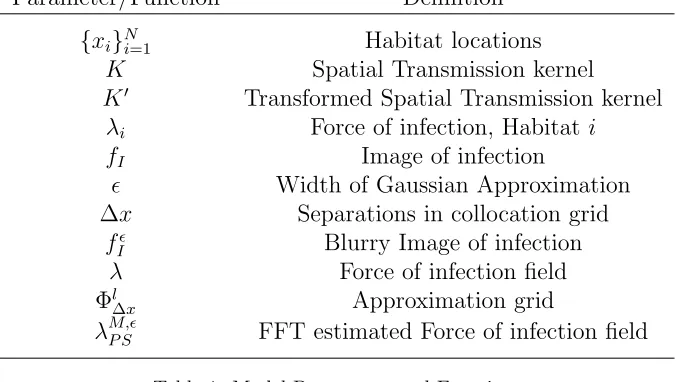
Parameter/Function Definition
{xi}Ni=1 Habitat locations K Spatial Transmission kernel
K0 Transformed Spatial Transmission kernel
i Force of infection, Habitat i
fI Image of infection
✏ Width of Gaussian Approximation
x Separations in collocation grid
f✏
I Blurry Image of infection Force of infection field l
x Approximation grid
M,✏
[image:12.612.141.479.45.236.2]P S FFT estimated Force of infection field
Table 1: Model Parameters and Functions
in the following section we consider how this assumption can be relaxed.
Two ideas underpin accelerating the calculation of the force of infection (Figure 1). Firstly, the
image of the infectious sources is ‘blurred’ by approximating each delta distribution as a Gaussian
shaped function of width ✏ > 0; this is so that infection potential can be approximated as
origi-nating from grid points. For real populations where individuals are not tied to a point location,
this Gaussian blurring may actually more closely reflect reality. Secondly, we solve an analogous
equation to (6) defined on a discrete collocation grid using efficient FFT convolution solving and
read o↵ { i(t)}N
i=1 directly from a local interpolation scheme.
To this end we introduce a 2-dimensional regular grid over an l ⇥l area, with a spacing x
between grids,
l
x ={i = x(i1, i2) |(i1, i2)2Z2, i2Il}. (7)
These grid-points are the collocation points used for the discrete transformation, that is the points
at which the force of infection is calculated. By varying the spacing x we can use M collocation
points to cover our space, however we always choose x such that l/ x = m 2 N, leading to
Since our goal is to utilise the efficiency of FFT algorithms we require that both the transmission
kernel and image of infection can be well approximated by their support on the collocation grid. This
will not be true for the delta distributions in the definition of fI since they are not functions in the
traditional sense, but rather distributions in a more general sense [32]. We resolve this problem by
introducing the blurred image of infection, f✏
I, where the delta distributions in the image definition
(5) are replaced by tight Gaussians of width ✏ (>0),
fI✏(x, t) = N
X
i=1
✏(x xi)Ii(t), ✏(x) = 1 2⇡✏2e
|x|2
2✏2 . (8)
To provide even greater computational efficiency, we treat these Gaussians as having finite range,
cutting o↵at a distance of 5✏. The number of collocation points local to habitati(that are involved
with the blurring of the image of i) is denoted ni =|{i2 l x s.t. |i xi|<5✏}|.
The natural grid-based approximation to the integral form of the force of infection field (6) on
the periodic domainIlis to use a sum over grid points, respecting the periodic boundary conditions,
(i, t)⇡( x)2 X
j2 l x
K({i j}l)fI✏(j, t), (9)
where{i j}l represents periodic summation of all distances betweeniand j on a periodic domain,
although in our examples only the shortest vector between points i and j on the periodic space Il
will contribute. The approximation (9) is in the form of a circular convolution sum which can be
efficiently solved (see supporting information) using Fourier (FFT) coefficients of the transmission
kernel ( ˜K) and the blurry image of infection ( ˜f✏
I) and the inverse fast Fourier transform (IFFT)
operation F 1[·],
(i, t) ⇡ M,✏P S(i, t) = ( x)2F 1[ ˜Kf˜I✏](i, t), (10)
where M,✏P S is equivalently the exact solution to the sum (9) and the discrete Fourier transform, or
computa-tional burden for its solution everywhere on the grid grows as O(MlnM). Once, we have estimated
the force of infection on the grid of points, l
x, we can read o↵ an approximation for i(t) from
local bilinear interpolation from the 4 grid points nearest xi.
The relationship between the Fourier pseudo-spectra of the ‘true and ‘blurry’ images of infection
is approximately
˜
fI✏(!, t)⇡˜✏f˜I(!, t), !2Z2, (11)
where ✏ is the zero centred Gaussian (8) and! is a discrete wavenumber for the pseudo-spectrum.
Equation (11) motivates defining a transformed kernel spectrum K˜0,
˜
K0(!) = K˜˜(!)
✏(!), ! 2Z
2. (12)
The approach being to as far as possible reduce the error due to using Gaussian approximations
of delta functions whilst retaining their numerical convenience. Numerical investigation suggests
that using the transformed kernel spectrum (12) improves the accuracy of the pseudo-spectral
ap-proximation to the force of infection field compared to using the discrete spectrum ˜K directly (see
supporting information). A secondary benefit of using the transformed kernel spectrum is to largely
eliminate✏dependence from parameterisation of the FSR simulation scheme. Throughout we choose
✏ sufficiently great so that the mass of the Gaussians (8) is fully supported on the grid (˜✏(0) ⇡1)
but no greater. A detailed error analysis reveals that, without kernel spectrum transformation,
the accuracy of the FSR method depends more strongly upon ✏ with both extremes ✏ ⌧ x and
✏ x being poor parameter value ranges. We refer the reader to the supporting information.
We call simulation using recalculation of M,✏P S and local interpolation the fast spectral rate
re-calculation (FSR) method, and can be represented by the following algorithm.
1. Choose a suitable FFT algorithm and number of simulation repetitions.
2. Perform one-o↵ pre-calculations:
(a) Calculate and store local points for each habitat i, {i2 l
x s.t. |i xi|<5✏}.
(b) Calculate pseudo-spectra of transmission kernel ˜K, zero-centred Gaussian ˜✏ and
trans-formed kernel ˜K0, avoiding zero division error in (12).
3. Choose initial epidemic state, construct the initial blurry image of infection fI✏(i,0), and set
t = 0.
4. Solve the sum M,✏P S(i, t), 8i 2 l
x, by using an FFT algorithm to construct the product
function ˜Kf˜I and taking IFFT using transformed kernel, F 1[ ˜K0f˜I].
5. Re-normalise M,✏P S by the factor ( x)2, if this is not performed by the FFT algorithm.
6. Perform stochastic time-step update using rates of infection i(t) read o↵ from bi-linear
in-terpolation of M,✏P S(i, t).
7. For each ofE events that occurred in step 6., update f✏
I on l x at the ni local points to the
habitat where the event has occurred.
8. If there are remaining infected habitats sett !t+ 1 and return to 4. If epidemic has finished,
stop simulation.
9. If further simulations are required return to 3. The information calculated in 2. can be reused.
Conveniently, there are a multiplicity of high quality FFT algorithms publicly accessible, for
ex-ample the FFTw library for C programming or the high quality FFT routine in MATLAB. Hence,
there is no necessity for the reader to construct their own transformation algorithm. The
conver-gence and error analysis of random epidemics generated using FSR method onto the ‘true’ random
epidemic defined by dynamics such as (3) is discussed in supporting information.
Although we have chosen to illustrate the use of the FSR method with the motivating example
of the spatial SIR-type epidemic, it should be noted that this methodology holds for any type
of stochastic spatial process where the stochastic rate for events can be written in the form (6).
Examples therefore include a range of spatial epidemiological models (eg SEIR-type and SIS-type
dynamics) and spatial ecological models where a local interaction process governs competition or
• (Euclidean) Spatially distributed individuals or densities,
• Smooth and translation invariant spatial interactions.
2.3.1. Non-periodic Boundary Conditions
In many real-world applications the idealised periodic boundary conditions are unrealistic:
phys-ical boundaries to transmission may play an important role in containing epidemic spread, or the
habitats may exist in a finite domain isolated from external infection. However, FSR implicitly
requires periodic boundary conditions in solving the convolution sum (10); essentially modelling
the dynamics on a torus rather than a finite plane. To circumvent this problem and yet retain the
efficiency of using FFT we embed our original space, Il, within a larger extended space, Il0, setting
l0 > lsufficiently large such thatl0 periodic extensions of do not interact. This is done by placing
the habitats in the smaller space Il, and then subsequently creating an empty padded space for f✏ I
on Il0. On this larger space an infection event has a zero probability of ‘wrapping’ round the space
Il0. We achieve this either by restricting to transmission kernels of compact support, or by imposing
compact support by finite range truncation. We therefore set the epidemic on Il0 and use the FSR
method for fast calculation of (i, t) on i2 l0
x as above.
3. Results
We present results and analyse the accelerated performance due to using the FSR method for
a spatially distributed population of varying size undergoing an SIR-type epidemic. The deviation
between epidemic simulation using direct rate recalculation and simulation using the FSR method
was firstly investigated by comparing their resultant epidemic curves and spatio-temporal
distri-bution of infected habitats at epidemic peak. More systematically error between direct and FSR
simulation was measured using latent variable matching in the sense of Cook et al [31]; essentially
the latent random variables encode the intrinsic stochastic fluctuations of the spatial epidemic
pro-cess and therefore deviation between epidemics with identical latent variables is due solely to error
in the rate calculation. By choosing sufficiently fine grid spacing (small x) it was found that
FSR simulation could be highly accurate even whilst delivering significant time saving per
to direct simulation as the population size N became larger. We also demonstrate the possibility
of using FSR rate calculation to accelerate likelihood-based parameter inference for this class of
spatial epidemic model. Finally, we present a FSR-simulation case study of continental-scale
epi-demic outbreak amongst commercial US cattle farms, using spatial data that accurately reflect US
agricultural census data at the county scale. E↵ects of farm size on the epidemic dynamics are
introduced without compromising the numerical efficiency of the FSR method.
3.1. Epidemic Spread amongst a Spatial Metapopulation
For the examples in this section the habitat locations are given within a l⇥l square in two
dimensional space ({xi}Ni=1 2 [ l/2, l/2]2 = Il ⇢ R2). For simplicity we consider a discrete time
spatial epidemic model conforming to the classic SIR paradigm, such that infected individuals
recover and are then immune. Discrete time steps are chosen to reflect a daily change in disease
status with all rates given in units of (days) 1, and therefore the time scale t⇤ = 1 day. In
addition to the stochastic infection dynamics (3) there are the additional recovery dynamics; for
each infectious habitat (individual) i the daily probability of removal/recovery is,
P(Rec. event at hab. i | Ii(t) = 1) = 1 exp( ). (13)
Where the recovery rate = 0.1 (days) 1 is used in this section; this gives an average infectious
duration of 10.5 days given the discrete nature of the time-steps. The habitat location coordinates
were chosen as independent spatial Poisson points on Il. The length scales are fixed by choosing
units such that the habitat density N/l2 = 1. The length scale of transmission, L, is given in
these units. For each N considered, the random distribution of habitat locations was realised once,
with further simulations performed on identical landscapes. Non-periodic boundary conditions as
described above were imposed to replicate the fixed spatial scale of the population.
The transmission kernelK(x, y) encodes the rate of potentially infectious contact from an
infec-tious source at some pointx to pointy. However, in this work we only consider radially symmetric
kernels; that isK(x, y) = K(x0, y0) whenever |x y|=|x0 y0|. This is most naturally expressed in
range r; in two spatial dimensions the total potentially infectious contact rate in the infinitesimal
range interval [r,r+dr) is 2⇡rK(r)dr. Treating the radially symmetric transmission kernel as an
(unnormalised) spatial density gives three natural summary statistics, independent of the
distribu-tion of susceptibles: the magnitude of the kernel, the mean range of dispersal and the variance in
the range of dispersal.
Magnitude(K) = 2⇡
Z 1
0
rK(r)dr, (14)
Mean(K) =
R1
0 r
2K(r)dr
R1
0 rK(r)dr
, (15)
Var(K) =
R1
0 r
3K(r)dr
R1
0 rK(r)dr
Mean(K)2. (16)
In the idealised scenario of a uniformly distributed population of susceptibles the summary statistics
define the actual rate of infection and range statistics of successful infections.
The transmission kernel for this section was chosen from the family of Gaussian shaped functions
with width L, {K(·;L)}L>0 such that
K(|x|;L) =
2⇡L2e
|x|2/2L2
. (17)
For l L, sets the magnitude of the transmission kernel over Il independently of length scale
L. The mean and variance of dispersal for the Gaussian kernel in two dimensions are mean(K) =
p
⇡/2Land Var(K) = (2 ⇡/2)L2. This directly links the length scale parameterLto the expected
range of dispersal of infected habitats. As a reference, in the limit L! 1spatial position becomes
irrelevant and the epidemics collapses into the well understood non-spatial or mean-field stochastic
SIR model with population size N [1, 33] albeit in discrete time. We choose = 0.2 (days) 1,
where the pathogen can successfully invade except at small values of L.
3.1.1. Performance of FSR method compared to direct simulation
We took as default parameters a metapopulation of N = 12,100 habitats in a 110⇥110 box,
localised transmission kernel (relative to the scale of the system and the density of habitats) places
a severe test on the FSR methodology. The FSR method was implemented using a collocation grid
of size M = 2562, which gave a grid separation x = 0.5 on an augmented box of side length
110 + 6L used in order to implement non-periodic boundary conditions. Habitat point locations
were approximated as Gaussians of width ✏= 0.4. To initiate the epidemic, a single infected source
farm was positioned in the centre of the box and the 9 closest habitats where also infected.
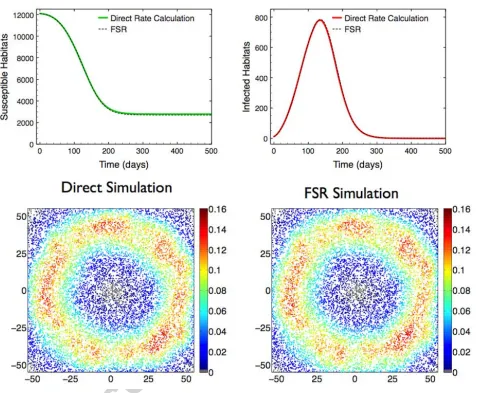
Simulation, using direct rate calculation with 1000 replicates, indicated that epidemic
realisa-tions typically recruit locally to the origin before an invasion front formed, infection then spreading
in a wave-like manner throughout the space causing a declining epidemic tail due to exhaustion
of available susceptible habitats. FSR simulation captured this phenomenology and closely
repli-cated the expected dynamics observed with direct simulation, including the expected peak day
(tpeak= 134 days). The maximum absolute deviation in expected number of infecteds between the
methods, supt 0{|hE[(IF SR Idir)(t)]i|} = 16.85 habitats, was small compared to the size of the
metapopulation (0.14% of total metapopulation). Since, in principle, rather di↵erent local spatial
epidemic processes can give rise to similar population level dynamics we also directly compared the
spatial distribution of disease prevalence on the expected epidemic peak day tpeak between direct
simulation and kernel corrected FSR simulation. The probability of each habitat i being infectious
on day tpeak,pi, was estimated using 1000 simulation replicates, and the values compared using
di-rect and FSR simulation; the mean deviation, averaged over all habitats, between the two methods
is small at just 8.5⇥10 3 (Figure 1).
In order to more efficiently assess the accuracy of the FSR simulation method under variation in
parametrisation we also introduce an alternative error measure based upon the maximum di↵erence
between states in simulations using the direct and FSR methods, but using identical latent variables
Z to account for stochastic fluctuations.
Error =EZ[Error(Z)] =EZ
h
sup t 0
n 1
N
N
X
i=1
where Xdir
i (t|Z) returns the disease state of the ith habitat on day t using direct simulation
condi-tional on latent variablesZ,XF SR
i (t|Z) is the same but where FSR simulation is used, andd(x, y) is
the discrete metric returning 0 i↵x=yand 1 otherwise. This error therefore measures the maximal
di↵erence between the spatial epidemic patterns predicted by the two methods over the entire
epi-demic process. This error measure has the useful property that if FSR returns identical estimates for
{ i(t), t = 0,1, . . . , T}N
i=1 to direct calculation then Error(Z) = 0, 8Z. Such a relationship would
not hold without matching latent variablesZ, due to inherent variability between epidemic samples.
We conducted a systematic investigation of the error due to using FSR, measured using (18) and
the default parameters above as a baseline comparison; averages were taken over 100 realisations
of the latent variables Z. To initiate the epidemic, a single source farm was placed at the centre
of the space and then surrounding farms where infected such that the initial density of infecteds
I/N = 0.02; this allows us to match initial densities across a range of population sizes N. For the
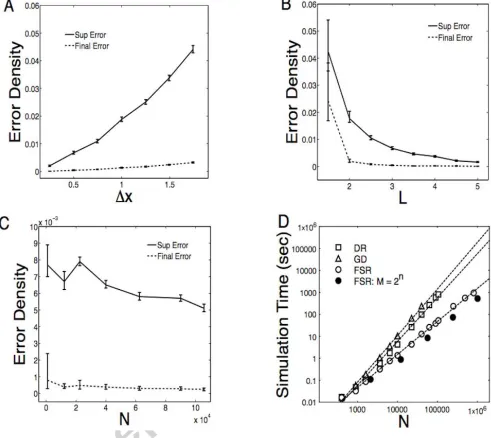
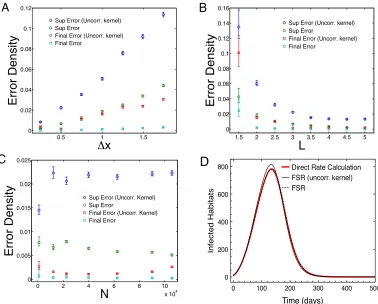
default parameters (N = 12,100, L= 3, x= 0.5), Error = 6.7⇥10 3 ([6.2⇥10 3,7.3⇥10 3] 95%
confidence region). The error decayed from baseline at finer grid separation, x (Figure 2A).
Sim-ilarly, error sharply decreased with increasing length scale of infection, L (Figure 2B). Fixing both
transmission length scale (L) and grid width ( x), and taking a sequence of epidemic models with
increasing N (but keeping a constant density of habitats) we found that average error depended
only weakly with N over two orders of magnitude (Figure 2C). These results are in line with both
the intuition that more disperse transmission resolved on at a finer grid scale should lead to better
performance, and the detailed error analysis presented in supporting information.
In addition to supremum (maximum) error over the entire epidemic, it is also of interest to
assess the final error of number and spatial distribution of recovered habitats at the end of the
epidemic. Again matching Z we found the final state error matched the trends observed in the
supremum error, but was generally significantly lower in every part of parameter space (Figure 2).
For our default scenario, the final error density was 3.84⇥10 4 ([3.00⇥10 4,5.84⇥10 4]). The
lower value for final error density suggests that (i) small errors in force of infection calculation due
the supremum error and (ii) that the large majority of errors are timing errors; that is errors in
when an event occurs rather than whether an event occurs. Dynamically, the latent variables Z
act as a set of thresholds defining when a given habitat has observed sufficient force of infection to
become infected. Therefore, even small errors in the force of infection calculated using FSR have
the potential to change the time-step upon which a habitat becomes infected compared to directly
calculated simulation but are less likely to change whether a habitat becomes infected on any
time-step. No significant systematic bias in the timing of infection was observed in the comparison of
average epidemic prevalence curves generated using FSR and direct calculation, their shapes are
closely similar and agree on expected peak tpeak (Figure 1).
The algorithmic efficiency of the FSR was measured by the time taken to simulate (serially) a
number of replicate complete epidemic realisations; results are presented as an average simulation
time per replicate epidemic (Figure 2D). The initial number of infected habitats was fixed to be the
2% of the total metapopulation size with the default parameterisation outlined above. For most
data points 100 replicate simulations were performed for speed estimates, however, for some of the
large simulations this number was reduced, but never decreased below 20. For large N there was
not great variation in simulation time between individual epidemics. For FSR simulation the main
determinant of speed per time step is the size of the collocation grid M, in order to compare the
speed of FSR simulation to direct simulation we fixed x= 0.5 and N/l2 = 1. As a comparison we
also produced speed estimates for both discrete time simulation using direct rate calculation and
for continuous time simulation based on equation (2) using the popular Gillespie algorithm [34].
For each form of simulation we found a time scaling O(N↵) which reflects both the computational
cost of force of infection recalculation and the number of time steps. Simulation time scaling was
found to be approximately O(N2) for both discrete time simulation using direct rate calculation
(↵ = 1.997) and for continuous time simulation (↵= 2.121). Simulation using FSR delivered
sub-stantial speed benefit (↵= 1.503), which can be further optimised by restricting M = 2n forn 2N
(↵ = 1.390) (Figure 2D). All simulations used for speed comparison were performed on the same
The maximum population size we considered for both FSR and direct simulation was N =
105,625 habitats, which is incidentally the same order of magnitude as the number of farms in
Great Britain [35]. At this large population size the FSR method considerably outperformed the
direct rate recalculation in terms of computational efficiency, running simulations in approximately
6.6% of the time. Unsurprisingly, the continuous time simulation algorithm was considerably slower
than either of the other two methods. It is therefore clear that for large scale simulation of spatial
epidemic outbreak together with wide sweeps of parameters space and large numbers of replicates
necessary, the standard GD based simulation is only feasible when dedicated high performance
computing resources are available. However, the use of discrete-time FSR simulation brings this
type of calculation within the realm of powerful desktop computers.
3.1.2. FSR acceleration compared to accelerating direct simulation using pair pre-calculation
We found that for more disperse transmission kernels (larger L) the collocation grid can be
coarsened ( x can be increased) without substantially impairing accuracy and time saving is then
even more dramatic. On the other hand very localised transmission demands very fine grid mesh
for good accuracy, which reduces the time saving due to using FSR. So far we have compared FSR
to the baseline performance of directly simulating the spatial epidemic. We now compare FSR
performance against an alternative acceleration strategy based on exploiting localised transmission.
A simple acceleration technique for simulating the local spread of disease from habitat to nearby
habitat is to pre-calculate e↵ective pairs of habitats; that is those pairs of habitats where an event
at one has a non-negligible e↵ect upon the force of infection of the other. During simulation
epi-demic events at a habitat only cause rate updating at that habitat’s e↵ective pairs which gives an
efficiency saving compared to rate updating at all remaining susceptible habitats, particularly if
each habitat has only a comparatively small number of e↵ective pairs due to localised transmission.
For the Gaussian shaped kernel (17) transmission is unlikely to occur at a range greater than 5L
and we used this range to pre-calculate e↵ective pairs of habitats in a series of simulation speed
scale L (2 L 17.5) for an entire epidemic. As before habitats were uniformly randomly
dis-tributed across the box Il at unit density (l = 325, N = 105,625) with the 2% of habitats closest
to the centre of Il chosen as the initial infectious set and other parameters as before. The size of
the full set of pre-calculated habitat pairs was therefore O(N L2). FSR simulation used a grid size
M = 2m with m chosen as small as possible such that L/ x > 6, a ratio of transmission range
to mesh size above which FSR was found to be accurate. For larger values of L a coarser grid of
fewer points could be used for FSR simulation despite a larger zero-padding domain being required
to avoid periodic boundary transmission.
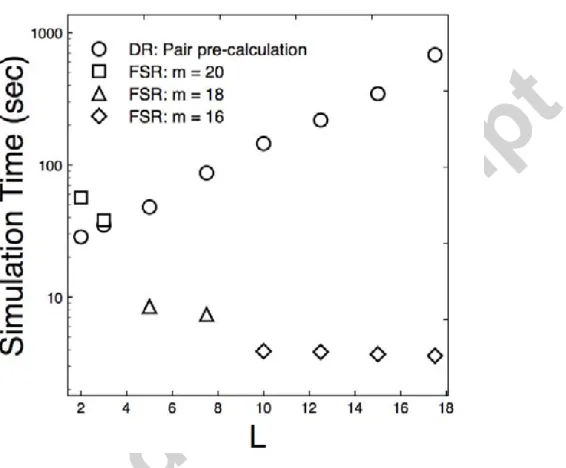
For the most local transmission scale considered (L = 2) direct simulation with pre-calculated
pairs did outperform FSR (direct simulation averaged 28.50 secs per full epidemic simulation, FSR
56.45 secs per full epidemic). The computation time for pre-calculating pairs was not included in
these averages. However, on the desktop used epidemic simulation time increased rapidly withLfor
the pair pre-calculation method despite epidemics with small L typically requiring more time steps
to simulate until the end. By contrast FSR simulation became faster for increasing L reflecting
a typically shorter epidemic and sharply faster whenever a coarser grid could be used (Figure 3).
The cross-over point was at L⇡3, byL= 5 FSR was significantly more efficient at simulating full
epidemics compared to direct simulation with pre-calculated pairs (direct simulation averaged 48
secs per full epidemic simulation, FSR 8.5 secs per full epidemic).
Certainly there exists the potential to further optimise direct simulation through more efficient
pair searching and using systems with greater available RAM. There also exist other methods of
accelerating direct simulation such as the subdivision of Il into cells and exploiting the property
that transmission to distant cells is highly unlikely, an example of such a method is given by
Keeling and Rohani [33]. However, pair pre-calculation is representative of acceleration techniques
for spatial epidemics extant in the literature in that performance improves as transmission becomes
more local. In general these acceleration methods are less successful whenever each habitat has
a large number of e↵ective pairs, whether this is due to long range transmission, heavy-tailed
for longer range transmission irrespective of metapopulation density, and therefore is a successful
strategy in a di↵erent problem domain from typical acceleration techniques. Heuristically, for very
localised transmission, the force of infection for a susceptible habitat can be compactly represented
as a truncated sum over only a comparatively small number of nearby infectious habitats but
would require many discrete modes for description in the spatial frequency domain used for FSR
convolution solving. The converse is that for disperse transmission a significant fraction of the total
population of infectious habitats contribute to the infection hazard for each susceptible habitat,
whereas in the frequency domain only a comparatively small number of modes are required for a
good description of the force of infection field.
3.2. Accelerated Likelihood Calculation
Likelihood based inference plays an important role in parameter estimation, and hence is key to
matching models with observations. From a classical statistics point of view the maximum likelihood
estimator (MLE), that is the parameter values which maximise the likelihood of the observations,
is viewed as the set of parameters that best captures the dynamics (see Casella and Berger [36] for
an introduction to classical likelihood methods). Additionally, for parameter inference by Markov
Chain Monte Carlo (MCMC) [37, 38, 39] the calculation of likelihood ratios is a necessary, and
often computationally intensive step. Hence the improvement in speed o↵ered by the FSR method
has clear advantages in parameter inference if the results are sufficiently accurate.
As an example of the computational efficiency gains for data imputation derived from using
the FSR algorithm we present a simulated outbreak amongst 19,600 habitats generated using the
simplified model given above. The random habitat locations are given within Il with l = 140 as
the points of a Poisson cluster process [40] chosen so as to give positive spatial correlation between
locations. The transmission kernel was chosen as heavy-tailed,
K(|x|) =
(2⇡(1 +|x|2))3/2, K ⇠|x|
3. (19)
Magnitude(K) = represents the infectiousness of the disease. The target for imputation is the
removal rate (chosen so that average period of infectiousness was 4 days) and the shape of the
transmission kernel as known data. In keeping with our final example on livestock epidemics, the
parameters chosen here roughly correspond to those for the 2001 UK Foot-and-Mouth outbreak [18].
For a given epidemic realisation we denote the set of populations that are first infected on day
t,I(t), and the set of populations that are susceptible at the beginning of day tand avoid infection
on that day, S(t). The likelihood L of the observed sequence of infections for a given transmission
rate is given in terms of the per day transmission probabilities [41],
L( |{I(t),S(t)}T
t=0) =P({I(t),S(t)}Tt=0| ) =
T
Y
t=0
h Y
i2I(t)
⇣
1 e i(t)⌘ Y
j2S(t)
e j(t)i. (20)
The likelihood of a full data set D, including removals and any other stochastic events, can then
be derived similarly by augmenting with their per day probabilities. We note that calculating the
likelihood (20) involves the sequential recalculation of the daily rates of infection i(t) for each
susceptible population i. This is exactly the task the FSR algorithm has been designed to achieve
with great numerical efficiency.
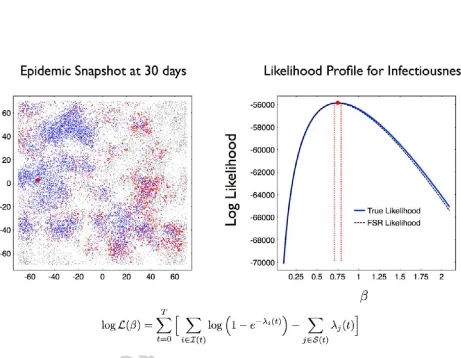
For a randomly chosen initially infected habitat (individual) with infectious intensity true = 0.75
a sample of an invasive epidemic was generated (Figure 4). This outbreak was characterised by long
range invasion of clusters of higher local density of habitats followed by intense spreading within
the cluster. The available data was assumed to be the set of infection and recovery events for the
first 30 time-steps (days) of the outbreak. The log-likelihood profile logLprof ile( ) for the interval
2[0.1,2.1] at a resolution of = 0.01 was calculated from (20) using both direct recalculation
and kernel corrected FSR for the daily infection rates (the approximating grid width used for FSR
was x= 0.5). The constructed log likelihood values were numerically close especially around the
peak, such that not only were the two implied maximum likelihood estimators indistinguishable
ˆdir = ˆF SR = true = 0.75, but also the 99.9% confidence intervals 2 [0.71,0.79] were also in
Constructing the full log likelihood profile using the FSR rate calculation took 16.5% of the time
required to construct the log likelihood profile using direct rate calculation. Such a time saving was
consistent with the accelerated simulation performance found in the previous section (Figure 2D).
The imputation method used in this section was accelerated by using FSR rate recalculation only
because each likelihood calculation (20) was accelerated. This suggests that any statistical method
for the class of spatial epidemic models considered in this work which require repeated likelihood,
or likelihood ratio, calculations could be accelerated by using FSR.
3.3. Case Study: Forecasting Epidemic Outbreak Amongst US Cattle Farms
In this final section we apply the FSR methodology to determine the impact of an epidemic
spreading amongst US cattle farms and to investigate how this depends upon transmission
assump-tions, such as the decay tail of the transmission kernel and the infectious intensity of the disease.
We performed repeated simulations to determine the distribution of epidemic severity using a
mod-ified version of the spatial force of infection (1) that takes into account the numbers of cattle at
both infectious and at-risk susceptible farms. Data for US farm locations and their cattle holding
sizes is only available aggregated at the county-scale. We circumvented this missing information by
generating a synthetic data set of randomised farm locations (with each county) and their cattle
numbers which is consistent with aggregate US agricultural census data at the county level. It is this
synthetic data set of 93,777,559 cattle distributed across 1,018,877 farms that we used to generate
epidemic realisations. The continent-wide nature of the epidemic and the necessity of performing
multiple simulations per parameter choice represented a major computational challenge. The FSR
simulation method presented in this work accelerated simulation sufficiently as to make predictive
Monte Carlo modelling for a range of parameter choices feasible using a standard desktop
com-puter; without an accelerated simulation method this investigation would be impracticable without
far greater computational resource.
3.3.1. Farm Infection Model and FSR Simulation with Demography
The livestock disease being modelled was considered to be sufficiently infectious that once
in-troduced into a naive farm it spread rapidly amongst all the livestock present. This motivates the
disease progression was represented by two stages, as in Keeling et al. [18] for Foot-and-Mouth
Disease (FMD); an initial exposed (E) period of 4 days during which the infected farm does not
actively recruit to the epidemic and a subsequent actively infectious (I) period of 5 days before
detection and removal. We do not include additional veterinarian tracing e↵orts such as
identify-ing dangerous contacts (DC) of detected infectious farms, or any form of additional control based
on geographic proximity to the detected infectious farm (such as contiguous premise (CP) or ring
culling). Therefore, this model reflects a control e↵ort directed only at removing detected infected
premises (IP) which is the simplest and least disruptive of possible control policies.
We follow Tildesley et al. [24, 42] in extending the basic spatial force of infection (1) to include
a non-linear dependency on the number of cattle (Ni) in both susceptible and infectious farms,
i(t) = Nip N
X
j=1
K(xi xj)NjqIj(t). (21)
The power parameters p, q scale, respectively, the dependence of farm susceptibility and
transmis-sibility upon cattle numbers. For the 2001 FMD outbreak the power parameters for cattle numbers
have been found to vary regionally between 0.2 and 0.44 [24]. We chose p = q = 0.2 for all US
regions which corresponds to the minimal amount of demographic dependence within the inferred
range (p=q= 0 recovers the demography-free model (1)). The FSR collocation grid approximated
a projection of the USA onto a plane with additional zero-padding extending 500 km from the
southern most and eastern most tips of contiguous USA. We chose the FSR collocation grid size
so that M was product of powers of 2 and 3 for numerical efficiency. The grid width was 3.6 km
north/south and 4.6 km west/east, which were a finer scale than the length scales of transmissions
considered below. Gaussian approximations were used with ✏ = 4 km. Simulating epidemic
real-isations with the daily risk model (21) required a small modification to the FSR method. When
updating blurry image of infection f✏
I at local points to farm j a factor N q
j is used to increase the
simulation with demography is,
i(t)⇡Nip M,✏
P S(xi, t). (22)
The pseudo-spectral approximation for point xi being given by bi-linear interpolation from its 4
nearest collocation grid points. All statistics in this section were estimated from 1000 independent
FSR simulations of a complete epidemic.
We are interested in the impact on epidemic severity of the decay tail of the transmission
kernel, and moreover how this tail a↵ects the upper quantiles for outbreaks severity, quantities of
considerable public policy importance. To achieve this we simulate outbreaks using a family of
kernels Ka(|x|)⇠|x| a,
Ka(|x|;L) = Na(L)(L2+|x|2) a/2, a= 3,4,5, (23)
where is the transmissibility of the disease,N normalises the transmission kernel so that Magnitude(K) =
and L is a length scale parameter. Each transmission kernel is heavy-tailed in the sense of Kot
et al due to each kernel having infinite moments of dispersal distance [20]. Nevertheless, K3 and
K5 represent rather di↵erent transmission tail behaviour within the general family of heavy-tailed
kernels; a consequence of the heavy-tailed decay of K3 is that both mean and variance of the
dis-persal distance (as given by (14) and (16)) are infinite for all L >0 whereas both these dispersal
range measures are finite forK5. Transmission kernelK4 gave an intermediate class of transmission
tail behaviour; Mean(K4) = (⇡/2)L is finite whereas Var(K4) = 1 for L > 0. In the subsequent
simulation study we choose L so that Mean(K5) = Mean(K4) = 20 km. The heavy tailed kernel
K3 cannot be matched in this manner: L= 10 km was chosen as its length scale.
3.3.2. Transmission Tail Decay and Variable Severity
Each epidemic realisation was initiated by a single infectious farm located in Franklin County,
Texas. This choice of initial location can be considered pessimistic from the point of view of disease
Despite the favourable initial location for the disease the range of epidemic sizes were found to be
multi-modal. For all transmission kernels, and even for the greatest infectious intensity considered
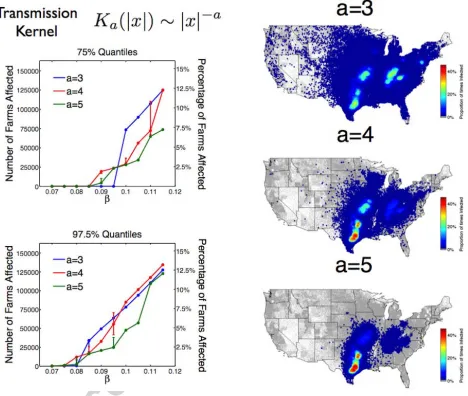
( = 0.115), there was a significant probability of only a small epidemic occurring (Psmall), defined
as at most 50 farms becoming infected. For the finite mean dispersal kernels, with = 0.115, the
probability of a small epidemic probability was similar (Psmall(K4) = 0.428 andPsmall(K5) = 0.434);
whereas for the heavy tailed kernel K3 the probability of a small epidemic occurring was greater
(Psmall(K3) = 0.537).
The most severe epidemic predicted led to almost 140,000 infected cattle farms (13.7% of US
total). For the finite kernels (K4 andK5) those epidemics which do take hold and produce a
nation-wide epidemic were found to be multi-modal in their distribution of final number of disease a↵ected
farms (Figure 5) with both large and intermediate scale epidemics common. The number of farms
a↵ected during a given epidemic realisation reflected that epidemic’s success in invading di↵erent
high-risk regions; in order of most to least likely of having a large-scale outbreak these high-risk
regions are: Texas, the central plains, the Ohio river basin and South-Eastern Pennsylvania (Figure
6). Given this multi-modal behaviour for epidemic sizes it is more natural to focus on quantiles
of outbreak size as a representative statistics for severity. However, epidemics with a heavy tailed
transmission kernel, K3, displayed rather di↵erent behaviour. Epidemic severity with heavy tailed
transmission became strongly bi-modal as the infectious intensity was increased; the epidemics
forecast were either small or tightly clustered around a large epidemic size (Figure 5).
As well as simply examining the number of farms infected, the spatial distribution of these
farms is of important applied interest as it relates to the necessary distribution of control resources.
In all our simulations, the western half of USA largely escaped infection for finite mean kernels.
The infinite dispersal variance kernel K4 had consistently more severe 75% and 97.5% quantiles
of outbreak size compared to K5, and we think of these upper quantiles as reasonable worst-case
scenarios. This reflects that a long-range dispersal event from one farm cluster to a distant one
was more likely for this kernel despite matched mean dispersal range and equal total transmission
plausible worst-case scenarios for US cattle epidemic forecasting (Figure 6). Risk of infection for
epidemics with heavy tailed transmission kernel K3 was more evenly distributed in space than for
the finite mean kernels K4 and K5. Nonetheless, there are regions in Texas, the central plains, the
Ohio river basin and South-Eastern Pennsylvania where greater risk of infection was observed for
all three kernels, although naturally K3 and K4 shows the greatest spread from the initial source
in Texas.
If we are considering an outbreak of Foot-and-Mouth in the USA, then there is uncertainty in
the transmission constant as well as the shape of the transmission kernel. For a less infectious
dis-ease ( 0.095) the 75% quantiles of outbreak size was significantly smaller for theK3 model than
for the K4 or K5 models. This is because the outbreak is initialised in a region of high cattle and
farm density; therefore more dispersed kernels simply waste infection by placing more transmission
away from this high-density region. Therefore this most dispersed kernel leads to the greatest risk
of early extinction. By contrast for more infectious diseases (0.095 < < 0.115) the 75%
quan-tiles for epidemics with transmission kernel K3 was significantly greater than for the more localised
transmission kernels. The upper extreme 97.5% quantiles for epidemic outcomes with either K3 or
K4 transmission kernel were similar; the ‘worst case’ scenarios for either transmission models were
similar in that either model could predict invasion into a number of important areas for US cattle
farming and further afield. For the most infectious disease intensities considered ( 0.11) the
local transmission kernel K5 also predicted similar 97.5% quantiles (Figure 6).
The predicted spatial patterns of disease incidence and multi-modal severity have important
implications for emergency disease control in response to an epidemic outbreak amongst US cattle
farms. The proportion of outbreaks predicted to cause national-scale epidemics suggests that control
e↵orts based only on removal of IPs, as simulated here, may be insufficient to control disease spread
amongst US cattle farms. This result is in line with findings for the 2001 UK foot-and-mouth
outbreak [18, 43]. The areas at most risk and the overall severity of a predicted outbreak were
found to depend crucially on the tail of the transmission kernel. For transmission kernels K4 and
and livestock and the ease with which infection can reach an area. This suggests that a regional
(state or county) level control method, such as local movement bans, might be e↵ective at reducing
epidemic burden. In contrast, epidemics predicted using a very heavy tailed transmission (K3),
showed far more limited spatial heterogeneity which combined with the heavier tail suggests that
regionally based control would be unlikely to be successful. This echoes findings for the
heavy-tailed dispersal of sudden oak death in California [44] albeit at a greater spatial scale. Moreover,
the qualitative distinction between predicted epidemic outcomes with K3 kernel and K4/K5 kernels
cannot be explained in analogy to analytic results for simpler models [21, 20, 22] since each kernel
falls into the general ‘heavy-tailed’ phenomenological category. This detailed sensitivity of outcome
upon the tail of the transmission kernel emphasises the need for numerically efficient methods for
forecasting simulations in order to best inform response to epidemic outbreak. The FSR simulation
method is designed to both accelerate the generation of epidemic forecasts and inference techniques
that require repeated calculation of likelihoods.
4. Discussion
We have considered the stochastic simulation of a very common class of models for the spatial
dispersion of an invasive infection. In particular, we have demonstrated a novel method for
recal-culating the stochastic transition rate using a convolution solution that can deliver significant time
saving to large scale Monte Carlo investigations. The convolution solution uses only ‘out-of-the-box’
software for implementation that is readily and freely accessible, moreover the analytic properties
of the error in spectral convolution solving are well understood.
Since the FSR method is an addendum to commonly used stochastic simulation algorithms it is
flexible and is not restricted to solely SIR type spatial epidemic modelling. Rather, the FSR method
is a possible tool for accelerating simulation of models concerned with spatial dispersal where the
dispersion kernel is translation invariant and smooth. It should be noted that the treatment of
habitats as point locations is a simplifying modelling assumption in order to allow the force of
infection to be written as a weighted sum over infected habitats. The FSR method allows the very