University of Warwick institutional repository: http://go.warwick.ac.uk/wrap
A Thesis Submitted for the Degree of PhD at the University of Warwick
http://go.warwick.ac.uk/wrap/67144
This thesis is made available online and is protected by original copyright.
Please scroll down to view the document itself.
M A
O
D
C
S
On Delaunay Random Cluster Models
by
Michael Eyers
Thesis
Submitted for the degree of
Doctor of Philosophy
Mathematics Institute
The University of Warwick
Contents
Acknowledgments iii
Declarations iv
Abstract v
Chapter 1 Introduction 1
Chapter 2 Continuum FK representation on hypergraph structures 6
2.1 Preliminaries . . . 6
2.2 Hypergraph structures . . . 8
2.2.1 Marked hypergraph structures . . . 8
2.3 Potts model and FK representation on an arbitrary graph . . . 9
2.4 Gibbs measures . . . 12
2.4.1 Existence of Gibbs measures . . . 15
2.5 Geometric Continuum Potts Model . . . 17
2.6 Geometric Continuum Random Cluster Model . . . 19
2.7 Percolation in the Geometric Continuum Random Cluster Model . . . 26
2.8 Voronoi tessellations and Delaunay triangulations . . . 30
Chapter 3 Delaunay Potts models with infinite range 32 3.1 Introduction . . . 32
3.2 Hardcore background interaction . . . 32
3.3 Type interaction . . . 34
3.4 Existence . . . 34
3.5 Non-uniqueness . . . 36
3.5.1 Coarse graining . . . 36
3.5.2 Papangelou conditional intensity . . . 38
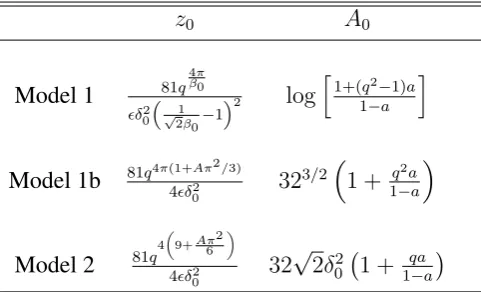
3.6 Model 1 – Delaunay Potts model with restricted triangles . . . 46
3.7 Model 1b – Relaxing of the type interaction . . . 52
3.8 Model 2 - Delaunay Potts model with infinite range . . . 55
3.9 Lower bounds for activity and temperature parameters in the phase transi-tion regime . . . 61
Chapter 4 Soft Widom-Rowlinson Model on Delaunay Graph 62 4.1 Introduction . . . 62
4.2 Mixed site-bond percolation . . . 65
4.3 Coarse graining . . . 66
4.4 Percolation . . . 68
4.5 Proof of Proposition 4.4 . . . 79
4.5.1 Sketch . . . 79
4.5.2 Notation . . . 80
4.5.3 Intermediary Lemmas . . . 83
4.5.4 Proof . . . 93
Chapter 5 Russo-Seymour-Welsh Theorem 96 5.1 Introduction . . . 96
5.2 Problems with Voronoi percolation . . . 98
5.3 Gibbsian models with geometric interactions . . . 103
Chapter 6 Conclusions and Outlook 106
Acknowledgments
I would like to acknowledge the Engineering and Physical Sciences Research Council for
my funding and thank my supervisor, Dr. Stefan Adams for his support and guidance
throughout my studies. This thesis would not have been possible without either. Thanks
must also go to the students of MASDOC for their advice, motivation and for making my
Declarations
All work thoughout this thesis is my own, unless stated otherwise, and was performed in
the Mathematics Institute at the University of Warwick under the supervision of Dr. Stefan
Adams during the period October 2011 to September 2014. This thesis has not been
sub-mitted for a degree at another university.
List of publications including submitted papers:
Abstract
We examine continuum percolative problems on the Delaunay hypergraph structure. In particular, we investigate the existence of a percolation transition for a class of Gibbsian particle systems with random hyperedges between groups of particles. Each such system will take the form of a random cluster representation of a corresponding continuum Potts model with geometric interactions on hyperedges of the Delaunay hypergraph structure. Any percolation results in the random cluster representation will lead to the existence of a phase transition for the continuum Potts model: that is, the existence of more than one Gibbs measure.
Chapter 1
Introduction
The Ising model, where each vertex of a finite graph is assigned a spin of−1or+1, was first introduced in 1925 and has been essential in producing elegant mathematics that describes the underlying physics of a ferromagnet. The spins−1and+1correspond to the magnetic moments and the particle interaction is defined so that neighbouring particles with the same
spin are favoured over ones with opposite spin. The interaction is stronger at lower temper-atures and in particular, for tempertemper-atures below a critical value, is strong enough to result
in the particles of one type dominating over the whole graph. In 1936, Peierls showed the
existence of such a phase transition for the Ising model in two dimensions [Pe36], whereas an exact solution was given by Ontager in 1944, [On44]. The Potts model is a
generalisa-tion of the Ising model where vertices take spins (which we now call marks) from the finite
set1, . . . , qinstead of using−1and+1. The Potts models behave in the same way to the Ising model: at low enough temperature, one mark will dominate.
Percolation for a disordered medium was first introduced in 1957 by Broadbent and Hammersley [BH57] using the example of a porous stone submerged in a volume of water.
In the bond percolation model in particular, each edge of a graph is assigned, independently
of the others, to be open, with probabilityp, or closed with probability1−p. The perco-lation problem is to investigate the existence of an infinite connected component of open
edges for different values ofp. In the porous stone in water analogy, this corresponds to the question of whether or not water reached the centre of the stone. For any givenp, the
probability that an infinite connected component exists is either zero or one, and since this
probability is increasing inp, there must exist0 ≤pc ≤ 1, such that forp < pcthe
prob-ability is zero, and forp > pc it is one. Fast forward to today, and percolation is now a
Although the random cluster model, invented around 1970 by Fortuin and
Kaste-leyn [FK69], [FK72], first had the purpose of unifying percolation with the Ising and Potts
models, it quickly became a beautiful area of study in its own right. So too, it seems, is the case for the continuum random cluster representation of the continuum Potts models,
first defined by [GH96], which continues to be the source of interesting problems. Whereas
the (non-continuum) random cluster model, which we will call the discrete random cluster model throughout this thesis, has played a key role in many proofs and studies,
includ-ing for example, the Wulff construction, the discontinuity of the phase transition for large
cluster-factor, the Widom-Rowlinson two type lattice gas and the Edwards-Anderson spin-glass model, the situation in the continuum setting is quite different as results are far fewer.
In [GH96], a phase transition is shown for a class of multi-type particle systems with a
finite range repulsion between pairs of particles with different type. Later, [BBD03] used a similar proof to show the existence of a phase transition for Delaunay Potts models with
hardcore repulsion between all pairs of particles and finite range type dependent interac-tions on the edges of the Delaunay graph.
In this study, we too will focus on Delaunay Potts models inR2, and indeed Delau-nay random cluster models where interactions between particles occur on edges or triangles
of the Delaunay graph. The Delaunay graph, in our two-dimensional setting, is the unique
triangulation of the plane given a set of points. It satisfies the criteria that the circumcir-cles of all triangles have an empty intersection with the point set. The Delaunay graph
corresponds to the dual graph of the Voronoi tessellation. It is straightforward to construct
the Delaunay graph from the Voronoi tessellation: just join, with an edge, any two points whose Voronoi cells share a1-dimensional face. Since the Voronoi cell of a point is the
subset of the plane that is closer to this point than any other, the Delaunay graph is a nearest
neighbour structure for a given set of points. This nearest neighbour graph gives rise to a prominent class of Gibbs measures with interactions that depend on the local geometry of
point sets inR2, see [Der08] and [DDG10]. Systems like this are often studied in biology to model cell interactions [FRA07], where interactions depend on the area of the cells and the distance between them.
A thermodynamic system is said to have a phase transition if the system has more than one Gibbs measure/equilibrium state. Phase transitions are an important area of
re-search in probability theory and statistical mechanics and aside from those described above,
notable results in the continuum include the hardcore (resp. softcore) Widom-Rowlinson model of [R71] and later [CCK94], (resp.[LL72]). In this study we look at a phase
A realisation of such a point process is called a configuration. A configuration comprises
of a number of particles (or points inR2), each with a mark assigned to it from a finite mark space. We consider two types of interaction between the particles: one which is mark dependent called the type interaction and one which is mark independent called the
back-ground interaction. All interactions occur between pairs of particles that share an edge in
the Delaunay graph or triples of particles that comprise a triangle in the Delaunay graph. These pairs and triples are both called hyperedges of the Delaunay hypergraph structure.
Interactions such as these are called geometric because they depend on the geometrical
structure of the Delaunay triangulation. A Delaunay Potts model and its corresponding Delaunay random cluster representation are determined by the background and type
inter-actions, together with a reference measure.
We draw your attention to some differences between geometric models on the
De-launay hypergraph structure and that of classical models such as the Widom-Rowlinson model and softcore variant of Lebowitz and Lieb [LL72]. The first is that edges and
trian-gles in the Delaunay hypergraph are each proportional in number to the number of particles
in the configuration. However, in the case of the complete hypergraph – on which interac-tions occur in the classical (non-geometric) models – the number of edges is proportional to
the number of particles squared and the number of triangles is proportional to the number of
particles cubed. Secondly, in the complete graph of the classical models, the neighbourhood of a given point depends only on the distance between points and so the number of
neigh-bours increases with the activity parameterzof the underlying point process. This means
that the system will become strongly connected for high values ofz. This is not the case for the Delaunay hypergraphs which exhibit a self-similar property. Essentially, as the activity
parameterzincreases, the expected number of neighbours to a given point in the Delaunay
hypergraph remains the same, see [Mø94]. Therefore, in order to keep a strong connectivity in our geometric models on Delaunay hypergraphs, we use a type interaction between
parti-cles of a hyperedge with a non-constant mark. Finally, and perhaps most importantly, is the
question of additivity. Namely, suppose we have an existing particle configurationω and we want to add a new particlexto it. In the case of classical many-body interactions, this
addition will introduce new interactions that occur betweenxand the existing
configura-tionω. However, the interactions between particles ofωremain unaffected, and so classical many-body interactions are additive. On the other hand, in the Delaunay framework, the
introduction of a new particle to an existing configuration not only creates new edges and
triangles, but destroys some too. The Delaunay interactions are therefore not additive, and for this reason, attractive and repulsive interactions are indistinct. In the case of a hard
somex,ω∪xis not. This is called the non-hereditary property, [DG09], which seems to rule out using techniques such as stochastic comparisons of point processes [GK97].
Although we show the existence of a Gibbs measure for each of our models, the
primary focus of this thesis is that of continuum percolation. In showing the existence of
percolation (for large activity and low temperature) of Delaunay random cluster represen-tations, we also happen to show the non-uniqueness of Gibbs measures, and essentially,
a phase transition for the Delaunay Potts models. In fact, one last piece of information
is needed to show a phase transition. That is, for small activity and high temperature, the Gibbs measure is unique. By interpreting percolation in our Delaunay random cluster
repre-sentation via a site percolation model, we prove our main results thanks to a discretization
to the integer lattice, on which we show either site percolation, or mixed site-bond per-colation, depending on the model. The main technical issue is to control the Papangelou
conditional intensities of the marginal point distribution of the Delaunay random cluster measure with respect to the Gibbs process with background interaction. Heuristically, this
is the conditional probability of there being a point of the process inside an infinitesimal
neighbourhood of the locationx, given the complete point configuration at all other loca-tionsω. With a hardcore background interaction present, which we show to be equivalent to
a classical hardcore short range repulsion between all pairs of particles, only a lower bound
of the Papangelou conditional intensity is required. However, when we consider models with only a type interaction, an upper bound for the Papengelou conditional intensity will
be needed as well.
To conclude the introduction, we remark on the makeup of the rest of the thesis. In
Chapter 2, after introducing necessary notations and definitions that will see us through the
rest of the thesis, we will put down an extension of the Fortuin–Kasteleyn (FK) represen-tation of [GH96] to a hypergraph structure, show that percolation in the Delaunay random
cluster models will imply the non-uniquness of Gibbs measures for the continuum Potts
models and finally give some insight into our techniques to show percolation for certain pa-rameter regimes. Although all models considered hereafter will be those on the Delaunay
triangulations, all work in Chapter 2 will be done for more general hypergraph structures.
Chapter 3 introduces our first class of Delaunay Potts models. These will exhibit infinite range type interactions on either triangles or edges of the Delaunay graph and will also have
a hardcore background interaction. Percolation is first shown to occur for models displaying
both the coarse-grain ready and bounded Papangelou properties – to be defined in Sections 3.5.1 and 3.5.2 respectively. We then look at three examples. Our proofs in Chapter 3 draw
property of the type interaction as in [BBD03], nor from the luxuries, described above, of
classical multi-body interactions as in [GH96].
Chapter 4 introduces our second class of Delaunay Potts models. These will take
the form of Widom-Rowlinson like models, i.e. without a background potential, and will
be seen as an extension to the work of [CCK94] and [LL72]. The key difference is that the interspecies interaction will only exist on the Delaunay hyperedges. The proofs are
much more complex compared to Chapter 3. This is because, without the crutch that is the
hardcore background interaction, it becomes necessary to perform a much more in depth analysis of the underlying geometrical properties of the Delaunay triangulations in order to
exhibit some control of the configurations. Chapter 5 sees an end to our investigations into
phase transitions as we steer towards other percolative problems on the Delaunay hyper-graph structure. These include the so-called Russo-Seymour-Welsh (RSW) Theorem which
relates the probability of an open horizontal crossing of a square to that of an open horizon-tal crossing (the long way) of a rectangle with short side equal to the length of the square,
see [Ru78] and [SW78]. There are only very few continuum RSW results in the literature,
see [Al96], [Ro90], which is unfortunate, because they would give a greater insight into the percolative properties of a model and it is thought that an RSW theorem would provide an
important step in a journey towards conformal invariance, similar to [Sm01], see [BS98].
Although a weak version is shown in [BR06a], the RSW theorem has yet to be proved for Voronoi percolation. We inform the reader of the major obstacles faced when trying to
prove RSW for Voronoi percolation and variants. The final chapter (Chapter 6) consists of
Chapter 2
Continuum FK representation on
hypergraph structures
In Section 2.1, we define the state spaces of marked and unmarked configurations of
par-ticles as well as other important notation before introducing hypergraph structures, both in
the marked and unmarked cases, in Section 2.2. In Section 2.3 we deal with a deterministic particle configuration – we fixω∈Ω– and introduce the Potts model and the random clus-ter model in this discrete setting, similar to [G94]. Although, in this thesis, we are generally
concerned with random structures, i.e. we do not fixω∈Ω, but rather sampleω∈Ωusing a suitable Gibbs measure as described in Section 2.4, it is important to fully understand the
discrete case as many of the results turn out to be useful to us later on. It is only then that
we can define what has come to be known, from [GH96], as the continuum Potts model and continuum random cluster model – we do this in Sections 2.5 and 2.6. In Section 2.7
we discuss percolation in the continuum random cluster model and how this shows the
ex-istence of several distinct Gibbs measures for the corresponding continuum Potts model. Finally, in Section 2.8, we step away from considering general hypergraph structures, and
formalise the Delaunay hypergraph structure that we will use throughout the remainder of
the thesis.
2.1
Preliminaries
This introduction will be from the view point of continuum systems of particles that lie in the plane (we only work in two dimensions) and that interact with each other
geometri-cally. That is, pairs, or groups of particles interact according to some underlying geometric
particle. For instance, particles may be marked, and in this case, each particle will have a
spatial location and a mark from some marked space.
Let us introduce the configuration spaces that we will use. We start off with the
space of locally finite subsets ofR2:
Ω :=nω ⊂R2 :|ω∩Λ|<+∞for allΛ∈ B(R2)o,
whereB(R2)is the space of all bounded Borel sets ofR2. LetFbe theσ-algebra generated by the sets{ω ∈ Ω, NΛ(ω) = n}, where n ∈ N, Λ ∈ B(R2) andNΛ(ω) denotes the
number of points ofωinΛ. More formally,NΛ: Ω→Nis defined as
NΛ(ω) =|ω∩Λ|, (2.1)
and are often called the counting variables. As is usual, we take a Poisson point process with intensityz >0as the reference measure on(Ω,F).
Definition 2.1. Letzbe a positive real number. A Poisson point process with intensityz
satisfies the following conditions:
1. ForΛ∈ B(R2),NΛis Poisson distributed with meanz|Λ|, where|Λ|is the standard
Lebesgue measure ofΛ.
2. For anyndisjoint setsΛ1, ...,Λn ∈ B(R2), the random variablesNΛ1, ..., NΛn are
independent.
We will denote a Poisson point process onΩwith intensityzbyΠz.
We also define the mark space. In our study, we restrict ourselves to the case of
a finite mark space, as it will be used to attribute marks or spins to the particles. Let
Σ := {1, . . . , q}, for a positive integer q > 0 denote the mark space. Denote λas the reference probability measure onΣ, and setλ(s) = 1/q fors = 1, . . . , q. We denote a
marked point of the plane byx = (x, s),x ∈ R2,s ∈ Σ. LetΩbe the space of marked configurations, i.e. the set of all pairsω = (ω, σω)whereω∈Ωis the spatial configuration
andσωis the mark vector inΣω:
Ω :=nω:ω= (ω, σω), ω ∈Ω, σω∈Σω o
.
We may writeσω := (σω(x) : x ∈ ω) whereσω(x) is the unique mark ofx ∈ ω. Let
configurations defined by(ω, σω) → ω. Let F be the σ-algebra generated by the sets {ω ∈Ω, NΛi(ω) = n}, wheren∈ N,i∈Σ,Λ ∈ B(R2)andNΛi(ω)denotes the number of points ofω in Λ×i. Instead of the reference Poisson point process Πz, we take the
Poisson point processΠz onΩ with intensity measurezν ⊗λ. Here, ν is the Lebesgue measure onR2. The probability space of marked configurations is the following triple:
(Ω,F,Πz).
LetΩf := {ω : |ω| < ∞} ⊂ Ωdenote the set of all finite configurations ω. Also let Ff be the trace sigma-algebra ofF onΩf. For a bounded regionΛ ∈ B(R2), we write
ωΛ:=ω∩ΛandΩΛ:={ω∈Ω :ω⊂Λ}, with prΛ: Ω→ΩΛ,ω7→ωΛthe projection of
configurations ontoΛ. The traceσ-algebraFΛ0 := F |ΩΛ is the restriction ofF toΩΛand FΛ:=pr−Λ1FΛ0 ⊂ F is theσ-algebra of all events that happen inΛonly.
In the case of marked configurations,Ωf andFfare defined analogously. However,
Λ∈ B(R2)will only refer to the positional part of a marked configuration. In particular, we
setωΛ:=ω∩(Λ×Σ),ΩΛ:={ω∈Ω :ρ(ω)⊂Λ},F
0
Λ :=F |ΩΛandFΛ:=pr −1 Λ F
0
Λ⊂ F
where prΛ : Ω → ΩΛsatisfyingω 7→ ωΛis the projection of marked configurations onto
Λ×Σ. LetΘ = (ϑx)x∈R2 be the group of translations, whereϑx: Ω→Ωis a translation
by the vector−x ∈ R2 that only act on the positions of particles. They have no affect on their marks.
2.2
Hypergraph structures
In what follows, we are interested in geometrical interactions that act on hyperedges
be-tween points. SupposeH ⊂ Ωf ×Ωis measurable. We callHa hyperedge structure if
η ⊂ ω for all (η, ω) ∈ H. If (η, ω) ∈ H, we callη a hyperedge ofω. We will write
η∈ H(ω), thereby definingH(ω).
2.2.1 Marked hypergraph structures
The definition of a hypergraph structure is easily extended to the space of marked
configu-rations. SupposeH ⊂Ωf ×Ωis measurable. We callHa marked hypergraph structure if
η⊂ωfor all(η, ω)∈ H. Similar to the non-marked case, if(η, ω)∈ H, we callηa hyper-edge ofωand writeη∈ H(ω). Note that the geometrical properties of a marked hyperedge
and an unmarked configurationω∈Ω, define
H(ω) = [
(η,ση)∈H(ω)
{η} (2.2)
as the set of the images, underρ, of the hyperedges of an arbitrary marked configurationω
satisfyingρ(ω) =ω. This is particularly useful as when working with marked hypergraph structures we can easily distinguish betweenH(ω)andH(ω). In fact,H(ω) is the set of hyperedges ofωin the corresponding unmarked hypergraph structureG ⊂Ωf×Ω, defined
by
G:= [
((η,ση),(ω,σω))∈H
{(η, ω)}.
2.3
Potts model and FK representation on an arbitrary graph
In this section we deal with a deterministic particle configuration – we fixω ∈ Ω– and introduce the Potts model and the random cluster model in this discrete setting. It is
iden-tical to that in [G94], except that we consider hyperedges rather than simply edges. Let
H ⊂ Ωf ×Ω be a hypergraph structure, but fix ω ∈ Ω. Denote byG = (ωΛ,H(ωΛ))
the finite hypergraph inΛ ∈ B(R2) where ωΛ is the vertex set and H(ωΛ) is the set of
hyperedges ofωΛ. Letpbe a constant satisfying0 ≤p ≤ 1. A Potts measure,νp(q), is a
measure on the sample spaceΣωΛ :={1, . . . , q}ωΛ where each vertex inω
Λis assigned a
mark from the set{1, . . . q}, withq ≥2. Given a mark vector, or configurationσωΛ ∈Σ ωΛ,
we define
νp(q)(σωΛ) =
1 Z1
Y
η∈H(ωΛ)
exph−J1−δσωΛ(η)
i
, (2.3)
whereZ1is the normalisation constant given by
Z1:=
X
σωΛ∈ΣωΛ
Y
η∈H(ωΛ)
exp
h −J
1−δσωΛ(η)
i
, (2.4)
the parameterJ := ln(1−p)−1satisfies0≤J ≤ ∞and for a hyperedgeη ∈ H(ωΛ),
δσωΛ(η) =
(
1 ifσωΛ(x) =σωΛ(y), for all pairs{x, y} ∈η,
0 otherwise. (2.5)
The random cluster model, on the other hand, has realisations in the setEgiven by
configuration: each hyperedgeη∈ H(ωΛ)is either open or closed. Forv ∈ E, let
Ev :={η∈ H(ωΛ) :v(η) = 1}
represent the set of open hyperedges. To represent a realisation of a random cluster measure, we only useEv which, withωΛforms a hypersubgraph(ωΛ, Ev)ofG. However, the open
hyperedge setEv is uniquely determined byv∈ E which is chosen randomly according to
the probability mass functionµ(pq)onEgiven by
µ(pq)(v) = 1 Z2
p|Ev|(1−p)|H(ωΛ)\Ev|qK(Ev), (2.6) whereK(Ev)is the number of connected components of the hypergraph(ωΛ, Ev)andZ2
is the normalising constant given by
Z2:=
X
v∈E
p|Ev|(1−p)|H(ωΛ)\Ev|qK(Ev).
Notice that by settingq = 1we arrive at the standard bond percolation model where each hyperedge is open (resp. closed) with probabilityp (resp. 1−p). Before we give some important properties of the random cluster measure in this discrete hyperedge setting, we generalise to the case of non-constantp. By this we mean that a hyperedgeη ∈ H(ωΛ)
is open with probabilityp(η), which depends on the geometry of the hyperedge. A simple
example is whenp(η)is a function of|x−y|whereη={x, y}. Thus, Equation 2.6 can be rewritten as
µ(pq)(v) = 1 Z3
Y
η∈H(ωΛ)
p(η)v(η)(1−p(η))1−v(η)
qK(Ev), (2.7)
where the normalising constantZ3is given by
Z3 :=
X
v∈E
Y
η∈H(ωΛ)
p(η)v(η)(1−p(η))1−v(η)
qK(Ev)
.
The measure µ(pq) satisfies the Fortuin-Kasteleyn-Ginibre (FKG) inequality, see
[FKG71], if and only ifq≥1. Before we specify the FKG inequality, we give some prelim-inary definitions. A functionf :E →Ris said to be increasing iff(E1) ≤f(E2)
when-everE1 ⊆ E2. Similarly, a functionf : E → R is called decreasing iff(E1) ≥ f(E2)
Lemma 2.2. (FKG inequality – as a generalisation of [G94])
Fixq≥1. Then iff andgare both increasing functions onE, then we have
Eµ(q)
p (f g)
≥E
µ(pq)(f)Eµ(pq)(g). (2.8)
In particular, ifAandB are both increasing events, then
µp(q)(A∩B)≥µp(q)(A)µ(pq)(B). (2.9)
We now give a generalisation of a well-known comparison inequality (see [G94])
for random-cluster measures in the discrete setting. We generalise to our hypergraph
frame-work and to the case of non-constantp. The result relies on the FKG inequality in Lemma 2.2. For any two probability measuresµ1, µ2 onE, we sayµ1stochastically dominatesµ2,
and writeµ1 <µ2, ifEµ1(f)≥Eµ2(f)for all increasing functionsf :E →R.
Proposition 2.3. (Comparison inequality)
Letq≥1and supposepandp˜are two probability measures onH(ωΛ)such that
p(η)
q|η|−1(1−p(η)) ≥
˜ p(η)
(1−p(η))˜ , (2.10)
for allη∈ H(ωΛ). Then,µp(q) <µ(1)p˜ .
Proof. The proof in a slight adaptation of the proof in [G94] to the case of non-constantp
and to our hypergraph framework. By the assumption thatq≥1, the measureµ(pq)satisfies
the FKG inequality. See that, forv∈ E
µ(1)p˜ (v) =
g(v)
Q
η∈H(ωΛ)(1−p(η))˜
p(η) 1−p(η)
v(η)
qK(Ev)
P
v0∈Eg(v0)
Q
η∈H(ωΛ)(1−p(η))˜ p(η)
1−p(η)
v0(η)
qK(Ev0)
(2.11)
wheregsatisfies
g(v) = 1
qK(Ev)+(|η|−1)|Ev|
Y
η∈Ev
˜ p(η) (1−p(η))˜
p(η) q|η|−1(1−p(η))
However, by multiplying Equation (2.11) by
Q
η∈H(ωΛ)(1−p(η))
Q
η∈H(ωΛ)(1−p(η)) = 1, we are left with
µ(1)p˜ (v) = g(v)µ
(q)
p (v) P
v0∈Eg(v0)µ
(q)
p (v0)
.
SinceK(Ev) + (|η| −1)|Ev|is an increasing function ofEvand
p(η)
q|η|−1(1−p(η)) ≥
˜ p(η) (1−p(η))˜ ,
it follows thatgis a decreasing function of Ev. Therefore, iff is increasing, then, by the
FKG inequality,
Eµ(1) ˜
p
(f) = Eµ
(q)
p (f g)
Eµ(q)
p (g)
≤E
µ(pq)(f).
Note that we do not requirepandp˜to be constant: they can vary as long as equation
(2.10) is satisfied. This stochastic domination result is frequently used to prove the existence
of a phase transition for the infinite volume discrete random cluster models with varying values ofp. Indeed, whilst proving a phase transition in continuum random cluster models,
we also make use of this discrete result.
2.4
Gibbs measures
Instead of working with a fixed hypergraph as in Section 2.3, we will now look to
sam-ple point configurations fromΩ. In order to do this, we introduce the concept of Gibbs measures on a marked hypergraph structureH. In later Chapters we will look for phase transitions of Delaunay Potts models using probabilistic techniques, however, before this
can be done, we must first show the existence of at least one Gibbs measure. We out-line how this is done in the general hypergraph structure setting. Only once we can show
the existence of a Gibbs measure for a particular model, can we use similar strategies to
the Fortuin-Kasteleyn representation of the Potts model [FK72] to show non-uniqueness of Gibbs measures. This non-uniqueness, as we shall see, is equivalent to the existence of a
phase transition which is a principle goal of this work.
Having established a definition for a hypergraph structure in Section 2.2, we look
sample these high energy configurations less frequently, i.e. low energy configurations will
be favoured by the Gibbs measure. To measure the energy of a configuration, we introduce
hyperedge potentials.
Definition 2.4. A hyperedge potential is a measurable function,Φ : Ωf ×Ω→R∪ {∞},
from a marked hypergraph structure,H ⊂Ωf ×Ω, to the extended reals.
Definition 2.5. A marked hypergraph structureHand a hyperedge potentialΦare called translation invariant if for all(η, ω)∈ Hand for allx∈R2,
(ϑx(η), ϑx(ω))∈ H and Φ(ϑx(η), ϑx(ω)) = Φ(η, ω).
Hypergraph potentials allow us to control the random hypergraph by giving more or
less weight to certain configurations. LetΦ : Ωf ×Ω→R∪ {∞}be one such hyperedge
potential attributing a real valued energy to each hyperedge in a hypergraph structure. By summing over the whole configuration, we arrive at the Hamiltonian energy with respect to
Φfor a given configurationω ∈Ω:
HΦ(ω) := X
η∈H(ω)
Φ(η, ω). (2.12)
This is the formal Hamiltonian: it is an infinite sum. In order to work with finite sums, we
restrict our Hamiltonian to a bounded regionΛ∈ B(R2). Consider the subset
HΛ(ζ) :={η∈ H(ζ) :ηΛ6=∅} (2.13)
and takeξ ∈ΩΛc, a fixed configuration outside ofΛ, to be the prescribed boundary condi-tion. The Hamiltonian inΛwith marked boundary conditionξis given by the formula
HΛΦ|ξ(ω) = X
η∈HΛ(ω∪ξ)
Φ(η, ω∪ξ), forω ∈ΩΛ, (2.14)
provided the sum is well defined. The Hamiltonian describes the model, and in particular,
the energy excess of the marked configurationω∪ξ over the boundary configuration, ξ. Notice that it depends only on the marked hypergraph structureHand the hyperedge po-tentialΦ. IfΦonly depends on the single hyperedges, and not on their neighbourhood, then
for any two distinct boundary configurationsξ, ζ ∈ΩΛc,
HΛΦ|ξ(ω) =HΛΦ|ζ(ω) provided that HΛ(ω∪ξ) =HΛ(ω∪ζ).
called the local horizon property. We use the Hamiltonian and a reference measure to define
a probability measure for the model. Recall our Poisson point process reference measure
Πz on Ωwith intensity measurezν ⊗λand defineΠzΛ := Πz ◦pr−Λ1 to be the reference measure on the local restricted configuration spaceΩΛ. Together with the Hamiltonian, we
define the partition function
ZΛ|ξ :=
Z
ΩΛ
exp
h
−HΛΦ|ξ(ω)
i
ΠΛ(dω), (2.15)
and the negative part ofHΦ
Λ|ξ:
HΦ−
Λ|ξ(ω) := X
η∈HΛ(ω∪ξ)
Φ−(η, ω∪ξ),
whereΦ− is simply the negative part of Φ. Classically, there should be a factorA in the
exponent of (2.15) to represent the inverse temperature of the system. However, we will assume this information is encompassed inΦ.
Definition 2.6. A marked configurationξ∈ΩΛc is called admissible for a bounded region
Λ∈ B(R2)and an activityz >0, if
HΦ−
Λ|ξ(ω)<∞
forΠzΛ−almost allω ∈ ΩΛand if0 < ZΛ|ξ < ∞. Denote byΩ ∗
Λ,z the space of marked
configurations whose restrictions toΛc×Σare admissible configurations forΛandz.
ForΛ∈ B(R2), we define the Gibbs distribution for(H,Φ, z)in the regionΛwith admissible boundary conditionξas follows:
QΛ|ξ(dω) = 1 ZΛ|ξexp
h
−HΛΦ|ξ(ω)
i
ΠzΛ(dω). (2.16)
Definition 2.7. Given a marked hypergraph structureH, a hyperedge potentialΦand an activityz >0, a probability measureP on(Ω,F)is called a Gibbs measure forH,Φand
zifP(Ω∗Λ,z) = 1and
Z
f dP =
Z
Ω∗Λ,z
Z−1
Λ|ξΛc
Z
ΩΛ
f(ω∪ξΛc) exp
h −HΛΦ|ξ
Λc(ω) i
ΠzΛ(dω)P(dξ), (2.17)
The equations of Definition 2.7 are known as the the DLR equations (after
Do-brushin, Lanford and Ruelle), see for example [Geo99].
LetA∗be the universal completion of aσ-algebraA. Precisely,A∗is theσ-algebra of all sets that belong to theν-completion ofAfor all probability measuresν onA. The Hamiltonian in (2.14) and the partition function in (2.15) are not measurable with respect to theσ-algebras introduced in Section 2.1, but only with respect to their universal completion.
More precisely,
1. The function(ω, ξ)→HΛΦ|ξ(ω)is measurable with respect to(F0Λ⊗ FΛc)∗. 2. The functionξ→ZΛ|ξis measurable with respect toF∗Λc.
3. The setΩ∗Λ,z belongs toF∗Λc.
4. QΛ|ξ(dω)is a probability kernel from(Ω∗Λ,z,F∗Λc|Ω∗
Λ,z)→(Ω,F).
According to the definition of the reference measureΠzΛ, the marks are chosen indepen-dently of the spatial positions, henceforth, the above measurability statements can be
ob-tained from Claims A.2 and A.3 of [DDG10] via consideration ofR2×Σinstead ofR2as
the state space of the point process.
2.4.1 Existence of Gibbs measures
The existence of a Gibbs measureP on (Ω,F)with activity z > 0, marked hypergraph structureHand hyperedge potentialΦ, relies on the following conditions.
Definition 2.8. We say the couple (Φ,H) satisfy the range condition (R) if there exists
`R,nR ∈N, such that, for all(η, ω) ∈ H, there exist a bounded region∆∈ B(R2)such
that;(η, ω0) ∈ HandΦ(η, ω0) = Φ(η, ω)whenever ω0∆ =ω∆; and for every x, y ∈ ∆,
there exist ` open balls B1, . . . , B` (with ` ≤ `R) such that ∪`i=1Bi is connected and
containsxandy, andNBi(ω) ≤nRfor eachi. Here,Bi denotes the closure of the open
ballBi⊂R2.
LetΛ∈ B(R2),r >0andΛ⊕r:=∪x∈ΛB(x, r), whereB(x, r)denotes the open
ball of radiusr centred atx. A configurationξ ∈ Ωis said to confine the range ofΦfrom
Λif there exists a boundary layer∂Λ(ξ) = (Λ⊕r)\Λfor somer = rΛ,ξ, whererΛ,ξ is chosen as small as possible, such thatHΛ(ω∪ξΛc) = HΛ(ω∪ξ
0
Λc)wheneverξ
0
= ξon
∂Λ(ξ). We define the setΩΛcras follows:
ΩΛcr :=
Remark 2.9. In order to show phase transition in Section 2.7, we will need an adaptation of Proposition 3.1 in [DDG10] to the marked case. If a hyperedge potential Φ and a hypergraph structureHsatisfy the range(R)condition, then for eachΛ ∈ B(R2), there
exists a setΩbΛcr ∈ FΛc such that ΩbΛcr ⊂ Ω
Λ
cr andP(ΩbΛcr) = 1for all translation invariant
probability measures P on (Ω,F) with P({∅}) = 0. The proof of this statement is an adaptation of Proposition 5.4 in [DDG10] to the marked case. It is straightforward as the mark distribution, with respect to our reference measureΠz does not depend on the spatial location of the particles and henceforth we omit it and just give the statement.
We now define stability which will ensure that the partition functions are finite.
Definition 2.10. We say the couple(Φ,H)satisfy the stability condition(S)if there exists a constantcS ≥0such that
HΛ|ξ(ω)≥ −cS
NΛ(ω) +N∂Λ(ξ)(ξ)
for all boundedΛ∈R2,ω ∈Ω
Λandξ ∈Ω Λ
cr.
To avoid the meaningless case when Φ ≡ ∞, we need a final condition to control the Hamiltonian from above. Let M ∈ R2×2 be an invertible 2 ×2 matrix, and define a partition ofR2as
[
k∈Z2 ∇(k)
where each
∇(k) :={M x∈R2:x−k∈[−1/2,1/2]2}. (2.18) is a rhombus. Furthermore, letΓs be the set of all configurations that consist of a single point with marks∈Σwhose position lies in some Borel setD⊂ ∇(0)and define the set of all configurations whose restriction to a cell∇(k), when shifted back to∇(0), belongs toΓsas
b
Γs={ω ∈Ω :ϑM k(ω∇(k))∈Γsfor allk∈Z2}. (2.19)
A marked configuration ofω ∈Γbsis called pseudo-periodic. Note that when the mark of
the particles is obvious, we drop the superscript and writebΓinstead of bΓs. The required
partial upper bound for the Hamiltonians is then achieved via the following property.
1. Uniform confinement:bΓs⊂Ω
Λ
crfor all boundedΛ⊂R2, and
rΓs := sup
Λ
sup
ω∈Γbs
rΛ,ω <∞.
2. Uniform summability:
c+D := sup
ω∈bΓs
X
η∈H(ω):
ρ(η)∩∇(0)6=∅
Φ+(η, ω)
|η| <∞. (2.20)
3. Strong non-rigidity:
z|D|> ecD
wherecD is defined as in (2.20), but withΦinstead ofΦ
+
.
If the(R),(S)and(U)conditions are satisfied, the existence of a Gibbs measure is given by the following theorem:
Theorem 2.12. For every translation invariant marked hypergraph structureH ⊂Ωf×Ω,
hyperedge potentialΦand activityz > 0satisfying the(R),(S)and(U)conditions, there exists at least one translation invariant Gibbs measureP on(Ω,F)with reference measure
Πz.
The proof is an immediate adaptation of the proof of Theorem 3.2 and Corollary
3.4 in [DDG10] to the marked case following Remark 3.7 in [DDG10]. Further details of that adaptation can be found in [No13], Theorem 2.1. The proof relies on an entropy bound
and a careful control of the interaction range. The entropy bound is used to obtain tightness
of certain Gibbs distributions with pseudo-periodic boundary conditions.
2.5
Geometric Continuum Potts Model
We now go on to define Potts models on random structures in the continuum. The
exten-sion to the continuum was first introduced as the Widom-Rowlinson model, a continuum
analogue of the Ising model, in [WR70]. Much later, [GH96] generalised this further and defined continuum Potts models. We present these ideas here, but generalise further to
our hypergraph structure framework and to geometric interactions. To do this, we define
(η, ω)∈ Hwithη = (η, ση)andω = (ω, σω), set
Φ(η, ω) =ψ(η, ω) +ϕ(η, ω)(1−δση(η)) (2.21)
where
δση(η) =
(
1 ifση(x) =ση(y)for all pairs{x, y} ∈η,
0 otherwise, (2.22)
andψ, ϕ : Ωf ×Ω → R∪ {∞}. The marks of the particles contribute to Φ(η, ω) only
through theδση term. We callψthe background interaction andϕthe mark or type inter-action because(1−δση)is only non-zero when hyperedges contain particles with different marks. Letq≥2, then, given a finite boxΛ∈ B(R2), and an admissible boundary config-urationξ = (ξ, σξ), the finite volume Gibbs distributionQΛ|ξis given by
QΛ|ξ(dω) = 1 ZΛ|ξ exp
h
−HΛΦ|ξ(ω)
i
ΠzqΛ(dω) (2.23)
where forω= (ω, σω)∈ΩΛ,
HΛΦ|ξ(ω) =Hψ
Λ|ξ(ω) +H ϕ
Λ|ξ(ω),
Hψ
Λ|ξ(ω) = X
η∈HΛ(ω∪ξ)
ψ(η, ω∪ξ),
and
Hϕ
Λ|ξ(ω) = X
η=(η,ση)
∈HΛ(ω∪ξ)
ϕ(η, ω∪ξ)(1−δση(η)).
From (2.23), for fixedω ∈ΩΛ, notice that the conditional distribution ofσωunder
the conditionρ(ω) =ωwith respect toQΛ|ξis just the discrete Potts model, given in (2.3), onωwith parameterJ a function ofϕ. This is the justification given by [GH96] to call their
model a continuum Potts model. As we are working in a hypergraph structure framework, we call the model defined by (2.23) the geometric continuum Potts model. A Gibbs
mea-sure on(Ω,F), if one exists for this model, is called a geometric continuum Potts measure with activityzand hyperedge potentialsψandϕon a marked hypergraph structureH.
We will use Theorem 2.12 to show the existence of geometric continuum Potts
this non-uniqueness for a number of different models. Our main tool is the geometric
continuum random cluster model which is introduced in Section 2.6.
2.6
Geometric Continuum Random Cluster Model
Fixk∈N. For the remainder of this section, letHbe a marked hypergraph structure with
|η| = k, for allη ∈ H(ω). Our aim is to introduce a hyperedge process on the random marked hypergraph structureHvia a joint construction with the related geometric contin-uum Potts model with parametersH, ψ, ϕandz as outlined in Section 2.5. This is akin to the joint construction of the discrete Potts model and the Fortuin-Kasteleyn representa-tion of [FK72]. Like in Secrepresenta-tion 2.3, the idea behind the random cluster representarepresenta-tion is to
introduce the concept of open and closed hyperedges between the particle positions. This
will enable us to set up percolation problems. Our outline of the continuum random cluster representation is adapted from [GH96]: we give the main results here for convenience and
to show they fit within our hypergraph structure framework. LetΛ ∈ B(R2)andξ ∈ΩΛc. The construction consists of three main steps. First, we use a finite volume, Gibbs distri-bution PΛzq|ξ inΛ with boundary condition ξ, marked hypergraph structure H, hyperedge potential ψ and activity zq > 0 to sample particles without marks. Recall, from (2.2), the definition ofH(ω)for a marked hypergraph structure and an unmarked configuration,
ω∈ΩΛ. Then,
PΛzq|ξ(dω) = 1 ZΛ|ξ
exp
− X η∈HΛ(ω∪ξ)
ψ(η, ω∪ξ)
Π zq
Λ(dω), (2.24)
where
ZΛ|ξ:= Z
ΩΛ
exp
− X η∈HΛ(ω∪ξ)
ψ(η, ω∪ξ)
Π zq
Λ(dω). (2.25)
This gives us the distribution of particle positions in a boxΛgiven a configuration of particle positionsξ, outsideΛ. Note thatξ ∈ΩΛcmust be chosen such that
X
η∈HΛ(ω∪ξ)
ψ−(η, ω∪ξ)<∞,
for ΠzqΛ – almost all ω ∈ ΩΛ, where ψ− is the negative part of ψ, and also, such that
0 < ZΛ|ξ < ∞. Such a boundary configuration is admissible in the sense of Definition
given a fixed set of positions,ω ∈ ΩΛ|ξ, we mark each particle inωindependently with a
mark inΣ ={1, . . . , q}. This gives us a marked configurationω ∈Ω. We denote byλω,Λ
the distribution of the random mark vectorσω∈Σω, where
σω = (σω(x) :x∈ω).
The random variables (σω(x))x∈ωΛ are independent and uniformly distributed on Σ = {1, . . . , q}, whereasσω(x) = 1forx∈ωΛc =ξ.
Finally, we introduce the hyperedge process by declaring eachη ∈ H(ω)open or closed. LetE be the space of locally finite hyperedge configurations. More precisely, denote the space of all hyperedge configurations in the plane:
ER2 :=
η={x1, . . . xk} ⊂R2 :x1 6=. . .6=xk
and let
E :={E⊂ER2 :Eis locally finite}. (2.26)
Then, givenω ∈ΩΛ|ξ, letµω,Λdenote the distribution of the random hyperedge
configura-tion
{η∈ H(ω) :v(η) = 1} ∈ E (2.27)
where(v(η))η∈H(ω)are independent Bernoulli random variables with probability
P rob(v(η) = 1) =pΛ(η) :=
(
1−e−ϕ(η,ω) ifη ∈ HΛ(ω),
1 otherwise. (2.28)
Note thatµω,Λis nothing more than a point process on the space of all hyperedge
configu-rations in the plane, and can be seen as apΛthinning of the complete hyperedge setH(ω).
We call a hyperedgeηopen ifv(η) = 1and closed ifv(η) = 0. Ensuring all hyperedges
outside ofΛare open with probability one, as in (2.28), is called the wired boundary
Combining the above, we have the probability measurePzqΛ|ξonΩ× E which is given by
PzqΛ|ξ:=
Z
PΛzq|ξ(dω)λω,Λ⊗µω,Λ. (2.29)
We address measurability in the following Lemma, and show thatω→λω,Λandω→µω,Λ
are probability kernels.
Lemma 2.13. The maps ω → λω,Λ and ω → µω,Λ from Ω to Ω, respectively E, are
probability kernels.
Proof. Due to the fundamental properties of randomisation of point processes – see Lemma 2.4(a) of [GH96] –λω,Λdepends measurably onω, and hence, the first result follows. For
µω,Λ, let Lω,Λ denote the Laplace transform of µω,Λ. That is, for f : ER2 → [0,∞[
measurable, we have
Lω,Λ(f) =
Z
exp
h −X
η∈E
f(η)
i
µω,Λ(dE)
= Y
η∈H(ω)
h
pΛ(η)e−f(η)+ 1−pΛ(η)
i
= exph− X
η∈H(ω)
˜ f(η)i,
where
˜
f(η) = loghe−f(η)+1{η∈HΛ(ω)}e
−ϕ(η,ω)(1−e−f(η))i.
Therefore, since f˜is measurable, the function ω → Lω,Λ(f) is also measurable. This implies thatω→µω,Λdepends measurably onω.
LetA⊂Ω× E be the event that no two vertices with different types belong to the same open hyperedge. Formally, we have
A:=
(ω, E)∈Ω× E :X
η∈E
(1−δσω(η)) = 0
. (2.30)
Letσ1ξ denote the event that all points ofξare assigned a mark of 1. Then, from (2.29), we see that
PzqΛ|ξ(A)≥PΛzq|ξ({ξ})λω,Λ(σξ1)µω,Λ(H(ξ)) =PΛzq|ξ({ξ}) =ZΛ−|ξ1e−zq|Λ|>0,
representation measure:
PA=PzqΛ|ξ( · |A).
If we ignore the open hyperedges of the random-cluster representation, i.e. we
only considerω which gives us the particle positions and their types, then we obtain the
continuum Potts model with geometric interactions.
Proposition 2.14. Let pr denote the projection fromΩ× EontoΩ. ThenPA◦pr−1=QΛ|ξ
Proof. Forω∈ΩΛ|ξ, letAωbe theω−section ofAin (2.30). That is
Aω :={E∈ E : (ω, E)∈A}.
Then, by equations (2.23) and (2.30), it follows that forω=ρ(ω),
µω,Λ(Aω) = Y
η∈H(ω)
1−pΛ(η) 1−δσω(η)
= exph−Hϕ
Λ|ξ(ω) i
Hence, for any bounded measurable functionf onΩ, we have
Z
f◦prdPA=c1
Z
A
f ◦prdPzqΛ|ξ =c1
Z
PΛzq|ξ(dω)
Z
λω,Λ(dσω)f(ω)µω,Λ(Aω)
=c2
Z
ΠzqΛ(dω)
Z
λω,Λ(dσω)f(ω∪ξ) exp h
−HΛψ|ξ(ω)−HΛϕ|ξ(ω)
i
=c2
Z
ΠzqΛ(dω)f(ω∪ξ) exph−HΛψ|ξ(ω)−HΛϕ|ξ(ω)i (2.31)
=c3
Z
f dQΛ|ξ,
wherec1, c2, c3are relevant constants. Equation (2.31) is down to the fact that
R
ΠzΛ(dω)λω,Λ
is precisely the Poisson point processΠzonΩwith intensity measurezν ⊗λω,Λ.
Realis-ing that PA and QΛ|ξ are both probability measures, we have c3 = 1. The Proposition
follows.
On the other hand, if we ignore the type or mark of the particles, and only consider
the particle positions together with the configuration of open hyperedges, then we will
with geometric interactions, which is defined by
CΛ|ξ(dω, dE) :=
1 Z2,Λ|ξ
qK(ω,E)PΛz|ξ(dω)µω,Λ(dE) (2.32)
whereK(ω, E), withE ⊂ H(ω), is the number of connected components of the hypergraph
(ω, E), including the single connected component that intersectsΛc, ifξ 6= ∅. Note that
PΛz|ξ is the same as in (2.24) but with activityzrather thanzq. The normalisation constant
Z2,Λ|ξis given by
Z2,Λ|ξ:= Z
ΩΛ Z
E
qK(ω,E)µω,Λ(dE)PΛz|ξ(dω), (2.33)
where the subscript2is just to differentiate from the normalisation constant in (2.25). No-tice that the continuum random cluster distribution is completely mark independent and is
defined by using the wired boundary condition.
Proposition 2.15. Letρ: Ω× E →Ω× E be defined byρ(ω, E) = (ω, E). Then
PA◦ρ−1 =CΛ|ξ.
Proof. For(ω, E)∈Ω× E withω∈ΩΛ|ξandH(ω)\HΛ(ω)⊆E⊆ H(ω), letA(ω,E)be
the set of mark vectorsσω ∈Σωsuch that marks are constant across connected components
of(ω, E), i.e.
A(ω,E):={σω ∈Σω : (ω, E)∈Aforω= (ω, σω)}. (2.34)
Underλω,Λthere are exactlyq|ω∩Λ|distinct mark vectorsσω ∈Σω, each of which
have equal probability. For σω ∈ A(ω,E), we requireσω(x) = σω(y) for all x andy in
the same connected component of(ω, E). In particular, σω(x) = 1 for x in the unique
connected component intersecting withΛc. This givesqKΛ(ω,E)distinct possible markings.
Therefore,
λω,Λ(A(ω,E)) =
qKΛ(ω,E)
q|ω∩Λ| , (2.35)
whereKΛ(ω, E)is the number of connected components of the hypergraph(ω, E)that lie
functionf onΩΛ× EΛ,
Z
f◦ρ−1dPA=c1
Z
A
f◦ρ−1PzΛ|ξ =c1
Z
PΛzq|ξ(dω)
Z
µω,Λ(dE)f(ω, E)λω,Λ(A(ω,E))
=c2
Z
PΛz|ξ(dω)
Z
µω,Λ(dE)f(ω, E)qKΛ(ω,E) (2.36)
with suitable constantsc1, c2 >0. Equation (2.36) is due to the fact thatPΛzq|ξis absolutely
continuous with respect to PΛz|ξ, with density proportional to ω → q|ω∩Λ|. In the case whenξ = ∅, the result follows because K(ω, E) = KΛ(ω, E). In the case whenξ 6= ∅,
K(ω, E)−KΛ(ω, E) = 1, so the result follows by lettingc3 =c2q−1.
For any boxes∆,Λ ∈ B(R2), with∆⊂Λand any marked particle configuration
ω= (ω, σω)∈Ω, let
N∆,s(ω) :=|{x∈ω∆:σω(x) =s}|, fors= 1, . . . , q,
be the random variable for the number of particles in∆×Σwith marks. Also, let
N∆↔Λc(ω, E) :=|{x∈ω∆:xbelongs to a connected component of
(ω, E)that intersectsΛc}|.
Lemma 2.16. For all∆,Λ ∈ B(R2), with ∆⊂ Λ, the functionsKΛ : Ω× E → Nand
N∆↔Λc : Ω× E →Nare measurable.
Proof. Let
B :={(x, y, ω, E)∈R2×R2×Ω× E :x, y∈ω, x6=yandx↔y}
wherex↔ydenotes thatxandyare connected in the graph(ω, E∩ H(ω)). Also, let
B1 :={(x, y, ω, E)∈R2×R2×Ω× E :
x, y∈ωand∃η∈E:{x, y} ⊆η}
and, forn≥1
Bn+1:={(x, y, ω, E)∈R2×R2×Ω× E :
X
v∈ω
Therefore,
B = [
n≥1
Bn.
SinceBnis measurable for any n, so isB. Now, for k ≥ 1,KΛ(ω, E) ≥ k if and only
if there existskdistinct pointsx1 6= · · · 6= xk inωΛ such that, for each pairxi, xj, with
1≤i < j≤k,(xi, xj, ω, E)∈Bc. More precisely,KΛ(ω, E)≥kif and only if
X
x1,...,xk∈ωΛ Y
1≤i<j≤k
1{xi6=xj}1Bc(xi, xj, ω, E)>0,
which gives us the measurability ofKΛ. By noticing that
N∆↔Λc(ω, E) =
X
x∈ω∆
g(x, ω, E)
withg(x, ω, E) = 1ifP
y∈ωΛc1B(x, y, ω, E) >0andg(x, ω, E) = 0if not, we also see thatN∆↔Λc is measurable.
The final proposition of this section states a relationship betweenN∆,1(ω) in the
geometric continuum Potts model and the percolation property of the geometric continuum random cluster model. It is this proposition that forms an integral part of the proof of phase
transitions in continuum Potts models with various geometric interactions. Notice that our
choice of wired boundary condition with all particles with mark1was arbitrary. The same applies to each of the markss∈Σand each random variableN∆,s.
Proposition 2.17. For all∆,Λ∈ B(R2), with∆⊂Λ,
Z
(qN∆,1−N∆)dQΛ|ξ= (q−1)
Z
N∆↔ΛcdCΛ|ξ. (2.37)
Proof. By Proposition 2.14 and (2.34), the left hand side of (2.37) is equal to
PzqΛ|ξ(A)−1
Z
PΛzq|ξ(dω)
Z
µω,Λ(dE)
X
x∈ω∆ Z
A(ω,E)
λω,Λ(dσω)(q1{σω(x)=1}−1).
Now suppose thatxis connected toΛcin the hypergraph(ω, E), and henceσω(x) = 1for
allσω ∈A(ω,E). It follows that
Z
A(ω,E)
λω,Λ(dσω)(q1{σω(x)=1}−1) = (q−1)λω,Λ(A(ω,E)). (2.38) On the other hand, if x is not connected to Λc in the hypergraph(ω, E), then the mark
with equal probability. This implies that
Z
A(ω,E)
λω,Λ(dσω)(q1{σω(x)=1}−1) = 0. (2.39) Therefore, by (2.38), (2.39) and Proposition 2.15, the result follows.
2.7
Percolation in the Geometric Continuum Random Cluster
Model
In the next chapters, we investigate several different geometric hyperedge potentials for
background and type interactions. For each of these models, we will establish the existence
of percolation in the geometric continuum random cluster modelCΛ|ξ when q ≥ 1 is an
arbitrary parameter,zis sufficiently large and for other appropriately chosen parameters,
for the pseudo-periodic boundary conditionξ∈ΓbΛc whereΓbwas defined in (2.19) andM
andΓare chosen such that(U)is satisfied. More precisely, let
Λn:=
[
k∈{−n,...,n}2 ∇(k).
for largen ∈ N, where∇(k)is given in (2.18). We show that for any∆∈ B(R2), there existsc >0, such that for allΛn⊃∆, and for allξ = (ξ, σξ)∈bΓΛc
Z
CΛn|ξ(dω, dE)N∆↔Λcn(ω, E)≥c. (2.40)
This is the main result upon which the proof of the phase transition in all our different
mod-els is based on, and is analogous to the statement of Proposition 3.1 in [GH96], but adapted to the hypergraph structure. The proof of (2.40) is deferred until later, but supposing it is
satisfied, we can relate it to the notion of a phase transition in the geometric continuum
Potts model. We give an outline of the main arguments here.
Assuming that the couple(Φ,H)satisfy(R),(S)and(U), a Gibbs measure is con-structed as a limit of Gibbs distributions in boxesΛn. Letξ = (ξ, σξ) ∈ bΓΛc
n such that
σξ(x) = 1 for allx ∈ ξ be a pseudo-periodic boundary condition with mark 1. The
up-per regularity(U)and stability(S)conditions then show thatξis admissible forΛnandz.
Therefore,
Qn:=QΛn|ξ◦pr−Λn1
Re-call the matrixM ∈R2×2from (2.18) and letPnbe the probability measure on(Ω,F)such
that the marked configurations in the disjoint boxesΛn+(2n+1)M k, k∈Z2, are
indepen-dent with respect toPn and have distributionQn. Rather than obtaining a full asymptotic
translation invariance now, we first confine ourselves to the skewed lattice translations, in
recognition of our cell structure. So we define the spatial average ofPn,
b
Pn=
1
|Λn| X
i∈L(n)
Pn◦ϑ−i 1,
whereL(n) = Λn∩MZ2. To obtain a limit for the sequence(Pbn)n≥1, a suitable topology
must be specified. A measurable functionf : Ω→Ris called local and tame if
f(ω) =f(ωΛ) and |f(ω)| ≤aNΛ(ω) +b
for allω = (ω, σω)∈Ω, someΛ∈ B(R2)and suitable constantsa, b≥0, whereNΛ(ω)is
the counting variable defined in (2.1). The set of all local and tame functions is denoted by
T. TheT–topology, on the set of all translation invariant probability measures on(Ω,F), is defined as the smallest topology for which the mappingsP 7→ R
f dP are continuous,
wheref ∈ T. It can be shown that there exists a subsequence of(Pbn)n≥1which converges
in theT–topology. The limit of this subsequence Pb, once found, cannot be shown to be
concentrated on admissible configurations, see [DDG10], and so it is not known to be Gibbs.
However, sincePbis non-degenerate, it follows by the Range condition(R)and Remark 2.9
that
P :=Pb(·|{∅}c)
is a Gibbs measure and hence, a Delaunay continuum Potts measure forH,Φandz, and invariant under the skewed lattice translations. To obtain full translation invariance under
(ϑx)x∈R2, the spatial average ofP,
P(1) := 1
|∇(0)| Z
∇(0)
P◦ϑ−x1dx,
is taken. The superscript identifies the choice for the marks of the particles in the boundary
when constructingPbn. An application of (2.40) and Proposition 2.37 shows that Z
(qN∆,1−N∆)dPbn= (q−1) Z
N∆↔ΛcdCΛ
n|ξ (2.41)
≥(q−1)c. (2.42)
P(1)is symmetric under changes to the marks2, . . . , q, this means that
Z
(qN∆,1−N∆)dP(1) >
Z
(qN∆,2−N∆)dP(1) =· · ·=
Z
(qN∆,q−N∆)dP(1).
Fort∈ {2, . . . , q}, letP(t)be the translation invariant, Delaunay continuum Potts measure which is obtained fromP(1)by switching the marks1andt. It is then evident, that there
ex-istsqdistinct translation invariant, Delaunay continuum Potts measures – a phase transition.
The only missing step so far, is the proof of (2.40), i.e. the existence of percolation in the Delaunay continuum random cluster models. This depends heavily on the specific
model in question, and is the dedicated work of this thesis – it forms the bulk of Chapters
3 and 4. Although we use different techniques for different classes of model, we present here a theme that runs through each: a relationship involving the existence of percolation
for geometric continuum random cluster distributionsCΛ|ξand the existence of percolation
in certain site percolation models. LetMΛ|ξ be the distribution of particle positions given
by the marginal distributionCΛ|ξ(·,E). We can then writeCΛ|ξas follows:
CΛ|ξ(dω, dE) =MΛ|ξ(dω)µ(ω,q)Λ(dE), (2.43)
with
µ(ω,q)Λ(dE) = q
K(ω,E)µ
ω,Λ(dE)
R
qK(ω,E)µ
ω,Λ(dE)
. (2.44)
Letµ˜ω be an alternative distribution of open hyperedge configurations where each
hyper-edgeη∈ H(ω)is declared open with probability
pΛ(η) =p1H∗(ω)(η), (2.45)
and closed otherwise, where H∗(ω) is some subset of H(ω) andp ∈ [0,1]. Instead of
declaring hyperedges as open or closed, we may wish, instead, to declare the mark of each
particle. This leads us to the definition of a continuum site percolation model,C˜Λsite|ξ, with the same distribution of particle positions as our geometric continuum random cluster model. We write
˜
CΛsite|ξ(dω) =MΛ|ξ(dω)˜λω(dω), (2.46)
elements inΣ, where(σω(x))x∈ωare independent random variables with probability
P rob(σω(x) = 1) =p1ω∗(x). (2.47)
Using the same arguments as in Lemma 2.13, we see that the map ω → λ˜ω is a
probability kernel fromΩtoΩ. Note that the value ofpis the same as in (2.45) andω∗ ⊂ω
is the set of points ofωthat build the hyperedges in H∗(ω). Finally, define the event that there is a path that intersects both∆andΛcand is made up of points of mark1connected by edges in the reduced hypergraphH∗(ω). That is:
{∆↔Λc}:=
n
ω∈Ω× {1}:∃x1, . . . , xn∈ωwithx1∈∆, xn∈Λc
and fori= 1, . . . , n−1, ∃η ∈ H∗(ω) :{xi, xi+1} ⊆η
o
. (2.48)
Proposition 2.18. Letµ˜ω and˜λω be as in (2.45) and (2.47). Then, ifµ
(q)
ω,Λ <µ˜ω, we have
for all∆,Λ∈ B(R2), with∆⊂Λ
Z
N∆↔ΛcdCΛ|ξ ≥C˜site
Λ|ξ({∆↔Λc}).
Proof.
Z
CΛ|ξ(dω, dE)N∆↔Λc(ω, E) =
Z
MΛ|ξ(dω) Z
µ(ω,q)Λ(dE)N∆↔Λc(ω, E)
≥ Z
MΛ|ξ(dω) Z
˜
µω(dE)N∆↔Λc(ω, E)
≥ Z
MΛ|ξ(dω) Z
˜
µω(dE)1{N∆↔Λc≥1}(ω, E) ≥
Z
MΛ|ξ(dω) Z
˜
λω(dσω)1{∆↔Λc}(ω, σω)
= ˜CΛsite|ξ({∆↔Λc}),
where the first inequality is a direct application of the assumption in the statement of the
Proposition (sinceN∆↔Λc is an increasing event), and the third inequality is due to the fact that site percolation implies hyperedge percolation.
We have shown that to prove the existence of percolation in a geometric continuum
random cluster model, it is sufficient to show percolation in a suitable continuum site model. This is essentially the work of the next two chapters as we investigate several different
2.8
Voronoi tessellations and Delaunay triangulations
Having outlined general hypergraph structures and marked hypergraph structures in
Sec-tion 2.2, and continued in this generic way up until now, we turn towards our main object of study: the Delaunay hypergraph structures. It is these so called ‘nearest neighbour’
hyper-graph structures that underlie the models we present in Chapters 3 and 4, so we introduce
them now. One way to define a nearest neighbour hypergraph structure is to look at Voronoi tessellations. A Voronoi tessellation is a decomposition of a metric space (in our caseR2), into a discrete set of objects which we attribute the label Voronoi cells. Givenω ∈Ω, each pointx ∈ ω lies inside its own Voronoi cell Vorω(x): the set of all points in R2 that are
closer toxthan any other pointy∈ω. That is
Vorω(x) :=
z∈R2 :|x−z| ≤ |x0−z|for allx0 ∈ω . (2.49) Often easier to work with than Voronoi tessellations, are Delaunay triangulations.
The Delaunay triangulation of a given spatial configurationω ∈Ωcorresponds to the dual graph of the Voronoi tessellation. It is straightforward to construct the Delaunay triangu-lation from the Voronoi tesseltriangu-lation – just join, with an edge, any two points ofω whose
Voronoi cells share a1-dimensional face. The set Del of Delaunay hyperedges is given by
Del:=
n
(η, ω)∈Ωf ×Ω :η ⊂ωand∃an open ballB(η, ω)⊂R2 with
ω∩(∂B(η, ω)×Σ) =ηandω∩(B(η, ω)×Σ) =∅o. (2.50)
Clearly Del is a marked hypergraph structure, indeed, Del(ω) is the set of
hyper-edges onω. These include all singletons, edges and triangles of the Delaunay triangulation. Other, less general marked Delaunay hypergraph structures include the subsets
Delk={(η, ω) :η ∈Del(ω),|ρ(η)|=k}, fork∈ {1,2,3},
which we call the singletons, edges and triangles of Del respectively. Forω= (ω, σω)∈Ω,
the set of marked hyperedges ofωis
Delk(ω) ={η: (η, ω)∈Delk}.
We will also make use of Del(ω)and Delk(ω): the sets of unmarked hyperedges ofω, as
consider configurations ingeneral positionas in [Mø94]. More precisely, this means that no four points lie on the boundary of a circle and every half-plane contains at least one point.
Fortunately, this occurs with probability one for our Poisson reference measuresΠzandΠz.
In Chapters 3 and 4, we will make use of the following two classes of Delaunay
hyperedge potentials. The first consists of pair interactions of the form
ϕ(η, ω) =φ(|x−y|)forη={x, y} ∈Del2(ω),
which take the ‘length’ of an edge as argument. The second class consists of triplet interac-tions of the form
ϕ(τ, ω) =φ(β(τ))forτ ∈Del3(ω),
Chapter 3
Delaunay Potts models with infinite
range
3.1
Introduction
In [BBD03], the authors prove the existence of a phase transition for the nearest-neighbour
continuum Potts model with finite range type interaction on the Delaunay graph. We extend to the case of infinite range, giving a presentation of different results, also seen in [AE15],
by the same author of the thesis. We work in the hypergraph structure framework presented
in Chapter 2.
3.2
Hardcore background interaction
The models that we consider in this Chapter are those with a hardcore background
inter-actionψ between pairs of particles, or edges, in Del2 or triples of particles, or triangles,
in Del3. For fixedδ0 >0, we give an infinite energy to hyperedges that contain particles
of distance less thanδ0to each other. This guarantees, with probability one, that particles
cannot get too close. We show, in Lemma 3.1, that these interactions are equivalent to the
classical case of a hardcore repulsion between all pairs of particles that form a hyperedge in the complete hypergraph CG. In particular, let the background interaction satisfy
ψ(η, ω)≡
ψ(|x1−x2|) for η ={x1, x2} ∈CG2(ω),
ψ(|x1−x2|) for η ={x1, x2} ∈Del2(ω),
ψ(min1≤i<j≤3|xi−xj|) for η ={x1, x2, x3} ∈Del3(ω),
where CG2(ω)is the set of all pairs of particles inωandψ:R→R∪ {∞}is defined as
ψ(r) :=
(
+∞ ifr < δ0,
0 otherwise. (3.2)
Lemma 3.1. Letω ∈Ω. Then,
exp
− X η∈CG2(ω)
ψ(η, ω)
= exp
− X η∈Del2(ω)
ψ(η, ω)
= exp
− X τ∈Del3(ω)
ψ(τ, ω)
.
(3.3)
Proof. The second equality in (3.3) comes directly from (3.2) upon realising that every triangleτ ∈Del3 is made up of three edgesη ∈ Del2, but equally, each edgeη ∈Del2 is
the subset of a triangleτ ∈Del3. The first equality needs some more work. We begin by
defining the sets of hyperedges in Del2(ω)and CG2(ω)that contribute an infinite energy to
the sums in (3.3). Let
HC: ={η∈Del2(ω) :ψ(η, ω) =∞}
={η={x1, x2} ∈Del2(ω) :|x1−x2|< δ0},
and
HC∗: ={η∈CG2(ω) :ψ(η, ω) =∞}
={{x1, x2} ∈ω :x1 6=x2 and|x1−x2|< δ0}.
If we can show that HC∗ =∅ ⇔ HC =∅, the Lemma will follow. It is trivial to see that
HC⊂HC∗because each hyperedgeη ∈Del2(ω)comprises exactly two disjoint particles
x1, x2 ∈ ω. Therefore, HC∗ = ∅ ⇒ HC = ∅. The other direction is a little more tricky.
We make use of the set Vorω(x)⊂R2defined in (2.49), and also its boundary, denoted by
∂Vorω(x). Suppose{x1, x2} ∈ HC∗ and letx1x2 ⊂ R2 be the line segment betweenx1
andx2given by
x1x2 :={z∈R2 :z=x1+ (x2−x1)tfor somet∈[0,1]}. (3.4)
Take y to be the midpoint of x1x2 so that |x1 − y| = |x2 −y| < δ0/2. Obviously,
if{x1, x2} ∈ Del2(ω), we are done, so assume {x1, x2} ∈/ Del2(ω). This implies that