University of Warwick institutional repository: http://go.warwick.ac.uk/wrap
A Thesis Submitted for the Degree of PhD at the University of Warwick
http://go.warwick.ac.uk/wrap/66165
This thesis is made available online and is protected by original copyright. Please scroll down to view the document itself.
!
!
CONTRIBUTIONS TO A
CRITICALLY-INFORMED, EMBODIED
INTERPRETIVE CONSUMER RESEARCH
!
A dissertation submitted in fulfilment of the requirements for the degree of Doctor of Philosophy to be awarded for the submission of published work.
!
!
!
!
!
!
!
Maurice Patterson
Department of Management & Marketing
Kemmy Business School
University of Limerick,
Limerick, Ireland.
Maurice A. Patterson
Warwick Business School,
University of Warwick
February 2014
CONTRIBUTIONS TO A
CRITICALLY-INFORMED, EMBODIED
INTERPRETIVE CONSUMER RESEARCH
Maurice A. Patterson
A dissertation submitted in fulfilment of the requirements for the
degree of Doctor of Philosophy to be awarded for the
submission of published work.
Warwick Business School
University of Warwick
TABLE OF CONTENTS
Table of Contents ...2
Acknowledgements ...3
Declaration and Collaborative Work ...4
Prologue ...5
Critical Marketing ...8
Participative 10
Experiential 12
Concerned with Social Impact 14
Interpretivism ...16
Axioms 17
Reflexivity 21
Narrative 23
Embodiment ...25
Anti-Cognitivism 26
Representing Bodies 27
The Agency of Bodies 30
Epilogue ...32
References ...34
Appendix 1: Published Works Included ...44
Appendix 2: Statements by Collaborating Authors ...152
Appendix 3: Contribution of Collaborating Authors ...159
ACKNOWLEDGEMENTS
Heartfelt thanks go to all those people who, through the years, cajoled, berated, motivated, excited, admonished and pushed me. Without you this would never have been possible.
To Molly, Noah and Ruby who forced me to concentrate on other things when it was required.
To Maurice Patterson Snr., to whom I made a promise, too late.
DECLARATION AND COLLABORATIVE WORK
!
I declare that this work is not substantially the same as any I have previously submitted or am currently submitting in any form for any qualification at any university or other institution.
!
No parts of this work have previously been submitted for any similar qualification.
!
A number of the items included within this submission are joint-authored. Statements from all collaborators have been included in Appendix 2.
1. PROLOGUE
This document effectively works as a montage inasmuch as it is a collection of various thoughts, ideas and arguments brought together to create a composite whole. According to Denzin and Lincoln (2000: 6) these various elements “shape and define one another, and an emotional, gestalt effect is produced”. In what follows, the contributions from a series of published papers intermingle despite their different motivations, contexts, and outputs: “points of view and style collide, switch back and forth, co-mingle”, (Denzin 2001: 29). Montage also incorporates polyphony, as different voices vie for attention. To this end, I have incorporated elements from these papers, personal reflections on them, assessments of the work by those using them for their own purposes, and, ultimately, I attempt to situate the whole within the context of current literature. Montage presumes active readers, encouraging them to draw a series of interpretations that build one upon the other (Levitt-Jones and Lathlean 2007). Such interpretations emerge largely from “associations among the contrasting images that blend into one another” (Denzin and Lincoln 2000: 6), and, as such, your role in this endeavour is not without import. Naturally, I will be attempting to structure those interpretations through my craft such that we all arrive at a shared understanding of my contribution. Finally, montage blurs the line between cause and effect (Denzin 2001), as any sense of linear temporality fades into the background.
The core papers included here as evidence of my contribution include:
Patterson, M. and J.E. Schroeder (2010) “Borderlines: Skin, Tattoos and Consumer Culture Theory”, Marketing Theory, 10(3), 253-267.
de Coverly, E., P. McDonagh, L. O’Malley and M. Patterson (2008) “Hidden Mountain: The Social Avoidance of Waste”, Journal of Macromarketing, 28(3), 289-303.
Patterson, M. and L. O’Malley (2006) “Brands, Consumers and Relationships: A Review”, Irish Marketing Review, 18(1/2), 10-20.
Patterson, M. and R. Elliott (2002) “Negotiating Masculinities: Advertising and the Inversion of the Male Gaze”, Consumption, Markets and Culture, 5(3), 231-249.
O’Malley, L. and M. Patterson (1998) “Vanishing Point: The Mix Management Paradigm Re-Viewed”, Journal of Marketing Management, 14(8), 829-852.
In outlining this contribution these papers are supported by a number of others included in my full bibliography (Appendix 5).
The contributions I outline cover three main areas of endeavour: critical marketing, interpretivism, and embodiment. The first of these, critical marketing, leaves its traces in five papers (O’Malley and Patterson 1998; Patterson and Elliott 2002; Patterson
and O’Malley 2006; de Coverly et al. 2008; Patterson and Schroeder 2010). I put
forward an understanding of marketing as a participative venture, offering both mundane and extraordinary consumer experiences, but equally concerned with its social impact. Here, I delineate an alternative vision for marketing, one that might release us from the shackles of Kotlerite analysis, planning and control. I call into question some of the key tenets within the discipline. Nonetheless: “modem marketing knows where it is going (or believes it does) and takes a dim view of anyone bold enough to challenge the route it has chosen” (O’Malley and Patterson 1998: 829).
The second contribution, on interpretivism, also circulates around three key areas: the importance of interpretive researchers adhering to the axioms of interpretivism, the requirement within this paradigm for researcher reflexivity, and the centrality of narrative to our work. Four papers incorporate these elements (O’Malley and Patterson 1998; Shankar and Patterson 2001; Patterson and O’Malley 2006; Patterson and Schroeder 2010). To an extent this work presages the development of Consumer Culture Theory (CCT) as a disciplinary banner within consumer research. Further, it functions as a call to arms in the pursuit of a more literary representation of consumer research and has been used routinely in narrative work by others within the
discipline (Brown 2005; ; Patterson and Brown 2005; Jafari et al. 2013).
work. Once again this theme is oriented around three elements: an anti-cognitivist stance, the representation of bodies, and the agency of bodies. Here, these elements find their primary expression in two papers (Patterson and Elliott 2002; Patterson and Schroeder 2010). This stream of research is beginning to have an interdisciplinary impact as the ideas are taken up not just within consumer research, but also within the sociology of the body.
Documents of this nature are inevitably linear in their organisation. I have treated my contribution thematically and, in a sense, it appears as though the themes emerge in a relatively direct fashion. Section 2 outlines my contribution in respect of critical marketing. Section 3, concerned with interpretivism, seems to come into view only as a result of the preceding critical foundation. Section 4, on embodiment, unfolds as a logical conclusion of the entire body of work. Nonetheless, the papers used throughout, appear and disappear, crosscut, and circulate. They present a collection of images that ideally offer up a coherent whole centred on the establishment of an embodied interpretive consumer research. Section 5 presents a conclusion of sorts, attempting one last time to tie the various pieces of the work together.
Appendix 1 includes the papers for consideration in this submission. Appendix 2 documents the written statements of those who have worked with me on my joint publications. Appendix 3 summarises the contribution of each of the collaborating authors. Appendix 4 documents the citations found for each of the papers included in the submission. Appendix 5 presents a full bibliography of all my published work.
2. CRITICAL MARKETING
If we admit that human life can be ruled by reason, then all possibility of life is destroyed. Into The Wild (2007)
Critical marketing is a slippery concept, but it has been captured in a positive sense by Tadajewski and Brownlie (2008: 9) as incorporating “theoretical pluralism, methodological pluralism and boundaries delineated by a commitment on three fronts: ontological denaturalisation, epistemological reflexivity and a non-performative stance”. That is, critical marketing recognises that marketing incorporates systems of meaning that encourage consumers to view the world about them in particular ways that also defend the dominant interests of our consumer society. Indeed, marketing ideology has transformed society with consumption establishing itself as the new
dominant social paradigm (Kilbourne et al. 1998) and the “culture of the customer”
re-framing organisational life (Du Gay and Salaman 1992). The critical marketing project also necessitates a commitment by researchers to reflexivity. We must abandon the idea of an aboriginal ‘reality’ which might be apprehended by the effective marketing researcher through the successful deployment of ‘valid’ research instruments. Instead, we should embrace subjectivity and the wondrous interpretations it brings to light. Finally, the output of critical marketing is not the pursuit of managerial relevance (Tadajewski and Brownlie 2008), but thick descriptions of consumer experience and practice.
In a reaction against Kotlerite implementation, planning and control I sought early on
to establish my critical credentials. To this end, Vanishing Point (O’Malley and
discipline (see Patterson 1998), and from an increasingly crystallised understanding of consumption; both of which lead inevitably to the questioning of marketing’s key tenets and which Woodall (2007: 1286) positions within a new ‘radicalised literature’:
Venkatesh (1989) set in train a newly radicalised literature that presaged a total marketing rethink. With Brown (1993, 1994, etc.) its most prolific commentator the postmodern ‘camp’ argued that marketing’s broadly structuralist foundations were no longer viable. Its key articles of faith were roundly critiqued (e.g. Hackley, 2001; O’Malley and Patterson, 1998; Robson and Rowe, 1997) and all concurred that the “generic concept of marketing has become a geriatric concept of marketing” (Brown 2002: 317).
Contributions, though, are funny things. Writing about Vanishing Point (O’Malley and
Patterson 1998) in a retrospective printed fours years after the initial publication (O’Malley and Patterson 2002: 62-63), I argue:
In Vanishing Point we are adamant that the paper is less about denigrating the mix and changing the marketing mindset than it is about working out our own personal hang-ups.
“The victimisation of the mix management paradigm in this paper may be more meaningful in terms of being cathartic and liberating than it is in terms of vilifying the ‘model’ itself.”
Of course, statements like this are used as much for rhetorical effect as anything else. Secretly we did want to change how marketing academics, at least European ones, thought about our discipline. Despite all our protestations, we held fast to the humanist chimera that is progress. Typically, our desires have gone largely unsatisfied. Nonetheless, the paper does appear to have had an unsettling effect. Colleagues often remark how much they enjoyed the paper, yet it rarely gets cited. We both cling to the vain hope that this lack of citation is evidence of the paper’s focus on restoration. That is, there is little in Vanishing Point that is truly innovative. The paper instead seeks to collate the many criticisms of the mix, supporting the whole enterprise with the metaphor of the road movie. Should people wish to criticise the mix they can call upon the other, more venerable papers that we cite. The metaphor served our purposes well but is of little use to others. As I said, we cling to vain hope.
Furthermore, in the past four years we have had the opportunity to subject vast numbers of students to our thoughts on the mix. Many are energised by the prospect of working outside the box; others simply walk out of our lectures, copies of Analysis, Planning and Control held tightly in their hands. It seems that some of the world is not quite ready for a mixless marketing.
on, and as a way of underpinning my breaking free from the mainstream (O’Malley and Patterson 1998: 830):
We utilise the road metaphor, in the guise of road movie, to signify the critical journey upon which we as individuals and as members of the marketing Academy must now embark. "Theory is a product of displacement, comparison, a certain distance. To theorise one leaves home", (Clifford 1989: 177). Home is associated with attributes of warmth, safety, comfort and familiarity. In contrast, leaving home, particularly for a long or uncharted journey, connotes danger, excitement, discomfort, insecurity, adventure, discovery and hope. Home represents stasis and fixity; the road - movement, mobility, fluidity and provisionality. To go on the road is to break out of the patterned routine of everyday life, that's why it's liberating", (Eyerman and Lofgren 1995: 62).
The paper also evidences a degree of anti-cognitivism, arguing instead for a more experiential approach to the work that we do. This anti-cognitivism leads me to choose the body as a locus for much of my subsequent research on consumers. The unpredictable body, the enemy of reason (Burkitt 1999), suits me well and becomes a fertile hunting ground for my academic obsessions (see Patterson and Elliott 2002; Patterson and Schroeder 2010).
In Vanishing Point I point towards the potential of a more creative, experiential, open, flexible, participative and reflective marketing (O’Malley and Patterson 1998). Of particular interest to me here are the participative and experiential dimensions of marketing and consumption. Participation draws marketers and consumers together into mutually beneficial exchanges that invite the consumer to provide increasingly significant inputs and, in so doing, dismisses the artificial boundaries between production and consumption. Experiential marketing is the product of a recognition within consumer research (Holbrook and Hirschman 1982) that consumers are as much if not more interested in use as they are in acquisition. In the paper, I indicate too that marketing needs to reflect upon its societal impact, for it is after all a societal enterprise.
2.1. Participative
In suggesting that the alternative version of marketing should be participative, I draw
on my earlier work on direct and relationship marketing (see O’Malley et al. 1997;
consumers and organisations come together in the co-production of offerings. Here then are the seeds of an idea that was to be played out elsewhere as ‘prosumption’ (Ritzer and Jurgenson 2010), ‘value co-creation’ (Prahalad and Ramaswamy 2004) and ‘service dominant logic’ (Vargo and Lusch 2004). Recently, my ideas on these issues have solidified around an interest in a brand of consumer agency certainly not captured in the mainstream characterisations offered in the managerial literature, for as Peñaloza and Venkatesh (2006: 307) argue:
While such characterisation endows consumers with more subjectivity and agency than its predecessor, consumers nevertheless remain subordinated to firm interests.
While I have championed consumer agency in the vast majority of my work, the privileging of consumer agency within CCT has been roundly criticised (see Askegaard and Linnet 2011). Nonetheless, the academic pursuit of consumer agency has been enlightening in the face of so much managerially-oriented marketing theory. Landmark breakthroughs made in consumer research (for example, Holt, 1995; Schouten and McAlexander, 1995; Murray, 2002) through subjective, situated, context-specific accounts of consumption, would suggest that adopting a perspective far removed from the search for agency might be a hasty decision.
My concerns with the potential of relational approaches have also led me to consider the use and, to a degree, misuse of the ‘marketing as relationships’ frame (see
Patterson and O’Malley 2006; O’Malley et al. 2008). In Brands, Consumers and
many advocates have forgotten that it is a metaphor that is being used. BCRs have been reified and researchers have treated them as though they really were interpersonal relationships ... The reification of BCRs has led to an almost exclusive emphasis on concepts from SET in their description and explication. However, there are a number of conceptual difficulties associated with transferring concepts from the interpersonal literature into commercial situations. For example, discussions of trust (particularly in marketing) suggest that it is generally relevant only in situations involving vulnerability.
I make a strong case, which other authors take up, for a greater understanding of how brands might provide the fulcrum around which social relationships can be
constructed (see Hellman 2010; O’Sullivan et al. 2011). Thus, a brand facilitates
relationships between people rather than being a relational partner in itself (Cova 1997). Moreover, in this paper I highlight the centrality of narratives to brands and the maintenance of brand community. In this sense every brand is a story, the product of firm and consumer narratives (Patterson and O’Malley 2006: 16-17):
From the perspective of the organisation, a brand-centred community provides the ideal audience for origin myths that create a sense of heritage and bolster shared notions of authenticity ... Furthermore, the tales members of these communities tell about the brand serve as ‘morallegories’ ... cautionary moral anecdotes that help these consumers acquire and manipulate brand meanings through processes of integration ... and that allow members to differentiate themselves from other consumers of the brand.
!
2.2. Experiential
extraordinary and the mundane. In Hidden Mountain (de Coverly et al. 2008) I address our everyday experience with the waste produced by our consumption. So mundane is this experience that it has received little attention in the marketing and consumption literature (Wiese and Sherman 2011). Thus, a major contribution of this paper is that it
focuses attention on disposition processes so often overlooked. Perry et al. (2010:
77) acknowledge this contribution by highlighting how the paper:
examines our relationship with waste through the attitudes that people have toward its production, and the “systemic smoothing mechanisms” that we use to keep waste “out of sight and out of mind” ... The authors contend that to conceal the unacceptably huge amount of waste that the society creates, a variety of mechanisms have arisen through which waste is “rendered invisible.” These mechanisms include human socialisation against waste, the role of rubbish bins, and the work of garbage collectors.
Indeed, this “technological framework which limits as much as possible the physical engagement between people and their waste” (Bradshaw and Canniford 2010: 109) effectively means that our experience of the detritus of consumer culture may actually be construed as a lack of experience.
In Borderlines (Patterson and Schroeder 2010) I shift attention to the experience of women who become heavily tattooed, and thus hold in tension the transgressive
nature of this form of consumption (Hackley et al. 2012) and the everyday experiences
the body work engaged in by heavily tattooed women may see them inhabit a space both beyond and contained by the confines of normal beauty culture, simultaneously transgressive and deferential. These women are often caught in the contradiction identified by Jagger (2000), whereby at the moment of production they are self-monitoring and docile.
!
2.3. Concerned with Social Impact
In Negotiating Masculinities (Patterson and Elliott 2002) I consider the impact of marketing on contemporary body culture. The vast majority of literature in this domain suggests that the institutions of marketing, acting primarily through the processes of marketing communication and advertising, promote particular ideologies that have a deleterious effect on our relationship with our bodies and, as a consequence, with
each other. Negotiating Masculinities is at the forefront of an emergent stream of
consumer research that complicates these issues by addressing the social construction of gender identities (Brownlie and Hewer 2007), and by setting the agenda for studies of masculinity in advertising (Patterson and Elliott 2002: 236):
the more evident use of female bodies in advertising and the lack of attention paid to representations of male bodies in academic studies are consequences of the power of hegemonic masculinity and the Cartesian dualisms on which it depends. In a sense, there has been a general acceptance that masculinity, unlike femininity, remains in some way unconstructed ... the last two decades have been witness to a number of marketing-led forces with significant import for the construction of male identities. At a fundamental level, there has been a growing feminisation of hegemonic masculinity, designed to encourage greater male participation in consumption activities and with the added benefit of protecting patriarchy. Furthermore, we have observed a dramatic increase in the number of representations of male bodies in marketing communications ... intended to improve marketing effectiveness through adding value to otherwise neutral products and services. The result is that, now, more than ever, men are being encouraged to gaze upon images of other men and, thus, the gaze, as it is traditionally conceived, is being turned in upon itself.
The perpetually anxious nature of masculinity and ... men’s reliance upon symbolic props has become axiomatic in the men’s studies literature. Consumer culture provides a plethora of powerful masculine icons that men can vicariously consume.
According to Norman (2011) Negotiating Masculinities establishes how the
mesomorphic male body, in particular, is being commodified and eroticised. In this way, marketing encourages men to view their bodies as works in progress; sites of identity management (Schroeder and Zwick 2004) that require the liberatory intervention of marketplace commodities (Evans 2006). However, unlike much of the
previous work in this field, Negotiating Masculinities opens up a space for consumer
agency. Rather than viewing men as victims of conformity to ideologies of masculine embodiment, the paper underlines how body work allows men to take control not only of their bodies, but also of their lives, by empowering them as reinstated,
knowledgeable agents. Further, according to Elliott and Elliott (2005) Negotiating
Masculinities moves beyond studies that assume that advertising is a linear communication process in which audiences understand and acknowledge messages uniformly and uncritically. In contrast with work within the mainstream, I acknowledge that audiences are likely to adopt one of a number of possible strategies of interpretation from dominant readings, to negotiated and oppositional readings (Hall 1980). These issues are taken up again in later work on the representation of
femininity in advertising (see Patterson et al. 2009).
The ideologies of marketing and consumption also figure prominently in Hidden
Mountain (de Coverly et al. 2008). Here, I identify that the logic of capitalism requires us to consume in ever increasing quantities and at an ever increasing rate. To achieve this the waste produced by our consumption must be rendered invisible and our consumption made tolerable. In this way waste is treated “as if it were literally immaterial, as if it existed in a world apart from the one we inhabit in our daily, routine lives” (O’Brien 1999: 262). Interestingly, the ideologies promulgated by marketing and the associated smoothing mechanisms used to hide waste away do affect consumers in the sense that they find it increasingly difficult to articulate their experience of waste.
3. INTERPRETIVISM
There is truth, and there are lies, and art always tells the truth. Even when it's lying. Being John Malkovich (1999)
Interpretive consumer research has always been manifested as a rag-tag bunch of disparate epistemological and methodological approaches (Cova and Elliott 2008). Although the genesis of the interpretive consumer research project is usually
attributed to a group of American researchers (e.g. Belk et al. 1988; 1989) on what
became known as the Consumer Behaviour Odyssey (Shankar and Patterson 2001), even this history has been the subject of some debate (see Tadajewski 2006). The situation takes an even more confusing turn with the launch of Consumer Culture Theory (Arnould and Thompson 2005) which by its very nature serves to camouflage the multiplicity of approaches taken within consumer research. This comes despite the fact that Arnould and Thompson (2005) recognise that attempts to establish a common theoretical vernacular smack of modernist conceptions of science. All this variability in understanding, complicated further by its relativistic ontology (Shankar and Goulding 2001) inevitably leads to criticisms of interpretive research.
Nonetheless, I have always been proud to call myself an interpretive consumer researcher and much of my work has taken up its various concerns. Specifically, I have on numerous occasions defended the axioms of interpretive consumer research and the means which which we justify our work in relation to them. I have also engaged routinely with the various forms of reflexivity, subjectivist and discursive, that interpretivism entails. Finally, I have been preoccupied throughout my research career with narrative - from the narrative structure of my work to the use of narrative methodologies to pursue consumer narratives.
3.1. Axioms
As an interpretivist I am routinely called upon to position myself. Such positioning is not, or at least should not be, a simple process of characterising ‘us’ in the margins versus ‘them’ in the mainstream. And yet for many that is exactly what being an interpretivist entails; justifying claims to ‘truth’ in relation to the dominant positivistic
paradigm. In contrast, I am concerned in Interpreting the Past (Shankar and Patterson
2001) with how we as interpretive researchers should focus on justifying our work solely in respect of the axioms of interpretivism as laid out by Hudson and Ozanne (1988, see Figure 1). Although progress in this field has been made, it does tend to be slow. As Davies and Fitchett (2005: 273) stridently claim:
Current debates concerning the legitimacy of different research approaches may be less likely to adopt the oppositional tone that characterised much of this earlier discussion but acknowledgement of divisions and boundaries between research programmes nevertheless continues to feature regularly in respected journals.
Figure 1: Assumptions of the Interpretive and Positivist Approaches
Hudson and Ozanne (1988: 509)
Hudson and Ozanne (1988) outline the differences between interpretivist and positivist approaches in terms of ontological, axiological and epistemological dimensions. In
Interpreting the Past (Shankar and Patterson 2001) an historical examination of interpretive work to date highlights that though early interpretive researchers had made some strides they had tended to measure the worth of their research against post-positivistic criteria, and thus they failed to adequately live up to the assumptions of interpretivism. Specifically, they adopted Lincoln and Guba’s (1985) four parallel criteria for assessing the ‘trustworthiness’ of qualitative research: credibility, transferability, dependability, and confirmability. This finding was disappointing, though not necessarily surprising given that as Tadajewski (2006: 169) confirms:
the requirement that knowledge is subject to social certification has potential publishing and career implications for those wishing to promote oppositional discursive regimes to
Assumptions Interpretive Positivist
!
Ontological
!
Nature of Reality!
!
!
!
Nature of Social Beings
!
Socially constructed Multiple
Holistic Contextual
!
Voluntaristic Proactive
!
Objective, tangible Single
Fragmentable Divisible
!
Deterministic Reactive
!
Axiological
!
Overriding Goal!
Understanding!
Explanation!
Epistemological
!
Knowledge generated!
!
!
View of causality
!
Research relationship
!
Idiographic Time-bound Context-dependent
!
Multiple, simultaneous shaping
!
Interactive, co-operative
No privileged point of observation
!
Nomothetic Time-free
Context-independent
!
Real causes exist
!
Dualism, separation
Further, as Bradshaw and Brown (2008: 1408) identify:
Such reflections tempt us to reinterpret the original motivations of Belk and his co-workers. It is arguable that the group was less interested in challenging existing research methods – in fact they needed to familiarise themselves with new modes of inquiry beforehand – than with launching a credible alternative to the mainstream. In that sense it might be speculated that the original motivation was in fact to de-stabilise the power structure of the discipline. With this idea in mind it is interesting to reflect on the attraction and excitement of new ideas and notional paradigm shifts (Shankar and Patterson 2001).
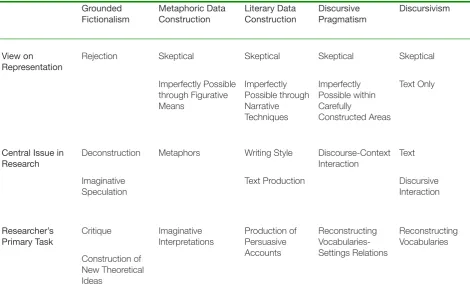
[image:20.595.57.528.388.685.2]In personally pursuing the axioms of interpretivism I have been much informed by Alvesson and Kärreman (2000) who provide a classification of research approaches which are sensitive to the linguistic turn and which differ in terms of their views on the issue of representation, the central issue in their research, and in terms of the researcher’s primary task (Figure 2). In view of the kind of interpretive work that I engage in, their classification serves to effectively position my research as literary data construction.
Figure 2: Research Approaches Sensitive to the Linguistic Turn
Adapted From Alvesson and Kärreman (2000: 144) Grounded Fictionalism Metaphoric Data Construction Literary Data Construction Discursive Pragmatism Discursivism
!
View on Representation!
Rejection
!
Skeptical!
Imperfectly Possible through Figurative Means!
Skeptical!
Imperfectly Possible through Narrative Techniques!
Skeptical!
Imperfectly Possible within Carefully Constructed Areas!
Skeptical!
Text Only!
Central Issue in Research
!
Deconstruction!
Imaginative Speculation!
Metaphors
!
Writing StyleSuch a classification acknowledges the natural slippage which occurs during data collection and writing such that any ‘reality’ can only be ever loosely and imperfectly represented (Alvesson and Kärreman 2000). The construction of the research text becomes my main focus and, while data collection is not abandoned, the focus is on how the data may be used to construct a persuasive and interesting research tale. Alvesson and Kärreman (2000: 146) continue:
Empirical material is fitted into and subordinated to a mode of writing research. The fictional and rhetorical qualities of the research product become paramount. Genres of writing, norms of producing a text, efforts to persuade and establish authority through various rhetorical devices guide the processing and use of empirical materials in the final text.
In Vanishing Point (O’Malley and Patterson 1998) the various arguments are marshalled through the narrative device of the road movie. Following Czarniawska (1998) I am inclined to use the term device as it is, at one and the same time, purposeful and artful. It also has a tendency to be idiosyncratic, thereby allowing for greater flexibility in meeting the demands of the research. Such devices also appear
elsewhere in my work, for example three skin metaphors in Borderlines (Patterson and
Schroeder 2010), and Homer’s Odyssey is used in Interpreting The Past (Shankar and
Patterson 2001: 493-494):
Homer too is a master of representation. The Odyssey begins in medias res. Rather than opening the story with the culmination of the Trojan War, Homer begins midway through Odysseus’ journey. Odysseus describes the intervening years in the fabulous stories told to the Phaeacians later in the epic. This allows the poet to achieve several things: he can immediately engage the interest of an audience already familiar with the plot; provide narrative space for a long and evocative flashback later in the text, and; quickly provide a description of the changes that have taken place since the end of the war.
Rhetorical devices also became the object of study for some of my research as I
explore the use of the relationship metaphor in Brands, Consumers and Relationships
(Patterson and O’Malley 2006; see also O’Malley et al. 2008).
3.2. Reflexivity
In addition to the standpoint reflexivity (Denzin 1997), or sensitivity to the social construction of reality that interpretivism naturally demands, it is also incumbent upon the interpretive researcher to engage with subjectivist reflexivity. As Denzin (1989a: 12) suggests, “interpretive research begins and ends with the biography and self of the researcher”. Here, I, as author, am obliged to examine myself as a legitimate subject of study, making plain to readers the personal impact of the research in respect of how it changes who I become (Foltz and Griffin 1996). The explicit placement of myself in the text, using my experiences as topics for inquiry, the acknowledgement of my role in constructing it, and the intentional revelation of my epistemological assumptions (Ruby 1980), enables readers to better judge the merits of my research (Watson 1994).
In Vanishing Point (O’Malley and Patterson 1998) the journey to a critical and alternative marketing begins with a serendipitous visit to a colleague’s home where
the bookshelves are stacked high with critical works. In Borderlines (Patterson and
Schroeder 2010) years of personally collecting tattoos and hanging out in tattoo parlours become the backdrop for an exploration of tattoo culture and, by extension, Consumer Culture Theory. Furthermore, being reflexive makes plain the very natural doubts which I as a researcher experience in the course of my research endeavours. The purpose here is to enable the reader to identify with me by making me seem accessible and human, for “[w]ho can identify with the all knowing author?”, (van Maanen 1995: 136). In this way, reflexivity may help to strengthen the persuasive
appeal of my research texts.
We can also acknowledge a discursive reflexivity that suggests that scholarly writing is simply a way of staging truth effects (Alvesson and Kärreman 2000). In this respect it is important for me to make clear to the reader how my text captures the phenomena
under investigation, despite its construction by me. For example in Borderlines
It is to these three relationships between femininity, skin and consumption that we now turn. In so doing we deploy the three metaphors of skin as container, skin as projection surface, and skin as cover to be modified. The metaphors are used here as framing devices enabling us to view these relationships from a particular vantage point. But metaphor is never neutral. It always highlights some elements of a phenomenon while hiding others. Nonetheless, the metaphors considered here are useful in that they also overlap with the motivations for tattooing outlined by Sanders (1989). As such they are not simply theoretical devices but also effectively work to organise the lived experience and practice of individuals.
Proponents of the canonical style would have us believe that language use is secondary to observation and reason (Hassard 1994), and, as such, research texts
are objective accounts of the facts (Alvesson and Kärreman 2000). As Coffey et al.
(1996: 3.1) submit:
The separation of rhetoric from logic in the creation of modern disciplinary knowledge parallels a number of other, equally fundamental, separations and dichotomies. It established the possibility of an observer armed with a neutral language of observation (since untouched with rhetoric) and thus allowed for the elementary distinction between that observed and the observed.
Thus, my text is simply a “contested [claim] to speak ‘the truth’ about the world”, (Fox 1995: 1), and, as De Cock (2000) suggests, these arguments provide mounting support for the assertion that we academics persuade our audiences primarily through the utilisation of specific narrative forms. Nonetheless, as Hackley (2003: 1338) reaffirms, such issues remain relatively unexplored within the marketing canon:
The shortcomings of the popular marketing textual genre are sometimes noted by marketing academics in critical papers (e.g. in O’Malley and Patterson 1998; citing Grönroos 1994; Holbrook 1995; Robson and Rowe 1997).
The discussion and mobilisation of discursive reflexivity has appeared with greater frequency within the consumer research literature. Here, scholars seem to have a degree more freedom to evidence these issues and the ultimate result is that they spur on those working within the field (Bode and Østergaard 2013: 176).
The history of pre-CCT and current CCT scholarship is interspersed and driven forward by self-reflective, critical, alerting and demanding texts. These texts are contextual junctions of mythologising the past and writing the future (Shankar and Patterson 2001).
3.3. Narrative
Wrestling with notions of discursive reflexivity naturally leads to a focus on narrative in research. According to Bruner (2004) we seem to have no other way of describing “lived time” save in narrative form. In their simplest sense, narratives are “mental models” whose defining property is their unique patterning of events over time (Cherrier 2005). They are not necessarily grounded in fact but are a representation of experiences encoded with symbolism and meaning (McAdams and Ochberg 1988). The stories we tell about our lives allow us to construct the experiences we live through (Schiffrin 1996) and offer a method of understanding these experiences and communicating them to others (Bruner 1990).
As such, in adopting a narrative approach I treat interviewees as ‘agents of meaning’ (Macdonald 2001), where their experience is vital in allowing them to create sufficient depth in their narratives. Here, interviews and casual conversations become sites of narrative production (Czarniawska, 2004). Moreover, narratives of identity change over time, constantly evolving to incorporate new experiences. For example, in Borderlines (Patterson and Schroeder 2010: 262) I tease out the fluidity of identity and its associated narratives:
notwithstanding modern methods of tattoo removal, tattoos are viewed as permanent marks in the skin thus defying change, effecting a degree of continuity ... and anchoring the self ... tattoos are used to question and ameliorate the uncertainty of the future and the confusion engendered by the postmodern fragmentation of identity.
However ... the practice of tattooing may, in fact, only serve to reinforce postmodern fragmentation given that tattoos are generally open to multiple interpretations and their legibility is never guaranteed. Indeed, the substance and meanings of tattoos may even change across time and context for those who bear them. Designs merge into each other, new designs are added, some are covered up, some altered, and the narratives that surround them evolve.
refers to “truthlike statements that produce for readers the feeling that they have experienced, or could experience, the events being described.”
For example, in Borderlines (Patterson and Schroeder 2010) I make use of the
narratives of heavily tattooed women who are required on an almost daily basis to justify what they have done to their bodies. Their justifications are fabricated through narratives of personalised meaning around their tattoos. Similarly, the context to this paper incorporates a cultural history of tattooed women that also pulses with a variety of narratives around spectacle, conformity and resistance. Importantly, the decision to focus on consumer narratives is not just a textual strategy but a conscious effort to incorporate the consumer’s voice. As Sparkes (1995: 159) contends:
No textual staging can ever be innocent. Whose voices are included in the text, and how they are given weight and interpreted, along with questions of priority and juxtaposition, are not just textual strategies but are political concerns that have moral consequences. How we as researchers choose to write about others has profound implications, not just for how readable the text is but also for how the people the text portrays are ‘read’ and understood.
As alluded to earlier I have also used narrative structures within my work to draw the reader in. These narratives are now considered to be central to the operations of
interpretive and even qualitative work (Jafari et al. 2013). Brown (2005: 222) makes
use of Interpreting the Past (Shankar and Patterson 2001) to conclude that narrative
data and narrative storylines are beginning to establish a concrete presence within the discipline:
The legitimisation of fiction is thus well underway and, while the marketing academy is in no rush to abandon the fruits of its scientistic labours, there is no doubt that studying stories is much more acceptable than before.
Indeed, Brown also recognises that my justification for narratology in the paper is itself presented as an heroic narrative (2004: 328):
Avi Shankar and Maurice Patterson (2001) have applied narratological methods to the rise of the interpretive research tradition, creatively construing it as a series of crises, climaxes and resolutions.
4. EMBODIMENT
Let me tell you... don't you look at those illustrations too long, because they'll come alive and they'll tell you stories.
The Illustrated Man (1969)
At 11:05 on Wednesday 23rd October 2013, I am a 44-year-old male worried about being a 44-year-old male. Too attached to culinary delights and potation, the appearance of my body looms particularly large in my daily thoughts. I have no great difficulty in seeing the direct connection between my consumption activities and my body. My heroic failure to curb these consumption activities accounts for the ever increasing waist measurement of my jeans, the rather sad looking pouch that hangs down over that waist, the poor state of my complexion, the amalgam receptacles that are my teeth, and the inability of my lungs to take in what by any normal standards would be a healthy volume of air. At times this list of my corporeal deficiencies seems endless. I live in vain hope of recapturing the ‘athletic’ body of my youth. Marketers, for their part seem only too keen to provide support for such futile dreams. Over the years I have also decorated my body with a succession of tattoos. My stock narrative explanation for these artworks is that they represent an effort to affirm my Celtic heritage. However, as a multitude of tattoo parlours spring up in secondary locations off the high street, I come to the sad realisation that my tattoo may affirm nothing more than the fact that I am a slave to fashion.
There is an increasing realisation that embodiment represents a fulcrum around which processes of identification revolve and Turner (1992) uses the term ‘somatic society’ to signify the body’s growing importance. Nonetheless, following Shilling (1993) we might refer to embodiment as having been an ‘absent presence’ within our discipline. That is, the corporeality of consumption has always been lurking in the shadows. If nothing else, embodiment has acted as consumer research’s Other, the irrational, emotive and impulsive flip side of the rational, information-processing consumer (Longhurst 1995).
with our bodies (Joy and Venkatesh 1994), and indeed the successful management of body projects requires the intervention of a range of marketplace commodities from dietary products to gym services. Moreover, marketing communications are primarily responsible for the constitution of bodily ideals (Thompson and Hirschman 1995): they promote the latest version of the body beautiful (Sturrock and Pioch 1998); they encourage consumers to be “actively concerned about the management, maintenance and appearance of their bodies”, (Shilling 1993: 5), and; they teach consumers how to work towards the idealised bodies they covet (Finkelstein 1997).
My interest in embodiment emerges from my focus on experiential consumption and the anti-cognitivist stance this entails. Early work in this domain centres upon the representation of bodies in advertising and consumers’ interpretive strategies. Later I move away from problems of representation to consider the agency of bodies.
!
4.1. Anti-Cognitivism
“To ignore the body in any discourse on consumption is to accept a very restrictive view of social reality”, (Firat and Venkatesh 1995: 258). And yet, until relatively recently, the body has not figured significantly in consumer research. Hirschman
(1993) and Thompson et al. (1989) both highlight the pervasive and problematic
nature of the machine and container metaphors in consumer research. For (Hirschman 1993: 544), machines:
act but do not emote; they make decisions but do not feel the consequences. When the machine metaphor is used to characterise human beings, we risk losing sight of the other significant aspects of being human.
In Negotiating Masculinities (Patterson and Elliott 2002: 231-232) I delineate the reasons why the body has not figured as prominently in consumer research as it should and underline why bodies are important:
liberatory intervention of rationality acting through science and technology ... the notion of embodiment helps to overcome this artificial division between body and mind. Embodiment straddles the nature/culture, mind/body divide and neatly captures the dialectical relationship between both ... We ‘are’ bodies and we ‘have’ bodies such that they do not simply exist ‘in themselves’ but become the subject of enterprise, interest and reflection ... To this end, our bodies represent unfinished projects, works-in-progress of central importance in our lives. Moreover, they are not simply controlled by social relations, but also underpin, intensify and change those relations.
In an effort to overcome the effects of Cartesianism, and to establish the importance of the body to consumer research, I have been influenced by the work of Arthur Frank (1991: 48–49) in viewing ‘the body’ as constituted by discourses, “cognitive mappings of the body’s possibilities and limitations”; institutions, the places and contexts in which discourses occur, and; corporeality, the obdurate physicality of the
body. Thus, in Negotiating Masculinities (Patterson and Elliott 2002) I take due
consideration of the discourse of hegemonic masculinity, the context of male lifestyle magazines which is a major outlet for this discourse, and the ability, or lack thereof, of men to mould their bodies to approximate the ideals on show (see also Patterson et al. 2009 for similar issues around emphasised femininity).
!
4.2. Representing Bodies
In accessing the reaction of audiences to advertising depictions of bodies early work
(e.g. Peterson and Kerin 1977; Simpson et al. 1996) employs a series of experiments
to determine the effects on attitudes. Many such studies continue to assume, despite the weight of critical evidence, that advertising is a linear communication process in which audiences understand and acknowledge messages uniformly and uncritically. In truth, as Bulmer and Buchanan-Oliver (2004: 2) contend:
Different audiences bring different cultural competencies to their readings [of advertising] and not everyone employs the same codes in interpreting communication.
The result is that advertisements are open to a host of alternative interpretations and may exhibit both synchronic and diachronic polysemy. Synchronic polysemy occurs when an advertisement “means one thing to one group of consumers and something
incorporates “a multiplicity of meanings during advertising reception, when advertising polysemy occurs in the same individual — such as on first viewing an ad, or viewing an ad on repeated occasions”. Thus, a more fruitful avenue has been the inclusion of
reader response analyses of advertising (Borgerson et al. 2006; O’Donohoe 2000). In
Negotiating Masculinities (Patterson and Elliott 2002: 238) I begin to tease out the nature of reader response in this context:
male spectators are unlikely to adhere strictly to the conventions of the male gaze. Rather, such a gaze represents just one of a variety of subject positions which men can adopt ... The suggestion, therefore, is that gender identities are complex and multi-dimensional, and undergo a process of constant negotiation and renegotiation ... For example, a gay male reader may engage in fetishistic scopophilia, recognising images as perfect examples of gay iconography ... and submitting himself to them fully. At other times, the same reader, wishing to retain some semblance of control, may experience narcissistic identification, enjoying the images but using them to his own ends. Still at other times, with the aim of reinforcing his male “rationality”, this reader may pursue a greater degree of voyeuristic detachment and reject the images out of hand.
This work is taken up by later by Elliott and Elliott (2005: 16) who conduct a study of the responses of young men at a British university; they find:
In an attempt to maintain a masculine persona, the respondents in this study rejected or disassociated themselves with images that did not fit masculine traits. By accepting an image that was feminine, they could risk breaking culturally established gender codes and allow suspicions of homosexuality ... The other negative theme that emerged was "gender stereotyping", where male respondents labelled consumption and body consciousness as female traits or female problems ... Several of the respondents evinced a disassociation with muscular body ideals, but they also displayed an association with normal bodies and were very aware of marketing ploys. They seemed lo pride themselves on this fad and were quick to voice their independence and ability to resist advertisers' 'tricks'.
Currie (1997) challenges the conceptualisation of advertising as a gender script and suggests that the work it spawns assumes that advertising works almost like a magic bullet, whereby “bad images produce bad attitudes and behaviours” (Walters, 1995: 3, cited in Currie 1997). Currie argues, following Smith (1990), that gender identity is an everyday accomplishment mediated by gender discourses but not determined by them.
I take up these issues primarily in Negotiating Masculinities (Patterson and Elliott
2002). Here, I propose that changes in the social environment are redefining what it
means to be a man (Bakewell et al. 2006; Martins et al. 2008). In an effort to open up
markets for male grooming and fashion, advertisers are encouraging men to take responsibility for the way they look, to treat their bodies as works in progress requiring
the liberatory intervention of marketplace offerings. Borrowing from Negotiating
Masculinities (Patterson and Elliott 2002), Östberg (2010: 54) reiterates that contemporary Western culture encourages men:
to gaze at other men either for pleasure or for anxiety-evoking contrast, and ... changing representations of the male body make men increasingly aware of, and dissatisfied with, bodies that do not meet various cultural ideals.
But the reception of advertising representations by audiences is not uncritical. Following Hall (1980) and Hirschman and Thompson (1997) I suggest that “when the [male] gaze is turned on itself, men are more likely to move through a range of responses such as rejection, identification and desire” (Patterson and Elliott 2002: 241). I acknowledge the ability of advertising to furnish us with polysemic texts, allowing us to adopt multiple subject positions, negotiated and renegotiated over time and in particular social contexts (Östberg 2010; Norman 2011). Such a position underlines the agency of the audience in its relationship with advertising.
abandon[s] any notion of a core-abiding subjectivity and instead seek to celebrate the corporeal intimacies and affective dimensions of social life.
However, such interests tend to be cerebral, esoteric and ultimately disembodied (Davis 1997). Burkitt (1999: 2) stridently argues:
Discursive constructionism … has difficulties in dealing with human embodiment and also, therefore, with the multi-dimensional way in which we experience reality … we are not just located in the world symbolically; nor do we experience reality purely through the text … embodied persons are not simply constructs, but are productive bodies … communicative bodies … powerful bodies [and] thinking bodies.
Thus, although discursive theories have helped to foreground interest in the body, their ability to adequately deal with embodiment remains limited. This is particularly true in respect of underlining, not just what bodies mean, but what they can do.
!
4.3. The Agency of Bodies
The body remains our most immediate means of interacting with the world (Lewis 2000). Joy and Sherry (2003) reiterate that while the body has been the object of some investigation in consumer research, much of this work has approached the body wholly as an outcome of social processes. Joy and Sherry (2003) argue that a more comprehensive treatment of the body should incorporate analyses of embodied agency and, in such a move, they mine a rich seam of work within the social sciences. For Hepworth (2004: 125) “embodied agency requires physical competencies of the body through which the self is socially expressed”. Indeed, the body is fundamental to understanding the means by which the subject is agental (McNay 2000). For example, while those who modify their bodies are often considered dupes, submitting to gender discourses (Pollock 1988), they are, in fact, able to operate within body culture in such a way as to maximise their potential (Reischer and Koo 2004).
‘The body’ is an object in practices of modification. It is reflectively thematised and worked upon. But it is equally a subject or agent in such practices. Embodied agents work upon themselves, upon their own embodiment, in body modification projects. The ‘I’ that is aware of ‘my body’ (qua embodied ‘me’) is my (active and changing) body. Moreover I modify and maintain myself, qua body, by way of bodily activities or ‘reflexive body techniques (2004: 37).
These body techniques are reflexive in that the agent utilises the environment around
her for the express purpose of working upon her body. These are techniques of the
body and for the body, making use of both bodily effort and embodied competence
(Crossley 2005).
My work in this area has focused primarily on the body techniques of heavily tattooed
women. In Borderlines (Patterson and Schroeder 2010; see also Larsen et al. 2014) I
identify how the body work engaged in by these women sees them inhabit a space that is both within and beyond the confines of normal beauty culture. These women are transgressive in that they seek to establish alternative notions of what is aesthetically pleasing and what is beautiful. According to De Mello (1995: 74):
Women are working to erase the oppressive marks of a patriarchal society and to replace them with marks of their own choosing which contest patriarchal power.
Tattooing also offers different cultural critiques than some body projects (Sweetman 2013: 354:
Tattooing and related forms of body modification can be argued to differ from other forms of contemporary body project, their lack of easy revisibility perhaps indicative of a rejection of the ideology of social mobility, which practices such as ‘keep fit’ vigorously pursue (Patterson and Schroeder 2010).
Moreover, I use the body techniques of tattooed women to critique body projects as they are currently framed within consumer research. There is no disembodied mind here calculating the potential exchange value of body modifications. Rather bodies submit themselves to the practice, change from blank canvas to work of art, further invigorate the practice of tattooing and gradually change our understandings of tattooing and feminine beauty (Patterson and Schroeder 2010: 255):
EPILOGUE
In putting this document together I have collected a series of thoughts, outputs and implications from a body of work that spans 15 years. It is the product not just of my labours, but of those who have collaborated with me along the way. It introduces a number of key themes that signpost the directions I have taken and that situate my work within the extant literature. The published works included here inform each of the contributions I have identified, contributions that range from the theoretical to the methodological. This work has been taken up and valued by my peers within the discipline, but has also crossed disciplinary borders to leave its mark on other disciplines. This impact is evidenced in Appendix 4. Further, my research experiences fuel my teaching by enhancing my understanding of a wide range of disciplinary issues and providing relevant examples of the complex problems facing contemporary consumers and organisations. Thus, my research also helps promote ‘credibility’ and
‘enhanced knowledge currency’ with students (Lindsay et al. 2002).
Within the discipline of marketing and consumer research the published works detailed here serve to promote a critically-informed, and embodied interpretive consumer research. In terms of specific contributions I have outlined three key areas
of endeavour, each with three core elements. Vanishing Point (O’Malley and
Patterson, 1998) offers a thorough critique of the dominant version of marketing founded upon the marketing mix. In so doing it underlines the importance of moving forward with a conception of marketing that is participative, experiential and cognisant of its social role; issues that are taken up in my subsequent work (Patterson and Elliott
2002; Patterson and O’Malley 2006; de Coverly et al., 2008; Patterson and Schroeder
2010). Interpreting the Past (Shankar and Patterson 2001) assesses the field of
interpretive consumer research, tracing the movement away from post-positivism towards more truly interpretive endeavours. Here, I also champion the use of narrative and rhetorical devices which are to be found elsewhere in my work (O’Malley and Patterson 1998; Patterson and O’Malley 2006; Patterson and Schroeder 2010). In
character of traditional consumer research which privileges the consuming mind to
the detriment of the body. In Brands, Consumers & Relationships (Patterson and
O’Malley 2006) I put forward a critique of relational approaches to branding theory, undermining the use of the brand as personality metaphor and the related brand as
relational partner metaphor. Hidden Mountain (de Coverly et al. 2008) is the first paper
within the field to properly theorise our relationship to waste. We submit that our everyday experience of waste is such that we are encouraged to avoid it, to keep waste in its place — out of sight and out of mind. In Borderlines (Patterson and Schroeder 2010) I explore the double-sidedness of skin, its ambiguity and ambivalence. As a result of this paper I have been invited onto an international research collaborative working on skin (see http://www.skinterlocutors.com). Through this lens, I examine the relationship between identity and consumption and throw into question many of the received ideas concerning embodied identity within Consumer Culture Theory.
These works document my growth and development as a researcher. Further, taken together they contribute significantly to the body of knowledge with marketing and consumer research.
!
!
REFERENCES
Abrahams, R. (1986) “Ordinary and Extraordinary Experience”, in V.W. Turner and E.M. Bruner (Eds.) The Anthropology of Experience, Urbana, IL: University of Illinois Press, 45–73.
Alvesson, M. and D. Kärreman (2000) “Taking the Linguistic Turn in Organisational Research: Challenges, Responses, Consequences”, Journal of Applied Behavioural
Science, 36(2), 136-158.
Arnould, E. and C. Thompson (2005) “Consumer Culture Theory (CCT): Twenty Years of Research”, Journal of Consumer Research, 31(4), 868-882.
Askegaard, S. and J.T. Linnet (2011) “Towards an Epistemology of Consumer Culture Theory: Phenomenology and the Context of Context”, Marketing Theory, 11(4), 381-404.
Bakewell, C., V-W. Mitchell and M. Rothwell (2006) "UK Generation Y Male Fashion Consciousness", Journal of Fashion Marketing and Management, 10(2), 169-180.
Belk, R., M. Wallendorf and J. Sherry (1989) “The Sacred and the Profane: Theodicy on the Odyssey”, Journal of Consumer Research, 16, 1–38.
Belk, R., J. Sherry and M. Wallendorf (1988) “A Naturalistic Inquiry into Buyer and Seller Behaviour at a Swap Meet”, Journal of Consumer Research,14, 449-470.
Bode, M. and P. Østergaard (2013) "The Wild and Wacky Worlds of Consumer Oddballs: Analysing the Manifestary Context of Consumer Culture Theory," Marketing
Theory, 13(2), 175-192.
Borgerson, J., J. Schroeder, B. Blomberg and E. Thorssén (2006) "The Gay Family in the Ad: Consumer Responses to Non-traditional Families in Marketing Communications", Journal of Marketing Management, 22(9-10), 955-978.
Bradshaw, A. and R. Canniford (2010) “Excremental Theory Development”, Journal of
Consumer Behaviour, 9(2), 102-112.
Bradshaw, A. and S. Brown (2008) "Scholars Who Stare at Goats: The Collaborative Circle Cycle in Creative Consumer Research," European Journal of Marketing, 42(11/12), 1396-1414.
Brownlie, D. and P. Hewer (2007) "Prime Beef Cuts: Culinary Images for Thinking ‘Men’", Consumption, Markets and Culture, 10(3), 229-250.
Brown, S. (2005) “I Can Read You Like A Book! Novel Thoughts On Consumer Behaviour”, Qualitative Market Research: An International Journal, 8(2), 219-237.
Bruner, J. (2004) "Life as Narrative," Social Research: An International Quarterly, 71(3), 691-710.
Bruner, J. (1990) Acts of Meaning, Cambridge, MA: Harvard University Press.
Bulmer, S. and M. Buchanan‐Oliver (2004) "Meaningless or Meaningful? Interpretation
and Intentionality in Post‐modern Communication", Journal of Marketing
Communications, 10(1), 1-15.
Burkitt, I. (1999) Bodies of Thought: Embodiment, Identity and Modernity, London: Sage.
Cherrier, H. (2005) "Becoming Sensitive to Ethical Consumption Behaviour: Narratives of Survival in an Uncertain and Unpredictable World", Advances in Consumer
Research, 32, 600-604.
Coffey, A., B. Holbrook and P. Atkinson (1996) “Qualitative Data Analysis: Technologies and Representations”, Sociological Research Online, 1(1), http:// www.socresonline.org.uk/socresonline/1/1/4.html, Date Accessed: 26/7/13.
Cova, B. (1997) “Community and consumption: towards a definition of the linking value of product and services”, European Journal of Marketing, 31(3/4), 297-316.
Cova, B. and R. Elliott (2008) “Everything You Always Wanted To Know About
Interpretive Consumer Research But Were Afraid To Ask”, Qualitative Market
Research: An International Journal, 11(2), 121-129.
Crossley, N. (2004) “The Circuit Trainer’s Habitus: Reflexive Body Techniques and the Sociality of the Workout", Body & Society, 10(1), 37-69.
Crossley, N. (2005) “Mapping Reflexive Body Techniques: On Body Modification and Maintenance", Body & Society, 11(1), 1-35.
Crossley, N. (2007) “Researching Embodiment by way of ‘Body Techniques’", The
Sociological Review, 55(1), 80-94.
Csikszentmihalyi, M. (1997) Finding Flow, New York: Perseus.
Currie, D. (1997) “Decoding Femininity: Advertisements and their Teenage Readers”,
Gender & Society, 1(4), 453-476.