Volume 81, Number 278, April 2012, Pages 1179–1200 S 0025-5718(2011)02530-5
Article electronically published on September 20, 2011
ON THE COMPUTATION OF LOCAL COMPONENTS OF A NEWFORM
DAVID LOEFFLER AND JARED WEINSTEIN
1. Introduction
1.1. The problem. Letf be a cuspidal newform for Γ1(N) with weightk≥2 and character ε. There are well-established methods for computing such forms using modular symbols; see [Ste07]. Letπf be the corresponding automorphic
representa-tion of the ad`ele group GL2(AQ). (As there are numerous possible normalizations, we shall recall the construction in section 2.1 below.) This representation decom-poses as a restricted tensor product over all placesv ofQ:
πf =
v πf,v,
where πf,v is an irreducible admissible representation of GL2(Qv). The
isomor-phism class of the infinite componentπf,∞ is determined by the weightkalone: it
is the unique discrete series subrepresentation of the representation constructed via unitary induction from the character
t1 ∗
t2
→t1
t2
k/2sgn(t1)k
of the Borel subgroup of GL2(R) [Gel75, prop. 5.21]. Similarly, the componentπf,p
for a prime p N is the unramified principal series with Satake parameters equal to the roots of the polynomialX2−a
pX+ε(p)pk−1. We are led naturally to the
following problem:
Problem 1.1. Compute the local componentsπf,p for each primep|N.
Problem 1.1 may be recast from an arithmetic perspective as a question about the local behavior of Galois representations. Suppose the Fourier coefficients off
lie in a number fieldE. Let
ρf,λ: Gal(Q/Q)→GL2(Eλ)
be the family ofλ-adic representations attached tof by Deligne.
Problem 1.2. Compute the restriction ofρf,λto Gal(Qp/Qp) for everyp|N and
every primeλofE not dividingp.
Received by the editor August 16, 2010 and, in revised form, February 3, 2011. 2010Mathematics Subject Classification. Primary 11F70; Secondary 11F11, 11Y99. The first author’s research is supported by EPSRC Postdoctoral Fellowship EP/F04304X/2. The second author’s research is supported by NSF Postdoctoral Fellowship DMS-0803089.
c
Problems 1.1 and 1.2 are equivalent. This is a consequence of the theorem of Carayol [Car86], which we now summarize. For an irreducible admissible repre-sentationπp of GL2(Qp), with coefficients in an arbitrary algebraically closed field
of characteristic zero, let σ(πp) be the corresponding two-dimensional
Frobenius-semisimple Weil-Deligne representation of Qp under the Hecke correspondence.
The Hecke correspondence is a modification of the local Langlands correspon-dence which has the convenient property of being invariant under automorphisms of the coefficient field; see [Car86], §0.5. If the coefficient field is the λ-adic field Eλ, where λ does not divide p, there is a further correspondence σ(πp) → σλ(πp) between Frobenius-semisimple Weil-Deligne representations and
continu-ous Frobenius-semisimple representations Gal(Qp/Qp)→GL2(Eλ) due to
Groth-endieck; cf. [Tat79].
Let f be a cusp form as above. Carayol’s theorem states that σλ(π
p,f) agrees
with the restriction ofρf,λto Gal(Qp/Qp). Therefore if one has access toπf,pas in
Problem 1.1 one could also computeρf,λ|Gal(Qp/Qp), at least if one has an explicit
construction of the Hecke correspondence.
Our approach is as follows. Whenπf,p is a principal series or special
repesenta-tion ofG= GL2(Qp), the problem is not difficult: In these cases the isomorphism
class ofπf,pis determined by thepth Fourier coefficient off and those of its twists
by an explicit set of Dirichlet characters of p-power conductor. We are therefore reduced to the case of πf,p supercuspidal. Here πf,p is of the form IndGKτ, for a
finite-dimensional representationτ of a maximal compact-modulo-centre subgroup
K⊆G. Using results of Casselman on the structure of irreducible representations of GL2(Qp), we find a canonical model of τ inside πf,p, which can be explicitly
realized as a subspace of the cohomology of a modular curve. We then compute this space, or rather its dual, using the explicit presentation of the homology of modular curves provided by modular symbols.
An alternative approach is provided by the local converse theorem of [BH06,§27], which shows that an irreducible supercuspidal G-representation π is determined by the local epsilon factors of its twists by a certain set of characters. While this approach is of enormous theoretical importance, it is less convenient from a computational perspective, as the description of the representationπgiven by the epsilon factors of its twists is very inexplicit and hence difficult to relate to other more familiar parametrizations of the set of representations ofG.
This article grew out of work done by the second author during his visit to the Magma Group in Sydney in 2009. A partial version of the algorithm described here, in which πf,p is computed up to a quadratic twist, is implemented in the
computational algebra system Magma [BCP97]. The slightly more refined version presented here is the result of discussions between the authors at the workshop “Computer methods forL-functions and automorphic forms” hosted by the Centre de Recherches Math´ematiques, Montr´eal, in March 2010, and an implementation by the first author will be included in a forthcoming version of the Sage system [Sag].
2. Basic Observations
2.1. Cusp forms and automorphic representations. We begin by recalling
ZA be the centers of those groups. Let us fix a levelN and a Dirichlet character
ε moduloN. Let ω be the adelization of ε; that is, ω is the unique character of
ZA/ZQ such that ω( p) = ε(p) for primes p N, where p ∈ Q×p ⊂ ZA is a uniformizer atp. Letωp be the restriction ofωto Q×p.
Remark 2.1. Note that the restriction ofωp toZ×p is theinverse of the character
ofZ×p inflated from thep-component of ε.
We write
K0(N) =
a b c d
∈GL2(Z)c≡0 (modN)
,
so that K0(N) is an open compact subgroup of GL2(Afin
Q). By [Bum97, Theorem 3.3.1], we haveGA=GQG+∞K0(N), where
G+∞={g∈GL2(R)|det(g)>0}.
We define a characterλofK0(N) by
λ
a b c d
=
p|N
ωp(dp);
this clearly agrees withω onZA∩K0(N).
Given an eigenformf ∈Sk(Γ1(N), ε), we define a functionφf onGA by
φf(γg∞k0) =f(g∞(i))·(ci+d)−k·(detg∞)k/2·λ(k0),
for γ ∈GQ, g∞ ∈G+
∞, and k0 ∈ K0. This is well defined, since GQ∩G+∞K0 = Γ0(N) andf satisfiesf(azcz++db) =ε(d)(cz+d)kf(z) for
a b c d
∈Γ0(N); it is clear thatφf(gz) =ω(z)φf(g) forz∈ZA.
The functionφf in fact lies in the spaceA0(ω) of automorphic forms onGA of central characterω; see [Gel75,§3]. We defineπf to be the linear span of the right
translates off under GA; then πf is an admissible smooth representation of GA.
If f is an eigenform, then it is well known that this representation is irreducible and decomposes as a restricted tensor product vπf,v of admissible irreducible
representations of GL2(Qv).
2.2. New vectors. Let us fix a prime p, and let G = GL2(Qp). We recall a
theorem of Casselman on smooth representations ofG:
Theorem 2.2 ([Cas73a]). Letπbe an irreducible smooth representation ofGon a vector spaceV (over a field of characteristic 0), with central characterω. For large enough r≥0, there exists a nonzero vectorv∈V satisfying
π
a b c d
v=ω(d)v
for all
a b c d
∈GL2(Zp)withc≡0 (modpr). Ifris the minimal such exponent, thenv is unique up to scalar.
Remark 2.3. Our conventions differ slightly from those of [Cas73a]. Casselman
Definition 2.4. With the notation of Theorem 2.2, theconductorofπisr=r(π), and anew vector forπisv.
One checks easily that the space of new vectors is preserved by the endomorphism
Tp=
1
√ p×
⎧ ⎪ ⎪ ⎪ ⎪ ⎨ ⎪ ⎪ ⎪ ⎪ ⎩
p−1
i=0 π
p i
0 1
(r≥1),
p−1
i=0 π
p i
0 1
+ω(p)·π
1 0 0 p
(r= 0).
Since the space of new vectors is one-dimensional, we must haveTpv=λvfor some
scalarλ. We defineλ(π) to be this scalar.
Smooth irreducible representations of G (other than the trivial 1-dimensional representations factoring through the determinant) fall into three classes, which we summarize in Table 1 below (see for instance [BH06,§9.11])
Table 1. The three classes of irreducible infinite-dimensional
smooth representations ofG= GL2(Qp)
Class Notation Conductor Central char. λ(π) Principal Series π(χ1, χ2) f1+f2 χ1χ2 χ∗1(p) +χ∗2(p) Special St⊗χ1 max(2f1,1) χ21 p−
1/2
χ∗1(p)
Supercuspidal IndGKτ ≥2 ωτ 0
In the table,χ1 andχ2 are characters ofQp× of conductorspf1 andpf2, and
χ∗i(p) =
χi(p), χi is unramified,
0, χi is ramified.
The representation denoted π(χ1, χ2) is the principal series representation at-tached to the characters χ1 and χ2, defined whenever χ1/χ2 =| · |±1. The repre-sentation denoted St is the irreducible infinite-dimensional quotient of IndGB1
(un-normalized induction), whereB⊂Gis the subgroup of upper-triangular matrices. The supercuspidal representations ofGare induced from certain finite-dimensional characters τ of compact-mod-center subgroups K ⊂G; these will be reviewed in
§3.1. We have writtenωτ for the central character ofτ.
If f is a p-new eigenform, the automorphic form φf constructed above is a
new vector for πf,p for every prime p. One checks thatλ(πf,p) =ap(f)/p(k−1)/2.
In particular, if p N, then πf,p ∼= π(χ1, χ2) with χ1 and χ2 the unramified characters whose values at p are {α/p(k−1)/2, β/p(k−1)/2}, forα and β the roots ofX2−a
pX+ω(p)pk−1.
2.3. Twisting. In this section we make an important reduction, which, in partic-ular, will allow us to immediately dispose of the non-supercuspidal cases of Prob-lem 1.1.
Definition 2.5. We sayπisprimitive ifr(π)≤r(π⊗(ψ◦det)) for any character
ψofQ×p.
ofπ(χ1, χ2) equals the conductor ofχ1. Similarly, St⊗χis primitive if and only if
χis unramified, in which case it has conductor 1 and unramified central character. The notions of twisting by a character and of primitivity have the following global analogues. For f ∈ Sk(Γ1(N), ε) a new eigenform, and μ a Dirichlet character
moduloM, the twistfμis the modular form (of level at mostN M2) whose Fourier
coefficients are given byan(fμ) =μ(n)an(f). We writef⊗μfor the uniquenewform
whose pth Fourier coefficient is μ(p)ap(f) for all but finitely many primes p; this
may have level smaller than N M2. Then f ⊗μ is the newform corresponding to the automorphic representationπf⊗(ψ◦det), whereψ is the adelic character
corresponding toμas in§2.1.
Later we will need the following technical observation:
Lemma 2.6. Let f be a newform of weight k ≥ 2, and let p be prime. If there
exists a nontrivial characterχofp-power conductor such thatf⊗χ=f, thenχis quadratic with χ(−1) =−1.
Proof. Iff is a newform of weightk≥2 andf does not have CM, then the set of primessuch thata(f) = 0 is well known to have density zero. Iff⊗χ=f, then
we must havea(f) = 0 for allsuch thatχ()= 1; so ifχis nontrivial,f must be
CM, andχthe unique quadratic character corresponding to the CM field off. In
particular,χ(−1) =−1.
Definition 2.7 ([AL78, p. 236]). The newformf isp-primitiveif thep-part of its level is minimal among all its twists.
Clearly,f isp-primitive if and only ifπf,p is a primitive representation ofG. If f isp-primitive, then itspth Fourier coefficient, its central character and its weight already determine πf,p completely,unlessπf,p is supercuspidal:
Proposition 2.8. Letπ=πf,pbe the local component atpof ap-primitive newform f ∈ Sk(Γ1(N pr), ε), with p N and r ≥ 1. Let ωp be the p-component of the character ofA×Q/Q× corresponding toε.
(1) If r ≥ 1 and the conductor of ωp is pr, then π ∼= π(χ1, χ2), where χ1 is
unramified,χ1(p) =ap(f)/p(k−1)/2, andχ2 is determined by χ1χ2=ωp.
(2) If r= 1and ωp is unramified, then πp∼= St⊗χ, whereχ is the unramified character withχ(p) =ap(f)/p(k−2)/2.
(3) If neither of the above conditions hold, then π is supercuspidal and the conductor of ωp is at mostr/2.
Proof. The only statement requiring proof is that a primitive supercuspidal repre-sentation of conductorrmust have central character of conductor≤ r/2; this is [AL78, Theorem 4.3]. The remaining statements are clear from Table 1 and the relationλ(πf,p) =ap(f)/p(k−1)/2.
Corollary 2.9. Suppose πf,p is not supercuspidal. Let χ be any character such that f ⊗χ is p-primitive. Then πf,p is determined up to isomorphism by ε,χ,k, andap(f⊗χ).
3. Supercuspidal Representations
3.1. Generalities on cuspidal types. Let π be a supercuspidal representation
of G = GL2(Qp). Then, by the induction theorem of [BH06, §15.5], π arises by
induction from a finite-dimensional character of an (explicit) open subgroupK⊂G
which contains the center Z of G and for which K/Z is compact. The following definition is not standard but is well suited for our purposes:
Definition 3.1. Acuspidal typeis a pair (K, τ), where Kis a maximal compact-mod-center subgroup of Gand τ is a finite-dimensional character of K such that IndGKτ is an irreducible supercuspidal representation ofG.
Up to conjugacy, there are two maximal compact-mod-center subgroups of G: one isQ×p GL2(Zp), and the other is the normalizer inGof an Iwahori subgroup
I0(p) =
Z×p Zp pZp Z×p
⊂GL2(Zp).
We will refer to these as theunramifiedandramifiedmaximal compact-mod-center subgroups, respectively.
In either case,Kcomes along with a natural filtration by normal subgroups. Let
K0⊂K be the maximal compact subgroup, so that K0 equals GL2(Zp) orI0(p).
ThenK0 is the group of units in aZp-algebraA⊂M2(Zp) equal toM2(Zp) in the
unramified case and
Zp Zp
pZp Zp
in the ramified case. The Jacobson radicalP of
AispAor
pZp Zp pZp pZp
. LetKn = 1 +Pn; then theKn are normal inK.
Definition 3.2. Let (K, τ) be a cuspidal type. The level of (K, τ) is the least integer n ≥0 for whichτ factors through K/Kn. The type (K, τ) is primitiveif π= IndGKτ is a primitive representation ofG.
Theorem 3.3. Every irreducible supercuspidal representation of G arises from a cuspidal type(K, τ). IfK is ramified, then one may take the level ofτ to be even.
Proof. For a proof that every irreducible supercuspidal representation arises from a cuspidal type, see [BH06],§15.8. There an exhaustive list of cuspidal types (K, τ) is given; these cuspidal types are classified according to which “simple strata” they contain. For the definition of simple stratum, see [BH06], §13.1 and §13.2. In the definition of ramified simple stratum (A, n, α) appearing in §13.1, the integer nis required to be odd; in our notation, the level of any τ containing such a stratum
has leveln+ 1, which is therefore even.
We remark that in [BCDT01], a concise list of pairs (K, τ) is given for which IndGKτ exhausts the set of isomorphism classes of supercuspidal representations, at
least in the case ofpodd.
Proposition 3.4. Let (K, τ) be a primitive cuspidal type of leveln. Let r be the conductor ofIndGKτ. Thenr= 2nifKis unramified andr=n+1ifKis ramified.
Proof. The relationship between the level of (K, τ) and the conductor of IndGKτ is
3.2. The restriction of a cuspidal representation to a compact-mod-center
subgroup. Suppose f is a p-primitive cusp form for which one has determined
(using Proposition 2.8, say) that the local component πf,p is supercuspidal. By
Theorem 3.3, there exists a cuspidal type (K, τ) for whichπf,p= IndGKτ. The
sub-groupKis determined (up to conjugacy in GL2(Zp)) by the parity of the exponent
of pin the conductor off. Therefore to complete the solution to Problem. 1.1 it suffices to compute a model for the K-moduleτ. We shall see how to compute τ
in Theorem 4.6. In preparation for this we shall need to gather some purely local results on supercuspidal representations of GL2(Qp).
We will have use for an old result of Casselman; see Theorem 3 of [Cas73b] and its proof. For the moment, let Γ(pm) ⊂ GL2(Zp) denote the group of matrices
congruent to the identity modulopm(this agrees withKmifKis unramified). For
a ringR, letN(R)⊂GL2(R) be the unipotent subgroup
1 R
1
.
Theorem 3.5. Let π be a primitive cuspidal representation of conductor pr, and letm=(r+ 1)/2. ThenπΓ(pm) is an irreducible representation ofGL2(Z/pmZ). Furthermore, the restriction of πΓ(pm)
to N(Z/pmZ) ∼
= Z/pmZ is determined as follows:
(1) If r is even, thenπΓ(pm)|
N(Z/pmZ) is the direct sum of characters of
con-ductor pm. Each of thesepm−1(p−1) characters appears with multiplicity
one.
(2) If r is odd, then πΓ(pm)|
N(Z/pmZ) is the direct sum of characters of
con-ductors pm−1 andpm. Each of thesepm−2(p2−1) characters appears with
multiplicity one.
Let (K, τ) be a primitive cuspidal type, and letπ= IndGKτ. We will use
Cassel-man’s theorem to construct a model ofτ inside ofπ.
Theorem 3.6. Let pr be the conductor of π, let v be a new vector forπ, and let wbe the vector
w=π
pr/2 0
0 1
v.
Finally, letW be the span of theN(Zp)-translates ofw.
(1) We have W =πKn. In particular, since K
n ⊂K is normal, we have that W is stabilized by the action ofK.
(2) The action of K onW is irreducible.
(3) There is an isomorphism ofK-modulesW ≈τ.
Proof. First observe that (1) and (2) implies (3). Indeed, sinceπis induced fromτ, andτ is fixed byKn, we see thatπKn contains a K-module isomorphic toτ. But
by (1) and (2),πKn=W is already an irreducibleK-module, which forcesW ≈τ.
Therefore it suffices to prove (1) and (2).
First suppose r = 2n is even, so that K = Q×pGL2(Zp) is unramified. Then Kn= Γ(pn). The vectorwhas the property that
π
a pnb pnc d
w=ω(a)w,
wherea, d∈Z×p,b, c∈Zp, and whereωis the central character ofπ. It immediately
follows thatW ⊂πKn. LetB(Z
matrices. SinceB(Zp) preservesCwand normalizesN(Zp) we see thatB(Zp)
pre-serves W. Consider the decomposition ofW into irreducible characters ofN(Zp);
certainly each character appearing has conductor ≤ pn. On the other hand, by Theorem 3.5, part (1), πKn|
N(Zp) contains exactly those characters of conductor
pn. ThereforeWonly contains characters of conductorpn. ButB(Z
p) preservesW:
as a result,everycharacter of conductor pn occurs inW. In view of Theorem 3.5, we have shown that W is all of πKn. Furthermore, the action of B(Z
p) on W is
irreducible (since it acts transitively on the set of characters of N(Zp) insideW).
Hence the action ofK onW is also irreducible, as required.
Now suppose that K is ramified, so that r is odd: Write r = 2m−1 and
n= 2m−2. We have that
π
a pm−1b
pmc d
w=ω(a)w,
for all a, d∈ Z×p, b, c∈Zp. The central character ω has conductor ≤pm−1. The
groupKn is
Kn=
1 +pm−1Z
p pm−1Zp pmZ
p 1 +pm−1Zp
⊃Γ(pm),
from which we see that W ⊂ πKn ⊂ πΓ(pm). Applying Theorem 3.5 shows that
πΓ(pm) is an irreducible representation of GL2(Z/pmZ) containing exactly those characters of N(Zp) of conductors pm−1 and pm. Consider the restriction of W
to N(Zp); each character that appears must have conductor pm−1. Since W is
preserved byB(Zp), we see thatW|N(Zp) is the sum of exactly those characters of
conductor pm−1. Since no characters of conductor pm could occur inπKn|
N(Zp),
we have that W =πKn. The action ofK onW is again irreducible, for identical
reasoning as in the previous paragraph.
Let Up ⊂GL2(Zp) be the subgroup of matrices
a b c d
with c ≡0 (modpr)
anda, d≡1 (modpr/2). Observe that
(3.2.1) Up=
pr/2
1
−1
Kn
pr/2
1
.
Therefore ifπis a primitive supercuspidal representation of conductorr, thenπUp
is stabilized by the group
(3.2.2) K=
pr/2
1
−1
K
pr/2 1
.
Note that K contains the subgroup of matrices
a b c d
∈ GL2(Zp) with c ≡ 0
(modpr). We will need the following corollary to Theorem 3.6.
Corollary 3.7. Let ρ:K → AutV be a continuous linear representation of K
which is isomorphic to a direct sum of finitely many copies ofπUp. Letv∈V be a
nonzero vector with the property that
ρ
a b c d
for all
a b c d
∈GL2(Zp)withc≡0 (modpr). LetX be the span of the translates
ofv under
1 p−r/2Z
p
1
. ThenX is preserved byK, and(K, X)is a cuspidal
pair withIndGKX ∼=π.
Proof. Writeρ= (πUp)⊕μ and suppose v= (v
i)1≤i≤μ, wherevi is a vector in the
space of πUp. Then by the hypothesis on v we see that v
i is a new vector for π.
By uniqueness of the new vector up to scaling we must have v = (aiv0)1≤i≤μ for
a particular new vectorv0 and a nonzero tuple (ai)∈Cμ. Thusv is contained in
(aix)|x∈πUp
⊂V which is itself a model forπUp. The result now follows from
Theorem 3.6.
3.3. Admissible pairs. If pis odd, then there is an explicit parametrization of the primitive supercuspidal types.
Definition 3.8 ([BH06,§18]). Anadmissible pair is a pair (E, θ), whereE/Qp is
a tamely ramified extension and θ is a character E× →Q×. These must satisfy the conditions:
(1) θdoes not factor through the norm map NE/Qp:E
×→Q× p.
(2) If E/Qp is ramified, then the restriction θ|UE1 must not factor through
NE/Qp.
We say that (E, θ) and (E, θ) are equivalent if there is an isomorphismι:E→E
such thatθ◦ι=θ.
In [BH06,§20], a construction is given which associates to each admissible pair (E, θ) a cuspidal type (K, τ), where K is ramified or unramified asE is. Ifχ is a character ofQ×p, then (E, θ×(χ◦NE/Qp)) corresponds to (K, τ⊗(χ◦det)); hence
(K, τ) is primitive if and only if for all charactersχofQ×p, we havec(θ×χ◦NE/Qp)≥
c(θ).
For p = 2 this construction gives a bijection between admissible pairs (up to equivalence) and cuspidal types (up to isomorphism); ifp= 2, then the admissible pairs correspond to a subset of the cuspidal types. We will need the following formula describing the trace of the representation (K, τ):
Definition 3.9. An elementα∈E× is minimal if:
(1) E/Qp is unramified and α = pkα0 for a unit α0 ∈ O×E whose image in OE/pE∼=Fp2 does not lie inFp.
(2) E/Qp is ramified andαhas odd valuation.
Theorem 3.10. Let(K, τ)be a primitive cuspidal type of levelncorresponding to an admissible pair(E, θ), and letα∈E×be a minimal element. Lets∈Gal(E/Qp) be the nontrivial automorphism. Then
Trτ(α) =ι(θ(α) +θ(αs)),
whereι= (−1)(n−1)if E/Q
p is unramified andι= 1otherwise.
Proof. See [Wei09], proof of Lemma 2.2.
Remark 3.11. Suppose (E, θ) is an admissible pair, and let πθ = IndGKτ be the
corresponding supercuspidal representation of GL2(Qp). By local class field theory
conditions on θ in Definition 3.8 ensure that σ is an irreducible representation of
WQp.
It isnotthe case thatπθandσθcorrespond under the local Langlands
correspon-dence. Rather, there is a character Δθ of E× of order dividing 4 for which πθΔθ
and σθ correspond. If E/Qp is unramified, then Δθ is the unramified quadratic
character. If E/Qp is ramified, then Δθ is a normalized Gauss sum; cf. [BH06], §34.4.
4. Modular symbols
4.1. Definitions. For k≥2∈Z and Γ a finite-index subgroup of SL2(Z), we let
Sk(Γ,Q) denote the space of cuspidal modular symbols of level Γ overQ. For the
definition of this space, see [Ste07,§8.1]. For our purposes, it suffices to state that: (1) Sk(Γ,Q) is a finite-dimensionalQ-vector space, equipped with an action of
the Hecke algebraH=H(GL+2(Q)//Γ).
(2) Given an algorithm to determine whether or not a given g ∈ SL2(Z) lies in Γ, there are algorithms that will calculate a basis for Sk(Γ,Q) and the
matrix of the Hecke operator [ΓxΓ] onSk(Γ,Q) for any givenx∈GL+2(Q). (3) There is a perfect pairing between Sk(Γ) =Sk(Γ,Q)⊗QC and Sk(Γ)⊕
Sk(Γ), with respect to which the action ofHis self-adjoint.
(4) If a subgroup Γ⊂SL2(Q) normalizes Γ, there is an action
Γ→GL(Sk(Γ,Q));
this action is denoted (γ, σ)→γ◦σ.
The subgroups Γ we shall consider will all be of the form
ΓH(N) =
a b
c d c= 0 (mod N), d∈H
,
where H is some subgroup of (Z/NZ)×. A highly optimized implementation1 of modular symbol algorithms for these level groups is included in the software package [Sag].
If f is a new eigenform of level N, and the character ε of f is trivial on the subgroupH, thenf ∈Sk(ΓH(N)), and hence there is a two-dimensional eigenspace Mf ⊂Sk(ΓH(N)) with the same eigenvalues asf for the Hecke operatorsTm. This
space is preserved by the Hecke operator corresponding to
1 0 0 −1
, which has
eigenvalues±1 on Mf. Thus there are corresponding basis vectorsσf+,σ−f of Mf,
each unique up to scaling. We refer to these as the plus eigensymbol and minus eigensymbol forf.
4.2. Determination of the minimal twist. Let us now suppose f is a new
eigenform of levelN pr, withpN, and characterε. Write ε=ε
Nεp as a product
of characters of (Z/NZ)× and (Z/prZ)×.
Proposition 4.1. Let the conductor ofεp be pc, and let u= min(r/2, r−c).
(1) If χis a Dirichlet character of conductor pv with v > u, thenf
χ is new of level LCM(N pr, N pc+v, N p2v)> N pr.
(2) If χ is a character modulo pu, then fχ has level N pr and is new at the primes|N. Moreover, the space
Xf⊆Sk(Γ1(N pr))
spanned by the translates of f by
1 p−uZ
0 1
is equal to the span of the
formsfχ, for charactersχ modulo pu.
Proof. The first part follows from results in [AL78,§3].
For the second part, it is immediate that each twistfχ is contained inXf. For
the reverse inclusion: If u= 0 there is nothing to prove; so we may assume that
r≥2 andc < r. In this case, it is easy to see thatUp operator onSk(Γ1(N pr), χ)
factors through Sk(Γ1(N pr−1), χ), and hence is zero on Sk(Γ1(N pr), χ)new. So,
sincef is assumed to be a new eigenform, we must havean(f) = 0 wheneverp|n.
Hence a basis forXf is given by the series
n=imodpuanqnwhereiruns through
(Z/puZ)×, and each such series is clearly a linear combination of twists of f by
Dirichlet characters modulopu. This proves the reverse inclusion.
If g is a newform in Sk(Γ1(N ps)) for some s≤r, we write Sk(Γ1(N pr))[g] for
the subspace ofSk(Γ1(N pr)) where the Hecke operatorsTmfor (m, N p) = 1 act as
multiplication by am(g). As is well known, a basis forSk(Γ1(N pr))[g] is given by
the formsg(pjz) for 0≤j≤r−s, and we have a direct sum decomposition
Sk(Γ1(N pr))N-new=
g
Sk(Γ1(N pr))[g],
where the summands are eigenspaces for the prime-to-N p Hecke operators with distinct systems of eigenvalues.
Proposition 4.2. Letf ∈Sk(Γ1(N pr))be a newform, and let g be a newform in Sk(Γ1(N ps))for somes≤r. The following are equivalent:
(1) There exists a Dirichlet character χ ofp-power conductor withf =g⊗χ,
(2) Xf∩Sk(Γ1(N pr))[g]= 0.
In particular,f isp-primitive if and only if Xf⊆Sk(Γ1(N pr))p-new.
Proof. In (1), if χ is a Dirichlet character whose conductor is a power ofp larger thanpu, then g⊗χhas level strictly bigger thanN pr, by part (1) of the previous proposition. So if such aχexists, its conductor divides pu.
Recall that Xf is spanned by the forms fχ, for χ modulo pu. Each of these
is an eigenvector for the Hecke operators Tm for (m, N p) = 1, and hence lies
in Sk(Γ1(N pr))[g] for some newform g. Comparing eigenvalues for the Tm with
(m, N p) = 1, we see that for each such m we must have am(g) = am(fχ) = χ(m)am(f) for eachmwith (m, N p) = 1.
Hence Xf∩Sk(Γ1(N pr))[g] = 0 if and only if there is a Dirichlet character χ
modulopu such thata
m(g) =χ(m)am(f) formcoprime toN p. Sincef is new by
assumption, this implies thatf =g⊗χ−1.
We now construct a space of modular symbols corresponding to Xf. Let HN
be any subgroup of (Z/NZ)× contained in the kernel of εN, and let Hp be the
subgroup of (Z/prZ)× which is the kernel of reduction modulo pmax(c,r/2). We
letH=HN×Hp⊆(Z/N prZ)×. Then
1 p−u
0 1
Definition 4.3. Thetype spaceXf+ off is the subspace ofSk(Γ) spanned by the
translates of the plus eigensymbolσ+f under
1 p−uZ p
0 1
.
For each newform g of level dividing N pr, with character trivial on H, let us
write Sk(Γ)[g] for the subspace of Sk where the prime-to-N p Hecke operatorsTm
act as multiplication by am(g). Just as with spaces of modular forms, we have a
decomposition
Sk(Γ) =Sk(Γ)p-new⊕Sk(Γ)p-old
where the first summand is spanned by the spaces Sk(Γ)[g] with g having level
exactly divisible bypr, and the second bygof level divisible by some smaller power
of p; and these two spaces can be explicitly computed using degeneracy maps, as in [Ste07,§8.6]. Translating the previous proposition into the language of modular symbols, we obtain the following proposition, which allows us to algorithmically determine whether or not a given newform isp-primitive:
Proposition 4.4. Let f be a newform of level N pr, and g a newform whose level isN ps for somes≤r. Then the following are equivalent:
(1) There exists a Dirichlet character χ ofp-power conductor withg=f⊗χ.
(2) Xf+∩Sk(Γ)[g]= 0.
In particular,f isp-primitive if and only if Xf+⊆Sk(Γ)p-new.
Proof. Since each of the twists fχ, for χ modulo pu, has character trivial on H,
the space Xf is contained in Sk(Γ) ⊆ Sk(Γ1(N pr)). Moreover, since the natural
pairing between modular forms and modular symbols commutes with the action of the Hecke algebra on the two spaces, the same systems of eigenvalues for the prime-to-N p Hecke algebra appear in the spaces Xf and Xf+. Hence we have Xf ∩Sk(Γ1(N pr))[g]= 0 if and only if Xf+∩Sk(Γ)[g] = 0, and the result is now
immediate from the previous proposition.
Iff is in fact p-primitive, then eitheru= 0, oru=r/2andπf,p is
supercus-pidal. In the latter case, we can give the following more precise description of the spaceXf+:
Lemma 4.5. If f isp-primitive and supercuspidal atp, the spaceXf+ is the direct
sum of the eigenspacesσχf⊗(−χ1) for charactersχ modulop r/2
. In particular, it has dimension φ(pr/2)and is stable under the operatorsT
manddfor allm andd, and under the Atkin-Lehner operatorWpr.
Proof. We define operatorsRχ, Σ andmpin EndSk(ΓH(N pr)) as follows. For a
Dirichlet characterχmodulopr/2, define
Rχ=
u∈(Z/pr/2Z)×
χ(u)−1
1 p−r/2u
0 1
.
Let Σ =
1 0 0 −1
be the star involution. Finally, for m ∈Z relatively prime to
N p, let mp∈(Z/N pr/2Z)× denote the unique element congruent to 1 (modN)
The following commutation relations are elementary:
Tm◦Rχ=χ(m)Rχ◦Tm,
(4.2.1)
Σ◦Rχ=χ(−1)Rχ◦Σ,
(4.2.2)
Tm◦Wpr =Wpr◦Tm◦ mp−1,
(4.2.3)
Σ◦Wpr =(−1)p ◦Wpr◦Σ.
(4.2.4)
For any character χ modulo pr/2, we have R
χ(σ+f) ∈ X
+
f. Hence X
+
f
con-tains the span of the Rχ(σf+). In fact, X
+
f equals the span of the Rχ(σ+f), by
Fourier inversion. Relations (4.2.1) and (4.2.2) show that Rχ(σ+f) lies in the
space Sk(ΓH(N pr))[f ⊗χ] and is an eigenvector for Σ with eigenvalue χ(−1).
This forces Rχ(σ+f) to be a scalar multiple of σ χ(−1)
f⊗χ , since the Σ-eigenspaces in Sk(ΓH(N pr))[f ⊗χ] are 1-dimensional. HenceXf+ is stable under the operators
Tmanddfor allmandd. Note that the eigenspacesσ χ(−1)
f⊗χ are all distinct, since
by Lemma 2.6 we can only have f⊗χ=f⊗χ for distinct charactersχand χ if
χ(−1) =−χ(−1).
Moreover, by relation (4.2.3), for each χ, Wpr(σfχ⊗(−χ1)) lies in the eigenspace Sk(ΓH(N pr))[f⊗εp−1χ−1] whereεp is thep-part of the character off, and (4.2.4)
implies that it is a Σ-eigenvector with eigenvalue εp(−1)χ(−1). Thus Xf+ is
pre-served byWpr.
4.3. The type space and cuspidal pairs. When f is p-primitive and πf,p is
supercuspidal, then in fact Xf+ tells us considerably more aboutπf,p, as we shall
show. As we have seen from Proposition 2.8, ifπf,pis primitive and supercuspidal
then we havec ≤ r/2, so Hp is the subgroup of elements of Z/prZ which are 1
modulopr/2.
As in§3.1, letKdenote either the unramified or the ramified maximal compact-modulo-centre subgroup ofG= GL2(Qp), for reven or odd, respectively, and let S(K) denote the intersection ofK with SL2(Qp). We observe thatK is generated
byS(K) along with the following subgroups and elements:
• The torusT =
ˆ
Z×p
ˆ
Z×p
.
• The matrixpI2=
p
p
, ifK is unramified.
• The matrix Π =
1
−p
, ifK is ramified.
Let ˜S(K) denote the subgroup of GL2(Qp) generated byS(K) and the single matrix pI2 or Π as K is unramified or ramified, respectively. Then ˜S(K) normalizes the subgroupS(Kn) =Kn∩SL2(Qp).
The closure of Γ in SL2(Qp) isβ−1S(Kn)β, whereβ=
pr/2
1
is the matrix
from Theorem 3.6 and nis the integer determined by Proposition 3.4. As S(Kn)
is normal in ˜S(K), this allows us to define an actionρ: ˜S(K)→GL(Sk(Γ)). This
action may be described concretely as follows. For α∈ S˜(K) and σ∈Sk(Γ), let
˜
α=
a b c d
(1) The image of ˜αin GL2(Qp) lies inαS(Kn),
(2) c≡0 (modN), anddmodN ∈H, and (3) det ˜αis a power ofp.
Then the matrixβ−1αβ˜ normalizes Γ, and we may define
ρ(α)σ=β−1αβ˜ ◦σ.
Note that in the case ofK ramified, the operatorρ(Π) is εN(pr/2)·Wpr, where
Wpr is the Atkin-Lehner operator; this follows from [AL78, Proposition 1.1].
The next theorem plays a crucial role in the determination of the local component of a newform when that component is supercuspidal.
Theorem 4.6. Let f be ap-primitive newform of weight k, level N pr and neben-typusε. Assume that πf,p is a supercuspidal representation ofGp= GL2(Qp). Let Xf+⊂Sk(Γ) be the subspace of modular symbols defined in Definition 4.3.
(1) The spaceXf+ is preserved by the actionρof S˜(K)onSk(ΓH(N pr)).
(2) In fact, there exists a unique action ρf:K → GL(Xf+) extending ρ for which
ρf
a b c d
σ+f =ωp(d)−1σf+, a, d∈Z×p, c≡0 (mod pr)
In particular, the central character ofρf isωp−1.
(3) Let τ be the contragredient ofρf. The pair (K, τ) is a cuspidal type, and
IndGKτ∼=πf,p.
The proof of Theorem 4.6 will occupy the following three subsections.
4.4. Shimura curves. The type spaceXf+ admits an action of the group ˜S(K),
which we intend to extend to an action ofK, the maximal compact-mod-center sub-group of GL2(Qp). For this we must perform a comparison between two sorts of
ob-jects. On the one hand, we have the space of modular symbolsSk(ΓH(N pr)), which
is amenable to computation and which admits an action by an “SL2 group”. On the other hand, there is the cohomology space of a (usually disconnected) Shimura curve, which has a direct interpretation in terms of automorphic representations and which admits an action by a “GL2 group”.
We recall the setup of Theorem 4.6. Letpbe prime,r≥2 and integer, andN ≥1 an integer prime top. LetHN ⊂(Z/NZ)× be any subgroup, let Hp⊂(Z/prZ)×
be the kernel of reduction modulo pr/2, and let H = HN ×Hp ⊂ (Z/N prZ)×.
Finally let Γ = ΓH(N pr).
We construct the Shimura curve analogue of the modular curveY(Γ). LetU ⊂
GL2( ˆZ) be the open subgroup consisting of matrices
a b c d
with
(1) c≡0 (modN pr),
(2) d(modN)∈HN,
(3) a, d(mod pr)∈H p.
Thus ifU =Uis the obvious decomposition into open subgroupsU⊂GL2(Z),
thenUp is as in Eq. (3.2.1). That is,Up is conjugate in GL2(Qp) to Kn, whereK
We writeH+ for the usual upper half-plane, andH± forC\R. Let ShU be the
Shimura curve of levelU:
ShU = GL2(Q)\
GL2(Af)× H±
/Γ.
We haveU∩GL2(Q) = Γ. Therefore the connected components of ShU are in
bijection with ˆZ×/detU = (Z/pn/2)×, and each connected component is isomor-phic to the modular curveY(Γ).
Fix a weightk≥2, and letV = Symk−2C2be the (k−2)-fold symmetric power of the tautological representation of GL2(Q). We writeLk for the corresponding
vector bundle on ShU. The following theorem relates the cohomology of Lk to
automorphic representations arising from newforms of level Γ:
Theorem 4.7. The space H1
P(ShU,Lk)decomposes as a direct sum
HP1(ShU,Lk)∼=
f
H1(g, K∞, πf,∞⊗V)⊗(πf,fin) U
over cuspidal newformsf of weight k. Hereπf =πf,fin⊗πf,∞ is the automorphic representation corresponding to f, g is the Lie algebra of GL2(R), and K∞ ⊂
GL2(R)is a maximal compact subgroup. For each f, the Lie algebra cohomology H1(g, K
∞, πf,∞⊗V)has dimension 2.
Proof. For the decomposition ofH1
P(ShU,Lk) into subspaces indexed by
automor-phic representations, see [Car83],§2.2.4. For the statement aboutH1(g, K
∞, πf,∞⊗
V), see [RT83], Propostion 1.5(b).
Recall the group K of Eq. (3.2.2): K containsUp as a normal subgroup, so
there is a natural actionK→Aut ShU.
4.5. Modular symbols onShU. We have a decomposition of ShU into connected
components:
(4.5.1) ShU =
a Y(Γ)a
wherearuns over a set of representatives for ˆZ×/detU andY(Γ)a is the
(isomor-phic) image ofY(Γ) under the map induced byz→
a
1
, z
. The groupK
acts on ShU, and the stabilizer of any component is
˜
S(K)=
g∈Kdetg∈pZ(1 +pr/2Zp)
.
LetSk(U) be the space of cuspidal modular symbols of weightk on ShU. Thus Sk(U) is the direct sum of copies of Sk(Γ) indexed by a as in Eq. (4.5.1). The
space Sk(U) admits an action ρ:K → GL(Sk(U)) as well as an action of the
Hecke algebra.
Letf ∈Sk(Γ) be a p-primitive newform of level N pr, and letσ+f ∈Sk(Γ) be a
plus eigensymbol forf. Let
ηf+=
a ρ
a
1
σf+∈Sk(U).
Lemma 4.8. Let Wf+ ⊂ Sk(U) be the span of the translates of η+f under the
1 p−r/2Z
p
1
. Then Wf+ is preserved by K. Let τ be the representation of
K which is contragredient to the representation of K on Wf+. Then (K, τ) is a cuspidal pair andIndGKτ ∼=πf,p.
Proof. The integration pairing
Sk(U)×HP1(ShU,Lk)→C
is perfect and equivariant for the actions of both the Hecke algebra and the group
K. By Proposition 4.7, ηf+ lies in a K-submodule of Sk(U) isomorphic to a
direct sum of copies of (ˇπf,p) Up
. Furthermore, a calculation shows that
a b c d
∈
GL2(Zp) acts onηf+ asωp(d)−1 wheneverc≡0 (modpr), whereωp is the central
character ofπf,p. The lemma now follows from Corollary 3.7.
4.6. Conclusion of the proof of Theorem 4.6. Consider the projection Φ :
Sk(U)→Sk(Γ) which restricts a modular symbol to the componentY(Γ)1⊂ShU.
Then Φ transforms the action of β−1S˜(K)β onSk(U) into the action of ˜S(K) on Sk(U) described in§4.3. We have Φ(ηf+) =σ
+
f, and consequently Φ(W
+
f ) =X
+
f.
On the other hand, dimWf+= dimX
+
f by Proposition 4.5. Therefore the restriction
of Φ to Wf+ furnishes an isomorphism W
+
f → X
+
f compatible with the actions
of ˜S(K) and ˜S(K). This establishes part (1) of the theorem. The group K
preservesWf+ and therefore induces an action ofK onXf+. Part (2) follows from the corresponding fact concerningηf+, and part (3) follows from Lemma 4.8.
5. The algorithm
We now use the above results to describe an explicit algorithm to determineπf,p,
given a new eigenformf ∈Sk(Γ1(N pr), ε) withr≥1 (specified by the sequence of
Hecke eigenvaluesa(f) forN, as elements of some number field).
Step 1: Check whetherap(f) = 0. Ifap(f)= 0, then by Proposition 2.8, one of the
following must hold:
• Thep-part of the conductor ofεispr. In this case,π
f,pis isomorphic
to the principal seriesπ(χ1, χ2), whereχ1is the unramified character with χ1(p) = ap(f)/p
1−k
2 , and χ2 is the unique character such that χ2|Zp =ε−
1
p and χ2(p) =εN(p)/χ1(p), where εp and εN are,
respec-tively, thep-part and the prime-to-p-part of ε.
• r = 1 and the conductor of ε is prime to p. In this case, ap(f)2 = pk−2ε(p), and πf,p is isomorphic to the special representation St⊗χ,
whereχis the unramified character withχ(p) =ap(f)/p
k−2 2 .
Ifap(f) = 0, we continue to step 2.
Step 2: Calculate a basis for the space of modular symbolsSk(ΓH(N pr)) of §4.1.
Calculate the matrices representing the action on this space of the star involution Σ and the Hecke operatorsT for primes=pup to the Sturm
bound. Use these to calculate the plus eigensymbol σf+ attached tof, by intersecting the kernels of Σ−1 andT−a(f) until a 1-dimensional space
Step 3: Calculate the subspace Xf+ ⊆ Sk(ΓH(N pr)) spanned by the orbit of σ+f
under
1 p−uZ
1
.
Step 4: Calculate the matrices of the two degeneracy maps from Sk(ΓH(N pr)) to Sk(ΓH(N pr−1)), whereH is the image of H moduloN pr−1. The sum of
the images of Xf+ is a Hecke-invariant subspace; if it is nonzero, then it contains an eigenform, which corresponds to a twist f of f having level
N pr−1. In this case, go back to step 1 with f in place off. If this does not occur, we may continue to step 5 knowing thatf isp-primitive. Step 5: Compute the matrix ofρ(g) acting onXf+for eachgin a set of generators
for the group ˜S(K)/S(Kn), where the groups ˜S(K) and S(Kn) and the
representationρare as defined in§4.3. One may take the set of generators to be
1 1 0 1
,
0 −1 1 0
,
p 0 0 p
forK unramified, or
1 1 0 1
,
1 0
p 1
,
a 0
0 a−1
,
0 −1
p 0
forKramified (whereais any generator of (Z/pZ)×); note thatρ
1 1 0 1
has been computed in the course of step 3.
Step 6: For eacharunning through a set of generators ofZ×p, determine the space of operatorsλa ∈GL(Xf+) satisfying λaρ(g) =ρ(δagδa−1)λa, whereg runs
through a set of generators of S(K) and where δa =
a
1
. By
Theo-rem 4.6, there will be a unique systemλa of such operators which each fix σ+f. Letρf be the unique extension ofρ toK which satisfies ρf(δa) =λa
for eacha.
Step 7: Output the representation (K, ρf). By Theorem 4.6 we have πf,p ∼=
IndGL2(Qp)
K ρˇf.
6. Examples
Example 1. Letf be the newformq−q2+q3+q4+. . . of weight 2 and level 50, and take p= 5. Since ap(f) = 0, we proceed to step 2. We find that the subgroup
Γ = ΓH(50), where H consists of the elements of (Z/50Z)× that are 1 (mod 5),
has index 360 in SL2(Z), and the space S2(Γ) has dimension 31. Continuing to step 3, we find thatXf+ is 4-dimensional. At step 4, we find that X
+
f is contained
in the 18-dimensional subspace that is the intersection of the kernels of the two degeneracy maps to level 10. Thusf is indeed 5-primitive.
Since the exponent of 5 in the conductor offis even, the groupK=Q×p GL2(Zp)
matrices ofρ 1 1 0 1 andρ
0 −1 1 0
are, respectively,
A1=
⎛ ⎜ ⎜ ⎝
1 0 0 −1 0 0 −1 0
−1 1 −2 1 1 0 −1 0
⎞ ⎟ ⎟
⎠ and A2=
⎛ ⎜ ⎜ ⎝
−1 1 −2 1 0 0 −1 0 0 −1 0 0 0 −1 −1 1
⎞ ⎟ ⎟ ⎠
with respect to a certain basis ofXf+ whose first vector isσf+.
Since f has trivial character, ρ
5 0 0 5
is the identity. In fact ρ is already
irreducible as a representation of S(K), as there are no nonscalar 4×4 matri-ces commuting with bothA1 and A2, so Xf+ is irreducible as a representation of
SL2(Z/5Z).
Continuing to step 6, we choosea= 2 as a generator of (Z/5Z)×, and compute
the action of the conjugated generators
1 a−1
0 1
and
0 −a−1
a 0
. Either by a
direct modular symbol computation, or (more efficiently) by expressing the conju-gated generators as words in the original generators and using the matrices already computed, we find that these two elements act by
A1=
⎛ ⎜ ⎜ ⎝
−2 1 −1 1
−2 2 −2 1
−1 2 −1 0
−2 2 −1 0
⎞ ⎟ ⎟
⎠and A2=
⎛ ⎜ ⎜ ⎝
−1 2 −1 0
0 1 0 0
0 0 1 0
0 1 1 −1
⎞ ⎟ ⎟ ⎠.
A straightforward computation shows that the space of matrices such that xAi= Aixfori= 1,2 is 1-dimensional, spanned by the matrix
B=
⎛ ⎜ ⎜ ⎝
1 −2 1 0 0 −1 0 1 0 0 −1 1 0 −1 −1 1
⎞ ⎟ ⎟ ⎠.
As mentioned above, the first vector in our basis ofXf+ is σf+. SoB acts trivially on σf+, and the desired extension ofρ to a representation of GL2(Z/5Z) is given
byρ
2 0 0 1
=B. Sincef has trivial character, ρfactors through PGL2(Z/5Z),
and we see that the character ofρis given by:
1 0 0 1 2 0 0 1 4 0 0 1 1 1 0 1 0 2 1 0 0 1 1 2 0 2 1 2
4 0 0 −1 −2 1 1
In particular, using the trace relation of Theorem 3.10 we see that ρcorresponds to the admissible pair (Q25, θ), whereQ25denotes the unramified quadratic exten-sion ofQ5 and θ is either of the two characters of Q×25 trivial onQ×5 and having order 3. (Since these two characters are interchanged by the nontrivial element of Gal(Q25/Q5), they correspond to equivalent admissible pairs.)
Example 2. Let λbe any root ofx4+ 9 = 0. Then λ2/3 is a square root of−1; we denote this byi. Then there is an eigenform f ∈S3(Γ1(25)) with q-expansion
whose character is the unique character χ modulo 5 mapping 2 toi. Then, since
χ generates the group of characters modulo 5, a basis forXf+ is given by the four
eigensymbols σ+f, σf−⊗χ, σ
+
f⊗χ2 and σ−f⊗χ3. All of the corresponding forms are are
in fact Galois-conjugate tof overQ(they are inner twists off).
One readily calculates that Xf+ is irreducible as an SL2(Z/5Z)-representation,
and the space of matrices intertwining Xf+ with its conjugate by
2 1
is
1-dimensional; any such matrix has the four eigensymbols above as its eigenvectors, with eigenvalues ±t,±itfor some scalar t. Thus, in particular, there is a unique
extension ofρto a representation of GL2(Z/5Z) withρ
2 1
σ+f =σ+f. (Note
that g=f ⊗χ2 has the same character as f, and moreover,Xf+ and X
+
g are the
same space. The extensions to GL2(F5) corresponding tof andgdiffer only in the
choice of sign ofρ
2 1
, and, in particular, they coincide as representations of
the index 2 subgroup of GL2(F5).)
One checks that F×25 is generated by a root α of x2−x+ 2, so the nonsplit
torus in GL2(Z/5Z) is generated byg =
1 −1 2 0
. If θ, θσ are the characters of
Q×25 corresponding to ρ, then we find that Trρ(g) = −λ, so θ(α) +θ(ασ) = λ. Sinceθ(α)θ(ασ) =θ(αασ) =θ(2) =i, we see thatθ(α) andθ(ασ) are the roots of
x2−λx+i, which are roots of unity of order 24.
Remark 6.1. Ifθis a character ofQ×25of level 1 such that (Q25, θ) is an admissible pair, then θ is determined up to unramified twists by the image of a root α of
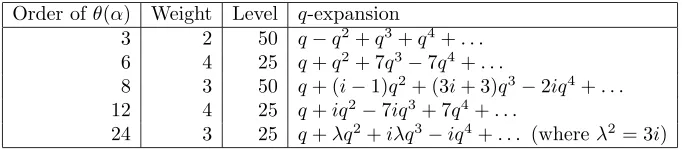
x2−x+ 2. This must be a root of unity whose order divides 24, and ifθ=θσ, it cannot be a factor of 4. Hence it is one of{3,6,8,12,24}. Conversely, the order of
[image:19.612.136.477.522.597.2]θ(α) determinesθuniquely up to Galois conjugacy and unramified twists. Table 2 gives examples of forms corresponding to each of these equivalence classes.
Table 2. Examples of forms realizing each equivalence class of
supercuspidal representations of GL2(Q5) of conductor 52, modulo unramified twists and Galois conjugacy
Order of θ(α) Weight Level q-expansion
3 2 50 q−q2+q3+q4+. . . 6 4 25 q+q2+ 7q3−7q4+. . .
8 3 50 q+ (i−1)q2+ (3i+ 3)q3−2iq4+. . . 12 4 25 q+iq2−7iq3+ 7q4+. . .
24 3 25 q+λq2+iλq3−iq4+. . . (whereλ2= 3i)
Example 3. For the unique Galois orbit of newforms of weight 2, trivial character and level 81, of which a representative isq+√3q2+q4−√3q5+. . ., the spaceX+
f
is a 6-dimensional representation of PGL2(Z/9Z), with
3 0 0 3
acting trivially.
One checks that the group