http://wrap.warwick.ac.uk/
Original citation:
Koufopoulos, Kostas, Kozhan, Roman and Trigilia, Giulio (2014) Optimal security design under asymmetric information and profit manipulation. Working Paper. Coventry:
University of Warwick. Department of Economics. Warwick economics research papers series (TWERPS), Volume 2014 (Number 1050). (Unpublished)
Permanent WRAP url:
http://wrap.warwick.ac.uk/66198
Copyright and reuse:
The Warwick Research Archive Portal (WRAP) makes this work of researchers of the University of Warwick available open access under the following conditions. Copyright © and all moral rights to the version of the paper presented here belong to the individual author(s) and/or other copyright owners. To the extent reasonable and practicable the material made available in WRAP has been checked for eligibility before being made available.
Copies of full items can be used for personal research or study, educational, or not-for-profit purposes without prior permission or charge. Provided that the authors, title and full bibliographic details are credited, a hyperlink and/or URL is given for the original metadata page and the content is not changed in any way.
A note on versions:
The version presented here is a working paper or pre-print that may be later published elsewhere. If a published version is known of, the above WRAP url will contain details on finding it.
Optimal Security Design under Asymmetric
Information and Profit Manipulation
Kostas Koufopoulos , Roman Kozhan, Giulio Trigilia
No 1050
WARWICK ECONOMIC RESEARCH PAPERS
Optimal Security Design under Asymmetric
Information and Profit Manipulation
∗
Kostas Koufopoulos
†, Roman Kozhan
‡, Giulio Trigilia
§July 1, 2014
Abstract
We consider a model of external financing under ex ante asymmet-ric information and profit manipulation (non verifiability). Contrary to conventional wisdom, the optimal contract is not standard debt, and it is not monotonic. Instead, it resembles a contingent convert-ible (CoCo) bond. In particular: (i) if the profit manipulation and/or adverse selection are not severe, there exists a unique separating equi-librium in CoCos; (ii) in the intermediate region, if the distribution of earnings is unbounded above there exists a unique pooling equilibrium in CoCos, otherwise debt might be issued but it is never the unique equilibrium; (iii) finally, if profit manipulation is severe, there is no financing.
These findings suggest that the standard monotonicity constraint exogenously imposed in the security design literature must be recon-sidered. Crucially, profit manipulation is part of the optimal contract, and non-monotonic, convertible securities mitigate the asymmetric in-formation problem. We discuss milestone payments in venture capital as an application.
KEYWORDS: Security design, financial innovation, capital struc-ture, asymmetric information, venture capital.
∗We would like to thank especially Dan Bernhardt, Motty Perry and Herakles
Polemar-chakis for their insightful comments on earlier drafts of the paper. We also thank Robert Akerlof, Peter Buisseret, Peter DeMarzo, Bhaskar Dutta, Marina Halac, Peter Hammond, Ilan Kremer, Dimitri Migrow, David Ronayne. All mistakes are our own.
†University of Pireaus, Department of Banking and Financial Management; ‡Warwick Business School;
1
Introduction
It is by now widely accepted that informational asymmetries are an impor-tant determinant of asset market prices and allocations. Since Akerlof (1970), they have been used to explain many empirical patterns in finance. Because the presence of asymmetric information violates a central underpinning for the Modigliani and Miller irrelevance argument, it also opened the opportu-nity for a theory of the firm’s capital structure. Myers and Majluf (1984) first took the challenge, and argued that the presence of asymmetric infor-mation in financial markets can justify the existence of a ‘pecking order’ in firm’s financing, the fact that privately informed borrowers often prefer to issue debt, then securities with option features (e.g. convertible bonds) and outside equity only as a last resort. Since then, several papers considered informational asymmetries as a key explanation for the widespread use of debt contracts.1
The intuition behind the preference for debt is the following: Suppose that the quality of borrowers is their private information. If there are no credible signaling opportunities, there can only exist pooling equilibria - equilibria in which all types issue the same portfolio of securities. At any (reasonable) pooling equilibrium, the securities issued will be the ones preferred by higher quality borrowers. In this context, debt is optimal because: (i) the financier seizes all assets in case of bankruptcy; (ii) the lower the borrower’s quality, the more likely is bankruptcy.
Notice the emphasis in the previous paragraph: the above argument is valid only if credible signaling is not possible. But when is this the case? The question has remained unanswered. In the literature, the standard as-sumption that the payoff of admissible securities must be non-decreasing in the project’s earnings (ormonotonic, in their language) precludes signaling2.
However, monotonicity isnot an assumption on model primitives: it imposes an exogenous constraint on the agent’s strategy space. As such, it requires a justification.
In fact, an established justification for the monotonicity assumption ex-ists: the borrower (entrepreneur) observes the realized earnings before
out-1See Nachman and Noe, 1994; DeMarzo and Duffie, 1999; DeMarzo et.al., 2005. The
argument is still pervasive in the public debate about capital structure and capital re-quirements (e.g. Admati et.al. 2010).
2Technically, the monotonicity assumption is sufficient to prevent signaling if the
earn-ings distribution is assumed to satisfy thehazard rate ordering, a stronger property than
side financiers do, and can manipulate them. If realized earnings are close
to a decreasing segment of the security’s payoff, a borrower has an incentive to borrow secretly and report higher earnings so that he repays less to the financiers. The existing literature, without explicitly modelling profit ma-nipulation, argues that this cannot be an equilibrium phenomenon and rules it out by exogenously restricting attention to monotonic or ‘manipulation-proof’ securities.
The argument for monotonicity might seem intuitive, but it has some subtlety to it. First, it implicitly assumes an ex post verification problem. If a project’s earnings were verifiable, then secret borrowing would not be a concern. Second, the effect of ex post manipulation possibilities on the set of equilibrium contracts is not clear.
In this paper, we explicitly model both ex ante asymmetric information and profit manipulation.3 The introduction of profit manipulation poses
modelling challenges: (i) it precludes the application of the revelation princi-ple; (ii) it requires a new definition of limited liability in terms of messages; (iii) it makes models with a rich type space less tractable. We address these issues in what follows.
Our baseline framework features two types of entrpeneurs, both endowed with a project with positive net present value. A type corresponds to a distri-bution over future earnings, and the two distridistri-butions are ordered according to the monotone likelihood ratio property. Entrepreneurs lack capital to finance their projects, so they require funding from competitive financiers. Entrepreneurs know their types, but the financiers only know the proportion of each entrepreneurial type in the population. Borrowers privately observe their realized earnings, which are not perfectly verifiable. More specifically, we allow the borower to report earnings that can differ from realized earnings up to some maximum amount. This is what we call ‘profit manipulation’.4
Our goal is to derive the optimal contract (or security) in this context. Cru-cially, because we model profit manipulation explicitly, we do not restrict exogenously the admissible contracts to be monotonic.
We show that the interaction of ex ante asymmetric information and profit manipulation gives rise to several novel results:
First, Contingent Convertible Bonds (so-called CoCos) are always
op-3In our model, we take the extent of profit manipulation possibilities as exogenously
given, and we do comparative statics with respect to it. The presence of profit manipu-lation possibilities may reflect the imperfect quality of the legal system and/or corporate governance issues (e.g. La Porta et.al., 1997).
timal.5 A distinguishing feature of our optimal contracts is that they in-duce profit manipulation (either output diversion or window dressing) on-the-equilibrium path. This is fully anticipated by outside financiers and it is properly priced. Nevertheless CoCos are optimal because they minimize the mispricing of securities issued by the higher quality borrowers. The intu-ition is that CoCos impose the maximum expected repayment when realized earnings are low, hence minimizing it when earnings are high. Because types of lower quality are more likely to obtain low earnings, CoCos maximize the cost for them to mimic the high types.
Second, we prove that debt is never optimal when profit manipulation and/or adverse selection are not severe. When investors are sophisticated, and the borrower types are sufficiently similar, non-monotonic, convertible securities are uniquely optimal. Indeed, they may implementseparating equi-libria in which better quality entrepreneurs signal their type by issuing a CoCo with high downside protection and low upside payoff. Such equilib-ria are absent in the literature because the monotonicity imposed on the securities offered prevents capital structure from being used as a signaling device.
Third, we show that debt is never optimal, regardless of the severity of profit manipulation and adverse selection, if the distribution of earnings is unbounded from above. The result implies that debt is never the equilibrium contract in models assuming (for instance) exponentially or normally dis-tributed earnings. It also suggests that debt can be optimal only as a corner solution, when CoCos are ruled out because of binding feasibility constraints. The latter observation leads us to our final result, which characterizes the conditions under which debt is optimal, and monotone securities arise in equilibrium. Such conditions are restrictive, and whenever debt is an optimal contract, there exists a CoCo that is ex post equivalent to it. That is, debt is
never uniquely optimal. This result contrasts sharply with existing models according to which debt is the uniquely optimal security.
Overall, our findings have the following important implications: i) they show that the assumption that the admissible securities are monotonic leads to sub-optimal securities and must be reconsidered; ii) they present a serious challenge to the ‘pecking-order’ theory of debt. The argument that the opti-mality of debt is driven by asymmetric information loses its strength; iii) they
5CoCos are a particular type of convertible bond, in which the possibility of converting
provide a rationale for the use of non-monotonic securities in settings where investors are skilled and profit manipulation is possible, but not severe.
Contingent Convertibles are not as common as debt contracts. How-ever, they are becoming increasingly popular among investors. According to Dealogic, a data provider, CoCo issuance by eurozone banks has increased to $7.8bn (2013) from $3.8bn (2012).6 It can be argued that banks’ recent
interest in CoCos is (at least in part) driven by the possibility of using them for regulatory purposes.7 Nevertheless, we would like to point out the
sim-ilarity - in terms of cash-flow rights, at least - between these contracts and the securities commonly used for at least a decade in financing risky projects. Non-monotonic components of contracts - such as milestone payments - are widely used in the venture capital and the pharmaceutical industries.8 Our
model can reconcile such payments because: (i) investment in risky projects is typically plagued by larger information asymmetries; (ii) lenders in these markets are sophisticated, and so the likelihood of un-detectable profit ma-nipulation is lower.
Existing models failed to link asymmetric information to non monotonic securities simply because these contracts were ruled out upfront. However, the issue has been identified by practicioners. In a 2003 Newsletter of the MIT Enterprise Forum of Cambridge, Jeffrey L. Quillen, a partner at a VC firm, writes: “Generally, any significant, objectively verifiable event in the development of a company can be used as a milestone in a financing con-tract. This structure significantly reduces risks for the investors and rewards the company if it is able to meet or exceed its projections. Effectively, the investors are telling the company prove it or lose it” [emphasis not in the original]. Mr. Quillen links the use of milestones to asymmetric information (be it moral hazard or adverse selection), as otherwise what could there be to ‘prove’ ? In this respect, we believe that our model might open a new direction for theoretical work on investment in risky (innovative) sectors.
The paper is structured as follows: Section II briefly reviews the lit-erature; Section III describes the model; Sections IV and V introduce the relevant securities, and discuss when and how they induce accounting fraud;
6See theFinancial Times article, May 29, 2014. Interestingly, it seems that the
incre-ment is primarily driven by Mediterranean countries banks. Given the current enthusiasm in the market for CoCos, we hope we will not be blamed for it if a new bubble is created around them.
7See, for instance, Flannery, 2005; Hart and Zingales, 2011.
8See Gompers and Lerner, 2001, and Kaplan and Stromberg, 2003, for the former;
Section VI derives the main results; Section VII illustrates how the general results apply in specific settings; Section VIII discusses extensions including moral hazard and more than two types; Section IX concludes by revisiting the paper’s relationship to the literature in light of the results derived.
2
Literature Review
Our paper is closely related to the literature on security design under asymmetric information. Myers and Majluf (1984) develop the ‘pecking or-der’ theory of debt optimality under asymmetric information in a setup where only debt and (inside or outside) equity contracts were allowed. Noe (1988) showed that the Myers and Majluf theory required somewhat restrictive as-sumptions on the distributions of earnings. Innes (1993) and Nachman and Noe (1994) revisited the theoretical argument allowing for a broader set of contracts than debt and equity. These papers found that to obtain debt as the optimal security some monotonicity constraint has to beexogenously im-posed. Such a constraint restricts the feasible contracts to be ‘manipulation proof’. Since then, the monotonicity constraint has been widely used. Promi-nent examples include DeMarzo and Duffie (1999); DeMarzo et.al. (2005); Inderst and Mueller (2006); Axelson (2007), Axelson et.al. (2009); Gorbenko and Malenko (2011); Philippon and Skreta (2012); Scheuer (2013).9 Our contribution is that we derive necessary and sufficient conditions for mono-tonicity to be without loss of generality. Because we show that debt is very rarely an optimal contract, we believe that further research is needed to con-sider the effects of allowing for non-monotonic, optimal securities on existing results.
Our paper is also related to the literature on the use of convertible rities in venture capital financing. The existing papers link convertible secu-rities to the optimal allocation of control rights. However, we are not aware of models focusing on cash-flow rights. More specifically, Casamatta (2003), Schmidt (2003) and Hellman (2006) derive the optimality of convertible se-curities in a context where both venture capitalists and entrepreneurs exert value enhancing effort, and the allocation of control rights matters. Cornelli
9The ‘pecking order’ is not the only economic theory of debt optimality. The main
and Yosha (2003) study a model of stage financing, where the entrepreneur can window dress in order to prevent exit from his financier. Convertible securities prevent window dressing because higher short-term returns would increase the probability of conversion. In their model, the optimal security is monotonic and window dressing is prevented. In contrast, in our model window dressing occurs on-the-equilibrium path and the optimal contract is non-monotonic.
Finally, our paper is related to Chakraborty and Yilmaz (2011). They consider a dynamic setting and argue that separation can be achieved if noisy information about a firm’s type is revealed over time. In contrast, we consider a static setting without information revelation, and focus on the signaling properties of capital structure decisions.
3
The Economy
We consider a model where an entrepreneur is endowed with a technology that generates future stochastic earnings x∈X ≡[0, K], and requires I >0 units of capital as input. We allow for unbounded future earnings by letting
K go to infinity. To finance his project, the entrepreneur can seek funds from competitive financiers, each of whom is endowed with equal amount of capitalW. All agents are risk neutral, and we normalize the risk-free rate to zero.
There are two types of projects (entrepreneurs), t ∈ T ≡ {l, h}. Types differ according to their distribution of earnings. The cumulative distribution function (cdf) over X for a type t project is Ft(x). Project’s type is private information of the entrepreneur. Outside financiers only know that a fraction
λl∈(0,1) are typelprojects, and a fractionλh = (1−λl) are typehprojects. All projects have positive net present value, and the firm’s assets in place are assumed to be zero.
Denote by Et(x) = R∞
0 x dFt(x) the full information expected value of a
type t project. We make the following assumptions:
Assumption 1: W ≥Et(x)≥I >0 for everyt ∈T. (A1)
A1says that a financier can fund a project, and all projects have positive net present value. In addition, we make the following standard assumptions on the distributions of earnings:
Assumption 2: (A2)
1. The cdfs are mutually absolutely continuous;
3. Strict Monotone Likelihood Ratio Property (MLRP):∂/∂x(fl(x)/fh(x))< 0 for every x∈X such that x∈[Z, K) for some (Z, K)∈X2;
Continuity is assumed for technical reasons. Since our problem is inter-esting only if investment might be loss making with positive probability (i.e. it is impossible to issue riskless securities), point (2) of A2 ensures that is the case. Finally, MLRP ensures that type h project is better than type l
project.
The timing of the game is as follows:
• date 0: The entrepreneur of type tissues publicly asecurity (financial contract) denoted by s. Each financier simultaneously quotes a price
P(s) at which he is willing to buy the security. If a contract is signed (a security is sold), the entrepreneur collectsP(s). Subsequent investment is observable and verifiable;
• date 1: Realized earnings ˆx∈X are perfectly but privately observed by the entrepreneur. He can costlessly manipulate reported earnings siphoning off the max{x−η,0}or secretly borrowing up to the min{x+
η, K}. Hence, outsiders can only infer that realized earnings belong to some interval [max{x−η,0},min{x+η, K}];
• date 2: Claims are settled on the basis of the borrower’s self reported earning and the game ends.
The novel ingredient that differentiates our findings from existing results is the possibility of ex post profit manipulation. In particular, we allow the entrepreneur to window dress and claim his earnings are anything between the true realisation x and (x+η). Moreover, we allow him to divert and claim his output to be anything between x and (x−η).
The possibility of earnings misreporting means that a security s cannot be a function of x as in the previous literature. Instead, it will be a function of reported earnings m(x). Since m : x → [max{x−η,0}, min{x+η, K}] for every x∈X, a security is a function s(m(x)) :X →R.
The only restriction we impose on the contract space is that each security must satisfy limited liability, as appropriately redefined in terms of messages:
Assumption 3: The set of admissible securities is given by: (A3)
S≡ {s(m)|0≤s(m)≤m, ∀m}
If the borrower declares m and cannot repay s(m) to his financier, then the financier becomes the legitimate owner of borrower’s assets.10
It is worth mentioning that:
1. If we were to allow for asymmetric, bounded, window dressing and diversion, our results would not change qualitatively (as will become clear).11 However, if one is willing to modelunbounded window dressing
and limited diversion, then non-monotonic contracts would never arise in equilibrium. In such environments, one would recover the results of Nachman and Noe (1994);
2. An equivalent way of modelling profit manipulation would have been to allow for secret borrowing from ‘friends’. Our results do not depend on the reason why imperfect verification comes about, but on its extent;
3. We could have modelled diversion asoutput destruction, in which case the entrepreneur could not put the diverted amount in his pocket. How-ever, in such cases the entrepreneur would be indifferent between di-verting and not, making such possibilities useless;
4. Finally, we assumeη as a constant independent on earnings. Although this simplifies the analysis, it is not necessarily a desirable assumption. For instance, one could think that it would depend on earnings, η(x). We leave such possibilities for future research, but we conjecture that the bulk of our results would not change.
Finally, denote by Vt(x) the state x profits of an entrepreneur of type t
whose offered security s has been priced at P by the financier, and by Vf(x) the state xfinancier’s profits. Then we can write:
Vt=P −I+Et
x−s(m(x)) (1)
Vf =Eλ(s)
s(m(x))−P(s) (2)
The expectation in (2) is given by the sum across types (weighted by the posterior belief λ(t|s) that typet is issuing the contracts) of the final payoff
realized output, we should consider the case in which the entrepreneur declares earnings that exceed true earnings, and he does not have the resources to repay the contractual obligation. In this case, the fraud becomes observable and verifiable, and hence we suppose that ownership of assets can change. The underlying assumption is that the owner of the assets can always perfectly discover their value.
11Allowing for unbounded window dressing and diversion would trivially lead to no
of the security after manipulation takes place:
Eλ(s)
s(m)
≡X
t∈T
λ(t|s) Z
x∈X
s(m(x|s))dFt(x)
Notice that we can writemt(x|s) =m(x|s) because the cost and benefits of commiting accounting fraud ex post are not type-dependent.
The equilibrium concept is Perfect Bayesian Equilibrium (PBE):
PBE: A strategy profile s∗(t), m∗(s), P∗(s) and a common posterior belief
λ∗(t|s) form a PBE of the game if the following conditions are satisfied: 1. For every x∈X and for s∈S:
m∗(x|s) = arg mins(m) s.t. m ∈[max{x−η,0}, min{x+η, K}]
2. For every t∈T, s∗t(m∗) maximizes Vt(s, P∗(s), m∗) subject to the
lim-ited liability constraint (s∈S);
3. The belief λ∗(t|s) is derived using Bayes’ Rule whenever possible; 4. Competitive Rationality: for s∈S, P∗(s) = Eλ∗(t|s)(s)
Notice first that, because of A3 and the fact that the set of feasible deviations is closed, for every (s, x) ∈ S×X there exists a finite, optimal message m∗(x|s). Moreover, in every equilibrium it must be the case that either P∗(s) = 0 (no investment), or P∗(s)≥I (investment takes place).
To rule out ‘unreasonable’ equilibria, we refine the off-equilibrium-path beliefs adopting the Intuitive Criterion by Cho and Kreps (1987). Denote by Vt(s∗t, e
∗) the expected utility of type t entrepreneur issuing s∗
t at the equilibrium e∗, and by Π∗(s|T) the set of all possible Nash Equilibria of the pricing game played by financiers given an observed s∈S12.
The Intuitive Criterion: A PBE is not reasonable if there exist an out-of-equilibrium security s0 ∈ S such that only one type may benefit from deviating to s0:
Vt(s∗t, e
∗
)≤ max
P∗∈Π∗(s0|T) Vt(s 0
, e∗)
V−t(s∗t, e
∗
)> max
P∗∈Π∗(s0|T) V−t(s 0
, e∗)
We provided a definition of the Intuitive Criterion for a generic set of types T because we extend some results to the case of |T|>2.
The next sections introduce the key properties of the two contracts which are relevant in this framework: Debt and Contingent Convertibles.
12Each element of the set can be parametrized by a posterior belief λ(s)∈∆
T, where
4
Debt Contracts
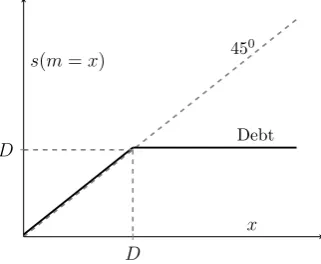
It is useful to start by defining formally a debt security, and to show the crucial distinction that arises in this model (unlike the existing literature) between thepromised payoff and thereal payoff of a security. Thepromised
payoff is given byEλ∗(s)(s(m=x)). In contrast, thereal payoff isEλ∗(s)(s(m∗)),
where m∗ solves condition (1) of a PBE, i.e. it maximizes the entrepreneur’s ex post payoff.
The characteristic feature of debt contracts is the fixed repayment in non-bankruptcy states: if the face value of debt is D, then whenever m≥D, the debt security specifies s = D. If, instead, m < D, a bankruptcy state, the debt holder is a senior claimant on the assets, obtaining repayments(m) = m.
Definition: A securitys∈S is adebt contractif and only ifs=min{m, D}
for some D∈M.
450
Debt
D D
[image:13.595.210.371.371.503.2]x s(m=x)
Figure 1: The Promised Payoff of a Standard Debt Contract
Like any other security with positive expected value, a debt contract will provide incentives to divert output for some x ∈ X. Lemma 1 provides a characterization of the real payoff of a standard debt contract.
Lemma 1 (The Real Payoff of Debt). For every debt security swith fixed repayment D,
m∗(x|s) = (
max{x−η, 0} if x < D+η x otherwise
Proof. Notice first that because a debt contract is monotonic there cannot be any benefit from overstating earnings. Therefore m∗ ≤x. As a consequence, the ex post accounting fraud problem in a generic statex∈X can be written as: minm∈[max{x−η,0},x]
The dashed curve in Figure 2 depicts the real payoff of a standard debt contract.
450
Debt Contract
η D+η
D
x s(m∗(x))
[image:14.595.209.372.190.331.2]s(m=x)
Figure 2: The Real Payoff of a Standard Debt Contract
5
Contingent Convertibles (CoCos)
The contract that turns out to be generically optimal takes a contingent convertible bond form. The payoff of a Contingent Convertible Bond is given by:
s(m) = (
m if m < m
D otherwise (3)
where D∈
0, m reflects limited liability.13 Figure 3 depicts the promised
payoff of contracts as defined in (3) above.
450
CoCo
m D
m
x s(m=x)
Figure 3: The Promised Payoff of a Contingent Convertible Bond
13Standard debt contracts are special cases of (3) whereD=m. Hence, we always add
[image:14.595.105.372.537.673.2]We next characterize the optimal ex post accounting fraud under CoCos.
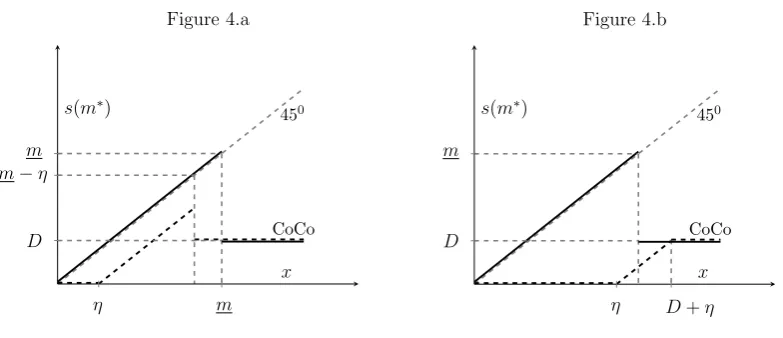
Lemma 2 (The Real Payoff of CoCos). For every CoCo security s with threshold m and fixed repayment D:
1. If m−D > η, then:
m∗(x|s) =
max{x−η, 0} if x < m−η
m if x∈[m−η, m)
x otherwise
2. If m−D≤η, then the real payoff of a CoCo is equivalent to that of a debt contract (see Lemma 1).
Proof. Follows from the payoff of CoCos and the same logic as that in Lemma 1. The only difference occurs for realizations in [m−η, m). Here, a borrower may benefit by window dressing depending on D.
Figures 4a and 4b depict the real payoff of a CoCo for the cases of two different levels of profit manipulation. In Figure 4.a, diversion possibilities are relatively high, and the real payoff is not ex post monotonic. In Figure 4.b, they are lower and the real payoff is ex post equivalent to that of a debt contract with face value D.
Figure 4, panels (a) and (b): The Real Payoff of a CoCo Bond
450
CoCo
η m
D m−η
m
[image:15.595.107.499.459.628.2]x s(m∗)
Figure 4.a
450
CoCo
η D+η
D m
x s(m∗)
Figure 4.b
6
Optimal Security Design
this conclusion. It is instructive to begin our analysis by deriving conditions under which financing occurs. To do so, we only need to study the contract in which the financier receives all reported earnings: s=m ∀m. If financing does not take place with such a contract it cannot take place with any other contract that satisfies A3.14
Suppose first that there is no ex ante asymmetric information. The con-dition for type t to get financing is Et(x|η)≥I. Since El(x|η)<Eh(x|η) we conclude that whenever the low type (type l) gets financing, the high type (type h) does as well. Hence, there will be a threshold on the diversion pos-sibility ˆηl such thatEl(x|ηˆl) = I, above which only typehreceives financing. Moreover, there will exist a ˆηh such that Eh(x|ηˆh) = I, above which no one will get funding.
If we introduce ex ante asymmetric information, it is clear from our pre-vious analysis that the boundaries of the region in which financing takes place will depend on the pooling zero profit condition, and there will be a
ˆ
ηp ∈(ˆηl, ηˆh) such that:
λlEl(x|ηˆp) + (1−λl)Eh(x|ηˆp) = I
Then for everyη ≤ηˆp there is financing, but for every η >ηˆp there is no financing.
6.1
Separating Equilibria
In this section we characterize the set of Separating Perfect Bayesian Equi-libria (SPBE). Such equiEqui-libria never arise with the exogenous monotonicity constraint. The intuition behind the SPBE is the following: the most pro-ductive type will try to distinguish himself from the less propro-ductive one by offering securities with high downside protection for the financier, and a low upside payoff (such as CoCos). By doing so, high types impose a relatively higher cost on low types should they try to mimic.
In a SPBE,sl6=sh. Moreover, given the offered security st, the posterior belief that it is offered by type t is one, i.e. λ(t|st) = 1 for every t ∈ T. In-centive compatibility for type h can be written as: Eh(sh)−El(sh)≤0. The formulation corresponds to the standard incentive compatibility constraints after: (i) we impose the zero profit condition; (ii) we notice that the
inter-14Notice that: (i) thes=m∀mcontract may be thought of as a CoCo wherem=K;
esting case is when a low type mimics the high type. The case in which the high type mimics the low type is considered in Theorem 1.
Suppose that sh has the shape given in (3), and that mh −Dh > η, as required by Lemma 1. Rewrite the incentive compatibility constraint as:
Z
mh−ηη
x−η
dFh(x)−dFl(x)
+
Fl mh−η
−Fh mh−η
Dh ≤0. (4)
In a SPBE, competitive financing yields P∗(sh) = Eh(sh) = I. Substituting this into (4) and integrating by parts yields:
Z
mh−ηη
Fl(x) 1−Fh(mh−η)
−Fh(x) 1−Fl(mh−η)
dx
| {z }
>0 by FOSD
+
Fl mh−η
−Fh mh−η
| {z }
>0 by FOSD
I −mh+ 2η
| {z }
sign?
≤0. (5)
Inequality (5) highlights the key mechanism that underlies separation: setting a thresholdmhhigh enough to make the last bracket not just negative, but low enough that the second line counterbalances the first.
Three properties of (5) are useful in the following analysis:
Lemma 3. If the set of mh that satisfies (5) is non-empty, then:
1. There is a unique mh at which the inequality binds. We denote it by
mIC h ;
2. For every mh < mICh the inequality is violated; 3. For every mh ≥mICh the inequality is satisfied. Proof. From the definition ofmIC
h we know that, ifmICh exists, it must solve:
mICh =I+2η+
Z mICh −η
η
Fh(x)dx+
Z
mIC h −ηη
Fl(x)−Fh(x) 1−Fh(mICh −η)
Fl mICh −η
−Fh mICh −η
dx. (6)
To show that the incentive constraint crosses zero from above notice that: (i) when mh tends to I+ 2η, the incentive constraint is strictly positive because of FOSD; (ii) differentiating the incentive constraint (4) with respect to mh
and evaluating at mIC
Z mIC h −η
η
Fh(x)−Fl(x)
dx
| {z }
<0 by FOSD
∗
∗
fl(mICh −η) 1−Fh(mICh −η)
−fh(mICh −η) 1−Fl(mICh −η)
| {z }
>0 because MLRP⇒HRO
<0.
An immediate consequence of the inequality is that if the incentive constraint crosses zero, it must do so only once. Lemma 3 follows.
Notice now that if (5) is satisfied, then a contract is incentive compatible and leaves the financier at his participation constraint. However, it remains to guarantee that the underlying contract satisfies limited liability on the financier’s side, i.e. that Dh ≥ 0. As usual, limited liability constrains the feasible thresholds that satisfy the zero-profit condition for financiers.
Denote by mmaxh the solution to the zero profit condition in a SPBE for type h when the face value of debt Dh = 0:
Z
mmax h −ηη
x−η
fh(x)dx=I. (7)
Notice that in the financing region equation (7) is guaranteed to have a solution. Also, equation (7) implies that all feasible thresholds are such that
mh ≤mmax
h . Given that, we can state the following theorem:
Theorem 1. (SPBE) If mIC
h ≤mmaxh then:
1. There exists a separating equilibrium e∗s in which a type h entrepreneur issues a contract as in (3) such that the financiers make zero profits, and m∗h ∈[mIC
h , mmaxh ];
2. Type l entrepreneurs are indifferent between any contract such that
El(s) =I, as long as it is not a CoCo with Dl∗ ≤D
∗
h;
3. No pooling equilibrium satisfies the Intuitive Criterion.
Proof. Claims 1 and 2: Follow from the previous discussion, and the fact that if tl issues a CoCo withD∗l ≤D
∗
h that breaks even on his type, the good type would mimic him and he would end up with a rate of repayment higher than one.
rate of return to the investors. No type other thant =h is in the set Θ for a security s0 that satisfies (5). Hence, the Intuitive Criterion implies that the investor must believe that the deviation comes from type hwith probability one. If this is so, the deviation is profitable and the pooling equilibrium does not satisfy the Intuitive Criterion.
Intuitively, whenmIC
h ≤mmaxh separation may be achieved because MLRP implies that the low type (t = l) expects to repay relatively more than the high type. Thus, by choosing a sufficiently high threshold for the contingent convertible bond (and a sufficiently low face value of debt) the high type can make the cost of mimicking for the low type excessively high, and credibly signal his type to the uninformed financiers.
Now we can proceed to characterize the set of equilibrium outcomes when Theorem 1 does not apply. We start by clarifying that outside the region in which Theorem 1 holds, credible signaling cannot occur. Importantly, this justifies our choice of focusing on CoCos, as they can be used to obtain necessary and sufficient conditions for separation to occur. To establish this result, some preliminary steps are required.
Denote the CoCo with mh = mmax
h and Dh = 0 as s∗, and compare it with another generic security s such that Eh(s∗) = Eh(s) = I. Moreover, define the following sets:
Π+(s)≡ {m|s∗(m=x)> s(m =x)}
Π−(s)≡ {m|s∗(m=x)< s(m =x)}
Lemma 4. For every pair (ml = xl, mh = xh) in X2 such that ml ∈ Π+
and mh ∈ Π− we have mh > ml. Moreover, m∗(xl|s∗) ≥ m∗(xl|s) and
m∗(xh|s∗)≤m∗(xh|s).
Proof. First notice that Π+(s) = ∅if and only if Π−(s) = ∅, becauseft(x)>0 for everyx∈[0, K], for everyt∈T. In this case the lemma is not very useful, but it is still satisfied. Suppose Π+(s) is non-empty. Because of limited
liability, it must be the case that mh > mmaxh −η for every mh ∈ Π−, and
ml< mmaxh −η for everyml ∈Π+(s). As for the claim about the real payoff,
it follows directly from the shape of s∗.
As a consequence:
Lemma 5. Denote the CoCo with mh =mmax
h and Dh = 0 as s∗. For any
Proof. The only interesting case is, again, when Π+(s) is non-empty (else the
lemma holds trivially). Suppose so. Furthermore, suppose we move from s∗
towards through a series of steps such that in each step we create a security
s0 such that Et(s0) = I, but there exists a small interval dxa ∈ Π+(s) such
that s0(m∗(dxa))< s∗(m∗(dxa)) and this change is compensated by inducing a change in the real payoff for another small interval dxb ∈ Π−(s) so that
s0(m∗(dxb))> s∗(m∗(dxb))15. Then,
El(s∗)−El(s0) =fl(xa)
s∗(m∗(dxa))−s0(m∗(dxa))
+ fl(xb)
s∗(m∗(dxb))−s0(m∗(dxb))
= s∗(m∗(dxb))−s0(m∗(dxb))
| {z }
<0 by construction
fl(xb)
fh(xb)
− fl(xa)
fh(xa)
| {z }
<0 by MLRP
ft(xb)>0,
where the second equality comes from Eh(s∗) =Eh(s0). The iteration of this procedure one step at a time concludes the proof.
The latter result implies immediately that:
Corollary 1. If mIC
h > mmaxh , then any PBE of the game must be pooling.
Proof. Because of Lermma 5 we know that Eh(s∗)−El(s∗)<Eh(s)−El(s), for every Eh(s∗) =Eh(s) = I. The Corollary follows.
The intuition for this result is as follows. Because a higher threshold for the CoCo (and a lower face value of debt) increases the cost of mimicking for the low type, this cost is maximized when Dh = 0 and the threshold is
mmax
h . If the distributions are such that the incentive constraint for the low type is violated at this contract, then a separating equilibrium cannot exist and the only possible equilibria are pooling. We characterize such equilibria next.
6.2
Pooling Equilibria
Since Nachman and Noe’s (1994) seminal paper, the literature has adopted a stronger refinement than the intuitive criterion to deal with pooling equilib-ria: the D1 criterion. As is well known, the intuitive criterion does not bind in the pooling region of such models. The reason is that both types may
15In both cases, construct the interval such that it is of equal length as the pdf centered
benefit from any deviation depending on the posterior belief of the financier. D1 allow us to refine the equilibrium set and obtain a unique equilibrium because it is a condition on the range of beliefs for which a deviation is profitable.
Denote by Vt0 the utility of type t entrepreneur at the deviant contract, and by Vt∗ the utility of typet entrepreneur at the equilibrium contract.
Moreover, denote by D(t|s0) the set of responses of the financier that would deliver strictly higher utility to type t entrepreneurs than the utility he would obtain at the equilibrium contract. Formally:
D(t|s0)≡ {P∗(s0)≥I :Vt0 > Vt∗}
where by competitive rationality, P∗(s0) =Eλ∗(s0)(s0) for all λ∗(s0) ∈∆T, as
beliefs off-the-equilibrium path are arbitrary. Finally, define the indifference setD0(t|s0):
D0(t|s0)≡ {P∗(s0)≥I :Vt0 =Vt∗}.
The D1 restriction can be defined as follows16:
D1: Suppose s0 ∈S is observed off-the-equilibrium path. Then for all t∈T:
λ∗t(s0) =
0 if ∃t0 ∈T s.t. t0 =6 t, andD(t|s0)∪D0(t|s0)⊂D(t0|s0)
1 if D(t0|s0)∪D0(t0|s0)⊂D(t|s0), ∀t0 6=t ∈T
1−λt06=t otherwise
The pooling zero profit condition at a contract such thatD = 0 is given by:
λh
Z
mmaxλ −ηη
x−η
fh(x)dx
+(1−λh)
Z
mmaxλ −ηη
x−η
fl(x)dx
=I. (8)
Applying D1 yields:
Theorem 2. (PPBE, part (a)) If mICh > mhmax and mmaxλ < K−η, then there is a unique pooling equilibrium e∗p which satisfies D1. At e∗p, all types issue a contract as in (3) with Dp∗ = 0.
16The D1 restriction is stronger than the inutitive criterion, hence Theorem 1 goes
Proof. Existence: Suppose there exists an mmaxλ that satisfies the pooling zero profit condition.
Define the security sp so that: Dp = 0 and mp = mmaxλ . Moreover,
suppose that the market posterior is equal to the prior at sp, and it isλh = 0 at any other s0 6=sp such that s0 ∈S.
Then, all types issuing sp is an equilibrium. It remains to show that it satisfies D1. In particular, we need to prove thatD(1|s0)∪D0(1|s0)6⊂D(2|s0)
for every s0 6=sp such thats0 ∈S. T There are two cases:
1. If El(s0) < El(sp), then D(1|s0) = [I,∞). Hence it must be that
D(2|s0)⊆D(1|s0)∪D0(1|s0);
2. If El(s0) ≥ El(sp), Lermma 5 implies Eh(s0) ≥ Eh(sp) as well. But we can say more:
Suppose we move fromsptos0through a series of consecutive steps (i.e. interim contracts s00) such that in each step we induce an increase in the real payoff ofsp by raisings00(mk=xk) for somexk ∈X. Clearly, it must be thatxk ≥mp. Notice that becausesp is a pooling equilibrium, it must be that it does not satisfy (5). Hence, because of MLRP, at
xk we must have fl(xk) < fh(xk) - i.e. xk must exceed the (unique) crossing point of the two densities. Therefore:
El(s00)−El(sp) = fl(xk)s00(m∗(xk|s00))−sp(m∗(xk|sp))
=fl(xk)(s00(m∗(xk|s00))
< fh(xk)(s00(m∗(xk|s00)) =Eh(s00)−Eh(sp).
Iterating the same logic we conclude that Eh(s0)−Eh(sp) > El(s0)−
El(sp). It follows that at e∗p it must be the case that, for allP∗ ≥I:
Vh0−Vh∗
− Vl0 −Vl∗
= El(s0)−El(sp)
− Eh(s0)−Eh(sp)
<0,
which implies that D(2|s0)⊆D(1|s0)∪D0(1|s0) again.
Uniqueness: From Corollary 1 we know that there can only exist other pooling equilibria if the conditions required for Therem 1 to apply do not hold. We now show that if there exists anmmax
λ ∈(mmaxh , K−η) such that (8) is satisfied, then every pooling equilibrium e0 of the game such that e0 6= e∗p
does not satisfy D1.
Eh(sp). Then the logic of the previous proof (point 2 above) is reversed. We conclude that such a equilibrium does not satisfy D1.
To conclude the characterization, we consider two final cases:
Theorem 3. (PPBE, part (b)) If mIC
h > mmaxh and mmaxλ ≥K−η, then either there is a unique pooling equilibrium e∗p that satisfies D1, at which all types issue a contract as defined in (3) withDp∗ >0; or there is no financing.
Proof. Part (1) can be proved in the same fashion as Theorem 2, with a twist: now it must be the case that a CoCo with D= 0 cannot satisfy the pooling zero profit condition. Hence, we start by finding the minimum D > 0 such that the condition can be satisfied. Then, the result follows from the logic of the previous proof.
Part (2) follows from the fact that with a contract as in (1) we are hitting the upper bound of the distribution of earnings. If such a contract does not exist, then any other security could not break even for the financier.
Corollary 2. Within the first case of Theorem 3, ifmp−Dp < η, the optimal
contract is ex post equivalent to a debt contract.
The Corollary follows directly from the definition of a CoCo and the no-financing condition. It is worth observing that Theorem 3 and its corollary rely on the distribution of earnings being bounded above. For this reason, both with exponential and (log)normally distributed earnings they describe empty sets.
Theorem 4. If the distribution of earnings is unbounded above, i.e. K → ∞, then debt contracts are never issued in equilibrum, regardless of parameter values.
Proof. WhenK → ∞there always exists anmmax
h such that the pooling zero profit condition is satisfied for a face value of debt of Dp = 0.
Moreover, regardless of the extent profit manipulation, as long as it is bounded, the pooling contract with Dp = 0 has a real payoff which is non-monotonic. As a result, any contract with a monotonic real payoff cannot be part of an equilibrium that satisfies D1.
7
Examples
Table1: Parameter Assumptions
Family Type I CDF Parameter
Exponential l 1$ 1−e
−(γl)−1x
tl∈[1,4)
h 1$ 1−e−4x th = 4
Truncated Normal
l 1$ 0.5
1 + erf x√−γl
2
tl∈[1,4)
h 1$ 0.5
1 + erf x√−4
2
th = 4
Linear l 1$ Eq. (9) with parametertl tl∈[1,4)
h 1$ Eq. (9) with parameterth th = 4
1 summarizes the parameter values that we assume for the three examples solved17. We consider the cases whereη∈[0,4].
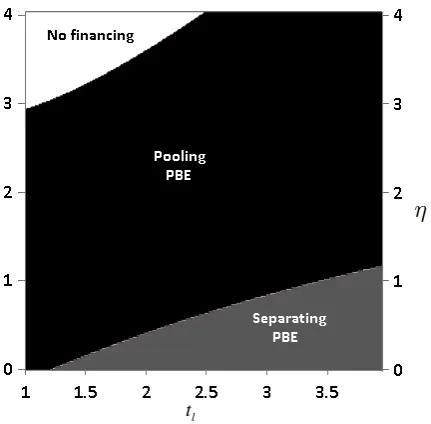
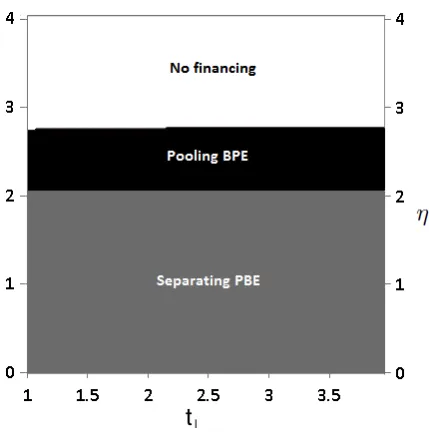
Figures 5 and 6 show the characterization of equilibria for two examples. The gray region is where a separating equilibrium exists (and it is unique, in terms of allocations). The black region is where a pooling equilibrium in CoCos exists, and it is unique. Finally, the white region is where no financing occurs.
Figures 5 and 6 show that the regions described in Theorems 1 and 2 are non-empty. Because of the un-boundedness of the earnings distributions support, the pooling region does not admit any monotonic security (including debt, of course).
Finally, we want to show that the unbounded support is not a necessary condition for non-monotonic contracts to be the unique equilibrium securi-ties. To do this, we introduce a family of distribution functions that has bounded support (i.e. K is finite), and satisfies MLRP. The pdfs for this family are linear and given by:
ft(x) = 1
K
K−2x
(µt+ 1)K + 1
(9)
withµt=l>0 andµt=l < µt=h. This family satisfies strict MLRP, because
17The examples include all projects such that $1 = I ≤
Figure 5: The Exponential Case
Figure 6: The Truncated Normal Case
for any (t, t0)∈T2 such that t0 < t we have:
∂ ∂x
ft(x)
ft0(x)
= 2K(1 +µt0)
(K(2 +µt0)−2x)2(1 +µt)
| {z }
>0
[µt−µt0]
Table 3 summarizes the parameter values that we assume for this case, and Figure 7 characterizes the set of equilibria. It should be clear from our results that the region where the unique euilibrium is separating admits
[image:26.595.188.403.250.469.2]only non-monotonic securities. However, contrary to the previous examples, the pooling region may include some monotonic securities, close to the no financing region18.
Figure 7: The Linear Case
8
Extensions
Our model is deliberately stylised in many respects. We now discuss some extensions and we show that the main insights of our analysis do not depend on (i) the type of asymmetric information assumed; (ii) the cardinality of the type space.
First, suppose that in addition to (or instead of) adverse selection, the capital market is subject to moral hazard: borrowers can increase the ex-pected value of their projects by exerting costly (unobservable) effort. As
18The reader may notice two features of this final example: (i) The division between the
separating and the pooling regions seems not to depend ontl. We explore this fact in the
next Section. (ii) The division between the pooling and the no financing regions seems to depend (very loosely) on tl. This is driven by the zero-profit pooling condition: as we
Innes (1990) has shown, as long as the effort decision generates a family of distributions which satisfy the MLRP ordering, non-monotonic contracts dominate debt.
Innes assumes that output is perfectly verifiable, hence his conclusions do not directly apply here. However, it is clear what the driving force of the result is: by choosing a non-monotonic contract borrowers have incentives to exert higher effort, because their payoff is zero unless they obtain high earnings. The optimal contract display a pay-for-performance payoff.
In our setup, where output is only coarsely verifiable, optimal contracts are constrained by the profit manipulation possibilities, which reduce the effort exerted by borrowers relative to that in Innes (1990). However, the results are qualitatively similar.
Second, consider our assumption that there are just two types. The as-sumption is restrictive, and one wonders how the results depend on it. To show that their qualitative properties extend to richer type spaces, we char-acterize the set of separating equilibria for an example that admits a closed form solution.
In particular, consider again the family of linear density functions de-scribed by (9). This family has a convenient property: the densities all cross at the same point. Indeed, it is easy to verify that for any pair of types (t, t0)∈T, ft(x) =ft0(x) if and only if x=K/2, in which case ft(x) = 1/K
for every t.
Consider now the incentive compatibility constraint (5) at the limit CoCo given by the solution to (7). Differentiating the LHS with respect to the type
t0 yields19:
(µt0 −µt)(2η+ 3K−4mmaxt )(mmaxt −2η)2
6K(1 +µt0)(1 +µn)
(10)
To achieve separation we must have thatmmax
t >2η, so the expression is negative if and only if:
mmaxt < η
2 + 3K
4 (11)
We know that the two inequalities describe a non-empty set of earnings realizations if K >2η.
Using (11), we can sign the derivative of the incentive constraint given by (10) with respect to type t0, which is always negative in the relevant range, i.e. for every x≤K/2.
19Technically, we can take such a derivative only if we assume a continuum type space.
The result has an immediate economic interpretation. It tells us that if a type t can separate from a typet0 < t, then it can separate from any other
t00∈(t0, t).
We can now restate our Theorem 1 for this case:
Theorem 5. Suppose that the pdfs are described by (9) for every t ∈ T, and suppose that T = {t1, t2, ..., tN}. If there exists a CoCo with threshold
m2 ≤mmax2 that satisfies the incentive constraint for the pair (t2, t1), then:
1. There exists a fully separating equilibrium e∗s in which everyt∈T\{t1}
issue a contract as in (3)such that the financiers make zero profits. The contracts are such that Dn< ... < D2;
2. Type t1 is indifferent between any contract such that E1(s) = I. If it is
a CoCo, though, it must be such that D1 > D2;
3. No pooling equilibrium satisfies the Intuitive Criterion.
Proof. From our previous analysis we know that if the incentive constraint for the pair (t, t1) is satisfied, then the one for any pair (t, t0) such that t0 ∈T \ {t1} also holds.
Because of our special distributional assumption, when the condition holds for th, then it holds for all t ∈ T \ {t1, t2} and a fully separating
equilibrium in which financiers make zero profits exists.
That no pooling equilibrium is reasonable can be proved as in the two-type case.
Theorem 5 is given for a specific distribution, as the general case is difficult to analyze20. However, it clearly shows that our main result on the signaling
property of capital structure does not depend on the two-type assumption.
9
Discussion of Related Papers and
Conclu-sion
We already discussed our theoretical contributions to the financial contract-ing literature in the introduction and literature review. We conclude by
20To prove that the incentive constraints are ordered in the type space one deals with two
discussing two key examples of their policy implications.
In the aftermath of the 2008 financial crisis, government interventions in financial markets have been widespread. As Philippon and Skreta (2012) ar-gue, given a budget to spend, governments can reduce underinvestment and alleviate the credit crunch. Nevertheless, a question that naturally arises concerns which instruments are best suited for this objective. Should the public intervention involve equity or debt contracts? How should it be linked to a borrower’s future earnings? These are some of the important norma-tive questions that Philippon and Skreta address. In particular, they derive the optimal monotonic intervention and show it involves the use of debt con-tracts. Moreover, they argue that governments can never target the interven-tion to those borrowers who are underinvesting, and as a result interveninterven-tions are particularly costly to implement.
As discussed in Trigilia (2014), once profit manipulation and adverse se-lection are explicitly modelled, quite different results hold. The optimal contract is a Contingent Convertible, as derived in this paper, and it may be that this contract implements a separating equilibrium in which only those firms who are underinvesting apply to the scheme. In such cases, the govern-ment’s intervention would be relatively less costly to implement. Strikingly, the result holds even when the optimal contract in the private market is a debt contract - contradicting the finding that the government needs to mimic the prevailing contracts traded in private markets.
A second important policy implication of our results concerns the issue of regressive taxation. As derived in Scheuer (2013), some non-monotonicity is necessary to implement efficient investment levels under adverse selection. However, allowing for optimal contracts in the private sector would actu-ally rule out the need for corrective taxation in models such as Scheuer’s, hence raising the problem of finding a different justification for the empirical phenomenon of countries adopting regressive taxes21.
Overall, the arguments that rely on monotonicity should be reconsidered in light of the findings of this paper. Market participants have used non-monotonic securities to mitigate asymmetric information problems since long ago. It may be worth allowing for them also in our economic models.
10
References
ADMATI, Anat R., et al. Fallacies, irrelevant facts, and myths in the discussion of capital regulation: Why bank equity is not expensive. 2010, 42. Preprints of the Max Planck Institute for Research on Collective Goods.
AKERLOF, George A. The Market for ‘Lemons’: Quality Uncertainty and the Market Mechanism. The Quarterly Journal of Economics, 1970, 84.3: 488-500.
AXELSON, Ulf. Security design with investor private information. The journal of finance, 2007, 62.6: 2587-2632.
AXELSON, Ulf; STROMBERG, Per; WEISBACH, Michael S. Why are buyouts levered? The financial structure of private equity funds. The Journal of Finance, 2009, 64.4: 1549-1582.
CASAMATTA, Catherine. Financing and Advising: Optimal Financial Contracts with Venture Capitalists. The journal of finance, 2003, 58, no. 5. CHAKRABORTY, Archishman; YILMAZ, Bilge. Adverse Selection and Convertible Bonds. Review of Economic Studies, 2011, 78 : 148-175.
CHO, In-Koo; KREPS, David M. Signaling games and stable equilibria.
The Quarterly Journal of Economics, 1987, 102.2: 179-221.
CORNELLI, Francesca; YOSHA, Oved. Stage financing and the role of convertible securities. The Review of Economic Studies, 2003, 70.1: 1-32.
DANG, Tri Vi; GORTON, Gary; HOLMSTROM, Bengt. Opacity and the optimality of debt for liquidity provision. Manuscript Yale University, 2009.
DEMARZO, Peter; DUFFIE, Darrell. A liquidity-based model of security design. Econometrica, 1999, 67.1: 65-99.
DEMARZO, Peter M.; KREMER, Ilan; SKRZYPACZ, Andrzej. Bid-ding with securities: Auctions and security design. The American economic review, 2005, 95.4: 936-959.
FLANNERY, Mark J. No pain, no gain? Effecting market discipline via reverse convertible debentures. Capital Adequacy Beyond Basel: Banking, Securities, and Insurance, HS Scott, ed, 2005: 171-196.
GALE, Douglas; HELLWIG, Martin. incentive-compatible debt con-tracts: The one-period problem. The Review of Economic Studies, 1985, 52.4: 647-663.
GOMPERS, Paul; LERNER Josh. The venture capital revolution. Jour-nal of Economic Perspectives, 2001: 145-168.
1806-1841.
HART, Oliver; ZINGALES Luigi. A new capital regulation for large financial institutions. American Law and Economics Review, 2011, 13.2: 453-490.
HELLMANN, Thomas. IPOs, acquisitions, and the use of convertible securities in venture capital. Journal of Financial Economics, 2006, 81.3: 649-679.
HIGGINS, Matthew J. The allocation of control rights in pharmaceutical alliances. Journal of Corporate Finance, 2007, 13.1: 58-75.
INDERST, Roman; MUELLER, Holger M. Informed lending and security design. The Journal of Finance, 2006, 61.5: 2137-2162.
INNES, Robert D. Limited liability and incentive contracting with ex ante action choices. Journal of economic theory, 1990, 52.1: 45-67.
INNES, Robert D. Financial contracting under risk neutrality, limited liability and ex ante asymmetric information. Economica, 1993, 27-40.
KAPLAN, Steven N.; Per STROMBERG. Financial Contracting Theory Meets the Real World: An Empirical Analysis of Venture Capital Contracts.
The Review of economic studies, 2003, 70, no. 2: 281-315.
KOUFOPOULOS, Kostas; TRIGILIA, Giulio. Adverse selection and re-gressive profit taxation: a comment. 2014, mimeo.
KRASA, Stefan; VILLAMIL, Anne P. Optimal contracts when enforce-ment is a decision variable. Econometrica, 2000, 68.1: 119-134.
KRAUS, Alan; LITZENBERGER, Robert H. A state-preference model of optimal financial leverage. The Journal of Finance, 1973, 28.4: 911-922.
LA PORTA, R., LOPEZ-DE-SILANES, F., SHLEIFER, A., & VISHNY, R. W. Legal Determinants of External Finance. Journal of Finance, 1997, 52(3): 1131-50.
MYERS, Stewart C.; MAJLUF, Nicholas S. Corporate financing and in-vestment decisions when firms have information that investors do not have.
Journal of financial economics, 1984, 13.2: 187-221.
NACHMAN, David C.; NOE, Thomas H. Optimal design of securities under asymmetric information. Review of Financial Studies, 1994, 7.1: 1-44. NOE, Thomas H. Capital structure and signaling game equilibria. Review of Financial Studies, 1988, 1.4: 331-355.
PHILIPPON, Thomas; SKRETA, Vasiliki. Optimal Interventions in Mar-kets with Adverse Selection. American Economic Review, 2012, 102.1.
SCHMIDT, K. M. Convertible Securities and Venture Capital Finance.
The Journal of Finance, 2003, 58.3.