Original citation:
Jantjies, Mmaki and Joy, Mike (2013) Mobile learning through indigenous languages :
learning through a constructivist approach. In: 12th World Conference on Mobile and
Contextual Learning (mLearn 2013), Doha, Qatar, 22-24 Oct 2013. Published in: 12th
World Conference on Mobile and Contextual Learning (mLearn 2013), Volume 2013
(Article number 14).
Permanent WRAP url:
http://wrap.warwick.ac.uk/61829
Copyright and reuse:
The Warwick Research Archive Portal (WRAP) makes this work by researchers of the
University of Warwick available open access under the following conditions. Copyright ©
and all moral rights to the version of the paper presented here belong to the individual
author(s) and/or other copyright owners. To the extent reasonable and practicable the
material made available in WRAP has been checked for eligibility before being made
available.
Copies of full items can be used for personal research or study, educational, or
not-for-profit purposes without prior permission or charge. Provided that the authors, title and
full bibliographic details are credited, a hyperlink and/or URL is given for the original
metadata page and the content is not changed in any way.
A note on versions:
The version presented in WRAP is the published version or, version of record, and may
be cited as it appears here.For more information, please contact the WRAP Team at:
Mobile learning through indigenous languages: learning
through a constructivist approach
Mmaki Jantjies
Department of Computer Science
University of Warwick
Coventry, CV4 7AL, UK
[email protected]
Mike Joy
Department of Computer Science
University of Warwick
Coventry, CV4 7AL, UK
[email protected]
ABSTRACT
An increase in accessible electronic pedagogy available in African languages is vital in extending learning resources to resource constrained schools and multilingual communities. The lack of appropriate mobile and electronic resources in these contexts often limits learners from participating in the digital age and discovering knowledge through technology. South Africa, used as the context for this study, has eleven official languages and promotes their use for education in schools. There are however limited bilingual resources that support bilingual education. The different challenges, such as the limited resources that enable an effective learning environment, often make it difficult for teachers to create new learning environments that embrace technology in classrooms.
This paper presents a case study that evaluates the potential use of mobile learning to support the current informal learning process for resource constrained multilingual high school learners. In the study learners created their own audio based bilingual learning material on mobile phones using a constructivist learning approach, in the subject area of physical science. A total of 32 high school learners and their teacher from a South African school participated in the study, and though semi–structured interviews and questionnaires learners reported on their experiences. Infrastructure challenges, including limited access to free electronic resources, and slow and expensive Internet access, became the main hurdles in supporting a constructivist learning environment. The mobile learning process however gave learners an opportunity to create their learning content in their own languages at any location at any time, and use the content later for revision.
Keywords
Mobile learning, bilingual learner, constructivism, multilingual, South Africa
INTRODUCTION
Mobile learning in developing countries
One of the contributing factors to digital divides in African countries is the limitation of available digital learning content in African languages. There are many factors contributing to this, including the lack of documentation of some African languages making it difficult for developers to use the languages in technology, and the poor access to using technology by Africans, thus hindering African language contributions to technology (Osborne, 2006). The constraint of limited multilingual learning resources in Africa also makes it difficult for learners to engage effectively with learning content. Language plays an imperative role in the development of pedagogy as it affects a learner’s interpretation and performance (Brock-Utne, 2007). South Africa is a multilingual country that places great emphasis on bilingual education but still struggles to provide learners with relevant resources to support the bilingual environment, especially in subject areas such as mathematics and the physical sciences.
There have been different initiatives through mobile learning across African countries that work towards reducing existing educational challenges (UNESCO, 2012). The intervention of mobile learning in developing countries needs to consider the contextual hurdles that developing countries face, and this could mean initiating novel concepts of mobile learning which are unique to the circumstances (Motlik, 2008).
The process of learning in the mobile environment
learning technologies in developing communities are often “used to address environmental and infrastructural challenges to delivering and supporting education where conventional e-learning technologies would fail” (Traxler, 2007: 13). This research aimed to explore the following main question: How can mobile learning be used to enhance the multilingual learning process in informal learning through a constructivist approach? The paper examines the support that mobile learning can have in a resourced constrained environment by supporting bilingual learners to create their own physical science learning materials in languages that they use to learn. The research study is based in a South African school. Using the constructivist theory, learners were given an opportunity to create their own bilingual learning material through mobile phones. The learners were also able to store and access this material for revision through the online system accessible from their mobile phones. The participating teacher also monitored the learning material to ensure that learners were creating learning content that was relevant to the prescribed curriculum. Subsequent to this process, learners were interviewed through semi-structured interviews and questionnaires to give their views on the process.
USING MACHINE TRANSLATION TO ACHIVE MULTILINGUAL CONTENT
There are various methods that can be used to create multilingual content in technology. One of the popular methods is translating content to support multilingual users through algorithms and statistical techniques that enable the translation process to occur. Machine language translation can make use of various algorithms to translate one language to another, and these algorithms often follow a statistical approach or employ a linguistic analysis that intensely focuses on lexical characteristics (Jayaraman and Lavie, 2005). One example of a statistical method is Dagan et al.’s (1993) algorithm called the word align algorithm where the system uses statistical methods to align one word to its equivalent in another language. An alternative method which explores the syntax and semantics of the language can be seen from Van Huyssteen and Pilon’s (2009) algorithm. Using as an example the Dutch and Afrikaans languages, this system depicts the possibility of translating content between similar languages with the aim of recycling existing resources to extend them to other language users. This is achieved through a rule based system where two languages are evaluated to establish if they are similar and subsequently evaluate their lexical similarities in order to convert them. Machine translated content is able to support a large number of multilingual users to access resources across the world. This is especially helpful where there are large amounts of data that need to be translated for the use of multiple language users.
However, despite continuous attempts to create expert translation systems, machine translators often find it difficult to produce quality translations that maintain the meaning and the culture of the original text. This can be especially difficult in an educational context. Learning content can come across as confusing with inappropriate words used within the text. Furthermore, this can also be detrimental to second language speakers of the content translation language as they may fail to realize the inaccuracies depicted within the learning content. The learning content can thus be misleading and erroneous, and machine translated content often needs to be reviewed and edited to ensure appropriate meaning (Harris, 2010). Translating pedagogy therefore requires more than the linguistic change of content as it necessitates further knowledge and understanding of the context, the content and the culture of the pedagogical environment.
THE SOUTH AFRICAN BILINGUAL EDUCATION CONTEXT
South Africa has a multicultural and diverse linguistic population. The country has eleven official languages with English as the official language of instruction. Even though English is the national medium of instruction the government maintains an equal policy on all official languages promoting the use of each language in communities and education (De Klerk, 2002). Despite the promotion of languages in educating learners across various subject areas, there are limited electronic and print learning materials that support this. Learners with poor English language foundations especially in resource constrained schools would often fail to grasp the essential elements of a subject due to their language inefficiency. This is more prevalent in subjects that require a clear understanding of a language i.e. mathematics, in order to appropriately interpret what is required from them (Sookrajh and Joshua, 2009).
to learn the language which the content is presented in (Barwell et al., 2006). There is therefore a need to further evaluate possible technologies that can be used to enhance the process of learning for bilingual learners in this context.
MOBILE LEARNING AND LANGUAGE USE
Considering the research that has been produced on the progress of mobile learning research in South Africa (UNESCO, 2012; Botha et al., 2012) and also considering the existing challenges of limited bilingual learning resources, there is a current need for research that focuses on mobile learning that supports bilingual learners.
However, there has only been limited research that focuses on the learning experiences of bilingual learners accessing bilingual content in subjects other than language learning, i.e. physical sciences and mathematics, and this paper will therefore review mobile learning literature used to enhance the language learning experience and draw from those experiences.
The use of mobile devices in supporting learners through language learning has proven to be valuable in supporting second language acquisition (Uther et al., 2005; Thornton and Houser, 2005; Ogata et al., 2008). Through quality mobile recorded lessons and learning material, learners can replay the lessons in their own time, repeatedly using its pause and replay features to get clarity on the learning content (Thorton and Houser, 2005). Through this method, they are able to easily identify key elements of the language such as syntax and pronunciation. A mobile device also provides ubiquitous access to an audio note taking tool that can help the learner record material at anytime which can be effective for their learning process (Kukulska-Hulme and Bull, 2009). The use of mobile podcasts in language learning has also proven to be effective in the assessment revision process. Learners seem to absorb learning content in less pressured environments which are supported through the ubiquitous nature of mobile learning allowing them to understand their learning material at their own pace in their own spaces (Evans, 2008). Whether creating their learning content or using existing audio format learning content, mobile learning has been effective in supporting the language learning process.
SUPPORTING A BILINGUAL MOBILE LEARNER THROUGH CONSTRUCTIVISIM
The current practice that the teacher in the study used to support the learning process for the participants while learning at home, was to allow learners to reflect on what they had been taught during their formal class, using different sources which included amongst others their text books, the Internet and class notes. Learners were at times also required to explore a topic at home which would be introduced and taught later in class using their different sources. Other methods that the teacher used to support learners while learning at home included providing learners with exercises that evaluated what learners’ had understood in their class. This method of promoting learners’ informal learning followed a constructivist learning approach, where learners constructed knowledge using their previous knowledge, their resources and a reflection of the learning content. While these learners were required to use one language to document their reflection, they used more than one language to interpret and understand the learning content.
Sharples et al. (2005) suggested that the process of learning is a process of using different skills and tools to transfer knowledge to a learner. The process in which the skills are transferred along with the tool used to transfer the knowledge will affect the understanding of the learner. Constructivism is the use of experiential and reflective learning approaches (Shih and Mills, 2007). In this theory, a learner constructs an understanding from their personal reflection of attempting a task. Therefore, learners cannot have identical reflections on the paths of attempting tasks and understanding as these processes are unique to each learner (Boghossian, 2006). A learner is also trained to build their knowledge and be able to resolve tasks even in unfamiliar circumstances (Ang et al., 2008). Through modern mobile technology, constructivism can be used through “activities in which learners actively construct new ideas or concepts based on both their previous and current knowledge” (Naismith et al., 2004:2). The constructivist theory is a philosophical theory from which modern models and theories that support the development of learning environments have emerged. The traditional constructivist approach has been used in many mobile learning initiatives to support current practices in both formal and informal learning, and these include the use of mobile software to support the construction of syllables by primary school learners (Zurita and Nussbaum, 2004) and the use of audio based learning initiatives where learners create audio material through a constructivist approach (Thornton and Houser, 2005; Evans, 2008). Theories stemming from this traditional approach such as the activity theory have also been used to support the design process of mobile learning activities (Uden, 2007). In this paper we use constructivism as a support for the current practice of learning drawing on its basic principles.
RESEARCH METHOD
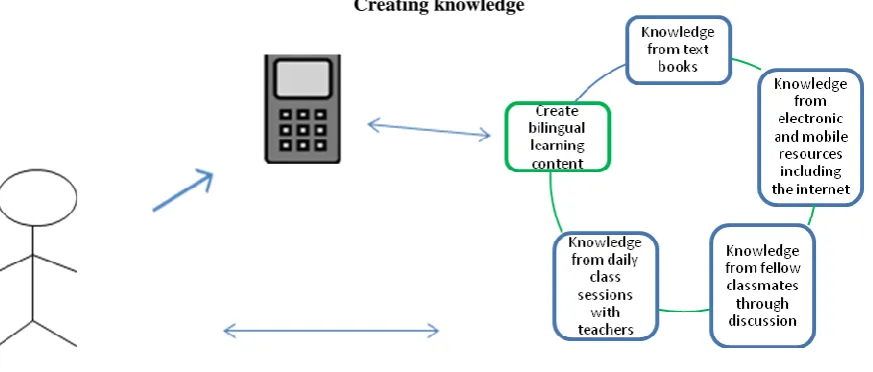
locations, effective telecommunication networks or the Internet. Most of the schools situated in these areas have infrastructure challenges including lack of computing facilitates to enable an ICT learning environment, lack of sufficient numbers of learning material per learner, lack of sufficient numbers of classrooms for the numbers of learners, and a lack of teachers adequately trained to facilitate ICT enabled environments (Herselman, 2003). These areas are also often populated by people who earn low incomes, meaning that most of the learners in these locations come from families that cannot afford beyond their basic daily needs (DOBE, 2011; Herselman, 2003). As the school in this study is located in an under-resourced area, not all learners had access to mobile phones equipped with features that were needed to access the mobile learning application used in the research. For the research process each learner was provided with a low-cost mobile phone that had features for creating audio sound clips and basic WAP features. As illustrated in figure 1, learners in the research project were required in their own languages to: (i) attend their physical science lessons where a learning topic was briefly introduced; (ii) in their informal environments, find further learning material from various sources related to the lesson topic; (iii) create audio clips through their provided mobile phones using their language of choice reflecting on the learning topic and learning material; and (iv) through their mobile phones, upload the learning material under their personal profiles in the online mobile learning system. Their teacher would then assess the learning material to ensure that the learners understood the topic area and that their personally created learning material adhered to what was required from them.
The research followed the following process:
Creating knowledge
[image:5.595.57.494.276.462.2]
The bilingual learner
Figure 1. The mobile learning environment
As reflected in figure 1, this process also assisted the learner to reflect on the learning content in their own language and to create their knowledge in their reflecting their own understanding. Furthermore, learners had ubiquitous access to this bilingual material and were able to learn through it at any time. At the end of the research period learners filled in questionnaires while some of them were also interviewed through semi structured interviews. The data collection strategies sought to answer the following sub questions. Was the mobile learning process effective in support their constructivist learning approach? Which languages did they use to develop the learning content? How did their experience affect their outlook on bilingual mobile learning? Ethical consent was obtained for the case study from both the authors’ university and from the school, with all participants granting consent to participate. The findings are discussed below through themes and through the use of descriptive statistics.
RESEARCH FINDINGS
MOBILE TECHNOLOGY IN THEIR CURRENT LEARNING PROCESS
During this study, 61% of learners created learning material on a weekly base and revised using the notes on a weekly period, while the remaining percentage created the notes on a daily base.
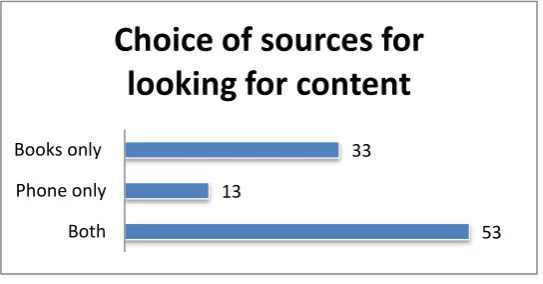
Of the
participating learners, 53% preferred using both the conventional method of discovering learning content from a text book and other traditional sources and also using mobile phones to discover material and related knowledge. The remaining 33% of learners preferred using only their conventional non-electronic sources for this process while a minimal 13% of learners preferred learning using only mobile phones in this process.Learners also expressed difficulty in discovering learning material through the mobile Internet citing: slow and limited Internet access, the expensive Internet downloading process as there is limited online learning content that is specially made for mobile phones under the curriculum, and lack of knowledge on where to access appropriate digital learning material. From the interviews, learner A had a more traditional focus on learning and expressed that, “It is difficult to focus on learning on the phone and it’s easier in a book because a phone has many distractions, especially if it has online access”. On the other hand learner B expressed, “I found it easier to create material on my own phone and listen to myself while making sense of what I was saying. I think my personal notes are easier to understand than the ones in the book”.
In relation to the content created by learners there was a clear link between what the learners had been taught in class and their audio clip understanding and interpretation of the content they created. It was interesting to note how learners were able to critique their interpretation of the topic. An example of this is when Learner B reflected, “The theory of atomic molecules is defined by….. I think my explanation may be wrong and I would need you (the teacher) to explain it better because I was rather confused with it”.
53 13
33
Both Phone only Books only
Choice of sources for
looking for content
[image:6.595.107.379.260.402.2]Figure 2. Learner’s platform preferences
Figure 2 illustrates the percentages of learners that preferred using either electronic or non-electronic resources to find their learning material. Learners also found the process of having ubiquitous access to this material helpful as they could revisit it at any time.
LANGUAGE USE IN CREATING LEARNING CONTENT
All of the participating learners were either English second or third language speakers. All learners also expressed that their teachers used various languages along with the English language to explain concepts in class. In the creation of mobile audio clips, Sepedi (one of the official South African languages) dominating with 58% of the learners using it along with English to create audio notes. Other languages were scattered in the remaining percentages. The school under study is located in a largely Sepedi speaking area which influences the language of the learners even though some of them were not first language Sepedi speakers.
58 33
8
Sepedi Setswana Sotho
Languages used by learners
with English to create clips
Figure 3. Learners percentages of language used in creating learning content
[image:6.595.105.389.588.722.2]would even mention that they did not understand what the teacher meant in a particular study area. The learners also constantly switched between English and the other languages when creating the notes. The teacher in this class felt that “It was useful for me to access the audio notes of the learners. The learners are free when making them which helps me realise the challenges that they might not be able to raise during class.” The class reflected a need for electronic learning resources that was tailored to support their resource and linguistic challenges.
DISCUSSION
Research challenges
The resource constraints in this study challenged the learners when they used mobile learning resources to construct their own learning material. The poor Internet speed and the high costs related to browsing often discouraged learners from resource constrained environments to construct knowledge from electronic media. The limitation of free and open resources available to learners also made it difficult for learners to seek learning material through electronic resources. Learners were also not use to being required to create their own learning materials using electronic support, and most were relying on text book content and class notes. However learners found ways of consolidating their resources and seemed to enjoy the mobile learning process regardless of the challenges they faced. The results from this research were however limited to a small sample in a specific type of context and a larger case study needs to be performed in the future.
Research findings
The data from this research revealed that mobile learning can be effective in supporting constructivism approaches used in informal bilingual learning. The challenge was, however, using the technology to support this traditional approach without seeing technology as a distraction in the learning process. In this study, a large percentage of the learners seemed to prefer using both mobile phones and text books to create knowledge and learning material. Their preference for the textbook as their main source of learning material seemed to stem from the challenges they faced when accessing electronic learning content. Even though mobile learning provided an ubiquitous learning environment, learners still preferred a blended learning approach of using both traditional sources of learning content and modern methods to create their knowledge. There seemed to be a lack of exposure to free and online mobile learning material and the use of the Internet to seek knowledge. After interacting with the mobile learning system, learners were motivated to seek learning material from other resources as they found their own learning material created using different sources to be easier to understand compared in comparison with their text book notes. The benefit of being able to learn on the mobile phone was highlighted by learners as they reflected how they enjoyed their trial experience of ubiquitous learning.
The design and development of personal learning content for learners also shifted the responsibility of the teacher to the learner allowing learners to create their own mobile learning environments. Through mobile phones, learners have had a personal environment that has allowed them to truly express their understanding of the topic area in a language that they could best relate to. The learners felt they could relate to their personal notes and were also open to expressing challenges where they felt they did not understand allowing them to reflect on their learning activities (Shih and Mills, 2007). In this activity, learners were allowed to construct notes based on their understanding from their personal perspectives and information gathered from different sources based on the class topic. Therefore, learners could not have identical reflections on the paths of creating their learning content (Boghossian, 2006).
CONCLUSIONS
Each learner used their languages of choice to create the audio notes, with learners using a variety of South African languages to create the content. A mobile learning system with learner profiles allowed each learner to log onto their system using their login details and store their personally created mobile audio learning material which formed part of the mobile learning system. The audio notes were also accessible to the class teacher allowing her to verify the learning content and ensure it was relevant to their learning curriculum. Contextual challenges such as lack of infrastructure and awareness of electronic mobile learning resources limited the learner’s ability to effectively create their own knowledge as they did not exhaust various knowledge areas. The opportunity of being able to create material in their own languages on their own mobile phones, at their own time allowed learners to create learning material that they could relate to and engage with at any time. The learners found this very useful for assessment purposes. The teacher also found the experience useful as they could access the audio learning material to monitor the understanding of learners.
FUTHER WORK
Mobile learning has been successfully used to design technology that can reduce digital divides across both resourced and under-resourced educational communities. Many communities can now access electronic resources as mobile phones are affordable and are able to provide the same learning resources as desktops. There is growing research in the field of mobile assisted language learning, however there are currently few studies that reflect a need for research that focuses on designing and creating bilingual learning content that can support a bilingual mobile learner in subjects such as physical science. The research results from this paper will contribute to the design of a mobile learning framework that can be used by mobile learning developers to design appropriate bilingual mobile learning content that can be used to support learners in bilingual schools and countries to learn and create their own knowledge in both resourced and under-resourced communities.
ACKNOWLEDGMENTS
The authors would like to acknowledge the South African National Research Foundation for their funding which contributed to this research work.
REFERENCES
Ang, C., Avni, E., and Zaphiris, P. (2008). Linking Pedagogical Theory of Computer Games To Their Usability.
International Journal on E-Learning 7(3), 533-558.
Barwell, R, Barton B., and Setati, M. (2007). Multilingual issues in mathematics education: introduction. Educational Studies in Mathematics 64(2), 113 – 119.
Boghossian, P. (2006). Behaviourism, Constructivism, and Socratic Pedagogy. Educational Philosophy and Theory
38(6), 713-721.
Botha, A., Batchelor, J., Traxler, J., De Waard, I., and Herselman, M. (2012). Towards a mobile learning curriculum framework. IST-Africa Conference Proceedings, Dares Salaam, Tanzania, 1-9.
Brock-Utne, B. (2007). Language of instruction and student performance: New insights from research performed in South Africa and Tanzania. International Review of Education 53, 509-530.
Dagan, I., Church, K., and Gale, W. (1993). Robust bilingual word alignment for machine aided translation.
Computational Linguistics 29(1), 1-8.
De Klerk, V. (2002). Language issues in our schools: Whose voice counts? Perspectives in Education. 20(1), 1-14. Department of Basic Education (DOBE). (2011). Quality education for rural schools in South Africa – challenges and solutions South African Rural Educator 1, 8-15.
Evans, C. (2008). The effectiveness of m-learning in the form of podcast revision lectures in higher education.
Computers and Education 50(2), 491–498.
Harris, H. (2010). Machine translations revisited: issues and treatment protocol. The language teacher34(3), 25 -29. Herselman, M. (2003). ICT in Rural Areas in South Africa: Various Case Studies. Informing Science Proceedings, 1-11. Heugh, K. (2000). The Case Against Bilingual and Multilingual Education in South Africa. PRAESA Occasional Paper 6. Cape Town: PRAESA, 1-22.
Jayaraman, S., and Lavie, A. (2005). Multi-Engine Machine Translation Guided by Explicit Word Matching.
Proceedings of the ACL Interactive Poster and Demonstration Sessions, 101- 104.
Kukulska-Hulme, A., and Bull, B. (2009). Theory-based support for mobile language learning: noticing and recording.
International Journal of Interactive Mobile Technologies 3(2), 12–18.
Motlik, S. (2008). Mobile learning in developing nations. The International Review of Research in Open and Distance Learning 9(2).
Naismith, L., Lonsdale, P., Vavoula, G., and Sharples, M. (2004). NESTA Futurelab Report 11: Literature review in mobile technologies and learning. Bristol, UK: NESTA Futurelab. See also website: http://www.nestafuturelab.org/research/reviews/ reviews_11_and12/11_01.htm , 1-44
Ogata, H., Gan Li, H., Chengjiu, Y., Takahito, U., Yasuko, O., and Yoneo, Y. (2008). LOCH: supporting mobile language learning outside classrooms. International Journal of Mobile Learning and Organisation 2 (3), 271-282. Osborn, D.(2006). African Languages and Information and Communication Technologies: Literacy, Access, and the Future. In John Mugane et al.(Ed.), Selected Proceedings of the 35th Annual Conference on African Linguistics, 86 -93. Somerville, MA: Cascadilla Proceedings Project.
Sharples, M. (2005). Learning as conversation: Transforming education in the mobile age. In Proceedings of conference on seeing, understanding, learning in the mobile age. Budapest: Institute for Philosophical Research of the Hungarian Academy of Sciences, 147-152.
Sharples, M., Taylor, J., and Vavoula, G. (2005). Towards a theory of Mobile learning. In: mLearn2005. Cape Town, South Africa, 1-9.
Shih, Y., and Mills, D. (2007). Setting the New Standard with Mobile Computing in Online Learning. International Review of Research in Open and Distance Learning 8 (2), 1-16.
Sookrajh, R., and Joshua, J. (2009). Language matters in rural schools in South Africa: are educators making the implementation of the Language in Education Policy (1997) work? The Language Learning Journal 37(3), 323-338. Thornton, P., and Houser, C. (2005). Using mobile phones in English education in Japan. Journal of Computer Assisted Learning 21 (3), 217-228.
Traxler, J. (2007). Defining, Discussing, and Evaluating Mobile Learning: The moving finger writes and having writ…International Review of Research in Open and Distant Learning 8(2), 9-24.
Uden, L. (2007). Activity theory for designing mobile learning. International Journal of Mobile Learning and
Organisation 1(1), 81-102.
Uther, M., Zipitria, I., Uther, J., and Singh, P. (2005). Mobile adaptive CALL (MAC): a case-study in developing a mobile learning application for speech/audio language training. IEEE International Workshop on Wireless and Mobile Technologies in Education (WMTE 2005), 187-191.
UNESCO. (2012). United Nations Educational scientific and cultural organisation. Turning on mobile learning in Africa and the middle east. Illustrative initiatives and policy implications. Working paper series. See also website:
http://www.unesco.org/new/en/unesco/themes/icts/m4ed/mobile-learning-resources/unescomobilelearningseries/, 1-41.
Van Huyssteen, G., and Pilon, S. (2009). Rule-based conversion of closely-related languages: a Dutch-to-Afrikaans convertor. 20th Annual Symposium of the Pattern Recognition Association of South Africa (PRASA). Stellenbosch, South Africa, 23-28.