University of Warwick institutional repository: http://go.warwick.ac.uk/wrap
A Thesis Submitted for the Degree of PhD at the University of Warwick
http://go.warwick.ac.uk/wrap/59739
This thesis is made available online and is protected by original copyright. Please scroll down to view the document itself.
Task Interference Effects in Prospective Memory
By
Joana S. Lourenço
Thesis submitted in fulfillment of the requirements for the degree of Doctor of Philosophy in Psychology
University of Warwick, Department of Psychology
Dedication
A special feeling of gratitude to my loving parents, Natália and Luis, and to my brother, João, whose words of encouragement and unconditional love motivate me to set higher and tenacious
targets. And to my mom in particular whose eager and kind spirit and passion for life and continuous development have and will never cease to be a source of inspiration to me. To my grandparents, Joana and Francisco, who have always taught me kindness, determination
and the beauty of simple things in life.
Table of Contents
Table of Contents ... i
List of Abbreviations ... v
List of Tables ... vi
List of Figures ... ix
Acknowledgements ... xii
Declaration ... xiii
Note on Inclusion of Published Work ... xiv
Abstract ... xv
Chapter 1: An Overview of Prospective Memory ... 1
Retrieval processes in PM: Theoretical approaches ... 5
PAM theory ... 5
Multiprocess view... 6
Focal and nonfocal PM targets ... 10
Overview of findings on PM retrieval and underlying processes ... 11
Focality of targets and importance effects in PM ... 12
Aging effects in PM ... 13
Suspending the PM task demands ... 15
Proximal cost and task interference across the ongoing task ... 16
Can a cost be found with focal PM tasks? ... 18
Nonfocal PM and the effect of intention-related material ... 23
Nature of the monitoring processes supporting PM retrieval ... 25
Chapter 2: The Role of Intention-Related Events in PM ... 34
Intention-related material and PM ... 34
Working memory and PM ... 40
Experiment 1 ... 41
Method ... 42
Results ... 48
Discussion ... 54
Chapter 3: The Role of (Relevant) Distraction in PM ... 60
PM and distraction ... 61
Distraction and aging ... 62
PM and aging ... 64
Experiment 2 ... 65
Method ... 66
Results and discussion ... 72
Experiment 3 ... 76
Method ... 77
Results and discussion ... 81
General discussion ... 86
Chapter 4: The Effect of Task Experience and WM on PM ... 91
WM and the role of FCS in PM tasks ... 92
Experiment 4 ... 94
Method ... 95
Discussion ... 105
Chapter 5: Context Specification Effects in PM ... 111
Monitoring processes in PM ... 111
Experiment 5 ... 114
Method ... 116
Results ... 119
Discussion ... 130
Experiment 6 ... 135
Method ... 137
Results ... 140
Discussion ... 146
General discussion ... 149
Chapter 6: The Role of Implicit Demands in PM ... 155
Experiment 7 ... 157
Method ... 158
Results ... 161
Discussion ... 165
Chapter 7: The Effect of Target Repetition on PM ... 169
A new approach for examining PM retrieval via spontaneous retrieval processes ... 170
Experiment 8 ... 171
Method ... 174
Results ... 178
Chapter 8: Conclusion... 188
Overview of findings ... 188
Speculation and future directions ... 193
Intention-related information and delay-execute PM tasks ... 193
Intention-related distractor information and PM tasks ... 196
Improving PM performance through FCS ... 198
Neural underpinnings that support monitoring processes in PM ... 199
The flexibility of attention allocation ... 202
PM retrieval and the nature of the underlying processes ... 205
Concluding remarks ... 210
References ... 212
Appendix 1 ... 242
The Digit Symbol Substitution task (DSST) ... 242
The Mill Hill vocabulary test (MHVT) ... 243
List of Abbreviations
Analysis of variance – ANOVA Automated version of the operation span task – Aospan task
Digit Symbol Substitution task – DSST Event-related potentials – ERPs Functional magnetic resonance imaging – fMRI Future context simulation – FCS Hyperspace Analogue to Language – HAL
Lexical decision task – LDT Mill Hill vocabulary test – MHVT Preparatory attentional and memory processes theory – PAM theory
List of Tables
Table 1: Scores on the Mill Hill Vocabulary Test (MHVT), Digit Symbol Substitution Task
(DSST) and Automated Operation Span Task (Aospan) for Participants in Each of the
Prospective Memory (PM) Conditions ... 44
Table 2: Means and Standard Deviations for Response Times in Milliseconds on Non-Target
Word Trials as a Function of Prospective Memory (PM) Condition (Lures, No-Lures)
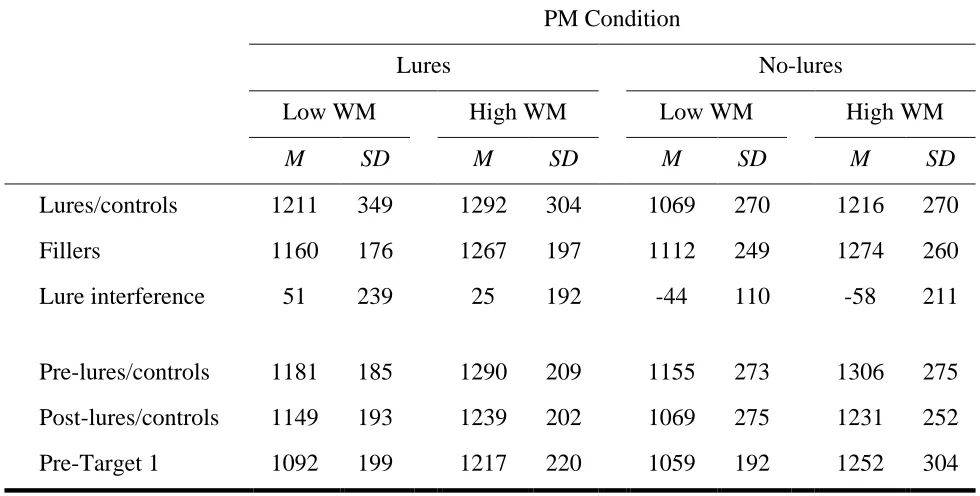
and Working Memory (WM; Low, High) ... 52
Table 3: Means and Standard Deviations for Demographic Information and Tasks Performed
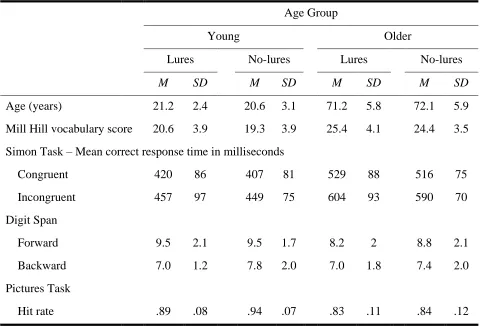
During the Testing Session for Each Age Group and Condition ... 67
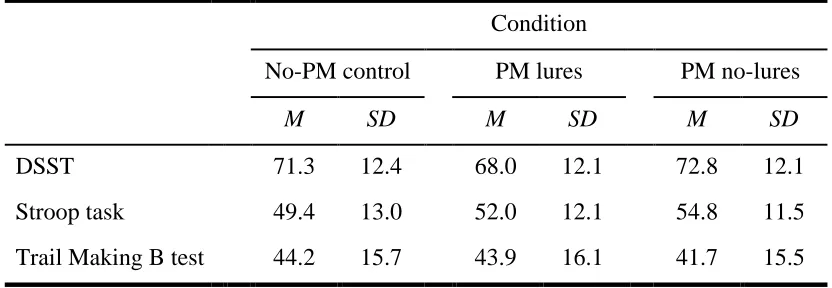
Table 4: Scores on the Digit Symbol Substitution Task (DSST), Stroop Task and Trail Making B
Test for Participants in Each Condition ... 78
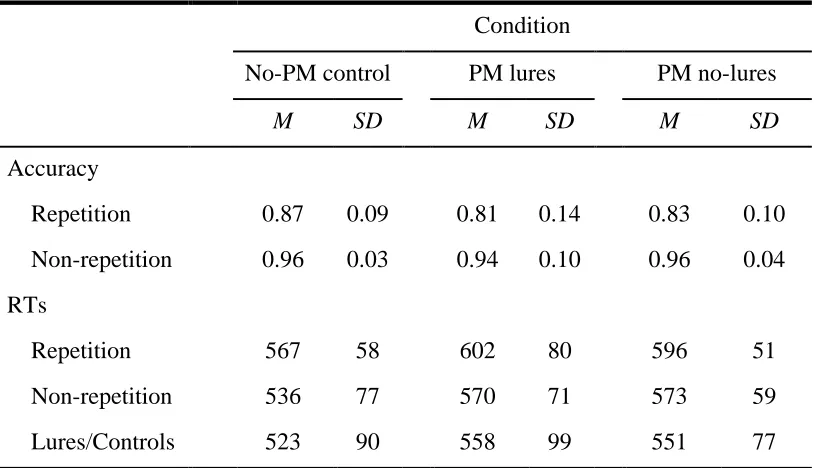
Table 5: Means and Standard Deviations for Accuracy (Proportion Correct) and Response
Times (RTs) for Non-Target Trials of the Pictures Task as a Function of Condition ... 84
Table 6: Means and Standard Deviations for Accuracy (Proportion Correct) on Word Filler
Trials in Each Phase of the Lexical Decision Task as a Function of Age Group (Young,
Older) and Condition (Future Context Simulation (FCS), No-FCS) ... 102
Table 7: Means and Standard Deviations for Response Times in Milliseconds on Word Filler
Trials in Each Phase of the Lexical Decision Task as a Function of Age Group (Young,
Table 8: Means and Standard Deviations for Response Times in Milliseconds on Word Filler
Trials in Each Phase of the Lexical Decision Task as a Function of Working Memory
(Low, High) and Condition (Future Context Simulation (FCS), No-FCS) ... 105
Table 9: Means and Standard Deviations for Response Times in Milliseconds on Color Match
and Color Mismatch Filler Items in Baseline and Prospective Memory (PM) Phases for
Each Condition ... 121
Table 10: ANOVA Results for Response Times on Filler Items, With Two Between-Subject
Factors (Condition and Lures) and Two Within-Subject Factors (Phase and Color) ... 123
Table 11: Means and Standard Deviations for Response Times in Milliseconds to Lures/Lure
Controls and Color Mismatch Filler Items, and Differences Between Them (Lure
Interference), Across Conditions ... 129
Table 12: Mean Percentage of Correct Responses to Word and Nonword Lexical Decision Filler
Trials as a Function of Block and Condition ... 141
Table 13: Mean Correct Response Time in Milliseconds for Word and Nonword Lexical
Decision Filler Trials in the Prospective Memory Block as a Function of Block Half and
Condition... 145
Table 14: Illustration of the Main Design and Procedure for Participants with High, Low and
None Expected Prospective Memory (PM) Demands, with Typicality of Animals
Indicated in Italics ... 160
Table 15: Prospective Memory (PM) Targets Studied During Instructions and Examples of PM
Table 16: Means and Standard Deviations for Performance on Word Filler Trials in the Lexical
List of Figures
Figure 1: Illustrative examples of ongoing lexical decision task trials (upper panel) and
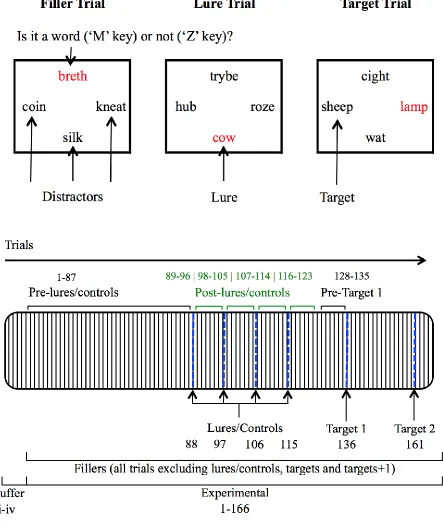
overview of the trial sequence (lower panel) in Experiment 1. ... 46
Figure 2: Mean proportion correct for the prospective memory (PM) task as a function of
working memory (low, high) and PM condition (lures, no-lures). Error bars represent ± 1
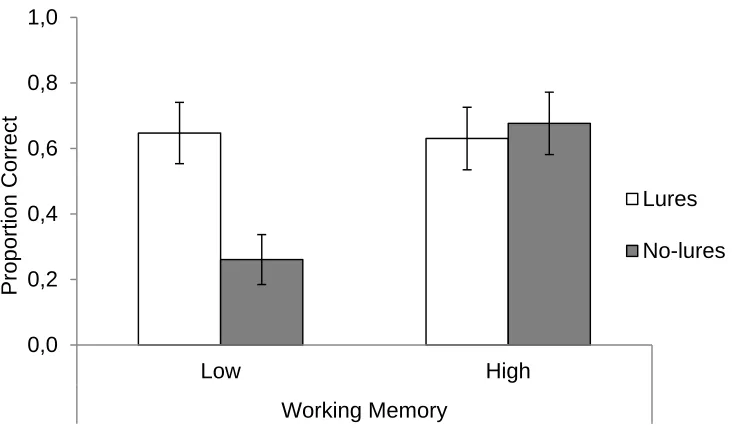
standard error. ... 50
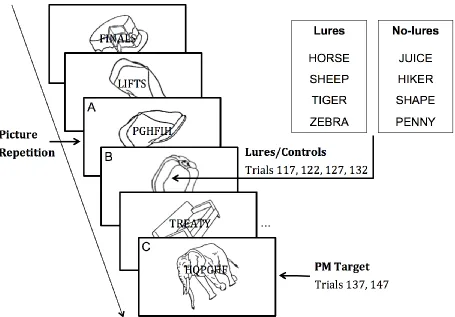
Figure 3: Schematic diagram of the 1-back pictures task that was used as the ongoing task in
Experiment 2. ... 70
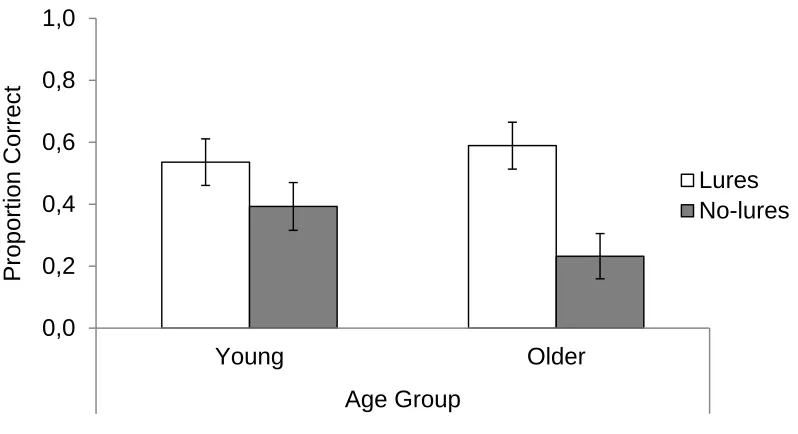
Figure 4: Mean proportion correct for the prospective memory task across conditions. Error
bars represent ± 1 standard error. ... 73
Figure 5: Overview of the trial sequence in the 1-back pictures task that was used as the ongoing
task in Experiment 3. ... 80
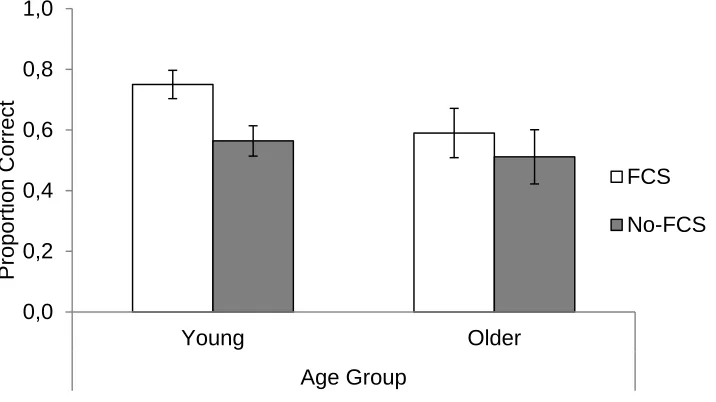
Figure 6: Mean proportion correct for the prospective memory task as a function of age group
(young, older) and condition (future context simulation (FCS), no-FCS). Error bars
represent ± 1 standard error. ... 98
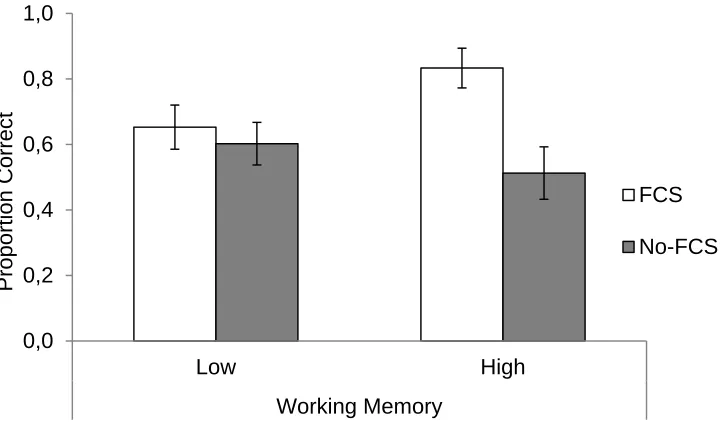
Figure 7: Mean proportion correct for the prospective memory task (young adults only) as a
function of working memory (low, high) and condition (future context simulation (FCS),
no-FCS). Error bars represent ± 1 standard error. ... 100
Figure 8: Mean proportion correct for the prospective memory task across conditions. Error
Figure 9: Task interference (prospective memory phase minus baseline phase response time) in
milliseconds (ms) for color match and color mismatch filler items with and without lures,
for random (left) and blocked (right) conditions. Error bars represent ± 1 standard error.
... 125
Figure 10: Mean correct response time (RT) in milliseconds (ms) for filler trials in the blocked
condition over the eight-trial color match (left) and mismatch (right) sequences, for
baseline and PM phases with lures and no lures. ... 127
Figure 11: Mean correct response time (RT) in milliseconds (ms) for the random (left) and
blocked (right) conditions to lures/lure controls, and the four trials immediately
preceding and succeeding them. ... 130
Figure 12: Mean correct response time (RT) in milliseconds (ms) in the lexical decision task as a
function of block and condition for words (left) and nonwords (right). Error bars
represent ± 1 standard error. ... 142
Figure 13: Mean correct response time (RT) in milliseconds (ms) for lexical decisions to filler
words for high, low and none expected prospective memory (PM) demands conditions
across blocks. Error bars represent ± 1 standard error. ... 162
Figure 14: Mean correct response time (RT) in milliseconds (ms) for lexical decisions to filler
words across conditions and subsets in the prospective memory (PM) block. Error bars
represent ± 1 standard error. ... 163
Figure 15: Mean proportion correct for the prospective memory (PM) task across conditions for
Figure 16: Mean proportion correct for the prospective memory task across conditions for
Acknowledgements
I would like to express the deepest appreciation to my supervisor, Elizabeth Maylor, for her valuable advice and guidance, fine eye for detail, and for always conveying an excitement in regard to teaching. Also, throughout my PhD I learned more and more to value the importance of time. A very special thank you to Elizabeth exactly for that: having the time!
I wish to thank some students for their valuable assistance with data collection: Arthur Chan and Ai Peng Yap for gathering the data in Experiment 3, Luke Benson and Kay Chiang for gathering the data in Experiment 4, Katherine White for gathering the data in Experiment 6, and Johnathan Hill for gathering the data in Experiment 7.
I also place on record my deepest sense of appreciation to FCT, the Portuguese
Foundation for Science and Technology, for awarding me a doctoral studentship and, above all, for investing in Portuguese researchers abroad and recognizing the fundamental role of science and technology in national development.
Declaration
Note on Inclusion of Published Work
Experiments 5 and 6 of this thesis have been published during the period of my PhD registration, and the copyright of these papers resides with the publishers (the reproduction of the papers in this thesis is permitted under the terms of the copyright agreement). The publications are:
S., & Maylor, E. A. (2013, August 25). Is it relevant? Influence of trial
manipulations of prospective memory context on task interference. Quarterly Journal of Experimental Psychology. Advance online publication. doi:
10.1080/17470218.2013.826257
Abstract
Prospective memory (PM), or remembering to remember, is biq it s i p pl ’s liv s a d PM misses might represent around half of daily memory failures according to recent research. In this thesis, several intention-related factors were investigated in order to clarify and elaborate our understanding of the effects of working memory (WM) and cognitive aging on prospective remembering, increase theoretical clarity regarding the dynamics of the monitoring processes in PM tasks, and investigate the interplay between two qualitatively different PM retrieval
processes (i.e., spontaneous retrieval and monitoring). The overall approach was to examine how holding a particular intention affected ongoing task performance in a series of specifically
devised laboratory studies of PM. The main findings of this thesis can be summarized as follows: First, encountering intention-related information boosted nonfocal PM performance for low, but not high, WM young adults, and did so without any additional cost to ongoing task performance (Experiment 1). Second, presenting intention-related information as distractor items improved PM performance for older, but not young adults (Experiments 2 and 3). The benefit was most likely due to distractor lures enhancing the salience of the target events and triggering
spontaneous retrieval of the intention, or alternatively (or additionally), triggering (functional) monitoring in close proximity to the target events (Experiment 2). Third, practicing the ongoing activity prior to encoding the PM task enhanced nonfocal target detection for high WM young adults, but not for low WM young adults and older adults; practice probably allowed individuals to encode a more elaborate and detailed representation of the PM task (Experiment 4). Fourth, explicit information about target-defining features led to trial-by-trial modulations in task interference as a function of stimulus relevance for the nonfocal PM task. The effect was observed when relevant and irrelevant stimuli varied at random with no cuing (Experiments 5 and 6) and when presentation was blocked (Experiment 5), and was most likely associated with the action of top-down attentional control. Fifth, implicit information about the PM task demands also aff ct d pa ticipa ts’ ff t a d s cc ss i the PM task. Moreover, experience with the PM targets triggered local changes in attention allocation when actual demands were higher than expected (Experiment 7). And sixth, target repetition within a set boosted PM performance by stimulating retrieval through spontaneous retrieval processes, and optimized performance relative to when retrieval relied mostly on monitoring processes alone (Experiment 8). In
Chapter 1: An Overview of Prospective Memory
On March 16, 2003, the New York Times (Burton, 2003) reported a a ticl titl d “Th Bigg st Mistak Of Th i iv s” th t pic f m dical s:
“Wh I w t h m my ight b ast sta t d t i c as i siz It l k d lik a big pl m
In the emergency room, they attached pumps to my chest for drainage. But after 10 weeks, they still couldn't figure out what was wrong. I was working for I.B.M. I'd be sent home because my clothes were soaking. I could hear people whispering behind me, you know, 'She's dying; she's got cancer.' I used to wake up during the night, covered in gummy stuff, like in ''Alien.'' Then I started growing another breast underneath my armpit. I went to a doctor. He said, 'Candy, there's something in there.' I went into surgery; they dug out this huge ball that my body formed around th ga z a d sp g ”
The above surgical error represents a real-world example of a prospective memory (PM) fail PM m mb i g t m mb is a vital a d p sist t l m t i p pl ’s liv s PM
actions can range from work-related actions to social events or health matters, such as
For instance, it is estimated that economic consequences of missed instruments (e.g., additional costs that stem from further surgery, defense costs or indemnity payments) can average the drastic amount of $24 million in the US for coronary artery bypass graft surgery alone (Egorova et al., 2008). Likewise, in aviation, PM failures can have serious consequences as revealed by the surprising figure that 1/5 of airline accidents can be attributed to intention-related failures
(Dismukes & Nowinski, 2006). Not long ago two commercial airline pilots were under federal investigation because they overshot their destination by 110 miles. The pilots reported that they “l st t ack f tim ” wh gag d i th ongoing activities, causing them to fail to begin their
descent (Maynard & Wald, 2009).
Early studies of PM were mostly naturalistic and were crucial to identify the inherent
characteristics of complex real-life PM behavior (see, for example, Maylor, 1990; Meacham &
Leiman, 1975; Meacham, 1982; R. L. West, 1988). More recently, there has been a greater focus on investigating PM in the laboratory in order to systematically examine the underlying
cognitive processes of prospective remembering and isolate the factors that affect PM successes and failures (Brandimonte, Einstein, & McDaniel, 1996; Dodhia & Dismukes, 2009; Einstein et al., 2005; Scullin, McDaniel, & Einstein, 2010; Scullin, McDaniel, & Shelton, 2013). In a pioneering example of laboratory PM research with young adults (see also Birenbaum, 1930, for what is most probably the first experimental study of PM), Kvavilashvili (1987) examined performance in a natural-seeming PM task. In brief, the author demonstrated that when
participants were instructed to hang up a telephone receiver on the rest at the end of a 5-minute testing period (Experiment 2), increasing the importance of this PM task improved prospective remembering. Following this early, but rather complex study (see Kvavilashvili, 1987, for full details of the intricate procedure used to capture PM), most researchers in this field would agree that laboratory-based PM research particularly sprung from the introduction of an easily
thesis comprised laboratory studies of PM only and it is beyond the scope of the present work to review studies of PM conducted under naturalistic conditions or consider differences between laboratory and naturalistic studies (for an interesting discussion see Kvavilashvili, Cockburn, & Kornbrot, 2013; Phillips, Henry, & Martin, 2008; see also Kvavilashvili & Fisher, 2007).
examination of the cost to ongoing task processing from holding a PM task. Next, the main theoretical views on PM retrieval are reviewed.
Retrieval processes in PM: Theoretical approaches
A central issue in PM research is whether or not target detection always depends on processes that require attentional resources. The presence (or absence) of ongoing task costs is central to distinguish between the theoretical claims of the two major theories of PM retrieval. Specifically, contrary to the multiprocess framework (Einstein et al., 2005; McDaniel & Einstein, 2000; McDaniel, Guynn, Einstein, & Breneiser, 2004), the preparatory attentional and memory processes theory (PAM; Smith, 2003; Smith et al., 2007) assumes that PM retrieval always requires capacity-demanding preparatory attentional processes to be engaged throughout the ongoing task in order to recognize PM cues as opportunities to perform the intended action. Much research has therefore focused on examining task interference (i.e., cost to the ongoing task from adding a PM task) as a way to investigate whether PM retrieval must rely on resource demanding monitoring processes.
PAM theory
1998; R. West & Craik, 1999) or due to recognition check failure. Additionally, the PAM theory assumes that preparatory attentional processes (e.g., nonautomatic monitoring, rehearsal of the PM target events) can occur outside the focus of attention or be strategic monitoring processes that are fully available to awareness but will always consume attentional resources. That is, a cost to the ongoing task should always be found as a result of having a PM task taxing the individual’s limited-capacity resources. The theory also proposes that the cost should be functionally related to performance, such that better PM performance should be found in the presence of increased monitoring and thus higher ongoing task cost.
This monitoring-only theory was initially developed on the basis of the large number of studies demonstrating that holding a PM task causes significant ongoing task cost (Burgess, Quayle, & Frith, 2001; Cohen, Bayer, Jaudas, & Gollwitzer, 2008; Einstein et al., 2005; Marsh, Hicks, Cook, Hansen, & Pallos, 2003; Scullin, McDaniel, Shelton, & Lee, 2010; Smith, 2003; Smith et al., 2007) or that dividing attention during retrieval hinders PM performance (Einstein, Smith, McDaniel, & Shaw, 1997; Marsh, Hicks, & Bink, 1998; McDaniel, Robinson-Riegler, & Einstein, 1998; Park, Hertzog, Kidder, Morrell, & Mayhorn, 1997). Such research provides support to the claim that nonautomatic, resource-consuming processes are necessary for PM retrieval. It is worth mentioning that ongoing task cost is assessed on filler trials (i.e., trials where PM targets do not occur), that is, it does not reflect a cost associated with executing the
prospective action.
Multiprocess view
spontaneous processes. This view proposes that spontaneous retrieval can occur through two mechanisms. The reflexive associative process (Einstein & McDaniel, 1996; McDaniel, Guynn, et al., 2004) assumes that an automatic associative system can support retrieval of the intention by bringing the PM action to mind when the target event occurs. In particular, when an
appropriate target stimulus is encountered, an involuntary automatic associative system would either reflexively (Guynn, McDaniel, & Einstein, 2001; McDaniel et al., 1998), or through spreading activation (Anderson, 1983), bring the PM action to mind. It is assumed that for associative retrieval to be successful, the target-action association formed at encoding needs to be strong and the target item also needs to be fully processed at retrieval. Support for this mechanism comes from studies showing that increasing the attentional demands of the ongoing task impairs PM performance when the target-intended action association is low, but not when a high association exists between the two (McDaniel, Guynn, et al., 2004).
target event occurs. Several studies have reported results consistent with the discrepancy-plus-search view by showing, for instance, that promoting extensive preexposure of nontarget filler items prior to performing the PM task (hence enhancing the discrepancy between target and nontarget words) can improve subsequent target detection (e.g., Breneiser & McDaniel, 2006; Lee & McDaniel, 2012; McDaniel, Guynn, et al., 2004).
The multiprocess view (McDaniel & Einstein, 2000, 2007) was developed in part to explain the inconsistent findings concerning age-related effects in PM. Given the decline in attentional resources associated with aging (Salthouse, 1991, 1996), it is assumed that older adults have reduced capacity for strategic processing. However, contrary to what would be expected if resource-consuming monitoring processes were always necessary for successful PM retrieval, several studies have failed to find a decline in PM performance for older relative to young adults when a single focal target1 was used (Einstein, Holland, McDaniel, & Guynn, 1992; Einstein & McDaniel, 1990; Einstein, McDaniel, Richardson, Guynn, & Cunfer, 1995; Einstein et al., 1997). By contrast, when task demands are increased, such as when the PM task is nonfocal, the ongoing task is attentionally demanding, or multiple PM targets are used, age-related deficits in PM performance arise (Einstein et al., 1992, 1997; Maylor, 1993, 1996; Park et al., 1997; see also Kvavilashvili, Kornbrot, Mash, Cockburn, & Milne, 2009; Reese & Cherry, 2002, on the importance of examining specific age bands of older participants when investigating age-related PM deficits). Results showing no age-related deficits in PM performance provide support for the multiprocess view’s claim that spontaneous retrieval processes can support PM retrieval as they suggest that retrieval can take place through a relatively resource-free process when the ongoing task focuses processing on the relevant features of the target.
1
It is crucial to note that the multiprocess view suggests that PM retrieval can occur in the absence of executive resources being devoted to the PM intention prior to the occurrence of the target event (see Kvavilashvili & Fisher, 2007, for a related point regarding prospective
remembering in real-world contexts). That is, this view does not claim that PM retrieval will be fully automatic. It is assumed that the presence of the PM target can spontaneously initiate retrieval of the intention, but that other aspects of PM performance (e.g., coordinating execution of the PM and ongoing task responses) might require processing resources (Einstein &
McDaniel, 2010; Einstein et al., 2005; McDaniel & Einstein, 2007). Moreover, the multiprocess view proposes that there is a natural tendency to rely on spontaneous retrieval processes to support PM retrieval. Given the multiple PM tasks and the considerable delays between the intention formation and execution that characterize retrieval in real-world situations, it is argued that it would not be adaptive for PM retrieval to always rely on a resource taxing process
(Einstein et al., 2005; McDaniel & Einstein, 2007).
According to the multiprocess view, the characteristics of the ongoing and PM tasks as well as of the individual determine the extent to which individuals rely on automatic retrieval processes, or instead allocate attentional resources to detect the PM targets (for a thorough description of the factors that affect whether monitoring processes are required see McDaniel & Einstein, 2007). Importantly, a key assumption of this view is that the extent to which the
perceptually salient items, may automatically capture attention leading to spontaneous retrieval of the intention (e.g., Einstein, McDaniel, Manzi, Cochran, & Baker, 2000).
Focal and nonfocal PM targets
One central assumption of the multiprocess view (Einstein et al., 2005; McDaniel & Einstein, 2000; McDaniel, Guynn, et al., 2004) is that participants rely on qualitatively different retrieval processes (i.e., spontaneous retrieval or monitoring) with focal and nonfocal targets (Einstein & McDaniel, 2005; Einstein et al., 2005; McDaniel & Einstein, 2007; McDaniel, Guynn, et al., 2004; see also Maylor, 1996, 1998, for an earlier related distinction based on task-appropriate processing). Specifically, it is assumed that attention-demanding monitoring
processes need to be engaged for successful performance when the PM target is nonfocal, that is, when the ongoing task does not direct attention towards processing the features of the PM target initially associated with the intention. For example, during a lexical decision task (LDT) the w d “t t is ” w ld b a f cal ta g t wh as th cat g y “a imals” th syllabl “t ”
Overview of findings on PM retrieval and underlying processes
Following the important work of Marsh et al. (Marsh, Hicks, & Cook, 2005; Marsh et al., 2003) and Smith (2003), researchers have consistently relied on the analysis of cost to ongoing task performance to draw inferences about the processes underlying PM retrieval (Boywitt & Rummel, 2012; Einstein et al., 2005; Marsh, Cook, & Hicks, 2006b; Scullin, McDaniel, & Einstein, 2010; Smith, 2003). Although there may be some limitation to this approach (e.g., costs may reflect rehearsal of the intention, consideration about the number or location of targets, among others; cf. Einstein et al., 2005; Guynn, 2003; Marsh et al., 2005), it is generally agreed that attention to the PM task (e.g., preparatory attentional processes) can be inferred from the extent to which holding a PM task produces costs to ongoing task performance. Hence, analysis of task interference has been the primary approach to legislate between the theoretical
Focality of targets and importance effects in PM
Across three experiments, Einstein et al. (2005) demonstrated that instructing participants to respond to a single focal PM target did not cause ongoing task cost. Furthermore, with the aim of directly testing the existence of spontaneous retrieval, Einstein et al. (2005, Experiment 4) additionally examined PM performance as a function of individual differences in ongoing task monitoring. Specifically, participants were classified on the basis of their task interference levels into either a no-cost group (i.e., individuals showing faster RTs in the PM relative to the no-PM baseline block) or a cost group. Results showed that detection of the focal PM target was nearly perfect for both groups of participants. These findings were particularly important in
demonstrating that some participants may monitor for the PM target events even with a single focal target, but that with this type of PM task spontaneous retrieval processes can also support good levels of PM performance.
target. Results are therefore consistent with the multiprocess view that qualitatively different retrieval processes are responsible for prospective remembering with the two types of targets, such that spontaneous retrieval processes can trigger retrieval with a focal, but not a nonfocal, target.
Finally, Einstein et al. (2005, Experiment 1) also examined how focality and importance of the PM task affect ongoing task processing and PM target detection. Results showed that both nonfocal intentions and instructions that emphasized the importance of the PM task caused participants to devote attentional resources to monitoring for the target events as indicated by significant task interference. By contrast, when the PM task was focal and the importance of the PM task was not emphasized, there was no evidence of ongoing task cost. Moreover,
emphasizing the importance of the PM task improved target detection with a nonfocal, but not with a focal intention. The high level of PM performance in the absence of task interference when the target was focal and no emphasis was placed on the PM task, suggests that spontaneous retrieval processes supported PM retrieval. In line with Ei st i t al ’s (2005) findings, Kliegel, Martin, McDaniel, and Einstein (2004; see also Loft, Kearney, & Remington, 2008; Smith & Bayen, 2004) have also shown that increasing the relative importance of the PM relative to the ongoing task can cause participants to monitor for the presence of the PM target and influence the size of the task interference effect. Moreover, they additionally showed that emphasizing the importance of the ongoing task in relation to the PM task lowered PM performance (relative to the high PM importance condition) with nonfocal but not with focal targets.
Aging effects in PM
for others age-related sparing has been found (see McDaniel & Einstein, 2007, for a review). Recent meta-analyses of PM and aging (Henry, MacLeod, Phillips, & Crawford, 2004; Kliegel, Jäger, & Phillips, 2008) have documented and tried to address the wide variability in age effects in PM tasks. These studies provide suggestive evidence for the multiprocess view that retrieval in focal and nonfocal PM tasks can rely on qualitatively different processes. Specifically, the authors reported that age-related differences in PM performance were substantial with nonfocal PM targets, but considerably reduced with focal targets. Kliegel et al. (2008) argued that their results were consistent with a weaker prediction of the multiprocess framework (i.e., greater deficits for nonfocal than for focal PM tasks). (The strong prediction was that deficits would be absent altogether for focal PM tasks.) A caveat to this conclusion was the fact that most of the studies examined in the meta-analysis did not measure ongoing task cost. As discussed by Einstein, McDaniel, and Scullin (2012), it is possible that young adults (who have greater availability of attentional resources) engaged in monitoring processes even when performance could rely on spontaneous retrieval processes, and that relying on both processes gave them a performance advantage relative to older adults.
In addition, there has been evidence to suggest that one reason for the discrepancies between studies is that comparisons are made using an older adult sample with a wide age range (Ellis & Kvavilashvili, 2000; Kvavilashvili et al., 2009). Specifically, previous research has shown that age differences in attention-demanding PM tasks are more pronounced among the old-old (71-80 years) than the young-old (61-70 years) (Kvavilashvili et al., 2009; Maylor, 1998; Shelton et al., 2011). These studies suggest that monitoring processes may be relatively
background differences between young and older adults may contribute to the pattern of inconsistencies. Specifically, smaller deficits have been found for older adults with high educational achievement and verbal abilities (Cherry & LeCompte, 1999) and higher fluid intelligence (Cockburn & Smith, 1991) than for those with lower abilities.
In sum, for older adults who have compromised resources there is a large body of empirical evidence to support the existence of a deficit on PM performance with attention-demanding tasks (Einstein et al., 1992, 1997; Maylor, 1993, 1996; Park et al., 1997; Vogels, Dekker, Brouwer, & de Jong, 2002). Importantly, our everyday lives are replete with PM demands, and, particularly for older adults, forgetting intentions – such as taking medication at scheduled times – can threaten independent living. Thus, it appears critical to explore ways to boost PM performance for this age group and, at the same time, to examine the mechanisms underlying any age-related improvement in PM. Such lines of research will be important for further development of effective strategies for promoting behavioral change in the real world. This issue is returned to at the end of this chapter upon summarizing the empirical work presented in this thesis.
Suspending the PM task demands
in resource consuming monitoring processes when the intention was suspended. Moreover, it suggests that slowing for the PM targets was caused by spontaneous retrieval of the intention when these items were encountered.
More recently, Scullin, Einstein, and McDaniel (2009) extended Ei st i t al ’s (2005) findings by showing slowing to target words when the PM task was suspended, but not when participants had been instructed that the PM task was finished. This allays concerns that slowing to PM targets could be due to a simple familiarity-based process, as opposed to spontaneous retrieval of the intention upon encountering the targets. Furthermore, Scullin et al. (2009) replicated the finding that target words were receiving additional processing in the suspended condition in the absence of preparatory attentional processes. Finally, in this study, participants were given the suspended/finished instructions after performing the PM task, thereby ruling out concerns that Ei st i t al ’s (2005) procedure represented a Zeigarnik task. It is assumed that the need to interrupt and postpone the execution of a task can cause participants to maintain the task in a higher state of activation and ultimately benefit performance (Zeigarnik effect;
Zeigarnik, 1939). Although the PAM theory focuses on retrieval in the designated performance interval, the Einstein et al. (2005) and Scullin et al. (2009) studies provide at least indirect evidence for the involvement of spontaneous retrieval processes in PM tasks.
Proximal cost and task interference across the ongoing task
Scullin, McDaniel, and Einstein (2010) recently introduced a new approach for
has momentarily waned before a PM target is presented, such that monitoring is not occurring proximal to the target (cf. Loft et al., 2008; McDaniel, Einstein, & Rendell, 2008; R. West & Craik, 1999), averaging RTs across the entire set of ongoing task trials could still yield significant levels of task interference. Instead, Scullin, McDaniel, and Einstein (2010) argued that it is important to examine proximal cost (i.e., cost on the (five) trials immediately preceding each target event) to determine whether ongoing task cost is functionally related to PM
performance (see also Loft & Yeo, 2007; McNerney & West, 2007).
To examine whether cost was functional for PM, Scullin, McDaniel, and Einstein (2010) presented participants with a cue to the PM task several trials prior to each PM target. Cues were words semantically associated with the focal target (Experiment 1) or color screens linked with the occurrence of the targets and associated with the focal/nonfocal PM task during instructions (Experiment 2). Results showed that cues caused ongoing task slowing, suggesting that these items triggered monitoring for the target events, or at least caused awareness of the PM task. Moreover, Experiment 1 showed that with a focal PM task, ongoing task slowing was not sustained for long periods of time, such that proximal cost was observed when the semantic lure was presented 6 but not 21 items away from the target (proximal and distal conditions,
respectively). Interestingly, although cost immediately preceding the focal PM targets was
observed only for the proximal condition, PM performance in this condition was high and similar to that in the distal condition. Scullin, McDaniel, and Einstein (2010) interpreted these results as evidence that spontaneous retrieval processes can support PM retrieval for focal PM tasks as proposed by the multiprocess view.
difference in overall cost between conditions. Rather a difference was obtained for proximal cost such that color screens stimulated monitoring proximal to nonfocal target events when
participants were aware that screens could precede PM targets (i.e., cued condition). Moreover, a more detailed analysis according to PM success revealed that participants in the cued condition who did not show slowing following the color screens displayed lower PM performance than those who showed evidence of proximal cost. Findings from Scullin, McDaniel, and Einstein (2010, Experiment 2) are particularly important in demonstrating a functional relationship between monitoring and nonfocal PM performance, such that monitoring close to target events was crucial for successful target detection with a nonfocal PM task.
Additionally, Scullin, McDaniel, and Einstein (2010) showed a decrease in task interference across the ongoing task with a nonfocal PM task, a finding that converges with results from previous studies (Einstein et al., 2005; Loft et al., 2008). Moreover, such a decrease is in line with Smith’s (2003) proposal that monitoring is a nonautomatic, resource consuming process and with Ba gh a d Cha t a d’s (1999) view that individuals have a limited capacity to sustain controlled processes. Importantly, decreased monitoring in the Scullin, McDaniel, and Einstein (2010) study was associated with declines in PM performance in the nonfocal but not in the focal condition, a result that is predicted by the multiprocess view only.
Can a cost be found with focal PM tasks?
As just reviewed above, the strong assertion of the PAM theory (Smith, 2003; Smith et al., 2007) that resource-consuming preparatory attentional processes are always necessary for PM retrieval has been challenged by a number of studies. Despite the support for the
theory, Smith (2003; see also Burgess et al., 2001; Smith & Bayen, 2004) found a 200 to 300 ms increase in LDT RTs when participants had to additionally perform a focal PM task. This
suggests that attentional resources were devoted to monitoring for the target events, causing a reduction in the amount of resources available for ongoing task performance as a result. Moreover, there was a positive relationship between cost and PM performance such that participants who displayed greater ongoing task slowing also showed superior target detection. These results are consistent with the PAM theory’s claim that preparatory attention is
functionally related to PM performance (but see Einstein et al., 2005; Loft & Yeo, 2007; Marsh et al., 2005; McNerney & West, 2007; Scullin, McDaniel, & Einstein, 2010; Scullin, McDaniel, Shelton, et al., 2010, for studies showing that cost levels are not always related to PM
performance).
target word was used, suggesting that number of PM targets can affect the processes involved in PM retrieval.
Note, however, that Cohen, Jaudas, et al. (2008) did not report accuracy data for the ongoing task. Recently, Smith (2010) proposed some considerations regarding aspects to take into account when examining whether high levels of PM performance can be observed in the absence of ongoing task cost. Specifically, the author pointed out that failing to consider both speed and accuracy on the ongoing task (e.g., Cohen, Jaudas, et al., 2008), and failing to analyze performance separately for different types of ongoing trials (e.g., Scullin, McDaniel, & Einstein, 2010; see also Chapter 5 in this thesis), among others, can be problematic as they have the potential to eliminate evidence for significant ongoing task costs that would otherwise be obtained. In addition, Smith et al. (2007) argued that some studies (e.g., Cohen, Jaudas, et al., 2008; Einstein et al., 2005) might be underpowered for detecting the presence of significant task interference (but see Einstein & McDaniel, 2010, for a counterargument).
More recently, however, Smith et al. (2007) conducted a study using conditions that, according to the multiprocess view (McDaniel & Einstein, 2007), encourage spontaneous retrieval. The authors hypothesized that successful PM performance, together with no evidence for disruptions to ongoing task performance, would disprove the PAM theory and provide support for the multiprocess view. Across four experiments, Smith et al. (2007) showed
significant task interference (by an average of 86 ms relative to a no-PM control condition) when participants additionally performed the focal PM task of responding to a highly salient target word. Hence, Smith et al. (2007) concluded that engaging in preparatory attentional processes was necessary for successful PM retrieval. Nevertheless, such results contrast with several studies showing high PM performance and no ongoing task cost with a single focal target (e.g., Cohen, Jaudas, et al., 2008; Einstein et al., 2005; Marsh et al., 2003; Scullin, McDaniel, & Einstein, 2010; Scullin, McDaniel, Shelton, et al., 2010).
In contrast to Smith et al. (2007), Harrison and Einstein (2010) proposed that the
McDaniel, 2010; Einstein et al., 2005; Harrison & Einstein, 2010; Scullin, McDaniel, & Einstein, 2010) have claimed that in order to examine whether spontaneous retrieval can support
prospective remembering, it is important to examine performance under conditions that discourage engaging in preparatory attentional processes (i.e., when task interference has been eliminated). It is under such conditions that the predictions from the multiprocess and PAM theories concerning the levels of PM performance differ.
In an attempt to examine PM performance when task interference was absent, Harrison and Einstein (2010) strongly emphasized the importance of ongoing task performance and used a single focal PM target that was presented only in the last quarter of the LDT and after multiple ongoing task trials. When the importance of the ongoing task had been emphasized, results showed significant task interference for the first quarter of the ongoing task only. That is, slowing was not observed for the following quartiles, such that there was no evidence for task interference in the trials proximal to the PM target. By contrast, when the importance of the PM task was emphasized, higher levels of task interference were observed. Crucially, results
additionally showed that task interference declined across the ongoing task and that, similar to the ongoing task emphasis condition, there was no evidence of slowing before the PM target in the PM-emphasized condition (despite the high levels of PM performance). Hence, Harrison and Ei st i ’s (2010) findings add to those of Scullin, McDaniel, and Einstein (2010), who also
showed high levels of PM performance with a focal target in the absence of cost proximal to target events, and provide support for the multiprocess view.
examining whether PM retrieval can rely on spontaneous retrieval processes. As noted by Harrison and Einstein (2010 p 866) “th ta g t v t i th c sp di g Smith et al. (2007) experiment always occurred relatively early (task interference in all four of their experiments was measured within th fi st 64 t ials)” a d a ta g t v t cc d v y 10 t ials. Thus, results such as those of Smith et al. (2007) suggest that it is hard to discourage monitoring in laboratory tasks and that length of the ongoing task and the frequency of target presentation are important aspects of the procedure. These can influence the perceived task demands and the extent to which monitoring processes are observed (Einstein & McDaniel, 2010; Harrison & Einstein, 2010; Loft & Yeo, 2007; Marsh, Cook, et al., 2006b). Finally, several authors have highlighted the importance of conducting more fine-grained examinations of task interference by analyzing cost throughout the ongoing task as monitoring processes can decrease across time and overall ongoing task cost may reflect initial concern with the PM task (Einstein & McDaniel, 2010; Loft et al., 2008; Scullin, McDaniel, & Einstein, 2010; R. West, Krompinger, & Bowry, 2005).
Nonfocal PM and the effect of intention-related material
Nonfocal PM targets have been extensively investigated and the consensus in the literature is that nonfocal PM performance relies on resource-consuming monitoring processes (e.g., Einstein & McDaniel, 2005; Einstein et al., 2005; McDaniel & Einstein, 2007; McDaniel, Guynn, et al., 2004; Scullin, McDaniel, & Einstein, 2010; Scullin, McDaniel, Shelton, et al., 2010; Smith & Bayen, 2004). Curiously, an important, but understudied, area in the PM literature is the (potential) benefit of intention-related material for nonfocal prospective
remembering. Only a few studies to date have examined the role of intention-related material on PM performance, and while most studies support the idea that this material can benefit
Hicks, & Hancock, 2004; see also Dewitt, Hicks, Ball, & Knight, 2012), other studies have found only limited evidence for such a benefit (Mäntylä, 1993; Meier, Zimmermann, & Perrig, 2006; Penningroth, 2005). In particular, Mäntylä (1993) showed that generating instances of a target cat g y p i t th PM task imp v d y g ad lts’ d t cti f atypical b t t typical
instances of the target category. In addition, Meier et al. (2006, Experiment 1) found that
intention-related material benefited PM performance only under certain conditions. Specifically, the authors asked participants to give a PM response to words from the category of musical instruments while performing a short-term memory task. On each trial, a drawing of an easy-to-name object was presented together with an unrelated noun; the ongoing task consisted of reading each word aloud while memorizing the object for a later recall. Meier et al. showed that presenting pict l s ( g a d awi g f a “c d ct ”) but not word lures (e.g., the word “c d ct ”), improved PM performance relative to a no-lures condition. The inconsistency of
findings regarding the benefit of intention-related material on PM performance is particularly relevant to the present thesis because it suggests the need for further research. Moreover, earlier studies were limited in several ways including the lack of control over the intention-related material (e.g., Mäntylä, 1993; Penningroth, 2005), or the use of procedures that probably confounded the effect of intention-related material with that of increasing the importance of the PM task (e.g., Guynn & McDaniel, 2007; Taylor et al., 2004). Additionally, research
Furthermore, research has shown that nonfocal PM performance is negatively affected by aging (e.g., Henry et al., 2004; Kliegel et al., 2008) and can also vary as the result of individual differences in WM capacity (Brewer, Knight, Marsh, & Unsworth, 2010; Smith & Bayen, 2005). In particular, there is considerable evidence to suggest that low WM individuals are more
susceptible to task-unrelated thoughts and have less efficient attentional control, which can impair their ability to succeed at attention and memory tasks (e.g., McVay & Kane, 2010; Unsworth, 2007). Hence, it may be fruitful to expand the focus of research to include
examination of factors such as aging and individual differences in WM capacity. Will the effect of intention-related information on PM performance be qualitatively distinct between individuals who differ in their use of controlled attention? Hitherto, no study has considered how WM capacity might modulate the effect of intention-related material on nonfocal PM performance in young adults, and only Mäntylä (1993) has used a sample of both young and older adults. It is proposed here that a more complete understanding of the effects of intention-related material on nonfocal PM will be fostered by the systematic examination of ongoing task processing (and in particular cost proximal to the intention events), as well as by focusing on individuals with differing ability to rely on resource-demanding strategies.
efficient execution of intentions, determining whether individuals with reduced attentional capacity can rely on environmental cues to optimize performance when intentions involve a high degree of strategic processing is worthy of further investigation. Previous studies examining the effect of intention-related material on PM performance and research on individual differences in WM capacity will be considered in detail in Chapter 2.
Nature of the monitoring processes supporting PM retrieval
It is assumed that task interference reflects the division of the limited pool of attentional resources between the ongoing and PM tasks, and, as such, an increase in monitoring for target events should produce greater levels of task interference (Hicks, Marsh, & Cook, 2005; Marsh et al., 2005). Something of a consensus has developed around the idea that monitoring is dependent on the prefrontal cortex (Burgess et al., 2008; Burgess, Gonen-Yaacovi, & Volle, 2011; Burgess et al., 2001; Volle, Gonen-Yaacovi, Costello, Gilbert, & Burgess, 2011) and on WM capacity (Brewer et al., 2010; McDaniel, Guynn, et al., 2004; Smith & Bayen, 2005; Smith et al., 2007). That said, more research is needed to further our understanding about the nature of monitoring processes in PM. Most importantly with respect to this thesis, much of the PM research has focused on determining whether preparatory attentional processes are necessary for PM retrieval in order to legislate between the theoretical predictions of the multiprocess and PAM theories. By contrast, very little attention has been given to examining the nature of the
Guynn (2003) proposed a two-process model of strategic monitoring which assumes that the cost associated with monitoring is the result of maintaining a retrieval mode (i.e., keeping the cognitive system ready to perform the future action) and of checking for target events (i.e., deploying attention to stimuli in the context where the PM target is likely to occur to check whether they are a cue to perform the intended action). Marsh and colleagues (Hicks et al., 2005; Marsh, Cook, et al., 2006b; Marsh et al., 2005) also proposed that task interference is the result of both a global attention allocation policy and more local attention allocation policies. They argued that participants set a distribution of attentional resources between the ongoing and PM tasks based on their beliefs about their PM abilities and their expectations about the PM context and the difficulty of the PM task (Einstein & McDaniel, 2008; Meeks, Hicks, & Marsh, 2007). Crucially, the local attention allocation policy is assumed to be more dynamic in that attention varies according to the relevance of the material being processed and due to natural fluctuations over time. Marsh, Cook, et al. (2006b) argued that the nature of the local/specific task
i t f c ff ct is what disti g ish s b tw th i s a d G y ’s acc ts f task
interference.
In an attempt to disentangle the two views, Marsh, Cook, et al. (2006b) examined whether task interference can be material-specific (i.e., reduced for material that is not relevant to the intention). According to their view, when the type of stimulus about to be processed can be predicted, participants should be able to process stimuli irrelevant for the intention more quickly (i.e., reduced task interference for these stimuli should be observed). However, when the ongoing task involves the random presentation of two different materials and/or judgments, the
Hancock, & Hicks, 2002) and give rise to a general interference effect instead. By contrast, according to G y ’s (2003) view, item-level changes in task interference would be expected even when stimuli vary at random and the nature of the upcoming trial cannot be predicted because target checking (i.e., poststimulus processing) is one of the components giving rise to task interference.
In brief, Marsh, Cook, et al. (2006b) instructed participants to perform an ongoing task consisting of reading words and naming pictures, and to give a PM response to furniture words (pictures in a counterbalanced condition); the two types of material were then either presented randomly or blocked in groups of trials (Experiments 1-2). Results showed that task interference for stimuli not relevant to the PM task (e.g., picture trials when the intention was to perform an action to furniture words) was reduced when presentation of word and picture trials alternated in groups of trials (Experiment 1B), as well as when the two types of trials were presented
inconsistent findings, is reviewed in more detail in Chapter 5. In this chapter, the nature of the resource demanding monitoring processes is examined in more detail by focusing on trial-by-trial changes in the allocation of attention as a function of ongoing task stimuli relevance to a nonfocal intention.
Thesis overview
The overall aim of the thesis was to clarify and understand how individuals modify their ongoing task processing to meet the demands of different PM tasks. More specifically, this thesis identifies as well as explores several intention-related factors that have the potential to further our knowledge about the effects of WM and cognitive aging in prospective remembering, increase theoretical clarity regarding the dynamics of the monitoring processes in PM tasks, and develop our understating about the type of processes that can support PM retrieval.
The effect of exposure to intention-related material was also investigated in older adults (Chapter 3). Given the weight of evidence suggesting that aging increases the susceptibility to distractor information (Campbell, Hasher, & Thomas, 2010; Gopie, Craik, & Hasher, 2011; Healey, Campbell, & Hasher, 2008), the interactive effects of age and exposure to intention-related events presented as distractor information on PM performance were investigated in Chapter 3. Presentation of intention-related events as distractor information was achieved by asking individuals to perform an n-back task to pictures superimposed with to-be-ignored strings of letters. Words semantically associated with the categorical PM task were then presented as some of the to-be-ignored strings. The first of the two experiments in this chapter constitutes the first study to date to offer insight into the effect of encountering intention-related distractor information on ld ad lts’ ability t ca y t f t i t ti s The second experiment was designed to allow examination of ongoing task processing and assessed the effect of intention-related distractor information o y g ad lts’ PM performance more systematically.
Hence, in Chapter 4, individual differences in WM capacity and aging were considered in relation to the effect of FCS on PM performance. It was hypothesized that if FCS improves PM by enhancing retrieval context familiarity and decreasing the attentional demands of the
intention, a benefit should be observed for both older adults and low WM capacity individuals. Alternatively, if controlled attention is particularly advantageous under FCS conditions (e.g., to strategically plan intention execution and optimize deployment of resources to monitor for the nonfocal target), the benefit of exposure to the retrieval context should be limited to high WM young adults only.
In Chapters 5 and 6, the focus was shifted from factors that can improve prospective remembering to the processes that underlie PM retrieval. Specifically, much of the research on PM has centered on the extent to which prospective remembering relies on monitoring processes (e.g., Einstein & McDaniel, 2010; Einstein et al., 2005; Smith, 2010). Chapter 5 aims to address an equally important but severely understudied issue, that is, the nature of the resource
demanding monitoring processes. This chapter comprises two experiments; the overarching aim was to determine whether there can be trial-by-trial changes in task interference as a function of stimulus relevance to a nonfocal intention. In the first experiment, the PM task was associated with one of the colors of ongoing stimuli and occurrence of the target’s color (random vs. predictable in eight-trial blocks) was manipulated. In the second experiment, target context specification was manipulated by explicitly associating the PM target with a subset of ongoing stimuli (word trials) for some of the participants. Both experiments comprised a single ongoing task in order to avoid the reduction of attention resources associated with task switching
vary at random with no cuing? Secondly, will blocked presentation of relevant and irrelevant trials affect the dynamics of cost throughout the sequence of intention-irrelevant trials? For instance, will cost be fully eliminated on these trials? And if not, will cost be equally reduced for all trials or will task interference be modulated as a function of the it m’s p ximity t th relevant trials? Thirdly, will explicitly informing participants about the target context impact the extent to which limited attentional resources are allocated to intention-related processing
throughout ongoing task trials? That is, can individuals optimize their attention allocation at an item level (by reducing costs to irrelevant items without compromising PM performance) in accordance with their expectations about the target context?
Chapter 5 examines whether there can be trial-by-trial changes in the allocation of attention according to explicit information about the relevance of the ongoing items for the intention. Chapter 6 complements this approach by investigating whether the amount of attention allocated to a nonfocal intention can also be adjusted according to implicit information about the PM demands. Specifically, it was examined whether exposure to target exemplars (atypical vs. typical a imals) d i g c di g ca aff ct pa ticipa ts’ ff t a d s cc ss i a f cal PM
task. Furthermore, this chapter also investigates whether participants can adjust their attention allocation strategies when the cognitive effort required to successfully fulfill the PM task is higher than expected.
Chapter 7 investigates the interplay between strategic monitoring and spontaneous retrieval processes and introduces a novel approach for testing whether target detection can rely on multiple processes. The rationale for the experiment in this chapter stemmed from the premise that relying on both monitoring and spontaneous retrieval processes should augment the
McDaniel, 2010; Einstein et al., 1997; Scullin et al., 2013). A PM task consisting of responding to multiple target words was used. Target experience at retrieval (i.e., whether each target occurrence consisted of a different target or whether one of the targets in the set of encoded targets was repeatedly presented) was then manipulated. Rather than examining performance when cost-inducing monitoring processes were absent (cf. Einstein et al., 2005; Scullin,
McDaniel, & Einstein, 2010), the approach was to manipulate target repetition within a set. This was done with the aim of creating conditions for which successful PM performance can rely on processes that utilize minimal cognitive resources. It is proposed that the presence of
spontaneous retrieval processes can be inferred from target repetition boosting PM performance at no extra cost to ongoing task performance.
Finally, Chapter 8 outlines the conclusions that may be drawn from the studies
Chapter 2: The Role of Intention-Related Events in PM
During the course of a day, most individuals establish and have to accomplish multiple PM tasks. However, individuals are typically exposed to a variety of information before they can perform their intention(s). For instance, one might form the intention to divert from the usual route home in order to collect theater tickets. Meanwhile, information that is somewhat related to this PM task might be encountered, such as chatting with a friend about a great play s/he recently viewed, listening to the entertainment news on the radio, seeing a theater advertisement on the way home, etc. This chapter examines whether presentation of intention-related material (i.e., words semantically related to the PM target) can improve PM performance with an attentionally demanding, nonfocal PM task. In addition, ongoing task processing (at the exact time the
intention-related material was presented and following the presentation of this information) was also investigated in order to illuminate the nature of the process(es) underlying potential changes in PM performance.
Intention-related material and PM
To date, only a few studies have examined the influence of intention-related material on PM performance. Moreover, not only have the approaches used in each study varied greatly, there has also been surprisingly little focus on processing of the intention-related items and surrounding ongoing task items.
In an early study, Mäntylä (1993) asked participants to perform a PM task to instances of target categories. The author showed that when a category-fluency task using the target
activation of the intention representation in memory at the time of encoding, which subsequently facilitated PM retrieval. However, the exact nature of the processes underlying the activation-related PM benefit could not be determined as there were no measures of ongoing task processing. More recently, Penningroth (2005) conducted a similar study but additionally manipulated ongoing task demands. Interestingly, she failed to find a consistent benefit on PM performance from the preexposure of target categories. Penningroth (2005) proposed that the inconsistent results might be due to a difference in the categories used in the two studies. Thus, data from Mäntylä (1993) and Penningroth (2005) highlight the limited effect of encoding-related factors, such as preexposure of target categories, on PM performance and suggest that the extent to which a benefit is found might depend on the specific material used.
More recently, Guynn and McDaniel (2007) investigated whether negative effects of demanding ongoing conditions on PM performance can be overcome by preexposing words later designated as PM targets. Participants performed an ongoing word rating task and had to
additionally respond to two different PM targets. Results showed that target preexposure benefited PM performance relative to a no-target-preexposure condition and eliminated the negative effect of divided attention on target detection. In addition, participants in the preexposure group showed no cost on the secondary digit detection task relative to a no-PM control group. By contrast, a cost was found for participants in the no-preexposure group suggesting that PM retrieval in the two conditions relied on qualitatively different processes. M v ta g t p xp s ha c d pa ticipa ts’ ability t t i v th acti ass ciat d with
attentional processes and benefiting PM performance through relatively automatic reflexive retrieval processes (Guynn, McDaniel, & Einstein, 1998; McDaniel, Guynn, et al., 2004; McDaniel et al., 1998).
A distinctive aspect of Guynn and McDaniel’s (2007) procedure was that target words were preexposed by presenting participants with six word fragments and six anagrams for each of the two targets before receiving the PM instructions. Importantly, such exclusive and
extensive processing of the targets might have caused these items to stand out during PM instructions and increased the perceived importance of successfully performing the PM task in the preexposure condition. As shown by previous studies (Einstein et al., 2005; Kliegel et al., 2004), emphasizing the importance of the PM task at encoding causes an increase in monitoring for the target events (as indexed by costs to ongoing task processing). Unfortunately, ongoing task RTs were not reported in G y a d McDa i l’s (2007) study and, as such, interference to the ongoing task from holding an intention could not be examined. Note that although
secondary-task digit detection was better for the preexposure than no-preexposure condition (suggesting that more resource-consuming processes were being devoted to the PM task in the latter case), without ongoing task RTs it is not possible to determine whether this result was due to a speed-accuracy tradeoff (i.e., greater ongoing task slowing in the preexposure condition).
In addition, Dewitt et al. (2012, Experiment 2) recently examined whether encountering items (cues) previously paired with the PM targets can improve performance in a categorical PM task. Items were paired by asking participants to complete a paired associate learning task
close proximity (i.e., 3, but not 6 or 9, items away from each other). In addition, results revealed that slowing was present for the two trials that immediately followed the cues, but gradually dissipated throughout the following trials. Dewitt et al. (2012) suggested that consciously
retrieving the intention upon encountering the cues was beneficial, but only to the extent that the intention was maintained in a heightened state of activation. According to the authors, the need to continuously process information in the o g i g task lik ly limit d i divid als’ ability t sustain the heightened activation. Thus, results suggest that paired-associate cues can improve performance with a categorical intention but only to the extent that cues and targets are presented in close temporal proximity. It is interesting to note that, in addition to finding that the paired-associate cues triggered slowing only for the immediately succeeding trials, Dewitt et al. (2012, Experiment 2) found no lure interference (i.e., slowing for the cue items; cf. Taylor et al., 2004). Together these results suggest that paired-associate cues might serve only as weak covert
reminders of the intention.
More relevant to the present thesis are two other studies that have examined how PM performance is affected by presenting items semantically associated with the targets. In the first, Meier et al. (2006, Experiment 1) asked participants to give a PM response to words from the category of musical instruments while performing a short-term memory task. On each trial, a line drawing of an object together with an unrelated word was presented; the ongoing task consisted of reading each word aloud while memorizing the object for a later recall. Results showed that picture lures (e.g., a d awi g f a “conductor”) improved PM performance relative to a no-lures condition. Although task interference was not assessed, pa ticipa ts’ s bj ctiv p ts indicated that retrieval experience differed between the lures and the no-lures conditions, such that