ISSN Online: 2329-3292 ISSN Print: 2329-3284
Cost-Benefit Analysis of Computer-Aided
Technology Customization Projects
Samar K. Saha
Prospicient Devices, Milpitas, CA, USA
Abstract
This paper presents a methodology to assess the quantitative benefit of a computer-aided technology customization project in wafer foundries. As the dedicated semiconductor foundries transition to complete integrated circuit (IC) product development solution providers, offering customer-centric IC fabrication technology to fables customers has become crucial for foundry business model. In order to support customers’ niche product-line, comput-er-aided design (CAD) tools are used for a rapid and cost-effective customiza-tion of foundry’s core IC fabricacustomiza-tion technology. In this paper, the efficiency and effectiveness of CAD in IC fabrication technology customization projects are evaluated by an analytical model. The data obtained by the model, clearly, shows a significant reduction in technology customization cycle time and cost by using CAD in a technology customization project compared to the conven-tional practice.
Keywords
Wafer Foundry, Fabless Company, IC Fabrication Technology, Technology Customization, Customer-Centric Technology, Project Management,
Cost-Benefit Analysis, Technology CAD, Customer Relationship Management
1. Introduction
One of the recent trends in the microelectronics industry is the transitioning of the “pure-play,” manufacturing only, dedicated wafer foundries to complete in-tegrated circuit (IC) product development turn-key solution providers [1]-[6]. In the conventional foundry business model, a foundry develops or acquires a core IC fabrication technology to provide wafer fabrication solutions to fables IC manufacturing companies. With the advancement of mobile computing, social networking, smart-electronic products, and 5G initiatives, it has become man-datory for the IC manufacturers to offer high density products with multiple
How to cite this paper: Saha, S.K. (2017) Cost-Benefit Analysis of Computer-Aided Technology Customization Projects. Open Journal of Business and Management, 5, 272-279.
https://doi.org/10.4236/ojbm.2017.52024
Received: February 27, 2017 Accepted: April 11, 2017 Published: April 14, 2017
Copyright © 2017 by author and Scientific Research Publishing Inc. This work is licensed under the Creative Commons Attribution International License (CC BY 4.0).
http://creativecommons.org/licenses/by/4.0/
circuit functions, what is known today as “System-on-a-Chip (SoC)” [6]. The design and manufacturing of SoCs are extremely complex due to the increased complexities of IC devices and fabrication technology at nano nodes [7][8][9] [10] [11]. With the increased complexities of SoC design, it is no longer cost- effective for fabless design companies to acquire and manage head counts and core competencies in-house. Thus, today’s fabless companies require wafer fa-brication as well as design services for rapid and cost-effective product develop-ment [1][6]. In addition, in order to gain competitive advantage in product of-fering, some of the fabless companies designing novelty IC-chips require specia-lized IC fabrication technology. Thus, some of the specialty fabless companies require rapid customization of core foundry technology for their niche prod-uct-lines. Therefore, a cost-effective and rapid customization of foundry’s core IC fabrication technology node to support the target design specifications of fabless customers is crucial for the success of these fabless companies as well as foundries [12][13][14][15].
Typically, the core IC fabrication technology of a foundry at a node is custo-mized to support a fabless customer’s product-line by processing wafers in the production line [16]. Several iterations and a large number of wafers are re-quired to process in the fabrication facility in achieving the final customer-cen- tric IC fabrication technology. And, for a large number of fabless customers, a large number of wafers are used in the conventional technology customization process using trial-and-error experimentation. This iterative fabrication method is time consuming and expensive for customization of a core foundry technology at nano nodes [16]. Besides, processing customization wafers in the produc-tion-line causes delay in the fabrication of production wafers incurring potential loss of revenue [16]. Therefore, the foundries must adopt a cost-effective and ef-ficient strategy to provide customer-centric wafer fabrication technology.
In today’s foundry business model, a customer support team is organized to offer customer-centric technology customization, design and layout verification, characterization and modeling, packaging, and so on by acquiring relevant core competencies and tools for an efficient customer relationship management
[1]-[6]. In a technology customization project, computer-aided design (CAD) tools and simulation methodology can be used for an efficient and effective cus-tomization of an IC fabrication technology as well as characterization and mod-eling of that customer-centric technology [17]-[24]. Though the technology CAD tools have been used in the development of new generation of IC fabrica-tion technology to reduce the development cycle time and cost in comparison to the conventional method [16] [17] [18] [19], a quantitative cost-benefit analysis of CAD-based technology customization projects has not been reported. In this paper, an analytical model [16][17] is used to estimate the benefit of CAD in a customer-centric IC fabrication technology customization project.
used in this study for reduction in the technology customization cycle time and cost over the conventional method is presented. Then the simulation data ob-tained by the model showing the benefit of a computer-aided technology custo-mization project is discussed. Finally, the conclusion of the study showing a cycle time reduction of above 25% with a multi-million dollar cost saving in a typical IC fabrication technology customization project compared to the con-ventional trial-and-error experiment is discussed.
2. Overview of the Analytical Model
Recently, an analytical model for cost-benefit analysis of a computer-aided technology development (TD) project in the semiconductor industry is reported
[16]. In a new TD project, the next generation technology is developed by mod-ifying the technology of the previous node, whereas in a technology customiza-tion project a customer-centric technology is generated from the core foundry technology at the current node. Therefore, a customer-centric IC fabrication technology customization project can be considered as a computer-aided TD project.
The model to quantify the benefits of computer-aided TD projects compared to the conventional practices is derived based on a set of realistic assumptions observed in the semiconductor industry [16]. The key assumption of the model is that the CAD tools accurately predict the device and process performance of the target fabrication technology [16][17][21]. In order to develop a realistic ana-lytical model to compute the benefit of CAD-based projects over the conventional approach, a typical IC fabrication TD project is divided into three phases (φ): • Phase 1, generation of initial guess process recipe;
• Phase 2, process optimization to generate process and device specifications; • Phase 3, evaluation of process manufacturability.
The detailed model formulation is described in the published report [16] and a brief overview is presented in Section 2.1 and 2.2.
2.1. Expression to Compute Reduction in Technology
Customization Cycle Time
If we consider tconv as the conventional development time using only iterative
method and F is the development cycle time reduction factor by a CAD-based project, then the reduction in the development cycle time, Δt in a CAD-based project compared to the conventional method is given by [16]
conv
t Ft
∆ ≅ . (1)
In Equation (1), F is given by
(
1 sim fab)
F= −τ τ , (2)
where τsim is the typical simulation time in a CAD-based virtual fabrication
process of a typical customization project and τfab is the wafer fabrication time
fa-brication technology at a node of about 67% [16]. In Section 2.2, (1) is used in modeling the cost-benefit analysis of a CAD-based IC fabrication technology customization project over the conventional methodology.
2.2. Expression to Compute Reduction in Technology
Customization Cost
The reduction in the IC fabrication technology customization cost, ΔC in a CAD-based project compared to the conventional method is given by [16]
(
1) (
1)
wfr cad
C C F ρ ROI n C
∆ ≥ − + + ∆ − (3)
where Cwfr is the fabrication cost of a wafer-lot, ρ is the fraction of the
conven-tional development wafers used in a CAD-based project, ROI is the return-on- investment from wafer sale, Δn is the reduction in the number of wafer-lots in the fab by using CAD, and Ccadis the cost of investment on CAD-infrastructure
in the wafer foundry.
In Section 3, the reported values [16] of the model parameters in Equation (3) are used to estimate the cost-benefit analysis in a CAD-based IC fabrication technology customization project compared to the conventional approach.
3. Results and Discussions
Equation (3) is used to estimate the minimum cost saving, ΔC by CAD-based customer-centric IC fabrication technology generation at a node. Equation (3) shows that ΔC can be increased by increasing Cwfr, F, ρ, ROI, and Δn and by
re-ducing Ccad. However, the values of Cwfr, ρ, and ROI are industry dependent
standard. Therefore, in this study, only the effect of Δn and F on ΔC is consi-dered. And, the reported values of the parameters used are Cwfr ≥ $40 K, F =
0.67, ρ ≥ 0.33, ROI ≥ 20%, and Ccad≤ 500 K [16] to estimate ΔC for the
technol-ogy customization projects using a CAD-based methodoltechnol-ogy. The simulation data are shown in Figure 1 and Figure 2.
Figure 1 shows the estimated minimum cost saving as a function of the re-duction in the number, Δn of fabricated-wafers by a CAD-based project over the conventional methodology. The goal of CAD and simulation is to minimize ex-pensive fab-experiments to generate customer-centric IC fabrication technology from the core foundry technology. It is seen from Figure 1 that ΔC decreases with the increase in Ccadand for 100, 250, and 500 K values of Ccad, the values of
Δn required to breakeven capital expenses are 1.1, 2.8, and 5.7, respectively. Thus, for higher values of capital expenses, the simulation process must reduce a large number of fab-experiment for cost-saving by CAD-based technology cus-tomization projects. Typically, Ccad< $300 K [16] for the initial acquisition and
implementation of CAD infrastructure which are used in ongoing multiple de-velopment projects within the wafer foundry. Therefore, in this study, Ccad =
Figure 1. Minimum cost saving, ΔC as a function of the reduction in wafer-lot fabrica-tion, Δn for different CAD-infrastructure expenses, Ccad. The data are obtained by (3)
us-ing Cwfr = $40 K, F = 0.67, ρ = 0.33, and ROI ≥ 20%.
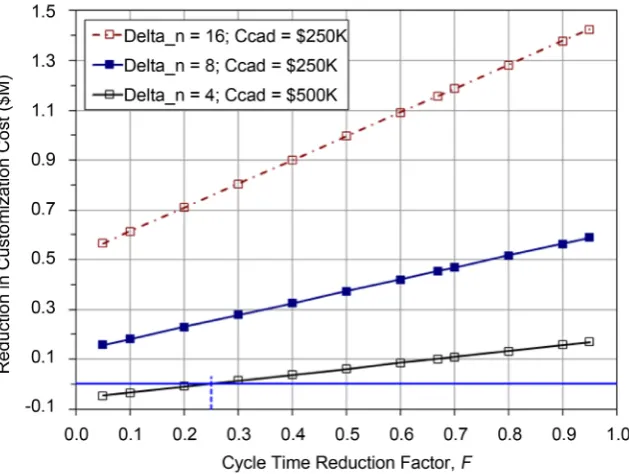
Figure 2. Minimum cost saving, ΔC as a function of cycle-time reduction factor, F with Δn as a third parameter. The data are obtained by (3) using Cwfr = $40 K, ρ = 0.33, and
ROI ≥ 20% and Ccad = 250 K. Plots show that F ≥ 0.25 for cost saving, ΔC > 0 by a
CAD-base technology customization project. In figure legends “Delta-n” represent Δn.
[image:5.595.216.531.382.619.2]cost saving of more than $600 K can be achieved compared to the same project using the conventional method. And, considering a large number of fabless cus-tomers requiring customer-centric technology, over multi-million dolar total cost saving can be achieved by CAD-based technology customization compared to the conventional iterative wafer processing in the fab. Thus, Ccad = 250 K is
used in assessing the cost-saving as a function of cycle-time reduction factor, F
for different values of Δn > 3 as shown in Figure 2.
It is observed from Figure 2 that for ΔC ≥ 0 and Δn = 4, F ≥ 0.25. In Figure 1, the reported typical value of F = 0.67 is used to compute ΔC. Figure 2 shows that for the typical value of Ccad = 250 K, the lower limit of F is about 0.25. Thus,
F is valid over a wide range, 0.25 ≤ F ≤ 0.67 and therefore, the worst case reduc-tion in technology customizareduc-tion cycle time by a CAD-based project is about 25% compared to that using the conventional method. This implies that any in-crease in the simulation time, τsim [Equation (2)] due to a potential increase in
the complexities of device and fabrication technology still offers more than 25% cycle-time reduction by a CAD-based project over the conventional iterative fab-experiments. Typically, after the initial investment and implementation of CAD-infrastructure, Ccad represents the maintenance cost only which is less than
$100 K annually [16]. Therefore, the range of the values of F is more flexible for
τsim variation than that shown in Figure 2. Thus, the analytical model shows a
rapid customer-centric IC-fabrication technology generation from a core foun-dry IC fabrication technology along with multi-million dollar cost-saving using a CAD-based methodology compared to the conventional expensive and time consuming trial-and-error wafer-fabrication.
4. Conclusion
Recently, the semiconductor wafer foundries are transitioning to a complete IC product development turn-key solution providers. In this model, it is extremely critical for foundries to provide customer-centric IC fabrication technology to their fabless customers. For an efficient and effective customization of a foun-dry’s core IC fabrication technology, a CAD-based customization method is cru-cial. This paper presents a methodology to estimate the cost-benefit of such a CAD-based project management. The data obtained by the analytical model show a reduction in technology customization cycle time over 25% with a mul-ti-million dollar cost-saving in comparison to the conventional practice of wafer fabrication in the foundry production-line. Thus, this paper offers project man-agers a quantitative methodology for cost-benefit analysis of an IC fabrication technology customization project in a wafer foundry for successful planning and execution of the project.
References
[1] Saha, S.K. (2016) Emerging Business Trends in the Microelectronics Industry. Open Journal of Business and Management, 4, 105-113.
[2] Taiwan Semiconductor Manufacturing Company (TSMC). http://www.tsmc.com/ [3] Global Foundries. http://www.globalfoundries.com
[4] United Microelectronics Corporation (UMC). http://www.umc.com/ [5] Silterra Malaysia (Silterra). http://www.silterra.com/
[6] Vagues, M.V. and Kumar, S. (2012) Transitioning Semiconductor Foundry Business Model to Complete IC Manufacturing Turnkey Solution Provider. Proceedings of Technology Management for Emerging Technologies, Vancouver, 29 July-2 August 2012, 2754-2757.
[7] Saha, S.K. (2016) Transistor Structure and Method with an Epitaxial Layer over Multiple Halo Implants. US Patent No. 9299702.
[8] Saha, S.K. (2002) Transistors Having Optimized Source-Drain Structures and Me-thods for Making the Same. US Patent No. 6344405.
[9] Saha, S.K. (2007) Design Considerations for Sub-90 nm Split-Gate Flash Memory Cells. IEEE Transactions on Electron Devices, 54, 3049-3055.
https://doi.org/10.1109/TED.2007.907265
[10] Saha, S.K. (2008) Scaling Considerations for Sub-90 nm Split-Gate Flash Memory Cells. IET Circuits, Devices, and Systems, 2, 144-150.
https://doi.org/10.1049/iet-cds:20070126
[11] Iwai, H., Kakushima, K. and Wong, H. (2006) Challenges for Future Semiconductor Manufacturing. Journal of High Speed Electronics and Systems, 16, 43-81. https://doi.org/10.1142/S0129156406003539
[12] Tseng, M.M. and Piller, F. (2011) The Customer Centric Enterprise: Advances in Mass Customization and Personalization. Springer Sciences and Business Media, New York.
[13] Johnson, M.D. and Ettlie, J.E. (2001) Technology, Customization, and Reliability.
Journal of Quality Management, 6, 193-210.
[14] Dewan, R. and Bing Jing, A.S. (2000) Adoption of Internet-Based Product Custo-mization and Pricing Strategies. Journal of Management Information Systems, 17, 9-28.
[15] Tseng, M.M., Jiao, J. and Merchant, M.E. (1996) Design for Mass Customization.
CIRP Annals-Manufacturing Technology, 45, 153-156.
[16] Saha, S.K. (2010) Modeling the Effectiveness of Computer-Aided Development Projects in the Semiconductor Industry. International Journal of Engineering Man-agement and Economics, 1, 162-178.
[17] Saha, S.K. (2013) Introduction to Technology Computer Aided Design. In: Sarkar, C.K., Ed., Technology Computer Aided Design: Simulation for VLSI MOSFET, CRC Press, Taylor and Francis Group, Boca Raton.
[18] Dutton, R.W. and Strojwas, A.J. (2000) Perspective on Technology-Driven CAD.
IEEE Transactions on Computer-Aided Design, 19, 1544-1560. https://doi.org/10.1109/43.898831
[19] International Technology Roadmap for Semiconductors: Modeling and Simulations (2011).
https://www.dropbox.com/sh/r51qrus06k6ehrc/AACQYSRnTdLGUCDZFhB6_iXu
a/2011Chapters?dl=0&preview=2011Modeling.pdf
[20] Saha, S.K. (2015) Compact Models for Integrated Circuit Design: Conventional Transistors and Beyond. CRC Press, Taylor and Francis Group, Boca Raton. [21] Saha, S. (1994) Extraction of Substrate Current Model Parameters from Device
[22] Kuhn, K.J., Giles, M.D., Becher, D., Kolar, P., Kornfeld, A., Ma, S.T., Maheshwari, A. and Mudanai, S. (2011) Process Technology Variation. IEEE Transactions on Electron Devices, 58, 2197-2208.https://doi.org/10.1109/TED.2011.2121913
[23] Saha, S.K. (2010) Modeling Process Variability in Scaled CMOS Technology. IEEE Design & Test of Computers, 27, 8-16. https://doi.org/10.1109/MDT.2010.50
[24] Saha, S.K. (2014) Compact MOSFET Modeling for Process Variability-Aware VLSI Circuit Design. IEEE Access, 2, 104-115.
https://doi.org/10.1109/ACCESS.2014.2304568
Submit or recommend next manuscript to SCIRP and we will provide best service for you:
Accepting pre-submission inquiries through Email, Facebook, LinkedIn, Twitter, etc. A wide selection of journals (inclusive of 9 subjects, more than 200 journals)
Providing 24-hour high-quality service User-friendly online submission system Fair and swift peer-review system
Efficient typesetting and proofreading procedure
Display of the result of downloads and visits, as well as the number of cited articles Maximum dissemination of your research work
Submit your manuscript at: http://papersubmission.scirp.org/