No.38 Nov./Dec.1987
THE
M
Parallel
Processing
CR 0
This issue we have three articles on the transputer, a processor specially designed for parallel processing. The articles cover the transputer,
communications between transputers, and creating a parallel C compiler. Series begins on page 6
Laser Printers, Typesetters
And Page Definition
Languages
page 20The problems designers (and purchasers) face getting information onto paper.
Magic In The
Real World
page 28What can you do with a $20 PC parallel card? A lot! Bruce tells you how.
Build A Graphics Scanner
For
$6.00,
Part
2
page 42This time, John covers the hardware construction and begins the software.
In Depth Turbo C
·
page 56Writing a resident-program extractor entirely in C.
I
o
7$3.95
T E C H N
CAL
J 0 URN A L
i#';"Ma\H~'¢o~r~cessor
for
X16B::,::JheX16:8087 Math Coprocessor runs at full CPU speed. That's ;:;;,r:;,10MHzofnumber smashing power! The Math Coprocessor on the
"·;2;t::/Et"~Tonlynins;.at
2/3 of the CPU clock.lr,·':.~";SC$I~ortOption
for
X16B,,:.;,):~L'·'.··:fuH .SCSI port using the 5380. Software built into ROM BIOS for the
!:t,' \\.'t:·OMTI3100 hard disk controller achieves a 1 to 1 sector interleave.
~Eh<{t'fOUR'~MEGGER
, •.. '; .. ' Running out of spreadsheet room? Need something faster than a
~f,'::,;':, > hard disk for those long compiles? The Four Megger is the answer.
: The Four Megger meets the LotusllntellMicrosoft expanded
memory specifications and works in all PC and XT computers. The . : ' Four Megger also works in AT computers as expanded memory ,;:.:' ···only.
, . .
... ' ... ~' ' 1 6 MEGGER!
/ .•. ' .•...
'~~~
.. ' Expanded or Extended Memory for PC/XT/AT. Up to 16 . . . . Megabytes total. Expanded memory works as on FOUR'. '.J'.' . . . MEGGER. , :,.' ~ ",":',<
.'" .•
~
T~~n!42~~sta~~·nR~~Phi;s~~~o~rBp~N~?S
board has
~
its own 32·bit graphics CPU running at 5 MIPS, with up<;~
;~;.~~ %,»;., to 4 M Bytes of memory plus 1 M byte display memory. Emulates CGA. Up to 1024 by 800 pixels, 256 colors from a palatte of 256k!
P.O. Box 128
904 North 6th Street
Lake City, MN 55041
(612) 345·4555
COD, VISA, MASTER CARD, CERTIFIED FUNDS
'''''''I'''I'U'L.I:6ne;r~: ~ltie;'high~s(,<:;,:··
,: •.•
;~:.p,~rfofmance·aJld,:fntegration
·.of
!;~t;.ahY::
PC/XT compatible. With its
jS:::
;,'1()M
Hz,·
zero wait state
.
'operation it walks away from AT
compatibles as well. On board is
one megabyte of DRAM, a real
time clock, floppy disk
controller, and optional one or
two serial ports, SCSI port and
8087.
The PC Tech SmartBIOS
provides PC compatability with
ease of use. We wrote it and we
support it!
PRICES!
X16B I 1 Meg I RTC .... $600.00
8 M Hz version ... $540.00
SCSI option ... $25.00
Serial ports (2) ... $38.75
8087-1/82188 ...
$340.00
8087 -2/82188 ...
$260.00
Four Megger ...
~NOW $750.00
2S1 P ... $99.00
Memories ... , ... $95.00
Systems:
The Box ... $799.00
Mono System ... $1 ,099.00
EGA System ... $1,849.00
Call for system configuration details. PC Tech also sells hard drives and controllers, video boards and monitors, etc.
Watch for more innovative products
Enlarged
Shift keys
Two Ctrland
Altkeys for ambidextrous
Positive-tactile,
firm-feel 12 Function
keys for increased automatic operation.
Extra-wide, easy-to-find Return key.
Dedicated
Function Con-trol keys.
Caps, Num and
Scroll Lock indicator lights.
IBM has no lights
on their XI
Separate dedicated
Numeric Pad
with enlarged
Enter key, four
Arithmetic
Switch-selectable compatibility with IBM, PC, XT, AT, and all compatibles.
IBM's new
Enhanced Keyboard runs only on their
newXTs, ATs and ignores their installed base which probably in-keys. access. _ _ _ --,
Isolated
Escape key.
IBM changed sizes again by shrinking their Return key.
, - - - Function keys.
cludes you. - - - . . . ;
---ESK'S
fJfD)fJ
fEfAflf#JIA/MCElOJ
{f{~lf[ffJ@&J!tl@)
for the 10 million PC users IBM just ignored!
Switch allows you - - - - . . ; . ; ; ; i i G .to swap position of
Ctrl and Caps lock.
IBM moved Ctrl to
bottom row, you have
no choice!
IBM just announced their new
redesigned "standard" keyboard for per-sonal computers. There's only one problem: it won't work on your IBM computer if it was purchased priortoJune 1986oron any PC compatible purchased at any time! Not to worry. Our new Turbo-101 Enhanced Keyboard gives you the layout and en-hancements of the IBM with some logical improvements (see above photo). And it works on your existing PC, XT, AT, PCjr, AT&T, Epson and virtually all compatibles!
Get Borland's Turbo Lightning Til
For FREE!
To really turbocharge " your productivity, we are . ~.'
including, tree-ot-cha' IiiC::lW Borland's red-hot.1i. 0
,"'.:'.,1.'
Lightning soft~a" ith ~.
J
each keyboafji.· ow, -when.,.,.u .. s. i,.n ..•~
..'S
....
i iC. K .. ick, WordPerfect, Micro-soft War. ~ ·1· -3 or most popular programs, our li . ' , .'~board will check your sp . "", , u ty; ,gives you instant access to R ... nd' House's 80,000-word Concise D' . ary and 60,000-word Thesaur d much, much more!, ing's good enougb to make pr ammers and 'users cbeer, executives
o 'tber software companies weep," says Seymour of PC Week. Sold separately, rbo Lightning retails for $99.951
I N T E R N A T I O N A L
7650 Haskell Avenue
Van Nuys, California 91406 (818) 780-1673
Turbo-tOt is a trademark 01 DataDesk International. Turbo Lighlning is a trademark 01 Borland International. IBM and IBM AT are registered trade· marks ollnlernational Business Machines, Inc.
The Turbo-101 is the best data entry tool since the pencil!
For users of spreadsheets like 1-2-3, the Turbo-101's separate cursor controls and numeric keypad makes entering numeric data into cells and moving from cell to cell as natural as moving your fingers. And for word-processing, the 'Selectric' typewriter layout makes the Turbo-101 as easy to use as a pencil; and with the extra large Enter, Shift & Control Keys, you'll make so few mistakes, you won't even need an eraser!
SfPfCUAL OFfER!
ONLY $149.95* FOR BOTH KEYBOARD & SOFTWARE
Includes 30-day money back ' guarantee and 2 year full warranty. 'To prove that we don't ignore you or your pocketbook, you get our , Turbo-101 Enhanced Keyboard and
Borland's Turbo lightning for an astounding $149.95.* No, you didn't read it wrong. During this amazing
Introductory Offer you get both keyboard and software for less than most software programs by themselves! Now, if you're still feeling ignored, you can.; , always do what you-know-who wants you to .do .. . and buy
a
new computer to get theircredit card orders call
(800) 826-5398
mCAcall (800) 592-9602
Up to now, DataDesl( International may be one of the best kept secrets, but here's what's being said about our first end-user l(eyboard/Borland software bundle:
"Who Can Pass Up a Deal? Department. Talk about an aggressive product/" john C. Dvorak, InfoWorld Mar 86
"It solves all of the problems exhibited by their regular PC/XT keyboard ... It's a great bargalnl" PC Productivity Digest May 86
"DataDesk Inti. has designed a sturdy and handsome key-board that has tactile re-sponse ... ls the hardware bargain of the year" says Charles Humble, Oregonian jan 86
"The best part of the key-board Is tbe way Itfeels.It's Ideal! Andfast. I've never worked on a keyboard with a nicer touch."
Business Computer Digest Aug 86
'J\.~sociate Edit~~s
Gary Entsmmger" Caiy;Gatton
, , < , ,
Accounting ,
Sandra Thompson
< , ,", ~"::. ,"', / " '
, SUBSCRIPTION RATES~
',".
' .. '.
" 1 yr. (6 issues) .... ';. ~ .' .:-.:. ~ ;;.' ~ .. ,. ;$18.00u2yr;(12 issues) ~, .. :. .. ;~:. ~. :~; ... ,.$34.oo ,3'yr.(18,issues) ~ .. ;. ;,.,:,'., ... ' .:$48.00 .,1yrdCanada& ~exico).,. " " ;$26.00.
tyr. (Other foreign) ,.~; .•. , , v . ",$36.00 '
Make all order~payablein, (1:5, funds'ofla.
·U.S.b~nkiplease,. . . ' , ' .
.•.. CHANGE OF :ADDRESS:Pleasestmd\;our .; ; old laoetandnew,address; . . '.'
.. " ','MU:ROCORNUCOPIA '
,.;' '·P.O;Box'223:';· ,,/. Bend/. qr~g(m',97709
'>;COS:r0r.1ER' SE~VICE:' for' ord~rs&sJb< . ; sCriptionproblemscaU 50~.382~5060, .?iUll ,to "; ;5.pm,:Racifict,i
rn
e;:M, -:P;. ..'':Fo;,tech~tt~l' h;~fpcilL?~~382~s048.; ·9a~·.to·
',noon; . PacifiC time; M·;'F;·
..
.;, ··.RBBS-i
4t\r
i:
30th
1200~24()(}'b~~d:<'.<;t; " 8~i~$, No ~Rarity~·.15top~i;~ >;,',
'~~:3.S,t~?,64~,.~;.}~·
,
::" ' ,,~; ; - ' , ~ i ... ; v
•• U, .:
t~iJ~~~~1~7 6/~i(~: ~~r~:u~oPia'lhc.
.;; .' .•. < . Ailrights:rese~ed> ' ; '~SSN0747"S87X:; t·
',' ~:,~,~, ..:'<> ", " .:', ,-~<;'.,
:: :,;:; ,'. ':<>'; ;";';;;'
<,
<"." ;
By
David Thompson
Para~lel
Ed itolrnal
Last year I was vaguely curious about parallel processing. This year it's a lot more interesting. So inter-esting, in fact, that I tried it at home:
• Erin was to clear the table and put leftovers in the fridge.
• Sandy was to wash.
• Jennifer's task was drying and putting away the dishes.
• I wasthe supervisor/task scheduler.
It seemed like the perfect time, since it was my night to do dishes.
What happened, however, was not pretty. By the time I'd finished proposing the experiment, Erin had disappeared into her room to feed Popcorn (her pet rat), Sandy had tossed me the sponge and headed downstairs to finish the illustrations for this issue, and Jennifer ... well, Jennifer is a teenager.
This experiment left no doubt in my mind that the supervisor has the most difficult task. And, there's no guarantee that a task will be handled any faster on a parallel system than on a workable one. Especially if
there are teenagers in the house.
However, mine was not the definitive study in paral-.leI processing. I had no dedicated hardware, and no
special language tools. Using: "You fed your rat an hour ago," doesn't seem to work.
Anyway, for a more definitive look at parallel processing, check out the three transputer articles in this issue. They are from Bernt Roelofs, Hans Bieleman, Klaas Wijbrans, and Rob Kurver, students of Andy Bak-• kers at Twente University in Holland. Better yet, find a
friend and read the articles in parallel.
Hard Drives (Again)
After ,the article in issue #36, I've gotten some updates. ,
-First, Microscience called and asked if they could . send me a drive. I said sure. But, I specified that it had to be off-the-shelf, and it had to be their cheap 20-meg model, the one I'd reported was having problems.
They sent a 725 (20 meg 85 ms), and I'm certain they followed my instructions to the letter. When we applied power, the drive spun up, then shut itself down. Per-manently.
6
10
14
20
28
48
THE
M I C R 0
TECHNICAL
JOURNAL
MICRO CORNUCOPIA
Bernt Roelfs
The Transputer
The designers of the RISC processor started out with a clean sheet and a need to do parallel processing.
Hans Bieleman
Between
Transputers
Now that we have the parallel processors, how do they communicate?
Rob Kurver & Klaas Wijbrans
Developing A Parallel C Compiler
Once we have the processors and the communication, we need software to direct everything.
David Thompson
Laser Printers, Typesetters, And Page
Definition Languages
How to get all that information out of the computer and onto paper.
Bruce Eckel
Magic In The Real
World
Buying your parrallel ports prepackaged and then making them useful.
Thomas Ochs
Data Abstraction And Dynamic
Allocation
Writing Modula 2 code that dynamically allocates data space.
54
NOV.lDEC. 1987 - ISSUE NO. 38
David Thompson
The Konan Hard Drive Card
Data compression built into a hard drive controller. How fast is if?
How well does it work?
26
On Your Own42
56
When his employer went under, Dave Coahran computerized the original product and went
out on his own.
Pascal Procedures
The $6.00 scanner continues. This time John talks about construction and begins the software.
C'ing Clearly
Ron bows out with a strong column on Turbo C.
62
86 WorldLnine launches a new career, river rafting in Turkey.
66
In the Public DomainAn 8086 assembler that's faster than Microsoft's? Yep.
78
Technical Tips80
Culture Corner70
Kaypro ColumnThe 280's secret instructions.
74
CP/M Notes76
84
96
Adding fish paper to a Kaypro.
ZRP/M2: Anticipating The Z280
Designing a 2280 emulator for clones.
Tidbits
By Gary Entsminger
Prolog beats Pascal in a statistical race.
Last Page
The Micro C Technical Conference, SaG VI.
Letters
Polyboost for the Kaypro 2000
Having had such good experience with Kaypro's CP 1M machines, it was only natural that I should consider their K2000 when I branched out into MS-DOS. I've had a lot of success with the 2000 in spite of its underwhelming screen and disk I/O speed. I had been hoping that some speedup scheme would eventually crop up.
After a year of waiting for a hardware solution, I came across a neat product called Polyboost from Polytron. As I had been pleasantly impressed by Polytron's PolyWindows Plus, I decided to order Polyboost on the blind.
I've been very happy with the im-proved keyboard, screen, and floppy performance provided by this software accelerator. Even an already fast package like PC-Write runs noticeably quicker. Kaypro, if you're listening, why not package Polyboost with the 2000?
Polyboost is available for $79.95 from:
Polytron Corp.
1815 NW 169th PI. Suite 2110 Beaverton, OR 97006 (800) 547-4000
Hans Austermuhle Sierra Leona 650 Lomas Chapultapec 11000 Mexico D.F.
Like, Wow
I like your new cover. I liked your old cover. I even liked the cover before that. I like the cover because you write a good magazine and whatever it looks iike, I enjoy seeing Micro C arrive in the mail.
It's very much like the way I feel about my wife's hair - I like however she wears it because I like her.
Roger Paige KAC BerryHill
Frankfort, KY 40601
Challenger Problems
Bob G. Roberts' letter in Micro C's February-March issue (#34) was just great. Not so much for the letter but for the fact that you allowed him to voice his problem. I had similar problems with a mail order firm which not only sold me a mother board plagued by incom-patibilities, but also refused to repair the board when it proved defective.
I wrote three letters directly to them and one to the publisher of Computer Shopper (in which they frequently adver-tise). I've done everything I could short of flying to their door and Vaselining the handle.
The editorial in the April-May Micro C (#35) proved to be fertile ground for me since you mention the board sold by Challenger Computer (the villain in my story). This board in 10 MHz dress shows many software incompatibilities. It also proved to be useless with various hardware additions.
In my opinion, it would be best to avoid doing business with Challenger Computer. They may have solved their compatibility problems, but their busi-ness philosophy remains unchanged.
If your readers would like additional opinions on clones and compatibility, . they can write my company. We are
of-fering free photocopies of a pamphlet we publish on this issue. Please enclose a couple of stamps to help cover postage.
Robert L. Sabaitis Lee Consulting 14040 Salem Redford, MI 48239
Editor's note: You could probably clean up many of the hardware incompatibilities by slowing down the system from 10 MHz to 8 MHz. The software problem is a BIOS problem. I don't have a cure for that.
Where'sThe Mag???
Alas, sadness and despair prevail. The bimonthly rendezvous with joy and true happiness has not occurred despite being
4
six whole days into the dreary month of expectation. Not that anyone's existence should rest in its entirety on receipt of a single periodical...
Prose aside, may I simply report that I have not received the August-September issue as of yet, and I miss it sorely. Lost in the mails, no doubt. Evil mail carriers!
Yes, I confess. I am one of those who tosses the rest of the world aside while greedily reading each newly-arrived issue from cover to cover in one sitting. Then, having gorged and reveled in ex-quisite ecstasy, I wait impatiently for the rising of the second moon. Oh good people, hear the plea of this your humble reader; PLEASE send my issue with no further. delay. I'll do (almost) anything. I'll learn Forth. I'll enjoy Pascal. I'll even give up C for 20 minutes (shudder).
David W. Stojan 10310 Lybert Rd. Houston, TX 77041
Editor's note: Yes, we were a bit behind with issue #37, but rest assured that by the time you receive this issue (#38), you will probably have #37 as well. We were having an awful lot of fun at
soc.
(And all you can think about is the magazine. Aren't you ashamed?)Unconceived Program Destroyed Elle M. Enno's program sounded so good that some deviant created a Trojan Horse with the same name and number of bytes. The Fido Net people felt that the only way to protect large numbers of people from losing their FATs was to kill it on every BBS. I believe they were suc-cessful and all real and phony copies have been destroyed.
Grant Raddon 2806 NE 11th Portland, OR 97212
•
M
..
.. *M • \"
*
ore
~
\
not ••".~~~'\.o,
*
from Blkise.
~ ,~
..
\~~
.. ·
..
;of
Turbo
C TOOIL§m
.~rtn~U~ing
Magic is easy with Turbo C TOOLS in your bag of tricks. New Turbo C TOOLS™ from Blaise Computing is a library of compiled C functions that allows you full control over the com-puter, the video environment, and the file system, and gives you the jump on building programs with Borland's new C compiler. Now you can concentrate on the creative parts of your programs. The library comes with well-docu-mented source code so that you can study, emulate, or adapt it to your speci-fic needs. Blaise Computing's attention to detail, like the use of function proto-typing, cleanly organized header files,
and a comprehensive, fully-indexed ... ~m~~,:anual, makes Turbo C TOOLS the choice for experienced ~~ . . . ~~software
" • . . control; ISRs;
\ < , . code; andinuch
more. " "
developers as well as newcomers
~~. ~~L:',.,:,
",.':':',"
""";"'f'>~<"'>"
',',",'>,':' "
Turbo C TOOLS provides the sophisti- ~:'/::Turbo ~()WEJl~C~E~N.' :~::, ..,,";.',.:,:'. . . ;,,,, COMING SOON~G~neral'screenmanage~" ,,'
~ated, bullet-proof c~pabIhtI~s neeqed :",:",:'rpent;:~aint~ie'ems; block;irt~edaci ¢ntry':',
m today's programmmg envirOnmel,l~ ':'",\'ofJietd-bY:fleld contrQl,"'m?lrst~nts?ree~ ",'
including removable windows, "sid~- :' ,.,~'ac~ess:,For:J,urbo rasc~L: ,~ :: .. ' '" '. ,"". '
~ickable" applicati~ns, an~ ge~erar- t,/:::rlu:bO~~'XN,C;~PL{)S,,;,';:; ~99~?t
"
mterrupt serVIce routmes wntten mo.. ~", ',;\ I~~errupt dri.ve~supportJorthe COMports..;"• • • 1 , l,:.J!.Ot;.uffers<llil tQ,64K;XON!XOFF:;up~()'
The functIons contamed In Turbo 0t _ 1::~",/96<xjJ:l~U~;'fl\qd~m.and)(MOD~¥con,t~oL",
TOOLS are carefully crafted to supple- \ r,,;',~;J:of,TErb~\R;ts,sa!<:,/:): ' . , ~, " , ment Turbo C, exploiting its strengths \ • t"PASCA:LvtOOLS/TOOLS 2';$175.00 \
without duplicating its library functions. \ \. "E~N'nded string anq scr~e,n h<tndling; graph-,
As a result you'll get functions written \ .;"'>':iCSf~lIdn~~~·me1Tl()rYm.anp,gement;·,general i."';'
Pre. dominantly in C that isolate hard- \ ,t>.: ':: .••.. ,1 •. 1 > . "ro. ~,~~, .OtlU'. 0., "I:.p, ,,0, S ... W~~\JP,.~.rt ... , all.dJ-q,?r.,.c,:: .. :",,'.'.'~ .. :~,:'.' .• ,~.'
' . . ", ,,' .. ·rorlVl$-Pasca!'. "" '" . '., " .,'" .. "".". "
ware independence, and are small and
'\t<.c.',;,.:',\v''''':'':''.»,i'.:,.'''::'<:':~:'.:~<
.. <:.: ..•.. : ... :,:'.':,~i:".::>,ir,·l:-':.',t:,'
..o·."o·".'i.<.'~
.. :.,: ..• easy to use. . t}~,::),c:.~~Q~S,:~~y~:t\:.y> :;:~ \ ;:;::':":v;J~ , ,/;'" (,',. \ 1
:.
;·,~~itld()Ws,., l'SRs~ :screellrandllng~.mlltttp~e:':;/ 'Turbo C TOOLS embodies the full spectrum I,,; ~>:,'m.o~'iiQrs~,EG~,43;Ui'~;~I?,x;t:.nl9ael;i,1lfect'~:;;~ •
of general purpose utility functions that are l;.:~~~~en~aeCess;p.9~We h~l~limn~·nQ.:m~re.,~:','
critical to today's applications. Some of the i:~ " •. :,fOt:'M~ a~o, l;»tt<;e~ ,vers~o~:3:~Q~d later. \<:;>
features in Turbo C TOOLS are: t,::"~:,':tQQLS:i'~~: v
~ WINDOWS that are stackable and remov- t,'·,...,: " '~l~ , ". '
able, that have optional borders and a cursor 1",' ):s tlll~:I1I~nclllnf:.tJ
memory, and that can accept user input. • INTERRUPT SERVICE ROUTINE sup-port for truly flexible, robust and polite applications. We show you how to capture DOS critical errors and keystrokes. ~ INTERVENTION CODE lets you devel-.., op memory resident applications that can
take full advantage of DOS capabilities. With simple function calls, you can schedule a Turbo C function to execute either when a "hot key" is pressed or at a specified time.
'*"
~ RESIDENT SOFTWARE SUPPORT lets .~you create, detect, and remove residentutil-J.Ves· that you write with Turbo C TOOLS. "''' FAST DIRECT VIDEO ACCESS for , efficiency, and support for all monitors
including EGA 43-line mode.
~ DIRECTORY AND FILE HANDLING support let you take advantage of the DOS file structure, including volume labels and directory structure.
In addition to Turbo C TOOLS, Blaise Computing Inc. has a full line of
sup-port products for Microsoft, Lattice ________ . and Datalight C, Microsoft Pascal '. . . , . copies 0\
. d T b P I C 11 - - - tnagtc •. '. . . ..---:- oducts.
an '. ur 0 asca. a _----HO 1l\a~e . tor~ _ ~ri ~our pr 400 tor
today for details,· and
r
~£S\ \ ~:~ $~n\Onnatlon ~c orders add ~ a\r.make magic! ., Bnp~:~e send 11\e :~es 'Tar.. DO~~~press s:ndar .) _____
-COMPUTING
INC.
o .
dents add 00 tor Feder 'Phone. (-~S~~i.PPPp.,.iinn
.. ,gg", ,$3 ..\10~,"-.,~,
' . ' .' ..• _ _ _2iP:~
~at1\~!~ ~ State. ...• B'l'P, Addr
CiW:.
~C#:=----==--~
The Transputer
By Bernt Roelofs
Ingenieursbureau Bieware Witbreuksweg 381-401 7522 ZA Enschede, The Netherlands
A Microprocessor Designed For Parallel Processing
If your interests are anything like those of our SOG attendees, you'll join in on this dis-cussion. At least here, you won't have to stay up well into the morning to get the details.
C
omputer applications today are demanding more and more processor power. Over the past decade these power demands have resulted in new processors with their powerful instruction sets, large RAM ad-dressing schemes, and higher clock speeds.Some say there's no limit to single-processor technology, but there is an al-ternative: parallel processing.
The British firm, INMOS, has designed the transputer, the first com-mercially-available microprocessor spe-cially designed for parallel processing.
In this article, I'll first look briefly at parallel processing systems and then ex-plore some of the hardware specifics of the transputer. Finally, I'll consider the transputer's instruction set and operation with emphasis on its parallel processing features.
Parallel Processing
Parallel technologies have appeared in mini- and mainframe computers for a long time. Cray, CDC, and Floating Point Systems offer processing units that allow pipelining, concurrent evaluation in-structions, arrays, and digital. signal processing.
Such systems aren't very flexible be-cause these processors are often designed to solve specific problems. And, in the best cases, the number of processors can't be increased despite the need for greater processing power.
Computing systems distributed over several processing units, so-called MIMD (Multiple Instruction, Multiple Data) sys-tems, are more flexible. MIMD systems frequently employ a number of
general-purpose microprocessors (e.g., a Z80 or 68020) so that the system can solve a variety of problems.
But designers of MIMD parallel processing systems must decide how the processors will communicate (intercon-nect). Most interconnection schemes fall into one of four categories:
• shared-memory systems • common bus systems • switched bus systems • network systems
Shared-memory, common, and
switched bus systems all transfer huge amounts of data quickly. But physical layout, memory bandwidths, and/or bus bandwidths restrict their expandability.
Using direct processor-to-processor communications overcomes the expan-dability problem. Typically, the com-munications are high-speed serial links. With such a system, it's possible to add more processing units - without violence to the existing network - to gain power.
The precise scheme of interconnection between processors in these multiple processor networks is commonly referred to as the system's "topology." Many topologies exist: they can be struc-tured as a mesh, a cube, hypercubes, or a tree.
Proponents of parallel processing sys-tems based on network architectures also believe that many computing problems can be mapped into subproblems, and that groups of different algorithms can be hidden in "black boxes."
The programmer houses the ''black boxes" on different processors in the net-work. These boxes constitute a kind of "process" or "task-hiding" similar to the programming concept of data hiding. Only the interconnections between the . boxes need to be well-defined and
under-stood.
Such a structural approach to problem solving, when applied consistently, can eventually yield a program that's easily implemented on a parallel system with point-to-point communications.
6
The Transputer Chip
INMOS hopes the transputer chip will be used in much the same way as the dis-crete transistor was used a few years ago: as the basic building block of larger sys-tems. Indeed, the word transputer derives from a combination of the words "transistor" and "computer."
Each transputer is equipped with hardware "links" capable of high-speed bidirectional serial communication. There are four such links on each transputer.
These links allow any single transputer to be part of a multiprocessor network.
The transputer has other on-chip facilities, including a hardware timer and a task scheduler. With the task scheduler, the transputer is capable of multitasking with virtually no software support.
The INMOS transputer family cur-rently consists of three processors: a 16-bit T212 and two 32-16-bit chips, the T414, and the T800. The T800 has an on-board floating point co-processor. The T414 is currently available in 15 and 20 MHz versions. The T800 will be available in 20 and 30 MHz versions. INMOS also has a number of transputer support products, including a disk processor and a graphics controller.
Transputers have fast on-chip memory. This memory (2K on the T212 and T414, 4K on the T800) is mapped into the low end of a transputer's ad-dress space. The transputer accesses its internal memory without waitstates while it adds at least two processor cycles for external memory.
Addresses are one word wide, yield-ing a contiguous address space of four gigabytes for the 32-bit T414 and the T800. The. address bus is multiplexed with the data bus:
memory type (static or dynamic), the speed of the memory, and the number of refresh cycles required.
Links & On-Chip Timer
The transputer's link engines are key to its success. Each transputer has four serial links, each providing two high-speed serial channels: one input, one output.
These links operate concurrently with the transputer's CPU, using Direct Memory Access to get data to and from memory. Thus, communication over-head is very small, even when all four links are running at the same time.
The links currently operate at a maxi-mum speed of 20 MBits/sec, yi,elding an effective unidirectional data rate of 800 kilobytes/sec for the T212 and T414, and 1.8 megabytes/ sec for the T800.
The links, utilize a' handshake in which each byte sent must be acknow-ledged before the next byte is sent. The T800 ,has an improved handshake mechanism, thus its faster transfer rate.
Links are assigned locations in the transputer's internal memory. Each input and output channel has its own memory address.
A program communicates across a link by issuing an input or output in-struction. These instructions include the memory ~tart address of the data and the length of the data block.
The input or output instruction in-vokes the link engine. Once it's started, the CPU is free to do something else.
The link engines don't do any buffer-ing, so communication only takes place when a sending process and a receiving process are ready to communicate (Le.,
one side has issued an output instruction and the other side has issued an input in-struction).
The transputer features an on-chip timer that can be set or read from a program. It also allows a process to be descheduled up to a certain time. The timer is also used as a timebase for the multitasking engine.
Sequential Transputing
Although the transputer was primari-ly developed to support parallel process-ing, we can also view it as a conventional microprocessor with added parallel fea-tures.
The transputer is largely a RISC (Reduced Instruction Set Computer) machine. It has limited addressing modes and a relatively small number of instructions, especially when contrasted with some other 32-bit microprocessors. But, in part, because of this, it features a very fast, microcoded processing unit that ~ns at 15, 20 or 30 MHz.
rhe transputer's working registers are organized as a register stack - three words deep. These registers are (from top to bottom) A, Band C.
We access the register stack through the A register. When we pop its value, its contents come off the stack, and those of the Band C registers move up. Conver-sely, when we push a value onto the stack, it's placed in the A register; the old contents of the A register move into the B register; and the C register will contain the value that was contained in the B register. The contents of the C register are lost.
Programmers used to conventional addressable registers may have difficulty adjusting to the transputer's register stack.
In addition to the register stack, the transputer has three other major registers: the instruction pointer, the operand register, and the workspace pointer register.
Instructions
Transputer instructions are one byte long. Since the transputer fetches one word at a time, 32-bit transputers are ef-fectively equipped with a four-byte in-struction cache. Inin-structions consist of two separate fields: a four-bit operation code and a four-bit operand.
As a RISC machine, the transputer is designed to allow many instructions to resolve to a single byte; it's obviously im-possible, however, to code all operations
(continued next page)
(continued from page 7)
in a single byte. Therefore, some opera-tions require more than one instruction.
Of the 16 basic operation codes, 13 are frequently used - like load, store, jump, and call. These instructions all require an operand, which is partially supplied by the four-bit operand field.
Since four bits per operand often aren't enough, the transputer has two special instructions, "pfix" and "nfix," that load its operand register. These in-structions shift the operand register four bits to the left and place their operand in the four bits cleared by the shift (the lowest four bits or least significant nib- , ble). With these instructions, it's possible to load the operand register with any value up to the maximum word length of the transputer.
This unconventional instruction set al-lows us to code many frequently-used operations in only one byte. Decoding'is simple and quick. Expressing a large constant, however, requires eight bytes . with this INMOS approach, whereas other 32-bit processors require less. But we encounter this so seldom in program code it doesn't pose a problem.
Workspaces
Each task or process running on a transputer has its own workspace. The transputer's workspace pointer register points to the base address of the workspace for the currently executing process. The workspace lies above the base address.
Memory locations within a small off-set from this workspace are "local," and can be accessed with extreme speed using 'load local' ("ldl") and 'store local' ("stl") instructions. If a memory location is within 16 words of the workspace pointer, it can be accessed with a one-byte instruction.
When a process's workspace resides in the transputers internal memory, workspace data can be accessed in one processor cycle (50 nanoseconds on a 20 MHz T414). In this case, the workspace acts much like a large set of registers on a conventiona.1 microprocessor. Later, we'll see how works paces enhance multitask-ing on a transputer.
Parallel Transputing
As we've seen, the transputer can be used as a building block for parallel sys-tems, with its links forming the com-munication channels between process-ing.
In itself, however, a transputer also
has parallel features like a task scheduler, in hardware, which can schedule processes on its own. Task switching takes less than one microsecond.
Processes that are running on a transputer can have one of the following statuses:
• running
• waiting in a queue to be executed • waiting for input
• waiting for output
• waiting for a certain timer value In the first two cases, the process is ac-tive; in the latter three cases, it's inactive.
~
ts unconventional
instruction set
allows us to code
many
frequently-used
operations in only
one byte.
Process Switching
Processes run either in low or high priority. A high priority process can in-terrupt a low priority process at any time, and continues until it's finished or until it must wait for communication or for the timer. Low priority processes are descheduled after they've been running for a preset time.
A low priority process is allowed to finish its current instruction and its infor-mation saved in reserved memory before it must give way to one with high priority.
Depending on the instruction being performed at interruption, the task switch time from high to low priority can take from 19 to 58 processor cycles (1 to 3 microseconds on a 20 MHz T414).
As soon as a high priority process has to wait, an interrupted low priority process is rescheduled (if there are no other active high priority processes).
Low Priority Switches
The manner of scheduling differs for process switches between two (or more) low priority processes.
8
Descheduling only occurs when cer-tain instructions are executed, and the programmer or compiler must take care that the register stack doesn't contain in-formation that shouldn't be lost.
This places an additional burden on the programmer or compiler writer, but the transputer stores much less process information during a low priority to low priority switch.
If descheduling occurs due to times-licing, the workspace pointer is put in a , linked list of active-but-not-running processes. If descheduling occurs be-cause a process becomes inactive, the workspace pointer is saved in a memory location associated with the event for which the process has to wait. As soon as the event has occurred, the process be-comes active and is put in the linked list of active processes, waiting to be ex-ecuted. All this is done automatically in microcode.
The linked lists are managed with two registers that contain pointers to the first and last processes in the list. The workspace of every descheduled process also contains a pointer to the next process in the list.
Internal Channels
When a transputer is running several processes, these processes will typically want to communicate. For this reason, the transputer offers internal channels. Internal channels are used in exactly the same way as links. The only difference is that any memory location will work in place of the reserved locations used for the links.
When an output instruction is per-formed on a specific channel, the memory location used will contain the workspace of the sending process. Another process that wants input from that channel performs an input instruc-tion and will find the workspace pointer of the sending process. The workspace of that process now also contains informa-tion about the data to be sent and the communication takes place.
The big and obvious advantage of this internal channel approach is that programs can use internal channels in the same way, as external channels. Programs can easily be adjusted to run on several transputers as well as on one.
D LOGITECH Modula-2
$99
V. 3.0 Compiler Pack
Compiler in overlay and fully linked form, Linkable Library, Post Mortem Debugger, Point Editor
D LOGITECH Modula-2
$169
V. 3.0Toolkit
Library sources, Linker, RunTime Debug-ger, MAKE, Decoder, Version, XRef, Formatter
D LOGITECH Modula-2
$249
V. 3.0 Development System
Compiler Pack plus Toolkit
D Thrbo Pascal to
FREE
Modula-2 TranslatorWith Compiler Pack or Developrrient System
D Window Package
$49
Build true windowing into your . Modula-2 code.
D Upgrade Package
Call LOGITECH for information or to receive an order form.
Add $6.50 for shipping and handling. California residents add applicable sales tax. Prices valid
in U. S. only. Total Enclosed $ _ _ _ _
o
VISA 0 MasterCard 0 Check EnclosedCard Number Expiration Date Signature
Name Address
Between Transputers:
The Communication Manager
Your assignment, should you choose to accept it, is to study this carefully. Commit it to memory, understanding that you may be one of only a handful who understands its ramifications. This is total immersion into parallel processing.
A
lthough my subtitle, "The Com-munication Manager," sounds like the start of an intriguing novel about some fellow in the communica-tions game, what follows is really much more interesting. This is about control-ling communications between networked transputers.The purpose of a communication manager is to relieve a program (or programs) from dealing with dataflow. A communication manager can also emu-late more than one hardware link be-tween two transputers.
To give you a feeling for the mechanisms involved (e.g., the proper use of priority levels and other hardware features of the transputer), I'll first describe a simple, dedicated mes-sagepasser. Then I'll discuss a more generic messagepasser and communica-tion manager.
The Mandelbrot Demo
Calculating and displaying a Man-delbrot set is one way to demonstrate the meaning of "real" parallel computing. The calculation is processor intensive, re-quiring solving a complex equation many, many times.
For every pixel on a screen, we calcu-late the Mandelbrot equation with slight-ly different parameters so that every point on the screen is represented by a unique value. The number generated for each pixel on the screen is mapped to a color. Thus, we can represent a Man-delbrot set on a color monitor.
What concerns us here is not the Man-delbrot equation itself, but the fact that it
requires a separate calculation for each pixel on the screen (and the fact that it makes sensational pictures).
In principle, if you have as many com-. puters as there are pixels on your screen,
the maximum time it takes to calculate the complete screen will be roughly equal to the time it takes to calculate a single pixel. (The duration of the calcula-tion varies with the parameters passed to
it.)
We decided to write a generic program in which the number of com-puters was set in a variable.
We wrote our Mandelbrot algorithm to calculate a number of pixels at a time. This process reads in the coordinates of the first pixel and outputs a block of data containing the number of iterations (the number which ultimately renders the color on the screen) for the next n pixels. All the transputers run this same algo-rithm as a single task or "process."
We have a program running on the PC which controls the generation of the Mandelbrot picture. It issues pixel coor-dinates, receives calculated blocks of data, and translates the data into colored pixels on the screen.
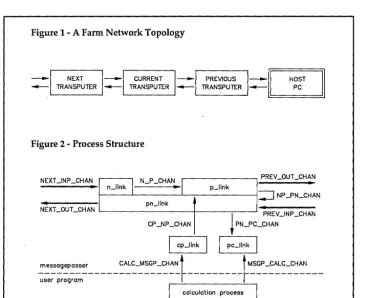
The Mandelbrot demo uses a "farm network topology." Two links are used on every transputer; one connects to the previous transputer (the one that is nearer to the host) and the other one to the next transputer (the one that is fur-ther from the host). See Figure 1.
The Mandelbrot Messagepasser To connect (in a software sense) the calculating processes on all the transputers to the control process on the host, every transputer has, in addition to a calculation process, a dedicated mes-sagepasser.
The messagepasser is the communica-tion manager in this applicacommunica-tion. It's a dedicated messagepasser, as opposed to a general purpose communications manager, because it only knows how to deal with the kind of communication
re-10
quired by the Mandelbrot demo.
When the calculation process has finished calculating a block of pixels, it
passes the address of its result (the data block) to the messagepasser. Once the calculating process sends this pointer, the messagepasser requests the next pixel coordinates from the host.
The messagepasser takes care of buf-fering and passing results back to the host while, at the same time, receiving new coordinates from the host (control-ler). The calculating process is therefore almost immediately able to start calculat-ing the next block of pixels.
To balance the work load among a number of transputers, the controller (the PC in this case) sends new pixel coor-dinates into the network o~ly after it has received back a block of data.
When the controller sends out the
W
e decided to
write a generic
program in which
the number of
computers was set
in a variable.
new pixel coordinates, they go to the first messagepasser in the line. The first mes-sagepasser checks its own processor. If
the processor isn't busy, then the mes-sagepasser puts the coordinates into a special buffer for its own processor; otherwise, it passes the coordinates to the next transputer in the line.
transputers in the (farm) network. It ar-bitrates the flow of messages so that a message can pass through even while its own process is also receiving and send-ing messages.
Messagepasser Processes
In order to make optimal use of the transputer, the messagepasser is divided into several parallel processes. A closer look at the transputer's features makes this "division of labor" obvious.
First, the hardware channels. Reading and writing by the hardware channels (also known as "links") into the memory of the transputer is performed via Direct Memory Access (DMA). Thus, there's lit-tle CPU overhead once communication begins.
[image:13.627.46.414.438.736.2]A process which wants to communi-cate through a hardware link will always
Figure 1 -A Farm Network Topology
be descheduled. The transputer will res-chedule the process only after the mes-sage has been sent or received. Thus, transputer processes sleep as long as they're waiting for communications.
When a process is descheduled, the transputer puts its ID at the end of a ready queue. It can take some time before the process has worked its way back to the start of the queue and is able to run again. Therefore, to use the hardware links efficiently, it's best to use the largest possible message. In this way, a process will be descheduled a mini-mum number of times. (Thus, in this case it makes sense to calculate and pass 100 or even 1,000 pixels worth of data at a time, rather than 1.)
Synchronization
The use of internal channels offers a
:::L---...:::L---J---'----_.--I=w
Figure 2 - Process Structure
NEXT -,NP _CHAN
n_link
t
N_P_CHAN .1 ••
"I p_link::J
NP YN_CHA pn link•
NEXLOULCHAN
l
•
PREV~NP _CHAN
CP~P_CHAN PNYC_CHAN
PREY OUT CHAN
N
I
cp_linkI I
pc_linkI
messagepasser CALC_MSGP _CHAN
~
tMSGP _CALC_CHAN--- --- ---
user programI
calculation processI
By Hans Bieleman
Ingenieursbureau Bieware Witbreuksweg 381-401 7522 ZA Enschede, The Netherlands
sophisticated way to synchronize proces-ses without semaphores or other fancy software tricks.
For instance, let's say two processes need to share data. One might be ready to send data to the other, but the other isn't ready to receive. The sending process will be descheduled until the receiving process is ready.
When the receiving process is ready, the sending process (in our example) will be automatically rescheduled. Meanwhile, the sending process hasn't been pestering its processor to check if
the second (receiving) process is ready. As you can see, the hardware scheduling features of the transputer channels (or links) really save time.
Process-Structure
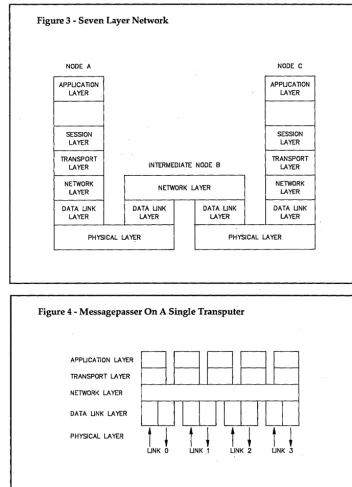
Let's have a look at Figure 2, the process-structure.
The boxes represent different proces-ses, all of which run concurrently on one transputer. The arrows represent chan-nels. A bold arrow represents an external (hardware) channel. I'll refer to proces-ses with lower-case names and to chan-nels with upper-case.
As Figure 2 illustrates, the mes-sagepasser consists of five different processes, which are all started by a parent (boot) process (not shown in the illustration). The parent process kills it-self after booting the child processes. (Obviously not a traditional American process.)
Three processes run in high-priority: n_link, p_link, and pn_link. They're high-priority processes because com-munication between the next- and the previous-transputer won't depend too much on the processes on the current transputer. Only high-priority processes on the current transputer can slow down communications. (The Mandelbrot cal-culation has no other high-priority processes.)
(continued next page)
(continued from page 11)
High-Priority Processes
Running at high-priority has a few major effects on the execution of the process.
First, a high-priority process will not be descheduled unless it has to wait for a channel to become reac;iy or for the timer to match a certain count.
Once a ~hannel becomes ready, the process is scheduled again. As long as there are processes on the high-priority ready queue, no low-priority processes will be executed.
To give low-priority processes a chance to execute, it's wise to keep the high.,.priority processes as short as pos-sible. Therefore, it's sometimes necessary to divide a· single process into a high-priority and a low-high-priority process. Com-munication and synchronization can be done with an internal channel. What this means is that a high-priority process will be almost immediately executed after it's been put on the ready queue.
The n_link process is a very simple piece of code. It merely reads in a block of data from the previous transputer al!d sticks it directly into memory.
Then a pointer to the block is passed on to the p_link process (rather than the contents of the block).
This pointer is passed on an internal channel. The data transfer between processes on the same transputer is thus very fast. n_link can put received data in one of two blocks. Once it's sent a pointer to the first block to p _link, n_link starts filling the second block.
p_link will start reading the N_P _CHAN only after it has passed the contents of the first block to the previous transputer. Because p_link hasn't yet read the N_P _CHAN, n_link can't send a pointer to the second block. So n_link is descheduled.
n_link will only be rescheduled after p_link has read the pointer to the second block. At this time, the first block is empty. Thus, the internal link helps synchronize the two processes.
Because we have a receiving process on NEXT_INP_CHAN and a transmit-ting process on PREY _OUT_CHAN, . reception and transmission can take place at the same time (thanks to DMA).
[image:14.627.218.571.37.525.2]The p_link process not only passes data blocks from N_P _CHAN to PREY _OUT_CHAN, but also transmits the calculated blocks on the current transputer to the previous transputer. After the block has been sent, p_link pas-ses the pointer to that block to the
Figure 3 - Seven Layer Network
NODE A NODE C
APPUCATlON APPUCATlON
LAYER LAYER
SESSION SESSION
LAYER LAYER
TRANSPORT TRANSPORT
LAYER INTERMEDIA TE NODE B LAYER
NETWORK
NETWORK LAYER NETWORK
LAYER LAYER
DATA UNK DATA UNK DATA UNK DATA UNK
LAYER LAYER LAYER LAYER
PHYSICAL LA~R PHYSICAL LAYER
Figure 4 - Messagepasser On A Single Transputer
APPUCATlON LAYER
TRANSPORT LAYER
NETWORK LAYER
DATA UNK LAYER
PHYSICAL LAYER
pn_link process by means of the NP_PN_CHAN.
pn_link then reads in the first set of coordinates coming from the host and places it at the first location of the'block. In this way, we are always sure that the block is empty before putting in new coordinates.
When .the pn_link· reads coordinates from the previous transputer, it first checks to see if there's a request for new coordinates from the current transputer.
If so, the new coordinates are put in the waiting empty block. If not, the coor-dinates are passed on to the next transputer. Once the new coordinates for the current transputer have been received, pn_link sends the datablock's
pointer to pc_link.
The messages are so small that hardly any time is required to send or receive them. pn_link can do this job sequential-ly and onsequential-ly runs after an input on the in-coming channels. Because pn_link will wait for input most of the time, an out-put to the pn_link on the next transout-puter is serviced immediately.
The pc_link process acts only as a buffer to hold the next coordinates for the calculating process. cp_link buffers the calculated block. So, the calculating process can start calculating the next set of pixels and doesn't have to wait for the p _link to service it.
The calculation process can read them in from the pc.;.Jink. The calculation
process is always fully loaded, so every transputer is never idle.
The use of links also has the ad-vantage that the pc_link and cp_link processes are descheduled; they don't consume processor time to check now and then if a service is requested from them. If the calculating process wants a service, the processes are rescheduled.
Because we use internal links; and"be-: cause both pc_link and cp _link will wait on the calculating process, the calculat-ing process will not be descheduled to wait for a channel to become ready "and it's able to keep on running.
The Mandelbrot messagepasser demonstrates how we can combine transputer features (e.g., internal chan-nels, process priority levels, and charac-teristics of the hardware scheduler) into an efficient whole.
A Generic Messagepasser
A network of transputers is just like any other computer network. It cannot
A
network of
transputers is just
like any other
computer network.
It cannot claim
divine right or other
forms of exemption.
Figure 5 - Message Types
• general resource call direct resource call resource call acknowledge general path call
direct path call path call acknowledge • message request
normal message confirmed message express message • retransmit packet
check link check node
claim divine right or other forms of ex-emption. As with other computer net-works, it's best to keep the sending, receiving, routing, error detection and correction, etc., out of user sight.
One of the goals of a generic mes-sagepasser is to support multitasking. Multitasking for a system of transputers is a minor extension, but it's of great use to the user because he can run
a
second~sk. "
For instance, in a control system, it might be handy to start a statistical task or a distributed database. In later stages, dynamic load balancing "of the pr6cesses on the transputers should be possible. So let me give you an overview of a generic messagepasser.
The ISO-OSI 7-Layer Model
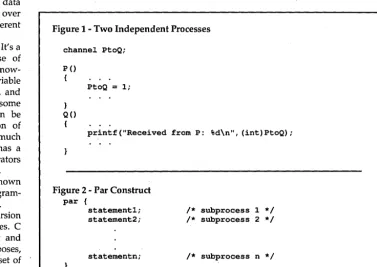
The ISO-OSI network model provides a good starting point for a general pur-pose messagepasser. If we look briefly at the ISO-OSI model for a network, we can see that it's divided into several layers (see Figure 3).
Not all layers of the. ISO-OSI model need to be implemented for a transputer messagepasser since the model is general and flexible in nature. The physical layer is already implemented by the transputer hardware. The wires of the external channels form the Physical layer.
The messagepasser on a single transputer will roughly look like Figure
4.
The Data link layer consists of several parallel processes - two each for the eight hardware channels or four links of the transputer.
The function of the Data link layer is to receive message-packets, put them in a message-block, check them for parity, and pass a block pointer to the Network layer.
The Network layer takes care of the routing of the messages. This layer has the following tasks. It interprets the mes-sage-blocks coming from the Data link layer.
The Network layer looks at the type of message and the destination of the message. If the block is meant for another node, the network layer will look into a routing table to find the best link to output the block on. In case of obstruction of the best link, an alterna-tive link may be chosen from the table.
Other things may also influence the Network layer'S choice of a link. If the block is meant for this node, the pointer to the message-block is passed on to the Transport layer.
Message-blocks coming from the Transport layer are interpreted on their destination address. The source address is completed with the node ID (NID). The Network layer then routes the block to an appropriate link.
In case of receive or transmit errors
fro~ the Data link layer, the Network layer issues a check on the erroneous link/node.
The upper layers have identical processes running for every task, so we can keep the task administration simple.
The Transport layer takes data from" the Session layer and splits it up into message-blocks. It also determines the message type. (The types of messages currently defined are in Figure 5.)
The resource call types are used to find a resource in the network (Le., disk systems, screen if 0, etc.). The path calls
find and build a specific or general vir-tual channel to another process. The message types are used when a virtual channel between two processes is estab-lished and communication can take place. The last are some miscellaneous types used to check channels, etc.
The Transport layer splits up mes-sages to be sent into message-blocks with a maximum size of 255 bytes. This mes-sage-size is a compromise between the performance advantage of long mes-sages and the ability to send short, ex-press messages through the network. Smaller messages are allowed, so there's little overhead in sending characters to a screen on another node (a host com-puter, for example).
Received message-blocks are as-sembled into a singl~ message, and the pointer to this messages is passed on to the Session layer.
The higher layers (Session layer through Application layer) implement the interface to a kernel. The type, length, and destination of messages are determined here.
Thanks From Transputerland
A good discussion of a general mes-sagepasser would fill a book. I hope my brief discussion has given you at least a little insight into the purpose and utility of a messagepasser.
I wish to thank Prof. Andy Bakkers of the University of Twente, The Nether-lands, for guiding me into (parallel) transputerland.
•••
Developing A Parallel C Compiler
Powerful New Extensions For A Familiar Language
Parallel processing isn't much good if you have to rewrite everything you have from scratch. Here, Klaas and Rob show us how an old favorite can be taught new tricks, and how we can learn them, too.
T
he transputer has made it possible to build large parallel processing systems, which increase linearly in speed with the addition of processors. However, to use these systems, we need a good programming language.This programming language needs to be powerful and should support special transputer features like channels, links, and the ability to initiate processes.
INMOS (British marketers of the transputer) provides a high-level lan-guage called Occam for parallel programming. Occam is quite powerful -with its parallel constructs: par and alt. And Occam knows the channel data type, which gives us some control over the placement of processes on different transputers.
But it has several disadvantages. It's a new language, with a small base of source code and programming know-how. It's a static language: every variable must be allocated at compile time, and there's no recursion. (Although some folks claim that any problem can be solved without dynamic allocation of variables or recursion, it's often much easier to use recursion.) Also, it has a smaller set of statements and operators than other, more popular languages.
C, ~m the other hand, is well-known and well-suited for systems program-ming. PIl:ls, there are vast C libraries.
Unlike Occam, C supports recursion and dynamic allocation of variables. C has a powerful expression syntax and range of statements. For our purposes, the only thing C lacks is a special set of statements and operators for the transputer.
To obtain both the advantages of C, and the advantages of the transputer, the C language had to be extended. And, these extensions had to fit into the C en-vironment.
This article describes these extensions.
The Channel Datatype
The channel datatype is new, provid-ing synchronized communication be-tween processes. A programmer uses channel variables to transmit data be-tween processes. The processes may be running on the same transputer or on separate transputers.
From ~he programmer's point of view, communication is the same regardless of whether or not the two communicating processes are on the same chip. The transputer's specialized hardware hand-les both types of message-sending with equal facility.
[image:16.627.189.566.474.741.2]Using the keyword "channel," one can declare a variable of the channel
Figure 1-Two Independent Processes channel PtoQ;
PO
{
}
QO
{
PtoQ
=
1;type:
channelchanl,chan2,chan3;
Declared this way, each channel variable will occupy one word in memory. Send-ing a message with the aid of a channel variable is most simply performed with an assignment operator. For example, the fragment:
int a; a=chanl;
will read an integer val ue from the chan-nel chan1, and store it in the variable a.
The use of a channel is not restricted to simple expressions. Channels can also be used in expressions like:
chan2 = chan1 + a * (char) chan3
This statement inputs a character value (1 byte) from the channel "chan3,"
printf ("Received from P: %d\n", (int)PtoQ);
Figure 2 - Par Construct par {
statement1; statement2;
statementn;
/* subprocess 1 */ /* subprocess 2 */
/* subprocess n */
and multiplies it by the integer "a." Then it takes this result, adds the integer value from "chan1," and outputs the final result to "chan2."
In this example, you can see that channel variables behave much like con-ventional variables. When we read chan-nel variables, their values are taken from another process instead of from a loca-tion in memory. Writing to a channel variable sends the value to another process.
The number of bytes transferred via a channel depends on the context. Expres-sions and sub-expresExpres-sions in a C state-ment are typically governed by a certain data type. A channel variable in an ex-pression or sub-exex-pression assumes this governing data type:
channel dogdays; struct CATSMEOW { int array[40];
} bigtime;
dogdays = bigtime;
In this example, the governing data type is the structure "CATSMEOW." The number of bytes sent by the channel is equal to the size of this data type (160 bytes or 40 * sizeof(int».
In this example:
channel tohostpc; double result; long count;
tohostpc
=
result / count;the compiler converts "count" to a double, performs the division, and out-puts the resulting value as a double to the channel "tohostpc."
Channel variables can also be used in a boolean expression:
if (chan1) ...
When declaring channels, there's no restriction on the complexity of the dec-laration. This means that arrays of chan~
By
Rob Kurver and Klaas Wijbrans·
UNICOM Irisstraat 10
Oldambt 69 7641 VT Wierden
Utrecht, The Netherlands· Holland
From
the
programmer's point
of view,
communication is
the same
regardless of
whether or not the
two communicating
processes are on
the same chip.
nels, and structures containing channels, all are possible. So it's legal to say:
struct P { channel ai
channel b[50]; };
Channel Behavior
Since a channel is a means of com-munication between two processes, whenever a process outputs a value via a channel, another process must input that value.
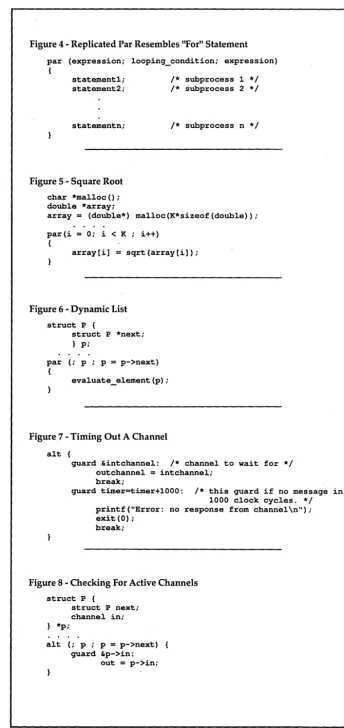
Suppose we have a program (like the one in Figure 1) with two independent parallel processes, P and Q.
For channel communications, you must have one inputting process and one outputting process, and both have to communicate an equal number of bytes.
If these conditions are not met, the be-havior is undefined.
The Link Interfaces
The transputer has four high-speed
bidirectional serial links; each link has an input and an output channel. It's inter-esting to note how the link interfaces are integrated into the transputer instruction set. A link behaves like any other chan-nel, with only a few differences:
• A link communicates between processes on different transputers. • The links are DMA based, and
thus consume no processor time. • The links are placed at fixed
ad-dresses.
It's not difficult to access the links from within a C program using pointers. On conventional machines, we common-ly access a memory mapped I/O register by creating a pointer to the type of that register, and initializing this pointer with the address of that I/O register. The same technique can be used to access the links on the transputer:
channel *LinkO_Out
=
LlNKOOUT;This declaration defines a pointer to the channel LinkO_Out, and initializes this link with the value LlNKOOUT. This value stands for the address of this link, Ox80000000 on a T414 transputer. To send information across this link, the fol-lowing expression suffice~:
*LinkO_Out
=
valueThis expression sends the value "value" over the link.
The Par Construct
The par construct allows the C programmer to instantiate several paral-lel processes within the body of a program. There are two variants of the par construct: replicated and non...,repli-cated.
A non-replicated par construct con-sists of the keyword "par," followed by a complex statement. See Figure 2.
Statements nested within the complex
(continued next page)
(continued from page 15)
statement are executed in parallel. A compiled par statement will continue to execute until all of these subprocesses have terminated.
On the transputer, the par statement translates into machine instructions quite easily: Each subprocess in a par state-ment is instantiated with the aid of only two transputer instructions - startp and endp.
The startp instruction, not surprising-ly, starts each of the subprocesses. At the end of the par statement, each sub-process finishes by executing an endp in-struction. After the last subprocess has ended, the calling process resumes ex-ecution. See Figure 3.
The replicated par construct behaves somewhat differently. With it, one can start any number of processes, using a loop expression. The replicated "par" resembles C's "for." See Figure 4.
Statements within the braces are started as independent processes for each iteration of the loop. Each subprocess receives its own copies of the variables in the loop expression.
The replicated par statement in Figure S computes the square root of each ele-ment in an array.
The replicated par construct's loop ex-pression isn't restricted to simple expres-sions. It's possible, for exainple, to start a procesS' for each element of a dynamic list. See Figure 6.
The AU Construct
Alt is another important language ex-tension. Like the par, it's closely tied to hardware features of the transputer. The alt construct is used to wait for certain events, or. it can be used instead of a C switch statement or nested if statements. The syntax of the alt mirrors that of C's switch statement:
alt {
guard guard expression: code;
~ guard guardexpression: code;
default: code;
In the alt construct two new keywords appear: 'alt' and 'guard.' The keyword 'alt' indicates the start of an alt statement; 'guard' compares to case labels in a switch statement.
However, there are some principal differences. Guards are evaluated at
run-time whereas case statements are evalu