Argumentation-based negotiation
I Y A D R A H W A N1, S A R V A P A L I D. R A M C H U R N2,
N I C H O L A S R. J E N N I N G S2, P E T E R M c B U R N E Y3,
S I M O N P A R S O N S4 and L I Z S O N E N B E R G1
1Department of Information System, University of Melbourne, Parkville 3010, Australia.
E-mail: [email protected], [email protected]
2School of Electronics and Computer Science, University of Southampton, Southampton SO17 1BJ, UK.
E-mail: [email protected], [email protected]
3Department of Computer Science, University of Liverpool, Liverpool L69 7ZF, UK.
E-mail: [email protected]
4Department of Computer and Information Science, Brooklyn College, City University of New York, Brooklyn, NY 11210,
USA.
E-mail: [email protected]
Abstract
Negotiation is essential in settings where autonomous agents have conflicting interests and a desire to cooperate. For this reason, mechanisms in which agents exchange potential agreements according to various rules of interaction have become very popular in recent years as evident,for example,in the auction and mechanism design community.However,a growing body of research is now emerging which points out limitations in such mechanisms and advocates the idea that agents can increase the likelihood and quality of an agreement by exchanging arguments which influence each others’ states.This community further argues that argument exchange is sometimes essential when various assumptions about agent rationality cannot be satisfied.To this end,in this article,we identify the main research motivations and ambitions behind work in the field.We then provide a conceptual framework through which we outline the core elements and features required by agents engaged in argumentation-based negotiation,as well as the environment that hosts these agents. For each of these elements, we survey and evaluate existing proposed techniques in the literature and highlight the major challenges that need to be addressed if argument-based negotiation research is to reach its full potential.
1 Introduction
An increasing number of computer systems are being viewed in terms of multiple interacting autonomous agents.This is because the multi-agent paradigm offers a powerful set of metaphors, concepts and techniques for conceptualising, designing, implementing and verifying complex distributed systems(Jennings, 2001).As a result,applications of agent technology have ranged from electronic trading and distributed business process management to air-traffic and spacecraft control (Parunak, 1999;Wooldridge, 2002).
a coherent manner),collaboration(Panzarasa et al., 2002;Pynadath &Ttambe, 2002) (in which agents work together to achieve a common objective), and so on. One such interaction that is gaining increasing prominence in the agent community isnegotiation.
In an attempt to reconcile the definitions proposed by Jenningset al., 2001)and Walton and Krabbe(1995),we offer the following view1:
Negotiation is a form of interaction in which a group of agents,with conflicting interests and a desire to cooperate,try to come to a mutually acceptable agreement on the division of scarce resources.
Automated negotiation among autonomous agents is needed when agents have conflicting objectives and a desire to cooperate.This typically occurs when agents have competing claims on scarce resources,not all of which can be simultaneously satisfied.The use of the word ‘‘resources’’ here is to be taken in the broadest possible sense.Thus,resources can be commodities,services, time,money,etc.In short,anything that is needed to achieve something.
In the multi-agent literature, various interaction and decision mechanisms for automated negotiation have been proposed and studied.These include:game-theoretic analysis(Rosenschein & Zlotkin, 1994; Kraus, 2001; Sandholm, 2002); heuristic-based approaches (Faratin, 2000; Kowalczyk & Bui, 2001; Fatima et al., 2002); and argumentation-based approaches (Kraus et al., 1998; Parsons et al., 1998; Sierra et al., 1998). In this paper, we are concerned with argumentation-based approaches.The main distinguishing feature of such approaches is that they allow for more sophisticated forms of interaction than their game-theoretic and heuristic counterparts. This raises a number of research challenges related to both the design of the interactionenvironmentas well as theagentsparticipating in that interaction.
In this paper,we aim at setting up a research agenda for argumentation-based negotiation in multi-agent systems.We do so by achieving the following.First,we identify the main features of argumentation-based negotiation approaches. We do this by discussing the characteristics of traditional approaches and demonstrate why they fail in particular circumstances due to their underlying assumptions. Second, we discuss, in detail, the essential elements of argumentation-based negotiation frameworks and the agents that operate within these frameworks.We do this by constructing a conceptual model of argumentation-based negotiation,involving external elements (namely,the communication and domain languages,the negotiation protocol,and the information stores)and agent-internal elements(namely,the ability to evaluate,generate,and select proposals and arguments).In the course of discussing each element,we present an overview of existing work in the literature and identify the major challenges and opportunities that remain unaddressed.
This paper is organised as follows.In the next section,we briefly review the different approaches to automated negotiation and outline the contexts in which we believe argumentation-based approaches would be most useful. In Section 3, we describe, in detail, the elements of an argumentation-based framework that are external to the agents,namely the communication and domain languages,the negotiation protocol,and various information stores.In Section4,we move to discussing the various internal elements and functionalities necessary to enable an agent to conduct argumentation-based negotiation. More precisely,we discuss the processes of argument and proposal evaluation,argument and proposal generation,and argument selection.In Section5, we summarise the landscape of existing frameworks.Finally,in Section6,we state the conclusions and summarise the major research challenges.
1 Note that the precise definition of negotiation is not always stated explicitly in the literature.However,we
2 Approaches to automated negotiation
In this section,we discuss the three major classes of approaches to automated negotiation in the multi-agent literature. Even though there may be many ways to classify existing approaches to automated negotiation,the following classification suits our purpose2.
2.1 Game-theoretic approaches to negotiation
Game theory (Osborne & Rubinstein, 1994) is a branch of economics that studies the strategic interactions between self-interested economic agents3.It has its roots in the work of Neuman and Morgenstern (1944). Recently, it has been used extensively to study the interaction between self-interested computational agents(Rosenschein&Zlotkin, 1994;Sandholm, 2002b).
In game-theoretic analysis, researchers usually attempt to determine the optimal strategy by analysing the interaction as a game between identical participants, and seeking its equilibrium (Harsanyi, 1956; Rosenschein &Zlotkin, 1994; Stengel, 2002).The strategy determined by these methods can sometimes be made to be optimal for a participant,given the game rules,the assumed payoffs, and the goals of the participants, and assuming that the participants have no other knowledge of one another than that provided by introspection.Assuming further that participants behave according to the assumptions of rational-choice theory(Coleman, 1990),this approach can guide the design of the interaction mechanism itself,and thus force such agents to behave in certain ways(Varian, 1995;Conitzer&Sandholm, 2002).
However, classical game-theoretic approaches have some significant limitations from the computational perspective(Dashet al., 2003).Specifically,most of these approaches assume that agents have unbounded computational resources and that the space of outcomes is completely known. In most realistic environments, however, these assumptions fail due to the limited processing and communication capabilities of the information systems.Agents may be resource-constrained, altruistic,malicious, or simply badly-coded, so that participant behaviour may not conform to the assumptions of rational choice theory4.
2.2 Heuristic-based approaches to negotiation
To address some of the aforementioned limitations of game-theoretic approaches, a number of heuristic approaches have emerged.Heuristics are rules of thumb that produce good enough(rather than optimal)outcomes and are often produced in contexts with more relaxed assumptions about agents’ rationality and resources.The support for particular heuristics is usually based on empirical testing and evaluation(e.g.Faratin, 2000;Kraus, 2001).In general,these methods offer approxi-mations to the decisions made according to game-theoretic studies.One example of this approach is presented by Faratin,Sierra and Jennings in a number of papers(see Sierraet al., 1997;Faratin, 2000).In this model,various heuristic decision functions are used for evaluating and generating offers or proposals (i.e., potential deals) in multi-attribute negotiation (Faratin et al., 1998). A method for generating tradeoffs is also presented,which aids the construction of alternative offers
2 For a more comprehensive comparison between the various approaches to automated negotiation, see
Jenningset al. (2001).
3 We say ‘‘economic’’ agents because economics is concerned with the interaction among people,
organisations,etc.,rather than among computational agents.
4 A growing research area in economics that addresses some of the limitations of conventional models is
evolutionary game theory(Samuelson, 1998),in which the assumption of unbounded rationality is relaxed.In evolutionary models,games are played repeatedly,and strategies are tested through a trial-and-error learning process in which players gradually discover that some strategies work better than others. However, other assumptions, such as the availability of a preference valuation function, still hold. Another attempt is the modelling of ‘‘bounded rationality’’ by explicitly capturing elements of the process of choice,such as limited memory, limited knowledge, approximate preferences(that ignore minor differences between options),etc.
during bargaining(Faratinet al., 2002).Kowalczyk and Bui(2001)presented a negotiation model with decision procedures based on distributed constraint satisfaction(Yokoo, 1998).This was later extended to allow for multiple concurrent negotiations(Rahwanet al., 2002)and to accommodate fuzzy(as opposed to ‘‘crisp’’)constraints (Kowalczyk, 2000). The idea of using fuzzy constraint satisfaction was further investigated by Luoet al. (2003).Fatimaet al. (2001; 2002, 2004)study the influence of information and time constraints on the negotiation equilibrium in a particular heuristic model.
While heuristic methods do indeed overcome some of the shortcomings of game-theoretic approaches,they also have a number of disadvantages(Jenningset al., 2001).Firstly,the models often lead to outcomes that are sub-optimal because they adopt an approximate notion of rationality and because they do not examine the full space of possible outcomes.Secondly,it is very difficult to predict precisely how the system and the constituent agents will behave.Consequently, the models need extensive evaluation through simulations and empirical analysis.
2.3 Argumentation-based approaches to negotiation
Although game theoretic and heuristic based approaches have produced sophisticated systems and are highly suitable for a wide range of applications,they share some further limitations in addition to those mentioned above.
In most game-theoretic and heuristic models, agents exchange proposals(i.e. potential agree-ments or potential deals).This,for example,can be a promise to purchase a good at a specified price in an English auction, a value assignment to multiple attributes in a multi-dimensional auction (Wurman, 1999), or an alternate offer in a bargaining encounter (Larson & Sandholm, 2002). Agents are not allowed to exchange any additional information other than what is expressed in the proposal itself. This can be problematic, for example, in situations where agents have limited information about the environment, or where their rational choices depend on those of other agents5.
Another limitation of conventional approaches to automated negotiation is that agent’s utilities or preferences are usually assumed to be completely characterised prior to the interaction.Thus an agent is assumed to have a mechanism by which it can assess and compare any two proposals.This may be easy, for example, when the utility of the negotiation object is defined in terms of a monetary value,such as the charging rate of a phone call.An agent can compare the proposals of two phone service providers by simply comparing how much they charge per minute.However,in more complex negotiation situations, such as trade union negotiations, agents may well have incomplete information which limits this capability.Thus,agents might:
• lack some of the information relevant to making a comparison between two potential outcomes; • have limited resources preventing them from acquiring such information;
• have the information,but lack the time needed to process it in order to make the comparison; • have inconsistent or uncertain beliefs about the environment;
• have unformed or undetermined preferences(e.g.,about products new to them); or • have incoherent preferences.
Thus,to overcome these limitations,the process of acquiring information,resolving uncertainties, revising preferences,etc.often takes place as part of the negotiation process itself.
A further drawback of traditional models to automated negotiation is that agents’ preferences over proposals are often assumed to beproperin the sense that they reflect the true benefit the agent receives from satisfying these preferences. For example, an agent attempting to purchase a car might assign a high value to a particular brand according to its belief that this brand makes safer
5 This is typically the case,for instance, with network goods such as fax machines or computer operating
cars than other brands.If this belief is false,then the preferences do not properly reflect the agent’s actual gain if it was to purchase that car.
Finally,game-theoretic and heuristic approaches assume that agents’ utilities or preferences are fixed.One agent cannot directly influence another agent’s preference model,or any of its internal mental attitudes(e.g.,beliefs,desires,goals,etc.)that generate its preference model.A rational agent would only modify its preferences upon receipt of new information. Traditional automated negotiation mechanisms do not facilitate the exchange of this information.
Against this background,argumentation-based approaches to negotiation attempt to overcome the above limitations by allowing agents to exchange additional information,or to ‘‘argue’’6about their beliefs and other mental attitudes during the negotiation process.In the context of negotiation, we view anargumentas a piece of information that may allow an agent to: (a)justifyits negotiation stance; or(b)influenceanother agent’s negotiation stance (Jennings et al., 1998).
Thus,in addition to accepting or rejecting a proposal,an agent can offer a critique of it.This can help make negotiations more efficient. By understanding why its counterpart cannot accept a particular deal,an agent may be in a better position to make an alternative offer that has a higher chance of being acceptable. In a trade union dispute, for example, an agent representing the worker’s union might refuse an offer for a modified pension plan made by the organisation’s management agent (Sycara, 1985, 1992). As a response, the management agent might offer a different pension plan.If the union agent had been able to explain that the problem with the initial offer was not with its pension plan but rather that it did not include reduced working hours,the management agent would not have bothered exploring different pension plans. Instead, the management agent would have concentrated on finding an arrangement for workload reduction.
Another type of information that can be exchanged is a justification of a proposal,stating why an agent made such a proposal or why the counterpart should accept it.This may make it possible to change the other agent’s region of acceptability7 (Jennings et al., 1998), or the nature of the negotiation space itself.For example,an employee negotiating a salary raise might propose a big increase that gets rejected by the manager.After the employee justifies the proposal by denoting her significant achievements during the year, the manager might accept. Agents may also exchange information that results in changing the negotiation object itself,by introducing new attributes(or dimensions) to the negotiation object. For example, the manager might modify the negotiation object such that the negotiation involves not only the salary amount, but also the number of working hours.In this way,the manager might be able to offer reduced working hours instead of a salary increase.
An agent might also make a threat or promise a reward in order to exert some pressure on its counterpart to accept a proposal.For example,a manager requesting a project to be completed by a short deadline might promise a salary raise(or threaten to fire the employees)in order to entice them to allocate more time to working on that particular project8.
2.4 Summary
From the discussion above it should be clear that there is no universal approach to automated negotiation that suits every problem domain.Rather,there is a set of approaches,each based on 6 In this survey,we do not treat the topic of argumentation based on defeasible or non-monotonic reasoning
as discussed,for example,by Prakken and Vreeswijk(2002),Vreeswijk(1997),Chesnevaret al.(2000),Dung
(1995) and Loui (1987). Our focus here is on the general characteristics of argumentation in negotiation models for multi-agent systems.One may use either of the above argumentation systems as a basis for an argument-based negotiation system.
7 The region of acceptability may be defined as the complete set of outcomes the agent is willing to accept. 8 Promises and threats are also captured in evolutionary game-theoretic models (Samuelson, 1998). For
different assumptions about the environment and the agents involved in the interaction. The particular class of approaches that we focus on in this paper,often referred to as argumentation-based negotiation(ABN) frameworks,is gaining increasing popularity for its potential ability to overcome the limitations of more conventional approaches to automated negotiation. However, such models are typically more complex than their game-theoretic and heuristic counterparts.
Against this background,the aim of this analytical survey is to identify the main components of an abstract framework for ABN and discuss the different attempts to realise these components. While doing so,we highlight the major challenges encountered in the field.
3 External elements of ABN frameworks
At present,there is no agreed approach to characterising all negotiation frameworks.However,we believe it is instructive to develop such a framework so that the essential components that are needed to conduct automated negotiation, and consequently their associated challenges, can be clearly identified.In this section,we outline those elements that we consider are essential in the design of an ABN framework in particular. By developing an understanding of what an ABN framework is expected to contain,we are in a better position to understand and analyse existing models that have been proposed in the literature. Moreover, this nomenclature enables us to identify the ABN landscape and the main open research questions in the field.In the course of the discussion,we outline some of the major characteristics that differentiate ABN frameworks from other non-argumentation-based approaches to automated negotiation.
Abstractly,a negotiation framework can be viewed in terms of its negotiating agents(with their internal motivations,decision mechanisms,knowledge bases,etc.)and the environment in which these agents interact (with its rules of interaction, communication language, and information stores)9. In the remainder of this section, we discuss the main elements that define an ABN framework.In particular,we focus on the elements external to the agent(i.e.those elements that define the environment in which the ABN agents operate and interact).We leave the discussion of the internal features of ABN agents to Section4.
3.1 Communication language and domain language
Negotiation is, by definition, a form of interaction between agents. Therefore, a negotiation framework requires a language that facilitates such communication(Labrouet al., 1999).Elements of thecommunication languageare usually referred to aslocutions,utterancesorspeech acts(Searle, 1969; Traum, 1999).Traditional automated negotiation mechanisms normally include the basic locutions such asproposefor making proposals,acceptfor accepting proposals,andreject
for rejecting proposals.
In addition to the communication language,agents often need a commondomain languagefor referring to concepts of the environment,the different agents,time,proposals,and so on10.When a statement in the domain language is exchanged between agents,it is given particular meaning by the communication language utterance that encapsulates it. For example, in the framework presented by Sierraet al. (1998),the locutionoffer(a,b,Price=$200oItem=palm130,t1),means that agentaproposes to agentb,at timet1the sale of itempalm130for the price of $200.On the 9 There are other ways in which a negotiation framework can be viewed abstractly,such as those presented
by Bartoliniet al. (2002)and Wurmanet al. ( 2001),which view auction frameworks in terms of the rules that parametrise them.However,since these frameworks focus on auction mechanisms,they mainly address the external rules of interaction,and do not address issues such as commitments and preference modification.We believe our model is more suitable for the task at hand because it marks out the features that are peculiar to argumentation-based approaches.
10 Note that this language may be different from the language used internally by an agent.In such cases,the
other hand, the reject locution gives the same content a different meaning. The locution
reject(b,a,Price=$200oItem=palm130,t2)means that agentb rejects such a proposal made
by agenta.
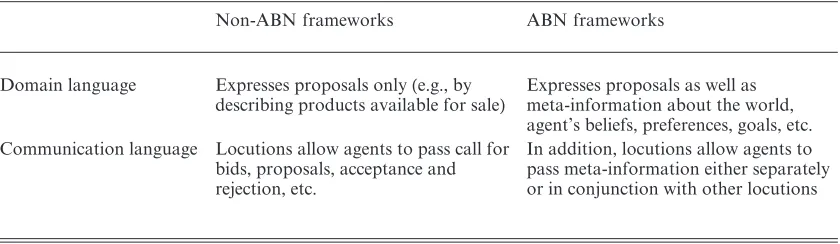
In ABN frameworks,agents need richer communication and domain languages to be able to exchange meta-level information(i.e.information other than that describing outcomes).Therefore, a major distinguishing factor of ABN frameworks is in the type of information that can be expressed and exchanged between agents and,consequently,in the specifications of the agents that generate and evaluate this information.Table 1 shows the main distinguishing features between ABN and non-ABN frameworks as they relate to the communication and domain languages.
3.1.1 State of the art
In existing ABN frameworks,various domain and communication languages have been proposed. They range from those designed as simplistic domain specific languages to more complex languages grounded in rich logical models of agency.
In multi-agent systems, two major proposals for agent communication languages have been advanced,namely the Knowledge Query and Manipulation Language (KQML) (Mayfieldet al., 1996)and the Foundation for Intelligent Physical Agents’ Agent Communication Language(FIPA ACL) (FIPA, 2001).FIPA ACL,for example,offers22locutions.The contents of the messages can be in any domain language. The locution inform(a, b, , lan),for example, allows agent a to inform another agent b of statement which is in language lan. Other locutions exist allowing agents to express proposals for action,acceptance and rejection of proposals,make various queries about time and place,and so on. FIPA ACL has been given semantics in the form of pre- and post-conditions of each locution. This semantics are based on speech act theory, due to a philosopher of language John Austin(Austin, 1962)and his student John Searle(Searle, 1969),in which a locution is seen as an action that affects the world in some way.
While FIPA ACL offers the benefits of being a more or less standard agent communication language,it fails to capture all the utterances needed in a negotiation interaction.For example, FIPA ACL does not have locutions expressing the desire to enter or leave a negotiation interaction, to provide an explicit critique to a proposal or to request an argument for a claim.While such locutions may be constructed by injecting particular domain language statements within locutions similar to those of FIPA ACL,the semantics of these statements fall outside the boundaries of the communication language.Consider the following locution from the framework presented by Kraus et al. (1998):
Request(j,i,Do(i,),Do(i,)→Do(j,)).
[image:7.595.60.480.135.257.2]In this locution,agentjrequests that agentiperforms actionand supports that request with an argument stating that ifiaccepts,jwill perform action in return.For the locution to properly Table 1 Differences between ABN and non-ABN frameworks with respect to domain and communication languages
Non-ABN frameworks ABN frameworks
Domain language Expresses proposals only(e.g.,by describing products available for sale)
Expresses proposals as well as meta-information about the world, agent’s beliefs,preferences,goals,etc. Communication language Locutions allow agents to pass call for
bids,proposals,acceptance and rejection,etc.
express a promise,actionmust actually be desired by agenti.If,in contrast,is undesirable to i,the same locution becomes a threat and might deterifrom executing.The locutionRequest,
however,does not include information that conveys this distinction.
In order to deal with the above problem, ABN framework designers often choose to provide their own negotiation-specific locutions, which hold the appropriate semantics of the message within them. For example, Sierra et al. (1998) and Ramchurn et al. (2003b) provide explicit locutions for expressing threats and rewards(e.g.,threaten(i,j,,)andpromise(i,j,,)). Having discussed some issues relating to the communication languages in ABN, let us now discuss the domain languages.In negotiation,the domain language must, at least, be capable of expressing the object of negotiation. In Sierra et al.’s model, the domain language can express variables representing negotiation issues (or attributes), constants representing values for the negotiation issues (including a special constant ‘‘?’’ denoting the absence of value), as well as equality and conjunction.This enables them to express full or partial multiple-attribute proposals. For example,the sentence
(Price=£10)o(Quality=high)o(Penalty=?)
expresses a proposal to agree on a high-quality product or service for the price of£10,and with a cancellation penalty yet to be agreed upon.There is also a meta-language for explicitly expressing preferences.For example,the statementPref(Price=£10,Price=£20)expresses the fact that an agent prefers a price of£10to £20.
In addition,ABN frameworks may need some way to express plans and resources needed for different plans. This is because agents participating in negotiation may be doing so in order to obtain resources needed for executing their plans.This means that an agent may be able to inform another agent of(parts of)its plans in order to justify its request for particular resources.Sadri et al. (2002),for example,express plans using theplan(.)predicate.The formula
plan(Khit(nail),hang(picture)L, {picture,nail,hammer})
denotes a plan(or intention)to hit a nail and hang a picture.The resources this plan requires are a picture,a nail and a hammer.
Some ABN frameworks also explicitly express information about agents’ mental attitudes.The ABN frameworks presented by Krauset al. (1998)and by Parsonset al. (1998),for example,allow an agent to represent beliefs about other agents’ beliefs,desires,intentions,capabilities,and so on, and are based on logics of belief,desire and intention(BDI) (Rao&Georgeff, 1995;Wooldridge, 2000).An agent can use this information not only in its internal reasoning processes,but also in its interaction with other agents.
The usefulness of the domain language in the context of ABN becomes particularly apparent when agents provide arguments for requesting certain resources,for rejecting certain requests,and so on.The richer the domain language,the richer the arguments that can be exchanged between agents.This will become more evident when we discuss argument generation and evaluation in the following sections.
3.1.2 Challenges
There are a number of challenges in the design of domain and communication languages for ABN. First,there is a need to provide rich communication languages with clear semantics.To this end, Mcburney et al. (2003) specified a set of locutions as part of a dialogue game11 for purchase 11 Dialogue games are interactions between two or more players,where each player makes amoveby making
negotiation among multiple agents. The authors provided public axiomatic semantics to their locutions by stating each locution’s externally observable preconditions,the possible response,and the updates to the information and commitment stores12. Moreover, the framework presents operational semantics of the whole framework,connecting locutions with each other via the agents’ decision mechanisms. However, this framework does not cover the whole spectrum of ABN situations.For example,there are no locutions for explicitly requesting,providing and challenging arguments, or for supporting argumentation over preference criteria. Locutions facilitating argument exchange have been proposed in other frameworks(e.g.,Sadriet al., 2001a, 2002;Torroni & Toni, 2001; Amgoud et al., 2000; Amgoud & Parsons, 2001). There are opportunities for extending the model of Mcburneyet al. (2003)with a richer argumentation system.
Another prospect of future research is the building of common,standardised domain languages that agent designers can use in order to plug their agents into heterogeneous environments.Efforts towards semantic and syntactic interoperability in domain languages and ontologies,such as the DARPA Agent Markup Language (Hendler & McGuinness, 2000; McGuinness, 2001) and the W3C Web Ontology Language (OWL) (McGuinness & van Harmelen, 2003) are particularly relevant. There is a need for exploring the suitability of these domain languages for supporting ABN and understanding how arguments can be expressed and exchanged.
3.2 Negotiation protocol
Given a communication and domain language, a negotiation framework should also specify a negotiation protocol in order to constrain the use of the language.Here we view a protocol as a formal set of conventions governing the interaction among participants(Jenningset al., 2001).This includes theinteraction protocolas well as other rules of the dialogue.
The interaction protocol specifies,at each stage of the negotiation process,who is allowed to say what.For example,after one agent makes a proposal,the other agent may be able to accept it,reject it or criticise it,but might not be allowed to ignore it by making a counterproposal.The protocol might be based solely on the last utterance made,or might depend on a more complex history of messages between agents.
The other rules that form part of the negotiation protocol may address the following issues (Estevaet al., 2001;Jenningset al., 2001):
• rules for admission,which specify when an agent can participate in a negotiation dialogue and under what conditions;
• rules for participant withdrawal, which specify when a participant may withdraw from the negotiation;
• termination rules, which specify when an encounter must end (e.g., if one agent utters an acceptance locution);
• rules for proposal validity,which specify when a proposal is compliant with some conditions(e.g., an agent may not be allowed to make a proposal that has already been rejected);
• rules for outcome determination,which specify the outcome of the interaction:in an auction-based framework, this would involve determining the winning bid(s) (Sandholm, 2002a); in argumentation-based frameworks, these rules might enforce some outcome based on the underlying theory of argumentation (e.g., if an agent cannot construct an argument against a request,it accepts it(Parsons et al., 1998));
• commitment rules, which specify how agents’ commitments should be managed, whether and when an agent can withdraw a commitment made previously in the dialogue,how inconsistencies between an utterance and a previous commitment are accounted for,and so on.
In ABN,the negotiation protocol is usually more complex than those in non-ABN.By ‘‘more complex’’, we mean that the protocol may involve a larger number of locutions, and a larger
number of rules.This leads to computational complexity arising from processes such as checking the locutions for conformance with the protocol given the history of locutions.
3.2.1 State of the art
With respect to the interaction protocol,a variety of trends can be found in the ABN literature. Interaction protocols can either be specified in anexplicitaccessible format,or only beimplicitand hardwired into the agents’ specification.
Explicit specification of interaction protocols may be done using finite-state machines (e.g., Sierraet al., 1998;Parsonset al., 1998).While this approach may be useful when the interaction involves a limited number of permitted locutions,it becomes harder to specify and understand when the number of locutions and their interactions increases significantly.This is particularly problem-atic when different agent designers need to look up the interaction protocol specification to guide their agents’ design and implementation.In such cases,other forms of protocol specification may be more suitable.
Another way of expressing interaction protocols explicitly is using dialogue games(as in,e.g., Amgoudet al. (2000),Amgoud and Parsons(2001),McBurneyet al. (2003)).As mentioned above, dialogue games have the advantage of providing clear and precise semantics of the dialogues,by stating the pre-and post-conditions of each locution as well as its effects on agents’ commitments. The following is the specification of a locution from the protocol presented by McBurneyet al. (2003).This locution allows a seller (or advisor) agent to announce that it(or another seller)is willing to sell a particular option13.
Locution:willing_to_sell(P1,T,P2,V),whereP1is either an advisor or a seller,Tis the set of participants,P2is a seller andVis a set of sales options.
Preconditions:some participantP3must have previously uttered a locutionseek_info(P3, S, p)whereP1∈S(the set of sellers),and the options inVsatisfy constraintp.
Meaning:the speakerP1indicates to audienceTthat agentP2is willing to supply the finite set V={a,b, . . .}of purchase options to any buyer in setT.Each of these options satisfy constraintp uttered as part of the priorseek(.)locution.
Response:none required.
Information store updates: for each a ∈ V, the 3-tuple (T, P2, a) is inserted into IS(P1), the information store for agentP1.
Commitment store updates:no effects.
One advantage of dialogue game protocols is that they have public axiomatic semantics.This is because they refer only to observable pre-conditions and effects,rather than to the agents’ internal mental attitudes.This makes it easier to verify whether agents are conforming to the protocol.
Other frameworks implicitly hardwire the interaction protocol into the agents’ internal specification(e.g.,Krauset al., 1998;Sadriet al., 2001a,b, 2002;Torroni &Toni, 2001).In these frameworks,the interaction protocol is specified using logical constraints expressed in the form of if–then rules.Since these frameworks describe a logic-based approach to agent specification(Kraus et al., 1998)implement their agents using logic programs,while Sadriet al. (2001b)use abductive logic programs),the protocol rules are coded as part of the agent’s program.These rules take the formP(t)oC(t)2P′(t+1),meaning that if the agent received performative(i.e.locution)Pat time t,and conditionCwas satisfied at that time,then the agentmustuse the performativeP′at the next time point.The conditionCdescribes the rationality precondition in the agent’s mental state.For example,one rule might state that if an agent received a performative which includes a request for a resource and it does not have that resource, then it must refuse the request. Note that this constitutes private semantics of the protocol, and is hence harder to enforce by an external regulator.
The termination rules in negotiation protocols specified as finite-state machines are defined as a set of links to a final state.This is usually the case when one agent utters awithdrawaccept(.)
locution.In the framework of McBurneyet al. (2003),a rule specifies that the dialogue ends after an agent utters the locution withdraw_dialogue(.)causing either no remaining sellers or no remaining buyers in the dialogue.In some frameworks,however,no termination rules have been defined,and hence the dialogue remains open even after agreement or failure.
In relation to outcome determination rules,some frameworks determine outcomes based on the logical structure of interacting arguments.For example,in the frameworks of Parsonset al. (1998) and Amgoudet al. (2000),a rule specifies that an agent must accept a request if it fails to produce an argument against that request.A similar case occurs when agents argue about their beliefs – an agent must accept a proposition if it fails to provide an argument for the negation of the proposition.In this sense,outcome determination isimplicitin the underlying argumentation logic. In other frameworks,such as those of Krauset al. (1998)and Ramchurnet al. (2003),outcomes are reached through uttering a specific locution explicitly(e.g., by uttering accept(.)). Agents may utter such a locution based on some internal utility evaluation.
We leave the discussion of commitment rules to Section 3.3, where we discuss commitment stores.
3.2.2 Challenges
Protocols for ABN share the challenges faced in the design of argumentation protocols in general. For example,there is a need for qualities such as fairness,clarity of the underlying argumentation theory,discouragement of disruption by participants,rule consistency,and so on14.
One particularly important property is that oftermination.To this end,some rules for preventing certain causes of infinite dialogues have been proposed.For example,the protocol of Amgoud and Parsons(2001)does not allow agents to repeat the exact same locutions over and over again.The intuition is that this would prevent the agent from,say,repeating the same question over and over again. In subsequent papers, the authors present further analysis of the outcomes of various argumentation-based dialogues(Parsons et al., 2002, 2003).
Torroni(2002)studied termination and success in the ABN framework presented earlier(Sadri et al., 2001b).Since the ABN framework is grounded in an operationally defined agent architecture based on abductive logic programming,it has been possible to study some properties by referring to the machinery of abduction.In particular,the author determined an upper limit to the maximum length of a dialogue, measured in the number of exchanged messages. Since these results are strongly dependant on the underlying logical system,it is not clear whether these results can be generalised to a variety of protocols without regard to the internal agent architecture.
Another important desired property in ABN protocols is that ofguaranteed success.Wooldridge and Parsons (2000) investigated the conditions under which particular logic-based negotiation protocols terminate with agreement.They provided results showing the complexity of solving this problem with negotiation frameworks using different domain languages.Most interestingly,they showed that the problem of determining whether a given protocol can be guaranteed to succeed, when used with a FIPA-like communication language,is provably intractable.
An important problem related to interaction protocols in general is that of conformance checking.This problem is concerned with answering the question of whether a particular utterance is acceptable, given the history and context of interaction.Conformance checking is one of the sources of complexity in dialogue systems;however,to date,it has received little attention in the ABN literature. Recently, Huget and Wooldridge (2003) investigated applying model checking techniques to this problem.
14 For a more elaborate discussion of the properties desired in argumentation protocols,refer to(McBurney
Another avenue of future research is in the design of admission rules in negotiation protocols. While some frameworks(e.g.,McBurneyet al., 2003)require that agents explicitly request to enter a negotiation dialogue,to our knowledge,no ABN framework includes external rules that govern admission to the negotiation dialogue. One may envisage situations where only agents with particular credentials,such as reputation or performance history,may be admitted to a negotiation. More work needs to be done on investigating the effect of different admission rules on the outcome of negotiation.For example,a malicious agent may attempt to disrupt the interaction among other participants,and hence should not be admitted. Relevant work has been done in the context of agent admission to electronic institutions(Rodriguez-Aguílar&Sierra, 2002).
3.3 Information stores
In some ABN frameworks, there is no explicit centralised information store available. Instead, agents internally keep track of past utterances (e.g., Kraus et al., 1998). However, in many negotiation frameworks there is a need to keep externally accessible information during interaction. For example, we might need to store the history of utterances for future reference or to store information about the reputation of participants (Rubiera et al., 2001; Yu & Singh, 2002). Moreover, having external information stores makes it possible to perform some kind of enforcementof protocol-related behaviours.For example,we may be able to prevent an agent from denying a promise it has previously made.
3.3.1 State of the art
One type of information store that is common in the argumentation literature is thecommitment store15.Commitment stores were initially conceived by Hamblin(1970) as a way of tracking the claims made by participants in dialogue games.Hamblin studied dialogues over beliefs,although he was at pains to state that commitments made in dialogue games should not be construed as necessarily representing the real beliefs of the respective participants (Hamblin, 1970, p. 257). Hamblin’s notion of commitment store has been influential in later work on dialogue games,both in philosophy and in multi-agent systems, although the notions of commitment used sometimes differ.In the work on the philosophy of dialogue (e.g.,Walton &Krabbe, 1995) the focus is on action commitments,i.e.promises to initiate,execute or maintain an action or course of actions. Commitments to defend a claim if questioned,called propositional commitments,are viewed as special cases of such action commitments by these authors.In the multi-agent systems literature the concern is usually with action commitments,where the actions concerned are assumed to take place outside the agent dialogue.For example,one agent may commit to providing a specified product or service to another agent.
Note that commitment stores should not be confused with the interaction history,which only records the sequence of utterances during the whole interaction16. While the latter only form a passive storage of ‘‘unprocessed’’ utterances, commitments in commitment stores have more elaborate consequences.For example,when an agent asserts a propositionp,it may not only be committed to believe thatpholds,but also to defending thatp(if challenged),not denying thatp, giving evidence thatp,and so on(Walton&Krabbe, 1995).In the multi-agent systems literature, Singh(2000)gave ‘‘social’’ semantics for commitments using modal operators in branching-time logic.These semantics are public(i.e.based on external observations of utterances as opposed to agents’ internal mental states)and hence can be used for specifying,and checking for conformance with,the interaction protocols.Amgoud et al. (2002) also present social semantics of communi-cation based on argumentation. Another difference of commitment stores in comparison with interaction histories is that commitment stores have specific commitment rules governing the
addition and removal of statements that the agent is committed to. One rule may specify, for example,that if the agent retracted a previously asserted claim,it must also retract every claim based on the former via logical deduction. Another relevant concept is that of pre-commitment proposed by Colombetti(2000).A request pre-commits the utterer in the sense that the utterer will be committed in case the hearer accepts the request.Commitment stores enable us to capture such pre-commitments.
In the ABN literature,Amgoud and Parsons(2001)define for each agent a publicly accessible commitment store.Adding statements to the commitment store is governed by the dialogue-game rules.For example,when an agent accepts a request for actionp,thenpis added to its commitment store.Agents may also be allowed to retract commitments under certain conditions.In the context of purchase negotiations,McBurneyet al. (2003)dealt with the issue of retraction differently.For example,the framework involves two locutions,agree_to_buy(.)andagree_to_sell(.),for committing to certain resource exchanges. Instead of providing explicit locutions for retracting these commitments, the authors provide additional locutions,willing_to_buy(.) and will-ing_to_sell(.), which are softened versions of the former locutions, however, with no commitments incurred(i.e.,they are free to refuse to sell or buy something they have previously agreed upon).This way,agents may usefully provide information without necessarily committing to it or having to explicitly retract it.
3.3.2 Challenges
The representation and manipulation of information stores is not a trivial task,and has significant effects on both the performance and outcomes of negotiation dialogues.In particular,information store manipulation rules have a direct effect on the types of utterances agents can make given their previous utterances(i.e.,the protocol),the properties of the dialogues(e.g.,termination),and the final outcome(e.g.,the ability to change one’s mind coherently).
Some of the key questions that need to be addressed in an ABN framework are as follows.Under what conditions should an agent be allowed to retract its commitments and how would this affect the properties of dialogues? Under what conditions should an agent be forced to retract its commitments to maintain consistency? While these questions are being investigated in the multi-agent dialogue literature in general(Maudet&Chaib-draa, 2003),there are issues specific to negotiation dialogues. In particular, commitments to providing, requesting, and exchanging resources may require different treatments from commitments in other types of dialogues,such as persuasion or information seeking.Very little work on this problem has been done in existing ABN frameworks.
4 Elements of ABN agents
In the previous section,we discussed the different elements of an ABN framework that are external to the participating agents. Issues such as the interaction protocol, commitment rules, and communication languages represent the environment in which agents operate,but often these say little about how agents are specified,or how they reason about the interaction.
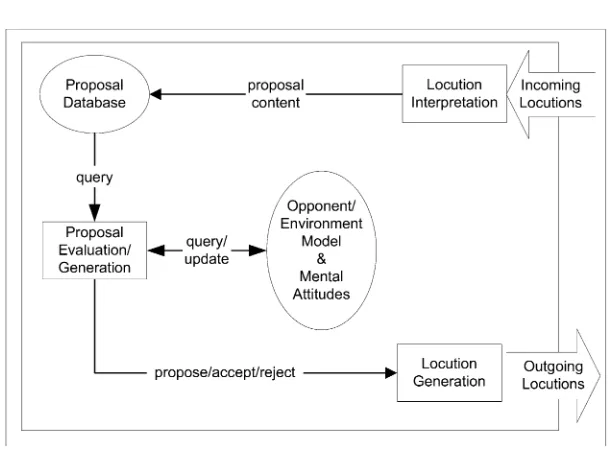
Before we get into a discussion of the general features of an ABN agent, we describe what constitutes(at an abstract level)a basic,non-ABN negotiating agent.This will allow us to clearly contrast the ABN agent from other negotiators,making our analysis more focused.Therefore,we begin by presenting a conceptual model of a simple negotiator in Figure1.This captures,on a very abstract level, the main components needed by an agent in order to be capable of engaging in negotiation17.This model is not meant to be an idealisation of all existing models in the literature, but rather a useful starting point for illustrating how ABN agents differ from other types of agent. 17 For a more detailed discussion of the conceptual architectures for negotiating agents,refer to(Ashriet al.,
We refer to an agent involved in negotiation interactions which largely depend on exchanging proposals,such as auction-based and bargaining agents,as a classical negotiating agent.This agent needs to have a locution interpretation component, which parses incoming messages. These locutions usually contain a proposal,or an acceptance or rejection message of a previous proposal. They might also contain other information about the interaction,such as the identity of the sender (especially in the case of multi-party encounters). Acceptance messages usually terminate the encounter with a deal. A proposal may be stored in a proposal database for future reference. Proposals(or rejections)feed into aproposal evaluation and generation component,which ultimately makes a decision about whether to accept,reject or generate a counterproposal,or even terminate the negotiation18.This finally feeds into thelocution generationcomponent which sends the response to the relevant party or parties.
A more sophisticated classical agent may maintain aknowledge baseof its mental attitudes(such as beliefs,desires,preferences,and so on(Wooldridge, 2002)),as well as models of the environment and the negotiation counterpart(s).This knowledge may be used in the evaluation and generation of proposals by judging the validity and worth of the proposals made(for example,by verifying whether proposals are actually feasible and do not conflict with the current observations of the environment). Moreover, the knowledge base may be updated in the light of new information. However,the updates that can be made are somewhat limited because the only information usually available to the agent during the interaction is:
1. proposals(or bids)from the counterpart or a competitor; 2. a message rejecting a proposal initially made by the agent;
3. other observations from the environment (e.g., a manufacturing plant agent bidding for raw material may monitor customer demand changes and bid accordingly).
The agent may be able to infer certain things from this information.For example,by receiving a rejection the agent may infer that the counterpart does not rate certain attribute/value assignments highly. Similarly, by receiving a proposal (or by observing the proposal of another competing 18 Note that the way components operate is constrained by the negotiation protocol.For example,in English
[image:14.595.170.477.95.320.2]auctions,which are highlyasymmetric,one agent usually only receives bids while others only generate them. In bargaining models(e.g.,Kowalczyk& Bui, 2001),however,the protocol tends to besymmetric,allowing both agents to evaluate and generate proposals.
bidder)the agent might infer attribute values that appeal to the counterpart(or competitor),which can then guide his own bargaining or bidding strategy19.
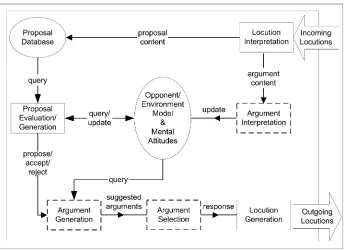
In contrast with a classical negotiating agent,more sophisticated meta-level information can be explicitly exchanged between the ABN agents (see Figure 2)20. This, in turn, can have a direct effect on the agent’s knowledge base. Therefore, in addition to evaluating and generating proposals, an agent capable of participating in ABN must be equipped with mechanisms for evaluatingarguments(and updating the mental state accordingly)and forgeneratingandselecting arguments.
If the locution contains an argument, anargument evaluation or interpretation mechanism is invoked which updates the agent’s mental state accordingly.This may involve updating the agent’s mental attitudes about itself and/or about the environment and its counterparts.Now,the agent can enter theproposal evaluationstage in the light of this new information.Note that at this stage,not only does the agent evaluate the most recent proposal,but it can also re-evaluate previous proposals made by its counterparts;these proposals are stored in the proposal database. This is important since the agent might (intentionally or otherwise) be persuaded to accept a proposal it has previously rejected.
As a result of evaluating proposals,the agent may generate a counterproposal,a rejection,or an acceptance.In addition,however,a finalargument generationmechanism is responsible for deciding what response to actually send to the counterpart and what(if any)arguments should accompany the response.For example,the proposal evaluation and generation component might decide that a proposal is not acceptable and the argument generation mechanism might accompany the rejection with a critique describing the reasons behind the rejection.Such arguments might also be explicitly requested by the other party or even enforced by the protocol.Note that an agent may also choose 19 Similar issues have been investigated in the study ofsignallingin game-theory(Spence, 1974).
20 Note that the actual way in which ABN agents are designed or implemented may differ from the above.
[image:15.595.98.445.107.357.2]For example,the agent might perform certain operations in a different order,or might combine or further decompose certain functionalities.Therefore,our conceptual model is to be taken in the abstract sense and should not be seen as a prescriptive account of how ABN agentsmustprecisely look.Instead,it provides a useful point of departure for beginning an analysis of the generic features of these agents.
to send a stand-alone argument(i.e.not necessarily in conjunction with a proposal,acceptance or rejection).
At times,there might be a number of potential arguments that the agent can send.For example, in order to exert pressure on a counterpart,an agent might be able to either make a threat or present a logical argument supporting some action.Deciding on which argument to actually send is the responsibility of anargument selectionmechanism.Finally,this information is given to thelocution generationmechanism which places this information in the proper message format and utters it.
In summary,negotiating agents must,at least,be able to: 1. interpret incoming locutions;
2. evaluate incoming proposals; 3. generate outgoing proposals; 4. generate outgoing locutions.
An ABN agent needs,in addition,to be able to:
1. evaluate incoming arguments and update its mental state accordingly; 2. generate candidate outgoing arguments;
3. select an argument from the set of available arguments.
Now that we have given an overview of the features of an ABN agent,we consider each of these features in more detail.In the course of doing so,we evaluate the state of the art and outline major challenges and opportunities.
4.1 Argument and proposal evaluation
Recall that an ABN agent needs to evaluate potential agreements proposed by its counterpart(s). The agent also needs to be able to evaluate arguments intended at influencing its mental state.While proposals may be evaluated more straightforwardly through comparison with some subjective preference criteria,argument evaluation is less trivial.
Argument evaluation is a central topic in the study of argumentation,and has been studied extensively by philosophers from at least the days of Aristotle(Aristotle, 1928;Hitchcock, 2002). In artificial intelligence, argument evaluation and comparison has been applied, for example, in internal agent deliberation(Kakas&Moraitis, 2003),in legal argumentation(Prakken&Sartor, 2001),and in medical diagnosis(Krauseet al., 1995;Fox&Parsons, 1998).
Here,however,we find it useful to distinguish between two types of considerations in argument evaluation.
1. Objective considerations. An argument may be seen as a tentative proof for some conclusion. Hence, an agent, or a set of agents, may evaluate an argument based on some objective convention that defines how the quality of that proof is established. This may be done, for example,by investigating the correctness of its inference steps,or by examining the validity of its underlying assumptions.For example,Elvang-Gøranssonet al. (1993) proposed a classifi-cation of arguments into acceptability classes based on the strength of their construction. Arguments may also be evaluated based on their relationships with other arguments.For Dung (1995),for instance,an argument is said to beacceptablewith respect to a setSof arguments if every argument attacking it is itself attacked by an argument from that set.The setSis said to beadmissibleif it is conflict free and all its arguments are acceptable with respect toS. 2. Subjective considerations. Instead of applying an objective, agent-independent convention for
participants may influence the outcome of the argument evaluation process by having different subjectivepreferences.
Let us now examine the usage of the above considerations in different types of argumentation dialogues.If two agents are reasoning about what is true in the world(i.e.if they are conducting theoretical reasoning),then it makes sense for them to adopt an objective convention that is not influenced by their individual biases and motivations. For example,whether it is sunny outside should not be influenced by whether participants want it to be sunny, but rather only by the material evidence available.
If,on the other hand,two participants are engaged in a dialogue for deciding what course of action to take(i.e.if they are conductingpractical reasoning),what division of scarce resources to agree upon or what goals to adopt,then it would make more sense for them to consider their subjective, internal motivations and perceptions, as well as the objective truth about their environment21.Even objective facts may be perceived differently by different participants,and such differences in perception may play a crucial role in whether or not participants are able to reach agreement.For example,a potential airline traveller may perceive a particular airline as unsafe, while the staff of the airline itself may consider it to be safe. Presumably such a difference in perceptions may be resolved with recourse to objective criteria (if any can be agreed)regarding relative crash statistics,deaths-per-mile-flown on different airlines,etc.However, if,for example, potential travellers perceive a particular airline as unsafe compared with other airlines, despite objective evidence showing the airline to be safer than others,this perception may inhibit them from flying the airline anyway. The marketing team of the airline concerned, in trying to persuade potential travellers to fly with it,will have to engage in dialogue with potential customers on the basis of those customers’ subjective perceptions,even though such perception may be false.For the marketers to ignore such mis-perceptions risks the dialogue terminating without the potential customers flying the airline.
In summary,agents participating in negotiation are not concerned with establishing the truthper se,but rather with the satisfaction of their needs.Hence, negotiation dialogues require agents to perform argument evaluation based on objective as well as subjective criteria22. In other words, agents need to performargument evaluationas part of,or in relation to,proposal evaluation.
4.1.1 State of the art
As we argued above, argument evaluation in negotiation must involve both objective as well as subjective considerations, and hence must involve some subjective assessment of proposals put forward by negotiation counterparts.In this subsection,we show some approaches to proposal and argument evaluation in the existing ABN literature.
One approach to proposal and argument evaluation is to assume agents are benevolent,using the following simple normative rule:if I do not need a resource, I should give it away when asked.This approach can be found in a number of frameworks(e.g.,Parsonset al., 1998;Amgoudet al., 2000b; Sadriet al., 2001b).
Consider the following example from Parsons et al. (1998).An agent a intending to hang a picture would produce, after executing its planning procedure, intentions to acquire a nail, a hammer and a picture.Interactions with other agents are only motivated in case the agent is not able to fulfil its intentions on its own.Suppose the agent does not have a nail.This leads the agent to adopt a new intention(we can call that a sub-intention)to acquire a nail,which may be written Ia(Have(a, nail)). If a believes that another agent b has a nail, it would generate another sub-sub-intention thatbgives the nail to it,writtenIa(Give(b,a,nail)).This triggers a request to be 21 Refer to Rahwanet al. (2003c)for a related comparison between argumentation over goals and beliefs. 22 Note that objective argument evaluation may also take into account certain ‘‘preferences’’,such as the
made to agent b in the form H1 w Ia(Give(b, a, nail)), where the argument H1 constitutes the sequence of deductive steps taken to reach the request23.In general,agent b accepts the request unless it has a conflict with it.There are two types of conflict that would causebto reject the request as follows.
1. Agentbhas a conflicting intention.In argumentation terms,the agent refuses the proposal if it can build an argument thatrebutsit.
2. Agentb rejects one of the elements of the argument supporting the intention that denotes the request.In argumentation terms,the agent refuses the proposal because it can build an argument thatundercutsit.
We explain the above two cases using the same picture-hanging example.An example of the first case is if agentbrejects the proposal because it also needs the nail,say to hang a mirror(i.e.it can build an argument for the intentionIb¬Give(b,a,nail))).This argument is based on(among other things) the intention Ib(Can(b, hang(mirror))). An example of the second case is if, in the plan supporting the intentionIa(Give(b,a,nail)),agentamade the false assumption that bpossesses a nail,writtenBa(Have(b,nail)).Ifbactually does not have a nail,then it would adopt the intention of modifying that belief,i.e.Ib(¬Ba(Have(b,nail))).Agents continue through a process of argument exchange,which may involve recursively undercutting each other’s arguments until a resolution is reached.
In order for argumentation to work,agents must be able tocomparearguments.This is needed, for example,in order to be able to reject ‘‘weak’’ arguments.Parsons et al. compare arguments by classifying them into acceptability classes based on the strength of their construction (Elvang-Gøranssonet al., 1993b).If two conflicting arguments belong to the same class,the authors assume the agent has some capability to perform comparisons based on utility analysis.However, they do not specify how this decision procedure is actually undertaken,nor do they specify the conditions it needs to satisfy.
A similar approach is taken by Sadriet al. (2001b).This framework,however,does not involve arguing about beliefs.If an agenta receives a request for a resource and needs that resource for achieving some goal ga, the agent rejects the request, unless an alternative acceptable plan for achievinggacan be produced by the counterpart,with a promise to provide any missing resources for that plan toa.Agents are also assumed to have some ordering over plans that allow them to choose between alternative plans.
In the frameworks of Parsons et al.and Sadri et al.described above,argument and proposal evaluation take into account a very simplistic subjective rule;that is,to accept any request that the agent does notcurrentlyneed.While this may be useful for facilitating cooperative behaviour and making sure agents preserve their current subjective interests,it may not be suitable in open agent systems where agents may be purely self-interested and may refuse to provide any resources without something in return.
An alternative trend in proposal and argument evaluation is to explicitly take into account the utility of the agent.The basic idea is that the agent would calculate theexpected utilityin the cases where it accepts and rejects a particular proposal.By comparing the expected utilities in these two cases(i.e.in the resulting states), the agent would be able to make a decision about whether to accept or reject the proposal.In the framework of Krauset al. (1998),the agent makes a decision about whether to accept a request by evaluating three factors: (i)the Collision_Flag,which fires if the requested action conflicts with one of the agent’s intentions; (ii)the Convincing_Factor,which is a value between0and1assigned to the argument using somead hocrule(e.g.,an appeal to a past promise is assigned a value of1if the agent believes it has actually made such promise,and assigned 0 otherwise); and (iii) the Acceptability_Value,which involves a numerical calculation of utility 23 Note that the argument(or plan) may not contain only intentions, but also belief and desire formulae
tradeoffs in the case of accepting the request versus rejecting it.However,it is not clear,from the paper,how these factors are combined to produce a final decision.
Ramchurnet al. (2003b)built on the work of Krauset al. (1998)and took it further by factoring thetrustthe agent has in its counterpart when calculating the expected values.The probability of moving into the proposed state is captured by the uncertainty expressed in the trust value. The different factors taken into consideration are combined using fuzzy reasoning mechanisms.
Sierraet al. (1998) introduced authority as a criteria for evaluating arguments.They presented anauthority graphimposed by a relation over agent roles.This graph can be used to specify,for each pair of agents,which agent has higher authority.The authors also propose a way of comparing the authority levels ofsets ofagents.This can be used to compare arguments involving statements made by multiple agents.An argumentH1is preferred to anotherH2if and only if the authority level of agents involved in H1 is higher than those in H2. As an example, the authors define a conciliatory agent,which accepts appeal-to-authority arguments regardless of the content of the justification of the appeal.This means that there would be no difference between a strong appeal and a weak(or even meaningless)one.While authority seems to be a useful factor in evaluating arguments in an organisation, it seems unreasonable to rely solely on it. There are, therefore, opportunities for combining authority with the other argument evaluation techniques described earlier.
4.1.2 Challenges
The discussion above shows that the nature of argument evaluation depends largely on the object of negotiation and the way that agents represent and update their internal mental states. For example,in the framework presented by Parsonset al. (1998), agents are able to perform some objective argumentation over their beliefs about the availability of resources,the achievability of intentions,and so on.This allows agents to potentially modify each other’s mental attitudes,which may influence their preferences.In frameworks such as those of Ramchurnet al. (2003b)and Kraus et al. (1998), on the other hand,evaluation is based solely on the direct comparison of expected utilities.Agents do not influence each other’s beliefs,but rather exert pressure on each other by exercising their ability to influence the outcomes(for example,by making a promise or a threat). In other words, an agent would not voluntarily modify its position as a result of correcting its perceptions of the environment,but ratherforcedly concedeon its position as a result of pressure from its counterpart. Many opportunities exist for combining the objective (belief-based) and subjective(value-based)approaches to argument evaluation.For example,how can we combine the objective evaluation of the logical form of an argument with a subjective evaluation of its consequences based on utility,trust,authority,etc.?
Another challenge is that of providing unified argumentation frameworks that facilitate negotiation dialogues involving the notions of goals, beliefs, plans, etc. Rahwan et al. (2003c) argued that systems of argumentation designed for arguing about beliefs are not readily suitable for allowing for argumentation over goals,particularly due to the different ways conflict resolution among arguments must be dealt with.For example,there is a difference between attacking a goal by demonstrating that it is not achievable and attacking it by demonstrating that it is not useful. Rahwan et al. (2003b, c) demonstrated different ways in which goals may relate to their sub-goals,their super-goals and the agent’s beliefs.This allows one to characterise different types of arguments that may be provided against a particular goal,and how they can,if successful,affect the agents’ mental states.For example,the following statement represents an argument stating that the goal of going to Sydney is justified by the belief that there is a conference there (written justify(confInSyd,goSyd)),that this goal isachievableby buying a ticket and arranging accommo-dation(writtenachieve({buyTicket,arrangeAccomm},goSyd)),and that it isinstrumentaltowards the more basic goal of presenting a paper, (written instr(goSyd,presentPaper)):