This Provisional PDF corresponds to the article as it appeared upon acceptance. Fully formatted PDF and full text (HTML) versions will be made available soon.
The DUNDRUM Quartet: validation of structured professional judgement
instruments DUNDRUM-3 assessment of programme completion and
DUNDRUM-4 assessment of recovery in forensic mental health services.
BMC Research Notes 2011, 4:229 doi:10.1186/1756-0500-4-229 Sarah O'Dwyer ([email protected])
Mary Davoren ([email protected]) Zareena Abidin ([email protected])
Elaine Doyle ([email protected]) Kim McDonnell ([email protected])
Harry G Kennedy ([email protected])
ISSN 1756-0500 Article type Research article Submission date 17 January 2011 Acceptance date 3 July 2011
Publication date 3 July 2011
Article URL http://www.biomedcentral.com/1756-0500/4/229
This peer-reviewed article was published immediately upon acceptance. It can be downloaded, printed and distributed freely for any purposes (see copyright notice below).
Articles in BMC Research Notes are listed in PubMed and archived at PubMed Central. For information about publishing your research in BMC Research Notes or any BioMed Central
journal, go to
http://www.biomedcentral.com/info/instructions/
BMC Research Notes
© 2011 O'Dwyer et al. ; licensee BioMed Central Ltd.
The DUNDRUM Quartet: validation of structured
professional judgement instruments DUNDRUM-3
assessment of programme completion and
DUNDRUM-4 assessment of recovery in forensic
mental health services.
Sarah O’Dwyer1, Mary Davoren1, Zareena Abidin1, Elaine Doyle1, Kim McDonnell1,
Harry G Kennedy1,2§
1
National Forensic Mental Health Service, Central Mental Hospital, Dundrum, Dublin
14, Ireland
2
Department of Psychiatry, Trinity College, Dublin, Ireland.
§
Corresponding author
Email addresses:
SO’D: [email protected]
KMcD: [email protected]
HGK: [email protected]§
*These authors contributed equally to this work
§
Abstract
Background
Moving a forensic mental health patient from one level of therapeutic security to a
lower level or to the community is influenced by more than risk assessment and risk
management. We set out to construct and validate structured professional judgement
instruments for consistency and transparency in decision making
Methods.
Two instruments were developed, the seven-item DUNDRUM-3 programme
completion instrument and the six item DUNDRUM-4 recovery instrument. These
were assessed for all 95 forensic patients at Ireland’s only forensic mental health
hospital.
Results
The two instruments had good internal consistency (Cronbach’s alpha 0.911 and
0.887). Scores distinguished those allowed no leave or accompanied leave from those
with unaccompanied leave (ANOVA F=38.1 and 50.3 respectively, p<0.001). Scores
also distinguished those in acute / high security units from those in medium or in low
secure / pre-discharge units. Each individual item distinguished these levels of need
significantly. The DUNDRUM-3 and DUNDRUM-4 correlated moderately with
measures of dynamic risk and with the CANFOR staff rated unmet need (Spearman r
= 0.5, p<0.001).
Conclusions
The DUNDRUM-3 programme completion items distinguished significantly between
levels of therapeutic security while the DUNDRUM-4 recovery items consistently
lowest levels of therapeutic security. This data forms the basis for a prospective study
of outcomes now underway.
Background
We have recently validated structured professional judgement instruments for the
triage of mentally disordered offenders and those like them to aid in the assessment of
need for appropriate levels of therapeutic security [1,2], and to help prioritise the most
urgent cases for admission. We have shown that the factors taken into account when
deciding whether a patient should be admitted to an open admission unit, a locked low
secure unit or a forensic high / medium secure unit are different from risk assessment
instruments. It follows that the factors taken into account when deciding to move a
patient from one level of therapeutic security to another, when deciding to allow leave
from hospital or to discharge to the community may also be more complex than risk
assessment. Since the factors taken into account when assessing the need for
therapeutic security are essentially static the factors influencing decisions regarding
progress to less secure places are likely to be different and inherently sensitive to
change.
Once admitted, patients progress from admission / high secure to medium secure and
on to pre-discharge low secure and community placements [3]. These placements
correspond to a pathway through the secure treatment and rehabilitation service
towards recovery, and also correspond to a stratified risk management system [4].
Levels of therapeutic security in a forensic hospital also correspond to measures of
risk of harm to others and to self, symptom severity and global function [5,6,7].
Others have shown that changes in symptom score and function [8] and changes
dynamic risk measures [9] relate to discharge. However decisions regarding risk
management such as the level of leave permitted to individual patients are still largely
made on the basis of implicit knowledge i.e. unstructured professional judgment
professional judgement instruments described in this paper arose from the concern
that when making the case for progress from high to medium, from medium to low
secure placements or to the community, whether conditionally discharged or
absolutely discharged, risk assessment did not fully describe the clinical and related
factors taken into account. The evidence presented by clinicians to Mental Health
Review Boards or Tribunals and other decision making authorities regarding leave
outside the hospital or moves down the ladder of security and into the community is
often influenced by factors such as stability, insight, rapport and working alliance, use
of leave, assessments of dynamic risk factors and victim sensitivities. When writing
reports to such decision making bodies, the emphasis was commonly on physical and
mental health, substance misuse, problem behaviours, self care and activities of daily
living, education, occupation and creative activities and family and social networks.
While these overlap with the content of risk assessment instruments such as the
HCR-20 [9] and the S-RAMM [11] or START [12] they are sufficiently different in content
to justify drafting and testing structured professional judgement instruments specific
for the function of assessing and communicating readiness for onward movement to
less secure therapeutic placements.
The DUNDRUM Quartet [2] is a set of four structured professional judgement
instruments modelled on the HCR-20 in that each consists of operationally defined
ratings for domains relevant to the decision in hand. The DUNDRUM-3 Programme
Completion Items and DUNDRUM-4 Recovery Items (see Additional File 1) are
grounded in theory concerning motivation, the cycle of change, engagement and
addressing issues relevant to future avoidance of relapse and problem behaviours. The
rating scheme for each item is designed so that those rated ‘4’ are unlikely to be ready
move from a high secure to a medium secure setting; those rated ‘2’ should be ready
for a move from medium to low security; those rated ‘1’ may be ready for a move to
an open or community placement, though the availability of a high level of
community support, structure and supervision, mandated if necessary by legally
binding conditional discharge with a power of recall, may be a part of such a decision.
Finally, those rated ‘0’ may be ready for an absolute legal discharge though this
should be an individual decision in all cases.
In this cross-sectional study we have tested the psychometric properties of these
scales. We have also examined the extent to which they correspond to proxy measures
of outcome. This study is a preliminary step in a prospective validation of the
predictive power of these scales.
We hypothesized (i) that these items would form two psychometrically distinct scales.
We hypothesized (ii) that the scales would have acceptable psychometric properties
including internal consistency and inter-rater reliability; (iii) they were expected to
correlate to some extent with measures of mental state and global function and (iv)
with each other. We hypothesized (v) that these scales would correlate well with
ratings of dynamic risk of violence, harm or suicide, but less well with ratings of
static, historical risk factors. (vi) We expected these items to correlate with other
measures of met and unmet need. As a proxy for the intended function of these items
and scales, we hypothesized (vii) that they would differ according to the level of leave
the patient was currently allowed and (viii) according to whether the patient was
currently in acute / high secure, medium secure, low secure / pre-discharge or
Methods
Study design
This is a cross-sectional ecological or naturalistic study employing routine outcome
and clinical audit data on all patients in the National Forensic Mental Health Service
for Ireland between the months of February and March 2010.
Setting
At the time of the study the National Forensic Mental Health Service for Ireland had
93 secure in-patient beds, including eight for women, at the Central Mental Hospital.
The male beds are in wards (units) organised into a coherent pathway through care.
There is a 12 bed high secure male admission unit and a six bed high secure intensive
care unit. Patients who are not discharged early back to prison or to their local
psychiatric services progress to a 16 bed medium secure ward where
pharmacotherapy aims to achieve remission from symptoms while the emphasis is on
patient education regarding physical and mental health and substance misuse
programmes. Patients progress from there to a second 16 bed medium secure unit
where treatment programmes continue, emphasising meta-cognitive training,
enhanced thinking skills, dialectic behaviour therapy or selected modules from that
programme, anger management and education regarding healthy relationships. These
programmes are designed in three phases, first to provide preliminary short
educational modules, second, full manualised programmes in which patients are
encouraged to engage and participate by bringing personal examples for group work.
There is then a third, maintenance or refresher phase. Patients progress to a 15 bed
pre-discharge unit which has open access to the grounds of the hospital (within a
return to the community. There is also a ten bed 'slow stream' low secure unit. The
next step is to a ten bed ‘hostel ward’ in the grounds of the hospital within the secure
perimeter. Patients there are mostly engaged in occupational and educational activities
outside the hospital during the day, in preparation for discharge. There is also a six
bed community residence which is staffed 24 hours a day. A the time of this survey,
all patients in the community residence were legally categorised as on temporary
leave from the hospital, returning to the hospital at intervals of between once a week
and once a month. Women patients are currently accommodated in an 8 bed unit
which is best described as high secure because of the staff to patient ratio and physical
design. However programmes are individualised according to the stage of treatment
and rehabilitation.
Assessments
The study was approved by the local research, audit, ethics and effectiveness
committee as part of the clinical governance audit programme for quality
management at the hospital. All patients were assessed as part of routine outcomes
assessments and clinical audit. All patients consented to those assessments that
required interviews. Where assessments required the rating clinician to obtain
information from a key informant this was either the primary nurse or key worker
who had the longest current knowledge of the patient, or the consultant psychiatrist
responsible for the care and treatment of the patient, as appropriate to the particular
rating instrument.
DUNDRUM-3 Programme Completion and DUNDRUM-4 Recovery instruments
The two structured professional judgment instruments the DUNDRUM-3 and
DUNDRUM-4 are the products of an iterative drafting process, which has been
here – the DUNDRUM-3 programme completion and DUNDRUM-4 recovery
instruments are part of the 22nd revision of this draft. They form part of a suite of
structured professional judgment instruments [2] along with the DUNDRUM-1 triage
security instrument and DUNDRUM-2 triage urgency instrument, for assessing the
need for admission and prioritisation of waiting lists. We have trained mental health
professionals from psychiatry, nursing, psychology, social work and occupational
therapy to use the DUNDRUM-3 and DUNDRUM-4 by guiding the use of the
handbook followed by joint ratings of three prepared vignettes. This training takes
two and a half hours and forms part of the induction for all new clinical staff, with
optional top up training every six months.
Rating Scales
The DUNDRUM-3 Programme Completion instrument [2] was completed by
interviewing the key worker and by reference to the multi-disciplinary case notes. The
DUNDRUM-4 [2] was completed in the same way. No patient interview was
required. Ratings were made in February and March 2010 jointly by two (SO’D &
MD) post-membership trainee psychiatrists (equivalent to U.S. fellows) who were
trained in the use of the manual by HGK. They were blind to the ratings of other
instruments made by colleagues. They also completed ratings for the DUNDRUM-1
triage security instrument [1,2]. Both can be rated together in an hour, less when the
clinician already knows the patient.
The Positive and Negative Symptom Scale (PANSS) [13] and Global Assessment of
Function (GAF) [14] were completed in February and March 2010 by different
DUNDRUM-4. Face to face interviews were carried out and in addition primary
nurses and treating psychiatrists were also consulted.
The HCR-20 rates historical (fixed), clinical and 'risk' (dynamic) items concerning the
risk of violence to others [9] and the S-RAMM rates background (fixed), current and
future (dynamic) risk factors for suicide and self harm [11]. These were rated by the
treating consultant-led disciplinary teams. All members of the
multi-disciplinary teams were trained in the use of the HCR-20 and S-RAMM by accredited
trainers. These were collated by ZA and ratings were checked for consistency by
consulting with the clinicians who made the ratings, in February and March 2010.
The Camberwell Assessment of Need, Forensic Version (CANFOR) [15] was
completed by the social worker members of each multi-disciplinary team who were
trained in the use of the manual using a training video prepared in house. Ratings
were coordinated for consistency by KMcD, a Masters-level psychiatric social worker
in February and March 2010.
Outcome Measures
The most valid outcome measure would be the subsequent movement of patients from
higher to lower levels of therapeutic security or to the community, whether
conditionally discharged or absolutely discharged. The data presented here are the
basis for such a prospective study. To establish preliminary validity in this study,
proxy outcome measures have been employed. All patients have been grouped
according to whether at the time of the assessments they had been allowed no leave
outside the hospital, accompanied leave or unaccompanied leave outside the hospital.
Male patients were also grouped according to the ward or unit in which they were
security, with the men’s intensive care unit and admission unit combining as the first
cluster of high secure environments; the second ‘medium’ cluster comprises two
men’s medium secure units each with progressively lower staff to patient ratios and
less restrictive procedural security. This cluster also includes a longer term / slow
stream low secure unit. The third cluster of pre-discharge / community units is the
next step on the recovery pathway - from the medium term medium secure units
patients progress to a medium term low secure unit then to a hostel ward within the
secure perimeter of the hospital and then on to a high support 24 hour nurse staffed
residence in the community, these last two constituting a pre-discharge / community
cluster. Those who made decisions about leave and placement within the hospital
made those decisions prior to the rating of patients using these scales and the decision
makers were therefore blind to the ratings.
Statistics
All data were entered in SPSS-16 [16] and stored in anonymised form. Correlations
were calculated using the Spearman rank correlation coefficient, a non-parametric
measure to avoid the assumption of normal distribution. Scale properties were
assessed using factor analysis and Cronbach’s alpha statistic for internal consistency.
Inter-rater reliability was assessed using Spearman’s rank correlation for scale scores.
For individual items, the kappa statistic was used where it could be calculated and for
all items, the Spearman rank correlation coefficient and the X2 linear by linear
coefficient. Groups were compared using univariate analysis of variance. Items and
Results
Patients
There were 95 patients in the hospital when data were gathered in February and
March 2010, 8 women and 87 men. The mean age was 40.9 years (95% confidence
interval 38.4 to 43.5). The mean length of stay was 7.2 years (95% confidence interval
5.3 to 9.2 years). The acute / high secure cluster included the women’s unit, the men’s
admission unit and an intensively staffed men’s unit, 25 (26%) patients in all. In some
of the analyses that follow, only male patients are included because women are part of
a separate recovery pathway. The medium cluster units comprised of two medium
secure units for men and one slow-stream or longer term low secure unit, 40 (42%)
patients in all. The pre-discharge and community service had 30 (32%) patients.
Primary diagnosis was schizophrenia in 68 (72%), schizoaffective disorder in 8 (8%),
bi-polar affective disorder in 11 (12%), psychotic depression in 5 (5%) and
intellectual disability in 3 (3%). There were 25 (26%) patients transferred from
prisons, 8 (8%) detained because unfit to stand trial, 46 (48%) not guilty by reason of
insanity and 16 (17%) who were detained under the civil mental health act and
transferred from local psychiatric services.
No leave outside the hospital was permitted for 55 (58%) patients, 20 (21%) were
allowed leave accompanied by staff and 20 (21%) were allowed unaccompanied leave
as part of their pre-discharge rehabilitation programmes.
Inter-Rater Reliability
The ratings of 21 of the patients using the DUNDRUM-3 and DUNDRUM-4 by the
researchers (SO’D and MD) were replicated over the period of data collection by
HGK, who was blind to the ratings of SO'D and MD. The kappa statistic could be
calculated for 7 of the 13 items and ranged between 0.44 and 0.77 (all p<0.001). For
the Spearman rank correlation coefficient was greater than 0.51 (range 0.51 to 0.95,
all p<0.02). For items rated 0 to 4, random agreement between two raters can be
expected in 5 out of 25 'cells' i.e. 20% of cases. a probability of 0.2. For the
DUNDRUM-3 programme completion items, there was exact agreement between the
two raters for item 1 in 19 of 21 cases (90%, binomial exact probability p<0.001),
exact agreement for items 2 and 3 in 16/21 (76%, p<0.001), for item 4 in 13/21 (62%,
p<0.001), for items 5 and 6 in 18/21 (86%, p<0.001) and exact agreement for item 7
in 17/21 (81%, p<0.001). For the DUNDRUM-4 recovery items there was exact
agreement between the two raters for item 1 in 14/21 cases (67%, p<0.001), for item 2
in 16/21 (76%, p<0.001), for item 3 in 17/21 (81%, p<0.001), for item 4 in 13/21
(62%, p<0.001), for item 5 in 18/21 (86%, p<0.001) and for item 6 in 15/21 (71%,
p<0.001).
Internal consistency
The seven programme completion items were subjected to a principle components
factor analysis. All statistics are for 95 patients. Initial extraction yielded one factor
with an Eigen value of 4.65 accounting for 66% of the variance and other factors had
Eigen values less than 1. All seven items loaded positively on the first factor (r values
all >0.724). Cronbach’s alpha statistic for the seven Programme Completion items
was 0.911. Cronbach’s alpha if any one item was deleted was in the range 0.886 to
0.911.
The six recovery items were subjected to a principle components factor analysis.
Initial extraction yielded one factor with an Eigen value of 3.9 accounting for 66% of
the variance and other factors had Eigen values less than 1. All six items loaded
positively on this first factor (r values all >0.75). Cronbach’s alpha statistic for the six
range 0.845 to 0.885 except for item 6 'victim sensitivities' deletion of which led to an
increase of the alpha statistic to 0.982, a negligible change.
Factor analysis on all thirteen items together yielded two components with Eigen
values greater than 1. The first had an Eigen value of 7.7 and accounted for 59% of
the variance while the second had an Eigen value of 1.3 and accounted for 9.8% of the
variance. All thirteen items loaded strongly positively on the first component (all
r>0.575), while all the recovery items loaded positively on the second component
with five of the seven programme completion items loading negatively on the second
component. Only two programme completion items, programme completion item 4
‘problem behaviours’ and programme completion item 7 ‘family and social networks’
loaded positively on the second component. Cronbach’s Alpha for the combined scale
of thirteen items was 0.94 and only one item if omitted lead to an increase in the
Alpha statistic. This was recovery item 6 'victim sensitivity', omission of which gave
an alpha of 0.941, a negligible increase. Because of the face validity of the two scales
as distinct in content and because of the result of the factor analysis for all thirteen
items, it appears reasonable to treat them as separate for validation purposes, while
also accepting that they could be used as a single score for validation purposes. The
DUNDRUM-3 Programme Completion and DUNDRUM-4 Recovery scores
correlated with each other (Spearman r = +0.730, p<0.001)
Possible confounders
Age correlated poorly with the DUNDRUM-3 Programme completion score
(Spearman r=-0.205, p=0.047) and did not correlate significantly with the
DUNDRUM4 Recovery score (r= 0.205, NS) or the total score for all 13 items (r=
Length of stay correlated inversely but weakly with the DUNDRUM-3 Programme
completion score (r= 0.337, p<0.001), with the DUNDRUM4 Recovery score (r=
-0.352, p<0.001) and with the total for all 13 items (r= -0.348, p<0.001).
Men and women did not differ significantly for mean scores in DUNDRUM-3
Programme completion, DUNDRUM-4 Recovery or combined scores.
The PANSS positive symptom score correlated 0.516 with the DUNDRUM-3
programme completion score and 0.656 with the DUNDRUM-4 Recovery score. The
PANSS negative symptom score correlated 0.525 with the DUNDRUM-3 programme
completion score and 0.487 with the DUNDRUM-4 recovery score. The PANSS
general symptom score correlated 0.506 with the DUNDRUM-3 programme
completion score and 0.495 with the DUNDRUM-4 recovery score. The PANSS total
score correlated 0.574 with the DUNDRUM-3 programme completion score and
0.596 with the DUNDRUM-4 recovery score. The Global Assessment of Function
(GAF) score correlated inversely -0.650 with the DUNDRUM-3 programme
completion score and -0.673 with the DUNDRUM-4 recovery score. All correlations
with PANSS scales and GAF were statistically significant p<0.001, n=95.
Cross-validation with measures of risk and need for therapeutic security
The DUNDRUM-3 programme completion score correlated with the DUNDRUM-1
triage security score, a measure of need for therapeutic security (r = 0.346, p<0.001)
as did the DUNDRUM-4 recovery score (Spearman r = 0.444, p<0.001).
The DUNDRUM-3 Programme Completion score correlated with the HCR-H score
(the sum of the 10 ‘historical’ or fixed risk factors) r = 0.480; with the HCR-C score
(the sum of the five 'clinical' or current risk factors) r = 0.637; with the HCR-R score
score (the sum of the ‘C’ and ‘R’ risk factors) r = 0.629 and with the HCR-20 total
score r= 0.686 (all significant p<0.001, n=95).
The DUNDRUM-4 Recovery score correlated with the HCR-20 H sub-scale r = 0.446
and with the C score r = 0.731; with the R r = 0.533; with the
HCR-dynamic items (C and R combined) r = 0.704; and with the HCR-20 total score r =
0.713 (all significant p<0.001, n=95). Because the fifth item of the DUNDRUM-4
recovery score is itself strongly dependent on the dynamic items of the HCR-20, a
score was calculated for the other five of the DUNDRUM-4 recovery items only. This
correlated with the HCR-H score r = 0.447; with the HCR-C score r = 0.725; with the
HCR-R score r = 0.519; with the HCR-dynamic score r = 0.694; and with the HCR-20
total score r = 0.705 (all significant p<0.001, n=95), the omission making little
difference.
The DUNDRUM-3 Programme Completion score correlated with the S-RAMM
Background (historical, fixed) score r = 0.263 (p=0.05); with the S-RAMM Current
score r = 0.529; with the S-RAMM Future score 0.451; with the S-RAMM dynamic
score (the sum of the RAMM current and future scores) r=0.553; and with the
S-RAMM total score r = 0.556 (all significant p<0.001except where indicated, n=95).
The DUNDRUM-4 Recovery score correlated with the S-RAMM background score r
= 0.197 (not significant); with the RAMM Current score r = 0.613; with the
S-RAMM Future score r = 0.609; with the S-S-RAMM dynamic score r = 0.702; and with
the S-RAMM total score r = 0.628 (all significant p<0.001, n=95 except where
indicated).
Using the CANFOR, The DUNDRUM-3 programme completion score did not
correlate significantly with the patient self-rated met needs (Spearman r = -0.11, NS),
it did correlate with the patient self-rated unmet needs (r=0.33, p=0.002) and did not
correlate with the patient rated total needs (r=0.114, NS). For staff ratings, met needs
did not correlate significantly with the DUNDRUM-3 programme completion score
(r=0.09, NS) but the DUNDRUM-3 did correlate with unmet needs r = 0.50,
(p<0.001) and total needs r = 0.36 (p<0.001).
Comparing the CANFOR and the DUNDRUM-4 recovery score, patient self-ratings
for met need did not correlate (r = -0.182, NS), patient rated unmet needs correlated
modestly (r=0.253, p=0.019) while patient rated total needs did not correlate (r=0.019,
NS). Staff ratings of met need did not correlate with the DUNDRUM-4 score
(r=-0.022, NS), though rated unmet need correlated 0.501 (p<0.001) while
staff-rated total need correlated weakly (r=0.238, p=0.02).
Leave
Patients were divided into those who had no leave outside the hospital, those who had
leave outside the hospital only when accompanied by staff and those who had
unaccompanied leave outside the hospital. Because the fourth item in the
DUNDRUM-4 recovery scale is largely determined by the level of leave, this was
recalculated for the five other items only – referred to here as the DUNDRUM-4 RL
score.
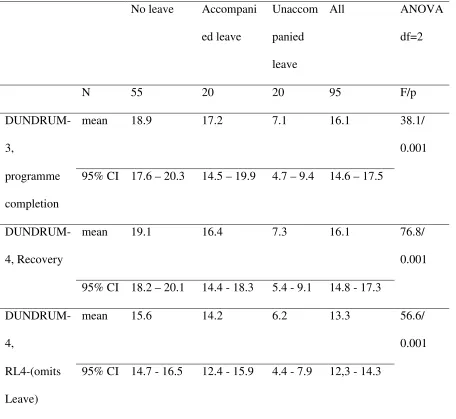
Table 1 shows that the DUNDRUM-3 programme completion score was significantly
lower for those who were allowed unaccompanied leave (ANOVA F=38.1, df=2,
p<0.001). Bonferroni post-hoc tests for multiple comparisons showed that those with
unaccompanied leave had significantly lower scores than those with no leave or
(ANOVA F=76.8, p<0.001), post hoc tests showed that those with unaccompanied
leave and accompanied leave both had significantly lower scores that those who had
no leave p<0.001 and p=0.014, and held also when the leave item was excluded -
DUNDRUM-4 RL, (ANOVA F=56.6, df=2, p<0.001) post hoc tests demonstrated
that those with unaccompanied leave had lower scores than those with accompanied
leave (p<0.001) or no leave (p<0.001) while those with accompanied leave also had
lower scores than those with no leave (p=0.009).
Stratification along the recovery pathway - clusters
Because the women’s unit is not part of the same recovery pathway as the
arrangement of wards and units providing for men, the arrangement of wards into
three clusters (acute & high secure, medium secure and pre-discharge) refers only to
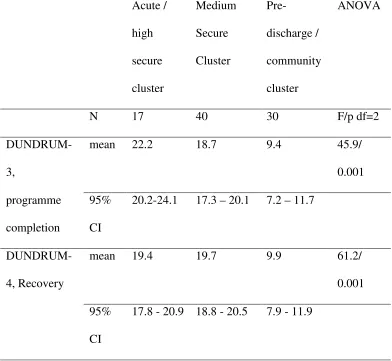
the 87 male patients. Table 2 shows that the DUNDRUM-3 programme completion
score was significantly different when each of the three stages were compared with
each other (ANOVA F=45.9, df=2, p<0.001, Bonferroni post hoc tests pre-discharge
significantly less than acute/high secure p<0.001 and medium secure p<0.001,
medium secure significantly less than acute / high secure p<0.05). The DUNDRUM-4
recovery score was significantly lower only for those in the pre-discharge cluster
(ANOVA F=66.8, df=2, p<0.001, post-hoc test pre-discharge less than medium
<0.001 and acute / high secure p<0.001).
Stratification along the recovery pathway - by units
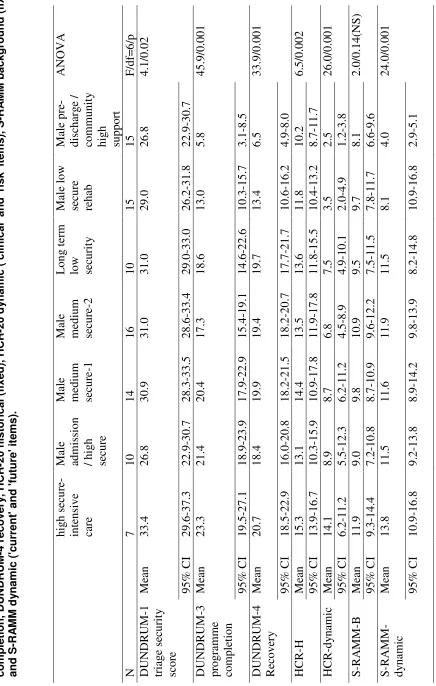
Table 3 shows that static measures such as the DUNDRUM-1 triage security score,
the HCR-20 ‘H’ score (sum of historical items) and S-RAMM ‘B’ score (sum of
background items) differ between units to a limited extent, with no clear pattern other
than the accumulation of those with the highest fixed historical risk profile or risk
lower scores. The dynamic risk scores for the HCR-20 and S-RAMM present a clearer
pattern of stratification from intensive care and admission units to pre-discharge. The
strongest and most consistent stratification was found for the DUNDRUM-3
programme completion (ANOVA F=45.9, df=6, p<0.001) and DUNDRUM-4
recovery scores (ANOVA F=33.9, df=6, p<0.001) with falling scores from high
secure /intensive care through medium secure units to low secure, pre-discharge and
community high support.
Bonferroni post hoc tests show that for the DUNDRUM-1, only the intensive care and
the pre-discharge / community groups differed significantly (p=0.021). For the
DUNDRUM-3 and DUNDRUM-4, the low secure rehab and pre-discharge /
community groups differed significantly from all other groups and from each other.
For HCR-H, the medium secure unit 1 differed from the pre-discharge and
community group p<0.05. For HCR-dynamic the intensive care unit had a
significantly higher mean score than all other units except the long term low secure
unit, the low secure rehab unit was significantly lower than the intensive care unit,
male medium secure unit 2 and the long term low secure unit, while the
pre-discharge/community group was lower than all other units except the low secure
rehab unit. S-RAMM dynamic scores were significantly lower in the pre-discharge/
community group than for any other unit and the low secure rehab unit was
significantly lower than the intensive care unit.
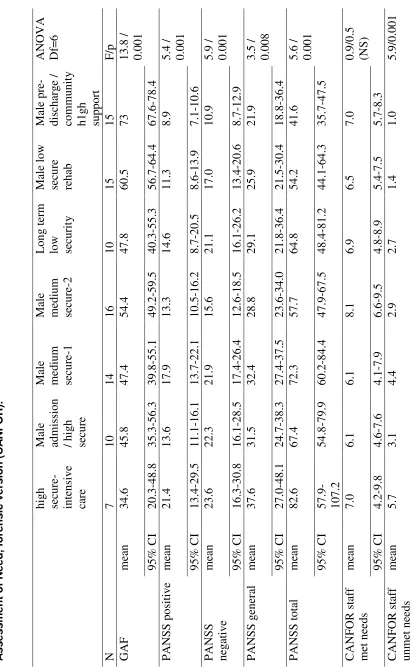
Table 4 shows that the Global Assessment of Function (GAF) increases progressively
from the intensive care and admission units through medium secure and low secure to
pre-discharge and community units (ANOVA F=12.0, p<0.001). PANSS positive,
PANSS negative, PANSS general and PANSS total scores also stratified, though less
differed significantly across the recovery pathway as expected, (F=5.9, p<0.001) but
neither staff-rated met needs nor staff-rated total needs differed significantly. Patient
self-rated needs, met, unmet and total did not differ significantly.
Bonferroni post hoc tests show that for the GAF, the pre-discharge / community group
had significantly higher scores than all other units except the male low secure rehab
unit while the intensive care unit had significantly lower scores than all but the
admission high secure and medium secure unit 1. The PANSS positive score was
significantly higher when the intensive care unit was compared with the low secure
rehab and pre-discharge / community groups while the pre-discharge / community
group had lower scores than the intensive care unit and the medium secure unit 1.
PANSS negative scores were lower for the pre-discharge / community group than for
the intensive care unit, admission / high secure unit, medium secure unit 1 and long
term low secure unit. For PANSS general score, the pre-discharge / community group
had a lower mean score than the intensive care unit or the medium secure unit 1.
PANSS total score was higher for the intensive care unit than for the male low secure
rehab and pre-discharge / community units while the pre-discharge and community
group had a lower mean PANSS total score than the intensive care unit and the
medium secure unit 1. CANFOR staff unmet needs were greater for medium secure
unit 1 than the low secure rehab unit, the intensive care unit had a higher score than
the low secure rehab unit and the discharge / community group and the
pre-discharge / community group had a lower mean score than the intensive care unit and
medium secure unit 1.
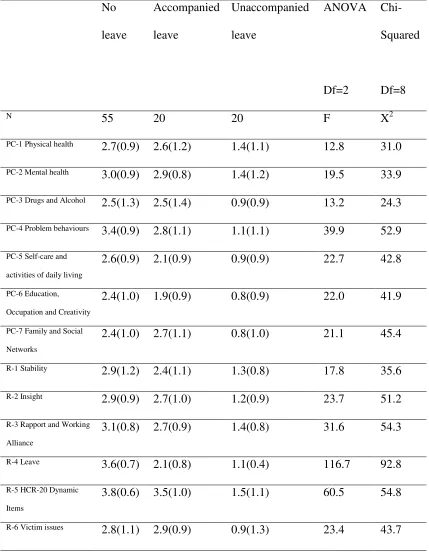
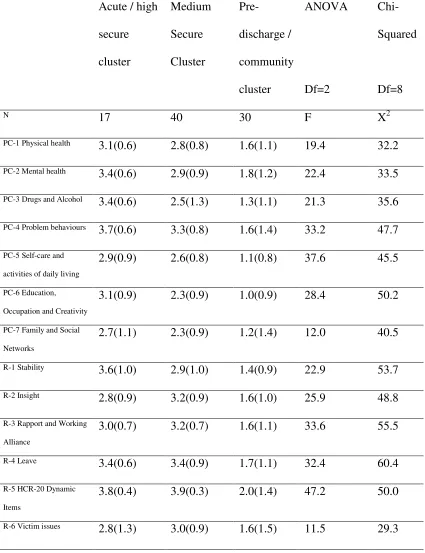
Tables 5 and 6 show that each item of the DUNDRUM-3 programme completion
instrument and DUNDRUM-4 recovery instrument differed significantly across the
recovery pathway clusters and according to the level of leave allowed at the time the
ratings were made. Note that for level of leave, the DUNDRUM-4 recovery item 4
'leave' has an extremely high statistical significance because the definition makes this
almost a circular measure.
Discussion
We have constructed two structured professional judgement instruments specifically
to cover those factors identified as likely to be relevant to the decision to allow
increasing amounts of leave from the hospital and to move from one level of
therapeutic security to a lower level, or to the community. The two instruments are
conceptually distinct. The DUNDRUM-3 allows clinicians to make ratings of the
extent to which a patient has successfully completed treatment programmes in a range
of domains relevant to forensic mental health needs. The DUNDRUM-4 allows
clinicians to rate aspects of the patient’s recovery relevant to successful risk
management. A factor analysis lends some support to a distinction between the two,
though in practice the two scales appear to be largely measuring the same statistical
tendency. The two scales have acceptable inter-rater reliability and internal
consistency. We have shown that the two instruments, the DUNDRUM-3 programme
completion items and the DUNDRUM-4 recovery items correlate modestly with the
criteria for admission to therapeutically secure hospitals (the DUNDRUM-1) and are
distinct from those criteria. We have shown in this cross-sectional study that the
DUNDRUM-3 and DUNDRUM-4 appear to vary between patient groups in the same
way as dynamic measures of risk, symptoms of mental illness and global function. All
instruments when making decisions regarding the progression of forensic mental
health patients from high or medium security to low security and on to conditional or
absolute discharge in the community.
We believe that both the programme completion items and recovery items explicitly
measure domains related to personal recovery, with a rating system that explicitly
incorporates the trans-theoretical model [17,18], a five stage model of recovery
[19,20] and Maslow's hierarchy of needs [21]. We have added a system for rating
engagement [2]. Both the programme completion items and the recovery items take
account of social and community factors (e.g. item PC7 social and family networks,
item R6 victim issues), which go beyond individual risk or psychopathological factors
and also go beyond clinician and consumer perspectives. We believe this reflects the
reality of how decision makers make these decisions - not just the treating clinicians,
but also mental health tribunals and where relevant Justice ministries. We believe
these are legitimate considerations and decisions made without considering them
would be flawed, leading to failed returns to the community which would have
adverse consequences for the patient as well as other stake holders including victims.
The scoring framework for each item is constructed so that ‘4’ indicates that the
person is not ready for a move to a less secure place, ‘3’ indicates readiness for a
move from high to medium therapeutic security, ‘2’ from medium to low secure, ‘1’
from low security to an open or community placement and ‘0’ indicates readiness for
an absolute discharge. The mean scores, if divided by the number of items, yield an
estimate of ‘average’ readiness to move. This gives an indication of the
appropriateness of placements within a service overall. Table 2 can be read in this
DUNDRUM-3 was 3.2 and on the DUNDRUM-4 was also 3.2. The medium cluster
had an average score of 2.7 for the DUNDRUM-3 and 3.3 for the DUNDRUM-4
while the pre-discharge and community cluster had an average score of 1.3 for the
DUNDRUM-3 and 1.7 for the DUNDRUM-4. Table 3 allows a more precise
calculation for the 15 patients in the pre-discharge hospital hostel ward and the
community high support residence, who had an average score of 0.8 on the
DUNDRUM-3 and 1.1 on the DUNDRUM-4. These averages indicate the extent to
which a ward or unit is being used as intended. Another way to read these average
scores for a ward or a cluster of wards such as the acute / high secure cluster would be
to consider how many individuals in the acute / high secure cluster scored above an
average of ‘3’ – 11/16 (69%) using the DUNDRUM-3 programme completion items,
15/16 (94%) using the DUNDRUM-4 recovery items. A further analysis might ask
how many had scored ‘4’ on any one item (all 16 male patients in the acute/high
secure cluster).
When making a decision about an individual, a single high-scoring item may
outweigh an individual’s low ‘average’ score. Such an assessment should then be
used clinically to prioritise that issue in the treatment plan, and to engage the patient
in motivational work on that issue.
Conclusions
We have shown that these two structured professional judgement instruments meet
many of the criteria for the validity of risk assessment instruments [22]. These are not,
however, intended for use as risk assessment instruments. The decisions they help to
structure are correlated to some extent with measures of dynamic risk of harm to
others and to self, but the content of items is for the most part very different because
therapeutic security. Our current clinical practice is to assess the HCR-20 and
S-RAMM, PANSS and GAF, DUNDRUM-3 and DUNDRUM-4 every six months prior
to case conferences and when recommending leave or moves to less secure settings
We believe these two structured professional judgement instruments fulfil many of
the criteria set out for personal recovery measures [23,24] because they explicitly
measure domains related to personal recovery, are brief and easy to use, take a
consumer perspective while also taking the clinician and societal perspectives, yield
quantitative data, have been scientifically scrutinised, demonstrate sound
psychometric properties and are acceptable to consumers. It follows however that the
true criterion measure of validity for these two structured professional judgement
instruments is the subsequent movement of patients from higher to lower levels of
therapeutic security or to the community. This data represents the first stage of a
prospective study in which movements between levels of therapeutic security and
discharge will be the outcomes.
We would welcome the piloting and validating of these instruments in other
jurisdictions. We believe the handbook is sufficient to use the instruments reliably but
we are willing to assist any clinicians or academics wishing to use these instruments
for practice, audit or research.
Competing interests
The authors declare that they have no competing interests..
Authors' contributions
SO’D and MD rated patients using the DUNDRUM-3 and DUNDRUM-4 and
KMcD coordinated and collated ratings of HCR-20 and S-RAMM. KMcD collated
the CANFOR ratings and contributed to the DUNDRUM-4. ED helped coordinate the
rating of the DUNDRUM-3. HGK wrote the first draft of the handbook, designed the
study and carried out the data analysis. All contributed to the authorship of the paper.
Acknowledgements
The content of the DUNDRUM-3 and DUNDRUM-4 was developed following wide
consultation with colleagues. The authors wish to acknowledge the service users who
cooperated with the assessment process and the authors also wish to acknowledge the
many colleagues who contributed to the rating process.
References
1. Flynn G, O’Neill C, Kennedy HG. The DUNDRUM-1 structured
professional judgment for triage to appropriate levels of therapeutic
security: retrospective-cohort validation studyBMC Psychiatry 2011,
11:43.
2. Kennedy HG, O’Neill C, Flynn G, Gill P, The Dundrum Toolkit.
Dangerousness, Understanding, Recovery and Urgency Manual (The
Dundrum Quartet) V1.0.21 (18/03/10). Four Structured Professional
Judgment Instruments for Admission Triage, Urgency, Treatment Completion
and Recovery Assessments, Dublin, Ireland, Trinity College Dublin, April,
2010. http://hdl.handle.net/2262/39131
4. Kennedy HG, Therapeutic Uses of Security: mapping forensic mental
health services by stratifying risk. . Advances in Psychiatric Treatment
2002, 8: 433-443.
5. Muller-Isberner M, Webster CD, Gretenkord L. Measuring progress in
hospital order treatment: relationship between levels of security and C
and R scores of the HCR-20. Int J Forensic Men Health 2007, 6: 113-121
6. Ijaz A, Papaconstantinou A, O’Neill H, Kennedy HG. The Suicide Risk
Assessment and Management Manual (S-RAMM) Validation Study I:
Inter-Rater Reliability, Internal Consistency, and Discriminatory
Capacity.Irish Journal of Psychological Medicine 2009, 26(2):54-58.
7. Fagan J, Papaconstantinou A, Ijaz I, Lynch A, O’Neill H & Kennedy HG.
The Suicide Risk Assessment and Management Manual (S-RAMM)
Validation Study II: Prospective Study of a Structured Professional
Judgement Tool for Suicide Risk Assessment.Irish Journal of
Psychological Medicine 2009, 26(3): 107-113.
8. Kozma CM, Dirani RG, Canuso CM, Mao L. Predicting hospital admission
and discharge with symptom or function scores in patients with
schizophrenia: pooled analysis of a clinical trial extension.Annals of
General Psychiatry 2010, 9:24 doi 1186/1744-859X-9-24.Article URL
http://www.annals-general-psychiatry.com/content/9/1/24
9. Webster CS, Douglas KS, Eaves D, Hart SD. HCR-20: Assessing risk for
violence, version 2. Burnaby, British Columbia: Simon Fraser University
1997.
10. Lyell M. Bartlett A. Decision making in medium security: can he leave?
11. Bouch J & Marshall JJ S-RAMM: Suicide Risk Assessment and Management
Manual (Research Edition) Cognitive Centre Foundation, Vale of Glamorgan
2003.
12. Webster CD, Martin ML, Brink J, Nicholls TL, Desmarais SL. Short-Term
Assessment of Risk and Treatability (START) Version 1.1. BC Mental Health
and Addiction Services Coquitlam. British Columbia & St Joseph's
Healthcare Hamilton, Ontario 2009.
13. Kay SR, Fiszbein A, Opler LA. The positive and negative syndrome scale
(PANSS) for schizophrenia. Schizophrenia Bulletin 1987, 13: 261-277
14. American Psychiatric Association. Diagnostic and Statistical Manual of
Mental Disorders (4th edition). Washington DC: American Psychiatric
Association, 1994.
15. Thomas S, Harty M-A, Parrott J, McCrone P, Slade M, Thornicroft G.
CANFOR: Camberwell Assessment of Need – Forensic Version. A needs
assessment for forensic mental health service users. London, Gaskell 2003.
16. SPSS 16 for Windows. Release 16.0.1 November 15, 2007.
17. . Prochaska JO, DiClemente CC. Stages and processes of self-change of
smoking: towards an integrative model of change.Journal of Consulting
and Clinical Psychology 1983, 51:350-395
18. DiClemente CC, Prochaska JO, Fairhurst SK, Velicer WF, Velasquez MM,
Rossi JR. The process of smoking cessation: an analysis of
pre-contemplation, contemplation and preparation stages of change.Journal
of Consulting and Clinical Psychology 1991, 59: 295-304.
19. Andresen, R., Oades, L., Caputi, P. The experience of recovery from
and New Zealand Journal of Psychiatry, 2003, 37, 586–594 [see also
http://www.uow.edu.au/health/iimh/index.html
20. Weeks G, Slade M, Hayward M. A UK validation of the stages of recovery
instrument.International Journal of Social Psychiatry April 8 2010,
doi:10.1177/0020764010365414
21. A.H. Maslow, A Theory of Human Motivation, Psychological Review 1943.
50(4):370-96
22. Risk Management Authority of Scotland. Risk Assessment Tools Evaluation
Directory (RATED) version 1. Scotland: Astron. 2006
http://www.rmascotland.gov.uk
23. Resnick SG, Rosenhack RA, Lehman AF. An exploratory analysis of
correlates of recovery. Psychiatric Services 2004, 55:540-547.
24. Burgess P, Pirkis J, Coombes T, Rosen A. Review of Recovery Measures
version 1.01. Australian Mental Health Outcomes and Classification
Table 1 - DUNDRUM-3 and DUNDRUM-4 according to level of leave outside hospital
Mean and 95% confidence intervals. Note DUNDRUM-4, RL4 is the total of only
five items, omitting leave.
No leave Accompani
ed leave
Unaccom
panied
leave
All ANOVA
df=2
N 55 20 20 95 F/p
DUNDRUM-3,
mean 18.9 17.2 7.1 16.1 38.1/
0.001
programme
completion
95% CI 17.6 – 20.3 14.5 – 19.9 4.7 – 9.4 14.6 – 17.5
DUNDRUM-4, Recovery
mean 19.1 16.4 7.3 16.1 76.8/
0.001
95% CI 18.2 – 20.1 14.4 - 18.3 5.4 - 9.1 14.8 - 17.3
DUNDRUM-4,
mean 15.6 14.2 6.2 13.3 56.6/
0.001
RL4-(omits
Leave)
Table 2 - DUNDRUM-3 and DUNDRUM-4 according to place in the recovery pathway
Mean and 95% confidence intervals.
Acute /
high
secure
cluster
Medium
Secure
Cluster
Pre-discharge /
community
cluster
ANOVA
N 17 40 30 F/p df=2
DUNDRUM-3,
mean 22.2 18.7 9.4 45.9/
0.001
programme
completion
95%
CI
20.2-24.1 17.3 – 20.1 7.2 – 11.7
DUNDRUM-4, Recovery
mean 19.4 19.7 9.9 61.2/
0.001
95%
CI
31 -le 3 : c ro s s -s e c ti o n a l s tr a ti fi c a ti o n o f p a ti e n ts a lo n g t h e r e c o v e ry p a th w a y D U N D R U M -1 t ri a g e s e c u ri ty , D U N D R U M -3 p ro g ra m m e m p le ti o n , D U N D R U M -4 r e c o v e ry , H C R -2 0 h is to ri c a l (f ix e d ), H C R -2 0 d y n a m ic ( 'c li n ic a l' a n d ' ri s k ' it e m s ), S -R A M M b a c k g ro u n d ( fi x e d ) d S -R A M M d y n a m ic ( 'c u rr e n t' a n d ' fu tu re ' it e m s ). hi g h s ec u re -int ens ive ca re M al e adm is si on / hi g h se cur e M al e m edi um se cur e-1 M al e m edi um se cur e-2 L on g t er m
low secur
[image:32.595.64.500.93.779.2]32 -T a b le 4 : c ro s s -s e c ti o n a l s tr a ti fi c a ti o n o f p a ti e n ts a lo n g t h e r e c o v e ry p a th w a y g lo b a l fu n c ti o n , s y m to m s a n d C a m b e rw e ll A s s e s s m e n t o f N e e d , fo re n s ic v e rs io n ( C A N F O R ). hi g h se cur e-int ens ive ca re M al e adm is si on / hi g h se cur e M al e m edi um se cur e-1 M al e m edi um se cur e-2 L on g t er m
low secur
it y M al e l ow se cur e re ha b M al e pr e-di sc ha rg e / com m uni ty h1g h suppor t A N O V A D f= 6 N 7 10 14 16 10 15 15 F /p G A F m ea n 34.6 45.8 47.4 54.4 47.8 60.5 73
13.8 / 0.001
95% C I 20.3-48.8 35.3-56.3 39.8-55.1 49.2-59.5 40.3-55.3 56.7-64.4 67.6-78.4 P A N S S pos it ive m ea n 21.4 13.6 17.9 13.3 14.6 11.3 8.9
5.4 / 0.001
95% C I 13.4-29.5 11.1-16.1 13.7-22.1 10.5-16.2 8.7-20.5 8.6-13.9 7.1-10.6 P A N S S ne ga ti ve m ea n 23.6 22.3 21.9 15.6 21.1 17.0 10.9
5.9 / 0.001
95% C I 16.3-30.8 16.1-28.5 17.4-26.4 12.6-18.5 16.1-26.2 13.4-20.6 8.7-12.9 P A N S S g ene ra l m ea n 37.6 31.5 32.4 28.8 29.1 25.9 21.9
3.5 / 0.008
95% C I 27.0-48.1 24.7-38.3 27.4-37.5 23.6-34.0 21.8-36.4 21.5-30.4 18.8-36.4 P A N S S t ot al m ea n 82.6 67.4 72.3 57.7 64.8 54.2 41.6
5.6 / 0.001
[image:33.595.79.491.109.778.2]33
-95%
C
I
3.5-7.9
1.5-4.7
2.2-6.7
2.0-3.9
1.2-4.2
0.8-2.0
0.4-1.6
N
F
O
R
s
ta
ff
ne
eds
m
ea
n
12.7
9.2
10.5
11.0
9.6
7.9
8.0
2.2/
0.052
(N
S
)
95%
C
I
8.7-16.7
6.3-12.1
7.3-13.7
9.1-12.9
6.2-12.9
6.8-8.9
Table 5 - ITEM TO OUTCOME: DUNDRUM-3 and DUNDRUM-4 according to level of leave
Means and standard deviations. All significant p<0.001.
No
leave
Accompanied
leave
Unaccompanied
leave
ANOVA
Df=2
Chi-Squared
Df=8
N 55 20 20 F X2
PC-1 Physical health 2.7(0.9) 2.6(1.2) 1.4(1.1) 12.8 31.0
PC-2 Mental health 3.0(0.9) 2.9(0.8) 1.4(1.2) 19.5 33.9
PC-3 Drugs and Alcohol 2.5(1.3) 2.5(1.4) 0.9(0.9) 13.2 24.3
PC-4 Problem behaviours 3.4(0.9) 2.8(1.1) 1.1(1.1) 39.9 52.9
PC-5 Self-care and
activities of daily living
2.6(0.9) 2.1(0.9) 0.9(0.9) 22.7 42.8
PC-6 Education,
Occupation and Creativity
2.4(1.0) 1.9(0.9) 0.8(0.9) 22.0 41.9
PC-7 Family and Social
Networks
2.4(1.0) 2.7(1.1) 0.8(1.0) 21.1 45.4
R-1 Stability 2.9(1.2) 2.4(1.1) 1.3(0.8) 17.8 35.6
R-2 Insight 2.9(0.9) 2.7(1.0) 1.2(0.9) 23.7 51.2
R-3 Rapport and Working
Alliance
3.1(0.8) 2.7(0.9) 1.4(0.8) 31.6 54.3
R-4 Leave 3.6(0.7) 2.1(0.8) 1.1(0.4) 116.7 92.8
R-5 HCR-20 Dynamic
Items
3.8(0.6) 3.5(1.0) 1.5(1.1) 60.5 54.8
Table 6 - ITEM TO OUTCOME: DUNDRUM-3 and DUNDRUM-4 according to place in the recovery pathway
Means and standard deviations. All significant p<0.001.
Acute / high
secure
cluster
Medium
Secure
Cluster
Pre-discharge /
community
cluster
ANOVA
Df=2
Chi-Squared
Df=8
N 17 40 30 F X2
PC-1 Physical health 3.1(0.6) 2.8(0.8) 1.6(1.1) 19.4 32.2
PC-2 Mental health 3.4(0.6) 2.9(0.9) 1.8(1.2) 22.4 33.5
PC-3 Drugs and Alcohol 3.4(0.6) 2.5(1.3) 1.3(1.1) 21.3 35.6
PC-4 Problem behaviours 3.7(0.6) 3.3(0.8) 1.6(1.4) 33.2 47.7
PC-5 Self-care and
activities of daily living
2.9(0.9) 2.6(0.8) 1.1(0.8) 37.6 45.5
PC-6 Education,
Occupation and Creativity
3.1(0.9) 2.3(0.9) 1.0(0.9) 28.4 50.2
PC-7 Family and Social
Networks
2.7(1.1) 2.3(0.9) 1.2(1.4) 12.0 40.5
R-1 Stability 3.6(1.0) 2.9(1.0) 1.4(0.9) 22.9 53.7
R-2 Insight 2.8(0.9) 3.2(0.9) 1.6(1.0) 25.9 48.8
R-3 Rapport and Working
Alliance
3.0(0.7) 3.2(0.7) 1.6(1.1) 33.6 55.5
R-4 Leave 3.4(0.6) 3.4(0.9) 1.7(1.1) 32.4 60.4
R-5 HCR-20 Dynamic
Items
3.8(0.4) 3.9(0.3) 2.0(1.4) 47.2 50.0
Additional Files
Additional File 1
Section One: DUNDRUM-3: Programme Completion Items (pp. 1 – 29)
Description: A structured seven item professional judgement instrument devised to consistently
assess risk factors and security requirements at every stage of patient recovery and treatment.
Section Two: DUNDRUM-4: Recovery Items (pp. 30 – 43)
Description: A structured six item professional judgement instrument to assist the decision to
Additional files provided with this submission:
Additional file 1: D3D4Additional files200611.doc, 128K