The Influence of the School on the Decision to
Participate in Learning Post 16
Nick Foskett, Martin Dyke, Felix Maringe
(School of Education, University of Southampton)
Paper presented to the Annual Conference of the British Educational Research Association, Heriot-Watt University, Edinburgh, 11th September 2003
Abstract
The paper reports on work in progress for a Department for Education and Skills (DfES) funded research project on “The Influence of the School in the Decision to Participate in Learning Post-16”. The primary aim of the project is to identify the nature and influence of school-based factors in the choices of young people about their post-16 education, training and career pathways. Twenty-four schools were selected to represent schools with rising attainment. The sampling frame included schools both with and without sixth forms, in nine Metropolitan, Urban Unitary, and Shire County Local Education Authorities (LEAs)in Engaland. A profile of schools whose ‘catchment’ areas represented different social and economic status was created using data on the number of pupils receiving free schools meals. Schools with and schools without rising levels of participation post-16 were also included in the sample. Pupils from Year 11 and Year 10 were interviewed in single sex focus groups providing a total of 48 pupils in each school. Each pupil interviewed
completed a questionnaire. Year 11 pupils will also take part in follow up interviews planned for Autumn 2003 when they have left compulsory education. Semi-structured interviews were also carried out with head teachers, senior careers teachers and Year 11 tutors, LEA and local Connexions service representatives. The study also
analysed secondary data relating to each school to build a profile for the schools in terms of its social and economic context, ethos and organisation. The secondary data included; inspection reports, DfeS and LEA published data for each school as well as school produced promotional material.
The study identified the attitudes and preferences of the pupils, their teachers and advisors towards post-16 education and training. The factors that influenced the pupils’, the teachers’ and advisors’ attitudes and preferences were identified and compared to those factors considered in previous research. The DfES commissioned the study to look specifically at the influence of the school rather than factors beyond the school, and aimed at contributing an understanding of the impact of schooling, thereby informing the policy development for widening participation post-16. In addition to the investigation of school based factors that influence the choices young people make about post- 16 learning the study had two other aims:
• To identify implications for the development of careers education and guidance and decision making awareness amongst pupils in schools.
• To enhance further the modelling of pupil decision-making in education and training markets, and in the labour markets.
Introduction
Research into the process of choice in relation to education, training and careers pathways post-16 has not been extensive, yet understanding the choice process of school leavers has an important contribution to make towards matching young
people’s aspirations and abilities to local education and training opportunities. This is particularly so in the current context of the expansion of participation rates post-16 and the emphasis on strategies of widening participation in post-compulsory
education. Recent research (e.g.Foskett and Brown, 1997, 1998; Hemsley-Brown and Foskett, 1997, 1998; Foskett and Hesketh 1995, 1996a, 1996b;
Hodkinson, 1995; Macrae et al,1996; Hemsley-Brown, 1996a, 1996b; Ball et al, 1998; Brooks, 1998) has explored some of the perceptions and the decision-making processes at work in young people’s career decision-making and has traced these decisions back to perceptions formed sometimes at quite a young age. From this small number of significant studies there is now some evidence of the impact of specific factors on choice and we have seen the development of a key generic model of the choice process (Foskett and Hemsley-Brown, 2001).
In the context of the research described here, from the work of Foskett and Hesketh (1997), Foskett and Hemsley-Brown (2001), Hemsley-Brown and Foskett (2002), Hodkinson and Sparkes (1997) and Maguire, Macrae and Ball (2001) has emerged the recognition that choice is a complex iterative process based on perceptions, set within a number of important contextual influences. Both factor analysis studies (e.g.
Brooks, 1998) and generic models suggest that the influence of the institutional context on choice may be particularly significant, and there is a need to explore the precise nature of that influence and the processes and pathways through which it operates. The importance of ‘in-school’ factors in influencing choice is highlighted in the work of Cheng (1995), Paterson and Raffe (1995) and Ferguson and Unwin (1996), who show that after controlling for GCSE results and socio-economic context as illustrated by parental occupation there remain substantial differences between individual schools in the proportion of students who continue in full-time education after the age of 16. It seems likely, therefore, that there are characteristics of
individual schools, whether organisational, structural or cultural, that promote or dampen young people’s aspirations to continue their education or formal training beyond 16. Foskett and Hesketh (1997), Payne (1998) and Connor et al (1999), for example, all suggest that young people are more likely to stay in full time education after 16 if they spent Year 11 in a school with a sixth form.
The influence of the institutional context is the key focus of this research, for, as Lauder, Jamieson and Wikeley (1998) suggest, there is as yet insufficient evidence or theoretical basis to understand the ways in which such school-based influences operate on ‘choice’. Throughout a child’s school experience the influence of both individuals and of the culture and ethos of the school shape the choices and
education and training providers. Several aspects of this institutional context appear to be of particular importance in the choice process.
First the interaction of institutional ‘messages’ and personal values may act as positive reinforcement to each other or, alternatively, provide contradictions and dissonance in the young person’s thinking. In general terms, for example, the
emphasis on academic pathways and examination achievement in a context of middle class values in suburban schools serving relatively affluent catchments will reinforce existing pupil and parental ambitions and views. This synergy might therefore create an almost irresistible pressure towards particular post-16 choices. In contrast, the contradictions between school values and the values and aspirations of some sectors of particularly lower socio-economic groups may generate very significant tensions for young people. Hemsley-Brown (1999) has shown how the choice of academic as opposed to vocational pathways at 16+ is strongly related to the dominant ethos of the pre-16 educational institution, but also by whether the young person’s perception of specific post-16 pathway aligns with their own view of ‘what people like me should do’.
Second, the knowledge and guidance of teachers other than careers teachers is of importance in shaping perceptions. However, the accuracy and reliability of that knowledge is questionable. Added to this limited knowledge is the institutional pressure for teachers to push young people towards decisions that are primarily in the school’s or college’s interests because of its own competitive needs. Between them these two dimensions compromise an important part of the information system in choice, and may handicap or at least constrain the choice process for young people. Hemsley-Brown and Foskett (1998) have shown how teachers’ own knowledge and understanding of post-16 options and careers may be extremely limited, and how this narrow perspective may be reflected in the emphasis that teachers place on certain choices as part of their day-to-day discourse with pupils.
Third the role of careers guidance is important as a counter to existing attitudes, knowledge and perception, and is a critical factor where young people from social backgrounds with no family traditions of or experience of post-16 education make a choice to pursue such a pathway. Although not without its own organisational needs relating to the aims of careers companies and the Connexions service, careers education and guidance (CEG) provides the nearest approximation to ‘objective’ guidance available to young people in support of their choice processes. CEG,
however, is constrained by resources in the extent of its influence, and its ability to act as a counter to entrenched perceptions is therefore limited. CEG provided within school by careers teachers will itself reflect the priorities and values of the school and the careers teacher. In a study of choice of Modern Apprenticeships (MAs) by pupils in inner London schools, for example, the key factor in determining the numbers choosing MAs was not levels of GCSE performance but the emphasis given to both MAs and alternative academic pathways by the schools (Hemsley-Brown and Foskett, 2000).
marketing processes become more important, although relationship marketing may still be significant in some market segments, particularly in recruiting into training pathways. Nicholls (1994), Hemsley-Brown (1999) and Maguire, Macrae and Ball (2001) have all shown how the marketing of post-16 choices both by 11-16 schools and by post-16 providers has a strong influence on the perceptions that are formed by pupils and hence the decisions those young people make
Aims and Methodology
The research project seeks to enhance the understanding we hold about the role of the school in shaping the perceptions, and hence choices of post-16 pathways amongst young people. The primary aim of the study, therefore is:
To identify the nature and influence of school-based factors in the choices of young people about their post-16 education, training and career pathways
The study, however, also seeks to contribute to wider understandings of choice and their policy implications, and so has two additional aims:
To identify implications for the development of careers education and guidance and decision-making awareness amongst pupils and students in schools.
To enhance further the modelling of pupil decision-making in education and training markets, and in labour markets.
Specifically, though, the research seeks to:
a)Identify the attitudes to and preferences in post-16 education options of Year 10 and 11 pupils across a range of schools, socio-economic contexts and local educational organisational structures.
b)Identify the attitudes to and preferences in post-16 education options of headteachers, teachers and careers teachers in those schools
c)Identify the factors influencing the attitudes and preferences of Year 10 and 11 pupils in post-16 choice
d)Identify the factors influencing the attitudes and preferences of headteachers, teachers and careers teachers to the post-16 option choices of pupils
e)Identify the relationship between pupil attitudes/preferences and the
attitudes/preferences of school staff as expressed through formal and informal ‘messages’ about post-16 choices in the school context.
f)Identify the influence on attitudes to post-16 options of those factors identified in previous research as having some influence in the context of the school. This includes:
• The nature and quality of careers education and guidance available to and accessed by pupils
• The ethos of the school
• The style of leadership in the school
• The teaching methods used within the school
• The curriculum content and organisation within the school
• The facilities in the school, in terms of general educational provision (e.g. classrooms), specialist facilities (e.g. laboratories, drama or sports facilities) and the specific locational environment of the school
• The presence or absence of a sixth form in the school
• The attitudes to each post-16 option of teachers, careers teachers and the headteacher
• The availability of, and access to, information about post-16 options within the school
• The messages about post-16 options within informational and marketing material
The research methodology adopted for the study uses existing qualitative
methodologies that have been used by the research teams at the Centre for Research in Education Marketing (CREM) at the University of Southampton in their previous studies of post-16 choice. These methodologies have been designed to:
a) Use qualitative approaches to analyse perceptions, choice and their development b) Triangulate between expressed attitudes and views of teachers, careers teachers and headteachers and those that are identified from both documentary sources within the post-16 choice market (e.g. careers booklets, sixth form brochures) and from the views, attitudes and knowledge of pupils and their parents
c) Conform strictly to the Ethical Research Guidelines of the British Educational Research Association (BERA)
Sampling Issues
The study has been designed as a qualitative study based in a sample of case study schools chosen to represent a broad picture of school settings in England. The total sample size was determined in part by the operational constraints of the Project (funding, timing etc), and was originally determined to be 20-25 schools across some 7-10 local education authorities (representing approximately 10% of authorities). To identify an appropriate sampling grid to enable schools to be identified, the following selection criteria were applied:
1. All schools in the sample should demonstrate rising attainment rates at GCSE level i.e. GCSE passes at Grades A*-C should have increased over the period 1999-2002
2. Half of the sample schools should demonstrate rising post-16 participation rates, and half should show stable or declining participation rates
3. Half of the sample schools should have their own sixth forms and half should be schools without their own sixth forms
5. The schools should represent three groups of local education authorities -schools in metropolitan LEAs, -schools in urban unitary authority LEAs, and schools in shire county LEAs
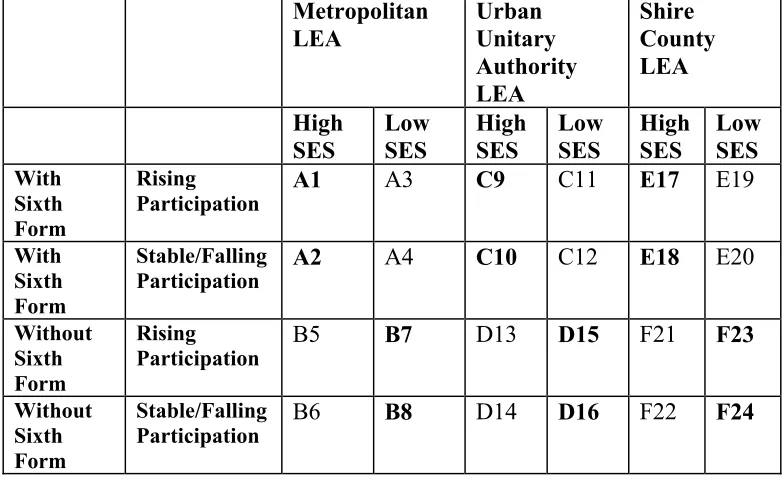
From these criteria the sampling grid shown in Figure 1was constructed, which identified a sample from within 8 LEAs (A to F in the sample grid) and 24 schools (1-24 in the sample grid)
Metropolitan LEA Urban Unitary Authority LEA Shire County LEA High SES Low SES High SES Low SES High SES Low SES With Sixth Form Rising
Participation A1 A3 C9 C11 E17 E19
With Sixth Form
Stable/Falling
Participation A2 A4 C10 C12 E18 E20
Without Sixth Form
Rising
Participation B5 B7 D13 D15 F21 F23
Without Sixth Form
Stable/Falling
[image:6.595.137.528.185.426.2]Participation B6 B8 D14 D16 F22 F24
Figure 1 Sampling grid for the schools in the study
Recognising the variations in LEA size and the fact that many LEAs only have one form of post-16 organisation (i.e 11-16 schools with sixth form colleges OR 11-18 schools), it was decided that where LEAs were not large enough, only contained one form of post-16 organisation, or did not contain enough socio-economic contrast to provide the full sample indicated by the sampling grid, then other similar LEAs would be used, provided that matched pairs of schools were always sampled within single LEAs. The matched pairs are indicated by bold or non-bold fonts within the table. Furthermore, in recognition of the need to provide an appropriate geographical coverage, the eight LEAs selected were chosen from across England to include representation from the north and the south of England and at least four standard economic planning regions.
Identifying local authorities and schools to constitute the sample was undertaken through an iterative process. Using DfES published data on post-16 participation rates (DfES, 2002), four LEAs were identified in each of the three categories (metropolitan LEA, urban unitary LEA, shire county LEA), one in each quartile of the data, to provide a broad geographical coverage within England. Within each LEA each secondary school was profiled to identify:
a) its GCSE attainment rate, using DfES data on GCSE attainment (DfES,2003) b) the proportion of its pupils receiving free school meals, using data within the
c) the presence or absence of a sixth form in the school
d) the post-16 participation rate for the school over the period 1999-2002. This data is not available in the public domain as school level data and is published only in summary data for whole LEAs. However, the data was made available by the relevant local Learning and Skills Councils, who collect the data by school, for those schools that the research team identified as meeting all other criteria.
This process enabled the sample of schools to be identified to match the sampling grid requirements. The schools identified as appropriate to each cell were approached directly to participate in the study, with ‘reserve’ schools and LEAs drawn in to replace those schools that declined to participate. The final sample comprised 23 schools drawn from 10 local authorities.
Data Collection
The research methodology uses existing qualitative methodologies that have been used by the Centre for Research in Education Marketing in previous studies into post-16 choice. The key stages of data collection, the data collected and the
methodologies used within the research are as follows:
Stage 1: Year 11 Data Collection (February – April 2003)
Data collection was undertaken using the following approaches in each school in the sample:
a. Single sex focus groups with Year 11 pupils, with one focus groups of 12 girls and one focus groups of 12 boys.
b. A questionnaire mailed to the parents of those young people in the focus group
In total 426 pupils participated in the focus groups, and 157 parents responded to the questionnaire.
Stage 2: Year 10 Data Collection (April – June 2003)
This stage used the same methodologies as Stage 1, but with Year 10 pupils in each school. In addition to the focus groups and parental questionnaires, face to face semi-structured interviews were undertaken with the school’s senior careers teacher, the headteacher, and with two Year 11 tutors. A total of 410 pupils participated in the focus groups, and 110 parents returned questionnaires.
Stage 3: Year 12 Data Collection (October – November 2003)
in a school with a sixth form but who opted to go to a different institution will then be undertaken, together with one-to-one telephone interviews with a 10% of those pupils originally in a school without a sixth form.
Stage 4 Data Analysis
Data analysis is being undertaken using SPSS to record quantitative data obtained from individual pupil response from within the focus groups and from the parental questionnaires. The focus group discussions and the interviews are being transcribed and then analysed using a classification of content approach.
Preliminary Findings
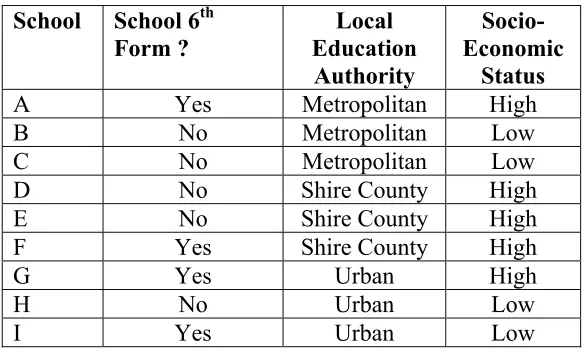
The findings presented here are based on analysis of data obtained from nine schools, selected from across the categories of school types identified in the sampling frame. Three schools each were selected from the urban unitary, metropolitan and shire counties respectively. Figure 2 illustrates the distribution of Year 10 and Year 11 students from the nine schools who participated in focus groups. The schools
provided a representative sample of students in terms of socio-economic background and ethnic group. Figure 3 summarises the profile of the schools included in the sample of nine.
Male Female Total Shire
County
64 65 129
Urban Unitary
47 93 140
Metropolitan 73 48 121
[image:8.595.201.409.375.476.2]Totals 182 206 390
Figure 2 Number of students interviewed in nine schools sampled
School School 6th
Form ? Education Local Authority
Socio- Economic
Status
A Yes Metropolitan High
B No Metropolitan Low
C No Metropolitan Low
D No Shire County High
E No Shire County High
F Yes Shire County High
G Yes Urban High
H No Urban Low
I Yes Urban Low
[image:8.595.155.448.529.705.2]To date the analysis of the schools is incomplete; as a consequence this paper reports some early tentative observations of the work in progress. The paper avoids the presentation of descriptive statistics as no definite conclusions have yet been reached. These observations primarily report the perception of students recorded in focus groups and through questionnaires. The final project report will seek to compare these student voices with the data gathered from interviews with headteachers, school career guidance personnel and heads of Y11.
Although the initial analysis has demonstrated a number of important findings, this paper will focus on two specific aspects of the emerging ideas:
1. The students’ perception of the overall influence of the school on post-16 decision making
2. Students’ suggestions for improving the information, advice and guidance on the decision to participate in post –16 education and training
1. Students’ perception of the overall influence of the school on post-16 decision making
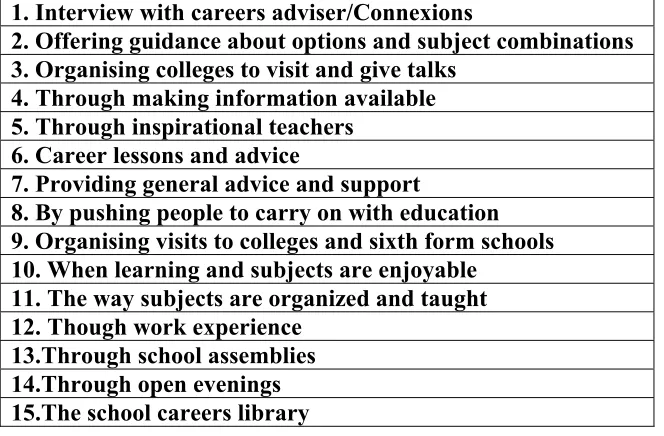
Students who indicated that their schools had influenced their post-16 choices spoke of a number of ways in which this influence was perceived to occur. Figure 4 presents the responses in rank order of those most frequently cited.
1. Interview with careers adviser/Connexions
2. Offering guidance about options and subject combinations 3. Organising colleges to visit and give talks
4. Through making information available 5. Through inspirational teachers
6. Career lessons and advice
7. Providing general advice and support
8. By pushing people to carry on with education 9. Organising visits to colleges and sixth form schools 10. When learning and subjects are enjoyable
11. The way subjects are organized and taught 12. Though work experience
[image:9.595.137.469.391.609.2]13.Through school assemblies 14.Through open evenings 15.The school careers library
Figure 4 The perceived influence of schools on decision-making
be using to influence their choice was through offering guidance and advice about options and subject combinations.
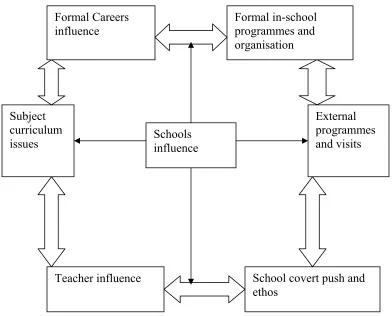
Other strategies mentioned included: the provision of information for choices by schools; careers lessons and guidance; schools’ covert strategies of pushing students towards staying on in the school; work experience; organizing visits to colleges and sixth form schools (mentioned mainly by students in schools with no sixth forms); the influence of inspirational teachers; assemblies; open evenings; talks given by colleges and the schools; and careers libraries. It appears that these school based strategies for influencing students choices could be grouped into five main categories, which are shown diagrammatically in Figure 5.
Formal Careers influence
Formal in-school programmes and organisation
Subject curriculum issues
External programmes and visits Schools
influence
School covert push and ethos
[image:10.595.97.489.245.561.2]Teacher influence
Figure 5 The schools influence in post-16 choices and decisions
The extent to which these factors contribute towards decision making vary, of course, from school to school, with students perceiving distinct patterns of intervention and differences in the balance of inputs from the school. Our analysis suggests that the factors that influence pupil decision-making might be regarded as ‘mediating
From this initial analysis our data suggests there may be three types of networks of mediating agencies that influence pupil decision-making. The first could be seen as a ‘school-centred’, where the school has a strong culture or ethos, usually one focused on high academic achievement, that permeates all its activity. It may be that the parents and students share this goal, but it is not in any sense negotiated. A typical school in this category draws from a ‘catchment’ of parents and pupils of high socio-economic status, and has its own sixth form. There is an expectation that school includes years twelve and thirteen, and students will continue at the school post-16. In such a school there are minimal connections with mediating agencies or school inputs that provide information, advice or guidance on options other than staying on at the school. The students acknowledge and largely accept that the school has
expectations of them to stay on in the sixth form and recognize that their school’s advice is not impartial. These schools have high participation rates post-16 and large numbers of students looking towards higher education.
The second category of school can be described as ‘student-centred’. Typically these schools do not have their own sixth form and are not perceived to promote any option other than some form of post-16 education and training. There are many mediating agencies, and students are exposed to a rich network of information, guidance and advice from diverse sources. These students report a wide range of events and activities introduced by the school to support the students in their decision-making. There would appear to be a structured whole school commitment to supporting students in their decisions about post-16 pathways. The students perceive the school as impartial and focused on what is best for them as an individual. Students in these schools were very positive about their school and the learning activities, advice, guidance and support that is provided.
The third category could be described as ‘functional’, where the task of careers related advice and support is demarcated through a small number of pathways, such as PSHE lessons or an interview conducted through the Connexions service. Students in these schools perceive their support coming from one or two key individual teachers or advisors linked to the school. The Connexions service has a high profile and is valued by students. In these schools supporting decision making about post-16 does not appear to be a high priority, and it appears almost as if it has contracted out the responsibility of particular functional roles of selected staff. Teaching staff, other than specialist careers staff, were not reported by students to have influenced their
decision-making. These schools generally do not have a sixth form and are more likely to be in low ses and metropolitan areas. External mediating agencies, such as the marketing activities of colleges, were more likely to have an impact on student decision-making than the activities of the school. It is in these schools, where the approach to post-16 was more routine and low key, that students were most vociferous in their recommendations for improving the school’s support with their post-16 decision-making.
2. Students’ suggestions for improving the information, advice and guidance on the decision to participate in post –16 education and training
Towards the end of each focus group, and after completion of a questionnaire on the influence of the school on their decision to participate in post-16 education or
the context of the research and focus group discussion these recommendations reflect the students’ considered opinions and perceptions on the issues. These student voices are summarized in the final section of this paper.
Figure 6 provides the ranked suggestions students provided for improving the careers curriculum in their schools. Although the range of suggestions given by students is broad, it is clear that they can be grouped into a limited number of categories. Overall, students are recommending: improving access to information about the full range of options; the need for schools to be more impartial in the advice and guidance role; attending to the timing of advice and guidance; improving teaching and the general curriculum; improving the quality of careers provision; and greater collaboration between schools and FE providers, to include parents.
Suggestion
1. Have more trips to FE providers 2. Provide more information generally 3. Provide guidance earlier, before Y10 4. Offer a broader subject curriculum 5. More talks about specific careers 6. More careers interviews
7. More information about other options other than A-levels 8. More in-depth one on one interviews
9. More information about modern apprenticeships 10. Link courses offered in colleges to school subjects 11. Interviews should be longer
12. Leave options open/ be more open minded 13. Make subjects more appealing and interesting
14. Update information videos and books in careers library 15. Have better careers advisers
16. Everyone should have a careers interview 17. Careers departments should be better organized 18. Teachers should be more caring
19. Work more closely with other schools/colleges 20. Pressure from subject teachers should be less 21. Provide more work experience
22. Organise small group discussions about careers 23. Make better use of facilities
24. Ask us about our options first before imposing choices 25. Have joint interviews with parents
Figure 6 Students’ suggestions for improving the careers curriculum
a. Improving access to information about post-16 options
The following have been included in this broad category:
market. Needless to say, the suggestion was more commonly given by students in schools with sixth forms than those in schools with no sixth form, suggesting that schools with a sixth form tend to utilize this strategy less frequently than would be preferred by students.
• Provide more careers interviews. Students suggested that they would like more than the standard single interview that their schools provide. There appears to be varied practice in different schools when it comes to the individual interview. In some schools the individual interview is given to all students. This appears to be the practice in schools with no sixth form and in low ses localities. In others, it is left optional to those who feel they need it. Additionally, the time allocated for the interviews appears to vary from one institution to the other. In some, students reported a twenty-minute interview while in others they reported hour long interviews. Students appear to see the value of this individual interview and indeed for some, it constitutes the most significant opportunity for them to make an informed decision about their post-16 options.
• Organise more talks about specific vocational areas. A number of students are calling upon schools to invite people in different occupational roles to visit their schools and talk about specific careers. They see this as bringing reality into the careers curriculum and anticipate more informed input from such visits. Some see this as being better than teachers talking about other
professions, about which they may know little and towards which they could have inherent prejudices.
b. Improving impartiality in the schools advice and guidance roles
The following suggestions fall into this broad category:
• Leave options open. A number of students suggested that their schools were not presenting post-16 options impartially. In the majority of cases, for example, the school’s own sixth form is openly promoted at the expense of other options.
• Pressure from subject teachers should be reduced. Some teachers are seen as exerting undue pressure on students, either deliberately or inadvertently. This may involve seeking to persuade students to pursue their subject beyond Year 11, or providing implicit messages that project other careers, outside the more professional ones, in dimmer light.
• Provide a broader guidance, not just 6th form options. Students specifically request more information and advice about the broad spectrum of post-16 pathways.
• Ask for our opinions also. A small number of students considered that most of the guidance they got did not respond to their particular needs and preferences. Some of these students felt they were just being given non specific
information.
c. The timing of advice and guidance
subject choices at the end of Key Stage 3. Similarly, a majority of these students indicated that they began to get their careers guidance either towards the end of Year 10 or early in Year 11, which most of these students considered to be too late.
d. Improving teaching and the curriculum
Students who mentioned this item see teachers as an important influence in their post-16 choices. They particularly considered the value of making the teaching of subjects in an interesting and appealing way a strategy schools could use to influence them in making post-16 choices. This category included those who said:
• Make subjects more appealing and interesting.
• Link courses offered in FE to subjects studied at school. This appears to be a call for subject teachers to make teaching of subjects more relevant to future careers. It could also be directed at a much broader level of the organization of careers advice and guidance, to pay greater attention to explaining how school subjects relate to different careers.
• Make better use of facilities. Some students thought that facilities that were available for certain subjects were securely stored away and not being utilized for subject lessons.
• Teachers should be more caring and interested in their students. • Broaden the curriculum to widen choice of subjects.
e. Improving the quality of the careers provision
Suggestions for improving careers provision in schools included: • Calls for careers departments to be better organized. • Having more in-depth one-on-one interview.
• Lengthening the times set aside for individual interviews. • Providing more opportunities for work experience
• Updating information sources including videos and reading materials in the careers library.
• Organizing more small group activities
• Making information about careers more readily available. • Have better careers advisers.
• Ensuring everyone has a careers interview.
Conclusions
The research team has data from another fourteen schools to analyze and is still in the process of completing interviews and administering questionnaires. Some strong themes do appear to be emerging form the data studied so far.
The first concerns the information about post-16 options received by students. Students would like the inputs from the school to take place earlier. Most schools focus their efforts on post-16 in Year 11, yet students are asking for more support in Year 10 and also in Year 9 when they are thinking of subject choices for GCSE.
students to study with them, and students report that teachers are enthusiastic in their promotion of their subject and the school’s sixth form. The students in all schools, and schools with sixth forms in particular, would like to receive more impartial information, advice, guidance and support from which to make an informed judgment about their post-16 options. Many students commented positively about the
Connexions service as a source of impartial advice, guidance and support.
A third theme to emerge is one of bewilderment. There are vast amounts of textual information that students find confusing. The qualification frameworks, new subjects, and the wide range of vocational courses are all unfamiliar, and students do not get a firm idea about what the options are really about or what they would be like. The need for rationalisation of qualifications and greater transparency in 16-19 education was recognized by Dearing (1996). In 2003 students are still struggling to navigate their way through the 16-19 curriculum.
Students in this study desire more than simple information about post-16 pathways - they would like to get closer to the experience of post-16 learning. Work experience was often reported to be an axial point in decision making about individual careers, helping students determine what they want or did not want from future careers. In the same way that work experience takes them close to the world of work, students would like more direct and real experience of post-16 learning. Visits to colleges, and
opportunities to get a better idea of what a particular subject, qualification or programme were really about, were high on the list of student recommendations. Students reported that they had difficulty making sense of what a particular post-16 pathway would mean for them. They would like more than leaflets, presentations and information, and opportunities to meet students, tutors and participate in subjects of their choosing. Perhaps ‘work experience’ could be enhanced by opportunities for post-16 ‘learning experience’. Student-centred schools with rich networks of mediating agencies tend to provide experiential learning opportunities that engaged students in post-16 decision making. However, the emphasis in schools with ‘school- centred’ and ‘functional’ approaches tends to be on the transmission of information and provision of careers advice and guidance.
It could be that the relative success of post-16 participation in schools with sixth forms is in part linked to the fact that students have direct experience of the school and a clearer idea of what to expect from staying on in Year 12. Compared to students going to college, students in their school sixth forms enter post-16 learning with a relative degree of what Giddens (1981) refers to as ‘ontological security’. They know the institution and its staff, and are familiar with the habitus of the school; they have learnt from experience and developed a degree of cultural capital that provides for a relatively smooth transition from Year 11 to 12. This is in stark contrast to a student leaving school to travel to a new institution in unfamiliar surroundings with a complex curriculum and assessment regime. This latter student probably has to adapt to a new language of learning and to different pedagogic relationships, and faces a degree of risk and uncertainty in order participate in post-16 learning. They may also find the experience exciting and challenging, but there are likely to be different configurations of the costs and benefits of post-16 participation.
providers, a 14-19 curriculum, will help provide students with experience of post-16 learning and promote participation in lifelong learning beyond the school. It is clear from our analysis to date that students would like more experience of post-16 learning on which to reflect and make informed judgments about their post-16 education and training. Programmes and opportunities to participate in tertiary education in school time appear to be well received by students where they have choice and control over curriculum options. Is there a role for ‘College Experience’ in compulsory schooling?
What is less clear from the analysis so far is the classification of the influence of the school on the decision to participate in post-16 learning derived form student
perceptions. Examples that fit the broad types of school-centred, student-centred and functional approaches can be found. It is less certain, though, that these are
representative of all the schools in the study or whether such a typology confounds or enhances our understanding. Those schools that were perceived to provide impartial advice by the students also appeared to encourage a more experiential approach to supporting students in their decision making, providing a whole school approach centred on the needs, questions and interests of their pupils. It was particularly heartening to hear these young people talk positively talk about their school, and a privilege to have had the opportunity to listen to the thoughtful and considered
opinions of the 390 students in the study. It is hoped that these conclusions accurately reflects their voice and recommendations.
References
Ball, S., Maguire, M. and Macrae, S. (1998) Education Markets in the Post-16 Sector of One Urban Locale, Paper presented as part of the Learning Society Programme, Kings College London
Brooks, R. (1998)Staying or Leaving? A Literature Review of Factors Affecting the take up of post-16 options’ Slough: NFER
Cheng, Y. (1995) Staying on in Full-Time Education after 16: Do Schools make a Difference? Department for Education and Employment Research Series Youth Cohort Report No 37, London: DfEE
Connor,H., Burton, R., Pearson,R., Pollard,E., and Regan,J. (1999) Making the Right Choice: How Students Choose Universities and Colleges London: CVCP/Institute for Employment Studies
Dearing, R (1996) Review of Qualification for 16-19 year olds. Middlesex. SCAA
Duff, C. (2003) Association of Colleges (England and Wales), article on impartiality in the career guidance in schools www.education.guardian.co.uk visited 16/08/03. Ferguson,R. and Unwin,L. (1996)Making Sense of Post-16 Destinations: a case study of an English Shire County Research Papers in Education 11,1, pp.53-81
Foskett, N. & Hemsley-Brown, J.V. (1997) Career Perceptions and Decision Making Leeds: CREM/Heist Publications
Foskett, N.H. and Hemsley-Brown, J.V. (2001) ‘Choosing Futures: Young People’s Decision-Making in Education, Training and Careers Markets’London: RoutledgeFalmer
Foskett, N.H. and Hesketh, A.J. (1995) Higher Education Awareness Amongst Year 10 Pupils in Hampshire Schools Southampton: Centre for Research in Education Marketing
Foskett, N.H. and Hesketh, A.J. (1996a) Higher Education Awareness Amongst Year 8 Pupils in Hampshire Schools Southampton: Centre for Research in Education Marketing
Foskett, N.H. and Hesketh, A.J. (1996b) Student Decision-Making in the Post-16 Market Place Southampton: Centre for Research in Education Marketing/Heist Publications
Foskett, N.H. and Hesketh, A.J. (1997) ‘Constructing Choice in contiguous and parallel markets: institutional and school leavers’ responses to the new post-16 market place’ Oxford Review of Education 23, 2, pp. 299-330
Giddens, A (1991) Modernity and Self Identity. Cambridge Polity
Hemsley-Brown, J. (1996a) Marketing Post-16 Colleges: A Quantitative and Qualitative Study of Pupils’ Choice of Post Sixteen Institutions Unpublished PhD Thesis, University of Southampton
Hemsley-Brown, J. (1996b) Decision-Making Amongst 15 and 16 Year Olds in the Further Education Market Place Paper presented to the ‘Markets in Education’ Symposium, University of Southampton, July 1996
Hemsley-Brown,J.V. (1999) College choice, perceptions and priorities’ Educational Management and Administration 27, 1, pp. 85-98
Hemsley-Brown, J. V. and Foskett, N.H (1997) Higher Education Awareness Amongst Year 6 Pupils in Hampshire Schools Southampton: Centre for Research in Education Marketing
Hemsley-Brown, J. V. and Foskett, N.H (1998) The Marketisation of the Careers Service Leeds : Heist.
Hemsley-Brown,J.V. and Foskett, N.H.(2000) Factors Affecting Post-16 Choices Made by Young People Attending Central London Secondary Schools London: FOCUS TEC
Hodkinson, P. (1995) How Young People Make Career Decisions Education and Training 37(8) 3-8
Hodkinson, P. and Sparkes, A. (1997) ‘Careership: a sociological theory of career decision-making’ British Journal of Sociology of Education 10, 1, pp. 2-20
Lauder, H., Jamieson, I., and Wikeley, F. (1998) ‘Models of effective schools: limits and capabilities’, in Slee,R. and Weiner,G. with Tomlinson,S. (eds) School Effectiveness for Whom? Challenges to the School Effectiveness and School Improvement Movements London: Falmer Press
Maguire, M, Macrae, S. and Ball, S.J. (2000) Choice, pathways and transitions: 16-19 education, training and (un)employment in one urban locale London: King’s College
Nicholls, A. (1994) Schools and Colleges: Collaborators or Competitors in Education? London: LASER
Paterson, L., and Raffe, D. (1995) ‘Staying on in full time education in Scotland, 1985-1991’ Oxford Review of Education 21,1, pp.3-23
Payne,J. (1998) Routes at 16: Trends and Choices in the Nineties Department for Education and Employment Research Report RR55, London: DfEE
Schools Council (1981) Working paper 40 Career education in the 1970s, Evans/Methuen Educational.
Note
This paper reports some of the methodological issues and emerging findings from the research project “The Influence of the School in the Decision to Participate in Learning Post-16”, commissioned by the Department for Education and Skills (DfES) from the research team based at the School of Education, University of Southampton. The Project is funded for the period January 2003-February 2004, and the final report will be published in Spring 2004. The ideas and comments presented here do not necessarily represent the final conclusions of the Project, but are emerging ideas presented for discussion and comment.