B-GL-305-001/FT-001
ARMOUR
VOLUME 1
THE ARMOURED REGIMENT IN BATTLE
(BILINGUAL)
(This publication supersedes B-GL-305-001/FT-001 dated 82-05-01)
WARNING
Although not classified this publication, or any part of it, may be exempt from disclosure to the public under the Access to Information Act. All elements of information contained herein must be closely scrutinized to ascertain whether or not the publication, or any part of it may be released.
Issued on Authority of the Chief of the Defence Staff
LIST OF EFFECTIVE PAGES
Insert latest changed pages; dispose of superseded pages in accordance with applicable orders.
NOTE
The portion of the text affected by the latest change is indicated by a black vertical line in the margin of the page. Changes to illustrations are indicated by miniature pointing hands or black vertical lines.
Dates of issue for original and changed pages are:
Original ...0...1 990-1 2-31 Ch...3...
Ch...1... Ch...4...
Ch...2... Ch...5...
Zero in Change No. Column indicates an original page. Total number of pages in this publication is 260 consisting of the following: Page No. Change No. Cover... 0
Title ... 0
A to C... 0
i, ii ... 0
iii/iv ... 0
v to xvi ... 0
1-1-1, 1-1-2 ... 0
1-2-1 to 1-2-3/1-2-4 ... 0
1-3-1 to 1-3-3/1-3-4 ... 0
2-1-1 to 2-1-3/2-1-4 ... 0
2-2-1 to 2-2-4 ... 0
3-1-1 to 3-1-5/3-1-6 ... 0
3-2-1 to 3-2-5/3-2-6 ... 0
3-3-1 to 3-3-4 ... 0
3-4-1/3-4-2 ... 0
3-5-1, 3-5-2 ... 0
3-6-1, 3-6-2 ... 0
3A-1 to 3A-8 ... 0
3B-1 to 3B-12 ... 0
4-1-1, 4-1-2 ... 0
4-2-1, 4-2-2 ... 0
4-3-1 to 4-3-9/4-3-10 ... 0
4-4-1 to 4-4-9/4-4-10 ... 0
4-5-1 to 4-5-4 ... 0
4-6-1, 4-6-2 ... 0
4-7-1 to 4-7-13/4-7-14 ... 0
4A-1 to 4A-4 ... 0
5-2-1 to 5-2-10 ... 0
5-3-1 to 5-3-7/5-3-8 ... 0
5-4-1 to 5-4-2 ... 0
5-5-1 to 5-5-10 ... 0
5-6-1 to 5-6-6 ... 0
5-7-1, 5-7-2 ... 0
5-8-1/5-8-2 ... 0
5-9-1/5-9-2 ... 0
5-10-1, 5-10-2 ... 0
5-11-1 to 5-11-5/5-11-6 ... 0
5-12-1, 5-12-2 ... 0
5-13-1 to 5-13-3/5-13-4 ... 0
5-14-1 to 5-14-5/5-14-6 ... 0
5-15-1/5-15-2 ... 0
5-16-1 to 5-16-5/5-16-6 ... 0
5-17-1 to 5-17-3/5-17-4 ... 0
5A-1/5A-2 ... 0
5B-1, 5B-2... 0
6-1-1 to 6-1-4 ... 0
6-2-1/6-2-6 ... 0
6-3-1 to 6-3-13/6-3-14 ... 0
6-4-1, 6-4-2 ... 0
7-1-1 to 7-1-7/7-1-8 ... 0
7-2-1 to 7-2-6 ... 0
7-3-1/7-3-2 ... 0
7-4-1 to 7-4-3/7-4-4 ... 0
7-5-1 to 7-5-4 ... 0
8-1-1 to 8-1-3/8-1-4 ... 0
8-2-1 to 8-2-5/8-2-6 ... 0
8-3-1, 8-3-2 ... 0
8-4-1/8-4-2 ... 0
8-5-1/8-5-2 ... 0
9-1-1 to 9-1-4 ... 0
9-2-1 to 9-2-4 ... 0
A-1 to A-3/A-4... 0
ARMY DOCTRINE AND TACTICS BOARD
FW 2910-1 (DCOS CD)
Mobile Command Headquarters St-Hubert, Quebec
J3Y 5T5
5 April 1991
Distribution List
REVISION TO B-GL-305-001/FT-001
ARMOUR, VOLUME ONE, THE ARMOURED REGIMENT IN BATTLE
Reference: B-GL-305-001/FT-001 1 May 82
1. This revision is authorized by the Army Doctrine and Tactics Board (ADTB). It is effective on receipt and supersedes the reference.
2. The doctrine in this manual is applicable to operations in low, middle and high levels of conflict by armoured regiments using generic equipment.
3. The responsibility for the quality of ADM publications is shared by all members of the army. To this end, I ask all users of this publication to report any errors or emissions, through normal channels, to mobile Command Headquarters, attention SSO Armour.
R.E. Acreman Colonel Chairman
Army Doctrine and Tactics Board
Enclosure: 1
FOREWORD
1. B-GL-305-001/FT-001, Armour, Volume 1, The Armoured Regiment in Battle, Interim 1, is issued on authority of the Chief of the Defence Staff.
2. This publication is effective on receipt and supersedes B-GL-305-001/FT-001 1982-05-01.
AIM
3. The aim of this manual is to detail the tactical doctrine for the employment of armoured regiments. It is a guide for operations and forms the basis for instruction and training for war.
SCOPE
4. Information on the organization, role, characteristics, command, and the tactical employment of the regiment and its squadrons is provided. Even where the manual
exclusively discusses tanks the doctrine is meant to be implemented within the context of the combined arms team. The emphasis is placed on the fundamental requirement for a balanced force of armour infantry, artillery, and engineers as the essential components of an effective and viable fighting force. The doctrine presented is adaptable and applicable to a range of potential conflict situations, and to the different types of armoured vehicles that may be employed in a Canadian armoured regiment. It is the requirement for this universal
applicability that has driven the retention of the name "The Armoured Regiment In Battle" for this manual.
5. Troop level tactics are covered in B-GL-305-003/FT-001, Interim 1. Higher level tactics and organizations are discussed in B-GL-300-000/FP-001, The Army, and B-GL-301-001/FP-001 Land Formations In Battle. A list of major references including STANAGS and QSTAGs is in Annex A.
6. In addition to editorial and terminology changes, this manual reflects the following major revisions:
a. revised doctrine for the assault; and
b. the addition of doctrine for the employment of mine ploughs and rollers.
RECORD OF CHANGES
Identification of Change
CONTENTS CHAPTER 1 - INTRODUCTION
Section 1 - General
The Principles of War
Section 2 - Role, Tasks and Characteristics
General Role Tasks
Characteristics
Section 3 - Fundamentals of Employment
General Fundamentals
Limitations of Armour
CHAPTER 2 - ORGANIZATION Section 1 - Introduction
General
Organization for Battle
Section 2 - Appointments and Responsibilities
Regimental Headquarters Reconnaissance Troop Tank Squadrons
Headquarters Squadron
CHAPTER 3 - COMMAND AND CONTROL Section 1 - Introduction
General
The Commander Grouping
Control Measures
Location of Commanders Communications
Intelligence
Standing Operating Procedures (SOPs)
General
Reconnaissance and Orders Groups Battle Procedure Sequence
Section 3 - Regimental Headquarters
General Siting
Command Posts Moves
Intelligence Cell Functions Operations Cell Functions
Section 4 - Reconnaissance Troop
General
Section 5 - Tank Squadron
General Command
Section 6 - Law of Armed Conflict
Purpose
Rules of Combat
ANNEX A - REGIMENTAL STANDING OPERATING PROCEDURES
SUGGESTED CONTENT
ANNEX B - AIDE MEMOIRE FOR OPERATIONS ORDERS
CHAPTER 4 - ADMINISTRATION Section 1 - Introduction
General
Section 2 - Combat Service Support
Purpose Concept
Section 3 - The Regimental Administrative System
Introduction
Composition of the Echelons Location of Echelons
Regimental Administrative Net Commodities
Basic and Maintenance Loads Demands
Types of Resupply
Standing Operating Procedures
Section 4 - Resupply
General
Demand Procedure Resupply Cycle Squadron Resupply
Regimental Headquarters and Reconnaissance Troop Regimental Resupply
Section 5 - Maintenance
General Organization
Categories of Equipment Condition Priority of Repair
Procedure Repair parts
Section 6 - Personnel, AFV and Vehicle Replacement
Section 7 - Personnel Administration
Medical Postal
Legal Services Spiritual Welfare Finance
Regimental Police Postal Censorship Prisoners of War Stragglers Refugees Burials
Personnel Support Programmes Honours and Awards
Other Routine Services
ANNEX A - HEADQUARTERS SQUADRON SOPs SUGGESTED HEADINGS
CHAPTER 5 - COMMON OPERATIONAL PROCEDURES
Section 1 - Introduction
General
Section 2 - Security
General
Cover and Concealment
Nuclear Biological and Chemical Defence Measures Safety and Control Measures
Electronic Counter-Counter Measures (ECCM) Deception
Security of Information
Section 3 - Air Defence
General
Section 4 - Warning for Movement
General
Warning Procedure States of Readiness
Section 5 - Harbours, Hides, Waiting Areas
Harbour Hides
Waiting Areas
Section 6 - Manoeuvre
General
Squadron Formations Squadron Manoeuvre Use of Ground
Section 7 - Fire Discipline
General Procedures
Section 8 - Fire Base
Fire Base
Section 9 - After Action Procedure
Procedure
Section 10 - Meeting Engagement
General
With Tactical Surprise Without Tactical Surprise
Section 11 - Relief in Place
General
Forces and Tasks Planning
Conduct
Command and Control Administrative Support
Section 12 - Forward Passage of Lines
Forces and Tasks Planning
Conduct Command Administration
Section 13 - Rearward Passage of Lines
General
Forces and Tasks Planning
Conduct
Command and Control Administration
Section 14 - Hasty Breaching
General Threat
Plough and Roller System Planning
Troop Hasty Mine Drill
Section 15 - Covering Forces
Covering Forces
Section 16 - Fire Planning
General
Fire Planning Responsibilities Fundamentals of Fire Planning Allotment of Artillery Fire Support Fire Planning Process
Defensive Fire (DF) Planning Offensive Fire Planning Continuous Fire Support
Section 17 - Counter-Ambush Action for Vehicle Convoys
General
Action Before Contact Counter-Ambush Drills Road Block Drill
ANNEX A - GRADUATED LEVELS OF NBC THREAT AND NORMAL PROTECTION (STANAG 2984)
ANNEX B - EMERGENCY ALARMS OF HAZARD OR ATTACK (NBC AND AIR
ATTACK ONLY) (STANAG 2047 AND QSTAG 183) CHAPTER 6 - OFFENSIVE OPERATIONS
Section 1 - Introduction
General
Forms of Manoeuvre
Section 2 - Advance to Contact
General Concept
Conduct of the Advance to Contact by Formations Tasks for the Tank Regiment in the Advance to Contact Planning the Advance
Conduct
Section 3 - Attack
General Types Concept
Stages of the Attack Planning
Orders
Reduced Visibility
Fighting in Built Up Areas
Section 4 - Pursuit
General Concept Planning Conduct
General
Principles of War Concept
Organization of a Defensive Area of Responsibility Conduct of the Defence by Formations
Tasks for the Tank Regiment in the Defence
Section 2 - Blocking
General
Estimate of the Situation and Plan Preparation
Conduct
Section 3 - Reinforcement
General
Planning and Conduct
Section 4 - Counter-Attacking
General Planning Preparation
Conduct of the Counter-Attack Command and Control
Section 5 - Support to Infantry in Defended Areas
General
Estimate of the Situation and Plan Preparation
Conduct
CHAPTER 8 - THE DELAY Section 1 - Introduction
General
Principles of War Concept
Section 2 - Planning and Preparation
Commander's Direction Estimate of the Situation
Initial Contact
Decisive Engagement
Section 4 - Command and Control
Command Control
Section 5 - Administration
General
CHAPTER 9 - THE WITHDRAWAL Section 1 - Introduction
General
Principles of War Concept
Conduct of a Withdrawal by Formations Tasks of the Regiment in a Withdrawal
Section 2 - Planning
Formation Commander's Direction Withdrawal Estimate
Casualty Evacuation Conduct
LIST OF FIGURES FIGURES
2-1 The Tank Regiment
3-1 Comparison of Command and Control Relationships 3-2 Typical Battle Procedure Sequence
3-3 Typical Battle Procedure Sequence 4-1 Typical Resupply Cycle
4-2 Layout of a Typical Running Resupply 4-3 Layout of a Typical Delivery Point 5-1 Fire Co-ordination Measures 5-2 States of Readiness
5-3 Example Squadron Harbour (Wooded Area) 5-4 Example Squadron Harbour (Urban Area) 5-5 Squadron Formations
5-6 Squadron Leap-Frog Manoeuvre 5-7 Squadron Caterpillar Manoeuvre 5-8 Typical Enemy Nuisance Minefield
CHAPTER 1 INTRODUCTION
SECTION 1 GENERAL THE PRINCIPLES OF WAR
1. Although the application of the Principles of War alters with changes in weapons and tactics, the principles themselves are as applicable to modern as to ancient campaigns. Circumstances dictate the relative importance of each principle and a commander's challenge is to know where to place the emphasis. Thus the Principles of War are not immutable laws, but rather are a guide to actions at all levels. The principles are discussed below in relation to tank forces.
2. Selection and Maintenance of the Aim. This is the master principle. Every plan or action must be tested by its bearing on the chosen aim and then executed to achieve that aim.
3. Maintenance of Morale. Success in war depends more on morale than on physical qualities. Numbers, armament and resources cannot compensate for lack of courage, energy, skill and bold offensive spirit. It is imperative that morale be developed and maintained.
4. Offensive Action. By wresting the initiative from the enemy, one acquires freedom of action and a distinct phychological advantage. A commander must act, not react. An
offensive, aggressive spirit must pervade in all types of operations. Tank forces are well suited for offensive action.
5. Security. This helps to maintain a commander's freedom of action. Receipt of timely intelligence while denying the same to the enemy contributes to security. It is achieved by maintaining balance.
6. Surprise. Surprise can confer the initiative, undermine enemy morale, reduce own casualties and often give material advantages similar to a superior concentration of force. It is significant that surprise is the only principle that is common to all major armies and NATO. The elements of surprise are secrecy, concealment, deception, originality, audacity and speed. To derive the maximum benefit from surprise it must be exploited. Tanks are most capable of this exploitation.
7. Concentration of Force. Concentration does not necessarily imply massing of forces, but rather having them so disposed as to be able to unite to deliver a crushing blow where and when required. Concentration is more a matter of time than of space.
9. Flexibility. This is necessary in planning and execution to cater for changing situations and unexpected developments. Flexibility of mind and the ability to make quick decisions are necessary to ensure opportunities for success are not lost.
10. Cooperation. Cooperation is based on team spirit and training, and entails the coordination of all activities to achieve the maximum combined effort from the whole. It can be achieved if good will and the desire to work together are fostered at all levels. Tanks seldom fight alone.
SECTION 2
ROLE, TASKS AND CHARACTERISTICS GENERAL
1. The improvement of weapons and related equipment has caused changes in the concepts of land warfare. Today's battlefield reflects a marked increase in tempo and scale with the emphasis on fire and movement and greater dispersion of tactical formations. The armour regiment is the principal striking force of a brigade. Armour is better suited than any other arm for conducting mobile warfare where fire power and manoeuvre are the keys to success.
ROLE
2. The role of armour is to defeat the enemy through the aggressive use of firepower and battlefield mobility.
TASKS
3. Specific tasks within this role are:
a. participate in a covering force;
b. participate in the advance to contact;
c. assault and destroy the enemy;
d. exploit the effects of weapons of mass destruction;
e. penetrate, exploit, and conduct pursuits; and
f. participate in defensive operations, primarily as part of manoeuvre forces for counter-attacks and blocking actions.
CHARACTERISTICS
4. The battlefield requirements of firepower, mobility, and protection are present,in the tank. Because of this the tank is one of the most decisive weapons on the battlefield. Tanks can produce shock action through the violent application of firepower and mobility.
5. Firepower. Tanks have large calibre guns capable of firing armour defeating, high explosive, smoke and canister ammunition. Tank gun fire is accurate and lethal against stationary and moving targets. During the assault the tank provides intimate support for the infantry. The ability to redeploy quickly and to engage targets of opportunity rapidly make the tank particularly lethal. The use of image intensification, thermal imagery, and battlefield illumination permit the tank to deliver accurate, aimed fire in limited visibility.
compromise which affords a good chance of survival at tank battle ranges. The tank is the most effective fighting vehicle in nuclear operations and can operate much closer to ground zero than any other. It also provides protection against biological and chemical attack. An attached dozer blade gives the tank a digging and earth moving capability which can contribute to its protection. Tanks are vulnerable to anti-armour weapons; but supporting infantry can reduce this threat.
7. Mobility. Mobility springs as much from the attitude of mind of commanders and crews, as from the performance of the tank. To derive full value from the tank the crew must be trained to think quickly and aggressively. The cross-country performance of tanks enables them to move quickly from position to position and to avoid enemy ground observation and fire. This agility, combined with speed, is vital in all types of operations. The concept of battlefield mobility embraces the characteristic of protection too. Mine rollers and ploughs provide an improved minefield breaching capability. Size and weight may affect tactical plans by ruling out certain routes and vehicle noise can preclude surprise. Skillful driving and the use of cover may reduce these drawbacks.
8. Flexibility. Flexibility derives from a combination of the firepower, mobility and communications. Standard Operating Procedures (SOPs), battle procedure and drills also contribute to flexibility by enabling commanders to concentrate and disperse and to shift the point of attack quickly from one place to another without detailed orders.
SECTION 3
FUNDAMENTALS OF EMPLOYMENT GENERAL
1. Over the years, study, practice and experience have led to a number of fundamental considerations in the employment of tanks.
FUNDAMENTALS
2. Aggressiveness. Tank operations must be executed with speed, resolution and boldness. It is only when the firepower, protection, mobility and flexibility of tanks are exploited aggressively that the full fighting potential is realized. Tanks should not be tied to static positions.
3. Concentration. Every opportunity must be taken to mass the firepower of as many tanks as possible to produce shock effect. Concentration may be achieved by fire, by physical presence, or by a combination of both. Concentration depends on how closely engaged the opposing forces are, enemy target acquisition, and the air situation including the enemy anti-armour helicopter threat.
4. Fire and Movement. The movement of one element covered by the fire of another is a basic tactic of tanks. The basic manoeuvre unit in a tank regiment is the tank squadron. The basic fire unit is the tank troop.
5. Use of Ground. Ground has great significance for the employment of tanks. In open terrain such as the desert or steppes tanks tend to be the predominate arm. Here tanks can make the best use of their characteristics of fire power and mobility.
6. Combined Arms Operations. The understanding of the capabilities, characteristics and limitations of artillery, tanks and infantry is essential at all levels of command. Tanks do not operate alone, but fight with infantry supported by other arms.
7. Administration. Administrative arrangements must be planned in such a way that the tactical plan is not adversely affected by the lack of logistical support. Adequate and timely resupply for all elements must be arranged prior to, and during operations.
LIMITATIONS OF ARMOUR
8. Introduction. Commanders must be aware of the limitations of armour. Some of these are ever present and must be minimized by sensible planning. Others are tactical shortcomings which are overcome by cooperation with other arms. Tanks are subject to the following limitations:
a. Air attack. Tanks are extremely vulnerable to air attack. A constant awareness of this threat must be emphasized, and SOPs developed to counter it.
conceal and requires effort, imagination and skilful driving.
c. Vulnerability in close quarter fighting. At close quarters, tanks are blind and vulnerable to enemy short range anti-tank weapons. In close country, built-up areas or during periods of reduced visibility good liaison with supporting infantry is essential.
d. Poor ground holding capability. Tanks can deny ground by the application of fire, but they cannot by themselves hold ground against a determined dismounted enemy. This requires the presence of infantry.
e. Sensitivity to obstacles. Natural and artificial obstacles can seriously restrict a tank's mobility. Liaison with engineers will be necessary if obstacles are to be overcome and freedom of movement restored.
f. Reduced efficiency in darkness and bad visibility. Despite the assistance of night observation devices, night and poor visibility will often restrict
movement and ranges of engagement. Supporting infantry are required to provide protection at night.
g. Crew fatigue. This is reduced by physical fitness and sensible plans for rest. h. Logistic and maintenance demands. Tanks are only as effective as their
CHAPTER 2 ORGANIZATION
SECTION 1 INTRODUCTION GENERAL
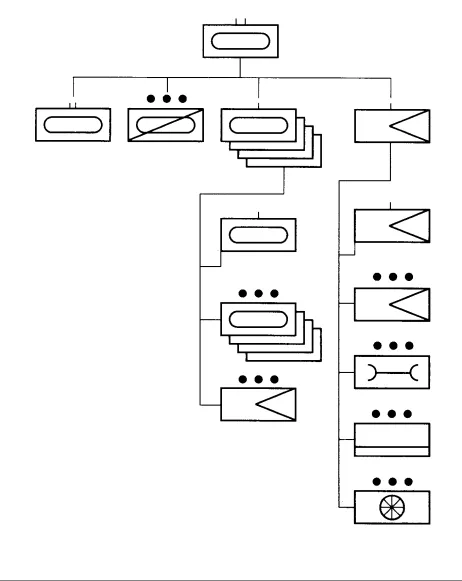
1. The tank regiment is organized as follows (see Figure 2-1):
a. regimental headquarters (RHQ);
b. reconnaissance troop;
c. four tank squadrons; and
d. headquarters squadron.
ORGANIZATION FOR BATTLE
2. In battle the regiment is grouped into functional echelons:
a. F Echelon. This includes the men, weapons and vehicles essential for combat such as tanks, command and reconnaissance vehicles and command posts (Cps).
b. A Echelon. This includes the men, vehicles and equipment required for the resupply, repair and maintenance of F Echelon. Squadron A Echelons are broken down further into an A1 and A2.
c. B Echelon. This includes the men, vehicles and equipment not in F and A Echelons, but required for the routine administrative support of the regiment.
SECTION 2
APPOINTMENTS AND RESPONSIBILITIES REGIMENTAL HEADQUARTERS
1. Commanding Officer (CO). He is responsible for the command, control, organization, fighting effectiveness, training, discipline and welfare of his regiment.
2. Second in Command (21C). He controls the regiment when the CO is resting or absent and assumes command if the CO becomes a casualty. Located at RHQ, the 21C co-ordinates training, operations, administration and logistics in the regiment.
3. Operations Officer (Ops O). He is responsible for the efficient operation, training, layout and defence of RHQ, and in particular the operation of the CP complex. He is also responsible for drafting operational staff work and the staging of orders groups (OGps).
4. Regimental Liaison Officer (RLO). He represents the CO at other headquarters. He must know the CO's plan and be able to assist the other headquarters with their plans and operations. When not employed on liaison duties he is a duty officer in the CP.
5. Intelligence Officer (IO). He is responsible to the CO for combat intelligence. He accompanies the CO during his reconnaissance and his visits to higher headquarters. He may command the second RHO, tank or accompany the CO in his command tank. He is the unit NBCW officer and is also employed as a duty officer in the CP. He maintains the war diary.
6. Signal Officer (Sig O). He is a Communication and Electronics Engineering (CELE) officer and the CO's advisor on all signal matters and ensures the efficient operation of all communications in the regiment. He is also a duty officer.
7. Adjutant. He is responsible for all personnel administration in the regiment and is on the establishment of HQ Squadron. He may be employed in the CP as a senior duty officer.
8. Regimental Sergeant Major (RSM). He commands the regimental A1 Echelon when it is formed. He co-ordinates the defence of RHQ. He is the RHQ harbour master. The RSM advises the CO on the morale and welfare of the troops.
9. Operations Warrant Officer. He is responsible to the Operations Officer for the readiness of the command post vehicles and the training; discipline and welfare of the soldiers in RHQ. He assists in carrying out the defence of RHO.
10. Regimental Police Sergeant. He is a military police sergeant. He commands the Regimental Police (RP) Section. He is responsible for supervising traffic control within the regiment. He assists the RSM in carrying out the defence of RHQ and he performs this function in the absence of the RSM. He liaises with the formation military police.
RECONNAISSANCE TROOP
control, organization, fighting effectiveness, training, discipline and welfare of his troop.
TANK SQUADRONS
12. Squadron Commander (OC). He is responsible to the CO for the command, control, organization, fighting effectiveness, training, discipline and welfare of his squadron.
13. Second-in-Command. He is responsible to the squadron commander for administration and he commands the administrative troop. He understudies the OC and replaces him should the OC become a casualty.
14. Battle Captain (BC). He is responsible to the squadron commander for the training and technical efficiency of the squadron. In the absence of the OC, he assumes command of the squadron temporarily until the OC returns or is replaced by his 21C.
15. Liaison Officer (LO) He represents the squadron commander at other headquarters. He must know the squadron commander's plan and be able to assist the other headquarters with their plans and operations. The LO understudies the 21C and replaces him when required.
16. Troop Leader. A troop leader is responsible to the squadron commander for the command, control, organization, fighting effectiveness, training, discipline and welfare of his troop. He understudies both the BC and the LO and replaces either as required.
17. Squadron Sergeant Major (SSM). He commands the squadron A1 Echelon. He is the squadron harbour master. The SSM provides advice to the OC on the morale and welfare of the troops.
18. Squadron Quartermaster Sergeant (SQMS). He commands the squadron B Echelon. He understudies the SSM and assumes his responsibilities should the SSM become a casualty.
HEADQUARTERS SQUADRON
19. Squadron Commander. He is responsible to the CO for the organization, efficiency, training, discipline and welfare of his squadron. He controls the regimental A and B
Echelons. He understudies the regimental 21C. His headquarters is the alternate RHQ.
20. Second-in-Command. He commands the regimental A2 Echelon. He understudies the OC and must be prepared to replace him.
21. Administrative Officer (AO). He commands Administrative Troop. He understudies the 21C. He may be a duty officer in Echelon control, the squadron CP.
22. Quartermaster (QM). He is a Logistics Officer. He commands Logistics Troop and the regimental B echelon. He is responsible to the OC for the organization, efficiency, training, discipline, and welfare of his troop.
Engineering (LEME) Officer. He commands Maintenance Troop. He is responsible to the OC for the organization, efficiency, training, discipline and welfare of his troop. He may be a duty officer in the CP.
24. Medical Officer (MO). He is responsible to provide medical care to all regimental personnel. This involves inspection, sustaining care and evacuation. He commands the unit medical station.
CHAPTER 3
COMMAND AND CONTROL
SECTION 1 INTRODUCTION GENERAL
1. Command and control is the exercise of authority and direction by a designated commander over assigned forces to accomplish the force's mission. The functions of command and control are performed through an arrangement of personnel, equipment, communications, facilities and procedures which are employed by a commander in planning, directing, coordinating and controlling.
THE COMMANDER
2. The Commanding Officer (CO) and the Squadron Commanders (OCs) are the key appointments in the command structure of the tank regiment. They have the authority to command their troops and they bear the responsibility for the outcome.
3. A commander is responsible for achieving his mission with a minimum loss of life and expenditure of resources, and at the same time, he must provide for the welfare of his troops.
4. A commander plans (what is to be done, by whom, how and when), directs, controls and coordinates. He must:
a. know and understand the situation;
b. identify and consider the options;
c. make decisions and prepare his concept of operations and a basic plan;
d. assign tasks;
e. allocate resources; and
f. direct, sustain and motivate his troops.
GROUPING
6. Organizing the unit into tactical groups to fight the battle is part of battle procedure and the grouping may change with different phases of an operation.
7. In mobile operations, regroupings may occur on short notice with the issue of radio orders.
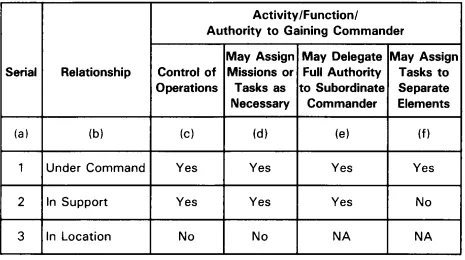
8. Command Relationships. Figure 3-1 provides a comparison of command
relationships applying to the activities, functions and authority of the commanders involved.
9. Standard groupings are usually contained in unit standing operating procedures (SOPs).
CONTROL MEASURES
10. Movement on the battlefield must be carefully controlled to avoid confusion, disorganization and wasted effort. However, control measures can lead to confusion if the measures adopted are not known and not commonly used throughout the regiment. Squadrons should resist developing their own. If they must do so, Regimental Headquarters (RHQ) must be informed or they must ensure that no reference to them is made over the regimental
*Subject to the direction of the superior commander
LOCATION OF COMMANDERS
11. The CO has a choice of commanding from his tank or from the command post (CP). Commanding from his tank allows the CO to directly influence the battle but it may be easier to deal with the information flow, maps, logs and codes in a CP vehicle where the CO has a staff to assist him. On the other hand, the CP vehicle is easier to detect because of its size and electronic emissions which make it a potential target for enemy aircraft or artillery.
Ultimately, the choice of vehicles depends on the nature of the battle at a particular time.
12. It is essential that a commander makes frequent personal contact with his
subordinates. His presence reinforces his verbal and written orders, builds confidence and high morale. There are specific times when a CO and Ocs must be with their troops. These include:
a. during critical periods with their presence could affect the outcome of the battle;
b. when an action is over, particularly when heavy casualties have occurred; and
c. following the capture of an objective once consolidation is under way.
COMMUNICATIONS
13. Reliable communications are vital to the operation of the regiment. The disciplined use of radio and knowledge of equipment capabilities and limitations are mandatory at all levels.
14. Normal radio communications are not possible under conditions of radio and electronic silence or effective jamming. Many of the problems associated with the loss of radio communications can be overcome by training, battle drills and alternate methods of communicating. The communication means available in the regiment include radio, line, dispatch riders QRs), liaison officers (Los), acoustic and visual signals, and timed programmes.
INTELLIGENCE
15. Timely, accurate intelligence is essential for effective command.
16. Information from the squadrons is collected and passed quickly to a higher
STANDING OPERATING PROCEDURES
17. Standing Operating Procedures (SOPs) are developed to reduce certain activities within the regiment to standard drills. They are developed for both operations and
administration. RHQ, in developing its own SOPs, must ensure that they conform to those of brigade headquarters. If SOPs at regimental level are thorough, there should be little
requirement for separate SOPs at squadron and troop level.
SECTION 2 BATTLE PROCEDURE GENERAL
1. Battle procedure is the process by which a commander receives his orders, makes his reconnaissance and plan, issues his orders and prepares and deploys his troops for battle. The procedure should permit concurrent activity at each level of command.
2. It is not a rigid process because it can be adapted for use in all situations.
Commanders may abbreviate their battle procedure to react quickly to changing situations.
3. Commanders must give their subordinates adequate time to conduct their own battle procedure. If time is limited, commanders should be prepared to sacrifice some of their time to permit the maximum time possible for their subordinates' preparation.
RECONNAISSANCE AND ORDERS GROUPS
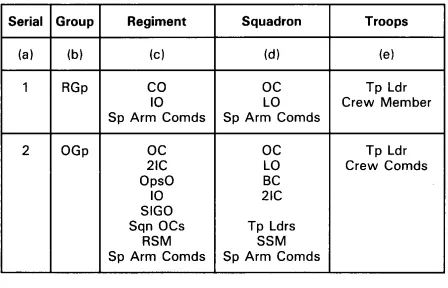
4. To streamline battle procedure, certain standard groups are established. See Figure 3-2. These are specified in regimental SOPs. They include:
a. Reconnaissance Group (RGp). The Rgp includes the commander and those needed to assist him in his reconnaissance and planning.
Figure 3-2 Typical Composition of R and O Groups
BATTLE PROCEDURE SEQUENCE
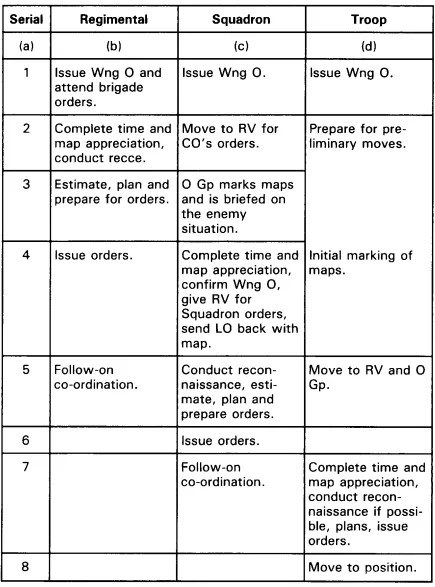
5. Except for routine administrative activity which is continuous, battle procedure begins with the receipt of a warning order (Wng O) from higher headquarters. A commander than takes some or all of the following sequential steps (see Figure 3-3 for summary):
a. Initial Time Appreciation. Upon receipt of Wng 0 a commander does a time appreciation. Working backwards from the time of his commander's OGp he calculates travelling time to the OGp, time available for his preliminary reconnaissance, troop movement and other important timings.
b. Initial Wng O. The initial Wng 0 gives subordinate commanders as much information as possible. It contains the probable task, the location and time for orders, the degree of warning or time for movement of the main body and any special administrative arrangements.
c. Receipt of Orders. The commander meets his RGp at a rendezvous (RV) following his superior commander's OGp. Frequently support arm advisers also attend orders of their functional commander. They are then in a position to advise on their arm's support to the plan and details of support available from the higher formation.
d. Time Appreciation. Following orders the commander knows the key timings for the operation. A quick time appreciation is done to ensure that the
e. Map Study and Outline Plan. When time is available for reconnaissance, a map study contributes to the initial plan, which may be confirmed or adjusted during the reconnaissance. When time is not available the plan made from the map study serves the purpose until the commander reconnoitres the ground with his subordinates.
f. Reconnaissance Plan. Reconnaissance either confirms a plan or indicates that adjustments are needed. The commander decides which questions can be answered from each location and en route. Security permitting, the ground should be viewed from the enemy's perspective. The threat, the time available, the number of locations to be visited, the routes available and the necessity for a protection party all influence the preparation of the reconnaissance plan.
g. Supplementary Wng O. This Wng O confirms information in the initial Wng O and adds new information as required.
h. Reconnaissance. Reconnaissance is conducted according to the plan but adjustments may be made as necessary. If battle procedure has been abbreviated, the reconnaissance may be conducted after orders are issued.
j. Estimate of the Situation and Orders. Following the reconnaissance, the commander completes his estimate of the situation, prepares and delivers his orders. (See Annex B).
k. Co-ordination. Co-ordination is a key job for a commander, and it is a continuing process. It is at this stage that details of the plan are tied together and any adjustments are made.
SECTION 3
REGIMENTAL HEADQUARTERS GENERAL
1. RHQ provides the CO with all the control facilities that permit him to command the regiment. Within RHQ the CP is the focal point for control activity. RHQ is small and must be kept that way. In battle it moves frequently, either for reasons of security or
communications. RHQ SOPs are used to standardize routine drills and procedures.
2. RHQ is organized to operate on a "24 and 7" basis and it provides its own security and reconnaissance for moves.
SITING
3. RHQ should be located where reliable radio communication is possible and where there is:
a. concealment from ground and air observation;
b. firm ground for vehicles and adequate room for dispersion, including a helicopter landing site;
c. screening from intercept;
d. access to the main axis; and
e. defensible ground.
COMMAND POSTS
4. Two CP vehicles are needed because of continuous operations and frequent moves. The two CPs are equipped and prepared identically so that control can shift smoothly from one vehicle to the other following a move.
5. Duty Shifts. The minimum staff in the CP is a duty officer and two radio operators. During busy periods, two duty officers and two operators, supervised by the operations officer, may be required.
6. The step-up vehicle is manned by the intelligence section when it and the CP are co-located. In addition to their intelligence and NBC defence duties this section keeps
operational information in the step-up vehicle current by maintaining a duplicate of such items as maps and logs, so that the step-up vehicle is prepared to move quickly.
7. RHQ may be designated as the formation alternate HQ and in this case formation HQ operational information and SOPs are also maintained.
8. RHQ operates even during moves, therefore:
a. Moves must be anticipated and general locations chosen, with alternatives. Reconnaissance of new sites should be done as early as possible.
b. the CP continues as the control station until the step-up is in its new location and has established communications.
c. The handover of information is completed.
d. Control passes smoothly from the CP to the step-up.
e. Moves are made quickly to permit RHQ to regroup and function together as soon as possible.
INTELLIGENCE CELL FUNCTIONS
9. The functions of the Regimental Intelligence Section include:
a. collecting and disseminating essential intelligence including nuclear, biological and chemical data within the regiment;
b. ensuring that regimental intelligence and NBC records and maps are kept up-to-date;
c. passing information and NBC data to brigade headquarters;
d. maintaining current operational information in the step-up vehicle;
e. acquiring and distributing maps, air photographs and traces;
f. arranging for the onward transmission of captured documents, materiel and prisoners;
g. assisting with recognition training and instruction on the enemy's tactics; and
OPERATIONS CELL FUNCTIONS
10. The functions of the operations cell include:
a. continuously manning and operating a station on the brigade net and controlling the regimental command net;
b. keeping operational information and operations maps current;
c. maintaining a log for each radio net;
d. maintaining an orderly system for receiving, logging, actioning and displaying relevant information;
e. maintaining current battle boards, net diagrams, reports and returns, groupings, and other information contained in regimental SOPs; and
SECTION 4
RECONNAISSANCE TROOP GENERAL
1. The Reconnaissance Troop is the only dedicated reconnaissance element in the
regiment. The troop may be employed on reconnaissance, surveillance, security or other tasks, reporting directly back to RHQ, or it may be placed under command or in support of one of the squadrons, either in total or by patrols.
2. Typical tasks for the troop include:
a. reconnaissance of counter-attack and blocking routes;
b. advance, flank or rear area surveillance;
c. acquiring terrain (going) information for the tanks;
d. maintaining contact with the enemy;
e. surveying chemical or radiological contamination;
f. traffic control;
g. protection of RHQ;
h. liaison duties; and
SECTION 5 TANK SQUADRON GENERAL
1. The OC commands from a tank while the battle captain (13C) assists him from a second tank. A dozer tank travels with this group to provide additional fire support and flexibility.
2. SHQ may travel as a group or the OC may be forward with the leading troop(s) while the BC controls the rear elements.
3. SHQ tanks may carry a proportionately higher load of smoke rounds for screening and target indication.
COMMAND
4. The OC is located where he can best exercise command. He should avoid becoming decisively engaged but he must keep in touch with the battle.
5. The OC and BC monitor both the regimental and squadron command nets but with a different priority. Fighting the squadron, the OC concentrates on the squadron command net and monitors the regimental net. The BC is primarily concerned with the regimental net. He keeps RHQ informed of the squadron situation and answers for the OC when the OC is unable to do so. At the appropriate time, the BC passes information to the OC on the squadron net.
6. The BC protects his OC f rom routine information. All radio traffic is kept short and concise.
7. The squadron is structured to fight as a single entity. The functions of the OC and BC are complementary, not redundant. The Squadron administrative echelon is not double banked in critical support vehicles and tradesmen. It must not be allotted by half -squadron to different battle groups. Within the battle group, splitting the squadron in half or detaching troops must only be done after careful deliberation and with full acceptance of the risks of ignoring one of the fundamentals of employment: concentration. The control and
administration of detached elements below squadron level are unwieldy and reduce
SECTION 6
LAW OF ARMED CONFLICT PURPOSE
1. The law of armed conflict is the body of a law which governs the conduct of states when they are engaged in an armed conflict. The purposes of the law of armed conflict are to protect both combatants and non-combatants from unnecessary suffering, to safeguard certain fundamental human rights of persons who fall into the hands of an enemy, particularly
prisoners of war, the wounded and sick, and civilians, and to facilitate the restoration of peace.
RULES OF COMBAT
2. The basic sources of the law of armed conflict are treaties and custom. From these sources, the following rules of combat have been developed:
a. Rule 1 - Fight only enemy combatants and attack only military objectives.
b. Rule 2 - Employ methods of attack which will achieve your objective with the least amount of incidental damage.
c. Rule 3 - Do not attack enemy soldiers, sailors or airmen who surrender. Disarm them and treat them as prisoners of war.
d. Rule 4 - Collect and care for the wounded or sick whether friend or foe.
e. Rule 5 - Do not torture, kill or abuse prisoners of war.
f. Rule 6 - Treat all civilians humanely.
g. Rule 7 - Respect civilian property - looting is prohibited.
h. Rule 8 - Respect all cultural property and places of worship.
j. Rule 9 - Respect all persons and objects bearing the Red Cross, Red Crescent, Red Lion and Sun or Red Shield of David.
k. Rule 10 - Do not alter your weapons or ammunition to increase suffering.
m. Rule 11 - Disobedience of the Law of Armed Conflict is a crime and only only dishonours your country but renders you liable to
ANNEX A, CHAPTER 3
ANNEX A, CHAPTER 3
REGIMENTAL STANDING OPERATING PROCEDURES SUGGESTED CONTENT GENERAL
1. Regimental SOPs are fundamental for the efficient operation of the unit. They standardize the application of certain functions into simple drills and routines.
2. The headings themselves are general. If regimental SOPs are complete there should be no need for sub-units to produce their own SOPs.
OPERATIONS GENERAL
3. Organization For Battle.
a. Allocation of Resources. RHQ, squadron and troop are divided into echelons that contain:
1) personnel,
2) vehicles,
3) weapons, and
4) vehicle loads.
b. Grouping. The following are suggested:
1) common attachments/detachments to the regiment,
2) command relationships, and
3) affiliations as applicable.
c. Operational and Garrison Duties of Key Personnel.
d. Composition of R and 0 Groups.
4. Command Control.
a. chain of command - including succession of command at the various levels;
b. battle procedure - including sequence of activities, O Gp procedures, orders formats, regrouping orders; and
-1) allocation of vehicles, duty shift crews, routines,
2) message handling,
3) layout and security of RHQ,
4) redeployment procedures,
5) distribution of maps,
6) operation cell duties,
7) intelligence cell duties,
8) tactical control measures, and
9) requirements of alternate formation headquarters.
5. Intelligence. Subjects should include:
a. procedure for discriminating intelligence;
b. evaluation of information; and
c. handling of prisoners of war (PW), captured documents and materiel.
6. Security.
a. security of information;
b. physical security;
c. conduct in the event of capture;
d. destruction of equipment and materiel;
e. field censorship; and
f. incident reporting.
7. Communications.
a. radio nets - including allocation of call signs, order of answering, collective calls, EW drills, communication, electronic operating instructions (CEOIs);
b. alternate communications - including line, dispatch riders, LO, acoustic and visual signals, other nets (arty, int, adm); and
compromise drills.
8. Protection.
a. states of readiness,
b. stand-to,
c. sentry duties,
d. camouflage drills,
e. local alarm signals,
f. protection against air attack, and
g. protective digging.
9. Hides/Harbours/Waiting Areas. a. policy for their use,
b. recce parties,
c. duties of hide/harbour masters and guides,
d. routines,
e. drills (defence, crash action, etc),
f. occupation orders, and
10. NBC Defence.
a. duties and responsibilities,
b. sentries,
c. survival rule,
d. immediate action/immediate decontamination drills,
e. local alarms,
f. decontamination drills,
g. monitoring (radiological/chemical),
h. NBC threat levels, and
j. radiation exposure state (RES).
11. Operations During Periods of Reduced Visibility. a. navigation,
b. identification,
c. use of illumination, and
d fire control policy.
12. Air Defence.
a. weapon control orders,
b. anti-helicopter drill,
c. open fire policy, and
13. Air Support Procedures. a. types of air support,
b. helicopter support, and
c. landing zones (LZ).
14. Rules of Combat.
ADMINISTRATION
15. Organization For Resupply. Echelon organization and functions. 16. Resupply System.
a. regimental resupply procedures,
b. resupply points, and
c. squadron resupply.
17. Repair and Recovery.
a. Equipment Collecting Point (ECP),
b. spare parts, and
c. vehicle repair priorities.
18. Reinforcement. a. augmentation,
b. casualty replacement,
c. Personnel Daily Summary (PDS), and
d. reporting.
19. Medical and Dental Support. a. casualty evacuation,
b. medical stores,
c. casualty kit handling, and
20. Burials.
a. responsibility,
b. marking,
c. documentation,
d. disposal of effects,
e. group burials, and
f. reporting.
21. Personnel Services. a. postal,
b. pay,
c. chaplains,
d. laundry and bath, and
e. honours and awards.
22. Field Censorship. a. censor stamps,
b. standing orders,
c. prohibited subjects, and
23. Movement.
a. road movement;
1) administrative moves,
2) tactical moves,
3) march discipline.
b. rail movement; and
c. tank transporters.
REPORTS
24. Operational Land Reports.
25. Operational Air Reports.
26. Operational NBC Reports.
ANNEX B, CHAPTER 3
ANNEX B, CHAPTER 3
AIDE MEMOIRE FOR OPERATIONS ORDERS NOTE
This aide memoire for operation orders has a common
Situation, Mission, Execution (less coordinating instructions) Service Support, and Command and Signal content. A unique Execution - Co-ordinating Instructions paragraph has been included for the advance to contact, attack, defense, withdrawal and delay operations.
1. SITUATION
a. Enemy
1) activity
2) intentions
3) location
4) strength
5) morale
6) types of equipment
7) tactics
8) capabilities
a) nuclear
b) chemical
c) air
b. Friendly
1) tasks two levels up
2) outline plan one level up
3) flanking units/subunits
5) elements to the rear
6) air
7) nuclear
c. Attachment and Detachments
1) remaining under command
2) under command
a) forthwith
b) from ...
3) remaining in direct support
4) in direct support
a) forthwith
b) from ...
5) remaining in support
6) in support
a) forthwith
b) from ...
7) remaining in location
8) in location
a) forthwith
2. MISSION
(From task given to regiment or squadron)
3. EXECUTION
a. General outline of plan
b. Grouping and tasks
c. Co-ordinating instructions (advance to contact)
1) timings
a) h-hour
b) depart assembly area
c) depart attack position
2) routes and order of march
a) to assembly area
b) to attack position
c) to line of departure
3) methods of movement
4) formations
5) rate of advance
6) air defence weapon control order
7) speculative fire
8) NBCD state
9) assembly area
a) location
b) security
c) marking
e) action in assembly area
10) attack position
a) location
b) security
c) marking
d) guides
e) action in attack position
11) line of departure
a) location
b) security
c) marking
d) guides
e) action at line of departure
12) actions during anticipated drills
13) bypass
14) consolidation
15) limit of exploitation
16) control measures
17) fire plan
d. Co-ordinating instructions (attack)
1) timings
a) h-hour
b) depart assembly area
d) rehearsals
e) reconnaissance
2) routes and order of march
a) to assembly area
b) to attack position
c) to line of departure
3) air defence weapon control order
4) speculative fire
5) NBCD state
6) assembly area
a) location
b) security
c) marking
d) guides
e) action in assembly area
7) attack position
a) location
b) security
c) marking
d) guides
e) action in attack position
8) line of departure
a) location
b) security
d) guides
e) action at line of departure
9) zulu harbour
10) dismount
11) bypass
12) consolidation
13) limit of exploitation
14) control measures,
15) fire plan
16) rehearsals
17) reconnaissance restrictions
e. Co-ordinating instructions (defence)
1) timings
a) position defensible
b) position occupied
c) hide occupied
d) reconnaissance completed
2) priority and extent of work
3) obstacle plan
4) allotment of mines and defensive stores
5) patrols
6) security
7) surveillance plan
8) open fire policy
10) routes to battle positions
11) rehearsals
12) withdrawal routes
13) RVs for battle resupply
14) air defence weapon control order
15) NBCD state
16) control measures
17) fire plan
18) co-ordination
a) visits
b) conference
f. Co-ordinating instructions (withdrawal)
1) timings
a) move of rearward reconnaissance
b) before which rearward move of main body is forbidden
c) position denied until
d) position abandoned by
e) by which troops are clear designated control line
2) RV for reconnaissance
3) new assembly area
a) location
b) security
c) marking
d) guides
4) checkpoints
5) RV for withdrawal
6) sequence of withdrawal
7) routes
8) traffic control
9) obstacle plan
10) deception
11) air defence weapon control order
12) NBCD state
13) control measures
14) fire plan
g. Co-ordinating instructions (delay)
1) timings
a) in position by
b) phase line timings
c) clear handover line
2) method of movement
3) formations
4) obstacle plan
5) surveillance plan
6) open fire policy
7) routes
8) disengagement
9) action if disabled
11) NBCD state
12) control measures
13) fire plan
4. SERVICE SUPPORT
a. Medical
b. Ammunition
c. POL
d. Rations and feeding
e. Prisoners of war
f. Repair and recovery
g. Dress and equipment
h. Locations and movement of echelons
j. Resupply
1) routine
a) harbour
b) leaguer (desert operations only)
c) running
2) battle
3) dumping
5. COMMAND AND SIGNAL
a. Alternate command
b. Headquarters location and movement (one level up and own)
c. Liaison
d. EMCON
f. CEOIs
g. Codewords
h. Nicknames
j. Net check
1) order of answering
2) collective calls
k. Password
CHAPTER 4 ADMINISTRATION
SECTION 1 INTRODUCTION GENERAL
1. Administration is the management and execution of all military matters not included in strategy or tactics, primarily in the fields of logistics and personnel administration. The internal management of army units is referred to as unit administration. At formation level this function is described as combat service support. The aim of administration at all levels is to ensure that the greatest value is obtained from all resources and that they are correctly balanced to deal effectively with the task at hand.
2. In battle an armour regiment needs continuous access to combat supplies, repair and replacement services. The regiment's administrative system is organized to provide routine as well as battle resupply and repairs while centralized or decentralized.
FUNDAMENTALS OF ADMINISTRATION
3. The fundamentals of administration are:
a. foresight,
b. economy,
c. flexibility,
d. simplicity,
e. co-operation, and
f. self-sufficiency.
4. Foresight. This is simply the intelligent anticipation of administrative needs. The commander must tell the senior administrative officer what the operational plan is so that the administrative arrangements can be made before the operation commences.
5. Economy. Exercising conservation is essential. Excessive demands impose an unnecessary burden not only on the regiment's administrative elements, but on second line resources as well.
7. Simplicity. Although administration can be complex and demanding, its planning is largely a matter of using common sense, intelligent anticipation, and having effective administrative SOPs.
8. Co-operation. Co-operation between F Echelon and the regiment's administrative echelons is essential. This also applies to the regiment's relationship with second line support units.
SECTION 2
COMBAT SERVICE SUPPORT PURPOSE
1. The purpose of combat service support is to provide personnel, supplies and services in the right quantity at the required time and place. it is a responsibility of commanders at all levels.
CONCEPT
2. Combat service support is provided through four levels:
a. first line - unit administration,
b. second line - division support,
c. third line - corps support, and
d. fourth line - national or theatre support.
3. Combat service support units are found at corps and at division. The regiment, as part of a brigade, receives second line support from its affiliated service battalion and field
ambulance.
4. The Service Battalion. The role of the service battalion is to pro-vide the immediate second line support, less medical and military police services, required by its affiliated brigade. The service battalion is small, and as mobile as the brigade it serves. This limits its capability to provide the full range of second line support to the brigade. Additional support can be obtained from the divisional transport, supply and maintenance battalions and the medical, dental and finance companies.
5. The service battalion provides:
a. second line transportation support including carriage of the brigade maintenance load of combat supplies;
b. second line resupply of ammunition, petrol, oil and lubricants (POL), rations, repair parts, field defence stores, water, and a limited range of general stores and equipment;
c. second line recovery and repair services for all land technical equipment;
d. backloading of equipment and salvage;
e. advice to units on support functions; and
6. Divisional Field Ambulance. The role of the divisional field ambulance is to provide second line medical support to the division. This support includes:
a. evacuating patients from units;
b. providing medical facilities for sorting, staging, and emergency treatment of patients;
c. holding and treating the minor sick and injured;
d. reinforcing or replacing unit medical organizations;
e. replenishing unit medical supplies; and
SECTION 3
THE REGIMENTAL ADMINISTRATIVE SYSTEM INTRODUCTION
1. The administrative system comprises a number of echelons. Their composition is decided by the CO based on his tasks. Headquarters Squadron has most of the regiment's administrative resources; however there is an administrative troop in each squadron. This permits varying degrees of administrative decentralization. The objective is to keep F Echelon fully supplied by topping up at every opportunity.
2. The administrative system is designed so that units and sub-units resupply forward and evacuate to the rear. The service battalion delivers supplies forward to A Echelons. In turn the A Echelons move personnel and vehicle casualties back to an area where the second line elements collect the casualties and move them further to the rear.
3. Support elements in the forward area are kept as small as possible and carry only the supplies anticipated for an operation. The regiment is equipped for a wide range of activities and some resources may not always be needed.
4. The system permits regrouping. The squadron has its own administrative troop that is large enough to meet normal daily needs. Squadrons adjust the composition of their echelons according to the task.
COMPOSITION OF THE ECHELONS
5. The administrative echelon of the regiment is sub-divided as follows:
a. Within the tank squadron there are:
1) A1 Echelon,
2) A2 Echelon, and
3) B Echelon.
b. Within Headquarters Squadron there are:
1) A Echelon, and
2) B Echelon.
c. Within the regiment there are:
1) A1 Echelon,
2) A2 Echelon, and
6. Tank Squadron Administrative Troop. The tank squadron administrative troop is commanded by the squadron second-in-command (21C) and it is normally sub-divided as follows:
a. Squadron A1 Echelon. This echelon holds only the vehicles, equipment and supplies needed for immediate battlefield resupply, casualty evacuation, recovery and urgent repair of vehicles, weapons, and radios. A1 Echelon must have cross country mobility and adequate armour protection to permit it to operate well forward. The A1 Echelon is commanded by the squadron sergeant-major (SSM) and is typically made up of - 1) SSM and his vehicle,
2) armoured recovery vehicle ARV),
3) ambulance (one or two),
4) POL vehicle,
5) ammunition vehicle,
6) repair teams consisting of vehicle, weapons, fire control systems and radio technicians,
7) squadron commander's (OC) rover, and
8) mine roller carrying vehicles.
b. Squadron A2 Echelon. The squadron A2 Echelon holds the remainder of the squadron supply and repair vehicles, less those in B Echelon. A2 Echelon is commanded by the squadron 21C and is typically made up of
-1) squadron 21C and his vehicle,
2) ambulance (if not in A1 Echelon),
3) remaining POL and ammunition vehicles, and
4) remaining maintenance vehicles.
c. Squadron B Echelon. The squadron B Echelon holds all the vehicles not required in A Echelon. The B Echelon is commanded by the squadron quartermaster sergeant (SQMS) and is typically made up of
-1) SQMS and his vehicle,
2) kitchen,
3) baggage vehicle, and
7. Headquarters Squadron Administrative Troop. The headquarters squadron administrative troop provides daily administrative support for headquarters squadron. This troop is commanded by the squadron administrative officer (AO), who is normally located at echelon control. The troop is normally sub-divided as follows:
a. Squadron A Echelon. The squadron A Echelon contains the necessary vehicles, equipment and supplies necessary for immediate resupply, casualty evacuation, recovery and urgent repair of vehicles, weapons and radios. The A Echelon is commanded by the SSM and is typically made up of
-1) SSM and his vehicle,
2) ambulance,
3) POL vehicles (two),
4) ammunition vehicle, and
5) repair teams consisting of vehicle, weapons, and radio technicians.
b. Squadron B Echelon. The squadron B Echelon holds the remaining vehicles not required in A Echelon. The B Echelon is commanded by the SQMS and is typically made up of
-1) SQMS and his vehicle,
2) kitchen,
3) ambulance (if not in A Echelon),
4) baggage vehicle,
5) stores vehicle, and
8. Regimental Administrative Echelon. The regimental administrative echelon comprises:
a. Regimental A1 Echelon. When formed, it is commanded by the regimental sergeant-major (RSM). The regimental A1 Echelon is a grouping of squadron A1 Echelons.
b. Regimental A2 Echelon. The regimental A2 Echelon is based on
headquarters squadron and contains the balance of the regiment's combat supplies, essential maintenance vehicles, spare parts and medical facilities, less those in B Echelon. Normally squadron A2 Echelons are located with regimental A2 Echelon. Commanded by 21C headquarters squadron, the regimental A2 Echelon typically consists of
-1) echelon control,
2) transport troop with POL and ammunition vehicles,
3) maintenance troop,
4) unit medical station if not deployed,
5) headquarters squadron A Echelon, and
6) tank squadron A2 Echelons.
c. Regimental B Echelon. The regimental B echelon is the personnel, vehicles, and equipment not required in F or A echelons. It is the direct link with the service battalion and second line combat service support. It is here that replacement crews join the regiment and are briefed. Replacement B vehicles are checked and kitted as required and crews are assigned. B echelon is
commanded by the quartermaster (QM) and typically consists of the following
-1) QM,
2) regimental quartermaster sergeant (RQMS),
3) technical quartermaster sergeant (TQMS),
4) maintenance control,
5) stores vehicles,
6) adjutant,
7) orderly room vehicle,
9) squadron B echelons, and
10) left out of battle (LOB) personnel, minor sick and wounded who are recovering.
LOCATION OF ECHELONS
9. In siting the echelons, commanders must consider the mission, enemy, time and space. The following is guidance for siting the administrative echelons:
a. A1 Echelon. The A1 echelon is normally located one or two bounds behind the rear elements of F echelon.
b. A2 Echelon. A2 echelon is usually centrally located to resupply F echelon and it deploys five to ten kilometres behind it. Whenever possible, A2 echelon does not move during daylight.
c. B Echelon. Normally, B echelon is located in the brigade administrative area (BAA).
REGIMENTAL ADMINISTRATIVE NET
10. Administrative radio traffic is necessary because sometimes the success of the operational plan depends on logistic problems being resolved over radio. However, the volume of administrative traffic requires a separate radio net because administrative traffic cannot be allowed to interfere with fighting the battle.
11. Echelon control (headquarters squadron headquarters) controls the regimental administrative net with the following stations:
a. Permanent
-1) A1 echelon commanders (SSMs),
2) A2 echelon commanders (Ms),
3) maintenance troop headquarters,
4) medical officer,
5) B echelon commander (QM), and
6) transport officer;
b. As Required
-1) RSM (if Regimental A1 echelon formed),