ARMY RAIL OPERATIONS
DECEMBER 2003
DISTRIBUTION RESTRICTION: Approved for public release; distribution is unlimited.
This publication is available at Army
Knowledge on line (
www.us.army.mil
)
and the General Dennis J. Reimer
ARMY RAIL OPERATIONS
TABLE OF CONTENTS
Page
PREFACE………i
CHAPTER 1 RAIL TRANSPORT OPERATIONS
Railway Service in the Theater ... 1-1 Establishment of Rail Operations ... 1-2 Phases of Operation... 1-2 Methods of Operation ... 1-3 Use of existing Facilities... 1-4 Battlefield Security... 1-5 Communication and Automation... 1-7
CHAPTER 2 RAILWAY TRAIN OPERATIONS
Operating and Safety Rules ... 2-1 Communications System ... 2-2 Operation of Trains ... 2-4 Track Facilities ... 2-5 Car Allocation and Distribution... 2-7 Records and Reports... 2-8 Ports... 2-15
CHAPTER 3 RAIL OPERATIONS IN SMALLER SCALE CONTINGENCIES
Role of the Rail Unit ... 3-1 Unconventional Operations ... 3-1 Defense Measures... 3-2 Attacks on the Right-of-Way... 3-2 Train Operations... 3-5 Armored Trains and Cars ... 3-6 Countermeasures ... 3-7
CHAPTER 4 RAIL DISPATCHING OPERATIONS AND PROCEDURES
Dispatching Operations ... 4-1 Dispatching Personnel... 4-10 Timetable ... 4-12 Loss of Timetable Schedule... 4-14
__________________________
DISTRBUTION RESTRICTION: Approved for public release; distribution is unlimited.
Orders Affecting Scheduled Trains... 4-17 Train Registers ... 4-18 Track Warrants and Bulletins... 4-19 Track Bulletin (DA Form 5706-R)... 4-22 Extra Trains ... 4-23 Centralized Traffic Control... 4-27
CHAPTER 5 MAIN LINE OPERATIONS AND PROCEDURES
Train Operating Company Personnel... 5-1 Calling and Reporting... 5-1 Automatic Signal System ... 5-4 Signals and Markers ... 5-6 Clerical Work and Train Movements... 5-11 Safety Measures... 5-14
CHAPTER 6 YARD AND TERMINAL OPERATIONS AND PROCEDURES
Rail Yards... 6-1 Terminal Facilities... 6-5 Tracks and Yard Characteristics ... 6-7 Yard Personnel Duties and Responsibilities ... 6-9 Freight Grouping and Classification ... 6-21
CHAPTER 7 RAILWAY STRUCTURE, RECONNAISSANCE, CONSTRUCTION, AND REHABILITATION
Track and Structures ... 7-1 Co mponents and Functions... 7-1 Track Tools ... 7-11 Effects of Terrain on Track Alignment and Profile ... 7-13 Structures ... 7-16 Effects of Cold Weather... 7-21 Construction and Rehabilitation Requirements... 7-23
CHAPTER 8 RAILWAY EQUIPMENT
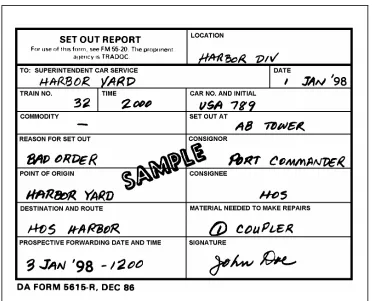
Equipment Use... 8-1 Rolling Stock... 8-1 Locomotive Classification ... 8-9 Types of Railway Equipment ... 8-11 Effects of Cold Weather on Motive Power and Rolling Stock... 8-17
CHAPTER 9 WRECK CREWS AND EQUIPMENT
Rail Operations Planning ... 10-1 Line Capacity Planning ... 10-3 Yard Capacity Determination... 10-8 Railway Equipment Requirements ...10-11 Personnel and Unit Requirements ...10-14 Supply Requirements...10-15
CHAPTER 11 FOREIGN SERVICE HOST NATION EQUIPMENT
Types of Equipment... 11-1 Rules ... 11-2 Sustainment of Rail Operations ... 11-2
CHAPTER 12 RAIL ACCIDENTS AND INCIDENTS
Rail Hazard Issues ... 12-1
APPENDICES
APPENDIX A BLANK LOCALLY PRODUCABLE FORMS... A-1
APPENDIX B RAILWAY PLANNING EXAMPLE...B-1
APPENDIX C RAIL TRANSPORT ORGANIZATIONS...C-1
GLOSSARY...Glossary-1
PREFACE
This manual describes the organizations, processes, procedures, and systems involved in the rail operations across the military spectrum. The focus of this manual is for the reader to gain an understanding of the Army rail system and how it functions. Rail transport operations in developed nations are considered to be a HN-provided service. In contingency areas, US rail units may have to be employed to support the theater of operations. This FM sets forth transportation rail doctrine and organizational structure. It is written to explain the functions of rail transport operations service in a theater of operations. It provides basic information for commanders and staffs of supporting units and for staff officers of higher HQ. It is also intended to serve as a text for student instruction and training of rail unit personnel.
This manual remains consistent with Army operations, logistics doctrine, and concepts currently published or in the process of being published. However, the reader is cautioned that logistics doctrine is changing — and changing rapidly. The on-going efforts to reduce the Army logistics footprint and move to the Objective Force will require doctrinal change. Users acting within the scope of their authority may vary from this doctrine in this manual when such variation will result in improved operations.
The Army’s environmental strategy into the 21st century defines its philosophy and commitment in protecting and preserving the environment and natural resources for present and future generations. Sound environmental practices and considerations must be integrated into all Army documents, missions, and operations. In keeping with the Army’s vision to be a national leader in environmental stewardship, commanders and leaders must ensure that all local, state, federal, and host nation laws and regulations pertaining to the environment are included in the planning process and followed to an extent consistent with operational considerations.
The proponent of this publication is the United States Army Combined Arms Support Command (CASCOM). Send comments and recommendations on Department of the Army (DA) Form 2028 to Commander, US Army Combined Arms Support Command and Fort Lee, ATTN: ATCL-T, Fort Lee, Virginia, 23801.
Chapter 1
Rail Transport Operations
There are four primary functions of rail transport operations for military and commercial railways. These functions include the following:
• Train operation.
• Maintenance of way.
• Maintenance of equipment.
• Train Control.
OPERATIONS
1-1. NATO and US war plans involves extensive rail use. Rail transport operations in Europe is a HN-provided service.
RAILWAY SERVICE IN THE THEATER
1-2. Each potential HN in NATO (with emphasis on Germany, the Netherlands, Belgium, and France) operates a sophisticated, modern railway system. The western area of Europe offers multiple routing possibilities, plenty of marshaling yards, and discharge/loading terminals. Rail line repair and equipment maintenance facilities are dispersed throughout the system. The European railway system poses the following potential limiting factors:
• Primary dependence on electrified train operations.
• Civilian dependence on uninterrupted rail support.
• Improbability of civilian rail personnel being used in the CZ (corps and division).
1-3. Personnel should consult and comply with AMovP2 before moving trains across NATO borders. The Army uses the area’s existing rail structure as much as possible to support the TA. The following provides the support needed to operate the rail system without extensive rail construction or major engineer reconstruction.
• Existing tracks.
• Locomotives and rolling stock
• Switching modes.
• Marshalling yards.
Extensive rail construction is beyond the capabilities of a military force, except during a prolonged war when a civilian work force would be employed to operate the railroad.
contingency area’s rail system. In some cases, the service organization is much smaller than was needed in the past.
ESTABLISHMENT OF RAIL OPERATIONS
1-5. There are many similarities between military and commercial railways. Military railroads operate on the same basic principles as commercial railroads. These principles are:
• Locomotives pull railcars loaded with freight and passengers over miles of track.
• Train movements are controlled by schedule or signal communication.
• Some trains have superiority over others.
1-6. Rail operations in a theater may consist of a broad initial or preinvasion plan based on limited available intelligence data. As more detailed data becomes available, the initial plan is modified. Initial or preinvasion planning provides general estimates of the potential movement capability of a particular railway system in the theater.
PHASES OF OPERATION
1-7. Military railway operations are accomplished in three phases. These phases are normally conducted in sequence. However, depending on military requirements, a phase II or phase III operation may be initiated without progression through the preceding phases or regress to a previous phase. These phases aim to reduce requirements for military units and personnel for railway
operations. Therefore, skilled local labor and HNS is a prime consideration in initiating phase II and phase III operations. In discussing these phases, the terms "civilian labor" and "host nation support" are not synonymous terms, as HNS can be other than civilian labor.
Phase I
1-8. Only military personnel conduct phase I operations. Personnel use this phase during the early stages of a military operation. Phase I is used in or near the CZ where there is a need for the military and where security restricts the employment of civilians.
Phase II
1-9. This phase is a joint civilian-military operation under direct military supervision. In this phase, military and local civilian railway personnel operate and maintain the railway lines.
Phase III
METHODS OF OPERATION
1-11. Existing railway facilities support military operations in a theater. Communications and railway signal facilities may be damaged, destroyed, or inoperative. This may include any form of centralized traffic control, electrically-operated interlocking plants, and automatic block signal systems. Rail transport operations uses the following four methods of train operations in a theater.
Fleet Operation
1-12. This operation (Figure 1-1) is an emergency measure and is discontinued as soon as possible because it limits railway capacity. Upon entry into a theater, communications may not exist. There may be only a single stretch of track with no sidings or passing tracks. Loaded trains are run forward until the tracks at the railhead are full. Trains are then unloaded and returned to the port or point of origin. Grouped trains also make good targets for the enemy.
Block Operation
1-13. This operation (Figure 1-2) permits the train to operate from one block to the next in a station. The train operates from one block station to another under authority of the train-movement
operator or station agent. The two types of block operations used are positive and permissive.
Positive Block Operation
1-14. In this operation, the use of the block is limited to one train at a time. The train can stop if it is attacked or if the line is obstructed. It can also back up to the last station passed or to a safe place and wait until the track is secure before proceeding. This operation has definite security advantages, but the permissive operation is more efficient.
Permissive Block Operation
1-15. In this operation, more than one train is moving in the same direction. Therefore, the trains may occupy the same block at the same time.
Figure 1-2. Block Operation
TRAIN ORDER OPERATION
1-16. During this operation, the communications system must be adequate and dependable. Sufficient sidings and passing tracks must also be available. The dispatcher issues train orders and controls movement. A train order remains in effect until it is fulfilled, superseded, or annulled. A train order authorizes movement of trains when not provided for by timetable. Chapter 4 describes a train order operation.
Timetable Operation
1-17. Use the timetable operation in the theater when traffic is stabilized. The timetable contains schedules and special instructions relating to train operation. It is also the authority for movement of trains. Since military train operations usually consist of extra trains not shown in the timetable, use the train order operation in conjunction with a timetable for maximum effect. See Chapter 4 for more discussion on timetable operation.
Note: The four methods of train operation are generally used in the order discussed and progress to the more flexible and precise timetable operation in stabilized rear areas.
USE OF EXISTING FACILITIES
1-18. Use existing tracks and facilities as much as possible as the theater of operations expands. Captured track is rehabilitated as needed. If possible, avoid new track construction because of the manpower required. However, when new construction would take less time and manpower than rehabilitation, it may be advisable to construct new track and facilities. You can use panel track for quick repairs and new construction in the theater. They can be built ahead of time and stored until needed. The following are those facilities that may require rehabilitation or new construction.
Main Lines, Yards, and Sidings
Service Facilities
1-20. Adequate service facilities (for example fuel, sand, and water servicing facilities) are of vital importance in railway operations. Normally, railway cars spend over half of their useful life in terminals. If proper facilities do not exist or are not fully used, congestion can occur.
Signal Systems
1-21. On newly constructed or rehabilitated lines, signals of the simplest kind are installed. Automatic block signals and interlocking switches are maintained and used only if they exist. If used, they require tight security since they are highly vulnerable to sabotage.
Telephone and Telegraph Lines
1-22. The most dependable and fastest method of dispatching trains is by telephone. Existing telegraph lines are easily converted for telephone operations. If sidings are equipped with telephone boxes, train crews help the train dispatcher to move trains in emergencies.
Enginehouses
1-23. Roundhouses and turntables are easily recognizable from the air. In an area subject to enemy attack, enginehouse facilities may have to be avoided. If roundhouses and turntables do exist, precautions should be taken to ensure that locomotives would not become useless if the facilities were disabled. Newly constructed enginehouses should be simple frame structures without complicated windows and doors.
RESPONSIBILITIES
1-24. Rail units are responsible for the security of railway installations, equipment, and rail shipments. Security measures of railway installations, equipment, and rail shipments at all levels of rail transport operations are command responsibilities. However, commanders of rail units do not have adequate organic personnel to provide necessary active security along rail lines or to guard bridges, tunnels, yards, and so forth without hampering the primary rail mission of maintaining and operating a military railroad.
SECURITY
1-25. Commanders must take all active and passive security measures that are within their
capabilities. Commanders of rail units must then cooperate and coordinate with area commanders and local security agencies to the maximum extent consistent with performance of the rail mission.
BATTLEFIELD SECURITY
Main targets for enemy forces are the rail lines and facilities. Units must protect against attempts to disrupt their operations. Since supporting combat operations is the primary requirement for all CSS operations, units must not divert assets to security and defense that would significantly reduce their support capability.
Enemy Detection
1-27. Detecting the enemy is the responsibility of every soldier in the rear area. Detection is achieved by observation, reconnaissance, and surveillance. It is performed during all weather and light conditions and on any terrain throughout the rear area. Report any unusual or suspected activity. Use active and passive measures to stop the enemy. Detection efforts include the following:
• Use of day and night observation devices.
• Communications and intelligence.
• Radar.
• Remote sensor.
• Chemical and radiological detection equipment.
These efforts provide early warning of enemy infiltration attempts or the use of chemical or nuclear weapons. They also aid in preventing reactions to false alarms (such as movements by friendly persons, defectors, or refugees).
Train Security
1-28. You may use armored trains to patrol track where sabotage is expected. Locomotives are preceded by two or more cars loaded with sandbags or hard-packed dirt for protection against mines and obstructions. On a single-tracked rail division subject to attack, employ the positive block method of operation. This method allows the train to move forward or backward if the track is blocked. If the train is unable to move or complete its mission, the escort commander must defend the train with all available personnel. If there is no escort, the senior occupant (who is appointed before departure) must defend the train.
Shipment Security
1-29. The consignor (shipper) must ensure that carload freight is secure until the car is coupled to a locomotive and leaving the loading site. Personnel must inform shippers of their responsibilities. Before loading a car, the shipper should thoroughly inspect it to see that it meets security
1-30. Personnel are responsible for security of shipments from point of origin to destination consignee delivery. Personnel must document rail shipments to effect prompt movement and prevent cars from going astray. When operationally feasible, group cars containing security shipments or freight (subject to pilferage) together in trains and/or yards to reduce the number of guard personnel required. Yardmasters and chief dispatchers must coordinate with yard or train crews when the escort or guard personnel ride in or on cars containing sensitive material. Guard crews check car seals or door fastenings at every stop. They must also keep a trip record (by car number and lading) of all cars guarded. They should record deficiencies or events that occur en route. Relief guards take over and sign this record, which also serves as a delivery receipt. The trip record is transmitted through MP channels to the unit at the end of the trip or when the record is completed. When a car containing critical or pilferable supplies is set off en route, one or more of the train guard crew must be detailed to remain with the car. MP units will provide proper security for freight in transit. Based on assets available, MP units may provide security for freight in railway yards.
1-31. Consignees assume responsibility for the security of loaded freight cars at the time they are placed at the designated depot or other unloading track. Unload cars as quickly as possible to reduce the chance of pilferage. Use care when removing wire or seals from closed cars to avoid breaking the car door latches.
COMMUNICATIONS AND AUTOMATIC DATA PROCESSING
1-32. The TA is responsible for reconstruction and rehabilitation of railway communications
landlines. Use cable as the primary means of communication for train operations. However, you may use a radio as a backup or as a primary means of communication when construction and/or
rehabilitation of landlines are not feasible. Rail units must perform the following:
• Operate and maintain railway communications circuits used only for operation and administration of the transportation railway system. Rail units are not responsible for maintenance of ADP equipment.
• Install organizational communications (such as local switchboards, telephones, radios, and teletypewriters in yards, way stations, shops, and dispatch offices) for normal administrative and operational communications.
The transportation railway battalion installs, operates, and maintains organizational communications for administrative use.
Wire Communications System
1-33. The railway battalion uses wire facilities as one of its primary means of
communication to dispatch trains in a theater of ope rations. The following are the three communication circuits provided for operations within each railway division.
• Dispatcher’s circuit.
• Message circuit (station-to-station circuit).
Dispatcher’s Circuit
1-34. Use this exclusively to control train movements by train order and to control trains through towermen and station agents within a division. The division dispatcher may call each way station independently or all stations simultaneously. The division dispatcher monitors the line at all times. Way station personnel may talk to the dispatcher on this circuit without signaling.
Message Circuit (Station-to-Station Circuit)
1-35. Use this with the block system operation within a division. Also use this for the following:
• Operational supervision and control.
• Daily and special reports.
• Car distribution.
• Distribution of movement orders to operating personnel.
• Operational matters between stations.
Way stations are connected to each other and to the division dispatcher. Any station may contact another station through code signaling.
Teletypewriter Circuit
1-36. This joins a division dispatcher with the adjacent division dispatcher. Use this for written transmission of train consists, operational orders, movement programs, general instructions, and miscellaneous messages. This circuit may be superimposed upon the message circuit.
Radio Communications
1-37. Mobile and fixed radio communications increase efficiency, control, coordination, and safety of train movements. Radio equipment is organic to railway operating units and its use is a normal part of rail operations. Use radio communications in yards, main track, and other operations. As an insecure means of communication, radio is subject to exploitation by hostile communications intelligence and EW activities. Radio communications in yard operations have the following advantages:
• Yard crews can notify the yardmaster when assignments are complete and immediately receive new assignments.
• Delays at the interlocking plant can be eliminated by knowledge of train location.
• Special movements (such as hospital trains) can be expedited.
• Delays caused by derailment or damage to cars or cargo can be reported immediately.
• Arrival time can be determined more accurately through communication with incoming trains.
• Changes in train movements or orders can be rapidly dispersed.
any communications systems for which C-E units are responsible on a planned project basis. Main track radio communications furnish contact between trains and the dispatcher, between trains and way stations, and between stations. Using this equipment has the following advantages:
• The train engineer, in an emergency, can call the way station operator. If the train has to stop, other trains within range of the radio frequency can be advised to take necessary precautions.
• Train speeds can be regulated to ensure proper meetings at passing points.
• Derailments can be reported immediately and repair crews can be quickly dispatched.
• Crossing accidents can be reported and MP and medical assistance can be expedited.
• Train crews, to reduce time at stops, can request fuel or other supplies before arrival.
• The train engineer can be informed of the condition of the tracks as a result of snow and rock slides, flash floods, and bridge washouts.
• Train crews can promptly report guerrilla operations, sabotage attempts, and air attacks.
Automatic Data Processing System
Chapter 2
Railway Train Operations
There are many hazards that exist during railway train operations. The following have always been hazards of railway operations:
• Human errors.
• Recklessness.
• Mechanical failures.
• Collisions.
• Wrecks.
OPERATING AND SAFETY RULES
2-1. The design of operating rules to prevent these hazards has been formulated gradually. There are now rules to cover all situations, which conceivably present a potential accident hazard. These rules, published in the "Standard Code" by the Association of American Railroads, are the basis for nearly all railroad rules currently used in the US. Many railroads have altered the rules slightly or dropped those that do not apply to them due to local conditions and types of operations. However, the rule numbers have not changed. For instance, Rule 99 means the same thing to railroaders in California as to those in Connecticut. All railroads have also developed safety rules. While safety rules do not have the general uniformity of operating rules, they are similar in that they prohibit dangerous practices and prescribe safety procedures. See FM 55-21 for detailed explanations of these rules.
OPERATING RULES
2-2. Train operations are governed by current railway operating rules adapted from the Standard Code of Train Rules issued by the Association of American Railroads. These rules are modified to meet military railway requirements and are published in FM 55-21. The battalion commander must ensure that all operating personnel have a copy of the timetable and be familiar with the operating rules. Periodic examinations are given to ensure that personnel completely understand the rules. Personnel must always obey operating and safety rules.
2-3. Do not randomly use vehicles equipped with road -rail devices on railroad tracks or without proper authority from the train dispatcher. When a vehicle equipped with a conversion device operates on the tracks of a railroad that is under the supervision of the rail unit, it constitutes a train and must be considered as such. Operate such a vehicle according to FM 55-21.
SAFETY RULES
Safety Conditions
2-5. The following are only a few of the changes that has eliminated many conditions that once caused injury and death on the railroad:
• Automatic couplers.
• Electric signals.
• Rolling-stock improvements (steps, grab irons, running boards, and so forth).
• Use of diesel motive power instead of steam.
On many foreign railroads, safety conditions and safety devices vary considerably from the standards of US railroads. In many foreign countries there is not enough clearance on bridges, buildings, tunnels, and overhead lines and obstructions for personnel riding the tops and sides of cars. There is also a lack of uniformity in the safety devices (such as the number and location of grab irons, ladders, sill steps, braking devices, and couplers). These conditions require a constant watch by rail personnel unaccustomed to them.
Accidents
2-6. Many accidents are caused by people from outside agencies who have not had the safety training given to rail personnel and/or who ignore posted warnings and all rules of common sense. Some common examples of accidents are those resulting from the following:
• Other agencies mishandling dangerous articles into and out of cars on railroad premises.
• Improper loading of dangerous material.
• Vehicles loaded with explosives.
• Flammables crashing into locomotives and trains at crossings.
Extensive safety campaigns, safety rules, and supervisory discipline have helped. However, the human factor still remains and injuries and deaths do occur.
Warning Signs
2-7. The design of warning signs and labels is to prevent accidents. Railway personnel must think and live safety. Applicable safety rules are in FM 55-21. Members of rail units must know and obey these rules. Supplementary instructions are issued for unusual situations as required. SAFETY IS
EVERYONE’S RESPONSIBILITY–ALL THE TIME.
COMMUNICATIONS SYSTEM
2-8. The railway communications system consists of two major parts. The first part is for the efficient operation of the railways. The second part is for routine administration, communication, and
Train Dispatcher’s Circuit
2-9. The train dispatcher, station operators, and tower men, mainly use this circuit. Its use is for the control of trains by train order, block signals, and special instructions issued by the train dispatcher. A terminal operator not only controls trains entering the terminal from his own division, but he also receives and releases trains to the adjacent dispatcher in the connecting division. He also coordinates all train movement responsibilities between connecting divisions for the dispatcher concerned. The train dispatching circuit has a selective ringing device that permits the dispatcher to call stations separately or simultaneously. The train dispatcher is responsible for strict wire discipline and issues orders and instructions in compliance with the rules for movement of trains by train order (see FM 55-21).
Station-to-Station Circuit
2-10. Use this circuit to distribute general information, reports, and records needed for efficient operation. Information obtained must implement orders or instructions issued by the train dispatcher.
Teletypewriter Circuit
2-11. This simplex circuit connects the battalion with adjacent battalions and higher HQ. The circuit transmits operating policies and directives to coordinate the movement of troop, hospital, and VIP trains. It is used at the battalion level to transmit routine matters to higher HQ.
Pole and Line Maintenance
2-12. Planned and continuous preventive maintenance prevents frequent service interruptions (particularly after heavy storms and in areas subject to enemy action or sabotage). Regular patrols are established to detect and correct faulty conditions. The nature and frequency of inspection depend on the age and type of poles and lines and the terrain, weather, and other conditions. Regular inspections can normally be made from the ground. However, pole-top inspections should be made often at points in the line where defects are most likely to develop. Inspection crews are equipped with tools and equipment for making minor repairs and for trimming small branches and vegetation. Unsatisfactory poles, crossarms, and so forth should be replaced.
Radio Communications
2-13. The rail unit may need radio communications during the early stages of an operation.
personnel. When equipment is made available, the rail unit uses the following three general systems of radio communications.
• Train operational control, en route.
• Between dispatcher and stations.
• Between train crew members.
• Between stations.
• Between dispatcher and trains (if range is adequate).
• Between stations and trains.
• Between crews of different trains.
• Operational control in yards and terminals, yard offices, switch crews, and yard personnel.
• Administrative and technical control.
• Operating units.
• Administrative units.
OPERATION OF TRAINS
2-14. Railroad main line operations are complex. They involve the movement of freight, passenger, and mixed (freight and passenger) trains from one terminal or yard to another over a division or subdivision of track. Adding to the complexity is that rail operations are a prime target of enemy NBC weapons. Contingency plans must be developed with the capability and flexibility to continue operations in an NBC environment. Protective measures and procedures to relieve the effects of NBC weapons must be integrated into daily operations. NBC attacks will create high casualty rates and material losses, as well as contaminate terrain within the unit. Increased levels of MOPP will result in heat buildup; reduced mobility; and reduction of visual, touch, and hearing senses. Rail unit operational efficiency and productivity will be lowered.
deliberate decontamination as soon as practical. Keep a record of each locomotive and railcar to identify the date of contamination, the type of agent, and the date and method of decontamination used. FM 3-100 has more information covering operations in an NBC environment.
2-16. Depending on the phase of operations, the trains operated by the rail unit may be extra or regular trains and may be civilian or military-controlled. A regular train is authorized by timetable while an extra train is authorized by a train order issued by authority of the chief train dispatcher. Road movements are coordinated operations with successful accomplishment depending on the following factors:
• People and facilities provided.
• Adequate functioning equipment.
• Suitable trackage.
• Competent dispatchers, maintenance personnel, and operating crews.
The requirement for adherence to special orders, rules, and other operating instructions are in FM 55-21.
TRACK FACILITIES
2-17. In railway terminology, track facilities are defined as those facilities that are required to operate railway trains at a predetermined safe speed. Track facilities include the following:
• Main tracks.
• Sidings.
• Towers.
• Signals.
• Buildings.
• Fuel/lube, sanding, and water points.
• Shops.
• Enginehouses.
• Communications system.
Main Track
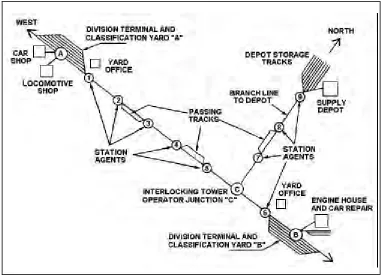
Figure 2-1. Schematic Layout of a Typical Railway Battalion’s AOR
2-19. Although a single-track line permits trains to run in opposing directions, provisions for their meeting or passing must be made either by train order or timetable schedule authority. When operating on a single track by the timetable method of train operation, the inferior trains must be in the siding 10 minutes before the scheduled arriving time of the opposing superior train unless otherwise directed by train order. When a train dispatcher authorizes an extra train to run over a single-track rail line, he must make provisions for the new extra train to meet all opposing extra trains en route in the train order authorizing the new extra to run. Single-track railway operation not only requires that all operating personnel know, understand, and comply with all provisions of the
operating rules, but that they also strictly comply with all train orders issued by the authority and over the signature of the chief train dispatcher.
2-20. A double-track rail operation consists of two main tracks with the flow of traffic being in the direction specified in the special instructions of the timetable. The train dispatcher has a firm base on which to control scheduled trains. The existence of a double-track rail line operated by timetable authority does not relieve the train dispatcher of the many details inherent in a single-track operation, since only first-class trains are normally listed in a timetable schedule. While the flow of traffic is specified in the timetable, facing and trailing point switches permit the dispatcher to use either track at any time to relieve congestion or interruption on one of the lines.
Siding
2-22. A siding is a track auxiliary to the main track. It is connected by switches at both ends and is used for the purpose of meeting and/or passing trains. To prevent delays when two opposing trains contain a greater number of cars than a siding can accommodate, sidings should be long enough to contain the longest train that can be run over the railway line. NEVER use a siding as a loading and/or unloading point except for a serious interruption to traffic or in an extreme emergency.
Spur
2-23. A spur is a dead-end track auxiliary to the main track. It is connected to the main track at one end and is used to load and/or unload railway equipment. Spurs used as loading and unloading points must be easily accessible to adjacent roads or highways. When two locomotives "meet" face to face, the spur provides a place for one to get out of the way. However, this operation requires train crews to be very vigilant because the train must be headed out or vice versa.
Switch
2-24. A switch consists of moveable rails which can be positioned to allow cars or trains to move from one track to another. Power-operated switches are usually found in busy terminals, at interlocking plants, and in CTC installations on the main line. Manually operated switches are normally equipped with locks for safety purposes (a switch usually is opened to the main track and closed to the spur or siding). The position of a switch is indicated by colored panels or blades by day and lights by night. The universal code has a green aspect for a closed switch and a red aspect for an open switch.
Branch Line
2-25. A branch line may be either a double- or single-track railway line connecting main lines. It may also be designed to serve relatively remote places, such as industrial plants or sparsely settled areas. Usually a branch line is constructed of lighter rail and has fewer crossties and poorer ballast than a main line. You may use branch lines during phase I operations to meet military needs until the main lines can be rehabilitated.
CAR ALLOCATION AND DISTRIBUTION
2-26. Cars are allocated for loading based on priorities set by TA and other higher HQ. Necessary rolling stock to fill requirements is authorized in the movement program. Movements not included in this program must be specifically authorized on a "spot" or immediate requirement based by
appropriate rail unit or logistical command HQ.
Distribution
he has received from situation, current station or empty car status, train and yard reports, and reports from adjacent divisions. Yardmasters and/or station agents have switching crews place the empty cars for loading according to programmed and authorized nonprogrammed requirements.
2-28. A daily operational and movement conference makes car distribution easier for a port, depot, or other large loading point. Car distribution requirements for the next 24 hours are stated and coordinated with the movement program. The chief dispatcher is responsible for informing the operations superintendent (battalion commander) of the empty car situation and inability to meet loading requirements. In such cases, the changes in priorities are made through movement control channels.
Unauthorized Uses
2-29. Units, depots, or services must not hoard or be given cars without proper authority. Using railcars for mobile or storage keeps them out of service, upsets the flexibility of car supply, and disrupts the distribution program. Such practices result in confusion and shortage of equipment already committed for other uses. Agents, field transportation officers, yardmasters, and unit
personnel must report any unauthorized use or hoarding of rail equipment to higher HQ. The report is then forwarded to the required command level for corrective action.
RECORDS AND REPORTS
2-30. Records and reports are essential in the unit. The transportation railway battalion, as the basic operating unit, reports the following information to group HQ for relay to logistical planners at all command levels.
• Total tonnages moved.
• Number of empty and loaded cars on hand at midnight.
• Number of serviceable locomotives.
• Delays and interruptions to traffic for the preceding 24 hours.
• Fuel requirements.
• Operational reports required by higher HQ and transportation movement control agencies for daily planning.
The records and reports discussed in this section are typical of those pertaining to the administration, maintenance, and operation of military railways. Space limitations preclude full discussion of all forms used by the unit. Unnecessary paperwork and the accumulation of voluminous reports should be avoided.
Preparation, Forwarding, and Retention
2-31. Reports are prepared, forwarded, and/or retained according to the SOP of the next highest echelon of command requiring the information. At each echelon, reports are reviewed, information extracted, and consolidated reports prepared and forwarded to the next higher HQ. Reports are forwarded (as applicable) by telephone, teletype, mail, or messenger service. Reports and records prepared or received, particularly those containing personnel and statistical information, are
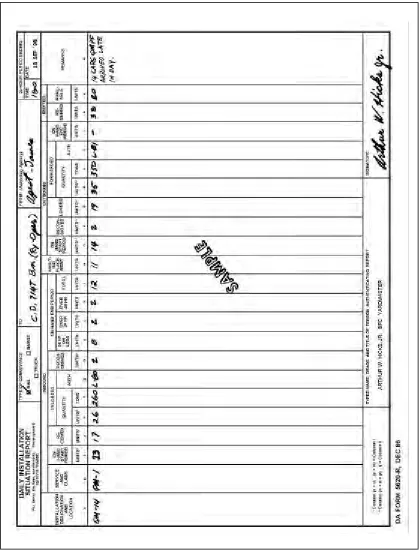
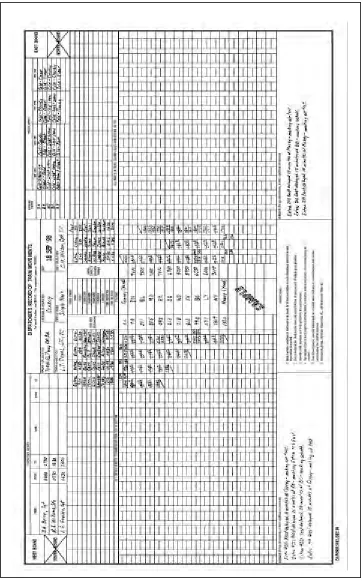
Daily Installation Situation Report (DA Form 5620-R)
2-32. All rail activities prepare this report (Figure 2-2, page 2-12) at depots, railheads, yards, terminals, ports, or other points where loading, unloading, or movement of cars takes place. They prepare this report at a fixed time each day. This report is completed and consolidated at each level of command. It reflects the situation as of the hour it is compiled and the progress of operations over the
preceding 24 hours for the entire division. The report is based on data obtained by a thorough physical check of all yards, stations, depots, docks, warehouses, loading and unloading tracks, or other tracks where cars are stored. The report is then filed as a permanent station record. Appendix A contains a blank copy of a DA Form 5620-R. Instructions for completing this form are also shown in Figure 2-2, page 2-10.
Maintenance of Way Reports
2-33. The transportation railway engineering company prepares maintenance of way reports. These reports cover normal operations in repair and rehabilitation work and are used by the battalion commander and higher HQ. Special reports are promptly made by electrical means on the extent of damage to bridges, buildings, tracks, and tunnels resulting from enemy or guerrilla action, floods, sabotage, slides, wrecks, or other causes. All personnel casualties are reported. If tracks are
obstructed, an estimate is made as to the time required to restore traffic. Progress reports are made periodically, as directed, until repairs are completed and the line is open for train movement.
Equipment Maintenance Reports
2-34. Equipment maintenance reports, made by the transportation equipment maintenance company, include the daily enginehouse reports. The equipment maintenance reports show the following:
• Available motive power.
• Number of locomotives undergoing repairs.
• Estimated time when each will be ready for service.
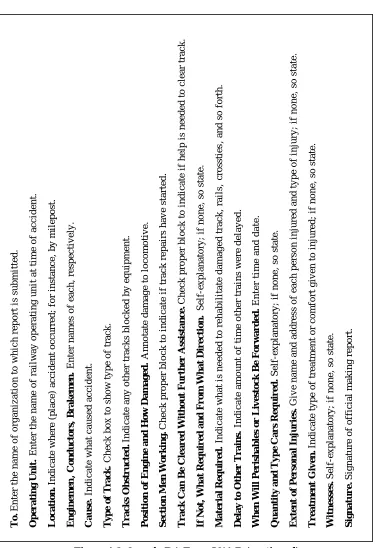
Figure 2-2. Sample DA Form 5620-R (continued)
Type of conveyance. Check proper block (rail, barge, or truck).
To: Indicate destination of form. From: Self-explanatory.
Inbound
a. Installation Designation and Location. Self-explanatory.
b. Service and Class. Enter primary class of supplies.
c. On Hand Start Period. Enter number of in-bound freight cars on hand.
d. Received. Enter number of freight cars received during unloading.
e. Quantity Units. Enter number of freight cars unloaded during time period.
f. Quantity Tons. Enter tonnage unloaded during time period.
g. Auth. Indicate consignee.
h. Reconsigned. Enter the number of cars that have changed their original destination or consignee.
i. through l. On Hand End of Period. Indicate the number of cars that have been at your location for 24 hours or less; over 24 hours; or over 48 hours. Show total of cars in block l.
m. Awaiting Placement. Indicate number of cars awaiting placement instructions from consignee.
Outbound.
n. through t. Follow instructions for b through l above.
Empties.
u. Required. Indicate projected need for out-bound loads for next time period.
v. Available. Indicate number of empties available for outbound load.
w. Remarks. Enter any additional comments.
24-Hour Period Ending. Enter time period ended and date.
CAR LABELS AND PLACARDS
2-35. Use car labels and placards to ensure proper handling of certain types of shipments. They also inform yard personnel, inspectors, and switching and train crews of a car’s contents. Affix labels or placards in conspicuous or prescribed places to either both sides of a car or the end of a car. In overseas theaters, labels and placards are usually multilingual and are used as prescribed by theater SOPs.
Urgent-Expedite Labels
2-36. Use these labels for priority shipments only. They inform rail personnel of the shipment’s importance so that it is expedited through yards and junctions.
General Car Labels
[image:27.612.116.484.394.669.2]2-37. These labels usually have a colored stripe through the middle. They inform railway personnel at a glance what type of commodity or supplies the car contains. They also help local personnel who cannot read English to quickly identify shipments by color association. These labels also give general information such as contents, weight, consignor, consignee, seal numbers (if used), and so forth. The consignor places car labels on both sides of the car. Figure 2-3 shows examples of car labels used by railroads in Europe.
Re-icing Placards
2-38. Use these placards only on refrigerator cars carrying perishable items. Place these placards at eye-level on both sides of the car and near the ice bunkers. These placards show when ice and salt (date and time) were placed in the bunkers at origin and include instructions on any re-icing en route.
Special Placards
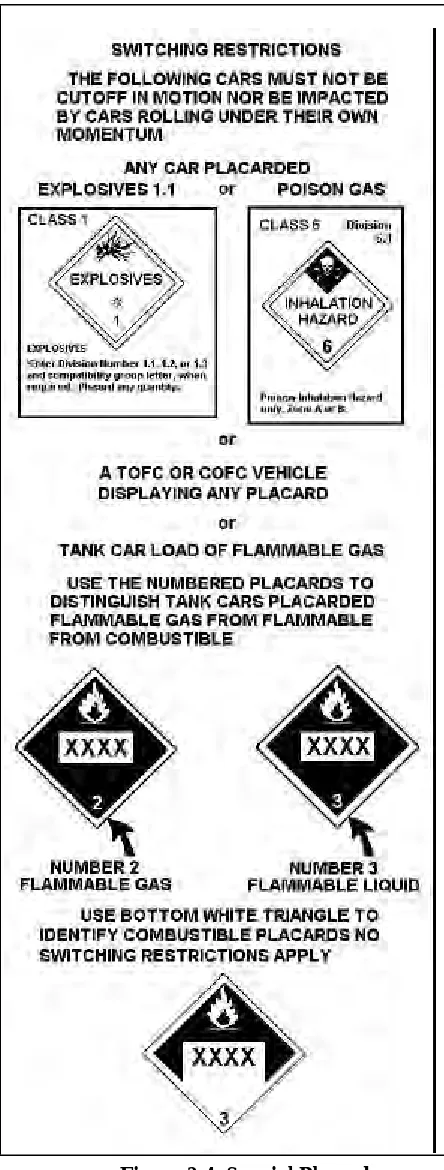
2-39. Special placards (Figure 2-4, page 2-16) indicate requirements for special handling, easy coupling, and so forth. These placards identify the following:
• Explosives.
• Flammable articles.
• Fragile or perishable cargo.
• Missile components.
• Radioactive materials.
• Any other potentially hazardous items.
Such placards include DO NOT HUMP instructions if applicable. These special placards are usually printed in various color schemes to emphasize their meaning and importance. The consignor or loading activity affixes these placards to each side (or end) of a car before the car is released to the railway service for movement.
Standard NATO NBC Markers
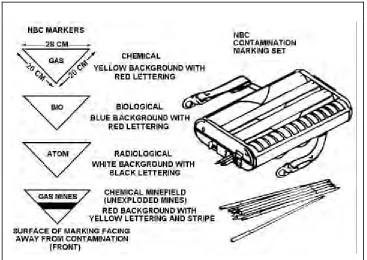
2-40. Place standard NATO NBC markers (Figure 2-5, page 2-17) on both sides of railroad rolling stock to indicate contamination. Railroad personnel will take appropriate actions to separate rolling stock for decontamination
FORECAST MOVEMENT REQUIREMENTS
Figure 2-5. NBC Marking Devices
PORTS
2-42. Close coordination is required between rail unit personnel serving ports and port operating personnel. A large percentage of the tonnage from a port is moved by rail. The smooth operation of a port depends on prompt cargo clearance from the port area. The railway yardmaster must attend the port operations, meeting daily to coordinate the receipt and disposition of cargo that has been designated by the MCT to move from the port area by rail.
Port Clearance
2-43. Port capacity depends on prompt movement of cargo from the port area. Since depots, dumps, and storage areas are located within a 20- to 25-mile radius of the ports, MCTs do not designate rail as the best mode to accomplish port clearance for short distances. Railways are characterized by their capability to move large tonnages over long distances. Movements personnel coordinate rail
Car Inspection and Repair Facilities
2-44. Local maintenance facilities may be established when the number of cars used in shuttle service between ports and depots or dumps justifies such action. Car inspectors and maintenance personnel from a car repair platoon, transportation railway equipment maintenance company are stationed in the port area. They perform the following:
• Inspect cars for mechanical defects.
• Make minor repairs (such as replacing air hoses or brake shoes).
• Repair door fastenings, brake rigging, couplers, and so forth.
Inspectors inspect loaded cars, particularly those containing dangerous commodities, to ensure compliance with clearance requirements and safe loading regulations. Promptly report cars with defective loads to the yardmaster.
Border Crossings
2-45. When operating within territories of NATO nations of continental Europe, American forces must be prepared for crossing international borders and border crossing requirements. The format used by movement agencies responsible for relaying information at border crossing points is shown in AMovP2.
Pier Operations
Chapter 3
Rail Operations In Smaller Scale Contingencies
Smaller-scale contingencies (SSCs) encompass a wide range of joint and multinational military operations that fall between Major Theater War and Peacetime Military Engagement. While not all-inclusive, Army forces committed to SSCs protect American lives and interests, support political initiatives, facilitate diplomacy, promote fundamental American ideals, or disrupt illegal activities. As in MTWs, the JFC assigns supported and supporting relationships to components of the joint force to best accomplish the mission.
ROLE OF THE RAIL UNIT
3-1. The rail unit monitors or provides technical assistance to the operation of the HNs railroad system. Rail unit's assistance may include providing resupply to US forces to the actual operation of the rail system to maintain the credibility of the host government.
UNCONVENTIONAL OPERATIONS
3-2. Unconventional operations are predominately of a military nature and are characterized by extensive use of unorthodox tactics conducted by irregular forces. The most potent weapon of this type force is surprise. Rail personnel, especially train crews and those at outlying points, must stay alert at all times in case of an attack. Rail personnel at small stations, yards, enginehouses, and maintenance of way detachments along the line of road must also stay alert.
Sabotage
3-3. Constant vigilance is necessary to prevent or reduce sabotage. Sabotage is any willful act
intended to aid the enemy by destroying, impeding, or interrupting any person or function. Some acts of sabotage include placing sand in car journal boxes, water in fuel tanks, or bolts in a machine gearbox. Identifying acts of sabotage are not as easy as unconventional operations, but the effects are the same. These acts are done secretly making them more difficult to prevent. Inspect trains
frequently for concealed saboteurs or guerrillas who may cut air hoses or train lines to force an emergency stop where guerrillas wait to attack. If tonnage can be handled with locomotive brakes only, operating trains without air brakes rules out this type of sabotage.
Objectives
3-4. Level I and II threat operations (see FM 100-20) most commonly use fire and explosives against railway lines and installations to disrupt train traffic. Conduct threat operations to perform the following:
• Destroy bridges and tunnels.
• Destroy track (derailments and wrecks).
• Destroy buildings, shops, and terminal facilities.
• Destroy locomotives and rolling stock.
• Capture and/or destroy equipment and supplies.
• Capture weapons and ammunition. Weapons and ammunition are especially critical items and are primary objectives. They must be either in the hands of using personnel or properly secured at all times.
• Capture personnel and/or inflict personnel casualties.
DEFENSE MEASURES
3-5. Military planning includes the possibility of frequent and continuing military actions of special warfare occurring during LIC. This chapter outlines some of the conditions which may be
encountered and some of the methods that the rail personnel may adopt to counter the tactics irregular forces design to wreck trains or delay train movements. The type of defense that may be used varies with local conditions, degree of isolation, proximity of other troops, and so forth. Experience shows that aggressive attacks can cause considerable damage despite apparently foolproof security measures. Trip wires, sentry dogs, barbed wire, land mines, and similar measures give some protection against surprise.
Guidelines
3-6. Guidelines differ depending on the circumstances of the attack and the geographical area in which it occurs. Hard and fast rules cannot be made. Whenever unconventional forces attempt to derail or wreck a train, rail operating and maintenance personnel must attempt to forestall it by suitable countermeasure.
Plans
3-7. Any counter plan must consider the mentality of the enemy, the changing physical characteristics of the particular line, and the terrain. Plans must always be flexible and changed frequently as
conditions warrant.
ATTACKS ON THE RIGHT-OF-WAY
3-8. Irregular forces, possessing a minimum of arms and explosives, may concentrate their efforts on train derailing and wrecking. In many instances, their primary goal may be stealing and pilfering supplies and ammunition after a wreck occurs. Delay may be secondary, but both goals may be accomplished simultaneously. To wreck trains, action must be directed against the track, switches, ballast, and bridges along the right-of-way.
Track
3-9. Tampering with the track and fastenings is the simplest way to cause a derailment. Removing enough spikes from rails will cause them to spread under the weight of a locomotive or buffer cars. Removing nuts and bolts from the joint bars is another method of causing rails to spread.
the irregular forces is the first step to be taken. Tools are removed from the large toolboxes normally spaced along the right-of-way for worker convenience. Track tools should be safeguarded more zealously than their monetary or salvageable value warrants.
Roadbed
3-10. Unless the opposing forces have large stores of explosives or the tools and ability to make improvised mines and bombs, extensive damage to ballast and subballast will probably not be attempted. Crews should be alert for mines and bombs when rounding sharp curves or at the bottom of steep grades where stopping in short distances may be difficult. The absence of a quantity of ballast or dirt is not an easy condition to detect until the observers are quite close to the spot. Crews should be watchful for any piles of scattered ballast or dirt along the track in areas where they would not normally be found.
Track Barricades
3-11. Barricades thrown across the track may serve many purposes. Small, poorly armed bands may drop trees across the track to bring trains to a halt. Generally, when train guards are superior in number and arms, guerrillas will disperse and leave the crew to remove the blockade. In undeveloped countries, unconventional forces and terrorists block the track with anything available. They will often leave false evidence that the barricade has been boobytrapped. This makes removal much slower than usual. Guards must be constantly alert and careful because the terrorists leave the same evidence at barricades that they did not boobytrap.
RIGHT-OF-WAY CONCEALMENT
3-12. In areas where sniping is common or where heavy small arms fire is experienced or expected, brush and green growth along the right-of-way should be cut back as far as practicable (at least 20 feet on each side). Use chemicals to kill jungle growth that serves as enemy concealment.
Concealment is also important to small working groups. Where action is light and confined to sniping and trains are carrying guards or troops, it may be desirable to try to trap the guerrillas.
BRIDGES
3-13. Bridges and trestles are naturally vulnerable. Until repaired, their destruction can stop all movement. Irregular forces may not be interested in total destruction of such important rail facilities. Their primary mission may be to delay, pillage, and try to prevent certain types of cargo from reaching their destination. These same trains may be carrying freight important to their ultimate goal or cause. The average political or military group of a country with a limited rail network, wants to achieve its goal without destroying transportation facilities.
3-14. Bridges and high embankments are excellent points for train wrecking and derailing. Bridges often span rivers and deep ravines. Therefore, efforts are often made to derail trains near these points in the hope that part of the train will topple to the ground or into the river below. It may prove profitable to keep guard forces in areas where simple derailments may have serious results.
3-16. There is a great possibility of a derailment where there are many bridges and high
embankments. The engineman must be prepared to stop immediately upon derailment. One method that has been tried is mounting a white disk on each corner of the foremost buffer car. The engineer watches the disks constantly for any noticeable movement. Movement denotes a derailment and brakes are applied promptly. Another method is one that causes the brakes to be applied,
independent of the engineman’s actions, as soon as a derailment occurs. A method of doing this is to bring the brake pipe down to the wheels, 2 or 3 inches above the rails, with a glass tube installed in the line. When the wheels of the leading car leave the track, the glass tube drops down and breaks and the air brakes are applied.
Wayside Communications Facilities
3-17. Telephone and utility poles and lines are often targets for disrupting communications. Since these facilities are easily sabotaged, it may not be practical to keep these LOC open. If radio communication is not available, trains can be dispatched with reasonable safety and expediency by using manual block operations. Where an attempt is made to keep lines open, enemy forces can often cut wire faster than breaks can be repaired. Cuts may also be made for the sole purpose of attacking repair crews for their tools and weapons when they arrive to repair breaks. Armed escorts should usually accompany repair personnel.
Wayside Signals
3-18. Wayside signals are in the same category as communications when it comes to tampering. Guerrillas can switch electrical leads and cause a signal to display a false aspect. The displayed aspect on main-track switch lights should not be depended on completely. It is a relatively simple matter to turn the lamp or to reverse the roundels and display false aspects. Switch points should always be observed to make sure that they agree with the aspect displayed. It is doubtful whether electric signals should be relied on by the rail unit in guerrilla-infested territory.
Hand Signals
3-19. Railroad crews moving along a main track are always on the alert for hand signals displayed on the track ahead. Open stations will display "stop" or "proceed" signals depending on whether or not the station has any orders or instructions for the crew. When operating in adverse territory, hand signals observed between stations are regarded with suspicion. A red flare or fuse waved violently across the track is a universal stop signal. Opposing forces in possession of fuses and red lanterns can stop trains with little effort. The only countermeasure to use against unauthorized signals is to specify the exact manner in which a signal is to be given. The average nonrailroader usually holds a fuse at arm’s length and waves it over his head in a half circle. A railroader usually swings it across his knees in a lower half-circle. There are many signaling combinations that can be worked out. They should be classified, coded, and changed daily or as necessary.
False Reporting
and verify the report. Such tactics can be overcome by using approved CEOI. COMSEC procedures should be used at all times.
TRAIN OPERATIONS
3-21. Operations over a division experiencing frequent disruption of supply and passenger transport must change with the aims and tactics of the opposing forces. Trains should be operated at irregular intervals. In areas subject to guerrilla warfare, trains should not move on schedule or use traffic patterns that can be anticipated. If logistical considerations permit, all movement should be made in daylight with several freight (supply) trains running close together, at random intervals, for mutual protection. At night, frequent roving patrols or armored trains should move over the lines at irregular intervals to prevent sabotage to tracks and structures. If irregular forces know when to expect trains, they can operate effectively against railroads with very little interruption. In a conventional war, the operation of passenger trains continues for military use but usually diminishes for civilian use if it can be done without disrupting the economy.
Precautions
3-22. Depending on the tactics and goals of the aggressors, special precautions must be taken for passenger train operations. Where irregular forces are well organized and well armed,
countermeasures must be similar to those used in conventional warfare. If passenger trains are kept in operation, it may be necessary to install steel plates over the windows and pile sandbags up to the bottom of the windows. Cover windows with steel-meshed wire to prevent grenades from being thrown into the cars. Doors are closed and secured to prevent guerrillas from boarding. When tracks are torn up or bridges blown, the train should back away if time and conditions permit. When enough motive power is available, a locomotive operated at the rear of the train is used to pull undamaged portions of the train back to safety if the locomotive or cars at the front end are derailed. Troop trains may carry a supply of ammunition and grenades for the crew and passengers to use in case of attack. Locomotives and train guard cars will be equipped with fire extinguishers and first aid kits. The security objective is to save personnel and equipment from capture, damage, or destruction.
Pilot and Inspection Trains
3-23. Conditions may require the operation of a pilot train to travel over a section of track a short time ahead of a following train. This train may be operated as a pilot train, as an escort to a troop or supply train, or as a security patrol train to prevent sabotage. A pilot train running interference for a troop or supply train moves ahead as short a distance as is feasible, safe, and consistent with operating conditions. The pilot train will move 2 to 5 minutes ahead of the second train. After the pilot train passes, the guerrillas do not have enough time to obstruct the track, remove a rail, spike a switch, and so forth, before the train they seek to derail has passed. A pilot train may consist of any combination of rolling stock. For night operations, the lead car can be rigged with a headlight
powered from the locomotive generator. This car may be partially armored with boiler-plate steel and carry a small machine gun or rifle crew for protection against small guerrilla groups or wayside snipers. Additional cars, similarly equipped and manned, may be pulled behind, carrying enough troops or guards for protection against attacks on the train if it is stopped. Depending on the
the front. These cars should be heavily loaded with anything that provides enough weight to explode a buried mine or to test the stability of the track by derailing before the locomotive reaches the spot. If the pilot train can safely pass over a given track section, an ordinary train should also be able to safely pass. It would be useless to have individual (light) engines act as pilot trains. They might safely pass over a track that had been tampered with, but a train of more weight would be derailed. If time delayed or remote controlled mines are used, then patrols must be increased to deny the opposing forces the opportunity of employment.
Emergency Supplies and Equipment
3-24. Aside from necessary weapons and first aid equipment, equip locomotives with a full set of track tools in addition to those normally carried for emergency repairs. Track fastenings, spikes, jacks, sledges, crowbars, and even a limited number of ties and rails may be needed. Engine and train crews and security guards aboard trains should have flare pistols for firing signals to indicate
unauthorized stopping or attack. Train crews, security guards, and patrols may be furnished portable telephones that can be hooked to wire lines along the track to report attacks, derailments, location of interruptions, and similar information. Where the equipment is available and weather conditions permit, railway personnel and guards may be equipped with radio-telephones for similar purposes and communication between enginemen and train crews at the rear. DO NOT place cars containing explosives or flammable materials next to locomotives or cars containing troops or guards. Fire directed toward personnel might explode or set fire to the hazardous material.
ARMORED TRAINS AND CARS
3-25. The tempo may change from sniping, wrecking, and pilfering to organized attack with heavy firepower when enemy forces and irregulars increase and possess large stores of ammunitions and explosives. Heavier armor may have to be installed on the pilot trains. Crude, improvised gondolas with mounted guns may change to armored tank-like structures mounted on flatcars. These can often be made by using 1/2-inch plates. Firing slots may be provided and revolving searchlights fitted into the roofs.
Armored Trains
3-26. Armored trains may consist of specially armored cars, flatcars, or gondolas with tanks secured to them. Tanks are particularly effective because their moveable turrets and large caliber guns give long-range protection in all directions. When equipped with flame-throwing devices, tanks are very effective in searing growth that may be used as hiding places along the right-of-way. Boilerplate steel boxes or turrets installed on flatcars provide armor for troops and gun crews inside. These turrets may rotate and be rigged with firing slots, gun ports, and swivel lights. Reinforce locomotive cabs with armor plate thick enough to withstand machine gun and rifle fire. Cover locomotive windows with steel shutters to protect enginemen, but permit visibility.
Self-Propelled Cars
wrecked and left unguarded, the guns (or at least the breech locks) must be removed. In some areas where an undeclared war is being fought, local government militia or constabulary may be taught to operate self-propelled track equipment. However, they must first be given detailed instructions about the rules of the road. Like all other rail operating personnel, they must be given periodic
examinations and refresher instructions.
Derail Detection Devices
3-28. Unconventional forces may rig the track with an explosive device and permit an armored or pilot train to pass unharmed in the hope of wrecking the more valuable train. One or two idler cars, which may or may not be armed and equipped as described above, should be pushed in front of the locomotive. The derailment of the leading car warns the engine crew and often permits
counteraction. The leading truck can be equipped with a spring-plunger device that starts automatic brake application in case of derailment.
COUNTERMEASURES
3-29. With extensive unconventional operations, precautions and countermeasures against attacks on rail facilities may be only partially successful. Such operations may reach such proportions that the only practical defense would be to expel them from the area.
Counterguerrilla
3-30. Counterguerrilla tactical operations may be necessary. Denial of food and supplies, occupation of areas harboring and assisting them, and even the resettlement of communities to fortified centers may be required. HN employees around shops and terminals who could sabotage equipment should be carefully screened.
Deception
3-31. Two forms of deception are used when deceiving the enemy. The first is deceiving the enemy about our intention. The second is preventing the enemy from obtaining intelligence. A number of methods may be used to deny the enemy intelligence.
Camouflage and Concealment
3-32. Make camouflage loads appear to be non-military. Break the pattern of loads through the use of netting.
Smoke
Schedule Departures and Arrivals
3-34. To the greatest extent possible, do not use schedules in railway transport. An established routine would give the enemy an added advantage. Schedule and departure times should also be encoded for transmission and the minimum number of personnel allowed access to this information.
Routing
3-35. If possible, and if parallel lines exist, vary the routes that trains will operate in the theater. There should not be any set pattern that the enemy may use to their advantage.
OPERATIONS IN AN NBC ENVIRONMENT
3-36. Conduct train operations in an NBC environment according to doctrine in FM 3-100. Conduct NBC operations the same as in other type units with the exception of operations that will be
degraded from a personnel standpoint rather than from an equipment standpoint. Toxic chemicals have little effect on motive power and rolling stock. However, nuclear detonation, depending on its proximity, might detail motive and rolling stock and damage equipment components (such as brake hoses and communication equipment).
3-37. Equipment being transported by rail may have to be decontaminated. Decontamination depends on whether the equipment is being transported in closed or open-topped railcars. This decontamination will have to be done at the nearest yard or loading facility. Due to the size of the equipment being used, perform decontamination by spraying the railcars with water (see FM 3-5).
3-38. Train crews must don protective gear and stay under cover of the locomotive cab during train operations under NBC attack or when crossing a contaminated area.
REAR OPERATIONS
3-39. Rear operations assist in providing freedom of action and continuity of operations, logistics, and battle command. Their primary purposes are to sustain the current close and deep fights and to posture the force for future operations. Rear operations can be the targets of the enemy's deep attack.
General Protective Measures
3-40. Security measures of railroad operations are determined by the situation and AO. These measures may include the following:
• Route reconnaissance by Army aircraft.
• Occupation of critical terrain features.
• Using special observation cars.
• Using two or three gondola cars (filled with rock, sand, or other ballast) in front of the engine to absorb mine detonation effects.
• Using empty and decoy trains to be ahead of critical shipments.
• Using escort or scout trains to patrol right-of-way.
• Using special armored guard cars.
• Placing mobile maintenance trains in strategic locations along the route or moving with trains.
• Movement at the highest safe speed through areas where guerrilla or partisan forces are active.
• Consolidating trains to ensure the most economical use of available air cover.
• Placing security patrols along the length of the line to be traversed.
Rear Area Operations Center
3-41. An RAOC is provided each support group and brigade within the theater of operations. The RAOC keeps the commander informed of the RAS, the ADC situation in his area, and the resources available to cope with emergencies. It represents the planning capability of the commander and performs command and control over forces designed to execute RAP missions. As rail elements will be located within or moving through the RAOC’s areas of responsibility, rail units will normally have communications with and maintain plans in support of RAOC activities.
3-42. Rail units maintain communications with supporting RAOCs through the area communications system. The RAOC provides these units with current information on the following:
• Security force, artillery, and aviation support.
• Weather, terrain, and intelligence data.
• Location and level of chemical, biological, or radiolog