Abstract—To outperform the stock market index, a stock portfolio must be actively managed by periodically buying and selling a selected group of stocks. This paper proposes a stock selection method that applies Mamdani-type fuzzy rule-based inference on dual time frame Relative Strength Index momentum technical indicators. The rational for this approach is based on well-known technical phenomena of long-term trend and short-term momentum. Tested on the Thailand’s SET100 constituents using price data of the past five years, the proposed method significantly outperformed the index benchmark.
Index Terms—stock, momentum, technical analysis, fuzzy
I. INTRODUCTION
nvesting in the stock market typically entails holding a portfolio of multiple stocks over a period of time. A typical retail investor wishing to do so can purchase shares of various companies directly from the market through a brokerage firm. Or he may instead choose to purchase investment units that represent a stock portfolio from one of the many available professionally-managed mutual funds. In either case, the decision on which stocks to include in the portfolio at any given time period must be made by either the investor or the fund manager. To judge how well a portfolio performs, its return is compared to that of the benchmark, which is typically the index of the market where the investment takes place. The market index is a dimensionless value computed from prices of all stocks in the market and is typically weighted by size (market capitalization) of those stocks.
It has been observed that professional fund managers on average cannot outperform the market index over the long run due to high management fees incurred [1]. This led to the popularity of low-fee, index-based mutual funds [2], where the returns track that of the index itself as these funds purchase all stocks in the market weighted by size. Because there is no active decision-making process to be made, these funds are often called passive mutual funds. However, in some, less-efficient markets where market participants do not share the same access to information (i.e., “insiders” have better access), enforcement of regulation is lacking, and few participants have disproportionally large influence on the market, outperforming the market index may very well be possible.
Manuscript received December 8, 2017. Ratchata Peachavanish is with the Department of Computer Science, Thammasat University, Pathum Thani 12121, Thailand. E-mail: [email protected].
The process of stock selection involves in-depth analysis using one or both of the following analytical approaches: fundamental analysis and technical analysis. In fundamental analysis, a company is analyzed financially as well as qualitatively to obtain its intrinsic business worth. If the value of the company as given by the market, i.e., its stock price, is below that of the calculated intrinsic value, then the stock is probably a “buy”. Technical analysis, however, does not consider the nature or the financial standing of the business behind the stock. It treats a stock simply as a tradable object to be speculated, not invested. Technical analysis considers price movements to be mainly affected by supply and demand of market participants. These movements are then exploited to make profitable trades. Nevertheless, investors often utilize both fundamental analysis and technical analysis in their decision-making processes. Typically, fundamental analysis is used to select a subset of stocks that are fundamentally sound; and technical analysis is subsequently used to identify the right timing to buy or sell those stocks.
II. RELATED WORKS
Due to the quantitative nature of stock-related data, many techniques in computing have been broadly applied to stock market investing. Traditional data mining techniques and machine learning algorithms have been used on both fundamental and technical data to create profitable trading rules [3, 4, 5]. Various evolutionary computing approaches have been widely applied and are reviewed in [6]. Fuzzy logic has been used on stock price movements to perform market timing [7], to create a new technical analysis indicator that incorporated investor risk tendency [8], and to assist in portfolio management [9, 10, 11]. Even social media data have been exploited to perform prediction of the stock market [12, 13].
Although literature related to computational stock trading is both broad and deep, the generalizability and real-world applicability of various methods are questionable due to many factors. The most apparent one is the fact that stock markets in different countries have very different rules and characteristics. Highly-developed markets, such as those in the United States, are relatively efficient and difficult for investors to outperform their indices [14]. On the other hand, stock exchanges in emerging markets, like those in the South East Asian countries, are relatively inefficient. Extreme and unexplainable price movements are common as few well-funded participants with privilege information can easily manipulate share prices. This is especially true in markets
Dual Time Frame Relative Strength Stock
Selection Using Fuzzy Logic
Ratchata Peachavanish
where large amount of foreign funds can effortlessly flow in and out [15]. Lack of regulations and inconsistent enforcement against insider trading also make market unfair [16]. All these factors make comparisons among different computational trading methods difficult because strategy that works under one market environment may not work at all in another.
Nevertheless, this paper proposes a method based on technical analysis that uses fuzzy logic as the mean to assist in the decision-making process of stock selection. When applied to the Stock Exchange of Thailand, a dynamically-adjusted portfolio can be created that outperforms the market index over the long run.
III. METHOD
A. Rational
A classic theory in technical analysis states that stock price moves in a cycle consisting of four phases [17]. The first phase is called accumulation where a group of well-informed professional investors with large amount of funds slowly amass shares without disturbing the stock price or trading volume. In the second phase called markup, the same group of investors greatly drives up the share price, hoping to attract the public to participate in the buying. If successful, the less-informed public mass will follow up, further pushing up the price in the rally and greatly increasing the trading volume of the stock. In the third phase called distribution, the professional investors sell the previously-acquired shares to the public within a range of highly profitable prices. After selling the requisite number of shares, the fourth and final phase called markdown commences where the stock price is deliberately pushed down by heavy selling with the aim to cause the public to follow, further pushing down the price. In the end, the shares are re-accumulated and a new accumulation phase begins.
The entire four-phase cycle may take from a few weeks to many months. If the stock is of a fundamentally-sound and growing company, the share price will have its “base” price (price after markdown) lifted up permanently. This helps explain why stock price never goes up in a straight line over the long term, but displays a sharp zigzag pattern. Figure 1. demonstrates the four phases of stock price movements. Price line is drawn from real historical price data of a stock listed in the Stock Exchange of Thailand.
A stock price that moves in this deliberate manner exhibits trend and momentum that can be measured during the markup or the markdown phase. A trending stock has an observed tendency for the price to keep moving in the same direction [18] due to momentum. It then follows that once momentum is weakened, by accumulation or distribution, the chance that the existing trend will reverse in direction increases.
To be profitable, an investor should ideally buy a stock at the beginning of the markup phase, and hold on to it until the end of the distribution phase, just before the markdown. However, detecting the beginning of a markup phase is difficult as the process may be abandoned early due to various reasons, e.g., poor market condition, unexpected selling pressure. Nevertheless, once the markup has been
successfully sustained with public participation, it is easy to see the resulting price rally and higher trading volume.
Accumulation
Markup
Distribution
Markdown
Fig. 1. The four-phase stock price movements, from accumulation to markdown. (Taken from real historical price data of a stock.)
B. Indicator
Technical analysis practitioners have developed myriad technical indicators to measure momentum. One such indicator is the Relative Strength Index (RSI) [19], a popular oscillator bounded between the values of 0 and 100. Computed using the past n consecutive prices, RSI is essentially the ratio of average gain to average loss during past n periods (1).
𝑅𝑆𝐼= 100− 100
1 +𝐴𝑈𝑖 𝐴𝐷𝑖
𝐴𝑈𝑖=
𝐴𝑈𝑖−1∗ 𝑛 −1 +𝑈𝑖 𝑛
𝐴𝐷𝑖=
𝐴𝐷𝑖−1∗ 𝑛 −1 +𝐷𝑖 𝑛
𝑈𝑖=
𝑝𝑟𝑖𝑐𝑒𝑖− 𝑝𝑟𝑖𝑐𝑒𝑖−1,𝑖𝑓𝑝𝑟𝑖𝑐𝑒𝑖> 𝑝𝑟𝑖𝑐𝑒𝑖−1 0,𝑖𝑓𝑝𝑟𝑖𝑐𝑒𝑖≤ 𝑝𝑟𝑖𝑐𝑒𝑖−1
𝐷𝑖=
𝑝𝑟𝑖𝑐𝑒𝑖−1− 𝑝𝑟𝑖𝑐𝑒𝑖,𝑖𝑓𝑝𝑟𝑖𝑐𝑒𝑖−1> 𝑝𝑟𝑖𝑐𝑒𝑖
0,𝑖𝑓𝑝𝑟𝑖𝑐𝑒𝑖−1≤ 𝑝𝑟𝑖𝑐𝑒𝑖
An RSI value higher than 50 indicates an upward momentum, while a value less than 50 indicates a downward momentum. RSI is traditionally computed using past n=14 daily closing prices to detect if there is too much buying or selling in the short term. If price increases too fast, the stock is considered overbought and sudden price drop may be imminent. Similarly, if price decreases too fast, the stock is oversold and may soon rebound. Overbought and oversold conditions are indicated by extreme RSI values. For n=14, value over 70 is conventionally considered overbought, and value under 30 oversold. If a stock price has a strong long-term primary trend, the price reversal is likely to be temporary and the stock price will resume its prevailing direction. If the primary trend is weak, then major trend reversal may result.
[image:2.595.305.550.87.221.2]short-term market activities. For primary trend measurement, n=120 or 120-day RSI is chosen, representing approximately 6-month worth of trading (20 trading days per month), which should be sufficient for any existing long-term trend to be compared among different stocks. To measure overbought and oversold impulses, 5-day RSI is chosen over the traditional 14-day RSI to increase sensitivity.
C. Ranking
120-day and 5-day RSI values are computed for all candidate stocks, which comprise all constituents of the SET100 index of the Stock Exchange of Thailand. The index is market capitalization-weighted, computed from the prices of 100 largest and most liquid stocks in the country (index inclusion criteria is described in [20]). The daily closing price data was obtained from the SETSMART system [21], spanning July 2012 to November 2017.
The core of the proposed method is the use of fuzzy logic to assign “goodness” scores to all candidate stocks, so that they can be ranked. In general, stock selection by a human investor is subjective and fuzzy in nature, even when using technical analysis. An investor may be able to objectively rank stocks by using one of the many available indicators, but most of the time multiple indicators are needed concurrently. For example, the investor may prefer to buy an uptrend stock that is experiencing a temporary drop in price. In this case, the investor will need to use more than one indicators – one to measure trend, and another to see the temporary drop in price (and to determine that the drop is indeed temporary). These indicators, in combination with visual inspection of chart patterns, are often needed for the investor to come up with a decision, which is inherently subjective.
Fuzzy logic [22], with its linguistic features, allows imprecise criteria to be expressed naturally and multiple sets of rules to be combined. When applied to stock selection, multiple technical criteria can be specified, and stock preferential rules can be systematically combined. For the proposed method, Mamdani-type fuzzy logic [23] rule-based inference system is used to compute the goodness scores.
Long-term primary trend based on 120-day RSI is classified into one of the three linguistic labels: DOWNTREND, SIDEWAY, and UPTREND. Similarly, impulse momentum is classified based on 5-day RSI into one of the following three labels: OVERSOLD, CALM, and OVERBOUGHT. Finally, the resulting score for each stock is classified into one of the five labels: STRONGSELL, SELL, NEUTRAL, BUY, and STRONGBUY. Fuzzy membership functions are shown in Figure 2.
Rule antecedents are intersected (“AND”) and the consequents are combined using the root-sum-square method. Center-of-gravity defuzzification process was performed to obtain a numerical goodness score between 0 and 10. Stocks are then sorted and ranked based on these scores.
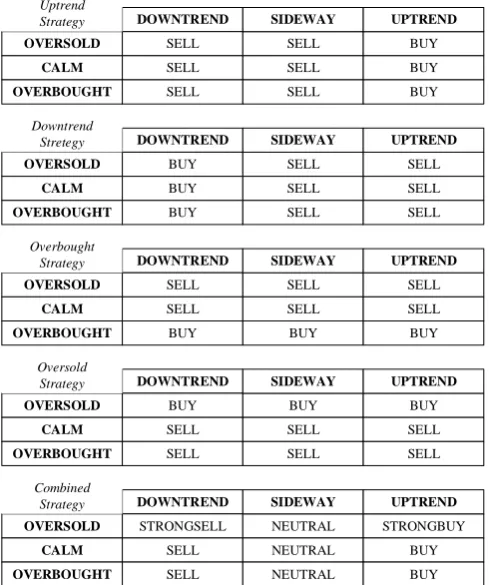
Five fuzzy trading strategies are created for comparisons. In the first two strategies, preference is given to trending stocks with no consideration to impulse momentum. The Uptrend strategy prefers stocks that show high 120-day RSI values, while the Downtrend strategy prefers those with low
120-day RSI values. The next two strategies, Overbought and Oversold, are what typical naïve investors often do – buy on upward impulse (“follow buy”), or buy on downward impulse (“buy the dip and hope for a rebound”) – with no regards to long-term trend. Finally, the Combined strategy considers both the long-term trend and the impulse momentum. This strategy prefers stocks with upward primary trend, especially those that experience (hopefully) temporary dips. Any stocks on the downtrend are to be avoided, especially those that have strong downward impulse. Trading rule matrices for the five strategies are shown in Figure 3.
STRONGBUY STRONGSELL
NEUTRAL
SELL BUY
1 9
OVERBOUGHT OVERSOLD
CALM
10 30 70 90
UP DOWN
SIDEWAY
[image:3.595.314.544.205.378.2]45 50 55
Fig. 2. From top to bottom: fuzzy membership functions for primary trend (120-day RSI), impulse momentum (5-day RSI), and goodness score (0-10 scale).
DOWNTREND
OVERSOLD
CALM
OVERBOUGHT
SELL SELL BUY
SELL SELL BUY
SELL SELL BUY
SIDEWAY UPTREND
DOWNTREND
OVERSOLD
CALM
OVERBOUGHT
BUY SELL SELL
BUY SELL SELL
BUY SELL SELL
SIDEWAY UPTREND
DOWNTREND
OVERSOLD
CALM
OVERBOUGHT
SELL SELL SELL
SELL SELL SELL
BUY BUY BUY
SIDEWAY UPTREND
DOWNTREND
OVERSOLD
CALM
OVERBOUGHT
BUY BUY BUY
SELL SELL SELL
SELL SELL SELL
SIDEWAY UPTREND
DOWNTREND
OVERSOLD
CALM
OVERBOUGHT
STRONGSELL NEUTRAL STRONGBUY
SELL NEUTRAL BUY
SELL NEUTRAL BUY
SIDEWAY UPTREND
Uptrend Strategy
Downtrend Stretegy
Overbought Strategy
Oversold Strategy
Combined Strategy
Fig. 3. Trading rules for five different strategies. Uptrend and Downtrend
[image:3.595.305.550.427.720.2]D. Trading
The portfolio always maintains ten best-ranked stocks on an equal-money basis, and regularly rebalanced at every fixed time interval of twenty trading days (approximately one month). For rebalancing, ranks of all stocks are recomputed using the method described above. Stocks already in the portfolio but not in the new top-ten ranking are sold, and replaced with stocks newly made to the ranking. All stocks are re-weighted such that they are equal-money after rebalancing. Retail commission fees are applied on all transactions.
IV. RESULTS AND ANALYSIS
The compounded investment returns from July 2012 to November 2017 for different strategies are shown in Figure 4. The SET100 index benchmark returns 36.13% (excluding stock dividends of approximately 3% annually); the Uptrend strategy returns 208.09%; the Downtrend strategy returns a loss of -28.94%; the Overbought strategy returns 51.23%; the Oversold strategy returns 4.97%; and finally, the Combined strategy returns 281.91%. The results show that the Combined strategy greatly outperformed the index benchmark over the long run, followed by the Uptrend strategy.
0 50 100 150 200 250 300 350 400
SET100 Benchmark Uptrend
Downtrend Overbought
Oversold Combined
Fig. 4. Compounded portfolio values for different trading strategies from July 2012 to November 2017. The best result is the Combined strategy – an initial investment of 100 million THB would become 382 million THB. The same amount of money invested in the SET100 index would become 136 million THB (excluding dividends of approximately 3% annually).
To better see how consistently the Combined strategy outperforms the benchmark, Figure 5. shows percentage outperformance for each monthly rebalancing period. The periods where underperformances occur were when major markdown activities took place.
Within the context of the proposed method, the results suggest the following. First, long-term primary trend is the most important factor in choosing stocks, with “buying the dip” enhances the returns. Second, buying oversold stocks that are not on a primary uptrend are not likely to yield a good return. Finally, avoid stocks that are on a strong downtrend, as the chance for a quick price turnaround may not be worth the risk.
-15 -10 -5 0 5 10 15
Fig. 5. Percentage outperformance of the Combined strategy against the index benchmark, for each one of the sixty-seven monthly rebalancing periods.
It should be noted however, that the result of the Combined strategy appears to be extremely profitable partly because of the compounding effect (profits are entirely re-invested). Additionally, the market environment has been advantageous due to the high liquidity of the financial markets (e.g., low interest rate). If during long-term bear market, the strategy may not work at all because the primary trend of most stocks will be downward and professional investors are less likely to participate in the markup phase of the price cycle.
V. CONCLUSION AND FUTURE WORK
This paper proposes a method for trading a stock portfolio using Mamdani-type fuzzy logic inference to select stocks by taking advantage of technical phenomena of trend and momentum. The resulting investment return significantly outperforms the market index benchmark over the recent five-year period of good market condition. The proposed method can be used to supplement the investment decision-making process. To improve on the results, other technical indicators, such as trading volume, may be added to the fuzzy rules to confirm the strength of the prevailing primary trend.
REFERENCES
[1] C. Mateepithaktham, “Equity mutual fund fees & performance,” SEC Working Papers Forum, The Securities and Exchange Commission, Thailand, June 2015.
[2] N. Amenc, F. Goltz, “Smart Beta 2.0,” The Journal of Index Investing, Winter 2013, Vol. 4, No. 3: pp 15-23.
[3] H. Yu, R. Chen, and G. Zhang, “A SVM stock selection model within PCA,” 2nd International Conference on Information Technology and Quantitative Management, ITQM 2014.
[4] C. Huang, “A hybrid stock selection model using genetic algorithms and support vector regression,” Applied Soft Computing, 12 (2012), pp. 807-818.
[5] R. Peachavanish, "Stock Selection and Trading Based on Cluster Analysis of Trend and Momentum Indicators," IMECS 2016, 16-18 March, 2016, Hong Kong, pp317-321.
[image:4.595.308.546.51.232.2] [image:4.595.49.289.367.538.2][7] C. Dong, F. Wan, “A fuzzy approach to stock market timing,” 7th International Conference on Information, Communications and Signal Processing, Macau, 2009.
[8] A. Escobar, J. Moreno, S. Munera, “A technical analysis indicator based on fuzzy logic,” Electronic Notes in Theoretical Computer Science 292 (2013) 27-37.
[9] K. Chourmouziadis, P. Chatzoglou, “An intelligent short term stock trading fuzzy system for assisting investors in portfolio management,” Expert Systems with Applications, Volume 43, January 2016, Pages 298–311.
[10] M. Yunusoglu, H. Selim, “A fuzzy rule based expert system for stock evaluation and portfolio construction: An application to Istanbul Stock Exchange”, Expert Systems with Applications 40 (2013) 908-920.
[11] R. Peachavanish, "Fuzzy Rule-Based Stock Ranking Using Price Momentum and Market Capitalization," FSDM 2016, 11-14 December, 2016, Macau.
[12] J. Bollen, H. Mao, X. Zeng, “Twitter mood predicts the stock market,” Journal of Computational Science, 2 (2011), pp. 1-8. [13] L. Wang, “Modeling Stock Price Dynamics with Fuzzy Opinion
Networks”, IEEE Transactions on Fuzzy Systems, Vol. PP, Issue: 99, June 2016.
[14] A. Andersen, S. Mikelsen, A Novel Algorithmic Trading Frame- work Applying Evolution and Machine Learning for Portfolio Optimization, Master’s Thesis, Faculty of Social Science and Technology Management, Department of Industrial Economics and Technology Management (2012).
[15] C. Chotivetthamrong, “Stock market fund flows and return volatility,” Ph.D. Dissertation, National Institute of Development Administration, Thailand, 2014.
[16] W. Laoniramai, “Insider Trading Behavior and News Announcement: Evidence from the Stock Exchange of Thailand,” CMRI Working Paper 3/2013, The Stock Exchange of Thailand.
[17] R. Wyckoff, The Day Trader’s Bible, Ticker Publishing, 1919. [18] N. Jegadeesh, S. Titman. “Returns to Buying Winners and Selling
Losers: Implications for Stock Market Efficiency” Journal of Finance, Volume 48, Issue 1 (Mar., 1993), 65-91.
[19] J. Welles Wilder, New Concepts in Technical Trading Systems, ISBN 0-89459-027-8, Trend Research, 1978.
[20] SET50 and SET100 Indices Rule https://www.set.or.th/ en/products/index/files/2013-01-SET50-100-IndexRule-EN.pdf [21] SETSMART (SET Market Analysis and Reporting Tool),
http://www.setsmart.com.
[22] [17] L. Zadeh, “Fuzzy sets,” Information and Control. 1965; 8: 338– 353.