Abstract—Multicultural instruction poses numerous challenges to educators and students alike. While these challenges have been traditionally recognized in the field of social sciences, they have been neglected by the natural sciences. We developed a pilot study aimed at highlighting the importance of cultural differences in science and engineering education. Our study presents engineering students’ perceptions of these differences and how they affect the teaching and learning process.
Index Terms—computer literacy, international students, multicultural environments, cultural differences.
I. INTRODUCTION
HE world we live in is globalized, internationalized, multicultural. These are words that have become so common, that we may forget about their deep and complex implications. Multicultural environments are omnipresent, and, in the field of education, they present challenges that educators and students alike must deal with.
One of the pioneers of multicultural education, James Banks, defined multiculturalism in 1989 as: “a philosophical position and movement that deems that the gender, ethnic, racial, and cultural diversity of a pluralistic society should be reflected in all of the institutionalized structures of educational institutions, including the staff, the norms, the values, the curriculum, and the student body” [1]. Society has changed and evolved since then and numerous new ideas, challenges and solution have emerged. As Xie et al. stated in [2], “while globalization has resulted in shorter distances between individuals, cross-cultural problems arise in many aspects, especially communication conflicts caused by cultural diversity”. According to Parrish and Linder-VanBerschot, “the growing multicultural nature of education and training environments makes it critical that instructors and instructional designers […] develop skills to deliver culturally sensitive and culturally adaptive instruction” [3].
Various studies have highlighted the issues arising from mismatches between the educators’ teaching style and the students’ learning styles [4]. Culturally responsive teaching has gained more and more attention in the past years. It was
Manuscript received March 18, 2019; revised April 6, 2019. This work was partly supported by JSPS KAKENHI Grant Number 18K02953 (Grant-in-Aid for Scientific Research (C)).
Simona Vasilache is with the University of Tsukuba, Graduate School of Systems and Information Engineering, Dept. of Computer Science (e-mail: [email protected]).
defined as “a pedagogy that recognizes the importance of including students' cultural references in all aspects of learning” [5]. Culturally responsive education implies changes to the teaching process that include “varying teaching styles, employing flexible grouping, and collaborating with students, in order to create a more cooperative learning climate” [6].
Traditionally, cultural differences were recognized in social sciences education, whereas natural sciences tend to be considered less culturally dependent. However, as stated in [7], recent research work suggests that also in science and math, culturally responsive teaching could be implemented [8]. We developed a pilot study aimed at highlighting the importance of cultural differences in science and engineering education.
The remainder of our paper is organized as follows: section II describes the research setting and the method used, while section III presents the results and discusses their implications. Section IV concludes our paper and points out directions for future research.
II. RESEARCH SETTING AND METHOD
The study presented in this paper is based on two sets of data. The first set of data was collected during a visit to the Faculty of Engineering in Foreign Languages (FILS) at the Politehnica University of Bucharest in Romania, in November 2018 (henceforth called “FILS data”). The author attended and peer taught, together with the local teacher, a practical course devoted to the topic of “Teaching strategies in multicultural environments”. The participants were international and local students enrolled in the Information Technology course of FILS (taught in English), coming from 16 different countries. At first, the students filled in a questionnaire online; a number of 157 responses were collected. This was followed by participation in two focus groups encouraging class reflection on the same topic. The goals of the course were identifying cultural aspects of education, in relation to teaching style and course structure, as well as finding “the best way” to teach (international) students in multicultural settings [9].
The second set of data (henceforth called “UT data”) was collected through a questionnaire administered at the end of the “Information Literacy (practice)” course taught during winter 2018 at the University of Tsukuba in Japan. This is a mandatory course for all freshmen, regardless of their field of study, where computer literacy related issues are taught.
Science Language: Universal or Culturally
Dependent? Multicultural Instruction and
Engineering Students’ Perceptions
Simona Vasilache,
Member, IAENG
The participants were 23 freshmen studying in English in the departments of social and international studies, and life and environmental sciences. They belong to a program aimed at international students, where a bachelor’s degree can be obtained through English only courses, and they come from 10 different countries.
It is worth noting that both sets of participants consist of students accustomed to studying in a multicultural environment; by definition, the programs they belong to are aimed at international students. Furthermore, the language of instruction is English for all the participants; in most cases, English is not the students’ native language.
III. RESULTS AND DISCUSSION A. Multicultural classrooms in general
The first section of the questionnaires asked the participants to express their opinions on advantages and disadvantages of being in an international/multicultural classroom (multiple answers were possible).
[image:2.595.311.542.102.247.2]Regarding the advantages, “learning about new cultures / broadening one’s horizon” was the option chosen by most participants (31.81%), followed by “becoming culturally flexible/aware” (28,19%) and “making new friends” (26.02%). “Questioning one’s own cultural values” was selected by 10.6% of all participants, whereas only 2.41% participants found no advantage at all. One other advantage mentioned by two of the participants was the opportunity to practice and learn other languages. The combined results from the two sets of data are displayed in Fig. 1.
Fig. 1. Advantages of being in an international/multicultural classroom
When it comes to disadvantages, the answer chosen by most students in both groups was “no disadvantage at all” (38.73% in total). However, participants in a large proportion of both groups found the extra effort needed for social interactions to be significant (34.89% in total). This result underlines the social implications of interacting with others in a multicultural group. The detailed results are displayed in Fig. 2.
The participants offered other answers, as well, e.g. "possibility of being offensive or ignorant to the othe[r] cultures", "as a foreigner, it's kind of hard interacting with the other people, since their views, style of life, values and so on are more or less different". This shows that the
students are clearly aware of the differences in culture and they are concerned about the possibility of offending their colleagues.
Fig. 2. Disadvantages of being in an international/multicultural classroom
As expected in a group where most people study in a language which is not their first language, this issue was also brought into attention, in the form of “language barrier issues and misunderstandings”. Moreover, one participant pointed out that “the group might be divided into smaller subgroups with little socialising between them if students from one culture are less likely to want to integrate into the class”. As can be observed, various cultural-related issues are brought up as being significant in an international/multicultural educational environment.
B. Teaching and learning
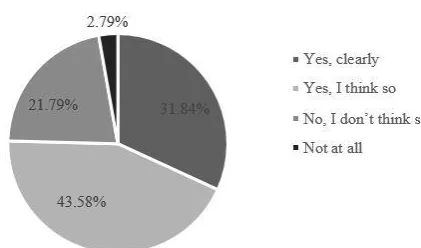
[image:2.595.62.281.447.600.2]The participants in both groups were asked if they believe that differences exist between the way students approach learning and teaching methods, depending on the culture they belong to. Two thirds of the respondents (75.42%) chose either “yes, clearly” or “yes, I think so”. Only 2.79% chose “not at all”, whereas 21.79% chose “no, I don’t think so” – as shown in the chart in Fig. 3.
Fig. 3. Perception of differences in teaching/learning
[image:2.595.324.535.564.688.2]Fig. 4. Opinion regarding adapting teaching style to class
We can observe that the participants do not seem to have a distinct preference with regard to the necessity of adapting teaching style based on the cultural background: 41.67% either strongly agree or agree, whereas 42.22% neither agree nor disagree. This may be an indication that, while the students are acutely aware of cultural differences in the classroom, they may tend to accept the current methods of teaching as not being culturally dependent and they are ready to overcome any possible difficulties by themselves. The expectation of the teacher adapting the teaching style based on where the students come from is not present.
[image:3.595.47.291.411.557.2]When asked about their perceptions of so-called “social sciences” (e.g. literature, history etc.) vs. “natural sciences” (e.g. mathematics, engineering etc.) with regard to cultural differences, the participants responded as shown in Fig. 5.
Fig. 5. Perception regarding “social sciences” vs. “natural sciences”
43.33% of the total number of participants agreed with the fact that the cultural differences are more visible in social sciences than in natural sciences, along with 22.78% who strongly agreed with this statement. When considering the two sets of data separately, we obtain the results illustrated in Fig. 6.
As mentioned in section II, the first group of participants are students enrolled in the “Information Technology” course (the FILS group); they study to become future IT specialists (i.e. they study “natural sciences”). The second group of participants are those taking the mandatory computer literacy course (UT group); however, they belong to either the social sciences department (“social sciences” students) or the life and environmental sciences department (“natural sciences” students). Although the questionnaire did not differentiate between these two departments, we need to
[image:3.595.329.528.438.684.2]take into consideration the presence of the social sciences students. We can observe that between 64% and 68% of participants in each group either strongly agree or agree with the previous statement; at the same time, between 26% and 30% in each group neither agree nor disagree. (Only approx. 8% of the students disagree or strongly disagree – both from the FILS group.)
Fig. 6. FILS group vs. UT group perception regarding “social sciences” vs. “natural sciences”
One related question was posed to the UT group only, since this is the group that studies the computer literacy subject. The participants were asked whether computer literacy is more, less or equally challenging than studying other subjects, in the context of a multicultural classroom. The results are summarized in Fig. 7.
Fig. 7. Comparison between computer literacy and other subjects
responsive teaching in subjects like science and math” [12], [13], [14], who are “often considered culture-free and objective by nature” [15].
C. Class interactions
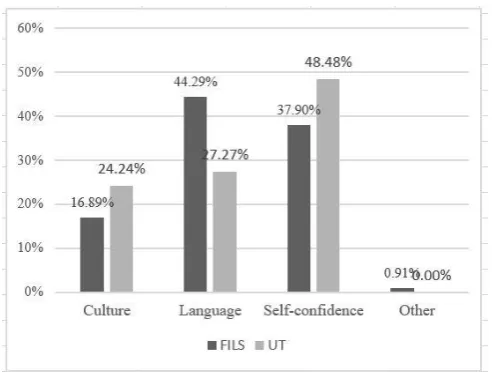
[image:4.595.306.550.48.208.2]Class interactions represent a significant aspect in a multicultural environment; in order to illustrate the students’ perceptions, the participants were asked about the most difficult issue to deal with during discussions. The answer choices were as follows: cultural differences (people from different cultures have different styles of arguing/discussing), language issues (some people speak the language better/worse than the others), self-confidence issues (some people are too shy, while others are the exact opposite) and other. The results from the two sets of respondents appear in Fig. 8.
Fig. 8. Most difficult issue during class discussions
According to the data illustrated above, for the FILS group, the most difficult issue is “language” (chosen by 44.29% of respondents). In case of the UT group, self-confidence occupies the highest place, with 48.48% respondents finding this the most difficult. Interestingly, the least difficult issue out of the three suggested ones is “cultural differences”, for both groups: 16.89% for the FILS group and 24.24% for the UT group. One student noted that “personality” is the most difficult issue to deal with. Moreover, another student mentioned observing instances of colleagues “afraid of discussing or answering” because of the three factors suggested as possible answers.
[image:4.595.46.294.266.452.2]When it comes to class discussions, the participants were asked about their preferred style of discussion, with people from the same culture, as well as with people from different cultures. The results are shown in Fig. 9. Around 40% of the participants in each of the two situations prefer either plenary discussions (42.58% and 41.03%, respectively) or group discussions (38.71% and 38.46, respectively). Talking in pairs is less popular (18.71% and 20.51% respectively). It is interesting to observe that the students’ preferences are very similar, regardless of whether they interact with colleagues from the same culture or with colleagues from different cultures.
Fig. 9 Preferred discussion style comparison: same vs. different culture
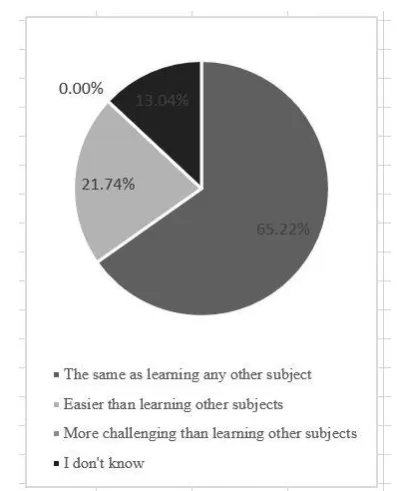
The UT group responded to one distinct question, regarding difficulties in working with student-colleagues from different cultural backgrounds. This question was posed to this group in particular because a large percentage of the grade for the computer literacy class (that this group is enrolled in) is based on a small group project, where students from various countries work together on creating (and presenting in front of the class) a PowerPoint presentation. The students responded as follows: 21.74% chose “different work styles”, 65.22% chose “different personalities” and 13.04% chose “variations in language skills”.
IV. CONCLUSION
This pilot study identified the students’ perceptions of studying natural sciences in multicultural/international environments. While the students are acutely aware of cultural differences in the classroom, they tend to accept the current methods of teaching as not being culturally dependent and they are ready to overcome any possible difficulties by themselves. This work aims to be a first step in creating an adaptive model of teaching in the “science” classroom, one that takes into consideration the cultural differences and constantly adapts to the class composition and evolution. Future work will collect more data and will propose concrete steps to achieve this goal.
ACKNOWLEDGMENT
The author would like to thank Dr. Yolanda Catelly for providing the setting needed to collect the first set of data, as well as her participation and valuable feedback.
REFERENCES
[1] J.A. Banks, “Approaches to multicultural curriculum reform”, Trotter
Review, Vol. 3, No.3, Article 3, 1989.
[2] A. Xie, P.P. Rau, Y. Tseng, H. Su, C. Zhao, "Cross-cultural influence on communication effectiveness and user interface design", International Journal of Intercultural Relations, Vol. 33, No. 1, 2009, pp. 11-20.
[3] P. Parrish and J. Linder-VanBerschot, "Cultural dimensions of learning: Addressing the challenges of multicultural instruction", The
International Review of Research in Open and Distributed Learning,
[4] G.D. Vita, "Learning styles, culture and inclusive instruction in the multicultural classroom: A business and management perspective", Innovations in Education and Teaching International, Vol. 38, No. 2, 2001, pp. 165-174.
[5] G. Ladson-Billings, "The dreamkeepers: Successful teachers of African American children" San Francisco, Jossey-Bass, 1994. [6] M. Ortiz, “Culturally Responsive Multicultural Education”, St. John
Fisher College, School of Education, 8, 2012.
[7] S. Civitillo, L.P. Juang, M. Badra, M.K. Schachner, “The interplay between culturally responsive teaching, cultural diversity beliefs, and self-reflection: A multiple case study”, Teaching and Teacher
Education, 77, 2019, pp. 341-351.
[8] B. Aronson and J. Laughter, “The theory and practice of culturally relevant education: A synthesis of research across content areas”,
Review of Educational Research, 86, 2016, pp. 237-276.
[9] The Department of Communication in Modern Languages, “Teaching Strategies in Multicultural Environments”, Available: https://dclm.pub.ro/?p=1995&lang=en.
[10] G. Hofstede, "Cultures and organizations. Intercultural cooperation and its importance for survival. Software of the mind.", London, McGraw-Hill, 1991.
[11] D.K. Deardorff, "Assessing intercultural competence", New
directions for institutional research, 2011.149, 2011, pp. 65-79.
[12] E.P. Bonner and T.L. Adams, “Culturally responsive teaching in the context of mathematics: A grounded theory case study”, Journal of
Mathematics Teacher, Education, 15, 2012, pp. 25-38.
[13] K.J. Debnam, E.T. Pas, J. Bottiani, J., A.H. Cash, C.P. Bradshaw, “An examination of the association between observed and self-reported culturally proficient teaching practices”, Psychology in the
Schools, 52, 2015, pp. 533-548.
[14] L. Shumate, G.D. Campbell-Whatley, Y.Y. Lo, “Infusing culturally responsive instruction to improve mathematics performance of Latino students with specific learning disabilities”, Exceptionality, 20, 2012, pp. 39-57.
[15] J.S. Matthews and F. López, “Speaking their language: The role of cultural content integration and heritage language for academic achievement among Latino children”, Contemporary Educational