Accepted Manuscript
Secure Source-Relay Link Based Threshold DF Relaying Scheme Jin Yao, Jia Ye, Danyang Wang, Hongjiang Lei, Gaofeng Pan
PII: S1434-8411(17)32403-2
DOI: https://doi.org/10.1016/j.aeue.2018.01.002
Reference: AEUE 52191
To appear in: International Journal of Electronics and Communi-cations
Received Date: 10 October 2017 Accepted Date: 3 January 2018
Please cite this article as: J. Yao, J. Ye, D. Wang, H. Lei, G. Pan, Secure Source-Relay Link Based Threshold DF Relaying Scheme, International Journal of Electronics and Communications (2018), doi: https://doi.org/10.1016/ j.aeue.2018.01.002
Secure Source-Relay Link Based Threshold DF Relaying
Scheme
Jin Yao1, Jia Ye2, Danyang Wang2, Hongjiang Lei3,Gaofeng Pan4
1. Chongqing City Management College, Chongqing, 401331, China.
2. Chongqing Key Laboratory of Nonlinear Circuits and Intelligent Information Processing, Southwest University, Chongqing, 400715, China.
3. Chongqing Key Lab of Mobile Communications Technology, Chongqing University of Posts and Telecommunications, Chongqing 400065, China (email: [email protected]).
4. School of Computing and Communications, Lancaster University, Lancaster, LA1 4WA, U.K. (e-mail: [email protected]).
Abstract
In this work, a dual-hop cooperative system, in which there are a
Source-Destination (S-D) pair, a relay node (R) and an eavesdropper (E), which
attempts to eavesdrop the confidential message sent bySand forwarded byR,
is considered. In order to enhance the system performance and save the
sys-tem resource, we propose an S−R link based threshold decode-and-forward
(DF) relaying scheme for R to decide whether to aid S-Dpair’s information
transmission or not, other than the traditional DF relaying scheme. The
secrecy outage performance of the considered system is investigated and the
closed-form analytical expression for secrecy outage probability is derived
and verified via Monte-Carlo simulations.
Keywords:
1. Introduction
Due to the openness of wireless medium, the probability that the delivered
information suffers eavesdropping will increase, when there is an
eavesdrop-per trying to overhead the information transmission between the source and
the destination. Then, the amount of secrecy information capacity of the data
transmission between the source and the destination will degrade, resulting
in poor physical layer security. [1] firstly described the wiretap channel, in
which two legitimate terminals want to have secure communication with an
eavesdropper appears in the channel.
Recently, plenty of works have been presented to study the security at
the physical layer [2-8]. The author of [2] examined the security issue in the
5G network by considering the randomness of the communication terminals
with disruptive technologies. [3] proposed a secure input
multiple-output (MIMO) system consisting of a base station, an information-decoding
user, and an energy-harvesting user, while considering simultaneous wireless
information and power transfer (SWIPT). The authors of [4] and [5]
investi-gated the secrecy performance of visible light communication system, while
considering the randomness of the locations of the terminals. [6] presented a
new key management mechanism which combines trusted-server scheme and
key pre-distribution scheme to satisfy the security network architecture. The
author of [7] also studied the secrecy outage performance for an underlay
cognitive radio unit system over Nakagami-m fading channel. [8] studied a
MIMO cognitive wiretap system, which adapts generalized selection
combin-ing over Nakagami-m channels in place of a multiple-antenna eavesdropper.
α-µ fading channels.
Therefore, one can clearly see that physical layer security issue is quite
important and urgent for wireless relay communication systems, as more
information leakage might happen over the extended links [10]. In other
words, the additional communication links from the source to relays can
improve the system’ coverage and throughput [11-12], however
eavesdrop-ping can also take place over these relaying links. Therefore, the security of
the wireless cooperative/relay systems attracts more and more researchers’
interests [13-24]. Several cooperation strategies were considered in [13] to
de-rive the optimal rate-equivocation region for four-terminal relay-eavesdropper
channel. A best decode-and-forward (DF) relay was selected by adopting
se-lection combining (SC) technique to communicate with a destination [14]. In
order to improve the security against eavesdroppers, an opportunistic
selec-tion scheme of two relay nodes was proposed in [15]. Partial relay selecselec-tion
schemes were proposed for cooperative systems with multi-relays in [16].
Hybrid decode-amplify-forward relay with three different selection schemes
was introduced to enhance the secrecy performance of the considered
wire-less system in [17]. In [18], the outage and symbol error performance has
been studied for a dual-hop conditional DF relay system. The influence of
SWIPT at the relay on the outage of A dual-hop DF system was investigated
in [19]. In [20], the authors studied the physical layer secrecy performance
of multi-hop DF relay network was investigated in the presence of multiple
passive eavesdroppers over Nakagami-m fading channels. For time-division
multiple-access based DF cooperative protocols, the authors of [21] analyzed
design relay beamforming weights to improve the secrecy rate. [22] presented
and analyzed a jamming power allocation method that can effectively achieve
the secrecy rate in cooperative network. An exponential-type integral
repre-sentation for the logarithmic function was utilized to derive an approximate
expression for the ergodic secrecy rates of cooperative DF relay networks only
in terms of the moment generating function of signal-to-noise ratio (SNR)
[23]. In order to provide security at the physical layer, [24] designed a
coop-erative protocol relying on both coopcoop-erative relaying and jamming.
However, to the best of our knowledge, the secrecy performance has not
been well studied for cooperative systems, as most of the existing works
focus on traditional relay schemes, e.g., amplify-to-forward and DF schemes.
In this work, a dual-hop cooperative system, in which there are a
Source-Destination (S-D) pair, a relay node (R) and an eavesdropper (E), which
attempts to eavesdrop the confidential message sent by S and forwarded by
R, is considered. R tries to coordinate the processes of information decoding
from the received signal, by recoding and forwarding the received messages
to D. Further, R adopts threshold DF relaying scheme to decide whether
to aid S-D pair’s information transmission or not, aiming to enhancing the
system performance and save the system resource. The main contributions
of this work are listed as follows:
1) In this work, we propose S-R link based threshold DF scheme, which
can improve the secrecy outage performance and system resource
consump-tion when the quality of S-R link is not good;
2) The secrecy outage performance ofS-Rlink based threshold DF scheme
been derived.
The rest of the paper is structured as follows. In Section 2, the system
model is introduced. The secrecy outage performance is studied for threshold
DF scheme by deriving the closed-form analytical expressions for the secrecy
outage probability of the considered system, in Section 3. Monte-Carlo
sim-ulations are conducted to verify the proposed analytical models in Section 4.
Finally, Section 5 concludes the paper.
2. System model
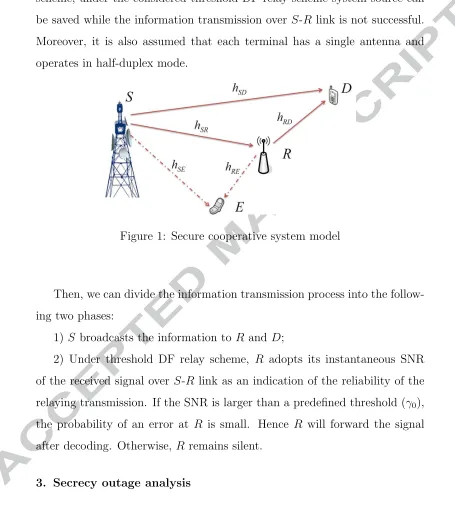
In this section, a cooperation group including aS-Dpair,RandE, which
attempts to eavesdrop the confidential message sent by S and forwarded by
R, is considered. All links experience independent and identically Rayleigh
fading. An S-R link based threshold relay scheme is considered in this work
in order to enhance the system performance and save the system resource.
Namely, R will decide to forward the decoded information bits according to
the transmission over S-R link: if it is not successful, R will not take any
action and keep silence; otherwise,R will forward its decoded information to
D1. Therefore, one can clearly see that, compare to the traditional DF relay
1OnceRcan successfully decode the received signal fromS, it will forward the received
signal to D. Under this case, there will be two copies of the transmitted signal at both
D and E. However, for practical scenarios, the main channels (including S −R and
R−D links) should outperform the eavesdropping channels (including S−E and R−
E links); otherwise, the secrecy capacity will be zero and the information delivery will be meaningless. So even under this case, the secrecy performance of the system will
scheme, under the considered threshold DF relay scheme system source can
be saved while the information transmission over S-R link is not successful.
Moreover, it is also assumed that each terminal has a single antenna and
[image:7.612.75.530.136.641.2]operates in half-duplex mode.
Figure 1: Secure cooperative system model
Then, we can divide the information transmission process into the
follow-ing two phases:
1)S broadcasts the information to R and D;
2) Under threshold DF relay scheme, R adopts its instantaneous SNR
of the received signal over S-R link as an indication of the reliability of the
relaying transmission. If the SNR is larger than a predefined threshold (γ0),
the probability of an error at R is small. Hence R will forward the signal
after decoding. Otherwise, R remains silent.
3. Secrecy outage analysis
If R forwards the message, there will be two copies of the transmitted
at both of D and E to process the received two copies of the signals.
In Phase 2, the received signals at R, D and E are given by
yR=
p
PShSRs+nR (1−a)
yD1 =
p
PShSDs+nD (1−b)
yE1 =
p
PShSEs+nE (1−c)
respectively, where Pi (i ∈ {S, R, D}) is the transmit power at node i, hij (i, j ∈ {S, D, R, E}) is the link channel gain between node iandj,sdenotes
the transmitted symbols from S, ni (i∈ {D, R, E}) denotes the independent complex Gaussian noise atR,DandE. In this work, to simplify the analysis,
we assume that nR, nD and nE are with zero means and a same variances, N0.
Therefore, the SNR of the received signal atR,D and E can be written
as
γR =
PS|hSR|
2
N0
(2−a)
γD1 =
PS|hSD|2 N0
(2−b)
γE1 =
PS|hSE|2 N0
(2−c)
respectively.
The probability density function (PDF) of |hSR|2, |hSD|2 and |hSE|2 can be given as
f|h
SR|2(x) =
1 hSRexp − x hSR
(3−a)
f|h
SD|2(x) =
1 hSD exp − x hSD
f|h
SE|2(x) =
1 hSE exp − x hSE
(3−c)
respectively, where hSR, hSD and hSE are the expectation of channel power gain |hSR|2, |hSD|2 and |hSE|2, respectively.
Further, we can obtainγR∼Exp (λSR),γD1∼Exp (λSD) andγE1∼Exp (λSE), respectively, where λSR = N0
hSRPS, λSD =
N0
hSDPS and λSE =
N0
hSEPS,
respec-tively.
In the second phase, if R decides to forward the detected symbol, sR, to
D after regenerating, the received signal at D and E is
yD2 =
p
PRhRDsR+nD (4−a)
yE2 =
p
PRhREsR+nE (4−b)
respectively.
Therefore, the SNR of the received signal at D and E can be written as
γD2 =
PR|hRD|
2
N0
(5−a)
γE2 =
PR|hRE|2 N0
, (5−b)
respectively.
The PDF of|hRD|
2
and|hRE|
2
can be written asf|h
RD|2(x) = 1
hRD exp
− x hRD
and f|h
RE|2(x) = 1
hRE exp
− x hRE
, respectively, where hRD and hRE is the expectation of channel power gain |hRD|
2
and |hRE|
2
, respectively. Then, we
can also obtain γD2∼Exp (λRD) and γE2∼Exp (λRE), respectively. Then, when SC scheme is adopted, we can have
γD =
γD1 ifγSR ≤γ0
max{γD1, γD2D} else
γE =
γE1 ifγSR ≤γ0
max{γE1, γE2} else
, (6−b)
respectively, whereγD2D = min{γSR, γD2}is the end-to-end SNR ofS−R−D
link under DF scheme, the cumulative distribution function (CDF) of which
can be written as FγD2D(x) = 1−exp (−(λSR+λRD.)x).
Therefore, the instantaneous secrecy capacity of the considered system
can be written as
Cs =
log2(1 +γD)−log2(1 +γE) ifγE ≤γD
0 else
(7−a)
IfγSR ≤γ0, we can have
Cs =
log2(1 +γD1)−log2(1 +γE1) ifγD1 ≥γE1
0 else
(7−b)
IfγSR ≥γ0,it deduces
Cs =
log2(1 + max{γD1, γD2D})−log2(1 + max{γE1, γE2}) ifγD ≥γE
0 else
(7−c)
where γD = max{γD1, γD2D} and γE = max{γE1, γE2}.
Therefore, the secrecy outage probability for the considered system using
threshold can be expressed as
Prout(Cth) = Pr{γSR > γ0}Pr{Cs ≤Cth|γSR > γ0}
+ Pr{γSR ≤γ0}Pr{Cs≤Cth|γSR≤γ0} (8)
The probability that the SNR of the S-R link γ0 is below the threshold
can be given as
Pr{γSR≤γ0}=
γ0 Z
0
λSRexp (−λSRx)dx = 1−exp (−λSRγ0) (9)
Then, it is easy to obtain
Pr{γSR> γ0}= 1−Pr{γSR ≤γ0}= exp (−λSRγ0) (10)
When γSR ≤γ0, the probability that the instantaneous secrecy capacity
Cs drops below Cth can be presented as
Pr{Cs≤Cth|γSR ≤γ0}= Pr{Cs≤Cth}
= Pr{log2(1 +γD1)−log2(1 +γE1)≤Cth}
= Prnlog21+γD1 1+γE1
≤Cth
o
= Prn1+γD1 1+γE1 ≤2
Cth o
= Pr{γD1 ≤λγE1+λ−1}
=
∞ R
0
λSEexp (−λSEγE1)
λγE1+λ−1 R
0
λSDexp (−λSDγD1)dγD1dγE1
=
∞ R
0
λSEexp (−λSEγE1) [1−exp (−λSD(λγE1+λ−1))]dγE1
= 1−
∞ R
0
λSEexp (−(λSE+λSDλ)γE1−λSD(λ−1))dγE1
= 1− λSEexp(−λSD(λ−1))
λSE+λSDλ
(11)
where λ= 2Cth.
Cs drops below Cth can be presented as
Pr{Cs≤Cth}= Pr{log2(1 +γD)−log2(1 +γE)≤Cth}
= Pr{γD ≤λγE +λ−1}
=
∞ R
0
fγE(γE)
λγE+λ−1
R
0
fγD(γD)dγDdγE
=
∞ R
0
fγE(γE)FγD(λγE+λ−1)dγE
(12)
where fγD(x) and fγE(x) are the PDF of γD and γE, respectively, FγD(x)
denotes the CDF of γD.
As γD = max{γD1, γD2D} and γE = max{γE1, γE2}, fγE(x) and FγD(x)
can be presented as
fγE(x) = λSEexp (−λSEx) [1−exp (−λREx)]
+λREexp (−λREx) [1−exp (−λSEx)] (13-a)
FγD(x) = [1−exp (−λSDx)] [1−exp (−(λSR+λRD)x)] (13−b)
Substituting Eq. (13) into (12), we can obtain
Pr{Cs ≤Cth}=
∞ R
0
λSEexp (−λSEγE) [1−exp (−λREγE)]
×[1−exp (−λSD(λγE +λ−1))]
×[1−exp (−(λSR+λRD) (λγE+λ−1))]dγE
+
∞ R
0
λREexp (−λREγE) [1−exp (−λSEγE)]
×[1−exp (−λSD(λγE +λ−1))]
×[1−exp (−(λSR+λRD) (λγE+λ−1))]dγE
(14)
In order to facilitate the following analysis, we will consider a new integral
I =
∞ R
0
a, b, c, d, e and f are constant, and a > 0, b >0, c >0 and d > 0 ), which
can be calculated as
I =
∞ R
0
exp (−ax)dx−
∞ R
0
exp (−(a+b)x)dx
−
∞ R
0
exp (−(a+c)x−e)dx−
∞ R
0
exp (−(a+d)x−f)dx
+
∞ R
0
exp (−(a+b+c)x−e)dx+
∞ R
0
exp (−(a+b+d)x−f)dx
+
∞ R
0
exp (−(a+c+d)x−e−f)dx
−
∞ R
0
exp (−(a+b+c+d)x−e−f)dx
= 1a− 1
a+b −
1
a+cexp(−e)−
1
a+dexp(−f) +a+1b+cexp(−e) + a+1b+dexp(−f)
+a+1c+dexp(−e−f)− 1
a+b+c+dexp(−e−f)
(15)
By using Eq. (15) into (14), we obtain
Pr{Cs ≤Cth}= 1−
λSE
λSE+λSDλ +
λRE
λRE+λSDλ
exp (λSD(1−λ))
− λSE
λSE+(λSR+λRD)λ +
λRE
λRE+(λSR+λRD)λ
exp ((λSR+λRD) (1−λ))
+ λSE+λRE
λSE+λRE+λSDλexp (λSD(1−λ))
+ λSE+λRE
λSE+λRE+(λSR+λRD)λexp ((λSR+λRD) (1−λ))
+ λSE
λSE+λSDλ+(λSR+λRD)λ +
λRE
λRE+λSDλ+(λSR+λRD)λ
×exp ((λSD+λSR+λRD) (1−λ))
− λSE+λRE
λSE+λRE+λSDλ+(λSR+λRD)λexp ((λSD+λSR+λRD) (1−λ))
(16)
Therefore, the SOP for the threshold DF scheme can be obtained by
4. Numerical and simulation results
In order to confirm our proposed model, in this section we compare
Monte-Carlo simulation and analytical results corresponding to the secrecy
outage over independent Rayleigh fading channels. During each simulation,
S sends 106 bits toD.
Figure 2 presents the result of the SOP versus (hRD/hRE). Unless oth-erwise explicitly specified, the parameters are set as Ps = 5 dB,Pr = 5 dB,
N0 = 1 dB, Cth = 3 dB, γ0 = 0.05. It is obvious that SOP can be improved
while (hRD/hRE) increases, because a larger (hRD/hRE) means a betterR-D
link with high security. Further, it can also be seen that simulation results
match very well with analytical ones. In Figure 2 simulation and analytical
results are presented forhSD= 2, 4, 6. It could be observed that the SOP for a higher hSD outperforms that of a smaller hSD as a higher hSD represents a better S-D link.
Figure 3 presents the results of the SOP versus (hSR/hRD). Unless oth-erwise explicitly specified, the parameters are set as Ps = 5 dB,Pr = 5 dB, N0 =1 dB,Cth = 3 dB,γ0 = 0.05. It is obvious that SOP can be improved
while (hSR/hRD ) increases, because a larger (hSR/hRD ) represents a better S-R link. Further, one can also be seen that simulation results match very
well with analytical ones. In Figure 3, we can also see that simulation and
analytical results of SOP are given while hRE = 0.1, 0.3 and 0.5. It could be observed that the SOP for a higher hRE outperforms that of a smaller hRE as a smaller hRE represents a worse R-E link.
−5 0 5 10 15 20 25
10−2 10−1
hRD/hRE (dB)
SOP
hSD= 2 Simulation
hSD= 4 Simulation
hSD= 6 Simulation
[image:15.612.68.540.129.622.2]Analysis
Figure 2: SOP versus (hRD/hRE) for different hSD
−15 −10 −5 0 5 10 15
10−2 10−1
hSR/hRD(dB)
SOP
hRE= 0.1 Simulation
hRE= 0.3 Simulation
hRE= 0.5 Simulation
Analysis
0 5 10 15
10−1 100
Ps(dB)
SOP
hSE= 0.1 Simulation
hSE= 0.05 Simulation
hSE= 0.01 Simulation Analysis
Traditional DF
0 1 2 3 4 5
[image:16.612.176.538.133.392.2]10−0.5 10−0.4 10−0.3 10−0.2
Figure 4: SOP versus Ps for different hSE
[image:16.612.104.542.145.623.2]a larger success probability of the transmission over S-R and S-D links. In
Figure 4, we compare simulation and analytical results whilehSE = 0.1, 0.05
and 0.01 with Pr = 10 dB, N0 = 0.5 dB, Cth = 1, γ0 = 0.5. It is observed
that SOP can be improved with the decreasing ofhSE in the high Ps region,
while no more improvement can be found in the low Ps region. Because, when Ps is low, the probability that γSR ≤γ0 will increase, as suggested by
Eq. (11).
In Figure 5, we present the simulation and analytical results of SOP while
hRD = 2, 4 and 6 with Pr = 10 dB, N0 = 1 dB, Cth = 1.5, γ0 = 1. It is
observed that SOP can be enhanced with the increase of hRD in the high
Ps region. One can also clearly observe that there exists a fluctuation and the SOP for different hRD will approach to a constant. Because when Ps is
−5 0 5 10 15 20 25
10−1 100
Ps(dB)
SOP −5 0 5
100
hRD= 2 Simulation hRD= 4 Simulation hRD= 6 Simulation Analysis
[image:17.612.165.540.130.399.2]Traditional DF
Figure 5: SOP versus Ps for different hRD
transmission over S-R link will succeed. Then R will aid the information
delivery between S and D, finally resulting in the diversity gain at D. So
under this case the proposed threshold DF scheme will be degrade to the
traditional DF scheme, and the secrecy outage performance of the target
system will tend to a constant in high hRD.
Moreover, as observed in Figs. 4 and 5, the proposed threshold DF scheme
outperforms the traditional DF scheme in low Ps region. It can be explained by the following fact: Under the proposed threshold DF scheme, R will not
forward the information for S and D, as R find the S-R transmission does
not satisfy the requirement of quality. Then, in low Ps region only S-D
transmission happens and E only can overhear the data transmission for one
time, leading to the improved secrecy outage performance. The performance
−5 0 5 10 15 20 25
0.2 0.3 0.4 0.5 0.6 0.7 0.8 0.9 1
Ps(dB)
η
Pr= 10 dB
Pr= 8 dB
[image:18.612.184.529.135.376.2]Pr= 6 dB
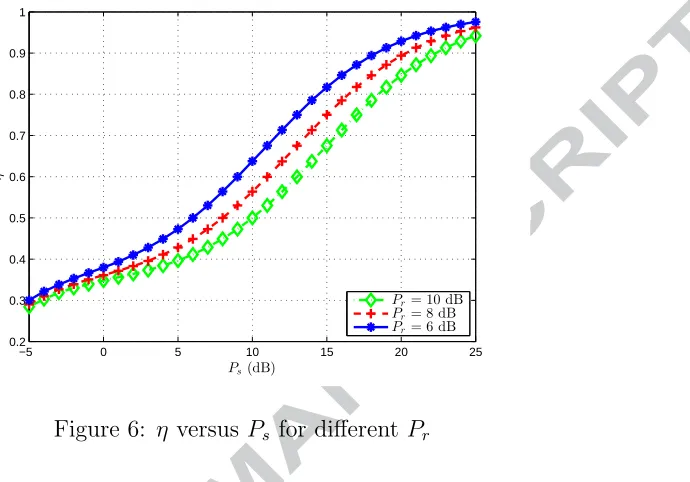
Figure 6: η versus Ps for different Pr
DF scheme in high Ps region. Because R will play as the relay for S-D transmission to forward the information over R-D link, which inevitably
increases the eavesdropping probability of the data transmission.
In the following, we define the total consumption power of the considered
system with the proposed threshold DF relaying scheme as PSU M and the total consumption power of the considered system with traditional DF system
as PDF
SU M, respectively. In Figure 6, we define a new performance index η = PSU M
PDF SU M
to illustrate the proposed threshold DF system can significantly
save the consumed power. We can see from Figure 6 that η ≤ 1, which
means that the proposed threshold DF scheme can significantly save more
consumed power than the traditional DF scheme, especially in low Psregion. Because when S-R link is poor, R will keep silent and save the transmit
5. Conclusions
In this work, we have investigated the secrecy outage performance of a
dual-hop DF cooperative network. We derived the closed-form analytical
ex-pressions for SOP while considering the proposedS−R link based threshold
DF relay scheme, which is verified via Monte-Carlo simulations. By
observ-ing these numerical results, we can conclude that lower transmit power at
the source can obtain lower secrecy outage probability. However, when the
transmit power at the source increases, the data forwarding offered by
thresh-old DF relay from the relay to the destination will inevitably increase the
probability of the data transmission being eavesdropped, and then SOP will
degrade and approaches to a constant, as the traditional DF scheme.
6. Acknowledgment
This research was supported in part by the National Science Foundation
under Grants 61401372, the Project of Fundamental and Frontier Research
Plan of Chongqing under Grant cstc2017jcyjAX0204, and the Scientific and
Technological Research Program of Chongqing Municipal Education
Com-mission under Grant KJ1600413, the Fundamental Research Funds for the
Central Universities under Grant XDJK2015B023 and XDJK2016A011.
References
[1] C. E. Shannon. (1949). Communication theory of secrecy systems. Bell
[2] N. Yang, L. Wang, G. Geraci, M. Elkashlan, J. Yuan, and M. Di Renzo.
(2015). Safeguarding 5G wireless communication networks using
physi-cal layer security. IEEE Commun. Mag, 53(4): 20-27.
[3] J. Zhang, C. Yuen, C. K. Wen, et al. (2015). Large system secrecy rate
analysis for SWIPT MIMO wiretap channels. IEEE Trans. Inf. Forensics
Sec, 11(1): 74-85.
[4] G. Pan, J. Ye and Z. Ding. (2017). Secure hybrid VLC-RF systems with
light energy harvesting. IEEE Trans. Commun., 65(10): 4348-4359
[5] G. Pan, J. Ye and Z. Ding. (2017). On secure VLC systems with spatially
random terminals. IEEE Commun. Lett, 21(3): 492-495.
[6] S. Yang, J. Liu, C. Fan, X. Zhang and J. Zou. (2010). A new design of
security wireless sensor network using efficient key management scheme.
2010 2nd IEEE International Conference on Network Infrastructure and
Digital Content, Beijing, 2010, pp. 504-508.
[7] C. Tang, G. Pan and T. Li. (2014). Secrecy outage analysis of
under-lay cognitive radio unit over Nakagami-m fading channels, IEEE Wirel.
Commun. Lett, 3(6): 609-612.
[8] H. Lei et al. (2017). Secrecy outage performance of transmit antenna
selection for MIMO underlay cognitive radio systems over Nakagami-m
channels. IEEE Trans. Veh. Technol, 66(3): 2237-2250.
[9] H. Lei, I. S. Ansari, G. Pan, B. Alomair and M. S. Alouini. (2017).
Secrecy capacity analysis overα-µfading channels. IEEE Commun. Lett,
[10] R. Peng, H. Yu. (2014). Distributed estimation scheme based on
cooper-ative communication in wireless sensor networks. IET Wirel. Sens. Syst,
4(4): 206-212.
[11] A. Bletsas, H. Shin, and M. Z. Win. (2007). Cooperative
communica-tions with outage-optimal opportunistic relaying. IEEE Trans. Wirel.
Commun, 6: 3450-3460.
[12] J. N. Laneman, D. N. C. Tse, and G. W. Wornell. (2004). Cooperative
diversity in wireless networks: efficient protocols and outage behavior.
IEEE Trans. Inform. Theory, 50: 3062-3080.
[13] L. Lai and H. El Gamal. (2008). The relay-eavesdropper channel:
Co-operation for secrecy. IEEE Trans. Inform. Theory, 54: 4005-4019.
[14] D. K. Sarker, M. Z. I. Sarkar and M. S. Anower. (2016). Wireless security
in selection decode-and-forward relay networks. 2016 2nd International
Conference on Electrical, Computer & Telecommunication Engineering
(ICECTE), Rajshahi, 2016, pp. 1-4.
[15] I. Krikidis, J. Thompson, S. Mclaughlin. (2009). Relay selection for
se-cure cooperative networks with jamming. IEEE Trans. Wirel. Commun,
8(10): 5003-5011.
[16] Y. Zhou, G. Pan, T. Li, H. Liu, C. Tang and Y. Chen. (2015). Secrecy
outage performance for partial relay selection schemes in cooperative
systems. IET Communications, 9(16): 1980-1987.
[17] T. Divya, K. K. Gurrala and S. Das. (2015). Performance analysis of
in cooperative wireless network. 2015 Global Conference on
Communi-cation Technologies (GCCT), Thuckalay, 2015, pp. 682-687.
[18] W. He, H. Lei, G. Pan. (2016). Performance analysis on conditional
DF relaying schemes over Nakagami-m fading channels with integralm,
AE ¨U-International Journal of Electronics and Communications, 70(6):
743-749.
[19] G. Pan, C. Tang. (2017). Outage performance on threshold AF and
DF relaying schemes in simultaneous wireless information and power
transfer systems, AE ¨U-International Journal of Electronics and
Com-munications, 71(1): 175-180.
[20] D. D. Tran, N. S. Vo, T. L. Vo and D. B. Ha (2015). Physical layer
secrecy performance of multi-hop decode-and-forward relay networks
with multiple eavesdroppers. 2015 IEEE 29th International
Confer-ence on Advanced Information Networking and Applications Workshops,
Gwangiu, 2015, pp. 430-435.
[21] J. H. Lee. (2015). Cooperative relaying protocol for improving physical
layer security in wireless decode-and-forward relaying networks. Wireless
Personal Communications, 83(4): 3033-3044.
[22] P. Mangayarkarasi, R. Revathi, Dr. S. Jayashri. (2014). Secured power
allocation for decode and forward relay in wireless relay networks.
In-ternational Journal of Innovative Research in Science, Engineering and
[23] P. Adebo, E. Adebola and A. Annamalai. (2014). On the ergodic secrecy
rate of cooperative decode-and-forward relay networks. 2014 IEEE
Mili-tary Communications Conference, Baltimore, MD, 2014, pp. 1595-1600.
[24] N. Kolokotronis and M. Athanasakos. (2016). Improving physical layer
security in DF relay networks via two-stage cooperative jamming. 2016
24th European Signal Processing Conference (EUSIPCO), Budapest,