1
A hybrid MLP-CNN classifier for very fine resolution
1
remotely sensed image classification
2
Ce Zhang 1, *, Xin Pan 2, 3, Huapeng Li 2, Andy Gardiner 4, Isabel Sargent 4, Jonathon 3
Hare 5, Peter M. Atkinson 1, * 4
1 Lancaster Environment Centre, Lancaster University, Lancaster LA1 4YQ, UK; 2 Northeast Institute 5
of Geography and Agroecology, Chinese Academic of Science, Changchun 130102, China; 3 School of 6
Computer Technology and Engineering, Changchun Institute of Technology, 130021 Changchun,
7
China; 4 Ordnance Survey, Adanac Drive, Southampton SO16 0AS, UK; 5 Electronics and Computer 8
Science (ECS), University of Southampton, Southampton SO17 1BJ, UK
9
Abstract The contextual-based convolutional neural network (CNN) with deep
10
architecture and pixel-based multilayer perceptron (MLP) with shallow structure are
11
well-recognized neural network algorithms, representing the state-of-the-art deep
12
learning method and the classical non-parametric machine learning approach,
13
respectively. The two algorithms, which have very different behaviours, were
14
integrated in a concise and effective way using a rule-based decision fusion approach
15
for the classification of very fine spatial resolution (VFSR) remotely sensed imagery.
16
The decision fusion rules, designed primarily based on the classification confidence
17
of the CNN, reflect the generally complementary patterns of the individual
18
classifiers. In consequence, the proposed ensemble classifier MLP-CNN harvests the
19
complementary results acquired from the CNN based on deep spatial feature
20
representation and from the MLP based on spectral discrimination. Meanwhile,
21
limitations of the CNN due to the adoption of convolutional filters such as the
22
uncertainty in object boundary partition and loss of useful fine spatial resolution
23
detail were compensated. The effectiveness of the ensemble MLP-CNN classifier
24
was tested in both urban and rural areas using aerial photography together with an
25
additional satellite sensor dataset. The MLP-CNN classifier achieved promising
26
performance, consistently outperforming the pixel-based MLP, spectral and
textural-27
based MLP, and the contextual-based CNN in terms of classification accuracy. This
28
research paves the way to effectively address the complicated problem of VFSR
29
image classification.
30
Keywords: convolutional neural network; multilayer perceptron; VFSR remotely
31
sensed imagery; fusion decision; feature representation
2 1. Introduction
33
With the rapid development of modern remote sensing technologies, a large quantity of 34
very fine spatial resolution (VFSR) images is now commercially available. These 35
VFSR images, typically acquired at sub-metre spatial resolution, have opened up many 36
opportunities for new applications (Zhong et al., 2014), for example, urban land use 37
retrieval (Mathieu et al., 2007; Shi et al., 2015), precision agriculture (Ozdarici-Ok et 38
al., 2015; Zhang and Kovacs, 2012), and tree crown delineation (Ardila et al., 2011; 39
Yin et al., 2015). However, despite the presence of a rich spatial data content (Huang 40
et al., 2014), the information conveyed by the imagery is conditional upon the quality 41
of the processing (Längkvist et al., 2016). With fewer spectral channels in comparison 42
with coarse or medium spatial resolution remotely sensed data, it can be challenging to 43
differentiate subtle differences amongst similar land cover types (Powers et al., 2015). 44
Meanwhile, objects of the same class may exhibit strong spectral heterogeneity due to 45
differences in age, level of maintenance and composition as well as illumination 46
conditions (Demarchi et al., 2014), which might be further complicated by the 47
scattering of peripheral ground objects (Chen et al., 2014). As a consequence, such high 48
intra-class variability and low inter-class disparity make automatic classification of 49
VFSR images a challenging task. 50
Ever since the advent of VFSR imagery, tremendous efforts have been made to develop 51
robust and accurate, automatic image classification methods. Among these, machine 52
learning is currently considered as the most promising and evolving approach (Zhang 53
et al., 2015). Popular pixel-based machine learning algorithms, such as Multilayer 54
Perceptron (MLP), Support Vector Machine (SVM) and Random Forest (RF), have 55
drawn considerable attention in the remote sensing community (Attarchi and Gloaguen, 56
2014; Yang et al., 2012; Zhang et al., 2015). The MLP, as a typical non-parametric 57
neural network classifier, is designed to learn the nonlinear spectral feature space at the 58
pixel level irrespective of its statistical properties (Atkinson and Tatnall, 1997; Foody 59
and Arora, 1997; Mas and Flores, 2008). The MLP has been used widely in remote 60
sensing applications, including VFSR-based land cover classification (e.g. Del Frate et 61
al., (2007), Pacifici et al. (2009)). The MLP algorithm is mathematically complicated 62
yet can be simple in model architecture (e.g., a shallow classifier with one or two feature 63
representation levels). At the same time, a pixel-based MLP classifier does not consider, 64
3
with unprecedented spatial detail. In essence, the MLP (and related algorithms, e.g. 66
SVM, RF, etc.) is a pixel-based classifier with shallow structure (one or two layers) 67
(Chen et al., 2016), where the membership association of a pixel for each class is 68
predicted. 69
Recent advances in neuroscience have shown that deep feature representations can be 70
learned hierarchically from simple concepts such as oriented edges to higher-level 71
complex patterns such as textures, segments, parts and objects (Arel et al., 2010). This 72
discovery motivated the breakthrough of the so-called “deep learning” methods that 73
represent the state-of-the-art in a variety of domains, including target detection (Chen 74
et al., 2016; Tang et al., 2015), image recognition (Farabet et al., 2013; Krizhevsky et 75
al., 2012) and robotics (Bezak et al., 2014; Lenz et al., 2015; Yu et al., 2013), amongst 76
others. The convolutional neural network (CNN), a well-established deep learning 77
approach, has produced excellent results in the field of computer vision and pattern 78
recognition (Schmidhuber, 2015), such as for visual recognition (Farabet et al., 2013; 79
Krizhevsky et al., 2012), image retrieval (X. Yang et al., 2015) and scene annotation 80
(Othman et al., 2016). 81
In the remote sensing domain, CNNs have been studied actively and shown to produce 82
state-of-the-art results over the past few years, focusing primarily on object detection 83
(Dong et al., 2015) or scene classification (Hu et al., 2015a; Zhang et al., 2016). Recent 84
studies further explored the feasibility of CNNs for the task of remotely sensed image 85
classification. For example, Yue et al., (2016) utilized spatial pyramid pooling to learn 86
multi-scale spatial features from hyperspectral data, Chen et al. (2016) introduced a 3D 87
CNN to jointly extract spectral–spatial features, thus, making full use of the continuous 88
hyperspectral and spatial spaces. In terms of the classification of multi- and 89
hyperspectral imagery, a deep CNN model was formulated through a greedy layer-wise 90
unsupervised pre-training strategy (Romero et al., 2016), whereas an image pyramid 91
was built up through upscaling the original image to capture the contextual information 92
at multiple scales (Zhao and Du, 2016). For VFSR image classification, CNN models 93
with varying contextual input size were constructed to learn multi-scale features while 94
preserving the original fine resolution information (Längkvist et al., 2016). All of the 95
above-mentioned work applied CNNs with contextual patches as their inputs, and 96
demonstrated the robustness and effectiveness in spatial feature representations with 97
4
CNN as a classifier itself have not been studied thoroughly. In particular, the CNN, as 99
a contextual classifier with deep structures (Szegedy et al., 2015), explores the complex 100
spatial patterns hidden in the image that are not seen by representation in its shallow 101
counterparts, whereas it may overlook certain information in spectral space observed 102
by pixel-based classifiers. Moreover, uncertainties may appear in object boundaries due 103
to the usage of convolutional filters of the CNN. These issues deserve further 104
investigation. 105
Any single set of features (e.g., spectral only) or a specific classifier (e.g., pixel-based 106
only) is unlikely to achieve the highest classification accuracies for VFSR imagery 107
because the result is conditional upon both spectral and spatial information. In this 108
context, two categories of spectral and spatial information were fused for classification 109
or handled with a classifier ensemble. Information fusion can be realized by stacking 110
the spatial and spectral information as feature bands. However, this does not allow the 111
specification of the relative influence of the extracted features (Wang et al., 2016). 112
Others proposed integrative algorithms considering the spatial and spectral features at 113
the same time. For example, Fauvel et al., (2012) proposed a composite kernel-based 114
SVM with spectral and spatial kernels applied simultaneously. However, the spatial 115
kernel summarizes only basic information (e.g. median) of the spatial neighbourhood 116
(Wang et al., 2016). 117
In terms of classifier ensemble technology, two strategies, namely “multiple classifier 118
systems” (Benediktsson, 2009) and “decision fusion” (Fauvel et al., 2006) are 119
employed. Multiple classifier systems are based on the manipulation of training sample 120
sets, including boosting (Freund et al., 2003) and bagging (Breiman, 1996). This 121
ensemble approach, however, usually requires a relatively large sample size and the 122
computational complexity tends to be high. An alternative classifier ensemble is 123
derived from decision fusion of the outputs of different classification algorithms 124
according to a certain combination of approaches (Du et al., 2012; Löw et al., 2015). 125
This decision fusion-based ensemble approach is preferable where the individual 126
classifiers demonstrate complementary behaviour. For instance, different non-127
parametric classifiers are sometimes accurate in different locations in a classification 128
map, thus, producing complementary results from the ensemble (Clinton et al., 2015; 129
5
using pixel-based classifiers with shallow structures, whose complementary behaviours 131
are insufficient to address the challenges of VFSR image classification. 132
In this paper, a hybrid classification system was proposed that combines the CNN (a 133
contextual-based classifier with deep architectures) and MLP (a pixel-based classifier 134
with shallow structures) using a rule-based decision fusion strategy. The hypothesis is 135
that both MLP and CNN classifiers can provide different views or feature 136
representations with strong complementarity. Thus, the classifier ensemble has the 137
potential to enhance the final classification performance. The decision fusion rules were 138
built up at the post-classification stage, primarily based on the confidence distribution 139
of the contextual-based CNN classifier, such that the classified pixels with low 140
confidence can be rectified by the MLP at the pixel level. The effectiveness of the 141
proposed method was tested on images of both an urban scene and a rural area. A 142
benchmark comparison was provided by the standard pixel-based MLP, spectral-143
texture based MLP as well as contextual-based CNN classifiers. 144
2. Methodology 145
2.1 Brief review of multilayer perceptrons (MLP)
146
A multilayer perceptron (MLP) is a network that maps sets of input data onto a set of 147
outputs in a feedforward manner (Atkinson and Tatnall, 1997). The typical structure is 148
that the MLP is composed of interconnected nodes in multiple layers (input, hidden and 149
output layers), with each layer fully connected to the preceding layer as well as the 150
succeeding layer (Del Frate et al., 2007). The outputs of each node are weighted units 151
followed by a nonlinear activation function to distinguish the data that are not linearly 152
separable (Pacifici et al., 2009). Formally, the output activation a(l1) at layer l+1 is 153
derived by the input activationa(l): 154
)
( ( ) ( ) ( )
) 1
(l l l l
b a w
a
(1)155
Where l corresponds to a specific layer, w(l) and b(l) denote the weight and bias at layer 156
l, and represents the nonlinear activation operation (e.g. sigmoid, hyperbolic tangent, 157
rectified linear units) function. For an m layer multilayer perceptron, the first input layer 158
is a(1) x while the last output layer is: 159
6 ) ( ,
(
)
m bw
x
a
h
(2)160
The weights and bias in equation (2) are learned by supervised training using a 161
backpropagation algorithm to approximate an unknown input-output relation (Del Frate 162
et al., 2007). The objective function is to minimize the difference between the predicted 163
outputs and the desired outputs: 164 2 , ( ) 2 1 ) , ; ,
(W b x y h x y
J wb (3)
165
2.2 Brief review of Convolutional Neural Networks (CNN)
166
A Convolutional Neural Network (CNN), is a variant of the multilayer feed forward 167
neural networks, and is designed specifically to process large scale images or sensory 168
data in the form of multiple arrays by considering local and global stationary properties 169
(LeCun et al., 2015). Similar to the MLP, the CNN is a network stacked into a number 170
of layers, where the output of the previous layer is connected sequentially to the input 171
of the next one by a set of learnable weights and biases (Romero et al., 2016). The major 172
difference is that each layer is represented as input and output feature maps by capturing 173
different perspectives on features through the operation of convolution. 174
The CNN basically consists of three major operations: convolution, nonlinearity and 175
pooling/subsampling (Schmidhuber, 2015). The convolutional and pooling layers are 176
stacked together alternatively in the CNN framework, until obtaining the high-level 177
features on which a fully connected classification is performed (LeCun et al., 2015). In 178
addition, several feature maps may exist in each convolutional layer and the weights of 179
convolutional nodes in the same map are shared. This setting enables the network to 180
learn different features while keeping the number of parameters tractable. 181
Mathematically, the output feature map , ()
l j i
y at convolutional layer l is calculated as: 182
k n k m l l m j n i l m n l l ji w x b
y 1 1 ) ( ) 1 ( , ) ( , ) ( ) (
, ( ) (4)
183
Where the , ()
l m n
w denotes the convolutional filter with size k×k at layer l, and the 184 ) 1 ( , l m j n i
x represents the spatial position of the corresponding feature map at the 185
preceding layer l-1. The algorithm passes the convolutional filter throughout the input 186
7
feature map using the dot product between them with an addition of a bias unit b(l)
187
(Arel et al., 2010). Moreover, a nonlinear activation function (l) at layer l is taken 188
outside the dot product to strengthen the nonlinearity (Strigl et al., 2010). 189
The pooling/subsampling layer can generalize the convolved features through down-190
sampling and thereby reduce the computational complexity during the training process 191
(Zhao and Du, 2016). Given a pooling/subsampling layer q, the feature output Fq can 192
be derived from the preceding layer f(q1) through 193
max( ,..., ,..., ,... ,1)
1 ), 1 ( 1 1 ) 1 ( 1 , 1 ) 1 ( 1 ), 1 ( 1 , q pj pi q pj i p q j p pi q j p i p q j
i f f f f
F
194
(5) 195
Where is the size of the local spatial region, and 1i,j(mn1)/p, here the 196
m refers to the size of input feature map, while n corresponds to the size of filter 197
(Längkvist et al., 2016). The simply summarizes the input features within local 198
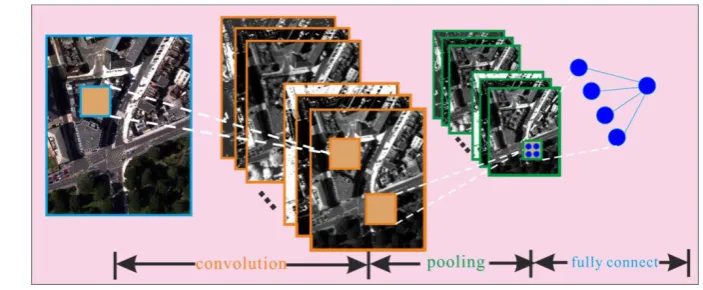
spatial region using the maximum value (Figure 1: Pooling). By doing this, the learnt 199
features become robust and abstract with certain sparseness and translation invariance. 200
Once the higher level features are extracted, the output feature maps are flattened into 201
a one-dimensional vector, followed by a fully connected output layer (Figure 1: fully 202
connect). This operation is exactly a simple logistic regression, which is equivalent to 203
the standard MLP discussed in section 2.1, but without any hidden layer. 204
[image:7.595.115.467.524.669.2]205
Figure 1 A schematic illustration of the three core layers within the CNN architecture, including the
206
convolutional layer (convolution), pooling layer (pooling) and fully connected layer (fully connect).
207
2.3 Hybrid MLP-CNN Classification Approach
8
Suppose the predictive outputs of the MLP and CNN at each pixel are n-dimensional 209
vectorsC(c1,c2,...,cn), where n represents the number of classes and each dimension 210
] , 1 [ n
i corresponds to the probability of a specific class (i-th class) with certain 211
membership association. Ideally, the probability of the classification prediction would 212
be 1 for the target class and 0 for the others. However, due to the uncertainty in the 213
process of remotely sensed image classification, the probability value c is denoted as 214
)} ,..., 2 , 1 ( | { )
(x c x n
f x , where cx[0,1] and
nx
c
1 1 . The classification model
215
simply takes the maximum membership association as the predicted output label 216
(denoted as class(C)): 217
)}) ,..., 2 , 1 ( | ) ( max({ arg )
(C f x c x n
class x (6)
218
The confidence conf of such membership association is defined here as: 219
) ( )
(C Mean C Max
conf (7)
220
In equation (7), Max(C) represents the maximum value of vector C, while Mean(C) 221
denotes the average of all the values of C. The conf, quantified by the difference 222
between Max(C) and Mean(C), measures the confidence or reliability of the class 223
membership allocation (i.e. classification confidence map). Since the CNN takes 224
contextual image patches as its inputs instead of image pixels, it has the following 225
properties: 226
(1). If the input image patch is located at the central homogeneous region, its class 227
purity is relatively high with large difference between the membership association of 228
the predicted class and those of the other classes, and the conf tends to be large (White 229
regions in Figure 2(c)). 230
(2). If the image patch contains other land cover classes as contextual information, the 231
resulting distinction between the membership association of prediction and those of the 232
others is relatively low, and the conf tends to be small (Dark regions in Figure 2(c)). 233
However, the MLP (spectral feature only) is based on per-pixel spectral information, 234
thereby ruling out the difference of membership association between central and 235
9
aforementioned properties, the fusion decision rules are constructed primarily based on 237
CNN confidence. To be more specific, the fusion output gives credit to the CNN when 238
its confidence is larger than a predefined threshold (α1), while the MLP is trusted given 239
that the CNN confidence is lower than another threshold (α2); once the confidence of 240
the CNN lies in-between the two thresholds ((α1,α2)), the fusion output chooses the 241
CNN or MLP classification result with a larger confidence. Therefore, for a given image 242
pixel at location(h,v), a rule-based decision fusion approach to determining the class 243
label (class(h,v)) of the corresponding pixel is formulated as follows: 244 2 2 1 2 1 1 ) & ( ) & ( ) , ( cnn mlp cnn cnn mlp cnn cnn cnn cnn cnn mlp mlp conf conf conf conf conf conf conf conf class class class class v h
class (8)
245
Where the classmlp and classcnn represent the classification results of the MLP and CNN 246
respectively; the confmlp and confcnn denote the classification confidence of the MLP 247
and CNN accordingly. 248
Estimation of the two thresholds (α1,α2) is conducted using grid search with cross-249
validation (Min and Lee, 2005; Zhang et al., 2015) based on the CNN classification 250
confidence map (as illustrated by Figure 2(c)). Specifically, the α1 was searched from 251
0.1 to 0.5 to detect those regions with low confidence as predicted by the CNN, while 252
the α2 was chosen from 0.5 to 0.9 to discover the high confidence regions. By initially 253
fixing α1 as 0.1, α2 was tuned with step size of 0.05 (i.e. α2=0.5, 0.55, 0.6, ..., 0.9) to 254
cross-validate the classification accuracy influenced by the selected thresholds; α1 was 255
then increased to further tune α2 in a similar way until the optimal α1 and α2 were found 256
with the best classification accuracy. 257
10
Figure 2 (a) A subset of the original imagery with RGB spectral bands, (b) the classification confidence
259
of the MLP and (c) the classification confidence of the CNN. The dark pixels represent low confidence,
260
while white pixels signify high confidence.
261
3. Experiment 262
3.1 Study area and data source
263
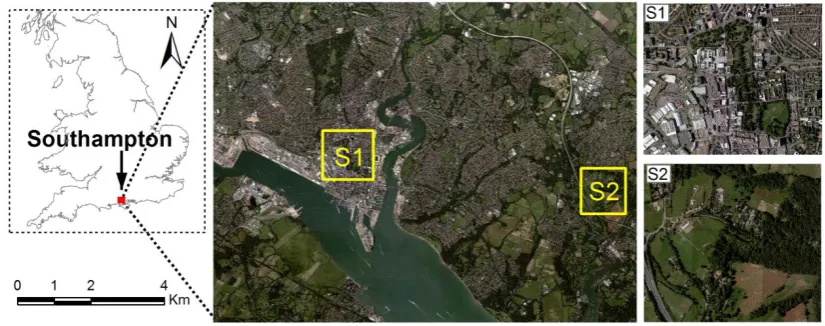
For this study, the city of Southampton, UK and its surrounding environment, which 264
lies on the south coast of England, was chosen as a case study area (Figure 3). The 265
urban and suburban areas in Southampton are strongly heterogeneous with a mixture of 266
anthropogenic urban surface (e.g. roof materials, asphalt, concrete) and semi-natural 267
environment (e.g. vegetation, bare soil), thereby representing a good test for 268
classification algorithms. 269
A scene of aerial imagery of Southampton was captured on 22 July 2012 using a Vexcel 270
UltraCam Xp digital aerial camera with 50 cm spatial resolution and four multispectral 271
bands (Red, Green, Blue and Near Infrared). Two study sites S1 (3087×2750 pixels) 272
and S2 (2022×1672 pixels) were selected to investigate the effectiveness of the 273
proposed algorithm. S1 is located in the city centre of Southampton, which consists of 274
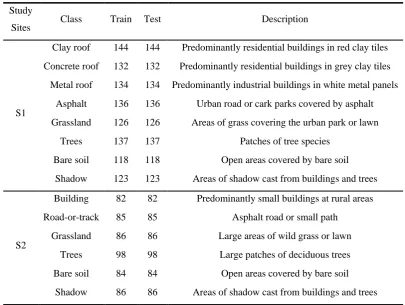
eight dominant land cover classes, including Clay roof, Concrete roof, Metal roof, 275
Asphalt, Grassland, Trees, Bare soil and Shadow, with detailed descriptions listed in 276
Table 1. S2, on the other hand, is situated in a suburban and rural area of Southampton 277
comprised of large patches of forest, grassland and bare soil speckled with small 278
buildings and roads. There are six land cover categories in this study site, namely, 279
Buildings, Road-or-track, Grassland, Trees, Bare soil and Shadow (Table 1). 280
[image:10.595.90.503.570.733.2]281
Figure 3 Southampton, UK Location of study area and aerial imagery with two study sites S1 and S2.
11
Sample points were collected using a stratified random scheme from ground data 283
provided by local surveyors at Southampton, and split into 50% training samples and 284
50% testing samples for each class (Table 1). Field land cover survey was conducted 285
throughout the study area on July 2012 to further check the validity and precision of 286
the selected samples. In addition, a highly detailed vector map from Ordnance Survey, 287
namely the MasterMap Topographic Layer (Regnauld and Mackaness, 2006), was fully 288
consulted and cross-referenced to gain a comprehensive appreciation of the land cover 289
[image:11.595.94.500.290.595.2]and land use within the study area. 290
Table 1 Detailed description of land covers at two study sites with training and testing sample size per
291
class.
292
Study
Sites Class Train Test Description
S1
Clay roof 144 144 Predominantly residential buildings in red clay tiles
Concrete roof 132 132 Predominantly residential buildings in grey clay tiles
Metal roof 134 134 Predominantly industrial buildings in white metal panels
Asphalt 136 136 Urban road or cark parks covered by asphalt
Grassland 126 126 Areas of grass covering the urban park or lawn
Trees 137 137 Patches of tree species
Bare soil 118 118 Open areas covered by bare soil
Shadow 123 123 Areas of shadow cast from buildings and trees
S2
Building 82 82 Predominantly small buildings at rural areas
Road-or-track 85 85 Asphalt road or small path
Grassland 86 86 Large areas of wild grass or lawn
Trees 98 98 Large patches of deciduous trees
Bare soil 84 84 Open areas covered by bare soil
Shadow 86 86 Areas of shadow cast from buildings and trees
293
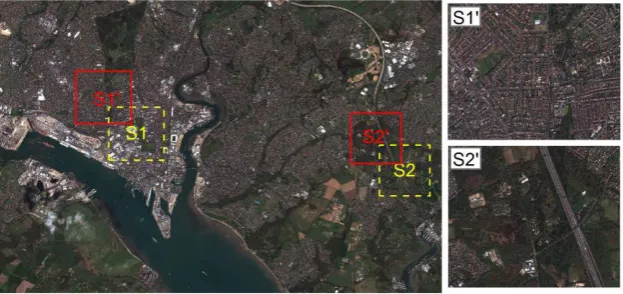
To further test the applicability of the proposed method, another scene of Worldview-294
2 satellite sensor imagery was acquired on 24 July 2013 in the same region of 295
Southampton with urban (S1’) and rural (S2’) study sites close to the Northwest of S1 296
and S2. The Worldview-2 image was geometrically and atmospherically corrected, and 297
pan-sharpened at 50 cm spatial resolution to be consistent with the aerial imagery. 298
Figure 4 demonstrates the WorldView-2 satellite sensor image together with two 299
12 301
Figure 4 Additional WorldView-2 satellite sensor image covering the same region of Southampton
302
with the S1’ and S2’ study sites to the northwest of S1 and S2, respectively.
303
3.2 Model input variables and parameters
304
Model inputs: the standard pixel-based MLP (hereafter, MLP) and CNN take only the 305
four spectral bands as their input variables, whereas the pixel-based texture MLP based 306
on the standard Grey Level Co-occurrence Matrix (hereafter, GLCM-MLP) 307
simultaneously makes use of both the four spectral bands and the texture features 308
derived from GLCM textural features including the Mean, Variance, Homogeneity, 309
Contrast, Dis-similarity, Entropy, Second moment and Correlation (Haralick et al., 310
1973; Rodriguez-Galiano et al., 2012; Xia et al., 2010; Zhang et al., 2003). Three 311
window sizes for each spectral band, including 3×3 (1.5×1.5 m), 5×5 (2.5×2.5 m), and 312
7×7 (3.5×3.5 m), were optimally chosen to perform multi-scale texture feature 313
representation, thus generating 96 GLCM texture features in total. It should be noted 314
that both the MLP and the CNN as well as the GLCM-MLP were trained to predict all 315
pixels within the images. Although the CNN was designed to predict a single label from 316
a small image patch, the sliding window was densely overlapping to cover the entire 317
image at the inference phase. 318
Both the MLP (also including GLCM-MLP) and CNN models require a series of 319
predefined parameters to optimize the learning accuracy and generalization capability. 320
Following the recommendations of Mas and Flores, (2008), the MLPs with one, two 321
and three hidden layers were tested, using a varying number of {4, 8, 12, 16, 20, and 322
24} nodes in each layer. The learning rate was chosen optimally as 0.2 and the 323
momentum factor was set as 0.7. In addition, the number of iterations was set as 1000 324
13
nodes and hidden layers, the best predicting MLP was found using two hidden layers 326
with 8 nodes in each layer. Similar parameters were also set for the GLCM-MLP, 327
except that two hidden layers with 20 nodes in each layer were found to be the optimal 328
solution in this case. 329
For the CNN, a range of parameters including the number of layers, the input image 330
patch size, the number and size of convolutional filter, as well as other predefined 331
parameters, such as the learning rate and number of epochs (iterations), need to be tuned 332
(Romero et al., 2016). Following the discussion by Längkvist et al., (2016), the input 333
image size was chosen from {8×8, 10×10, 12×12, 14×14, 16×16, 18×18, 20×20, 22×22 334
and 24×24} to evaluate the influence of context area on classification performance. In 335
general, a small-sized contextual area results in overfitting of the model, whereas a 336
large one often leads to under-segmentation. In consideration of the image object size 337
and contextual relationship coupled with a small amount of trial and error, the optimal 338
input image patch size was set to 16×16 in this research. Besides, as discussed by Chen 339
et al., (2014) and Längkvist et al., (2016), the depth plays a key role in classification 340
accuracy because the quality of learnt feature is highly influenced by the level of 341
abstraction and representation. As suggested by Chen et al. (2016), the number of CNN 342
layers was chosen as four to balance the network complexity and robustness. Other 343
parameters were set based on standard practice in the field of computer vision. For 344
example, the filter size was set to 5×5 for the first convolution layer and 3×3 for the 345
rest with stride of 1, and the number of the filters was set to 24 to extract multiple 346
convolutional features at each level. The fully connected layer was tuned as 12 nodes 347
followed by a softmax classification. The learning rate was set to 0.01 and the number 348
of epochs (iterations) was chosen as 600 to fully learn the features through 349
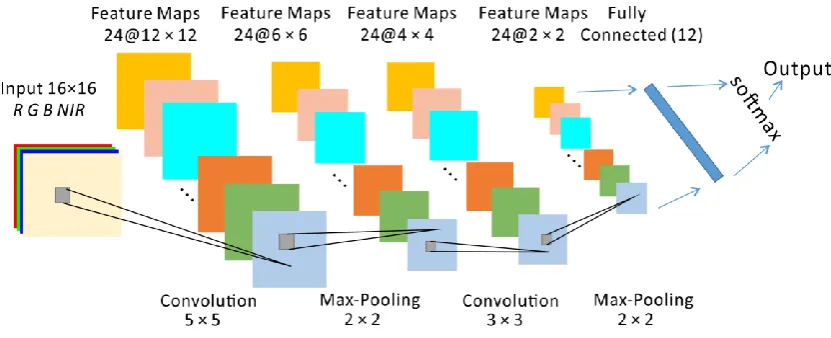
backpropagation. The detailed architecture of the CNN and its parameter configurations 350
14 352
Figure 5. The architecture of the CNN and its configurations.
353
3.3 Decision Fusion Parameter Setting and analysis
354
A rule-based decision fusion approach was implemented based on the classification 355
confidence maps of the CNN (e.g. Figure 2(b)) and MLP (e.g. Figure 2(c)). The 356
parameters of decision fusion, including two thresholds α1 and α2, were determined by 357
grid search with cross-validation using 10% of the randomly chosen samples. In this 358
study, the optimal thresholds α1=0.4 and α2=0.6 were found that reported the greatest 359
classification accuracy. 360
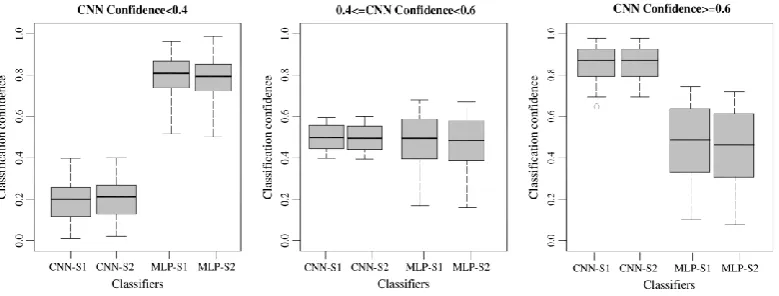
For the sake of visual interpretation, the confidence distribution of the CNN and MLP 361
influenced by the chosen thresholds is shown in Figure 6. Clearly, the CNN and MLP 362
demonstrated individually consistent, but mutually converse distribution patterns in the 363
two study sites: along with the increase in the CNN’s confidence, the MLP inversely 364
exhibited a decreasing trend. Specifically, for low CNN confidence (<0.4), the MLP 365
confidence was around 0.75, significantly higher than that of the CNN, thus outputting 366
the results of MLP in the final decision; once the CNN confidence ranged from 0.4 to 367
0.6, no significant difference was shown between the two classifiers, thereby, optimally 368
choosing the classification results based on the competitive “winner-takes-all” 369
approach; while for large CNN confidence (>0.6), the MLP was, in contrast, much less 370
15 372
Figure 6 Classification confidence distributions of the CNN and MLP at two study sites (S1 and S2)
373
under different fusion thresholds.
374
3.4 Classification results and analysis 375
3.4.1 Classification results and visual assessment
376
By integrating the classification results of the MLP and CNN using the above-377
mentioned fusion parameters, the final classification of the proposed MLP-CNN was 378
obtained at both study sites, S1 (city centre with complex urban scene) and S2 (rural 379
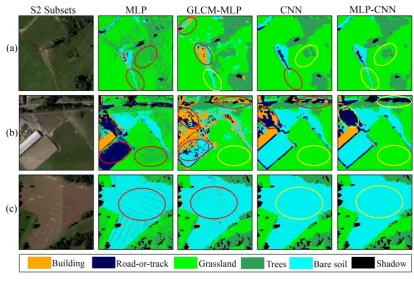
areas with natural phenomena). To provide a better visualization, Figure 7 (three 380
subsets of S1) and Figure 8 (three subsets of S2) highlights the correct or incorrect 381
classification results of different classifiers marked in yellow or red circles, respectively. 382
From Figure 7, it can be seen that the MLP classification results consist of undesirable 383
noise (marked in red circle), such as a severe salt-and-pepper effect in Figure 7(a) and 384
7(b), and linear noisy textures in Figure 8(c). Besides, Trees and Grassland are seriously 385
confused with each other as illustrated by Figure 7(c) and Figure 8(a) and 8(b). 386
However, as shown by Figure 7(b), the MLP has certain advantages over CNN in 387
identifying the Clay roof class with spectrally distinctive features (marked in yellow 388
circle). With the addition of the GLCM textures, the GLCM-MLP achieved certain 389
improvements in both spectral and spatial pattern differentiation. For example, Trees 390
and Grassland are better distinguished to some extent compared with the pixel-based 391
MLP results, as illustrated in Figure 7(c) and Figure 8(b). Besides, the clear linear noisy 392
textures in Figure 8(c) are much reduced, and primarily turned into small speckles due 393
to the introduction of texture features. Yet, the GLCM-MLP falsely identifies some 394
16
(marked in red circle). Additionally, some geometrical distortions of building roof tops, 396
e.g. the Metal Roof and Concrete Roof in Figure 7(b), are shown in the GLCM-MLP 397
classification results caused by the GLCM texture filters. 398
In contrast to the pixel-based MLP and the GLCM-MLP, the classification results of 399
the CNN in both study sites exhibit smoothed visual effects with the least speckle noise 400
as shown by Figure 7 and 8. Additionally, the classes of green vegetation including 401
Grassland and Trees are accurately distinguished as demonstrated by the yellow circles 402
in Figure 7(c) and Figure 8(a) and 8(b) in spite of their spectral similarity. Moreover, 403
the CNN is able to discriminate the Concrete roof from Asphalt with a moderate 404
accuracy, as highlighted by the yellow circle in Figure 7(a). Nevertheless, the CNN 405
delivers some uncertainties in partitioning object boundaries. For example, the regular 406
shapes of some buildings (e.g. the geometries of some Clay roof and Concrete roof 407
areas) are distorted with false boundary partitions, as marked by the red circle in Figure 408
7(b). In addition, small or linear features are either merged into a large object or 409
discarded by over-smoothness. For instance, some Clay roof buildings (small objects) 410
are falsely connected together, while Asphalt is sometimes misclassified as Clay roof 411
(Figure 7(c)) and the small paths covered by Bare soil are discarded (Figure 8(b)). 412
With respect to the results of the MLP-CNN, all of the aforementioned 413
misclassifications produced by MLP or CNN are resolved with a higher resulting 414
accuracy. Thus, the incorrect classifications (marked by red circles) which appeared in 415
Figure 7 and 8 are revised accordingly, with no red circles appearing in the 416
classification results of MLP-CNN. The MLP-CNN modifies the classification errors 417
of the CNN for Asphalt, as illustrated by the red circles in Figure 7(c) and Figure 8(b), 418
thanks to the correct classification results of the MLP. Moreover, the linear-shaped Bare 419
Soil area missed by the CNN in Figure 8(a) is brought back correctly without losing 420
useful information. In addition, the original shapes of the Clay roof and Concrete roof 421
areas shown in Figure 7(b) are accurately restored. Most importantly, some mutual 422
misclassifications between the MLP and CNN are successfully rectified. For example, 423
the MLP-CNN correctly differentiates some Asphalt (with spectrally distinctive but 424
spatially confusing characteristics) and Concrete roof (distinctive in texture and 425
geometry but vague in spectrum) areas that are mutually misclassified by the MLP and 426
17 428
Figure 7 Three typical image subsets (a, b and c) in study site S1 with their classification results.
429
Columns from left to right represent the original images (R G B bands), the MLP classification, the
430
GLCM-MLP classification, the CNN classification and the MLP-CNN classification correspondingly.
431
The red and yellow circles denote incorrect and correct classification, respectively.
432
433
Figure 8 Three typical image subsets (a, b and c) in study site S2 with their classification results.
434
Columns from left to right represent the original images (R G B bands), the MLP classification, the
[image:17.595.87.502.438.725.2]18
GLCM-MLP classification, the CNN classification and the MLP-CNN classification correspondingly.
436
The red and yellow circles denote incorrect and correct classification, respectively.
437
3.4.2Classification accuracy assessment
438
The classification performance of the proposed MLP-CNN approach was further 439
investigated through benchmark comparison with the MLP, GLCM-MLP and the CNN. 440
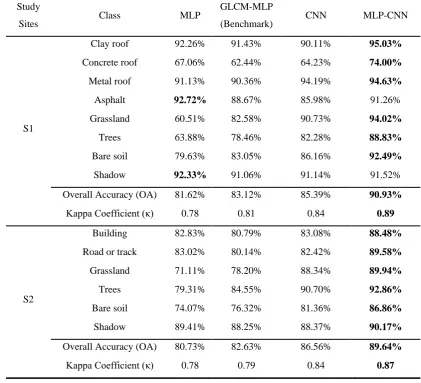
Table 2 lists the classification accuracy assessment, including the overall accuracy 441
(OA), Kappa coefficient (κ), and the class-wise mapping accuracy. From the table, it 442
can be seen that the decision fusion approach (MLP-CNN) consistently reports the best 443
classification OA with up to 90.93% for S1 and 89.64% for S2, higher than that of the 444
CNN (85.39% and 86.56%, respectively) and GLCM-MLP (83.12% and 82.63%, 445
respectively) as well as MLP (81.62% and 80.73%, respectively) (Table 2). Moreover, 446
a Kappa z-test for pair-wise comparison also shows that a significant increase in 447
classification accuracy has been achieved by the proposed MLP-CNN classifier over 448
the MLP, GLCM-MLP and CNN in S1, with z-value=3.68, 3.12 and 2.25, respectively. 449
For S2, the MLP-CNN also revealed a significant increase over the MLP with z -450
value=3.71 as well as GLCM-MLP with z-value=3.18, but no significant difference in 451
comparison with the CNN (z = 1.59, smaller than 1.96 at 95% confidence level) 452
(Congalton, 1991), despite the obvious improvement shown in Table 2. 453
The increase in classification accuracy was also checked by class-wise accuracy 454
assessment (Table 3). As illustrated by the table, MLP-CNN outperforms CNN for all 455
classes at both study sites in terms of classification accuracy. The largest increase is up 456
to 9.77% for the class of Concrete roof in S1 and 7.16% for the class of Road-or-track 457
in S2. Similar patterns were found such that the MLP-CNN was constantly superior to 458
GLCM-MLP at the class-wise level, where the greatest increase in accuracy was shown 459
up to 11.56% for the class of Concrete Roof in S1 and 11.74% for the class of Grassland 460
in S2. When compared with the MLP, most classes in the two sites except for Asphalt 461
and Shadow in S1 are classified with higher accuracy by the MLP-CNN. Here, 462
Grassland exhibits the highest increase in classification accuracy, up to 33.51% and 463
18.83% for S1 and S2, respectively. For the classes of Asphalt and Shadow, the 464
accuracy of the MLP is slightly larger than that of the MLP-CNN, but without a 465
19
With respect to the three benchmark classifiers themselves (i.e. MLP, GLCM-MLP and 467
CNN), it can be seen from Table 2 that their classification accuracies are ordered as: 468
MLP <GLCM-MLP < CNN. While the accuracy of CNN is remarkably higher (3%-469
5%) than that of the MLP and GLCM-MLP, the GLCM-MLP is just slightly higher 470
(<2%) than the MLP. The Kappa z-tests (Table 3) further demonstrate that the CNN is 471
statistically significantly more accurate than MLP and GLCM-MLP in both urban and 472
rural areas, whereas a significant increase in accuracy of the GLCM-MLP over the MLP 473
appears only in the rural area rather than the urban area. 474
Table 2 Classification accuracy comparison amongst MLP, GLCM-MLP, CNN and the proposed
MLP-475
CNN approach for study sites S1 and S2 using the per-class mapping accuracy, overall accuracy (OA)
476
and Kappa coefficient (κ). The bold font highlights the greatest classification accuracy per row.
477
Study
Sites Class MLP
GLCM-MLP
(Benchmark) CNN MLP-CNN
S1
Clay roof 92.26% 91.43% 90.11% 95.03%
Concrete roof 67.06% 62.44% 64.23% 74.00%
Metal roof 91.13% 90.36% 94.19% 94.63%
Asphalt 92.72% 88.67% 85.98% 91.26%
Grassland 60.51% 82.58% 90.73% 94.02%
Trees 63.88% 78.46% 82.28% 88.83%
Bare soil 79.63% 83.05% 86.16% 92.49%
Shadow 92.33% 91.06% 91.14% 91.52%
Overall Accuracy (OA) 81.62% 83.12% 85.39% 90.93%
Kappa Coefficient (κ) 0.78 0.81 0.84 0.89
S2
Building 82.83% 80.79% 83.08% 88.48%
Road or track 83.02% 80.14% 82.42% 89.58%
Grassland 71.11% 78.20% 88.34% 89.94%
Trees 79.31% 84.55% 90.70% 92.86%
Bare soil 74.07% 76.32% 81.36% 86.86%
Shadow 89.41% 88.25% 88.37% 90.17%
Overall Accuracy (OA) 80.73% 82.63% 86.56% 89.64%
Kappa Coefficient (κ) 0.78 0.79 0.84 0.87
[image:19.595.84.506.311.694.2]478
Table 3 Kappa z-test (p-value) comparing the performance of the three classifiers for two study sites S1
479
and S2. Significantly different accuracies with confidence of 95% (z-value > 1.96 with p-value < 0.05)
480
are indicated by *.
20
Study sites Classifiers
Kappa Z-test (p-value)
MLP GLCM-MLP
(Benchmark) CNN
MLP-CNN
S1
MLP —
GLCM-MLP 1.56 (0.1188) —
CNN 2.64* (0.0083) 2.44* (0.0147) —
MLP-CNN 3.68* (0.0002) 3.12* (0.0018) 2.25* (0.0244) —
S2
MLP —
GLCM-MLP 2.05* (0.0404) —
CNN 2.51* (0.0121) 2.36* (0.0183) —
MLP-CNN 3.71* (0.0002) 3.18* (0.0015) 1.59 (0.1118) —
482
The proposed MLP-CNN method and the other three benchmarks (MLP, GLCM-MLP 483
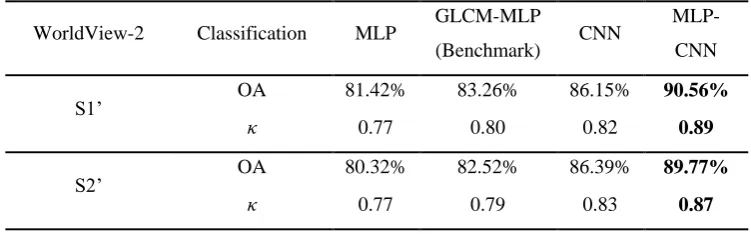
and the CNN) were also validated using an additional WorldView-2 satellite sensor 484
dataset at the S1’ and S2’ study sites. The OA and κ of both study sites are in accordance 485
with the results of aerial photo classification, where the decision fusion approach (MLP-486
CNN) acquires the largest OA of 90.56% at S1’ and 89.77% at S2’, consistently higher 487
than the CNN (86.15% and 86.39%), the GLCM-MLP (83.26% and 82.52%) and the 488
MLP (81.42% and 80.32%) (Table 4). Such coherency of classification results further 489
demonstrates the wide applicability of the proposed method with different datasets. 490
Table 4 Classification accuracy comparison amongst MLP, GLCM-MLP (Benchmark), CNN and the
491
proposed MLP-CNN approach for study sites S1’ and S2’ from the WorldView-2 satellite sensor image
492
using overall accuracy (OA) and Kappa coefficient (κ). The bold font highlights the greatest
493
classification accuracy per row.
494
WorldView-2 Classification MLP GLCM-MLP
(Benchmark) CNN
MLP-CNN
S1’ OA 81.42% 83.26% 86.15% 90.56%
κ 0.77 0.80 0.82 0.89
S2’ OA 80.32% 82.52% 86.39% 89.77%
κ 0.77 0.79 0.83 0.87
495
[image:20.595.109.485.562.679.2]21
In this research, a rule-based decision fusion approach (MLP-CNN) was proposed to 497
integrate classifiers of the pixel-based MLP with shallow structures and the contextual-498
based CNN with deep architectures for the classification of VFSR remotely sensed 499
imagery. The MLP-CNN takes advantage of the merits of the two classifiers and 500
overcomes their individual shortcomings as discussed below. 501
4.1 Characteristics of MLP and GLCM-MLP classification
502
In principle, the MLP builds the decision boundaries among classes in feature space 503
based on per-pixel spectral information (Mokhtarzade and Zoej, 2007). Such 504
classification boundaries are very sensitive to the class with salient spectral properties 505
that are spectrally distinctive from other classes (Berberoglu et al., 2000). For example, 506
classes like Clay roof, Asphalt and Shadow in Site 1 are spectrally exclusive to other 507
classes, leading to high classification accuracies, up to 92.26%, 92.72% and 92.33%, 508
respectively (Table 2). However, the MLP relies on the pixel-based spectral information 509
in the classification process without exploiting the abundant spatial information 510
appearing in the VFSR imagery (e.g. texture, geometry or contextual relationship) 511
(Wang et al., 2016). These limitations often result in unsatisfactory classification 512
performance; for example, confusion and misclassification between the Trees and 513
Grassland classes that are spectrally similar. Even for those correctly identified objects, 514
severe salt and pepper effects still exist (Dark and Bram, 2007), for example, the linear 515
texture noise appearing for Bare soil in Figure 8(c). For these reasons, the classification 516
accuracy of MLP is generally statistically significantly lower than that of the CNN and 517
the proposed MLP-CNN. However, objects in VFSR imagery are mostly depicted by 518
pure pixels, especially for human-made features with crisp boundaries, such as 519
buildings, residential houses and cultivated land. The membership association of a pixel 520
deduced by MLP is, therefore, not affected by its relative position (e.g. lying on or close 521
to boundaries), as long as the corresponding spectral space is separable. 522
The inclusion of GLCM texture features in the GLCM-MLP classifier enables the 523
model to process spectral and spatial information simultaneously. Those GLCM texture 524
descriptors are handcrafted features that are designed to capture statistical co-525
occurrence information (Xia et al., 2010). However, the GLCM textures are essentially 526
first or second order feature transformations instead of feature learning. Such hand-527
22
challenging to generalize to other domains and datasets. Besides, the addition of 96 529
GLCM textures results in a dramatically increased number of input variables, which 530
leads to a relatively high dimensional feature space. The so-called “curse of 531
dimensionality” (Hughes, 1968) and collinearity make the GLCM-MLP hard to 532
parameterize and potentially leads to texture overfitting. That is why the GLCM-MLP 533
cannot substantially increase the classification accuracy compared to the MLP. That is, 534
the spectral and spatial information cannot be effectively exploited by the GLCM-MLP. 535
For example, some spectrally different classes but with similar textures such as Clay 536
Roof, Concrete Roof and Asphalt are confused to some degree. 537
4.2 Characteristics of CNN classification
538
Spatial features in remotely sensed data like VFSR imagery are intrinsically local 539
(especially in lower layers) and spatially invariant (Masi et al., 2016). The MLP, 540
however, assumes that the location of the data in the input is irrelevant to the model 541
construction and it is, thus, incapable of learning spatial features of remote sensing data. 542
In contrast, by using multiple convolution and pooling operations, CNN models the 543
way that the human visual cortex works and enforces weight sharing with translation 544
invariance that enables the extraction of high-level spatial features from image patches. 545
It should be mentioned that the pooling operations play an important role in dimension 546
reduction, thus, avoiding “the curse of dimensionality” present in the GLCM-MLP 547
classifier. Thanks to these superior characteristics, the CNN classifier outperforms the 548
MLP and GLCM-MLP classifiers in both the urban scene and rural areas. Especially, 549
classes like Concrete roof and Road-or-track that are difficult to distinguish from their 550
backgrounds with only spectral or low-level features (e.g. distance between the 551
prediction and the target class at spectral space), are identified with relatively high 552
accuracies. In addition, classes with heavy spectral confusion in both study sites (e.g. 553
Trees and Grassland), are accurately differentiated due to their obvious spatial pattern 554
differences; for example, the texture of tree canopies is generally much rougher than 555
for grassland. As a contextual classifier with deep architectures, the CNN could reveal 556
the spatial patterns hidden in the image data that cannot be perceived by its shallow 557
counterparts (e.g. MLP classifier or even the GLCM-MLP classifier). The higher layers 558
in CNN models provide more semantically meaningful information concentrating on 559
global semantics rather than local or pixel-level information, making the CNN 560
23
Yang et al., 2015). Therefore, the CNN shows an impressive stability and effectiveness 562
in spatial feature representation, which is crucial for VFSR image classification (Zhao 563
and Du, 2016). 564
However, according to the “no free lunch” theorem (Wolpert and Macready, 1997), any 565
elevated performance in one aspect of a problem will be paid for through others, and 566
the CNN is no exception. Using contextual image patches as inputs and learning deep 567
spatial features, the CNN demonstrates power in spatial pattern recognition but also 568
weakness in spatial partition. Boundary uncertainties (over-smoothness) often appear 569
in the classified object and small useful features are erased, somewhat similar to 570
morphological or Gabor filter methods (Pingel et al., 2013; Reis and Tasdemir, 2011). 571
For example, the human-made objects in urban scenes like buildings and asphalt are 572
often geometrically enlarged with distortion to some degree (See Figure 7(b)). As for 573
natural objects in rural areas (S2), edges or porosities of a landscape patch are simplified 574
or ignored, and even worse, linear features like river channels or dams that are of 575
ecological importance, are erroneously erased. One may argue that the reduction of 576
image patch size might be able to detect small features by multiple CNNs by varying 577
the contextual filter size as adopted in Längkvist et al. (2016). However, objects, 578
whether large or small in size, all have boundaries, thus, retaining the problem of 579
smoothing edges. In addition, the adoption of convolution and pooling operations 580
intrinsically reduces the image contextual size but strengthens the spatial feature 581
representation. Thus, a far too small initial image patch size can limit the network depth 582
of a CNN model. In fact, the currently used 16×16 window size is close to the minimum 583
requirements for a deep CNN with four hidden layers in total. Moreover, certain 584
spectrally distinctive features without obvious spatial patterns are poorly differentiated. 585
For example, some Asphalt pixels are wrongly identified as Concrete roofs as illustrated 586
in Figure 7(a). This further demonstrates the necessity of introducing spectral features 587
for VFSR image classification. 588
4.3 fusion decision of MLP-CNN classification
589
Huge uncertainty and inconsistency exists inherently in any remotely sensed data 590
(including VFSR imagery), and this runs through the training and the testing samples. 591
In fact, different classification algorithms vary in terms of remote sensing data 592
24
2015) to various applications of VFSR image classification, even for the powerful CNN 594
classifier with deep spatial feature representations. It is therefore especially important 595
to make use of the complementarities of different classifiers. It should be mentioned 596
that, the more heterogeneous the classification algorithms’ behaviours, the more that 597
different places might be accurately classified by each individual classifier, and the 598
more accurate the ensemble classifier might be (Löw et al., 2015). An ideal ensemble 599
classifier, thereby, should be established using individual classifiers that are very 600
differently behaved. 601
The experimental results show that the pixel-based MLP classifier with shallow 602
structures and the contextual-based CNN classifier with deep architectures can provide 603
complementary information, leading to a more accurate classification result than either 604
classifier alone. In addition to the elimination of heavy noise, the CNN can accurately 605
identify classes with rich spatial information implicit in VFSR data. Such 606
characteristics of the CNN emphasize the limitations of the MLP classifier for VFSR 607
image classification. At the same time, the CNN might lose some useful details, and it 608
has difficulties in utilizing spectral information and delineating object boundaries and 609
is, thus, incapable of maintaining geometric fidelity. The MLP classifier, however, 610
compensates directly with regard to the limitations of the CNN. The aforementioned 611
complementary properties between the CNN and MLP are well reflected from the 612
inverse confidence trends of the two classifiers (Figure 2). Specifically, in the case of 613
the CNN with the highest confidence, the MLP has the least confidence and vice versa, 614
which further indicates that the proposed MLP-CNN ensemble classifier can take 615
advantage of the MLP and CNN. 616
The proposed fusion decision rules were derived primarily on the basis of the CNN’s 617
confidence distribution, in consideration of the superiority of CNN classification 618
performance and the regularity of its confidence distribution. Such a decision fusion 619
strategy captures the patterns of the complementarities between the two individual 620
classifiers in general, thus, achieving a desirable classification result. At the same time, 621
the MLP-CNN classifier demonstrates great utility and wide applicability for both 622
aerial photography and WorldView-2 satellite sensor imagery with consistent and 623
competitive classification performance. However, in comparison with MLP, the 624
classification accuracies of Asphalt and Shadow were slightly higher than for the 625
25
decision fusion rules at the class-wise level for VFSR image classification. It might be 627
better to incorporate the spectral separability differentiated by MLP to achieve the best 628
classification performance at class level. Besides, no significant improvement was 629
acquired for rural areas (S2) by the MLP-CNN compared with the CNN. This is mainly 630
due to the ineffectiveness of the MLP in classifying natural features that dominate in 631
the rural environment. This shortcoming might be overcome by the replacement of the 632
MLP by other non-parametric machine learning classifiers (e.g. SVM, RF, etc.). 633
Moreover, incorporating other data sources (e.g. digital surface model) might be needed 634
to increase the accuracy of the MLP-CNN for both the CNN and MLP with very low 635
confidence simultaneously. These aforementioned issues will be investigated in future 636
research. 637
5. Conclusion 638
Due to its high intra-class variability and low inter-class disparity, VFSR image 639
classification poses great challenges to any single machine learning algorithm, even for 640
the powerful deep learning convolutional neural network (CNN). In this paper, two 641
neural network classifiers with strong heterogeneous behaviours (i.e. pixel-based MLP 642
with shallow structures and contextual-based CNN with deep architectures), were 643
integrated in a concise and effective way using a rule-based decision fusion strategy. 644
The decision fusion rules, designed primarily on the basis of the classification 645
confidence of the CNN, reflect the general complementary patterns of both the MLP 646
and CNN. In consequence, the proposed ensemble classifier MLP-CNN harvests the 647
complementary results acquired from the CNN with deep spatial feature representations 648
(CNN) and from the MLP based on spectral discrimination. Meanwhile, limitations of 649
the CNN such as uncertainty in object boundary partition and loss of useful fine 650
resolution detail were compensated. The effectiveness of the new MLP-CNN algorithm 651
was tested in both urban and rural areas using aerial and satellite sensor images. The 652
MLP-CNN algorithm consistently outperformed both of the individual classifiers (MLP 653
and CNN) as well as the GLCM-MLP that includes the GLCM texture features, with a 654
statistically significant difference in the majority of cases. This research paves the way 655
to an effective solution to the complicated problem of automatic VFSR image 656
classification. 657
26
This research was funded by PhD studentship “Deep Learning in massive area, multi-659
scale resolution remotely sensed imagery” (NO. EAA7369), sponsored by Ordnance 660
Survey and Lancaster University. The authors thank to the staff from the Ordnance 661
Survey for the supply of aerial imagery and supporting ground data. The authors also 662
thank to the two anonymous referees for their constructive comments on this 663
manuscript. 664
Reference 665
Ardila, J.P., Tolpekin, V.A., Bijker, W., Stein, A., 2011. Markov-random-field-based 666
super-resolution mapping for identification of urban trees in VHR images. 667
ISPRS J. Photogramm. Remote Sens. 66, 762–775. 668
doi:10.1016/j.isprsjprs.2011.08.002 669
Arel, I., Rose, D.C., Karnowski, T.P., 2010. Deep machine learning - A new frontier 670
in artificial intelligence research. IEEE Comput. Intell. Mag. 5, 13–18. 671
doi:10.1109/MCI.2010.938364 672
Atkinson, P.M., Tatnall, A.R.L., 1997. Introduction Neural networks in remote 673
sensing. Int. J. Remote Sens. 18, 699–709. doi:10.1080/014311697218700 674
Attarchi, S., Gloaguen, R., 2014. Classifying complex mountainous forests with L-675
Band SAR and landsat data integration: A comparison among different machine 676
learning methods in the Hyrcanian forest. Remote Sens. 6, 3624–3647. 677
doi:10.3390/rs6053624 678
Benediktsson, J.A., 2009. Ensemble classification algorithm for hyperspectral remote 679
sensing data. IEEE Geosci. Remote Sens. Lett. 6, 762–766. 680
doi:10.1109/LGRS.2009.2024624 681
Berberoglu, S., Lloyd, C.D., Atkinson, P.M., Curran, P.J., 2000. The integration of 682
spectral and textural information using neural networks for land cover mapping 683
in the Mediterranean. Comput. Geosci. 26, 385–396. doi:10.1016/S0098-684
3004(99)00119-3 685
Bezak, P., Bozek, P., Nikitin, Y., 2014. Advanced robotic grasping system using deep 686
learning. Procedia Eng. 96, 10–20. 687
27
Breiman, L., 1996. Bagging Predictors. Mach. Learn. 24, 123–140. 689
Chen, S., Member, S., Wang, H., Xu, F., Member, S., 2016. Target classification 690
using the deep Convolutional Networks for SAR images. IEEE Trans. Geosci. 691
Remote Sens. 54, 4806–4817. 692
Chen, Y., Jiang, H., Li, C., Jia, X., Member, S., 2016. Deep feature extraction and 693
classification of hyperspectral images based on Convolutional Neural Networks. 694
IEE Trans. Geosci. Remote Sens. 54, 6232–6251. 695
doi:10.1109/TGRS.2016.2584107 696
Chen, Y., Lin, Z., Zhao, X., Wang, G., Gu, Y., 2014. Deep learning-based 697
classification of hyperspectral data. IEEE J. Sel. Top. Appl. Earth Obs. Remote 698
Sens. 7, 2094–2107. doi:10.1109/JSTARS.2014.2329330 699
Clinton, N., Yu, L., Gong, P., 2015. Geographic stacking: Decision fusion to increase 700
global land cover map accuracy. ISPRS J. Photogramm. Remote Sens. 103, 57– 701
65. doi:10.1016/j.isprsjprs.2015.02.010 702
Congalton, R.G., 1991. A review of assessing the accuracy of classifications of 703
remotely sensed data. Remote Sens. Environ. 37, 35–46. 704
Dark, S.J., Bram, D., 2007. The modifiable areal unit problem (MAUP) in physical 705
geography. Prog. Phys. Geogr. 31, 471–479. doi:10.1177/0309133307083294 706
Del Frate, F., Pacifici, F., Schiavon, G., Solimini, C., 2007. Use of neural networks 707
for automatic classification from high-resolution images. IEEE Trans. Geosci. 708
Remote Sens. 45, 800–809. doi:10.1109/TGRS.2007.892009 709
Demarchi, L., Canters, F., Cariou, C., Licciardi, G., Chan, J.C.W., 2014. Assessing 710
the performance of two unsupervised dimensionality reduction techniques on 711
hyperspectral APEX data for high resolution urban land-cover mapping. ISPRS 712
J. Photogramm. Remote Sens. 87, 166–179. doi:10.1016/j.isprsjprs.2013.10.012 713
Dong, Z., Pei, M., He, Y., Liu, T., Dong, Y., Jia, Y., 2015. Vehicle type classification 714
using unsupervised Convolutional Neural Network. IEEE Trans. Intell. Transp. 715
Syst. 16, 2247–2256. doi:10.1109/ICPR.2014.39 716
28
for remote sensing image classification: A review. Sensors 12, 4764–4792. 718
doi:10.3390/s120404764 719
Farabet, C., Couprie, C., Najman, L., Lecun, Y., 2013. Learning hierarchical features 720
for scene labeling. IEEE Trans. Pattern Anal. Mach. Intell. 35, 1915–1929. 721
doi:10.1109/TPAMI.2012.231 722
Fauvel, M., Chanussot, J., Benediktsson, J.A., 2012. A spatial-spectral kernel-based 723
approach for the classification of remote-sensing images. Pattern Recognit. 45, 724
381–392. doi:10.1016/j.patcog.2011.03.035 725
Fauvel, M., Chanussot, J., Benediktsson, J.A., 2006. Decision fusion for the 726
classification of urban remote sensing images. IEEE Trans. Geosci. Remote 727
Sens. 44, 2828–2838. doi:10.1109/TGRS.2006.876708 728
Foody, G.M., Arora, M.K., 1997. An evaluation of some factors affecting the 729
accuracy of classification by an artificial neural network. Int. J. Remote Sens. 18, 730
799–810. doi:10.1080/014311697218764 731
Freund, Y., Iyer, R., Schapire, R.E., Singer, Y., 2003. An efficient boosting algorithm 732
for combining preferences. J. Mach. Learn. Res. 4, 933–969. 733
Haralick, R.M., Shanmugam, K., Dinstein, I., 1973. Textural Features for Image 734
Classification. IEEE Trans. Syst. Man. Cybern. 3, 610–621. 735
doi:10.1109/TSMC.1973.4309314 736
Hu, F., Xia, G.-S., Hu, J., Zhang, L., 2015a. Transferring Deep Convolutional Neural 737
Networks for the Scene Classification of High-Resolution Remote Sensing 738
Imagery. Remote Sens. 7, 14680–14707. doi:10.3390/rs71114680 739
Hu, F., Xia, G.S., Wang, Z., Huang, X., Zhang, L., Sun, H., 2015b. Unsupervised 740
Feature Learning Via Spectral Clustering of Multidimensional Patches for 741
Remotely Sensed Scene Classification. IEEE J. Sel. Top. Appl. Earth Obs. 742
Remote Sens. 8, 2015–2030. doi:10.1109/JSTARS.2015.2444405 743
Huang, X., Lu, Q., Zhang, L., 2014. A multi-index learning approach for 744
classification of high-resolution remotely sensed images over urban areas. ISPRS 745