© 2019, IRJET | Impact Factor value: 7.211 | ISO 9001:2008 Certified Journal | Page 7773
Heart Beat Based Security System Using Sampling Technique
G.Venkatesh
1, M.Sugumar
2, S.Pradeep
3,R.N.Vasantharaj
41
G.Venkatesh M.E, Asst Professor ,Panimalar Engineering College ,Chennai.
2M.Sugumar, Panimalar Engineering College ,Chennai
3
S.Pradeep Panimalar Engineering College ,Chennai
4R.N.Vasantharaj, Panimalar Engineering College ,Chennai
---***---Abstract -
To provide a security system using the pulseinterval of heart beat of a person which is unique for each individual which can provide high security and also establish an interface between the security system the individual for real time access.
Key Words: Security System , Heart Beat , Biometric Authentication, Sampling Technique , Heart Beat Security ,etc (Minimum 5 to 8 key words)…
1.INTRODUCTION
HIS heart-beat-based security is mainly used for improving our security encryption. In this System, a security key is derived from the time difference between consecutive heart beats (the inter-pulse interval, IPI).In heart-beat-based security (HBBS), each sensor measures a heart-related biosignal, for example, cardiac activity or blood flow, and forms a biometric security key based on the time interval between consecutive heart beats.The time interval between consecutive heartbeats (interpulse interval, IPI) has previously been suggested for securing mobile-health solutions. This time interval is known to contain a degree of randomness, permitting the generation of a time- and person-specific identifier. It is commonly assumed that only devices trusted by a person can make physical contact with him/her, and that this physical contact allows each device to generate a similar identifier based on its own cardiac recordings. Under these conditions, the identifiers generated by different trusted devices can facilitate secure authentication. Recently, a wide range of techniques have been proposed for measuring heartbeats remotely, a prominent example of which is remote photoplethysmography (rPPG).
Fig 1.1 Heat Beat Security
Automated security is one of the major concerns in modern time where secure and reliable authentication is in great demand. However, traditional authentication methods such as password and smart card are now outdated because they can be lost, stolen and shared. In this project, biometric system based on heartbeat signals which is also known as Electrocardiographic (ECG) signals is proposed. Heartbeat is chosen as modality due to an individual’s ECG signals cannot be faked. Compared to fingerprint it can be fooled with fake fingers, face can be extracted using user’s photo and voice can be imitated conveniently. As ECG signals are reflection of the mechanical movement of the heart, these features contain unique physiological information which make them a promising authentication technology.
[image:1.595.308.572.512.686.2]A Report From Binghamton University Had Proved it.Scientists from the Binghamton University in New York have explored with using a person's heartbeat as a password for encrypting and then decrypting personal data. Researchers say that each person possesses a unique electrocardiograph (ECG), which just like fingerprints and iris, can be used for authentication.
Fig 1.2 Heart Beat Replace Passwords
© 2019, IRJET | Impact Factor value: 7.211 | ISO 9001:2008 Certified Journal | Page 7774
1.1 Introduction to Heart Beat
Heart Beat Rate , also known as pulse, is the number of times a person's heart beats per minute.The heart rate can vary according to the body's physical needs, including the need to absorb oxygen and excrete carbon dioxide. It is usually equal or close to the pulse measured at any peripheral point. Activities that can provoke change include physical exercise, sleep, anxiety, stress, illness, and ingestion of drugs.
[image:2.595.310.561.136.277.2]Types of Heart Beat
Fig 1.3 Types of Heartbeat
Tachycardia is a fast heart rate, defined as above 100 bpm at rest.
Bradycardia is a slow heart rate, defined as below 60 bpm at rest.
When the heart is not beating in a regular pattern, this is referred to as an arrhythmia.
1.2 Heart Beat Pattern
Fig 1.4 Heart Beat Pattern
One pulse(Beat) pattern = P-Q-R-S-T
2. WORKING METHADOLOGY
2.1 Block Diagram
2.1 WORKING:
[image:2.595.80.204.591.705.2]© 2019, IRJET | Impact Factor value: 7.211 | ISO 9001:2008 Certified Journal | Page 7775
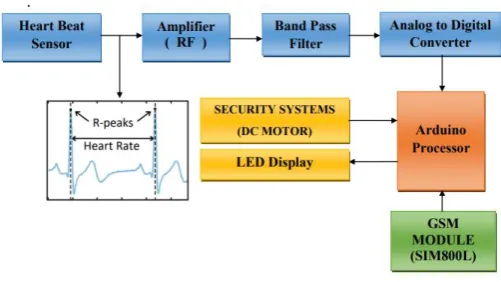
The output from A\D converter is given to the Aurdino
board which has been already fed with the suitable
program for grey code conversion. Thus the output is
fed to the Aurdino board (processor).The output from
the Aurdino board has been displayed in the 16*2 LCD
display.The pulse rate is displayed in the LCD display. If
the sampled value matches with the pulse rate value,
the security key unlocks, Here we have used a DC
motor for an output unit.And if the Sampled value does
not match with the pulse rate value, it sends a OTP to
the registered number within 15 seconds.Here the OTP
has been generated using a GSM module which has
been fed with a suitable GSM coding.Thus the security
system is even protected in a more secure manner
using the OTP method.
2.2 BACKGROUND AND RELATED WORK
In this Section, we first compare HBBS to other
biometrics qualitatively, after which we discuss works
related to its security performance. HBBS is a form of
cardiovascular
biometrics,
which
use
the
characteristics of a person‟s cardiac cycle for entity
authentication. Cardiovascular biometrics are typically
based on an electrocardiogram (ECG), using either a
combination of various fiducial features (e.g.,
“ST-slope”or “ST-interval”) or non-fiducial feature.This
makes it a suitable candidate for many Health
applications as.Heart beats are measurable throughout
the body using many types of cardiovascular
recordings, including ECG, blood pressure (BP) and
Photoplethysmography (PPG).As such, it may be
measured through a wide spectrum of sensors and
locations (more universally than othercardiovascular
biometrics.
I
The least significant bits have the useful property of
changing rapidly if the number changes even slightly.
For example, if 1 (binary 00000001) is added to 3
(binary 00000011), the result will be 4 (binary
00000100) and three of the least significant bits will
change (011 to 100). By contrast, the three most
significant bits (MSBs) stay unchanged (000 to 000). In
this Section we describe the most commonly used
method for facilitating entity authentication in HBBS
based on the IPI, after which we present our improved
method using the ImPI. Entity authentication in HBBS
comprises two steps: Security-key generation by two
entities and entityauthentication, if these keys are
similar enough.
3.HARDWARE COMPONENTS
[image:3.595.362.499.367.499.2]3.1 Heart Beat Sensor
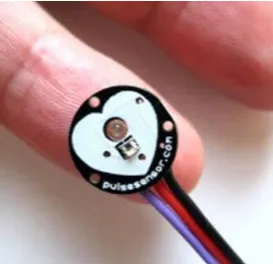
Fig 3.1 Heart Beat Sensor
Heart beat sensor is used to measure the pulse rate of heart in digital output.LED is used to detect the heart rate. The normal heart beat range is 78 bpm. This provides a direct output digital signal.
3.2 Amplifiers
© 2019, IRJET | Impact Factor value: 7.211 | ISO 9001:2008 Certified Journal | Page 7776
3.3 Band Pass Filter
A band-pass filter, also bandpass filter or BPF, is a device that passes frequencies within a certain range and rejects (attenuates) frequencies outside that range.
3.4 Analog To Digital Converter
In electronics, an analog-to-digital converter (ADC, A/D, or A-to-D) is a system that converts an analog signal, such as a sound picked up by a microphone or light entering a digital camera, into a digital signal. An ADC may also provide an isolated measurement such as an electronic device that converts an input analog voltage or current to a digital number representing the magnitude of the voltage or current.
[image:4.595.63.270.77.278.2]3.5 Gsm Module For OTP Generation
Fig 3.2 Gsm Module
SIM800L is a miniature cellular module which allows for GPRS transmission, sending and receiving SMS and making
and receiving voice calls. Low cost and small footprint and quad band frequency support make this module perfect solution for any project that require long range connectivity. After connecting power module boots up, searches for cellular network and login automatically. On board LED displays connection state (no network coverage - fast blinking, logged in - slow blinking).
4. SAMPLING TECHNIQUE
A
sample
is a value or set of values at a point in time
and/or space.
A
sampler
is a subsystem or operation that extracts
samples from a continuous signal.
[image:4.595.36.261.571.720.2]
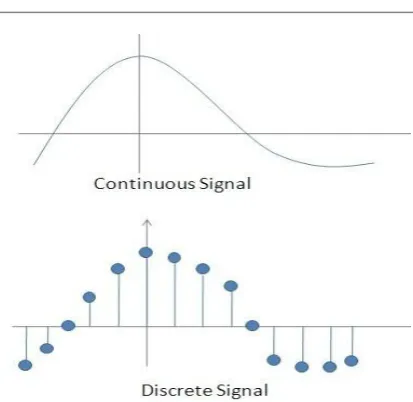
Sampling
is the reduction of a continuous-time signal
to a discrete-time signal. A common example is the
conversion of a sound wave (a continuous signal) to a
sequence of samples (a discrete-time signal).Like This
we use our continuous heart beat “ PQRST ” wave into a
sequence of samples ( Discrete Time Signal )
Fig 4.1 WaveForm of Signals
There are different types of sampling techniques
1.
Natural sampling
2.
Flat top sampling
3.
Ideal sampling
1.Natural sampling
is a practical method of sampling
in which pulse have finite width with time(t) carrier
wave.
2. Flat top sampling
same as natural but tops of
carrier signal remains same with as sampled signal.
3.Ideal sampling
has discrete amplitudes with carrier
wave .
There two different types of sampling
1.Upsampling
2.Down sampling
Upsampling
is also known as interpolation which
increases the resolution of signal or image ,improves
anti aliasing filter performance and reduces noise.
© 2019, IRJET | Impact Factor value: 7.211 | ISO 9001:2008 Certified Journal | Page 7777
Down sampling
is also known as decimation
which reduces data size and image reduction
ex: Extraction of thumbnails from an image
The Output is not in continuous
It is discrete by nature
Using discrete signal code can be generated.
Applications
Audio Sampling
Speech Sampling
Video Sampling
3d Sampling
5. ADVANTAGES
Portable system
Save risk of Havking Your Password as you can Only Access it
Affordable system
Improved Total 360 Security System
Quick Access Featured Enabled
This system can be used in many places like banks,doors,lockers, security room and more and more it will be used in high secured places like armed forces for weapons prevention and also used as security key generating tool.
6. CONCLUSIONS
Heart Beat Security System is a new security system which should provide more secure authentication to all.When compared to other security systems , this system is more affordable and a unique security like our
fingerprints and eyes.In Our Existing System,
• Finger Print Scanner – Hacked by Using Silica gel • Iris Scanner – Fails in Some Cases like Retinal
Damages
• Pass Code – Cracker By Hackers • Voice Unlock – Throat Problems
• Facial Recognition – Fails in Some Situations Like Facial Surgery
Hence we Conclude that our project will be a motivational one to all.Because , this project can’t work 100%.It mays have some Bugs in it .But we are almostly done and corrected most of the issues that appears. BEST KEY STRENGTH
FUTURE SCOPE
© 2019, IRJET | Impact Factor value: 7.211 | ISO 9001:2008 Certified Journal | Page 7778
7. WAY TO OVERCOME ISSUES
1.LIMIT
LOGIN
ATTEMPTS
FIG7.1LIMIT LOGIN ATTEMPTS
LIMITTHE NUMBER OF FAILEDLOGIN ATTEMPTSPER USER.FOR EXAMPLE, YOU CAN SAY AFTER 5 FAILEDATTEMPTS, LOCK THE USER OUT TEMPORARILY.
2.ADDING
SECONDARY
SECURITY
Fig 7.2 Secondary Security
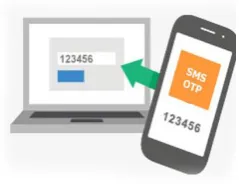
Every System fails in some situations in order to overcome that failure issues we have to install another secondary security systems.We can either use “IRIS SCANNER” OR “OTP GENERATION”
3.PROVIDE
MULTIPLE
USER
ACCESS
Fig 7.3 Multiple User Access
If the user is unluckily meet with any accidents or any other health problems,heartbeat may vary.or Even The user may dies in some situations so in that the security becomes permanently locked.so to overcome that this feature must be added.
[image:6.595.390.472.127.262.2]4.GET NOTIFIED EVERY SECOND
Fig 7.4 Notification
You Will Get Notifications During Every Access of this system . It will show up the limits you tried and limits remaining.
REFERENCES
[1] [4] X. D. Yang,Q. H. Abbasi, A. Alomainy and Y. Hao, "Spatial Correlation Analysis of On-Body Radio Channels Considering Statistical Significance ", IEEE Antenna and Wireless Propagation letter, Volume 10, pp. 780-783, August 2011.
[2] H. Poor, An Introduction to Signal Detection and Estimation. New York: Springer-Verlag, 1985, ch. 4. [3] R. Di Bari, Q. H. Abbasi, A. Alomainy and Y. Hao, "An
Advanced Ultra Wideband Channel Model for Body-Centric Wireless Networks", Progress In Electromagnetics Research (PIER), Vol. 136, pp. 79-99, 2013..
[4] O. Aziz, B. Lo, R. King, A. Darzi, and Y. Guang-Zhong, "Pervasive body sensor network: an approach to monitoring the post-operative surgical patient," in International Workshop on Wearable and Implantable Body Sensor Networks, BSN 2006., 2006, pp. 4 pp.-1C. [5] J.K.Sowbagya, “An approach to principles of Sampling
techniques”, Assist.Professor , Surya College Of Engineering , Villupuram.
[6] [5] S.-D. Bao et al. Using the timing information of heartbeats as an entity identifier to secure body sensor network. In T-ITB, pp. 772-779, volume 12. IEEE, 2008.
[7] M. P. Tulppo, T. Makikallio, T. Takala, T. Seppanen, and H. V. Huikuri. Quantitative beat-to-beat analysis of heart rate dynamics during exercise. American Journal of Physiology-Heart and Circulatory Physiology, 271(1):H244–H252, 1996.
K. K. Venkatasubramanian, A. Banerjee, and S. K. S. Gupta. Pska: usable and secure key agreement scheme for body area networks. ITB, IEEE Trans. on,
[image:6.595.83.203.348.440.2]