warwick.ac.uk/lib-publications
Manuscript version: Published Version
The version presented in WRAP is the published version (Version of Record).
Persistent WRAP URL:
http://wrap.warwick.ac.uk/116717
How to cite:
The repository item page linked to above, will contain details on accessing citation guidance
from the publisher.
Copyright and reuse:
The Warwick Research Archive Portal (WRAP) makes this work by researchers of the
University of Warwick available open access under the following conditions.
Copyright © and all moral rights to the version of the paper presented here belong to the
individual author(s) and/or other copyright owners. To the extent reasonable and
practicable the material made available in WRAP has been checked for eligibility before
being made available.
Copies of full items can be used for personal research or study, educational, or not-for-profit
purposes without prior permission or charge. Provided that the authors, title and full
bibliographic details are credited, a hyperlink and/or URL is given for the original metadata
page and the content is not changed in any way.
Publisher’s statement:
Please refer to the repository item page, publisher’s statement section, for further
information.
Received January 21, 2019, accepted February 8, 2019, date of publication February 21, 2019, date of current version March 18, 2019.
Digital Object Identifier 10.1109/ACCESS.2019.2900335
Convolution-Based Neural Attention With
Applications to Sentiment Classification
JIACHEN DU 1, LIN GUI2, YULAN HE2, RUIFENG XU1,3, (Member, IEEE), AND XUAN WANG1, (Member, IEEE)
1School of Computer Science and Technology, Harbin Institute of Technology (Shenzhen), Shenzhen 518000, China 2Department of Computer Science, University of Warwick, Coventry CV47AL, U.K.
3Peng Cheng Laboratory, Shenzhen 518000, China
Corresponding author: Ruifeng Xu ([email protected])
This work was supported in part by the National Natural Science Foundation of China under Grant U1636103, Grant 61632011, and Grant 61876053, in part by the Key Technologies Research and Development Program of Shenzhen under
Grant JSGG20170817140856618, in part by the Shenzhen Foundational Research Funding under Grant 20170307150024907, and in part by the Innovate U.K. under Grant 103652.
ABSTRACT Neural attention mechanism has achieved many successes in various tasks in natural language processing. However, existing neural attention models based on a densely connected network are loosely related to the attention mechanism found in psychology and neuroscience. Motivated by the finding in neuroscience that human possesses the template-searching attention mechanism, we propose to use convolution operation to simulate attentions and give a mathematical explanation of our neural attention model. We then introduce a new network architecture, which combines a recurrent neural network with our convolution-based attention model and further stacks an attention-based neural model to build a hierarchical sentiment classification model. The experimental results show that our proposed models can capture salient parts of the text to improve the performance of sentiment classification at both the sentence level and the document level.
INDEX TERMS Natural language processing, sentiment classification, convolutional neural networks, neural attention model.
I. INTRODUCTION
The task of sentiment classification, which identifies the sentiment polarity of a given sentence or document, has become an attracting topic in Natural Language Process-ing (NLP) [1]–[3]. Traditional approaches treat this task as text classification, focusing on designing effective features to obtain better performance, such as n-grams [4], topics extracted by topic models [5] and dependency parse trees [6]. These feature-based methods have achieved some success in sentiment classification, but they are sensitive to the noise in text and require expensive feature engineering.
To solve this problem, Neural Network (NN) based models have been introduced to learn the continuous doc-ument representations in an end-to-end manner for senti-ment classification. NN based models firstly project the one-hot representation of a word in text into a continuous low-dimensional space [7]–[9], and apply various deep NN
The associate editor coordinating the review of this manuscript and approving it for publication was Chao Tong.
architectures to learn the latent representation of text and perform classification. Two NN architectures are widely used in sentiment classification, namely, Convolutional Neural Networks (CNNs) [10] and Recurrent Neural Net-works (RNNs) based on long short-term memory [11]. CNN based neural networks have shown promising performance on various NLP tasks such as sentiment classification [12], [13], question answering [14] and text generation [15]. Although CNN is able to capture salient parts in text, it typically only deals with short-distance relations between words in text and largely ignores long-term dependencies such as words in a considerable distance indicating negations and sentiment transitions. RNN is another promising model commonly used in sentiment classification. For example, Tanget al. [16] used gated RNN to model documents for sentiment classification. Different from CNN based model, RNN is better at model-ing long-distance semantics in text and capturmodel-ing contextual information. However, conventional RNN is not capable of focusing on the salient parts in text which are important in sentiment classification.
VOLUME 7, 2019
2169-35362019 IEEE. Translations and content mining are permitted for academic research only. Personal use is also permitted, but republication/redistribution requires IEEE permission. See http://www.ieee.org/publications_standards/publications/rights/index.html for more information.
More recently, a new direction of deep learning research has emerged, which introduces an attention mechanism to conventional NN-based models. NN with attention is able to attend to specific parts of text as the simulation of human’s attention while processing text. The attention mechanism has been widely applied in various downstream applications including caption generation [17], [18], machine translation [19], [20], reading comprehension [21], [22] and text summarization. Although neural attention models give impressive performance in the aforementioned tasks, they are less effective for text classification. For example, Yang et al. [23] modified the neural attention mechanism used in the sequence-to-sequence (seq2seq) model and applied it for document-level classification. The attention used in [23] can be seen as a self-attention module that takes the hidden states of word-level or sentence-level RNN as input and outputs the attention scores based on the dot product between the hidden states and a global context vec-tor. Compared with non-attention methods, the improve-ment is marginal in the reported results. The reason is that, in the seq2seq problems, attention is defined based on the alignment between a given text unit (word or sentence) with some observed labels, such as a word in another lan-guage (for machine translation) or a Part-Of-Speech tag (for POS tagging). In sentiment classification, there is no target label for each text unit to indicate whether the unit is sentiment-relevant or not. As such, there is no evidence why the densely connected network with one hidden layer attention is efficient for sentiment classification.
Inspired by the cognitive and neuroscience research, we propose a novel neural attention model for sentiment clas-sification. The basic idea is to firstly apply one-dimensional convolution operation to model the information of text unit in its context and capture the attention signals, then use an RNN to autoregressively represent the text sequence with atten-tion signals for sentiment classificaatten-tion. A text unit (words or sentences) with higher attention weight, which conveys more important information, will be highlighted in senti-ment classification. Our main contributions in this paper is four-fold:
• we propose a convolution-based model to stimulate human’s reading attentions based on cognitive and neu-roscience research, justified by mathematical theories. • We also propose an efficient method for attention signal
extraction, which can be applied in a wide range of tasks. • We propose a new sentence-level sentiment classi-fication architecture named Convolutional-Recurrent Attention Network (CRAN) which combines convolution-based attentions with RNNs. Experimental results show that CRAN can capture salient words in sentence and outperforms several strong baselines. • Finally, we hierarchically stack CRAN to
con-struct a document-level model named Hierarchical Convolutional-Recurrent Attention Network (H-CRAN). Experimental results also show that H − CRAN can capture sentence-level attention signals and outperforms
the state-of-the-art models in document-level sentiment classification.
II. RELATED WORKS
A. SENTIMENT CLASSIFICATION
Sentiment analysis is one of the main research topics in NLP [2], [3]. It can be carried out at two different levels of granularity: sentence-level and document-level [2]. Generally speaking, sentiment classification can be treated as traditional text classification, and solved by supervised statistical learning models [1]–[4]. Traditional feature-engineering based models usually focus on extracting effi-cient features including lexical features [4], [24], topic-based features [5], [25] and ontology-based features [26], [27]. With the rapid development of deep learning, NN based models have shown promising performance on sentiment classification. Various architectures of NN including Multi-Layer Perceptron (MLP) [28], CNN [12] and RNN [29] have been proposed to obtain better representations of sentences for classification. In document-level sentiment classification, the hierarchical semantic composition of a doc-ument can be modeled by hierarchical models such as Gated Recurrent Neural Network [16] and Hierarchical Attention Network [23].
B. NEURAL ATTENTION MODELS
Neural Attention models are commonly applied to NLP tasks including neural machine translation [19], text summarization [30] and text inference [22]. The main idea of neural attention is to learn an alignment of a source sequence and a target sequence (sequence-to-sequence tasks) or learn how important a word is based on the matching score with a global context vector (classification tasks). Recent research on neural attention models focuses on the development of methods for computing the alignment scores to generate soft or hard attention signals. Soft attention models rep-resent the alignment score by a probability value between 0 and 1 which is usually computed by a fully-connected neural network [19], [20]. The probability value reflects the importance of an alignment pair between source and tar-get. The advantage of soft attention is that it can be easily trained with other component of the model in an end-to-end way. However, soft attention usually suffers fromAttention Distraction[18] which refers to the problem of assigning relatively small but nonzero attention value to unrelated parts of a sequence. The Attention Distraction problem usually weakens the attention scores assigned to significant parts in text and increases the computation burden.
To alleviate this problem, hard attention models are pro-posed to force the model to only select important parts and ignore the trivial items. Hard attention assumes that the attention score to be a Boolean value indicating whether selecting the item or not [18]. As in the soft attention model, the hard attention score in the hard attention model is com-puted by a densely connected network. Since the attention score is a discrete value that cannot be learned by back
J. Duet al.: Convolution-Based Neural Attention With Applications to Sentiment Classification
propagation, the hard attention model usually relies on opti-mization methods in reinforcement learning such as policy gradient [31]. The hard attention model is widely applied in NLP tasks like machine reading comprehension [32] and sentiment classification [33]. However, since the weights of models estimated by policy gradient usually have high vari-ance, the hard attention model is extremely hard to be trained and transferred to different data distributions.
Existing neural attention models (hard or soft) usually compute the attention score by a fully connected neural network which only leverages the current source input and ignores the context information. The fully-connected net-work of the attention model limits the receptive field on text sequences, especially when processing long sequences. Moreover, there is few in-depth research on the relation between human’s attention mechanism and neural attention models in deep learning. To remedy these problems, we pro-pose a convolution-based attention model which leverage context information in the source sequence to effectively models the human’s attention mechanism.
III. A CONVOLUTION-BASED ATTENTION MODEL A. CONVOLUTION AS A SIMULATION
TO HUMAN ATTENTION
While reading text, humans usually pay attention to only a small amount of information presented in visual scenes [34], [35] and only focus on the partial information that is directly related to a task at hand. Cognitive and neuroscience researches have explained this phenomena by many psychological experiments. These experiments show humans depict in brains a cognitive representation or asearch template of a certain task and try to only focus on text unit which can match thesearch template[36]. Psycho-linguists have proven that template-matching process also helps us concentrate on the important content while processing long texts in our brain [37], [38]. Although this mechanism of attention has been thoroughly investigated in neuroscience and psychology, there is few research on how to leverage these results from psychology and neuroscience into NLP. Motivated by this, we propose a novel model introducing the aforementioned attention mechanism to NLP, using text classification as an example.
Based on an in-depth investigation, we found that convo-lution operation is a natural model to stimulate previously discussedtemplate-searchingattention mechanism, since the convolution operation is similar to the process of template matching. For textual data, one-dimensional convolution is always applied to the concatenated word vectors or sen-tence vectors. Without loss of generality, we focus on the word-level attention here. In NN based models, a sequence of text with lengthT (padded when necessary) is often repre-sented as
x0:T−1=x0⊕x1⊕. . .⊕xT−1, (1) wherext ∈ Rd,t = {0,1, . . . ,T −1}is thed-dimensional
vector representation of the t-th word in a text sequence,
and⊕is the concatenation operation for vectors. One dimen-sional convolution applies a filterw=w0⊕w1⊕. . .⊕wl−1 to a span oflwords in the text sequence to get a convolutional similarity scorect. The convolution operation applies
sequen-tial linear transformation to each continuous subsequence of lengthlin [x0,x1, . . . ,xT−1] by:
ct =f (<w,xt:t+l−1>+b) (2)
=f
||w|| × ||xt:t+l−1||× <
w,xt:t+l−1>
||w|| × ||xt:t+l−1||
+b
. (3)
In Equation2, the subsequence of text is concatenation of word vectorsxt:t+l−1 = xt ⊕xt+1⊕. . .⊕xt+l−1,<·,· > is dot product of two vectors as < a,b >= aTb, || · ||
is the second-order normL2 of vectors,f is the non-linear transformation (i.e. sigmoid, hyperbolic tangent or ReLU function). Note thatwandxt:t+l−1arel×d-dimensional vec-tors, assuming that each dimension has its own distribution. According to the Chebyshev Law, for anywand anyxt:t+l−1, ifl ×d is large enough, then for any ε > 0, there exists
M such that P(M − ||w|| × ||xt:t+l−1||
< ε) = 1. The shape of convolution filtersl×d is usually larger than 25, which satisfies the assumption of Chebyshev Law. As a result, we can replace ||w|| × ||xt:t+l−1|| in equation (3) by M. If we define a functionF(x)=f(Mx) to replace the original functionf and replaceb0byb0=b/M, we obtain:
ct:t+l−1=F(cos(w,xt:t+l−1)+b0) (4) In Equation4, it is noticed that F is only a transformation function that satisfiesF0(x) > 0. The convolutional filterw
can be regarded as a search template in human’s attention while reading text as discussed previously. Andct+l−1can be treated as the cosine similarity between the search template and the part of text which is currently processed.b0in equa-tion4is the threshold of this similarity. When the similarity is greater than b0, the textual part being processed can be seen as task-relevant; otherwise it is task-irrelevant. Thus we show that one-dimension convolution is precisely the process of calculating the similarity between text and the attentive-search templates, which can be seen as a simulation to human reading attention.
B. CONVOLUTION-BASED ATTENTION MODEL
As we showed in SectionIII, the output of one-dimensional convolution operation can be seen as an attention signal on the text sequence. Motivated by this finding, we propose an convolution-based attention model to better capture the important parts in text sequence for sentiment classification. In order to reduce the variance in attention signals obtained by convolution, we apply multiple convolutional filters to the vector representation of a text sequence and average the outputs of all the filters to get a smoothed attention signal. The convolution filters are denoted by [w1,w2, . . . ,wm] (mis the number of convolutional filters), and the correspond-ing attentional signals are [c1,c2, . . . ,cm]. After averaging the attentional signals along the filter-axis, we can obtain the smooth attention signal,ct,t+l−1 ∈ R, representing the
importance of a word sequence starting from word t with lengthl.
ct,t+l−1=
m X
i=1
cit,t+l−1= m X
i=1
f <wi,xt:t+l−1>+b
(5)
In order to disentangle the attention signal for every single word, we average attention signals involving wordt. Equa-tion (4) shows that [ct−l+1,t, . . . ,ct:t+l−1] involves wordt. The attention signalat for wordtcan be written as
c0t =1
l
t X
t0=t−l+1
ct0,t0+l−1 (6)
Furthermore, to normalize the attention signals, we apply softmax function to [c00, . . . ,c0T−1]:
at =
expc0t
P t0expc0t0
(7)
at ∈ R is the final output of our attention model and
[image:5.576.300.536.127.293.2]represents the importance of word t in the whole sentence. The proposed convolution-based attention model is shown in Figure1.
FIGURE 1. Convolution-based model of attention signal extraction.
IV. PROPOSED MODELS
A. CONVOLUTIONAL-RECURRENT ATTENTION NEURAL NETWORKS (CRAN)
Based on the attention model we described in Section III, we propose a model named Convolutional-Recurrent Atten-tion Network (CRAN) that combines RNN with the con-volutional attention model. The reason we use RNN as the word encoder rather than directly applying the conventional CNN architecture [12] is that the conventional CNN uses a pooling operation to aggregate the convolutional results of the whole sentence, which ignore some global semantics and long-distance dependencies in text. On the other hand, RNN with gate mechanism such as LSTM and GRU, is designed for handling the long-distance dependencies. We speculate
that combining RNN with our proposed CNN-based atten-tion model will give better performance compared with con-ventional CNN, and our experimental results which will be presented in SectionV-Dand2confirm our hypothesis.
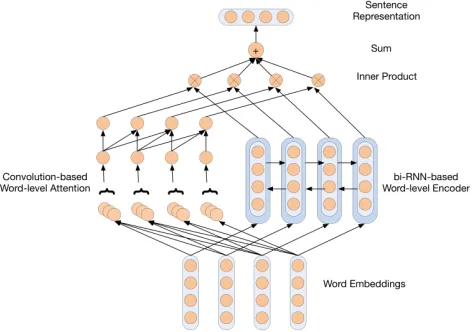
FIGURE 2. Architecture of the convolutional-recurrent attention network (CRAN).
The overall architecture of the CRAN is shown in Figure 2. It consists of two main parts: an RNN as the text encoder and a CNN as the attention extractor. We describe the details of these two parts in the following subsections.
1) RNN-BASED WORD-LEVEL ENCODER
To better model the semantic information of text, we use bidirectional LSTM [11] to derive the hidden state of each word by summarizing the information from both forward and backward directions. Forward LSTM and backward LSTM are denoted as−−−→LSTMand−−−→LSTM, whereas−−−→LSTMreads words from left to right and−−−→LSTMin reverse direction,
− →
ht = −−−→
LSTM(xt, −−→
ht−1), t∈[0,T−1] (8)
←−
ht = ←−−−
LSTM(xt, ←−−
ht+1), t∈[0,T−1] (9) We get the representation of each xt by concatenating the
forward hidden state−→ht and the backward hidden state ←−
ht,
i.e.,ht =[ − →
ht, ←−
ht]
2) CONVOLUTION-BASED WORD-LEVEL ATTENTION
As discussed in SectionIII, we use a convolution operation to model the attention signals in sentences. Suppose the text sequence is [x0,x1, . . . ,xT−1], the corresponding attention signals extracted by our model is [a0, . . . ,aT−1]. Note that the attention signals are all scalar values in the range of 0 to 1:
ct,t+l−1 =
m X
i=1
Conv(xt:t+l−1) (10)
c0t = 1
l
t X
t0=t−l+1
ct0,t0+l−1 (11)
at =
expc0t
P t0expc0
t0
(12)
[image:5.576.46.266.367.523.2]J. Duet al.: Convolution-Based Neural Attention With Applications to Sentiment Classification
Here,Convis the one-dimensional convolution operation,at
is the attention signal assigned to wordxt. 3) SENTENCE REPRESENTATION
We use the product of attention signalatand the
correspond-ing hidden state vector of RNN, ht, to represent word t in
text. The representation of the whole sequence of words is obtained by averaging the word representations:
r= 1
T
T−1
X
t=0
atht (13)
Then the representation of sentence is fed to a one-layer fully connected network by
p=softmax(Wcs+bc) (14)
wherep is the predicted probability of sentiment label,Wc
andbcare parameters of the classification layer. B. HIERARCHICAL CONVOLUTIONAL-RECURRENT ATTENTION NEURAL NETWORKS (H-CRAN)
For document-level sentiment classification, we con-struct a hierarchical classification model based on CRAN in Section IV-A. Assuming that a document has D
sentences,[s0, . . . ,sD−1], and sentencesd,d ∈ [0,D−1],
with lengthT is denoted as [x0l, . . . ,xTl]. As we showed in Equation (13) in SectionIV-A, we can use CRAN to obtain the representation with attention ad of sentenced, denoted
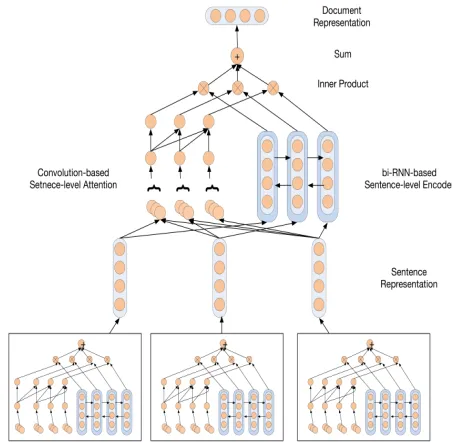
as rd. The representations [r0, . . . ,rL−1] of all sentences in a document can be computed through the same CRAN, which we called the word-level CRAN. We then apply a sentence-level CRAN to the representations of sentences to get the document-level representation vector. We call this modelHierarchical Convolutional-Recurrent Attention Neu-ral Networks (H-CRAN). The whole architecture of H-CRAN is shown in Figure3.
The sentence-level CRAN has the same structure as the word-level CRAN. The only difference is that the input to the
sentence-levelCRAN is vectors of sentences instead of words in a document. The sentence-level CRAN firstly encodes the output of the word-level CRAN by a sentence-level bidirec-tional LSTM:
−−→
hsentd =−−−→LSTM(rd, −−→
hd−1), t∈[0,D−1] (15)
←−−
hsentd =←−−−LSTM(rd, ←−−
hd+1), t∈[D−1,0] (16)
hsentd =[
−−→
hsentd ,
←−−
hsentd ] (17)
−−−→
LSTM,←−−−LSTM are the forward and backward sentence-level LSTM, respectively,
−−→
hsentd ,
←−−
hsentd are the corresponding hidden states of LSTM of both directions,hsentd as concatenation of the two hidden states is the vector representation of sentence
d in a document.
[image:6.576.302.528.64.285.2]Following the same procedure of extracting attention signals at the word-level as presented in Section IV-A.2,
FIGURE 3. Architecture of the hierarchical convolutional-recurrent attentional network (H-CRAN).
we applymconvolution filters to extract the attention signal for each sentence in a document by:
csentd,d+l−1= m X
i=1
Conv(rd:d+l−1), (18)
csentd 0 = 1
l
d X
d0=d−l+1
cd0,d0+l−1, (19)
asentd = expc
0
d P
d0expc0 d0
. (20)
Here,asentd is the sentence-level attention which shows the significant of a sentence in the whole document.
A given document can be represented as the average of products of the sentence-level RNN’s hidden states and the corresponding sentence-level attentions:
rdoc = 1
D
D−1
X
d=0
asentd hsentd , (21)
Finally, rdoc is fed to a softmax classifier to obtain the probability distributions of classes.
C. MODEL TRAINING
We use the cross-entropy between the predicted class prob-abilities and the ground-truth labels as the loss function of our model. All components can be trained end-to-end by minimizing the loss function,
L= −X
i X
j
yjilogp(yˆji|xi,zi)+λkθk2 (22)
whereiis the index of data andjis the index of class.λkθk2
is theL2-regularization term and θ is the parameter set of
our model. We use Adam algorithm [39] to train the proposed model withβ1=0.9, β2=0.95 and=1e−9. The learning rate is varied over the training procedure, which is inspired by the training strategy of Transformer [40]. The learning rate is set by
lr=min(step−12,step×prestep−
3
2) (23)
wherelr is the learning rate,stepis the number of training steps, and prestep is the number of steps in pre-training
phase (warmup training). In our experiments, we set
prestep = 1000 for sentence-level classification and
prestep=3000 for document-level classification. V. EXPERIMENTS ON SENTENCE-LEVEL SENTIMENT CLASSIFICATION
In this section, we investigate the empirical performance of our proposed CRAN on various sentence-level sentiment classification datasets and compare it with the state-of-the-art models for sentiment classification.
A. DATASETS
We choose four sentence-level sentiment classification datasets to evaluate our proposed model.
• MR: Binary sentiment classification dataset including 10,662 movie reviews. [41].
• SST-1: 5-classes sentence-level sentiment dataset
of 11,855 sentences [42].
• SST-2: Simplified version of SST-1, with neural classes removed and only containing binary labels (positive and negative), the size is 9,613.
• Subj: Subjectivity dataset of 10,000 user-generated reviews with binary categories [43].
Each of the datasets contains about 10k sentences. We con-duct experiments on the standard test sets on SST dataset. For the remaining datasets without standard train/test split, we use 10-fold cross validation.
B. MODEL TRAINING AND HYPER-PARAMETERS
Inspired by the pre-train strategy proposed in [44], we use two different initialization methods for convolutional attention layer:
• CRANrand: The weights are initialized by a uniform distribution in the range of (−0.01,0.01).
• CRANpretrain: We first pre-trained a one-dimensional CNN classifier with filter-axis pooling proposed inIII to obtain the initial weight of the attention layer. The weights of pre-trained CNN are set as initial values of the convolutional attentional layer in CRAN.
In all experiments, the word embeddings are initialized by the 300-dimensional word2vec vectors trained on the Google News data [8]. The number of hidden state of LSTM and convolutional filters is set to 150, the width of convolu-tion filter is set to 3, dropout rate during training is 0.3. All hyper-parameters are tuned to obtain the best performance
based on 5-fold cross validation on the training set for each dataset.
C. BASELINES
We use several state-of-the-art models as baselines for com-paring with our proposed model:
• NBOW: Text classifier which sums the word vectors within a sentence and applies a softmax classifier. • CNN[12]: One-dimensional CNN with max pooling,
the filter size is 3,4 and 5.
• LSTM[29]: The last hidden state of LSTM is fed to a linear sentiment classifier with softmax function.
• LSTM+attention[23]: The attention-based LSTM
model proposed by[23]. Since datasets used in our experiments are for sentence-level classification, we implement a flatten variant of this model without aggregating the attention signals from sentences to form the document-level attention signal.
• Tree-LSTM[45]: Tree-Structured LSTM networks for
sentence classification.
• Multi-Task[46]: Shared-layer multi-task learning
model trained on SST-1, SST-2 and Subj datasets.
• Sent-Type CNN[47]: Sentence-level sentiment
classi-fier which leverages several distinct CNN classiclassi-fiers according to the sentence types.
D. RESULTS AND ANALYSIS
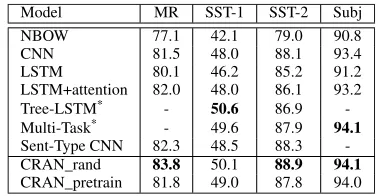
[image:7.576.322.511.528.626.2]The experimental results for sentence-level sentiment clas-sification are listed in Table1. When comparing the perfor-mance of the two variants of our model, it is observed that CRANrand performs better than CRANpretrain. One possible reason is that the weights of the convolutional attention layer of CRANpretrainare firstly trained by using different network architecture. The initial weights obtained by pre-training may lead to incompatible results during the fine-tuning phase.
TABLE 1.Results of our proposed CRAN against baselines. Results marked * are models that need external tools or resources.
Compared with other state-of-the-art models in sentiment classification, CRAN gives the best performance on three out of four datasets. The convolution-based attention extractor of CRAN is similar to the traditional CNN. However, CRAN combines the merits of RNN and CNN to better model sen-tences. Experimental results show that CRAN improves upon the traditional CNN by 1% and outperforms LSTM by 3% on average. CRAN also gives superior results than LSTM
J. Duet al.: Convolution-Based Neural Attention With Applications to Sentiment Classification
with attention. This shows that our proposed attention mod-elling method can capture the class-relevant information from text more accurately. Tree-LSTM outperforms our model on SST-1 by 0.4%. However, it needs an external parser to derive the tree-structure of each sentence, and the results listed in Table1is obtained on the exact parsing results of sentences labelled by annotators. It is worth noting that our models are comparable with RNN with multi-task learning [46]. This model is an extremely strong baseline which was trained jointly on four datasets.
VI. EXPERIMENTS ON DOCUMENT-LEVEL SENTIMENT CLASSIFICATION
To validate the efficiency of our proposed Hierarchi-cal Convolutional-Recurrent Neural Network (H-CRAN), we conduct experiments on large-scale document-level datasets.
A. DATASETS
For document-level experiments, we use four most com-monly used datasets. Yelp 2013/2014/2015 are restau-rant reviews labeled with 5-star ratings used in the Yelp Challenges [48]. IMDB is a dataset of movie review in which documents are manually labeled with 10-class ratings [49]1.
B. MODEL TRAINING AND HYPER-PARAMETERS
According to the results reported in Section V-D, CRAN_rand outperforms CRAN_pretrain. Therefore, CRAN_rand is used for both word-level and sentence-level models in H-CRAN. Parameters used in document-level experiments are set as follows. The number of hidden units of word-level LSTM and convolution filters is 300, the length of convolution filter is 3, the number of hidden units of sentence-level LSTM and convolution filters is 150, the dropout rate is 0.3 and mini-batch size is 128.
C. BASELINES
We compare H-CRAN with the following baselines:
• NBOW: The NBOW sums the word vectors within the document and applies a softmax classifier.
• Paragraph Vector[50]: Paragraph Vector used for
sen-timent classification.
• CNN[12]: Convolutional neural networks with max pooling applied to the whole document.
• Conv-GRNN[16]: Hierarchical document
classifica-tion model which composes a CNN-based word encoder and a GRU-base sentence encoder.
• LSTM-GRNN[16]: Same as Conv-GRNN but with
LSTM as the word encoder.
• HAN[23]: Hierarchical Attention Networks (HAN) for document classification which uses a fully-connect neu-ral network as an attention extractor.
1The size of Yelp data sets are seperately 211,245, 476,191, 612,636,
the size of IMDB is 115,831
• Text Concept Vector[28]: Neural network that
[image:8.576.296.538.144.228.2]Leverages word embeddings combined with concepts extracted from a knowledge base.
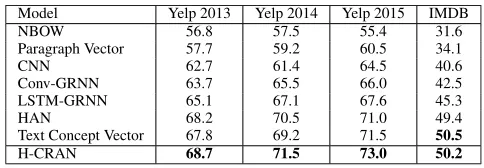
TABLE 2.Classification accuracy of our proposed CRAN against baselines.
D. RESULTS AND ANALYSIS
The experimental results of document classification are shown in Table 2. Firstly, we observe that NBOW, Para-graph Vector and CNN perform badly on document-level sentiment classification. The reason is that these models treat the whole document as a long sequence of words and ignore the latent semantic structures of documents. By lever-aging the semantic structures of document, Conv-GRNN and LSTM-GRNN use stacked word-level and sentence-level encoders to model the whole document. HAN and our model H-CRAN use a similar hierarchical architecture as that in LSTM-GRNN and Conv-GRNN, but with an addi-tional attention mechanism to extract salient words in sen-tences and salient sensen-tences in the document. As we can see in Table2, introducing attention extractor greatly improves the classification accuracy by more than 3.5%. Furthermore, when compared the previously proposed attention-base doc-ument model HAN with our model H-CRAN, we observe an improvement of 1.5% on average. The improvement is more prominent on Yelp 2015 in which H-CRAN outperforms HAN by 2%.
E. IMPACT OF DOCUMENT LENGTH
To investigate the difference in performance of convolution-based attention over documents with different number of sentences, we compare the performance of our model and HAN [23]. Figure4shows the classification results of both models on the four datasets. It is observed that both models achieve high accuracies on documents with moderate lengths, but perform relatively worse on documents which are too long or too short. The reason is that documents with fewer sentences usually contain less meaningful information and too long documents contain more redundant words and hence tend to be more noisy. Comparing our model with HAN, we observe that both models perform comparably on doc-uments with a smaller number of sentences (less than 20). However, it is interesting to observe that, when the number of sentences in a document exceeds 20, our model out-performs HAN significantly. The reason is that the convo-lution operation used as attention extractor in our model
FIGURE 4. Classification accuracy of our proposed model and HAN on four document-level sentiment classification datasets. (a) Yelp-2013. (b) Yelp-2014. (c) Yelp-2015. (d) IMDB.
[image:9.576.300.536.128.309.2]has a wider receptive fieldon the text sequence. Therefore convolution-based attention model performs better on longer text sequences which potentially contain more long-term dependencies.
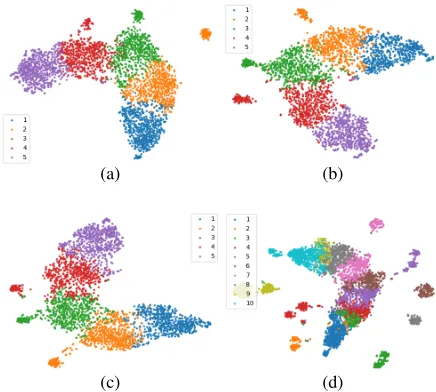
FIGURE 5. Visualization of document representations learned by our model on four document-level sentiment classification datasets. (a) Yelp-2013. (b) Yelp-2014. (c) Yelp-2015. (d) IMDB.
F. VISUALIZATION OF DOCUMENT REPRESENTATIONS To visualize the representations of documents learned by our proposed model, we extract the intermediate vector representations, feed them to the final classifier and apply t-SNE [51] to project the high-dimensional representations to the two-dimensional space. The t-SNE vectors of doc-ument representations are shown in Figure 5. Each point in the figure represents a document and different color of points indicates the ground-truth sentiment class of a docu-ment. It is observed that the learned document representations
[image:9.576.46.264.357.553.2]of different sentiment classes are well-separated in the two-dimensional space. We can thus conclude that our model is able to capture the sentiment information inherent in the documents effectively.
FIGURE 6. Visualization of attention signals derived from an example review in the Yelp 2015 dataset.
G. CASE STUDY AND ERROR ANALYSIS
In order to show that our attention-base model H-CRAN can better extract both sentence-level and word-level attention signals, we visualize the attention values of H-CRAN and the Hierarchical Attention Network (HAN) [23] in Figure 6. The heatmap on the left shows the sentence-level attention signals which indicate the contribution of each sentence towards the overall document-level sentiment classification and words in blue show the salient parts in each sentence. We select a document from the Yelp 2015 which expresses very negative sentiment towards a restaurant. In this example, the first two sentences express appreciation to the service. But the word ‘However’ in Sentence 3 indicates a change in attitude and the remaining sentences express more negative sentiment. To correctly predict the sentiment of this review, the model needs to recognise sentiment transition signified by the word ‘However’ in Sentence 3, and focus on the second parts of this document. The sentence attention signal extracted by HAN showed that HAN failed to identify the sentiment tran-sition and outputs the wrong sentiment label. On the contrary, H-CRAN captures the sentiment transition of this document successfully by assigning a high attention value to Sentence 3, which is crucial for document-level sentiment classification. For the word-level attention, we found that both H-CRAN and HAN are able to capture words expressing strong sentiment in text with some difference. HAN tends to capture salient words in isolation in sentences, but our model is capable of finding more multi-word expressions, such assuch a bad deal and
very disappointed. The results of visualization show that our proposed convolutional attention can capture broader context in documents compared to traditional attention models, which
J. Duet al.: Convolution-Based Neural Attention With Applications to Sentiment Classification
partly explain the better performance of H-CRAN over HAN in document classification.
VII. CONCLUSION
In this paper, we have shown that the convolution operation is a feasible and effective mechanism for extracting attentions from text sequences. Based on this finding, we have proposed a novel attention extraction model based on the convolution operation. Utilizing this convolution-based attention model, we have introduced a new neural network architecture which combines RNN with our attention model, and further pro-posed a hierarchical variant for document-level sentiment classification. We have conducted extensive experiments on both sentence-level and document-level datasets and observe from the experimental results that: (1) our model is capable of extracting salient parts from sentences and documents; (2) our model can combine the merits of CNN and RNN to improve the sentiment classification performance; (3) the visualization of attentions extracted by the model shows its impressive capability to capture sentiment transitions in discourses. In future works, we will extend the proposed convolution-based attention model to other tasks such as text generation and sequence to sequence learning.
REFERENCES
[1] B. Pang, L. Lee, and S. Vaithyanathan, ‘‘Thumbs up?: Sentiment classifica-tion using machine learning techniques,’’ inProc. Conf. Empirical Methods Natural Lang. Process., vol. 10, 2002, pp. 79–86.
[2] B. Liu, ‘‘Sentiment analysis and opinion mining,’’Synth. Lect. Hum. Lang. Technol., vol. 5, no. 1, pp. 1–167, 2012.
[3] E. Cambria, S. Poria, A. Gelbukh, and M. Thelwall, ‘‘Sentiment anal-ysis is a big suitcase,’’IEEE Intell. Syst., vol. 32, no. 6, pp. 74–80, Nov./Dec. 2017.
[4] S. Wang and C. D. Manning, ‘‘Baselines and bigrams: Simple, good sentiment and topic classification,’’ inProc. 50th Annu. Meeting Assoc. Comput. Linguistics, vol. 2, 2012, pp. 90–94.
[5] S. Zelikovitz and H. Hirsh, ‘‘Using LSI for text classification in the presence of background text,’’ inProc. 10th Int. Conf. Inf. Knowl. Manage., 2001, pp. 113–118.
[6] T. Nakagawa, K. Inui, and S. Kurohashi, ‘‘Dependency tree-based sentiment classification using CRFs with hidden variables,’’ in Proc. Annu. Conf. North Amer. Chapter Assoc. Comput. Linguistics, 2010, pp. 786–794.
[7] Y. Bengio, R. Ducharme, P. Vincent, and C. Jauvin, ‘‘A neural probabilistic language model,’’J. Mach. Learn. Res., vol. 3, pp. 1137–1155, Feb. 2003. [8] T. Mikolov, K. Chen, G. Corrado, and J. Dean. (2013). ‘‘Efficient esti-mation of word representations in vector space.’’ [Online]. Available: https://arxiv.org/abs/1301.3781
[9] A. Joulin, E. Grave, P. Bojanowski, and T. Mikolov, ‘‘Bag of tricks for efficient text classification,’’ inProc. 15th Conf. Eur. Chapter Assoc. Comput. Linguistics, vol. 2, 2017, pp. 427–431.
[10] Y. LeCun, L. Bottou, Y. Bengio, and P. Haffner, ‘‘Gradient-based learn-ing applied to document recognition,’’ Proc. IEEE, vol. 86, no. 11, pp. 2278–2324, Nov. 1998.
[11] S. Hochreiter and J. Schmidhuber, ‘‘Long short-term memory,’’Neural Comput., vol. 9, no. 8, pp. 1735–1780, 1997.
[12] Y. Kim, ‘‘Convolutional neural networks for sentence classification,’’ in
Proc. Conf. Empirical Methods Natural Lang. Process. (EMNLP), 2014, pp. 1746–1751.
[13] N. Kalchbrenner, E. Grefenstette, and P. Blunsom, ‘‘A convolutional neural network for modelling sentences,’’ inProc. 52nd Annu. Meeting Assoc. Comput. Linguistics, vol. 1, 2014, pp. 655–665.
[14] B. Hu, Z. Lu, H. Li, and Q. Chen, ‘‘Convolutional neural network architec-tures for matching natural language sentences,’’ inProc. Adv. Neural Inf. Process. Syst., 2014, pp. 2042–2050.
[15] S. Semeniuta, A. Severyn, and E. Barth, ‘‘A hybrid convolutional varia-tional autoencoder for text generation,’’ inProc. Conf. Empirical Methods Natural Lang. Process., 2017, pp. 627–637.
[16] D. Tang, B. Qin, and T. Liu, ‘‘Document modeling with gated recurrent neural network for sentiment classification,’’ inProc. Conf. Empirical Methods Natural Lang. Process., 2015, pp. 1422–1432.
[17] V. Mnih, N. Heess, A. Graves, and K. Kavukcuoglu, ‘‘Recurrent mod-els of visual attention,’’ inProc. Adv. Neural Inf. Process. Syst., 2014, pp. 2204–2212.
[18] K. Xuet al., ‘‘Show, attend and tell: Neural image caption generation with visual attention,’’ inProc. 32nd Int. Conf. Mach. Learn., 2015, pp. 2048–2057.
[19] D. Bahdanau, K. Cho, and Y. Bengio. (2014). ‘‘Neural machine trans-lation by jointly learning to align and translate.’’ [Online]. Available: https://arxiv.org/abs/1409.0473
[20] T. Luong, H. Pham, and C. D. Manning, ‘‘Effective approaches to attention-based neural machine translation,’’ in Proc. Conf. Empirical Methods Natural Lang. Process., 2015, pp. 1412–1421.
[21] Y. Cui, Z. Chen, S. Wei, S. Wang, T. Liu, and G. Hu, ‘‘Attention-over-attention neural networks for reading comprehension,’’ inProc. 55th Annu. Meeting Assoc. Comput. Linguistics, vol. 1, 2017, pp. 593–602. [22] B. Dhingra, H. Liu, Z. Yang, W. Cohen, and R. Salakhutdinov,
‘‘Gated-attention readers for text comprehension,’’ inProc. 55th Annu. Meeting Assoc. Comput. Linguistics, vol. 1, 2017, pp. 1832–1846.
[23] Z. Yang, D. Yang, C. Dyer, X. He, A. Smola, and E. Hovy, ‘‘Hierarchical attention networks for document classification,’’ inProc. Conf. North Amer. Chapter Assoc. Comput. Linguistics, Hum. Lang. Technol., 2016, pp. 1480–1489.
[24] D. Bespalov, B. Bai, Y. Qi, and A. Shokoufandeh, ‘‘Sentiment classifica-tion based on supervised latent n-gram analysis,’’ inProc. 20th ACM Int. Conf. Inf. Knowl. Manage., 2011, pp. 375–382.
[25] C. Lin and Y. He, ‘‘Joint sentiment/topic model for sentiment analysis,’’ in
Proc. 18th ACM Conf. Inf. Knowl. Manage., 2009, pp. 375–384. [26] Y. Dang, Y. Zhang, and H. Chen, ‘‘A lexicon-enhanced method for
sen-timent classification: An experiment on online product reviews,’’IEEE Intell. Syst., vol. 25, no. 4, pp. 46–53, Jul./Aug. 2010.
[27] S. Poria, E. Cambria, G. Winterstein, and G.-B. Huang, ‘‘Sentic patterns: Dependency-based rules for concept-level sentiment analysis,’’ Knowl.-Based Syst., vol. 69, pp. 45–63, Oct. 2014.
[28] Y. Liet al., ‘‘Incorporating knowledge into neural network for text repre-sentation,’’Expert Syst. Appl., vol. 96, pp. 103–114, Apr. 2018. [29] A. Graves. (2013). ‘‘Generating sequences with recurrent neural
net-works.’’ [Online]. Available: https://arxiv.org/abs/1308.0850
[30] A. M. Rush, S. Chopra, and J. Weston. (2015). ‘‘A neural attention model for abstractive sentence summarization.’’ [Online]. Available: https://arxiv.org/abs/1509.00685
[31] R. J. Williams, ‘‘Simple statistical gradient-following algorithms for connectionist reinforcement learning,’’Mach. Learn., vol. 8, nos. 3–4, pp. 229–256, 1992.
[32] M. Hu, Y. Peng, Z. Huang, X. Qiu, F. Wei, and M. Zhou. (2017). ‘‘Rein-forced mnemonic reader for machine reading comprehension.’’ [Online]. Available: https://arxiv.org/abs/1705.02798
[33] J. Cheng, S. Zhao, J. Zhang, I. King, X. Zhang, and H. Wang, ‘‘Aspect-level sentiment classification with heat (hierarchical attention) network,’’ inProc. ACM Conf. Inf. Knowl. Manage., Nov. 2017, pp. 97–106. [34] X. You, Q. Li, D. Tao, W. Ou, and M. Gong, ‘‘Local metric learning
for exemplar-based object detection,’’IEEE Trans. Circuits Syst. Video Technol., vol. 24, no. 8, pp. 1265–1276, Aug. 2014.
[35] Z. Zhuet al., ‘‘An adaptive hybrid pattern for noise-robust texture analy-sis,’’Pattern Recognit., vol. 48, no. 8, pp. 2592–2608, 2015.
[36] J. Duncan and G. W. Humphreys, ‘‘Visual search and stimulus similarity,’’
Psychol. Rev., vol. 96, no. 3, p. 433, 1989.
[37] G. McKoon and R. Ratcliff, ‘‘Inference during reading,’’Psychol. Rev., vol. 99, no. 3, p. 440, 1992.
[38] M. J. Green and D. C. Mitchell, ‘‘Absence of real evidence against com-petition during syntactic ambiguity resolution,’’J. Memory Lang., vol. 55, no. 1, pp. 1–17, 2006.
[39] D. P. Kingma and J. Ba. (2014). ‘‘Adam: A method for stochastic optimiza-tion.’’ [Online]. Available: https://arxiv.org/abs/1412.6980
[40] A. Vaswaniet al., ‘‘Attention is all you need,’’ inProc. Adv. Neural Inf. Process. Syst., 2017, pp. 5998–6008.
[41] B. Pang and L. Lee, ‘‘Seeing stars: Exploiting class relationships for sentiment categorization with respect to rating scales,’’ inProc. 43rd Annu. Meeting Assoc. Comput. Linguistics, 2005, pp. 115–124.
[42] R. Socheret al., ‘‘Recursive deep models for semantic compositionality over a sentiment treebank,’’ inProc. Conf. Empirical Methods Natural Lang. Process., 2013, pp. 1631–1642.
[43] B. Pang and L. Lee, ‘‘A sentimental education: Sentiment analysis using subjectivity summarization based on minimum cuts,’’ inProc. 42nd Annu. Meeting Assoc. Comput. Linguistics, 2004, p. 271.
[44] A. M. Dai and Q. V. Le, ‘‘Semi-supervised sequence learning,’’ inProc. Adv. Neural Inf. Process. Syst., 2015, pp. 3079–3087.
[45] K. S. Tai, R. Socher, and C. D. Manning, ‘‘Improved semantic represen-tations from tree-structured long short-term memory networks,’’ inProc. 53rd Annu. Meeting Assoc. Comput. Linguistics, 2015, pp. 1556–1566. [46] P. Liu, X. Qiu, and X. Huang, ‘‘Recurrent neural network for text
classifi-cation with multi-task learning,’’ inProc. 25th Int. Joint Conf. Artif. Intell., 2016, pp. 2873–2879.
[47] T. Chen, R. Xu, Y. He, and X. Wang, ‘‘Improving sentiment analysis via sentence type classification using BiLSTM-CRF and CNN,’’Expert Syst. Appl., vol. 72, pp. 221–230, Apr. 2017.
[48] Y. Zhang, H. Zhang, M. Zhang, Y. Liu, and S. Ma, ‘‘Do users rate or review?: Boost phrase-level sentiment labeling with review-level sentiment classification,’’ inProc. 37th Int. ACM SIGIR Conf. Res. Develop. Inf. Retr., 2014, pp. 1027–1030.
[49] Q. Diao, M. Qiu, C.-Y. Wu, A. J. Smola, J. Jiang, and C. Wang, ‘‘Jointly modeling aspects, ratings and sentiments for movie recommendation (JMARS),’’ inProc. 20th ACM SIGKDD Int. Conf. Knowl. Discovery Data Mining, 2014, pp. 193–202.
[50] Q. Le and T. Mikolov, ‘‘Distributed representations of sentences and documents,’’ inProc. 31st Int. Conf. Int. Conf. Mach. Learn., 2014, pp. 1188–1196.
[51] L. van der Maaten and G. Hinton, ‘‘Visualizing data using t-SNE,’’J. Mach. Learn. Res., vol. 9, pp. 2579–2605, Nov. 2008.
JIACHEN DU is currently pursuing the Ph.D. degree with the School of Computer Science and Technology, Harbin Institute of Technology, Shen-zhen, China. His research interests include sen-timent analysis, dialogue generation, and deep learning.
LIN GUI received the Ph.D. degree from the Harbin Institute of Technology, Shenzhen, China. He is a Marie Sklodowska-Curie Individual Fellow with the University of Warwick, U.K. His research interests include machine learning, natural lan-guage processing, and sentiment analysis.
YULAN HEreceived the Ph.D. degree in spoken language understanding from the University of Cambridge, U.K. She is currently a Professor of computer science with the University of Warwick, U.K. She has published over 150 papers in the areas of text and data mining, sentiment analysis and opinion mining, social media analysis, rec-ommender systems, learning analytics, and spoken dialogue systems.
RUIFENG XUreceived the Ph.D. degree in com-puter science from The Hong Kong Polytech-nic University. He is currently a Professor with the School of Computer Science and Technology, Harbin Institute of Technology, Shenzhen, China. He has published more than 100 papers in natu-ral language processing, sentiment analysis, and social media analysis.
XUAN WANGreceived the Ph.D. degree in com-puter science from the Harbin Institute of Tech-nology, Shenzhen, China, where he is currently a Professor with the School of Computer Science and Technology. His research interests include cybernetic security, natural language processing, and artificial intelligence.