Page 1 of 55
ACKNOWLEDGEMENTS
This practitioner-focussed report is based on research on Greenfields1 Cohousing group in the UK. The report has been
shared with the group and developed with them. Many thanks are owed to individual members of the group that took part in the research, and to the group collectively for allowing access to their documents and meetings and being involved in the production of the research. The research was funded by an Early Career Grant from Lancaster University Management School. Responsibility for the report, of course, lies with the authors. All photographs are the property of Greenfields Cohousing.
This work is licensed under a Creative Commons Attribution-ShareAlike 4.0 International License.
Page 2 of 55
CONTENTSContents
... 2
Summary and key suggestions
... 23
1. Introduction and background
... 10
The role of values in intentional social transformation ... 10
Cohousing ... 11
Greenfields Cohousing – a brief history ... 11
2. Methodology
... 14
Theories, concepts and assumptions informing the research questions ... 14
Specification of research questions ... 16
Selection of issues relevant to the research questions ... 17
Modes of data collection to investigate the issues ... 17
Modes of data analysis and representation ... 18
Strengths and limitations of the methodology and methods employed ... 19
3. Selected key social methods and their effects in relation to the five researched issues
... 20
The financial resources issue ... 20
The human capacities issue ... 21
The build organization in contrast to group relationships ... 24
The common meals issue ... 26
The conduct of group relationships issue ... 28
Diagnosis of the role of values in the co-ordination of intentional self-transformation ... 30
4. Conclusion - general implications for groups interested in intentional self-transformation
.. 36
Implications for navigating and negotiating tensions in types of intentionally self-transformational action……….36
Instrumental implications ... 39
Conclusion ... 45
5. References
... 47
Appendices
... 48
APPENDIX A: an overview of cohousing ... 48
APPENDIX B: initial project outline ... 50
APPENDIX C: the research project’s assessment framework for Greenfields Cohousing ... 52
Page 3 of 55
SUMMARY AND KEY SUGGESTIONS
There are two primary purposes to this practitioner-focussed report.
Firstly, the report focuses on reporting the key findings from a research project focussed on exploring and understanding the inter-relation and conflict between action that is based on ends, and action that is based on calculated means2 (Weber 1978) during the
development of Greenfields Cohousing. In other words, the research looked at what Greenfields Cohousing did in the light of what its aspirations were/are. The data were collected from September 2011 to October 2013.
Secondly, in order to support and help the development of other cohousing and social action groups, the report focuses on drawing out the implications of these findings. The implications point out fundamental issues to be aware of, to minimise, or to avoid, and can be adapted for different needs. The report’s implications are not intended to tell activists or practitioners precisely what to do, nor are they meant to dampen their creativity – there are multiple ways of achieving shared goals, transforming social practices, pursuing social action, or of developing community or solidarity.
Neither does the report attempt to provide comprehensive guidance on the development of cohousing groups (some relevant publications are listed in the references); rather it gives general guidance on how groups involved in intentional self-transformation might negotiate the tensions between making their values real, between different values, and living by those values.
Background:
A group slowly formed from 2004 around some aspirations for collective and ecologically sustainable living, and with a shared disenchantment with atomised and ecologically unsustainable living. The group had a range of experiences of collective living and ecological knowledge and came together with a range of social, cultural, human, and economic resources. The group managed to organize themselves and take advantage of external opportunities, as well
2 Value-rational action is determined by a conscious belief in the value for its own sake of some form of behaviour. Instrumentally-rational action is determined by expectations
as deal with a number of external requirements and constraints. They managed to bring about an evolved idea of a co-located community, with 41 residential units that were almost all sold by October 2013, as well as a range of communal facilities and a neighbouring commercial unit.
The group experienced successive periods that were aimed at successive necessary tasks, and throughout there were inflows and outflows of members. Inflows were generally due to the value aspirations of joiners, previous experiences of cohousing, positive interactional experience with the group, and a valuing of the pragmatic organization and progress of the group. Outflows were generally owing to either external causes (e.g., job relocations), or to levels of disaffection with the group. Approximately 30 households left over the eight years without signing a contract to lease/buy; and approximately five households did not complete on their agreement to lease/buy.
The key findings in relation to Greenfields Cohousing were:
Findings on means - finance:
- Generating the financial capacity of the group for the property development was significantly achieved via an external loan from a financial institution that paid for the development and which was then repaid via sales of the residential units to the members.
- Managing the financial budget entailed a finance director role and processes to make financial decisions in the light of the espoused values of the group (values that are explicitly expressed and chosen as principles).
- While broadly effective, these methods also led to some negative effects: some consciously accepted as the result of practical compromises, some unintended or unforeseen (see the main report).
Page 4 of 55
Findings on means – human capacities:- The group managed at least three human capacities of the group to varying degrees and in different ways – the project executive capacity; the group executive and governance capacity; and the relationship maintenance capacity (these are the authors’ terms, not terms used by the group).
- A range of co-ordinating methods were used in relation to each of these human capacities. Together, they involved the recruitment of members to the group, the induction of members into the executive capacities of the group, developing the coordination within and between the executive groups, and between the executive groups and the wider group. - While the group was successful in rotating
roles and in increasing the number and range of members actively involved in these human capacities, there were also instances of member burnout and exit, personal stress and interpersonal conflict that were at least partly related to the amount, co-ordination and distribution of work effort.
Findings on the tension between the building of the group’s physical infrastructure (the land and property development) and organizing the group as a neighbourly community:
- A significant tension recognised by the group was between the interim goal of the building of the group infrastructure and the end-goal of a neighbourly community. A number of members felt that the interim goal of the building of the property development overshadowed the end-goal of the community. - The group conceived of this tension in different ways, and three overlapping methods were used to help address this tension:
o a) Member involvement in an iterative design process, with account taken of the group’s espoused values;
o b) The attempt to structure inclusive and constructive dialogue within and across the group; and
o c) The generation and development of a process group to help with this tension. - The impacts of these methods included both
positive impacts and also negative impacts – sometimes owing to the method, or sometimes owing to the method not addressing the issue fully (often owing to the limited capacity to implement the method, or the multiple dimensions of the issue).
Findings on the conduct of group relationships:
- There were at least three organizing principles at work in the group:
a) An executive group to achieve the construction of the physical infrastructure and execute the group governance;
b) Ultimate formal authority was accorded to full group meetings (general meetings) that were run according to consensus decision-making principles; and
c) The group encouraged autonomous action by sub-groups.
- These principles were overlain with external legal structures of
1) A limited liability company status, which resulted in the formal role of Directors; and
2) A residents’ association status, imposed as a condition of the group’s planning permission.
- The group had documents of different governance status, and different values were variously explicit or implicit in these different documents, resulting in a degree of ambiguity around the governance of the group.
Page 5 of 55
- These different organizing principles anddifferent intra-group and group-member relationships contributed to a number of governance and group relationship tensions and conflicts.
- The most significant methods in relation to the conduct of group relationships were probably: 1) The set of methods by which the members came to decisions through discussion;
2) The evolution of the governance relations and relationships of the group; and
3) An underlying feature across these methods was a disposition to reflect on the aims, means, progress and capacity of the group, and this appeared to mediate and co-ordinate between the interpersonal and value tensions. - The set of meeting methods was observed and
generally considered broadly effective. While they did not fully preclude personalised conflict, they made it less likely, and enabled some such conflicts to be addressed constructively.
- The evolution of the governance structures was not a top-down process. It involved variable direction and input from different component sub-groups within the broad group. In terms of overall impact of the evolutions in governance, it appeared as if the group largely assented to the legitimacy of the evolved governance structure.
Page 6 of 55
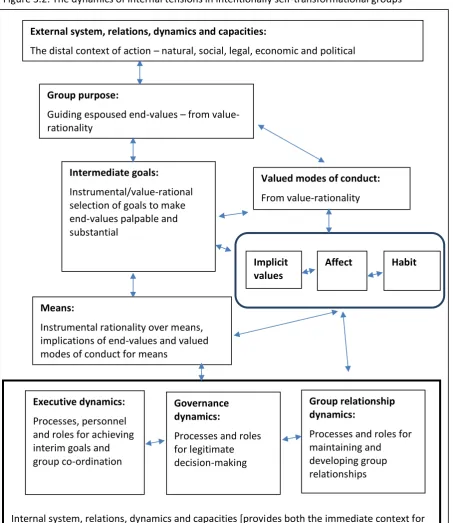
Figure 3.2: The dynamics of internal tensions in intentionally self-transformational groups
Internal system, relations, dynamics and capacities [provides both the immediate context for action on the object; and the tools through which it is made sense of and manipulated]: financial capacities; human capacities; concepts; discourses; procedures/rules/norms; division of labour; routinized practices; group-member relations; member-member relations
Group purpose:
Guiding espoused end-values – from value-rationality
Executive dynamics:
Processes, personnel and roles for achieving interim goals and group co-ordination
Governance dynamics:
Processes and roles for legitimate decision-making
Group relationship dynamics:
Processes and roles for maintaining and developing group relationships
External system, relations, dynamics and capacities:
The distal context of action – natural, social, legal, economic and political – also a potential source of tools, conceptual or material
Intermediate goals:
Instrumental/value-rational selection of goals to make end-values palpable and substantial
Means:
Instrumental rationality over means, implications of end-values and valued modes of conduct for means
Habit Affect
Implicit values External system, relations, dynamics and capacities:
The distal context of action – natural, social, legal, economic and political
Page 7 of 55
The key sources of tensions that appear to occur inself-transformation groups are within and between: - The different modes of action – whether they
are motivated by instrumental rationality, end-values, valued modes of conduct or emotion or habit
- The interactions between these modes of action, the object being manipulated, the intermediate goals and the outcomes of action
- The internal relations and capacities of the group
- The external relations and capacities in the environment of the group
The key implications of these findings are summarised below and are developed in more detail in the Conclusions section of the report
Implications for navigating and negotiating tensions between differing motivations for action
Issue
Potential tension between espoused end-values, intermediate
aims, means, implicit values, and governance structure and
practices
Why it matters
Intermediate aims are necessary in order to move towards
realising the espoused end-values, but can end up being
substituted for the end-values, or they can come into tension
with implicit values
Potential ways of addressing
Have an engaging, holistic and robust statement of end-values (a ‘purpose’ or ‘vision’)
Consider end-values, practicality and affect in making instrumental decisions
Discuss, agree and articulate intermediate aims and plans for achieving them, with a set
future-point for evaluating whether they help realise the end-values
Have informal and formal discussion methods to help identify and articulate tensions
Ensure that governance structure aligns with both the espoused end-values and the
valued modes of conduct, as well as enabling action
Issue
Potential tensions between roles, different informal and
formal status of members, and between the group and
members
Why it matters
Perceived and actual differences in status can easily lead to
interpersonal conflict and to division or exit
Potential ways of addressing
Circulate and rotate roles between people
Minimise the number and extent of formal status differences between members
Minimise the number and extent of informal status differences between members
Page 8 of 55
Instrumental implicationsInstrumental aim
Develop the foresight of the group
Why it matters
Developing the foresight of the group – particularly
in relation to necessary upcoming decisions,
potential issues, or potential resources and
constraints, may help groups with time-specific
constraints (especially financial ones) to prepare for
these decisions in advance and thereby forestall or
minimise tension.
Potential means
Iterative group discussion, reflection and investigation
Communicating with other similar and established groups
Investigating the external environment with regards to resources and external decision
processes
Instrumental aim
Develop human capacities: executive capacities; governance
and group executive capacities; and relationship development
and maintenance capacities
Why it matters
The human capacities of any group are what enables
sustained action
Potential means
Self-division and allocation of reciprocal roles and responsibilities in dialogue with other
parts of the group
Circulate and rotate roles
Develop agreed practical and robust methods of concerted action
Develop methods for transparently sharing progress and difficulties
Require a minimum of effort as a condition of membership, but accommodate
differences in forms of effort and capacity
Page 9 of 55
Instrumental aim
Develop and manage financial capacities
Why it matters
While human capacities are required for concerted action,
financial resources are necessary for many enabling and
required activities and resources to enable that concerted
action.
Potential means
Self-generate a pool of financial resources
Fund-raising
Enable human capacities to substitute for financial resources
Use some financial resources to pay for human capacities
Raise loan finance
Page 10 of 55
Page 11 of 55
1. INTRODUCTION AND
BACKGROUND
The role of values in intentional social
transformation
An abiding interest of humans is how best to live together and what the good life might actually be like. Images and ideas of what the good life might be are used by social action groups, such as cohousing groups, to try to change the way that they (and/or others) live. That is, social action groups do not simply contemplate what the good or right way to live might be, they also try to change the way that they live in order to match up to their images, ideas or ideals.
Intentional social change, of course, is not limited to groups that seek to establish a new way of life. In any society or group, people, to various degrees, seek to modify or change their (or others’) behaviour in order to live the way that they think is desirable or right. ‘Social engineering’ of different sorts and to different degrees is a feature of all groups and societies (even ‘traditional’ communities that try to preserve their ‘traditions’).
What makes the previous social action groups different to this ubiquitous process of intentional social change is that social action groups do not merely seek to change or amend society, they seek to bring a new type of society, community or group into being through transforming themselves. Two common features appear to differentiate what we can characterise as ‘intentional self-transformation’ from the ubiquitous dynamics of intentional ‘social change or reform’. Intentional self-transformation tends to involve: (1) The use of ideas, values, ideals or beliefs as an overarching formula for their vision of, or guide to, the good life3; and (2) The pursuance of these
3 Kanter (1972) argues from her research that intentional communities require a relatively strong and stable
ideological basis if they are to survive over time. Sargisson and Sargent (2004) and Coates (2006), however, argue that this is potentially a myth, and that there is no reason to presume that intentional communities require a strongly shared set of beliefs or values. Following this line of
ideas or beliefs entails the establishment of a degree (at least) of self-control and self-determination, separate to, or shielded from, other social forces. Given the importance of intended social transformation in human history, we decided to look at the role of values in co-ordinating social action in a developing cohousing group. Cohousing is a relatively new form of living that tries to change social relationships, based on a view of how people can live together more enjoyably and meaningfully. It also involves resident management. As such, it afforded us an opportunity to look at a particular instance of a group that had a formal ‘vision document’ that encapsulated some ideals and values that it was seeking to use to inform their living practices, and was also attempting to do so by using an egalitarian form of decision-making in exercising its self-determination. That is, the cohousing group was a case that had both of the key elements of intentional self-transformation – the use of a set of values to inform the bringing about of an alternative new way of living, and a self-conscious attempt to exercise self-determination by the group.
thought, it is conceivable that intentional communities may persist over time with weakly shared beliefs or,
Page 12 of 55
The aim of this report, in short, is to give more detailabout:
1) The inter-relation and conflict between value rationality (a focus on ends) and instrumental rationality (a focus on means) (Weber 1978) in the evolving coordination and organization of a mutual cohousing initiative;
2) This is achieved through a focus on the role of the operationalisation and expression of values in their activities (i.e., what the organisation did in the light of what its aspirations were/are).
In the next section we give a brief overview of cohousing as a broader phenomenon in the organization of housing and communities, which we follow with a brief history of the formation of Greenfields Cohousing Ltd.
Cohousing
Cohousing has been summarily described as an alternative means for organizing domestic living arrangements (Sargisson, 2010) involving forms of both private and shared property. Characteristically, cohousing communities generally involve private control (often via ownership, or leasehold status) of individual or family properties clustered around common and shared spaces and facilities that are collectively owned, maintained and organized45.
Cohousing is often represented as having the following features:
1. A participatory process – members organize, and participate in, the planning and design
4 See Vestbro (2000) for a discussion of different definitions of collective housing, and of cohousing – what he refers to as the ‘self-work’ model. The group discussed in this report is similar to the self-work model.
process and realisation of the physical neighbourhood;
2. Intentional neighbourhood design – the physical design encourages a sense of community;
3. Extensive common facilities – common spaces and amenities are designed for daily use, to supplement private living areas;
4. Complete resident management – residents manage the development, making decisions of common concern at community meetings (McCamant et al., 1994);
5. A non-hierarchical structure and decision-making - while there are leadership roles or positions, responsibility for decisions is shared by the adult members;
6. Separate income structures. There is no shared community economy (see McCamant and Durrett, 2009; The Cohousing Association of the United States, 2011). A more detailed overview of cohousing is given in Appendix A.
Greenfields Cohousing – a brief history
What became Greenfields Cohousing originally started in spring, 2004, when four households attempted to purchase a disused school and convert it to a multiply-owned shared apartment space. A builder that they consulted with commented to them that they seemed interested in setting up a cohousing project. After the failure of the attempted purchase, a few members of this group, together with other friends, began to research the concept of cohousing, and the builder then joined them in forming a network of eventually 5 The collectives, however, generally exercise private ownership over the shared spaces, with the private spaces leased to individuals on a leasehold basis (see Sargisson (2010) for a discussion of these property arrangements).Page 13 of 55
five households that explicitly decided to set up acohousing group.
As part of this exploratory work, the network was involved in hosting a national cohousing conference in early 2005. Subsequently, this initial group worked for six months in the setting up of ‘Greenfields Cohousing Ltd.’, a private company established to set up a cohousing community that was incorporated in early 2006, together with various project management structures, before publicly advertising the idea and business plan. This initial public meeting led to the recruitment of five further members, with the group growing between mid-2006 and 2009 to a fluctuating group size of 15-20 households at any one time. During this period the group reviewed many sites within a short distance of the local area and invested considerable energy into acquiring four sites in particular, none of which were successful. In November 2009, partly due to the financial recession’s effect on property prices, the group purchased a 2.5-hectare site on the edge of a river near a village close to the city of Greenfields. During this stage, members were consulted as to whether they wished to opt out of the project as the physical location was quite different from the city-centre location initially envisaged (two active members became less active, and one ‘waiting
pool’ member withdrew at this stage). The group developed a ‘Design’ team and engaged with architects (with whom they had had a relationship since 2007) and a building contractor. The group then held a number of participatory workshops to develop a site layout and detailed plans for different house types and the common house. The group were granted planning permission in 2010, and the development of the site started in late summer, 2011, following delays in sorting out legal issues involving a development loan from a bank, and planning-related issues.
Once these initial legal, financial and planning aspects were organised, the major ongoing issues were the completion of the build of the physical infrastructure (the property development) and the enrolling and retention of enough members to ensure that the financial commitments to the lending bank were met on schedule. By the time the first members moved into the development in August 2012, almost all of the individual properties had been bought. The development was completed in stages, and by September 2013 almost all building work had been finished and members had completed their mortgages (or payments to Greenfields Cohousing) and the handover of their contracts.
Page 14 of 55
The organizational vision, self-organizing groups andconsensus decision-making processes
The original group drafted a vision statement with the strapline of ‘a community built on ecological values’, which was reported as a synthesis of the two driving goals of the group – community and ecological living. The development of self-organizing groups and consensus decision-making practice within the group also went through a number of changes over time. The adoption of a consensus decision-making process was included from the outset of the group. The original members all had previous experience of consensus decision-making processes from direct action and/or anarchist groups. A number of rationales were reported for their choice of consensus decision-making processes. They were considered as inclusive and egalitarian in comparison to hierarchical decision-making processes. The original members thought that
by adopting consensus decision-making, the key needs and wants of each of the original members would be secured, thus stimulating their continued active involvement, which was an early-identified risk. Their consensus decision-making processes were informed by a training co-operative for grassroots activists.
The report is organised as follows:
Page 15 of 55
2. METHODOLOGY
Given the importance of intentional self-transformation, as discussed in the introduction section, some apparent issues include the relevance of the role of values and goals in co-ordinating social action, the potential difficulties in achieving values and
goals, and the potential for disaffection with the values, goals, or modes of action over time.
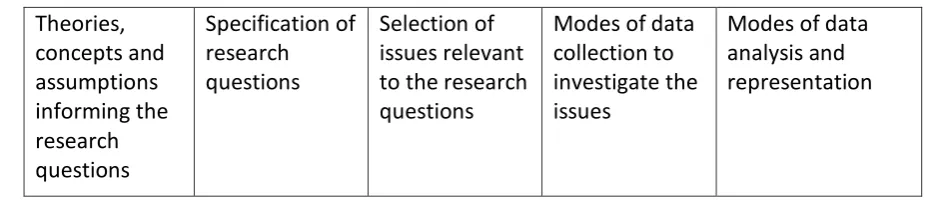
[image:16.595.61.525.213.313.2]In order to study the role of values in the cohousing group, the process outlined in Figure 2.1 was utilized for organizing the research, which will be outlined in this chapter.
Figure 2.1: Research process
Theories,
concepts and
assumptions
informing the
research
questions
Specification of
research
questions
Selection of
issues relevant
to the research
questions
Modes of data
collection to
investigate the
issues
Modes of data
analysis and
representation
Theories, concepts and assumptions informing the research questions
The basic analytical concepts used in relation to valuesare the different types of social action as delineated by Weber:
Social action, like all action, may be oriented in four ways. It may be:
(1) Instrumentally rational (zweckrational), that is, determined by expectations as to the behaviour of objects in the environment and of other human beings; these expectations are used as ‘conditions’ or ‘means’ for the attainment of the actor’s own rationally pursued and calculated ends;
(2) Value-rational (wertrational), that is, determined by a conscious belief in the value for its own sake of some ethical, aesthetic, religious, or other form of behaviour, independently of its prospects of success;
(3) Affectual (especially emotional), that is, determined by the actor’s specific affects [emotions] and feeling states;
(4) [Habitual]6, that is, determined by ingrained
habituation (Weber, 1978: 24-25).
6 Weber used the term ‘traditional’, but habitual is used here, since it avoids an unnecessary temporalization and
Whereas this might imply that values remain the same over time, it is also important to account for how they are influenced by context. One way of doing this is through the theoretical framework of cultural-historical activity systems.
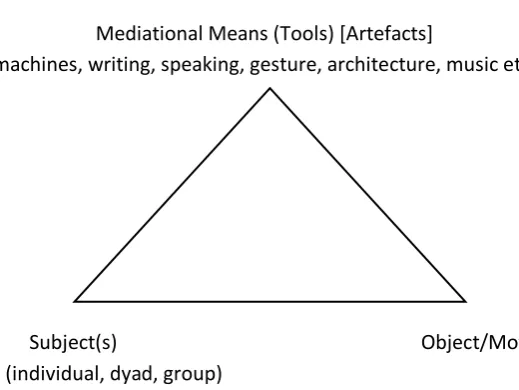
To explain this theoretical framework it is important to first get a sense of the basic components of the theory. An activity system involves more than social actions: any social action is embedded in a wider social context (or system), from which it derives its meaning and to which it contributes as a factor in its reproduction or change. Within the activity system an action is seen as a process involving a subject (S), an object (O), and artefacts (A) through which an action is mediated (see Vygotsky’s model of mediated action below). In this process, the subject is the individual, or individuals, who are engaged in the action, and the artefacts include the socially constructed tools (including language and signs) that lend meaning to the action. The object of action has at least three components. Firstly, it is the thing, or project, that the subjects are working to transform. Secondly, it is the sense or meaning of the action that is the social meaning of the
Page 16 of 55
action, as subscribed to by the subject’s reproductionof the action but not dependent upon the subject’s volition. Thirdly, it is also the particular objectives of the action, that is, the intended outcomes of the action, as aimed for by the active subject (Engeström and Blackler, 2005; Blackler and Regan, 2009). Through involvement in action, individuals deepen their relationship with their environment through
navigating, negotiating and developing both meaning and their practice in their given cultural/social context.
Mediational Means (Tools) [Artefacts]
(machines, writing, speaking, gesture, architecture, music etc.)
[image:17.595.165.425.264.459.2]Subject(s) Object/Motive -> Outcome(s) (individual, dyad, group)
Figure 2.2: Vygotsky’s model of mediated action(as adapted by Edwards, 2005: 52)
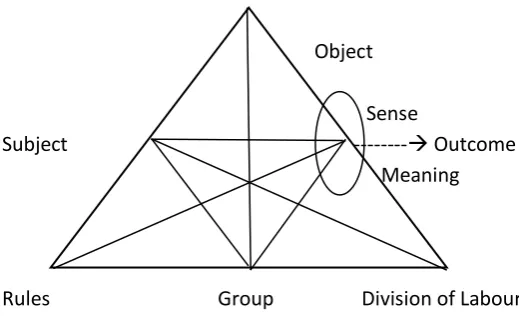
This basic model of mediated action has been developed into a more developed framework that helps outline further features of the activity system – the social rules and norms related to the activity
system, the wider group7 in which the subjects
operate, and the division of labour between members of the group, which each mediate the activity and each other.
Page 17 of 55
Mediating artefacts: Tools and SignsObject
Sense
Subject --- Outcome Meaning
[image:18.595.107.367.116.274.2]Rules Group Division of Labour
Figure 2.3: The structure of a human activity system (adapted from Engeström, 1987: 78)
Of particular relevance for the study of values in co-ordination is that different values may be inherent in the different aspects of the object of action and of the activity system, and the object of action and the activity system themselves change as subjects engage in different types of action over time. Values have varying locations and strengths in that they are sometimes a constituent part of some of the mediating artefacts, while at other times they are a part of the motivation of the subject. Sometimes they are part of the object of action or part of the objective of the action, as well as sometimes being ingrained in the rules or norms of the group, in the group identity, or in the division of labour.
The import and effect of values, therefore, are dependent to a large extent on how the object of action changes over time (both what is being focussed
upon and the intended objective). The object of action is always:
a project under construction, moving from potential raw material to a meaningful shape and to a result or outcome. In this sense the object determines the horizon of possible goals and actions. But it is truly a horizon: as soon as an intermediate goal is reached, the object escapes and must be reconstructed by means of new intermediate goals and actions (Engeström, 1999: 65).
These analytical distinctions between types of social action and a framework for understanding the dynamic components of activity systems allow us to begin to account for, and trace, the roles of values in social coordination.
Specification of research questions
In order to increase our understanding of the role of values in intentional self-transformation, the research project focussed on the following research questions: Primary Research Question: How are competing values navigated and/or co-ordinated in a cohousing group? The component research questions were:
Component Research Question 1: What social methods of co-ordination and conflict management (or avoidance) are used, and what are their effects?
In order to answer this research question, the methods or processes that the group utilised to try to foster continued social action and to mitigate tensions and conflicts, as well as their effects over time in relation to specific topics, were traced.
Page 18 of 55
Component Research Question 3: What values underliethese tensions?
In order to answer this research question, the interactions between the issues, the methods and processes related to them, and the values expressed in them, were traced over time.
Component Research Question 4: What
happens/happened in relation to these issues?
In order to answer this research question, the explicit values that informed the formation, operation and continuance of the group, and the implicit values that were expressed or inferred in the group’s practices, activities, language and other artefacts in relation to these issues were traced
Selection of issues relevant to the research questions
Owing to the complexity of cohousing groups and theconstraints on research time, it was decided to focus on a small number of particular issues or tensions that were or had been ‘live’ topics in the group and that also represented different aspects of value orientation and self-determination. Five issues were followed in detail to trace both how they evolved over time, and the variety of competing values and modes of coordination that were implicated in them.
Two particular building/project issues were selected to supplement a more general issue. The particular building/project issues were: (a) the human capacities of the group; and (b) the financial resources of the group. These issues were selected as they represent two core strategically instrumental concerns in organizations – the human capacities of the organization that are necessary for the organization to be able to act and to attempt to achieve its aims, and the economic resources available that enable the group to act (both topics were also identified as major risks in the group’s business plan). Of prime interest, therefore, was the degree to which these capacities were co-ordinated, enabled, or were at odds with the espoused ends of the group (realising a shared physical
community practicing forms of communal and ecologically sustainable living).
These particular building/project issues were part of a broader and more general issue of (c) the core tension between the instrumental focus on building the physical infrastructure (the property development) of the group and on the development of a shared community. This issue was selected as being fundamental to the primary research question (the tension between means and ends).
A further particular issue of (d) the common meals was selected as a topic, since it was not about the building of the site, but the ongoing living practices of the group. Common meals are an important common feature in cohousing communities, reflecting communitarian aspirations.
This particular issue was also part of a broader and more general issue of (e) right conduct – how people behave, evaluate and engage with their and others behaviour. This was selected since it is a core issue in social collaboration and coordination. The self-determining context of this group in developing its conduct is part of what makes the group an instructive case for research.
Modes of data collection to investigate the issues
In order to study the evolving coordination practicesand discourses of the group, the following methods were employed. 10 non-participant observations of a number of types of group meeting were undertaken – covering the group’s general meetings and at least one observation of each of the executive groups (the Directors, the Build and Resources (BaR) Group and the Process Group). 16 semi-structured interviews were conducted with nine different adult members (these were selected for a mix of memberships of different sub-groups, original geographical location and gender),
Page 19 of 55
The research processThe researchers approached the cohousing group to negotiate access in 2011. Access was gained by formally applying to the group, stating the research aims and outlining the methods of data collection, the initial project outline (Appendix B), the confidential use of the data, publication plans, and completing a research framework document that the group uses to evaluate participation in research (see Appendix C). Since a member of the research team was also a member of the group (the second author), this was
made explicit before and at the end of all interviews, giving research informants the option of limiting access to the data to the first author only. It was agreed that the group would have the opportunity to discuss and comment upon preliminary findings with the research team prior to submission for publication and that they (either individual members or the group) would be provided with a ‘right of reply’ to any publications arising from the research.
Modes of data analysis and representation
Analyses of the different data types were operationalised via combining process analysis (Langley, 1999), thematic interview analysis, as well as selected corpus linguistic and critical discourse analysis techniques (Mautner, 2009).In order to focus the analysis we concentrated on the five issues outlined above. The analysis was undertaken in the following ways. We reconstructed a temporal description of the group’s main activities, tasks, events, forms of group agency, and formal decision-making groups from the interviews and documentary analyses as a first form of interactional process analysis (Langley, 1999). This resulted in two initial temporal sequences of the group that were inter-related.
Firstly, we developed a descriptive account of broad sequential ‘periods’ of the group. The end-points of each period are based on documented dates by which the group completed a particular important activity. While this is useful in representing some activities that were sequential in completion, other important activities spanned across these identified periods. Secondly, we developed a temporal representation of the different forms of group agency and formal decision-making, based on the minutes available of these different sub-groups. Combining this with the ‘period’ description resulted in a broad representation of ‘what’ the group was doing, and ‘who’ (in terms of
sub-groups) was involved in doing that during the different periods (see Appendix D).
Thirdly, and of particular relevance to this report, the five selected issues were traced in terms of:
- What coordination methods were employed in relation to each issue;
- What values were implicit or explicit in these issues and the methods used in relation to them;
- What were the believed and interpreted enablers and constraints of these methods; and
- What were the believed and interpreted effects of these methods upon these issues. We then inductively developed the different aspects and dimensions of the issues from the data.
Page 20 of 55
Strengths and limitations of the methodology and methods employed
The particular strength of the methodology is thathaving multiple types of data enables cross-checking between the data types to develop multi-valent and multi-perspectival accounts of the group’s actions over time. This provides a synthetic and multi-layered overview of, and insight into, the group.
The primary limitation of the methodology is that the data, of course, is not fully representative, even of the five issues traced, and so there are undoubtedly further aspects and dimensions of these issues, and of
the group, that are not adequately accounted for in this analysis.
Page 21 of 55
3. SELECTED KEY SOCIAL METHODS AND THEIR EFFECTS IN RELATION TO
THE FIVE RESEARCHED ISSUES
In order to keep the length of the report manageable, the sub-sections below outline only a summary of the
key co-ordination methods and aspects of the selected issues, as well as their observed and perceived effects.
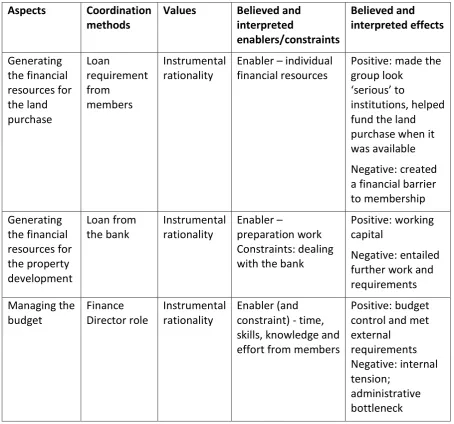
The financial resources issue
Two key aspects of the financial resources of the group were:
• The financial budget for the group, which included the budget for group functioning, for
purchasing the land, and for building the property development
[image:22.595.71.526.287.711.2]• Managing the financial budget for the group
Table 3.1: Key methods and their effects relating to the financial resources issue
Aspects
Coordination
methods
Values
Believed and
interpreted
enablers/constraints
Believed and
interpreted effects
Generating
the financial
resources for
the land
purchase
Loan
requirement
from
members
Instrumental
rationality
Enabler – individual
financial resources
Positive: made the
group look
‘serious’ to
institutions, helped
fund the land
purchase when it
was available
Negative: created
a financial barrier
to membership
Generating
the financial
resources for
the property
development
Loan from
the bank
Instrumental
rationality
Enabler –
preparation work
Constraints: dealing
with the bank
Positive: working
capital
Negative: entailed
further work and
requirements
Managing the
budget
Finance
Director role
Instrumental
rationality
Enabler (and
constraint) - time,
skills, knowledge and
effort from members
Page 22 of 55
Design team
Instrumental
rationality
and
value-rational
Enabler (and
constraint) - time,
skills, knowledge,
information and
effort from members
Positive: budget
control
Negative: internal
tension
Value
Engineering
Instrumental
rationality
and
value-rational
Enabler (and
constraint) - time,
skills, knowledge,
information and
effort from members
Positive: budget
control
Negative: internal
conflict
The methods employed in each of these aspects were largely instrumentally-focussed in that they were aimed at either raising money for the group or managing and reducing potential costs. Some of the methods for managing the financial budget also involved forms of value rationality, i.e., the design team and the value engineering process, which both involved the use of objectified values as criteria in making financial allocation decisions.
These methods were largely successful in that the projected financial cost of the infrastructure development of £2-3M at the inception of the group (in 2006) rose to approximately £8M by the end of the research project (2013), and the infrastructure was completed with a small leftover budget. A variety of
these methods also entailed a variety of negative effects:
- Some instrumental, such as unanticipated costs or additional administrative or organizational work;
- Some value-rational in impact, such as the recognition that the mode of financing the project created a financial barrier to entry for those without capital or on a low income; - Some may have led to group tension or
conflict: for example, the use of a finance director role was reported to have led to interpersonal tension over the management of the budget. It was also reported that one item addressed in the value engineering process did lead to significant conflict.
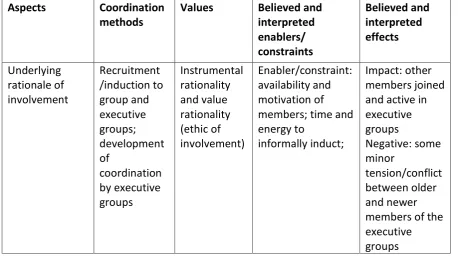
The human capacities issue
Early in the project, the human capacities to enable and make real the aim of a co-located community were identified as constituting a main risk. Human capacities are less tangible and more fluid than financial resources and are also much more open to being influenced by cultural, organizational and coordination practices and structures. The following overlapping aspects were some of those apparent from the data:
- Generating a group project and affective motivation
- The executive capacity of the group and the dynamic tension between project executive tasks and member issues
- The group executive and governance capacity of the group and governance tensions
Page 23 of 55
Table 3.2: Key methods and their effects relating to the human capacities issue
Aspects
Coordination
methods
Values
Believed and
interpreted
enablers/
constraints
Believed and
interpreted
effects
Underlying
rationale of
involvement
Recruitment
/induction to
group and
executive
groups;
development
of
coordination
by executive
groups
Instrumental
rationality
and value
rationality
(ethic of
involvement)
Enabler/constraint:
availability and
motivation of
members; time and
energy to
informally induct;
Impact: other
members joined
and active in
executive
groups
Negative: some
minor
tension/conflict
between older
and newer
members of the
executive
groups
Altogether, the various methods used in order to develop these different capacities, or to minimise the work being placed upon them, operated according to an underlying rationale. This underlying rationale involved trying to recruit members to the group, informally inducting members into the executive capacities of the group, and developing the coordination within and between the executive groups, and between the executive groups and the wider group. This involved instrumental rationality as well as the value of an ethic of involvement, and the value of positive group relationships. There were a number of dynamic tensions related to each of these capacities.
Page 26 of 55
The build organization in contrast to group relationships
One of the key tensions highlighted in the projectformulation by the co-researcher from the group was ‘the build versus the community’. Some people in the group, at least, perceived that a key tension appeared to be between the emphasis on the design, project management, construction and completion of the physical infrastructure (the property development) of the cohousing group, and the emphasis on a shared way of living. Two key aspects of this tension — the issues around the financial resources of the group and the issues around the human capacities of the group — are outlined above. There were also a number of other component aspects and dimensions of the tension between the organization of the build and the group relationships:
- The conceptions of the build versus community tension
- Individual versus community - Company versus buyer - Executive expertise - Intra-group distinctions
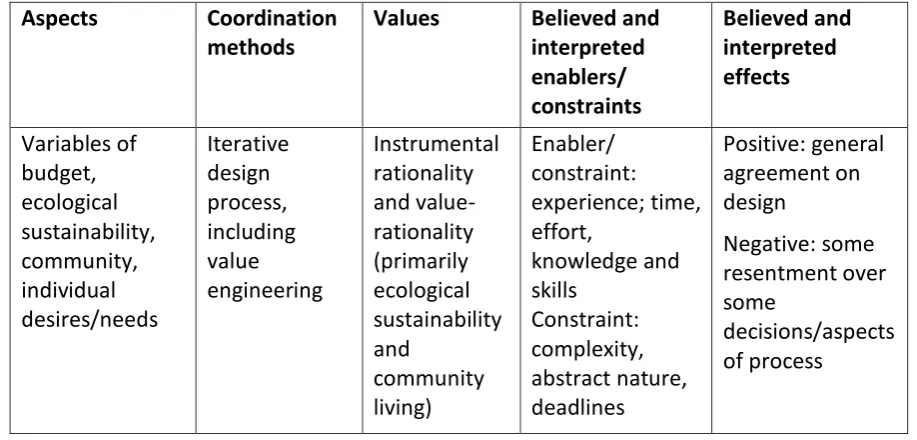
The over-riding constraint that appeared to help to cause this tension, and limit the capacity of the various co-ordination methods to address the tension, was the instrumental imperative to make timely decisions in order that the financial budget was not over-run. The co-ordination methods used in relation to the aspects and dimensions of this tension involved a strong focus on instrumental rationality, as well as a range of different explicit values. Some of these core values related to the initial values incorporated into the group’s vision – ecological sustainability and community living, as well as individual autonomy, a democratic ethos, and transparency. Three of the significant and overlapping methods utilised in this respect were:
a) Member involvement in an iterative design process, with account taken of the group’s espoused values;
b) The attempt to structure inclusive and constructive discussions within and across the group; and
[image:27.595.68.527.512.732.2]c) The generation and development of a process group to help with this tension.
Table 3.3: Key methods and their effects relating to the build versus the community issue
Aspects
Coordination
methods
Page 27 of 55
Making timely
decisions contra
being heard
Attempt to
structure
inclusive and
constructive
discussions
Instrumental
rationality
and
value-rationality
(primarily
democratic
ethos)
Enabler/
constraint: time,
effort,
knowledge and
skills of
facilitation,
discussion and
deliberation
Impact: generally
constructive
discussions;
some fractious
and divisive
discussions
Task versus
process
Process group Instrumental
rationality
and
value-rationality
(primarily
community
living)
Enabler:
conception of
group process;
time, effort,
knowledge and
skills
Constraint:
shared time,
effort,
knowledge and
skills, different
perspectives on
and values for
the group
process
Positive:
reported as a key
positive feature
of the group;
shared
conception of
group processes
for
decision-making; internal
articulation of
issues
Page 28 of 55
The impacts of these methods included both positiveimpacts and also negative impacts – sometimes owing to the co-ordination method, or sometimes owing to the method not addressing the issue fully (often owing to the limited capacity to implement the method, or the multiple dimensions of the issue).The positive impacts included an observed general agreement on the design, despite some individual misgivings; the
development of shared experience and conception of group processes for decision-making and the articulation of issues from within the group; and generally constructive discussions. While these methods were observed to enable a level of informed discussion and deliberation, they did not foreclose all disagreement or ensuing interpersonal conflict.
Page 29 of 55
The Common Meals issue
[image:30.595.68.526.132.582.2]The most significant aspect related to this issue was an issue around the vegan basis of the common meals policy:
Table 3.4: Key methods and their effects relating to the common meals issue
Aspects
Coordination
methods
Values
Believed and
interpreted
enablers/
constraints
Believed and
interpreted
effects
Divisiveness
over vegan
aspect of policy
for common
house meals -
including in
meals group and
wider
membership
Process group
facilitation of
meals group
and of
discussion at
GMs
Attempt to
agree
common
value-rational
way forward
Value
rationality
conflict -
individual
freedom
contra
collective
agreement
on shared
foodstuffs;
inclusivity
disputed;
ecological
sustainability
disputed
Enabler/
constraint: time,
energy, skills and
knowledge of
facilitation;
constructive
involvement of
members
Impact: a policy
was eventually
agreed, but some
reported
dissatisfaction
with the practice
of some
members in
flouting the letter
and spirit of the
policy; policy did
not work for all
and would
require some
revision; vegans
reported feeling
demonised;
omnivores were
reported as
feeling judged
Negative:
significant strain
on process group
members and
wider
membership
The vegan issue in relation to the common meals was a result of divergent and conflicting assent to, and interpretation of, different value-rationalities (veganism, vegetarianism, omnivorism, ecological sustainability, autonomy, and inclusivity). The initial co-ordination method of a common meals policy was seen as insufficient in forestalling significant later conflict
Page 30 of 55
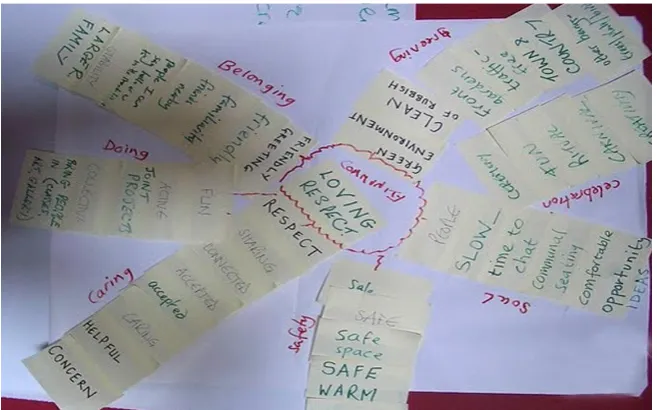
From a social standards workshop
The conduct of group relationships issue
There were a number of interconnected aspects and issues around the conduct of group relationships. These included:- Perceptions of ‘bad behaviour’
- The relationship between the individual and the group
- The conduct of meetings
[image:31.595.135.464.81.286.2]- Governance relations and relationships, including the evolution of governance structures and procedures
Table 3.5: Key methods and their effects relating to the conduct of group relationships issue
Aspects
Coordination
methods
Values
Believed and
interpreted
enablers/
constraints
Believed and
interpreted
effects
Perceptions of
bad behaviour
General
strategy to
engender
constructive
conversations
where people
felt heard,
and to avoid
differences
becoming an
interpersonal
conflict
Value-rational
(moral
respect and
community)
Enabler/constraint:
energy, time, skills
and knowledge for
constructive
discussion
Page 31 of 55
Initial group
relation to
vision, 'no
revisiting
policies' policy,
and five
ringfenced
policies
The ‘no
revisiting
policies' policy
was revisited
and a
stronger
version was
agreed by the
wider group
Instrumental
rationality
and value
rationality
(democratic
and
egalitarian
ethos)
Enabler/constraint:
energy, time, skills
and knowledge to
revisit policy
Impact: policy
appeared to be
accepted
Plan to revisit
vision
Instrumental
rationality
and value
rationality
Occurred after
end of period
studied
Rotation of
initial and
long-term
executive
members in
executive
groups over
time
Value
rationality
(democratic
and
egalitarian
ethos)
Impact: appeared
to lessen
perception of
special status of
long-term
executive
members
The conduct of
meetings
Set of
methods
around policy
and practice,
developed
over time
Value-rationality
(inclusive
and
democratic
ethos) and
instrumental
rationality
(ability to
make
decisions)
Enabler/
constraint: time,
energy, skills and
knowledge and
resources to
practice, articulate,
review, reflect
upon and adapt
consensus
decision-making process
Impact:
observed/
reported to help
facilitate
following of
process; did not
prevent all issues
from occurring
Evolution of
governance
structures and
procedures
Set of
methods
around policy,
structures and
practice,
developed
over time
Value-rational
(inclusive
and
democratic
ethos,
autonomous
workgroups)
and
instrumental
rationality
Enabler/
constraint: time,
energy, skills and
knowledge to make
explicit delegation
and activities
Impact:
structures
broadly effective;
Negative: a series
of issues and
tensions
potentially
contributed to
the exhaustion of
some key
Page 32 of 55
The general strategy to address the varied perceptionsof ‘bad behaviour’ was to try to engender constructive conversations, where people felt heard, and to avoid differences becoming interpersonal conflict. The implicit value-rational aim of moral respect from the espoused value of neighbourly community supplemented that of the instrumental aim to avoid interpersonal conflict.
The group used a number of methods in relation to the different dimensions of the relationship between the individual and the group. In particular, in relation to some of the perceived differences between the initial group and the general membership, the ‘no revisiting policies’ policy was revisited; it was agreed to revisit the vision, and there was some rotation of members from the executive positions over time. These methods reflected the tension between the instrumental rationality that led to an executive group and the democratic and egalitarian ethos of the group. These methods appeared to help mitigate and lessen some of the perceptions of unequal power and status.
The two most significant methods in relation to the conduct of group relationships were probably the set of methods related to the conduct of meetings, and the evolution of the governance relations and relationships. Both sets of methods involved instances of different ways to marry instrumental rationality with the democratic and egalitarian ethos of the group. The vision, as a particular element of the governance relations, also involved the explicit values of ecological sustainability and a neighbourly community.
The set of meeting conduct methods was observed to be, and generally considered, broadly effective. While they did not fully preclude personalised conflict, they made it less likely, and enabled some such conflicts to be addressed constructively. The evolution of the governance structures was not a top-down process, and it involved variable direction and input from different component sub-groups within the broad group. In terms of the overall impact of the evolutions in governance, it appeared as if the group largely assented to the legitimacy of the governance structure.
Diagnosis of the role of values in the co-ordination of intentional self-transformation
At least two general lessons can be generated from theabove analyses – firstly, the role of values in the action of groups attempting intentional self-transformation, and secondly, an overview of the different potential sources of tension that groups attempting intentional self-transformation can experience.
End-values appear to be necessary conditions for intentional self-transformation – they provide the ‘pull’ factor that motivates self-transformational action and give it a target at which to aim. In this group’s case, the explicit end-values were ecological sustainability and neighbourly community. Their location in the formal governance document of the group’s vision entailed:
- Giving them a symbolic power;
- Them becoming part of the formal context of the group in that the vision became a tool for evaluating potential blocks8;
- The vision becoming an artefact created by the initial group, which had a differing social relation to later members, which then resulted in the vision becoming an object for reflection
8 In consensus decision-making, a ‘block’ is when a member objects to a proposal. A proposal cannot be passed if it is blocked, although in different versions of consensus
and potential manipulation later on in the group’s history.
In other words, through end-values becoming articulated and institutionalised (in varying ways), they become parts of mundane tools and symbols for channelling action. This can result in a number of different potential tensions. Firstly, an end-value (for example, of neighbourly community) may not result in an experience of neighbourly living that matches with the end-value that the agent imagined. Alternatively, the end-value of ‘neighbourly community’ may result in a discourse of community, which may become a tool – a normative language of community, for example – that is negatively experienced by some members. Alternatively, the end-value of community may not be rendered in a project management tool that can measure and objectify features of communal living when making decisions on the design of the physical infrastructure (the land and property development), whereas the end-values of ecological sustainability may be more easily measured via proxies and therefore factored into design decisions. Alternatively, the
Page 33 of 55
value of community may come into tension withemotional or habitual attachments to particular types of social practice (e.g., practices predicated on individual autonomy).
A further type of value-rationality evident in the analyses is that related to implicitly valued modes of conduct. This type of implicit valuing was evident in the issues around right conduct that showed the large number of different implicit values ascribed to by members of the group. These implicit values interrelate with end-values in that they are the source from which explicit values may become articulated and given symbolic precedence; for example, the explicit value of ‘community’ was a combination of implicit values of belonging, identity, mutuality, or camaraderie, amongst others. In many instances, however, these implicit values were felt as lacking – for example in the instances recounted as ‘bad behaviour’ by members.
In the group, it was striking that end-values were regularly linked to instrumental rationality, in that there was significant evidence of regular consideration
of means. Indeed, many members noted that the instrumental competence of the group was valued by many members, which is an instance where a form of implicit valuing shades into a form of explicit end-value. Importantly, in many instances, instrumental rationality was channelled via recourse to end-values, in that end-values were explicitly considered and used to decide between alternative means. On the other hand, the ‘build versus community’ tension also indicates that some members experienced the instrumental goal of the group’s physical infrastructure (the property development) as having negatively affected their feeling of community.
Page 34 of 55
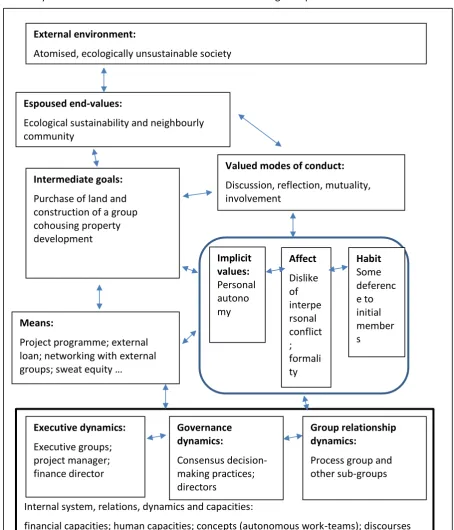
Figure 3.1: The dynamics of internal tensions in Greenfields Cohousing Group
Internal system, relations, dynamics and capacities:
financial capacities; human capacities; concepts (autonomous work-teams); discourses (rules of thumb; consensus; process); norms (community); division of labour (executive groups; workteams); routinized practices (meeting practices); group-member relations (agreement to lease/buy; membership categories); member-member relations
(geographical; interest-based; value-based; status-based) Espoused end-values:
Ecological sustainability and neighbourly community
Executive dynamics: Executive groups; project manager; finance director
Governance dynamics:
Consensus decision-making practices; directors
Group relationship dynamics:
Process group and other sub-groups
External system, relations, dynamics and capacities:
Favouring of llc status; planning restrictions and commitments; financial opportunities and restrictions; legal opportunities and restrictions
Intermediate goals: Purchase of land and construction of a group cohousing property development
Means:
Project programme; external loan; networking with external groups; sweat equity …
Habit Some deferenc e to initial member s Affect
Dislike of interpe rsonal conflict ; formali ty Implicit
values: Personal autono my External environment:
Atomised, ecologically unsustainable society