Permanent WRAP URL:
http://wrap.warwick.ac.uk/106945/
Copyright and reuse:
This thesis is made available online and is protected by original copyright.
Please scroll down to view the document itself.
Please refer to the repository record for this item for information to help you to cite it.
Our policy information is available from the repository home page.
‘
This is a problem
(.)’
Discursive construction of the organisational ‘problems’ in a
multinational corporate workplace
by
Kyoungmi Kim
A thesis submitted in partial fulfilment of the requirements for the degree of PhD in
Applied Linguistics
University of Warwick, Applied Linguistics
Table of Contents
List of tables... v
List of figures ... v
Acknowledgements ... vi
Declaration ... vii
Abstract... viii
1. Introduction ... 1
1.1. Rationale for the study/ Background ... 1
1.2. Objectives and scope ... 4
1.3. Discursive perspectives and conceptualising ‘organisational problem’ ... 6
1.4. Thesis overview ... 9
2. Literature review I: Problem-solving and role as discursive practice ... 10
2.1. Introduction ... 10
2.2. Approaches to problem-solving ... 11
2.3. Problem-solving discourse ... 14
2.3.1. Problem-solving and/or decision-making ... 15
2.3.2. Negotiation of expertise and power ... 18
2.4. Professional role as a social, emergent process ... 20
2.4.1. Role and identity ... 21
2.4.2. Negotiating professional roles in interaction ... 22
2.5. Summary ... 24
3. Literature review II: The multinational corporate workplace ... 25
3.1. Introduction ... 25
3.2. Multilingualism at work ... 27
3.2.1. Multilingualism ... 27
3.2.2. Language ideologies ... 29
3.3. Approaches to culture ... 31
3.3.1. Cultural essentialism ... 31
3.3.2. Culture as a discourse ... 35
3.3.3. Communities of practices ... 37
3.4. The HQ-subsidiary relationships and the actors ... 38
3.4.1. Agency-structure ... 39
3.4.2. HQ-subsidiary relationships as a discursive practice ... 41
3.5. Summary ... 43
4. Methodological approach and the methods ... 44
Introduction ... 44
Ethical considerations: Role of the researcher ... 47
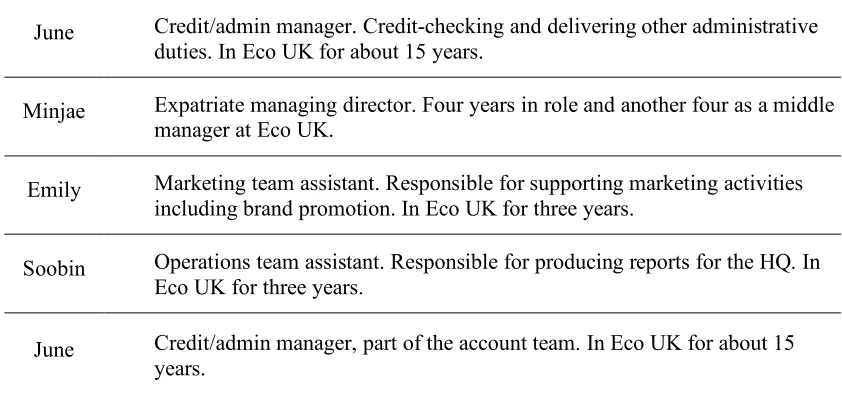
The participants in Eco UK ... 49
The datasets and methods ... 54
4.5.1. Workplace observation ... 56
4.5.2. Audio-recording the workplace interaction ... 57
4.5.3. Interviews: metatalk ... 58
Analytic approach and processes ... 60
4.6.1. Discourse analytic approaches ... 61
4.6.2. Interactional sociolinguistics... 62
4.6.3. Applying the analytic approach to the metatalk and meeting talk ... 64
5. Language and culture as a problem ... 67
5.1. Overview of the resources mobilised in constructing the organisational problems .... 67
5.2. ‘We had a language barrier problem.’ Language as ‘a problem’ ... 68
5.3. ‘We are just an arm of that culture from Korea.’ Cultural differences as ‘a problem’ ... 79
6. Problem-solving meetings ... 90
6.1. Introduction ... 90
6.2. Interactional activities in the problem-solving meetings ... 92
6.2.1. Analysis of interactional activities in problem-solving interaction... 92
6.2.2. Linguistic features of interactional activities ... 97
6.3. Problem-solving meetings ... 101
6.3.1. Meeting 1. A reduced local marketing budget and doing social media activities ... 101
6.3.2. Meeting 2. Sales-pricing strategy... 113
6.3.3. Meeting 3. Managing the customer credits... 122
7. HQ-subsidiary relationships as emergent in constructing the organisational problems . 131 7.1. Introduction ... 131
7.2. ‘The Korean’ in the power position? ... 132
7.3. The HQ-subsidiary relationships emerged ... 136
8. Discussion: constructing problems and the HQ-subsidiary relations ... 142
8.1. The organisational problems constructed in interaction ... 142
8.2. The HQ-subsidiary relationships as emergent in constructing of problems ... 147
9. Conclusion ... 150
9.1. Summary of the thesis ... 150
9.2. Contribution to the field ... 151
References ... 155
Appendices ... 183
Appendix 2. Consent Form ... 185
Appendix 3. Interview Questions ... 187
Appendix 4. Samples of observation log ... 189
Appendix 5. A sample of mapping individuals’ roles and activities ... 190
Appendix 6. A sample of manual coding ... 191
Appendix 7. MAXQDA Code system ... 192
Appendix 8. MAXQDA visualisation of codes ... 195
List of tables
Table 1 Examples of studies on problem-solving from a behaviourist and a cognitivist
approach ... 13
Table 2 Examples of empirical studies on culture from a positivist approach... 34
Table 3 Summary of profiles of participants in interview and problem-solving meetings .... 54
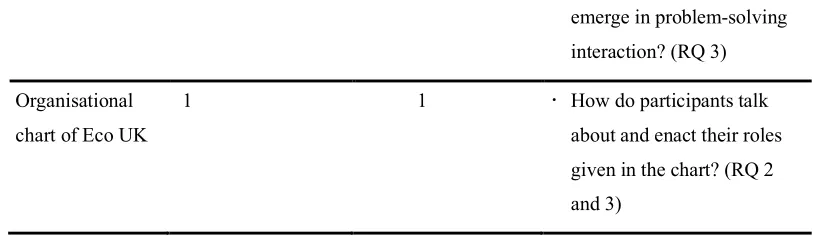
Table 4 Summary of the datasets of the case study ... 56
Table 5 Language as a resource for constructing ‘problems’ ... 70
Table 6 Culture as a resource for constructing ‘problems’ ... 81
Table 7 Summary of problem-solving meetings ... 92
Table 8 Linguistic features emerged in interactional activities in problem-solving meetings ... 98
List of figures Figure 1 Visualisation of the key relevant aspects of multinational corporate workplace context ... 26
Figure 2 Role-structure and mother tongue of the participants ... 50
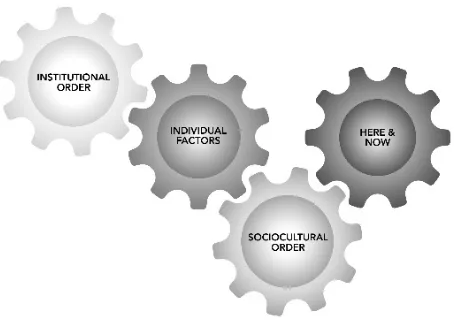
Figure 3 The interplay of factors in constructing organisational problems (Taken from ‘The interplay of factors influencing language choice’, Angouri, 2018) ... 64
Figure 4 Visualisation of key resources mobilised in the construction of organisational ‘problems’ ... 67
Figure 5 The mobilisation of language in constructing ‘organisational problems’ ... 69
Figure 6 The mobilisation of culture in constructing ‘organisational problems’ ... 80
Figure 7 Visualisation of the analysis of interactional activities ... 94
Figure 8 Representation of interactional activities in problem-solving interaction ... 95
Figure 9 Visualisation of resources mobilised in the construction of organisational ‘problems’ ... 143
Figure 10 Visualisation of the interactional processes of problem solving ... 146
Acknowledgements
This thesis would not have been able to come to be without the support of many people. First and foremost, I would like to express my sincere gratitude to my fantastic supervisors: Dr. Jo Angouri: for her ubiquitous influence during this amazing journey, giving her immense knowledge, ideas and energy, and for her enthusiastic engagement in matters PhD and beyond: she is my academic role model. I appreciate and will miss so much our late-night supervision sessions.
Dr. Stephanie Schnurr: for her constant support, her intellectual eye and constructive suggestions over all the years: these were determinant for the accomplishment of the work presented in this thesis and my personal growth as an academic.
I am also grateful to my participants who kindly shared their views and experiences with me for a prolonged period of time. Without their precious support, it would not be possible to conduct this research.
My heartfelt gratitude goes to my family, mum, dad, Yumi, Booyou, Woonghee and Somin, my friends and Al: for supporting me spiritually throughout my PhD venture and my life in general. I can’t thank enough for their unconditional support and absolute faith in me, and without which I would not have come this far. I dedicate this thesis to them.
Declaration
Abstract
Problem solving in the workplace is a high stakes activity that has important implications for organisations and individuals. Although problem-solving has attracted a lot of attention, there is little research on the interactional aspects of problem-solving processes. There are also few attempts to make interactional research relevant to business studies on organisational problems. In this thesis, I adopt a discursive approach and understand problems as locally produced in and through interaction. I draw on one case study and discuss data collected in one multinational company. Through interviews and interactional data, the thesis investigates how organisational ‘problems’ are constructed (and occasionally solved). The discussion focuses on the discursive resources employees draw upon in formulating problems and their professional roles and responsibilities negotiated in problem solving meetings. Special attention is paid to the meeting event and the HQ-subsidiary context in relation to the ways in which issues are negotiated and ratified as ‘problems’.
The findings show that in interviews, language and culture, as abstract concepts, constitute key resources for the construction of organisational problems. In participants’ talk about
1.
Introduction
This thesis investigates how organisational ‘problems’1 are constructed in interaction. By drawing on case study data collected in one multinational company, I focus on the discursive resources2 mobilised in employees’ construction of problems and how problem-solving is done in interaction. In the introduction to this thesis, I begin by providing the background of this research that includes my motivation and rationale for the study and a (linguistic) profile of Eco UK and (1.1). I then set out the thesis objectives and scope and articulate the research questions I seek to address (1.2). In Section 1.3, I provide a brief discussion on the main theoretical approaches that I draw upon in conceptualising and analysing the processes of constructing problems. This is followed by the overview of this thesis (1.4).
1.1.Rationale for the study/ Background
Problem-solving is a high stakes activity that has important implications for the organisations and the individuals. Multinational contexts represent a domain in which individuals and organisations operate at the interface of organisational, linguistic, geographic, and professional boundaries (Birkinshaw, Ambos and Bouquet, 2017). Research has shown a range of problems emerge in such context , and employees often find themselves in competing and conflicting roles when negotiating role-responsibilities in teams across different subsidiaries and countries (e.g. Haynes, 2018). Problem-solving is complex, involving the successful negotiation of local norms and practices as well as global organisational ways of doing.
Organisational problem-solving activities have long been studied from a range of non-linguistic perspectives. Organisational behaviourist and cognitivist approaches are common. However, as detailed in Section 2.2, in most cases, those approaches treat the problem as, more or less, given and problem solving as technical and generalizable steps or rules in a linear process (e.g. Felin and Zenger, 2015). This approach typically does not address the role of interaction. It, as a result, leaves out the processes through which problems are negotiated and ratified by the individuals. Hence, there is a need for further research in the sociolinguistics of problem-solving and this thesis seeks to contribute to this area of work. As I discuss in Section 1.3, this thesis draws on discursive perspectives that pay special attention to language
1 I have used inverted commas sparingly to indicate that the term carries a range of meanings. I am avoiding excess use for ease of reading and only highlight ambiguity when needed for clarity.
in and through which social meanings and practices are negotiated, and the organisational realities are talked into being. By drawing on interview and workplace interaction, this thesis investigates how organisational problems are discursively constructed in the interactional setting.
The research focus grew out of my initial research interests in social interaction in multinational contexts, and an opportunity to conduct an ethnographic case study in a multinational company, Eco UK (pseudonym). The multinational corporate workplaces provide researchers a rich site for the study of multilingualism, intercultural communication and the institutional context itself. The opportunity to conduct a case study in Eco UK has provided a unique opportunity to look closely at the ways in which employees construct their organisation, enact their professional roles and position self and other. Since I moved to the UK for my PhD degree at the University, I have been part of the UK Korean community which includes a number of local and expatriate Korean professionals, students and their families. I shared my research interests with the community members and one of those who were acquainted with Eco UK expatriate managers introduced me to the company. This is where and how I embarked on my fieldwork for this project.
In the section below, I provide a brief profile of the company as background information for the study. I then discuss how my research focus has evolved through the fieldwork.
(Linguistic) profile of Eco UK and doing fieldwork at the company
Eco is one of the Korean multinational companies with a history of more than half a century. It has expanded its global network with its local offices, plants, and R&D centres in more than 30 countries with over 20,000 employees. Korean multinational companies and their activities in general are considered to be still new since South Korea has a relatively young history of outward foreign direct investment. To establish its position in the European market, the company has a distribution centre and a plant in Europe since 2000 and the European headquarters. Until recently the company has been striving to enhance its global marketing and partnerships with European companies in the same industry in order to improve its brand image and status.
where managers just transferred from the HQ, and this was where language and cultural differences were foregrounded, and power positions were negotiated.
Local employees in the subsidiary consisted of three Korean employees and a Hungarian employee, and the rest were British. Important to note here is that most local employees had longer work tenure at Eco UK than those of the expatriate managers. As informed by my participants, the local Korean employees played a role in providing linguistic support for Korean expatriate managers and/ or the HQ in their communication with the subsidiary employees. When I was at the company, this was also suggested by the seating arrangement in each of the offices where the Korean expatriate managers and the local Korean assistants were sitting next to each other. I also frequently observed the managers requesting their assistants to send out emails or messages and translate or create reports to be sent to the HQ and the managing director. The Hungarian employee was in role of contacting one of the Eco’s units in Hungary. These would suggest the roles expected for the Korean and Hungarian local employees were associated with their language ability. I discuss this in light of my data in Section 5.2. In addition to the roles related to the languages, I provide detailed information about the institutional role structure with linguistic profiles of employees in Eco UK in Section 4.4.
Regarding the language use in the company, there is neither an official language policy nor a designated official language in the company. During my fieldwork, I observed that both English and Korean were used in the workplace, and the language choices were made depending on the organisational activities and the people who were involved in them. As my data suggests (Section 5.2), English was assumed to be used as a lingua franca within the subsidiary and between the subsidiary and the headquarters. Yet, Korean was used between Korean employees within the subsidiary and for the communication convenience with the HQ where Korean was used as a primary language. I will provide details about the language use at work as addressed by employees and discuss employees’ ideologies about language and its role in the workplace (Section 5.2).
It was intriguing to see the way in which employees interpreted and illustrated differences between certain groups, e.g. the HQ versus the subsidiary, the Korean versus the British or European. These were often negatively marked, and importantly made relevant to the organisational roles and activities. In other word, perceptions on culture and language were made relevant to the way Eco employees’ work.
This was the initial puzzle that triggered part of inquiry of this thesis to investigate problem talk and employees’ ideologies. These were developed further throughout my second phase of fieldwork and follow-up analysis. During this fieldwork, I focused on employees’ talk about their organisational roles and activities and audio-recorded a range of meetings that include problem solving ones, according to employees’ perception (see methodology for further detail). This was to establish an understanding of employees’ professional roles in the organisational setting. Moreover, this has developed further my understanding of employees’ problem talk in interviews and workplace interaction settings.
In the next section, I set out the objectives of the research and research questions this thesis seeks to address.
1.2.Objectives and scope
The aim of this thesis is to capture the ways in which organisational problems are constructed in interaction. This stance suggests, in line with the view of discourse scholars, that language does not just represent or express intentions or decisions (i.e. the representational role of language) but ‘it makes them’ (i.e. the constitutive role of language) (Roberts and Sarangi, 2005:632). I discuss discursive perspectives in detail in the section below.
By drawing on the multiple datasets, including observations, interviews and workplace interaction, this thesis provides a holistic description of the processes of constructing organisational problems situated in the employees’ local and broader organisational and social context. The thesis pays special attention to employees’ enactment of professional roles and the HQ-subsidiary relationships as emergent in the processes of constructing problems. This thesis seeks to address the following research questions:
1. How is the ‘organisational problem’ constructed in interaction in the case of one multinational company?
This question will be addressed in both the employees’ metatalk3 and problem-solving meetings. In the context of the metatalk, I focus on the symbolic and material resources
employees draw upon in constructing problems and the speakers’ ideologies enacted in interaction (Angouri, 2018). These usefully inform the local understandings of problems in the context of the participants’ perceived realities. In the context of problem-solving meetings, I aim to provide a detailed interactional analysis to demonstrate how problem-solving is done in situ. In the problem-solving literature, surprisingly, little attention has been paid to interactional aspects of problem-solving. This thesis makes a contribution to this area. It also looks into the interactional activities emerging in problem-solving meetings and focuses on the different stages of the meeting event. In interactional studies, to the best of my knowledge, with a few exceptions there is scant research that looks into problem-solving in its own right. Angouri and Bargiela-Chiappini’s (2011) study on problem-solving provides this thesis with a good starting point and foundation to explore how problems are negotiated and ratified in workplace meetings. I expand this work and provide a model which visualises problem solving meetings as emerging through my data analysis.
2. How do employees enact their professional roles in constructing organisational problems?
This question brings into focus the professional roles enacted in problem-solving meetings. ‘Role’ is conceptualised from a social constructionist perspective and is considered a conduit into the ways in which institutional interactions unfold (e.g. Sarangi, 2010). Participants’ institutional/ professional roles are intricately linked to the ways in which the organisations emerge in the interaction (Berger and Luckmann, 1966). This brings us to the following related question that calls for an investigation of how HQ-subsidiary relationships emerge in the processes of constructing problems.
3. How do the HQ-subsidiary relationships emerge in the processes of constructing problems?
The HQ-subsidiary relationships emerged as a key dimension in my participants’ constructions of problems in both the interview and the workplace interaction data. Drawing on organisational dimensions (e.g. Balogun, Jarzabkowski and Vaara, 2011; Whittle et al., 2016), this thesis investigates how the HQ-subsidiary relationships foreground participants’ constructions of problems and emerge in problem-solving interactions. I theorise the HQ-subsidiary relationships in accounting for how the organisational relationships are negotiated by the employees in constructing organisational problems.
1.3. Discursive perspectives and conceptualising ‘organisational problem’
In this section, I begin by introducing the ontological and epistemological position that I adopt in responding to the research enquiry (Section 1. 2), and from which my methodological approach has been derived (Chapter 4). This is followed by a discussion on a potential avenue for bridging linguistic research with organisational studies, and a conceptualisation of organisational problem from a discursive perspective.
This research is positioned broadly within a social constructionist paradigm. It frames realities as discursively constructed by social actors who, ‘in particular places, at particular times, fashion meaning out of events and phenomena through prolonged, complex processes of social interaction involving history, language, and action’ (Schwandt, 1994, p. 118). It, therefore, takes seriously social interaction in meaning-making and constructing the social structure (Weedon, 1987). Social practices from this approach then, are conceived of as ‘a series of acts’ brought by actors, ‘constituting forms of interaction’, and ‘constituting structures’ pertaining to the communities (Giddens, 1993, p. 110). And organisational knowledge and realities are ‘continuously created in the acts of communication between organisational members, rather than being independently out there’ (Iedema and Wodak, 1999, p. 7). In this line of approach, as a way of investigating employees’ construction of problems, I adopt an interactionist approach to unpack the language use in the process of meaning-making and constructing professional roles and identities (Butler, 1997, 2010).
Underpinned by the discursive approach, for the investigation of the research enquiry, I draw on theoretical and empirical perspectives largely from sociolinguistics and organisational discourse studies. In sociolinguistic workplace discourse studies (Holmes and Stubbe, 2003; Angouri and Marra, 2011; Schnurr and Zayts, 2011), workplace talk provides the context in which knowledge is constructed, professional identities are negotiated and ways of doing and being are brought to scrutiny. And the social meanings constructed in talk become part of organisation itself. The studies focus on language choices and other semiotic resources in association with social meaning and context. In this sense the studies provide empirical evidence on how people do work and the ways in which complex work practices are co-constructed in different professional settings and industries (Angouri and Angelidou, 2012:79). In a similar vein, organisational discourse studies (e.g. Fairhurst and Cooren, 2004; Langley
discourses and texts’ (p. 104). Furthermore, relatively recent studies in organisation communication studies equate the organisation with the communication, highlighting a processual approach to organisations as ‘a dynamic construct’ emerging through ‘actors ongoing collective action’ (Lorino, 2014, p. 96). In a similar vein, Whittle et al. (2014) state ‘communication brings the organisation alive in a continual, never-ending process of interacting’ (p. 87).
Given the common interest in the role of language in constructing practices and realities, there is much to share between these disciplinary areas. Relatively recent contributions have been made in the aforementioned fields by moving towards trans-, inter- and multidisciplinary work. For example, Angouri and Piekkari (2018) in their collaboration seek to bring together Sociolinguistics and International business studies to research multilingualism at work. And an emerging field, Communication as Constitutive Organisation (CCO) draws on ethnomethodology and seeks a fine grain engagement with language in understanding organisational phenomena. Nonetheless, to the best of my knowledge, the dialogue between these disciplinary areas seems still scarce. Indeed, Tietze (2008, p. 3) laments that ‘there are no institutionalised ways of communicating’ across those disciplines, arguing management processes can be studied through a linguistic lens. And I personally have experienced this when presenting my work and communicating with people at conferences in sociolinguistics and organisational studies. I consider this to be an avenue for this thesis by adequately adopting sociolinguistic (workplace discourse) perspectives to enrich the ways of responding to the ‘organisational sites of enquiry’ (Iedema and Wodak, 1999, p. 6). It is my hope that my work contributes to the multidisciplinary dialogue that the aforementioned scholars advocate, and I return to this point in the conclusions of the work. In the context of this thesis, frameworks from these disciplines are adopted for probing and theorising how organisational problems are constructed, and the HQ-subsidiary relationships emerge not only through material capital but also, and primarily, in the discursive processes.
Conceptualising the organisational problem
Grounded in my ontological and epistemological position, my premise in conceptualising problem is that, as Sarangi and Roberts (1999) claim, ‘the social facts of workplace life are not givens but are actively constructed out of the discourses and interactions of everyday life’ (p. 34). In this sense, organisational problems ‘come to life’ (ibid., 37) through employees’ acts, and are ‘not simply out there waiting to be realised in some common-sense way’ (ibid., 34).
(2002), for example, argues that ‘an issue does not simply lie there, rather it is something that we raise, take, put in, press, force, join or frame. An issue arises when we make an issue of it’ (p. 86). From an organisational perspective, Knights and Morgan (1991), although their focus is not on the problem per se, emphasise looking into the (strategic) discourse and the process of its formulation. The authors state ‘in the process of its formulation (i.e. formulation of discourse), strategy is actively involved in the constitution, or re-definition, of problems in advance of offering itself as a solution to them’ (p. 270). By conceiving of problems as being strategic and intentional, the authors highlight the role of individuals and discourses in the process of formulating and negotiating issues and discourses. With emphasis on the role of language, Tsoukas and Dooley (2011) state that ‘organisational members are not presented with objective problems, but they help bring them forth through the application of the symbols, categories, labels and assumptions contained in the tools they use and practice they draw upon’ (p. 731).
Adopting a discursive approach to organisational phenomena is not to deny material aspects of problems or organisations but to probe further the role of organisational actors and meaning-making processes in constructing problems, and more precisely the discourses4 in which the individuals engage. Cameron (2001, p. 16) succinctly defines discursive practice as ‘the various ways of discussing objects and the practices that go along with them’; and these ‘form a network of concepts and beliefs that set the agenda for debate and define what we perceive as reality on this subject’. This usefully conceptualises employees’ doing of problem in relation to the individuals’ engagement with discourses, drawing on a range of symbolic and material resources.
Finally, in conceptualising the organisational problem, I take into consideration ‘sociomaterial’ aspects of organisational problems (Orlikowski, 2007; Leonardi, 2012; Putnam, Fairhurst and Banghart, 2016). From a sociomaterial approach, the materiality5 is integral to the social, discursive processes. Leonardi (2012, p. 31) frames materiality as ‘created through social processes, and interpreted and used in social contexts’, and social actions take place in the presence of materiality in each and every phenomenon. The social and the material acts then should be understood to be mutually constitutive and inextricably linked (Orlikowski, 2007, p. 1437).
4 By ‘discourse’ I refer to Schiffrin’s (1994, p. 31) definition of discourse, i.e. ‘a socially and culturally organised way of speaking’ through which ‘particular functions’ and meanings are constructed.
Taken all previous work in consideration, I adopt as a starting point the definition by Angouri and Bargiela-Chiappini’s (2011, p. 211) on the organisational problem:
[Problems constitute] work-related topics associated with potentially negative consequences, raised by an employee and ratified as requiring further or different to current action.
This definition suggests that problems are emergent and situated in interactional processes. In this context, Angouri and Bargiela-Chiappini convincingly argue that the roles of actors are critical in the processes of negotiating and ratifying problems. I probe this work and extend further its scope and theoretical underpinning. Based on the analysis of my case study data, I propose a new definition of the organisational problem in Section 8.1 and a model in Section 6.2.
1.4.Thesis overview
Following this chapter, in Chapters 2 and 3, I explore relevant bodies of work for conceptualising and researching the discursive construction of the organisational problem in the multinational context. In Chapter 2, I explore studies on problem-solving from different approaches to position this thesis. I then draw on studies on problem-solving discourse and other relevant workplace discourse studies to identify relevant features of the problem-solving interaction. In paving the way to interactional data, I draw on social constructivist conceptualisations of roles and I discuss empirical studies that look into professional role construction in institutional interaction. In Chapter 3, I provide an overview of theoretical and empirical work that provides different perspectives on the multinational context as well as associated concepts particularly: multilingualism, culture and the HQ-subsidiary relationships. These are relevant to the themes emerging from my corpus as I discuss later. Chapter 3 is particularly concerned with the examination of the resources mobilised in employees’ construction of problems.
In Chapter 4, I turn to the methodology and methods to explain and justify the choices I made in the research. I start with the research design, the ethnographically informed case study, followed by the profiles of my research participants which facilitate an understanding of the employees’ positioning. I then discuss the datasets collected and the methods employed in the fieldwork. In line with the discursive perspective discussed in the introduction chapter, I provide details of my analytic approach employed to address the research questions and discuss Interactional Sociolinguistics as the main framework to understand problem-solving interaction.
pay attention to the role of language and culture as key resources mobilised in employees’ metatalk. I probe the participants’ ideologies which are associated to the ways in which problems are constructed, and their discursive positioning in (im) balancing power relations. In Chapter 6, drawing on problem-solving meetings, I provide a detailed interactional analysis of the meetings and zoom in on the interactional activities which take place in the timeframe of the meeting event. I provide a model which visualises these interactional activities and discuss how these are interrelated with the meeting participants’ roles. Chapter 7 follows from Chapter 5 and 6 and is concerned with a close examination of the ways in which the HQ-subsidiary relationships emerge in the process of constructing problems in both the interview and meeting data.
Chapter 8 brings together the findings and themes that emerged from the datasets. I articulate the ways in which this thesis responds to the set research questions. Based on the analysis, I propose a new definition of the organisational problem and provide an interpretive account of the participants’ negotiation of roles in problem-solving. Finally, drawing on the discussion on employees’ construction of problems, I provide my theorisation of the HQ-subsidiary relationship.
In the last chapter, I provide the summary of this thesis and discuss the contributions this thesis makes to the relevant areas of scholarship. I close the work by indicating areas for further research.
2.
Literature review I: Problem-solving and role as discursive practice
2.1.Introduction
opportunities identified in the existing studies to research employee’s constructions of problems at work.
2.2.Approaches to problem-solving
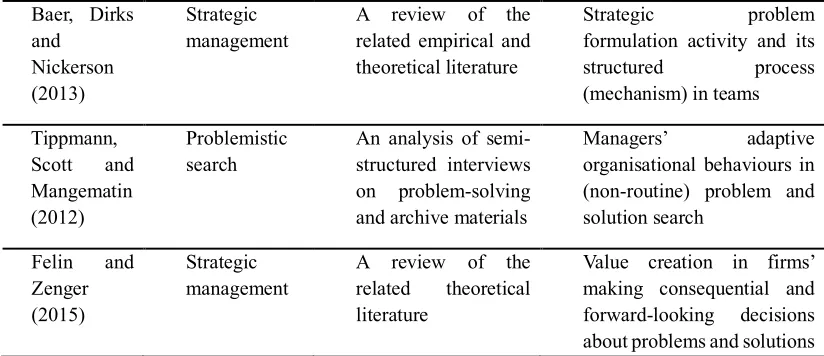
Problem-solving has long been researched from varying approaches in social sciences. Behaviourist and cognitivist approaches are common, and these have shown different perspectives on what counts as problems (i.e. the definitional criteria) and how problem-solving takes place (i.e. the way in which problems are solved). I discuss here firstly the influential studies from these two approaches with examples of studies in my areas of interest (Table 1), then move onto a discursive approach to understanding problems and problem-solving.
In studies taking a behaviourist approach, one of the most cited is Cyert and March’s (1963)
Behavioral Theory of the Firm. The study looks into managerial behaviours in problem-solving and proposes a model, problemistic search, that sequences the course of activity in terms of problem definition search and solution search. As shown in Table 1, the problemistic search model has been developed in recent studies that examine organisational adaptive behaviours believed to be motivated by the phases of problem-solving (e.g. Hansen, 1999; Greve, 2008; Wennberg and Holmquist, 2008; Tippmann, Scott and Mangematin, 2012; Posen
et al., 2018). The key assumption in these studies is that problems are firstly recognised by the discrepancies between organisational expectations and reality (i.e. problem definition search), and this guides the problem solution search (Tippmann, Scott and Mangematin, 2012, p. 747). From this approach, external conditions of the activity are important as they are considered to create the discrepancies that motivate adaptive behaviours, giving rise to organisational problems for the definitional criteria of problems.
The behaviourist approach, which aims to generalise phases of problem-solving activities with behavioural patterns, pays little attention to how the meaning or definition of problems, which are perceived differently for different individuals, are negotiated. In other words, it does not account for how the group of individuals share a common definition of the problems and reach consensus on the problem as well as its solutions. As importantly, the tendency to simplify the activities does not take into consideration a range of situational and contextual factors (e.g. roles, responsibilities and expertise of participants, historicity of the activities, institutional environment, etc.) which are critical in doing problem-solving.
structure and resources for problem-solving. Regarding the mental representation, the authors frame task environments as a ‘problem space’ that provides the available information and further shapes the individuals’ conceptual processes and behaviours (p. 865). This approach has been particularly influential but at the same time leaves out a focus on interaction by treating the information as merely given by the external environment. In this thesis I contend that interaction plays a critical role in not merely conveying but actively constructing knowledge and problems.
Authors Theoretical
base Methods Research focus
Smith (1989)
Phase theories An analysis of individuals’ problem definitional
statements
Phases of problem definition/ representation: recognition, development, exploration
Gavetti and Levinthal, (2000) Bounded rationality (Simon, 1990) Computer
simulations of individuals’ search/ choice processes
Cognitive representation of problems and the interrelationship between cognition and experiential search
Nickerson and Zenger, (2004)
Knowledge management
A review of the related empirical and theoretical literature
Managing knowledge formation in problems and solution search
Heiman and Nickerson (2004)
The knowledge-based view: the PSP
Cooperative
Agreements and Technology
Indicators (CATI) database
(observations)
The effects of problem complexity on organisational alignment and subsequent technological performance
Macher and Boerner (2006)
The knowledge-based view: the PSP
Statistical analysis of database of institutions’ project information
Representation of problem structure: how pharmaceutical firms organize efficiently to solve ill-structured and
complex problems in drug development
Hsieh, Nickerson and Zenger (2007)
The knowledge-based view: the PSP, theory of the entrepreneuria l firm
A review of the related theoretical literature
Opportunity discovery and entrepreneurship in problem-solving (the exploration for solutions) Wennberg and Holmquist (2008) Problemistic search
Surveys on internationalisation processes in firms Interviews
Baer, Dirks and Nickerson (2013) Strategic management
A review of the related empirical and theoretical literature
Strategic problem formulation activity and its structured process (mechanism) in teams
Tippmann, Scott and Mangematin (2012)
Problemistic search
An analysis of semi-structured interviews on problem-solving and archive materials
Managers’ adaptive organisational behaviours in (non-routine) problem and solution search
Felin and Zenger (2015)
Strategic management
A review of the related theoretical literature
[image:22.595.112.524.72.250.2]Value creation in firms’ making consequential and forward-looking decisions about problems and solutions
Table 1Examples of studies on problem-solving from a behaviourist and a cognitivist approach
Business studies in line with the cognitivist approach acknowledge that setting the problem is a problem-solving activity but the discussion remains narrow and fairly linear. As an example, strategic management studies develop a framework called ‘problem solving perspective’ (e.g. Heiman and Nickerson, 2004; Hsieh, Nickerson and Zenger, 2007; Leiblein and Macher, 2009) (see Table 1). The studies apply the framework to shed light on the relation between organisational forms and environmental conditions, which can offer individuals access to the information and resources necessary for problem-solving activities. A problem in this regard is treated as measurable in terms of structure and complexity, described as ‘ill-structured’ and ‘well-structured’ (Fernandes and Simon, 1999), and the structure of problems becomes an important indicator that determines the extent to which strategic knowledge is generated in problem-solving (Heiman and Nickerson, 2004; Macher and Boerner, 2006).
In addition, as shown in problem solving perspective and similar approaches in Table 1, the cognitivist approaches tend to focus heavily on individual cognition processes in representing problems and reduce the role of individuals in cognising and representing information. The role of interaction remains one of representing problems and knowledge. For example, Tippmann, Scott and Mangematin’s (2012) work on problem-solving in a multinational context attempts to illustrate problem-solving processes by drawing on participants’ accounts of problem-solving. It provides limited views on what individuals actually do during the procedure.
To conclude, both cognitive and behavioural approaches seem to be missing the explanation of interactional process in which interactants share and negotiate knowledge and problems and reach consensus on problems and solutions among the individuals.
argue that the interactional process involves the individuals’ negotiations of roles and positions.
Now I turn to studies that look to problem-solving interaction and its relevant activities (e.g. decision-making) and discuss main features of problem-solving discourse.
2.3.Problem-solving discourse
Problem-solving, in general, has been seen to be task- and resolution-oriented, which requires mutual understanding and joint activities of participants (e.g. Måseide, 2007; van de Sande and Greeno, 2012). Interaction then, is central in understanding how problem-solving unfolds in context, and more specifically, how problems are constructed and come to exist. In understanding instiutional interaction, I refer to Drew and Heritage’s (1992) framework. The authors characterise instituonal interaction in terms of ‘participants’ institutional or professional identities’ that are ‘made relevant to the work activities in which they are engage’ (p. 25). The authors characterise instiutional talk with
a) ‘the participants in specific goal orientations to institutional tasks that are tied to their institution-relevant identities’
b) ‘special constraints on what is considered as allowable contributions to the business at hand’
c) ‘special inferences that are particular to specific institutional contexts’
This characterisation suggests the institutionalised and role-structured interaction, which is shaped by both the constraints and the individuals’ agendas that operate within the institutional order. Relevance to this thesis is that in problem-solving meetings, the participants enact their professional roles vis-à-vis the insitutions or the institutional order in constructing and solving problems.
Meetings
has also focused power (ab)use and the ways the more or less powerful in professional contexts are silenced, and the power distribution is resisted and challenged.
What counts as a meeting however is not easy to determine. Typically, the term is used to indicate a gathering for professional purposes which despite variation in form and function, participants ‘commonsensically’ (Cuff and Sharrock, 1985) recognise it as a formal or informal meeting. Numerous attempts have been made to identify common characteristics of meetings and typologies based on the number of participants, purpose of the event, time and place of the gathering proliferate. Angouri and Marra (2010) make a case for a meeting ‘genre’ which is distinguishable and recognisable to the members of a group. Following from work in the field which attempted to define the “generic features of this fundamental form of communication” (Harris and Bargiela-Chiappini, 1997, p. 205), Angouri and Marra’s (2010) research in EU and NZ workplaces shows similarities in the functions and activities (e.g., opening and introducing and explicit or implicit agenda, debating, reporting, accepting/rejecting a position, closing the meeting) rather than specific linguistic features that are context dependent.
In this thesis I continue this line of work by analysing interactional activities that emerge in problem-solving meetigns from opening to closing stages, and the processes by which agreement (or not) on problems is achieved in the interactional events.
In interactional studies, there has been much attention paid to decision-making relative to problem-solving; the decision-making studies that touched upon problems or issues treat problem-solving as either part of the decision-making process or a broader context in which decision-making takes place (e.g. Clifton, 2009, 2012). Yet, as I review the literature below and note in my data, these two are related and share interactional features as they are emergent, embedded and intertwined ‘in the flow of events’ (Chia, 1996, p. 194). Hence, I consider that there is much to learn from understanding the relation between the two in theorising problem-solving discourses.
In the sections that follow, I draw on both problem-solving and decision-making, as these have much to share, and discuss the relation between them. I then discuss key contextual factors to consider in understanding problem-solving discourse.
2.3.1. Problem-solving and/or decision-making
professional roles in the authors’ work, as well as in this thesis, are critical for understanding problem-solving as the individuals actively draw on their roles specific to responsiblities and expertise in ratifying issues as problems. I explore this further in Section 2.3.2, and also in Section 2.4 where I draw on interational perspectives on roles.
Another relevant study on problem-solving discourse is Måseide’s (2007) work on medical problem-solving. This study highlights collaborative processes in which medical problems are presented and dealt with by the participants who ‘operate within local, linguistic and interactional contexts’ (p. 611). The study focuses on how ‘working orders’ are negotiated among the professionals, their colleagues and patients in the processes where diverse medical problems are regulated, developed and solved. Drawing on medical discourses, this sheds light on the characteristics of institutional interaction where the profession and the institution encounter each other, and how it shapes problem-solving discourses. The medical doctors who also bear the institutional responsibility regulate the development of medical problems being presented to their patients. What is relevant to this thesis is the professional and institutional discourses emerged in the author’s work. Although this work does not explicitly mention how the boundaries between the institutional and professional discourses become ambiguous, it suggests these discourses are interwoven through the medical doctors’ performing of their institutional roles. I discuss this point in Section 2.4 in light of the professional role enactment. Turning to interactional studies on decision-making, I refer to Huisman’s (2001) definition of decision, which has been widely cited in the area of studies – the joint ‘construction of a commitment to future action’ (p. 70). In my reading of the meeting data, decision-making as in ‘the construction of a commitment to future action’ constitutes a significant part of the problem-solving. More specifically, as I show in Figure 8 (p. 93) and also the analysis of problem-solving meetings (Chapter 6), problems and decisions appear to be achieved in a co-constituve manner, intrinsincally linked to another in the timeframe of the meetings.
‘parts of an organization combined to produce decisions as they are entangled with each other’ (ibid., 262). Although the focus is placed on decision-making and not accounting for the processes of constructing problems, Langley et al.’s (1995) work usefully situates the interrelation between decisions and problems. In this thesis, I further attempt to provide empricial evidence on this point and provide a nuanced reading of how these feed into each other within an interactional event.
Prominently, recent discourse-based studies on decision-making pay attention to the non-linear nature of problem-solving and decision-making and the complex relationship between the two (e.g. Clifton, 2009, 2012; Kwon, Clarke and Wodak, 2009). Clifton’s (2009, 2012) studies on decision-making, for example, show how decision-making processes are constituted by the negotiation of solutions to an issue defined as a problem. The process of defining issue and problem in this context feeds into the process in which decisions are made. From a reading of my data, the process of defining - hence, constructing problems - can be looked at in the opposite way. In other words, it can be decision-making that constitutes problem-solving. Although not made explicit, Alby and Zucchermaglio’s (2006) study on decision-making in the context of problem-solving in managing emergency shows participants make decisions on how to do problem-solving in the context. In this case, decision-making in its turn supports the process of problem-solving.
In looking into the relations between decision-making and problem-solving, I refer to Marra’s decision model (2003). Although the main research focus is different, the author’s work shares its concerns with interactional activities and approaches to identifying the interactional activities. Marra’s model demonstrates the cyclical patterns in decision-making, involving the core moves, ‘issues raised’, ‘solution proposed’ and ‘decision ratified’ (p. 211). The similar interactional activities have been identified in the problem-solving model presented in this thesis; albeit, the terms are different (see Figure 7, p. 93). Through the analysis of problem-solving meetings from opening to closing, I argue how these can be mutually constitutive, emerging in the meeting event.
line, my data has shown such interactional moment is not distinctive as such, but these activities are rather inferred from participants’ (linguistic) actions or (dis)aligning or (dis)affiliative moves taken to the issues being raised and negotiated. Given this, as also has been mentioned earlier, I avoid conceptualising problem-solving and decision-making as two distinctive activities but achieved in an emerging and mutually co-constitutive way. I discuss this point in light of my data in Chapter 6.
For unpacking the dynamics of workplace interaction in general and problem-solving in particular, interactional studies pay special attention to expertise and the power of the status quo and look to the way these are negotiated in interaction. The power of expertise and the status quo have an obvious implication on one’s professional and institutional roles (-responsibilities), which brings to the interaction specific perspectives and actions. Of particular interest in this thesis is the way employees enact and negotiate their institutional/professional roles specific to expertise and responsibilities in problem-solving meetings, and how the former shapes the latter. I discuss this point in detail in the following sections.
2.3.2. Negotiation of expertise and power
One of the most commonly discussed features in discourse-based studies on problem-solving or similar (e.g. Alby and Zucchermaglio, 2006; Clifton, 2009; Angouri and Bargiela-Chiappini, 2011; Asmuß and Oshima, 2012) is disagreement and negotiation in managing divergent views. In the context of problem-solving, Angouri (2012) sees disagreement as ‘an inherent and hence unmarked’ characteristic of the process, and the process of negotiation as an essential part in constructing a meeting as having a problem-solving function (p. 1568), and this further contributes to the construction of new knowledge in the given setting. In context of my data, I have identified the negotiation processes emerged throughout the interactional process in which interactants negotiate shared understandings of problems and situations.
succinctly put it, ‘negotiation is not just a matter of reaching agreement between differing professional perspectives on the case at hand; it is also a matter of fulfilling and giving shape to institutional goals’ (p. 484).
Negotiations in this way become a space where professional knowledge and authority are challenged. Dall and Caswell’s (2017) work identifies two main patterns of negotiation – ‘expanding’ and ‘postponing’. The former takes place ‘when professionals hold on to the issue of the negotiation and work to avoid the discussion being closed’; and the latter takes place ‘where decisions are delayed or avoided’ (p. 487). Similar patterns have emerged in my data, as I illustrate with Figure 7 in Section 6.2. Yet I conceptualise them in terms of formulating and resuming, seeing that formulating work involves expanding formulations of issues and negotiating the formulations, and resumption incorporates the processes of postponing and resuming the prior talk which has been delayed. I explain these two concepts in Section 6.2 as the core interactional activities that emerged in my data.
Negotiation takes place throughout interactional activities, and it provides analysts a critical point where the status and power are enacted and negotiated. Status and power have been one of the key aspects in investigating workplace interaction, and there has been much research
devoted to theorising how they manifest in interaction in workplace and institutional settings (e.g. Locher, 2004; Holmes, Schnurr and Marra, 2007). As has also been noted in Section 3.3
on the relations between the HQ and subsidiaries, power from discursive perspectives is not
static but ‘relational, dynamic and contestable’ phenomena (Locher, 2004, p. 37). In other
words, the power of the status quo does not always derive from hierarchical position but
constructed and negotiated in workplace interaction (Holmes and Stubbe, 2003). In sociolinguistic workplace studies, researchers take a bottom-up approach and provide detailed analysis of the discourses in which the power of the status quo shapes how to proceed in forms of ‘appeal to proper procedures’ or ‘an assertion of the inherent rights associated with the existing status hierarchy’ (Stubbe et al., 2003, p. 371).
Epistemic status and stance
problem-solving activities where interactants have to use and share background knowledge and make sense of their co-interactants’ actions. At the same time, as Heinemann, Lindström and Steensig (2011) argue, interactants are subject to display social affiliation by enacting their epistemic stances under such circumstances. Epistemic stance here is relevant to epistemic status but needs be distinguished to understand linguistic acts under investigation. In interactional studies, epistemic status, like the other social constructivist conceptions such as status and role, is treated as something that is enacted and negotiated by the interactants. In Heritage’s (2012) framework, epistemic status is ‘an inherently relative and relational concept concerning the relative access to some domain of two (or more) persons at some point in time’ (p. 4). The author sees epistemic status as a salient factor in determining and hence understanding social actions, in that interactants are aware of relative epistemic status, ‘distribution of knowledge and of rights to knowledge between them’ (ibid., 24). Epistemic status, then, as Heritage (2012) argues, should be understood as ‘consensual and thus effectively real state of affairs, based upon the participants’ valuation of one another’s epistemic access and rights to specific domains of knowledge and information’ (p. 7). Enacting epistemic status necessarily involves epistemic stance and relevant role enactment. According to Heritage (2012), epistemic stance concerns ‘the moment-by-moment expression’ of the relative status (p. 6). As linguistic features that index epistemic stances, studies on interactional stance identify question-answer sequences, oh-prefacing (Heinemann, Lindström and Steensig, 2012), (no-)knowledge claims (Asmuß, 2011; Keevallik, 2011), asserting, requesting information, and declaratives (Heritage, 2012). As I discuss in the analysis of problem-solving meetings in Section 6.3, those features with the speakers’ epistemic domains prevail in my findings. In my data, these usefully work to (re)formulate issues, situations and actions, and ratify the issues as problems or not, indexing their (perceived) professional roles. As emerged in the data analysis, I discuss further how epistemic stances can link interactants’ temporal roles in the interactional setting and professional roles that goes beyond the immediate interactional context.
Now I turn to the social constructionist perspectives on the professional role, which will facilitate an understanding of employees’ constructions of problems.
2.4. Professional role as a social, emergent process
pre-defined social facts. This is in line with the thesis’s position that brings to the fore the role of language, and more broadly the role of agency of individuals (Section 1.3). In my corpus, professional roles are talked in interview settings and enacted in the context of problem-solving. In this section, I explore social constructionist concepts of roles and identity as related concepts then turn to theoretical and empirical studies that explain how professional roles are negotiated in institutional interaction.
2.4.1. Role and identity
Within a social constructionist paradigm, which this thesis adopts (Section 1.3), a similar and perhaps interchangeable concept is identity. The constructionist approach rejects a static view of identity as a stable property that one possesses but sees identity as something that individuals ‘actively do’, construct and negotiate in interaction (e.g. Holmes, Stubbe and Vine, 1999; Bucholtz and Hall, 2005; Bamberg, De Fina and Schiffrin, 2011; De Fina, 2012). Doing
and being then, are intimately linked (Marra and Angouri, 2011, pp. 1–2). The studies look to linguistic choices and their creation of meaning in interaction, i.e. the association of language with ideas and ideologies (De Fina, 2012, p. 269).
In this way, the concepts of role and identity share common features, and studies have recognised the relation between the two, sometimes using them interchangeably. Hall, Sarangi and Slembrouck (1999), for example, argue that identities are negotiated as individuals enact their roles in relation to social expectation; the role, in turn, is ‘(re) confirmed through situated identity work’ (p. 228). Marra and Angouri (2011, p. 3) define role as ‘a resource for self-identity’ as individuals draw on professional roles in constructing the self, and self-identity in this way is understood to derive from the roles. As the authors claim, the analysis of the professional role enactment can throw light on one’s identity.
2.4.2. Negotiating professional roles in interaction
Interactional studies on professional roles demonstrate how the role is negotiated and hence jointly achieved by both the speakers enacting the performances and the audiences understanding the performances in context (e.g. Sarangi, 2010; Asmuß and Oshima, 2012; Halvorsen and Sarangi, 2015). In professional settings, the complexity of role enactment is evident in that individuals are subject to balancing their roles in the institutional setting, shifting them strategically from one to another in appealing to one’s responsibility, positioning and achieving interactional goals (Sarangi, 2011). The complexity can be explained in light of Sarangi and Roberts’s (1999, p. 15) framework on professional and institutional discourses. The authors provide a similar conceptualisation of institutional discourse to the one of Drew and Heritage (1992) discussed earlier (Section 2.3), yet it throws further light on the role of the professional:
what the professionals routinely do as a way of accomplishing their duties and responsibilities can be called professional discourse […] what counts as legitimate professional discourse will depend on the range of discourses available within an institutional order.
In this sense, the authors see the institution and profession as mutually co-constitutive. Hence, instead of seeing them as a dichotomy or focusing on the tensions emerging between the two,
as the authors suggested, it would be more comprehensible to see them in terms of ‘the interplay between the institutional and professional discourses’ (Sarangi and Roberts, 1999, p.16).
of the process as the doctors are subject to ‘(re)configure relevant roles according to the character and expectation of the patients’ (p. 54). Hence, as the author notes, individuals are ‘exposed to a repertoire of professional roles in their institutional and social context’ and have to ‘momentarily and cumulatively configure relevant roles’ according to social expectation (ibid.).
According to Henriksen (2008, p. 49), organisations, in turn, are enacted by interactants’ ‘role perspectives onto the issues of the context’, seeing role as ‘dynamic representations of structural perspectives’. Roles enacted in interaction can ‘bring structural issues into the interaction’ in a sense that ‘by enacting a role, its socially legitimated rights, duties, values, norms and perspectives are brought into play’ (ibid., 48). In examining the ways the institution is interactionally invoked, Nielsen et al. (2012) have demonstrated how the procedure of invoking the institution brings about certain actions in talk, thus indexing the situated expertise embedded in professional roles and responsibilities. In this sense, I contend that role should be conceptualised as dynamic positions that are both interactional and structural. In other words, role emerges in the interplay between social structure and the agency of individuals. My use of the concept ‘professional role’ encompasses both professional and institutional versions in the sense that these two are interlaced, enacted in interaction and situated in the institutional setting. Empirical studies have shed light on the complex ways in which the institutional and professional discourses and orders come into interactional processes in
institutional settings. Mehan’s (1983) study on team meetings concerning children with special needs relates authority in decision-making to institutional role as in speaking for the institutional and professional role as psychologist expert. The study demonstrated how the institutional and professional roles are linguistically enacted, projecting one’s authority in making claims and decisions. Griffiths (1997), in a similar vein, demonstrates the interconnection between institutional and professional roles by analysing different ways of organizing teamwork and providing their implications for the authority of different professions. Måseide (2007)’s studies on medical problem-solving further demonstrates how doctors manage professional and institutional problems in interaction and negotiate the institutional and professional orders. While acknowledging the relation between the institutional and professional roles and discourses, Graham (2009) illustrates the tension between the two by illustrating how competing hierarchies of institutional and expertise-based characteristics are manifested and managed at the interactional level. The analysis highlights participants’ perceptions of hierarchical status – ‘the ways in which people see themselves in relation to one another’ – as an important factor for investigation (p. 15).
within the activity. Although the authors provide a detailed analysis that provides nuanced understanding of role-positioning that is ‘accomplished situationally and in activity-specific ways’ (p. 2), the focus of analysis on discourse and activity roles remaining at the participation level does not provide much information about the institutional and professional characteristics of the participants. In other words, it does not account for the interactants’ roles specific to expertise and responsibilities – ‘anchored positions outside the temporary context’ of the interactional event which individuals draw on (Angouri and Mondada, 2017, p. 474), and which I consider to be crucial in understanding how problem-solving interaction and other relevant workplace interaction unfold.
As I discuss in my analysis, organisational role-responsibilities and expertise are valuable concepts that individuals discuss in their own terms in interviews and when enacting problem-solving interaction. Interactants project or claim roles specific to their responsibilities and expertise, while ratifying issues as problems and offering solutions to the problems at hand and balancing professional expertise with interpersonal issues. Such interactional activities, in turn, provide the analyst with a frame for studying how participants, through specific discourse practices, take positions and are being positioned by others in relation to specific roles and identities, and, therefore, the organisation emerges.
2.5.Summary
In this chapter, I have reviewed relevant scholarships in the problem-solving domain and institutional interactional studies. These together establish the theoretical framework of this thesis to conceptualise problem (-solving) and professional roles from a discursive perspective. In the review, I also have noted the gap and opportunities in the existing studies which this thesis seeks to explore. In Section 2.2, I have noted that in the domain of problem-solving, much of the existing literature treats the problem as a given and hence overlook the processes in and through which problems come into existence. This is the research gap this thesis aims to address and makes a contribution to problem solving domain by providing interactional perspectives.
emerge in problem-solving, and further investigate the relations between problem-solving and decision-making in meeting events.
Regarding the concept of role, many interactional studies have provided insight into understanding it as a dynamic position. The conception has been usefully drawn on in my analysis of problem-solving meetings. Yet in interactional studies, there seems to be little research into professional role enactment in multinational, inter-organisational contexts. At the same time, in international business studies little work has probed how professional roles are negotiated in interaction between employees. This is another important area that this thesis addresses. In using the concept of roles, I suggest role can be explored in an interdisciplinary frame drawing on both sociolinguistics and organisational perspectives (Section 1.3).
Now I move onto the second part of the literature review that provides theoretical and empirical perspectives on the multinational context and discuss them in relation to the ‘problems’ perceived and articulated by my participants.
3.
Literature review II: The multinational corporate workplace
3.1.Introduction
Researching work-related problems or business activities requires an understanding of the workplace context, encompassing organisational structure, norms, ideologies and local team practices (Roberts, 2010, p. 221) and specifically employees’ understanding of local practices – how they perceive, categorise and explain things (Zhu and Bargiela-Chiappini, 2013, p. 382). By this account, this chapter provides theoretical and empirical work that provides perspectives on the multinational corporate workplace context and sheds light on issues and problems emerging in such a context in relation to my data.
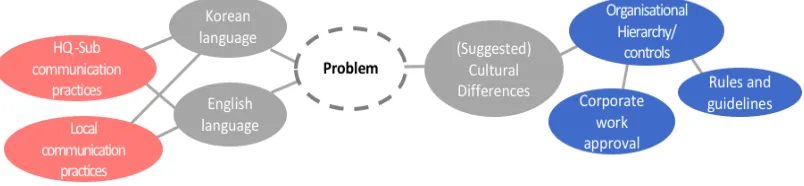
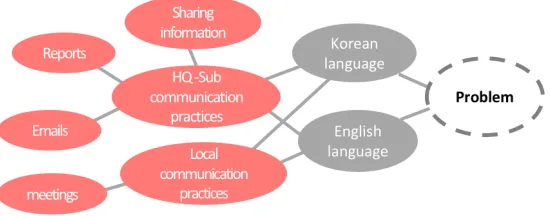
Figure 1 provides a first visualisation of the key aspects of the multinational corporate workplace context relevant to the resources employees mobilise in constructing the organisational problems. This paves the way for Chapters 5 and 7 (see Figure 5, p. 67, and Figure 6, p. 78) wherein I discuss symbolic and material issues employees draw on in constructing the organisational problems and positioning themselves and others.
Figure 1 Visualisation of the key relevant aspects of multinational corporate workplace context
As shown in the figure, language, culture and the HQ-subsidiary relationships are most relevant aspects that frequently emerge in my corpus and foreground employees’ construction of problems. The linkage between culture and HQ-subsidiary relationships are largely suggested by MNC literature as I will explore in Section 3.3.2 and Section 3.4, and also in my data analysis (Section 5.3).
I the sections that follow, I firstly explore multilingualism and language ideologies to provide views on language as situated at the interface between the local, organisational and social contexts (Section 3.2). In Section 3.3, I provide different approaches to culture – cultural essentialism, culture as a discourse and communities of practice. I discuss here how I understand culture emerging in my interview data, and the relevance of the communities of practice framework to understand problem-solving as an ongoing professional engagement. Regarding HQ-subsidiary relationships, which emerge in my data as one of the key contextual factors, I explore theoretical and empirical studies that conceptualise the HQ-subsidiary relationships (Section 3.4).