Bootstrapping via Graph Propagation
Max Whitney and Anoop Sarkar∗
Simon Fraser University, School of Computing Science Burnaby, BC V5A 1S6, Canada
{mwhitney,anoop}@sfu.ca
Abstract
Bootstrapping a classifier from a small set of seed rules can be viewed as the propaga-tion of labels between examples via features shared between them. This paper introduces a novel variant of the Yarowsky algorithm based on this view. It is a bootstrapping learning method which uses a graph propagation algo-rithm with a well defined objective function. The experimental results show that our pro-posed bootstrapping algorithm achieves state of the art performance or better on several dif-ferent natural language data sets.
1 Introduction
In this paper, we are concerned with a case of semi-supervised learning that is close to unsemi-supervised learning, in that the labelled and unlabelled data points are from the same domain and only a small set of seed rules is used to derive the labelled points. We refer to this setting asbootstrapping. In contrast, typical semi-supervised learning deals with a large number of labelled points, and a domain adaptation task with unlabelled points from the new domain.
The two dominant discriminative learning meth-ods for bootstrapping are self-training (Scud-der, 1965) and co-training (Blum and Mitchell, 1998). In this paper we focus on a self-training style bootstrapping algorithm, the Yarowsky algo-rithm (Yarowsky, 1995). Variants of this algoalgo-rithm have been formalized as optimizing an objective function in previous work by Abney (2004) and Haf-fari and Sarkar (2007), but it is not clear that any perform as well as the Yarowsky algorithm itself.
We take advantage of this formalization and in-troduce a novel algorithm called Yarowsky-prop which builds on the algorithms of Yarowsky (1995) and Subramanya et al. (2010). It is theoretically
∗
This research was partially supported by an NSERC, Canada (RGPIN: 264905) grant. We would like to thank Gho-lamreza Haffari and the anonymous reviewers for their com-ments. We particularly thank Michael Collins, Jason Eisner, and Damianos Karakos for the data we used in our experiments.
x denotes an example f,g denote features i,k denote labels
X set of training examples Fx set of features for examplex
Y current labelling ofX Yx current label for examplex
⊥ value ofYxfor unlabelled examples
L number of labels (not including⊥)
Λ set of currently labelled examples V set of currently unlabelled examples Xf set of examples with featuref
Λf set of currently labelled examples withf
Vf set of currently unlabelled examples withf Λj set of examples currently labelled withj Λf j set of examples withfcurrently labelled withj
Table 1: Notation of Abney (2004).
well-understood as minimizing an objective func-tion at each iterafunc-tion, and it obtains state of the art performance on several different NLP data sets. To our knowledge, this is the first theoretically mo-tivated self-training bootstrapping algorithm which performs as well as the Yarowsky algorithm.
2 Bootstrapping
Abney (2004) defines useful notation for semi-supervised learning, shown in table 1. Note thatΛ, V, etc. are relative to the current labellingY. We additionally define F to be the set of all features, and useU to denote the uniform distribution. In the bootstrapping setting the learner is given an initial partial labellingY(0)where only a few examples are labelled (i.e.Yx(0) =⊥for mostx).
Abney (2004) defines three probability distribu-tions in his analysis of bootstrapping:θf j is the pa-rameter for featuref with labelj, taken to be nor-malized so thatθf is a distribution over labels.φxis the labelling distribution representing the currentY; it is a point distribution for labelled examples and uniform for unlabelled examples. πx is the predic-tion distribupredic-tion over labels for examplex.
The approach of Haghighi and Klein (2006b) and Haghighi and Klein (2006a) also uses a small set of
Algorithm 1: The basic Yarowsky algorithm. Require: training dataXand a seed DLθ(0)
1: applyθ(0)toXproduce a labellingY(0)
2: foriterationtto maximum or convergencedo 3: train a new DLθonY(t)
4: applyθtoX, to produceY(t+1)
5: end for
seed rules but uses them to inject features into a joint model p(x, j) which they train using expectation-maximization for Markov random fields. We focus on discriminative training which does not require complex partition functions for normalization. Blum and Chawla (2001) introduce an early use of trans-ductive learning using graph propagation. X. Zhu and Z. Ghahramani and J. Lafferty (2003)’s method of graph propagation is predominantly transductive, and the non-transductive version is closely related to Abney (2004) c.f. Haffari and Sarkar (2007).1
3 Existing algorithms
3.1 Yarowsky
A decision list (DL) is a (ordered) list of feature-label pairs (rules) which is produced by assigning a score to each rule and sorting on this score. It chooses a label for an example from the first rule whose feature is a feature of the example. For a DL the prediction distribution is defined byπx(j)∝
maxf∈Fxθf j. The basic Yarowsky algorithm is shown in algorithm 1. Note that at any point some training examples may be left unlabelled byY(t).
We use Collins and Singer (1999) for our exact specification of Yarowsky.2 It uses DL rule scores
θf j ∝
|Λf j|+
|Λf|+L (1)
whereis a smoothing constant. When constructing a DL it keeps only the rules with (pre-normalized) score over a thresholdζ. In our implementation we add the seed rules to each subsequent DL.3
1Large-scale information extraction, e.g. (Hearst, 1992), Snowball (Agichtein and Gravano, 2000), AutoSlog (Riloff and Shepherd, 1997), and Junto (Talukdar, 2010) among others, also have similarities to our approach. We focus on the formal anal-ysis of the Yarowsky algorithm by Abney (2004).
2It is similar to that of Yarowsky (1995) but is better spec-ified and omits word sense disambiguation optimizations. The general algorithm in Yarowsky (1995) is self-training with any kind of underlying supervised classifier, but we follow the con-vention of using Yarowsky to refer to the DL algorithm.
3
This is not clearly specified in Collins and Singer (1999),
3.2 Yarowsky-cautious
Collins and Singer (1999) also introduce a variant algorithm Yarowsky-cautious. Here the DL training step keeps only the topnrules(f, j)over the thresh-old for each labelj, ordered by|Λf|. Additionally the thresholdζis checked against|Λf j|/|Λf|instead of the smoothed score. nbegins atn0 and is
incre-mented by∆nat each iteration. We add the seed DL to the new DL after applying the cautious pruning. Cautiousness limits not only the size of the DL but also the number of labelled examples, prioritizing decisions which are believed to be of high accuracy. At the final iteration Yarowsky-cautious uses the current labelling to train a DL without a threshold or cautiousness, and this DL is used for testing. We call this the retraining step.4
3.3 DL-CoTrain
Collins and Singer (1999) also introduce the co-training algorithm DL-CoTrain. This algorithm al-ternates between two DLs using disjoint views of the features in the data. At each step it trains a DL and then produces a new labelling for the other DL. Each DL uses thresholding and cautiousness as we describe for Yarowsky-cautious. At the end the DLs are combined, the result is used to label the data, and a retraining step is done from this single labelling.
3.4 Y-1/DL-1-VS
One of the variant algorithms of Abney (2004) is Y-1/DL-1-VS (referred to by Haffari and Sarkar (2007) as simply DL-1). Besides various changes in the specifics of how the labelling is produced, this algorithm has two differences versus Yarowsky. Firstly, the smoothing constantin (1) is replaced by 1/|Vf|. Secondly, π is redefined as πx(j) =
1
|Fx|
P
f∈Fxθf j, which we refer to as the sum def-inition ofπ. This definition does not match a literal DL but is easier to analyze.
We are not concerned here with the details of Y-1/DL-1-VS, but we note that Haffari and Sarkar
but is used for DL-CoTrain in the same paper.
4The details of Yarowsky-cautious are not clearly specified in Collins and Singer (1999). Based on similar parts of DL-CoTrain we assume the that the topn selection is per label rather in total, that the thresholding value is unsmoothed, and that there is a retraining step. We also assume their notation
(2007) provide an objective function for this al-gorithm using a generalized definition of cross-entropy in terms of Bregman distance, which mo-tivates our objective in section 4. The Breg-man distance between two discrete probability dis-tributions p and q is defined as Bψ(p, q) = P
i[ψ(pi)−ψ(qi)−ψ0(qi)(pi−qi)]. As a specific case we haveBt2(p, q) =Pi(pi−qi)2=||p−q||2.
Then Bregman distance-based entropy isHt2(p) =
−P
ip2i, KL-Divergence isBt2, and cross-entropy
follows the standard definition in terms ofHt2 and
Bt2. The objective minimized by Y-1/DL-1-VS is:
X
x∈X f∈Fx
Ht2(φx||θf) = X
x∈X f∈Fx
"
Bt2(φx||θf)− X
y φ2x
#
.
(2)
3.5 Yarowsky-sum
As a baseline for the sum definition ofπ, we intro-duce the Yarowsky-sum algorithm. It is the same as Yarowsky except that we use the sum definition when labelling: for examplexwe choose the labelj with the highest (sum)πx(j), but setYx =⊥if the sum is zero. Note that this is a linear model similar to a conditional random field (CRF) (Lafferty et al., 2001) for unstructured multiclass problems.
3.6 Bipartite graph algorithms
Haffari and Sarkar (2007) suggest a bipartite graph framework for semi-supervised learning based on their analysis of Y-1/DL-1-VS and objec-tive (2). The graph has verticesX ∪F and edges
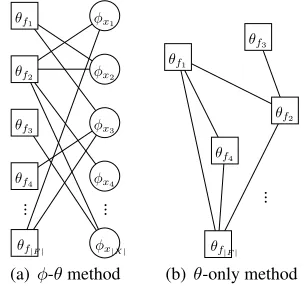
{(x, f) : x∈X, f ∈Fx}, as in the graph shown in figure 1(a). Each vertex represents a distribution over labels, and in this view Yarowsky can be seen as alternately updating the example distributions based on the feature distributions and visa versa.
Based on this they give algorithm 2, which we call HS-bipartite. It is parametrized by two functions which are called features-to-example and examples-to-feature here. Each can be one of two choices: average(S) is the normalized aver-age of the distributions of S, while majority(S)
is a uniform distribution if all labels are supported by equal numbers of distributions ofS, and other-wise a point distribution with mass on the best sup-ported label. Theaverage-majorityform is similar
Algorithm 2: HS-bipartite.
1: applyθ(0)toXproduce a labellingY(0)
2: foriterationtto maximum or convergencedo 3: forf ∈Fdo
4: letp=examples-to-feature({φx: x∈Xf}) 5: ifp6=U then letθf =p
6: end for 7: forx∈Xdo
8: letp=features-to-example({θf : f ∈Fx}) 9: ifp6=U then letφx=p
10: end for 11: end for
to Y-1/DL-1-VS, and the majority-majority form minimizes a different objective similar to (2).
In our implementation we label training data (for the convergence check) with theφdistributions from the graph. We label test data by constructing new φx =examples-to-feature(Fx)for the unseenx.
3.7 Semi-supervised learning algorithm of Sub-ramanya et al. (2010)
Subramanya et al. (2010) give a semi-supervised al-gorithm for part of speech tagging. Unlike the algo-rithms described above, it is for domain adaptation with large amounts of labelled data rather than boot-strapping with a small number of seeds.
This algorithm is structurally similar to Yarowsky in that it begins from an initial partial labelling and repeatedly trains a classifier on the labelling and then relabels the data. It uses a CRF (Lafferty et al., 2001) as the underlying supervised learner. It dif-fers significantly from Yarowsky in two other ways: First, instead of only training a CRF it also uses a step of graph propagation between distributions over then-grams in the data. Second, it does the propa-gation on distributions overn-gram types rather than overn-gram tokens (instances in the data).
They argue that using propagation over types al-lows the algorithm to enforce constraints and find similarities that self-training cannot. We are not con-cerned here with the details of this algorithm, but it motivates our work firstly in providing the graph propagation which we will describe in more detail in section 4, and secondly in providing an algorithmic structure that we use for our algorithm in section 5.
3.8 Collins and Singer (1999)’s EM
Method V N(u) qu
φ-θ X∪F Nx=Fx,Nf =Xf qx=φx,qf=θf
π-θ X∪F Nx=Fx,Nf =Xf qx=πx,qf =θf
θ-only F Nf =Sx∈XfFx\f qf =θf
θT-only F N
f =Sx∈XfFx\f qf =θfT Table 2: Graph structures for propagation.
They do not specify tuning details, but to get com-parable accuracy we found it was necessary to do smoothing and to include weightsλ1and λ2 on the
expected counts of seed-labelled and initially unla-belled examples respectively (Nigam et al., 2000).
4 Graph propagation
The graph propagation of Subramanya et al. (2010) is a method for smoothing distributions attached to vertices of a graph. Here we present it with an alter-nate notation using Bregman distances as described in section 3.4.5 The objective is
µ X
u∈V v∈N(i)
wuvBt2(qu, qv) +ν X
u∈V
Bt2(qu, U) (3)
whereV is a set of vertices,N(v)is the neighbour-hood of vertexv, andqv is an initial distribution for each vertexvto be smoothed. They give an iterative update to minimize (3). Note that (3) is independent of their specific graph structure, distributions, and semi-supervised learning algorithm.
We propose four methods for using this propaga-tion with Yarowsky. These methods all use con-stant edge weights (wuv = 1). The distributions and graph structures are shown in table 2. Figure 1 shows example graphs forφ-θandθ-only. π-θand θT-only are similar, and are described below.
The graph structure ofφ-θis the bipartite graph of Haffari and Sarkar (2007). In fact,φ-θthe propa-gation objective (3) and Haffari and Sarkar (2007)’s Y-1/DL-1-VS objective (2) are identical up to con-stant coefficients and an extra concon-stant term.6 φ-θ
5
We omit the option to hold some of the distributions at fixed values, which would add an extra term to the objective.
6
The differences are specifically: First, (3) adds the con-stant coefficientsµandν. Second, (3) sums over each edge twice (once in each direction), while (2) sums over each only once. Sincewuv =wvuandBt2(qu, qv) =Bt2(qv, qu), this can be folded into the constantµ. Third, after expanding (2) there is a term|Fx|inside the sum forHt2(φx)which is not
present in (3). This does not effect the direction of minimiza-tion. Fourth,Bt2(qu, U)in (3) expands toHt2(qu)plus a
con-stant, adding an extra constant term to the total.
θf|F| θf4 θf3 θf2
θf1 φx1
φx2
φx3
φx4
φx|X|
... ...
(a)φ-θmethod
θf1
θf|F| θf2
θf4 θf3
...
[image:4.612.348.500.61.204.2](b)θ-only method Figure 1: Example graphs forφ-θandθ-only propagation.
therefore gives us a direct way to optimize (2). The other three methods do not correspond to the objective of Haffari and Sarkar (2007). The π-θ method is likeφ-θexcept for usingπas the distribu-tion for example vertices.
The bipartite graph of the first two methods dif-fers from the structure used by Subramanya et al. (2010) in that it does propagation between two dif-ferent kinds of distributions instead of only one kind. We also adopt a more comparable approach with a graph over only features. Here we define adjacency by co-occurrence in the same example. Theθ-only method uses this graph andθas the distribution.
Finally, we noted in section 3.7 that the algo-rithm of Subramanya et al. (2010) does one addi-tional step in converting from token level distribu-tions to type level distribudistribu-tions. TheθT-only method therefore uses the feature-only graph but for the dis-tribution uses a type level version ofθ defined by θT
f j = |X1f|
P
x∈Xf πx(j).
5 Novel Yarowsky-prop algorithm
We call our graph propagation based algorithm Yarowsky-prop. It is shown withθT-only propaga-tion in algorithm 3. It is based on the Yarowsky al-gorithm, with the following changes: an added step to calculateθT(line 4), an added step to calculateθP (line 5), the use ofθPrather than the DL to update
the labelling (line 6), and the use of the sum defini-tion ofπ. Line 7 does DL training as we describe in sections 3.1 and 3.2. Propagation is done with the iterative update of Subramanya et al. (2010).
Algorithm 3: Yarowsky-prop.
1: letθf jbe the scores of the seed rules // crf train 2: foriterationtto maximum or convergencedo 3: letπx(j) = |F1x|Pf∈Fxθf j // post. decode
4: letθf jT =
P
x∈Xfπx(j)
|Xf| // token to type
5: propagateθTto getθP // graph propagate 6: label the data withθP // viterbi decode 7: train a new DLθf j // crf train
8: end for
done onθ, using the graph of figure 1(b). Inφ-θand π-θpropagation is done on the respective bipartite graph (figure 1(a) or the equivalent withπ). Line 4 is skipped for these methods, andφis as defined in section 2. For the bipartite graph methods φ-θ andπ-θonly the propagatedθvalues on the feature nodes are used forθP (the distributions on the exam-ple nodes are ignored after the propagation itself).
The algorithm usesθf j values rather than an ex-plicit DL for labelling. The (pre-normalized) score for any(f, j)not in the DL is taken to be zero. Be-sides using the sum definition ofπwhen calculating θT, we also use a sum in labelling. When labelling
an examplex(at line 6 and also on testing data) we usearg maxjP
f∈Fx:θPf6=Uθ
P
f j, but set Yx = ⊥if the sum is zero. Ignoring uniformθPf values is in-tended to provide an equivalent to the DL behaviour of using evidence only from rules that are in the list. We include the cautiousness of Yarowsky-cautious (section 3.2) in the DL training on line 7. At the labelling step on line 6 we label only examples which the pre-propagatedθwould also assign a label (using the same rules described above forθP). This choice is intended to provide an equivalent to the Yarowsky-cautious behaviour of limiting the num-ber of labelled examples; mostθP
f are non-uniform, so without it most examples become labelled early.
We observe further similarity between the Yarowsky algorithm and the general approach of Subramanya et al. (2010) by comparing algorithm 3 here with their algorithm 1. The comments in al-gorithm 3 give the corresponding parts of their algo-rithm. Note that each line has a similar purpose.
6 Evaluation
6.1 Tasks and data
For evaluation we use the tasks of Collins and Singer (1999) and Eisner and Karakos (2005), with data
Rank Score Feature Label
1 0.999900 New-York loc.
2 0.999900 California loc.
3 0.999900 U.S. loc.
4 0.999900 Microsoft org.
5 0.999900 I.B.M. org.
6 0.999900 Incorporated org.
7 0.999900 Mr. per.
8 0.999976 U.S. loc.
9 0.999957 New-York-Stock-Exchange loc.
10 0.999952 California loc.
11 0.999947 New-York loc.
12 0.999946 court-in loc.
13 0.975154 Company-of loc.
[image:5.612.317.534.58.229.2].. .
Figure 2: A DL from iteration 5 of Yarowsky on the named en-tity task. Scores are pre-normalized values from the expression on the left side of (1), notθf jvalues. Context features are indi-cated byitalics; all others are spelling features. Specific feature types are omitted. Seed rules are indicated byboldranks.
kindly provided by the respective authors.
The task of Collins and Singer (1999) is named entity classification on data from New York Times text.7 The data set was pre-processed by a statisti-cal parser (Collins, 1997) and all noun phrases that are potential named entities were extracted from the parse tree. Each noun phrase is to be labelled as a person, organization, or location. The parse tree provides the surrounding context ascontext features
such as the words in prepositional phrase and rela-tive clause modifiers, etc., and the actual words in the noun phrase provide thespelling features. The test data additionally contains some noise examples which are not in the three named entity categories. We use the seed rules the authors provide, which are the first seven items in figure 2. For DL-CoTrain, we use their two views: one view is the spelling fea-tures, and the other is the context features. Figure 2 shows a DL from Yarowsky training on this task.
The tasks of Eisner and Karakos (2005) are word sense disambiguation on several English words which have two senses corresponding to two dif-ferent words in French. Data was extracted from the Canadian Hansards, using the English side to produce training and test data and the French side to produce the gold labelling. Features are the original and lemmatized words immediately
adja-7
cent to the word to be disambiguated, and origi-nal and lemmatized context words in the same sen-tence. Their seeds are pairs of adjacent word fea-tures, with one feature for each label (sense). We use the ‘drug’, ‘land’, and ‘sentence’ tasks, and the seed rules from their best seed selection: ‘alco-hol’/‘medical’, ‘acres’/‘court’, and ‘reads’/‘served’ respectively (they do not provide seeds for their other three tasks). For DL-CoTrain we use adjacent words for one view and context words for the other.
6.2 Experimental set up
Where applicable we use smoothing = 0.1, a threshold ζ = 0.95, and cautiousness parameters n0 = ∆n = 5 as in Collins and Singer (1999)
and propagation parametersµ = 0.6, ν = 0.01 as in Subramanya et al. (2010). Initial experiments with different propagation parameters suggested that as long asν was set at this value changing µ had relatively little effect on the accuracy. We did not find any propagation parameter settings that outper-formed this choice. For the Yarowsky-prop algo-rithms we perform a single iteration of the propa-gation update for each iteration of the algorithm.
For EM we use weightsλ1 = 0.98, andλ2= 0.02
(see section 3.8), which were found in initial experi-ments to be the best values, and results are averaged over 10 random initializations.
The named entity test set contains some examples that are neither person, organization, nor location. Collins and Singer (1999) define noise accuracy as accuracy that includes such instances, and clean ac-curacy as acac-curacy calculated across only the exam-ples which are one of the known labels. We report only clean accuracy in this paper; noise accuracy tracks clean accuracy but is a little lower. There is no difference on the word sense data sets. We also report (clean) non-seeded accuracy, which we define to be clean accuracy over only examples which are not assigned a label by the seed rules. This is in-tended to evaluate what the algorithm has learned, rather than what it can achieve by using the input information directly (Daume, 2011).
We test Yarowsky, Yarowsky-cautious, Yarowsky-sum, DL-CoTrain, HS-bipartite in all four forms, and Yarowsky-prop cautious and non-cautious and in all four forms. For each algo-rithm except EM we perform a final retraining step
Gold Spelling features Context features
loc. Waukegan maker,LEFT
loc. Mexico, president, of president-of,RIGHT
[image:6.612.322.527.61.106.2]loc. La-Jolla, La Jolla company,LEFT
Figure 3: Named entity test set examples where Yarowsky-prop θ-only is correct and no other tested algorithms are correct. The specific feature types are omitted.
as described for Yarowsky-cautious (section 3.2). Our programs and experiment scripts have been made available.8
6.3 Accuracy
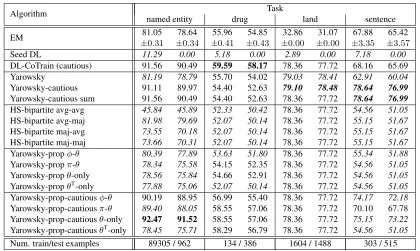
Table 3 shows the final test set accuracies for the all the algorithms. The seed DL accuracy is also included for reference.
The best performing form of our novel algo-rithm is Yarowsky-prop-cautious θ-only. It numer-ically outperforms DL-CoTrain on the named entity task, is not (statistically) significantly worse on the drug and land tasks, and is significantly better on the sentence task. It also numerically outperforms Yarowsky-cautious on the named entity task and is significantly better on the drug task. Is significantly worse on the land task, where most algorithms con-verge at labelling all examples with the first sense. It is significantly worse on the sentence task, although it is the second best performing algorithm and sev-eral percent above DL-CoTrain on that task.
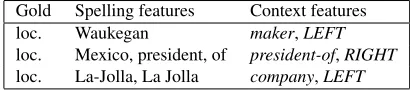
Figure 3 shows (all) three examples from the named entity test set where Yarowsky-prop-cautious θ-only is correct but none of the other Yarowsky variants are. Note that it succeeds despite mis-leading features; “maker” and “company” might be taken to indicate a company and “president-of” an organization, but all three examples are locations.
Yarowsky-prop-cautious φ-θ and π-θ also per-form respectably, although not as well. Yarowsky-prop-cautiousθT-only and the non-cautious versions are significantly worse. AlthoughθT-only was in-tended to incorporate Subramanya et al. (2010)’s idea of type level distributions, it in fact performs worse than θ-only. We believe that Collins and Singer (1999)’s definition (1) ofθincorporates suf-ficient type level information that the creation of a separate distribution is unnecessary in this case.
Figure 4 shows the test set non-seeded accuracies as a function of the iteration for many of the
algo-8
Algorithm Task
named entity drug land sentence
EM 81.05 78.64 55.96 54.85 32.86 31.07 67.88 65.42
±0.31 ±0.34 ±0.41 ±0.43 ±0.00 ±0.00 ±3.35 ±3.57
Seed DL 11.29 0.00 5.18 0.00 2.89 0.00 7.18 0.00
DL-CoTrain (cautious) 91.56 90.49 59.59 58.17 78.36 77.72 68.16 65.69
Yarowsky 81.19 78.79 55.70 54.02 79.03 78.41 62.91 60.04
Yarowsky-cautious 91.11 89.97 54.40 52.63 79.10 78.48 78.64 76.99
Yarowsky-cautious sum 91.56 90.49 54.40 52.63 78.36 77.72 78.64 76.99
HS-bipartite avg-avg 45.84 45.89 52.33 50.42 78.36 77.72 54.56 51.05
HS-bipartite avg-maj 81.98 79.69 52.07 50.14 78.36 77.72 55.15 51.67
HS-bipartite maj-avg 73.55 70.18 52.07 50.14 78.36 77.72 55.15 51.67
HS-bipartite maj-maj 73.66 70.31 52.07 50.14 78.36 77.72 55.15 51.67
Yarowsky-propφ-θ 80.39 77.89 53.63 51.80 78.36 77.72 55.34 51.88
Yarowsky-propπ-θ 78.34 75.58 54.15 52.35 78.36 77.72 54.56 51.05
Yarowsky-propθ-only 78.56 75.84 54.66 52.91 78.36 77.72 54.56 51.05
Yarowsky-propθT
-only 77.88 75.06 52.07 50.14 78.36 77.72 54.56 51.05
Yarowsky-prop-cautiousφ-θ 90.19 88.95 56.99 55.40 78.36 77.72 74.17 72.18
Yarowsky-prop-cautiousπ-θ 89.40 88.05 58.55 57.06 78.36 77.72 70.10 67.78 Yarowsky-prop-cautiousθ-only 92.47 91.52 58.55 57.06 78.36 77.72 75.15 73.22
Yarowsky-prop-cautiousθT
-only 78.45 75.71 58.29 56.79 78.36 77.72 54.56 51.05
[image:7.612.95.515.58.309.2]Num. train/test examples 89305 / 962 134 / 386 1604 / 1488 303 / 515
Table 3: Test set percent accuracy and non-seeded test set percent accuracy (respectively) for the algorithms on all tasks. Bold items are a maximum in their column.Italicitems have a statistically significant difference versus DL-CoTrain (p <0.05with a McNemar test). For EM,±indicates one standard deviation but statistical significance was not measured.
rithms on the named entity task. The Yarowsky-prop non-cautious algorithms quickly converge to the fi-nal accuracy and are not shown. While the other algorithms (figure 4(a)) make a large accuracy im-provement in the final retraining step, the Yarowsky-prop (figure 4(b)) algorithms reach comparable ac-curacies earlier and gain much less from retraining.
We did not implement Collins and Singer (1999)’s CoBoost; however, in their results it performs com-parably to DL-CoTrain and Yarowsky-cautious. As with DL-CoTrain, CoBoost requires two views.
6.4 Cautiousness
Cautiousness appears to be important in the perfor-mance of the algorithms we tested. In table 3, only the cautious algorithms are able to reach the 90% accuracy range.
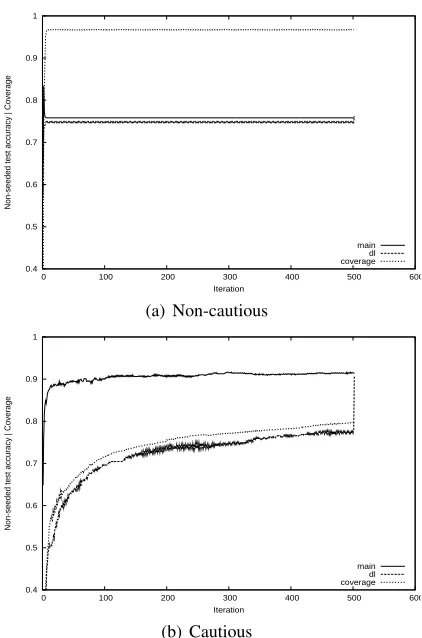
To evaluate the effects of cautiousness we ex-amine the Yarowsky-prop θ-only algorithm on the named entity task in more detail. This algorithm has two classifiers which are trained in conjunction: the DL and the propagatedθP. Figure 5 shows the train-ing set coverage (of the labelltrain-ing on line 6 of algo-rithm 3) and the test set accuracy of both classifiers, for the cautious and non-cautious versions.
The non-cautious version immediately learns a DL over all feature-label pairs, and therefore has full
coverage after the first iteration. The DL andθP con-verge to similar accuracies within a few more itera-tions, and the retraining step increases accuracy by less than one percent. On the other hand, the cau-tious version gradually increases the coverage over the iterations. The DL accuracy follows the cover-age closely (similar to the behaviour of Yarowsky-cautious, not shown here), while the propagated classifier accuracy jumps quickly to near 90% and then increases only gradually.
Although the DL prior to retraining achieves a roughly similar accuracy in both versions, only the cautious version is able to reach the 90% accuracy range in the propagated classifier and retraining. Presumably the non-cautious version makes an early mistake, reaching a local minimum which it cannot escape. The cautious version avoids this by making only safe rule selection and labelling choices.
0.5 0.55 0.6 0.65 0.7 0.75 0.8 0.85 0.9 0.95
0 100 200 300 400 500 600
Non-seeded test accuracy
Iteration
DL-CoTrain (cautious) Yarowsky Yarowsky-cautious Yarowsky-cautious sum
(a) Collins & Singer algorithms (plus sum form)
0.5 0.55 0.6 0.65 0.7 0.75 0.8 0.85 0.9 0.95
0 100 200 300 400 500 600
Non-seeded test accuracy
Iteration
Yarowsky-prop-cautious phi-theta Yarowsky-prop-cautious pi-theta Yarowsky-prop-cautious theta-only Yarowsky-prop-cautious thetatype-only
[image:8.612.322.533.56.375.2](b) Yarowsky propagation cautious
Figure 4: Non-seeded test accuracy versus iteration for various algorithms on named entity. The results for the Yarowsky-prop algorithms are for the propagated classifierθP, except for the final DL retraining iteration.
6.5 Objective function
The propagation methodφ-θwas motivated by opti-mizing the equivalent objectives (2) and (3) at each iteration. Figure 6 shows the graph propagation ob-jective (3) along with accuracy for Yarowsky-prop φ-θwithout cautiousness. The objective value de-creases as expected, and converges along with accu-racy. Conversely, the cautious version (not shown here) does not clearly minimize the objective, since cautiousness limits the effect of the propagation.
7 Conclusions
Our novel algorithm achieves accuracy compara-ble to Yarowsky-cautious, but is better theoretically motivated by combining ideas from Haffari and Sarkar (2007) and Subramanya et al. (2010). It also achieves accuracy comparable to DL-CoTrain, but does not require the features to be split into two in-dependent views.
As future work, we would like to apply our
0.4 0.5 0.6 0.7 0.8 0.9 1
0 100 200 300 400 500 600
Non-seeded test accuracy | Coverage
Iteration
main dl coverage
(a) Non-cautious
0.4 0.5 0.6 0.7 0.8 0.9 1
0 100 200 300 400 500 600
Non-seeded test accuracy | Coverage
Iteration
main dl coverage
[image:8.612.84.294.57.378.2](b) Cautious
Figure 5: Internal train set coverage and non-seeded test accu-racy (same scale) for Yarowsky-propθ-only on named entity.
0.4 0.5 0.6 0.7 0.8 0.9 1
10 100 1000 55000
60000 65000 70000 75000 80000 85000
Non-seeded test accuracy | Coverage
Propagation objective value
Iteration
main coverage objective
Figure 6: Non-seeded test accuracy (left axis), coverage (left axis, same scale), and objective value (right axis) for Yarowsky-propφ-θ. Iterations are shown on a log scale. We omit the first iteration (where the DL contains only the seed rules) and start the plot at iteration 2 where there is a complete DL.
[image:8.612.321.530.413.553.2]References
S. Abney. 2004. Understanding the Yarowsky algorithm.
Computational Linguistics, 30(3).
Eugene Agichtein and Luis Gravano. 2000. Snowball: Extracting relations from large plain-text collections. In Proceedings of the Fifth ACM International Con-ference on Digital Libraries, DL ’00.
A. Blum and S. Chawla. 2001. Learning from labeled and unlabeled data using graph mincuts. In Proc. 19th International Conference on Machine Learning (ICML-2001).
A. Blum and T. Mitchell. 1998. Combining labeled and unlabeled data with co-training. InProceedings of Computational Learning Theory.
Michael Collins and Yoram Singer. 1999. Unsupervised models for named entity classification. InIn EMNLP 1999: Proceedings of the Joint SIGDAT Conference on Empirical Methods in Natural Language Processing and Very Large Corpora, pages 100–110.
Michael Collins. 1997. Three generative, lexicalised models for statistical parsing. InProceedings of the 35th Annual Meeting of the Association for Computa-tional Linguistics, pages 16–23, Madrid, Spain, July. Association for Computational Linguistics.
Hal Daume. 2011. Seeding, transduction, out-of-sample error and the Microsoft approach... Blog post at http://nlpers.blogspot.com/2011/04/seeding-transduction-out-of-sample.html, April 6.
Jason Eisner and Damianos Karakos. 2005. Bootstrap-ping without the boot. In Proceedings of Human Language Technology Conference and Conference on Empirical Methods in Natural Language Processing, pages 395–402, Vancouver, British Columbia, Canada, October. Association for Computational Linguistics. Gholamreza Haffari and Anoop Sarkar. 2007. Analysis
of semi-supervised learning with the Yarowsky algo-rithm. InUAI 2007, Proceedings of the Twenty-Third Conference on Uncertainty in Artificial Intelligence, Vancouver, BC, Canada, pages 159–166.
Aria Haghighi and Dan Klein. 2006a. Prototype-driven grammar induction. In Proceedings of the 21st In-ternational Conference on Computational Linguistics and 44th Annual Meeting of the Association for Com-putational Linguistics, pages 881–888, Sydney, Aus-tralia, July. Association for Computational Linguistics. Aria Haghighi and Dan Klein. 2006b. Prototype-driven learning for sequence models. In Proceedings of the Human Language Technology Conference of the NAACL, Main Conference, pages 320–327, New York City, USA, June. Association for Computational Lin-guistics.
Marti A. Hearst. 1992. Automatic acquisition of hy-ponyms from large text corpora. InProceedings of the
14th conference on Computational linguistics - Vol-ume 2, COLING ’92, pages 539–545, Stroudsburg, PA, USA. Association for Computational Linguistics. John D. Lafferty, Andrew McCallum, and Fernando C. N.
Pereira. 2001. Conditional random fields: proba-bilistic models for segmenting and labeling sequence data. InProceedings of the Eighteenth International Conference on Machine Learning, ICML ’01, pages 282–289, San Francisco, CA, USA. Morgan Kauf-mann Publishers Inc.
K. Nigam, A. McCallum, S. Thrun, and T. Mitchell. 2000. Text classification from labeled and unlabeled documents using EM. Machine Learning, 30(3). Ellen Riloff and Jessica Shepherd. 1997. A
corpus-based approach for building semantic lexicons. InIn Proceedings of the Second Conference on Empirical Methods in Natural Language Processing, pages 117– 124.
H. J. Scudder. 1965. Probability of error of some adap-tive pattern-recognition machines. IEEE Transactions on Information Theory, 11:363–371.
Amarnag Subramanya, Slav Petrov, and Fernando Pereira. 2010. Efficient graph-based semi-supervised learning of structured tagging models. InProceedings of the 2010 Conference on Empirical Methods in Natu-ral Language Processing, pages 167–176, Cambridge, MA, October. Association for Computational Linguis-tics.
Partha Pratim Talukdar. 2010. Graph-based weakly-supervised methods for information extraction & in-tegration. Ph.D. thesis, University of Pennsylvania. Software:https://github.com/parthatalukdar/junto. X. Zhu and Z. Ghahramani and J. Lafferty. 2003.
Semi-supervised learning using Gaussian fields and har-monic functions. InProceedings of International Con-ference on Machine Learning.