Munich Personal RePEc Archive
Model selection consistency from the
perspective of generalization ability and
VC theory with an application to Lasso
Xu, Ning and Hong, Jian and Fisher, Timothy
University of Sydney, University of Sydney, University of Sydney
22 April 2016
Online at
https://mpra.ub.uni-muenchen.de/71670/
Model selection consistency from the perspective of generalization
ability and VC theory with an application to Lasso
✩Ning Xu
School of Economics, University of Sydney
Jian Hong
School of Economics, University of Sydney
Timothy C.G. Fisher
School of Economics, University of Sydney
Abstract
Model selection is difficult to analyse yet theoretically and empirically important, especially for high-dimensional data analysis. Recently the least absolute shrinkage and selection operator (Lasso) has been applied in the statistical and econometric literature. Consis-tency of Lasso has been established under various conditions, some of which are difficult to verify in practice. In this paper, we study model selection from the perspective of generalization ability, under the framework of structural risk minimization (SRM) and Vapnik-Chervonenkis (VC) theory. The approach emphasizes the balance between the in-sample and out-of-sample fit, which can be achieved by using cross-validation to select a penalty on model complexity. We show that an exact relationship exists between the generalization ability of a model and model selection consistency. By implementing SRM and the VC inequality, we show that Lasso is L2-consistent for model selection under assumptions similar to those imposed on OLS. Furthermore, we derive a probabilistic bound for the distance between the penalized extremum estimator and the extremum estimator without penalty, which is dominated by overfitting. We also propose a new measurement of overfitting,GR2, based on generalization ability, that converges to zero if model selection is consistent. Using simulations, we demonstrate that the proposed CV-Lasso algorithm performs well in terms of model selection and overfitting control.
Keywords: Model selection, VC theory, generalization ability, Lasso, high-dimensional data, structural risk minimization, cross validation.
✩The authors would like to thank Mike Bain, Colin Cameron, Peter Hall and Tsui Shengshang for
valuable comments on an earlier draft. We would also like to acknowledge participants at the The 12th
International Symposium on Econometric Theory and Applications and The 26th
New Zealand Econometric Study Group and seminar participants at Utah, UNSW, and University of Melbourne for useful questions and comments. Fisher would like to acknowledge the financial support of the Australian Research Council grant DP0663477.
Email addresses: [email protected](Ning Xu),[email protected](Jian Hong),
Model selection consistency from the perspective of generalization
ability and VC theory with an application to Lasso
1. Introduction
Model selection is vital in econometric analysis for valid inference and accurate prediction. Moreover, given the increasing prevalence of high-dimensional data analysis in economics, model selection is coming to the forefront of statistical inference. With high-dimensional data, the curse of dimensionality (Bellman, 1957) becomes a concern. In econometrics, the curse of dimensionality refers to the difficulty of fitting a model when a large number of possible predictors (p) are available. When the dimension is high relative to the given sample size n, the effective sample size (n/p or n/log(p)) is relatively small, making it harder to sample the population space sufficiently. With a larger p, the model to be estimated becomes more complex as well. A model may perfectly fit the data whenp=n, which is an example of the well-known overfitting problem. Estimation may also be affected by dimensionality in other ways. Estimation involving a matrix inverse, numerical integrals, or grid search may be difficult to implement with high-dimensional data. The convergence rate of non-parametric estimators is lower with a higherp. Problems due to measurement errors and missing values in estimation become worse with high-dimensional data as well. In this paper, we focus on linear model selection which reduces to variable selection and dimension reduction. However, the analysis covers some non-parametric models such as series regression and also provides an approximation to non-linear models in general—see Belloni and Chernozhukov (2011).
Model selection typically involves using a score function that depends on the data (Heckerman et al., 1995), as with the Akaike information criterion (Akaike, 1973), the Bayesian information criterion (Schwarz, 1978), cross-validation methods (Stone, 1974, 1977), and mutual information scores among variables (see Friedman et al. (1997) and Friedman et al. (2000)). Shao (1997) proves that various types of information criterion (IC) and cross-validation are consistent in model selection. However, the optimization-based search algorithms that are often used to implement these methods are not without drawbacks. First, they tend to select more variables than necessary and, as illustrated by Breiman (1995), they are sensitive to small changes in the data. Second, especially with high-dimensional data, combinatorial search algorithms may be computationally challenging to implement.1
As an alternative to conventional model selection methods, the least absolute shrinkage and selection operator (Lasso) is introduced by Tibshirani (1996). Consider the linear regression model
Y =Xβ+u
where Y ∈Matrix(n×1,R) is a vector of response variables, X ∈Matrix(n×p,R) is a matrix of covariates andu∈Matrix(n×1,R) is a vector of i.i.d. random errors. We are interested in estimating the parameter vector β ∈Rp, which may be sparse in the sense
1
that many of its elements are zero. The Lagrangian of the penalized least squares model may be written
min
bλ
1
n(kY −Xbλk2) 2
+λkbλkγ (1)
wherek · kγ is the Lγ norm and λ>0 is the penalty or tuning parameter. The estimator
bλ is the solution to the constrained minimization problem. Note that if λ= 0, the usual
OLS estimator is obtained. Lasso corresponds to the case withγ = 1. When γ = 2, we have the familiar ridge estimator (Tikhonov, 1963), which typically is not used for model selection. As a generalization of the ridge estimator, Frank and Friedman (1993) propose the bridge estimator for anyγ >0. Fu (1998) provides a comparison of these estimators in a simulation study.
Lasso may be thought of as a ‘shrinkage estimator’. James and Stein (1961) prove that, on average, the shrinkage estimator dominates the OLS estimator in terms of mean squared error (MSE).2
A shrinkage estimator restricts the norm of the estimated parameter vector to be less than or equal to a constant. By restricting kbλk1 to be smaller than a
constant, Lasso shrinks somebi to zero, effectively dropping the corresponding Xi from the
model. Surprisingly, a constrained estimator like Lasso may outperform an unconstrained estimator like OLS in terms of the bias-variance trade-off. From (1) it is clear that Lasso will produce a different model for each value of the penalty parameter λ. In general, a higher value ofλcorresponds to a higher penalty and a smaller number of Xi. Thus the
complexity of the model can be controlled by the value ofλ. We use an algorithm where λ is chosen by cross-validation, which we call the CV-Lasso algorithm.3
In economics, we often observe only one sample: cross-validation divides the sample into training and test sets. The parameters of interest are estimated using the training set with a given value of the penalty parameter. The estimated model is then applied to the test set to calculate the associated loss. The selected model is based on theλwith the lowest loss. Varian (2014) advocates that cross-validation should be used much more in economics, particularly when working with large datasets, because it may provide a more realistic measure of prediction performance than measures commonly used in economics such asR2.
A range of properties have been established for Lasso-type estimators. The parameter estimation and model selection consistency of Lasso are established for fixedp by Knight and Fu (2000). Meinshausen and Bühlmann (2006) show that Lasso is consistent in the Gaussian scenario even whenp > n. Zhao and Yu (2006) establish probabilistic consistency for both fixedpand largepproblems. They find that Lasso selects exactly the set of nonzero regression coefficients under the ‘irrepresentable condition,’ which may be hard to verify in practice. Zhang and Huang (2008) study the bias in Lasso and derive its consistency
2
The ridge estimator is an early example of a shrinkage estimator. The shrinkage estimator is also called the James-Stein estimator.
3
(convergence) rate.
Lasso is becoming increasingly popular in econometrics. As argued by Varian (2014), econometrics may require a different set of tools for manipulating and analyzing big data sets. Many tools from statistical learning can be adapted for econometric analysis; Lasso is one such tool. Recent applications of Lasso in economics include Bai and Ng (2008), De Mol et al. (2008), Pistoresi et al. (2011), Schneider and Wagner (2012), Kim and Swanson (2014), and Manzan (2015). Belloni et al. (2012) propose using Lasso to select instruments while the parameters of interest are estimated by conventional procedures. Caner (2009) proposes a Lasso-type GMM estimator and derives its asymptotic properties for the case where0< γ <1. Chatterjee et al. (2015) study the oracle property of the residual empirical process of the adaptive Lasso. Kock and Callot (2015) study the properties of Lasso and adaptive Lasso for a stationary VAR model with Gaussian errors. Cheng and Liao (2015) use Lasso to select moments where the penalty term depends on a preliminary consistent estimator that accounts for the strength and validity of the moments.4
In this paper, we study model selection from the perspective of generalization ability, the ability of a selected model to predict outcomes in new samples from the same population. Generalization ability is important for prediction purposes or for studying the effect of a new policy. The perspective is based on Vapnik-Chervonenkis (VC) theory (Vapnik and Chervonenkis, 1971b), a fundamental theory in statistical learning. In VC theory, an estimator (or algorithm) with good generalization ability will perform well with ‘in-sample’ data and ‘out-of-sample’ data. The consistency of model selection can be established under the structural risk minimization (SRM) framework, one of the main principles in VC theory. According to SRM, there are essentially two reasons why a model selected from one sample may not fit another sample well: the two samples may have different sampling errors, or the complexity of the model selected from the original sample may have been set inappropriately. To improve the generalization ability of the model estimated from a sample, SRM requires minimizing the error, known as the the ‘generalization error’ (GE), when the estimated model is applied to another sample. The balance between in-sample and out-of-sample fitting is described by the ‘VC inequality’. We adapt and generalize the VC inequality (in Lemmas 1 and 2) for extreme estimators and establish a model-free and distribution-free probabilistic bound for the generalization error (in Theorem 1). We also propose a measurement based on generalization ability,GR2, to summarize the in-sample and out-of-sample goodness-of-fit.
Using SRM, we then establish the consistency of Lasso-type model selection. For the n≥p case, the assumptions for consistency are similar to (and actually weaker than) those usually imposed on OLS, while for the n < p case an additional assumption on sparse eigenvalues of theXTX matrix is required. Given a sample, SRM can be implemented
in Lasso by selecting λ, which is equivalent to controlling the complexity of the model.
4
We show that, under certain conditions, the true DGP uniquely offers the minimum generalization error in the population (Proposition 1). Hence, we show that the true DGP will be selected by Lasso given λ(Proposition 2). We then show (Theorems 2, 3, and 4) that the VC inequality and minimization of the empirical GE guarantees not only that Lasso is consistent in model selection, but also that Lasso offers a better out-of-sample fit than extremum estimators. We derive a probabilistic bound for the distance between the penalized extremum estimator and the extremum estimator without penalty, which is dominated by overfitting. We have a detailed discussion on how the choice ofλaffects model selection.
Our proof strategy highlights the connection between asymptotic performance and generalization ability. Instead of restricting attention to a single sample, we consider both in-sample and out-of-sample fit. Then we transform and reformulate the consistency problem into the GE space. We show that empirical GE minimization not only controls overfitting and improves the finite-sample performance, but also helps us to find the true model asymptotically. In addition, our method has the potential to extend the consistency results in Knight and Fu (2000), Zhao and Yu (2006), Candes and Tao (2007) and Meinshausen and Yu (2009) to functional regression. Furthermore, our work also sheds light on the applicability of general model selection based on VC theory, offering insights into the bias-variance trade-off from the perspective of generalization ability.
The paper is organized as follows. We first discuss the relation between generalization ability and model selection consistency in section 2. In section 3, we prove that Lasso is L2-consistent in model selection under the proposed conditions. In section 4, we use simulations to demonstrate the ability of Lasso to select models and control for overfitting. Section 5 concludes with a brief discussion of our results. Proofs are contained in Appendix 1, pseudo-code for the algorithms is in Appendix 2, and graphs of the simulations are in Appendix 3.
2. Generalization ability, structural risk minimization and model selection
2.1. Generalization ability, and overfitting
In econometrics, choosing the best approximation to data involves measuring a loss, Loss (yi,mb(xi, b)), i= 1, . . . , n, defined as a functional between the estimated valuemb(x, b)
and the true valuey. The risk functional is defined as
R(b|X, Y) = Z
Loss(y,mb(x, b))dF(x, y)
whereF(x, y) is the joint distribution of (x, y). Without knowing the distributionF(x, y) a priori, we define the empirical risk functional as follows
Rn(b|X, Y) =
1 n
n
X
i=1
In the regression case, for example, the estimated valuemb(x, b) = ˆy=XˆbandRn(b|X, Y) =
1
n
Pn
i=1(yi−yˆi)2.
For regression models, the R2 is often used to measure goodness-of-fit for in-sample data. We can rewrite R2 as 1− Rn(b|X, Y)/TSS where TSS= (1/n)Pni=1(y−y¯)2. For
high-dimensional data analysis, however, an estimated model with a highR2 may have poor predictive power with out-of-sample data, a feature commonly referred to as ‘overfitting’. As a result, in-sample fit may not be a reliable indicator of the general usefulness of the model. Thus, Vapnik and Chervonenkis (1971a) propose thegeneralization ability(GA) of a model, a measure of its prediction performance with out-of-sample data.
Generalization ability can be measured by different criteria. In the case where X and Y are directly observed, generalization ability is a function of the difference between the actualY and the estimatedY for out-of-sample data. In this paper, generalization ability is measured by the generalization error (GE).5
Generally speaking, GE can be defined in terms of empirical risk.
Definition 1. The L2 training erroris defined as minbRnt(b|Yt, Xt) =Rn(btrain|Yt, Xt)
where btrain minimizes Rnt(b|Yt, Xt) and (Yt, Xt) refers to the data used for the
esti-mation of b, also called the training set. The L2 generalization error is defined as
Rns(btrain|Ys, Xs) where (Ys, Xs) refers to data that is not used for the estimation of b,
also called thetest set.
For linear regression, the estimator, training error, and generalization errors are, respec-tively as follows:
btrain = argmin
b
1 ntk
Yt−Xtbk22
Rnt(btrain|Yt, Xt) =
1 ntk
Yt−Xtbtraink22
Rns(btrain|Ys, Xs) =
1 nsk
Ys−Xsbtraink22
where nt and ns are the sample sizes for the training set and the test set, respectively.
Henceforth,min{ns, nt}is denoted by en.
If we have multiple samples, it is straightforward to define some of them as test sets and others as training sets, use training sets for estimation and use test sets to validate the generalization ability of the model estimated from the training sets. This method is called ‘validation’. If we only collect one sample from the population, we can randomly partition it into two subsets: one as the training set and the one as the test set. However, in reality we may not have enough sample points for validation with such a partition. To put this another way, if the only sample we collect is not large enough and we partition it into training and test sets, we decrease the size of the training set and consequently affect the performance of the model we estimate from training sets. Hence, when we have only
5
one sample and its size is not large enough to support such random partition, we need to switch toK-fold cross validation.
In more detail, cross validation implies randomly partitioning the full sample intoK folds.6
We choose one fold as the test set, and designate the remaining K−1 folds as the training set. We then carry out extremum estimation on the training data and use the fitted model to record its GE on the test set. This process is repeatedK times, with each of theK folds getting the chance to play the role of the test set, with the remaining K−1 folds used as the training set. In this way, we obtainK different estimates of the GE for the fitted model. TheseK estimates of the GE are averaged, giving the cross-validated GE. By implementing cross validation, each data point is used in both the training and the test sets. Moreover, cross validation reduces the resampling error by running validation K times over different training and test sets. Hence, intuitively, cross validation is more robust on resampling error and should perform at least as well as validation. In section 3, we study the generalization error of penalized extremum estimators in both the validation and cross validation cases and show the difference between them in detail.
We use the training error to measure in-sample fit and the generalization error to measure out-of-sample fit. The two errors illustrate why the generalization ability of a model is crucial to model selection. When an unnecessarily complicated model is imposed on the data, it will generally suffer from overfitting: the model will be too tailored for in-sample data, compromising its out-of-sample performance. To summarize the in-sample and out-of-sample goodness of fit, we propose the following empirical measure
GR2 =
1−Rns(btrain|Ys, Xs)
TSS (Ys)
×
1−Rnt(btrain|Yt, Xt)
TSS (Yt)
=R2s×R2t (2)
where R2
s is the the R2 for the test set, and R2t is the R2 for the training set. If btrain
is consistent, bothRnt(btrain|Yt, Xt) and Rns(btrain|Ys, Xs) converge to the same limit in
probability asen→ ∞, implying that limen→∞GR2 = 1.
ClearlyGR2combines measures of the in-sample fit and the out-of-sample fit. Intuitively, there are four different possibilities forGR2. A model that fits the training set and the test set well will have highR2t andR2s values and hence a highGR2. When overfitting occurs, theR2
t will be relatively high and the R2s will be low, reducing theGR2. When underfitting
occurs, both theR2t and R2s will be low, reducing theGR2 further. It is also possible that the model estimated on the training set fits the test set better (theR2s is high while the R2
t low). In the section 4 simulations we find that theGR2 performs well as a measure of
overfitting and underfitting.
2.2. Structural risk minimization and model selection
In econometrics, choosing the best model for data typically involves minimization of the training errorRn(b), which is also the SRM principle proposed by Vapnik and Chervonenkis
6
(1971a,b). Essentially, the SRM principle states that: given the functional form m, theb sampling error (that is, error due to the empirical distribution)kRn(b|X, Y)− R(b|X, Y)k
converges to zero as the sample size increases. If mb(x, b) happens to be the correct functional form for the model, the SRM principle is equivalent to the consistency property in econometrics.
The relation between Rn(b) andR(b) is summarized by the VC inequality (Vapnik and
Chervonenkis, 1974) as follows.
Lemma 1. (Vapnik and Chervonenkis, 1971a). The following VC inequality holds with probability (or power) 1−η,∀b, ∀n∈N+,
R(b|X, Y)6 Rnt(b|Xt, Yt)
1−√ǫ (3)
or
R(b|X, Y)6Rnt(b|Xt, Yt) +
√
ǫ
1−√ǫRnt(b|Xt, Yt) (4)
where Rnt(b|Xt, Yt) is the training error from the extremum estimator b,R(b|X, Y) is the
expectation of the generalization error Rns(b|Xs, Ys), h is the VC dimension for b, and
ǫ= (1/nt)[hln(nt/h) +h−ln (η)].
The VC dimension is a measure of the complexity of the model and reduces to pfor the case of generalized linear models.7
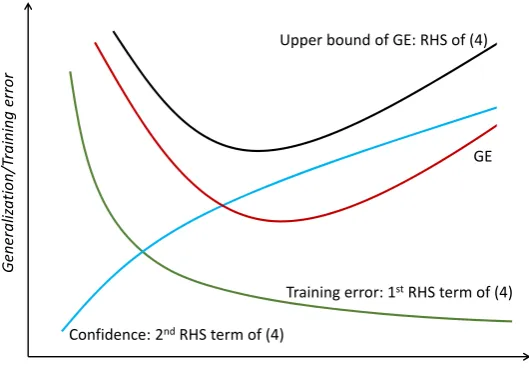
As long ashfor the model is finite, the model will never result in anR2 = 1 or GR2 = 1 regardless of the sample. A detailed explanation ofh can be found in the proof of Theorem 1 in Appendix 1. As shown in Figure 1, the VC inequality provides an upper bound for the generalization error ofb. When the effective sample size, defined asnt/h, is large,ǫis small, the second term on the RHS of (4) becomes small, the
training error is close to the generalization error, and overfitting is inconsequential (or can be ignored). However, if the effective sample sizent/his small (that is, the model is very
complicated), the second term on the RHS of (4) becomes larger. In such situations a small training error does not guarantee a small generalization error and overfitting becomes more likely.
In the smallnt/hcase, reducing overfitting requires minimizing both terms on the RHS
of (4). Since the second term in (4) depends onh, it follows that, instead of minimizing
Rnt, it is necessary to minimize the upper bound of the GE. Vapnik and Chervonenkis
(1971a) show that SRM guarantees that the minimal GE chosen by SRM converges to the minimum GE in the population at a given rate, as shown below in Theorem 1. Here we denote the model chosen by SRM asbSRM and Λas the space of alternative models.
Lemma 2. (Vapnik and Chervonenkis, 1971a). SRM provides approximations for which
7
Upper bound of GE: RHS of (4)
Training error: 1stRHS term of (4) GE
Confidence: 2ndRHS term of (4)
Complexity of the model (VC dimension)
Generaliz
ation/T
raining
[image:11.595.165.430.86.270.2]
error
Figure 1: The VC inequality and structural risk minimization
the sequence of Rnt(bSRM|Xt, Yt) converges to the smallest generalization error
Rmin = inf
b∈Λ
Z
Loss(b|X, Y)dF(x, y)
with asymptotic rate of convergence
V(nt) =rnt+τ
s
hln(nt)
nt
,
if
lim
nt→∞
τ2hln(n
t)
nt
= 0,
where F(x, y) is the population distribution of(X, Y), τ is a positive number such that, for
p>2,
τ >sup
b∈Λ
[R (Loss(b|X, Y))pdF(x, y)]1/p
R
Loss(b|X, Y)dF(x, y) ,
and
rnt =Rnt(bSRM|Xt, Yt)−inf
b∈Λ
Z
Loss(b|X, Y)dF(x, y).
VC dimension is crucial for SRM because it is used to construct the upper bound for the generalization error. SRM has been implemented to reduce overfitting in classification models for many years but it can be hard to implement in other models because it is difficult to calculate the VC dimension.8 Researchers in statistics have ignored the upper bound of
the generalization error and have instead minimized the empirical GE, in essentially the same way that Lasso implements the empirical generalization error on the test set. However, since the empirical GE and the actual GE are different, especially in finite samples, the
8
accuracy, convergence rate and divergence between the empirical and actual GE are of interest. By adapting and extending the VC inequality and the principle of SRM, we propose the following theorem that states the connection between the empirical GE minimizer and the structural risk minimizer for both the finite sample and asymptotic cases.
Theorem 1. Ifsup|Rns(b)− R(b)|→P 0for the extremum estimator b, the following
Bahr-Esseen bound for the empirical GE holds with probability at least̟(1−1/nt),∀̟∈(0,1).
Rns(b|Xs, Ys)6M+ς, (5)
where Rns(b|Xs, Ys) is the empirical risk of b on the test set,
M = Rnt(b|Xt, Yt)
(1−√ǫ) ,
ς =
l
√
2·τ(E[Loss (btrain|x, y)])
l
√
1−̟·n1s−1/l
,
l is a number strictly larger than 1 andτ has been defined in Lemma 2.
Thus, we immediately have the following corollary.
Corollary 1. Based on Theorem 1, as ne → ∞ the empirical GE minimizer and the structural risk minimizer converge to the same limit.
Theorem 1 and Corollary 1 establish a foundation to study the control of model complexity, including the use of Lasso as an empirical GE minimizer, and also prove that, from a distribution-free and model-free perspective, SRM is asymptotically equivalent to empirical GE minimization. By using the bound in (5), it is possible to quantify the difference between the effects of SRM and empirical GE minimization, and it is also possible to derive a confidence bound for the difference between SRM and empirical GE minimization.
SRM and empirical GE minimization offer a new angle to control model complexity and model selection, especially for Lasso. As shown in the CV-Lasso algorithm in Appendix 2, Lasso returns a vector of bλ for each λ. Larger values for λ are mapped to a smaller
VC dimension h orp, referred to as the ‘admissible structure’ of the model (Vapnik and Chervonenkis, 1971b). Among the list of models returned by Lasso, each different p(VC dimension) parameterizes a generalization error. By picking the model with minimal empirical GE from {bλ}, both SRM and empirical GE minimization guarantee that the
model chosen by Lasso has the best generalization ability.
3. Generalization ability and consistency of Lasso-type model selection
Estimator space GE space
Finite sample
Asymptotic
Globally minimal GE (uniquely offered by
the true DGP) Minimal GE among
all alternatives
True DGP
Lasso estimator CVGuaranteed‐Lasso algorithm by
Proposition 1
[image:13.595.134.463.88.267.2]Theorem 2
Figure 2: Outline of proof strategy
that, compared to the corresponding extremum estimator without penalty theL1-penalized extremum estimator, such as Lasso, minimizes the GE, improves out-of-sample performance, and controls for the overfitting problem. Moreover, the trade-off between in-sample and out-of-sample performance does not influence consistency. We also discuss the connection between the finite sample and asymptotic properties of the penalized extremum estimator.
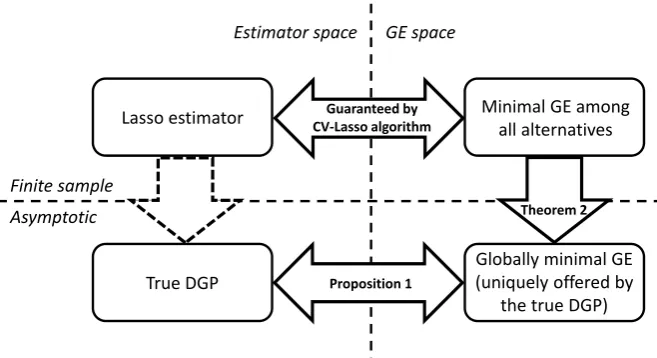
The traditional route to prove consistency is through analyzing the properties of the extremum estimator in the training set as n→ ∞. However, to control overfitting and balance in-sample and out-of-sample fit, we need to consider the properties of estimators on both the training and the test sets. Thus, we derive the finite sample and asymptotic properties following the scheme outlined in Figure 2.
An outline of our proof strategy is shown in Figure 2. Instead of working in the space of estimators, we reformulate the consistency problem in the space of generalization error. We show that empirical GE minimization not only controls overfitting and improves finite-sample performance, but also it helps us to find the true DGP asymptotically. We denotebLasso as
the model with the minimal GE among the alternatives. Lasso bijectively mapsbLasso to
the minimal GE on the test set, defined asτ : bLasso→minbλ{GEs of potential models}.
To ensure GE minimization guides us towards the true DGP, we need first to prove that the mappingτ also bijectively assigns β to the minimal GE in population, and second that if
min
b∈bλ
1 ns
ns
X
i=1
kYs−Xsbk22 →min
b
Z
ky−xTbk22 dF(x, y),
then
bLasso ⇔min{GEs of potential models}→P min
b
Z
kys−xTsbk22 dF(x, y)⇔β
or, in other words, thatbLasso is consistent. This approach applies not only to the Lasso
Assumptions and identification
At the outset, we stress that each variable in (X, Y) must be standardized before implementing the Lasso. Without standardization, the Lasso algorithm may be influenced by the magnitude (units) of the variables.9
After standardization, of course,X andY unit-and scale-free.
To ensure the L2 consistency of Lasso, we require the following four assumptions.
A1 The true DGP is Y =Xβ+u.
A2 E uTX=0.
A3 The true DGP is unique: no variable with a non-zeroβi can be represented by a linear
combination of any other variable in X.
A4 Both the training set and the test set are i.i.d. from the same population.
The assumptions warrant a few comments. A1 restricts attention to linear regression models. A2 is the usual exogeneity condition. A3 is necessary for model selection; otherwise there may exist another model that is not statistically different from the population DGP. Note that A3 allows for linear dependence for the regressors with zero coefficients, but it does not allow any linear dependence to affect the true DGP. Thus, A3 is weaker than the typical assumption made for OLS that rules out perfect collinearity for all regressors. Lastly, A4 implies that we focus on the i.i.d. case in this paper. If A4 is not satisfied, a sample could consist of data from two completely different DGPs and Lasso generally cannot select a single model to represent two different DGPs.10
Under assumptions A1 to A4, we show that the true DGP is the most generalizable model, yielding Proposition 1.
Proposition 1. Under assumptions A1 to A4, the true DGP, Y =Xβ+u, is the one and only one offering the minimal generalization error as en→ ∞.
Proposition 1 states that there is a bijective mapping between β and the globally minimal GE in the population. If A2 or A3 are violated, there may exist variables in the sample that render the true DGP not to be the most generalizable model. The Lasso algorithm picks the model with the minimal GE. As a result, we also need to prove that, when the sample size is ‘large’ enough, the true DGP is included in the list of models from which Lasso selects. This is shown in Proposition 2.
Proposition 2. Under assumptions A1 to A4 and Proposition 1, there exists at least one
e
λsuch that limen→∞bλe=β.
9
An intuitive explanation (Tibshirani, 1996) is that Lasso shrinks the absolute value of each bi by the
same|λ|. Without standardization, variables with a smaller scale will have larger coefficients and are less likely to be dropped than variables with a larger scale and smaller coefficients.
10
b 2 b1 bOLS bLasso
level set of L2 Loss
beta und er-shr ink ed b2 b 1 bOLS beta bLasso
level set of L2 Loss
perf ec t-shrin ked b 2 b1 b OLS bLasso
level set of L2 Loss beta
ov
[image:15.595.96.501.85.212.2]er-shrin ked
Figure 3: Solutions of Lasso and β
In Lemmas 1 and 2 and in Theorem 1, we show that minimizing the empirical GE guarantees that the minimal empirical GE in the sample converges to the minimum GE in the population asen→ ∞. We also show in Propositions 1 and 2 thatβ uniquely offers the minimum GE in the population and is feasible for someeλ. Hence, the minimal GE in the sample converges to the population minimum GE, which is offered byβ uniquely, at some e
λ.
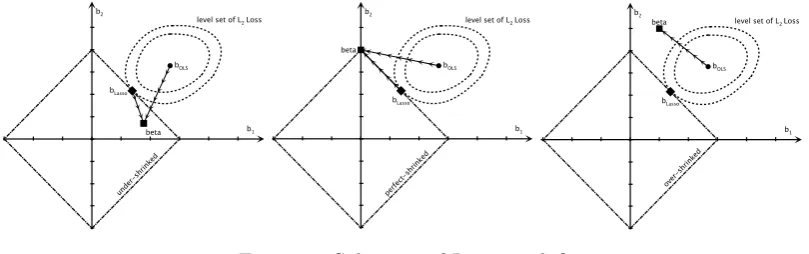
Note that Lasso-type estimation is equivalent to the constrained minimization of a loss function. In Figure 3, the diamond-shape feasible area is determined by theL1 penalty,
bLassorefers to the Lasso estimates, ‘beta’ refers toβ, andbOLS refers to the OLS estimates.
Different values forλimply different boundaries for the feasible area of the constrained minimization; the feasible area gets smaller as value ofλgets larger. Hence, one of three cases may occur: (1) for a small value ofλ,β remains in the feasible area (under-shrinkage); (2) forλ=λ∗,β is located precisely on the boundary of the feasible area (perfect-shrinkage); (3) for a large value of λ,β is outside of the feasible area (over-shrinkage). In cases (1) and (2), the constraints become inactive asne → ∞, so limen→∞bλ = limen→∞bOLS = β.
However, in case (3),limen→∞bλ =6 β. Therefore,limen→∞beλ=β,∀eλ∈ {λ|06λ6λ∗}.
As we show above, in practice we do not observe λ∗ a priori. The missing part of
the puzzle is to find λ→ eλ as n → ∞. Thus, given Propositions 1, 2 and Theorem 1, we now show that empirical GE minimization guarantees the model selected by Lasso asymptotically converges inL2 to the true DGP, completing the ‘transformation’ idea from Figure 2.
Theorem 2. Based on Theorem 1, Propositions 1 and 2, under assumptions A1 to A4, the following bound holds with probability̟(1−1/nt)
1 nsk
Xsbtrain−XbLassok22 6
1 nt
ketk22
1−√ǫ− 1 nsk
esk22
+ 4
nsk
eTsXsk∞kbtraink1+ς (6)
where btrain is the extremum estimator based on the training set and we define et =
Yt−Xtbtrain and es =Ys−Xsbtrain.
IfK= 2, the theoretical result for K-fold cross-validation is identical to Theorem 2.11
For K>3, we have Kdifferent test sets for tuningλandK different training set for estimation. Denote theqth
training set as(Xtq, Ytq), theqth
test set as(Xsq, Ysq), the extremum estimator
estimated from thekth
training set as bktrain, the sample size for each test set asns and the
sample size for each training set asnt.
Denoteargmaxk,qRns(b k
train|X
q
s, Ysq) ask∗ andq∗. To simplify notation, we denote the
extremum estimator for the worst case,bk∗
train, by btrain,ςk∗ by ς,ǫk∗ by ǫ, and ̟k∗ by ̟.
Hence, for anykandq ∈[1, K],
Rns(bktrain|Xsq, Ysq)6Rns
btrain|Xq
∗
s , Yq
∗
s
6Rnt
btrain|Xq
∗
t , Y
q∗
t 1−
√
ǫ−1+ς
In this equation, we define the ‘worst case’ to be where the GE among K validations,
Rns b k
train|X
q
s, Ysq, is the largest among all validations.
Here we propose the following probabilistic bound for the Lasso tuned by K-fold cross-validation.
Corollary 2. Based on Theorem 1 and Propositions 1 and 2, under assumptions A1 to A4, the following bound holds for the K-fold cross-validated Lasso with probability ̟(1−1/nt)
1 K K X q=1 1 ns Xq
sbtrain−XsqbLasso
22 6
1 nt
ketk22
1−√ǫ− 1 K K X q=1 1 ns eqs
22 + 1 K K X q=1 4 ns
eqs
T
Xsq ∞ btrain
1+ς.
where et is the largest training error of btrain on the training set, and eqs is the GE ofbtrain
on the qth
test set.
Using Theorem 2, Theorem 3 proves that Lasso is consistent for the nt>p case.
Theorem 3. Based on Theorem 2, under assumptions A1 to A4, for nt>p, the following
bound holds with probability ̟(1−1/nt)
kbtrain−bLassok2 6
s
1 ρnt
ketk22
(1−√ǫ) − 1 ρnsk
esk22 + r 4 ρnsk
eT
sXsk∞kbtraink1+
ς ρ 1 2 (7)
whereρis the minimal eigenvalue ofXTXandbtrainis the OLS estimator. As a result, based
on this bound, both OLS and the Lasso estimator converge in the L2 norm asymptotically
to the true DGP if limn→∞p/en= 0.
For nt>p, if Lasso is tuned by cross-validation, a slightly different probabilistic bound
can be derived based on Theorem 3, Corollary 2 and Theorem 1, as follows.
11
Corollary 3. Based on Theorem 3, Corollary 2 and Theorem 1, under assumptions A1 to A4, for nt>p, the following bound holds with probability̟(1−1/nt)
1 K K X q=1
btrain−bLasso
2 2 6 1 nt·ρ
ketk22
1−√ǫ− 1 K K X q=1 1 ns·ρ
eqs
2 2 + 1 K K X q=1 4 ns·ρ
eqs
T
Xsq ∞
btrain1+ς
ρ
where ρ is defined as minnρk|ρk is the minimal eigenvalue of Xsk
T
Xsk,∀ko and btrain is
is the OLS estimator that caused the largest GE inK validations. As a result, based on this bound, both OLS and the Lasso estimator converge in the L2 norm asymptotically to the
true DGP if limn→∞p/ne= 0.
Since OLS requires thatXTX is of full-rank, it cannot be directly implemented in cases
where p > n. In such cases, the extremum estimator btrain must satisfydim (btrain)6n.
Hence, the extremum estimator for p > n may be implemented by forward selection regression (FSR) without constrainingkbk1. To avoid including too many variables, FSR is designed to stop when corr (u, xi) is less than some preset number for all xi that are
not chosen by forward selection. To be specific, as shown by Efron et al. (2004), Lasso may be seen as a forward selection regression with an L1 norm constraint.12 Zhang (2010) shows (algorithm 2), that FSR finds the combination of variables,H, that minimizes the regression training error under the restriction that the number of variables in H is less or equal to min (nt, p), which is similar to Lasso. Moreover, Zhang shows that FSR is a
greedy algorithm that may result in overfitting in finite samples. He also shows that FSR is L2-consistent under the sparse eigenvalue condition (Bickel et al., 2009; Meinshausen and Yu, 2009). Therefore, in cases wherep > n, we set the FSR estimator to bebtrain. In
Theorem 4, we show that the Lasso reduces the overfitting of FSR and is L2-consistent for thep > ncase by importing the sparse eigenvalue condition from Bickel et al. (2009); Meinshausen and Yu (2009)—see the proof of Theorem 4 in Appendix 1 for the details.
Theorem 4. Based on Theorem 1, Theorem 2 and Corollary 2, under assumptions A1 to A4 and the restricted eigenvalue assumption, for the case p > nt, the following bound holds
with probability ̟(1−1/nt)
kbtrain−bLassok2 6
s
1 ρrent
ketk22
(1−√ǫ) − 1 ρrensk
esk22 + r 4 ρrensk
eT
sXsk∞kbtraink1+
ς ρre 1 2 (8) 12
ܾ
ଵܾ
ଶߚ
݊ଵ
݊ଶ
݊ଷ
ܾ௧
݊ଷ ݊ଶ ݊ଵ
ܾ௧
ܾ௧
ܾ௦௦
ܾ௦௦
[image:18.595.180.424.86.317.2]ܾ௦௦
Figure 4: Representation of btrain and bLasso convergence
where ρre is the minimum of the restricted eigenvalues of XTX and btrain is the extremum
estimator. As a result, both the Lasso and FSR estimator converge in the L2 norm to the
true DGP if limn→∞lnp/en= 0.
For nt6p, if Lasso is tuned by cross-validation, a slightly different probabilistic bound
can be derived based on Theorem 4, Corollary 2 and Theorem 1, as follows.
Corollary 4. Based on Theorem 1, Theorem 4 and Corollary 3, under assumptions A1 to A4 and the restricted eigenvalue assumption, for nt>p, the following bound holds with
probability ̟(1−1/nt)
1 K
K
X
q=1
btrain−bLasso22 6
1 nt·ρ
ketk22
1−√ǫ− 1 K
K
X
q=1
1 ns·ρ
eqs
2
2
+ 1
K
K
X
q=1
4 ns·ρ
eqs
T
Xsq
∞
btrain
1+ ς ρ
whereρis defined asminhρek|ρek is the minimal restricted eigenvalue of Xsk
T
Xk
s,∀k
i
and
btrain is is the FSR estimator that caused the largest GE in K validations. As a result, both
the Lasso and FSR estimator converge in theL2norm to the true DGP if limn→∞lnp/en= 0.
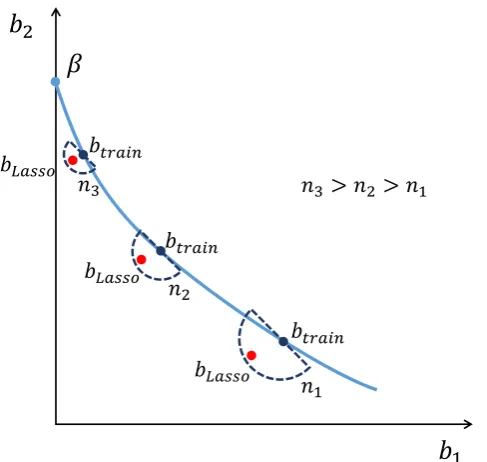
Theorems 2 to 4 capture the relationship between the Lasso estimator bLasso and the
extremum estimatorbtrain, which is summarized in Figure 4. Newey and McFadden (1994)
corresponding path of convergence.13
Since Lasso is implemented to reduce the GE,btrain andbLasso will typically be
numeri-cally different. Theorems 2 to 4 show that, with probability̟(1−1/nt), theL2 difference betweenbtrain andbLasso is bounded by the sum of three terms: overfitting caused by the
extremum estimator (the first RHS term (7) and (8)14
), error due toeT
sX/ns6= 0in the test
set (the second RHS term in (7) and (8)) and sampling error on the test set (the last RHS term in (7) and (8))15
. Hence, as shown in Figure 4, the Lasso estimator (the empirical GE minimizer) generally does not lie on the convergence path of the extremum estimator. However, Theorems 2 to 4 show that the deviation ofbLasso from the convergence path is
bounded. To be specific,bLasso always lies within the feasible area parameterized byλkbk1. Graphically,bLasso lies within an ǫ-ball centered onbtrain with radius given by the RHS of
(7) or (8). As shown in Figure 4,bLasso always lies within the bounds of theǫ-ball feasible
area shown by the dashed 45◦-offset semi-circles. As n/p increases, the ǫ-ball becomes smaller, the Lasso estimator gets closer to the extremum estimator, and both converge toβ.
By implementing the empirical GE minimizer, Lasso reduces overfitting and increases generalization ability. Hence, we show the connection between minimizing GE and asymp-totic performance. This justifies using Lasso for model selection: it is consistent if all the assumptions are satisfied and even if an assumption is not satisfied in practice, it still offers a model with maximal generalization ability. The maximal generalization ability is typically considered useful for empirical research, such as policy analysis, since it makes the performance of the estimated model stable when applied to out-of-sample data.
Connection to previous work
Our approach establishes L2 consistency for Lasso from a different perspective, as well as verifying, generalizing or complementing the results of following papers.
We extend and broaden the scope of VC theory and SRM. Vapnik and Chervonenkis (1971b) originally propose the SRM principle in the context of group classification models.
By balancing the in-sample and out-of-sample fit, SRM finds the best ‘off-shore’ classification algorithm. Alongside our transform strategy and Theorem 2, SRM can be applied to study the properties of numeric algorithms and estimators, general proofs of consistency proof functional spaces, and so on. In another paper we reveal the full power of SRM by extending the results to general spaces of functionals.
Our approach offers a new angle from which to view OLS and linear function approx-imation. As we show in introducing VC theory, the training error will be close to the generalization error if n/p is very large. Hence, OLS may be viewed as a special case of SRM, in which training error is considered approximately identical to generalization
13
Vapnik and Chervonenkis (1974) also derive the necessary and sufficient condition for consistency of the extremum estimator, which they refer to as empirical risk minimization.
14
The first RHS term in each of these two equations is also related to the difference between the training error and the testing error.
15
error. Moreover, typically we may approximate any DGP with linear regression because any analytic function can approximated by an infinite series of polynomials, at least locally. However, in practice this idea encounters three problems: (1) it is impossible to formulate infinite series in empirical research, (2) for high-dimensional data we need to decide which variable to include, and (3) it collapses immediately if the DGP is non-analytic. Thus, SRM and empirical GE minimization implemented by Lasso, offer a new angle on approximation: we approximate the generalization ability of true DGP. If in population the GE of the true DGP can be distinguished from other models, minimizing the GE will guide estimation to the true DGP eventually. Even if the DGP is not well-defined, asymptotically minimizing the GE will provide an approximation that improve model performance on out-of-sample data.
Zhao and Yu (2006), Meinshausen and Yu (2009), and Knight and Fu (2000) derive a necessary condition (and a relaxed version) for probabilistic consistency of Lasso, called the
irrepresentable condition, by definingX = [X1, X2], where theX1 are elements in the true DGP and theX2 are redundant. The condition claims thatLasso is consistent in probability
only if k(X1TX1)−1X1TX2sign(b)k1 <1. Intuitively, this condition implies that if we regress redundant variables on any variable in the true DGP, the norm of coefficient parameter cannot be larger than1ask(X1TX1)−1X1TX2jsign(b)k1 =Ppi=1|corr(X1i, X2j)|<1. Our
assumptions are less restrictive since A3 only requires that the true DGP is unique. Shao (1997) compares the performance of model selection across AIC, BIC, cross-validation and other methods, and proposes conditions to make generalized information criterion (GIC) and cross-validation consistent in model selection. K-fold cross-validation is consistent if the set of alternative models contains at least one correct model with a fixed dimension. By introducing VC theory, our work compliments and extends Shao’s condition in two ways. Firstly, we introduce the finite sample property of a method to implement SRM. Second, GIC and Lasso share a similar condition for consistency in terms of penalizing an over-complicated model. Our condition is consistent with Shao’s since we implement Lasso by cross-validation.
Lastly, some researchers have modified the Lasso to deal with specific scenarios, such as adaptive Lasso(Zou, 2006), relaxed Lasso(Meinshausen, 2007), and group Lasso (Friedman et al., 2010). It is straightforward to extend our framework and results to these algorithms.
4. Simulation Study
We illustrate our theoretical results using simulations. We assume the outcome variable y is generated by the following DGP:
y =X′β+u=X1′β1+X2′β2+u
where X = (x1,· · · , xp)∈ Rp is generated by a multivariate Gaussian distribution with
unit variance. Herexi doesn’t causexj and no causal relation exists betweenu and xi.
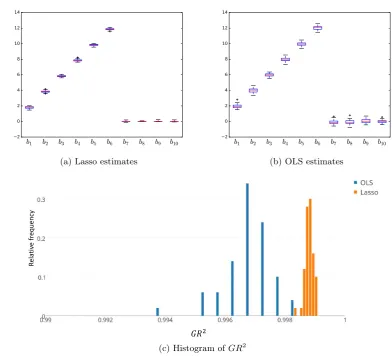
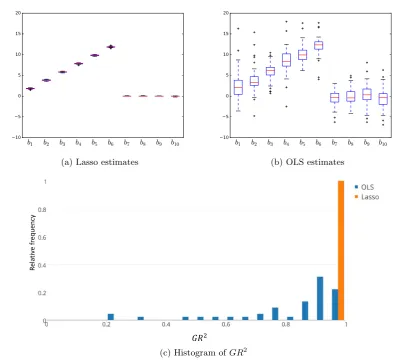
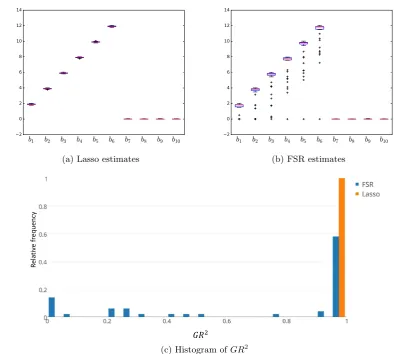
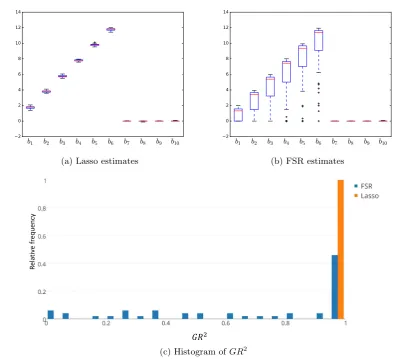
We set the sample size at 250 andp at four values: 200, 250, 300, 500. In each case, we repeat simulation 50 times. In each simulation, we apply the Lasso algorithm to find the estimate ofβ and calculate its distance to the true value, the generalization error, and the in-sample/out-of-sample goodness-of-fit measureGR2. As a comparison, we also apply OLS for then>p cases or the forward selection regression (FSR) algorithm for then < pcases.
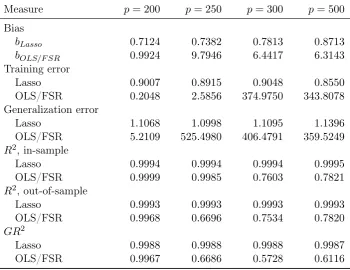
Boxplots (see Appendix 3) show the estimates of all coefficients in β1 (labeled b1 to b6) along with the four worst estimates of coefficients inβ2 (labeledb7 tob10), where ‘worst’ refers to the estimates with the largest bias. The Lasso and OLS/FSR estimates and histograms of theGR2 are reported for each case, respectively, in Figures 5–8 (Appendix 3). Finally, the distance between the estimates and the true values, the generalization error, andGR2 (averages across the 50 simulations) are reported in Table 1 for all four cases for p.
When n > p, as we can see from the boxplot in Figure 5, both Lasso and OLS perform well. All the coefficient estimates are centered around the corresponding true values, and the deviations are relatively small. However, Lasso outperforms OLS for the estimates of β2 in terms of having much smaller deviations. Indeed, a joint significance test (F test) fails to reject the null hypothesis that all coefficients inβ2 are zero for the OLS estimates. As shown in Figure 5, the Lasso GR2 is marginally larger than the OLS GR2, but the differences are inconsequential.
Whenn=p, as shown in Figure 6, Lasso still performs well while it is apparent that OLS is biased and its deviations much larger. Also as shown in Figure 6, the Lasso GR2 is clustered around 1 while theGR2 for OLS takes on a range of values from 1 down to 0.2. This is evidence that OLS suffers from an overfitting problem.
Whenn < p, the regression model is not identified, OLS is infeasible, and we apply FSR. As shown in Figures 7 and 8, Lasso still performs well and correctly selects the variables with non-zero coefficients. In contrast, although FSR also correctly identifies the non-zero coefficients, its biases and deviations are much larger than for the Lasso. For thep= 500 case shown in Figure 8 it is clear that the FSR estimates are unreliable. Generally speaking, overfitting is controlled well by Lasso (all theGR2 are close to 1) whereas the performance of FSR is mixed, as reflected by the deterioratingGR2 asp increases. This suggests that, by imposing anL1 penalty on estimates, Lasso mitigates the overfitting problem and that the advantage of Lasso is likely to be more pronounced asp increases.
Table 1: Average bias, training error, generalization error, in-sampleR2, out-of-sampleR2, andGR2 for Lasso and OLS/FSR
Measure p= 200 p= 250 p= 300 p= 500
Bias
bLasso 0.7124 0.7382 0.7813 0.8713
bOLS/F SR 0.9924 9.7946 6.4417 6.3143
Training error
Lasso 0.9007 0.8915 0.9048 0.8550
OLS/FSR 0.2048 2.5856 374.9750 343.8078
Generalization error
Lasso 1.1068 1.0998 1.1095 1.1396
OLS/FSR 5.2109 525.4980 406.4791 359.5249
R2, in-sample
Lasso 0.9994 0.9994 0.9994 0.9995
OLS/FSR 0.9999 0.9985 0.7603 0.7821
R2, out-of-sample
Lasso 0.9993 0.9993 0.9993 0.9993
OLS/FSR 0.9968 0.6696 0.7534 0.7820
GR2
Lasso 0.9988 0.9988 0.9988 0.9987
OLS/FSR 0.9967 0.6686 0.5728 0.6116
5. Conclusion
In this paper, by using SRM, we show that the maximization of generalization ability and model selection share the same algebraic and topological structure. If we address one, the other is also solved as well. This highlights the importance of generalization error minimization in model selection and parameter estimation. We establish the L2 consistency of Lasso-type model selection under assumptions (A1–A4) similar to those typically imposed on OLS. In this way, we ensure the Lasso is applicable to economic data, especially when big data is increasingly available. We propose the CV-Lasso algorithm which uses cross-validation to choose theL1 penalty parameter. The algorithm significantly reduces computation load and, thus, makes model selection in big data sets feasible. We also propose the generalizedR2, GR2, to measure both in-sample and out-of-sample fitting. We illustrate model selection consistency by simulations and demonstrate that the CV-Lasso algorithm has the potential to recover true DGPs if assumptions A1 to A4 are satisfied. It is clear that, under a range of settings, minimizing the generalization error picks the true DGP efficiently. In particular, the CV-Lasso algorithm strikes a good balance between in-sample and out-of-sample fitting, as indicated byGR2. In another paper, we develop a new algorithm that is able to recover DGPs with a sophisticated hierarchical structure, which should find many potential applications in economics.
is not achievable. However, since the CV-Lasso algorithm is based on minimizing the generalization error, the model selected by the CV-Lasso algorithm will still offer good generalization ability. This is similar in spirit to the case of quasi-maximum likelihood, where the estimates may not be consistent but are still useful for inference.
There are two tuning parameters in implementing Lasso, λ (the penalty parameter) andK (the number of folds used in validation). In this paper, we show that cross-validation selects a λthat leads to consistent model selection and parameter estimation. Alternatively, the BIC may be used for the choice of λ. We conjecture that cross-validation is asymptotically equivalent to BIC in selectingλ. Simulations (not reported here) indicate that both cross-validation and BIC work well for selectingλin medium to large samples. In practice, the number of folds (K) in cross-validation is conventionally set at 5, 10, 20 orn (leave one out). The choice ofK is of theoretical interest because it is related to the question of how much information is necessary for estimation and how much for validation. In another paper we provide some theoretical results surrounding the choice ofK.
References
Akaike, H., 1973. Information theory and an extension of the maximum likelihood principle. In: Petrov, B. N., Csaki, F. (Eds.), 2nd International Symposium on Information Theory,
Tsahkadsor, Armenia, USSR. Budapest: Akademiai Kaido, pp. 267–281.
Bai, J., Ng, S., 2008. Forecasting economic time series using targeted predictors. Journal of Econometrics 146 (2), 304–317.
Bellman, R. E., 1957. Dynamic Programming. Rand Corporation research study. Princeton University Press.
Belloni, A., Chen, D., Chernozhukov, V., Hansen, C. B., 2012. Sparse models and methods for optimal instruments with an application to eminent domain. Econometrica 80 (6), 2369–2429.
Belloni, A., Chernozhukov, V., 2011. High dimensional sparse econometric models: An introduction. Springer.
Bickel, P. J., Ritov, Y., Tsybakov, A. B., 2009. Simultaneous analysis of lasso and dantzig selector. The Annals of Statistics 37, 1705–1732.
Breiman, L., 1995. Better subset regression using the nonnegative garrote. Technometrics 37 (4), 373–384.
Candes, E. J., Tao, T., 2007. The dantzig selector: statistical estimation whenpis much larger thann. The Annals of Statistics, 2313–2351.
Caner, M., 2009. Lasso-type gmm estimator. Econometric Theory 25 (1), 270–290.
Chatterjee, A., Gupta, S., Lahiri, S., 2015. On the residual empirical process based on the ALASSO in high dimensions and its functional oracle property. Journal of Econometrics 186 (2), 317–324.
Cheng, X., Liao, Z., 2015. Select the valid and relevant moments: An information-based Lasso for gmm with many moments. Journal of Econometrics 186 (2), 443–464.
Chickering, D. M., Heckerman, D., Meek, C., 2004. Large-sample learning of Bayesian networks is NP-hard. Journal of Machine Learning Research 5, 1287–1330.
De Mol, C., Giannone, D., Reichlin, L., 2008. Forecasting using a large number of predictors: Is bayesian shrinkage a valid alternative to principal components? Journal of Econometrics 146 (2), 318–328.
Frank, I. E., Friedman, J. H., 1993. A statistical view of some chemometrics regression tools. Technometrics 35 (2), 109–135.
Friedman, J., Hastie, T., Tibshirani, R., 2010. A note on the group lasso and a sparse group lasso. arXiv preprint arXiv:1001.0736.
Friedman, N., Geiger, D., Goldszmidt, M., 1997. Bayesian network classifiers. Machine Learning 29 (2-3), 131–163.
Friedman, N., Linial, M., Nachman, I., Pe’er, D., 2000. Using Bayesian networks to analyze expression data. In: Proceedings of the Fourth Annual International Conference on Computational Molecular Biology. RECOMB ’00. ACM, New York, NY, USA, pp. 127–135.
Fu, W. J., 1998. Penalized regressions: the bridge versus the Lasso. Journal of computational and graphical statistics 7 (3), 397–416.
Heckerman, D., Geiger, D., Chickering, D. M., 1995. Learning Bayesian networks: The combination of knowledge and statistical data. Machine learning 20 (3), 197–243.
James, W., Stein, C., 1961. Estimation with quadratic loss. In: Proceedings of the 4th Berkeley symposium on mathematical statistics and probability. Vol. 1. pp. 361–379.
Kim, H. H., Swanson, N. R., 2014. Forecasting financial and macroeconomic variables using data reduction methods: New empirical evidence. Journal of Econometrics 178, 352–367.
Knight, K., Fu, W., 2000. Asymptotics for Lasso-type estimators. Annals of statistics, 1356–1378.
Kock, A. B., Callot, L., 2015. Oracle inequalities for high dimensional vector autoregressions. Journal of Econometrics 186 (2), 325 – 344.
Manzan, S., 2015. Forecasting the distribution of economic variables in a data-rich environ-ment. Journal of Business & Economic Statistics 33 (1), 144–164.
Meinshausen, N., 2007. Relaxed Lasso. Computational statistics and data analysis 52 (1), 374–393.
Meinshausen, N., Bühlmann, P., 2006. High-dimensional graphs and variable selection with the Lasso. The Annals of Statistics, 1436–1462.
Meinshausen, N., Yu, B., 2009. Lasso-type recovery of sparse representations for high-dimensional data. The Annals of Statistics, 246–270.
Pistoresi, B., Salsano, F., Ferrari, D., 2011. Political institutions and central bank indepen-dence revisited. Applied Economics Letters 18 (7), 679–682.
Schneider, U., Wagner, M., 2012. Catching growth determinants with the adaptive lasso. German Economic Review 13 (1), 71–85.
Schwarz, G. E., 1978. Estimating the dimension of a model. Annals of Statistics 6 (2), 461–464.
Shao, J., 1997. Asymptotic theory for model selection. Statistica Sinica 7, 221–242.
Stone, M., 1974. Cross-validatory choice and assessment of statistical predictions. Journal of the Royal Statistical Society, Series B (Methodological) 36 (2), 111–147.
Stone, M., 1977. An asymptotic equivalence of choice of model by cross-validation and akaike’s criterion. Journal of the Royal Statistical Society, Series B (Methodological) 39 (1), 44–47.
Tibshirani, R., 1996. Regression shrinkage and selection via the Lasso. Journal of the Royal Statistical Society, Series B (Methodological) 58, 267–288.
Tikhonov, A., 1963. Solution of incorrectly formulated problems and the regularization method. In: Soviet Math. Dokl. Vol. 5. pp. 1035–1038.
Tropp, J. A., 2004. Greed is good: Algorithmic results for sparse approximation. Information Theory, IEEE Transactions on 50 (10), 2231–2242.
Vapnik, V. N., Chervonenkis, A. Y., 1971a. On the uniform convergence of relative frequen-cies of events to their probabilities. Theoretical Probability and its Applications 16 (2), 264–280.
Vapnik, V. N., Chervonenkis, A. Y., 1971b. Theory of uniform convergence of frequencie of appearance of attributes to their probabilities and problems of defining optimal solution by empiric data. Avtomatika i Telemekhanika (2), 42–53.
Vapnik, V. N., Chervonenkis, A. Y., 1974. On the method of ordered risk minimization, II. Avtomatika i Telemekhanika (9), 29–39.
Varian, H. R., 2014. Big data: new tricks for econometrics. The Journal of Economic Perspectives 28 (2), 3–27.
Zhang, C.-H., 2010. Nearly unbiased variable selection under minimax concave penalty. The Annals of Statistics 38, 894–942.
Zhang, T., 2009. On the consistency of feature selection using greedy least squares regression. Journal of Machine Learning Research 10, 555–568.
Zhao, P., Yu, B., 2006. On model selection consistency of Lasso. The Journal of Machine Learning Research 7, 2541–2563.
Appendix 1
Proof. Theorem 1. Definebtest= argminb Rns(b|Xs, Ys)andbtrain = argminb Rnt(b|Xt, Yt).
The VC inequality (3) forms an upper bound for the generalization error with probability 1−η,∀b,
R(b|X, Y)6Rnt(b|Xt, Yt) 1−√ǫ−1
whereRnt(b|Xt, Yt) stands for the training error on(Xt, Yt), R(b|X, Y)stands for the true
generalization error ofband ǫ= (1/nt){hln [(nt/h)] +h−ln (η)}.
Denote M =Rnt(btrain|Xt, Yt) (1−√ǫ)−1. If we setη = 1/nt for ǫ, the VC inequality
forms a probabilistic bound for the GE. If(nt/h)→ ∞, then
lim
e
n→∞ǫ= limen→∞
1 nt/h
(ln[(nt/h)] + 1) + lim
f
nt→∞
1 nt
ln(nt) = 0.
Thus, the VC inequality is equal to
lim
e
n→∞PM − Rnt(btrain|Xt, Yt)
>1/nt = 0, ∀btrain
Given the extremum estimator exists, its loss is finite. Hence, the loss for each data point in the test setLoss(yi,ybi)∈[0, Bi], ∀i6ns, whereBi is the supremum ofLoss(yi,ybi). Also,
since the extremum estimator converges in theL∞ norm,
lim
e
n→∞P
sup
b∈Λ|Rn
s(b|Xs, Ys)− R(b|X, Y)|6ς
= 1, ∀ς >0.
Thus, the upper bound and lower bound of |Rns(b|Xs, Ys)− R(b|X, Y)|both converge
to 0. Let’s consider the worst case : suppose that theLoss (btrain|X, Y) have heavy tails;
however, for1< l62,∃τ such that
sup
b∈Λ
l
qR
Lossl(b|x, y)dF(x, y) R
Loss (b|x, y)dF(x, y) 6τ,
which means heavy tails doesn’t make the ratio explode. If the tail is so fat that the ratio above explodes, VC theory cannot offer enough information on convergence rate and probability computationally. Given the worst case as above, the Bahr-Esseen inequality
P{|R(btrain|X, Y)− Rns(btrain|Xs, Ys)|6ς} >1−2·
E[(Lossl
(btrain|x,y))]
ςl
·nl−1
s
>1−2τl·(E[Loss(btrain|x,y)])l
ςl
·nl−1
s
holds true for the extremum estimatorbtrain. If we define̟= 1−2τl·(E[Loss (btrain|x, y)])l/ςl·
nls−1, then
ς =
l
√
2·τ(E[Loss (btrain|x, y)])
l
√
This implies, for any extremum estimator btrain
P{Rns(btrain|Xs, Ys)6R(btrain|X, Y) +ς}>̟.
The VC inequality holds with probability 1−1/nt. For a given ns, we can adapt the
probabilistic bound of the empirical process above as follows
∀btrain ∈ {bλ},∀ς(1/nt) =O(1/nt)>0,∃Nt∈R+s.t. nt>Nt
Rns(btrain|Xs, Ys)6ς+M .
We can relax the bound as follows: ∀ς >0,∀τ1 >0,∃N1∈R+ subject to
P
Rns(btrain|Xs, Ys)6
Rnt(btrain|Xt, Yt)
1−√ǫ +ς
>̟
1− 1
nt
Hence, the probabilistic boundRns(btrain|Xs, Ys)6M+ς holds with probability at least
̟(1−1/nt)
Proof. Corollary 1. Based on Theorem 1, for any extremum estimator btrain,
lim
e
n→∞P{Rns(btrain|Xs, Ys)6M +ς}= 1.
It follows that
lim
e
n→∞P{Rns(btest|Xs, Ys)6Rns(btrain|Xs, Ys)6M +ς}= 1
Also, sinceς could be any small postive value asne→ ∞and
lim
e
n→∞{Rns(btest|Xs, Ys)}= limen→∞M
the empirical GE minimizer and structural risk minimizer share the same limit.
Proof. Proposition 1. Given A1–A4, the true DGP is
yi =xTi β+ui, i= 1, . . . , n.
Proving that the true DGP has the highest generalization ability (the lowest GE) is equivalent to proving, in a test set, that
Pn
i=1 yi−xTi β
2
n 6
Pn
i=1 yi−xTi b
2
which is equivalent to proving that
06 1
n
n
X
i=1
h
yi−xTi b
2
− yi−xTi β
2i
⇐⇒ 06 1
n
n
X
i=1
yi−xTi b+yi−xTi β
yi−xTi b−yi+xTi β
⇐⇒ 06 1
n
n
X
i=1
yi−xTi b+yi−xTi β
xTi β−xTi b.
Definingδ =β−b, it follows,
06 1
n
n
X
i=1
2yi−xTi b−xTi β
xTi δ
⇐⇒ 06 1
n
n
X
i=1
2yi−xTi β+xiTβ−xTi b−xTi β
xTi δ
⇐⇒ 06 1
n
n
X
i=1
2yi−2xTi β+xTi δ
xTi δ
⇐⇒ 06 1
n
n
X
i=1
2ui+xTi δ
xTi δ
Hence, proving (9) is equivalent to proving
06 1
n
n
X
i=1
2ui+xTi δ
xTi δ
SinceE(XTu) =0(A2), it follows that
1 n
n
X
i=1
ui·xi →P 0 ⇐⇒ 1
n
n
X
i=1
ui·xTi
β →P 0 and 1 n
n
X
i=1
ui·xTi
b→0
Hence, asymptotically 1 n n X i=1
2ui+xTi δ
xTi δ= 1 n
n
X
i=1
2δuixTi +
1 n
n
X
i=1
xTi δ2 →P E xTi δ2>0
Proof. Theorem 2. In the proof of Theorem 1 we definedbtrain = argminb Rnt(b|Xt, Yt),
meaning thatbtrain is the extremum estimator without penalty on any training set. We
also haveM =Rnt(btrain|Xt, Yt) (1−√ǫ)−1. Theorem 1 shows the following bound holds
∀b∈Λ
Rns(b|Xs, Ys)6Rnt(b|Xt, Yt) 1−
√
with probability at least(1−1/nt)̟. Also, among all the b∈ {bλ},bLasso has the lowest
GE on the test set,
Rns(bLasso|Xs, Ys)6Rns(b|Xs, Ys)
we have
1 nsk
Ys−XsbLassok22 6
1 ntk
Yt−Xtbtraink22 1−
√
ǫ−1+ς
By defining∆ =btrain−bLasso,Yt−Xtbtrain =etand Ys−Xsbtrain =es,
1 nsk
Ys−XsbLassok22 =
1 nsk
Ys−Xsbtrain+Xs∆k22
= 1
nsk
es+Xs∆k22
= 1
ns
(es+Xs∆)T (es+Xs∆)
= 1
ns
kesk22+ 2eTsXs∆ + ∆TXsTXs∆
Hence,
1 nsk
Ys−XsbLassok22 6
1 ntk
Yt−Xtbtraink22 1−√ǫ−1+ς
implies
1 nsk
esk22+
2 ns
eTsXs∆ +
1 ns
∆TXsTXs∆6
1
nt ketk
2 2
1−√ǫ +ς.
It follows that
1 nsk
Xs∆k22 6
1 nt
ketk22
1−√ǫ− 1 nsk
esk22
!
− 2
ns
eTsXs∆ +ς.
By the Holder inequality,
−eTsXs∆6|eTsXs∆|6eTsXs∞k∆k1.
It follows that
1 nsk
Xs∆k22 6
1 nt
ketk22
1−√ǫ− 1 nsk
esk22
!
+ 2
ns
eT
sXs∞k∆k1+ς.
Also, sincekbLassok1 6kbtraink1
k∆k1 =kbtrain−bLassok1
6kbLassok1+kbtraink1
As a result, we have
1 nsk
Xs∆k226
1 nt
ketk22
1−√ǫ− 1 nsk
esk22 !
+ 4
ns
eT
sXs
∞kbtraink1+ς (10)
where we denote ybs to be the extremum estimator prediction on the test set calculated
on the training set and byLassos to be the Lasso prediction on the test set. It follows that (10) is the bound forE bys−byLassos 2
2
, the expected difference between Lasso prediction and extremum estimator prediction on the test set. The bound holds with probability (1−1/nt)̟.
Proof. Corollary 2. We need to prove that the VC inequality and SRM also hold for Lasso with cross-validation. If Lasso is implemented byK-fold cross-validation, the sample is partitioned into K equal-sized folds. If K = 2, the theoretical result from K-fold cross-validation is identical to Theorem 2. Thus, we only discuss the case ofK >3 here.
For K > 3, we have K different test sets for λ-tuning and K different training sets for estimation. Denote the qth
training set as (Xtq, Ytq), the qth
test set as(Xsq, Ysq), the
extremum estimator estimated from thekth
training set as bk
train, the sample size for each
test set as ns and the sample size for each training set as nt. Based on Theorem 1, for
each test set, the following bound holds for k and q ∈ [1, K] with probability at least (1−1/nt)̟k
Rns(bktrain|Xsq, Ysq)6Rnt(btraink |Xtq, Ytq) (1−√ǫk)−1+ςk.
Hence, 1 K K X q=1
Rns(b k
train|Xsq, Ysq)6Rns(btrain|X
q∗
s , Yq
∗
s )
6Rnt(btrain|Xq
∗
t , Yq
∗
t )
1−√ǫ−1+ς
SincebLasso minimizes(1/K)PqK=1Rns(b|X q
s, Ysq),
1 K
K
X
q=1
Rns(bLasso|X
q
s, Ysq)6
1 K
K
X
q=1
Rns(b k
train|Xsq, Ysq), ∀k∈[1, K]
It follows that
1 K
K
X
q=1
Rns(bLasso|X
q
s, Ysq)6Rnt(btrain|X
q∗
t , Y
q∗
t )
1−√ǫ−1+ς.
Denote Rnt(b
k∗
train|X
q∗
t , Yt) by et and Rns(b
k∗
train|X
q∗
s , Yq
∗