The Berkeley FrameNet Project
C o l l i n F . B a k e r and C h a r l e s J . F i l l m o r e and J o h n B . L o w e
{collinb, fillmore, jblowe}@icsi.berkeley.edu
International C o m p u t e r Science Institute 1947 Center St. Suite 600
Berkeley, Calif., 94704
A b s t r a c t
FrameNet is a three-year NSF-supported project in corpus-based computational lexicog- raphy, now in its second year (NSF IRI-9618838, "Tools for Lexicon Building"). The project's key features are (a) a commitment to corpus evidence for semantic and syntactic generaliza- tions, and (b) the representation of the valences of its target words (mostly nouns, adjectives, and verbs) in which the semantic portion makes use of frame semantics. The resulting database will contain (a) descriptions of the semantic frames underlying the meanings of the words de- scribed, and (b) the valence representation (se- mantic and syntactic) of several thousand words and phrases, each accompanied by (c) a repre- sentative collection of annotated corpus attes- tations, which jointly exemplify the observed linkings between "frame elements" and their syntactic realizations (e.g. grammatical func- tion, phrase type, and other syntactic traits). This report will present the project's goals and workflow, and information about the computa- tional tools that have been adapted or created in-house for this work.
1 I n t r o d u c t i o n
The Berkeley FrameNet project 1 is producing frame-semantic descriptions of several thousand English lexical items and backing up these de- scriptions with semantically annotated attesta- tions from contemporary English corpora 2.
1The project is based at the International Computer Science Institute (1947 Center Street, Berkeley, CA). A fuller bibliography may be found in (Lowe et ai., 1997)
2Our main corpus is the British National Corpus. We have access to it through the courtesy of Oxford University Press; the POS-tagged and lemmatized ver- sion we use was prepared by the Institut flit Maschinelle Sprachverarbeitung of the University of Stuttgart). The
These descriptions are based on hand-tagged semantic annotations of example sentences ex- tracted from large text corpora and systematic analysis of the semantic patterns they exem- plify by lexicographers and linguists. The pri- mary emphasis of the project therefore is the encoding, by humans, of semantic knowledge in machine-readable form. The intuition of the lexicographers is guided by and constrained by the results of corpus-based research using high- performance software tools.
The semantic domains to be covered are" HEALTH CARE, CHANCE, PERCEPTION, COMMU- NICATION, TRANSACTION, TIME, SPACE, BODY (parts and functions of the body), MOTION, LIFE STAGES, SOCIAL CONTEXT, EMOTION and COG- NITION.
1.1 S c o p e of t h e P r o j e c t
The results of the project are (a) a lexical re- source, called the FrameNet database 3, and (b) associated software tools. The database has three major components (described in more de- tail below:
• Lexicon containing entries which are com- posed of: (a) some conventional dictionary-type data, mainly for the sake of human readers; (b) FOR- MULAS which capture the morphosyntactic ways in which elements of the semantic frame can be realized within the phrases or sentences built up around the word; (c) links to semantically ANNOTATED EXAM-
European collaborators whose participation has m a d e this possible are Sue Atkins, Oxford University Press, and Ulrich Held, IMS-Stuttgart.
PLE SENTENCES which illustrate each of the poten- tial realization patterns identified in the formula; 4 and (d) links to the FRAME DATABASE and to other machine-readable resources such as WordNet and COMLEX.
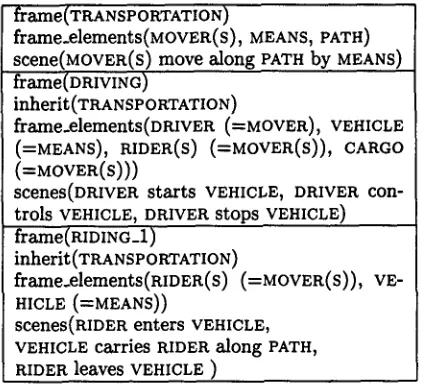
• F r a m e D a t a b a s e containing descriptions of each frame's basic conceptual structure and giving names and descriptions for the elements which par- ticipate in such structures. Several related entries in this database are schematized in Fig. 1.
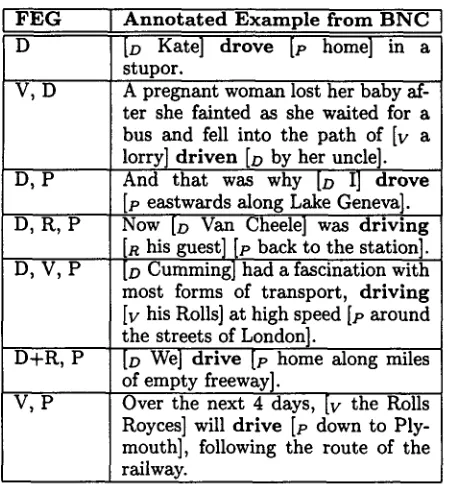
• A n n o t a t e d E x a m p l e S e n t e n c e s which are marked up to exemplify the semantic and morpho- syntactic properties of the lexical items. (Several of these are schematized in Fig. 2). These sentences provide empirical support for the lexicographic anal- ysis provided in the frame database and lexicon en- tries.
These three components form a highly rela- tional and tightly integrated whole: elements in each may point to elements in the other two. The d a t a b a s e will also contain estimates of the relative frequency of senses and comple- mentation patterns calculated by matching the senses and p a t t e r n s in the hand-tagged exam- ples against the entire B N C corpus.
1.2 C o n c e p t u a l M o d e l
The FrameNet work is in some ways similar to efforts to describe the argument structures of lexical items in terms of case-roles or theta- roles, 5 b u t in FrameNet, the role names (called f r a m e e l e m e n t s or F E s ) are local to particular conceptual structures ( f r a m e s ) ; some of these are quite general, while others are specific to a small family of lexical items.
For example, the TRANSPORTATION frame, within the domain of MOTION, provides
MOVERS, MEANS o f transportation, and PATHS; 6
4In cases of accidental gaps, clearly marked invented examples may be added.
5The semantic frames for individual lexical units are typically "blends" of more than one basic frame; from our point of view, the so-called "linking" patterns pro- posed in LFG, HPSG, and Construction Grammar, op- erate on higher-level frames of action (giving agent, pa- tient, instrument), motion and location (giving theme, location, source, goal, path), and experience (giving ex- periencer, stimulus, content), etc. In some but not all cases, the assignment of syntactic correlates to frame el- ements could be mediated by mapping them to the roles of one of the more abstract frames.
8A detailed study of motion predicates would require a finer-grained analysis of the Path element, separating out Source and Goal, and perhaps Direction and Area, but for a basic study of the transportation predicates such refined analysis is not necessary. In any case, our
subframes associated with individual words in- herit all of these while possibly adding some of their own. Fig. 1 shows some of the subframes, as discussed below.
fra~ne (TRANSPORTATION)
frame.elements(MOVER(S), MEANS, PATH)
scene(MOVER(S) move along PATH by MEANS)
frame(DRiVING)
inherit (TRANSPORTATION)
frarne.elements(DRIVER
(:MOVER),
VEHICLE(:MEANS), RIDER(S) (:MOVER(S)), C A R G O
(=MOVER(S)))
scenes(DRIVER starts VEHICLE, DRIVER con-
trois VEHICLE, DRIVER stops VEHICLE)
frame(RIDING-i)
inherit (TRANSP O RTATION)
frame.elements(RIDER(S) (=MOVER(S)), VE- HICLE (:MEANS))
scenes(RIDER enters VEHICLE, VEHICLE carries RIDER along PATH, RIDER leaves VEHICLE )
Figure 1: A subframe can inherit elements and semantics from its parent
The DRIVING frame, for example, specifies a
DRIVER (a p r i n c i p a l MOVER), a VEHICLE (a par- ticularization of the MEANS element), and po- tentially CARGO or RIDER as secondary movers. In this frame, the DRIVER initiates and controls the movement of the VEHICLE. F o r most verbs in this frame, DRIVER or VEHICLE can b e real- ized as subjects; VEHICLE, RIDER, or CARGO can appear as direct objects; and PATH and VEHICLE can appear as oblique complements.
Some combinations of frame elements, or F r a m e E l e m e n t G r o u p s ( F E G s ) , for some real corpus sentences in the DRIVING frame are shown in Fig. 2.
A RIDING_I frame has the primary mover role
as RIDER, and allows as VEHICLE those driven
by o t h e r s / In grammatical realizations of this frame, the RIDER can be the subject; the VEHI- CLE can appear as a direct object or an oblique complement; and the PATH is generally realized as an oblique.
The FrameNet entry for each of these verbs will include a concise formula for all seman-
work includes the separate analysis of the flame seman- tics of directional and locational expressions.
[image:2.612.316.535.137.329.2]F E G A n n o t a t e d E x a m p l e from B N C D
V, D
D, P
D, R, P
D, V, P
D+R, P
V, P
[D Kate] drove [v home] in a stupor.
[image:3.612.71.296.78.320.2]A pregnant woman lost her baby af- ter she fainted as she waited for a bus and fell into the path of [v a lorry] driven [~ by her uncle]. And that was why [D I] drove [p eastwards along Lake Geneva]. Now [D Van Cheele] was driving [R his guest] Iv back to the station]. [D Cumming] had a fascination with most forms of transport, driving [y his Rolls] at high speed [p around the streets of London].
[D We] drive [p home along miles of empty freeway].
Over the next 4 days, Iv the Rolls Royces] will drive [p down to Ply- mouth], following the route of the railway.
Figure 2: Examples of Frame Element Groups and Annotated Sentences
tic and syntactic combinatorial possibilities, to- gether with a collection of annotated corpus sen- tences in which each possibility is exemplified. The syntactic positions considered relevant for lexicographic description include those that are internal to the maximal projection of the target word (the whole VP, AP, or NP for target V, A or N), and those that are external to the max- imal projection under precise structural condi- tions; the subject, in the case of VP, and the subject of support verbs in the case of AP and NP. s
Used in NLP, the FrameNet database should make it possible for a system which finds a valence-bearing lexical item in a text to know (for each of its senses) where its individual argu- ments are likely to be found. For example, once a parser has found the verb drive and its direct object NP, the link to the DRIVING frame will suggest some semantics for that NP, e.g. that a person as direct object probably represents
the RIDER, while a non-human proper noun is probably the VEHICLE.
For practical lexicography, the contribution of the FrameNet database will be its presentation
SFor causatives, the object of the support verb is included; for details, see (Fillmore and Atkins, forthcoming).
of the full range of use possibilities for individ- ual words, documented with corpus data, the model examples for each use, and the statistical information on relative frequency.
2 O r g a n i z a t i o n a n d W o r k f l o w
2.1 O v e r v i e w
The computational side of the FrameNet project is directed at efficiently capturing h u m a n in- sights into semantic structure. The majority of the work involved is marking text with se- mantic tags, specifying (again by hand) the structure of the frames to be treated, and writ- ing dictionary-style entries based the results of annotation and a priori descriptions. With the exception of the example sentence extrac- tion component, all the software modules are highly interactive and have substantial user in- terface requirements. Most of this functionality is provided by WWW-based programs written in PERL.
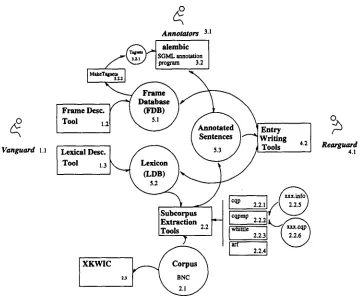
Four processing steps are required produce the FrameNet database of frame semantic rep- resentations: (a) generating initial descriptions of semantic and syntactic patterns for use in corpus queries and annotation ("Preparation"), (b) extracting good example sentences ("Sub- corpus Extraction"), (c) marking (by hand) the constituents of interest ("Annotation"), and (d) building a database of lexical semantic represen- tations based on the annotations and other data ("Entry Writing"). These are discussed briefly below and shown in Fig. 3.
2.2 W o r k f l o w a n d P e r s o n n e l
As work on the project has progressed, we have defined several explicit roles which project participants play in the various steps, these roles are referred to as V a n g u a r d (1.1 in Fig. 3), A n n o t a t o r s (3.1) and R e a r g u a r d (4.1). These are purely functional designations: the same person may play different roles at dif- ferent times. 9
1. P r e p a r a t i o n . The Vanguard (1.1) pre- pares the initial descriptions of frames, includ- ing lists of frames and frame elements, and adds these to the Frame Database (5.1) using the Frame Description tool (1.2). The Vanguard
Vanguard 1.1
Annotators 3.1
# ~ alembic
~ . . , ~ - ~ ' ~ ] [SGMLannotation , / f ~ . ~ [program 3.2
b
[ ~ [ ~nnom,e? ~ ~ ] Entry
LT:[.,,, D,,:; /
~,,,,,. 5.3 J
/ TooI I
Extraction . . ~ I - " 2 . 2 . 2 [ ~ . , , ~
I xKwIC
c".'Tju'/
I
"1
Rearguard
4.1
Figure 3: Workflow, Roles, Data Structures and Software also selects the major vocabulary items for the
frame (the
target words)
and the syntactic pat- terns that need to be checked for each word, which are entered in the Lexical Database (5.2) by means of the Lexical Database Tool (1.3).2. S u b c o r p u s E x t r a c t i o n . Based on the Vanguard's work, the subcorpus extraction tools (2.2) produce a representative collection of sentences containing these words.
This selection of examples is achieved through a hybrid process partially controlled by the pre- liminary lexical description of each lemma. Sen- tences containing the lemma are extracted from from a corpus and classified into subcorpora by syntactic pattern (2.2.1) using a CASCADE FILTER (2.2.2, 2.2.5, 2.2.6) representing a par- tial regular-expression grammar of English over part-of-speech tags (cf. Gahl (forthcoming)), formatted for annotation (2.2.4) , and automat- ically sampled (2.2.3) down to an appropriate number.
(If these heuristics fail to find appropriate examples by means of syntactic patterns, sen- tences are selected using INTERACTIVE SELEC-
TION TOOLS (2.3)).
3. A n n o t a t i o n . Using the annotation soft- ware (3.2) and the tagsets (3.2.1) derived from the Frame Database, the Annotators (3.1) mark selected constituents in the extracted subcor- pora according to the frame elements which they realize, and identify canonical examples, novel patterns, and problem sentences. 1°
4. E n t r y W r i t i n g . The Rearguard (4.1) reviews the skeletal lexical record created by the Vanguard, the annotated example sentences (5.3), and the FEGs extracted from them, and builds both the entries for the lemmas in the Lexical Database (5.2) and the frame descrip- tions in the Frame Database (5.1), using the Entry Writing Tools (4.2).
[image:4.612.128.488.78.374.2]3 I m p l e m e n t a t i o n
3.1 D a t a M o d e l
T h e d a t a structures described above are im- plemented in SGML. n Each is described by a DTD, and these DTDs are s t r u c t u r e d to provide the necessary links between the components.
3.2 S o f t w a r e
T h e software suite currently supporting database development is an aggregate of existing software tools held together with P E R L / C G I - b a s e d "glue". In order to get the project started, we have d e p e n d e d on off-the- shelf software which in some cases is not ideal for our purposes. Nevertheless, using these programs allowed us to get the project up and running within just a few months. We describe below in approximate order of application the programs used and their state of completion.
• Frame Description Tool (1.2) (in development) An interactive, web-based tool.
• Lexical Description Tool (1.3) (prototype) An interactive, web-based tool.
• CQP (2.2.1) is a high-performance Corpus Query Processor, developed at IMS Stuttgart (IMS, 1997). The cascade filter, which partitions lemma- specific subcorpora by syntactic patterns, is built using a preprocessor (written in PERL, 2.2.2) which generates CQP's native query language.
• XKWIC (2.3) is an X-window, interactive tool, also from IMS, which facilitates manipulating cor- pora and subcorpora.
• Subcorpora are prepared for annotation by a program ("arf" for
Annotation Ready Formatter,
2.2.4) which wraps SGML tags around sentences, target words, comments and other distinguishable text elements. Another program, "whittle" (2.2.3), combines subcorpora in a preselected order, remov- ing very long and very short sentences, and sampling to reduce large subcorpora.
• Alembic (3.2) (Mitre, 1998), allows the inter- active markup (in SGML) of text files according to predefined tagsets (3.2.1). It is used to introduce frame element annotations into the subcorpora.
• Sgmlnorm, etc. (from James Clark's SGML tool set) are used to validate and manage the SGML files.
• Entry Writing Tools (4.2) (in development) • Database management tools to manage the cat- alog of subcorpora, schedule the work, render the
nEventually, we plan to migrate to an XML data model, which appears to provide more flexibility while reducing complexity. Also, the FrameNet software is be- ing developed on Unix, but we plan to provide cross- platform capabilities by making our tool suite web-based and XML-compatible.
S G M L files into H T M L for convenient viewing on the web, etc. are being written in PERL. R C S main- tains version control over most files.
4 C o n c l u s i o n
At the time of writing, there is something in place for each of the major software compo- nents, though in some cases these are little more than stubs or "toy" implementations. Nearly 10,000 sentences exemplifying just under 200 lemmas have been annotated; there are over 20,000 frame element tokens marked in these example sentences. About a dozen frames have been specified, which refer to 47 n a m e d frame elements. Most of these annotations have been accomplished in the last few months since the software for corpus extraction, frame descrip- tion, and annotation became operational. W e expect the inventory to increase rapidly. If the proportions cited hold constant as the Framenet database grows, the final database of 5,000 lex- ical units m a y contain 250,000 annotated sen- tences and over half a million tokens of frame elements.
R e f e r e n c e s
Charles J. Fillmore and B. T. S. Atkins. forth- coming. FrameNet and lexicographic rele- vance. In
Proceedings of the First Inter-
national Conference On Language Resources
And Evaluation, Granada, Spain, P8-30 May
1998.
Susanne Gahl. forthcoming. A u t o m a t i c extrac- tion of subcorpora based on subcategoriza- tion frames from a part of speech tagged cor- pus. In
Proceedings o/ the 1998 COLING-
A CL conference.
Institut f'dr maschinelle Sprachverarbeitung IMS. 1997. IMS corpus toolbox web page at stuttgart, h t t p : / / w w w . i m s . u n i - stuttgart.de/~oli/CorpusToolbox/.
J o h n B. Lowe, Collin F. Baker, a n d Charles J. Fillmore. 1997. A frame-semantic approach to semantic annotation. In
Tagging Text with
Lexical Semantics: Why, What, and How?
Proceedings of the Workshop,
pages 18-24. Special Interest Group on the Lexicon, Asso- ciation for Computational Linguistics, April.Mitre. 1998. Alembic Work-