Data Cleaning for Word Alignment
Tsuyoshi Okita
CNGL / School of Computing Dublin City University, Glasnevin, Dublin 9
Abstract
Parallel corpora are made by human be-ings. However, as an MT system is an aggregation of state-of-the-art NLP tech-nologies without any intervention of hu-man beings, it is unavoidable that quite a few sentence pairs are beyond its analy-sis and that will therefore not contribute to the system. Furthermore, they in turn may act against our objectives to make the overall performance worse. Possible
unfa-vorable items aren :m mapping objects,
such as paraphrases, non-literal
transla-tions, and multiword expressions. This
paper presents a pre-processing method which detects such unfavorable items be-fore supplying them to the word aligner under the assumption that their frequency is low, such as below 5 percent. We show an improvement of Bleu score from 28.0 to 31.4 in English-Spanish and from 16.9 to 22.1 in German-English.
1 Introduction
Phrase alignment (Marcu and Wong, 02) has re-cently attracted researchers in its theory, although it remains in infancy in its practice. However, a phrase extraction heuristic such as grow-diag-final (Koehn et al., 05; Och and Ney, 03), which is a sin-gle difference between word-based SMT (Brown et al., 93) and phrase-based SMT (Koehn et al., 03) where we construct word-based SMT by bi-directional word alignment, is nowadays consid-ered to be a key process which leads to an over-all improvement of MT systems. However, tech-nically, this phrase extraction process after word alignment is known to have at least two limita-tions: 1) the objectives of uni-directional word
alignment is limited only in1 : n mappings and
2) an atomic unit of phrase pair used by phrase
ex-traction is thus basically restricted in1 :norn: 1 with small exceptions.
Firstly, the posterior-based approach (Liang, 06) looks at the posterior probability and partially delays the alignment decision. However, this
ap-proach does not have any extension in its 1 : n
uni-directional mappings in its word alignment. Secondly, the aforementioned phrase alignment
(Marcu and Wong, 02) considers then : m
map-ping directly bilingually generated by some con-cepts without word alignment. However, this ap-proach has severe computational complexity prob-lems. Thirdly, linguistic motivated phrases, such as a tree aligner (Tinsley et al., 06), providesn:m mappings using some information of parsing re-sults. However, as the approach runs somewhat in a reverse direction to ours, we omit it from the dis-cussion. Hence, this paper will seek for the meth-ods that are different from those approaches and whose computational cost is cheap.
n:mmappings in our discussion include
para-phrases (Callison-Burch, 07; Lin and Pantel, 01), non-literal translations (Imamura et al., 03), mul-tiword expressions (Lambert and Banchs, 05), and some other noise in one side of a translation pair (from now on, we call these ‘outliers’, meaning that these are not systematic noise). One
com-mon characteristic of these n : m mappings is
that they tend to be so flexible that even an ex-haustive list by human beings tends to be incom-plete (Lin and Pantel, 01). There are two cases which we should like to distinguish: when we use external resources and when we do not. For ex-ample, Quirk et al. employ external resources by drawing pairs of English sentences from a compa-rable corpus (Quirk et al., 04), while Bannard and Callison-Burch (Bannard and Callison-Burch, 05) identified English paraphrases by pivoting through phrases in another language. However, in this pa-per our interest is rather the case when our re-sources are limited within our parallel corpus.
Imamura et al. (Imamura et al., 03), on the other hand, do not use external resources and present a method based on literalness measure called TCR
(Translation Correspondence Rate). Let us
de-fine literal translation as a word-to-word transla-tion, and non-literal translation as a non word-to-word translation. Literalness is defined as a de-gree of literal translation. Literalness measure of Imamura et al. is trained from a parallel corpus using word aligned results, and then sentences are selected which should either be translated by a ‘lit-eral translation’ decoder or by a ‘non-lit‘lit-eral trans-lation’ decoder based on this literalness measure. Apparently, their definition of literalness measure is designed to be high recall since this measure incorporates all the possible correspondence pairs (via realizability of lexical mappings) rather than all the possible true positives (via realizability of sentences). Adding to this, the notion of literal translation may be broader than this. For exam-ple, literal translation of “C’est la vie.” in French is “That’s life.” or “It is the life.” in English. If literal translation can not convey the original meaning correctly, non-literal translation can be applied: “This is just the way life is.”, “That’s how things happen.”, “Love story.”, and so forth.
Non-literal translation preserves the original meaning1
as much as possible, ignoring the exact word-to-word correspondence. As is indicated by this ex-ample, the choice of literal translation or non-literal translation seems rather a matter of trans-lator preference.
This paper presents a pre-processing method us-ing the alternative literalness score aimus-ing for high precision. We assume that the percentages of these
n : m mappings are relatively low. Finally, it
turned out that if we focus on outlier ratio, this method becomes a well-known sentence cleaning approach. We refer to this in Section 5.
This paper is organized as follows. Section 2
outlines the 1 : n characteristics of word
align-ment by IBM Model 4. Section 3 reviews an
atomic unit of phrase extraction. Section 4 ex-plains our Good Points Algorithm. Experimen-tal results are presented in Section 5. Section 6 discusses a sentence cleaning algorithm. Section 7 concludes and provides avenues for further re-search.
1Dictionary goes as follows: something that you say when
something happens that you do not like but which you have to accept because you cannot change it [Cambridge Idioms Dictionary 2nd Edition, 06].
C
B A
[image:2.595.316.503.65.230.2]D
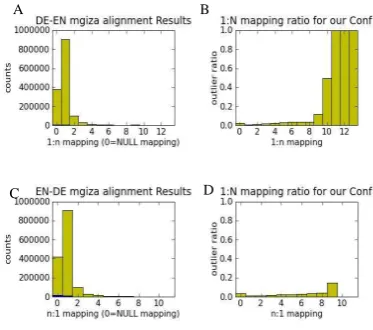
Figure 1: Figures A and C show the results of word alignment for DE-EN where outliers de-tected by Algorithm 1 are shown in blue at the bot-tom. We check all the alignment cept pairs in the training corpus inspecting so-called A3 final files by type of alignment from 1:1 to 1:13 (or NULL alignment). It is noted that outliers are miniscule in A and C because each count is only 3 percent. Most of them are NULL alignment or 1:1 align-ment, while there are small numbers of alignments with 1:3 and 1:4 (up to 1:13 in the DE-EN direc-tion in Figure A). In Figure C, 1:11 is the greatest. Figure B and D show the ratio of outliers over all the counts. Figure B shows that in the case of 1:10 alignments, 1/2 of the alignments are considered to be outliers by Algorithm 1, while 100 percent of alignment from 1:11 to 1:13 are considered to be outliers (false negative). Figure D shows that in the case of EN-DE, most of the outlier ratios are less than 20 percent.
2 1 :nWord Alignment
Our discussion of uni-directional alignments of word alignment is limited to IBM Model 4.
Definition 1 (Word alignment task) Let ei be thei-th sentence in target language,e¯i,j be thej -th word ini-th sentence, ande¯ibe thei-th word in parallel corpus (Similarly forfi,f¯i,j, andf¯i). Let |ei| be a sentence length of ei, and similarly for |fi|. We are given a pair of sentence aligned bilin-gual texts (f1, e1), . . . ,(fn, en) ∈ X × Y, where fi = ( ¯fi,1, . . . ,f¯i,|fi|)and ei = (¯ei,1, . . . ,e¯i,|ei|).
to my regret i cannot go today . i am sorry that i cannot visit today . it is a pity that i cannot go today .
i am sorry that i cannot visit today . it is a pity that i cannot go today . sorry , today i will not be available Source Language
GIZA++ alignment results for IBM Model 4 i NULL 0.667
cannot available 0.272 it am 1 is am 1 sorry go 0.667 , go 1 that regret 0.25 cannot regret 0.18 visit regret 1 regret not 1 be pity 1
available pity 1 cannot sorry 0.55 go sorry 0.667 am to 1 sorry to 0.33 to , 1 my , 1 will is 1 not is 1 a that 1 pity that 1
today . 1 . . 1 i cannot 0.33 that cannot 0.75 Target Language
to my regret i cannot go today . sorry , today i will not be available
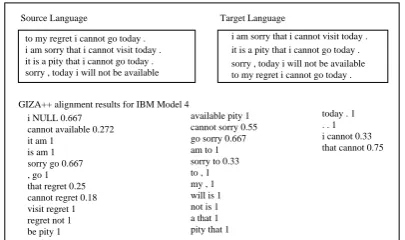
Figure 2: Example shows an example alignment of paraphrases in a monolingual case. Source and target use the same set of sentences. Results show that only the matching between the colon is cor-rect3.
as IBM Model 3 and 4 have deficiency problems). It is noted that there may be several words in source language and target language which do not map to any words, which are called unaligned (or null aligned) words. Triples ( ¯fi,¯ei, pfi¯(¯e1)) (or
( ¯fi,e¯i,−log10pfi¯(¯e1))) are called T-tables.
As the above definition shows, the purpose of the word alignment task is to obtain a lexical translation probability p( ¯fi|¯ei), which is a 1 : n uni-directional word alignment. The initial idea underlying the IBM Models, consisting of five distinctive models, is that it introduces an
align-ment function a(j|i), or alternatively the
distor-tion funcdistor-tiond(j|i)ord(j− ⊙i), when the task is
viewed as a missing value problem, whereiandj
denote the position of a cept in a sentence and⊙i
denotes the center of a cept. d(j|i)denotes a
dis-tortion of the absolute position, whiled(j−⊙i)
de-notes the distortion of relative position. Then this missing value problem can be solved by EM algo-rithms : E-step is to take expectation of all the pos-sible alignments and M-step is to estimate maxi-mum likelihood of parameters by maximizing the expected likelihood obtained in the E-step. The second idea of IBM Models is in the mechanism of fertility and a NULL insertion, which makes the performance of IBM Models competitive. Fertility and a NULL insertion is used to adjust the length
3
It is noted that there might be a criticism that this is not a fair comparison because we do not have sufficient data. Un-der a transductive setting (where we can access the test data), we believe that our statement is valid. Considering the nature of the1 : nmapping, it would be quite lucky if we obtain n :mmapping after phrase extraction (Our focus is not on the incorrect probability, but rather on the incorrect match-ing.)
nwhen the length of the source sentence is
differ-ent from thisn. Fertility is a mechanism to
aug-ment one source word into several source words or delete a source word, while a NULL insertion is a mechanism of generating several words from blank words. Fertility uses a conditional probabil-ity depending only on the lexicon. For example, the length of ‘today’ can be conditioned only on the lexicon ‘today’.
As is already mentioned, the resulting
align-ments are 1 : n (shown in the upper figure in
Figure 1). For DE-EN News Commentary cor-pus, most of the alignments fall in either 1:1 map-ping or NULL mapmap-pings whereas small numbers are 1:2 mappings and miniscule numbers are from
1:3 to 1:13. However, this 1 : nnature of word
alignment will cause problems if we encounter
n:mmapping objects, such as a paraphrase,
non-literal translation, or multiword expression. Figure 2 shows such difficulties where we show a mono-lingual paraphrase. Without loss of generality this can be easily extended to bilingual paraphrases. In this case, results of word alignment are completely wrong, with the exception of the example consist-ing of a colon. Although these paraphrases, non-literal translations, and multiword expressions do not always become outliers, they may face the potential danger of producing the incorrect word alignments with incorrect probabilities.
3 Phrase Extraction and Atomic Unit of
Phrases
The phrase extraction is a process to exploit phrases for a given bi-directional word alignment (Koehn et al., 05; Och and Ney, 03). If we focus on its generative process, this would become as fol-lows: 1) add intersection of two word alignments as an alignment point, 2) add new alignment points that exist in the union with the constraint that a new alignment point connects at least one previ-ously unaligned word, 3) check the unaligned row (or column) as unaligned row (or column,
respec-tively), 4) ifnalignment points are contiguous in
horizontal (or vertical) direction we consider that
this is a contiguous 1 : n(or n : 1) phrase pair
(let us call these type I phrase pairs), 5) if a
neigh-borhood of a contiguous1 : nphrase pair is (an)
[image:3.595.80.283.62.182.2]type II phrase pairs generatively.
The atomic unit of type I phrase pairs is1 : n
orn: 1, while that of type II phrase pairs isn:m if unaligned row(s) and column(s) exist in
neigh-borhood. So, whether they form a n : m
map-ping or not depends on the existence of unaligned
row(s) and column(s). And at the same time,nor
m should be restricted to a small value. There is
a chance that a n : m phrase pair can be created
in this way. This is because around one third of word alignments, which is quite a large figure, are
1 : 0 as is shown in Figure 1. Nevertheless, our concern is if the results of word alignment is very low quality, e.g. similar to the situation depicted in Figure 2, this mechanism will not work. Fur-thermore, this mechanism is only restricted in the unaligned row(s) and column(s).
4 Our Approach: Good Points Approach
Our approach aims at removing outliers by the lit-eralness score, which we defined in Section 1, be-tween a pair of sentences. Sentence pairs with low literalness score should be removed. Following two propositions are the theory behind this. Let
a word-based MT system beMW B and a
phrase-based MT system beMP B. Then,
Proposition 1 Under an ideal MT systemMP B, a paraphrase is an inlier (or realizable), and
Proposition 2 Under an ideal MT system MW B, a paraphrase is an outlier (or not realizable).
Based on these propositions, we could assume that if we measure the literalness score under a
word-based MT MW B we will be able to
deter-mine the degree of outlier-ness whatever the mea-sure we use for it. Hence, what we should do is,
initially, to score it under a word-based MTMW B
using Bleu, for example. (Later we replace it with a variant of Bleu, i.e. cumulative n-gram score). However, despite Proposition 1, our MT system at hand is unfortunately not ideal. What we can currently do is the following: if we witness bad sentence-based scores in word-based MT, we can consider our MT system failing to incorporating a
n : m mapping object for those sentences. Later
[image:4.595.323.500.67.208.2]in our revised version, we use both of word-based MT and phrase-based MT. The summary of our first approach becomes as follows: 1) employing the mechanism of word-based MT trained on the same parallel corpus, we measure the literalness between a pair of sentences, 2) we use the variants
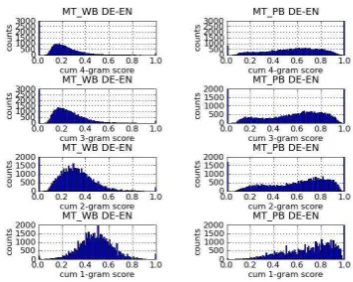
Figure 3: Left figure shows sentence-based Bleu score of word-based SMT and right figure shows that of phrase-based SMT. Each row shows the cu-mulative n-gram score (n = 1,2,3,4) and we use News Commentary parallel corpus (DE-EN).
[image:4.595.313.516.322.480.2]of Bleu score as the measure of literalness, and 3) based on this score, we reduce the sentences in parallel corpus. Our algorithm is as follows:
Algorithm 1 Good Points Algorithm
Step 1: Train word-based MT.
Step 2: Translate all training sentences by the above trained word-based MT decoder.
Step 3: Obtain the cumulativeX-gram score for
each pair of sentences whereXis 4, 3, 2, and 1.
Step 4: By the threshold described in Table 1, we produce new reduced parallel corpus. (Step 5: Do the whole procedure of phrase-based SMT using the reduced parallel corpus which we obtain from Step 1 to 4.)
conf A1 A2 A3 A4
Ours 0.05 0.05 0.1 0.2
1 0.1
2 0.1 0.2
3 0.1 0.2 0.3 0.5
4 0.05 0.1 0.2 0.4
5 0.22 0.3 0.4 0.6
6 0.25 0.4 0.5 0.7
7 0.2 0.4 0.5 0.8
[image:5.595.315.514.62.223.2]8 0.6
Table 1: Table shows our threshold where A1, A2, A3, and A4 correspond to the absolute cumulative n-gram precision value (n=1,2,3,4 respectively). In experiments, we compare ours with eight con-figurations above in Table 6.
but this does not matter . peu importe !
we may find ourselves there once again . va-t-il en ˆetre de mˆeme cette fois-ci ?
all for the good . et c’ est tant mieux !
but if the ceo is not accountable , who is ? mais s’ il n’ est pas responsable , qui alors ?
Table 2: Sentences judged as outliers by Algo-rithm 1 (ENFR News Commentary corpus).
We would like to mention our motivation for
choosing the variant of Bleu. In Step 3 we
need to set up a threshold in MW B to determine
outliers. Natural intuition is that this distribu-tion takes some smooth distribudistribu-tion as Bleu takes weighted geometric mean. However, as is shown
cumulative 4−gram scores
cumulative 1−gram scores cumulative 2−gram scores
cumulative 3−gram scores
4−gram scores
2−gram scores
3−gram scores 3−gram scores
1−gram scores
2−gram scores 1−gram scores of MT_PB
of MT_PB of MT_PB
of MT_PB of MT_WB of MT_WB
of MT_WB of MT_WB
4−gram scores
count count
[image:5.595.72.220.292.429.2]count count
Figure 5: Four figures show the sentence-based cumulative n-gram scores: x-axis is phrase-based SMT and y-axis is word-based SMT. Focus is on the worst point (0,0) where both scores are zero. Many points reside in (0,0) in cumulative 4-gram scores, while only small numbers of point reside in (0,0) in cumulative 1-gram scores.
in the first row of Figure 4, typical distribution of
words in this spaceMW Bis separated in two
clus-ters: one looks like a geometric distribution and the other one contains a lot of points whose value is zero. (Especially in the case of Bleu, if the sen-tence length is less than 3 the Bleu score is zero.) For this reason, we use the variants of Bleu score: we decompose Bleu score in cumulative n-gram score (n=1,2,3,4), which is shown in Figure 3. It is noted that the following relation holds: S4(e, f)≤
S3(e, f) ≤ S2(e, f) ≤ S1(e, f) whereedenotes
an English sentence,fdenotes a foreign sentence,
andSX denotes cumulativeX-gram scores. For
3-gram scores, the tendency to separate in two clus-ters is slightly decreased. Furthermore, for 1-gram scores, the distribution approaches to normal dis-tribution. We model P(outlier) taking care of the
quantity of S2(e, f), where we choose 0.1: other
configurations in Table 1 are used in experiments. It is noted that although we choose the variants of Bleu score, it is clear, in this context, that we can replace Bleu with any other measure, such as METEOR (Banerjee and Lavie, 05), NIST (Dod-dington, 02), GTM (Melamed et al., 03), TER (Snover et al., 06), labeled dependency approach (Owczarzak et al., 07) and so forth (see Figure 4). Table 2 shows outliers detected by Algorithm 1.
Finally, a revised algorithm which incorporates
sentence-based X-gram scores of phrase-based
[image:5.595.76.290.525.636.2]that there are many sentence pair scores actually improved in phrase-based MT even if word-based score is zero.
Algorithm 2 Revised Good Points Algorithm
Step 1: Train word-based MT for full parallel corpus. Translate all training sentences by the above trained word-based MT decoder.
Step 2: Obtain the cumulative X-gram score
SW B,X for each pair of sentences whereX is 4, 3, 2, and 1 for word-based MT decoder. Step 3: Train phrase-based MT for full parallel corpus. Note that we do not need to run a word aligner again in here, but use the results of Step 1. Translate all training sentences by the above trained phrase-based MT decoder.
Step 4: Obtain the cumulative X-gram score
SP B,X for each pair of sentences where X is 4, 3, 2, and 1 for phrase-based MT decoder.
Step 5: Remove sentences whose (SW B,2,
SP B,2) = (0,0). We produce new reduced par-allel corpus.
(Step 6: Do the whole procedure of phrase-based SMT using the reduced parallel corpus which we obtain from Step 1 to 5.)
5 Results
We evaluate our algorithm using the News Com-mentary parallel corpus used in 2007 Statistical Machine Translation Workshop shared task (cor-pus size and average sentence length are shown in Table 8). We use the devset and the evaluation set
alignment ENFR ESEN
grow-diag-final 0.058 0.115
union 0.205 0.116
intersection 0.164 0.116
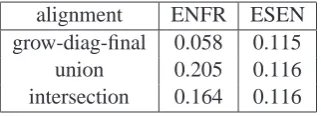
Table 3: Performance of word-based MT system in different alignment methods. The above is be-tween ENFR and ESEN.
pair ENFR FREN
score 0.205 0.176
ENES ENDE DEEN
0.276 0.134 0.208
Table 4: Performance of word-based MT system for different language pairs with union alignment method.
provided by this workshop. We use Moses (Koehn
et al., 07) as the baseline system, with mgiza (Gao and Vogel, 08) as its word alignment tool. We do MERT in all the experiments below.
Step 1 of Algorithm 1 produces, for a given parallel corpus, a word-based MT. We do this us-ing Moses with option max-phrase-length set to 1, alignment as union as we would like to extract the bi-directional results of word alignment with high recall. Although we have chosen union, other se-lection options may be possible as Table 3 sug-gests. Performance of this word-based MT system is as shown in Table 4.
Step 2 is to obtain the cumulative n-gram score for the entire training parallel corpus by using the word-based MT system trained in Step 1. Table 5 shows the first two sentences of News Commen-tary corpus. We score for all the sentence pairs.
c score = [0.4213,0.4629,0.5282,0.6275] consider the number of clubs that have qualified for the european champions ’ league top eight slots .
consid´erons le nombre de clubs qui se sont qualifi´es parmi les huit meilleurs de la ligue des champions europenne .
c score = [0.0000,0.0000,0.0000,0.3298] estonia did not need to ponder long about the options it faced .
[image:6.595.72.233.513.571.2]l’ estonie n’ a pas eu besoin de longuement rflchir sur les choix qui s’ offraient `a elle .
Table 5: Four figures marked as score shows the cumulative n-gram score from left to right. The following EN and FR are the calculated sentences used by word-based MT system trained on Step 1.
In Step 3, we obtain the cumulative n-gram
score (shown in Figure 3). As is already men-tioned, there are a lot of sentence pairs whose cu-mulative 4-gram score is zero. In the cucu-mulative 3-gram score, this tendency is slightly decreased. For 1-gram scores, the distribution approaches to normal distribution. In Step 4, other than our con-figuration we used 8 different concon-figurations in Ta-ble 6 to reduce our parallel corpus.
Now we obtain the reduced parallel corpus. In Step 5, using this reduced parallel corpus we car-ried out training of MT system from the begin-ning: we again started from the word alignment, followed by phrase extraction, and so forth. The results corresponding to these configurations are
ENES Bleu effective sent UNK
Base 0.280 99.30 % 1.60%
Ours 0.314 96.54% 1.61%
1 0.297 56.21% 2.21%
2 0.294 60.37% 2.09%
3 0.301 66.20% 1.97%
4 0.306 84.60% 1.71%
5 0.299 56.12% 2.20%
6 0.271 25.05% 2.40%
7 0.283 35.28% 2.26%
8 0.264 19.78% 4.22%
DEEN % ENFR %
Base 0.169 99.10% 0.180 91.81%
Ours 0.221 96.42% 0.192 96.38%
1 0.201 40.49% 0.187 49.37%
2 0.205 48.53% 0.188 55.03%
3 0.208 58.07% 0.187 61.22%
4 0.215 83.10% 0.190 81.57%
5 0.192 29.03% 0.180 31.52%
6 0.174 17.69% 0.162 29.97%
7 0.186 24.60% 0.179 30.52%
[image:7.595.73.281.59.377.2]8 0.177 18.29% 0.167 17.11%
Table 6: Table shows Bleu score for ENES,
DEEN, and ENFR: 0.314, 0.221, and 0.192, re-spectively. All of these are better than baseline. Effective ratio can be considered to be the inlier ratio, which is equivalent to1-(outlier ratio). The details for the baseline system are shown in Table 8.
ENES Bleu effective sent
Base 0.280 99.30 %
Ours 0.317 97.80 %
DEEN Bleu effective sent
Base 0.169 99.10 %
Ours 0.218 97.14 %
Table 7: This table shows results for the revised Good Points Algorithm.
English-Spanish our configuration discards 3.46 percent of sentences, and the performance reaches 0.314 which is the best among other configura-tions. Similarly in the case of German-English our configuration attains the best performance among configurations. It is noted that results for the base-line system are shown in Table 8 where we picked
up the score wheren is 100. It is noted that the
[image:7.595.324.501.68.208.2]baseline system as well as other configurations use MERT. Similarly, results for a revised Good Points
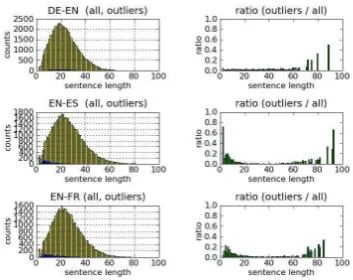
Figure 6: Three figures in the left show the togram of sentence length (main figures) and his-togram of sentence length of outliers (at the bot-tom). (As the numbers of outliers are less than 5 percent in each case, outliers are miniscule. In the case of EN-ES, we can observe the blue small distributions at the bottom from 2 to 16 sentence length.) Three figures in the right show that if we see this by ratio of outliers over all the counts, all of three figures tend to be more than 20 to 30 per-cent from 80 to 100 sentence length. The lower two figures show that sentence length 1 to 4 tend to be more than 10 percent.
Algorithm is shown in Table 7.
6 Discussion
In Section 1, we mentioned that if we aim at out-lier ratio using the indirect feature sentence length, this method reduces to a well-known sentence cleaning approach shown below in Algorithm 3.
Algorithm 3 Sentence Cleaning Algorithm
Remove sentences with lengths greater thanX
(or remove sentences with lengths smaller than
Xin the case of short sentences).
This approach is popular although the reason behind why this approach works is not well un-derstood. Our explanation is shown in the right-hand side of Figure 6 where outliers are shown at the bottom (almost invisible) which are extracted by Algorithm 1. The region that Algorithm 3
re-moves via sentence lengthXis possibly the region
where the ratio of outliers is high.
This method is a high recall method. This
[image:7.595.73.220.484.571.2]sen-X ENFR FREN ESEN DEEN ENDE
10 0.167 0.088 0.143 0.097 0.079
20 0.087 0.195 0.246 0.138 0.127
30 0.145 0.229 0.279 0.157 0.137
40 0.175 0.242 0.295 0.168 0.142
50 0.229 0.250 0.297 0.170 0.145
60 0.178 0.253 0.297 0.171 0.146
70 0.179 0.251 0.298 0.170 0.146
80 0.181 0.252 0.301 0.169 0.147
90 0.180 0.252 0.297 0.171 0.147
100 0.180 0.251 0.302 0.169 0.146
# 51k 51k 51k 60k 60k
ave 21.0/23.8(EN/FR) 20.9/24.5(EN/ES)
[image:8.595.71.301.60.253.2]len 20.6/21.6(EN/DE)
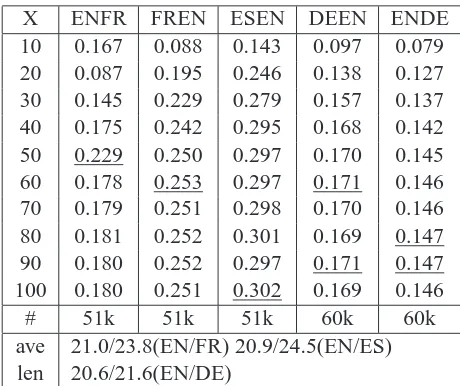
Table 8: Bleu score after cleaning of
sen-tences with length greater than X. The row
shows X, while the column shows the language
pair. Parallel corpus is News Commentary
par-allel corpus. It is noted that the default
set-ting of MAX SENTENCE LENTH ALLOWED in GIZA++ is 101.
tence length 10 to 30 where there are considerably many outliers in the region that a lot of inliers re-side. However, this method cannot cope with such outliers. Instead, the method cope with the region that the outlier ratio is possibly high at both ends, e.g. sentence length>60or sentence length<5. The advantage is that sentence length information is immediately available from the sentence which is easy to implement. The results of this algorithm
is shown in Table 8 where we varies X and
lan-guage pair. This table also suggests that we should
refrain from saying thatX= 60is best orX= 80
is best.
7 Conclusions and Further Work
This paper shows some preliminary results that data cleaning may be a useful pre-processing tech-nique for word alignment. At this moment, we ob-serve two positive results, improvement of Bleu score from 28.0 to 31.4 in English-Spanish and 16.9 to 22.1 in German-English which are shown in Table 6. Our method checks the realizability of target sentences in training sentences. If we
wit-ness bad cumulative X-gram scores we suspect
that this is due to some problems caused by the
n:mmapping objects during word alignment
fol-lowed by phrase extraction process.
Firstly, although we removed training sentences
whose n-gram scores are low, we can
dupli-cate such training sentences in word alignment. This method is appealing, but unfortunately if we use mgiza or GIZA++, our training process of-ten ceased in the middle by unrecognized errors. However, if we succeed in training, the results of-ten seem comparable to our results. Although we did not supply back removed sentences, it is pos-sible to examine such sentences using the T-tables to extract phrase pairs.
Secondly, it seems that one of the key matters
lies in the quantities of n : m mapping objects
which are difficult to learn by word-based MT (or by phrase-based MT). It is possible that such quan-tities are different depending on their language pairs and on their corpora size. A rough estimation is that this quantity may be somewhere less than 10 percent (in FR-EN Hansard corpus, recall and precision reach around 90 percent (Moore, 05)), or less than 5 percent (in News Commentary cor-pus, the best Bleu scores by Algorithm 1 are when this percentage is less than 5 percent ). As further study, we intend to examine this issue further.
Thirdly, this method has other aspects that it removes discontinuous points: such discontinu-ous points may relate to the smoothness of opti-mization surface. One of the assumptions of the method such as Wang et al. (Wang et al., 07) re-lates to smoothness. Then, our method may im-prove their results, which is our further study.
In addition, although our algorithm runs a word aligner more than once, this process can be re-duced since removed sentences are less than 5 per-cent or so.
Finally, we did not compare our method with TCR of Imamura. In our case, the focus was
2-gram scores rather than othern-gram scores. We
intend to investigate this further.
8 Acknowledgements
This work is supported by Science Foundation
Ireland (Grant No. 07/CE/I1142). Thanks to
Yvette Graham and Sudip Naskar for proof read-ing, Andy Way, Khalil Sima’an, Yanjun Ma, and annonymous reviewers for comments, and Ma-chine Translation Marathon.
References
Colin Bannard and Chris Callison-Burch. 2005.
Satanjeev Banerjee and Alon Lavie. 2005. METEOR:
An Automatic Metric for MT Evaluation With Im-proved Correlation With Human Judgments.
Work-shop On Intrinsic and Extrinsic Evaluation Measures for Machine Translation and/or Summarization.
Peter F. Brown, Vincent J.D. Pietra, Stephen A.D. Pietra, and Robert L. Mercer. 1993. The
Mathe-matics of Statistical Machine Translation: Parame-ter Estimation,” Computational Linguistics, Vol.19, Issue 2.
Chris Callison-Burch. 2007. Paraphrasing and
Trans-lation. PhD Thesis, University of Edinburgh.
Chris Callison-Burch, Philipp Koehn, and Miles Os-borne. 2006. Improved Statistical Machine
Transla-tion Using Paraphrases. NAACL.
Chris Callison-Burch, Trevor Cohn, and Mirella La-pala. 2008. ParaMetric: An Automatic Evaluation
Metric for Paraphrasing. COLING.
A.P. Dempster, N.M. Laird, and D.B. Rubin. 1977.
Maximum likelihood from Incomplete Data via the EM algorithm. Journal of the Royal Statistical
Soci-ety.
Yonggang Deng and William Byrne. 2005. HMM Word and Phrase Alignment for Statistical Machine Translation. Proc. Human Language Technology Conference and Empirical Methods in Natural Lan-guage Processing.
George Doddington. 2002. Automatic Evaluation of Machine Translation Quality Using N-gram Co-Occurrence Statistics. HLT.
David A. Forsyth and Jean Ponce. 2003. Computer
Vision. Pearson Education.
Qin Gao and Stephan Vogel. 2008. Parallel
Imple-mentations of Word Alignment Tool. Software
Engi-neering, Testing, and Quality Assurance for Natural Language Processing.
Kenji Imamura, Eiichiro Sumita, and Yuji Matsumoto. 2003. Automatic Construction of Machine
Trans-lation Knowledge Using TransTrans-lation Literalness.
EACL.
Philipp Koehn, Franz Josef Och, and Daniel Marcu. 2003. Statistical Phrase-Based Translation.
HLT/NAACL.
Philipp Koehn, Amittai Axelrod, Alexandra Birch, Chris Callison-Burch, Miles Osborne, and David Talbot. 2005. Edinburgh System Description for
the 2005 IWSLT Speech Translation Evaluation.
In-ternational Workshop on Spoken Language Transla-tion.
Philipp Koehn, Hieu Hoang, Alexandra Birch, Chris Callison-Burch, Marcello Federico, Nicola Bertoldi, Brooke Cowan, Wade Shen, Christine Moran, Richard Zens, Chris Dyer, Ondrej Bojar, Alexandra
Constantin, and Evan Herbst. 2007. Moses: Open
Source Toolkit for Statistical Machine Translation.
ACL.
Patrik Lambert and Rafael E. Banchs. 2005. Data
Inferred Multiword Expressions for Statistical Ma-chine Translation. MaMa-chine Translation Summit X.
Percy Liang, Ben Taskar, and Dan Klein. 2006.
Align-ment by agreeAlign-ment. HLT/NAACL.
Dekang Lin and Patrick Pantel. 1999. Induction of
Se-mantic Classes from Natural Language Text. In
Pro-ceedings of ACM Conference on Knowledge Dis-covery and Data Mining (KDD-01).
Daniel Marcu and William Wong. 2002. A
Phrase-based, Joint Probability Model for Statistical Ma-chine Translation. In Proceedings of Conference on
Empirical Methods in Natural Language Processing (EMNLP).
I. Dan Melamed, Ryan Green, and Joseph Turian. 2003. Precision and Recall of Machine Translation. NAACL/HLT 2003.
Robert C. Moore. 2005. A Discriminative Framework
for Bilingual Word Alignment. HLT/EMNLP.
Franz Josef Och and Hermann Ney. 2003. A
Sys-tematic Comparison of Various Statistical Align-ment Models. Computational Linguistics, volume
20,number 1.
Karolina Owczarzak, Josef van Genabith, and Andy Way. 2007. Evaluating Machine Translation with
LFG Dependencies. Machine Translation, Springer,
Volume 21, Number 2.
Kishore Papineni, Salim Roukos, Todd Ward, and Wei-Jing Zhu. 2002. BLEU: A Method For Automatic
Evaluation of Machine Translation ACL.
Chris Quirk, Chris Brockett, and William Dolan. 2004.
Monolingual machine translation for paraphrase generation. EMNLP-2004.
Matthew Snover. Bonnie Dorr, Richard Schwartz, Lin-nea Micciulla, and John Makhoul. 2006. A Study of
Translation Edit Rate with Targeted Human Anno-tation. Association for Machine Translation in the
Americas.
John Tinsley, Ventsisiav Zhechev, Mary Hearne, and Andy Way. 2006. Robust Language Pair-Independent Sub-Tree Alignment. Translation
Sum-mit XI.
Stephan Vogel, Hermann Ney, and Christoph Tillmann. 1996. HMM-based Word Alignment in Statistical
Translation. COLING 96.