NATURAL LANGUAGE INPUT T O A COMPUTER-BASED G L A U C O M A CONSULTATION S Y S T ~
V i c t o r B. Cieslelski, Department of Computer Science,
R u t g e r s U n i v e r s i t y . New B r u n s w i c k , N. J .
Abstract: A "Front End" for a Computer-Based Glaucoma Consultation System is described. The system views a case as a description of a particular instance of a class of concepts called "structured objects" and builds up a representation of the instance from the sentences in the case. The information required by the consultation system is then extracted and passed on to the consultation system in the appropriately coded form. A core of syntactlc, semantic end contextual rules which are applicable to all structured objects is being developed together with a representation of the structured object GLAUCOMA-PATIENT. There is also a facility for a d d i n g domain d e p e n d e n t syntax, abbreviations and defaults.
system that has a core of syntax and semantics that is a p p l i c a b l e t o all s t r u c t u r e d o b j e c t s a n d w h i c h c a n b e e x t e n d e d b y d o m a i n s p e c i f i c s y n t a x , i d i o m s a n d d e f a u l t s .
C o n s i d e r a b l e w o r k o n t h e i n t e r p r e t a t i o n o f h o s p i t a l discharge summaries, which are very similar t o case d e s c r i p t i o n s , h a s b e e n d o n e b y a g r o u p a t NYU [Sager 1978]. Their work has focused on t h e creation of formatted data bases for subsequent question answering and is syntax based. The research reported here is concerned with e x t r a c t i n g from t h e case the information understandable b y a consultation system a n d is primarily k n o w l e d g e b a s e d .
I. STRUCTURED OBJECTS During t h e past decade a n u m b e r of Medical Consultation
systems have been developed, for example INTERNIST [Pople. Myers and Miller 1973], CASNET/GLAUCOMA [Weiss st. al. 1978], MYCIN [Shortliffe 1976]. Currently still others are being developed. Some of these programs are reaching a stage where they are being used in hospitals and clinics. Such use brings with it the need for fast and natural communication with these programs for the reporting of the "clinical state" of the patient. This includes laboratory f i n d i n g s , symptoms, medications and certain history data. Ideally the reporting would be done b y speech but this is currently beyond the state of the art in speech understanding. A more reasonable goal is to try to capture the physicians" written "Natural Language" for describing patients and to write programs to convert these descriptions to the appropriate coded input to the consultation systems.
The original motivation for this research came from the desire to have natural language input of cases to CASNET/GLAUCOMA a computer-based glaucoma consultation system developed at Retgers University. A case is several paragraphs of sentences , written b y a physician, which describe a patient who has glaucoma or who is suspected of having glaucoma. It was desired to have a "Natural Language Front-End" which could interpret the cases and pass the content to the consultation system. I n t h e b e g i n n i n g stages it was b y n o means clear that it would even b e possible to have a "front end" since it was expected that some sophisticated knowledge of Glaucoma would be n e c e s s a r y a n d t h a t f e e d b a c k from the c o n s u l t a t i o n s y s t e m w o u l d b e r e q u i r e d i n u n d e r s t a n d i n g t h e i n p u t s e n t e n c e s . H o w e v e r d u r i n g t h e c o u r s e o f t h e investigation it became clear t h a t certain generalizations could b e made from the domain of Glaucoma. The key discovery was that under some reasonable assumptions the physic iane notes could be viewed as descriptions of instances of a class of concepts called structured oblects and the knowledge needed to interpret the notes was mostly knowledge of the relationship between language and structured objects rather than knowledge of Glaucoma.
This observation changed the focus of the research s o m m ~ a t - to the investigation of the relationship b e t w e e n language a n d s t r u c t u r e d o b j e c t s w i t h p a r t i c u l a r e m p h a s i s o n t h e s t r u c t u r e d o b j e c t GLAUCOMA-PATIENTo T h i s c h a n g e o f f o c u s h a s r e s u l t e d i n t h e d e v e l o p m e n t o f a
A s t r u c t u r e d o b j e c t i s l i k e a t e m p l a t e [ S r i d h a r a n 1 9 7 8 ] o r u n i t [ g o b r o w a n d W i n o g r a d 1977] o r c o n c e p t
[Brachman 1978] in t h a t i t implicitly defines a s e t of instances. It is characterized b y a biererchial structure. This structure consists of other structured o b j e c t s which a r e components ( n o t s u b - c o n c e p t s [ ) . F o r example the s t r u c t u r e d o b J e c t PATIENT-LEFT-EYE i s a component of the structured object PATIENT. Structured objects also have attributes, for exemple PATIENT-SEX is an attribute of PATIENT. Attributes can have numeric or non-nemeric vAlues. Each attribute has an associated "measurement concept" which defines the set of legal values, units etc.
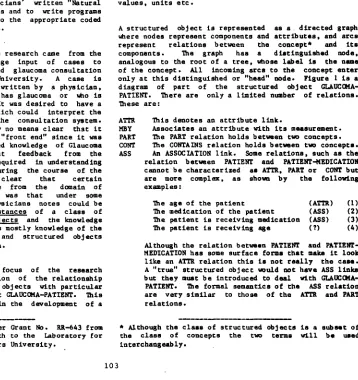
A s t r u c t u r e d o b j e c t i s r e p r e s e n t e d a s a . d i r e c t e d g r a p h ~ h e r e n o d e s r e p r e s e n t c o m p o n e n t s a n d a t t r i b u t e s , a n d a r c s represent relations b e t w e e n the concept* a n d its components. The graph has a distinguished node, analogous to the root of a tree, whose label is the name of the concept. All incoming errs to the concept enter only at this distinguished or "head" node. Figure I is a diagram of part of the structured object GLAUCOMA- PATIENT. There are only a limited number of relations° These are:
ATTR This denotes an attribute llnk.
M B Y Associates an attribute w i t h its measurement. PART The PART relation holds b e t w e e n two concepts. CONT The CONTAINS r e l a t i o n holds b e t w e e n two c o n c e p t s . ASS An ASSOCIATION llnk. Some relations, such as the
relation between PATIENT and PATIENT-MEDICATION cannot b e characterized aa ATTR, PART or CONT but are more complex, as shown b y the followln$ examples:
the age of the patient (ATTR) (I) The medication of the patient (ASS) (2) The patient is receiving m e d i c a t i o n (ASS) (3) The patient is receiving age (?) (4) A l t h o u g h t h e r e l a t i o n b e t w e e n PATIENT a n d PATIENT- MEDICATION h a s some s u r f a c e f o r m s t h a t make i t l o o k like a n ATTR r e l a t i o n t h i s is n o t r e a l l y the case. A "true" s t r u c t u r e d o b j e c t w o u l d n o t h a v e ASS links b u t t h e y m u s t b e i n t r o d u c e d t o d e a l w i t h GLAUCOMA- PATIENT. t h e formal semantics of the ASS relation are v e r y similar to those of the ATTR and PART relations.
T h i s r e s e a r c h w a s s u p p o r t e d u n d e r G r a n t No. R R - 6 4 3 f r o m t h e N a t i o n a l I n s t i t u t e s o f H e a l t h t o t h e L a b o r a t o r y f o r C o m p u t e r S c i e n c e R e s e a r c h . R u t g e r s U n i v e r s i t y .
[image:1.612.199.557.363.743.2]//~-~AT-~'~ }~,,FO~A~
PART SI~C
C I-PAT-LE
•
C2-PAT-EYE jq S~E
!
C I-PAT-LE
PRESSURE
M. ~c~-PAT-~YE
[
C I-PAT-LE , PRESSURE-MSMT
nESSURE-"S~'T,
I
SUBC
C l-PAT-RE J ATI"R C I-PAT-P.E
PRESSURE
C I-PAT-~E- P R E S S ~ E - M S M T
~C~-~AT- I PART
. . . . ~ S - J MEDICATION j
C I-PATIENT
ATTR
C I-PAT-NED- DL~MOX
i c x-~ATIENT-
i
MET
.~
c X-~AT~NT- i
ATT~
c , - , A T I , . N T -
,Ic -pAT ' NT: i
SEX
JH
(@1
SEX.-~T l
/ i
o z , ~ o x - ~ z Q
1 ~
-T d Ol-,A'- zo-
,]OL~OX.-Z'RZq-HSM~.
f
ATrP,.
/
ATTR ~ C I-PAT'HED- I M B T J C I-PAT-MED- J
i I DZsXoE,-OosEI
'1
D z ~ o x Dosz..~SHTI
P a r t o f t h e S t r u c ~ J e c t GLAUCCMA~PATZENT
FOCATTE ( F o c u s s l n $ A L t r i b u t e ) I f t h e r e a r e a u l t l p l a i d m ~ t i c a l s u b - p a r t s t h e n t y p i c a l l y ( b u t n o t a l ~ y s ) t h e v a l u e s o f a p a r t i c u l a r a t t r i b u t e a r e used to d i s t i n K u i s h b e t w e e n them,
SUBC One concept is a sub-concept of another.
~ e PART, COHT and ASS l i n k s a r e q u a l i f i e d by N~ME]m and MODALITY a s i n [Braclman 1978]. MODALITT c a n h a v e too v a l u e s NECESSARY and OPTIONAL. M o d a l i t y i s used to r e p r e x n t t h e f a c t ~ r a t e y e s a r e n e c e s s a r y p a r t s of
p a t i e n t s bu~ s c o t o u a a ( b l l n d - s p o t s ) may o r may n o t b e p r e s e n t i n t h e v i s u a l f i e l d . WOMBEK c a n b e e i t h e r a u m b e r ( e . s . 2 EYES) o r a p r e d l ~ a t a ( e . S . >-0 e c o t o n a e ) . The tarKeC o f • PART CONT o r ASS r e l a t i o n can a l s o b e a
flat as in
C I -PATIENT -LEFT-EYE-V~S UAL-F IELD
C~T (AS'tOY
C I-PATIENT-LEYT-g YE-VTS UAL-F IELD-SC OT~IA, C I-PATIENT-LEFT-EYE-V~S UAL-F IELD-ISLAND,
the first member of the tint is e "sele~tlon function" ~hich describes hoe e l m e a t s are to be M a r r e d free the
t i n t •
The nunbers after the C prefix in Fisure l donate levels of "sub-conceptln8". Level I £s the lowest level, those
c o n c e p t s do n o t h a v e any s u b - c o n c e p t s o n l y £ n a t a n c a o .
Note that CI-PATIENT-KIGHT-EYE is a sub-concept of C2- PATIENT-gYE, not an Instanceo CI-PATIENT-LEFT-gYE and C2-PATTENT-~IGHT-EYE are two different concepts t that is they have d/~Joint sub-structure; they are as different
to t h e s y s t e m a s C-AiM and C-LEG. T h e r e i s 8nod r e a s o n
for this. It is possible that a different Instrument will be needed to measure the value of an attribute in the right eye than in the taft aye. Thls means that the measurement concepts got these attrlbutee will have to he
d i f f e r e n t f o r t h e l e f t and r i g h t e y e s . A n o t h e r e x a m p l e f r o m t h e d ~ a i n o f s l a n c o m a s h o w t h i s more v i v i d l y . C I - PATIENT-LEYT-~YE-VISUAL-FIELD-~COTCMA d e n o t e s a s c o t o m a
in the left eye. A particular type of scotoma is the
a r c u a t e ( b o w - s h a p e d ) s c o t o m a . T h i s m u s t b e a s e p a r a t e c o n c e p t s i n c e i t is meaninsful to suty " d o u b l e a r c u s t e
scotoma" but not "doubte scotoma", This means that the concept C .... -FIELD-AACUATE-SCOTflMA has an attribute ~hat
c a n n o t b e i n h e r i t e d from C..,-~IELD-SCOTOMA. I f a m e a s u r e m e n t c o n c e p t i s t h e alune f o r h o r ~ e y e s ( o r any o t h e r I d s e t l c a l s u b - p a r t s ) t h e n i t need o n l y b e d e f i n e d
o n c e and SUBC p o i n t e r s c a n b e used t o p o i n t t o t h e
d e f i n i t i o n . An e x a m p l e o f t h i s i s t h e p r e s s u r e tuscan=ameer in l i k u t a l .
There are m a n y more levels of "sub-conceptlng" chat could b e represented here but it is not necessary for the interpretation of the cases. Only those mechanisms for manipulating structured objects that are n e c e s s a r y for the interpretation of cases are b e l n E implemented. Brachmen [Brachman 1978] has examined the problems of representing concepts in c o n s i d e r a b l y m o r e detail.
I. 1 M E A S L ~ E M E N T CONCEPTS
Measurements are associated w i t h t h o s e nodes of t h e graph Chat h a v e Ineomln8 ATTR ~ r c s . There are twn kinds of measurements those with numerical values and those with n o n - n ~ e r l c n l values. Numerical measurements h a v e the followln E internal structure:
RANGE A pair of numbers that speclfy the range. UNITS A set of units for the measurement.
QVALSET A set of qualitative v a l u e s for the measurement. T I M E A dace or one of the v a l u e s PAST, PRESENT. INSTR A set of p o s s i b l e instruments for taking the
maeaur amen, •
CF A confidence f a c t o r o r measure of reliability f o r the measurement.
There is also soma procedural knnwledge assoclatad with measurm-ents. This relates numerical values t o quantitative values, fellah Ill,lea with instruments etc. An e x a m p l e of a measurement c o n c e p t is given i n figure 2.
m | i
C I -FATIENT-LEFT-K YE-FLUI D-FR ES S UR E-M SMT RANGE 0, 120
UNITS K-~4-HG
QVALSET (ONEOF K-DECREASED, K-NORMAL,
K-ELEVATED, K-SEVERELY-ELEVATED) TIME (ONEOF PAST, PRESENT, DATE)
INSTR (ONEOF K-A PPLANAT TON -T ONOM ETER, K-SCHIOTZ -TONOM ETER ) CF O, I
*************************** if VALUE < 5 then **ERROR**
if 5 <- VALUE < i0 than QVAL - K - D E C R E A S E D if l0 <- VALUE < 21 than QVAL - K - N O R M A L if 21 <- VALUE < 30 then QVAL - K-ELEVATED
if 30 <- VALUE < I00 then QVAL - K-SEVERELY-ELEVATED if I00 <- VALUE than **ERROR**
Fi~ur e 2
The Measurement C o n c e p t for Intra-ocular Pressure
Items prefixed w i t h a ~ "K 't in figure 2 denote constants. Constants are "terminal items" having no further definition in the representation of the structured object.
number of instances is known beforehand, for e x a m p l e there can o n l y b e one instance of CI-PATIENT~.EFT-EYE0 while in other cases the number of instances is determined b y the input, for example m e a s u r e m e n t s of In,re-ocular pressure at different times are different instances. Instances are created along a number of dimensions, the most common one being TIME, for e x a m p l e pressure today, p r e s s u r e on Mar 23. When different instruments are used to take m e a s u r e m e n t s this constitutes a second dimension for instances. The rules of instantlatlon are embedded in the core.
A partial instantiation of CI-PATIENT can be done b e f o r e the first sentence is processed by tracing links marked NECESSARY. Any component or attribute ins,an,laced at this stage will b e introduced by a definite noun phrase while optional components will b e introduced b y indefinite noun phrases.
2. SEMANTICS
A fundamental assumption that has been m a d e and one that is Justlfled b y examination of several sets of cases is that the sentences dascrlbe an instance of a patient w i t h the assumption that the reader already knows the concept. None of the sentences in the notes examined had an interpretation which would requlre updating the concept GLAUCCMA-PATIENT. The interpretation of a case is thus consldared to b e the construction of t h e the corresponding instance of GLAUCOMA-PATIENT.
The nature of structured objects as outlined above dlccataa that o n l y two fundamental kinds of assertions are expected in sentences. There wlll either b e an assertion about the existence of an optional component as in (5) or about the value of an attribute as in (6) and
(7)
•There Is an arcuete scotoma od.** The pressure is 20 in the left eye. The pressure is normal os.
(5) ( 6 ) ( 7 ) Vary f e w of the sentences contain Just one assertion, most contain several as in (8) and (9).
There is a nasal step and an arcuete scotoma in the left e y e and a central
island in the right e y e ( 8 )
~he m e d i c a t i o n is I0 percent pilocarplne
daily in both eyes. (9)
2. I THE M E A N I N G OF A SENTENCE
Even though sentences are viewed as containing assertions their meanings can b e represented as sets of instances, Non-nmnerlcal measurements differ from numerical given that there is a procedure which takes these measurements in that RANGE, UNIT and QVALSET are replaced instances and incorporates them into the growing instance b y VALSET. One or more members of VALSET are to b e of GLAUCOMA-PATIENT. Ibis is due to the tree structure selected in creating an instance of the measurement of instances since Instantlatlon of a concept involves concept, for example: Instantlatlon of all concepts b e t w e e n itself and the root. In fact, m a n y sentences in the cases do not even CI-PATIENT-SEX-MSMT VALSET (ONEOF K-MALE K-FEMALE) contain a relation but m e r e l y assert the existence of an
instance or of an attribute value as in (I0) and ([1).
I. 2 INSTANCES
An i n s t a n c e o f a s t r u c t u r e d o b j e c t i s r e p r e s e n t e d a s a tree. Instances are created piece-meal as the Information trickles in from the case. In some cases the
N a s a l s t e p o d . ( I 0 )
a I 0 y e a r o l d w h i t e m a l e . ( I I )
2.2 P R O V I S I O N A L INSTANCES
Any particular n o u n o r adjective c o u l d refer to a number of d i f f e r e n t concepts. "Medication" for" e x a m p l e could refer to CI-PATIENT-MEDICATION, C I - P A T I E N T - & I G H T - E Y E - M E D I C A T I O N or ( I - P A T I E N T - L E F T - E Y E - M E D I C A T I O N . M o r e o v e r in any particular use it c o u l d b e referring Co one o r more of its possible referents. In (t2)
M e d i c a c i o n consists of d i a m o x
and pllocarpine drops in b o t h eyes. (12) "medication" refers co all of its p o s s i b l e referents since d i a m o x is n o t g i v e n t o the eye b u t is taken orally. In addition to this, ic £s g e n e r a l l y not p o s s i b l e t o k n o w at the clme of e n c o u n t e r i n g a word whether it refers to an e x i s t i n g Instance or to a n e w instance. This is due to the fact thaC at the time of e n c o u n t e r i n g a r e f e r e n c e to a concept all of the v a l u e s of the instance d i m e n s i o n s mlghc not b e known. The m e c h a n i s m for d e a l i n g with these problems is Co a s s i g n "provisional Instances" as the referents of words end phrases when they are scanned during the parse and to turn these provisional instances Into "real" instances when the c o r r e c t parse has b e e n found. This involves finding the v a l u e s of the instance d i m e n s i o n s from rest of the sentence, from k n o w l e d g e of defaults or perhaps from v a l u e s in previous sentences. The most c o m m o n Instance d i m e n s i o n is TIME and its v a l u e is r e a d i l y obtained from the tense of the verb or from a clme phrase. If the instance d i m e n s i o n s indicate an existing instance then the partial provisional instance from the sentence is incorporated into the e x i s t i n g real instance, otherwise a n e w i n s t a n c e is created.
2 . 3 F I N D I N G THE M E A N I N G O F A SENTENCE
S e v e r a l m a p p i n g s c a n b e m a d e f r o m t h e r e p r e s e n t a t i o n o f s t r u c t u r e d o b j e c t s t o syntactic c l a s s e s . F o r e x a m p l e ,
all n o d e s w i l l b e r e f e r r e d t o b y n o u n s a n d n o u n p h r a s e s , l i n k s w i l l b e r e f e r r e d t o b y p r e p o s i t i o n s a n d v e r b s a n d m e m b e r s o f a VALSET o r a 0VALSET w i l l b a r e f e r r e d t o b y a d j e c t i v e s . The l i n k s b e t w e e n c o n c e p t s a n d c h a ~ r d s t h a t c a n b e u s e d t o r e f e r t o t h e m a r e m a d e a t s y s t e m b u i l d t i m e w h e n c h e s t r u c t u r e d o b j e c t i s c o n s t r u c t e d . Some w o r d s s u c h as " b o t h " a n d " v e r y " r e f e r t o p r o c e d u r e s w h o s e a c t i o n s a r e t h e s a m e n o m a t t e r w h a t t h e s t r u c t u r e d o b j e c t .
The n a t u r e of structured objects and of the sentences in cases Indicate thac a "case'* [Bruce 1975] approach to semantic analysis is a "natural". A case syecsm ham in fact b e e n implemented with such c a s e s as ATTRIBUTE, OBJECT, VALUE, and UNIT. One case that is p a r t i c u l a r l y useful is FOCUS. I t is u s e d t o r e c o r d r e f e r e n c e s Co left e y e o r r i g h t e y e f o r u s e i n e m b e d d e d o r c o n j o i n e d sentences such as (13).
The p r e s s u r e i n t h e l e f t e y e i s 27
a n d there is an arcuate scocoma. (13)
For the reasons d i s c u s s e d in section 2.2 ic is n e c e s s a r y co a s s i g n sacs of candidate referents t o s o m a of t h e case values during the course of the parse. These sacs are pruned as higher levels of the parse tree are built.
3. S Y N T A X
It is noc r e a l l y p o s s i b l e t o v l e w c h a sentences comprising a case as a subset of English since m a n y of the e l e m e n t a r y grammatical rules are b r o k e n (e.g. frequent o m i s s i o n of verbs). Rather the sentences are in a medical dialect and parr of the task o f wrlClng an
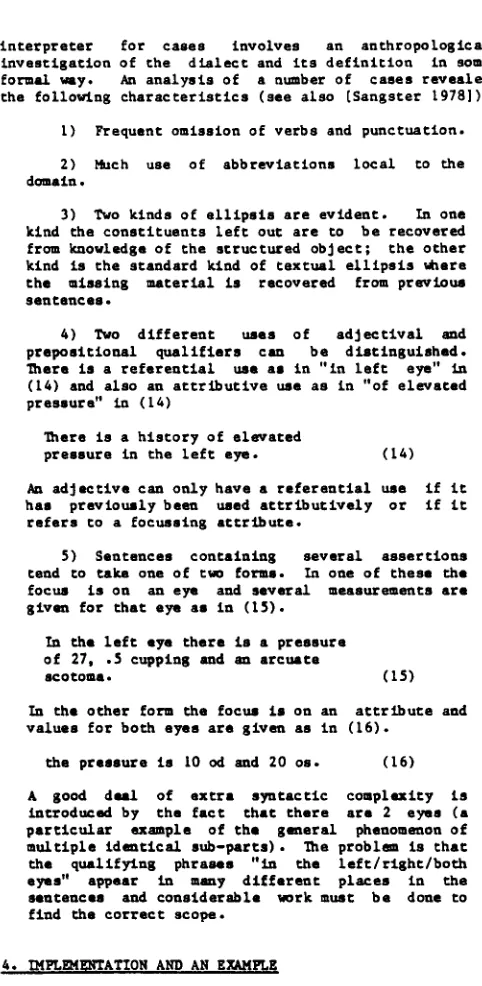
interpreter for cases involves an a n t h r o p o l o g i c a l investlgaclon of the d i a l e c t and its d e f i n i t i o n in some formal way. An analysls of a nt~"ber of c a s e s r e v e a l e d the following c h a r a c t e r i s t i c s (see also [Sangscer 1978]):
I) Frequent o m i s s i o n of v e r b s and p u n c t u a t i o n . 2) ~ c h u s e o f a b b r e v i a t i o n s l o c a l t o t h e d o m a i n .
3) Two kinds of ellipsis are evident. In one kind the c o n s t i t u e n t s left ouC are co b e recovered f r o m k n o w l e d g e o f t h e s t r u c t u r e d o b j e c t ; t h e o c h e r k i n d i s t h e s t a n d a r d k i n d o f t e x t u a l e l l i p s i s w h e r e t h e m i s s i n g m a c e r i s l i s r e c o v e r e d f r o m p r e v i o u s
s e n t e n c e s .
4) Two d i f f e r e n t uses of a d j e c t i v a l a n d p r e p o s i t i o n a l q u a l i f i e r s can b e d i s t i n g u i s h e d .
T h e r e is a r e f e r e n c l a l use as in "in Left eye" in
(14) and also an a t t r i b u t i v e use as in "of e l e v a t e d p r e s s u r e " in ( 1 4 )
T h e r e i s a h i s t o r y o f e l e v a t e d
pressure in the left e y e . ( 1 4 ) An a d j e c t i v e c a n o n l y h a v e a r e f e r e n t i a l use if i C h a s p r e v i o u s l y b e e n used a t t r l b u c i v e l y o r if i t refers to a focussing attribute.
5) Sentences c o n t a i n i n g several a s s e r t i o n s tend to tak~a one of two forms. In one of these cha focus is o n a n eye and several m e a s u r e m e n t s are g i v e n for that eye as in (15).
I n t h e l e f t e y e c h a r s i s a p r e s s u r e o f 2 7 , . 5 c u p p i n g a n d a n e r c u a C e
e c o t o m e . (:5)
I n t h e o t h e r f o r m t h e f o c u s i s o n a n a t t r i b u t e a n d v a l u e s f o r b o t h e y e s a r e g i v e n a s i n ( 1 6 ) .
t h e p r e s s u r e i s I 0 o d a n d 2 0 o s . ( 1 6 )
A g o o d d e a l o f e x t r a s y n t a c t i c c o m p l e x i t y i s i n t r o d u c e d b y t h e f a c t c h a t t h e r e a r e 2 e y e s ( a p a r t i c u l a r e x - , . p l a o f t h e g e n e r a l p h e n o m e n o n o f m u l t i p l e idanclcal sub-parts). The p r o b l m - is chac (ha q u a l i f y i n g phrases "in the left / r l g h c / b o c h eyes" appear in m a n y d i f f e r e n t places in the sentences and c o n s l d e r a b l a w o r k m u s t b e done to find the c o r r e c t scope.
4. T M P L E M ~ T A T T O N A N D A N E X A M P L E
T h e s y s t e m i s b e i n g i m p l e m e n t e d i n FUSPED a c o m b i n a t i o n o f Cha A I l a n g u a g e FUZZY [ L e f a i v r e 1 9 7 6 ] , t h e PEDAGLOT p a r s i n g s y s t e m [ F a b e n s 1 9 7 6 ] a n d RUTLISP ( & u r g e r s U C I L I S P ) . I ~ Z Z ¥ p r o v i d e s a n a s s o c i a t i v e n e t w o r k f a c i l i t y
~ i c h i s used f o r s c o r i n g b o t h d e f i n i t i o n s o f s t r u c t u r e d
o b j e c t s a n d i n s t a n c e s . FUZZY a l s o p r o v i d e s p a t t e r n m a r c h i n g a n d p a t t e r n d i r e c t e d p r o c e d u r e i n v o c a t i o n
f a c i l i t i e s w h i c h a r e v e r y u s e f u l f o r 4 m p l e m a n c i n g
d e f a u l t s a n d o c h e r i n f e r e n c e s . PEDACLOT i s b o t h a c o n t e x t f r e e p a r s e r a n d a s y s t e m f o r c r e a t i n g a n d e d i t i n g g r a m m a r s • PEDACLOT " C a g e " c o r r e s p o n d Co g n u c h
s y s c h e e t z a d a t t r i b u t e s [ g n u C h t 9 6 8 ] a n d p a r s e s c a n b e
f a i l e d b y r e s t i n g c o n d i t i o n s o n r a g v a l u e s t h u s p r o v i d i n g a n a t u r a l i m y o f i n t e r m i x i n g s e m a n t i c s a n d F a r s i n g .
~ h e ~ p l m m c a t i o n o f t h e s y s t m a i s n o C y a c c o m p l e t e b u c l C c a n d e a l w i t h a f a i r l y w i d e r a n g e o f s e n t e n c e s a b o u t a n u m b e r o f c o m p o n e n t s a n d a t t r i b u t e s o f Cl-GLAOCCMA-
PATIENT. F i g u r e 3 i s some e d i t e d o u t p u t f r o m a r i m o f t h e e3mcmm. The i n t e r p r e t a t i o n o f o n l y o n e s e n t e n c e i s
[image:4.612.317.558.44.537.2]shown. Space c o n s i d e r a t i o n s p r o h i b i t the
more of the intermediate o u t p u t .
inclusion of
,the patient is a 60 year o l d white male
*diamc~ 250 ms bid
Meaning :
(I 626 PATIENT M E D I C A T I O N DIAMOX DOSE MSMT) NVAL 250
UNIT (K MG) T I M E PRESENT
INST PRESENT
(T 630 PATIENT MEDICATION DIAMOX PREQUENCY MSMT) VAL (K BID)
TIME PRESENT INST PRESENT
~eplnephrlne 2 p e r c e n t b i d od and p i l o c s r p i n e 2 p e r c e n t b i d os
t t h e p r e s s u r e s a r e 34 od and 40 os tche c u p p i n g r a t i o i s .5 i n b o t h e y e s
~in t h e r i g h t e y e t h e r e i s 20 / 50 v i s i o n and a c e n t r a l i s l a n d
t i n t h e l e f t e y e t h e v i s u a l a c u i t y i s f i n g e r c o u n t ***GLAUCOMA CONSULTATION PROGRAM***
CAUSAL-ASSOC IATIONAL N E T W O R K *RESEARCH USE ONLY* ******************** * G L A U C O M A StHMARY * ******************** .)ERSONAL DATA:
bt~4E: ANON ~gIOUS
AGE: 60 RACE: W SEX: M
CASE NO: 50 (HYPOTHETICAL)
CLINICAL DATA StHMARY FOR VISIT OF 3/27/79
CURRENT MEDICATIONS:
PILOCARPINE 2Z B I D (OS) EPINEPHRINE 2% BID (OD)
DIAMOX/INHIBITOR8 250 M G BID BEST CORRECTED VISUAL ACUITY:
OD: 20/20 OS: FC
lOP:
OD: 34 OS: 40
VERTICAL CUP/DISC RATIO: 0.50 (OU)
VISUAL FIELDS:
CENTRAL ISLAND (OD)
* * * * , e e e * * * e . e * * * * e
1.
2.
3.
4.
5.
P i g u r e 3
Some ( e d i t e d ) o u t p u t from a r u n o f a case
R e f e r e n c e s
Bobrow D. G. and Winograd T. An O v e r v i e w o f KRL, a Knowledge R e p r e s e n t a t i o n Langua8e , C o g n i t i v e
Science, V o l . 1, No. 1. Jan 1977
Srachman R. J. A S t r u c t u r a l P a r a d i g m f o r R e p r e s e n t i n g K n o w l e d g e , R e p o r t No. 3605, B o l t Beranek and Newman, May 1978.
Bruce B. Case Systems f o r Natural Language,
A r t i f i c i a l I n t e l l i g e n c e , V o l . 6, No. 4, 1975.
Fabens W. PEDAGLOT U s e r s M a n u a l , D e p t . o f Computer S c i e n c e , R u t g e r s U n i v e r s i t y , 1976.
l ~ u t h D. S e m a n t i c s o f C o n t e x t F r e e L a n g u a g e s , M a t h e m a t i c a l S y s t e m s T h e o r y , Vol. 2. 1968.
6. L a F e i v r e R. A FUZZY R e f e r e n c e M a n u a l , TR-69, D e p t . o f Computer S c i e n c e , R u t s e r s U n i v e r s i t y , Jun 1976. 7. P o p l e H , , Myers J . and M i l l e r R. DIALOG: A Model o f
D i a g n o s t i c R e a s o n i n g f o r I n t e r n a l M e d i c i n e , P r o c . IJ,CAI _4, Vol. 2, Sept 1975.
8. S a g e r N. N a t u r a l L a n g u a g e I n f o r m a t i o n F o r m a t t t n B : The A u t o m a t i c C o n v e r s i o n o f T e x t s i n t o a S t r u c t u r e d D a t a - B a s e , In Advances i n C o m p u t e r s , Y o v i t s M.
[ E d . ] , V o l . 17, 1978.
9. S a n B s t e r B. N a t u r a l Language D i a l o g u e w i t h Data
Base S y s t e m s : D e s i g n i n g f o r t h e M e d i c a l E n v i r o n m e n t , Fro c . 3rd J e r u s a l e m C o n f e r e n c e on
I n f o r m a t i o n T e c h n o l o g y , North N o l l a n d , An8 1978. 10. S h o r t l i f f e E. C o m p u t e r - B a s e d M a d t c a l
C o n s u l t a t i o n s : MYCIN, ~ l s e v t e r , New York, 1976.
11. S r i d h a r a n N. S. AIMDS USer Manual - V e r s i o n 2,
TR-89, Dept. o f Computer Science, Rutgers
U n i v e r s i t y , Jun 1978.
12. Weiss S., K u l l k o ~ k l C., Amarel S. and Saflr A. A Model-Based Method for Computer-Aided Medical D e c i s i o n - M a k i n g , A r t i f i c i a l I n t e l l i g e n c e V o l . 11,