
Bayesian Unsupervised Word Segmentation with
Nested Pitman-Yor Language Modeling
Daichi Mochihashi Takeshi Yamada Naonori Ueda NTT Communication Science Laboratories
Hikaridai 2-4, Keihanna Science City, Kyoto, Japan {daichi,yamada,ueda}@cslab.kecl.ntt.co.jp
Abstract
In this paper, we propose a new Bayesian model for fully unsupervised word seg-mentation and an efficient blocked Gibbs sampler combined with dynamic program-ming for inference. Our model is a nested hierarchical Pitman-Yor language model, where Pitman-Yor spelling model is em-bedded in the word model. We confirmed that it significantly outperforms previous reported results in both phonetic tran-scripts and standard datasets for Chinese and Japanese word segmentation. Our model is also considered as a way to con-struct an accurate word n-gram language model directly from characters of arbitrary language, without any “word” indications. 1 Introduction
“Word” is no trivial concept in many languages. Asian languages such as Chinese and Japanese have no explicit word boundaries, thus word seg-mentation is a crucial first step when processing them. Even in western languages, valid “words” are often not identical to space-separated tokens. For example, proper nouns such as “United King-dom” or idiomatic phrases such as “with respect to” actually function as a single word, and we of-ten condense them into the virtual words “UK” and “w.r.t.”.
In order to extract “words” from text streams, unsupervised word segmentation is an important research area because the criteria for creating su-pervised training data could be arbitrary, and will be suboptimal for applications that rely on seg-mentations. It is particularly difficult to create “correct” training data for speech transcripts, col-loquial texts, and classics where segmentations are often ambiguous, let alone is impossible for un-known languages whose properties computational linguists might seek to uncover.
From a scientific point of view, it is also inter-esting because it can shed light on how children learn “words” without the explicitly given bound-aries for every word, which is assumed by super-vised learning approaches.
Lately, model-based methods have been intro-duced for unsupervised segmentation, in particu-lar those based on Dirichlet processes on words (Goldwater et al., 2006; Xu et al., 2008). This maximizes the probability of word segmentation
wgiven a strings:
ˆ
w= argmax
w
p(w|s). (1)
This approach often implicitly includes heuristic criteria proposed so far1, while having a clear
sta-tistical semantics to find the most probable word segmentation that will maximize the probability of the data, here the strings.
However, they are still na¨ıve with respect to word spellings, and the inference is very slow ow-ing to inefficient Gibbs samplow-ing. Crucially, since they rely on sampling a word boundary between two neighboring words, they can leverage only up to bigram word dependencies.
In this paper, we extend this work to pro-pose a more efficient and accurate unsupervised word segmentation that will optimize the per-formance of the word n-gram Pitman-Yor (i.e. Bayesian Kneser-Ney) language model, with an accurate character ∞-gram Pitman-Yor spelling
model embedded in word models. Further-more, it can be viewed as a method for building a high-performance n-gram language model di-rectly from character strings of arbitrary language. It is carefully smoothed and has no “unknown words” problem, resulting from its model struc-ture.
This paper is organized as follows. In Section 2,
1For instance, TANGO algorithm (Ando and Lee, 2003) essentially finds segments such that charactern-gram
proba-bilities are maximized blockwise, averaged overn.
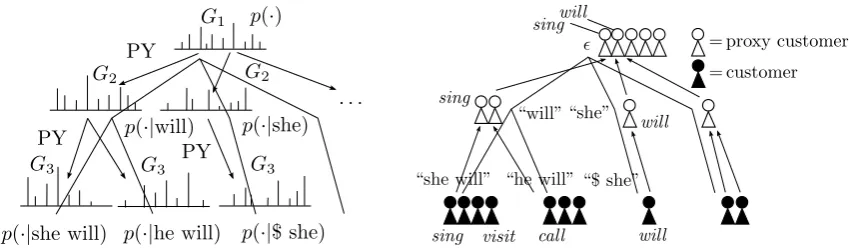
(a) Generatingn-gram distributionsGhierarchically
from the Pitman-Yor process. Here,n= 3.
[image:2.595.92.518.60.184.2](b) Equivalent representation using a hierarchical Chinese Restaurant process. Each word in a training text is a “customer” shown in italic, and added to the leaf of its two words context.
Figure 1: Hierarchical Pitman-Yor Language Model. we briefly describe a language model based on the
Pitman-Yor process (Teh, 2006b), which is a gen-eralization of the Dirichlet process used in previ-ous research. By embedding a character n-gram in wordn-gram from a Bayesian perspective, Sec-tion 3 introduces a novel language model for word segmentation, which we call the Nested Pitman-Yor language model. Section 4 describes an ef-ficient blocked Gibbs sampler that leverages dy-namic programming for inference. In Section 5 we describe experiments on the standard datasets in Chinese and Japanese in addition to English pho-netic transcripts, and semi-supervised experiments are also explored. Section 6 is a discussion and Section 7 concludes the paper.
2 Pitman-Yor process andn-gram
models
To compute a probability p(w|s)in (1), we adopt
a Bayesian language model lately proposed by (Teh, 2006b; Goldwater et al., 2005) based on the Pitman-Yor process, a generalization of the Dirichlet process. As we shall see, this is a Bayesian theory of the best-performing Kneser-Ney smoothing of n-grams (Kneser and Ney, 1995), allowing an integrated modeling from a Bayesian perspective as persued in this paper.
The Pitman-Yor (PY) process is a stochastic process that generates discrete probability distri-butionGthat is similar to another distributionG0,
called abase measure. It is written as
G∼PY(G0, d, θ), (2)
where d is a discount factor and θ controls how similarGis toG0 on average.
Suppose we have a unigram word distribution G1={p(·)}where·ranges over each word in the
lexicon. The bigram distribution G2 ={p(·|v)}
given a word v is different from G1, but will be
similar toG1especially for high frequency words.
Therefore, we can generate G2 from a PY
pro-cess of base measure G1, asG2 ∼ PY(G1, d, θ).
Similarly, trigram distribution G3 = {p(·|v0v)}
given an additional wordv0 is generated asG
3 ∼
PY(G2, d, θ), and G1, G2, G3 will form a tree
structure shown in Figure 1(a).
In practice, we cannot observe G directly be-cause it will be infinite dimensional distribution over the possible words, as we shall see in this paper. However, when we integrate out G it is known that Figure 1(a) can be represented by an equivalent hierarchical Chinese Restaurant Pro-cess (CRP) (Aldous, 1985) as in Figure 1(b).
In this representation, each n-gram context h (including the null context for unigrams) is a Chinese restaurant whose customers are the n-gram counts c(w|h) seated over the tables 1· · ·thw. The seatings has been incrementally
constructed by choosing the tablekfor each count inc(w|h)with probability proportional to
(
chwk−d (k = 1,· · · , thw)
θ+d·th· (k =new),
(3)
wherechwk is the number of customers seated at
tablekthus far andth·=
P
wthwis the total
num-ber of tables in h. When k = new is selected, thwis incremented, and this means that the count
model-ing (Brown et al., 1992).
As a result, then-gram probability of this hier-archical Pitman-Yor language model (HPYLM) is recursively computed as
p(w|h) = c(w|h)−d·thw
θ+c(h) +
θ+d·th· θ+c(h) p(w|h
0 ),
(4) where p(w|h0) is the same probability using a (n−1)-gram contexth0. When we set
thw≡1, (4)
recovers a Kneser-Ney smoothing: thus a HPYLM is a Bayesian Kneser-Ney language model as well as an extension of the hierarchical Dirichlet Pro-cess (HDP) used in Goldwater et al. (2006). θ, d are hyperparameters that can be learned as Gamma and Beta posteriors, respectively, given the data. For details, see Teh (2006a).
The inference of this model interleaves adding and removing a customer to optimize thw,d, and
θ using MCMC. However, in our case “words” are not known a priori: the next section describes how to accomplish this by constructing a nested HPYLM of words and characters, with the associ-ated inference algorithm.
3 Nested Pitman-Yor Language Model
Thus far we have assumed that the unigram G1
is already given, but of course it should also be generated asG1 ∼PY(G0, d, θ).
Here, a problem occurs: What should we use for G0, namely the prior probabilities over words2?
If a lexicon is finite, we can use a uniform prior G0(w) = 1/|V| for every word win lexicon V.
However, with word segmentation every substring could be a word, thus the lexicon is not limited but will be countably infinite.
Building an accurate G0 is crucial for word
segmentation, since it determines how the possi-ble words will look like. Previous work using a Dirichlet process used a relatively simple prior for G0, namely an uniform distribution over
charac-ters (Goldwater et al., 2006), or a prior solely de-pendent on word length with a Poisson distribution whose parameter is fixed by hand (Xu et al., 2008). In contrast, in this paper we use a simple but more elaborate model, that is, a charactern-gram language model that also employs HPYLM. This is important because in English, for example, words are likely to end in ‘–tion’ and begin with
[image:3.595.309.521.61.177.2]2Note that this is different from unigrams, which are pos-terior distribution given data.
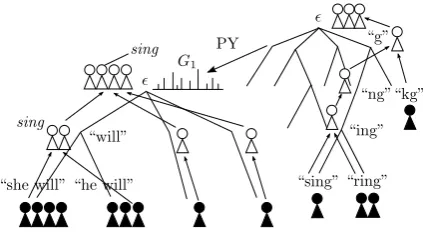
Figure 2: Chinese restaurant representation of our Nested Pitman-Yor Language Model (NPYLM). ‘re–’, but almost never end in ‘–tio’ nor begin with ‘sre–’3.
Therefore, we use
G0(w) =p(c1· · ·ck) (5)
=
k Y
i=1
p(ci|c1· · ·ci−1) (6)
where string c1· · ·ck is a spelling of w, and
p(ci|c1· · ·ci−1)is given by the character HPYLM
according to (4).
This language model, which we call Nested Pitman-Yor Language Model (NPYLM) hereafter, is the hierarchical language model shown in Fig-ure 2, where the character HPYLM is embedded as a base measure of the word HPYLM.4 As the
final base measure for the character HPYLM, we used a uniform prior over the possible characters of a given language. To avoid dependency on n -gram order n, we actually used the ∞-gram
lan-guage model (Mochihashi and Sumita, 2007), a variable order HPYLM, for characters. However, for generality we hereafter state that we used the HPYLM. The theory remains the same for ∞
-grams, except sampling or marginalizing over n as needed.
Furthermore, we corrected (5) so that word length will have a Poisson distribution whose pa-rameter can now be estimated for a given language and word type. We describe this in detail in Sec-tion 4.3.
Chinese Restaurant Representation
In our NPYLM, the word model and the charac-ter model are not separate but connected through a nested CRP. When a wordwis generated from its parent at the unigram node, it means that w
3Imagine we try to segment an English character string “itisrecognizedasthe· · ·.”
is drawn from the base measure, namely a char-acter HPYLM. Then we divide winto characters c1· · ·ck to yield a “sentence” of characters and
feed this into the character HPYLM as data. Conversely, when a table becomes empty, this means that the data associated with the table are no longer valid. Therefore we remove the corre-sponding customers from the character HPYLM using the inverse procedure of adding a customer in Section 2.
All these processes will be invoked when a string is segmented into “words” and customers are added to the leaves of the word HPYLM. To segment a string into “words”, we used efficient dynamic programming combined with MCMC, as described in the next section.
4 Inference
To find the hidden word segmentationwof a string
s=c1· · ·cN, which is equivalent to the vector of
binary hidden variables z = z1· · ·zN, the
sim-plest approach is to build a Gibbs sampler that ran-domly selects a characterciand draw a binary
de-cisionzi as to whether there is a word boundary,
and then update the language model according to the new segmentation (Goldwater et al., 2006; Xu et al., 2008). When we iterate this procedure suf-ficiently long, it becomes a sample from the true distribution (1) (Gilks et al., 1996).
However, this sampler is too inefficient since time series data such as word segmentation have a very high correlation between neighboring words. As a result, the sampler is extremely slow to con-verge. In fact, (Goldwater et al., 2006) reports that the sampler would not mix without annealing, and the experiments needed 20,000 times of sampling for every character in the training data.
Furthermore, it has an inherent limitation that it cannot deal with larger than bigrams, because it uses onlylocalstatistics between directly
contigu-ous words for word segmentation.
4.1 Blocked Gibbs sampler
Instead, we propose a sentence-wise Gibbs sam-pler of word segmentation using efficient dynamic programming, as shown in Figure 3.
In this algorithm, first we randomly select a string, and then remove the “sentence” data of its word segmentation from the NPYLM. Sampling a new segmentation, we update the NPYLM by adding a new “sentence” according to the new
seg-1: forj= 1· · ·Jdo
2: forsin randperm(s1,· · · , sD)do 3: ifj >1then
4: Remove customers ofw(s)fromΘ
5: end if
6: Draww(s)according top(w|s,Θ) 7: Add customers ofw(s)toΘ
8: end for
9: Sample hyperparameters ofΘ
[image:4.595.312.518.59.195.2]10: end for
Figure 3: Blocked Gibbs Sampler of NPYLM Θ.
mentation. When we repeat this process, it is ex-pected to mix rapidly because it implicitly consid-ers all possible segmentations of the given string at the same time.
This is called ablockedGibbs sampler that
sam-pleszblock-wise for each sentence. It has an
ad-ditional advantage in that we can accommodate higher-order relationships than bigrams, particu-larly trigrams, for word segmentation. 5
4.2 Forward-Backward inference
Then, how can we sample a segmentation w for
each strings? In accordance with the Forward fil-tering Backward sampling of HMM (Scott, 2002), this is achieved by essentially the same algorithm employed to sample a PCFG parse tree within MCMC (Johnson et al., 2007) and grammar-based segmentation (Johnson and Goldwater, 2009).
Forward Filtering. For this purpose, we
main-tain a forward variableα[t][k]in the bigram case. α[t][k] is the probability of a stringc1· · ·ct with
the finalkcharacters being a word (see Figure 4). Segmentations before the final k characters are marginalized using the following recursive rela-tionship:
α[t][k] =
t−k X
j=1
p(ctt−k+1|c t−k
t−k−j+1)·α[t−k][j] (7)
whereα[0][0] = 1and we wrotecn· · ·cmas cmn.6
The rationale for (7) is as follows. Since main-taining binary variables z1,· · ·, zN is equivalent
to maintaining a distance to the nearest backward
5In principle fourgrams or beyond are also possible, but will be too complex while the gain will be small. For this purpose, Particle MCMC (Doucet et al., 2009) is promising but less efficient in a preliminary experiment.
6As Murphy (2002) noted, in semi-HMM we cannot use a standard trick to avoid underflow by normalizingα[t][k]into p(k|t), since the model is asynchronous. Instead we always
Figure 4: Forward filtering ofα[t][k] to marginal-ize out possible segmentationsjbeforet−k.
1: fort= 1toN do
2: fork= max(1, t−L)totdo
3: Computeα[t][k]according to (7).
4: end for
5: end for
6: Initializet←N,i←0,w0 ←$ 7: whilet >0do
8: Drawk∝p(wi|ctt−k+1,Θ)·α[t][k] 9: Setwi ←ctt−k+1
10: Sett←t−k,i←i+ 1
11: end while
12: Returnw=wi, wi−1,· · ·, w1.
Figure 5: Forward-Backward sampling of word segmentationw. (in bigram case)
word boundary for eachtasqt, we can write
α[t][k] =p(ct1, qt=k) (8)
=X
j
p(ct1, qt=k, qt−k=j) (9)
=X
j
p(ct−k 1 , c
t
t−k+1, qt=k, qt−k=j)(10)
=X
j
p(ctt−k+1|ct
−k 1 )p(c
t−k
1 , qt−k=j)(11)
=X
j
p(ctt−k+1|c t−k
1 )α[t−k][j], (12)
where we used conditional independency of qt
givenqt−kand uniform prior overqtin (11) above.
Backward Sampling. Once the probability
ta-bleα[t][k]is obtained, we can sample a word seg-mentation backwards. Sinceα[N][k]is a marginal probability of string cN
1 with the last k
charac-ters being a word, and there is always a sentence boundary token $ at the end of the string, with probability proportional top($|cN
N−k)·α[N][k]we
can samplek to choose the boundary of the final word. The second final word is similarly sampled using the probability of preceding the last word just sampled: we continue this process until we arrive at the beginning of the string (Figure 5).
Trigram case. For simplicity, we showed the
algorithm for bigrams above. For trigrams, we
maintain a forward variableα[t][k][j], which rep-resents a marginal probability of string c1· · ·ct
with both the final k characters and further j characters preceding it being words. Forward-Backward algorithm becomes complicated thus omitted, but can be derived following the extended algorithm for second order HMM (He, 1988).
Complexity This algorithm has a complexity of
O(N L2
) for bigrams and O(N L3
) for trigrams for each sentence, where N is the length of the sentence andLis the maximum allowed length of a word (≤N).
4.3 Poisson correction
As Nagata (1996) noted, when only (5) is used in-adequately low probabilities are assigned to long words, because it has a largely exponential dis-tribution over length. To correct this, we assume that word lengthkhas a Poisson distribution with a meanλ:
Po(k|λ) =e−λλk
k! . (13)
Since the appearance ofc1· · ·ck is equivalent
to that of lengthkand the content, by making the charactern-gram model explicit asΘwe can set
p(c1· · ·ck) =p(c1· · ·ck, k) (14)
= p(c1· · ·ck, k|Θ)
p(k|Θ) Po(k|λ) (15) where p(c1· · ·ck, k|Θ) is an n-gram
probabil-ity given by (6), and p(k|Θ) is a probability that a word of length k will be generated from Θ. While previous work used p(k|Θ) = (1−
p($))k−1p($), this is only true for unigrams.
In-stead, we employed a Monte Carlo method that generates words randomly from Θ to obtain the empirical estimates ofp(k|Θ).
Estimatingλ. Of course, we do not leaveλas a
constant. Instead, we put a Gamma distribution
p(λ) = Ga(a, b) = b
a
Γ(a)λ
a−1
e−bλ (16)
to estimate λ from the data for given language and word type.7 Here,Γ(x)is a Gamma function
and a, bare the hyperparameters chosen to give a nearly uniform prior distribution.8
7We used differentλfor different word types, such as dig-its, alphabets, hiragana, CJK characters, and their mixtures.
W is a set of words of each such type, and (13) becomes a
mixture of Poisson distributions in this case.
[image:5.595.76.260.179.339.2]DenotingW as a set of “words” obtained from word segmentation, the posterior distribution ofλ used for (13) is
p(λ|W)∝p(W|λ)p(λ)
= Ga a+X
w∈W
t(w)|w|, b+X
w∈W
t(w)
, (17)
wheret(w)is the number of times wordwis gen-erated from the character HPYLM, i.e. the number of tablestwforwin word unigrams. We sampled
λfrom this posterior for each Gibbs iteration.
5 Experiments
To validate our model, we conducted experiments on standard datasets for Chinese and Japanese word segmentation that are publicly available, as well as the same dataset used in (Goldwater et al., 2006). Note that NPYLM maximizes the probabil-ity of strings, equivalently, minimizes the perplex-ity per character. Therefore, the recovery of the “ground truth” that is not available for inference is a byproduct in unsupervised learning.
Since our implementation is based on Unicode and learns all hyperparameters from the data, we also confirmed that NPYLM segments the Arabic Gigawords equally well.
5.1 English phonetic transcripts
In order to directly compare with the previously reported result, we first used the same dataset as Goldwater et al. (2006). This dataset con-sists of 9,790 English phonetic transcripts from CHILDES data (MacWhinney and Snow, 1985).
Since our algorithm converges rather fast, we ran the Gibbs sampler of trigram NPYLM for 200 iterations to obtain the results in Table 1. Among the token precision (P), recall (R), and F-measure (F), the recall is especially higher to outperform the previous result based on HDP in F-measure. Meanwhile, the same measures over the obtained lexicon (LP, LR, LF) are not always improved. Moreover, the average length of words inferred was surprisingly similar to ground truth: 2.88, while the ground truth is 2.87.
Table 2 shows the empirical computational time needed to obtain these results. Although the con-vergence in MCMC is not uniquely identified, im-provement in efficiency is also outstanding.
5.2 Chinese and Japanese word segmentation
To show applicability beyond small phonetic tran-scripts, we used standard datasets for Chinese and
Model P R F LP LR LF
NPY(3) 74.8 75.2 75.0 47.8 59.7 53.1
NPY(2) 74.8 76.7 75.7 57.3 56.6 57.0
HDP(2) 75.2 69.6 72.3 63.5 55.2 59.1
Table 1: Segmentation accuracies on English pho-netic transcripts. NPY(n) meansn-gram NPYLM. Results for HDP(2) are taken from Goldwater et al. (2009), which corrects the errors in Goldwater et al. (2006).
Model time iterations
NPYLM 17min 200
HDP 10h 55min 20000
Table 2: Computations needed for Table 1. Itera-tions for “HDP” is the same as described in Gold-water et al. (2009). Actually, NPYLM approxi-mately converged around 50 iterations, 4 minutes. Japanese word segmentation, with all supervised segmentations removed in advance.
Chinese For Chinese, we used a publicly
avail-able SIGHAN Bakeoff 2005 dataset (Emerson, 2005). To compare with the latest unsupervised results (using a closed dataset of Bakeoff 2006), we chose the common sets prepared by Microsoft Research Asia (MSR) for simplified Chinese, and by City University of Hong Kong (CITYU) for traditional Chinese. We used a random subset of 50,000 sentences from each dataset for training, and the evaluation was conducted on the enclosed test data.9
Japanese For Japanese, we used the Kyoto
Cor-pus (Kyoto) (Kurohashi and Nagao, 1998): we used random subset of 1,000 sentences for evalua-tion and the remaining 37,400 sentences for train-ing. In all cases we removed all whitespaces to yield raw character strings for inference, and set L= 4for Chinese andL= 8for Japanese to run the Gibbs sampler for 400 iterations.
The results (in token F-measures) are shown in Table 3. Our NPYLM significantly ourperforms the best results using a heuristic approach reported in Zhao and Kit (2008). While Japanese accura-cies appear lower, subjective qualities are much higher. This is mostly because NPYLM segments inflectional suffixes and combines frequent proper names, which are inconsistent with the “correct”
Model MSR CITYU Kyoto
NPY(2) 80.2 (51.9) 82.4(126.5) 62.1 (23.1)
NPY(3) 80.7(48.8) 81.7 (128.3) 66.6(20.6)
ZK08 66.7 (—) 69.2 (—) — Table 3: Accuracies and perplexities per character (in parentheses) on actual corpora. “ZK08” are the best results reported in Zhao and Kit (2008). We used∞-gram for characters.
MSR CITYU Kyoto
Semi 0.895 (48.8) 0.898 (124.7) 0.913 (20.3)
Sup 0.945(81.4) 0.941(194.8) 0.971(21.3)
Table 4: Semi-supervised and supervised results. Semi-supervised results used only 10K sentences (1/5) of supervised segmentations.
segmentations. Bigram and trigram performances are similar for Chinese, but trigram performs bet-ter for Japanese. In fact, although the difference in perplexity per character is not so large, the per-plexity per word is radically reduced: 439.8 (bi-gram) to 190.1 (tri(bi-gram). This is because trigram models can leverage complex dependencies over words to yield shorter words, resulting in better predictions and increased tokens.
Furthermore, NPYLM is easily amenable to semi-supervised or even supervised learning. In that case, we have only to replace the word seg-mentationw(s)in Figure 3 to the supervised one,
for all or part of the training data. Table 4 shows the results using 10,000 sentences (1/5) or complete supervision. Our completely generative model achieves the performance of 94% (Chinese) or even 97% (Japanese) in supervised case. The result also shows that the supervised segmenta-tions are suboptimal with respect to the perplex-ity per character, and even worse than unsuper-vised results. In semi-superunsuper-vised case, using only 10K reference segmentations gives a performance of around 90% accuracy and the lowest perplexity, thanks to a combination with unsupervised data in a principled fashion.
5.3 Classics and English text
Our model is particularly effective for spoken tran-scripts, colloquial texts, classics, or unknown lan-guages where supervised segmentation data is dif-ficult or even impossible to create. For example, we are pleased to say that we can now analyze (and build a language model on) “The Tale of Genji”,
the core of Japanese classics written 1,000 years ago (Figure 6). The inferred segmentations are
! "#%$&('*),+.-/'!021354% (6879&:9;<>=8 ?@19>BAC(DE"ED,F4.G ?2HIDJK4L'2M. %7NDOP#Q%RES(T?
U
/V1%WXZY('V!?C[B\>]>BA8F^IGQ_
`
L[aHIDEbac.9>Ld%4&e.Vf=%)>: (gFih.j5kBlKm@"a=EWO
· · ·
Figure 6: Unsupervised segmentation result for “The Tale of Genji”. (16,443 sentences, 899,668
characters in total)
mostly correct, with some inflectional suffixes be-ing recognized as words, which is also the case with English.
Finally, we note that our model is also effective for western languages: Figure 7 shows a training text of “Alice in Wonderland” with all whitespaces
removed, and the segmentation result.
While the data is extremely small (only 1,431 lines, 115,961 characters), our trigram NPYLM can infer the words surprisingly well. This is be-cause our model contains both word and character models that are combined and carefully smoothed, from a Bayesian perspective.
6 Discussion
In retrospect, our NPYLM is essentially a hier-archical Markov model where the units (=words) evolve as the Markov process, and each unit has subunits (=characters) that also evolve as the Markov process. Therefore, for such languages as English that have already space-separated to-kens, we can also begin with tokens besides the character-based approach in Section 5.3. In this case, each token is a “character” whose code is the integer token type, and a sentence is a sequence of “characters.” Figure 8 shows a part of the result computed over 100K sentences from Penn Tree-bank. We can see that some frequent phrases are identified as “words”, using a fully unsupervised approach. Notice that this is only attainable with NPYLM where each phrase is described as a n -gram model on its own, here a word∞-gram
lan-guage model.
lastly,shepicturedtoherselfhowthissamelittlesisterofhersw ould,intheafter-time,beherselfagrownwoman;andhowshe wouldkeep,throughallherriperyears,thesimpleandlovingh eartofherchildhood:andhowshewouldgatheraboutherothe rlittlechildren,andmaketheireyesbrightandeagerwithmany astrangetale,perhapsevenwiththedreamofwonderlandoflo ngago:andhowshewouldfeelwithalltheirsimplesorrows,an dfindapleasureinalltheirsimplejoys,rememberingherownc hild-life,andthehappysummerdays.
(a) Training data (in part).
last ly , she pictured to herself how this same little sis-ter of her s would , inthe afsis-ter - time , be herself agrown woman ; and how she would keep , through allher ripery ears , the simple and loving heart of her child hood : and how she would gather about her other little children ,and make theireyes bright and eager with many a strange tale , perhaps even with the dream of wonderland of longago : and how she would feel with all their simple sorrow s , and find a pleasure in all their simple joys , remember ing her own child - life , and thehappy summerday s .
(b) Segmentation result. Note we used no dictionary.
Figure 7: Word segmentation of “Alice in Wonder-land”.
7 Conclusion
In this paper, we proposed a much more efficient and accurate model for fully unsupervised word segmentation. With a combination of dynamic programming and an accurate spelling model from a Bayesian perspective, our model significantly outperforms the previous reported results, and the inference is very efficient.
This model is also considered as a way to build a Bayesian Kneser-Ney smoothed word n-gram language model directly from characters with no “word” indications. In fact, it achieves lower per-plexity per character than that based on supervised segmentations. We believe this will be particu-larly beneficial to build a language model on such texts as speech transcripts, colloquial texts or un-known languages, where word boundaries are hard or even impossible to identify a priori.
Acknowledgments
We thank Vikash Mansinghka (MIT) for a mo-tivating discussion leading to this research, and Satoru Takabayashi (Google) for valuable techni-cal advice.
References
David Aldous, 1985. Exchangeability and Related Topics, pages 1–198. Springer Lecture Notes in
Math. 1117.
Rie Kubota Ando and Lillian Lee. 2003. Mostly-Unsupervised Statistical Segmentation of Japanese
nevertheless , he was admired
by many of his immediate subordinates for his long work hours
and dedication to building northwest into what he called a “ mega carrier . ”
although
preliminary findings were reported more than a year ago , the latest results appear
in today ’s
new england journal of medicine , a forum
likely to bring new attention to the problem .
south korea
registered a trade deficit of $ 101 million in october
, reflecting the country ’s economic sluggishness , according to government figures released wednesday .
Figure 8: Generative phrase segmentation of Penn Treebank text computed by NPYLM. Each line is a “word” consisting of actual words.
Kanji Sequences. Natural Language Engineering,
9(2):127–149.
Peter F. Brown, Vincent J. Della Pietra, Robert L. Mer-cer, Stephen A. Della Pietra, and Jennifer C. Lai. 1992. An Estimate of an Upper Bound for the En-tropy of English.Computational Linguistics, 18:31–
40.
Arnaud Doucet, Christophe Andrieu, and Roman Holenstein. 2009. Particle Markov Chain Monte Carlo.in submission.
Tom Emerson. 2005. SIGHAN Bakeoff 2005. http://www.sighan.org/bakeoff2005/.
W. R. Gilks, S. Richardson, and D. J. Spiegelhalter. 1996. Markov Chain Monte Carlo in Practice.
Chapman & Hall / CRC.
Sharon Goldwater, Thomas L. Griffiths, and Mark Johnson. 2005. Interpolating Between Types and Tokens by Estimating Power-Law Generators. In
NIPS 2005.
Sharon Goldwater, Thomas L. Griffiths, and Mark Johnson. 2006. Contextual Dependencies in Un-supervised Word Segmentation. InProceedings of ACL/COLING 2006, pages 673–680.
Sharon Goldwater, Thomas L. Griffiths, and Mark Johnson. 2009. A Bayesian framework for word segmentation: Exploring the effects of context.
Cognition,in press.
Mark Johnson and Sharon Goldwater. 2009. Im-proving nonparameteric Bayesian inference: exper-iments on unsupervised word segmentation with adaptor grammars. InNAACL 2009.
Mark Johnson, Thomas L. Griffiths, and Sharon Gold-water. 2007. Bayesian Inference for PCFGs via Markov Chain Monte Carlo. In Proceedings of HLT/NAACL 2007, pages 139–146.
Reinhard Kneser and Hermann Ney. 1995. Improved backing-off for m-gram language modeling. In Pro-ceedings of ICASSP, volume 1, pages 181–184.
Sadao Kurohashi and Makoto Nagao. 1998. Building a Japanese Parsed Corpus while Improving the Pars-ing System. InProceedings of LREC 1998, pages
719–724. http://nlp.kuee.kyoto-u.ac.jp/nl-resource/ corpus.html.
Brian MacWhinney and Catherine Snow. 1985. The Child Language Data Exchange System. Journal of Child Language, 12:271–296.
Daichi Mochihashi and Eiichiro Sumita. 2007. The Infinite Markov Model. InNIPS 2007.
Kevin Murphy. 2002. Hidden semi-Markov models (segment models). http://www.cs.ubc.ca/˜murphyk/ Papers/segment.pdf.
Masaaki Nagata. 1996. Automatic Extraction of New Words from Japanese Texts using General-ized Forward-Backward Search. InProceedings of EMNLP 1996, pages 48–59.
Abel Rodriguez, David Dunson, and Alan Gelfand. 2008. The Nested Dirichlet Process. Journal of the American Statistical Association, 103:1131–1154.
Steven L. Scott. 2002. Bayesian Methods for Hidden Markov Models.Journal of the American Statistical Association, 97:337–351.
Jun Suzuki, Akinori Fujino, and Hideki Isozaki. 2007. Semi-Supervised Structured Output Learning Based on a Hybrid Generative and Discriminative Ap-proach. InProceedings of EMNLP-CoNLL 2007,
pages 791–800.
Yee Whye Teh. 2006a. A Bayesian Interpreta-tion of Interpolated Kneser-Ney. Technical Report TRA2/06, School of Computing, NUS.
Yee Whye Teh. 2006b. A Hierarchical Bayesian Lan-guage Model based on Pitman-Yor Processes. In
Proceedings of ACL/COLING 2006, pages 985–992.
Frank Wood and Yee Whye Teh. 2008. A Hierarchical, Hierarchical Pitman-Yor Process Language Model. InICML 2008 Workshop on Nonparametric Bayes.
Jia Xu, Jianfeng Gao, Kristina Toutanova, and Her-mann Ney. 2008. Bayesian Semi-Supervised Chi-nese Word Segmentation for Statistical Machine Translation. In Proceedings of COLING 2008,
pages 1017–1024.

![Figure 4: Forward filtering of α [ t ] [ k ] to marginal-ize out possible segmentations j before t −k .](https://thumb-us.123doks.com/thumbv2/123dok_us/233176.522741/5.595.76.260.179.339/figure-forward-ltering-a-marginal-ize-possible-segmentations.webp)